In Situ Analyses of Sulphides from the Tomingley Gold Project, Central-West NSW, Australia: Pathfinder Textures and Trace Elements

 ,
,  , and
, and
Abstract
1. Introduction
- Identify sulphides and characterise major sulphide textures within the Au-hosting lithologies within the TGP.
- Investigate the relationship between Au mineralisation and sulphide textures and chemistry.
- Assess the capabilities of sulphide trace element chemistry as mineral exploration vectors.
- Compare and evaluate the effectiveness of data obtained from in situ and whole-rock techniques for mineral exploration vectors.
2. Geological Background
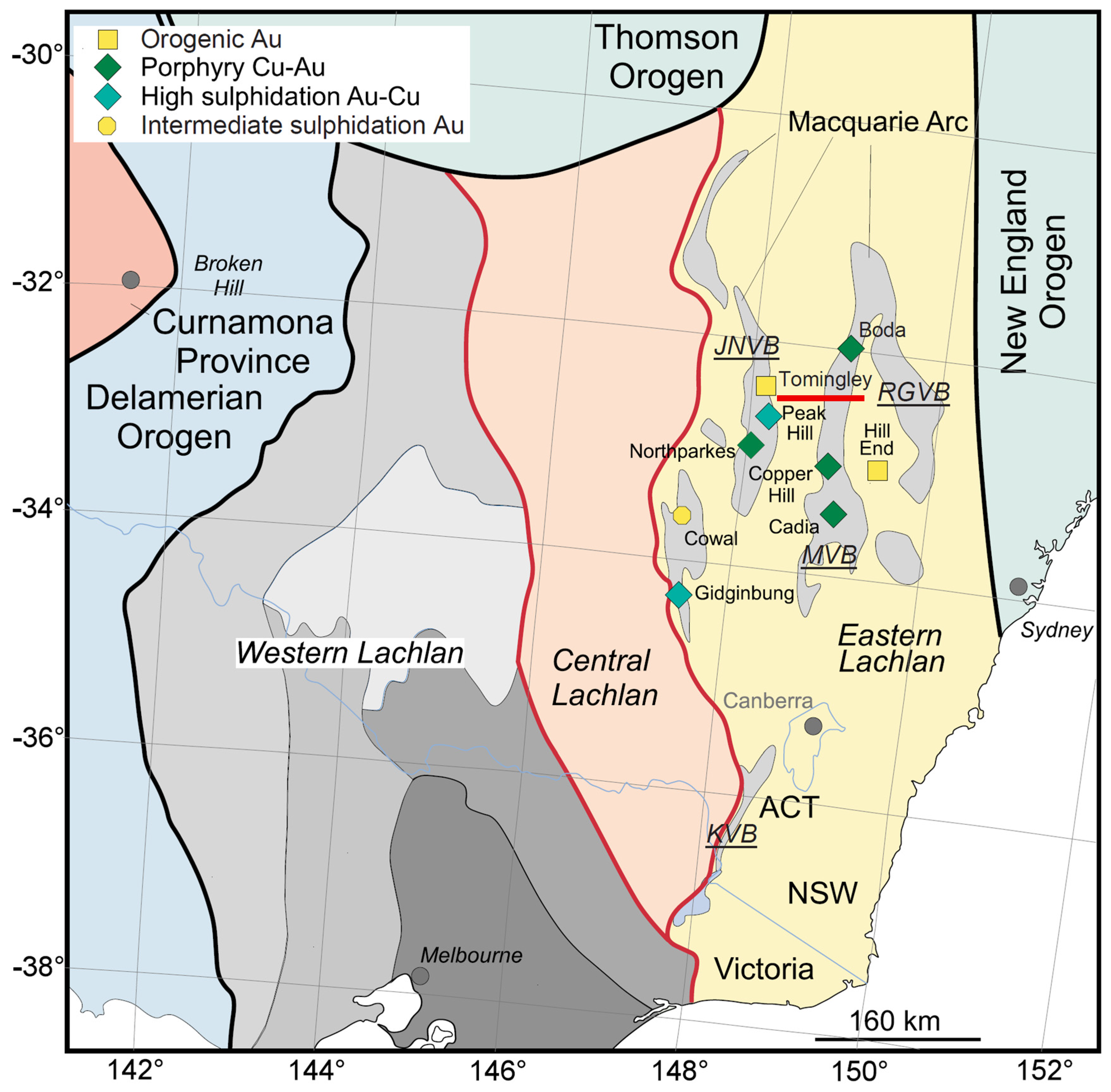
2.1. Regional Geology
2.2. Geology of the Tomingley Gold Project
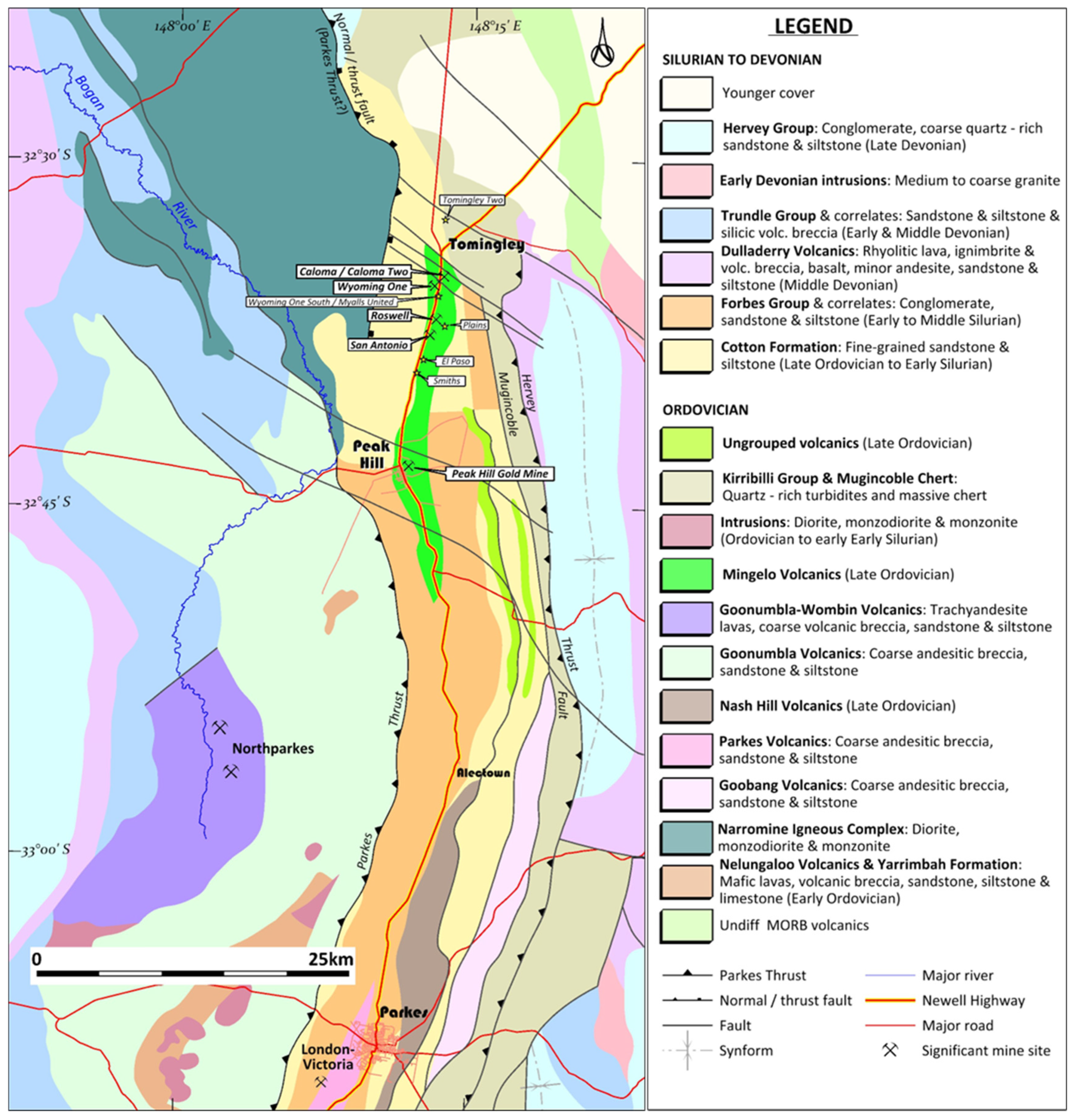
2.2.1. District Scale Geology

2.2.2. Deposit Geology
3. Materials and Methods
3.1. Sample Selection and Rationale
3.2. Microscopic and Analytical Techniques
4. Results
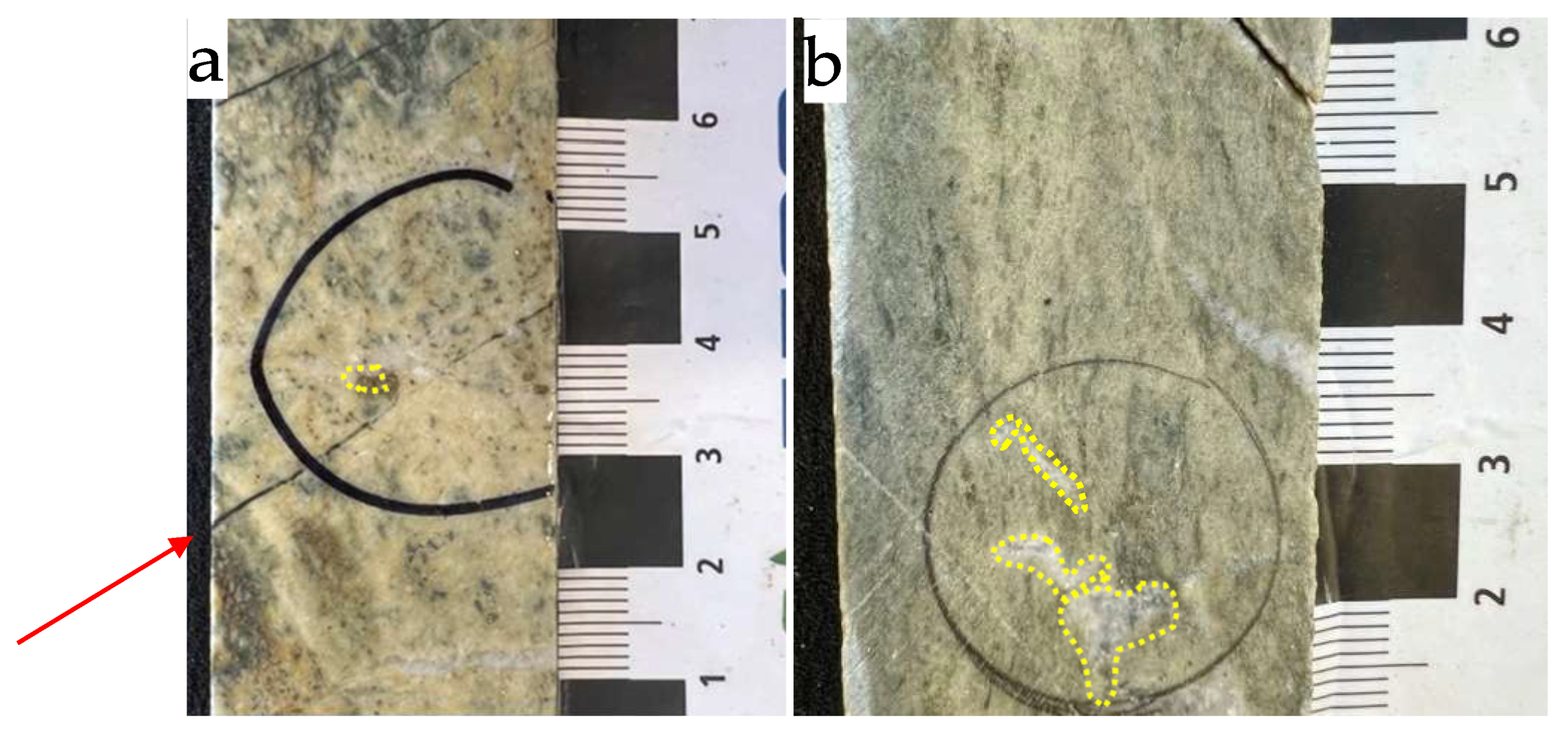
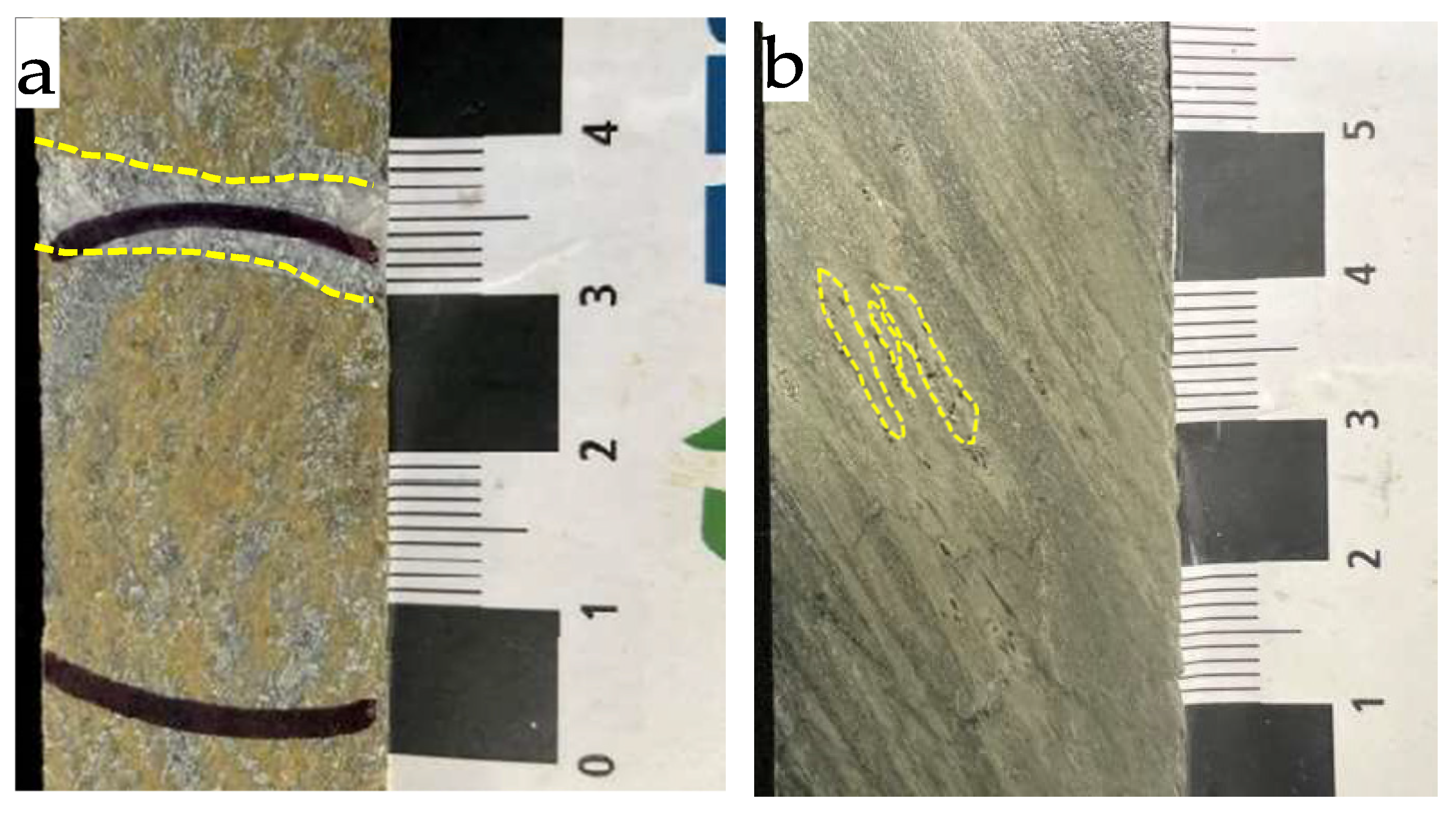
4.1. Drill Core Observations
4.2. Sulphide Textural Observations
4.3. Trace Element Compositional Mapping (EPMA and LA-ICP-MS)
4.4. Trace Element LA-ICP-MS Spot Data for Pyrite and Arsenopyrite
5. Discussion
5.1. Textures and Their Trace Element Composition
5.2. Pyrite Association with Mineralisation
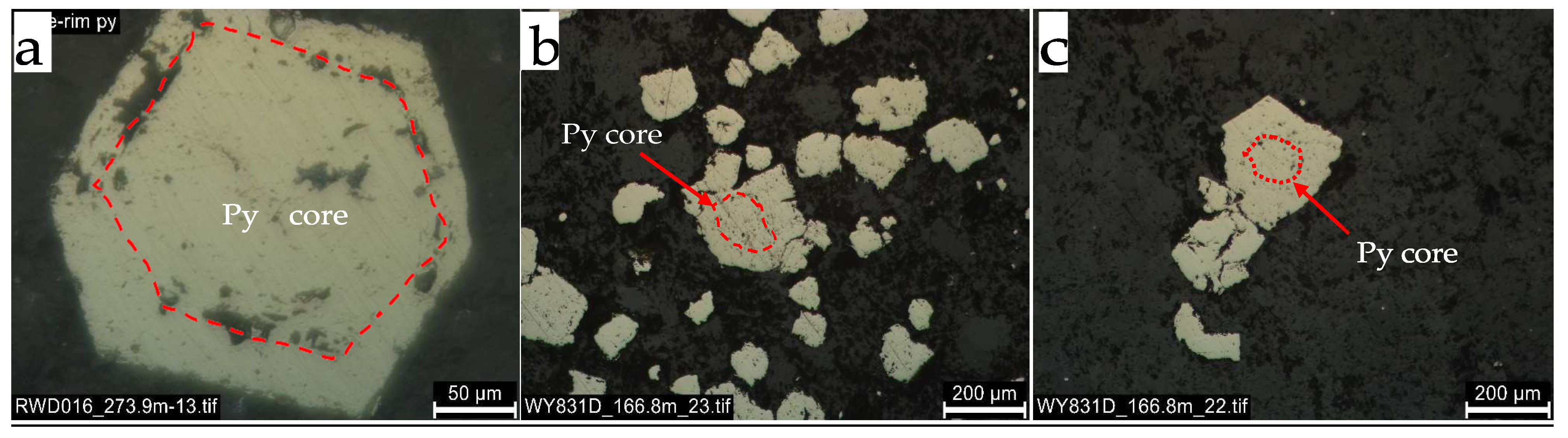
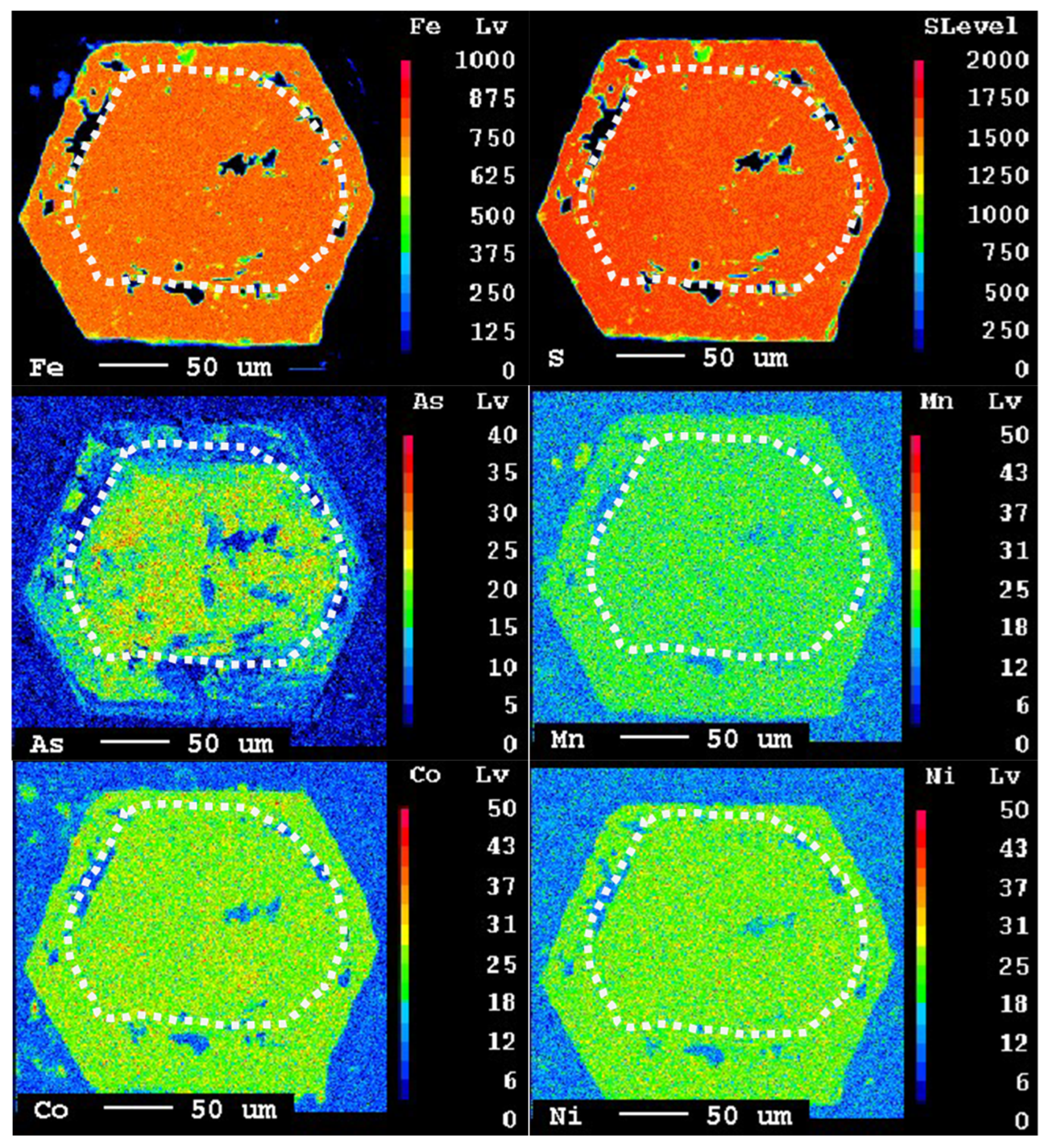
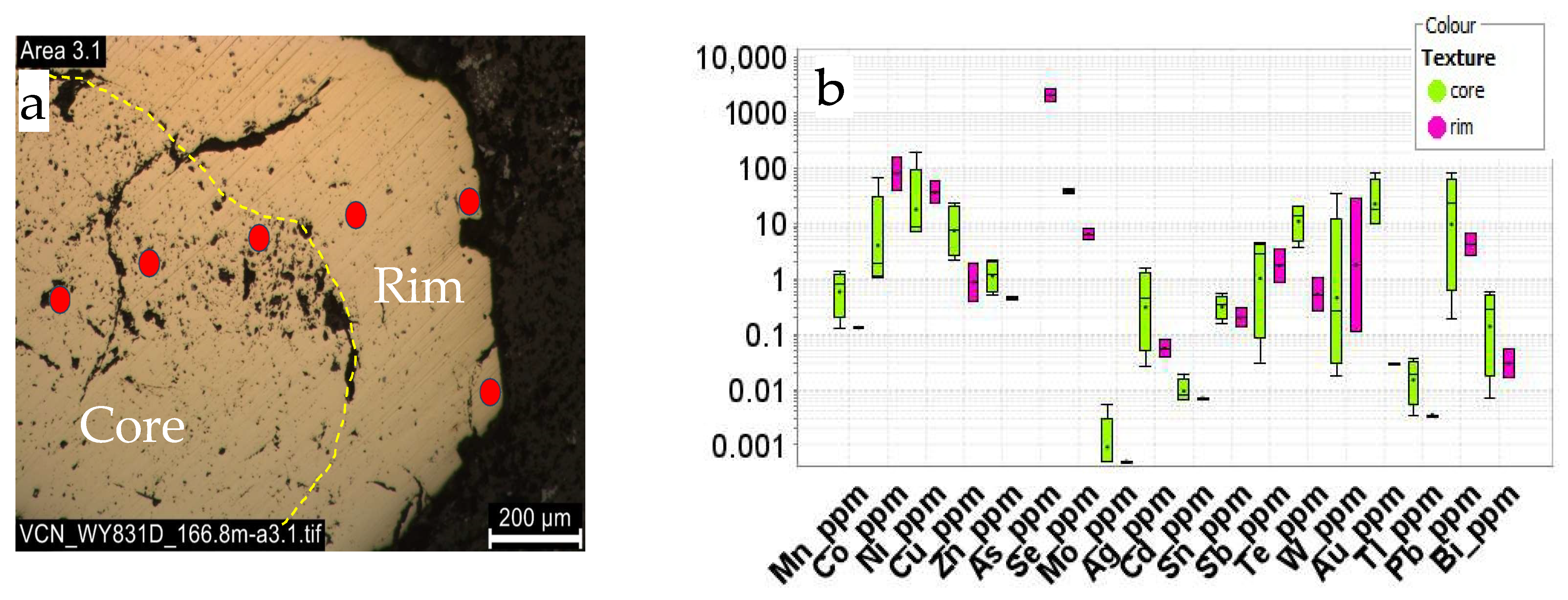
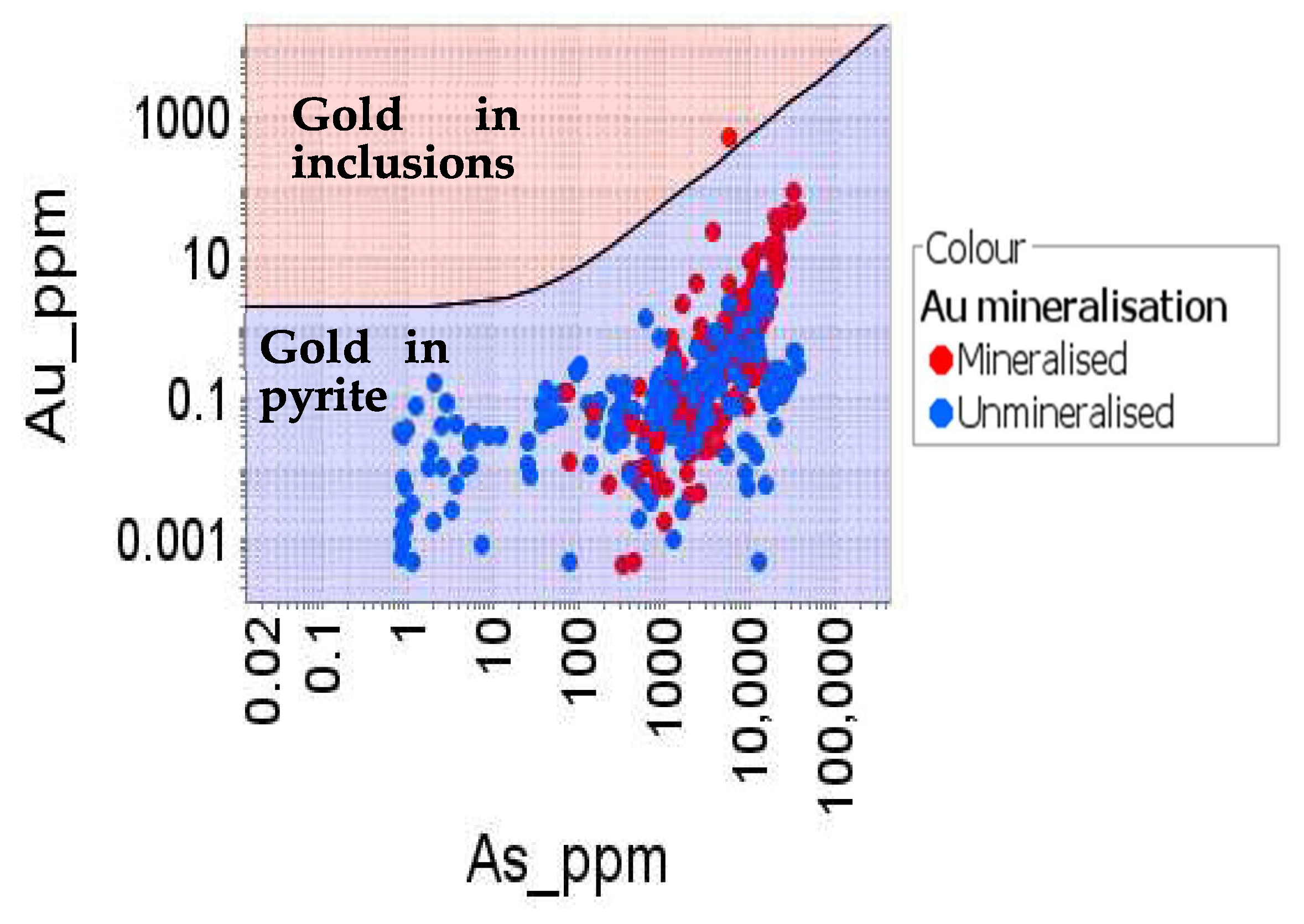
- Spot analyses (LA-ICP-MS) comparison between porous pyrite core and inclusion-poor rims showed significantly higher Au concentrations in the cores (9.93–84.01 ppm) compared to the rims (0.028–0.029 ppm) in the metasedimentary units of this study.
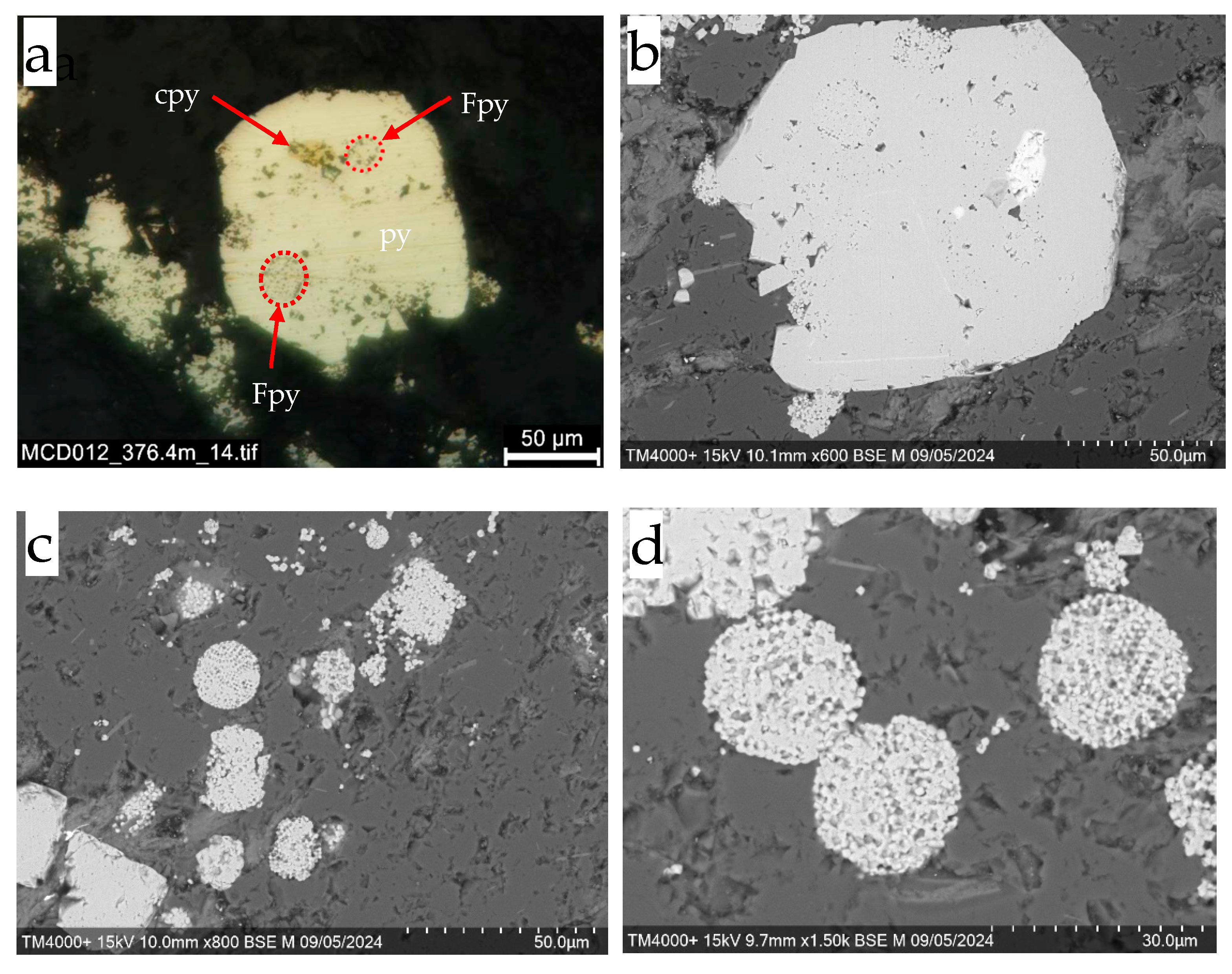
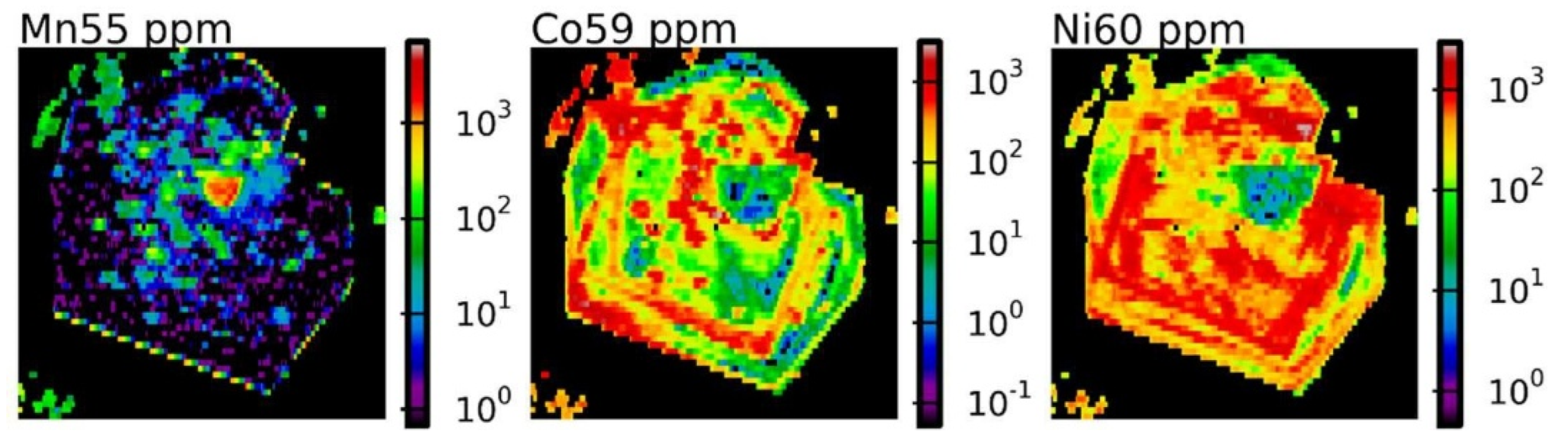
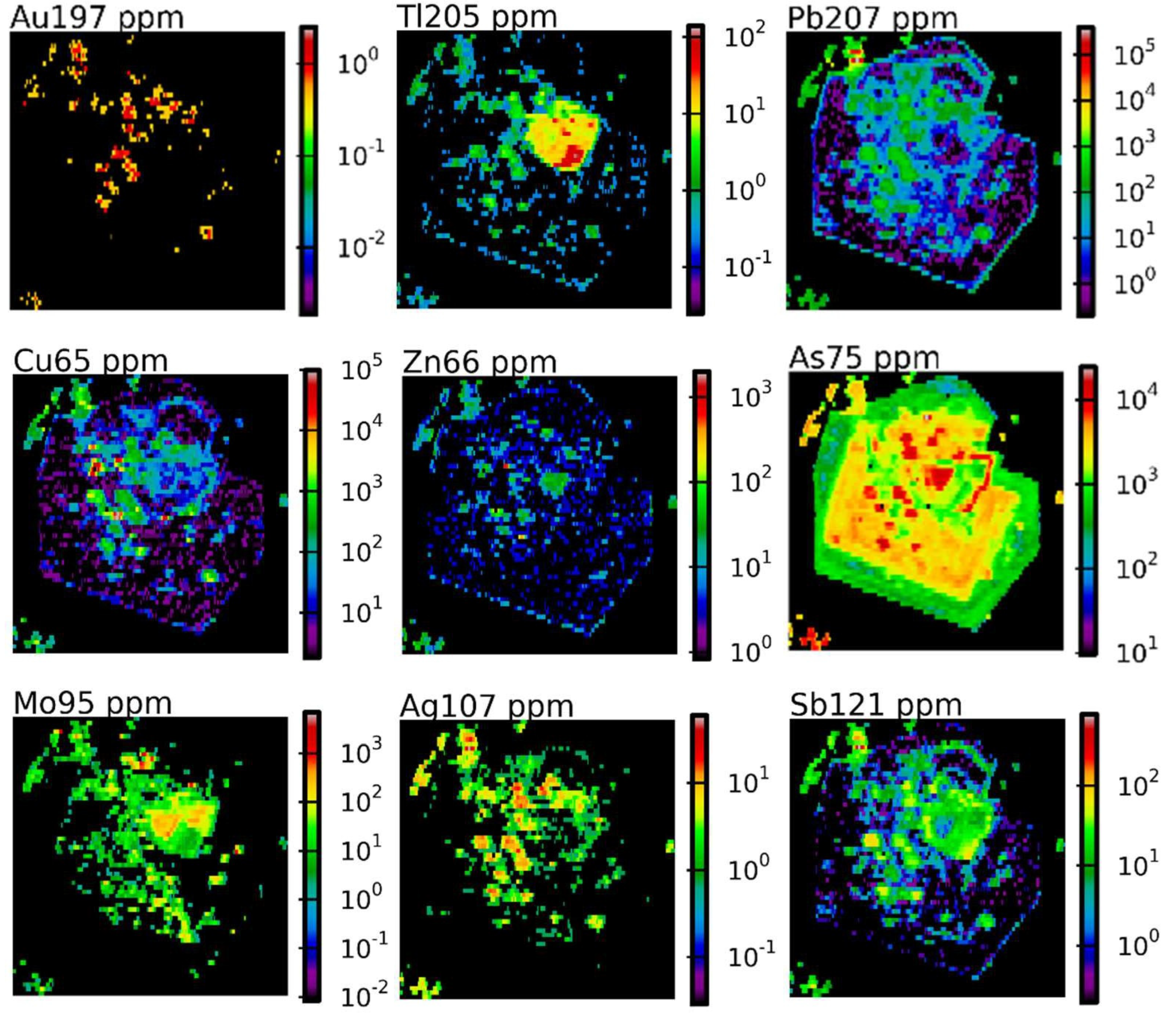
- The LA-ICP-MS trace element image of a pyrite grain with framboids (Figure 22) also showed high Au concentration in framboidal pyrite, suggesting Au incorporation during the formation of sedimentary pyrite. Sedimentary pyrite from black shales has been suggested to be a likely source of Au [61,62]. Given the various host lithologies in the TGP, graphitic siltstone could be one of many lithologies to contribute as the source of gold.
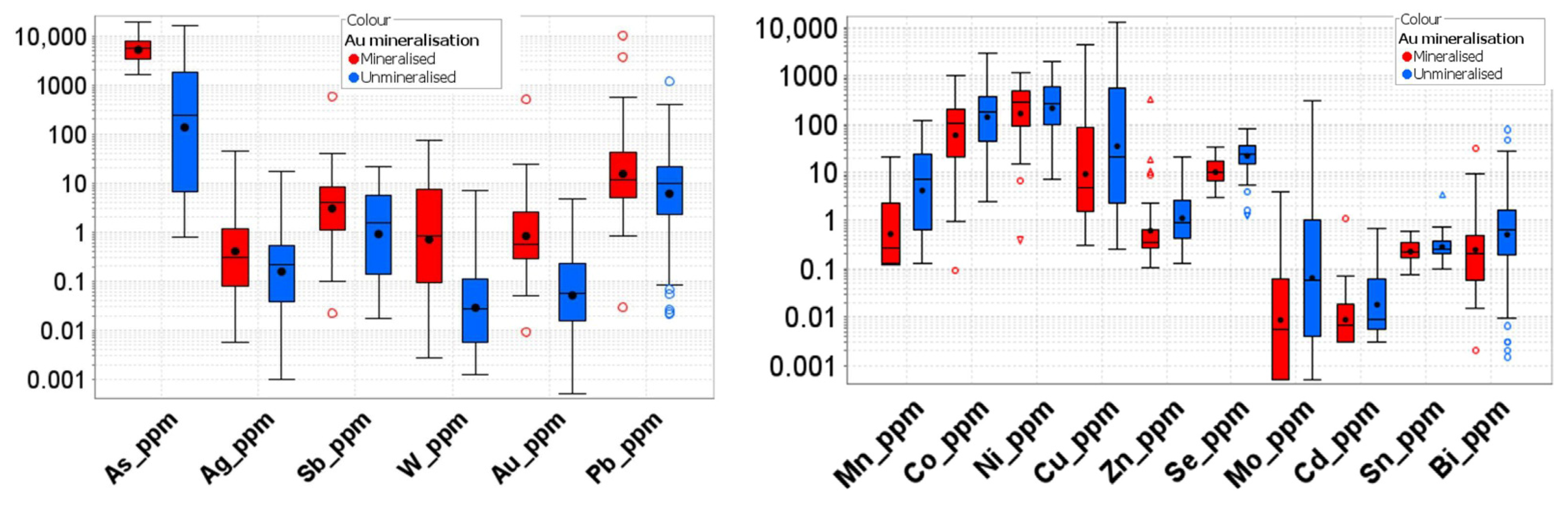
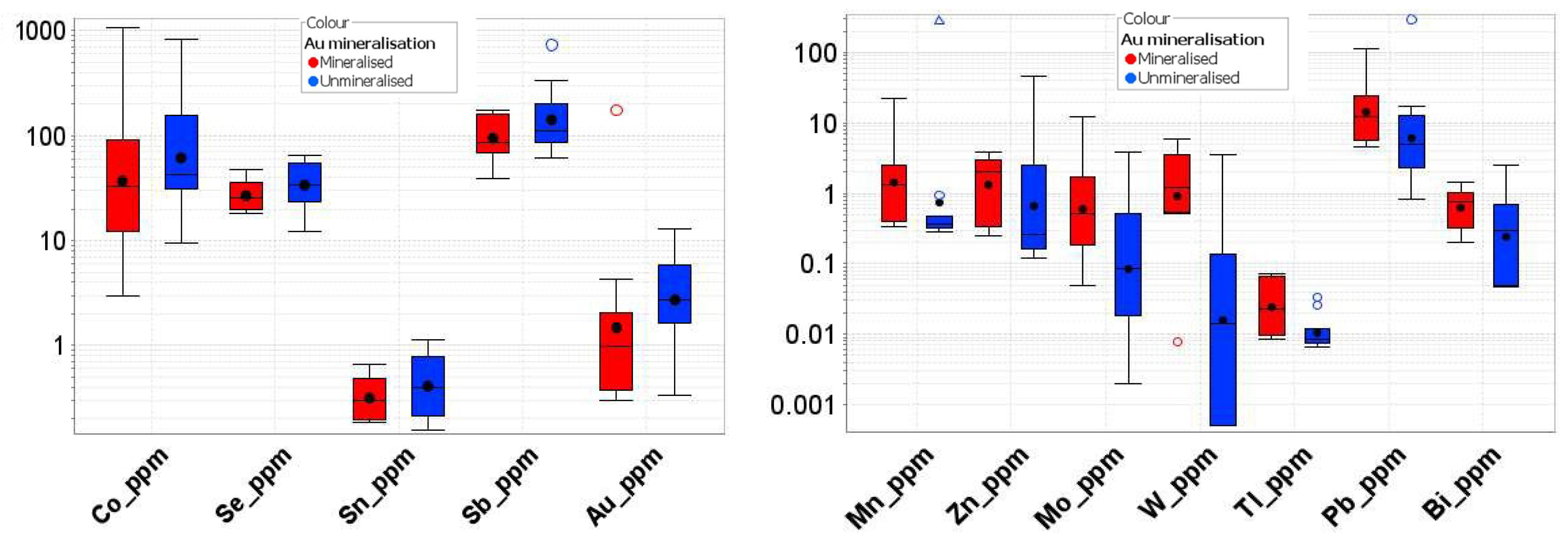
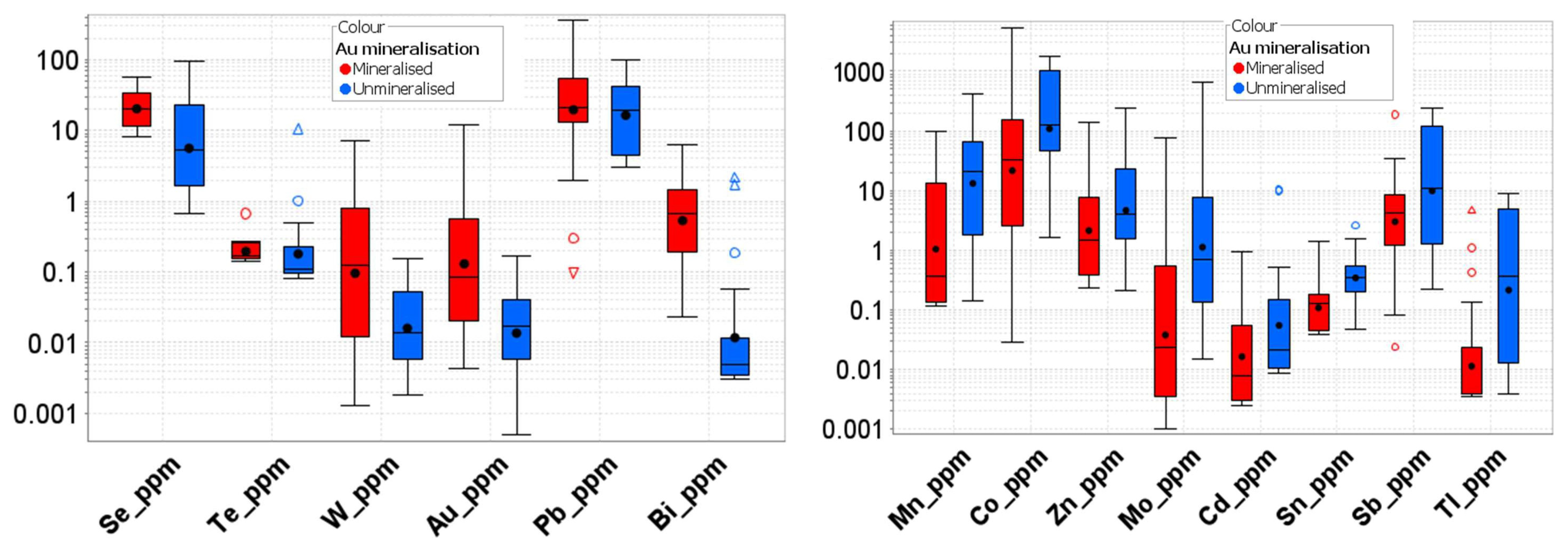
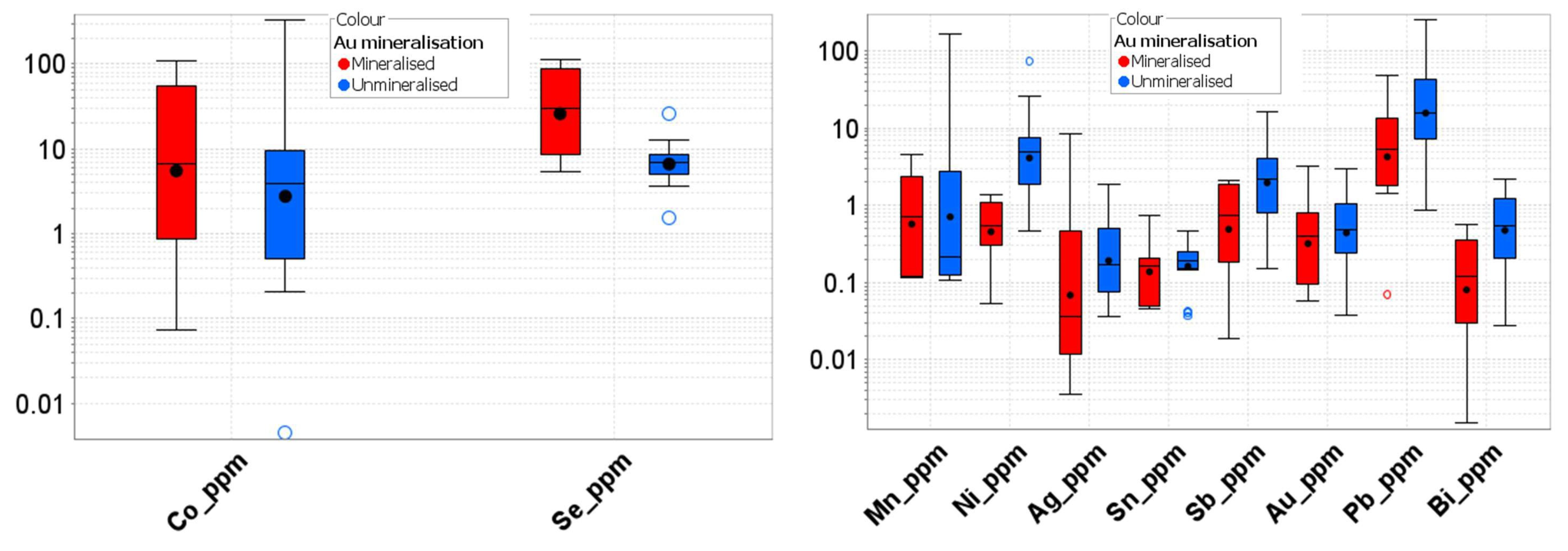
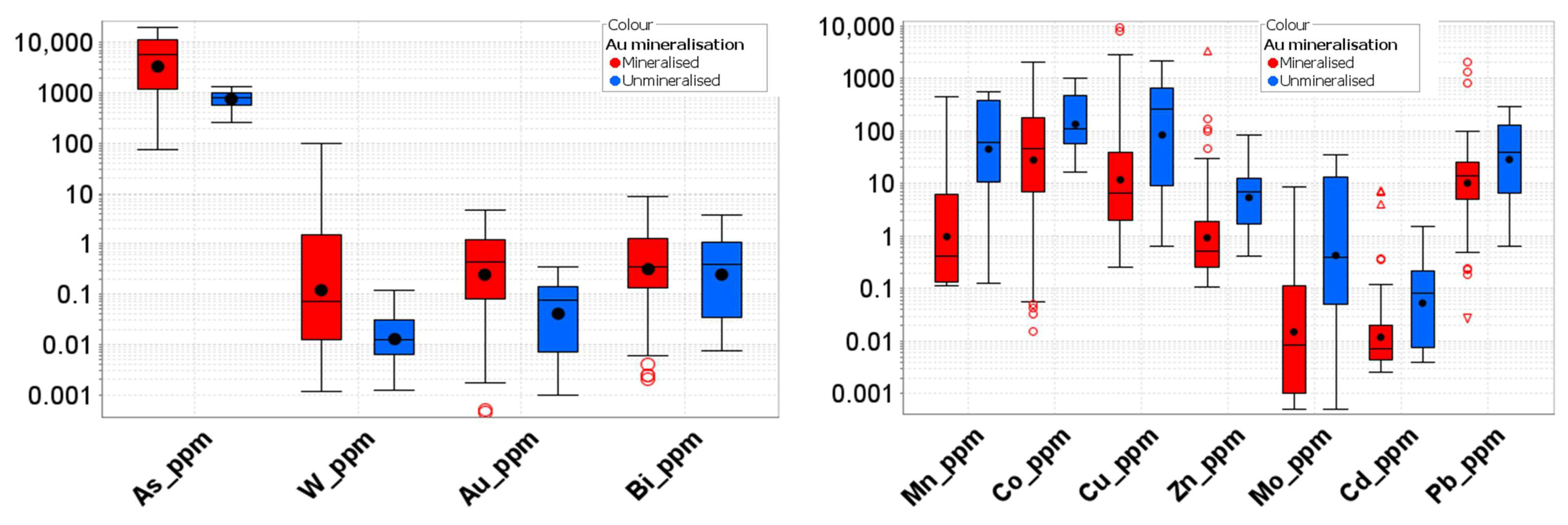
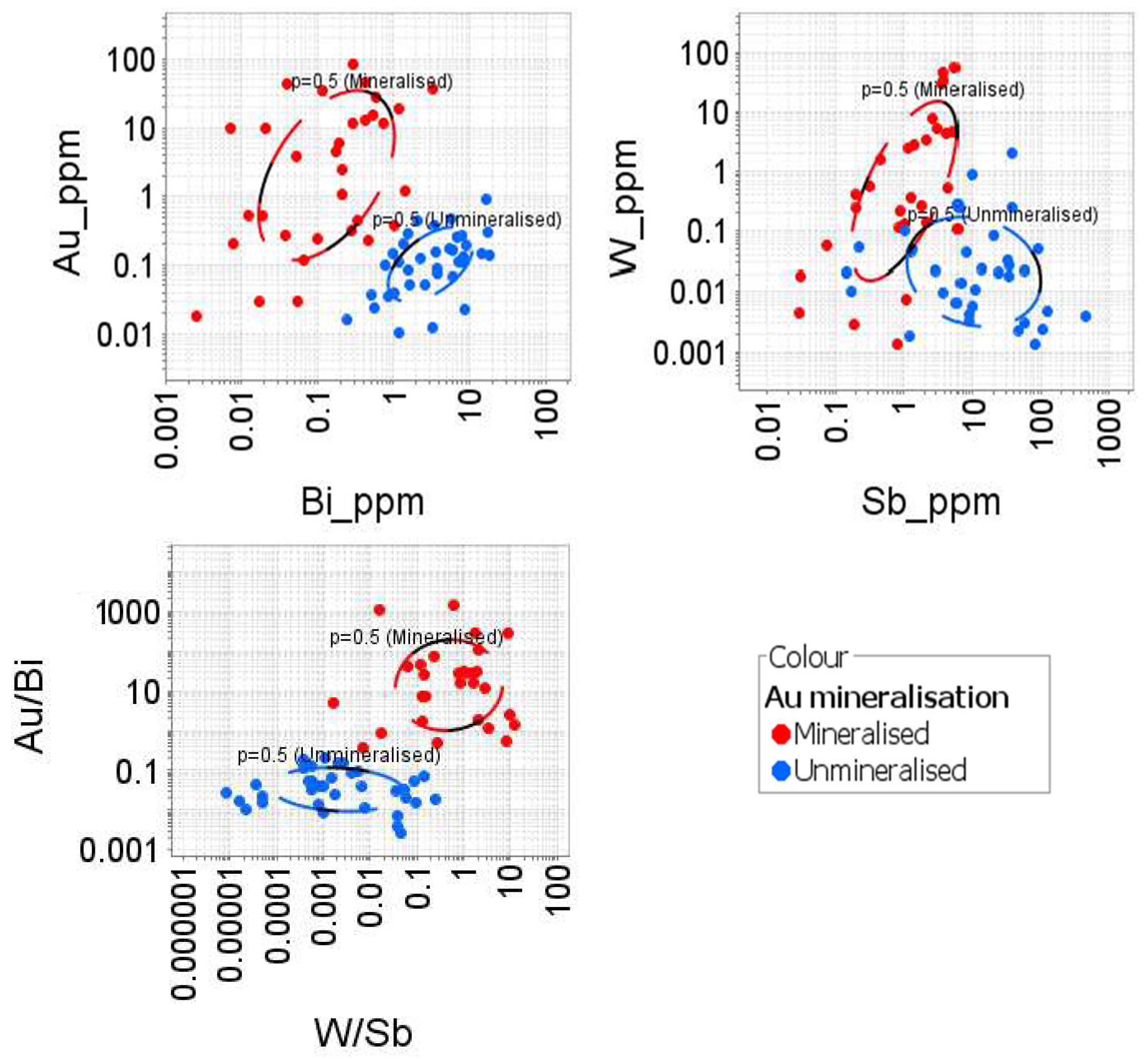
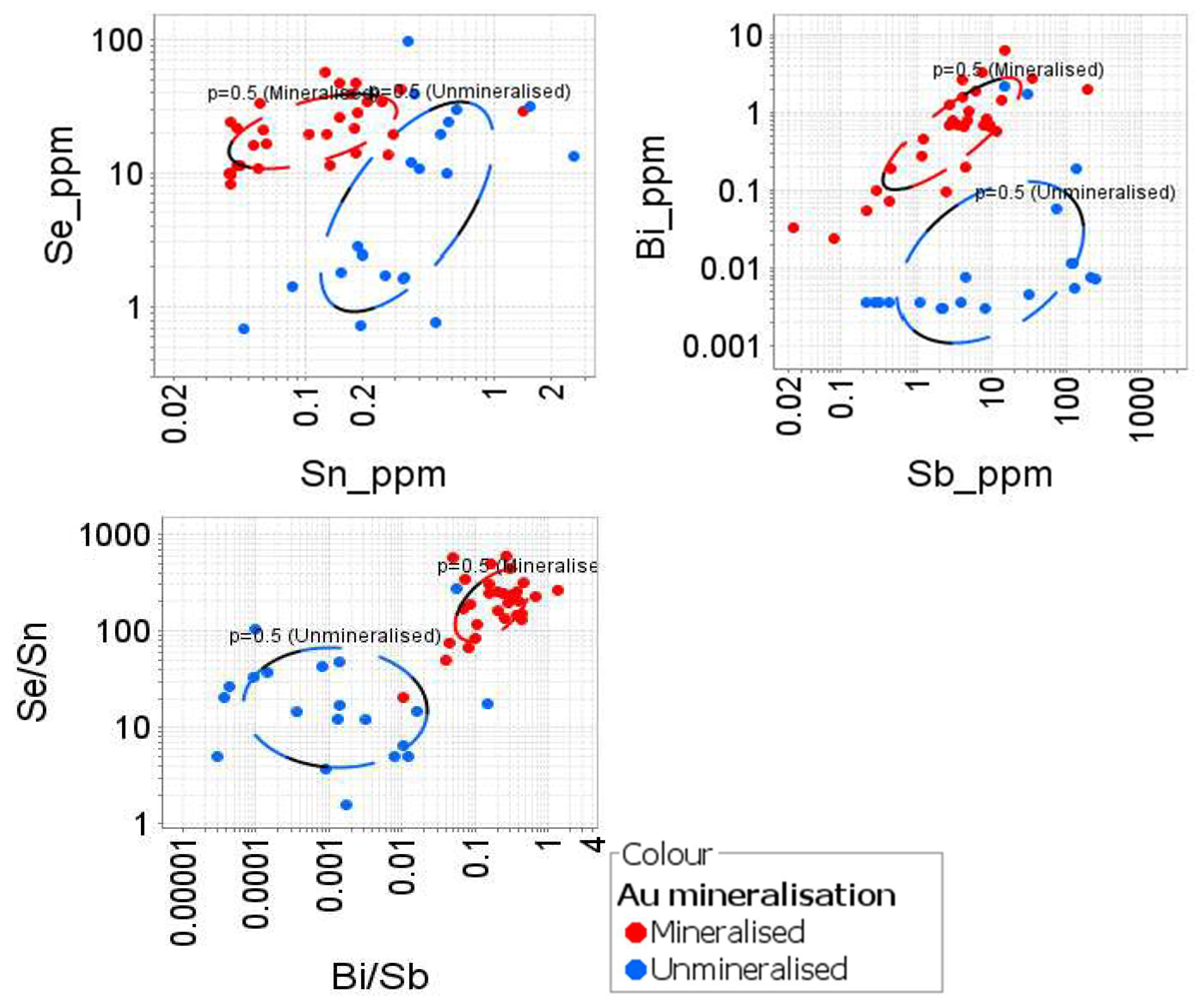
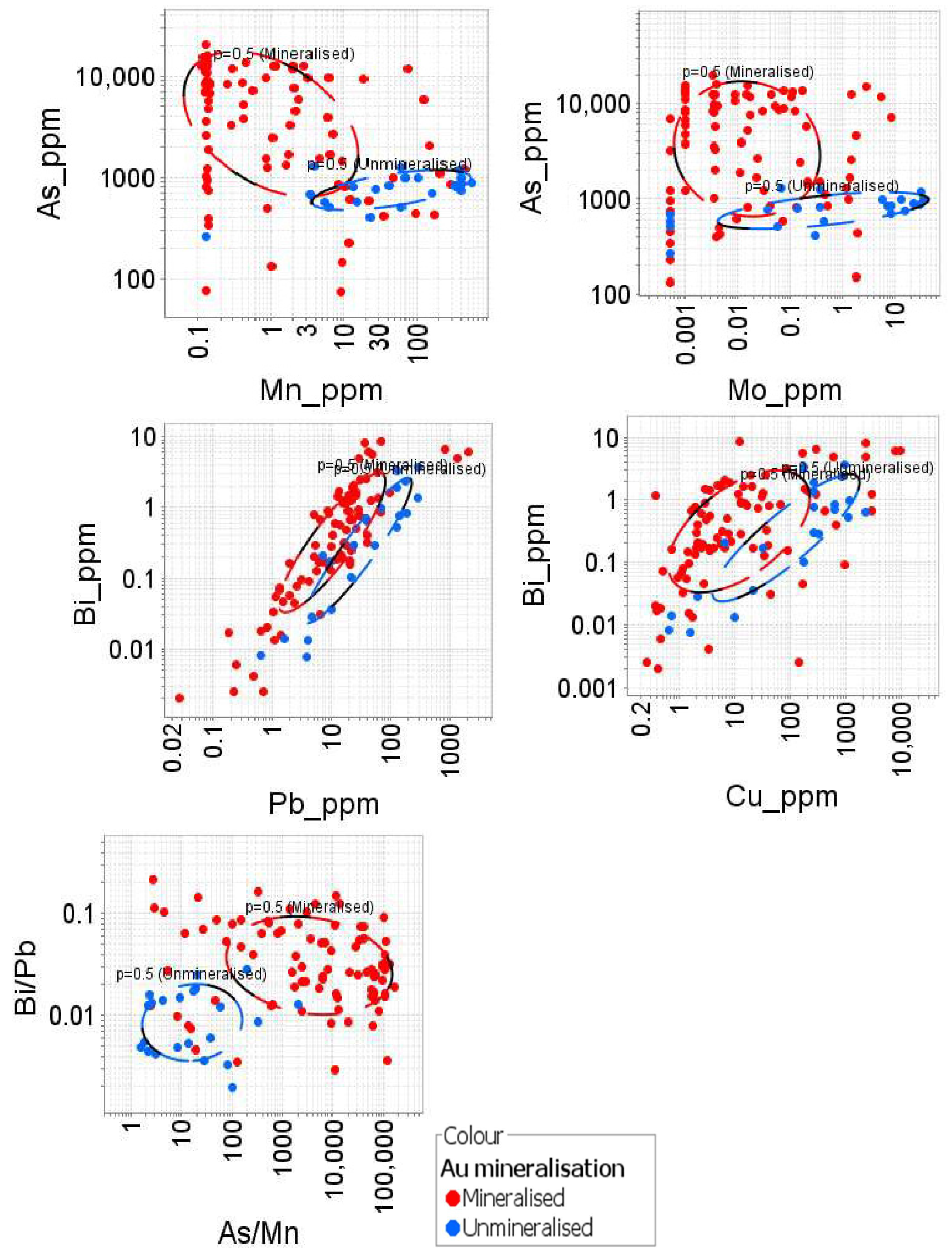
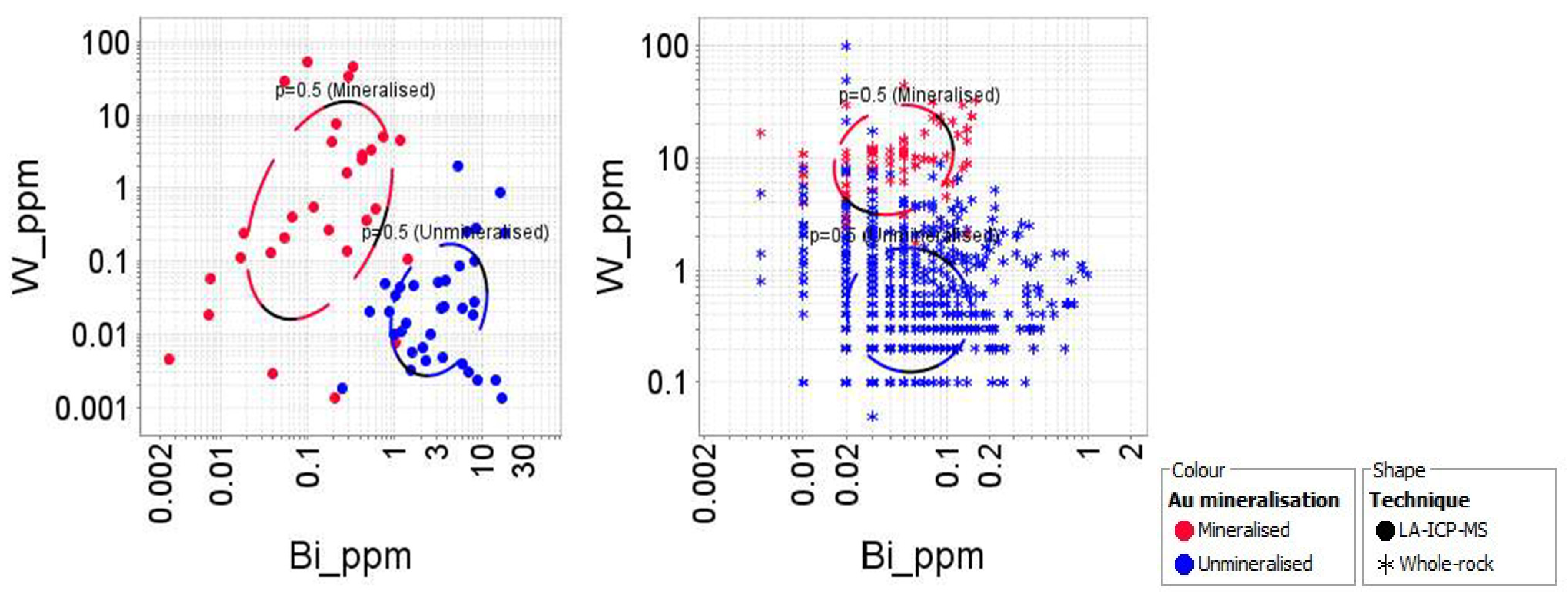
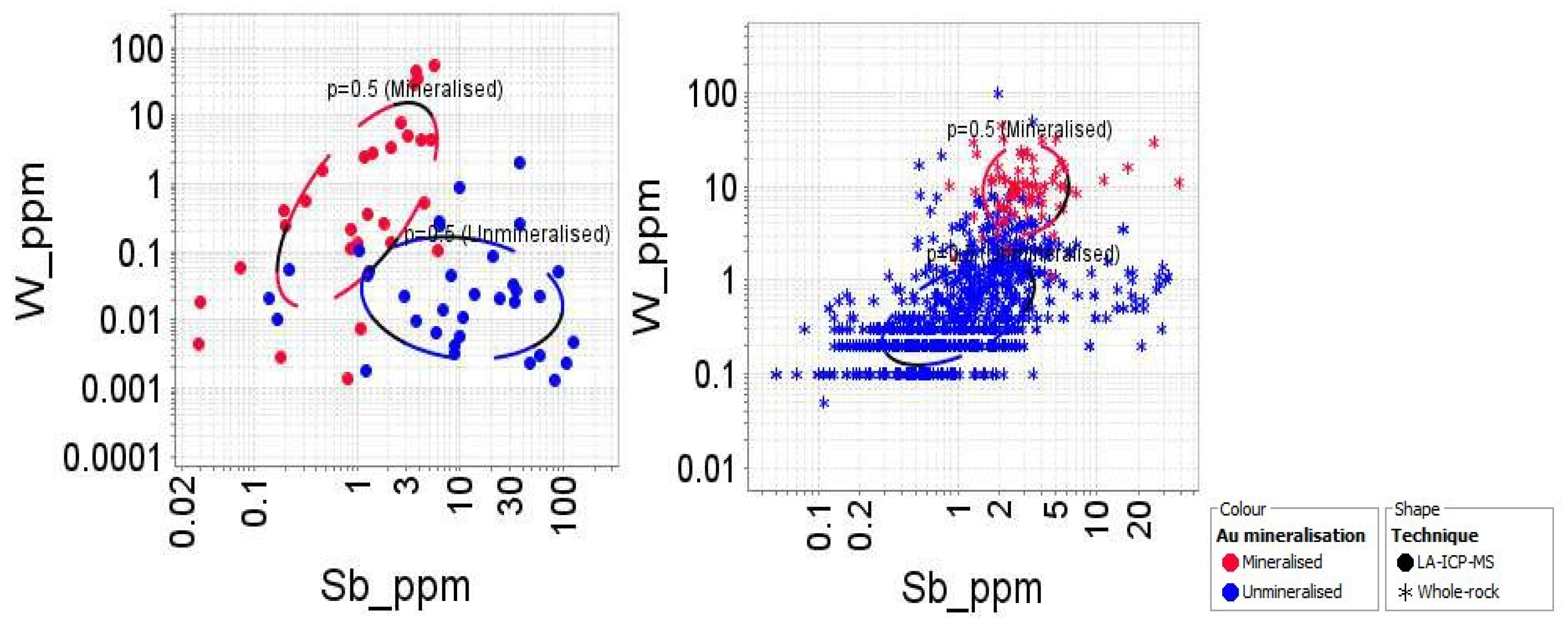
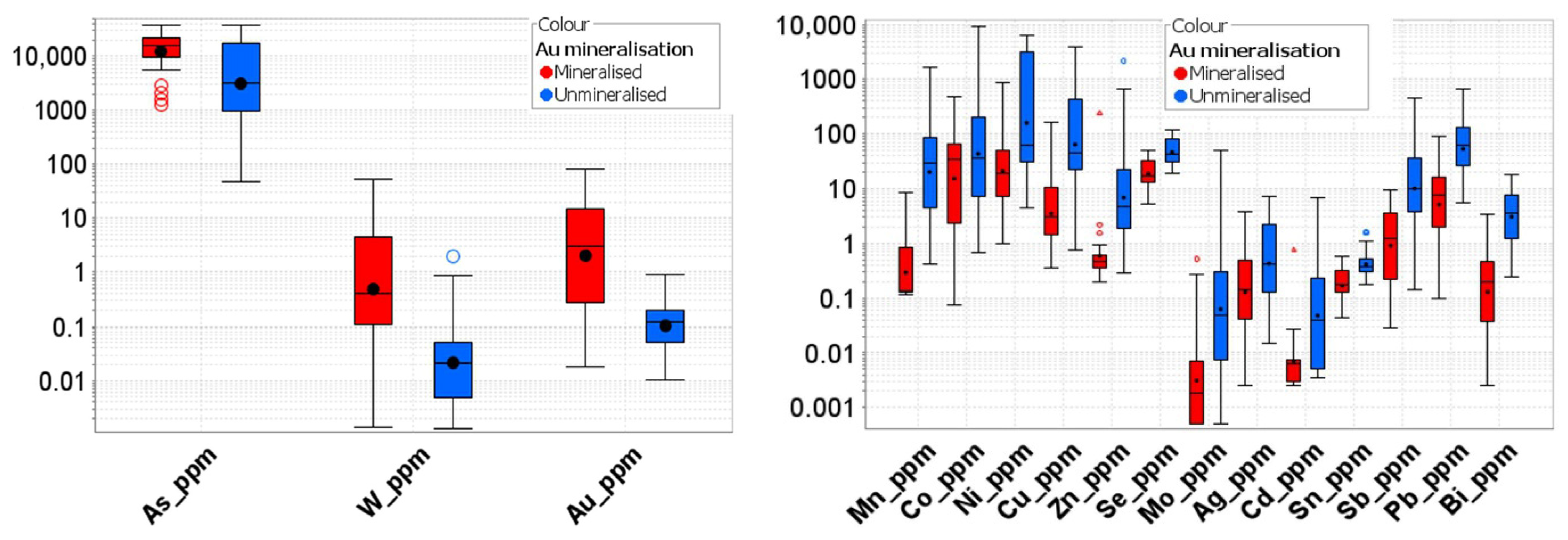
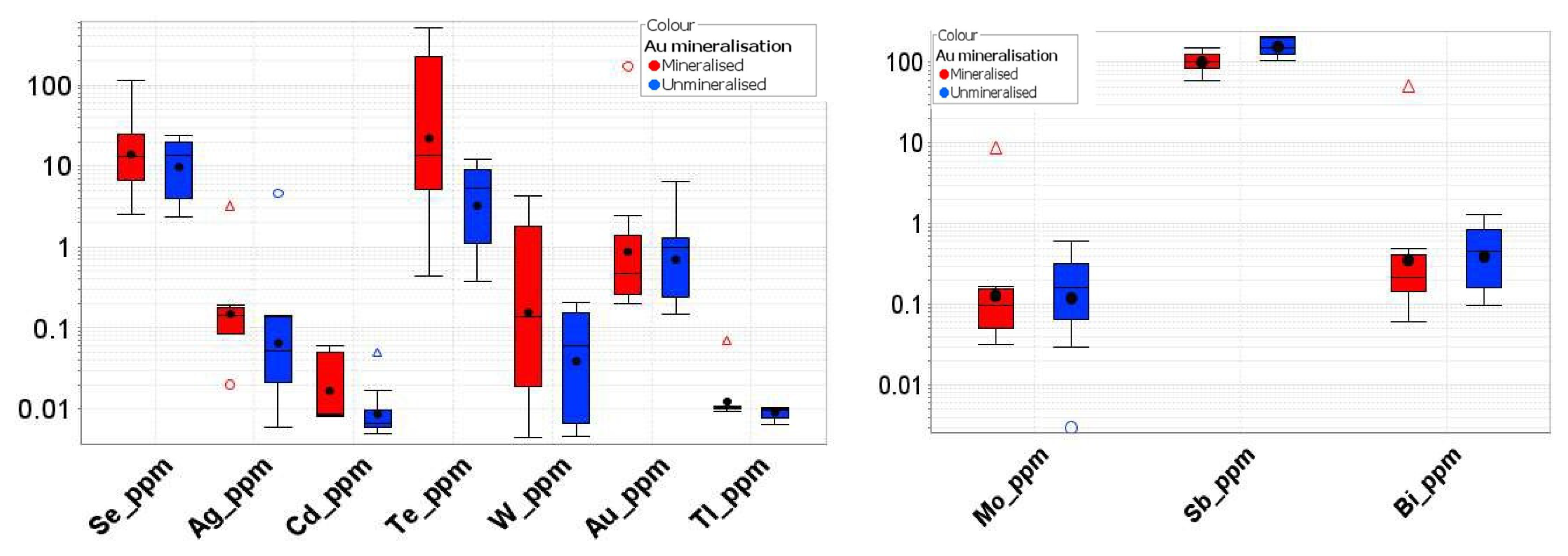
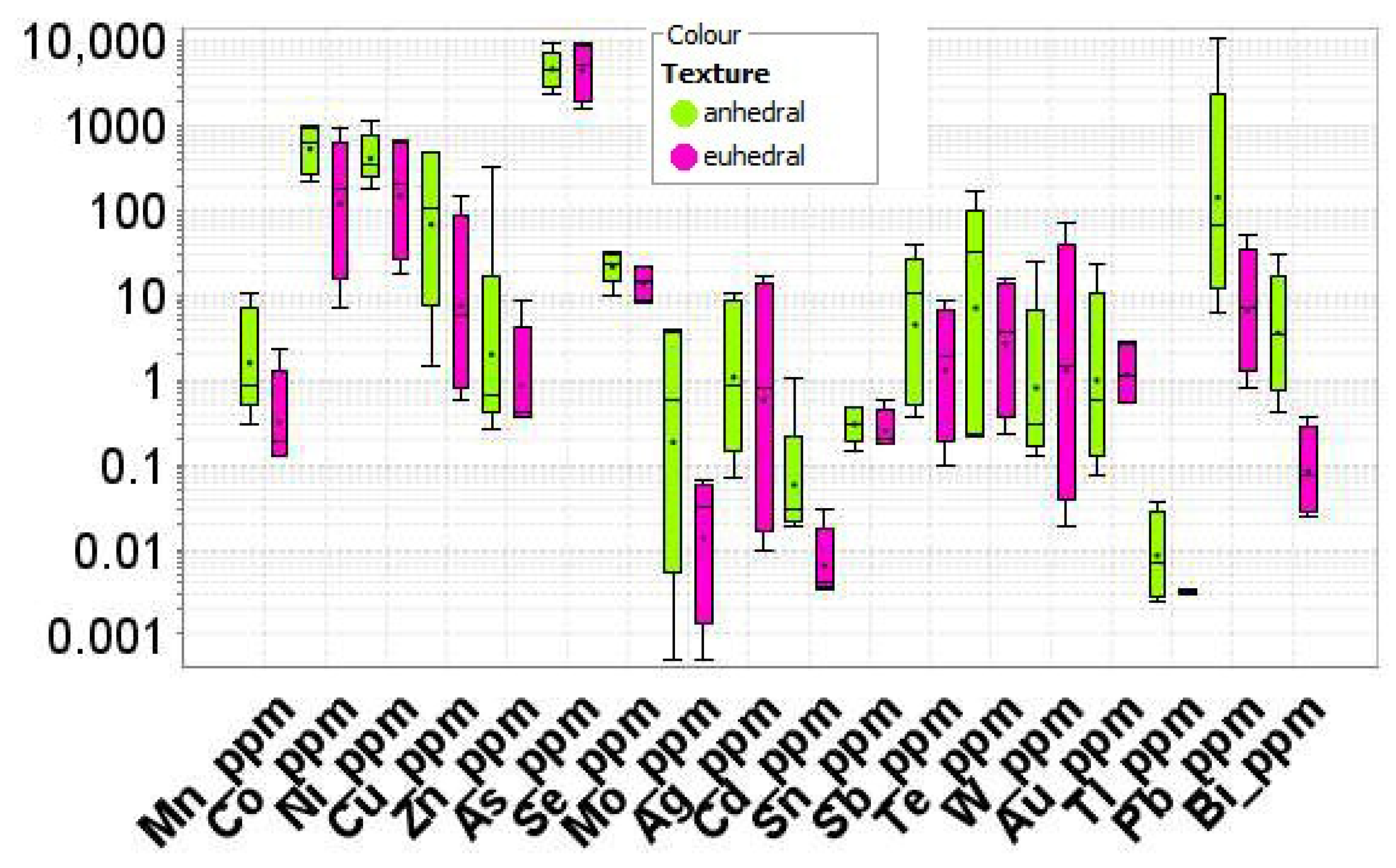
- Based on trace element patterns, distinct discrimination between mineralised and unmineralised samples suggested that mineralisation was associated with specific elements, not limited to Au. These pathfinder elements may vary depending on their rock types.
5.3. Pathfinder Elements for Each Rock Type
5.4. Implications for Exploration
6. Conclusions
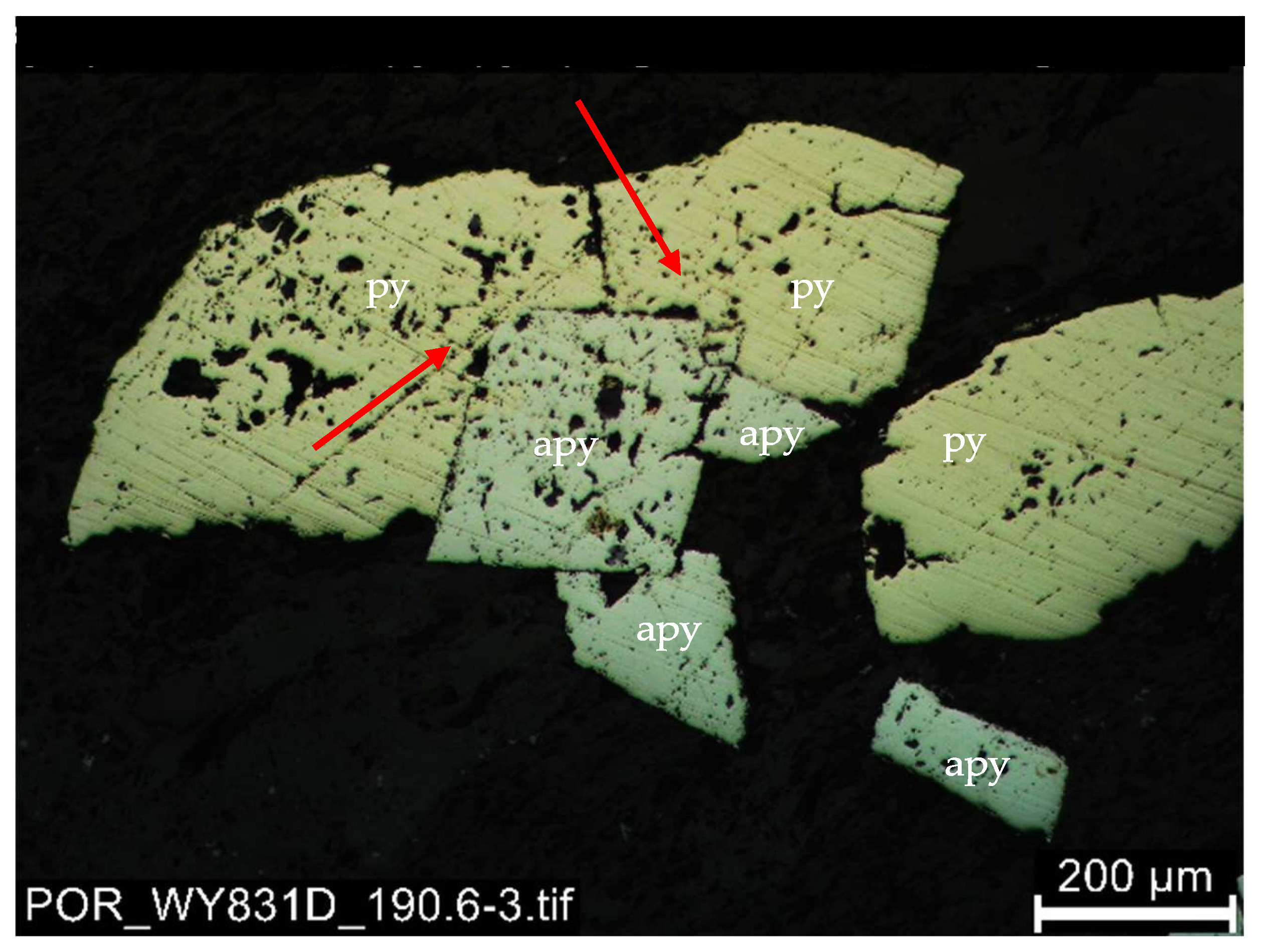
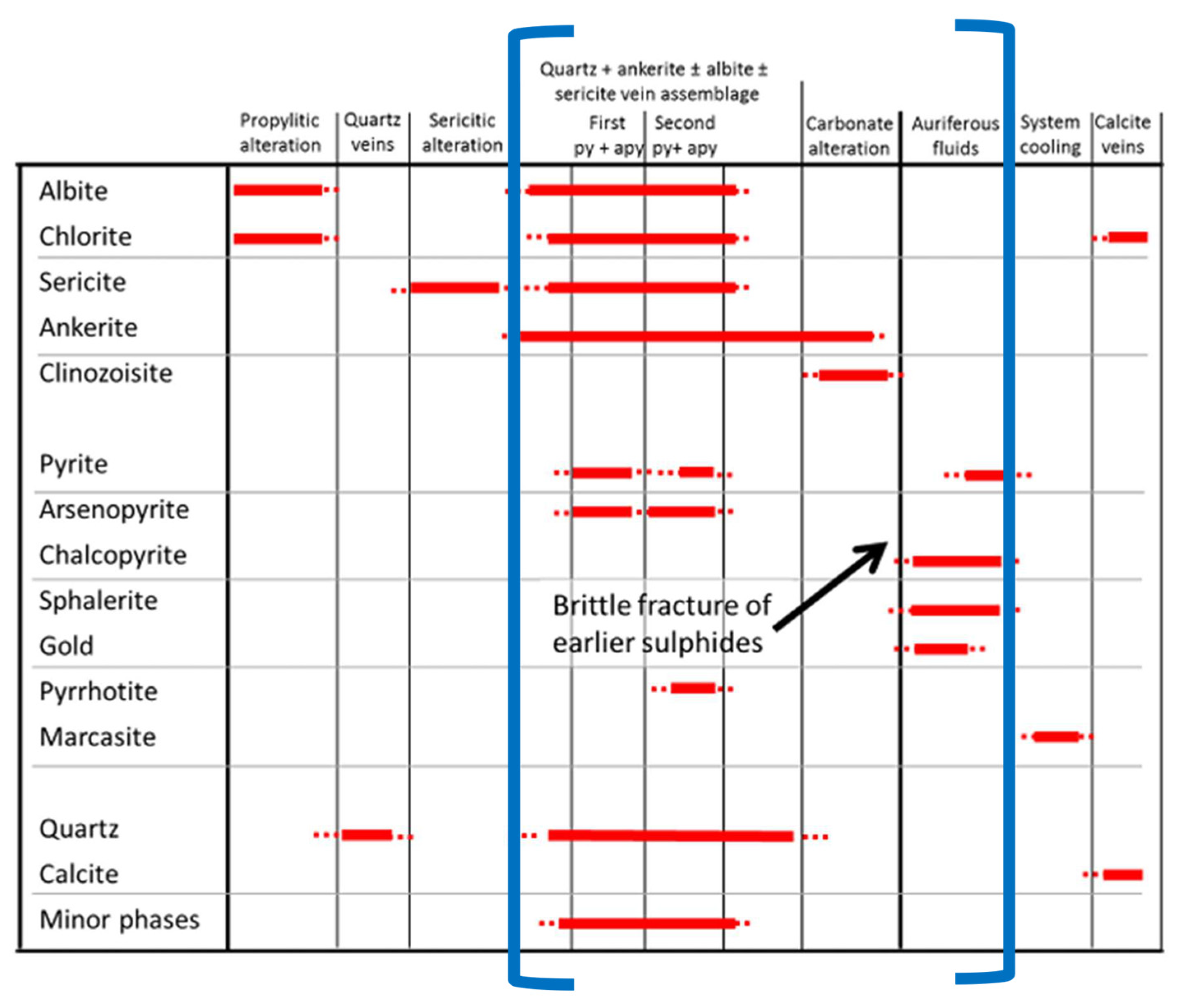
- Pyrite was identified to be the dominant sulphide in the TGP, followed by arsenopyrite.
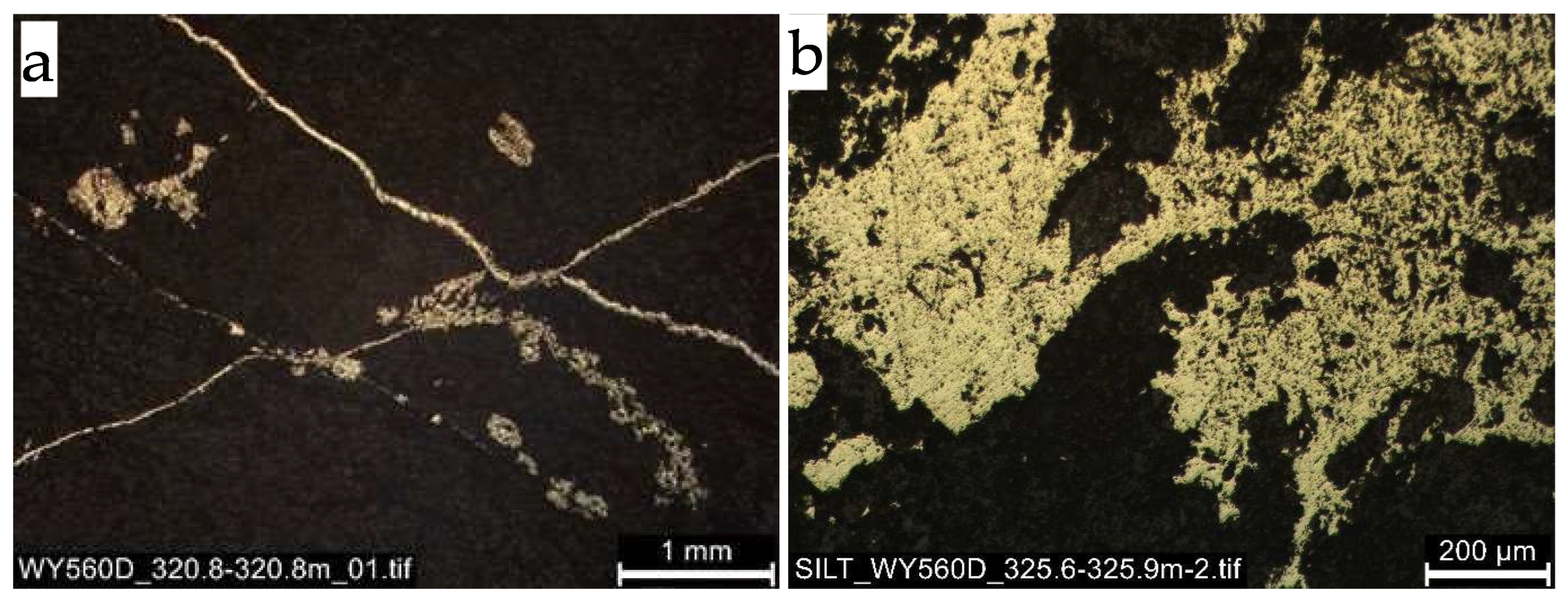
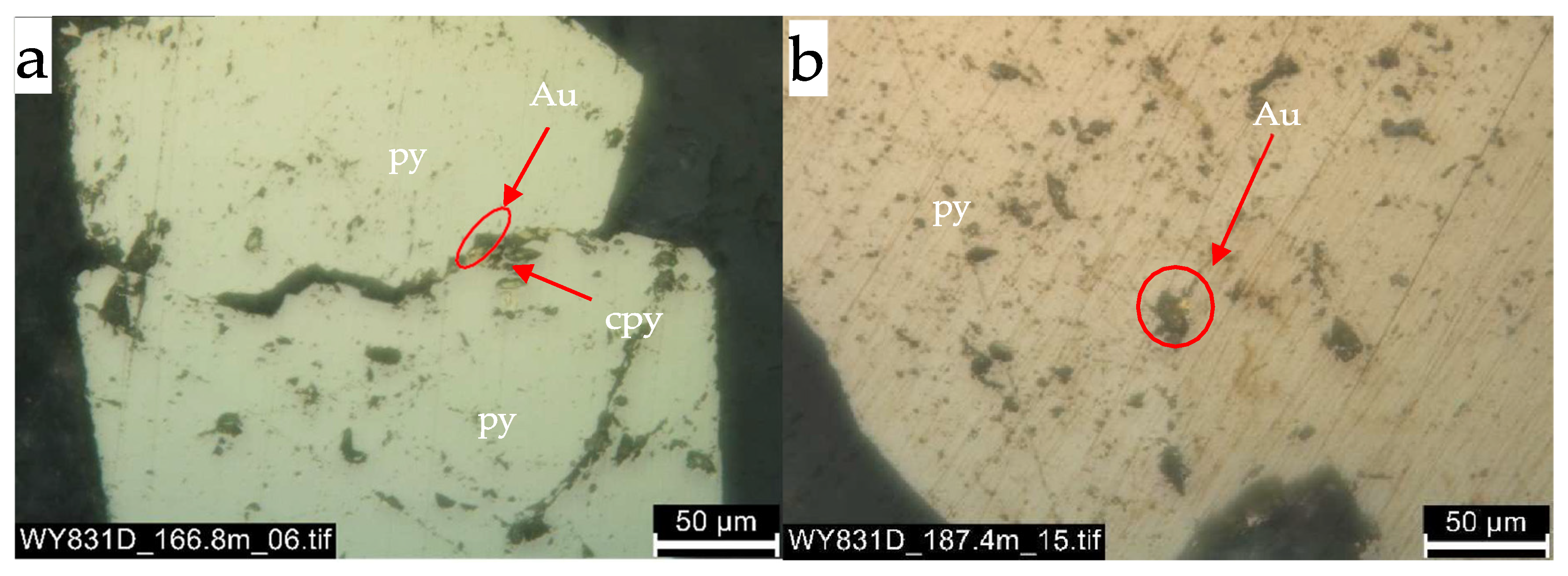
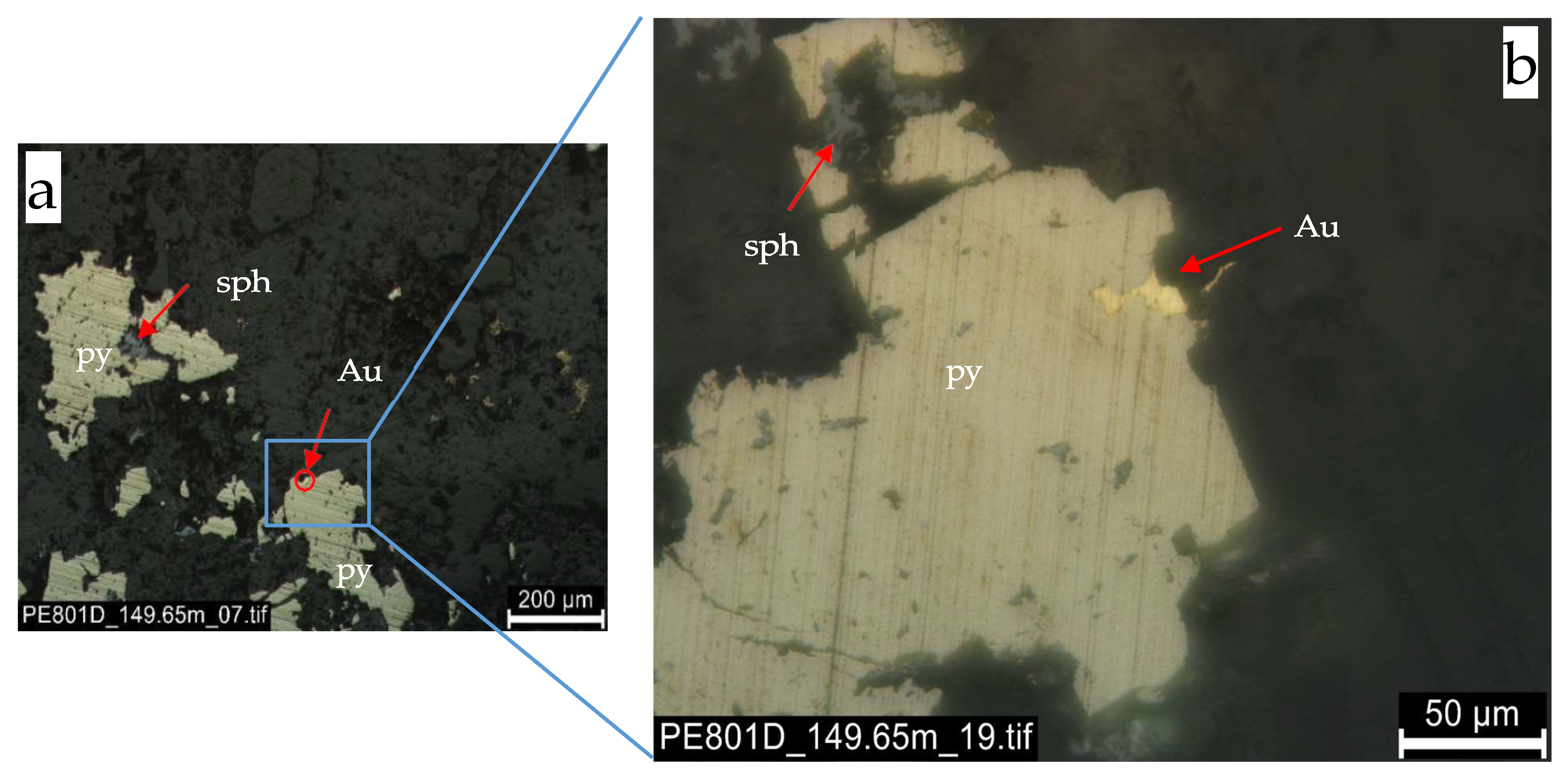
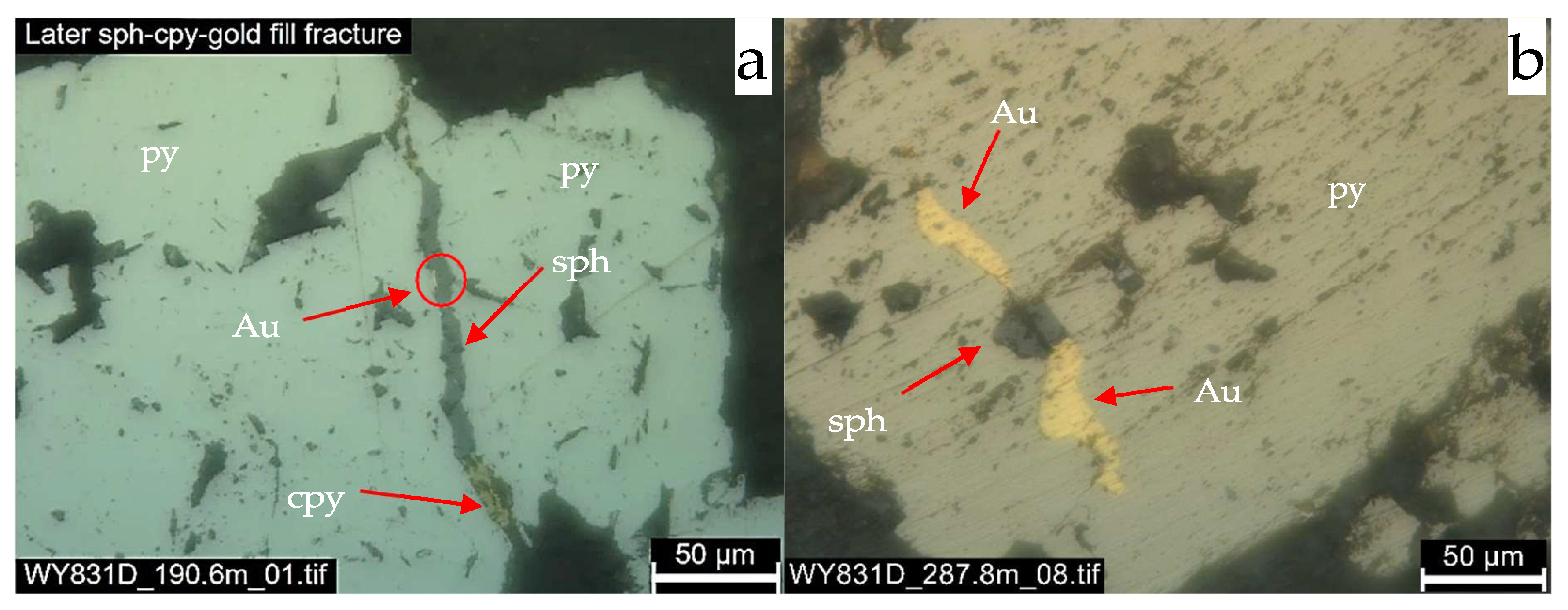
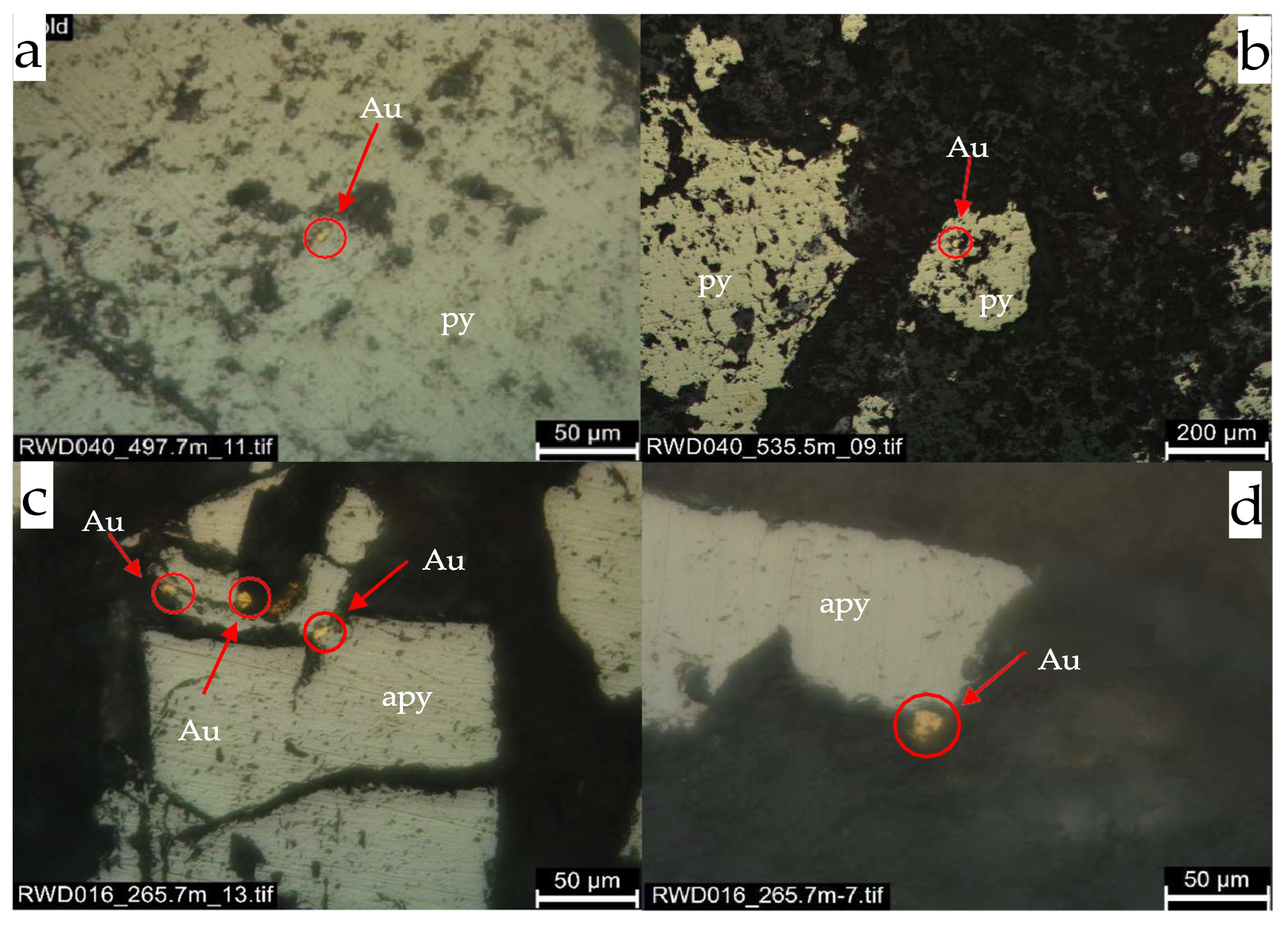
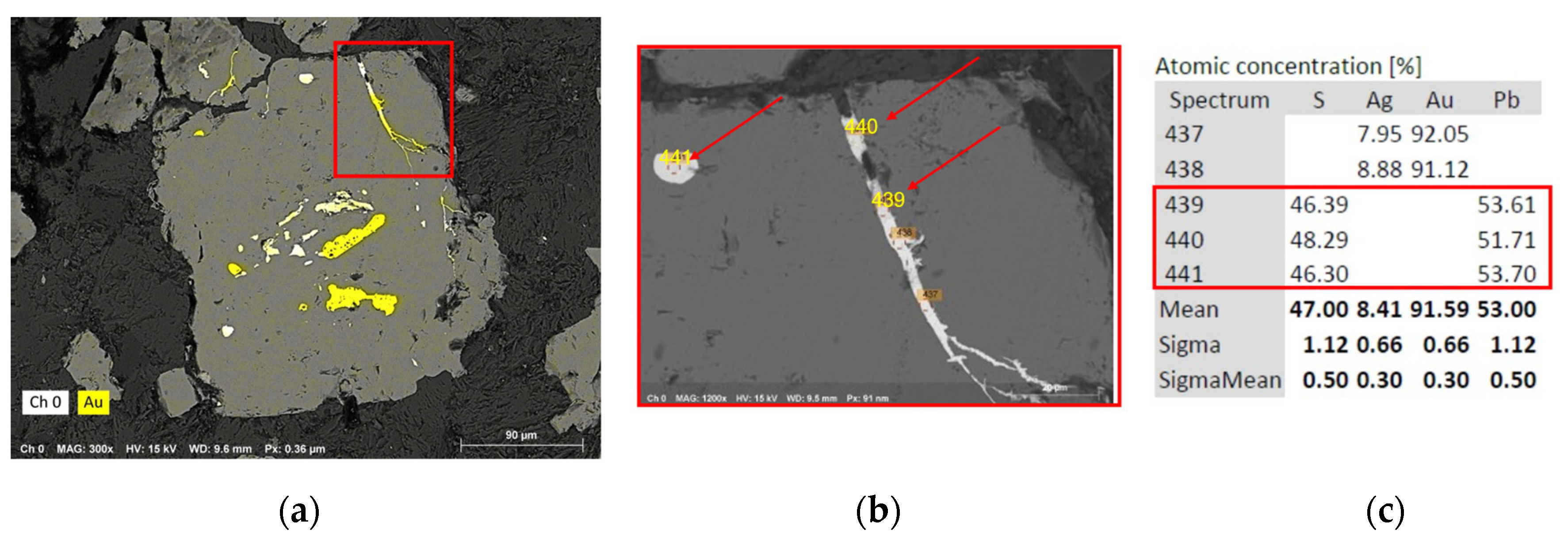
- Gold was present as inclusions or filling fractures and within the lattice structure of pyrite/arsenopyrite as invisible gold.
- Common observations of pyrite textures across all lithologies suggested that the paragenetic sequence can be applied to most deposits/prospects within the TGP.
- The best texture to investigate for Au is porous pyrite.
- Gold may have been incorporated early as sedimentary pyrite in graphitic siltstone, but the various host lithologies in the TGP suggest that graphitic siltstone may have been one of many Au sources. However, S isotopes are needed to confirm the early source of Au.
- Volcaniclastics, graphitic siltstone and andesite were the best Au-hosted lithologies that showed high vectoring potential using pyrite trace elements (Au, Bi, W, Sb, Se, Sn, As, Mn, Mo).
- Arsenopyrite trace elements were more suited for vectoring in dacite and monzodiorite (Se, Ag, Cd, Te, W, Mo, Sb, Bi, Tl, Pb, Co, Sn).
- Whole-rock data can distinguish between mineralised and unmineralised samples, but relationships between trace elements were unclear despite the high number of data points. On the other hand, fewer data obtained using the in situ LA-ICP-MS technique helped to further refine relationships between trace element pairs and differentiation between mineralised and unmineralised samples.
Supplementary Materials
Author Contributions
Funding
Data Availability Statement
Acknowledgments
Conflicts of Interest
References
- Chalmers, D.I.; Ransted, T.W.; Kairaitis, R.A.; Meates, D.G. The Wyoming gold deposits: Volcanic-hosted lode-type gold mineralisation in the eastern Lachlan Orogen, Australia. Miner. Depos. 2007, 42, 505–513. [Google Scholar] [CrossRef]
- Cherry, A. Paragenesis of Gold-Sulphide Mineralisation in the Wyoming One and Caloma Two Deposits, Tomingley. Unpublished Bachelor’s Thesis, University of New South Wales, Kensington, NSW, Australia, 2013. [Google Scholar]
- Kelly, A.P. Why is the Gold Where It Is? The Lithological, Mineralogical, and Geochemical Controls on the Distribution of Gold Mineralisation Within the Tomingley Gold Project. Unpublished Bachelor’s Thesis, Central NSW University of New South Wales, Sydney, NSW, Australia, 2024. [Google Scholar]
- Squire, R.J.; Herrmann, W.; Pape, D.; Chalmers, D.I. Evolution of the peak hill high-sulfidation epithermal Au-Cu deposit, eastern Australia. Miner. Depos. 2007, 42, 489–503. [Google Scholar] [CrossRef]
- Meates, D.G.; Chalmers, D.I.; Ransted, T.W.; Pridmore, C. Tomingley Exposed-Changes in Geological Interpretation Once Opened Up. Discoveries in the Tasmanides Extended Abstracts, AIG Bulletin 67, Australian Institute of Geoscientists, 13p. 2017. Available online: https://smedg.org.au/wp-content/uploads/2020/07/papers-2017-pdf/3_orogenic-deposits/2_Tomingley-exposed_DMeates_EtAl.pdf (accessed on 15 June 2025).
- Alkane. Tomingley Mine Life Extended Beyond. 3 June 2021. ASX Announcement. Available online: https://investors.alkres.com/site/pdf/6fdfebf9-0c01-4558-a60a-4bddd7c67d71/Tomingley-Mine-Life-Extended-Beyond-2030.pdf (accessed on 15 June 2025).
- Mann, R. Landscape Evolution of the Tomingley Area. Unpublished Bachelor’s Thesis, NSW Australian National University, Acton, ACT, Australia, 2009. [Google Scholar]
- Bamford, P.L.M.; McQueen, K.G.; Scott, K.M. Geochemical dispersion and under-cover expression of gold mineralization at the Wyoming gold deposit. In Regolith 2004; Roach, I.C., Ed.; CRC LEME: Canberrra, Australia, 2004; pp. 26–28. [Google Scholar]
- Roach, I.C. Tomingley Project, Central Western NSW, 1: Regolith-Landform Mapping Techniques and Implications for Landscape Evolution. In Regolith 2006; Fitzpatrick, R.W., Shand, P., Eds.; CRC LEME: Canberrra, Australia, 2006; pp. 296–300. [Google Scholar]
- Roach, I.C. Results of a preliminary biogeochemical survey of the Wyoming Au deposit. In Regolith 2004; Roach, I.C., Ed.; CRC LEME: Canberrra, Australia, 2004; pp. 307–310. [Google Scholar]
- Roach, I.C.; Walker, S.D. Biogeochemical expression of gold in native tree leaves at Wyoming and Tomingley, NSW. In Regolith 2005—Ten Years of CRC LEME; Roach, I.C., Ed.; CRC LEME: Canberra, Australia, 2005; pp. 277–282. [Google Scholar]
- Mesthos, A. Orogenic Gold Potential of the Eastern Lachlan Fold Belt: Geochemical Evidence. Unpublished Bachelor’s Thesis, University of Sydney, Tomingley, NSW, Australia, 2012. [Google Scholar]
- Large, R.R.; Halpin, J.A.; Danyushevsky, L.V.; Maslennikov, V.V.; Bull, S.W.; Long, J.A.; Gregory, D.D.; Lounejeva, E.; Lyons, T.W.; Sack, P.J.; et al. Trace element content of sedimentary pyrite as a new proxy for deep-time ocean–atmosphere evolution. Earth Planet. Sci. Lett. 2014, 389, 209–220. [Google Scholar] [CrossRef]
- George, L.L.; Biagioni, C.; Lepore, G.O.; Lacalamita, M.; Agrosì, G.; Capitani, G.C.; Bonaccorsi, E.; D’Acapito, F. The speciation of thallium in (Tl,Sb,As)-rich pyrite. Ore Geol. Rev. 2019, 107, 364–380. [Google Scholar] [CrossRef]
- Voute, F.; Hagemann, S.G.; Evans, N.J.; Villanes, C. Sulfur isotopes, trace element, and textural analyses of pyrite, arsenopyrite and base metal sulfides associated with gold mineralization in the Pataz-Parcoy district, Peru: Implication for paragenesis, fluid source, and gold deposition mechanisms. Miner. Depos. 2019, 54, 1077–1100. [Google Scholar] [CrossRef]
- Daneshvar, N.; Maanijou, M.; Lentz, D.R.; Azizi, H.; McFarlane, C.R.; Maruoka, T. Interpretation of hydrothermal evolution in the Qolqoleh gold deposit, southwest of Saqqez, Iran: Analysis of pyrite by LA-ICP-MS and sulfur isotopes. Ore Geol. Rev. 2021, 133, 104087. [Google Scholar] [CrossRef]
- Zhu, D.-P.; Li, H.; Tamehe, L.S.; Jiang, W.-C.; Wang, C.; Wu, K.-Y. Two-stage Cu–Pb–Zn mineralization of the Baoshan deposit in southern Hunan, South China: Constraints from zircon and pyrite geochronology and geochemistry. J. Geochem. Explor. 2022, 241, 107070. [Google Scholar] [CrossRef]
- Koglin, N.; Frimmel, H.E.; Minter, W.E.L.; Brätz, H. Trace-element characteristics of different pyrite types in Mesoarchaean to Palaeoproterozoic placer deposits. Miner. Depos. 2010, 45, 259–280. [Google Scholar] [CrossRef]
- Mathieu, L. Detecting magmatic-derived fluids using pyrite chemistry: Example of the Chibougamau area, Abitibi Subprovince. Ore Geol. Rev. 2019, 114, 103127. [Google Scholar] [CrossRef]
- Deditius, A.P.; Utsunomiya, S.; Reich, M.; Kesler, S.E.; Ewing, R.C.; Hough, R.; Walshe, J. Trace metal nanoparticles in pyrite. Ore Geol. Rev. 2011, 42, 32–46. [Google Scholar] [CrossRef]
- Cao, G.; Zhang, Y.; Zhao, H.; Cheng, J.; Hao, J.; Lei, J.; Song, S.; Wang, X. Trace element variations of pyrite in orogenic gold deposits: Constraints from big data and machine learning. Ore Geol. Rev. 2023, 157, 105447. [Google Scholar] [CrossRef]
- Babedi, L.; von der Heyden, B.P.; Tadie, M.; Mayne, M. Trace elements in pyrite from five different gold ore deposit classes: A review and meta-analysis. Geol. Soc. Lond. Spéc. Publ. 2022, 516, 47–83. [Google Scholar] [CrossRef]
- Davies, H.M. Expanding the Footprint of Orogenic Gold–Trace Elements in Sulphides University of Otago. 2021. Available online: https://hdl.handle.net/10523/12370 (accessed on 15 June 2025).
- Cook, N.; Ciobanu, C.L.; George, L.; Zhu, Z.-Y.; Wade, B.; Ehrig, K. Trace Element Analysis of Minerals in Magmatic-Hydrothermal Ores by Laser Ablation Inductively-Coupled Plasma Mass Spectrometry: Approaches and Opportunities. Minerals 2016, 6, 111. [Google Scholar] [CrossRef]
- Keith, M.; Smith, D.J.; Jenkin, G.R.; Holwell, D.A.; Dye, M.D. A review of Te and Se systematics in hydrothermal pyrite from precious metal deposits: Insights into ore-forming processes. Ore Geol. Rev. 2018, 96, 269–282. [Google Scholar] [CrossRef]
- Steadman, J.A.; Large, R.R.; Olin, P.H.; Danyushevsky, L.V.; Meffre, S.; Huston, D.; Fabris, A.; Lisitsin, V.; Wells, T. Pyrite trace element behavior in magmatic-hydrothermal environments: An LA-ICPMS imaging study. Ore Geol. Rev. 2021, 128, 103878. [Google Scholar] [CrossRef]
- Raič, S.; Molnár, F.; O’BRien, H.; Cook, N.; Vasilopoulos, M. Building geochemical vectors with trace element compositions of sulfides in orogenic gold mineral systems in northern Finland. J. Geochem. Explor. 2023, 251, 107252. [Google Scholar] [CrossRef]
- Phillips, D.; Fu, B.; Wilson, C.J.; Kendrick, M.A.; Fairmaid, A.M.; Miller, J.M. Timing of gold mineralisation in the western Lachlan Orogen, SE Australia: A critical overview. Aust. J. Earth Sci. 2012, 59, 495–525. [Google Scholar] [CrossRef]
- Vandenberg, A. The Tasman Fold Belt System in Victoria. Tectonophysics 1978, 48, 267–297. [Google Scholar] [CrossRef]
- Willman, C.E.; Korsch, R.J.; Moore, D.H.; Cayley, R.A.; Lisitsin, V.A.; Rawling, T.J.; Morand, V.J.; O’Shea, P.J. Crustal-Scale Fluid Pathways and Source Rocks in the Victorian Gold Province, Australia: Insights from Deep Seismic Reflection Profiles. Econ. Geol. 2010, 105, 895–915. [Google Scholar] [CrossRef]
- Foster, D.A.; Gray, D.R. Evolution and Structure of the Lachlan Fold Belt (Orogen) of Eastern Australia. Annu. Rev. Earth Planet. Sci. 2000, 28, 47–80. [Google Scholar] [CrossRef]
- Glen, R.A.; Walshe, J.L.; Barron, L.M.; Watkins, J.J. Ordovician convergent- margin volcanism and tectonism in the Lachlan sector of east Gondwana. Geology 1998, 26, 751–754. [Google Scholar] [CrossRef]
- Kemp, A.; Blevin, P. Norman A SIMS U-Pb (zircon) and Re-Os (molybdenite) isotope study of the early Paleozoic Macquarie Arc, southeastern Australia: Implications for the tectono-magmatic evolution of the paleo-Pacific Gondwana margin. Gondwana Res. 2020, 82, 73–96. [Google Scholar] [CrossRef]
- Crawford, A.J.; Meffre, S.; Squire, R.J.; Barron, L.M.; Falloon, T.J. Middle and Late Ordovician magmatic evolution of the Macquarie Arc, Lachlan Orogen, New South Wales. Aust. J. Earth Sci. 2007, 54, 181–214. [Google Scholar] [CrossRef]
- Cayley, R. Oroclinal folding in the Lachlan Fold Belt: Consequence of SE-directed Siluro-Devonian subduction rollback superimposed on an accreted Ordovician arc assemblage in eastern Australia. In Selwyn Symposium 2012; Geological Society of Australia Extended Abstracts; Geological Society of Australia: Hornsby, NSW, Australia, 2012; Volume 103, pp. 34–43. [Google Scholar]
- Moresi, L.; Betts, P.G.; Miller, M.S.; Cayley, R.A. Dynamics of continental accretion. Nature 2014, 508, 245–248. [Google Scholar] [CrossRef] [PubMed]
- Huston, D.L.; Champion, D.C.; Mernagh, T.P.; Downes, P.M.; Jones, P.; Carr, G.; Forster, D.; David, V. Metallogenesis and geodynamics of the Lachlan Orogen: New (and old) insights from spatial and temporal variations in lead isotopes. Ore Geol. Rev. 2016, 76, 257–267. [Google Scholar] [CrossRef]
- Glen, R.A.; Spencer, R.; Willmore, A.; David, V.; Scott, R.J. Junee—Narromine Volcanic Belt, Macquarie Arc, Lachlan Orogen, New South Wales: Components and structure. Aust. J. Earth Sci. 2007, 54, 215–241. [Google Scholar] [CrossRef]
- Cooke, D.R.; Wilson, A.J.; House, M.J.; Wolfe, R.C.; Walshe, J.L.; Lickfold, V.; Crawford, A.J. Alkalic porphyry Au–Cu and associated mineral deposits of the Ordovician to Early Silurian Macquarie Arc. Aust. J. Earth Sci. 2007, 54, 445–463. [Google Scholar] [CrossRef]
- Krynen, J.P.; Sherwin, L.; Clarke, I. Stratigraphy and Structure. Geological Survey of New South Wales, Records of the Geological Survey of New South Wales 23 Part 1. 1990. Available online: https://digs.geoscience.nsw.gov.au/report/R00050785 (accessed on 15 June 2025).
- Cherry, A.; Meates, D.; Burrows, L.; Chalmers, I. Roswell and San Antonio Gold Deposits. Discoveries in the Tasmanides Extended Abstracts, AIG Bulletin 70, Australian Institute of Geoscientists, 45–54p. 2022. Available online: https://smedg.org.au/wp-content/uploads/2022/05/AlexCherry_Alkane_RoswellSanAntonio.pdf (accessed on 15 June 2025).
- Sherwin, L. Narromine 1:250 000 Geological Sheet S1/55-3: Explanatory Notes, viii ed.; Geological Survey of New South Wales: Sydney, Australia, 1996. Available online: https://digs.geoscience.nsw.gov.au/report/R00050909 (accessed on 15 June 2025).
- Bodorkos, S.; Blevin, P.L.; Simpson, C.J.; Gilmore, P.; Glen, R.A. New SHRIMP U-Pb zircon ages from the Lachlan, Thomson and Delamerian orogens, New South Wales: July 2009–June 2010; Geoscience Australia Record 2013/29, Geological Survey of New South Wales Report GS2013/0427; Geoscience Australia: Canberra, Australia, 2013. Available online: https://ecat.ga.gov.au/geonetwork/srv/api/records/d2c042dd-c6e9-5a6e-e044-00144fdd4fa6?language=eng (accessed on 6 March 2020).
- Alkane Resources Ltd. Tomingley Gold Operations: Gold Mining and Production. 2024. Available online: https://alkres.com/projects/tomingley-gold-project/tomingley-gold-operations/ (accessed on 6 December 2024).
- Mastermant, G.J.; White, N.C.; Wilson, C.J.; Pape, D. High-Sulfıdation Gold Deposite in Ancient Volcanic Terranes: Insights from the Mid-Paleozoic Peak Hill Deposite, NSW. SEG Discov. 2002, 1–16. [Google Scholar] [CrossRef]
- Young, M.P. Geology, Alteration, Mineralization and Geochemistry of the Peak Hill Au-Cu deposit. NSW—Genetic and Exploration Implications. Unpublished Bachelor’s Thesis, University of Tasmania, Hobart, TAS, Australia, 2023. [Google Scholar]
- Crawford, A.J. Petrographic Report—37 Rocks from Tomingley Gold Project; Alkane Resources Ltd.: Perth, NSW, Australia, 2022. [Google Scholar]
- Belousov, I.; Danyushevsky, L.; Goemann, K.; Gilbert, S.; Olin, P.; Thompson, J.; Lounejeva, E.; Garbe-Schönberg, D. STDGL3, a Reference Material for Analysis of Sulfide Minerals by Laser Ablation ICP-MS: An Assessment of Matrix Effects and the Impact of Laser Wavelengths and Pulse Widths. Geostand. Geoanal. Res. 2023, 47, 493–508. [Google Scholar] [CrossRef]
- Jochum, K.P.; Wilson, S.A.; Abouchami, W.; Amini, M.; Chmeleff, J.; Eisenhauer, A.; Hegner, E.; Iaccheri, L.M.; Kieffer, B.; Krause, J.; et al. GSD-1G and MPI-DING Reference Glasses for In Situ and Bulk Isotopic Determination. Geostand. Geoanal. Res. 2010, 35, 193–226. [Google Scholar] [CrossRef]
- Wright, K.; Watson, G.W.; Parker, S.C.; Vaughan, D.J. Simulation of the structure and stability of sphalerite (ZnS) sur-faces. Am. Miner. 1998, 83, 141–146. [Google Scholar] [CrossRef]
- Fougerouse, D.; Micklethwaite, S.; Tomkins, A.G.; Mei, Y.; Kilburn, M.; Guagliardo, P.; Fisher, L.A.; Halfpenny, A.; Gee, M.; Paterson, D.; et al. Gold remobilisation and formation of high grade ore shoots driven by dissolution-reprecipitation replacement and Ni substitution into auriferous arsenopyrite. Geochim. Cosmochim. Acta 2016, 178, 143–159. [Google Scholar] [CrossRef]
- Herzog, M.; LaFlamme, C.; Beaudoin, G.; Barré, G.; Martin, L.; Savard, D. Fluid-rock sulfidation reactions control Au-Ag-Te-Bi precipitation in the Val-d’Or orogenic gold vein field (Abitibi subprovince, Canada. Miner. Depos. 2024, 59, 1039–1064. [Google Scholar] [CrossRef]
- Kutzschbach, M.; Dunkel, F.; Kusebauch, C.; Schiperski, F.; Börner, F.; Drake, H.; Klimm, K.; Keith, M. Arsenic-poor fluids promote strong As partitioning into pyrite. Geochim. Cosmochim. Acta 2024, 376, 37–53. [Google Scholar] [CrossRef]
- Large, R.R.; Danyushevsky, L.; Hollit, C.; Maslennikov, V.; Meffre, S.; Gilbert, S.; Bull, S.; Scott, R.; Emsbo, P.; Thomas, H.; et al. Gold and Trace 73 Element Zonation in Pyrite Using a Laser Imaging Technique: Implications for the Timing of Gold in Orogenic and Carlin-Style Sediment-Hosted Deposits. Econ. Geol. 2009, 104, 635–668. [Google Scholar] [CrossRef]
- Chang, Z.; Large, R.R.; Maslennikov, V. Sulfur isotopes in sediment-hosted orogenic gold deposits: Evidence for an early timing and a seawater sulfur source. Geology 2008, 36, 971. [Google Scholar] [CrossRef]
- Cook, N.J.; Ciobanu, C.L.; Meria, D.; Silcock, D.; Wade, B. Arsenopyrite-Pyrite Association in an Orogenic Gold Ore: Tracing Mineralization History from Textures and Trace Elements. Econ. Geol. 2013, 108, 1273–1283. [Google Scholar] [CrossRef]
- Lee, M.; Shin, D.; Yoo, B.; Im, H.; Pak, S.; Choi, S. LA-ICP-MS trace element analysis of arsenopyrite from the Samgwang gold deposit, South Korea, and its genetic implications. Ore Geol. Rev. 2019, 114, 103147. [Google Scholar] [CrossRef]
- Reich, M.; Kesler, S.E.; Utsunomiya, S.; Palenik, C.S.; Chryssoulis, S.L.; Ewing, R.C. Solubility of gold in arsenian pyrite. Geochim. Cosmochim. Acta 2005, 69, 2781–2796. [Google Scholar] [CrossRef]
- Pokrovski, G.; Escoda, C.; Blanchard, M.; Testemale, D.; Hazemann, J.-L.; Gouy, S.; Kokh, M.; Boiron, M.-C.; de Parseval, F.; Aigouy, T.; et al. An arsenic-driven pump for invisible gold in hydrothermal systems. Geochem. Perspect. Lett. 2021, 17, 39–44. [Google Scholar] [CrossRef]
- Sherlock, R.L.; Shannon, A.; Hebel, M.; Lindsay, D.; Madsen, J.; Sandeman, H.; Hrabi, B.; Mortensen, J.K.; Tosdal, R.M.; Friedman, R. Volcanic Stratigraphy, Geochronology, and Gold Deposits of the Archean Hope Bay Greenstone Belt, Nunavut, Canada. Econ. Geol. 2012, 107, 991–1042. [Google Scholar] [CrossRef]
- Large, R.R.; Bull, S.W.; Maslennikov, V.V. A carbonaceous sedimentary source-rock model for carlin-type and orogenic gold deposits. Econ. Geol. 2011, 106, 331–358. [Google Scholar] [CrossRef]
- Pitcairn, I.K.; Craw, D.; Teagle, D.A.H. Metabasalts as sources of metals in orogenic gold deposits. Miner. Depos. 2015, 50, 373–390. [Google Scholar] [CrossRef]

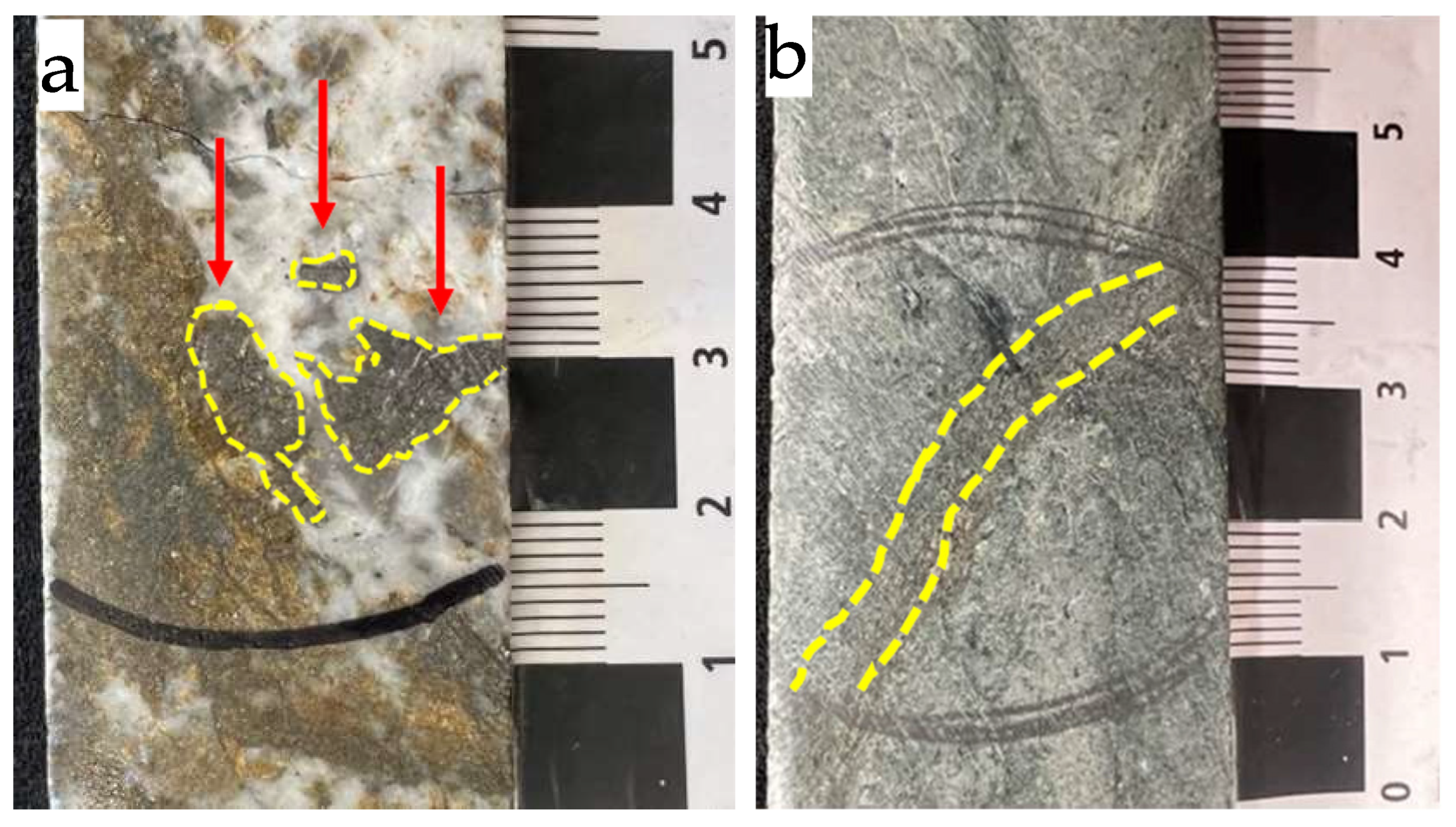


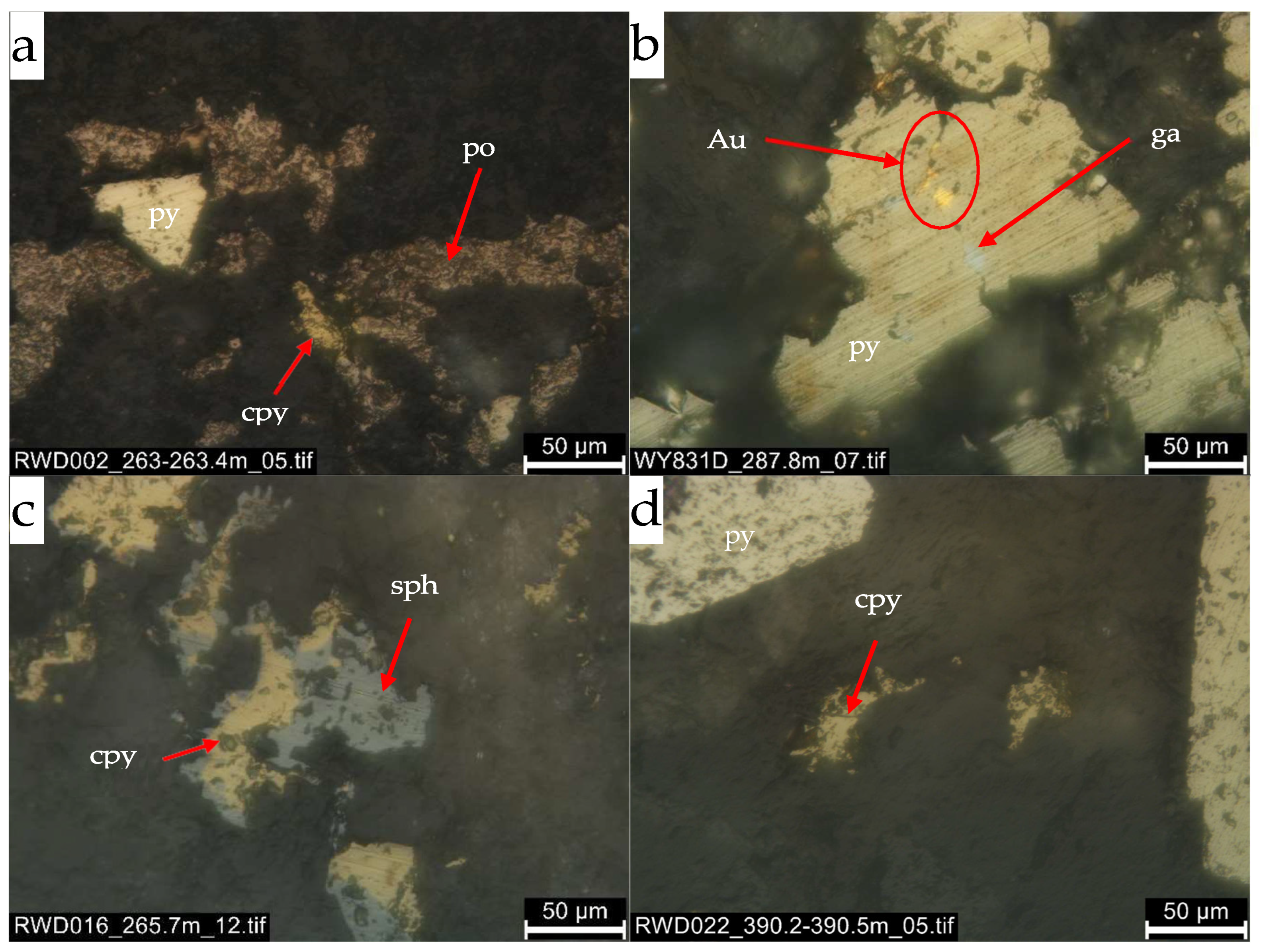











| Site (Bold = Au Bearing) | Deposit or Prospect | Lithologies Present | Mineralisation Style | Mineralisation Assemblage | Type of Samples Collected | |
|---|---|---|---|---|---|---|
| Sulphides | Other Minerals (Vein or Alteration) | |||||
| Wyoming One | Deposit | VCN and GSILT | Stockwork-like vein system, poddy quartz veining, brecciated cap of main host intrusion | Py (diss., vein); Apy (vein) | Qz (vein) | Mineralised vein (Py+Apy) in MZD; Unmineralised (Py) in MZD |
| Wyoming One South | Prospect, no significant mineralisation | MZD | Narrow isolated sheeted veins | Cpy (vein), Py (diss., vein) | Qz (vein) | Mineralised (Py) in MZD |
| San Antonio-Roswell | Deposit | MZD, ANT, DAC, and VCN | Stockworks, breccias | Py (vein); Apy (vein) | Qz-carb (vein, altered) | Unmineralised (Py) in MZD; Mineralised vein and non-vein (Py+Apy) in ANT; Unmineralised (Py+Apy) in ANT; Mineralised vein and non-vein (Py+Apy) in DAC; Unmineralised (Py+Apy) in DAC; Unmineralised (py) in VCN |
| Plains | Prospect; no significant mineralisation | BAND | Not applicable | Py (diss.); Apy (diss.) | Qz-carb (vein, altered) | Mineralised (Py) in BAND |
| Caloma 2 | Deposit | MZD and VCN | Sheeted quartz veins, en echelon veins, potential saddle reef structure | Py (vein, selv); Apy (vein) | Qz-carb (vein, altered) | Mineralised (Py) in GSILT |
| Tomingley Two | Prospect; no significant mineralisation | VCN and GSILT | Not applicable | Py (diss., vein, selv); Apy (vein) | Qz (vein, altered) | Mineralised (Py) in VCN and GSILT |
| Smiths/Cotton | Prospect, Unmineralised | VCN | Not applicable | Py (diss., selv) | Qz (vein) | Unmineralised (Py) in VCN |
| Rock Type | Number of Samples Obtained | |
|---|---|---|
| Mineralised | Unmineralised | |
| Monzodiorite | 3 | 9 |
| Graphitic siltstone | 3 | 3 |
| Volcaniclastics | 4 | 4 |
| Andesite | 9 | 3 |
| Dacite | 1 | 2 |
| Rock Type | Texture Occurrences | |
|---|---|---|
| Mineralised | Unmineralised | |
| Volcaniclastics | Euhedral to anhedral pyrite Abundant arsenopyrite Abundance of chalcopyrite and sphalerite inclusions | Euhedral to anhedral pyrite Less arsenopyrite Less chalcopyrite and sphalerite inclusions |
| Monzodiorite | Abundant arsenopyrite Abundant sphalerite, and rare chalcopyrite and galena | Less arsenopyrite Less sphalerite, and rare chalcopyrite and galena |
| Graphitic siltstone | Framboidal pyrite, fractured pyrite Abundant fracture-fill sphalerite and chalcopyrite | Framboidal pyrite, porous pyrite Less sphalerite and chalcopyrite inclusions |
| Dacite | Anhedral to subhedral pyrite (diss., caries) Arsenopyrite present Sphalerite inclusions/fracture-fill | Anhedral to subhedral pyrite (diss., caries) Arsenopyrite present Chalcopyrite free grains and galena inclusions |
| Andesite | Euhedral to anhedral pyrite Abundant sphalerite, chalcopyrite and galena inclusions in pyrite | Euhedral to anhedral pyrite Less sphalerite and rare chalcopyrite and galena inclusions in pyrite |
Disclaimer/Publisher’s Note: The statements, opinions and data contained in all publications are solely those of the individual author(s) and contributor(s) and not of MDPI and/or the editor(s). MDPI and/or the editor(s) disclaim responsibility for any injury to people or property resulting from any ideas, methods, instructions or products referred to in the content. |
© 2026 by the authors. Licensee MDPI, Basel, Switzerland. This article is an open access article distributed under the terms and conditions of the Creative Commons Attribution (CC BY) license.
Share and Cite
Nasir, M.F.B.M.; Mukherjee, I.; Cherry, A.; Graham, I.; Privat, K.; Belousov, I. In Situ Analyses of Sulphides from the Tomingley Gold Project, Central-West NSW, Australia: Pathfinder Textures and Trace Elements. Minerals 2026, 16, 335. https://doi.org/10.3390/min16030335
Nasir MFBM, Mukherjee I, Cherry A, Graham I, Privat K, Belousov I. In Situ Analyses of Sulphides from the Tomingley Gold Project, Central-West NSW, Australia: Pathfinder Textures and Trace Elements. Minerals. 2026; 16(3):335. https://doi.org/10.3390/min16030335
Chicago/Turabian StyleNasir, Muhammad Fariz Bin Md, Indrani Mukherjee, Alexander Cherry, Ian Graham, Karen Privat, and Ivan Belousov. 2026. "In Situ Analyses of Sulphides from the Tomingley Gold Project, Central-West NSW, Australia: Pathfinder Textures and Trace Elements" Minerals 16, no. 3: 335. https://doi.org/10.3390/min16030335
APA StyleNasir, M. F. B. M., Mukherjee, I., Cherry, A., Graham, I., Privat, K., & Belousov, I. (2026). In Situ Analyses of Sulphides from the Tomingley Gold Project, Central-West NSW, Australia: Pathfinder Textures and Trace Elements. Minerals, 16(3), 335. https://doi.org/10.3390/min16030335