Metallogeny of Low-K Tholeiitic Magmas in Volcanic Arcs: Inferences from Petrology, Geochemistry and Micromineralogy of the Modern Mutnovsky Volcano Lavas (Kamchatka, Russia)



Abstract
1. Introduction
2. Geologic Background
3. Materials and Methods
4. Results
4.1. Petrography of Volcanic Rocks
4.2. Geochemistry of Volcanic Rocks
4.2.1. Major and Trace Elements
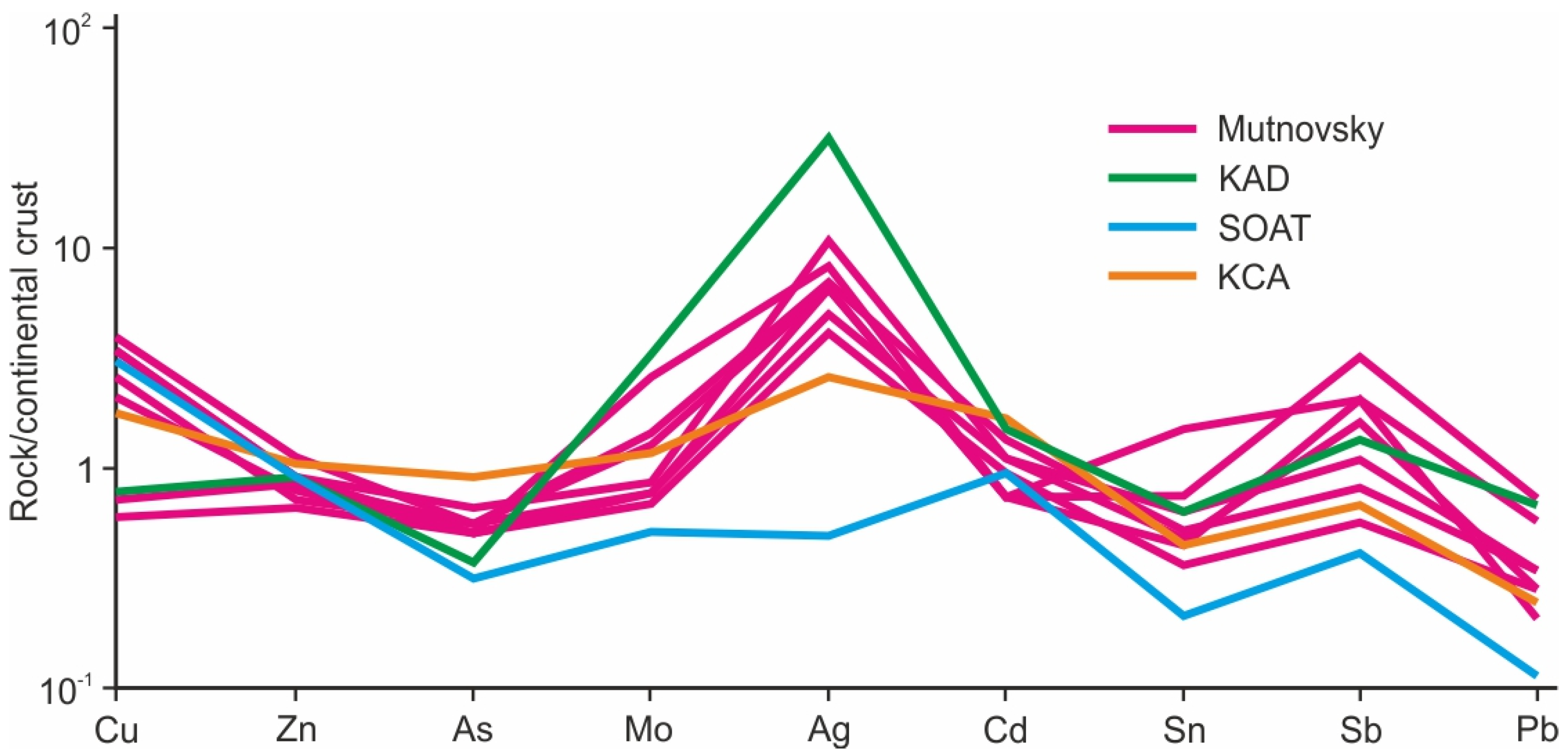
4.2.2. Ore Elements
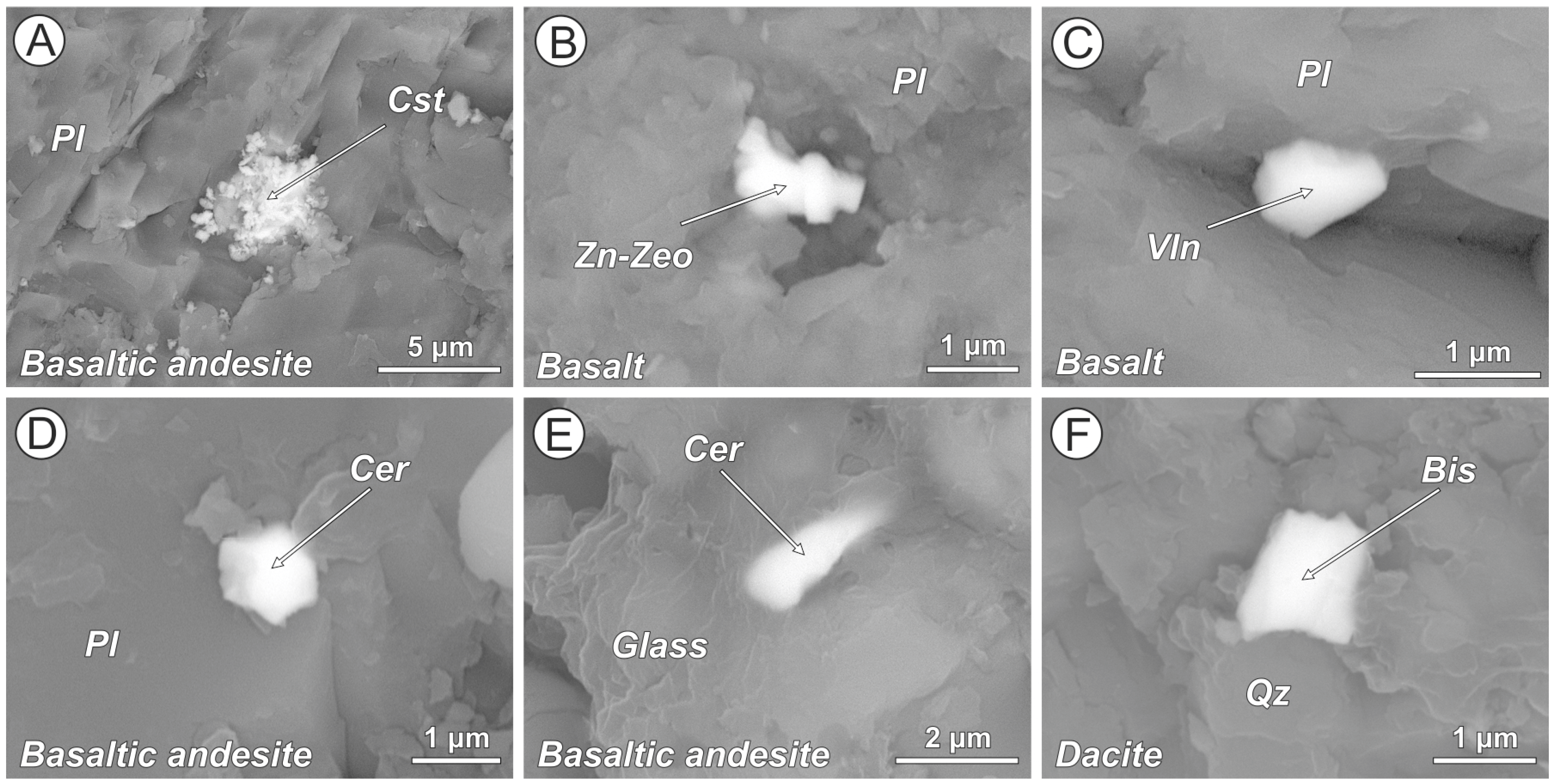
4.3. Metal and Mineral Microinclusions
5. Discussion
5.1. Possible Role of Magmatic Differentiation
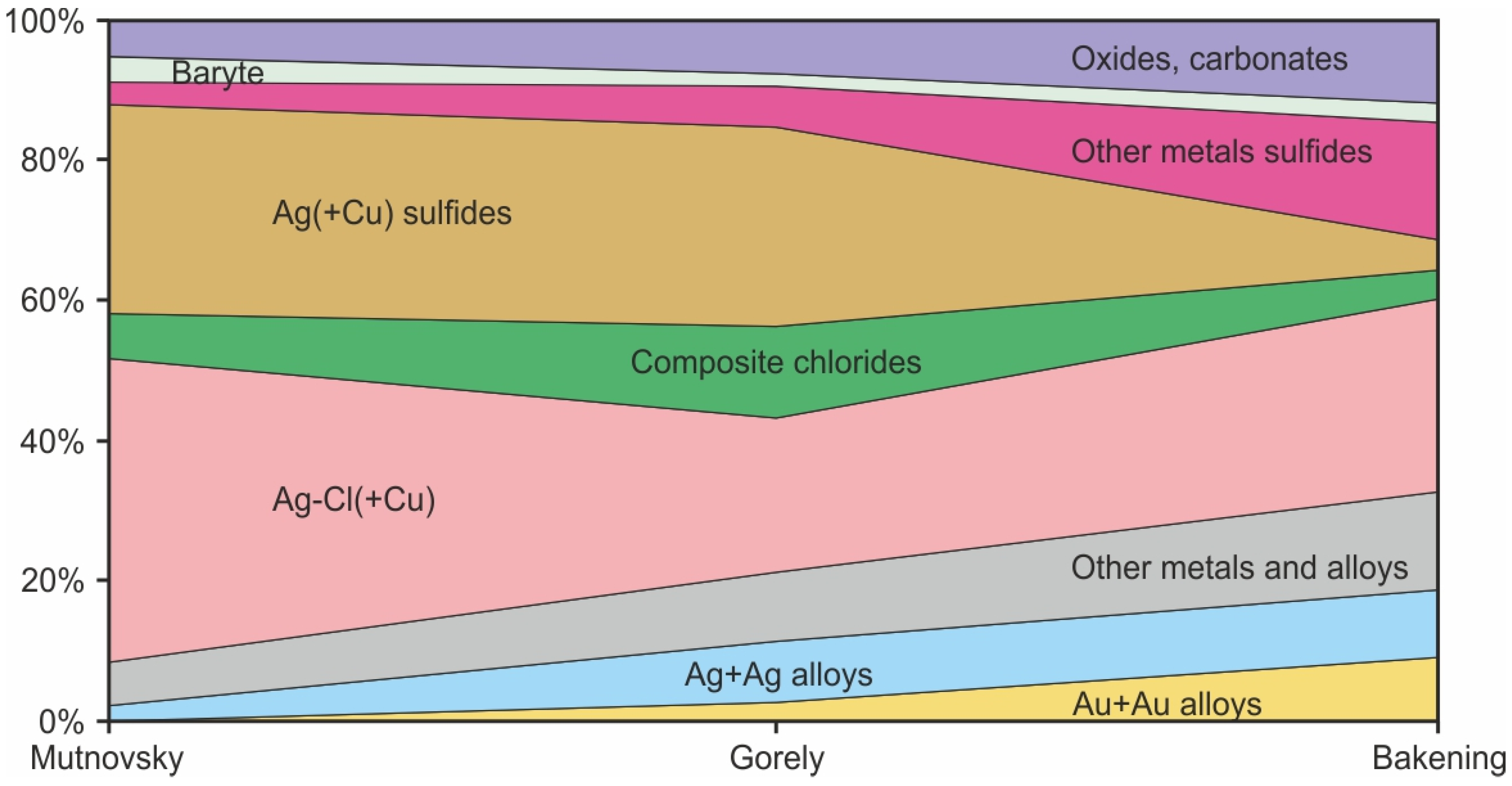
5.2. Comparison with the Rear-Arc Volcanoes
5.3. Comparison with Epithermal and Porphyry Mineralization in Kamchatka
5.4. Inferences on the Nature of the Associated Fluid
5.5. Implications for the Metallogeny of Low-K Tholeiitic Magmas in Volcanic Arcs
6. Conclusions
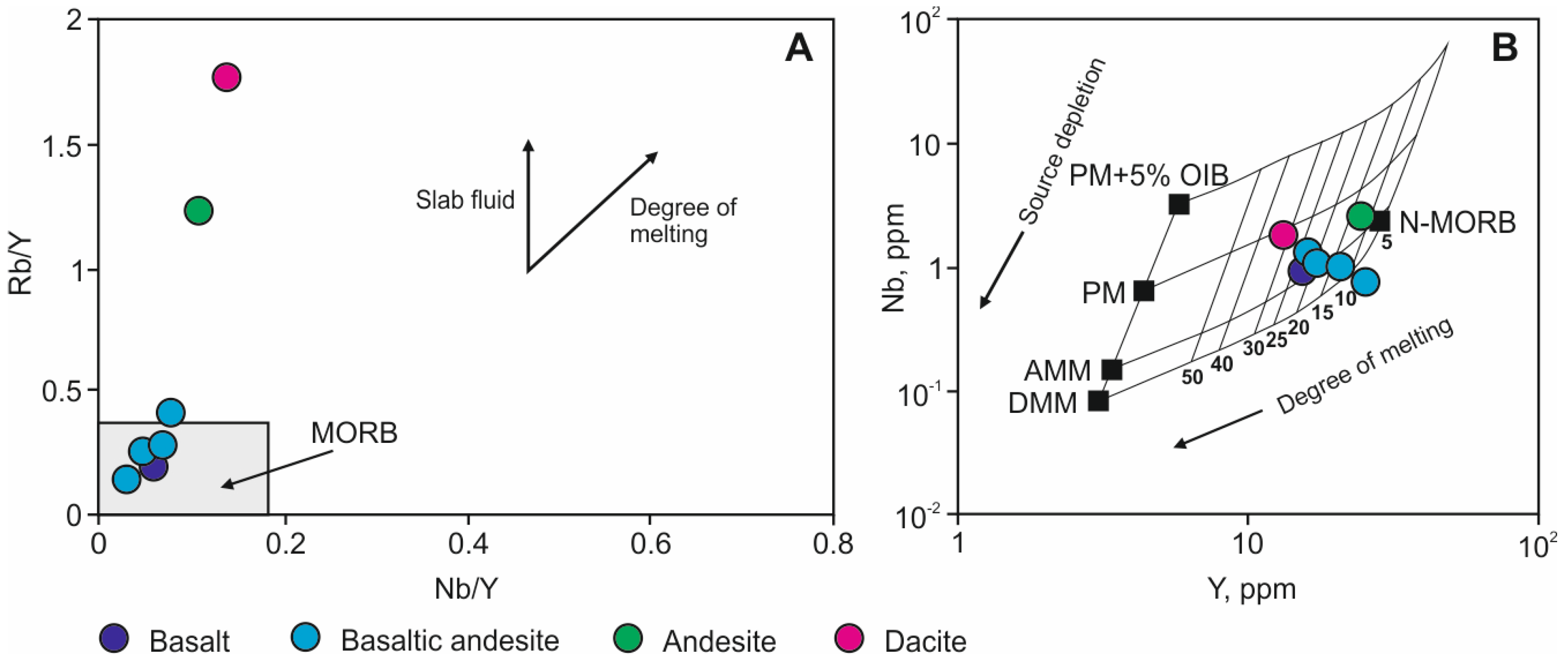
- Low-K tholeiitic basalts and basaltic andesites from the Mutnovsky volcano are products of 15–26% partial melting of a depleted mantle wedge source beneath southern Kamchatka. Andesites and dacites were either formed through crystal fractionation of parental basalt or through partial melting of a garnet-free basaltic protolith in the subarc crust.
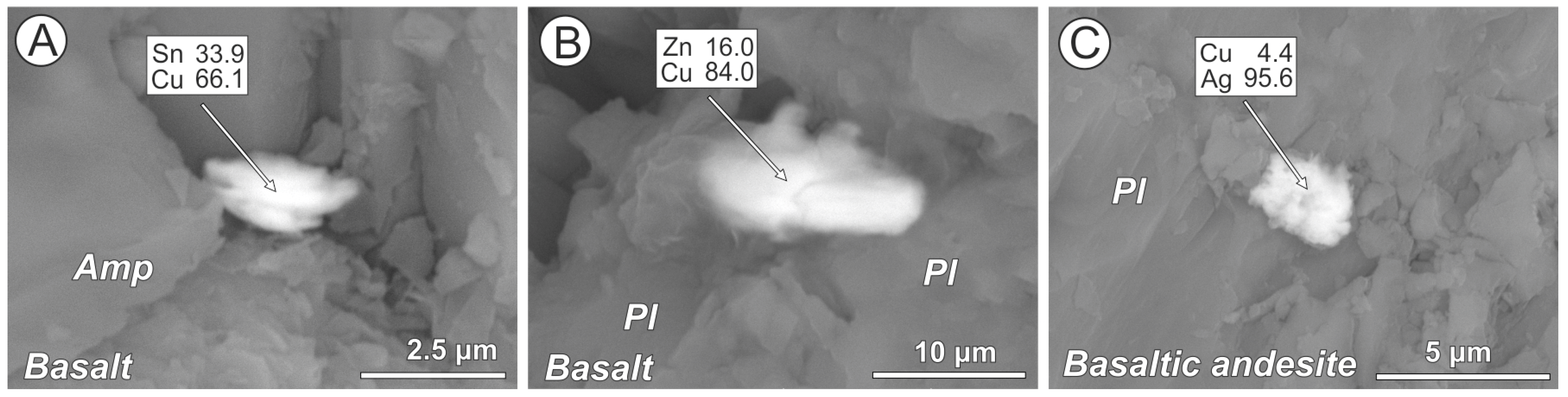
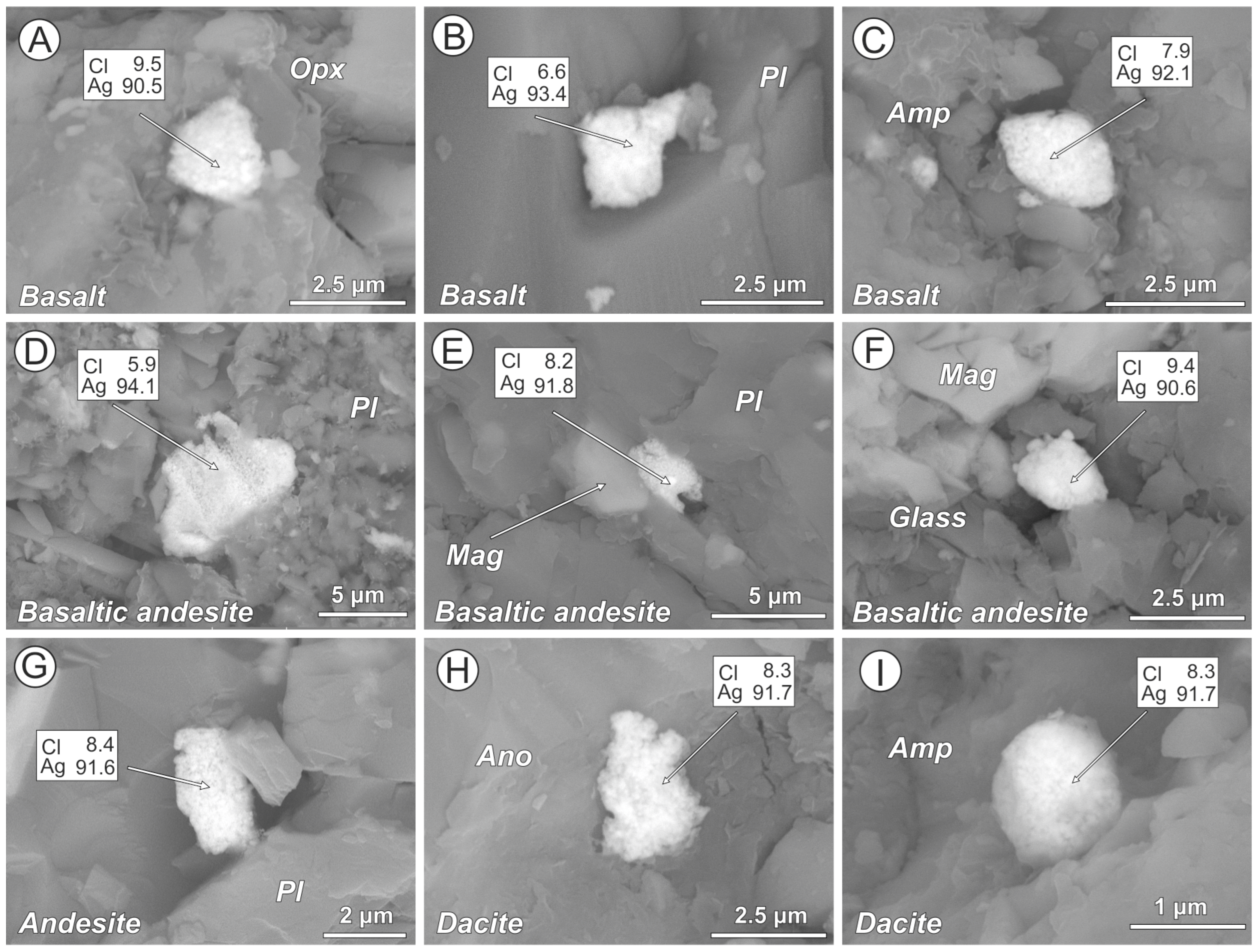
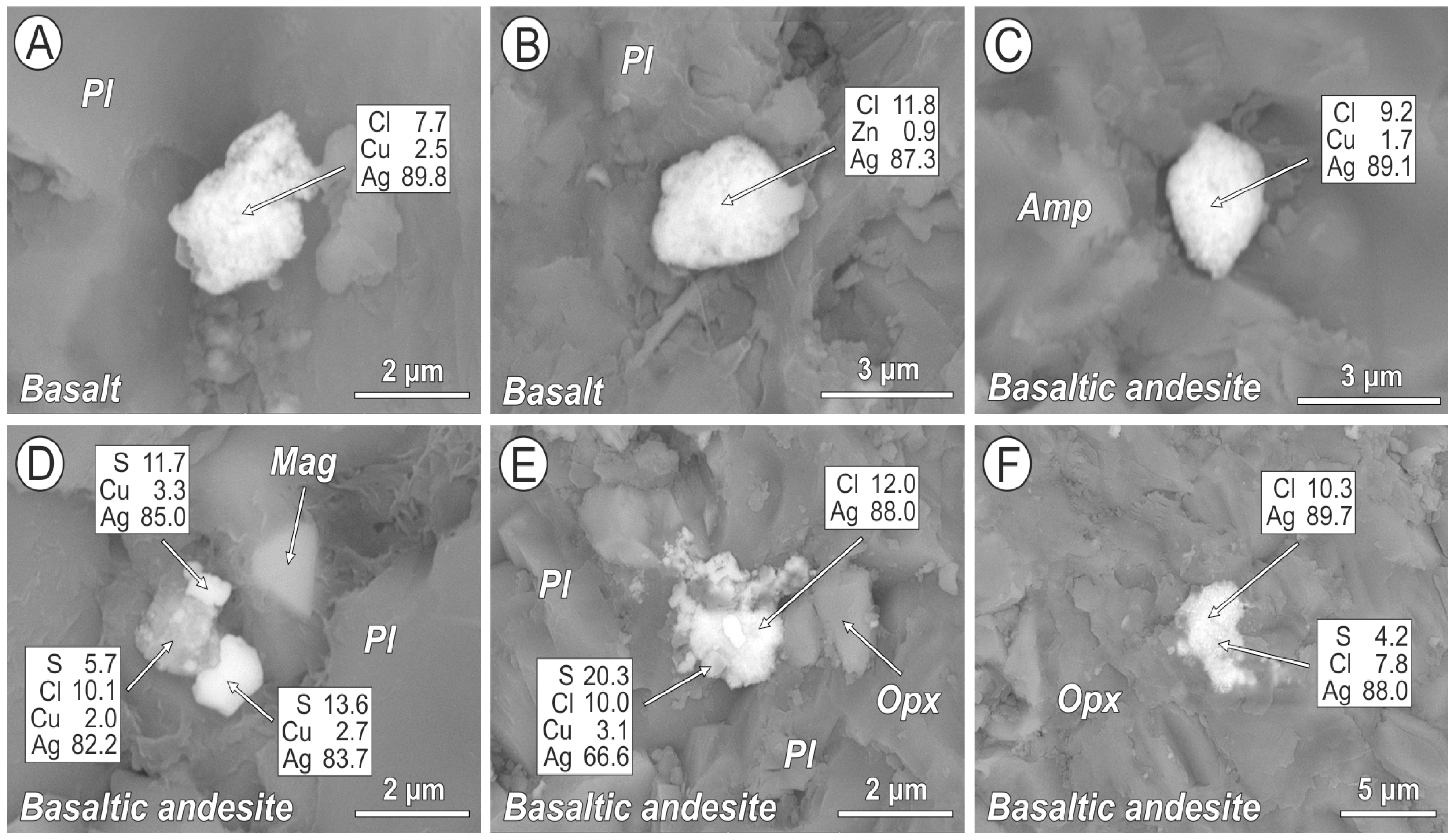
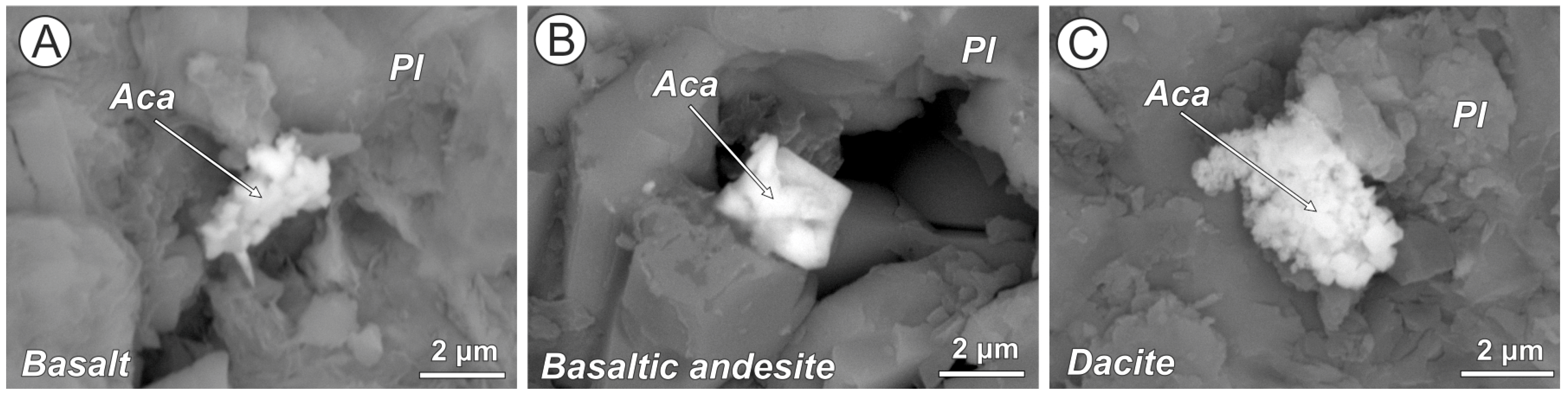
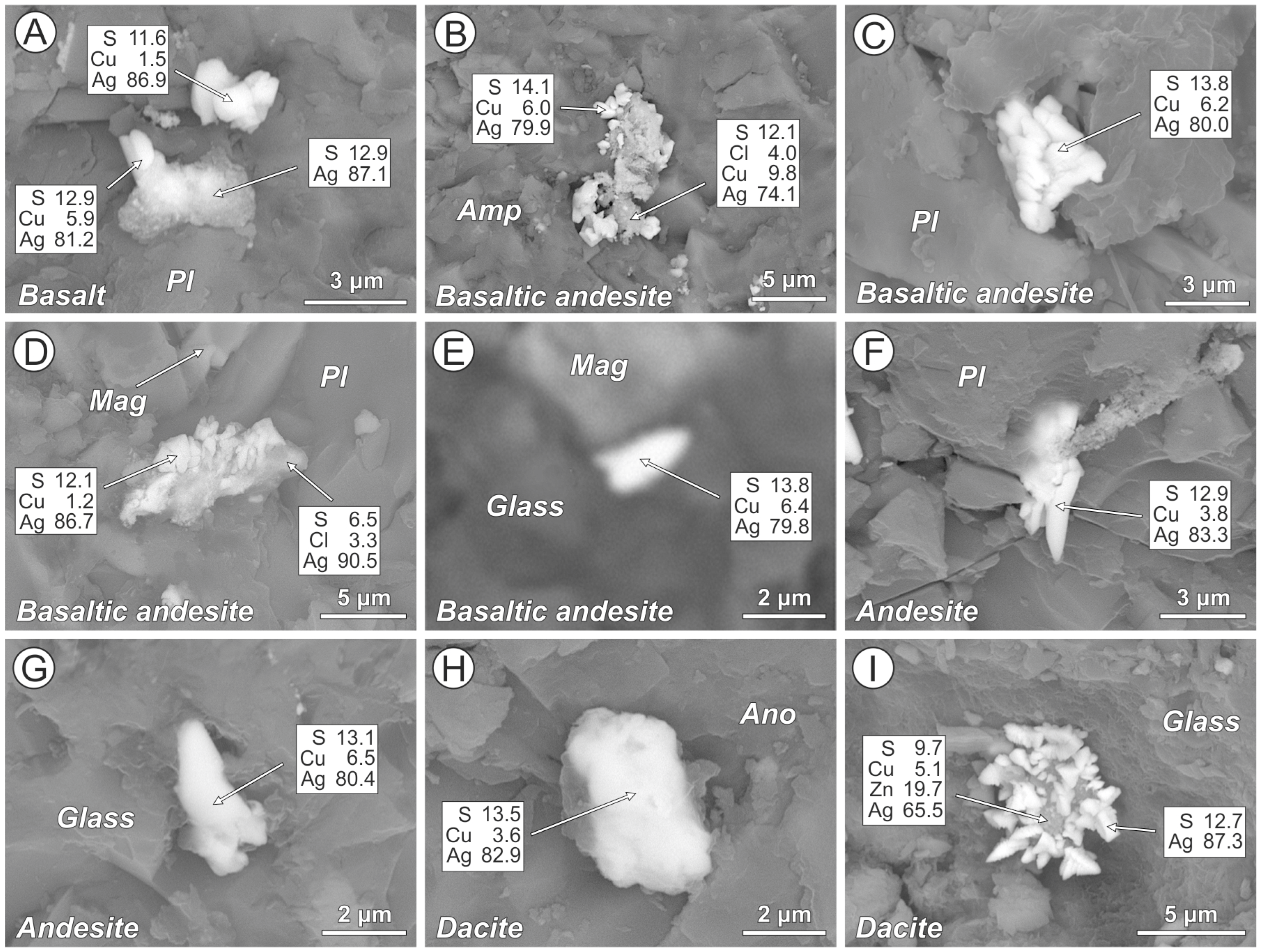
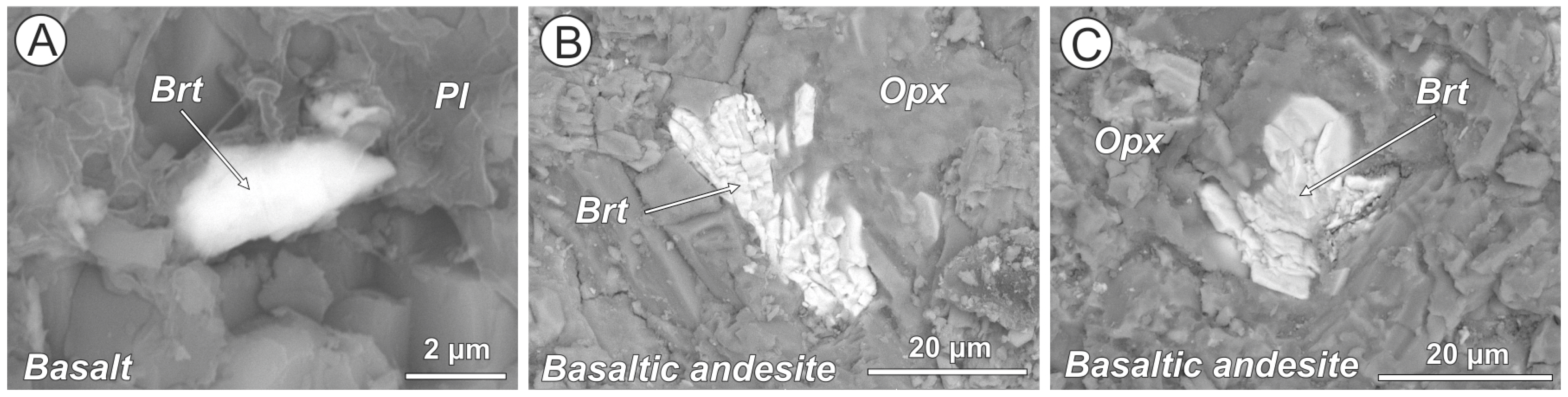
- Basalt, basaltic andesite, andesite and dacite lavas contain microinclusions of Cu-Zn-Sn-Ag alloys, acanthite, composite Cu-Ag and Cu-Zn-Ag sulfides and chlorides, along with Sn-Sb-Bi oxides and baryte. Proportions of Cu-Ag sulfide microminerals and bulk concentrations of Cu, Ag, Sn, Sb and Pb increase from basalt to dacite, potentially reflecting incompatible behavior of some chalcophile elements during magmatic differentiation.
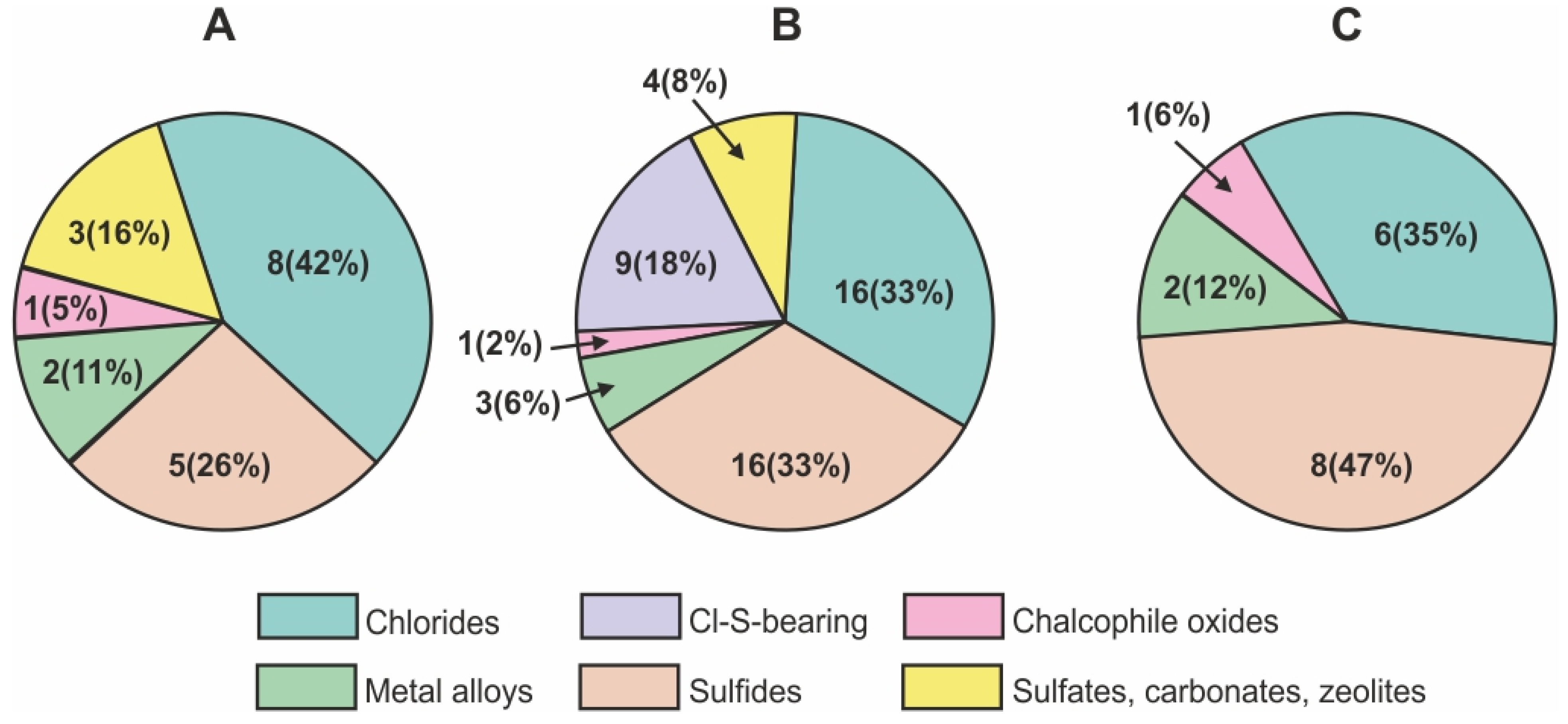
- Mutnovsky lavas are characterized by higher cumulative proportions of Cu-Ag chlorides and sulfides in comparison with calc-alkaline magma series in both frontal-arc and rear-arc volcanoes in the Kamchatka arc. The predominance of chalcophile metal chlorides and sulfides and enrichment of Mutnovsky volcanic rocks in Cu, Ag and Sb may indicate involvement of S-Cl-bearing fluids in crustal evolution of Kamchatka arc tholeiite magmas.
- Assemblages of microminerals in Mutnovsky lavas display certain similarities with ore mineral associations of epithermal and porphyry deposits in Kamchatka, which suggests that low-K tholeiitic magmas may be potentially linked to the evolution of magmatic–hydrothermal ore-forming systems beneath active and dormant volcanoes at convergent plate margins.
Author Contributions
Funding
Data Availability Statement
Acknowledgments
Conflicts of Interest
References
- White, N.C.; Leake, M.J.; McCaughey, S.N.; Parris, B.W. Epithermal gold deposits of the southwest Pacific. J. Geochem. Explor. 1995, 54, 87–136. [Google Scholar] [CrossRef] [Scilit]
- So, C.-S.; Dunchenko, V.Y.; Yun, S.-T.; Park, M.-E.; Choi, S.-G.; Shelton, K.L. Te- and Se-bearing epithermal Au-Ag mineralization, Prasolovskoye, Kunashir Island, Kuril island arc. Econ. Geol. 1995, 90, 105–117. [Google Scholar] [CrossRef] [Scilit]
- KIlias, S.P.; Naden, J.; Cheliotos, I.; Shepherd, T.J.; Constandinidou, H.; Crossing, J.; Simos, I. Epithermal gold mineralization in the active Aegean Volcanic Arc: The Profitis Illias deposit, Milos, Island, Greece. Mineral. Depos. 2001, 36, 32–44. [Google Scholar] [CrossRef] [Scilit]
- Kamenov, G.D.; Perfit, M.R.; Jonasson, I.R.; Mueller, P.A. High-precision Pb isotope measurements reveal magma recharge as a mechanism for ore deposit formation: Examples from Lihir Island and Conical seamount, Papua New Guinea. Chem. Geol. 2005, 219, 131–148. [Google Scholar] [CrossRef] [Scilit]
- Bortnikov, N.S.; Tolstykh, N.D. Epithermal deposits of Kamchatka, Russia. Geol. Ore Depos. 2023, 65, 124–152. [Google Scholar] [CrossRef] [Scilit]
- Henley, R.W.; Berger, B.R. Nature’s refineries—Metals and metalloids in arc volcanoes. Earth Sci. Rev. 2013, 125, 146–170. [Google Scholar] [CrossRef] [Scilit]
- Nadeau, O.; Stix, J.; Williams-Jones, A.E. Links between arc volcanoes and porphyry-epithermal ore deposits. Geology 2016, 44, 11–14. [Google Scholar] [CrossRef] [Scilit]
- Heald, P.; Foley, N.K.; Hayba, D.O. Comparative anatomy of volcanic-hosted epithermal deposits: Acid-sulfate and adularia-serecite types. Econ. Geol. 1987, 82, 1–26. [Google Scholar] [CrossRef] [Scilit]
- Boyce, A.J.; Fulignati, P.; Sbrana, A.; Fallick, A.E. Fluids in early stage hydrothermal alteration of high-sulfidation epithermal systems: A view from the Vulcano active hydrothermal system (Aeolian Island, Italy). J. Volcanol. Geotherm. Res. 2007, 166, 76–90. [Google Scholar] [CrossRef] [Scilit]
- Williams-Jones, A.E.; Heinrich, C.A. Vapor transport of metals and the formation of magmatic-hydrothermal ore deposits. Econ. Geol. 2005, 100, 1287–1312. [Google Scholar] [CrossRef]
- Richards, J.P. Magmatic to hydrothermal metal fluxes in convergent and collided margins. Ore Geol. Rev. 2011, 40, 1–26. [Google Scholar] [CrossRef] [Scilit]
- Audétat, A. The metal content of magmatic-hydrothermal fluids and its relationship to mineralization potential. Econ. Geol. 2019, 114, 1033–1056. [Google Scholar] [CrossRef] [Scilit]
- Grondahl, C.; Zajacz, Z. Sulfur and chlorine budgets control the ore fertility of arc magmas. Nat. Commun. 2022, 13, 4218. [Google Scholar] [CrossRef] [Scilit]
- Mafra, C.; Loucks, R.; Fiorentini, M. Distinctive source and hydration state of gold-ore-forming arc magmas. Geology 2025, 53, 195–200. [Google Scholar] [CrossRef] [Scilit]
- Tosdal, R.M.; Dilles, J.H.; Cooke, D.R. From source to sinks in auriferous magmatic-hydrothermal porphyry and epithermal deposits. Elements 2009, 5, 289–295. [Google Scholar] [CrossRef] [Scilit]
- Costa, S.; Fulignati, P.; Gioncada, A.; Pistolesi, M.; Bosch, D.; Bruguier, O. Tracking metal evolution in arc magmas: Insights from the active volcano of La Fossa, Italy. Lithos 2021, 380–381, 105851. [Google Scholar] [CrossRef] [Scilit]
- Cooke, D.R.; Simmons, S.F. Characteristics and genesis of epithermal gold deposits. Soc. Econ. Geol. Rev. 2000, 13, 221–244. [Google Scholar]
- Moncada, D.; Rimstidt, J.D.; Bodnar, R.J. How to form a giant epithermal precious metal deposit: Relationships between fluid flow rate, metal concentration of ore-forming fluids, duration of the ore-forming process, and ore grade and tonnage. Ore Geol. Rev. 2019, 113, 103066. [Google Scholar] [CrossRef] [Scilit]
- Richards, J.P. The oxidation state, and sulfur and Cu contents of arc magmas: Implications for metallogeny. Lithos 2015, 233, 27–45. [Google Scholar] [CrossRef] [Scilit]
- Park, J.-W.; Campbell, I.H.; Kim, J.; Moon, J.-W. The role of late sulfide saturation in the formation of a Cu- and Au-rich magma: Insights from the platinum group element geochemistry of Niuatahi-Motutahi lavas, Tonga rear arc. J. Petrol. 2015, 56, 59–81. [Google Scholar] [CrossRef] [Scilit]
- Evans, K.-A.; Tomkins, A.-G. The relationship between subduction zone redox budget and arc magma fertility. Earth Planet. Sci. Lett. 2011, 308, 401–409. [Google Scholar] [CrossRef] [Scilit]
- Rezeau, H.; Jagoutz, O. The importance of H2O in arc magmas for the formation of porphyry Cu deposits. Ore Geol. Rev. 2020, 126, 103744. [Google Scholar] [CrossRef] [Scilit]
- Blundy, J.; Cashman, K.V.; Rust, A.; Witham, F. A case for CO2-rich arc magmas. Earth Planet. Sci. Lett. 2010, 290, 289–301. [Google Scholar] [CrossRef] [Scilit]
- Farsang, S.; Zajacz, Z. Sulfur species and gold transport in arc magmatic fluids. Nat. Geosci. 2025, 18, 98–104. [Google Scholar] [CrossRef] [Scilit] [PubMed]
- Large, S.J.E.; Nathwani, C.L.; Wilkinson, J.J.; Knott, T.R.; Tapster, S.R.; Buret, Y. Tectonic and crustal processes drive multi-million year arc magma evolution leading up to porphyry copper deposit formation in Central Chile. J. Petrol. 2024, 65, egae023. [Google Scholar] [CrossRef] [Scilit]
- Tardani, D.; Tassara, S.; Sanchez-Alfaro, P.; Reich, M.; Pérez-Flóres, P.; Robidoux, P.; Contreras, C.; Pinti, D.L.; Cembrano, J.; Ague, J.J. The orientation of intra-arc crustal fault systems influences the copper budget of magmatic-hydrothermal fluids. Commun. Earth Environ. 2024, 5, 477. [Google Scholar] [CrossRef] [Scilit]
- Leong, T.S.J.; Mavrogenes, J.A.; Arculus, R.J. Water-sulfur-rich, oxidized adakite magmas are likely porphyry copper progenitors. Sci. Rep. 2023, 13, 5078. [Google Scholar] [CrossRef] [Scilit]
- Portnyagin, M.; Hoernle, K.; Plechov, P.; Mironov, N.; Khubunaya, S. Constraints on mantle melting and composition and nature of slab components in volcanic arcs from volatiles (H2O, S, Cl, F) and trace elements in melt inclusions from the Kamchatka Arc. Earth Planet. Sci. Lett. 2007, 255, 53–69. [Google Scholar] [CrossRef] [Scilit]
- Tolstykh, M.L.; Naumov, V.B.; Gavrilenko, M.G.; Ozerov, A.Y.; Kononkova, N.N. Chemical composition, volatile components, and trace elements in the melts of the Gorely volcanic center, southern Kamchatka: Evidence from inclusions in minerals. Geochem. Int. 2012, 50, 522–550. [Google Scholar] [CrossRef] [Scilit]
- Kepezhinskas, P.; Berdnikov, N.V.; Kepezhinskas, N.; Konovalova, N. Adakites, high-Nb basalts and copper-gold deposits in magmatic arcs and collisional orogens: An overview. Geosciences 2022, 12, 29. [Google Scholar] [CrossRef] [Scilit]
- Lander, A.V.; Shapiro, M.N. The origin of the modern Kamchatka subduction zone. In Volcanism and Subduction: The Kamchatka Region; Eichelberger, J., Gordeev, E., Izbekov, P., Kasahara, M., Lees, J., Eds.; Geophysical Monograph Series; American Geophysical Union: Washington, DC, USA, 2007; Volume 172, pp. 57–64. [Google Scholar]
- Harbert, W.; Kepezhinskas, P.; Krylov, K.; Grigoriev, V.; Sokolov, S.; Aleksuitin, M.; Heiphetz, A.; Layer, P. Paleomagnetism and tectonics of the Kamchatka region, Northeastern Russia: Implications for development and evolution of the Northwest Pacific Basin. Polarforschung 2000, 68, 297–308. [Google Scholar]
- Hochstaedter, A.G.; Kepezhinskas, P.K.; Defant, M.J.; Drummond, M.S.; Bellon, H. On the tectonic significance of arc volcanism in Northern Kamchatka. J. Geol. 1994, 102, 639–654. [Google Scholar] [CrossRef] [Scilit]
- Ponomareva, V.; Melekestsev, I.; Braitseva, O.; Churikova, T.; Pevzner, M.; Sulerzhitsky, L. Late Pleistocene-Holocene volcanism on the Kamchatka Peninsula, Northwest Pacific Region. In Volcanism and Subduction: The Kamchatka Region; Eichelberger, J., Gordeev, E., Izbekov, P., Kasahara, M., Lees, J., Eds.; Geophysical Monograph Series; American Geophysical Union: Washington, DC, USA, 2007; Volume 172, pp. 165–198. [Google Scholar] [CrossRef] [Scilit]
- Kepezhinskas, P.; McDermott, F.; Defant, M.J.; Hochstaedter, A.; Drummond, M.S.; Hawkesworth, C.J.; Koloskov, A.; Maury, R.C.; Bellon, H. Trace element and Sr-Nd-Pb isotopic constraints on a three-component model of Kamchatka Arc petrogenesis. Geochim. Cosmochim. Acta 1997, 61, 577–600. [Google Scholar] [CrossRef] [Scilit]
- Simon, A.; Yogodzinski, G.M.; Robertson, K.; Smith, E.; Selyangin, O.; Kiryukhin, A.; Mulcahy, S.R.; Walker, J.D. Evolution and genesis of volcanic rocks from Mutnovsky Volcano, Kamchatka. J. Volcanol. Geotherm. Res. 2014, 286, 116–137. [Google Scholar] [CrossRef] [Scilit]
- Selyangin, O.B. Mutnovsky volcano, Kamchatka: New evidence on structure, evolution, and future activity. Volcanol. Seismol. 1993, 15, 17–38. [Google Scholar]
- Zelenski, M.; Taran, Y. Geochemistry of volcanic and hydrothermal gases of Mutnovsky volcano, Kamchatka: Evidence for mantle, slab and atmosphere contributions to fluids of a typical arc volcano. Bull. Volcanol. 2011, 73, 373–394. [Google Scholar] [CrossRef] [Scilit]
- Zelenski, M.; Bortnikova, S. Sublimate speciation at Mutnovsky volcano, Kamchatka. Eur. J. Mineral. 2005, 17, 107–118. [Google Scholar] [CrossRef] [Scilit]
- Krutikova, V.O.; Berdnikov, N.V.; Kepezhinskas, P.K. Metal and mineral microinclusions in rocks: Research finding interpretation and application to the study of magmatic systems of Kamchatka and Stanovoi fold belt. Russ. J. Pac. Geol. 2024, 18, 37–49. [Google Scholar] [CrossRef] [Scilit]
- Krutikova, V.O.; Berdnikov, N.V.; Kepezhinskas, P.K. Microminerals as complimentary guides into metallogeny and the ore-forming potential of igneous rocks: Evidence from the Stanovoy superterrane (Russian Far East). Minerals 2025, 15, 504. [Google Scholar] [CrossRef] [Scilit]
- Whitney, D.L.; Evans, B.W. Abbreviations for names of rock-forming minerals. Amer. Mineral. 2010, 95, 185–187. [Google Scholar] [CrossRef] [Scilit]
- Warr, L.N. IMA-CNMNC approved mineral symbols. Mineral. Mag. 2021, 85, 291–320. [Google Scholar] [CrossRef] [Scilit]
- Berdnikov, N.; Kepezhinskas, P.; Nevstruev, V.; Krutikova, V.; Konovalova, N. Explosive ultramafic volcanism in Phanerozoic accreted terranes: A case study of the Taragai peridotite complex (Russian Far East). J. Asian Earth Sci. 2025, 281, 106503. [Google Scholar] [CrossRef] [Scilit]
- Le Bas, M.J.; Le Maitre, R.W.; Streckeisen, A.; Zanettin, B. A chemical classification of volcanic rocks based on the total alkalie-silica diagram. J. Petrol. 1986, 27, 745–750. [Google Scholar] [CrossRef] [Scilit]
- Peccerillo, A.; Taylor, S.R. Geochemistry of Eocene calc-alkaline volcanic rocks from the Kastamonu area, Northern Turkey. Contrib. Mineral. Petrol. 1976, 58, 63–81. [Google Scholar] [CrossRef] [Scilit]
- Irvine, T.N.; Baragar, W.R.A. A guide to the chemical classification of the common volcanic rocks. Can. J. Earth Sci. 1971, 8, 523–548. [Google Scholar] [CrossRef] [Scilit]
- McDonough, W.F.; Sun, S.-s. The composition of the Earth. Chem. Geol. 1995, 120, 223–253. [Google Scholar] [CrossRef] [Scilit]
- Perfit, M.R.; Gust, D.A.; Bence, A.E.; Arculus, R.J.; Taylor, S.R. Chemical characteristics of island-arc basalts: Implications for mantle sources. Chem. Geol. 1980, 30, 227–256. [Google Scholar] [CrossRef] [Scilit]
- Hamada, M.; Okayama, Y.; Kaneko, T.; Yasuda, A.; Fujii, T. Polybaric crystallization differentiation of H2O-saturated island arc low-K tholeiite magmas: A case study of the Izu-Oshima volcano in the Izu arc. Earth Planet. Sp. 2014, 66, 15. [Google Scholar] [CrossRef] [Scilit]
- Hochstaedter, A.G.; Kepezhinskas, P.K.; Defant, M.J.; Drummond, M.S.; Koloskov, A.V. Insights into the volcanic arc mantle wedge from magnesia lavas from the Kamchatka arc. J. Geophys. Res. 1996, 101, 697–712. [Google Scholar] [CrossRef] [Scilit]
- Gorbach, N.; Tobelko, D.; Ovsyannikov, G.; Rogozin, A.; Shcherbakov, V.; Plechova, A.; Portnyagin, M. Kronotsky Volcano—A low K end-member frontal volcano in Kamchatka: Geological structure and composition of rocks and minerals. J. Volcanol. Geotherm. Res. 2025, 467, 108430. [Google Scholar] [CrossRef] [Scilit]
- Workman, R.K.; Hart, S.R. Major and trace element composition of the depleted MORB mantle (DMM). Earth Planet. Sci. Lett. 2005, 231, 53–72. [Google Scholar] [CrossRef] [Scilit]
- Sun, S.-s.; McDonough, W.F. Chemical and isotopic systematics of oceanic basalts: Implications for mantle composition and processes. Geol. Soc. London Spec. Publ. 1989, 42, 313–345. [Google Scholar] [CrossRef] [Scilit]
- Pearce, J.A.; Baker, P.E.; Harvey, P.K.; Luff, I.W. Geochemical evidence for subduction fluxes, mantle melting and fractional crystallization beneath the South Sandwich island arc. J. Petrol. 1995, 36, 1073–1109. [Google Scholar] [CrossRef] [Scilit]
- Belovezhets, N.; Berezhnev, Y.; Abramenkov, S.; Abkadyrov, I.; Dergach, P.; Khmarin, E.; Chebrov, D.; Koulakov, I. Crustal sources of geothermal and magmatic activity in the area of Mutnovsky-Gorely volcanic complex (Kamchatka) inferred from ambient noise tomography. J. Geophys. Res. 2025, 131, e2025JB032025. [Google Scholar] [CrossRef] [Scilit]
- Eichelberger, J.; Kiryukhin, A.; Simon, A. Magma-hydrothermal system at Mutnovsky volcano, Kamchatka Peninsula, Russia. Sci. Drill. 2009, 7, 54–59. [Google Scholar] [CrossRef]
- Shevko, A.Y.; Gora, M.P.; Shevko, E.P.; Bortnikova, S.B. Forms of occurrence of metals and metalloids in products of the gas-hydrothermal activity of Mutnovsky volcano. Dokl. Earth Sci. 2025, 515, 541–545. [Google Scholar] [CrossRef] [Scilit]
- Zhitova, E.S.; Khanin, D.A.; Nuzhdaev, A.A.; Nazarova, M.A.; Ismagilova, R.M.; Shilovskikh, V.V.; Kupchinenko, A.N.; Kuznetsov, R.A.; Zhegunov, P.S. Efflorescent sulphates with M+ and M2+ cations from fumarole and active geothermal fields of Mutnovsky volcano (Kamchatka, Russia). Minerals 2022, 12, 600. [Google Scholar] [CrossRef] [Scilit]
- Webster, J.D.; De Vivo, B. Experimental and modeled solubility of chlorine in aluminosilicate melts, consequences of magma evolution, and implications for exsolution of hydrous chloride melt at Somma-Vesuvius. Amer. Mineral. 2002, 87, 1046–1061. [Google Scholar] [CrossRef] [Scilit]
- Hui, K.; Rottier, B.; Qin, K.; Zajacz, Z.; Tsay, A.; Zhao, J.; Gao, S.; Shi, R. Silver behavior during magmatic and magmatic-hydrothermal evolution of a highly evolved reduced granitic system related to the giant Shuangjianzishan Ag-Pb-Zn-(Sn) epithermal deposit, Northeast China. Econ. Geol. 2024, 119, 59–83. [Google Scholar] [CrossRef] [Scilit]
- Yin, Y.; Zajacz, Z. The solubility of silver in magmatic fluids: Implications for silver transfer to the magmatic-hydrothermal ore-forming environment. Geochim. Cosmochim. Acta 2018, 238, 235–251. [Google Scholar] [CrossRef] [Scilit]
- Shishkina, T. Storage Conditions and Degassing Processes of Low-K and High-Al Tholeiitic Island-Arc Magmas: Experimental Constraints and Natural Observations for Mutnovsky Volcano, Kamchatka. Ph.D. Thesis, Universität Hannover, Hannover, Germany, 2012. [Google Scholar]
- Borchardt, J.S.; Lee, C.-T.A. The chlorine evolution of arc magmas and the crustal water filter. Earth Planet. Sci. Lett. 2024, 648, 119048. [Google Scholar] [CrossRef] [Scilit]
- Keppler, H. Experimental evidence for the source of excess sulfur in explosive volcanic eruptions. Science 1999, 284, 1652–1654. [Google Scholar] [CrossRef] [Scilit]
- Ding, S.; Longpré, M.-A.; Economos, R.; Jackson, Y.; Vidal, C.-M.; Komorowski, J.-C.; Monteleone, B. Redox and magma recharge controls on excess sulfur build-up at Mount Samalas, 1257CE. Nat. Commun. 2025, 16, 9256. [Google Scholar] [CrossRef] [Scilit]
- Kepezhinskas, P.K.; Potapova, N.V.; Berdnikov, N.V. Microminerals as evidence for metallogenic specialization and ore potential of Quaternary lavas from the Gorely volcano (Kamchatka). J. Volcanol. Seismol. 2025, 5, 72–88. [Google Scholar] [CrossRef] [Scilit]
- Kepezhinskas, P.; Berdnikov, N.; Krutikova, V.; Kozhemyako, N. Iron-titanium oxide-apatite-sulfide-sulfate microinclusions in gabbro and adakite from the Russian Far East indicate possible magmatic links to iron oxide-apatite and iron oxide-copper-gold deposits. Minerals 2024, 14, 188. [Google Scholar] [CrossRef] [Scilit]
- Pekov, I.V.; Zubkova, N.V.; Koshlyakova, N.N.; Belakovskiy, D.I.; Vigasina, M.F.; Agakhanov, A.A.; Britvin, S.N.; Turchkova, A.G.; Sidorov, E.G.; Zhegunov, P.S.; et al. Achyrophanite, (K,Na)3(Fe3+,Ti,Al,Mg)5O2(AsO4)5, a new mineral with the novel structure type from fumarolic exhalations of the Tolbachik volcano, Kamchatka, Russia. Minerals 2025, 15, 706. [Google Scholar] [CrossRef] [Scilit]
- Sandalov, F.D.; Pekov, I.V.; Koshlyakova, N.N.; Latyshev, A.V.; Zhegunov, P.S. Hematite from fumaroles of the Tolbachik volcano (Kamchatka, Russia): Chemistry, relationships with associated minerals, morphological and genetic features. Geol. Ore Deposits 2024, 66, 1145–1166. [Google Scholar] [CrossRef] [Scilit]
- Pekov, I.V.; Britvin, S.N.; Agakhanov, A.A.; Vigasina, M.F.; Turchkova, A.G.; Zhegunov, P.S. Paramolybdomenite, PbSeO3, a new mineral dimorphous with molybdomenite from the Tolbachik volcano, Kamchatka, Russia. Mineral. Mag. 2025, 1–22. [Google Scholar] [CrossRef] [Scilit]
- Nestola, F.; Kasatkin, A.V.; Biagioni, C.; Gurzhiy, V.V.; Skoda, R.; Santelio, L.; Agakhanov, A.A. Manuelarossiite, CaPbAlF7, a new fluoride from the Vesuvius volcano, Italy. Mineral. Mag. 2025, 89, 133–140. [Google Scholar] [CrossRef] [Scilit]
- Rychagov, S.N.; Sandimirova, E.I.; Chernov, M.S.; Kravchenko, O.V.; Sergeeva, A.V. Mineral formation at the East Pauzhetka thermal field (South Kamchtka) as an indication of influence of a deep-seated alkaline fluid and an epithermal ore-forming system. Russ. Geol. Geophys. 2023, 64, 210–230. [Google Scholar] [CrossRef] [Scilit]
- Sergeeva, A.V.; Rychagov, S.N.; Kravchenko, O.V.; Sandimirova, E.I.; Nazarova, M.A.; Kartasheva, E.V.; Kuzmina, A.A. Mineral and geochemical features of zeolite-siliceous deposits at the Pauzhetka geothermal field, Southern Kamchatka. J. Volcanol. Seismol. 2024, 18, 32–47. [Google Scholar] [CrossRef] [Scilit]
- Vladimirtseva, O.V.; Bergal-Kuvikas, O.; Subbotin, N.A.; Orlov, S.Y. New data on the copper mineralization of the Pribrezhny volcanic complex of Southern Kamchatka. Russ. J. Pacific Geol. 2025, 19, S99–S108. [Google Scholar] [CrossRef] [Scilit]
- Okrugin, V.M.; Vymazalová, A.; Kozlov, V.V.; Laufek, F.; Stanley, S.J.; Shkilev, I.A. Svetlanite, SnSe, a new mineral from the Ozernovskoe deposit, Kamchatka peninsula, Russia. Mineral. Mag. 2022, 86, 234–242. [Google Scholar] [CrossRef] [Scilit]
- Tolstykh, N.; Bukhanova, D.; Shapovalova, M.; Borovikov, A.; Podlipsky, M. The gold mineralization of the Baranyevskoe Au-Ag epithermal deposit in Central Kamchatka. Minerals 2021, 11, 1225. [Google Scholar] [CrossRef] [Scilit]
- Tolstykh, N.; Shapovalova, M.; Shaparenko, E.; Bukhanova, D. The role of selenium and hydrocarbons in Au-Ag ore formation in the Rodnikovoe low-sulfidation (LS) epithermal deposit, Kamchatka Peninsula, Russia. Minerals 2022, 12, 1418. [Google Scholar] [CrossRef] [Scilit]
- Borovikov, A.A.; Lapukhov, A.S.; Borisenko, A.S.; Seryotkin, Y.V. The Asachinskoe epithermal Au-Ag deposit in southern Kamchatka: Physicochemical conditions of formation. Russ. Geol. Geophys. 2009, 50, 693–702. [Google Scholar] [CrossRef] [Scilit]
- Nathwani, C.; Blundy, J.; Large, S.J.E.; Wilkinson, J.J.; Buret, Y.; Loader, Y.; Tavazzani, L.; Chelle-Michou, C. A zircon case for super-wet arc magmas. Nat. Commun. 2024, 15, 8982. [Google Scholar] [CrossRef] [Scilit]
- Colin, A.; Schmidt, C.; Pokrovski, G.S.; Wilke, M.; Borisova, A.Y.; Toplis, M.J. In situ determination of sulfur speciation and partitioning in aqueous fluid-silicate melt systems. Geochem. Persp. Lett. 2020, 14, 31–35. [Google Scholar] [CrossRef] [Scilit]
- Kesler, S.E. Metallogenic evolution of convergent margins: Selected ore deposit models. Ore Geol. Rev. 1997, 12, 151–171. [Google Scholar] [CrossRef] [Scilit]
- Sillitoe, R.H.; Perelló, J. Andean copper province: Tectonomagmatic settings, deposit types, metallogeny, exploration, and discovery. Econ. Geol. 2005, 100, 845–890. [Google Scholar]
- Belgrano, T.M.; Milton, J.A.; Diamond, L.W.; Wolf, R.C.; Kusano, Y.; Teagle, D.A.H. Metallogeny of subduction initiation revealed by chalcophile element behavior in the Samail ophiolte. Earth Planet. Sci. Lett. 2025, 667, 119486. [Google Scholar] [CrossRef] [Scilit]
- Du Bray, E.A.; John, D.A. Petrologic, tectonic, and metallogenic evolution of the Ancestral Cascades magmatic arc, Washington, Oregon, and northern California. Geosphere 2011, 7, 1102–1133. [Google Scholar] [CrossRef]
- Liu, H.; Xiao, Y.; Sun, H.; Tong, F.; Heuser, A.; Churikova, T.; Wörner, G. Trace elements and Li isotope compositions across the Kamchatka arc: Constraints on slab-derived fluid sources. J. Geophys. Res. 2020, 125, e2019JB019237. [Google Scholar] [CrossRef] [Scilit]
- Cox, D.; Watt, S.F.L.; Jenner, F.E.; Hastie, A.R.; Hammond, S.J. Chalcophile element processing beneath a continental arc stratovolcano. Earth Planet. Sci. Lett. 2019, 522, 1–11. [Google Scholar] [CrossRef] [Scilit]
- Kepezhinskas, P.; Berdnikov, N.; Voinova, I.; Kepezhinskas, N.; Potapova, N.; Krutikova, V. Cl-bearing mineral microinclusions in arc lavas: An overview of recent findings with some metallogenic implications. Geosciences 2026, 16, 40. [Google Scholar] [CrossRef] [Scilit]
- Rudnick, R.L.; Gao, S. Composition of the continental crust. In Treatise on Geochemistry; Elsevier: Amsterdam, The Netherlands, 2014; Volume 3, pp. 1–64. [Google Scholar]
- Jenner, F.E. Cumulate causes for the low contents of sulfide-loving elements in the continental crust. Nat. Geosci. 2017, 10, 524–529. [Google Scholar] [CrossRef] [Scilit]
- Moroz, Y.F.; Gontovaya, L.I. Deep structure of Kamchatka according to the results of MT sounding and seismic tomography. Russ. J. Pacific Geol. 2017, 11, 354–367. [Google Scholar] [CrossRef] [Scilit]
- Fu, S.; Zajacz, Z.; Tsay, A.; Hu, R. Can magma degassing at depth donate the metal budget of large hydrothermal Sb deposits? Geochim. Cosmochim. Acta 2020, 290, 1–15. [Google Scholar] [CrossRef] [Scilit]
- Skilskaya, E.D.; Sergeeva, A.V.; Zobenko, O.A.; Chernev, I.I. Geochemical characteristics and the ore potential of the Mutnovsky geothermal field, Southern Kamchatka. J. Volcanol. Seismol. 2025, 19, 435–450. [Google Scholar] [CrossRef] [Scilit]
- Bortnikova, S.B.; Garvrilenko, G.M.; Bessonova, E.P.; Lapukhov, A.S. The hydrogeochemistry of thermal springs on Mutnovskii volcano, Southern Kamchatka. J. Volcanol. Seismol. 2009, 3, 388–404. [Google Scholar] [CrossRef] [Scilit]
- Lattanzi, P.; Okrugin, V.M.; Corsini, F.; Ignatiev, A.; Okrugina, A.; Tschubarov, V.; Livi, S. Geology, mineralogy and geochemistry of base and precious metal mineralization in the Mutnovsky area, Kamchatka, Russia. SEG Discov. 1995, 20, 1–9. [Google Scholar] [CrossRef] [Scilit]






| Sample | MTN-4 | MTN-6 | MTN-5 | MTN-7 | MTN-3 | MTN-2 | MTN-1 |
|---|---|---|---|---|---|---|---|
| Rock type | Basalt | Basaltic andesite | Basaltic andesite | Basaltic andesite | Basaltic andesite | Andesite | Dacite |
| SiO2 | 52.14 | 53.20 | 54.51 | 54.67 | 55.88 | 62.33 | 63.56 |
| TiO2 | 0.99 | 1.31 | 1.16 | 1.43 | 0.97 | 0.91 | 0.60 |
| Al2O3 | 18.41 | 16.11 | 15.03 | 16.94 | 15.96 | 15.77 | 16.38 |
| Fe2O3 | 10.43 | 12.39 | 11.26 | 11.74 | 10.07 | 7.49 | 5.93 |
| MnO | 0.18 | 0.20 | 0.18 | 0.21 | 0.16 | 0.13 | 0.12 |
| MgO | 3.61 | 3.91 | 3.36 | 2.70 | 3.30 | 1.39 | 1.06 |
| CaO | 9.90 | 8.62 | 8.66 | 8.25 | 8.82 | 6.61 | 4.77 |
| Na2O | 2.49 | 2.70 | 2.61 | 2.99 | 2.62 | 3.07 | 4.24 |
| K2O | 0.38 | 0.42 | 0.37 | 0.41 | 0.61 | 1.66 | 1.87 |
| P2O5 | 0.15 | 0.19 | 0.18 | 0.20 | 0.17 | 0.16 | 0.20 |
| LOI | 1.02 | 0.34 | 2.54 | 0.18 | 0.94 | 0.36 | 1.30 |
| Total | 99.69 | 99.40 | 99.85 | 99.72 | 99.50 | 99.86 | 100.02 |
| Cr | 52.25 | 51.54 | 45.38 | 34.74 | 75.81 | 109.45 | 54.50 |
| Ni | 7.57 | 8.04 | 6.20 | 4.41 | 24.27 | 10.72 | 4.84 |
| Co | 26.57 | 29.76 | 23.88 | 24.21 | 28.12 | 17.26 | 18.74 |
| V | 262.51 | 294.71 | 236.31 | 256.54 | 198.30 | 141.04 | 88.71 |
| Sc | 26.82 | 30.01 | 25.88 | 30.32 | 22.41 | 18.07 | 10.80 |
| Li | 2.92 | 5.20 | 6.08 | 6.14 | 4.09 | 13.18 | 6.27 |
| Cs | 0.16 | 0.43 | 0.41 | 0.38 | 0.42 | 2.12 | 1.29 |
| Rb | 3.08 | 5.30 | 5.00 | 3.78 | 6.47 | 30.06 | 23.30 |
| Ba | 133.49 | 920.92 | 166.13 | 160.00 | 211.72 | 405.05 | 369.52 |
| Sr | 352.59 | 336.67 | 315.59 | 342.09 | 333.36 | 309.43 | 246.04 |
| Zr | 38.72 | 52.76 | 44.09 | 50.02 | 51.23 | 118.64 | 55.05 |
| Y | 15.47 | 20.63 | 17.04 | 25.23 | 15.94 | 24.28 | 13.07 |
| Nb | 0.89 | 0.98 | 1.13 | 0.77 | 1.29 | 2.57 | 1.76 |
| Ta | 0.24 | 0.32 | 0.20 | 0.16 | 0.26 | 0.34 | 0.46 |
| Hf | 1.28 | 1.76 | 1.42 | 1.75 | 1.55 | 3.78 | 1.74 |
| Th | 0.37 | 0.31 | 0.52 | 0.29 | 0.51 | 2.16 | 1.94 |
| U | 0.17 | 0.15 | 0.19 | 0.14 | 0.22 | 0.95 | 0.84 |
| La | 3.98 | 4.79 | 5.16 | 5.87 | 6.02 | 11.35 | 7.64 |
| Ce | 10.25 | 12.91 | 12.70 | 13.84 | 14.40 | 26.35 | 16.21 |
| Pr | 1.77 | 2.32 | 2.17 | 2.81 | 2.30 | 4.00 | 2.32 |
| Nd | 8.48 | 11.45 | 10.02 | 13.81 | 10.32 | 17.04 | 9.58 |
| Sm | 2.55 | 3.49 | 2.89 | 4.24 | 2.82 | 4.42 | 2.45 |
| Eu | 0.89 | 1.18 | 1.00 | 1.35 | 0.95 | 1.13 | 0.83 |
| Gd | 3.07 | 4.11 | 3.48 | 4.99 | 3.36 | 5.03 | 2.76 |
| Tb | 0.53 | 0.72 | 0.59 | 0.87 | 0.56 | 0.83 | 0.45 |
| Dy | 2.97 | 4.05 | 3.29 | 4.84 | 3.05 | 4.55 | 2.49 |
| Ho | 0.67 | 0.92 | 0.75 | 1.10 | 0.69 | 1.03 | 0.55 |
| Er | 1.85 | 2.53 | 2.08 | 3.02 | 1.95 | 2.85 | 1.57 |
| Tm | 0.29 | 0.39 | 0.32 | 0.46 | 0.30 | 0.45 | 0.26 |
| Yb | 1.79 | 2.37 | 1.91 | 2.81 | 1.80 | 2.74 | 1.67 |
| Lu | 0.29 | 0.39 | 0.32 | 0.46 | 0.29 | 0.45 | 0.28 |
| Cu | 16.45 | 106.54 | 99.34 | 91.58 | 71.89 | 59.82 | 20.09 |
| Zn | 49.50 | 81.49 | 60.88 | 68.04 | 54.63 | 56.49 | 63.40 |
| Mo | 0.62 | 0.68 | 0.58 | 0.68 | 1.13 | 2.16 | 1.00 |
| Ag | 0.39 | 0.30 | 0.25 | 0.63 | 0.39 | 0.48 | 0.38 |
| Sn | 0.76 | 1.12 | 0.62 | 0.81 | 0.84 | 1.24 | 2.65 |
| Sb | 0.42 | 0.23 | 0.12 | 0.34 | 0.17 | 0.66 | 0.40 |
| As | 1.29 | 1.41 | 1.34 | 1.67 | 1.38 | 1.26 | 1.33 |
| Pb | 2.33 | 3.67 | 3.13 | 3.21 | 3.75 | 7.85 | 6.59 |
| Cd | 0.06 | 0.09 | 0.08 | 0.09 | 0.11 | 0.06 | 0.06 |
| Bi | <0.001 | <0.001 | <0.001 | <0.001 | <0.001 | 0.03 | 0.02 |
| Volcano | Tectonic Setting | Rock Types | Metal and Mineral Microinclusions | Host and Associated Minerals |
|---|---|---|---|---|
| Mutnovsky | Volcanic arc front | Basalt, basaltic andesite, andesite, dacite | Cu-Ag, Cu-Sn and Cu-Zn alloys; Cag + native Ag composites; Cu-Ag-Cl, Zn-Ag-Cl, Cu-Ag-Cl-S, Zn-Cu-Ag-Cl-S compounds; Cst; Bis; Cer; Vln | Ol; Cpx; Opx; Pl; Ano; Ab; Qz; Ap; Ti-Mag; Mag; Ttn; Brt; Zeo |
| Gorely | Rear arc | Basalt, basaltic andesite, andesite, dacite | Native Ag and Au; Cu-Ag, Cu-Sn, Cu-In-Sn and Fe-W alloys; Cag + native Ag composites; U-Ag-Cl, Cu-Ag-Cl; Cu-U-Ag-Cl-S, Cu-Ag-Sn-Cl-S, Cu-Ag-Sn-Cl and Cu-Ag-Cl-S compounds; Aca; Po; Gn; Cu-Ag sulfides; Ni-Cu-Fe sulfides; Cst | Ol; Opx; Cpx; Amp; Pl; Ano; Kfs; Bt; Ser; Ab; Qz; Ti-Mag; Mag; Ilm; Spl; Ap; Bdy; Zrn; Brt |
| Bakening | Rear arc | Dacite | Native Cu; Cu-Sn, Cu-Ag, Cu-Ag-Au and Ti-Co-W alloys; Ag-Cl, Cu-Cl, Cu-Ag-Cl-S compounds; Cu-Ag sulfides; Po; Py; Ccp; Bis; Cst; Znc; Cer; Str; Bmc | Opx; Amp; Bt; Pl; Ano; Qz; Ti-Mag; Mag; Ilm; Rt; Cr-Fe-Spl Cl-Ap; Bdy; Zrn; Brt; Mnz; REE-silicates |
| Volcano/Deposit Type | Ore Minerals and Microminerals | Host and Associated Minerals |
|---|---|---|
| Mutnovsky volcano | Cu-Ag, Cu-Sn and Cu-Zn alloys; native Ag; Cag; Cu-Ag-Cl, Zn-Ag-Cl, Cu-Ag-Cl-S, Zn-Cu-Ag-Cl-S compounds; Cst | Ol; Cpx; Opx; Pl; Ano; Ab; Qz; Ap; Ti-Mag; Mag; Ttn; Brt; Zeo |
| Epithermal deposits | Py; Gn; Sp; Aca; Cag; Tnt-Ttr; native Au and Ag; Au-Ag, Cu-Ag, Cu-Sn and Cu-Zn alloys; Au, Ag and Pb tellurides, selenides, bismuthites and antimonides; Ag, Sn, Sb and As sulfosalts; Ccp; Bn; Cct; Cv; Apy; Sbn; Cu-Ag sulfides; Au, Ag, Pb and Bi sulfides; native Cu; Cst | Qz; Cal; Adl; Alu; Kln; Ano; Or; Pl; Ab; Ms; Chl; Ep; Act; Ser; Ap; Mag; Brt; Anh; Zeo |
| Porphyry deposits | Py; Po,; Ccp; Cct; Bn; Dg; native Au (± Cu, Pd); Cu-Ag alloys; Sp; Cu-Ag sulfides; platinum-group minerals; Gn; Mol; Cst; Mlc; Azu | Bt; Or; Cpx; Pl; Ab; Ep; Act; Rt; Hem; Mag; Ap; Chl; Ttn; Cal; Kln; Anh; Brt |
Disclaimer/Publisher’s Note: The statements, opinions and data contained in all publications are solely those of the individual author(s) and contributor(s) and not of MDPI and/or the editor(s). MDPI and/or the editor(s) disclaim responsibility for any injury to people or property resulting from any ideas, methods, instructions or products referred to in the content. |
© 2026 by the authors. Licensee MDPI, Basel, Switzerland. This article is an open access article distributed under the terms and conditions of the Creative Commons Attribution (CC BY) license.
Share and Cite
Potapova, N.; Kepezhinskas, P.; Berdnikov, N. Metallogeny of Low-K Tholeiitic Magmas in Volcanic Arcs: Inferences from Petrology, Geochemistry and Micromineralogy of the Modern Mutnovsky Volcano Lavas (Kamchatka, Russia). Minerals 2026, 16, 332. https://doi.org/10.3390/min16030332
Potapova N, Kepezhinskas P, Berdnikov N. Metallogeny of Low-K Tholeiitic Magmas in Volcanic Arcs: Inferences from Petrology, Geochemistry and Micromineralogy of the Modern Mutnovsky Volcano Lavas (Kamchatka, Russia). Minerals. 2026; 16(3):332. https://doi.org/10.3390/min16030332
Chicago/Turabian StylePotapova, Nadezhda, Pavel Kepezhinskas, and Nikolai Berdnikov. 2026. "Metallogeny of Low-K Tholeiitic Magmas in Volcanic Arcs: Inferences from Petrology, Geochemistry and Micromineralogy of the Modern Mutnovsky Volcano Lavas (Kamchatka, Russia)" Minerals 16, no. 3: 332. https://doi.org/10.3390/min16030332
APA StylePotapova, N., Kepezhinskas, P., & Berdnikov, N. (2026). Metallogeny of Low-K Tholeiitic Magmas in Volcanic Arcs: Inferences from Petrology, Geochemistry and Micromineralogy of the Modern Mutnovsky Volcano Lavas (Kamchatka, Russia). Minerals, 16(3), 332. https://doi.org/10.3390/min16030332