Development of Braided River Delta–Shallow Lacustrine Siliciclastic–Carbonate Mixed Sedimentation in the Upper Ganchaigou Formation, Huatugou Oilfield, Qaidam Basin, China

Abstract
1. Introduction
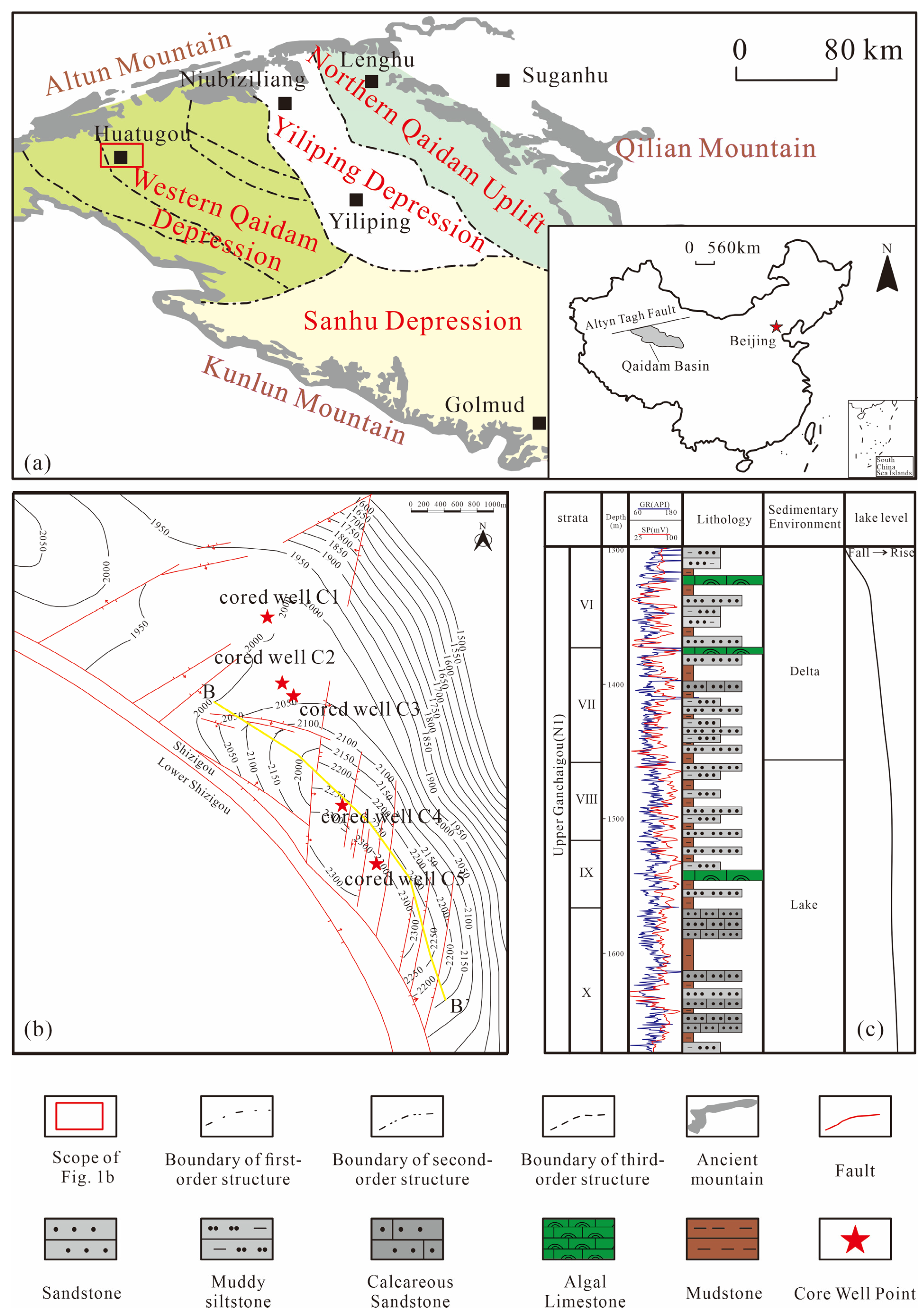
2. Regional Geological Background
3. Materials and Methods
4. Results
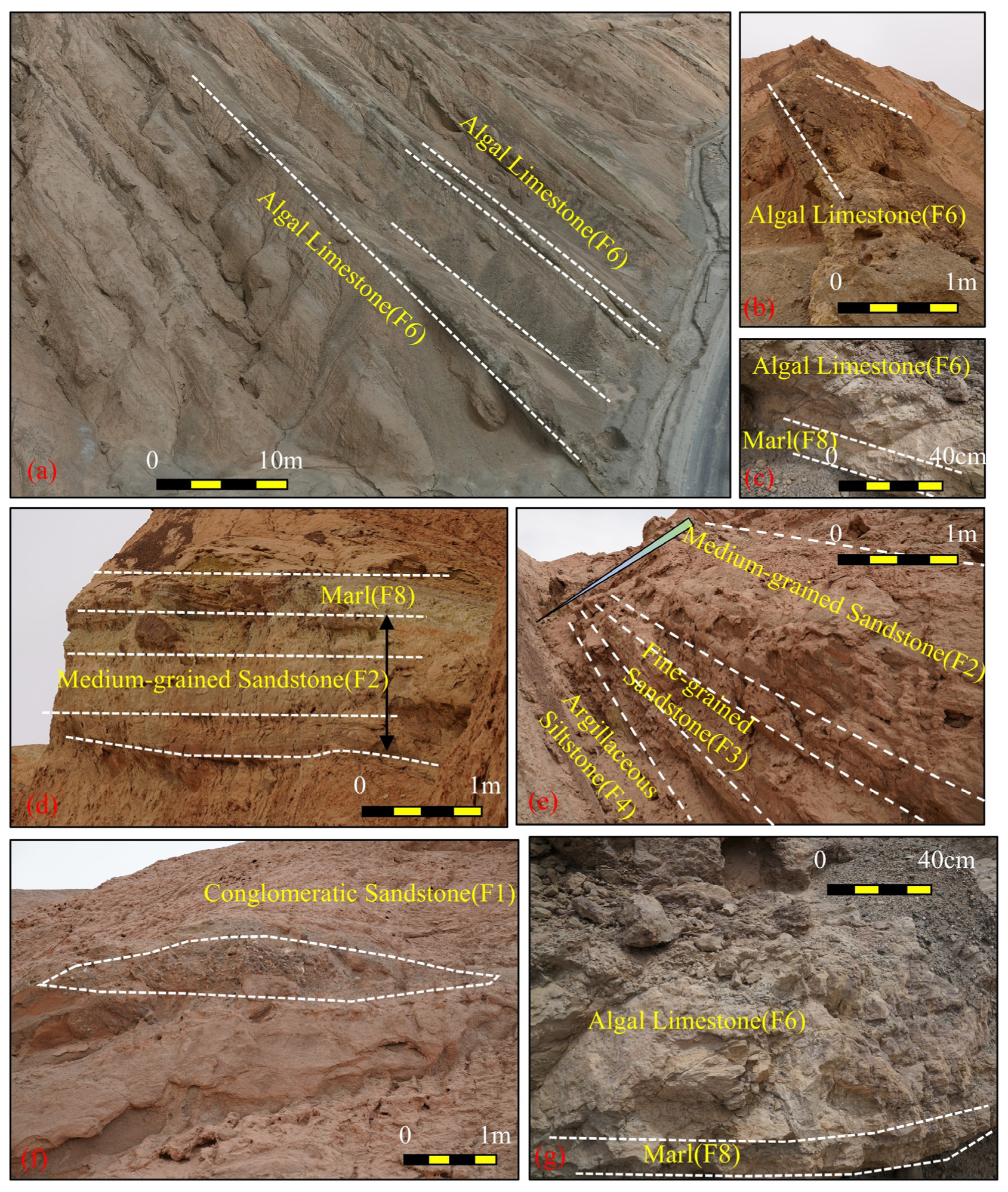
4.1. Field Outcropping Characteristics
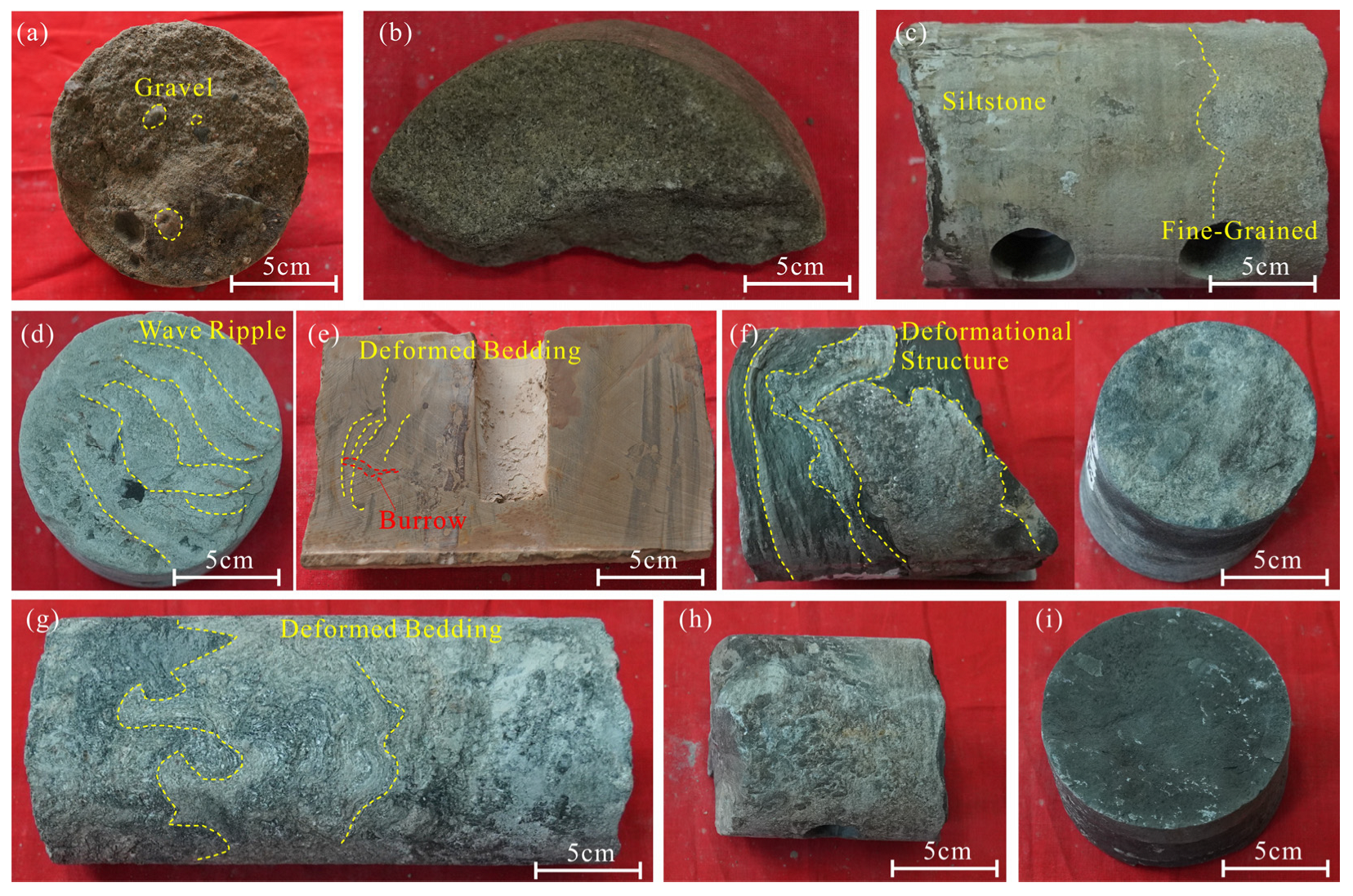
4.2. Lithofacies Characteristics
4.2.1. Clastic Lithofacies
- Gravelly sandstone facies (F1):
- Medium-to coarse-grained sandstone facies (F2):
- Fine sandstone facies (F3):
- Siltstone facies/muddy siltstone facies (F4):
- Mudstone facies (F5):
4.2.2. Mixed Sedimentary Facies
- Mixed sandstone facies (F7):
- Marl facies (F8):
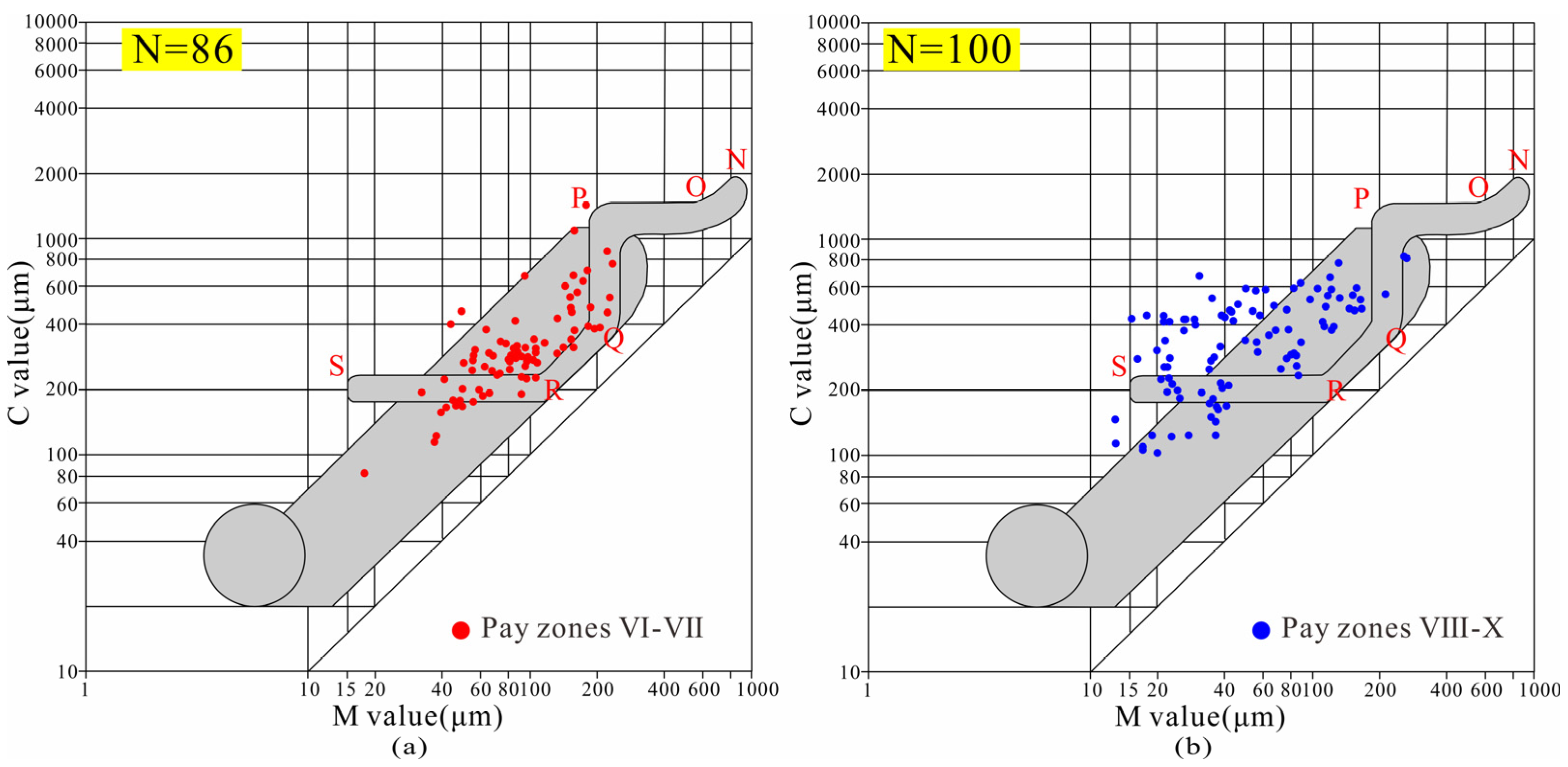
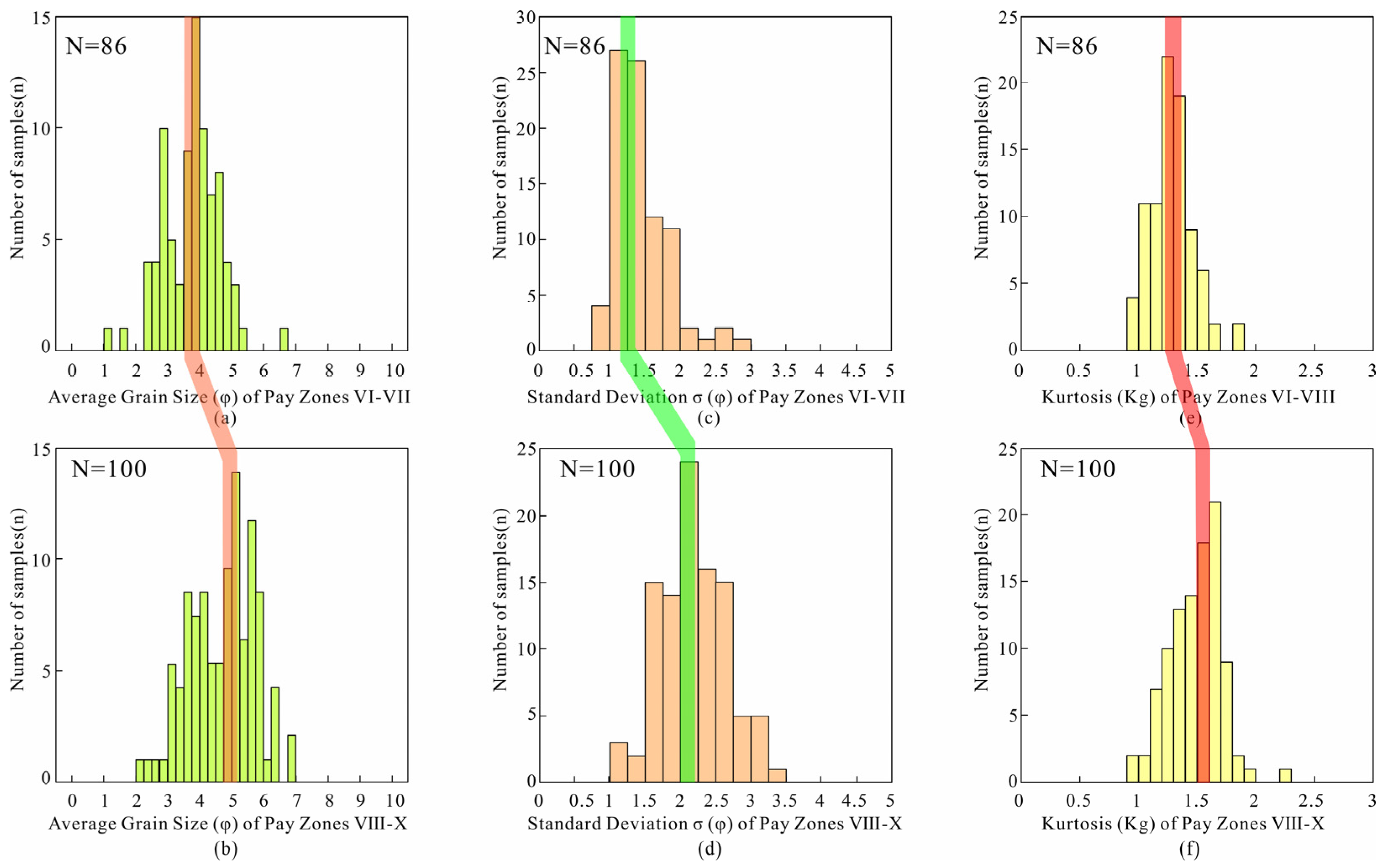
4.3. Sediment Grain Size and Dynamics
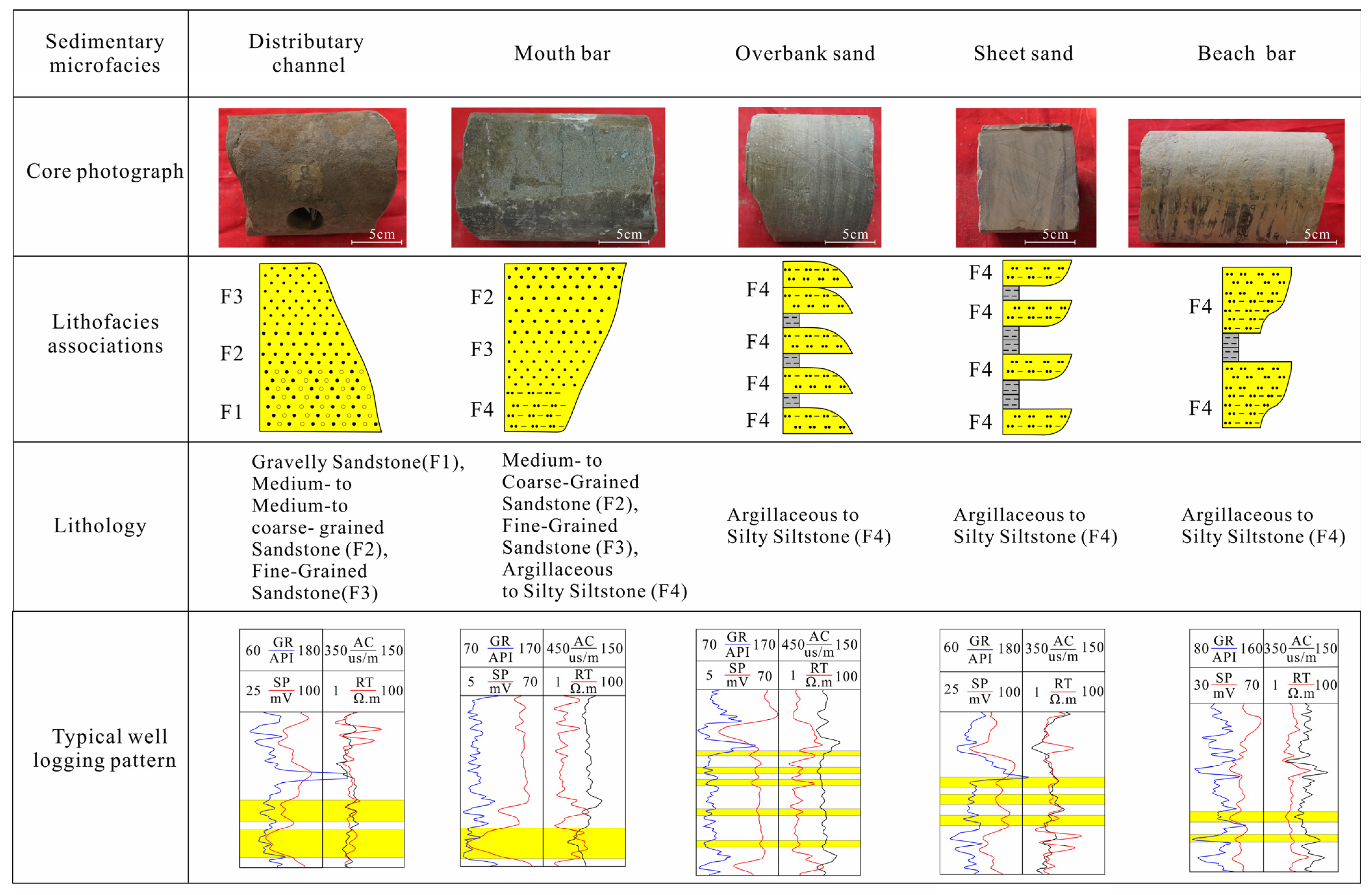
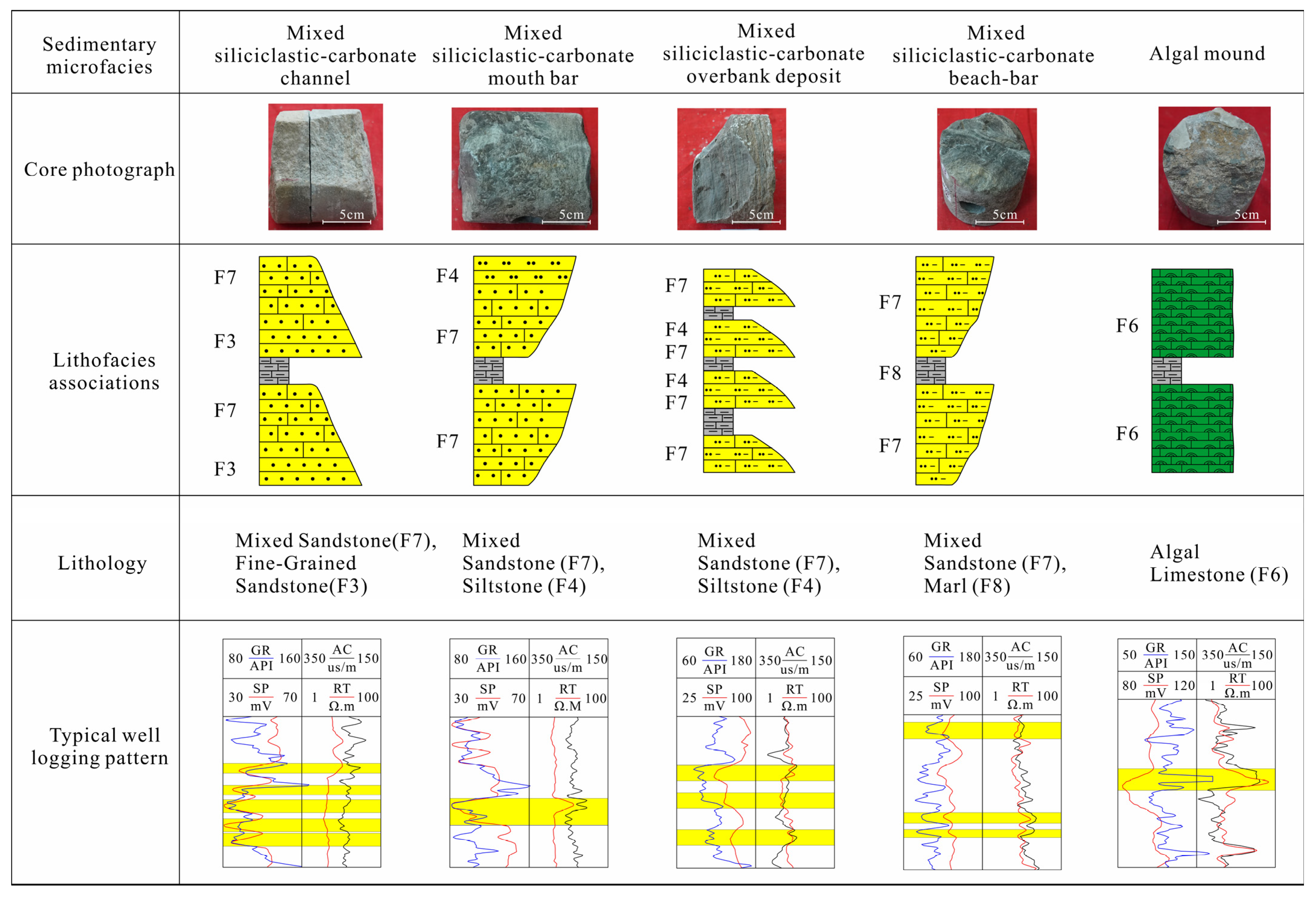
4.4. Sedimentary Microfacies Classification and Description
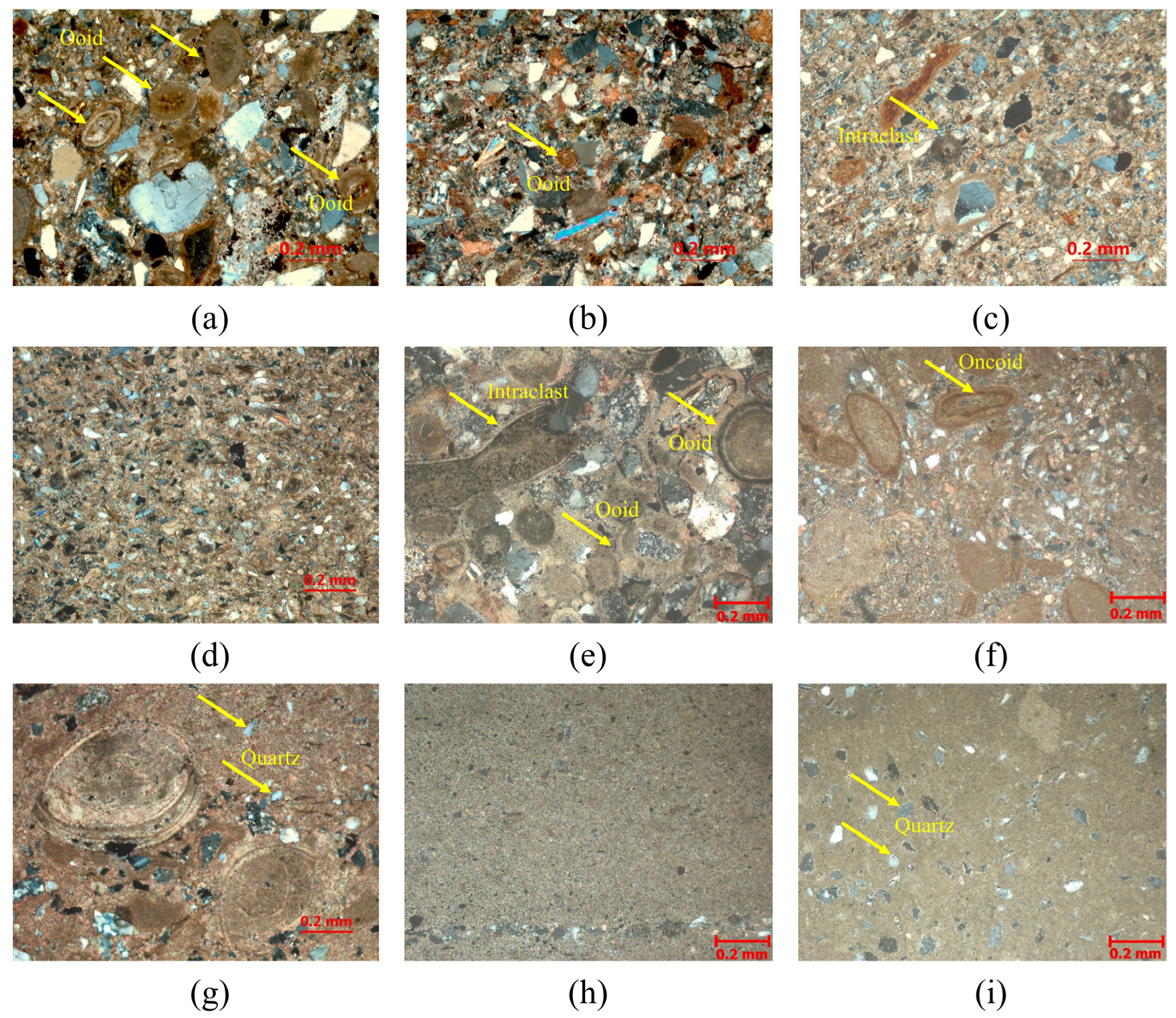
4.5. Mixed Sedimentary Characteristics
- (1)
- Component type mixed rocks
- (2)
- Sequence-Type Mixed Sedimentary Rock
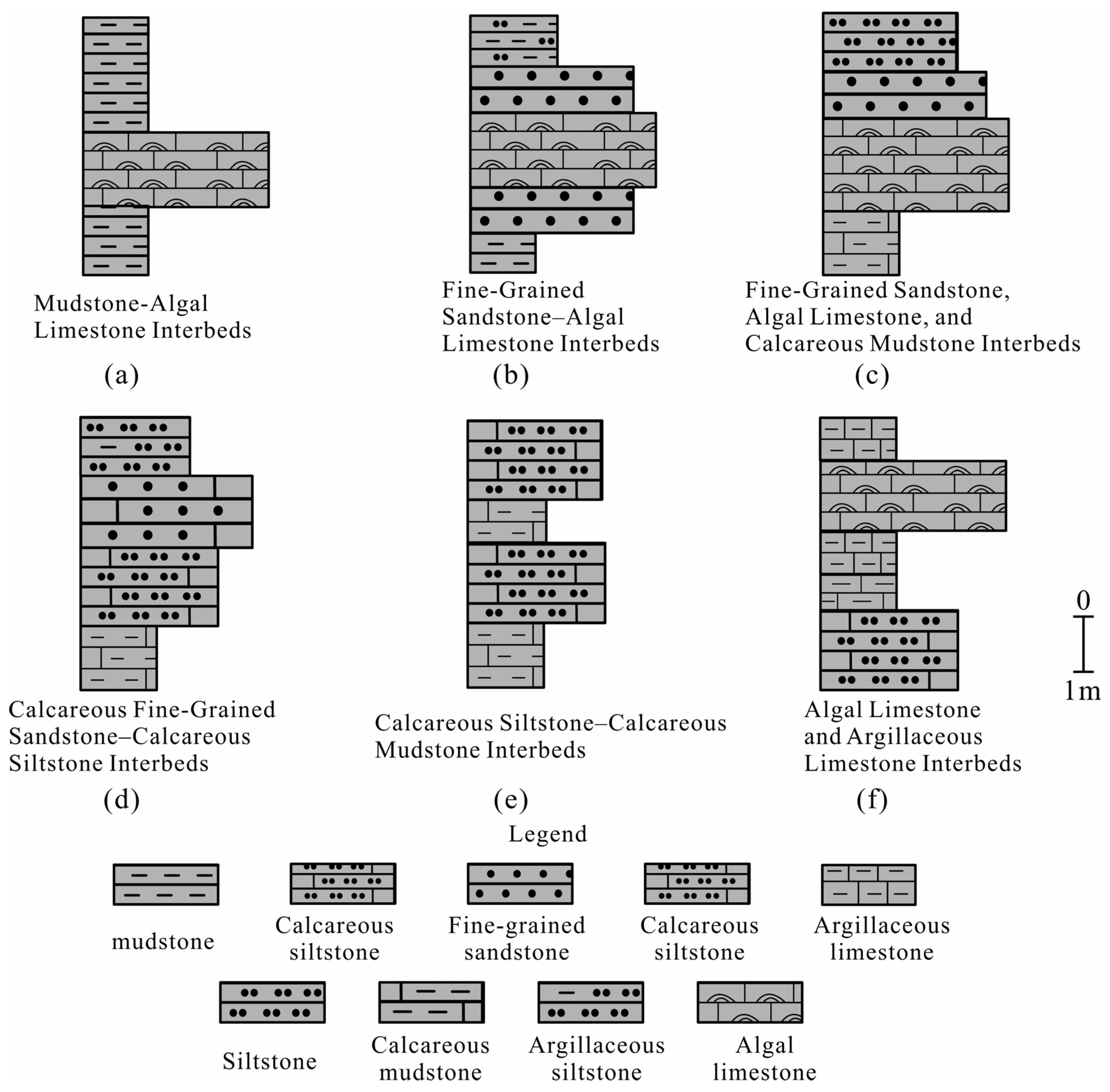
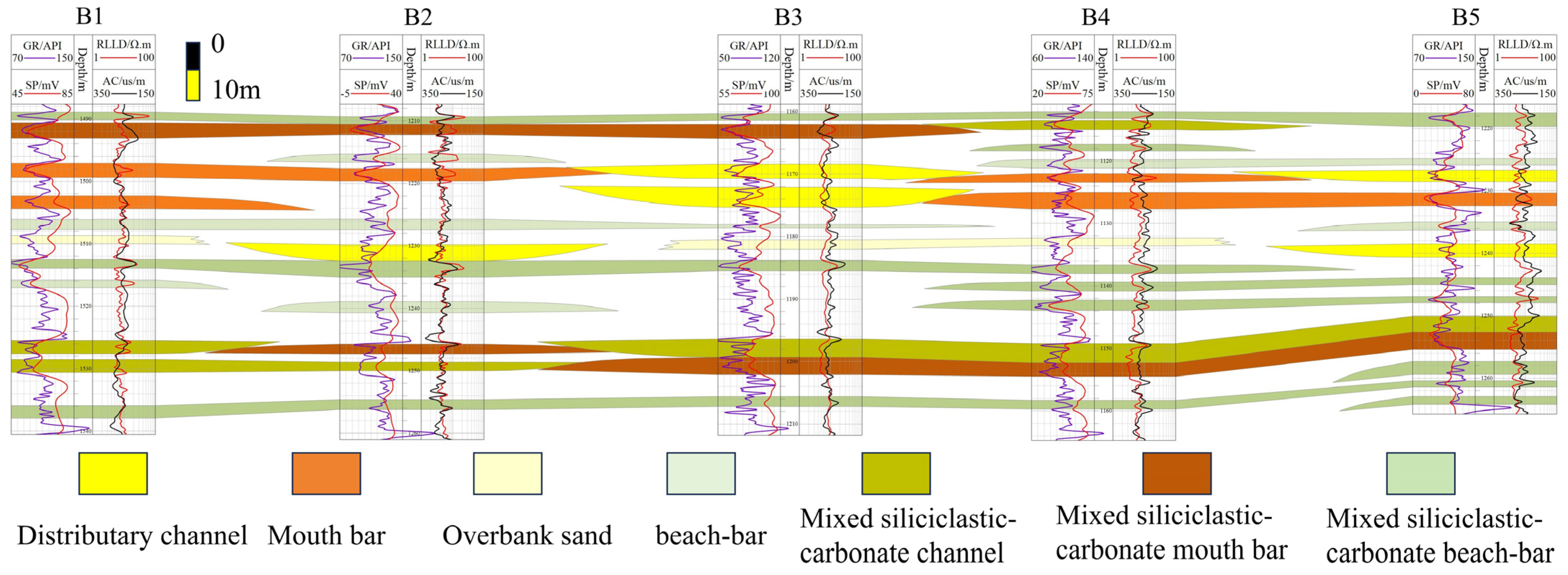
4.6. Vertical Evolution Sequence
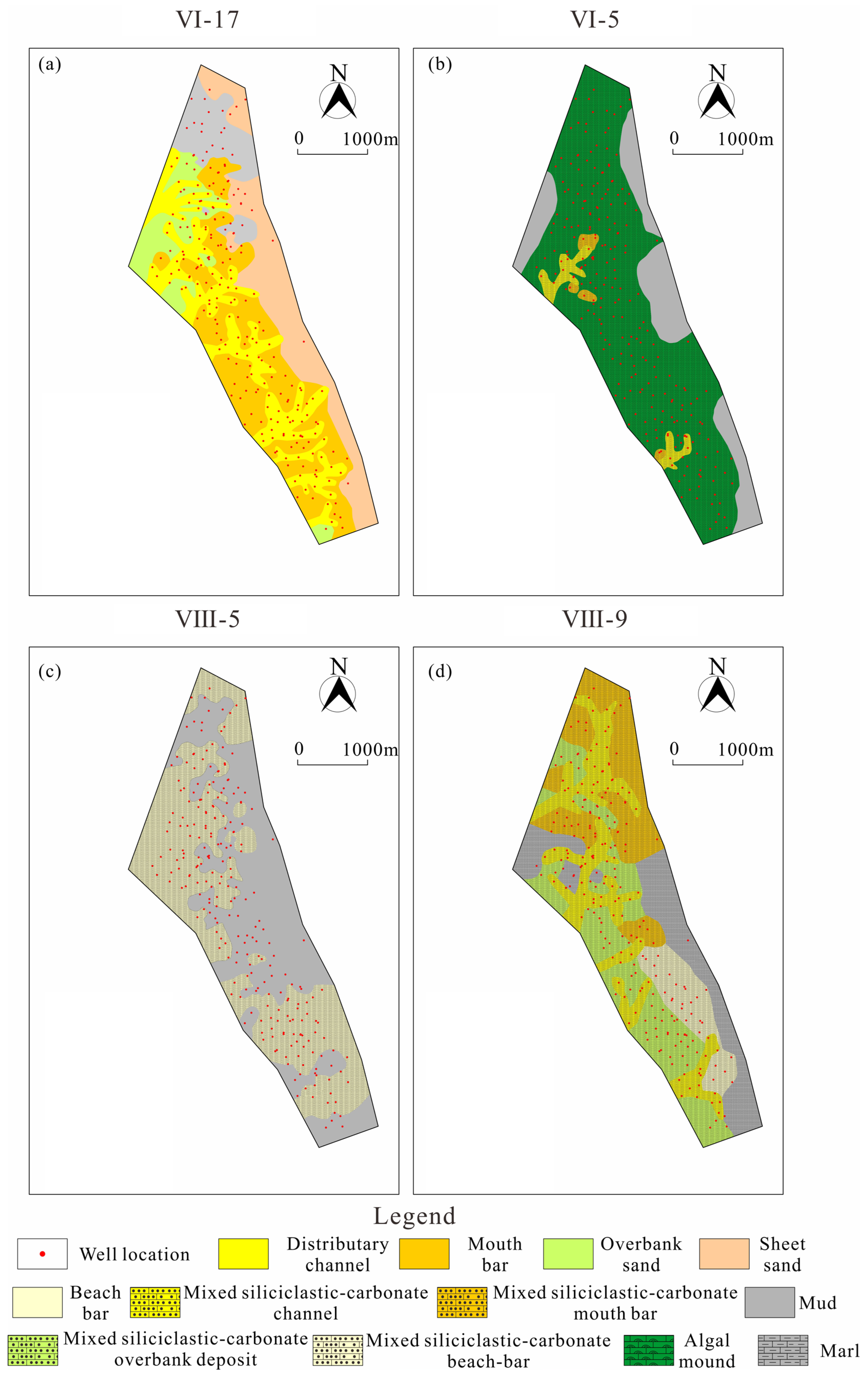
4.7. Planar Sedimentary Distribution
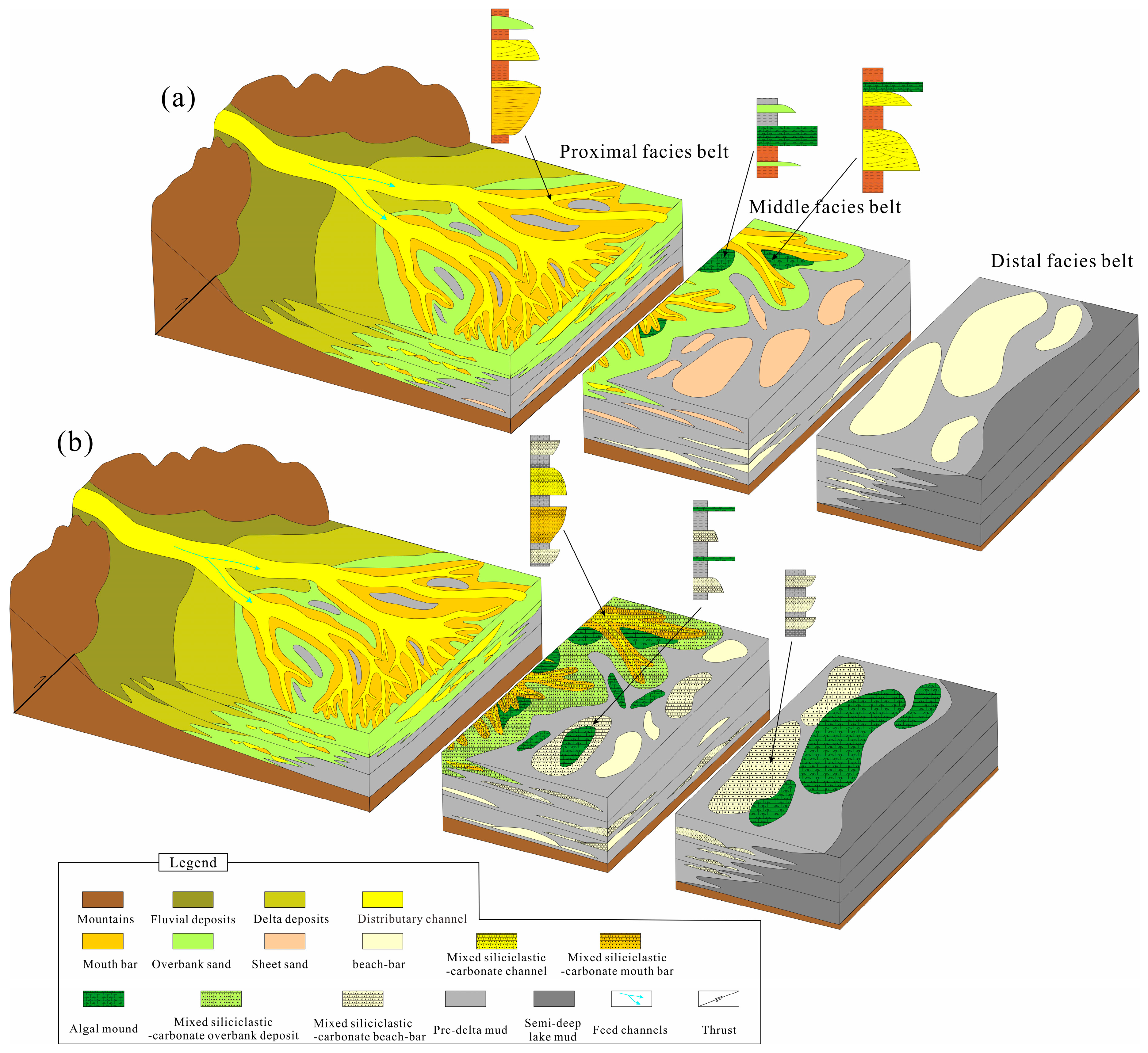
4.8. Mixed Sedimentary Models
4.8.1. Sedimentary Model of the VI–VII Oil Formations
4.8.2. Sedimentary Model of the VIII–X Oil Formations
5. Discussion
5.1. Coupling Mechanism of “Sediment Supply–Lake Level” and Its Control on Mixed Sedimentary Characteristics
5.2. Mixed Siliciclastic–Carbonate Depositional Model of a Braided River Delta–Littoral-Shallow Lacustrine System
6. Conclusions
- (1)
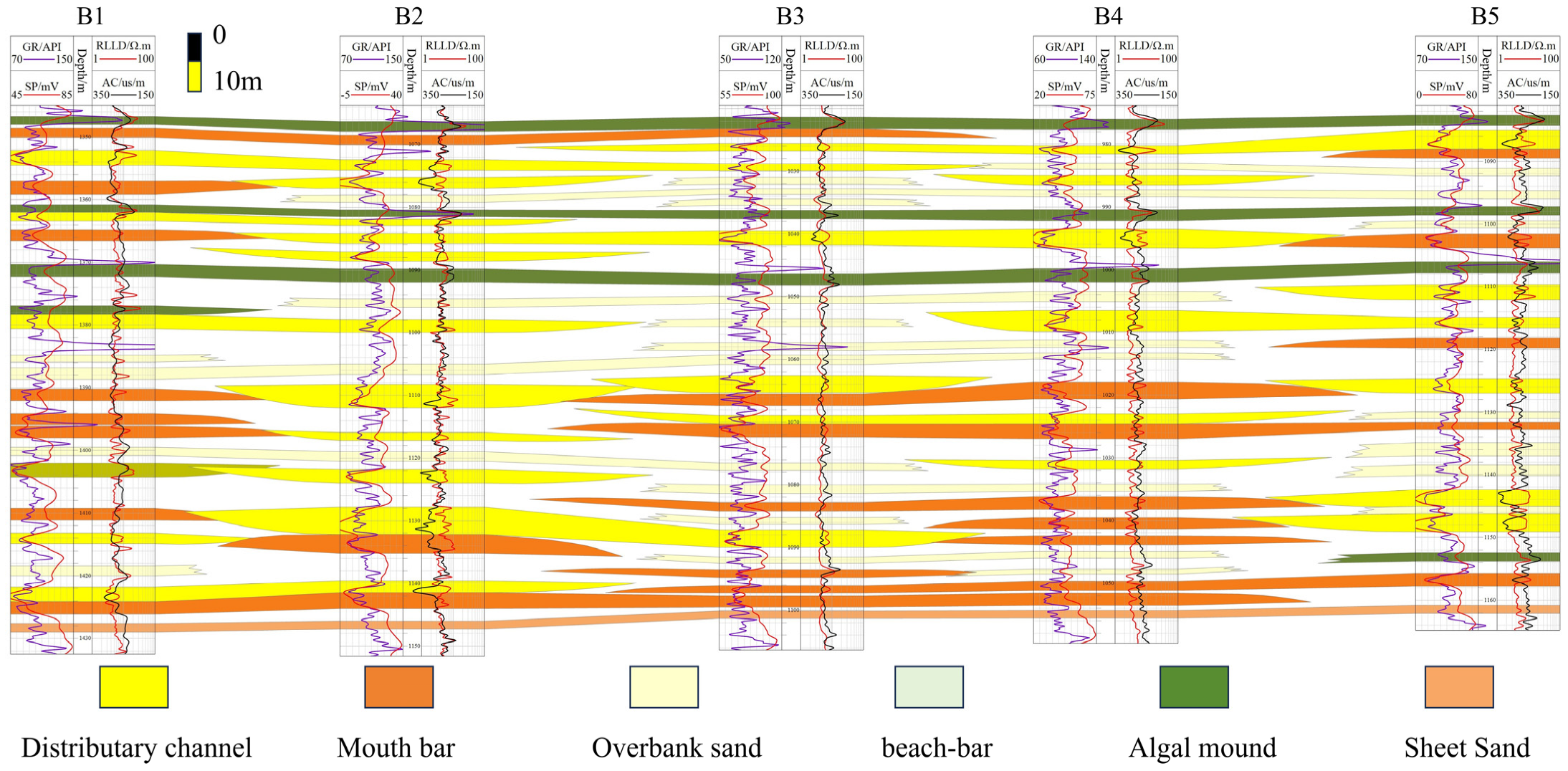
- The Upper Ganchaigou Formation (N1) in the Huatugou Oilfield of the Qaidam Basin is characterized by a braided river delta–shallow lacustrine bar mixed sedimentary system. Macroscopic features in outcrops, such as the distribution of algal limestone and the coarsening-upward sequences of the mouth bar, provided critical empirical evidence for lithofacies and microfacies classification. Based on this, core, well logging, and grain size analysis identified 8 lithofacies, 10 sedimentary microfacies, and 2 types of mixed sedimentary patterns. The lithofacies included 5 clastic lithofacies (including conglomeratic sandstone, medium- to coarse-grained sandstone, fine sandstone, siltstone/muddy siltstone, and mudstone) and 3 mixed sedimentary lithofacies (algal limestone, mixed sandstone, and marl).
- (2)
- The Upper Ganchaigou Formation (N1) formed a complete transgression–regression cycle from bottom to top. The sedimentation gradually transitioned from a littoral-shallow lacustrine beach bar mixed sediments to a braided-river delta front. The planar distribution was controlled by the combined influence of sediment supply intensity from the western short-axis source and fluctuations in lake level. During the transgression, it was dominated by a laterally extensive mixed beach bar. While, during the regression, it formed laterally braided-river delta front sand bodies.
- (3)
- A mixed sedimentary evolution model for the short-axis source in arid saline terrestrial lacustrine basins was established. Based on the “source–lacustrine level” model, two evolution models were established for the lacustrine transgression and regression periods. The unique evolution paths of “weak source, high lacustrine level, strong mixing” and “strong source, low lacustrine level, weak mixing” under the background of arid salinization were clarified. This model provides an important reference for mixed sedimentary research and oil and gas exploration in similar arid saline terrestrial lacustrine basins.
Author Contributions
Funding
Data Availability Statement
Acknowledgments
Conflicts of Interest
References
- Accordi, G.; Carbone, F. Evolution of the siliciclastic-carbonate shelf system of the northern Kenyan coastal belt in response to Late Pleistocene-Holocene relative sea level changes. J. Afr. Earth Sci. 2016, 123, 234–257. [Google Scholar] [CrossRef]
- Caracciolo, L.; Gramigna, P.; Critelli, S.; Calzona, A.B.; Russo, F. Petrostratigraphic analysis of a Late Miocene mixed siliciclastic-carbonate depositional system (Calabria, Southern Italy): Implications for Mediterranean paleogeography. Sediment. Geol. 2013, 284–285, 117–132. [Google Scholar] [CrossRef]
- Zhang, P.L.; Meng, Q.T.; Misch, D.; Sachsenhofer, R.F.; Liu, Z.J.; Hu, F.; Shen, L. Oil shale potential of the lower Cretaceous Jiufotang Formation, Beipiao Basin, Northeast China. Int. J. Coal Geol. 2021, 236, 103640. [Google Scholar] [CrossRef]
- Li, S.; Zhu, H.T.; Liang, J.; Du, X.F.; Wang, Q.B.; Yao, T.T.; Zeng, H.L. Mixed siliciclastic-carbonate deposition and cyclical evolution of the Upper Shahejie Formation and its impact on reservoir development in the Eocene Huanghekou Sag, Bohai Bay Basin, East China. Interpretation 2021, 9, SC17–SC30. [Google Scholar] [CrossRef]
- Mount, J.F. Mixing ofsiliciclastic and carbonate sediments in shallow shelf environments. Geology 1984, 12, 432. [Google Scholar] [CrossRef]
- Mount, J.F. Mixedsiliciclastic and carbonate sediments: A proposed first-order textural and compositional classification. Sedimentology 1985, 32, 435–442. [Google Scholar] [CrossRef]
- Sha, Q.A. Discussion on mixing deposit and hunji rock. J. Palaeogeogr. 2001, 3, 63–66. [Google Scholar]
- Zhang, J.Q.; Ye, H.Z. A study on carbonateand siliciclastic mixed sediments. J. Chengdu Univ. Technol. 1989, 16, 87–92. [Google Scholar]
- Jiang, M.S.; Sha, Q.A. Research advancesin the mixed siliciclastic-carbonate sedimentary systems. Adv. Earth Sci. 1995, 10, 551–554. [Google Scholar]
- Jie, X.N.; Ye, M.S.; Xu, C.G.; Du, X.F.; Du, X.B. High Quality Reservoirs Characteristics and Forming Mechanisms of Mixed Siliciclastic-Carbonate Sediments in the Bozhong Sag, Bohai Bay Basin. Earth Sci. 2018, 43, 3526–3539. [Google Scholar] [CrossRef]
- Yose, L.A.; Heller, P.L. Sea-level control of mixed-carbonate-siliciclastic, gravity-flow deposition: Lower part of the Keeler Canyon Formation (Pennsylvanian), southeastern California. Geol. Soc. Am. Bull. 1989, 101, 427–439. [Google Scholar] [CrossRef]
- Wright, E.E.; Hine, A.C.; Goodbred, S.L., Jr.; Locker, S.D. The effect of sea-level and climate change on the development of a mixed siliciclastic-carbonate, deltaic coastline: Suwannee river, Florida, U.S.A. J. Sediment. Res. 2005, 75, 621–635. [Google Scholar] [CrossRef]
- Cózar, P.; Somerville, I.D.; Rodríguez, S.; Mas, R.; Medina-Varea, P. Development of a late Viséan (Mississippian) mixed carbonate/siliciclastic platform in the Guadalmellato Valley (southwestern Spain). Sediment. Geol. 2006, 183, 269–295. [Google Scholar] [CrossRef]
- Lee, H.S.; Chough, S.K. Depositional processes of the Zhushadong and Mantou Formations (Early to Middle Cambrian), Shandong Province, China: Roles of archipelago and mixed carbonate-siliciclastic sedimentation on cycle genesis during initial flooding of the North China Platform. Sedimentology 2011, 6, 1530–1572. [Google Scholar] [CrossRef]
- Dix, G.R.; Nehza, O.; Okon, I. Tectonostratigraphy of the Chazyan (Late Middle- Early Late Ordovician) mixed siliciclastic-carbonate platform, Quebec Embayment. J. Sediment. Res. 2013, 83, 451–474. [Google Scholar] [CrossRef]
- Reis, H.L.S.; Suss, J.F. Mixed carbonate-siliciclastic sedimentation in forebulge grabens: An example from the Ediacaran Bambuí Group, Săo Francisco Basin, Brazil. Sediment. Geol. 2016, 339, 83–103. [Google Scholar] [CrossRef]
- Button, A.; Vos, R.G. Subtidal and intertidal clastic and carbonate sedimentation in a macrotidal environment: An example from the lower Proterozoic of South Africa. Sediment. Geol. 1977, 18, 175–200. [Google Scholar] [CrossRef]
- Coffey, B.P.; Read, J.F. Mixed carbonate-siliciclastic sequence stratigraphy of a Paleogene transition zone continental shelf, southeastern USA. Sediment. Geol. 2004, 166, 21–57. [Google Scholar] [CrossRef]
- Xu, W.; Chen, K.Y.; Cao, Z.L. Original mechanism of mixed sediments in the saline lacustrine basin. Acta Petrol. Sin. 2014, 30, 1804–1816. [Google Scholar]
- Xue, Y.A.; Pang, X.J.; Hao, Y.W.; Feng, C. Genesis of High-Quality Mixed Rock Reservoir and Its Exploration Significance in Es1 around Southeast Margin of Qinnan Sag, Bohai Sea. Earth Sci. 2020, 45, 3527–3542. [Google Scholar]
- Ye, M.S.; Xie, X.N.; Swennen, R.; Xu, C.G.; Du, X.F.; Du, X.B. Depositional characteristics of a lacustrine mixed sediment system: A case study from the eastern Shijiutuo Uplift, offshore Bohai Bay Basin, eastern China. J. Asian Earth Sci. 2021, 209, 104671. [Google Scholar] [CrossRef]
- Tänavsuu-Milkeviciene, K.; Plink-Björklund, P.; Kirsimäe, K.; Ainsaar, L. Coeval versus reciprocal mixed carbonate-siliciclastic deposition, Middle Devonian Baltic Basin, Eastern Europe: Implications from the regional tectonic development. Sedimentology 2009, 56, 1250–1274. [Google Scholar] [CrossRef]
- Carcel, D.; Colombié, C.; Giraud, F.; Courtinat, B. Tectonic and eustatic control on a mixed siliciclasticcarbonate platform during the Late Oxfordian-Kimmeridgian (La Rochelle platform, western France). Sediment. Geol. 2010, 223, 334–359. [Google Scholar] [CrossRef]
- Schwarz, E.; Veiga, G.D.; Trentini, G.Á.; Spalletti, L.A. Climatically versus eustatically controlled, sediment-supply-driven cycles: Carbonate-siliciclastic, highfrequency sequences in the Valanginian of the Neuquén Basin (Argentina). J. Sediment. Res. 2016, 86, 312–335. [Google Scholar] [CrossRef]
- Zecchin, M.; Catuneanu, O. High-resolution sequence stratigraphy of clastic shelves VI: Mixed siliciclastic-carbonate systems. Mar. Pet. Geol. 2017, 88, 712–723. [Google Scholar] [CrossRef]
- Jin, Z.K.; Shi, L.; Gao, B.S.; Yu, K.H. Carbonate facies and facies models. Acta Sedimentol. Sin. 2013, 31, 965–979. [Google Scholar]
- Yang, Y.X.; Jin, Z.K.; Bai, W.H.; Qiao, D.S.; Diao, L.Y.; Meng, F.Y.; Yuan, M.H.; Zhang, C. Depositional model and evolution characteristics of thin-layer lacustrine carbonates in Qibei slope, Huanghua depression. J. Jilin Univ. (Earth Sci. Ed.) 2013, 43, 1330–1340. [Google Scholar]
- Hussain, A.; Bello, A.; Butt, M.N.; Malik, M.H.; Koeshidayatullah, A.; Amao, A.; Olariu, C.; Al-Ramadan, K. Diagenetic variability in Tertiary, syn-rift mixed siliciclastic-carbonate depositional system (Lower Musayr Formation), Red Sea, Saudi Arabia. Sediment. Geol. 2024, 470, 106699. [Google Scholar] [CrossRef]
- Chiarella, D.; Longhitano, S.G.; Tropeano, M. Types of mixing and heterogeneities in siliciclastic-carbonate sediments. Mar. Pet. Geol. 2017, 88, 617–627. [Google Scholar] [CrossRef]
- Li, Y.N.; Xue, J.Q.; Wang, S.; Ye, Z.R.; Yang, J. Mixed siliciclastic-carbonate-tuffaceous sedimentation in a rift lacustrine basin: A case study of the Lower Cretaceous Jiufotang Formation in the Luxi sag, Songliao basin. Mar. Pet. Geol. 2024, 164, 106851. [Google Scholar] [CrossRef]
- Chen, N.G.; Wang, Y.Q.; Xu, F.; Yang, T.Y.; Xia, Z.Y. Palaeosalinity characteristics and its sedimentary response to the Cenozoic salt-water lacustrine deposition in Qaidam Basin. J. Palaeogeogr. 2015, 17, 371–380. [Google Scholar]
- Du, X.F.; Xu, C.G.; Zhu, H.T.; Xie, X.N.; Zhu, X.M.; Liu, K.Y.; Jiang, Z.X.; Zeng, H.L. Research Advances of Mixed Siliciclastic and Carbonate Sediments in Continental Rift Basins. Earth Sci. 2020, 45, 3509–3526. [Google Scholar]
- Feng, W.J.; Zhang, Y. Sedimentary characteristics and reservoir architecture of a lacustrine mixed carbonate/siliciclastic system: The lower member of the ShangGanchaigou Formation, Neogene, in the western Qaidam Basin, China. Front. Earth Sci. 2024, 12, 1437205. [Google Scholar]
- Sun, G.Q.; Zheng, J.J.; Su, L.; Liu, X.W.; Yang, X.; Liu, Y.H. Mesozoiccenozoic tectonic evolution in northwestern Qaidam Basin. Nat. Gas. Geosci. 2010, 21, 212–217. [Google Scholar]
- Pang, Y.M.; Zou, K.Z.; Guo, X.W.; Chen, Y.; Zhao, J.; Zhou, F. Geothermal regime and implications for basin resource exploration in the Qaidam Basin, northern Tibetan Plateau. J. Asian Earth Sci. 2022, 239, 105400. [Google Scholar] [CrossRef]
- Li, G.X.; Shi, Y.J.; Zhang, Y.S.; Chen, Y.; Zhang, G.Q.; Lei, T. New progress and enlightenment of oil and gas exploration and geological understanding in Qaidam Basin. Litholigic Reserv. 2022, 34, 1–18. [Google Scholar] [CrossRef]
- Wang, Q.Q.; Yuan, S.H.; Wang, Y.D.; Li, W.M.; Liu, Y.J.; Zheng, S.G. Thenature of the cenozoic western Qaidam Basin. J. Jilin Univ. Earth Sci. Ed. 2023, 53, 160–181. [Google Scholar] [CrossRef]
- Li, N.W.; Li, J.H.; Jiang, Y.Q. Study on sedimentary microfacies of the N22 reservoir and its implications for oil in the Huatugou oilfield. Nat. Gas Geosci. 2012, 23, 916–922. [Google Scholar]
- Passega, R. Grain size representation by CM patterns as a geological tool. J. Sediment. Petrol. 1964, 34, 830–847. [Google Scholar] [CrossRef]
- Tcherepanov, E.N.; Droxler, A.W.; Lapointe, P.; Mohn, K.; Larsen, O.A. Siliciclastic influx and burial of the Cenozoic carbonate system in the Gulf of Papua. Mar. Pet. Geol. 2010, 27, 533–554. [Google Scholar] [CrossRef]
- Yilmaz, I.O.; Altiner, D. Cyclostratigraphy and sequence boundaries of inner platform mixed carbonate–siliciclastic successions (Barremian–Aptian, Zonguldak, NW Turkey). J. Asian Earth Sci. 2007, 30, 253–270. [Google Scholar] [CrossRef]
- Massari, F.; Chiocci, F. Biocalcarenite and mixed cool-water prograding bodies of the Mediterranean Pliocene and Pleistocene. Architecture, depositional setting andforcing factors. Geol. Soc. Lond. Spec. Publ. 2006, 255, 95–120. [Google Scholar] [CrossRef]
- Song, G.Y.; Liu, Z.G.; Wang, Y.Q.; Long, G.H.; Zhu, C.; Li, S.M.; Tian, M.Z.; Shi, Q.; Xia, Z.Y.; Gong, Q.S. Lithofacies types, sedimentary cycles, and facies models of saline lacustrine hybrid sedimentary rocks: A case study of Neogene in Fengxi area, Qaidam Basin, NW China. Pet. Explor. Dev. 2024, 51, 1304–1316. [Google Scholar] [CrossRef]
- Feng, J.L.; Hu, K.; Cao, J.; Chen, Y.; Wang, L.G.; Zhang, Y.; Wang, M.; Zhao, J. A Review on Mixed Rocks of Terrigenous Clastics and Carbonates and Their Petroleum-Gas Geological Significance. Geol. J. China Univ. 2011, 17, 297–307. [Google Scholar]
- Madden, R.H.C.; Wilson, M.E.J. Diagenesis of Neogene Delta-Front Patch Reefs: Alteration of Coastal, Siliciclastic-Influenced Carbonates from Humid Equatorial Regions. J. Sediment. Res. 2012, 82, 871–888. [Google Scholar] [CrossRef]
- Thompson, D.L.; Stilwell, J.D.; Hall, M. Lacustrine Carbonate Reservoirs from Early Cretaceous Rift Lakes of Western Gondwana: Pre-Salt Coquinas of Brazil and West Africa. Gondwana Res. 2015, 28, 26–51. [Google Scholar] [CrossRef]





| Lithofacies Type | Lithofacies (Code) | Composition | Genetic Interpretation | Sedimentary Microfacies |
|---|---|---|---|---|
| Clastic Lithofacies | Gravelly sandstone facies (F1) | Gravel (5%–30%) and sand | High-energy traction currents; channel lag or basal mouth bar | Distributary channels, mouth bars |
| medium- to coarse-grained sandstone facies (F2) | Dominantly medium and coarse sand | Strong traction currents | Distributary channels, mouth bars | |
| Fine sandstone facies (F3) | Dominantly fine sand | Moderate to weak traction currents | Terminal distributary channels, mouth bars | |
| Siltstone facies/muddy siltstone facies (F4) | Dominantly silt | Low-energy suspension settling with minor reworking | Overbank sands, sheet sands, beach bars | |
| Mudstone (F5) | Dominantly clay minerals with minor silt | Suspension deposition in quiet water | Interdistributary bays, prodelta | |
| Mixed Lithofacies | Algal Limestone Facies (F6) | Abundant algal laminae/stromatolites, ooids, bioclasts | Dominantly biological/chemical deposition | Algal mounds |
| Mixed sandstone facies (F7) | Terrigenous sand/silt (matrix) and carbonate components (>10%) | Syn-depositional mixing of terrigenous input and carbonate precipitation/growth | Mixed channels, mixed mouth bars, mixed beach bars | |
| Marl facies (F8): | Micritic calcite matrix and terrigenous clay/silt (>10%) | Mixing of chemical precipitation and fine-grained suspension deposition | Marl flats, prodelta mixed zone |
Disclaimer/Publisher’s Note: The statements, opinions and data contained in all publications are solely those of the individual author(s) and contributor(s) and not of MDPI and/or the editor(s). MDPI and/or the editor(s) disclaim responsibility for any injury to people or property resulting from any ideas, methods, instructions or products referred to in the content. |
© 2026 by the authors. Licensee MDPI, Basel, Switzerland. This article is an open access article distributed under the terms and conditions of the Creative Commons Attribution (CC BY) license.
Share and Cite
Liang, Y.; Song, X.; Wang, Y.; Feng, W. Development of Braided River Delta–Shallow Lacustrine Siliciclastic–Carbonate Mixed Sedimentation in the Upper Ganchaigou Formation, Huatugou Oilfield, Qaidam Basin, China. Minerals 2026, 16, 92. https://doi.org/10.3390/min16010092
Liang Y, Song X, Wang Y, Feng W. Development of Braided River Delta–Shallow Lacustrine Siliciclastic–Carbonate Mixed Sedimentation in the Upper Ganchaigou Formation, Huatugou Oilfield, Qaidam Basin, China. Minerals. 2026; 16(1):92. https://doi.org/10.3390/min16010092
Chicago/Turabian StyleLiang, Yuxin, Xinmin Song, Youjing Wang, and Wenjie Feng. 2026. "Development of Braided River Delta–Shallow Lacustrine Siliciclastic–Carbonate Mixed Sedimentation in the Upper Ganchaigou Formation, Huatugou Oilfield, Qaidam Basin, China" Minerals 16, no. 1: 92. https://doi.org/10.3390/min16010092
APA StyleLiang, Y., Song, X., Wang, Y., & Feng, W. (2026). Development of Braided River Delta–Shallow Lacustrine Siliciclastic–Carbonate Mixed Sedimentation in the Upper Ganchaigou Formation, Huatugou Oilfield, Qaidam Basin, China. Minerals, 16(1), 92. https://doi.org/10.3390/min16010092