
Review

Nanoscale Microstructure and Microbially Mediated Mineralization Mechanisms of Deep-Sea Cobalt-Rich Crusts
1
School of Ocean Sciences, China University of Geosciences, Beijing 100083, China
2
Key Laboratory of Polar Geology and Marine Mineral Resources (China University of Geosciences, Beijing), Ministry of Education, Beijing 100083, China
3
National Deep-Sea Center, Qingdao 266237, China
4
School of Earth Sciences and Resources, China University of Geosciences, Beijing 100083, China
5
Colloge of Petroleum & Gas Engineering, Liaoning Petrochemical University, Fushun 113001, China
6
Key Laboratory of Marine Geology and Metallogeny, First Institute of Oceanography, Ministry of Natural Resources, Qingdao 266061, China
7
School of Artificial Intelligence, China University of Geosciences, Beijing 100083, China
*
Author to whom correspondence should be addressed.
Minerals 2026, 16(1), 91; https://doi.org/10.3390/min16010091 (registering DOI)
Submission received: 31 October 2025 / Revised: 24 December 2025 / Accepted: 13 January 2026 / Published: 17 January 2026
(This article belongs to the Special Issue Geochemistry and Mineralogy of Polymetallic Deep-Sea Deposits)

Abstract

As a potential strategic resource of critical metals, deep-sea cobalt-rich crusts represent one of the most promising metal reservoirs within oceanic seamount systems, and their metallogenic mechanism constitutes a frontier topic in deep-sea geoscience research. This review focuses on the cobalt-rich crusts from the Magellan Seamount region in the northwestern Pacific and synthesizes existing geological, mineralogical, and geochemical studies to systematically elucidate their mineralization processes and metal enrichment mechanisms from a microstructural perspective, with particular emphasis on cobalt enrichment and its controlling factors. Based on published observations and experimental evidence, the formation of cobalt-rich crusts is divided into three stages: (1) Mn/Fe colloid formation—At the chemical interface between oxygen-rich bottom water and the oxygen minimum zone (OMZ), Mn2+ and Fe2+ are oxidized to form hydrated oxide colloids such as δ-MnO2 and Fe(OH)3. (2) Key metal adsorption—Colloidal particles adsorb metal ions such as Co2+, Ni2+, and Cu2+ through surface complexation and oxidation–substitution reactions, among which Co2+ is further oxidized to Co3+ and stably incorporated into MnO6 octahedral vacancies. (3) Colloid deposition and mineralization—Mn–Fe colloids aggregate, dehydrate, and cement on the exposed seamount bedrock surface to form layered cobalt-rich crusts. This process is dominated by the Fe/Mn redox cycle, representing a continuous evolution from colloidal reactions to solid-phase mineral formation. Biological processes play a crucial catalytic role in the microstructural evolution of the crusts. Mn-oxidizing bacteria and extracellular polymeric substances (EPS) accelerate Mn oxidation, regulate mineral-oriented growth, and enhance particle cementation, thereby significantly improving the oxidation and adsorption efficiency of metal ions. Tectonic and paleoceanographic evolution, seamount topography, and the circulation of Antarctic Bottom Water jointly control the metallogenic environment and metal sources, while crystal defects, redox gradients, and biological activity collectively drive metal enrichment. This review establishes a conceptual framework of a multi-level metallogenic model linking macroscopic oceanic circulation and geological evolution with microscopic chemical and biological processes, providing a theoretical basis for the exploration, prediction, and sustainable development of potential cobalt-rich crust deposits.

1. Introduction

Cobalt-rich ferromanganese crusts (CRFCs) are important mineral resources in the deep-sea environment, widely distributed on hard substrates such as seamounts, ridges, and plateaus across the global oceans [1]. In the northwestern Pacific seamount region, the crusts mainly form through hydrogenetic deposition, wherein Fe–Mn oxides precipitate directly from seawater onto exposed bedrock surfaces. Their growth rate is extremely slow, typically only 1–5 mm per million years [2,3]. Owing to their distinctive genesis, cobalt-rich crusts not only record the evolution of marine environments but also exhibit pronounced enrichment in a wide range of critical metals such as Co, Ni, Cu, Te, Pt, Zr, Nb, W, Bi, and selected rare earth elements (e.g., La, Ce, Nd, Eu, Tb). Their concentrations far exceed those in seawater, making these crusts prime targets for future seafloor mineral exploration and development. Importantly, compared with most continental deposits, the elements that are truly enriched to the greatest extent in ferromanganese crusts are the heavy rare earth elements (HREEs) together with yttrium (Y) [2,4,5,6,7]. With the increasing global demand for new energy technologies and high-tech industries, deep-sea cobalt-rich crusts have become a potential strategic source of critical metals, attracting growing attention to their resource value and environmental implications [8].
In recent years, high-resolution microanalytical techniques such as micro–X-ray fluorescence spectroscopy (μ-XRF), laser ablation inductively coupled plasma time-of-flight mass spectrometry (LA-ICP-TOFMS), and laser ablation inductively coupled plasma mass spectrometry (LA-ICP-MS) have been widely applied to study the mineralogical composition and elemental distribution of cobalt-rich crusts [3,9]. Studies have demonstrated that the mineralogical structure of the crusts exerts a crucial influence on metal enrichment. The principal mineral phases of cobalt-rich crusts include vernadite (δ-MnO2), layered manganese oxides such as birnessite and buserite, tunnel-type manganese oxides such as todorokite, and Fe oxyhydroxides [10]. These mineral phases not only control the occurrence modes of key metals but also determine their adsorption and fixation mechanisms. For example, octahedral vacancies and surface coordination sites in manganese oxides effectively adsorb Co2+, Ni2+, and Cu2+, whereas poorly crystalline Fe oxyhydroxides primarily enriches Fe-associated elements such as Mo, W, V, As, and Sb [1]. Moreover, the redox conditions of seawater directly affect Mn/Fe ratios and regulate the enrichment processes of Co, Ni, and Cu [11]. These microstructural characteristics and mineralization mechanisms provide essential insights into the resource evaluation and genetic understanding of deep-sea cobalt-rich crusts.
In addition to inorganic mineral phases, recent studies have revealed that microorganisms play an important role in the biomineralization of cobalt-rich crusts [7,12,13,14,15,16]. Calcareous skeletons of planktonic organisms such as coccolithophores can serve as mineralization nuclei, facilitating the precipitation of Mn–Fe oxides and forming localized microenvironments enriched in metals [17]. Furthermore, certain microorganisms are capable of catalyzing the oxidation of Mn2+ to form vernadite, thereby influencing the microstructure of the crusts and their metal adsorption capacity [12,18]. Such bio–mineral interactions not only reveal the complex genesis of cobalt-rich crusts but also provide new perspectives for the biotechnological control of mineral precipitation.
Despite the enormous resource potential of cobalt-rich crusts, research on their mineralization processes, spatial structures, nanoscale metal adsorption mechanisms, and microbial mineralization remains limited. The oxidation and precipitation mechanisms of Fe and Mn that lead to the formation of Fe–Mn crusts in different parts of the ocean are still not well understood [19]. Existing studies have mainly focused on the Prime Crust Zone (PCZ) in the northwestern Pacific, where cobalt-rich crusts exhibit the highest metal contents and resource potential, making it one of the most promising deep-sea mining areas [1]. However, vast cobalt-rich crust deposits across the global ocean remain poorly investigated, and the geochemical characteristics and genetic models of crusts in different oceanic regions remain uncertain. Therefore, further research integrating advanced analytical techniques, microstructural characterization, and biogeochemical approaches is required to comprehensively elucidate the mineralization mechanisms of cobalt-rich crusts, thereby providing a scientific basis for their resource assessment and sustainable development.
Against this background, this review focuses on cobalt-rich ferromanganese crusts from the Magellan Seamount region in the northwestern Pacific, with particular attention to the Caiwei and Jiaxie Guyots. This region represents a typical open-ocean seamount setting dominated by hydrogenetic crust growth, characterized by persistently low sedimentation rates, stable oxic conditions, and minimal overprinting by diagenetic or hydrothermal processes [1,5]. Such conditions favor both the long-term preservation of primary mineral textures and the efficient enrichment of cobalt, making the Magellan Seamounts one of the most representative natural laboratories for studying hydrogenetic Co-rich crust formation. From a microstructural and biogeochemical perspective, this review synthesizes existing observations into a three-stage, process-based framework for cobalt-rich crust formation. Microbial processes are treated here not as isolated mechanisms, but as kinetic and structural modifiers that accelerate Mn oxidation, regulate nanoscale mineral growth, and enhance metal immobilization efficiency within the hydrogenetic framework. Taking the Magellan Seamount contract area as a case study, this review focuses on the nanoscale crystallographic controls and microbially mediated processes that govern cobalt enrichment in hydrogenetic Fe–Mn crusts, and systematically evaluates the key drivers of economically favorable mineralization, providing a conceptual basis for future prospecting and assessment of Co-rich crust resources.

2. Regional Context of the Western Pacific Region
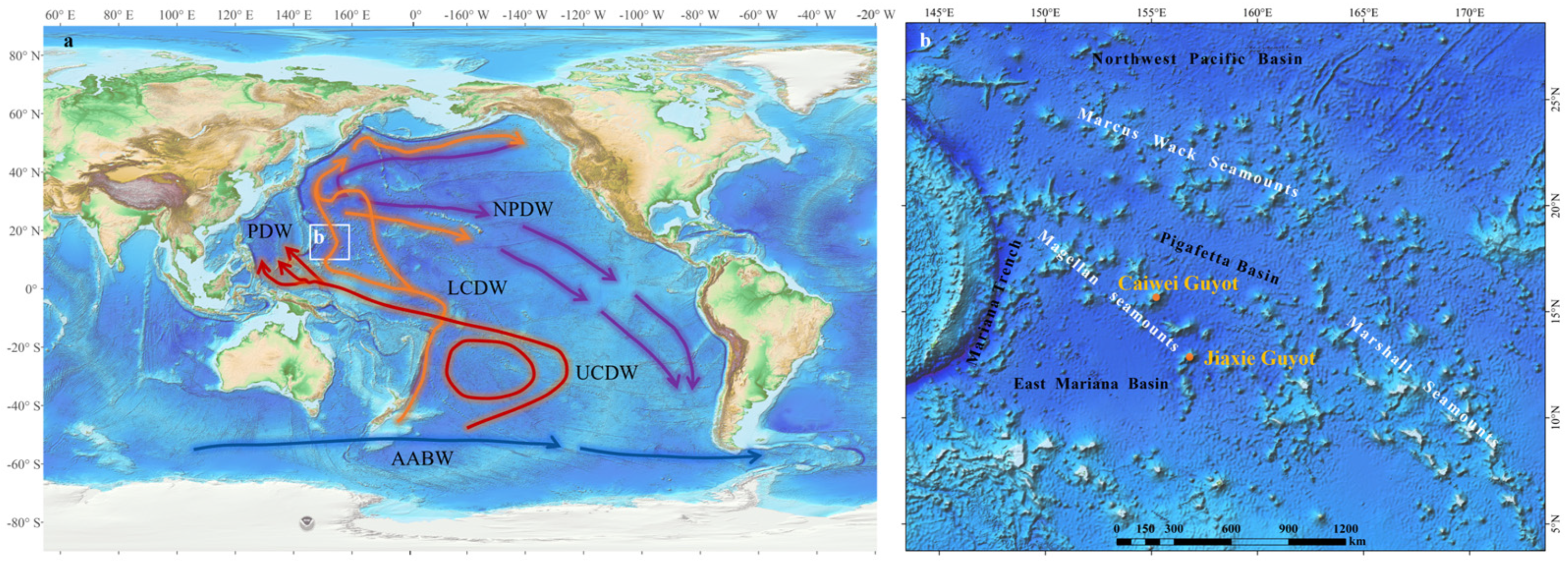
The western and central Pacific represents one of the most important regions for cobalt-rich ferromanganese crusts worldwide. Crusts are mainly distributed on major seamount provinces, including the Magellan Seamounts, the Marcus–Wake Seamount chain, the Central Pacific Seamounts, and the Marshall Islands region (Figure 1), which together define the so-called Prime Crust Zone (PCZ) characterized by the thickest and most metal-rich crusts [3]. Ferromanganese crust thickness varies widely, ranging from less than a millimeter to more than 20 cm, and locally reaching ~25 cm on old Pacific seamounts. Cobalt-rich crusts typically contain high Co concentrations of ~0.8–1.7 wt.% (average ~1.2 wt.%), substantially exceeding those of most land-based cobalt deposits [3,5]. The cobalt-rich crusts in this region are characterized by high Co content, with grades typically ranging from 0.8% to 1.7% (average 1.2%), representing nearly twenty times the concentration found in terrestrial cobalt deposits [5]. In addition to cobalt, other key metals are also significantly enriched: Mn 18%–28%, Ni 0.4%–0.6%, Cu 0.08%–0.12%, Pt 0.5–1.5 ppm, and total REEs 1000–2500 ppm [20]. Based on global and regional assessments of cobalt-rich ferromanganese crusts, the total dry mass of crust resources on western Pacific seamounts is estimated to be on the order of 1010 tons, containing more than 108 tons of cobalt metal [5]. Owing to the large crustal thickness and high concentrations of cobalt and platinum-group elements, the Central–Western Pacific seamount region has been designated by the International Seabed Authority as a “Platinum Belt” with high exploration priority [1,21]. The exceptional metal enrichment and resource potential of this region underpin its strategic importance in the global deep-sea mineral resource framework [4,22].
Most seamounts in the Central–Western Pacific are located along subduction zones or hotspot volcanic chains. These seamount chains formed during Cretaceous hotspot volcanic activity (120–80 Ma) and subsequently drifted northwestward with the Pacific Plate at rates of 60–198 mm/a, forming chain-like volcanic groups [23,24]. The bedrock is dominated by basalts and volcanic clastic rocks, locally overlain by carbonate caps such as drowned coral reefs. Plate tectonic movements have caused episodic subsidence of the seamounts, and their present water depths generally range from 800 to 2500 m, providing rigid substrates suitable for crustal growth [25]. Within the study area, the Caiwei and Jiaxie Guyots rest upon Late Cretaceous basalts that have undergone prolonged weathering and erosion, forming stable, hard substrates for crust development [26,27,28]. These seamounts lie above the carbonate compensation depth (CCD, approximately 4900 m), with water depths of 1500–2500 m. Their morphology is characterized by flat summits and gentle slopes, effectively minimizing sediment cover and promoting continuous crust accretion [1].
The seawater chemistry of this region plays a crucial role in mineralization. The convergence of Antarctic Bottom Water (AABW) and North Pacific Deep Water (NPDW) brings high dissolved oxygen (>3.5 mL/L), low temperature, and nutrient-rich conditions (Figure 1; [29]), which promote the oxidation Mn(II) and Fe(II) to Mn(IV) and Fe(III) followed by precipitation. Fluctuations at the deep-water redox interface influence the solubility and adsorption behavior of metal ions such as Co2+ and Ni2+. Dissolved metals including Mn, Fe, Co, and Ni mainly exist as colloids or organic complexes, with typical concentrations of Mn: 0.2–0.5 nM, Fe: 0.05–0.2 nM, Co: 10–50 pM, and Ni: 2–6 nM [4]. Rare earth elements (REEs) in deep seawater typically exhibit light REE depletion and a pronounced negative Ce anomaly, with low total concentrations (ΣREE < 50 pmol/kg). In contrast, due to the strong selective adsorption and coprecipitation of Ce(IV) by Mn and Fe oxyhydroxides, ferromanganese crusts display a marked positive Ce anomaly, allowing REE concentrations to reach levels of 1000–2500 ppm [30]. Non-metallic components such as phosphates also participate in early diagenetic processes by forming fluorapatite, thereby influencing the microstructure and elemental distribution within the crusts [20].
Figure 1. (a) Location of the study area and the modern Pacific Ocean circulation system. The white box indicates the enlarged area shown in panel (b), highlighting the Caiwei and Jiaxie Guyots in the Magellan Seamount region. The circulation pathways of major deep-water masses: Antarctic Bottom Water (AABW, blue); Pacific Deep Water (PDW), composed of Upper Circumpolar Deep Water (UCDW, red), characterized by a temperature maximum, and Lower Circumpolar Deep Water (LCDW, orange), characterized by a salinity maximum; and North Pacific Deep Water (NPDW, purple). Modified from [26].
Minerals 16 00091 g001

3. Mineralogy and Occurrence of Ferromanganese Crusts

The high metal contents of marine ferromanganese crusts and nodules are reflected in their microscopic uptake mechanisms and mineralogical structures. Specifically, from a microscopic perspective, metal enrichment is commonly interpreted in terms of how metal ions are incorporated at the atomic scale into the layered or tunnel-structured components of ferromanganese crusts and nodules. Oceanic ferromanganese crusts are primarily composed of layered phyllomanganates such as vernadite and birnessite, and tunnel-structured todorokite, all of which consist of [MnO6] octahedral nanounits associated with iron oxyhydroxides coexisting with manganese oxides.

3.1. Manganese Oxide Phases

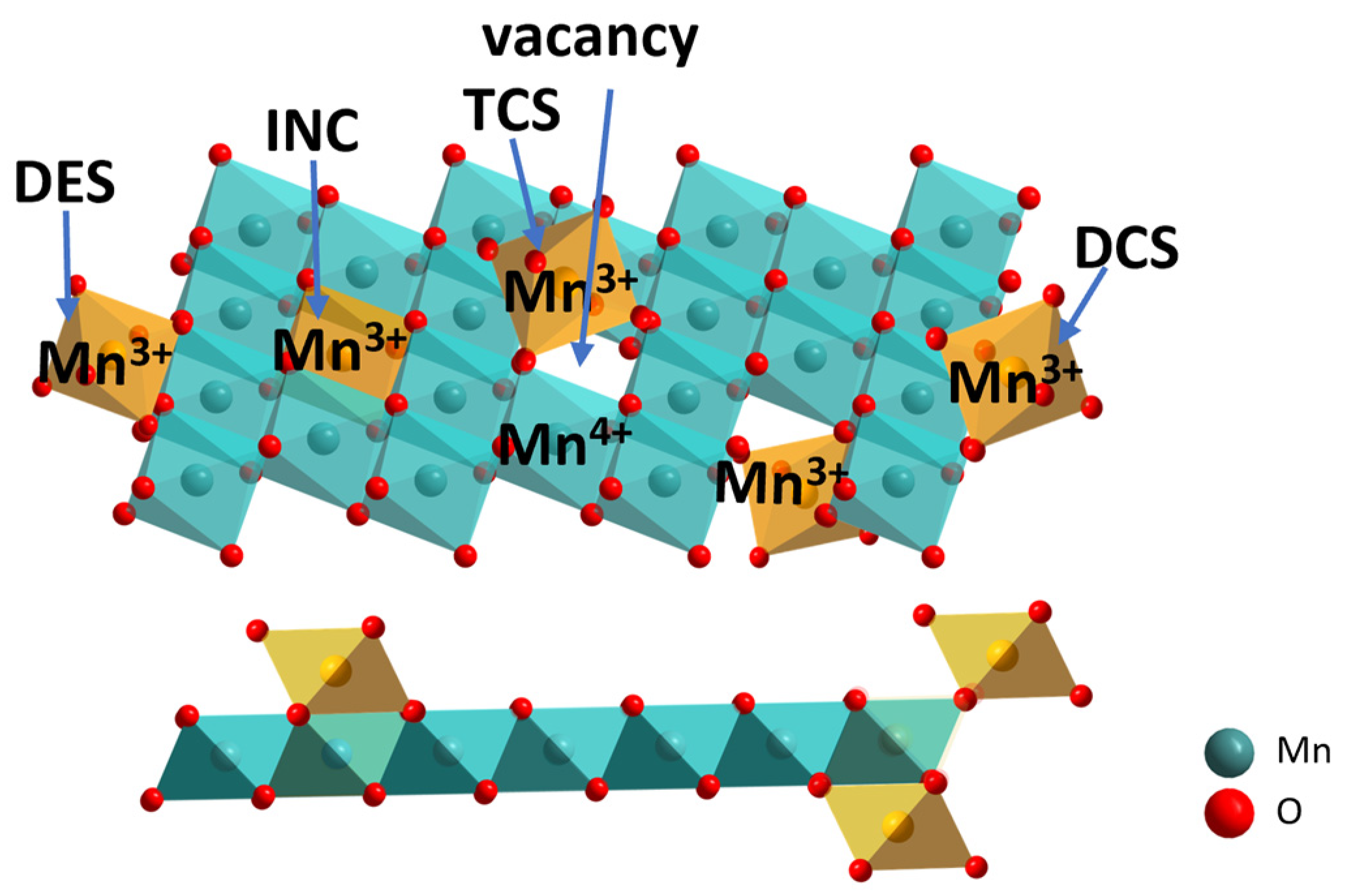
Ferromanganese crusts consist of two primary X-ray reflective phases: δ-MnO2 (vernadite) and poorly crystalline Fe oxyhydroxides. The manganese mineral phases in cobalt-rich crusts mainly include layer Mn oxides, sometimes referred to as phyllomanganates, such as hydrated vernadite, birnessite, and buserite, as well as tunnel-structured Mn oxides like todorokite (Figure 2a,b). These minerals are composed of [MnO6] octahedral units and coexist with poorly crystalline Fe oxyhydroxides, forming the main mineral framework of iron-manganese crusts [3].
Vernadite is the dominant manganese mineral phase in cobalt-rich crusts, typically occurring as δ-MnO2. It is a nanocrystalline, poorly ordered phyllomanganate characterized by a turbostratically disordered layered structure. As a nanomineral with high defect density and limited crystallinity, its precise structural configuration remains incompletely defined [31,32]. High-resolution TEM and XRD analyses of samples from the Magellan Seamount region show that vernadite commonly occurs as a mixed assemblage of monolayered, 7 Å, 10 Å, and interstratified nanophases rather than a single homogeneous structure (Figure 2a; [33]). In contrast to birnessite, which is more structurally ordered and typically stabilized by interlayer alkali cations, and to buserite, which contains abundant hydrated interlayer cations and larger basal spacings, vernadite is characterized by a highly defective, vacancy-rich framework with weakly defined interlayers. These vernadite phases are rich in structural water and contain abundant octahedral vacancies, which are critical to their chemical reactivity and metal-hosting capacity [31,32,34,35,36]. Within the Mn layers, some Mn4+ ions are replaced by octahedral vacancies, Mn3+, and/or other lower-valent cations such as Co3+, Ni2+, and Cu2+ [34,37]. These vacancies provide exceptionally high reactivity for metal adsorption, enabling key metals like Co2+, Ni2+, and Cu2+ to occupy the octahedral vacancies via double corner-sharing (DCS) or triple corner-sharing (TCS) coordination, thereby being stably immobilized within the mineral structure [36]. Furthermore, the high specific surface area (200–400 m2/g) and negatively charged layered structure of vernadite give it an exceptional metal adsorption capacity. Particularly in oxygen-rich environments, it catalyzes the autocatalytic oxidation of Co2+ to Co3+, thereby enhancing cobalt enrichment efficiency [37]. In the mineral composition of cobalt-rich crusts, vernadite typically occurs as Fe-vernadite, where Fe3+ partially replaces Mn4+ in its structure and coexists with Fe oxyhydroxides. This association confers enhanced stability to Fe-vernadite under varying redox conditions, establishing it as the primary carrier for key metals during cobalt-rich crust mineralization [1].
Among phyllomanganates, birnessite and buserite share a similar layered structure composed of edge-sharing [MnO6] octahedra. However, buserite contains a higher amount of interlayer water molecules and hydrated cations, resulting in a larger basal spacing (~10 Å). Changes in environmental conditions—particularly interlayer dehydration, variations in seawater salinity, temperature, and interlayer cation composition—can reduce hydration energy and trigger collapse of the hydrated interlayers, promoting a nanoscale structural reorganization from buserite to the more compact 7 Å birnessite structure (Figure 2b; [38,39,40]).
In contrast, the tunnel-structured Mn oxide todorokite exhibits a rigid 3 × 3 tunnel framework (Figure 2c, typically forming through later-stage diagenetic or topotactic transformation from layered Mn oxides. During this process, divalent cations such as Mg2+ play a structure-directing role by stabilizing the developing tunnel architecture [39]. Once formed, the well-defined tunnel and framework sites of todorokite enable efficient incorporation of trace metals, particularly Ni2+ and Cu2+, via substitution for Mn in octahedral positions [38,41]. Although todorokite generally occurs in low abundances in oceanic crusts—accounting for ~2% of some Pacific seamount crusts [1]—its high structural rigidity and resistance to redox-driven reorganization make it an important late-stage host for metal sequestration.
While detailed constraints on the crystal chemistry of buserite and todorokite are often derived from polymetallic nodules and sedimentary environments, these studies remain directly relevant to cobalt-rich crusts. This is because the fundamental MnO6-octahedral frameworks and transformation pathways (vernadite → buserite/birnessite → todorokite) are common to both crusts and nodules, allowing mineral-scale mechanisms of metal incorporation to be evaluated independent of deposit type [3,33]. Therefore, insights from nodule-based mineralogical studies provide a robust structural analogue for interpreting nanoscale mineralization and metal sequestration processes in hydrogenetic cobalt-rich crusts.
In the western Pacific, Co-rich ferromanganese crusts exhibit variable Mn/Fe ratios, which are commonly <5 for most hydrogenetic crust layers but may locally exceed this value (up to ~13) in Mn-enriched layers [9]. Such variability reflects a dominantly hydrogenetic framework composed of Fe-vernadite, with minor contributions from Mn-rich phyllomanganates in locally developed diagenetic or mixed layers. Studies of cobalt-rich crusts from Pacific guyots consistently show Mn/Fe ratios close to unity (typically ~1–2), characteristic of Fe-vernadite–dominated mineral assemblages [3,27]. Additionally, the mineral phases of cobalt-rich crusts contain minor amounts of todorokite, typically formed through later diagenetic conversion from vernadite or birnessite. In localized areas, todorokite exhibits elevated concentrations of Ca2+ and Cu2+ [41]. Overall, the highly disordered structure of vernadite and the interlayer adsorption properties of layered manganese oxides jointly govern the metal enrichment mechanism in cobalt-rich crusts, providing a crucial mineralogical foundation for the immobilization of key metals like cobalt, nickel, and copper.

3.2. Iron Oxide Phases

The iron mineral phases in cobalt-rich crusts are primarily composed of poorly crystalline Fe oxyhydroxides (including feroxyhyte-like, δ-FeOOH and ferrihydrite-like, Fe5HO8 · 4H2O phases) and crystalline iron oxides, such as goethite and hematite. Among these, the poorly crystalline Fe oxyhydroxides(δ-FeOOH) exhibits a layered structure with hexagonal symmetry (Figure 2d; [42]). It commonly coexists with vernadite, forming a nanoscale intergrown structure [3]. Feroxyhyte is an unstable hydrous iron oxide that readily transforms into more stable goethite (α-FeOOH) and ultimately to hematite (α-Fe2O3) through progressive crystallization [43,44,45].
Ferrihydrite is also a poorly crystalline, nanometer-sized hydrous iron oxide with a generally accepted chemical formula is Fe5HO8·4H2O, in which surface hydroxyl groups (≡Fe–OH) are abundant and highly reactive [46]. Structural studies indicates that approximately 75% of Fe atoms occupy octahedral sites, whereas surface Fe is predominantly tetrahedrally coordinated [47]. The enrichment of oxyanions such as phosphate ( P O 4 3 ), molybdate ( M o O 4 2 ), and tungstate ( W O 4 2 ) on ferrihydrite surfaces is primarily controlled by inner-sphere complexation via ligand-exchange reactions, in which oxyanions replace surface hydroxyl groups bound to Fe atoms. Thus, the high density of reactive ≡Fe–OH groups provides abundant exchangeable surface sites, enhancing the strong affinity of ferrihydrite for oxyanions. Combined with its large specific surface area, this surface chemistry promotes the efficient sequestration of P, Mo, and W in cobalt-rich crusts [1,10]. Ferrihydrite commonly represents the earliest precipitate formed during Fe3+ hydrolysis and is a metastable phase that readily transforms into more crystalline Fe oxides such as goethite and hematite during subsequent diagenesis [48].
In addition, goethite and hematite are the crystalline products of δ-FeOOH, commonly occurring in the older layers of cobalt-rich crusts [1]. Studies have shown that goethite can be detected in about 6% of the deeper, mature layers of Pacific cobalt-rich crusts, indicating a gradual crystallization of δ-FeOOH during diagenetic evolution, which enhances the mineral structural stability. Goethite frequently coexists with vernadite in nanoscale intergrowths [3,45], forming Fe–Mn oxide associations that significantly enhance the adsorption and fixation of Fe-associated elements such as Mo, W, V, As, and Sb, and influence metal migration and precipitation under redox gradients [10].
In phosphorus-rich environments, δ-FeOOH may further undergo structural rearrangement during the diagenesis of carbonate-fluorapatite (CFA) and promote CFA formation through phosphate complexation [10]. Overall, the Fe mineral phases play a key “adsorption–carrier–transformation” role during cobalt-rich crust formation: the poorly crystalline δ-FeOOH dominates trace-metal enrichment during the early adsorption stage, whereas subsequent crystallization processes determine the solid-phase fixation of metals and the mineralogical evolution pathway of the crusts.

3.3. Other Mineral Phases

Beyond the primary manganese and iron mineral phases, cobalt-rich crusts from the Magellan Seamount region, including Caiwei and Jiaxie Guyots, are also reported to contain variable proportions of authigenic, clastic, and diagenetic mineral phases. Authigenic minerals commonly documented in western Pacific seamount crusts include carbonate fluorapatite (CFA), barite (BaSO4), minor zeolites, and subordinate carbonate minerals, although their occurrence and abundance may vary among individual seamounts and stratigraphic intervals. Carbonate fluorapatite (CFA) represents the most significant authigenic phosphate phase in cobalt-rich crusts from the Magellan Seamounts, preferentially occurring in older crustal layers and locally reaching contents of up to ~30% [1]. Its formation is closely linked to episodic marine phosphatization events, particularly during pre-Miocene paleoceanographic and climatic transitions, when elevated seawater phosphate concentrations favored CFA precipitation [10]. Owing to its strong affinity for rare earth elements (REEs), phosphatized crust layers in this region commonly exhibit pronounced REE enrichment [3]. Barite and zeolite minerals are locally observed minor phases in some western Pacific seamount crusts and are generally interpreted to reflect localized seawater–rock interactions or low-temperature fluid circulation rather than large-scale hydrothermal activity. These phases may act as secondary hosts for elements such as Ba and Sr and serve as mineralogical indicators of specific micro-environmental conditions during crust growth [1].
Clastic minerals primarily include quartz, feldspar (plagioclase, potassium feldspar), and volcanic glass. Their sources are mainly attributed to eolian (wind-blown) dust transport and local submarine volcanic eruptions [3]. The content of eolian clastic minerals is typically low; in Pacific cobalt-rich crusts, quartz generally does not exceed 5%, whereas feldspar may originate from the weathered material of adjacent ridges or seamounts [49]. Additionally, in some older crust samples, carbonate minerals formed by diagenesis, such as calcite (CaCO3), can be observed. These may originate from the skeletal deposits of foraminifera and other calcareous organisms [3].
Overall, the mineral assemblages observed in cobalt-rich crusts from the Magellan Seamount region reflect multistage hydrogenetic growth under relatively stable deep-sea conditions, superimposed by episodic phosphatization, detrital input, and minor diagenetic modification. This combination highlights the suitability of this region as a natural laboratory for investigating the nanoscale mineralization processes of hydrogenetic cobalt-rich crusts.

4. Mechanisms of Cobalt-Rich Crust Mineralization

4.1. Chemical Formation, Stable Aggregation, and Precipitation of Manganese/Iron Hydroxide Colloids

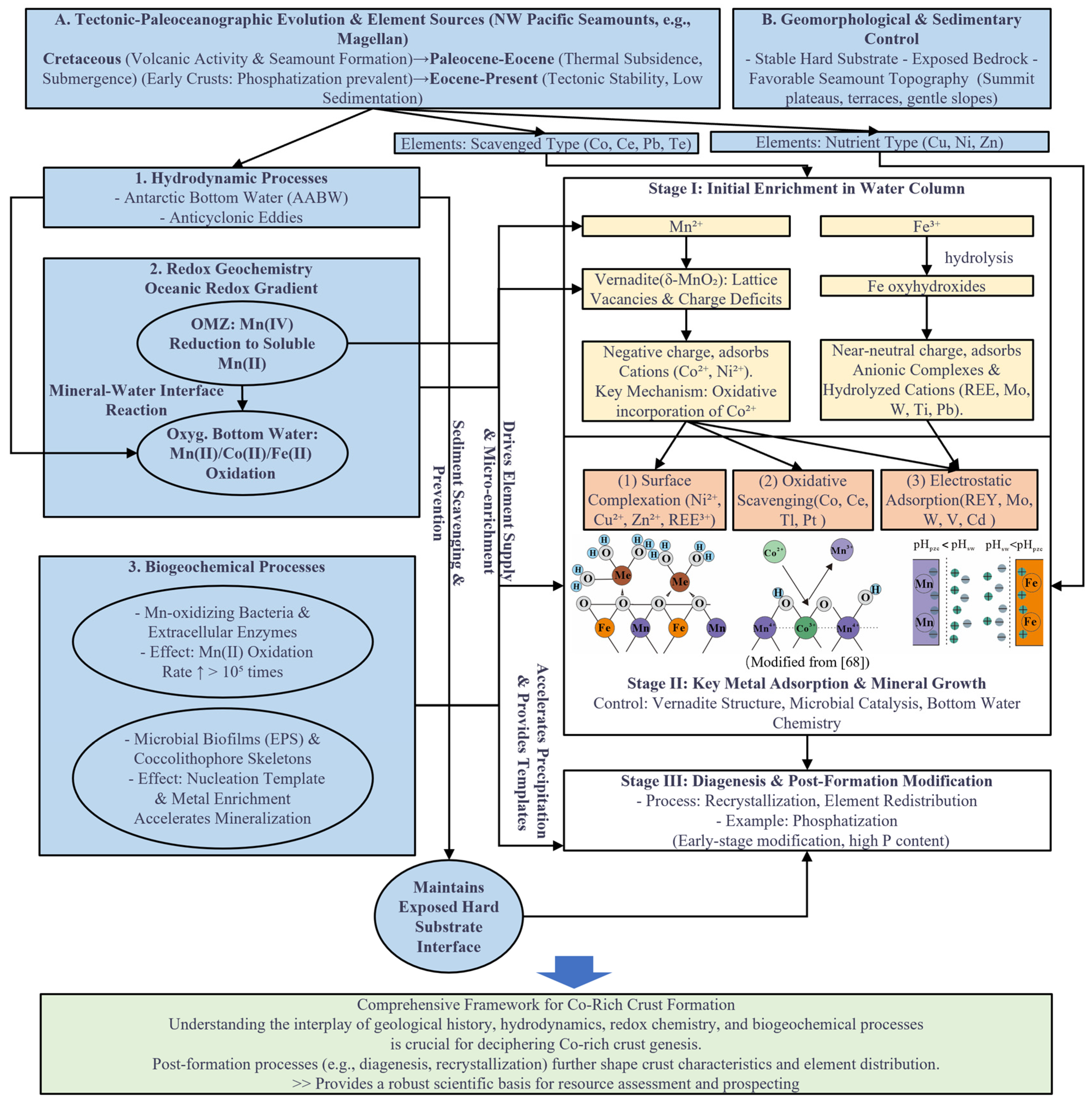
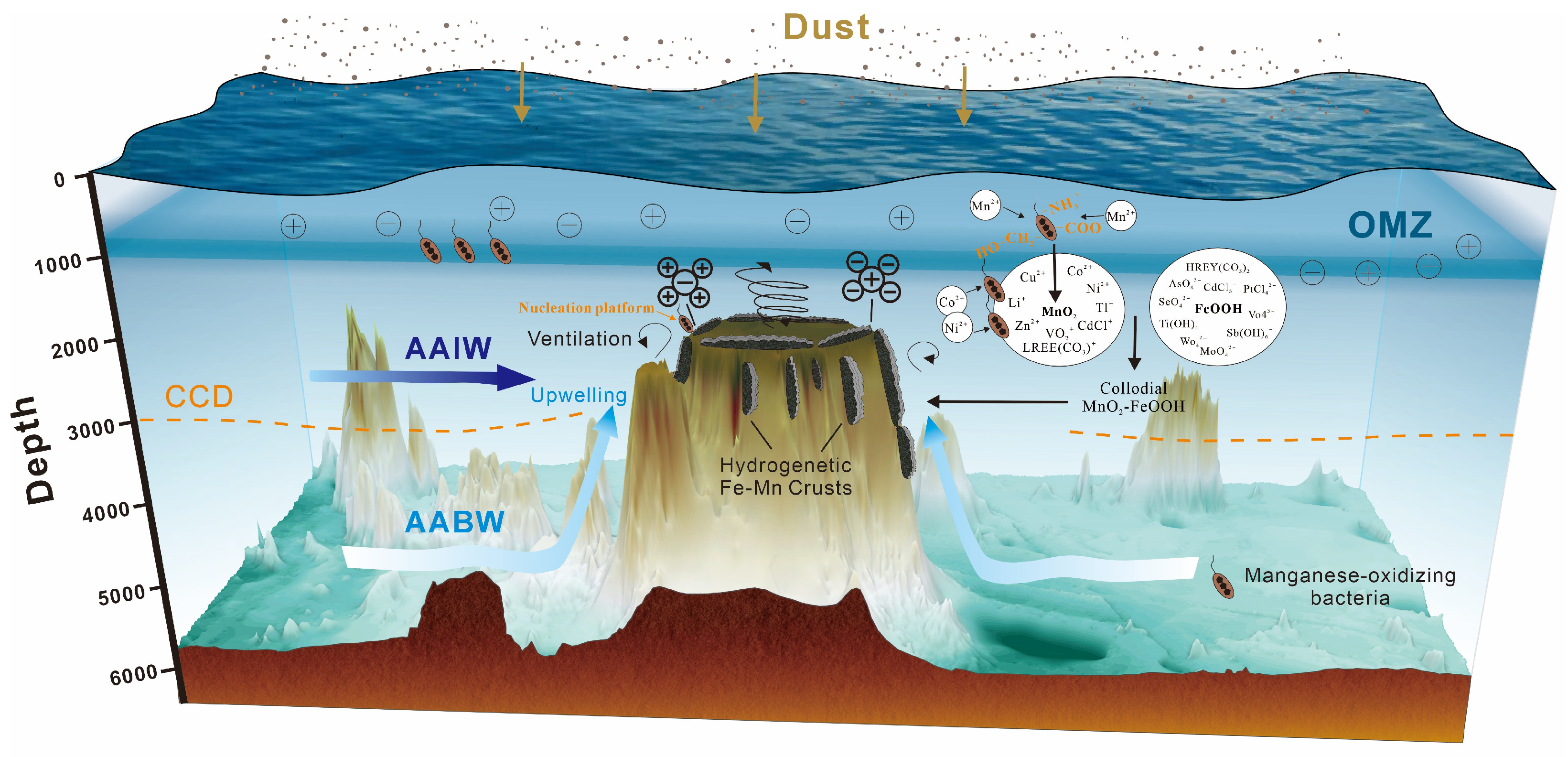
The formation of cobalt-rich crusts is a multi-mechanism chemical precipitation process from seawater. This paper discusses it in three consecutive stages: (1) Formation of manganese/iron colloids; (2) Stable aggregation of colloids; (3) Deposition and authigenic mineralization of colloids. This sequence is controlled by seawater redox conditions, ionic chemical composition, microbial catalysis, and physical environmental factors [21,50] (Figure 3).

4.1.1. Initial Formation of Fe–Mn Nanocolloids by Chemical and Microbial Oxidation

In deep-sea water, elements such as manganese, iron, cobalt, nickel, copper, and zinc exist in dissolved form as divalent cations [50].
The initial formation of Fe–Mn nanocolloids takes place under oxygenated deep-water conditions, where dissolved Mn(II) and Fe(II), supplied by background seawater inventories and microscale redox cycling near the seafloor, are oxidized to Mn(III/IV) and Fe(III), forming δ-MnO2 and Fe(OH)3 colloids, respectively [49]. The oxidation of Fe(II) proceeds rapidly in seawater at pH ≈ 8, producing weakly positively charged Fe(OH)3 colloids, whereas Mn(II) oxidation is kinetically slower and commonly requires catalytic surfaces or microbial mediation to form strongly negatively charged δ-MnO2 [51]. The contrasting surface charge characteristics of these two colloids establish the physicochemical basis for subsequent electrostatic aggregation.
Geological records indicate that the earliest mineral phases of ferromanganese crusts are typically poorly crystalline and possess exceptionally high specific surface areas. These phases include Fe-vernadite and poorly crystalline Fe oxyhydroxides, which commonly appear as globular, filamentous, or sheath-like structures in microscopic observations [12,15,16]. Such microtextures are widely interpreted to reflect microbially influenced oxidation and nucleation processes. Diverse manganese-oxidizing bacteria and iron-oxidizing bacteria have been detected or isolated from ferromanganese crusts in multiple seamount systems [14,52]. These microorganisms are capable of catalyzing the rapid oxidation of dissolved Mn(II) and Fe(II) through surface-associated enzymes such as multicopper oxidases, accelerating Mn(II) oxidation by several orders of magnitude relative to abiotic rates [53]. The resulting Mn–Fe nanocolloids may exhibit specific surface areas exceeding 300 m2/g [5], forming highly reactive carriers for subsequent metal enrichment.
Laboratory studies provide direct confirmation of these processes. Pseudomonas putida MnB1 and marine Bacillus sp. SG-1 rapidly oxidize Mn(II) in seawater-like media, producing poorly crystalline, layered birnessite-type Mn(III/IV) oxides on cell surfaces, with oxidation rates several orders of magnitude higher than sterile controls [54,55]. Roseobacter sp. AzwK-3b oxidizes Mn(II) via extracellular superoxide, initially forming highly reactive colloidal hexagonal birnessite that progressively transforms into more crystalline triclinic birnessite, revealing the structural evolution of biogenic Mn oxides [56]. Iron-oxidizing bacteria show similar behavior: Leptothrix cultures in Fe(II)-bearing solutions precipitate ferrihydrite and goethite nanoparticles directly on cell sheaths and EPS matrices [57]. More realistic deep-sea simulations demonstrate that Jeotgalibacillus campisalis, when co-incubated with natural polymetallic nodules, can enhance the dissolution of Fe and Mn from mineral surface and subsequently induces the re-precipitation of Fe oxyhydroxides (e.g., goethite) on microbial surfaces, thereby modifying the mineral composition of the nodule [58]. Although these experiments were conducted on deep-sea nodules rather than ferromanganese crusts, they provide process-level insights into microbe–mineral interactions at the Fe–Mn oxide–seawater interface under deep-sea conditions. Given the shared nanocrystalline Fe–Mn oxide phases (e.g., vernadite and ferrihydrite) present in both nodules and hydrogenetic crusts, such microbial dissolution–reprecipitation pathways are considered mechanistically relevant for understanding the early-stage formation of Fe–Mn nanocolloids in cobalt-rich crusts. These findings therefore support the interpretation that microbial mediation can contribute to the transformation of dissolved Mn(II) and Fe(II) into nanometer-scale Fe–Mn colloids, without implying identical microbial communities or depositional environments.

4.1.2. Colloidal Stabilization and Metal Adsorption Stage

Colloidal stability is closely related to surface charge states. Fe(OH)3 has an isoelectric point (IEP) of approximately 8.5, carrying a positive charge under seawater pH conditions [59]; δ-MnO2 has a pHzpc of about 2.8, carrying a negative surface charge [55,60]. The two undergo heterocoagulation via electrostatic attraction, forming MnO2–Fe(OH)3 composite colloids. This composite structure possesses both positive and negative sites, enabling efficient adsorption of metal ions from seawater: MnO2 surfaces preferentially adsorb cations such as Co2+, Ni2+ and Cu2+, while Fe(OH)3 adsorbs anions like HVO42− and MoO42− (Figure 3). This facilitates elemental fractionation and enrichment at the microscale [20,61,62]. Co2+ adsorbed onto the Mn oxide surface is further oxidized to Co3+ and stably incorporated into [MnO6] octahedral vacancies, constituting the key enrichment mechanism for cobalt-rich crusts [63]. Rare earth elements (REEs) are scavenged primarily through surface complexation on Fe–Mn oxyhydroxides, with most REE3+ adsorbed at Fe–OH and Mn–O sites. Cerium exhibits a distinct behavior, as Ce3+ is catalytically oxidized to Ce4+ on MnO2 surfaces, leading to its irreversible fixation and the development of positive Ce anomalies in cobalt-rich crusts [63,64,65]. Platinum-group elements such as Pt are enriched through surface-mediated redox reactions and co-precipitation with Mn oxides, where Pt(II/IV) complexes are oxidized and stabilized on MnO2 surfaces during prolonged hydrogenetic growth [5,66,67,68].
Microbial regulation during this stage primarily manifests through biofilm-mediated aggregation and structural control. Extracellular polymeric substances (EPS) secreted by microorganisms can chelate metal ions, stabilize colloidal precursors, and promote particle binding and flocculation via three-dimensional networks [64]. Microbial activity is a key factor controlling the preferential enrichment of cobalt (Co) over nickel (Ni) in hydrogenetic cobalt-rich ferromanganese crusts. Bacterial EPS also modulate the metal coordination environment through charge distribution and organic functional groups, thereby enhancing the oxidative adsorption and stable binding of Co [13]. The calcareous skeletons of coccolithophores serve as “biological templates” upon settling, where their CaCO3 is replaced by Mn oxides, forming Ca–Mn-enriched layers [17,65,67] that further accelerate microscale aggregation and deposition.

4.1.3. Colloidal Deposition and Authigenic Mineralization Stage

With fluctuations in redox interfaces and hydrochemical conditions, the surface charges of Fe–Mn composite colloids are gradually neutralized, weakening electrostatic repulsion and promoting flocculation and deposition [66]. The oxidation of Mn(II) exhibits autocatalytic properties: the surface of pre-existing solid MnO2 significantly accelerates the oxidation and deposition rates of subsequent Mn(II). The initial MnO2 nuclei (formed by microorganisms) provide active sites for adsorbing more dissolved Mn(II). The surface of this newly formed MnO2 itself catalyzes the oxidation of adsorbed Mn(II), converting it into solid-phase MnO2. This not only adds new material layers to the crust but also creates additional surface area and catalytic sites. This positive feedback loop (autocatalysis) enables crusts to grow continuously by persistently scavenging manganese from the overlying water [22].
During the nucleation stage of crust formation, microbial communities (e.g., bacteria and archaea) and their secreted extracellular polymeric substances (EPS) form biofilms on bedrock surfaces. These biofilms, rich in negatively charged functional groups [33], serve as “bio-seeds” providing initial nucleation sites for subsequent mineral precipitation [12]. The nascent mineral layer becomes a new active interface, continuously promoting new Mn–Fe oxide deposition through autocatalysis to form layered structures.
During long-term mineralization, crusts undergo Phosphatization and Diagenetic Recrystallization. The former occurs during sea-level drop or upward migration of the Oxygen Minimum Zone (OMZ), where phosphate-rich seawater metasomatizes the primary layer, leading to cobalt leaching and re-enrichment of REE and Pt [69,70]. The latter manifests as the transformation of vernadite into the structurally more stable todorokite. Transmission electron microscopy (TEM) studies indicate that crystallinity increases with depth [33].

4.2. Enrichment Characteristics of Critical Metals and the Structural Adsorption Mechanism of Co

4.2.1. Enrichment Characteristics of Critical Metals

  • The metal enrichment of cobalt-rich crusts is primarily controlled by the adsorption capacity of Fe–Mn oxides and variations in marine redox conditions. Manganese and iron are the principal ore-forming elements in cobalt-rich crusts, occurring in multiple oxidation states and undergoing migration and fractionation within the marine environment [21]. Recent high-resolution observations reveal that hydrogenetic ferromanganese crusts and nodules exhibit submicron-scale alternating porous and compact laminae, which record short-term fluctuations in bottom-water redox conditions [71]. Variations in the Mn3+/Mn4+ ratio and the crystallinity of δ-MnO2 indicate periodic redox oscillations during crust growth, affecting the partitioning and fixation of transition metals such as Co, Ni, and Cu within different micro-layers [5,11,72]. Under relatively oxic conditions, the oxidation of Mn2+ to Mn4+ generates negatively charged Mn oxide surfaces that preferentially adsorb divalent cations, while mildly reducing microenvironments promote the partial reduction of Mn4+ to Mn3+, altering the layer charge balance and enhancing the selective uptake of Co3+ and Ni2+ [62]. Conversely, Fe oxyhydroxides dominate under less oxidizing or slightly reducing conditions, favoring the incorporation of Fe3+-associated anions such as M o O 4 2 and P O 4 3 . These redox-driven transformations dynamically regulate the physicochemical reactivity of Fe–Mn oxides, thereby determining their metal adsorption selectivity and enrichment efficiency. Overall, the interplay between redox fluctuations, mineral structural evolution, and surface complexation processes governs the multi-scale enrichment mechanism of cobalt-rich crusts in deep-sea environments [62,71,73].
  • Marine microorganisms also play a significant role in the metal enrichment process. Many microorganisms can promote the transformation of Fe and Mn via redox reactions and influence the speciation of metallic elements. Under oxic conditions, microorganisms catalyze the oxidation of Mn2+, causing Mn4+ to precipitate as Mn oxides, thereby enhancing their adsorption capacity for metal ions such as Co, Ni, and Cu. Furthermore, microorganisms can affect metal solubility and mobility by complexing with metal ions through extracellularly secreted organic ligands [74]. Biogeochemical cycling further regulates the distribution of metallic elements in the water column, leading to a trend where Mn and Co are enriched in surface waters and depleted in deep waters [75]. Fe exhibits dual characteristics of scavenging and cycling; it can be removed by adsorption onto colloidal oxides or re-enter the water column through the microbial reduction of Fe3+ [76]. Co is primarily sequestered by Mn oxides, whereas Cu and Zn have lower regeneration rates in the water column due to their strong binding affinity with organic matter [77]. The combined effect of these biogeochemical processes determines the speciation and distribution patterns of metals in deep-sea cobalt-rich crusts.
  • Metallic elements and their adsorption mechanisms. Metallic elements are enriched in ferromanganese oxide colloids via surface complexation, redox reactions, and structural incorporation: ① Selective adsorption by surface charge: Manganese oxides (negative charge) preferentially adsorb positively charged cations (e.g., Co2+, Ni2+, Zn2+) and high-valence metals (e.g., Co3+, Ce4+). Iron oxyhydroxides (weak positive charge) adsorb negatively charged complexes (e.g., A s O 4 3 , M o O 4 2 ) and neutral molecules (e.g., T i ( O H ) 4 0 ). ② Adsorption via oxidative substitution mechanism: Cobalt (Co): Co2+ is oxidized to Co3+ on the manganese oxide surface, forming edge-sharing complexes and becoming embedded in the layered structure. Cerium (Ce): Ce3+ is oxidized to Ce4+ and immobilized in the Mn phase as CeO2, forming significant positive Ce anomalies. Platinum (Pt): Pt2+ is oxidized to Pt4+ and enriched via surface complexation or as discrete phases. For Co, Ce, and Tl, enrichment via oxidative adsorption is primarily related to the oxidative substitution mechanism associated with δ-MnO2. Redox-sensitive elements in seawater remain at lower valences and are oxidized by MnO2 in oxic environments. Co, Ce, and Tl are preferentially oxidized to insoluble, inner-sphere, high-valence species within the Mn oxides. These insoluble oxidized species participate less in exchange reactions, gradually accumulating over time and eventually becoming exceptionally abundant, thus showing a high correlation with Mn [69]. ③ Direct substitution via surface complexation: Nickel (Ni2+) and Copper (Cu2+) are stably incorporated by occupying vacancies in the manganese oxide layers (e.g., the hexagonal structure of vernadite). For elements like Ni, Cu, Zn, and Li, this primarily occurs on the δ-MnO2 surface. For these elements, direct surface complexation occurs on the Fe-Mn oxides. Ni, Cu, Zn, and Li form abundant inner-sphere complexes on the mineral surfaces (Li also exhibits outer-sphere complexation in carbonate phases and at tunnel wall sites), and Mn oxides generally make a larger contribution to the enrichment of this group [68].

4.2.2. Structural Adsorption Characteristics and Mechanism of Co Element

The adsorption and enrichment of Co in cobalt-rich crusts primarily depend on the mineral structure and redox properties of manganese oxides. The enrichment of Co in cobalt-rich crusts is mainly controlled by the mineral structures of layered and tunnel-structured manganese oxides, and its adsorption and substitution processes involve complex lattice adjustments and redox reactions. The [MnO6] octahedral layers in cobalt-rich crusts contain numerous vacancies. These vacancies can be filled by low-valence cations such as Co2+, Ni2+, and Cu2+, accompanied by the reduction of structural Mn4+, which leads to a layer charge imbalance [69]. To compensate for the charge deficit, various dissolved cations present in seawater may be incorporated into the interlayers or tunnel centers of manganese oxides. Commonly reported hydrated cations include Mg2+, Ca2+, Zn2+, Li+, and Na+, which are frequently observed due to their high seawater abundance and suitable hydration radii, thereby stabilizing the manganese oxide structure and enhancing its adsorption capacity for metal ions. The primary adsorption modes for Co2+ include double corner-sharing (DCS) and triple corner-sharing (TCS), where Co2+ occupies sites above or below the vacancies and binds to the manganese oxide lattice via O bonds. Furthermore, Co2+ can also be adsorbed at the terminal edge sites of the layers via double edge-sharing (DES) and triple edge-sharing (TES) configurations (Figure 4; [78]). In tunnel-structured manganese oxides, Co2+ can adsorb onto the tunnel walls or in the tunnel center, forming stable Co-O or Co-OH coordination structures. High Co/Mn ratios may lead to the gradual filling of vacancies, thereby altering the layer structure and making edge-site adsorption modes more prevalent [69]. The substitution mechanism of Co from solution via oxidation reactions with Mn is as follows:
2 M n l a y e r 3 + M n l a y e r 4 + + l a y e r + M n s o l u t i o n 2 +
C o s o l u t i o n 2 + + 1 + M n l a y e r 3 + C o i n t e r l a y e r 2 + + 1 + M n l a y e r 3 + C o i n t e r l a y e r 3 + + 1 + M n l a y e r 2 + C o l a y e r 3 + + 2 + M n s o l / i n t e r 2 +
C o s o l u t i o n 2 + + M n l a y e r 3 + + M n s o l u t i o n 2 + + C o i n t e r l a y e r 3 + + M n s o l u t i o n 2 + + C o l a y e r 3 +
where □ denotes a vacant site.
The adsorption process of Co is not only affected by the mineral structure but also controlled by the redox conditions of seawater. Co2+ in seawater can be transformed into Co3+ through oxidation by highly reactive manganese oxides such as birnessite, and subsequently enter interlayer vacancies via octahedral triple-corner-sharing (TCS) complexes [33,37,78,79,80]. This process begins with the TCS adsorption of Co2+ onto an exposed Mn4+ vacancy. Subsequently, Co2+ undergoes electronic rearrangement via the Jahn-Teller effect, transitioning from a high-spin ( t 2 g 5   e g 2 ) state to a low-spin ( t 2 g 6   e g 1 ) state, and is finally oxidized to the stable Co3+ ( t 2 g 6   e g 0 ). Concurrently, Mn4+ is reduced to Mn3+ and experiences lattice distortion due to the Jahn-Teller effect [37,81]. This oxidative adsorption mechanism allows Co3+ to be irreversibly fixed within the manganese oxide structure, greatly enhancing its stability. The enrichment of Co, Ce, and Tl primarily relies on the oxidative substitution mechanism of δ-MnO2, whereby low-valence elements from seawater are transformed into poorly soluble high-valence forms through oxidation by Mn oxides, gradually accumulating and thus exhibiting high enrichment characteristics [69,82].
However, the adsorption of Co is not entirely irreversible; its speciation may be affected when the marine redox environment changes. When seawater enters an anoxic environment or is influenced by microbial/abiotic reduction, Mn4+ is easily reduced to Mn2+/Mn3+, leading to a decrease in the stability of Co3+. Furthermore, the increase in Mn2+/Mn3+ intensifies their competition with Co2+ for adsorption sites, thereby weakening the capacity of manganese oxides to immobilize Co. Simulation studies on δ-MnO2 indicate that an increase in low-valence Mn significantly reduces the adsorption efficiency of critical metals. Particularly in layered birnessite, competition for corner-sharing and edge-sharing adsorption sites further impacts the adsorption stability of Co [69]. Overall, the enrichment and sequestration of Co are influenced by multiple factors, including the structure of Mn oxides, redox conditions, and microbial activity. These mechanisms collectively determine the distribution and speciation of Co in cobalt-rich crusts.

5. Metallogenic and Ore-Controlling Factors and Mechanisms

5.1. Control of Tectonics and Paleoceanographic Evolution on the Metallogenesis of Cobalt-Rich Crusts

5.1.1. Influence of Tectonics and Paleoceanographic Evolution

The metallogenesis of cobalt-rich crusts requires a stable accommodation space and an extended duration of mineralization. Their distribution is highly selective, with large-scale enrichment resulting from the long-term interaction among specific tectonic settings, paleoceanographic conditions, and geomorphological evolution [83,84]. The tectonic and paleoceanographic evolution not only determined the timing and spatiotemporal migration of seamount formation but also directly influenced water-mass structure, metal sources, and sedimentary environments, establishing the fundamental geological and hydrological framework for subsequent crust development.
The Magellan and Marcus–Wake Seamount Groups in the northwestern Pacific rest on old oceanic crust (~150–170 Ma) and represent volcanic products from the early evolutionary stage of the Pacific Plate [85]. Since the Late Cretaceous, the evolution of the global tectonic framework has profoundly reshaped ocean circulation systems, altered the origin and characteristics of Pacific deep water, and thereby controlled the metallogenic environment of cobalt-rich crusts in the western Pacific. During the Late Cretaceous, the study area was located south of the equator and received terrigenous input from the Americas, resulting in the enrichment of K, Si, and Al. Under less oxidative seawater conditions, the limited formation of Mn oxyhydroxides reduced the adsorption capacity for Co, leading to its relative depletion. The lower Mg content is mainly associated with dilution by terrigenous material. Meanwhile, the location within a high-productivity zone favored the relative enrichment of Cu and Zn. Bottom waters can become suboxic to anoxic under conditions of restricted circulation, high organic matter remineralization, or intrusion of oxygen-minimum-zone (OMZ) waters. These low-oxygen environments suppress Mn(II) and Fe(II) oxidation, thereby modifying the redox pathways and the mineral phases formed in Fe–Mn crusts. From the latest Mesozoic to the early Paleogene, the equatorial Pacific and Atlantic were connected via the Central American Seaway, and the Tethys Seaway remained open. Global ocean currents were predominantly zonal, deep-water formation was weak, and anoxia was widespread [23,86]. With the expansion of the Atlantic and continental drift, the connectivity between the Pacific and Arctic Oceans decreased, and bottom water was supplied mainly from the south. In the early Cenozoic, crusts formed within the equatorial low-wind belt, where reduced dust flux caused K, Si, and Al depletion. Repeated climatic warming events triggered phosphatization, leading to growth hiatuses and the formation of P and Ca peaks. By the late Paleocene to early Eocene, the sequential opening of the Tasmanian–Antarctic Passage (~32 Ma) and the Drake Passage (~30 Ma) facilitated the establishment of the Antarctic Circumpolar Current (ACC) around Antarctica [87,88], giving rise to the global thermohaline circulation. This event marked the transition of the oceanic circulation pattern from a “greenhouse” to an “icehouse” regime. The intensification of Antarctic Bottom Water (AABW) and Antarctic Intermediate Water (AAIW) lowered bottom-water temperatures and increased oxygen levels, rendering Pacific deep waters broadly oxidizing [86,89]. Approximately 71% of modern Pacific bottom water originates from AABW [86], whose inflow introduced an oxidizing environment and supplied Mn and Fe ions—key prerequisites for crust formation.
During the Miocene, tectonic events further reshaped global circulation. The closure of the Tethys Seaway and the Australian–Indonesian Gateway at ~8 Ma terminated low-latitude deep-water exchange between the Pacific and Indian Oceans. Strengthening of the ACC drove the development of a symmetrical meridional circulation in both hemispheres [88,90]. This intensified circulation pushed AAIW northward, improving redox conditions in the western Pacific’s intermediate and deep waters and significantly contracting the Oxygen Minimum Zone (OMZ) [91]. Following the closure of the Isthmus of Panama (~3 Ma), the modern thermohaline circulation became fully established. North Atlantic Deep Water (NADW) and AABW formed complementary bottom-water systems in the Pacific, providing a persistently oxygenated, cold, and low-sedimentation environment favorable for long-term crust growth. Since the Late Cenozoic, crustal development migrated toward the northwestern Pacific, where strong westerlies and elevated eolian flux increased K, Si, and Al contents, enhanced seawater oxidation, and led to gradual enrichment of Co and Ni, accompanied by depletion of Cu, Zn, P, and Ca [3,92,93]. Concurrently, the transition from a “greenhouse” to “icehouse” climate intensified temperature gradients and increased seawater CO2 solubility, deepening the carbonate compensation depth (CCD) from ~3900 m to ~4500 m. The deeper CCD reduced the dissolution of biogenic calcite shells at crust-forming depths, thereby diminishing an important source of dissolved Fe and influencing metal reprecipitation [83]. Overall, cold phases with high productivity provided abundant Fe–Mn solid phases and strong bottom currents, while interglacial acidification promoted metal dissolution and re-adsorption. The alternation of these regimes collectively shaped the layered structure and compositional evolution of the crusts [88,89,90]. Thus, the formation and evolution of cobalt-rich crusts in the western Pacific fundamentally represent a geological response to the coupled processes of tectonics, ocean circulation, and climate (Figure 5).
Mineralization was primarily concentrated in periods of elevated eolian flux and enhanced carbonate dissolution—namely 80–75 Ma, 60–50 Ma, and 15–0 Ma—with hiatuses corresponding to large-scale phosphatization events. In general, the tectonic evolution and circulation dynamics of the Pacific regulated dust transport, redox conditions, and marine productivity, thereby determining the spatial–temporal distribution and metallogenic rhythm of cobalt-rich crusts.

5.1.2. Constraints of Topography, Micro-Geomorphology, and Seamount Stability

The geomorphological characteristics of seamounts act as direct spatial controls on the metallogenesis of cobalt-rich crusts. Seamounts in the western Pacific commonly exhibit star-shaped guyot morphologies, with alternating narrow ridges and concave valleys along their slopes—features reflecting the superimposed effects of multiple volcanic episodes and gravitational slope failures [94,95,96]. Although slope failure may disrupt local crust layers, it also exposes new hard substrates favorable for subsequent mineral precipitation. The bedrock of the Magellan Seamounts, dominated by basalt, is crucial for maintaining long-term stability of the mineralization environment. Studies show that while bedrock type exerts little influence on crust chemistry, prolonged exposure of stable basaltic substrates to oxygenated seawater is essential for sustained crustal growth [38]. Seamount topography accelerates and perturbs bottom currents, producing dynamic conditions that continuously remove sediments and maintain hard-substrate exposure—favoring crust enrichment along slopes and summit margins where hydrodynamic energy is optimal [97].
At the geomorphological scale, the thickness and distribution of cobalt-rich crusts correlate strongly with slope gradient. Steeper upper slopes (15–30°) represent the most favorable zones for crust development, where vigorous hydrodynamics inhibit sediment accumulation and promote Fe–Mn colloid deposition and adhesion. In contrast, at slope bases or depressions, sediments readily accumulate, burying crusts or interrupting growth [94]. Observational data show that crust thickness on western Pacific seamounts generally increases with slope angle, typically ranging from 10–120 mm, with average growth rates of 1–5 mm Ma−1 [3]. Furthermore, morphological evolution—such as guyot flattening or dike emplacement—can modify local current structures, thereby regulating the microenvironmental conditions of metal precipitation.
In summary, tectonic and paleoceanographic evolution provided the macro-scale geological framework and circulation background necessary for cobalt-rich crust formation, whereas seamount topography and geomorphology controlled bedrock exposure, sedimentation rates, and local hydrodynamics, creating the immediate mineralization space and depositional interface. The interplay of these processes has made the Magellan Seamount region one of the most representative global sites for cobalt-rich crust concentration and development.

5.2. Microscopic Mineral–Water Interface Drivers of Mineralization: Microstructural and Microbial Coupling Mechanisms

The high metal content of marine ferromanganese crusts reflects their microscopic uptake mechanisms and mineralogical structures. At the microscale, the metallogenic process of cobalt-rich crusts is jointly governed by the crystallographic characteristics and surface chemical reactivity of ferromanganese oxides. The dominant mineral phases, layered δ-MnO2 (vernadite) and nanocrystalline Fe oxyhydroxides, possess high specific surface areas and abundant structural vacancies, providing ideal microenvironments for metal ion adsorption, exchange, and oxidation [1,38]. Within the octahedral layer structure of δ-MnO2, widespread isomorphic substitution of Mn4+ → Mn3+ generates significant charge imbalance and vacancy defects. These sites selectively adsorb transition-metal ions such as Co2+, Ni2+, and Cu2+, facilitating their valence transformations through surface coordination reactions or electron transfer processes [37]. Studies have demonstrated that Co2+ forms octahedral triple-corner-sharing (TCS) complexes at δ-MnO2 vacancies, undergoing electron-exchange reactions to yield low-spin Co3+ accompanied by the reduction of Mn4+ to Mn3+. This solid-phase redox reaction serves as a key driving force for cobalt enrichment within the crusts [69]. In addition, dissolved Mn(III) is inherently unstable in seawater and rapidly undergoes disproportionation (2Mn(III) → Mn(II) + Mn(IV)), providing an important abiotic pathway for generating Mn(IV) oxides involved in crust accretion. Meanwhile, poorly crystalline Fe oxyhydroxides phases, acting as carriers for anion adsorption and Fe–O–Mn bridge formation, promote the co-precipitation of Mn–Fe composite colloids at mineral–water interfaces, leading to nanoscale co-enrichment of Co, Ni, Cu, and REEs. Consequently, the structural defects, surface charge, and redox activity of ferromanganese oxides collectively constitute the chemical microenvironment for crust formation, with their microscopic adsorption–oxidation mechanisms forming the material foundation of macroscopic metallogenesis (Figure 5).
In addition to inorganic structural controls, microbial processes play important catalytic and regulatory roles within this microscale system. Several heterotrophic Mn-oxidizing bacteria, such as Leptothrix, Pseudomonas, and Bacillus, have been reported from various environments, including marine settings. Although these microorganisms do not obtain energy from Mn(II) oxidation, they can accelerate the conversion of Mn(II) to mixed-valence Mn(III/IV) oxides through extracellular polyphenol oxidases or peroxidases (e.g., Mn-peroxidase, multicopper oxidase) [53]. The resulting biogenic MnOx nanoparticles act as reactive nucleation sites that adsorb metal ions and promote the layered growth of ferromanganese crusts. Simultaneously, extracellular polymeric substances (EPS) secreted by these microbes exhibit strong metal-chelating capabilities, stabilizing Mn, Fe, and Co ions and controlling crystal orientation, thereby forming organic-coated nanomineral composites [98]. Such bio–mineral interfacial interactions not only accelerate oxidative precipitation rates but also enhance structural compactness and fine-scale lamination within the crust. Notably, MnO2 produced by Mn-oxidizing bacteria often acts as a precursor to later δ-MnO2 layers, serving as biologically induced mineralization (BIM) nuclei during the early stages of crust growth [3]
Therefore, the microscopic metallogenic process of cobalt-rich crusts represents a synergistic outcome of crystal structure characteristics and biochemical reactions: structural vacancies and surface redox sites provide the chemical driving force, while microbial metabolic activity regulates metal migration, enrichment, and crust morphology through catalytic oxidation and organic-ligand mediation.
In summary, the microscale metallogenic driving mechanism of cobalt-rich crusts can be conceptualized as an integrated “mineral structure–surface chemistry–microbial activity” coupling system. The layered δ-MnO2 structure and microbial bio-oxidation processes together sustain a continuous Mn redox cycle, establishing a stable microreactive field for crustal growth. This coupled mechanism not only explains the high degree of metal enrichment and ordered stratification in cobalt-rich crusts but also elucidates the intrinsic co-mineralization nature between inorganic geochemistry and biogeochemical processes in deep-sea environments.

6. Conclusions

(1)
Based on cobalt-rich crusts from the Magellan Seamount region in the northwestern Pacific, the metallogenic process can be divided into three stages: ① Formation of Mn/Fe colloids—At the chemical interface between oxygen-rich bottom water and the oxygen minimum zone (OMZ), Mn2+ and Fe2+ are oxidized to produce hydrated oxide colloids such as δ-MnO2 and Fe(OH)3 and suspended in water. ② Metal adsorption stage—The formed colloidal particles adsorb key metal ions such as Co2+, Ni2+, and Cu2+ through surface complexation and oxidation–substitution reactions. Among them, Co2+ can be oxidized to Co3+ and stabilized within the octahedral layer vacancies of MnO6. Metal adsorption is continuous in the process of colloid formation, suspension aggregation and precipitation. ③ Colloid deposition and mineralization stage—Mn–Fe colloidal particles aggregate, dehydrate, and cement on the exposed seamount bedrock surface, forming layered cobalt-rich crusts. The entire process is governed by the Fe/Mn redox cycle, reflecting a continuous evolution from colloidal reactions to solid-phase mineral formation.
(2)
Biological processes act as crucial catalytic mechanisms promoting the microstructural evolution of crusts. Mn-oxidizing bacteria oxidize Mn2+ to MnO2 nanoparticles via extracellular oxidase systems, providing precursors for the initial nucleation of crusts. Meanwhile, extracellular polymeric substances (EPS) chelate metal ions at the interface, control crystal orientation, and enhance interparticle binding, leading to the formation of dense, laminated Mn–Fe oxide composites. This bio–mineral coupling mechanism significantly enhances both the oxidation rate and adsorption efficiency of metal ions, representing one of the key microscopic driving forces for crustal growth.
(3)
The metallogenesis of cobalt-rich crusts in the Magellan Seamount region is jointly driven by macro-scale geological backgrounds and microscale physicochemical mechanisms. Tectonic and paleoceanographic evolution determine the formation, drift, and stability of seamounts, providing long-term exposed hard substrates and stable depositional environments for mineralization. The inflow of Antarctic Bottom Water (AABW), the spatiotemporal variability of the OMZ, and the evolution of the carbonate compensation depth (CCD) collectively control redox conditions and metal sources. At the microscale, the crystal defects, interlayer vacancies of Mn–Fe oxides, and biological activities together constitute the interfacial driving forces for metal enrichment. The macro-tectonic framework defines the metallogenic site, while microchemical and biological processes determine the metallogenic mechanism—their coupling jointly governs the spatiotemporal distribution and elemental enrichment intensity of cobalt-rich crusts.
(4)
This study establishes a regionally constrained, multi-level metallogenic model for cobalt-rich crusts in the Magellan Seamount region, linking tectonic–paleoceanographic evolution with micro- to nanoscale mineralogical and geochemical processes. By synthesizing existing mineralogical and geochemical evidence, this review highlights that crystal defects, lattice vacancies, and redox-active surface sites of Mn–Fe oxides play a key role in controlling the selective enrichment and stabilization of cobalt and other critical metals. To rigorously evaluate the relative importance of these nanoscale crystal-chemical features, future studies should integrate conventional bulk and microanalytical approaches (e.g., SEM, XRD, XRF, ICP-OES, ICP-MS, EPMA) with advanced nanoscale imaging and spectroscopic techniques, including (S)TEM, synchrotron-based XANES/EXAFS, XPS, NanoSIMS, and PDF analysis, to directly constrain metal coordination environments, oxidation states, and lattice incorporation mechanisms, in combination with in situ observations of redox gradients, ocean circulation, and substrate characteristics. Such integrated, multi-technique and multi-scale approaches will allow quantitative assessment of the coupled roles of crystal chemistry, redox conditions, microbial mediation, and oceanographic setting, thereby refining metallogenic models and providing a robust scientific framework for predicting cobalt-rich crusts development and identifying economically significant cobalt-rich crust provinces in the western Pacific.

Author Contributions

Conceptualization, X.Y. and K.Z.; methodology, K.Z.; software, K.Z.; validation, C.L., Y.D. and Q.G.; formal analysis, K.Z. and X.Y.; investigation, K.Z., H.W. and J.W.; resources, X.H.; data curation, C.L.; writing—original draft preparation, K.Z.; writing—review and editing, H.W. and J.W.; visualization, K.Z.; supervision, X.Y.; project administration, X.Y.; funding acquisition, X.Y. All authors have read and agreed to the published version of the manuscript.

Funding

This research was funded by the National Natural Science Foundation of China (NSFC) (Grants U24B6001 and 41972107), the Discipline Breakthrough Precursor Project of the Ministry of Education of China (Grant JYB2025XDXM803), and the Chinese “111” project (Grant B20011).

Data Availability Statement

The original contributions presented in this study are included in the article. Further inquiries can be directed to the corresponding author.

Acknowledgments

We thank any assistance and/or helpful discussions. We acknowledge the anonymous reviewers for their comments that greatly improved the earlier version of this manuscript. We are grateful to our research group members’ support.

Conflicts of Interest

The authors declare no conflicts of interest.

References

  1. Hein, J.R.; Koschinsky, A.; Bau, M.; Manheim, F.T.; Kang, J.-K.; Roberts, L. Cobalt-rich ferromanganese crusts in the Pacific. In Handbook of Marine Mineral Deposits; Cronan, D.S., Ed.; CRC Press: Boca Raton, FL, USA, 2000; pp. 239–279. [Google Scholar]
  2. Koschinsky, A.; Hein, J.R. Marine Ferromanganese Encrustations: Archives of Changing Oceans. Elements 2017, 13, 177–182. [Google Scholar] [CrossRef]
  3. Hein, J.R.; Mizell, K.; Koschinsky, A.; Conrad, T.A. Deep-Ocean Mineral Deposits as a Source of Critical Metals for High- and Green-Technology Applications: Comparison with Land-Based Resources. Ore Geol. Rev. 2013, 51, 1–14. [Google Scholar] [CrossRef]
  4. Hein, J.R.; Koschinsky, A.; Halliday, A.N. Global Occurrence of Tellurium-Rich Ferromanganese Crusts and a Model for the Enrichment of Tellurium. Geochim. Cosmochim. Acta 2003, 67, 1117–1127. [Google Scholar] [CrossRef]
  5. Hein, J.R.; Koschinsky, A. Deep-Ocean Ferromanganese Crusts and Nodules. In Treatise on Geochemistry; Elsevier: Amsterdam, The Netherlands, 2014; pp. 273–291. ISBN 978-0-08-098300-4. [Google Scholar]
  6. Halbach, P.E.; Jahn, A.; Cherkashov, G. Marine Co-Rich Ferromanganese Crust Deposits: Description and Formation, Occurrences and Distribution, Estimated World-Wide Resources. In Deep-Sea Mining: Resource Potential, Technical and Environmental Considerations; Sharma, R., Ed.; Springer International Publishing: Cham, Switzerland, 2017; pp. 65–141. ISBN 978-3-319-52557-0. [Google Scholar]
  7. Verlaan, P.A.; Cronan, D.S. Origin and Variability of Resource-Grade Marine Ferromanganese Nodules and Crusts in the Pacific Ocean: A Review of Biogeochemical and Physical Controls. Geochemistry 2022, 82, 125741. [Google Scholar] [CrossRef]
  8. Maciąg, Ł.; Zawadzki, D.; Kozub-Budzyń, G.A.; Piestrzyński, A.; Kotliński, R.A.; Wróbel, R.J. Mineralogy of Cobalt-Rich Ferromanganese Crusts from the Perth Abyssal Plain (E Indian Ocean). Minerals 2019, 9, 84. [Google Scholar] [CrossRef]
  9. Deng, X.; Ren, J.; Deng, X.; Tu, J.; Hong, S.; He, G.; Zhang, L.; Yang, Y. Occurrence and Enrichment of Critical Metals in Ferromanganese Deposits in the Western Pacific. Ore Geol. Rev. 2024, 174, 106314. [Google Scholar] [CrossRef]
  10. Koschinsky, A.; Stascheit, A.; Bau, M.; Halbach, P. Effects of Phosphatization on the Geochemical and Mineralogical Composition of Marine Ferromanganese Crusts. Geochim. Cosmochim. Acta 1997, 61, 4079–4094. [Google Scholar] [CrossRef]
  11. Kuhn, T.; Wegorzewski, A.; Ruehlemann, C.; Vink, A. Composition, Formation, and Occurrence of Polymetallic Nodules; Springer: Cham, Switzerland, 2017; pp. 23–63. [Google Scholar]
  12. Jiang, X.-D.; Sun, X.-M.; Guan, Y.; Gong, J.-L.; Lu, Y.; Lu, R.-F.; Wang, C. Biomineralisation of the Ferromanganese Crusts in the Western Pacific Ocean. J. Asian Earth Sci. 2017, 136, 58–67. [Google Scholar] [CrossRef]
  13. Sujith, P.P.; Ramanan, D.; Gonsalves, M.J.B.D.; LokaBharathi, P.A. Microbial Activity Promotes the Enrichment of Cobalt over Nickel on Hydrogenetic Ferromanganese Crusts. Mar. Georesour. Geotechnol. 2017, 35, 1158–1167. [Google Scholar] [CrossRef]
  14. Sujith, P.P.; Gonsalves, M.J.B.D. Ferromanganese Oxide Deposits: Geochemical and Microbiological Perspectives of Interactions of Cobalt and Nickel. Ore Geol. Rev. 2021, 139, 104458. [Google Scholar] [CrossRef]
  15. Yang, K.; Park, H.; Son, S.-K.; Baik, H.; Park, K.; Kim, J.; Yoon, J.; Park, C.H.; Kim, J. Electron Microscopy Study on the Formation of Ferromanganese Crusts, Western Pacific Magellan Seamounts. Mar. Geol. 2019, 410, 32–41. [Google Scholar] [CrossRef]
  16. Park, K.; Jung, J.; Park, J.; Ko, Y.; Lee, Y.; Yang, K. Geochemical-Mineralogical Analysis of Ferromanganese Oxide Precipitated on Porifera in the Magellan Seamount, Western Pacific. Front. Mar. Sci. 2023, 9, 1086610. [Google Scholar] [CrossRef]
  17. Wang, X.; Müller, W.E.G. Marine biominerals: Perspectives and challenges for polymetallic nodules and crusts. Trends Biotechnol. 2009, 27, 375–383. [Google Scholar] [CrossRef]
  18. Santelli, C.M.; Webb, S.M.; Dohnalkova, A.C.; Hansel, C.M. Diversity of Mn Oxides Produced by Mn(II)-Oxidizing Fungi. Geochim. Cosmochim. Acta 2011, 75, 2762–2776. [Google Scholar] [CrossRef]
  19. Usui, A.; Hino, H.; Suzushima, D.; Tomioka, N.; Suzuki, Y.; Sunamura, M.; Kato, S.; Kashiwabara, T.; Kikuchi, S.; Uramoto, G.-I.; et al. Modern precipitation of hydrogenetic ferromanganese minerals during on-site 15-year exposure tests. Sci. Rep. 2020, 10, 3558. [Google Scholar] [CrossRef] [PubMed]
  20. Josso, P.; Lusty, P.; Chenery, S.; Murton, B. Controls on metal enrichment in ferromanganese crusts: Temporal changes in oceanic metal flux or phosphatisation? Geochim. Cosmochim. Acta 2021, 308, 60–74. [Google Scholar] [CrossRef]
  21. Glasby, G.P. Manganese: Predominant Role of Nodules and Crusts. In Marine Geochemistry; Schulz, H.D., Zabel, M., Eds.; Springer: Berlin/Heidelberg, Germany, 2006; pp. 371–427. ISBN 978-3-540-32144-6. [Google Scholar]
  22. Yamazaki, T.; Sharma, R. Morphological Features of Co-Rich Manganese Deposits and Their Relation to Seabed Slopes. Mar. Georesour. Geotechnol. 2000, 18, 43–76. [Google Scholar] [CrossRef]
  23. Cottrell, R.D.; Tarduno, J.A. Late Cretaceous true polar wander: Not so fast. Science 2000, 288, 2283. [Google Scholar] [CrossRef]
  24. Natland, J.H. Capture of Helium and Other Volatiles during the Growth of Olivine Phenocrysts in Picritic Basalts from the Juan Fernandez Islands. J. Petrol. 2003, 44, 421–456. [Google Scholar] [CrossRef]
  25. Halbach, P. Processes Controlling the Heavy Metal Distribution in Pacific Ferromanganese Nodules and Crusts. Geol. Rundsch. 1986, 75, 235–247. [Google Scholar] [CrossRef]
  26. Wang, L.; Zeng, Z. The Formation of Ferromanganese Crusts from the Western Mariana Ridge and Implications for Deep-water Environment since the Late Pliocene. Geochem. Geophys. Geosyst. 2025, 26, e2024GC011964. [Google Scholar] [CrossRef]
  27. Yang, K.; Ma, W.; Zhang, W.; Li, Z.; He, G.; Li, X.; Qiu, Z.; Wang, H.; Zhao, B.; Yang, Y.; et al. Geological and geochemical characteristics of shallow-buried ferromanganese crusts from Weijia Guyot and their resource potential. Mar. Geol. 2023, 464, 107119. [Google Scholar] [CrossRef]
  28. Peretyazhko, I.S.; Savina, E.A.; Pulyaeva, I.A. Cobalt-Rich Fe-Mn Crusts in the Western Pacific Magellan Seamount Trail: Geochemistry and Chronostratigraphy. Geosciences 2025, 15, 411. [Google Scholar] [CrossRef]
  29. Johnson, G.C. Quantifying Antarctic Bottom Water and North Atlantic Deep Water Volumes. J. Geophys. Res. Ocean. 2008, 113, C05027. [Google Scholar] [CrossRef]
  30. Elderfield, H.; Greaves, M.J. The Rare Earth Elements in Seawater. Nature 1982, 296, 214–219. [Google Scholar] [CrossRef]
  31. Zhu, M.; Farrow, C.L.; Post, J.E.; Livi, K.J.T.; Billinge, S.J.L.; Ginder-Vogel, M.; Sparks, D.L. Structural Study of Biotic and Abiotic Poorly-Crystalline Manganese Oxides Using Atomic Pair Distribution Function Analysis. Geochim. Cosmochim. Acta 2012, 81, 39–55. [Google Scholar] [CrossRef]
  32. Manceau, A.; Marcus, M.A.; Grangeon, S.; Lanson, M.; Lanson, B.; Gaillot, A.-C.; Skanthakumar, S.; Soderholm, L. Short-Range and Long-Range Order of Phyllomanganate Nanoparticles Determined Using High-Energy X-Ray Scattering. J. Appl. Crystallogr. 2013, 46, 193–209. [Google Scholar] [CrossRef]
  33. Lee, S.; Xu, H.; Xu, W.; Sun, X. The Structure and Crystal Chemistry of Vernadite in Ferromanganese Crusts. Acta Crystallogr. Sect. B Struct. Sci. Cryst. Eng. Mater. 2019, 75, 591–598. [Google Scholar] [CrossRef] [PubMed]
  34. Manceau, A.; Kersten, M.; Marcus, M.A.; Geoffroy, N.; Granina, L. Ba and Ni Speciation in a Nodule of Binary Mn Oxide Phase Composition from Lake Baikal. Geochim. Cosmochim. Acta 2007, 71, 1967–1981. [Google Scholar] [CrossRef]
  35. Giovanoli, R. Vernadite Is Random-Stacked Birnessite: A Discussion of the Paper by F.V. Chukhrov et al.: Contributions to the Mineralogy of Authigenic Manganese Phases from Marine Manganese Deposits? [Mineralium Deposita 14, 249–261 (1979)]. Miner. Depos. 1980, 15, 251–253. [Google Scholar] [CrossRef]
  36. Grangeon, S.; Manceau, A.; Guilhermet, J.; Gaillot, A.-C.; Lanson, M.; Lanson, B. Zn Sorption Modifies Dynamically the Layer and Interlayer Structure of Vernadite. Geochim. Cosmochim. Acta 2012, 85, 302–313. [Google Scholar] [CrossRef]
  37. Manceau, A.; Steinmann, S.N. Density functional theory modeling of the oxidation mechanism of Co (II) by birnessite. ACS Earth Space Chem. 2022, 6, 2063–2075. [Google Scholar] [CrossRef]
  38. Post, J.E. Manganese Oxide Minerals: Crystal Structures and Economic and Environmental Significance. Proc. Natl. Acad. Sci. USA 1999, 96, 3447–3454. [Google Scholar] [CrossRef]
  39. Bodeï, S.; Manceau, A.; Geoffroy, N.; Baronnet, A.; Buatier, M. Formation of todorokite from vernadite in Ni-rich hemipelagic sediments. Geochim. Cosmochim. Acta 2007, 71, 5698–5716. [Google Scholar] [CrossRef]
  40. Golden, D.C.; Dixon, J.B.; Chen, C.C. Ion exchange, thermal transformations, and oxidizing properties of birnessite. Clays Clay Miner. 1986, 34, 511–520. [Google Scholar] [CrossRef]
  41. Manceau, A.; Lanson, M.; Takahashi, Y. Mineralogy and Crystal Chemistry of Mn, Fe, Co, Ni, and Cu in a Deep-Sea Pacific Polymetallic Nodule. Am. Mineral. 2014, 99, 2068–2083. [Google Scholar] [CrossRef]
  42. Chukhrov, F.V.; Zvyagin, B.B.; Gorshkov, A.I.; Yermilova, L.P.; Korovushkin, V.V.; Rudnitskaya, Y.S.; Yakubovskaya, N.Y. Feroxyhyte, a New Modification of FeOOH. Int. Geol. Rev. 1977, 19, 873–890. [Google Scholar] [CrossRef]
  43. Drits, V.A.; Sakharov, B.A.; Manceau, A. Structure of Feroxyhite as Determined by Simulation of X-Ray Diffraction Curves. Clay Miner. 1993, 28, 209–222. [Google Scholar] [CrossRef]
  44. Manceau, A.; Drits, V.A. Local Structure of Ferrihydrite and Feroxyhite by Exafs Spectroscopy. Clay Miner. 1993, 28, 165–184. [Google Scholar] [CrossRef]
  45. Yang, Y.Z.; Chen, H.Y. Formation of Oceanic Cobalt-rich Crust: Progress and Perspectives. Geotectonica Metallogenia 2021, 47, 80–97. [Google Scholar]
  46. Wang, X.; Wiens, M.; Schröder, H.C.; Schloßmacher, U.; Müller, W.E.G. Molecular Biomineralization: Toward an Understanding of the Biogenic Origin of Polymetallic Nodules, Seamount Crusts, and Hydrothermal Vents. In Molecular Biomineralization: Aquatic Organisms Forming Extraordinary Materials; Müller, W.E.G., Ed.; Springer: Berlin/Heidelberg, Germany, 2011; pp. 77–110. ISBN 978-3-642-21230-7. [Google Scholar]
  47. Hiemstra, T. Ferrihydrite Interaction with Silicate and Competing Oxyanions: Geometry and Hydrogen Bonding of Surface Species. Geochim. Cosmochim. Acta 2018, 238, 453–476. [Google Scholar] [CrossRef]
  48. Jambor, J.L.; Dutrizac, J.E. Occurrence and Constitution of Natural and Synthetic Ferrihydrite, a Widespread Iron Oxyhydroxide. Chem. Rev. 1998, 98, 2549–2586. [Google Scholar] [CrossRef]
  49. Hein, J.R.; Morgan, C.L. Influence of Substrate Rocks on Fe–Mn Crust Composition. Deep Sea Res. Part Oceanogr. Res. Pap. 1999, 46, 855–875. [Google Scholar] [CrossRef]
  50. Bruland, K.W.; Franks, R.P. Mn, Ni, Cu, Zn and Cd in the Western North Atlantic. In Trace Metals in Sea Water; Wong, C.S., Boyle, E., Bruland, K.W., Burton, J.D., Goldberg, E.D., Eds.; Springer US: Boston, MA, USA, 1983; pp. 395–414. ISBN 978-1-4757-6866-4. [Google Scholar]
  51. Liu, X.; Millero, F.J. The Solubility of Iron in Seawater. Mar. Chem. 2002, 77, 43–54. [Google Scholar] [CrossRef]
  52. Kato, S.; Hirai, M.; Ohkuma, M.; Suzuki, K. Microbial Metabolisms in an Abyssal Ferromanganese Crust from the Takuyo-Daigo Seamount as Revealed by Metagenomics. PLoS ONE 2019, 14, e0224888. [Google Scholar] [CrossRef] [PubMed]
  53. Tebo, B.M.; Bargar, J.R.; Clement, B.G.; Dick, G.J.; Murray, K.J.; Parker, D.; Verity, R.; Webb, S.M. Biogenic Manganese Oxides: Properties and Mechanisms of Formation. Annu. Rev. Earth Planet. Sci. 2004, 32, 287–328. [Google Scholar] [CrossRef]
  54. Bargar, J.R.; Tebo, B.M.; Villinski, J.E. In Situ Characterization of Mn(II) Oxidation by Spores of the Marine Bacillus Sp. Strain SG-1. Geochim. Cosmochim. Acta 2000, 64, 2775–2778. [Google Scholar] [CrossRef]
  55. Villalobos, M.; Toner, B.; Bargar, J.; Sposito, G. Characterization of the Manganese Oxide Produced by Pseudomonas Putida Strain MnB1. Geochim. Cosmochim. Acta 2003, 67, 2649–2662. [Google Scholar] [CrossRef]
  56. Learman, D.R.; Wankel, S.D.; Webb, S.M.; Martinez, N.; Madden, A.S.; Hansel, C.M. Coupled Biotic–Abiotic Mn(II) Oxidation Pathway Mediates the Formation and Structural Evolution of Biogenic Mn Oxides. Geochim. Cosmochim. Acta 2011, 75, 6048–6063. [Google Scholar] [CrossRef]
  57. Nedkov, I.; Slavov, L.; Angelova, R.; Blagoev, B.; Kovacheva, D.; Abrashev, M.V.; Iliev, M.; Groudeva, V. Biogenic Nanosized Iron Oxides Obtained from Cultivation of Iron Bacteria from the Genus Leptothrix. J. Biol. Phys. 2016, 42, 587–600. [Google Scholar] [CrossRef]
  58. Lyu, J.; Yu, X.; Jiang, M.; Cao, W.; Saren, G.; Chang, F. The Mechanism of Microbial-Ferromanganese Nodule Interaction and the Contribution of Biomineralization to the Formation of Oceanic Ferromanganese Nodules. Microorganisms 2021, 9, 1247. [Google Scholar] [CrossRef] [PubMed]
  59. Dzombak, D.A.; Morel, F. Surface Complexation Modeling: Hydrous Ferric Oxide; A Wiley-Interscience publication; Wiley: New York, NY, USA, 1990; ISBN 978-0-471-63731-8. [Google Scholar]
  60. Murray, J.W.; Dillard, J.G.; Giovanoli, R.; Moers, H.; Stumm, W. Oxidation of Mn(II): Initial Mineralogy, Oxidation State and Ageing. Geochim. Cosmochim. Acta 1985, 49, 463–470. [Google Scholar] [CrossRef]
  61. Aplin, A.C.; Cronan, D.S. Ferromanganese Oxide Deposits from the Central Pacific Ocean, II. Nodules and Associated Sediments. Geochim. Cosmochim. Acta 1985, 49, 437–451. [Google Scholar] [CrossRef]
  62. Ren, J.; He, G.; Yang, Y.; Yu, M.; Deng, Y.; Pang, Y.; Zhao, B.; Yao, H. Ultraselective Enrichment of Trace Elements in Seawater by Co-Rich Ferromanganese Nodules. Glob. Planet. Change 2024, 239, 104498. [Google Scholar] [CrossRef]
  63. Moffett, J.W.; Ho, J. Oxidation of Cobalt and Manganese in Seawater via a Common Microbially Catalyzed Pathway. Geochim. Cosmochim. Acta 1996, 60, 3415–3424. [Google Scholar] [CrossRef]
  64. Flemming, H.-C.; Wingender, J. The Biofilm Matrix. Nat. Rev. Microbiol. 2010, 8, 623–633. [Google Scholar] [CrossRef]
  65. Wang, X.; Gan, L.; Müller, W.E.G. Contribution of Biomineralization during Growth of Polymetallic Nodules and Ferromanganese Crusts from the Pacific Ocean. Front. Mater. Sci. China 2009, 3, 109–123. [Google Scholar] [CrossRef]
  66. Koschinsky, A.; Halbach, P. Sequential Leaching of Marine Ferromanganese Precipitates: Genetic Implications. Geochim. Cosmochim. Acta 1995, 59, 5113–5132. [Google Scholar] [CrossRef]
  67. Wang, X.; Schloßmacher, U.; Natalio, F.; Wolf, S.E.; Tremel, W. Evidence for Biogenic Processes during Formation of Ferromanganese Crusts from the Pacific Ocean: Implications of Biologically Induced Mineralization. Micron 2009, 40, 526–535. [Google Scholar] [CrossRef]
  68. Guan, Y.; Sun, X.; Jiang, X.; Sa, R.; Zhou, L.; Huang, Y.; Liu, Y.; Li, X.; Lu, R.; Wang, C. The Effect of Fe-Mn Minerals and Seawater Interface and Enrichment Mechanism of Ore-Forming Elements of Polymetallic Crusts and Nodules from the South China Sea. Acta Oceanol. Sin. 2017, 36, 34–46. [Google Scholar] [CrossRef]
  69. Huang, S.; Fu, Y. Enrichment Characteristics and Mechanisms of Critical Metals in Marine Fe-Mn Crusts and Nodules: A Review. Minerals 2023, 13, 1532. [Google Scholar] [CrossRef]
  70. Peng, J.; Li, D.; Poulton, S.W.; O’Sullivan, G.J.; Chew, D.; Fu, Y.; Sun, X. Episodic Intensification of Marine Phosphorus Burial over the Last 80 Million Years. Nat. Commun. 2024, 15, 7446. [Google Scholar] [CrossRef]
  71. Zhou, J.; Kogure, T.; Okumura, T.; Takahashi, Y.; Liu, J.; Yang, S.; Yuan, P. Characterization of Submicron-thick Layered Structure in Hydrogenetic Ferromanganese Nodule Suggests Short-term Redox Fluctuation of Paleo-ocean. J. Geophys. Res. Ocean. 2024, 129, e2023JC020240. [Google Scholar] [CrossRef]
  72. Liu, J.; Chen, Q.; Yang, Y.; Wei, H.; Laipan, M.; Zhu, R.; He, H.; Hochella, M.F. Coupled Redox Cycling of Fe and Mn in the Environment: The Complex Interplay of Solution Species with Fe- and Mn-(Oxyhydr)Oxide Crystallization and Transformation. Earth-Sci. Rev. 2022, 232, 104105. [Google Scholar] [CrossRef]
  73. Su, R.; Sun, F.; Li, X.; Chu, F.; Sun, G.; Li, J.; Wang, H.; Li, Z.; Zhang, C.; Zhang, W.; et al. Diverse Early Diagenetic Processes of Ferromanganese Nodules from the Eastern Pacific Ocean: Evidence from Mineralogy and in-Situ Geochemistry. Int. Geol. Rev. 2023, 65, 2131–2147. [Google Scholar] [CrossRef]
  74. Sunda, W.G.; Kieber, D.J. Oxidation of Humic Substances by Manganese Oxides Yields Low-Molecular-Weight Organic Substrates. Nature 1994, 367, 62–64. [Google Scholar] [CrossRef]
  75. Martin, J.H.; Knauer, G.A. Lateral Transport of Mn in the North-East Pacific Gyre Oxygen Minimum. Nature 1985, 314, 524–526. [Google Scholar] [CrossRef]
  76. Rue, E.L.; Bruland, K.W. The Role of Organic Complexation on Ambient Iron Chemistry in the Equatorial Pacific Ocean and the Response of a Mesoscale Iron Addition Experiment. Limnol. Oceanogr. 1997, 42, 901–910. [Google Scholar] [CrossRef]
  77. Coale, K.H.; Bruland, K.W. Copper Complexation in the Northeast Pacific. Limnol. Oceanogr. 1988, 33, 1084–1101. [Google Scholar] [CrossRef]
  78. Li, F.; Yin, H.; Zhu, T.; Zhuang, W. Understanding the role of manganese oxides in retaining harmful metals: Insights into oxidation and adsorption mechanisms at microstructure level. Eco-Environ. Health 2024, 3, 89–106. [Google Scholar] [CrossRef]
  79. Wu, Z.; Lanson, B.; Feng, X.; Yin, H.; Tan, W.; He, F.; Liu, F. Transformation of the Phyllomanganate Vernadite to Tectomanganates with Small Tunnel Sizes: Favorable Geochemical Conditions and Fate of Associated Co. Geochim. Cosmochim. Acta 2021, 295, 224–236. [Google Scholar] [CrossRef]
  80. Wu, Z.; Peacock, C.L.; Lanson, B.; Yin, H.; Zheng, L.; Chen, Z.; Tan, W.; Qiu, G.; Liu, F.; Feng, X. Transformation of Co-Containing Birnessite to Todorokite: Effect of Co on the Transformation and Implications for Co Mobility. Geochim. Cosmochim. Acta 2019, 246, 21–40. [Google Scholar] [CrossRef]
  81. Manceau, A.; Silvester, E.; Bartoli, C.; Lanson, B.; Drits, V.A. Structural Mechanism of Co2+ Oxidation by the Phyllomanganate Buserite. Am. Mineral. 1997, 82, 1150–1175. [Google Scholar] [CrossRef]
  82. Zhao, H.; Feng, X.; Lee, S.; Reinhart, B.; Elzinga, E.J. Sorption and Oxidation of Co(II) at the Surface of Birnessite: Impacts of Aqueous Mn(II). Chem. Geol. 2023, 618, 121281. [Google Scholar] [CrossRef]
  83. Ren, X. The Metallogenic System of Co-Rich Manganese Crusts in Western Pacific. Doctoral Dissertation, Institute of Oceanology, Chinese Academy of Sciences, Beijing, China, 2005. [Google Scholar]
  84. Wang, L.; Zeng, Z. The Geochemical Features and Genesis of Ferromanganese Deposits from Caiwei Guyot, Northwestern Pacific Ocean. J. Mar. Sci. Eng. 2022, 10, 1275. [Google Scholar] [CrossRef]
  85. Clouard, V.; Bonneville, A. How Many Pacific Hotspots Are Fed by Deep-Mantle Plumes? Geology 2001, 29, 695–698. [Google Scholar] [CrossRef]
  86. Kennett, J.P. Marine Geology; Englewood Cliffs, N.J., Ed.; Prentice-Hall: Hoboken, NJ, USA, 1982; ISBN 978-0-13-556936-8. [Google Scholar]
  87. Lawver, L.A.; Gahagan, L.M. Evolution of Cenozoic Seaways in the Circum-Antarctic Region. Palaeogeogr. Palaeoclimatol. Palaeoecol. 2003, 198, 11–37. [Google Scholar] [CrossRef]
  88. Kawabe, M.; Fujio, S. Pacific Ocean Circulation Based on Observation. J. Oceanogr. 2010, 66, 389–403. [Google Scholar] [CrossRef]
  89. Haq, B. Paleogene Paleoceanography: Early Cenozoic Oceans Revisited. Oceanol. Acta Spec. Issue 1981, 4, 71–82. [Google Scholar]
  90. Xu, D. Paleo–Ocean Events and Mineralization in the Pacific Ocean. In Marine Geology and Palaeoceanography; CRC Press: Boca Raton, FL, USA, 1997; Volume 13, pp. 129–144. [Google Scholar]
  91. Roden, G.I. Effects of the Fieberling Seamount Group upon Flow and Thermohaline Structure in the Spring of 1991. J. Geophys. Res. Ocean. 1994, 99, 9941–9961. [Google Scholar] [CrossRef]
  92. Halbach, P.; Kriete, C.; Prause, B.; Puteanus, D. Mechanisms to Explain the Platinum Concentration in Ferromanganese Seamount Crusts. Chem. Geol. 1989, 76, 95–106. [Google Scholar] [CrossRef]
  93. Usui, A.; Nishi, K.; Sato, H.; Nakasato, Y.; Thornton, B.; Kashiwabara, T.; Tokumaru, A.; Sakaguchi, A.; Yamaoka, K.; Kato, S.; et al. Continuous Growth of Hydrogenetic Ferromanganese Crusts since 17 Myr Ago on Takuyo-Daigo Seamount, NW Pacific, at Water Depths of 800–5500 m. Ore Geol. Rev. 2017, 87, 71–87. [Google Scholar] [CrossRef]
  94. Bulmer, M.H.; Wilson, J.B. Comparison of Flat-Topped Stellate Seamounts on Earth’s Seafloor with Stellate Domes on Venus Using Side-Scan Sonar and Magellan Synthetic Aperture Radar. Earth Planet. Sci. Lett. 1999, 171, 277–287. [Google Scholar] [CrossRef]
  95. Koppers, A.A.P.; Staudigel, H.; Wijbrans, J.R.; Pringle, M.S. The Magellan Seamount Trail: Implications for Cretaceous Hotspot Volcanism and Absolute Pacific Plate Motion. Earth Planet. Sci. Lett. 1998, 163, 53–68. [Google Scholar] [CrossRef]
  96. Mitchell, N.C. Characterising the Irregular Coastlines of Volcanic Ocean Islands. Geomorphology 1998, 23, 1–14. [Google Scholar] [CrossRef]
  97. Bogdanov, Y.A.; Bogdanova, O.Y.; Dubinin, A.V.; Gorand, A.; Gorshkov, A.I.; Gurvich, E.G.; Isaeva, A.B.; Ivanov, G.V.; Jansa, L.F.; Monaco, A. Composition of Ferromanganese Crusts and Nodules at Northwest Pacific Guyots and Geologic and Paleoceanographic Considerations. Proc. Ocean Drill. Program Sci. Results 1995, 144, 745–768. [Google Scholar]
  98. Nealson, K.H.; Saffarini, D. Iron and Manganese in Anaerobic Respiration: Environmental Significance, Physiology, and Regulation. Annu. Rev. Microbiol. 1994, 48, 311–343. [Google Scholar] [CrossRef] [PubMed]
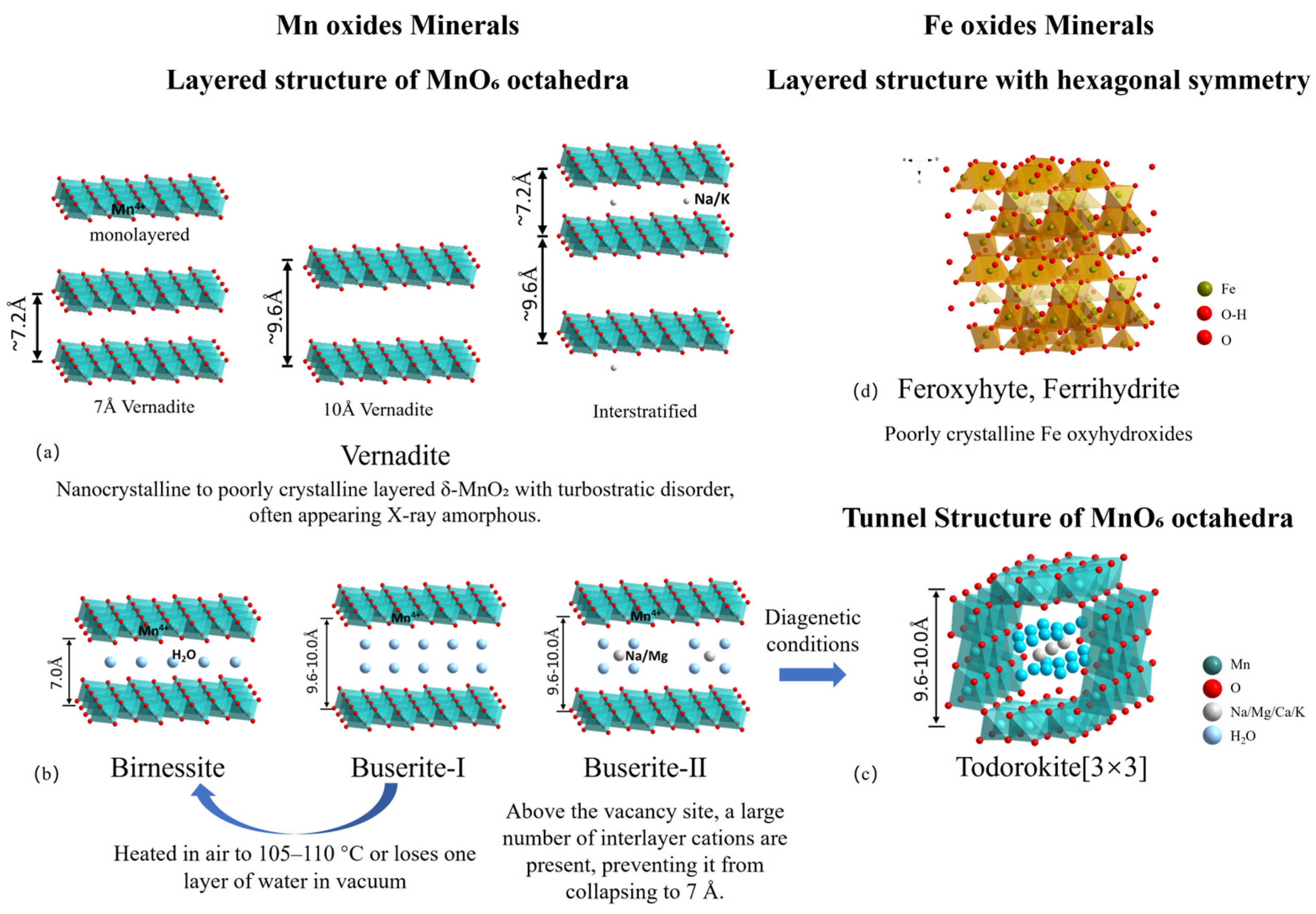
Figure 2. Structures of manganese minerals and iron mineral structures in cobalt-rich crusts, and transformation relationships between manganese mineral crystal structures. (a) Vernadite (δ-MnO2) showing nanocrystalline to poorly crystalline layered MnO6 octahedral structures, including monolayered, 7 Å, 10 Å, and interstratified types, characterized by turbostratic disorder and abundant octahedral vacancies; (b) Birnessite and buserite, composed of edge-sharing MnO6 octahedra; buserite contains higher interlayer water and hydrated cations, and may transform into the more compact 7 Å birnessite structure through interlayer dehydration and cation rearrangement under changing environmental conditions.; (c) Todorokite with a tunnel-structured MnO6 octahedral framework (3 × 3 tunnels), typically formed via diagenetic or topotactic transformation from layered Mn oxides, with tunnel sites hosting hydrated cations such as Na+, Mg2+, Ca2+, and K+; (d) Poorly crystalline Fe oxyhydroxides (e.g., ferrihydrite and feroxyhyte) occurring as associated iron phases in cobalt-rich crusts.
Minerals 16 00091 g002
Figure 3. Conceptual model illustrating the genesis of hydrogenetic Fe–Mn crusts at the Caiwei Guyot, Magellan Seamount region (northwestern Pacific), including precipitation depth and spatial setting, electrochemical controls on metal adsorption by negatively charged manganese oxides and weakly positively charged iron oxyhydroxides, and microbially mediated mineralization processes. OMZ: Oxygen Minimum Zone; CCD: Carbonate Compensation Depth; Antarctic Bottom Water, AABW; Antarctic Intermediate Water, AAIW.
Minerals 16 00091 g003
Figure 4. The schematic diagram of vernadite structure. Schematic representation of major enrichment pathways in hydrogenetic Fe-Mn (oxy)hydroxides. TCS: triple corner-sharing position above layer vacancy, DCS: double corner-sharing position, DES: double edge-sharing at the layer terminal, INC.: metal incorporation into the layer from interlayer.
Minerals 16 00091 g004
Figure 5. Comprehensive correlation of mechanisms and driving factors for cobalt-rich crust mineralization. Structural models of the three metal adsorption mechanisms in Stage II, modified from [68].
Minerals 16 00091 g005
Disclaimer/Publisher’s Note: The statements, opinions and data contained in all publications are solely those of the individual author(s) and contributor(s) and not of MDPI and/or the editor(s). MDPI and/or the editor(s) disclaim responsibility for any injury to people or property resulting from any ideas, methods, instructions or products referred to in the content.