You are currently viewing a new version of our website. To view the old version click .
Minerals
  • Article
  • Open Access

16 December 2025

Differential Karst Control of Carbonate Reservoirs: A Case Study of the Fourth Member of Sinian Dengying Formation in Gaoshiti-Moxi, Sichuan Basin, SW China

,
,
,
,
,
and
1
School of Energy Resources, China University of Geosciences (Beijing), Beijing 100083, China
2
Institute of Karst Geology, CAGS/Key Laboratory of Karst Dynamics, MNR&GZAR/International Research Centre on Karst under the Auspices of UNESCO, Guilin 541004, China
3
Pingguo Guangxi, Karst Ecosystem, National Observation and Research Station, Pingguo 531406, China
*
Author to whom correspondence should be addressed.
This article belongs to the Section Mineral Exploration Methods and Applications

Abstract

The dolomite of the fourth member of Dengying Formation in Gaoshiti-Moxi area of central Sichuan Basin is rich in hydrocarbon resources. It has experienced superimposition-reformation of multistage karstification, and is the key target for studying deep ancient carbonate reservoirs. Exploration and development practices show that there are great differences in the development of karst reservoirs of the fourth member of Dengying Formation between the platform margin and intraplatform in Gaoshiti-Moxi area. However, the differences in the genetic mechanism of karst reservoirs between these two zones are unclear. Therefore, based on an integrated analysis of core, thin section, drilling, logging, and geochemical test data, this study clarifies the differences in karstification between the platform margin and intraplatform and conducts a comparative analysis of the controlling factors for the differences in karst reservoirs. Results show that the fourth member of Dengying Formation experienced superimposition-reformation of four types of paleokarstification, including eogenetic meteoric water karst, supergene karst, coastal mixed water karst, and burial karst. Large-scale dissolved fractures and caves are mainly controlled by meteoric water karstification, primarily developing three types of reservoir space: vug type, fracture-vug type, and cave type. Dolomite and quartz fillings are mainly formed in the medium-deep burial period. Four types of paleokarstification are developed in the platform margin, while the coastal mixed water karst is not developed in the intraplatform. Eogenetic meteoric water karst and supergene karst in the platform margin are stronger than those in the intraplatform, while burial karst shows no notable difference between the two zones. The thickness of soluble rock (mound-shoal complex), karst paleogeomorphology, and different types of paleokarstification are the main controlling factors for the difference in karst reservoirs between the platform margin and the intraplatform.

1. Introduction

With the ongoing advancement of hydrocarbon exploration and development, deep ancient carbonate reservoirs have become a crucial frontier in global hydrocarbon exploration [1,2,3]. Statistics indicate that carbonate reservoirs account for over 60% of global hydrocarbon production, with more than half originating from dolomite reservoirs [4]. The Sinian Dengying Formation dolomite in the Sichuan Basin is rich in hydrocarbon resources and represents a key exploration and development target [5,6,7,8]. Large gas fields such as Weiyuan, Ziyang, Anyue, and Penglai have been successively discovered [9,10], representing the oldest marine carbonate gas reservoirs currently identified in China [11]. Among these, the fourth member of Dengying Formation reservoirs in Gaoshiti-Moxi area are characterized by deep burials (burial depth exceeding 5000 m), strong reservoir heterogeneity, diverse fabric types, and having undergone multiple stages of superimposed karstification. These reservoirs are thus a key focus for research on deep ancient carbonate reservoirs [12,13].
Previous studies on the dolomite reservoirs of the fourth member of Dengying Formation in central Sichuan Basin have conducted extensive research and achieved numerous results regarding sedimentary facies, dolomitization, karstification, and hydrocarbon accumulation. However, great disagreements remain concerning the genesis of these dolomite reservoirs and the genetic mechanisms responsible for the differences between the platform margin and intraplatform karst reservoirs. Regarding the genesis of dolomite reservoirs in the fourth member of Dengying Formation, the following viewpoints exist: ① It is related to supergene karst caused by the Tongwan movement, with karst paleogeomorphology controlling reservoir distribution [14,15]; ② It is associated with eogenetic (syngenetic-penecontemporaneous) karst, where sedimentary facies and cyclical sea-level changes control reservoir distribution [16,17]; ③ It is related to burial dissolution by organic acids [18], with high-quality source rocks controlling reservoir distribution [18,19]; ④ It is related to hydrothermal karstification [20], and deep faults control the distribution of reservoirs [21,22]. As for the controlling factors behind the significantly superior reservoir quality in the platform margin compared to the intraplatform, some scholars propose that the Gaoshiti-Moxi platform margin is an “erosional” margin where supergene karstification is stronger than in the intraplatform [17,18,23]. Others argue that sedimentary differentiation is the prerequisite for reservoir differentiation, suggesting that the formation of a “depositional” platform margin is the fundamental reason for the reservoir differences between platform margin and intraplatform, with supergene karst merely modifying and enhancing the reservoirs [24]. Yet another view holds that the fundamental cause of reservoir differentiation between the platform margin and intraplatform lies in the development of favorable mound-shoal facies and the intensity of supergene karst related to the Tongwan movement [25]. The main reason for these controversies is the diverse reservoir space types and complex genesis of the fourth member of Dengying Formation, coupled with the fact that different scholars mainly focus on distinct aspects, leading to a lack of comprehensive understanding of the superimposition-reformation by multistage and multi-type karstification in both the platform margin and intraplatform.
Currently, a “superimposed karst” development model has been established in the fourth member of Dengying Formation in central Sichuan Basin [11]. Additionally, the differential diagenesis evolution process has been revealed [7,26], and the zonal development characteristics of the karst reservoirs have been clarified, supporting gas reservoir development evaluation and favorable area optimization [27]. However, the differences in the genetic mechanisms of karst reservoirs between the platform margin and the intraplatform remain poorly understood, and a differential karst development model for these zones has not yet been established. Therefore, the study takes the fourth member of Dengying Formation in Gaoshiti-Moxi area as an example. Integrating core, drilling, logging, and geochemical test data to clarify the differences in paleokarstification between platform margin and intraplatform, comparatively analyze the controlling factors for the differences in karst reservoir between these two zones, and establish a differential karst development model for the platform margin and intraplatform. This work is intended to provide a reliable basis and reference for karst reservoir evaluation and the prediction of high-quality reservoir distribution.

2. Geological Setting

The Sichuan Basin is a large multi-cycle superimposed hydrocarbon-bearing basin developed on the foundation of the Upper Yangtze Craton, covering an area of approximately 18 × 104 km2. The Yangtze Craton was generally in an extensional tectonic setting accompanied by multiple episodes of rift activity during the Neoproterozoic, against the backdrop of the breakup of the Rodinia supercontinent [28]. Consequently, the Sichuan Basin exhibited a tectonic pattern of alternating uplifts and depressions in the pre-Sinian period, which controlled the sedimentary framework from the Sinian to the Early Cambrian [28]. Simultaneously, the multistage Tongwan movement formed two unconformities in the Sichuan Basin: the top of the second member of Dengying Formation and the top of the fourth member of Dengying Formation, corresponding to episode I and episode II of the Tongwan movement, respectively. Some scholars have also identified an unconformity at the top of the Lower Cambrian Maidiping Formation, interpreting it as episode III of the Tongwan movement. Furthermore, influenced by the breakup of the Rodinia supercontinent and the convergence of the Gondwana supercontinent, the Sichuan Basin developed a trough trending north–south along the Deyang–Anyue–Luzhou (Figure 1b). In recent years, multiple perspectives have been proposed regarding its formation mechanism and timing [29,30,31], and significant controversy persists. It is provisionally termed the Deyang–Anyue rift trough. Research suggests genetic differences between its northern and southern segments: the northern segment is primarily characterized by extension, developing a sedimentary-type platform margin, whereas the southern segment is dominated by erosion, developing platform margin erosion scarps [32,33]. The formation and evolution of the rift trough control differentiation of sedimentary facies in the Dengying Formation [34].
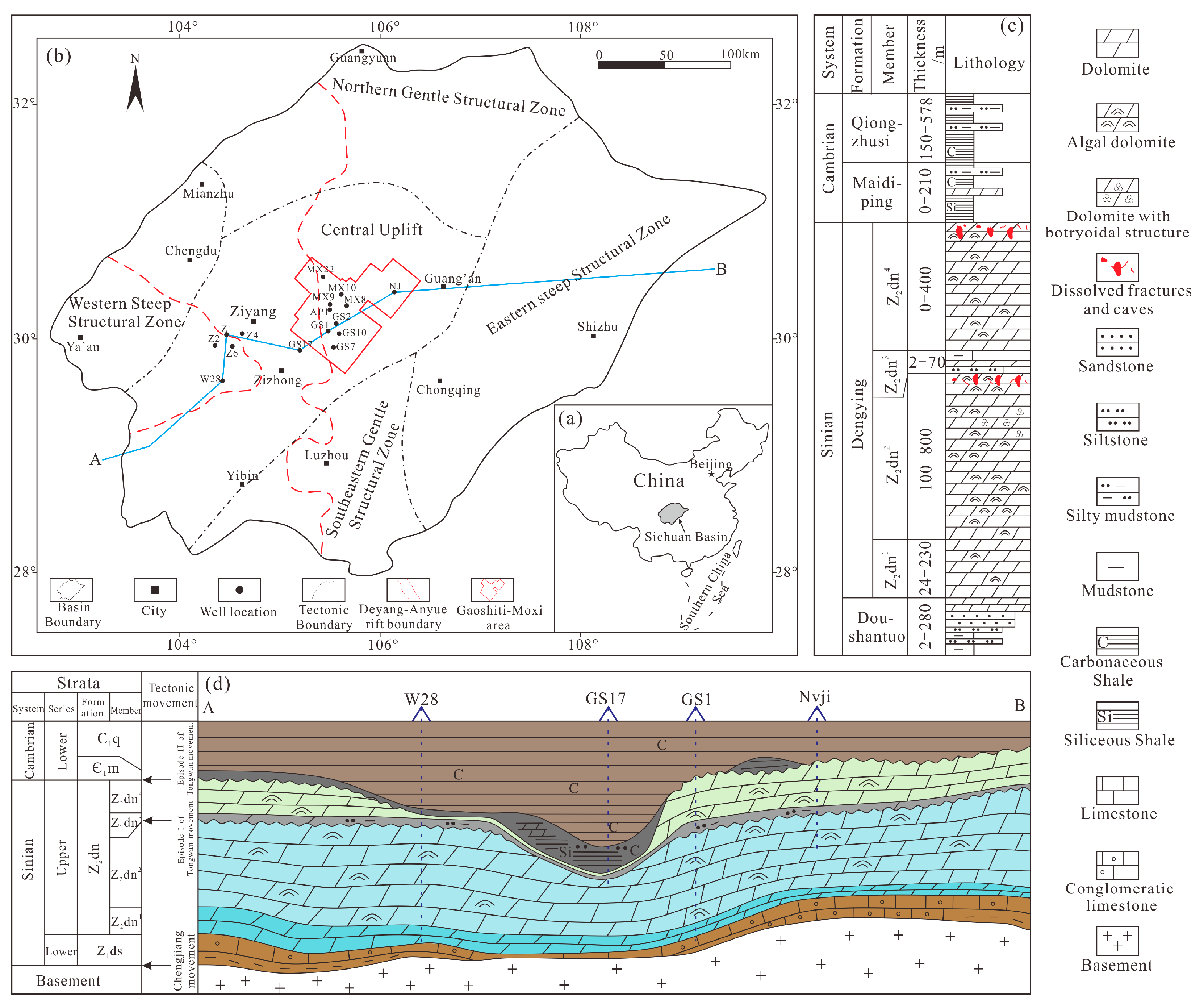
The Gaoshiti-Moxi area is in the central part of the Central Sichuan paleo-uplift, specifically on the eastern side of the southern segment of the Deyang–Anyue rift trough (Figure 1b). The primary focus of this study is the contiguous 3D seismic coverage area in Gaoshiti-Moxi area, which possesses abundant drilling data (Figure 1b). The Sinian Dengying Formation in the Sichuan Basin can be divided into four members from bottom to top (Figure 1c) [6,35,36,37]. Except for the absence of the fourth member of Dengying Formation in the rift trough due to subsequent erosion, Dengying Formation is relatively well-developed in the study area (Figure 1d). The first member of Dengying Formation represents the product of the early transgression in the Late Sinian, primarily consisting of light gray to dark gray micritic dolomite and powder crystal dolomite interbedded with laminated dolomite. The second member of Dengying Formation predominantly consists of light gray to grayish-white thrombolite and powder crystal dolomite, with well-developed thrombolitic, stromatolitic, and laminar fabrics, as well as grape-shaped texture. During the end of the deposition of the second member of Dengying Formation, the episode I of Tongwan movement resulted in tectonic uplift and subsequent denudation, which created abundant dissolution pores and vugs, thus forming karst reservoirs. The third member of Dengying Formation mainly consists of mudstone, dark gray to gray dolomitic siltstone, or dolomitic mudstone, unconformably overlying the second member of Dengying Formation. The fourth member of Dengying Formation consists of light gray to gray powder crystal dolomite, sandy dolomite, and algal dolomite, with locally developed siliceous dolomite. It is dominated by platform margin and restricted platform deposits, and develops sedimentary microfacies such as algal mound, grain-shoal, and inter-shoal sea [38]. Influenced by episode II of the Tongwan movement, the fourth member of Dengying Formation developed abundant dissolution vugs and caves [37], and was in unconformable contact with the overlying Cambrian strata (Figure 1d).
Figure 1. (a) Location of the Sichuan Basin; (b) Major tectonic and structural unites of the Sichuan Basin with the location of the Gaoshiti-Moxi area shown (modified after [6,29,36]); (c) Generalized stratigraphic column of the Sinian and Lower Cambrian periods, showing lithologies and thickness of each member (modified after [29,36]); (d) A SW–NE lithofacies profile flattening to the Cambrian Qiongzhusi Formation, showing lithofacies and thickness difference within and outside the Deyang–Anyue rift trough. Location of the A–B profile is shown in Figure 1b (modified after [6,29,36,37]).

3. Materials and Methods

3.1. Materials

Based on the observation and description of cores from the fourth member of Dengying Formation in Gaoshiti-Moxi area, the study selected a total of 102 samples from 20 cored wells, including GS1, GS16, GS102, GS103, MX39, and MX127 wells. The sampled lithologies comprise crystalline dolomite, algal dolomite, sandy dolomite, siliceous dolomite, and fracture-cave fillings. A total of 50 samples were selected to prepare universal thin sections and cast thin sections for analyzing the lithology, vug form, and filling minerals characteristics. While 33 samples were subjected to major and trace element analysis (Table 1), including the dolomite bedrock and fracture-cave fillings in both the platform margin and intraplatform. Carbon and oxygen isotope analyses were performed on 49 samples (Table 2), encompassing the dolomite bedrock and various types of dolomite fillings. Concurrently, 10 samples were tested for fluid inclusion analysis, and a total of 146 sets homogenization temperature data of dolomite and quartz inclusions were obtained.
Table 1. Major and trace elements of dolomites in the fourth member of Dengying Formation in Gaoshiti-Moxi area.
Table 2. The results of carbon and oxygen isotopes of dolomites in the fourth member of Dengying Formation in Gaoshiti-Moxi area.

3.2. Methods

Samples require pretreatment prior to geochemical testing. Fresh samples were selected indoors, washed with deionized water, pulverized, and ground to 200 mesh using an agate mortar. The samples for major elements, trace elements, and carbon and oxygen isotopes were conducted at the Karst Geological Resources and Environmental Testing Center. Major elements were tested using an A68 Atomic Absorption Spectrophotometer. Trace elements were analyzed using an A-17 inductively coupled plasma mass spectromete, with measured data error less than 0.001%. Carbon and oxygen isotope analysis was performed using a MAT-253 mass spectrometer with a precision of ±0.01%. Testing of thin sections and fluid inclusion were completed at the Sichuan Keyuan Testing Center of Engineering and Technology. Samples were polished into 0.03 mm thick sections. Simultaneously, organic resin monomer was injected under specific pressure differentials and thermally polymerized to form blue pore-marking structures. Cast thin sections were analyzed using a Nikon Eclipse LV100 POL polarizing microscope to analyze lithology, vug form, and filling minerals. Building upon thin section observations, the fluid inclusion microthermometry was conducted using a LINKAM THMS600 heating-freezing stage with a temperature measurement accuracy of ±0.1 °C.

4. Results

4.1. Characteristics of Karst Paleogeomorphology and Paleo-Water System

4.1.1. Paleogeomorphology Recovery Methods

Previous studies have achieved significant results in reconstructing the karst paleogeomorphology at the top of the Dengying Formation in the Sichuan Basin or Gaoshiti-Moxi area. Currently, differences in reconstruction methods among scholars regarding the paleogeomorphology primarily manifest in two aspects [14,39,40,41]: ① Differences in paleogeomorphology reconstruction methods, primarily the residual thickness method and the impression method, with the latter being more prevalent; ② In the application of the impression method, different overlying marker layers are selected, such as the top of the Qiongzhusi Formation, marine-flooding surface of the Canglangpu Formation, the top of the Canglangpu Formation, or the top of the Longwangmiao Formation.
The sedimentary period of the Qiongzhusi Formation–Canglangpu Formation in the Cambrian overlying the Dengying Formation in Gaoshiti-Moxi area, represents a complete transgression–regression cycle, characterized by compensatory sedimentation that principally leveled and filled the pre-existing denudation paleogeomorphology at the top of the Dengying Formation. As a result, the impression thickness from the bottom of the Cambrian to the top of the Canglangpu Formation can accurately reflect the paleogeomorphology prior to the Cambrian deposition. Moreover, due to the relatively stable tectonic activity in the Leshan-Longnüsi paleo-uplift area during the deposition of the Qiongzhusi to Canglangpu Formations, coupled with the contiguous coverage of high-quality 3D seismic data in the study area, the thickness of the Longwangmiao Formation within the same tectonic unit remains relatively consistent (80–110 m), representing “pan-marine deposition”. Therefore, selecting the bottom of the Longwangmiao Formation as the reference surface for paleogeomorphology reconstruction is considered feasible.

4.1.2. Paleogeomorphology Recovery Results

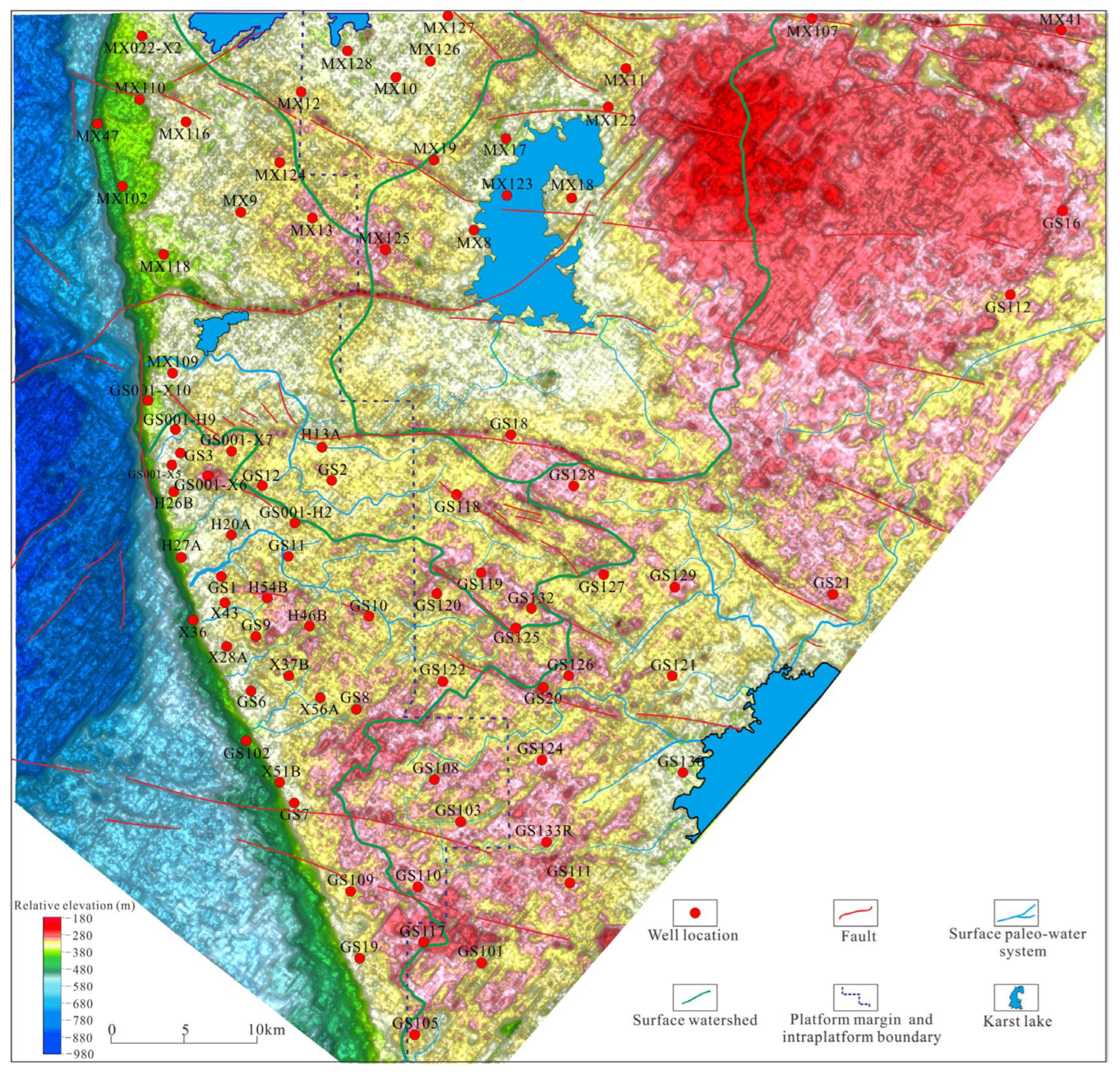
The bottom of the Longwangmiao Formation is selected as the marker layer for reconstructing karst paleogeomorphology at the top of the fourth member of Dengying Formation by the impression method. Specifically, the depth domain horizon data of the bottom of the Longwangmiao Formation were subtracted from those of the fourth member of Dengying Formation, followed by decompaction correction, ultimately yielding the map of the relative elevation of the karst paleogeomorphology in the study area (Figure 2). The relative elevation of the karst paleogeomorphology ranges from −980 m to −180 m, with lower values indicating lower topography and higher values representing higher topography. Results show that paleogeomorphology of the platform margin and intraplatform are different. The platform margin generally shows higher elevations in the east and lower in the west, with the Gaoshiti area being overall higher than the Moxi area (Figure 2). Within the Gaoshiti intraplatform, elevations are generally higher in the west and lower in the east, with a karst lake developed in the southeast. In contrast, the Moxi intraplatform shows higher elevations in the eastern and western parts and lower in the central part, where a north–south trending karst lake is developed (Figure 2).
Figure 2. Karst paleogeomorphology and paleo-water system.

4.1.3. Characteristics of Paleo-Water System

Based on the paleotopography and geomorphic characteristics, the paleo-water systems on the top of the fourth member of Dengying Formation in Gaoshiti-Moxi area are reconstructed (Figure 2). Bounded by watershed divides, four major paleo-water systems are identified: the eastern, central, western, and northwestern systems. The eastern paleo-water system comprises three main tributaries. One is the tributary developed between GS108, GS20, and GS130 wells, exhibiting surface runoff directed from southwest to northeast. The second tributary develops along GS128 and GS129 wells, characterized by surface runoff from northwest to southeast with the development of secondary branches. The third tributary develops between GS112 and GS21 wells with surface runoff from northeast to southwest (Figure 2). These tributaries are characterized by broad valleys, gently extending slopes, and riverbed gradients of less than 3%. All tributaries ultimately converge into a karst lake located to the southeast. The central paleo-water system is characterized by converging tributaries from the surroundings to the karst lake. The karst lake is developed near the MX18 well, which is characterized by shallow karst water runoff, and the overall the paleo-water system is relatively small. Surface runoff in the western paleo-water system generally disperses from east to west with a riverbed gradient below 1%. It mainly develops tributaries along the GS125–GS10–GS11–GS1 wells, flowing from southeast to northwest and ultimately discharging into the western trough (Figure 2). The northwestern paleo-water system mainly develops tributaries along GS118–X12–MX109 wells, flowing from southeast to northwest and ultimately discharging into the trough. To the west of the MX125 and MX19 wells, no surface water system has formed. Instead, small-scale karst lakes have developed, and groundwater mainly discharges westward into the western trough by diffuse flow.

4.2. Identification of Paleokarst Characteristics

4.2.1. Identification of Paleokarst Characteristics in Cores and Thin Sections

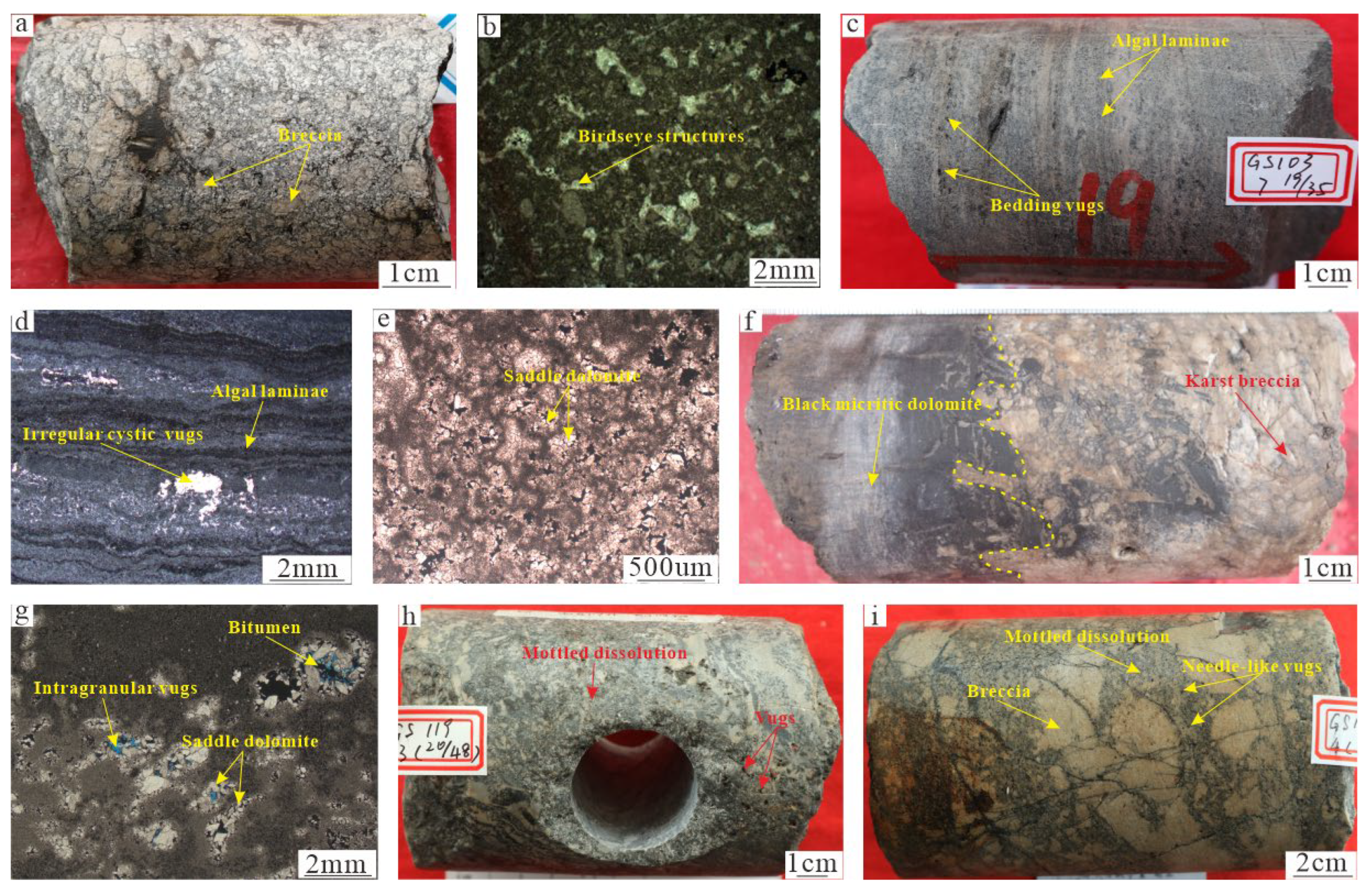
Core and thin section observations show that various karst features, including karst breccias, selective dissolution, high-frequency exposure dissolution surfaces, and mottled dissolution, are developed (Figure 3). These karst features are extensively developed in both platform margin and intraplatform, closely associated with eogenetic meteoric water karst driven by frequent rising and falling of the relative sea-level. Karst breccias are mainly characterized by overall brecciation, with single breccia components consistent with the bedrock. The residual vugs between the breccias are almost filled with dissociated carbonate sand and argillaceous dolomite (Figure 3a). Selective dissolution, a key indicator of eogenetic karst, is manifested as inter-framework residual vugs (Figure 3b), bedding dissolved vugs developed along algal laminae (Figure 3c), and irregular cystic vugs (Figure 3d). The development of these dissolution pores and vugs is associated with algal, with occasional inter-algal and intragranular dissolution vugs. These vugs are filled by saddle dolomite and bitumen (Figure 3e,g). High-frequency exposure dissolution surfaces are widely developed, and can be developed at any depth of the fourth member of Dengying Formation. They appear as irregular lithological discontinuity surfaces (Figure 3f). Below the interface, karst features are obvious, characterized by dissolution vugs and karst breccias, Above the interface lie initial marine transgression deposits, mainly composed of gray-black mud-powder crystal dolomite with relatively dense lithology and indistinct dissolution features (Figure 3f). Mottled dissolution is widely developed. It is mostly characterized by the distribution of light and dark patches. Among them, a light part shows well preserved original rock textures with relatively weak karstification, while the dark patches show stronger dissolution, developing dissolution pores and vugs (Figure 3h,i).
Figure 3. Photographs showing the eogenetic meteoric water karst characteristics of the fourth member of Dengying Formation, central Sichuan. (a) Overall brecciation in the core (MX17, 5093.1 m); (b) Clotted-framework dolomite with birds-eye structures and inter-framework residual vugs, plane-polarized light (PPL) (GS109, 5309 m); (c) Fabric-selective vugs developed along algal laminae (GS103, 5304.1 m); (d) Controlled by algal laminae, irregular cystic vugs are formed between algae (MX105, 6363.4 m, PPL); (e) Vugs between algae are filled with saddle dolomite (MX126, 5309.69 m, PPL); (f) Transgressive black micritic dolomite is developed on the karst breccia (MX105, 5328.65 m); (g) Development of intragranular vugs, filled with saddle dolomite and bitumen (GS18, 5178.54 m, PPL); (h) Mottled dissolution characteristics in the core (GS119, 5588.72 m); (i) Brecciation and mottled dissolution characteristics in the core (GS109, 5521.51 m).
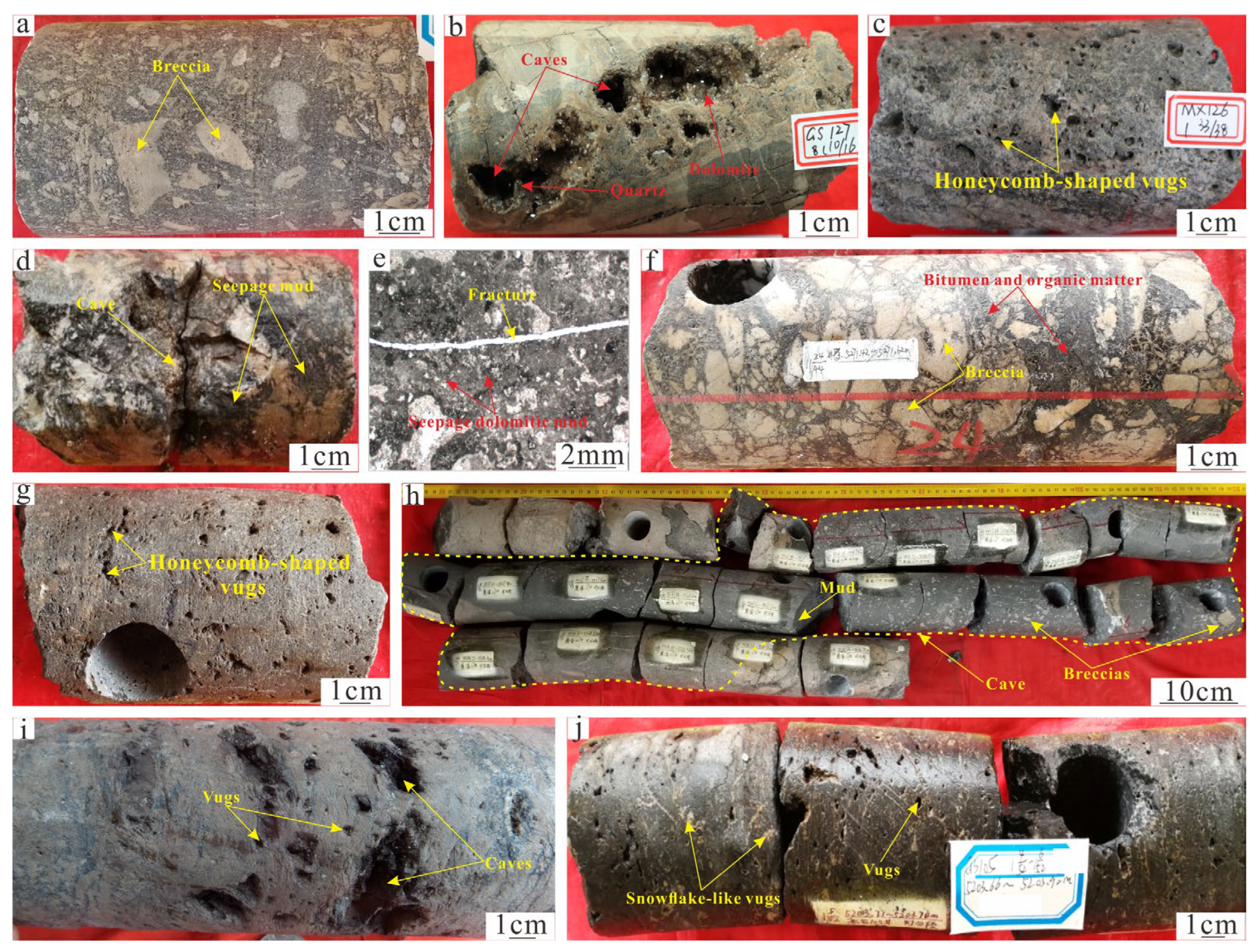
Affected by episode II of the Tongwan movement, the fourth member of Dengying Formation was widely subjected to weathering and erosion. Supergene karstification led to the development of karst breccias and large-scale dissolution vugs, caves, and fractures (Figure 4). Karst breccias are commonly found near the unconformity surface in the fourth member of Dengying Formation. The breccia composition is consistent with the bedrock, and the sorting and roundness are poor. The breccia is floating (Figure 4a), dotted, or linear in contact (Figure 4e). Dissolution vugs, caves, and fractures do not have the characteristics of selective dissolution. The karst features mainly include dissolution fracture-caves by dissolution and expansion along high-angle fractures (Figure 4b), honeycomb-shaped dissolution vugs (Figure 4c,g), and snowflake-shaped dissolution pores (Figure 4j). Large-scale caves (Figure 4h) and bedding dissolved vugs (Figure 4i) are locally observed. Seepage dolomitic mud is developed near the unconformity surface (Figure 4d,e). Dissolution vugs, caves and fractures formed by supergene karstification are widely developed. Their sizes vary from several millimeters to several meters, mainly millimeter-scale and centimeter-scale. Most of them are disorderly distributed, and a few are arranged in a direction (such as bedding distribution). The overall filling degree is low, and the fillings include dolomitic mud, dolomitic breccia, dolomite, quartz, and bitumen (Figure 4).
Figure 4. Photographs showing the supergene karst characteristics of the fourth member of Dengying Formation, central Sichuan. (a) Karst breccias developed near the unconformity, where the sorting and rounding of breccia are poor—breccias were floating in shape. (GS109, 5315.53 m); (b) Dissolution expands along high-angle fractures to form dissolution fracture-caves, which are filled with dolomite and quartz (GS127, 5880.1 m); (c) Algae dolomite with development of honeycomb-shaped vugs (MX126, 5308.6 m); (d) Development of seepage mud and caves (GS20, 5198.45 m); (e) Development of seepage dolomitic mud and fracture (GS20, 5198.2 m, PPL); (f) Karst breccias developed near the unconformity, where most of the breccias are point or line contact and filled with bitumen and organic matter between breccias (MX39, 5271.42 m); (g) Thrombolite with development of honeycomb-shaped vugs (MX22, 5418.79 m); (h) Development of large caves filled with mud and dolomite breccias (MX127, 5536.17–5538.76 m); (i) Bedding vugs and caves are developed and the filling degree is low (GS101, 5510 m); (j) Development of snowflake-shaped vugs filled with dolomite (GS105, 5203.66 m).
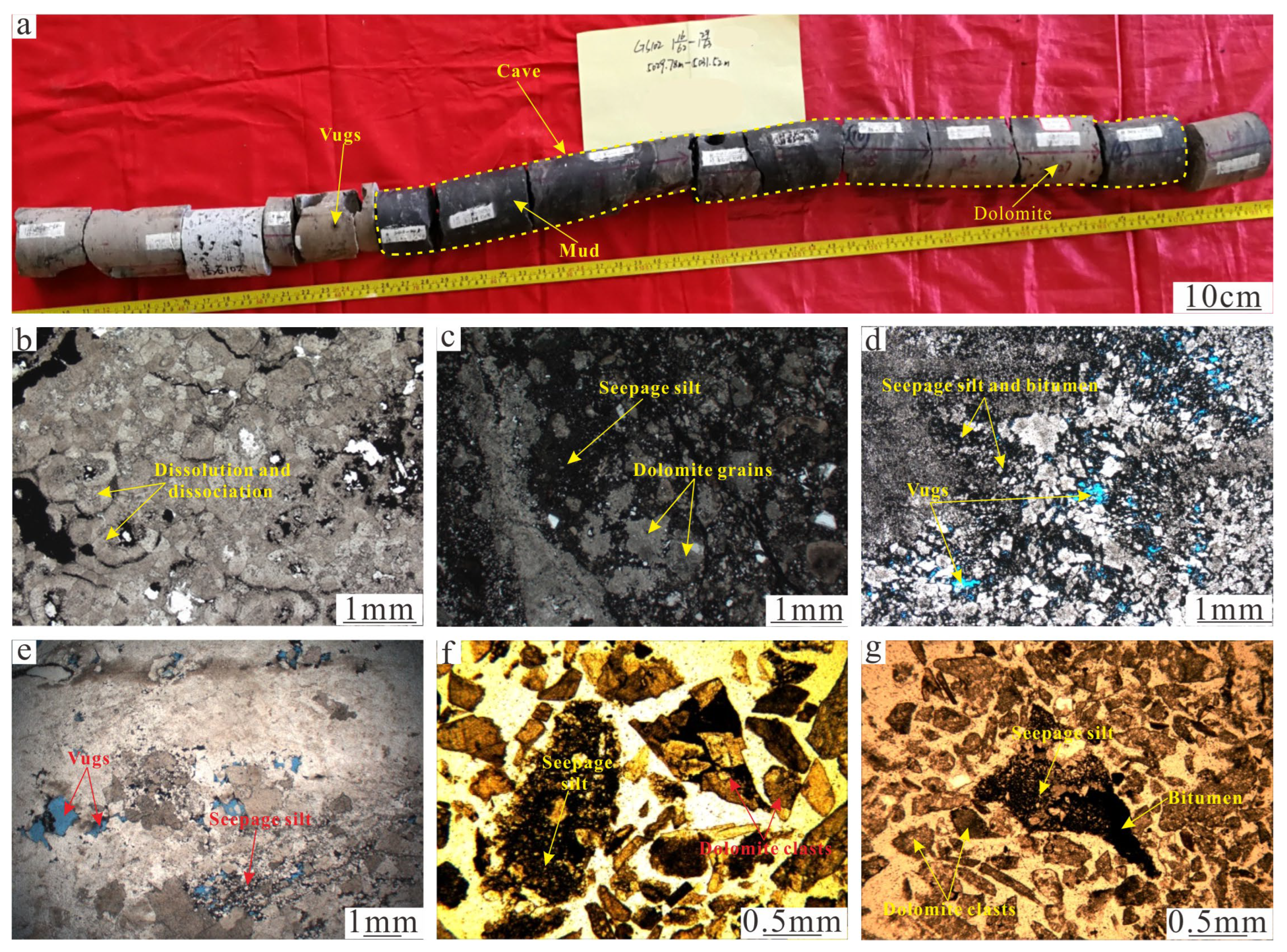
Core and thin section observations identify a dissolution feature that is different from the eogenetic meteoric water karst and supergene karst: ① The karst feature is mainly developed in the platform margin, with karstification gradually diminishing from the platform margin to the intraplatform; ② The karstification mainly occurs near the unconformity surface of the fourth member of Dengying Formation; ③ The mixed filling of dolomite and mud in meter-scale caves (Figure 5a), dissolution and dissociation of matrix particles (Figure 5b,c), and pre-existing dissolution pores and vugs filled with seepage clay and seepage silt (Figure 5d,e) are shown. The thin section shows mixed filling of silty, argillaceous dolomite (Figure 5f,g). It is considered that the karst belongs to coastal mixed water karst.
Figure 5. Photographs showing the coastal mixed water karst characteristics of the fourth member of Dengying Formation, central Sichuan. (a) The cave is filled with a mixture of dolomite and mud (GS102, 5029.78–5031.52 m); (b) Dissolution and dissociation of matrix-supported grains in dolomite (GS102, 5030.2 m, PPL); (c) The cave fillings are seepage silts and dolomite grains under cross-polarized light (CPL) (GS102, 5030.2 m); (d) Vugs are developed and partially filled with bitumen and seepage silt (MX109, 5111.97 m, PPL); (e) Vugs are developed and partially filled with seepage silt (MX109, 5129 m, PPL); (f) Development of very poorly sorted dolomite clasts with seepage silt (GS001-H9, 5245 m, PPL); (g) Localized occurrences of bitumen and seepage silt in dolomite clasts (GS001-H11, 5350 m, PPL).
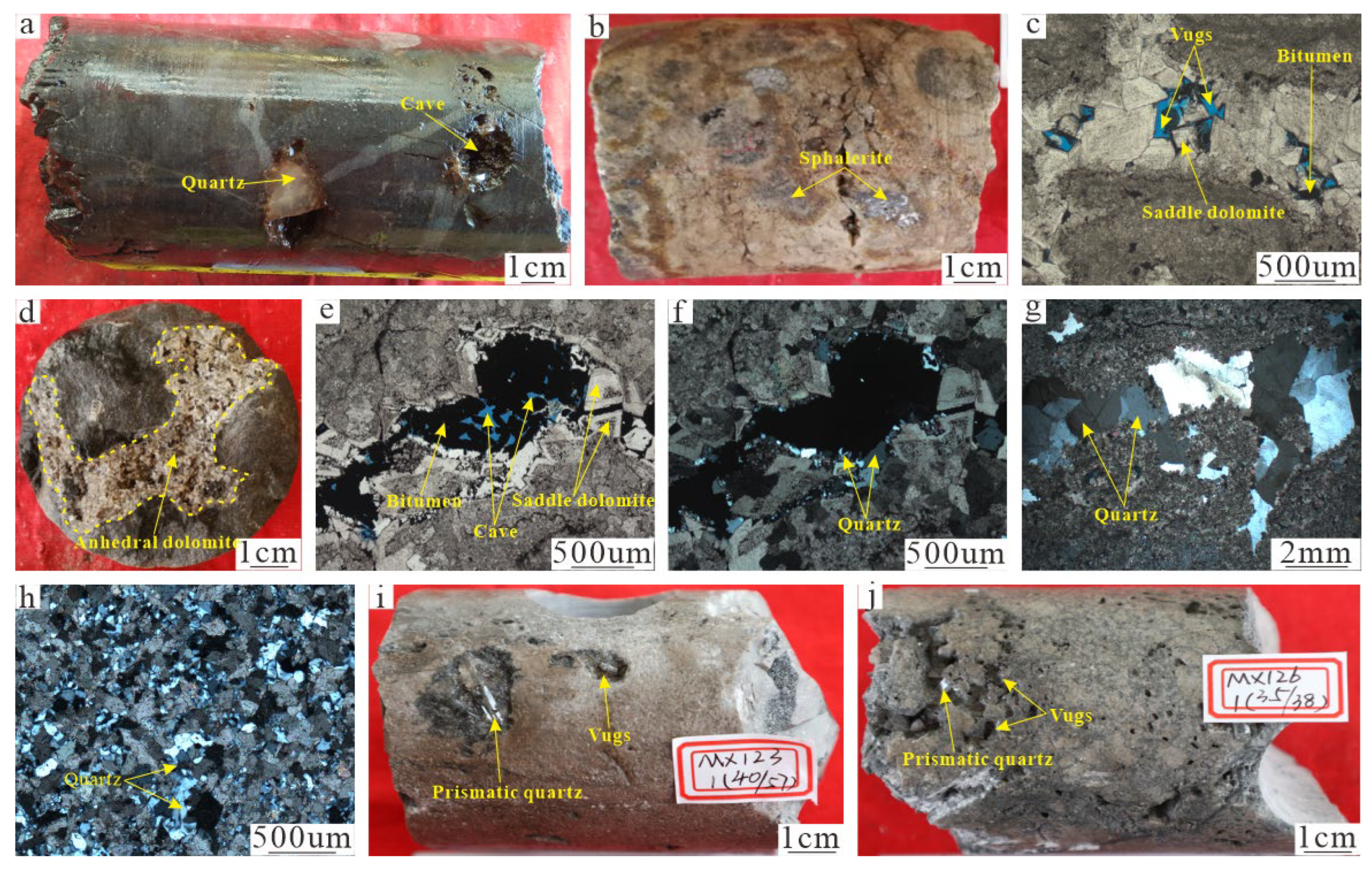
The fourth member of Dengying Formation generally develops burial hydrothermal karst (Figure 6). The karstification mainly occurs in the middle-deep burial stage of the fourth member of Dengying Formation. Burial hydrothermal karst mainly develops near the faults, and hydrothermal fluid dissolves and fills along pre-existing vugs, caves, and fractures. Hydrothermal minerals such as quartz (Figure 6a,i,j), sphalerite (Figure 6b), and anhedral dolomite (Figure 6d) can be seen in the core. Saddle dolomite is a typical hydrothermal mineral characterized by curved crystal faces and distinctive saddle-shaped crests, which indicate that the dolomite reservoir is subjected to hydrothermal activity. Microscopically, saddle dolomite (Figure 6c,e,f) and quartz (Figure 6e–h) can be seen in the vugs, and partially to fully filled with hydrothermal minerals (Figure 6c,g,h). It shows that dolomite, quartz, and bitumen are successively filled in the dissolution vugs (Figure 6e,f).
Figure 6. Photographs showing the hydrothermal karstification characteristics of the fourth member of Dengying Formation, central Sichuan. (a) Caves are quartz semi-filled (MX105, 5308.73 m); (b) Vugs are filled with sphalerite (GS109, 5316 m); (c) Saddle dolomite and bitumen are filled in the dissolution fracture (GS18, 5138.6 m, PPL); (d) Anhedral dolomite formation by hydrothermal boundary-replacive dissolution (GS20, 5182.57 m); (e,f) The cave is successively filled with saddle dolomite exhibiting cloudy cores and clear rims, quartz grains, and bitumen, as well as PPL(E) and CPL(F) (GS102, 5045.53 m); (g) Vugs are filled with quartz (MX109, 5128.78 m, CPL); (h) Intergranular vugs filled with quartz (GS103, 5429.19 m, CPL); (i) Vugs filled with prismatic quartz (MX123, 5480.47 m); (j) Development of honeycomb-shaped vugs, locally filled with prismatic quartz (MX126, 5308.99 m).

4.2.2. Logging Response Characteristics of Paleokarst Vugs and Caves

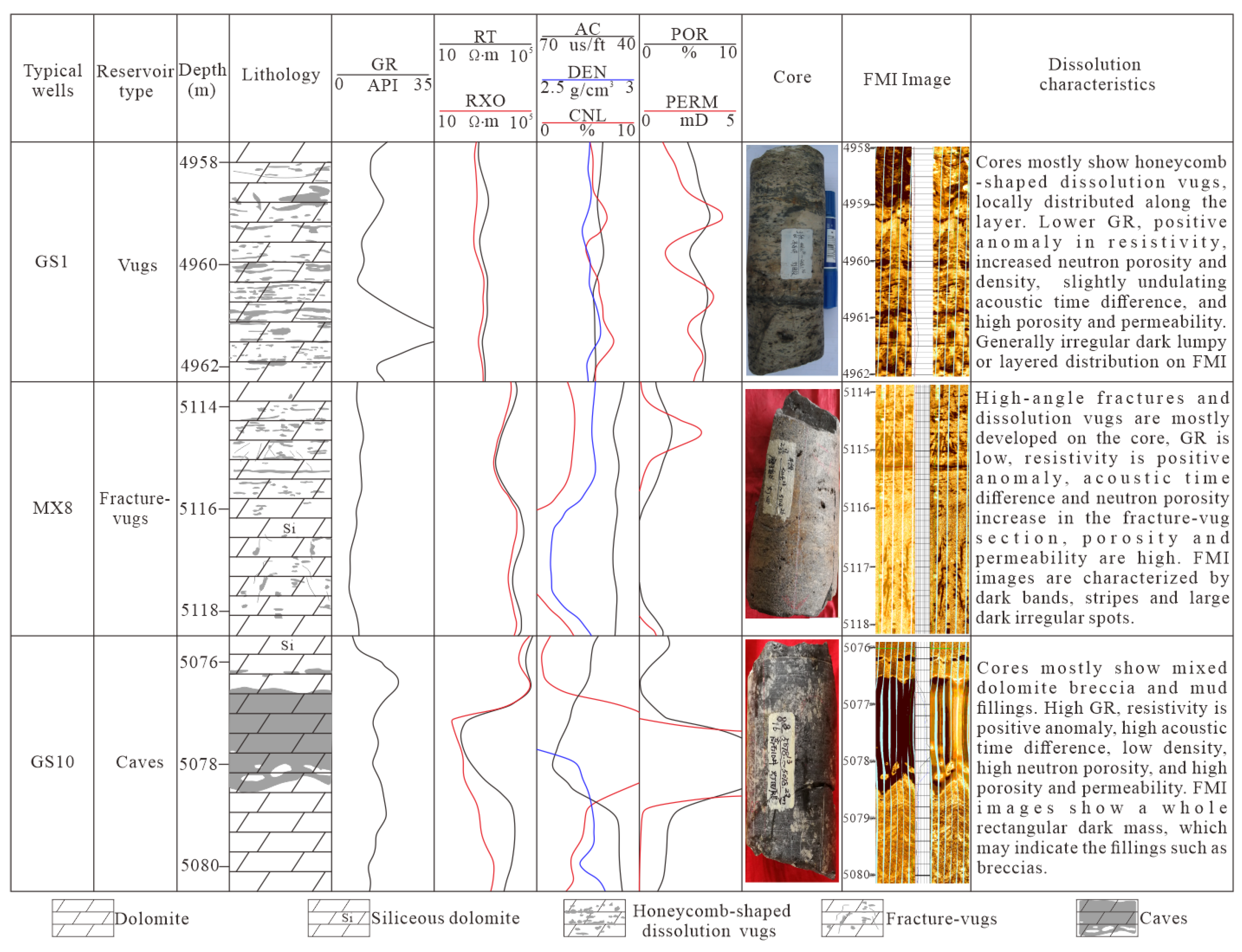
Based on core and thin section observations, combined with logging results, the high-quality reservoirs of the fourth member of Dengying Formation mainly show three types of reservoir spaces: vug, fracture-vug and cave (Figure 7). The conventional logging of the vug type reservoirs shows low GR values, positive resistivity anomalies, increased neutron and density porosity, slightly fluctuating the acoustic time difference, and relatively high logging porosity and permeability. FMI images show vugs are generally irregular dark masses or layered strip distribution (Figure 7). Fracture-vug type reservoirs represent one of the most favorable reservoir types, where vugs are the main reservoir space, while fractures are both reservoir space and seepage pathways. The conventional logging of the fracture-vug type reservoirs shows low GR values, positive resistivity anomalies, increased acoustic time difference and neutron porosity in reservoir intervals, and decreased density porosity in reservoir intervals. On FMI images, they are characterized by dark bands, stripes, and large irregular spots (Figure 7). Decimeter- to meter-scale caves developed are marked on conventional logging by a significant increase in GR values showing a convex shape, positive resistivity anomalies with a significant decrease in caves, an increase in acoustic time difference and neutron porosity, and a decrease in density porosity. FMI images display continuous rectangular dark masses, with internal bright spots likely indicating fillings such as breccias (Figure 7).
Figure 7. Logging response characteristics of paleokarstification.

4.3. Distribution Characteristics of Karst Reservoirs

4.3.1. Single-Well Reservoir Statistics

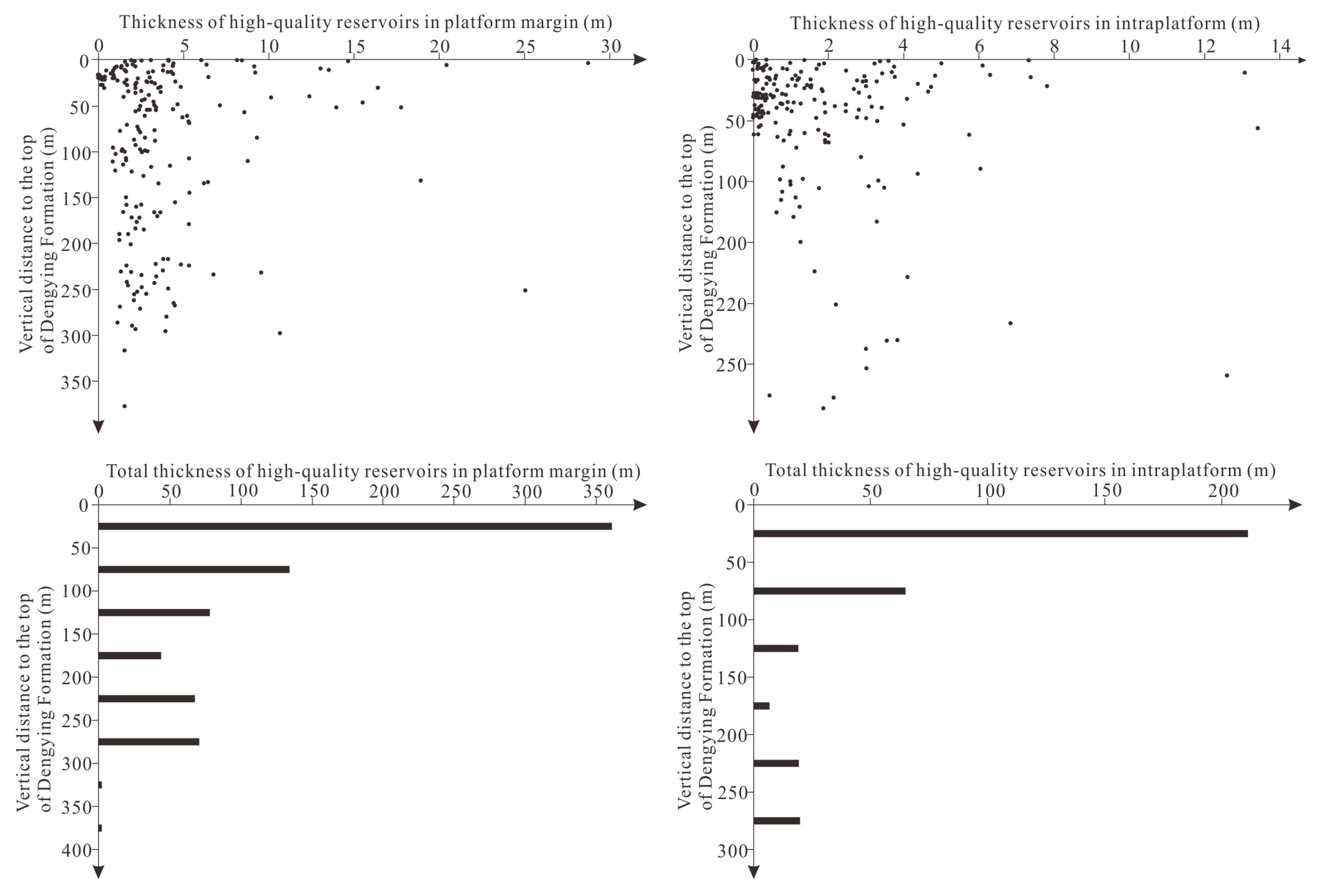
Based on a study of 29 typical wells from the platform margin and intraplatform, respectively, the depth and extent of reservoir development in the fourth member of Dengying Formation are systematically analyzed. Results show that reservoirs are developed in both platform margin and intraplatform exhibiting similar trends with increasing depth. However, the number and thickness of reservoirs in the intraplatform are significantly lower than those in the platform margin (Figure 8). Approximately 50% of the platform margin reservoirs develop within 50 m below the top of the Dengying Formation. A total of 109 sets of reservoirs are developed in 29 single wells, with a total thickness of about 361 m. About 80% of dolomite reservoirs in the platform margin are developed within 200 m below the top of the Dengying Formation, with a total of 179 sets of reservoirs and a total thickness of about 618 m. With the increase in depth of 0–150 m, the number and thickness of the reservoir decreases sharply; with the increase in depth from 150 m to 300 m, the number and thickness of reservoirs gradually increases, but there is almost no reservoir above 300 m (Figure 8). In the intraplatform, about 72% of reservoirs are located within 50 m below the top of the Dengying Formation, with a total of 142 sets of dolomite reservoirs and a total thickness of about 210 m from the 29 wells. About 95% of reservoirs are developed within 200 m below the top of the Dengying Formation, with a total of 186 sets of dolomite reservoirs and a total thickness of about 302 m from the 29 wells. Like the platform margin, the number and thickness of reservoirs decrease sharply with increasing depth in the 0–150 m range, and show a slight increase between 150 and 300 m depth (Figure 8).
Figure 8. Scatter plot and histogram of karst reservoir development in typical wells in platform margin and intraplatform.

4.3.2. Stratigraphic Correlation

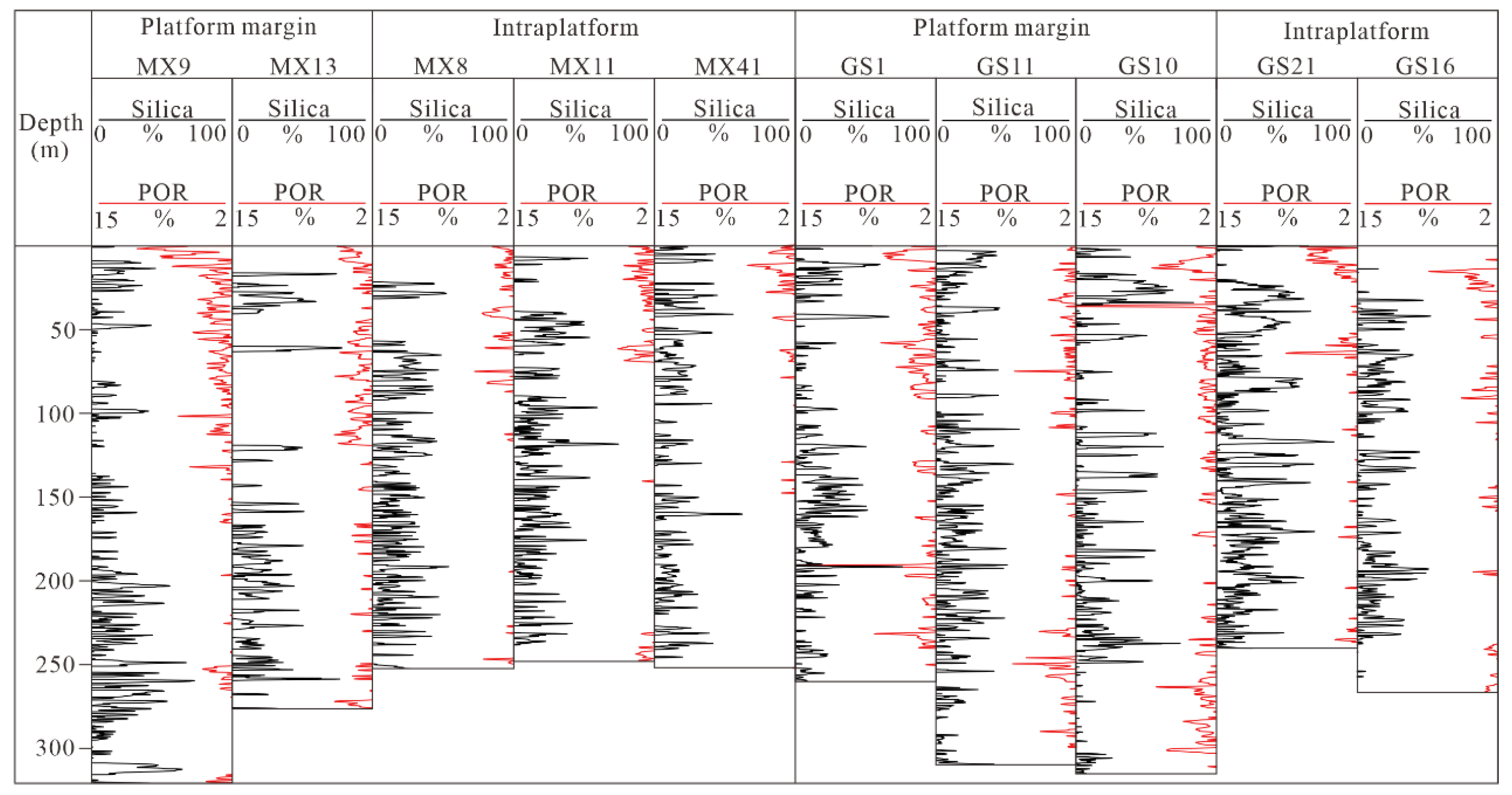
Silica is insoluble. A higher silica content indicates weaker dissolution capacity and a lower potential for the formation of high-quality reservoirs. The typical wells in the platform margin and the intraplatform are selected to compare the silica content and logging porosity of the fourth member of Dengying Formation. The results show that significant inter-well variations in silica content and porosity, with higher silica content corresponding to lower porosity (Figure 9). Overall, the platform margin shows lower silica content and higher porosity than the intraplatform (Figure 9). The high-porosity intervals of the platform margin are mainly located within approximately 50 m below the top of the fourth member of Dengying Formation. Beyond 50 m depth, the porosity gradually decreases with increasing depth, with sporadic high-porosity intervals visible. In contrast, silica content shows no clear correlation with depth. Thick high-porosity intervals develop at depths of 200–300 m in the platform margin of the Gaoshiti area. In the intraplatform, the high-porosity intervals are mainly located within approximately 30 m below the top of the fourth member of Dengying Formation. However, both the thickness and porosity are significantly lower than those in the platform margin. Beyond 30 m depth, porosity decreases markedly with depth, mostly falling below 2%. Silica content remains generally high in the intraplatform and shows little variation with depth (Figure 9).
Figure 9. Stratigraphic correlation of the fourth member of Dengying Formation in the platform margin and intraplatform (black logging curve is silica content, red logging curve is porosity, depth represents vertical distance to the top of Dengying Formation).

4.4. Geochemical Characteristics

4.4.1. Major Elements

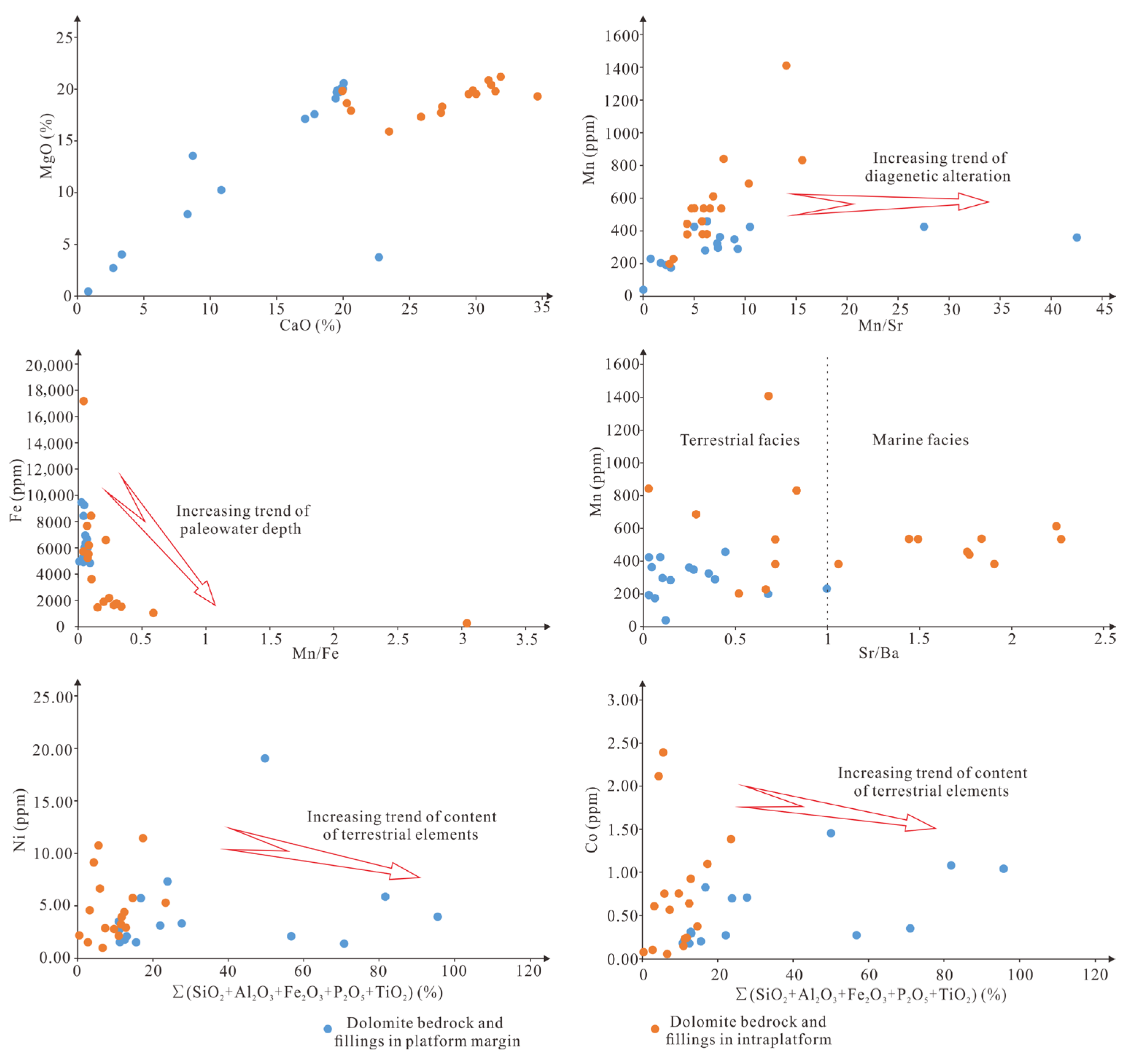
The major element contents of the 33 core samples are shown in Table 1, including the bedrock and fillings from the platform margin to the intraplatform. The results show that MgO content in the platform margin ranges from 0.55% to 20.64% (avg. 13.61%), while CaO content varies between 0.78% and 19.98% (avg. 14.36%). MgO content ranges from 15.93% to 21.26% (avg. 19.20%), and CaO content from 19.85% to 31.39% (avg. 26.98%) in the intraplatform. Most samples show a positive correlation between CaO and MgO contents, while a few show a negative correlation (Figure 10). SiO2 content in the platform margin and intraplatform ranges from 8.48% to 92.23% and 0.12% to 20.48%, respectively, with siliceous dolomite showing the highest silica content. Al2O3 content ranges from 1.49% to 3.39% (avg. 1.76%) in the platform margin and 0.05% to 2.20% (avg. 0.79%) in the intraplatform, and the overall content is low. TiO2 content varies between 0.05% and 0.09% (avg. 0.06%) in the platform margin and from below detection to 0.10% (avg. 0.04%) in the intraplatform. It is worth noting that the P2O5 content in the cave fillings of GS102 well show significantly higher P2O5 content (up to 27.96%) compared to other samples. In other platform margin samples, P2O5 content ranges from 0.01% to 0.58% (avg. 0.10%), while it varies between 0.01% and 0.17% (avg. 0.06%) in the intraplatform. Fe2O3 content ranges from 0.708% to 1.374% (avg. 0.91%) in the platform margin and 0.04% to 2.49% (avg. 0.67%) in the intraplatform. MnO content varies between 0.01% and 0.06% (avg. 0.04%) and 0.03% and 0.18% (avg. 0.07%) in the platform margin and intraplatform, respectively.
Figure 10. Cross-plot of major and trace elements in the fourth member of Dengying Formation in the platform margin and intraplatform.

4.4.2. Trace Elements

The trace element contents of the 33 core samples are shown in Table 1, including the bedrock and fillings in the platform margin and the intraplatform. The results show that the contents of Sr and Ba in dolomite fillings of GS103 well are significantly higher than those in bedrock, up to 6126.64 ppm and 51,104.75 ppm, respectively. In other platform margin samples, Sr and Ba contents range from 8.65 to 337.42 ppm and 81.39 to 3432.58 ppm, respectively. In the intraplatform, Sr and Ba contents range from 54.03 to 113.73 ppm and 32.30 to 3974.33 ppm, respectively. Fe content varies between 4956 and 9618 ppm (avg. 6368.25 ppm), and Mn content ranges from 41.16 to 465.10 ppm (avg. 307.66 ppm) in the platform margin. Fe content ranges from 280 to 17,430 ppm (avg. 4669.41 ppm), and Mn content from 206.27 to 1426.98 ppm (avg. 568.35 ppm) in the intraplatform. The cave fillings from GS102 well show higher Ni content than other samples at 19.3 ppm. Other samples from the platform margin showed Ni content ranging from 1.45 to 7.51 ppm (avg. 3.30 ppm), while in the intraplatform it varies between 1.11 and 11.63 ppm (avg. 4.86 ppm). The V content in cave fillings from GS102 well is significantly higher than other samples at 388.41 ppm. Other samples from the platform margin samples range from 2.24 to 15.85 ppm (avg. 5.77 ppm), and the intraplatform ranges from 2.76 to 18.24 ppm (avg. 10.30 ppm). Co content ranges from 0.18 to 1.46 ppm (avg. 0.52 ppm) in the platform margin and from 0.11 to 2.39 ppm (avg. 0.74 ppm) in the intraplatform. Sr/Ba, Mn/Sr, and Mn/Fe ratios in the platform margin range from 0.05 to 1.00, 0.01 to 42.50, and 0.01 to 0.09, respectively. Corresponding ratios in the intraplatform are 0.03 to 2.29, 2.64 to 14.00, and 0.04 to 3.04, respectively (Table 1, Figure 10).

4.4.3. Carbon and Oxygen Isotopes

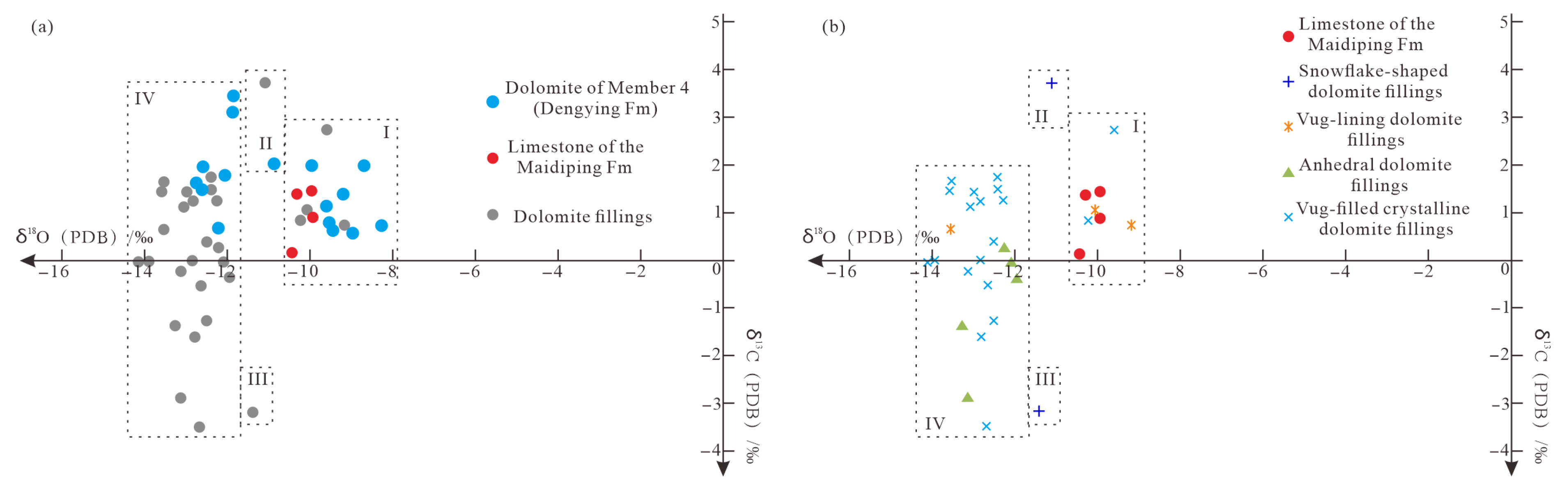
The δ13C and δ18O values of 49 core samples range from −3.48‰ to 3.73‰ (avg. 0.74‰) and −14.10‰ to −8.26‰ (avg. −11.60‰), respectively (Table 2). Obvious differences in carbon and oxygen isotopes are observed among different lithologies and types of dolomite fillings (Table 2, Figure 11). The carbon isotope of dolomite (bedrock) in the fourth member of Dengying Formation is 0.58 ‰–3.45‰ (avg. 1.58‰), and the oxygen isotope is −12.62‰–−8.26‰ (avg. −10.51‰). The carbon isotope of limestone in Maidiping Formation is 0.14‰–1.63‰ (avg. 1.09‰), and the oxygen isotope is −12.75‰–−9.91‰ (avg. −10.65‰). Among the dolomite fillings, two snowflake-shaped dolomite fillings samples show δ13C values of −3.17‰ and 3.73‰, with δ18O values of −11.39‰ and −11.09‰, respectively. Vug-lining dolomite fillings have δ13C values of 0.66‰ to 1.06‰ (avg. 0.82‰) and δ18O values of −13.52‰ to −9.16‰ (avg. −10.91‰). Anhedral dolomite fillings show δ13C values ranging from −2.86‰ to 0.28‰ (avg. −0.87‰) and δ18O values from −13.26‰ to −11.94‰ (avg. −12.53‰). Crystalline dolomite fillings show δ13C values of −3.48‰ to 2.74‰ (avg. 0.44‰) and δ18O values of −14.10‰ to −9.59‰ (avg. −12.62‰) (Table 2, Figure 11).
Figure 11. Cross-plots showing the carbon and oxygen isotopic characteristics of bedrock and fillings in Gaoshiti-Moxi area. (a) Cross-plots showing the carbon and oxygen isotopic characteristics of bedrocks and dolomite fillings; (b) Cross-plots showing the carbon and oxygen isotopic characteristics of Maidiping Formaton (bedrocks) and four types of dolomite fillings.

4.4.4. Fluid Inclusions

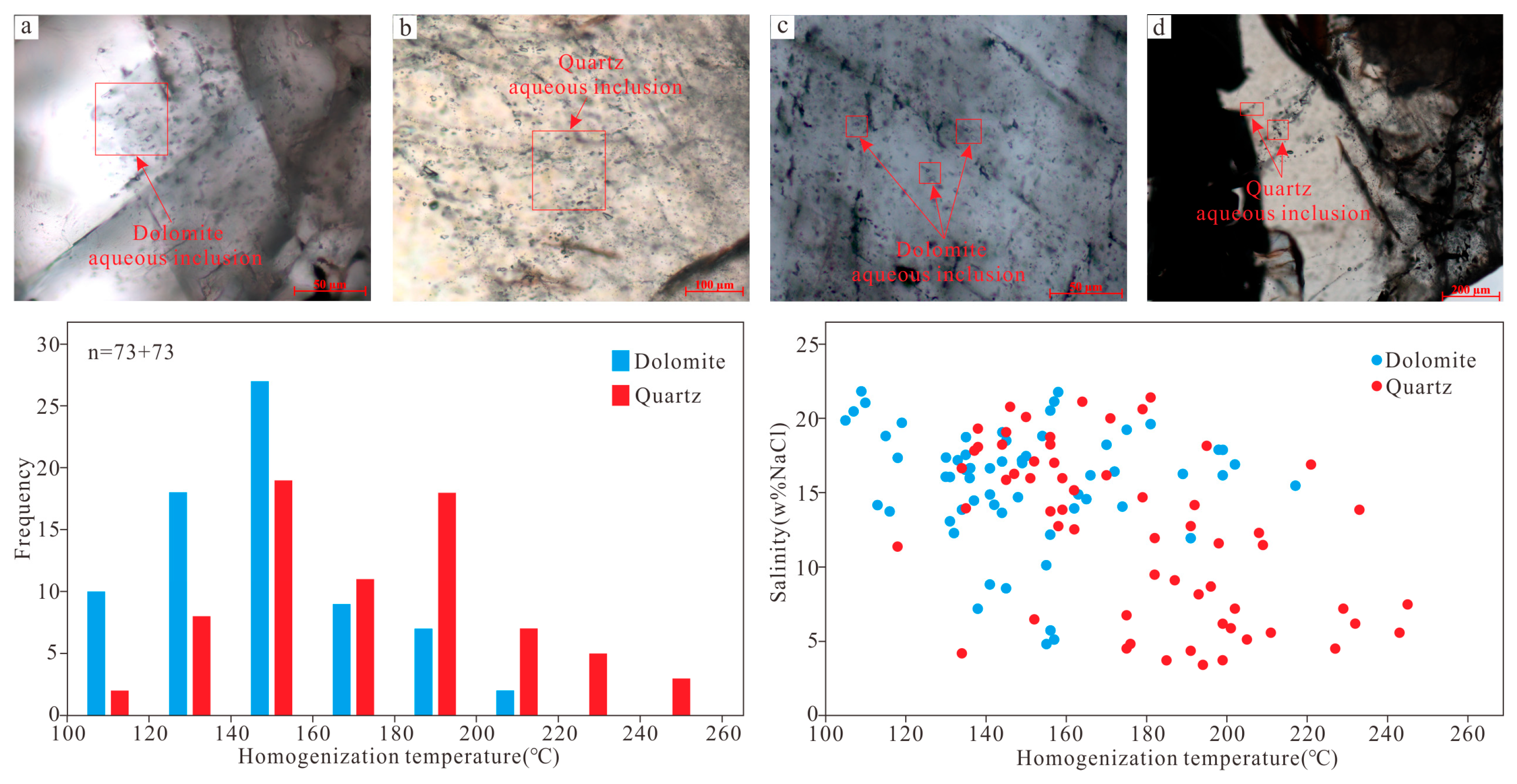
Ten samples are collected for the fluid inclusion test. Results show that fracture-cave fillings mainly develop single-phase and two-phase brine inclusions, with single-phase gaseous hydrocarbon inclusions and single-phase liquid hydrocarbon inclusions accounting for a lower proportion. Two-phase brine inclusions are tested, and 73 sets of homogenization temperature data of dolomite and quartz inclusions are obtained, respectively (Figure 12). The homogenization temperatures of dolomite inclusions range from 105 °C to 217 °C, with an average of 148.5 °C, while those in quartz range from 115 °C to 247 °C, with an average of 176.3 °C. In addition, ice-melting temperatures are measured for 61 inclusions each in dolomite and quartz, from which salinities are calculated. The ice-melting temperatures of dolomite inclusions vary from −19.2 °C to −2.9 °C (avg. −12.1 °C), corresponding to salinities between 4.8 and 21.82 wt% NaCl (avg. 15.68 wt% NaCl). For quartz inclusions, ice-melting temperatures range from −18.6 °C to −2.0 °C (avg. −9.2 °C), equivalent to salinities of 3.39 to 21.4 wt% NaCl.
Figure 12. Microscopic characteristics, homogenization temperature, and salinity distribution of fluid inclusions in dolomite and quartz of the fourth member of Dengying Formation. (a) Micritic dolomite, dolomite inclusion (GS102, 5100.43 m); (b) Fine-powder crystalline dolomite, quartz inclusion (GS20, 5190.89 m); (c) Fine-crystalline dolomite, dolomite inclusion (GS16, 5450.72 m); (d) Fine-crystalline dolomite, quartz inclusion (GS109, 5324.82 m).

5. Discussion

5.1. Geochemical Constraints on Karstification and Paleoenvironment

5.1.1. Major and Trace Elements

The results show that the contents of MgO and CaO in only a few samples from the intraplatform are negatively correlated, and the contents of MgO and CaO in other samples show a significant positive correlation. Except for the cave fillings from GS102 well, which have a low MgO/CaO ratio of 0.17, the MgO/CaO ratios of other samples range from 0.63 to 1.58, showing that dolomite of the fourth member of Dengying Formation was mostly formed during the contemporaneous–penecontemporaneous period. However, the MgO and CaO contents show a wide distribution with significant differences between the platform margin and the intraplatform. The contents of MgO and CaO in the intraplatform are higher than those in the platform margin, and the contents of MgO and CaO vary greatly in different lithologies (Table 1, Figure 10). It shows that the dolomitization degree between these two zones may be different, and dolomite fillings, argillaceous dolomite, and siliceous dolomite have lower dolomitization. Some sedimentary dolomites were subsequently altered by dolomitization processes, resulting in complete dolomitization.
The trace elements of Sr, Ba, Fe, Mn, Ni, and Co can be used as paleoenvironmental indicator elements of carbonate rocks, and their contents are different in different types of dolomite and fracture-cave fillings. It is generally believed that Sr tends to be enriched in the deep sea, while Ba is mostly enriched in coastal water and its corresponding sediments [42]. Mn and Fe are elements strongly enriched in atmospheric diagenetic environments [6], and can be used as indicators of paleo-water depth. Ni and Co are important indicators for judging redox environment or paleo-water depth. The Sr content in the bedrock of the platform margin is 8.65–118.90 ppm, with an average value of 53.86 ppm. The intraplatform is 54.03–113.73 ppm, with an average of 85.39 ppm. The average Sr content of primary aragonite formed in modern oceans is greater than (7740 ± 300) ppm. The Sr content of primary high-Mg calcite is lower than that of aragonite, which is distributed in 400–5000 ppm, while primary dolomite displays the lowest Sr content, distributed between 245 and 600 ppm [43,44]. Strong dolomitization can reduce the Sr content to 155 ppm in the normal marine environment [6,45]. The Sr content in the platform margin is lower than that in the intraplatform, indicating dolomitization fluid is not a single sea source fluid, which is different from contemporaneous–penecontemporaneous dolomite and related to freshwater, and the platform margin is more affected by freshwater.
The Mn/Sr ratio can be used to analyze the degree of diagenetic alteration in carbonate rocks [6]. When Mn/Sr is less than 2, diagenesis has little effect on carbonate rocks. When Mn/Sr ranges from 2 to 10, the carbonate rock has undergone diagenetic alteration to a certain degree but still retains original seawater information. The Mn/Sr ratios range from 0.01 to 42.5, most of which are 0.01–10.5. The intraplatform shows Mn/Sr ratios of 2.96–15.58, mostly between 2.96 and 10.33 (Table 1, Figure 10). The change in Mn/Sr ratios of the dolomite bedrock is primarily due to the change in Mn content, while the change in Sr content has little effect. Generally, the Mn content of dolomite is often positively correlated with the degree of diagenesis alteration. Mn content and Mn/Sr ratios in the platform and intraplatform are broadly comparable, indicating no significant difference in diagenetic alteration between these zones. The carbonate minerals formed in normal seawater at different periods show Fe content around 50 ppm and Mn content around 1 ppm [46]. In contrast, the Mn and Fe contents in the dolomite of the fourth member of Dengying Formation significantly exceed these values (Table 1, Figure 10), indicating the injection of Mn- and Fe-rich external fluids. The Mn/Fe ratio is widely used as an indicator of paleo-water depth. The Mn/Fe ratio in the platform margin ranges from 0.01 to 0.09 (avg. 0.05), while in the intraplatform it ranges from 0.04 to 3.04 (avg. 0.35). Overall, the Mn/Fe ratio in the intraplatform is significantly higher than in the platform margin (Table 1, Figure 10), indicating a relatively greater paleo-water depth in the intraplatform.
Sr/Ba ratio is an important indicator for judging the salinity of sedimentary water. Freshwater sediments show Sr/Ba < 1, while marine sediments show Sr/Ba > 1 [45,47]. Sr/Ba ratios in the dolomite bedrock and fracture-cave fillings of the fourth member of Dengying Formation in the platform margin are less than 1, with an average of 0.25. Approximately half of the samples from the intraplatform show Sr/Ba ratios exceeding 1, with an average of 1.20 (Table 1, Figure 10). The Sr/Ba in the platform margin is significantly lower than that in the intraplatform, indicating that the platform margin may be more affected by freshwater. The terrestrial elements (SiO2, Al2O3, Fe2O3, P2O5, TiO2) of the platform margin samples vary greatly, ranging from 11.03% to 95.93%, and the intraplatform is 0.21%–23.41%. The content of terrestrial elements in the platform margin is higher than that in the intraplatform (Figure 10), indicating that the platform margin is more affected by terrestrial fluids. The interpretation is consistent with the conclusions observed in trace element analysis.

5.1.2. Carbon and Oxygen Isotopes

Carbon and oxygen isotopes of carbonate rocks show different abundances with different geological settings, with smaller late-stage alteration and strong regional comparability, making them good indicators for studying paleoclimate and recovering paleoenvironments [48,49]. Consequently, carbon and oxygen isotopes are often used to explain dolomite genesis and the filling stages of fracture-cave fillings. The carbon and oxygen isotope composition of marine dolomite (bedrock) is closely related to those of contemporaneous seawater. The carbon and oxygen isotopes of carbonate rocks are mainly controlled by the salinity and temperature of karst fluids [50,51]. Fairchild and Spiro (1987) and Zempolich et al. (1988) measured the carbon and oxygen isotope values of late Precambrian seawater in North America and showed that the carbon isotope values range from 5‰ to 7‰ and the oxygen isotope values range from −0.5‰ to 0.9‰ [52,53]. Therefore, these values can represent the carbon and oxygen isotope values of seawater of the Dengying depositional stage. Due to isotope fractionation and the subsequent alteration by karst fluids, the carbon and oxygen isotope values of the fourth member of Dengying Formation are lower than those of coeval seawater. Moreover, significant differences exist in carbon and oxygen isotope values between the bedrock and various types of dolomite fillings (Table 2, Figure 11).
In general, carbon isotope values ranging from 0 to 4‰ are characteristic of typical marine environments, while the oxygen isotope is more sensitive to temperature and is an important indicator for reconstructing paleotemperature [54]. The change of δ18O value is due to the isotope fractionation caused by the increase in temperature during burial diagenesis, but the thermal isotope fractionation has little effect on carbon isotope. Therefore, δ18O values less than −5‰ indicate partial alteration of the original carbonate sediment, while values below −10‰ indicate strong alteration by diagenesis [51,55]. Analysis of the δ13C−δ18O relationship diagram in Gaoshiti-Moxi area, the bedrock and dolomite fillings can be divided into four different types based on their paleokarst depositional environments (Figure 11).
Type I is eogenetic (syngenetic-penecontemporaneous) karst environment. The δ18O values are similar to the background value of carbonate bedrock, but the δ13C varies greatly (Figure 11a). It shows that the karst environment is similar to the sedimentary environment of carbonate rocks, reflecting the short-term exposed karstification shortly after the deposition of carbonate rocks. The distribution of δ13C is wider than that of bedrock due to the influence of meteoric water-seawater mixing. The δ13C values of fracture-cave dolomite fillings range from 0.14‰ to 2.74‰ and δ18O values range from −8.26‰ to −10.39‰. According to different output points, it is found that two of the three vug-lining dolomite fillings fall into the interval (Figure 11b), indicating that vug-lining dolomite fillings were mainly precipitated in the early diagenesis period. Type II is a shallow buried karst environment. The δ18O values of dolomite fillings are lower than those of Type I dolomite bedrock, while δ13C values are broadly comparable to the bedrock. δ13C values range from 2.02‰ to 3.74‰, and δ18O values from −12‰ to 10.39‰ (Figure 11). In the shallow burial environment, the δ13C of dolomite fillings mainly comes from carbonate bedrock, and δ13C values are comparable to the bedrock. In contrast, δ18O is sensitive to temperature, when temperatures rise during shallow burial, δ16O becomes more active and readily incorporates into dolomite, lowering δ18O values. Only one dolomite filling sample falls into the interval (Figure 11b), indicating that the shallow burial karst period is not the main period for the formation of dolomite fillings. Type III is meteoric water karst environment, δ13C and δ18O have obvious negative deviations. δ13C is less than −3‰, and δ18O is −12‰–−10‰. Among the 49 bedrock and dolomite filling samples, only one sample falls into the interval (Figure 11b), which reflects that the meteoric water karst environment is mainly characterized by dissolution and the difficulty to form dolomite filling. Type IV is medium-deep burial or hydrothermal environment. The δ18O value of dolomite fillings is less than −12‰, while the δ13C value varies greatly. Nearly half of the dolomite bedrock and most of the fracture-cave fillings fall into the interval (Figure 11), indicating that the fracture-cave dolomite fillings in the fourth member of Dengying Formation are mainly formed under high-temperature conditions.

5.1.3. Fluid Inclusion Microthermometry

Fluid inclusions can indicate the characteristics of fluid in diagenesis and different tectonic environments [21]. There are no bubbles in the single-phase liquid inclusions, which belong to quasi-stable liquid inclusions and generally indicate a lower capture temperature [56]. Most of them are formed in a low-temperature environment less than 50 °C, representing a meteoric water karst environment [57]. Test results show that single-phase liquid inclusions account for more than half of the total inclusion population, indicating significant influence from meteoric water karsts. A study shows that the Sinian system in Gaoshiti-Moxi area has experienced five thermal evolution stages, that is Sinian–Early Paleozoic warming, Middle Silurian–Early Permian cooling, Middle Permian–Early Triassic rapid warming, Late Triassic–Early Cretaceous rapid warming, and cooling since the Late Cretaceous. The paleotemperature of the Dengying Formation in the Late Silurian is about 95 °C, the paleotemperature in the Middle-Late Triassic is more than 120 °C, and the paleotemperature in the Late Cretaceous reaches the maximum, close to 240 °C [58], and then uplifts and cools. The present-day geothermal temperature of Dengying Formation is about 165 °C [59].
The homogenization temperatures of fluid inclusions in dolomite from the fourth member of Dengying Formation in the study area can be divided into three intervals, indicating relatively low-temperature (100–120 °C), medium-temperature (120–160 °C), and high-temperature (160–220 °C) fluids (Figure 12). It suggests that fracture-cave fillings during the burial period may be affected by three stages of fluids. Based on the research of burial history and thermal history of Dengying Formation in central Sichuan area [58,60], it is found that the Triassic paleotemperature is generally 100–120 °C, and the maximum burial depth is about 4000 m. The Early Jurassic paleotemperature is 120–160 °C, and the maximum burial depth is about 5000 m. The paleotemperature of Late Jurassic-Early Cretaceous is 160–220 °C, and the maximum burial depth is more than 7000 m. It suggests that the dolomite fillings mainly experienced three filling phases of Triassic, Early Jurassic, and Late Jurassic–Early Cretaceous during burial. Among them, the number of inclusions with homogenization temperature of 120–160 °C is the largest (Figure 12), indicating that the Early Jurassic is the main filling period.
Quartz is a typical hydrothermal mineral, and its inclusion formation temperature is generally higher than that of dolomite (Figure 12). The homogenization temperature of quartz inclusions in the fourth member of Dengying Formation can also be divided into three intervals, which indicate relatively low-temperature (100–120 °C), medium-temperature (120–160 °C), and high-temperature (160–260 °C) fluids (Figure 12) mainly experienced Triassic, Early Jurassic, Late Jurassic–Cretaceous three-stage filling. Unlike dolomite inclusions, only two quartz inclusions show a homogeneous temperature of 100–120 °C, while the majority belong to the 160–260 °C, indicating that the Late Jurassic–Cretaceous is the main filling period, that is, the main filling period of quartz is later than that of dolomite, and the fluid temperature is higher.
It is worth noting that both dolomite and quartz inclusions show a negative correlation between homogenization temperature and fluid salinity (Figure 12). It is speculated that it is related to downward infiltration of meteoric water during exposure [61]. The tectonic uplift breaks the original closed fluid system, causing a relative decrease in the salinity of brine inclusions associated with dolomite and quartz inclusions, but it is still under the influence of high-temperature fluid, with the characteristics of high temperature and medium-low salinity [62].

5.2. Differential Characteristics of Paleokarstification in Platform Margin and Intraplatform

The fourth member of Dengying Formation in Gaoshiti-Moxi area develops four types of paleokarstification, but some differences exist in the type and intensity of paleokarstification between the platform margin and the intraplatform.

5.2.1. Eogenetic Meteoric Water Karst

In the eogenetic karst period, high-frequency sea-level fluctuations lead to frequent exposure of carbonate rocks, and soluble minerals are dissolved by meteoric water. Eogenetic meteoric water dissolution shows obvious fabric selectivity, such as intragranular dissolved pores, moldic pores, and geopetal structures [63]. Eogenetic meteoric water karst affects the development of karst reservoirs in the fourth member of Dengying Formation [38,64]. Core and thin section observations reveal that selective dissolution, high-frequency exposed dissolution surfaces, and mottled dissolution are widely developed in both the platform margin and intraplatform (Figure 3). Single-well reservoir statistics indicate that the thickness of high-quality reservoirs gradually increases within 150–300 m below the top of Dengying Formation, with greater thickness in the platform margin than in the intraplatform (Figure 8). This depth is less affected by supergene karstification, and the widely distributed high-quality reservoir is mainly controlled by eogenetic meteoric water dissolution. In the eogenetic karst period, the carbonate rock has not completely separated from the sedimentary water, which belongs to the immature or semimature carbonate rock [65]. The fracture-cave fillings will retain the carbon and oxygen isotope characteristics of bedrock during the process of filling. Only four of the twenty-nine fracture-cave filling samples in the fourth member of Dengying Formation are comparable to the carbon and oxygen isotope values of bedrock (Figure 11), indicating that eogenetic karst is dominated by dissolution. As described previously in Section 5.1.1, the dolomite of the fourth member of Dengying Formation in the platform margin is more affected by freshwater, with relatively shallow paleo-water depths and greater terrestrial input. Therefore, when the sea-level drops, the platform margin suffers from greater intensity and a wider range of atmospheric freshwater dissolution in the early diagenesis period.

5.2.2. Supergene Karst

The Tongwan movement at the end of the Sinian led to regional uplift of Dengying Formation in the Sichuan Basin, resulting in varying degrees of denudation and forming two regional unconformities [66,67]. Due to regional uplift caused by episode II of the Tongwan movement, the entire Sichuan Basin suffered from a 10 Ma meteoric water dissolution [68]. Exploration practice shows that supergene karstification is the key to the formation of high-quality reservoirs in the fourth member of Dengying Formation in Gaoshiti-Moxi area [27,69]. The karst paleogeomorphology of the fourth member of Dengying Formation is undulating, and many paleo-water systems are developed (Figure 2). Cores and thin sections can identify abundant of supergene karst features such as honeycomb-shaped dissolved vugs, dissolved enlarged fractures, karst breccias, and caves (Figure 4). The single-well reservoir statistics show that the high-quality reservoirs are mainly developed within 50 m below the top of the fourth member of Dengying Formation, with their quality diminishing beyond this depth (Figure 8 and Figure 9). This close relationship with the regional unconformity indicates that the development of high-quality reservoirs is mainly controlled by supergene karstification, which affected both the platform margin and intraplatform. However, the platform margin shows greater reservoir thickness and deeper vertical development than the intraplatform (Figure 8 and Figure 9), suggesting that the intensity of supergene karstification in the platform margin is greater than that in the intraplatform.

5.2.3. Coastal Mixed Water Karst

The large-scale dissolution pores and vugs is mainly controlled by meteoric water karstification. As mentioned in Section 4.2.1, there is also a special karstification in Gaoshiti-Moxi area, that is, it is different from the characteristics of eogenetic meteoric water karst and supergene karst from the core and thin section. Furthermore, this kind of karstification tends to gradually weaken from the platform margin to the intraplatform. It is considered that the fourth member of Dengying Formation in the platform margin is affected by coastal mixed water karstification. The main basis is as follows: ① Some wells near the coastline contain high-GR mud and dolomite mixed fillings. For instance, GS102 well, located adjacent to the Deyang–Anyue trough (Figure 2), shows dissolution vugs and fractures filled with mud in the upper part of the fourth member of Dengying Formation. Approximately several meters below, a cave about 1 m in diameter is developed, which is filled with a mixture of mud and dolomite (Figure 5a). It is considered that the cave developed by GS102 well is the result of the combination of multistage sea-level rise and fall and meteoric water leaching, that is, the mixing of meteoric water and seawater. The mixing of these two fluids with different chemistries promotes dissolution of carbonate rocks in the coastal zone. Thin sections show mixed mud and dolomite fillings (Figure 5f,g). These wells are less than 10 km away from the trough and have similar genesis, whereas such features have not been observed in the intraplatform. ② Modern coastal mixed water karstification mostly forms inland-extending network pipelines near the shore, such as Mexico’s Yucatan Peninsula. The network pipelines are mainly located within 12 km of the coastline, and the cave pipelines have a large aspect ratio [70,71]. The karst caves of the fourth member of Dengying Formation in the platform margin show a large aspect ratio. The GS001-H9 horizontal well is about 150 m high GR section, which is a muddy filling cave. These caves are not typical of supergene karst origin but are comparable to characteristics of modern coastal mixed water karst. ③ Geochemical characteristics indicate the existence of coastal mixed water karstification. Major element analysis shows that the P content of cave fillings in GS102 well is extremely high (Table 1). It is speculated that P-rich seawater entered the karst cave formed during the depositional period of Maidiping Formation. The cave was subjected to transgression in the supergene period, that is, the mixing of fresh water and seawater. A trace element of GS102 well shows that the Sr content in the cave fillings is 377.42 ppm, the Ba content is 336.22 ppm, and the Sr/Ba ratio is 1 (Table 1), indicating a genesis related to the mixing of meteoric water and seawater [27]. In addition, the analysis of trace elements shows that the Sr/Ba ratios of bedrock and fracture-cave fillings in the platform margin are less than 1 (Table 1, Figure 10), and the Sr/Ba ratio in the platform margin is significantly smaller than that in the intraplatform, further indicating stronger effects from the coastal mixed water karst in the platform margin.

5.2.4. Buried Karst

During the burial period, the formation pressure and temperature gradually increased due to the compaction of the overlying strata. Compared with the eogenetic meteoric water karst and supergene karst, the burial karst occurred in a relatively closed fluid system [6]. Hydrothermal karst is a typical representative of karstification in burial period. Hydrothermal fluid mainly refers to the fluid that is higher than the formation temperature and invades into the formation [72], which is of great significance for the development of hydrocarbon reservoirs [73,74]. The fourth member of Dengying Formation has undergone a long burial stage after being reformed by supergene karstification caused by episode II of the Tongwan movement, and has been reformed by hydrothermal fluid in the burial period, resulting in widespread hydrothermal karstification [20,21,75]. The cores and thin sections show that the dissolution fractures and caves are filled with hydrothermal minerals such as saddle dolomite, quartz, and sphalerite (Figure 6), and are associated with bitumen (Figure 6c,e,f). Carbon and oxygen isotopes show that most of the fracture-cave fillings have δ18O less than −12‰ (Figure 11), which is indicative of a high-temperature or hydrothermal origin. Homogenization temperature analysis of fluid inclusions reveals that the Early Jurassic is the main filling period of dolomite fillings, and the Late Jurassic–Cretaceous is the main filling period of quartz. The depth of dolomite in the fourth member of Dengying Formation in the Jurassic–Cretaceous is 5000–8000 m, which is in the medium–deep burial stage [58].
It is worth noting that many of the NWW-trending strike-slip faults developed in Gaoshiti-Moxi area [76,77] experienced multiple activities in the Early Caledonian-Yanshanian period [77], which is highly consistent with the filling period of dolomite and quartz minerals in the fourth member of Dengying Formation. These strike-slip faults can be used as a channel for hydrothermal fluid migration and control hydrocarbon accumulation, but they do not cause differences in hydrothermal karstification between the platform margin and the intraplatform.

5.3. Controlling Factors of Karst Reservoirs Differences Between the Platform Margin and Intraplatform

Studies have shown that the high-quality reservoirs of Dengying Formation are controlled by sedimentary facies, multistage karstification, and fault activity [6,8,11]. Mound-shoal facies deposits are the material basis for the development of karst reservoirs. Supergene karstification is the key to the formation of high-quality reservoirs. Fault activity is a favorable factor to promote the development of karstification. The development of karst reservoirs in the platform margin of Gaoshiti-Moxi area is significantly larger than that in the intraplatform, which is the result of soluble rock difference controlled by sedimentary facies, karst paleogeomorphology, and paleokarstification differences.

5.3.1. Soluble Rock Controls on Reservoir Quality Difference

The fourth member of Dengying Formation in the study area is mainly composed of grain-shoal, algal mound, and platform flat subfacies. The mound-shoal complex appears in the medium-high-energy environment, which are mainly composed of thrombolites, stromatolite dolomite, and grain dolomite. These dolomites show relatively well-developed primary porosity and are more susceptible to form dissolution fractures and caves under meteoric freshwater leaching, and the solubility is strong. The platform flat subfacies develop in low-energy environments, mainly composed of micritic dolomite with poor primary porosity and relatively weak solubility. The porosity and permeability data of the three sedimentary subfacies show that the mound-shoal complex has good porosity and permeability, while the porosity and permeability of the platform flat subfacies are the lowest [8]. The lithology of the platform margin and the intraplatform is generally similar, but the development of mound-shoal complex differs significantly. The mound-shoal complex is well-developed in the platform margin, with relatively greater thicknesses of grain-shoal and algal mound, accounting for 0.6–0.8 of the stratigraphic thickness and being widely distributed in the fourth member of Dengying Formation [25]. The intraplatform is dominated by platform plat subfacies, and developing scattered grain-shoal and algal mound [6]. These are represented mainly by thin interbedded algal mounds and sandy grains, accounting for only 0.3–0.6 of the stratigraphic thickness and mostly located at the top of the fourth member of Dengying Formation [25]. In addition, the overall silica content in the intraplatform is higher than that in the platform margin, and the content of insoluble substances is higher (Figure 9). The fourth member of Dengying Formation in the intraplatform shows lower porosity and poorer reservoir quality.

5.3.2. The Karst Paleogeomorphology Controls the Differential Distribution of Karst Reservoirs

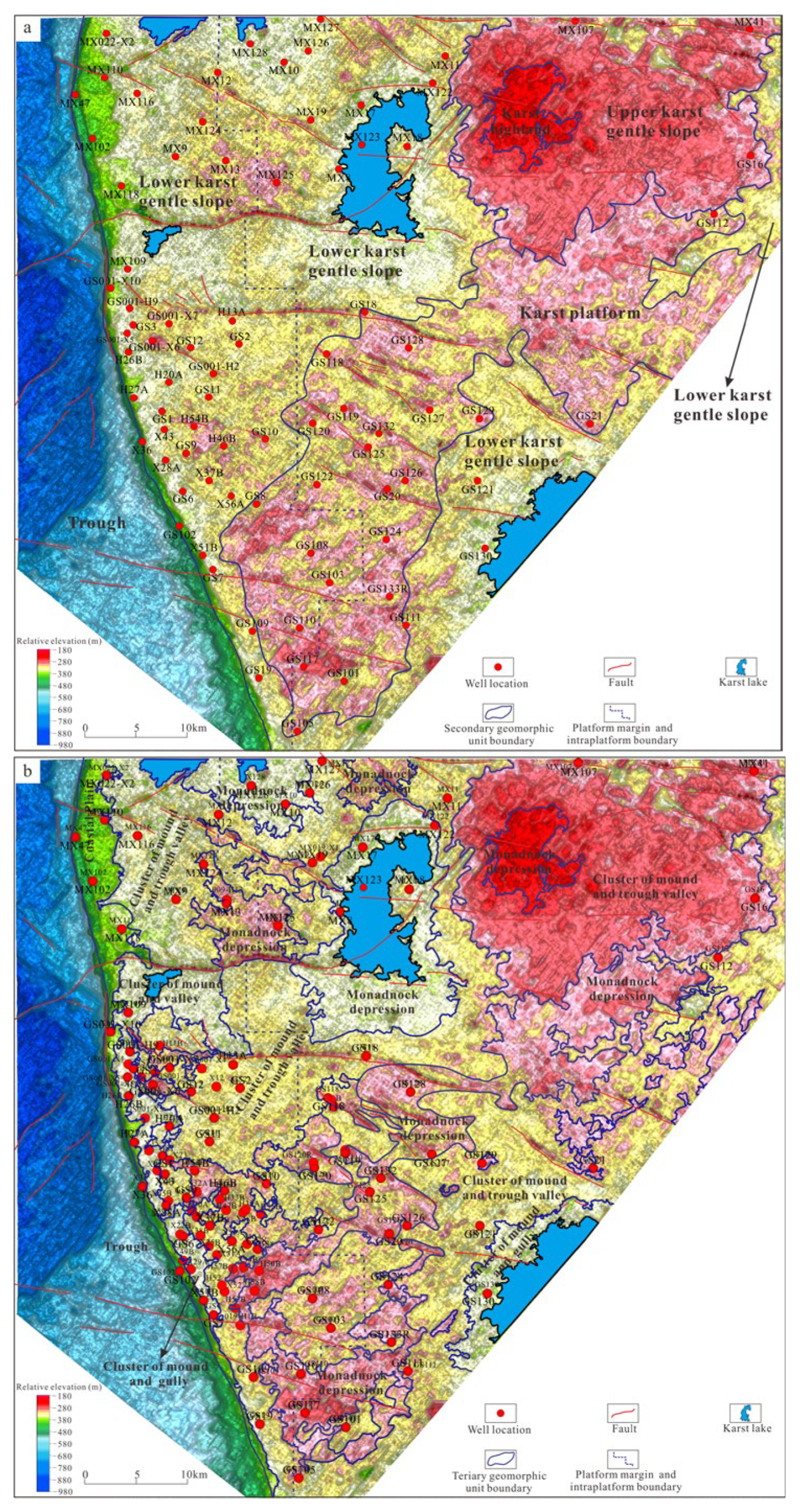
Karst paleogeomorphology controls the flow and distribution of surface water and groundwater, and affects the development characteristics of karst reservoirs [41]. Gaoshiti-Moxi area shows significant differences in karst paleogeomorphology between the platform margin and intraplatform. The Moxi platform margin is in the secondary geomorphic unit of the lower karst gentle slope (Figure 13a), developing three-level geomorphic units such as cluster of mounds and trough valley, monadnock depression and coastal plain (Figure 13b), and poorly developed surface water systems (Figure 2). Multiple runoff dissolution zones can be developed under the influence of meteoric water, characterized by strong hydrodynamic conditions of groundwater and the formation of high-quality reservoirs. The Moxi intraplatform is in the secondary geomorphic unit of the lower and the upper karst gentle slopes, mainly showing three-level geomorphic units such as cluster of mounds and trough valley, monadnock depression, and karst lakes (Figure 13b). However, the topography near the karst lake is relatively low. To the east, there are karst highlands and upper karst gentle slope, and the surface water system is not developed (Figure 2). Groundwater runoff discharges to karst lakes, which is the main catchment area, and the reservoir development is relatively poor.
Figure 13. The division of paleokarst microgeomorphic units in Gaoshiti-Moxi area. (a) The division of secondary geomorphic units. (b) The division of tertiary geomorphic units.
The Gaoshiti platform margin is in the secondary geomorphic unit of the lower karst gentle slope (Figure 13a), developing three-level geomorphic units such as cluster of mounds and trough valley, monadnock depression, and coastal plain (Figure 13b). It shows relatively high topography and well-developed surface water systems (Figure 2 and Figure 13). The Gaoshiti platform margin is a surface water runoff and discharge area with strong hydrodynamic conditions. Multiple runoff dissolution zones can be developed under the influence of meteoric water, leading to well-developed karst reservoirs. The Gaoshiti intraplatform is in the secondary geomorphic unit of karst platform and lower karst gentle slope (Figure 13a), developing cluster of mounds and trough valley, cluster of mounds and gully, monadnock depression, and a karst lake (Figure 13b). The overall topography is slightly lower than the platform margin, but slightly higher than the Moxi intraplatform. Surface water systems are well-developed (Figure 2). Karst reservoirs are mainly developed in the high part of microgeomorphology such as a residual mound or karst mound. In contrast, dissolution is relatively weak in depressions, resulting in a poor reservoir.

5.3.3. Different Types of Paleokarstification Resulting in Karst Reservoir Differences

Paleokarstification is the primary controlling factor for the development of karst reservoirs. As discussed previously, the fourth member of Dengying Formation in Gaoshiti-Moxi area mainly develops four types of paleokarstification. However, the types and intensity of paleokarstification between the platform margin and the intraplatform are quite different. The platform margin develops the above four types of paleokarstification, while the intraplatform, being away from the trough, lacks coastal mixed water karst. In addition, due to the difference in hydrodynamic conditions between the platform margin and the intraplatform, there is a difference in the intensity of paleokarstification. Eogenetic meteoric water karst is more intense and widespread in the platform margin, and supergene karst penetrated to greater depths vertically. During the burial stage, both the platform margin and the intraplatform are in a relatively closed fluid system. Consequently, burial karst is widely developed in the platform margin and the intraplatform, showing no significant differences between them.

5.4. Differential Karst Development Model

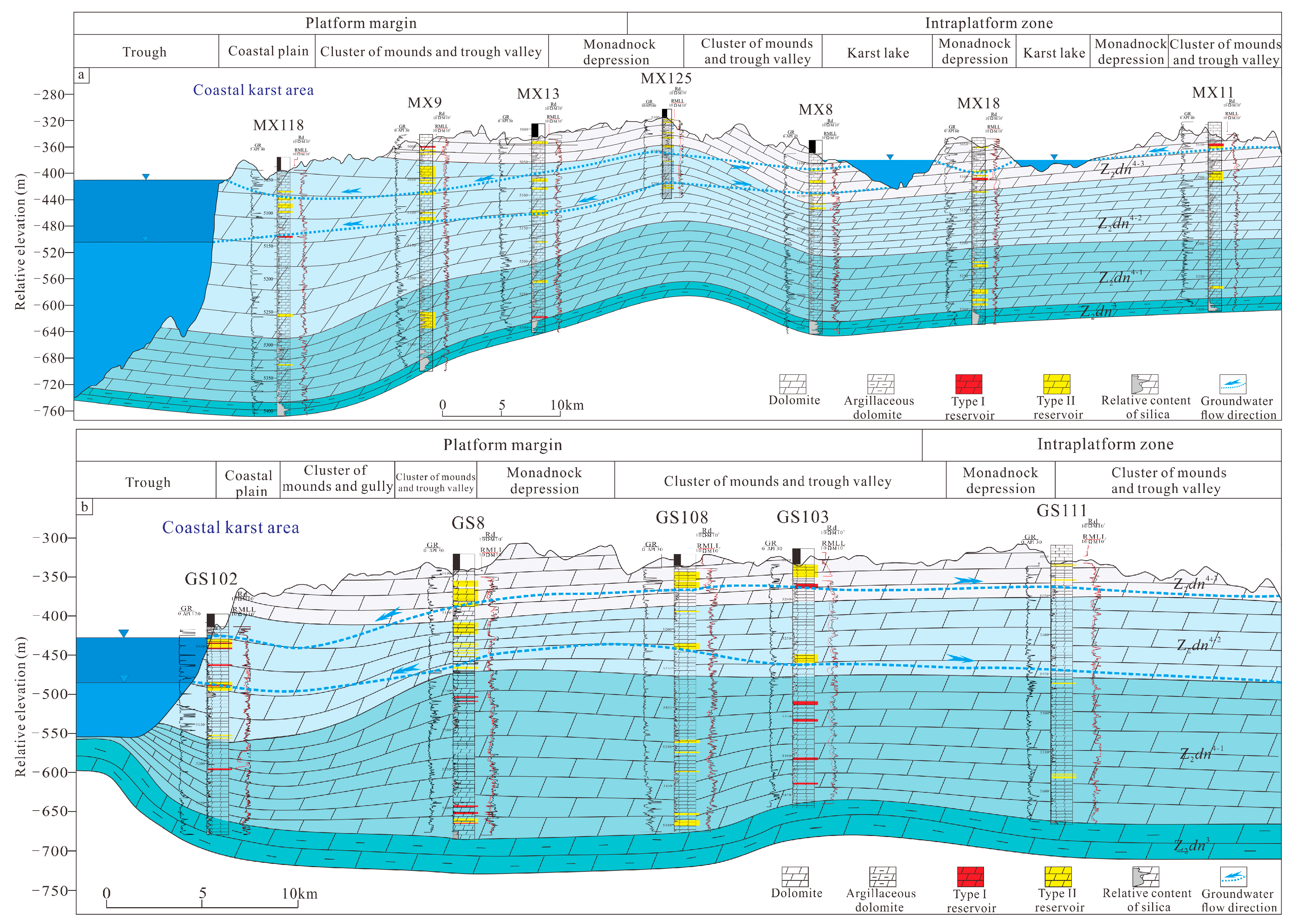
The differential paleokarstification of the fourth member of Dengying Formation in Gaoshiti-Moxi area was mainly reflected in the meteoric water karst (including eogenetic meteoric water karst and supergene karst) and coastal mixed water karst. Based on the comprehensive research above, a differential karst development model for the Gaoshiti-Moxi area is established (Figure 14). The platform margin of the Moxi area develops three-level geomorphic units such as coastal plain, cluster of mounds and trough valley, and monadnock depression (Figure 14a), showing with relatively high topography. The intraplatform develops three-level geomorphic units such as monadnock depression, cluster of mounds and trough valley, and karst lakes. Bounded by the watershed near MX125 well, meteoric water infiltrates from the surface to the ground, and diverges into eastward and westward flow paths. It discharges eastward into karst lakes and westward into the trough (Figure 2 and Figure 14a), with mixed water karst developing along the coastal area. The discharge base level is controlled by the trough in the western part of the platform margin and karst lakes in the intraplatform. Influenced by coastal mixed water karst, multiple sea-level fluctuations, and meteoric water dissolution, the platform margin can develop several sets of runoff dissolution zones, resulting in vertically developing several sets of high-quality reservoirs. The intraplatform is mainly located in the low part of paleogeomorphology, showing clastic sediment accumulation and water catchment during exposure periods, and leading to higher reservoir filling and poorer reservoir properties.
Figure 14. Differential karst development model in Gaoshiti-Moxi area. (a) Differential karst development model of platform margin–intraplatform zone in Moxi area; (b) Differential karst development model of platform margin–intraplatform zone in Gaoshiti area.
The platform margin of the Gaoshiti area mainly develops coastal plains, cluster of mounds and gully, and monadnock depression. The intraplatform mainly develops monadnock depression, cluster of mounds and trough valley, cluster of mounds and gully, and karst lakes (Figure 13b and Figure 14b). Bounded by the watershed southeast of GS8 well, meteoric water infiltrates the subsurface and diverges into northwest and southeast flow paths. It discharges northwestward into the trough and southeastward into karst lakes (Figure 2 and Figure 14b), with mixed water karst developing along the coastal area. The multistage sea-level rise and fall controls the vertical development depth of karst reservoirs. Influenced by coastal mixed water karst, multistage sea-level rise and fall, and meteoric water dissolution, the platform margin develops several sets of runoff dissolution zones, resulting in vertically developing several sets of high-quality reservoirs. The intraplatform, topographically slightly lower than the platform margin and with less developed soluble rocks, has been affected by multistage sea-level fluctuations and meteoric water dissolution, leading to limited development of high-quality reservoirs.

6. Conclusions

(1)
The fourth member of Dengying Formation in Gaoshiti-Moxi area experienced eogenetic meteoric water karst, supergene karst, coastal mixed water karst, and burial karst. Large-scale dissolved fractures and caves are mainly controlled by meteoric water karstification, resulting in three main types of reservoir spaces: vug type, fracture-vug type, and cave type. Dolomite and quartz fillings are mainly formed in the medium-deep burial period.
(2)
There are differences in paleokarstification between the platform margin and the intraplatform. Four types of paleokarstification are developed in the fourth member of Dengying Formation in the platform margin, while the mixed water karst is not developed in the intraplatform. Eogenetic meteoric water karst and supergene karst in the platform margin are stronger than those in the intraplatform. Burial karst shows no notable difference between the two zones.
(3)
The controlling factors of karst reservoir differences between the platform margin and intraplatform are the thickness of soluble rock (mound-shoal complex), karst paleogeomorphology, and different types of paleokarstification. Soluble rocks are more extensively developed in the platform margin. The hydrodynamic conditions controlled by the karst paleogeomorphology are strong in the platform margin, leading to the development of high-quality reservoirs. The intraplatform develops karst lakes, characterized by weaker hydrodynamics, leading to relatively poorer reservoir quality. The area with strong hydrodynamic conditions and a thick mound-shoal complex is a favorable area for the development of high-quality reservoirs.

Author Contributions

Conceptualization, G.N. and D.H.; methodology, G.N. and D.H.; formal analysis, G.N. and X.L.; investigation, G.N., S.J., G.M. and M.Z.; writing—original draft preparation, G.N.; writing—review and editing, G.N. and X.L.; project administration, Q.Z.; funding acquisition, G.N. and Q.Z. All authors have read and agreed to the published version of the manuscript.

Funding

This research was funded by the Basic Research expenses of the Chinese Academy of Geological Sciences (No. JKYZD202331, No. JKYQN202368, No. JKYQN202372), Basic Research Fund of Institute of Karst Geology, Chinese Academy of Geological Sciences (No. YRQN2025020, No. 2022011).

Data Availability Statement

Date is contained within the article.

Acknowledgments

We would like to thank reviewers and the journal editor for constructive comments and suggestions.

Conflicts of Interest

The authors declare no conflicts of interest.

References

  1. Xiao, D.; Cao, J.; Luo, B.; Tan, X.C.; Liu, H.; Zhang, B.J.; Yang, X. On the dolomite reservoirs formed by dissolution: Differential eogenetic versus hydrothermal in the lower Permian Sichuan Basin, southwestern China. AAPG Bull. 2020, 104, 1405–1438. [Google Scholar] [CrossRef]
  2. Li, J.Z.; Tao, X.W.; Bai, B.; Huang, S.P.; Jiang, Q.C.; Zhao, Z.Y.; Chen, Y.Y.; Ma, D.B.; Zhang, L.P.; Li, N.X. Geological conditions, reservoir evolution and favorable exploration directions of marine ultra-deep oil and gas in China. Pet. Explor. Dev. 2021, 48, 52–67. [Google Scholar] [CrossRef]
  3. Yang, Y.; Wang, Z.C.; Wen, L.; Xie, W.R.; Fu, X.D.; Li, W.Z. Sinian hydrocarbon accumulation conditions and exploration potential at the northwest margin of the Yangtze region, China. Pet. Explor. Dev. 2022, 49, 238–248. [Google Scholar] [CrossRef]
  4. Liu, Y.Y.; Wang, Z.C.; Ming, X.Y.; Jiang, L. Profitable Diagenetic Path and Reservoir Formation Efficiency of the Sinian-Lower Cambrian Dolostone: Origins of deep dolomites and differential reservoir formation. Acta Sedimentol. Sin. 2024, 42, 2159–2173. [Google Scholar]
  5. Zhou, Z.; Wang, X.Z.; Yin, G.; Yuan, S.S.; Zeng, S.J. Characteristics and genesis of the (Sinian) Dengying Formation reservoir in Central Sichuan, China. J. Nat. Gas Sci. Eng. 2016, 29, 311–321. [Google Scholar] [CrossRef]
  6. Zhou, Y.; Yang, F.L.; Ji, Y.L.; Zhou, X.F.; Zhang, C.H. Characteristics and controlling factors of dolomite karst reservoirs of the Sinian Dengying Formation, central Sichuan Basin, southwestern China. Precambrian Res. 2020, 343, 105708. [Google Scholar] [CrossRef]
  7. Xu, Z.H.; Lan, C.J.; Zhang, B.J.; Hao, F.; Lu, C.J.; Tian, X.W.; Zou, H.Y. Impact of diagenesis on the microbial reservoirs of the terminal Ediacaran Dengying Formation from the Central to Northern Sichuan Basin, SW China. Mar. Pet. Geol. 2022, 146, 105924. [Google Scholar] [CrossRef]
  8. Yan, R.J.; Xu, G.S.; Xu, F.H.; Song, J.M.; Yuan, H.F.; Luo, X.P.; Fu, X.D.; Cao, Z.Y. The multistage dissolution characteristics and their influence on mound–shoal complex reservoirs from the Sinian Dengying Formation, southeastern Sichuan Basin, China. Mar. Pet. Geol. 2022, 139, 105596. [Google Scholar] [CrossRef]
  9. Zhou, J.G.; Zhang, J.Y.; Deng, H.Y.; Chen, Y.N.; Hao, Y.; Li, W.Z.; Gu, M.F.; Luo, X.Y. Lithofacies paleogeography and sedimentary model of Sinian Dengying Fm in the Sichuan Basin. Nat. Gas Ind. 2017, 37, 24–31. [Google Scholar] [CrossRef]
  10. Chen, H.W.; Wang, S.L.; Mansour, A.; Qin, Q.; Ahmed, M.S.; Cen, Y.; Liang, F.; He, Y.; Fan, Y.; Gentzis, T. Key Characteristics and Controlling Factors of the Gas Reservoir in the Fourth Member of the Ediacaran Dengying Formation in the Penglai Gas Field, Sichuan Basin. Minerals 2025, 15, 98. [Google Scholar] [CrossRef]
  11. Ma, X.H.; Yan, H.J.; Chen, J.Y.; He, D.B.; Xu, W. Development patterns and constraints of superimposed karst reservoirs in Sinian Dengying Formation, Anyue gas field, Sichuan Basin. Oil Gas Geol. 2021, 42, 1281–1294. [Google Scholar]
  12. Yang, W.; Wu, S.J.; Wei, G.Q.; Xie, W.R.; Jin, H.; Zeng, F.Y.; Su, N.; Sun, A.; Ma, S.Y.; Shen, Y.H. Hydrocarbon accumulation and exploration prospect of mound-shoal complexes on the platform margin of the fourth member of Sinian Dengying Formation in the east of Mianzhu-Changning intracratonic rift, Sichuan Basin, SW China. Pet. Explor. Dev. 2020, 47, 1174–1184. [Google Scholar] [CrossRef]
  13. Tan, Q.; Yuan, H.F.; Wang, T.; Ma, Z.L.; Tang, B.J.; Peng, Q.; Li, W.J. Genesis and impact of dissolution in deep dolomite reservoirs: A case of the 2nd member of the Sinian Dengying Formation, Penglai area, central Sichuan Basin. Oil Gas Geol. 2025, 46, 809–826. [Google Scholar]
  14. Liu, H.; Luo, S.C.; Tan, X.C.; Li, L.; Lian, C.B.; Zeng, W.; Luo, B.; Shan, S.J. Restoration of paleokarst geomorphology of Sinian Dengying Formation in Sichuan Basin and its significance, SW China. Pet. Explor. Dev. 2015, 42, 283–293. [Google Scholar] [CrossRef]
  15. Zhang, Z.L.; Qiao, Y.P.; Dou, S.; Li, K.Y.; Zhong, Y.; Wu, L.Y.; Zhang, B.S.; Dai, X.; Jin, X.; Wang, B. Karst paleogeomorphology and reservoir control model of the 2nd member of Dengying Formation in Penglai gas area, Sichuan Basin, China. Oil Gas Geol. 2024, 45, 200–214. [Google Scholar]
  16. Wang, W.Z.; Yang, Y.M.; Wen, L.; Luo, B.; Luo, W.J.; Xia, M.L.; Sun, S.N. A study of sedimentary characteristics of microbial carbonate: A case study of the Sinian Dengying Formation in Gaomo area, Sichuan Basin. Geol. China 2016, 43, 306–318. [Google Scholar]
  17. Chen, Y.N.; Shen, A.J.; Pan, L.Y.; Zhang, J.; Wang, X.F. Features, origin and distribution of microbial dolomite reservoirs: A case study of 4th Member of Sinian Dengying Formation in Sichuan Basin, SW China. Pet. Explor. Dev. 2017, 44, 704–715. [Google Scholar] [CrossRef]
  18. Liu, S.G.; Yu, Y.Q.; Long, Y.; Wan, Y.B.; Song, J.M.; Luo, P.; Qing, H.R.; Lin, T.; Sun, W.; Li, Z.W. Characteristics of microbial carbonate reservoir and its hydrocarbon exploring outlook in the Sichuan Basin, China. J. Chengdu Univ. Technol. Sci. Technol. Ed. 2016, 43, 129–152. [Google Scholar]
  19. Song, J.M.; Liu, S.G.; Li, Z.W.; Luo, P.; Yang, D.; Sun, W.; Peng, H.L.; Yu, Y.Q. Characteristics and controlling factors of microbial carbonate reservoirs in the Upper Sinian Dengying Formation in the Sichuan Basin, China. Oil Gas Geol. 2017, 38, 741–752. [Google Scholar]
  20. Liu, Q.Y.; Zhu, D.Y.; Jin, Z.J.; Liu, C.Y.; Zhang, D.W.; He, Z.L. Coupled alteration of hydrothermal fluids and thermal sulfate reduction (TSR) in ancient dolomite reservoirs-An example from Sinian Dengying Formation in Sichuan Basin, southern China. Precambrian Res. 2016, 285, 39–57. [Google Scholar] [CrossRef]
  21. Feng, M.Y.; Wu, P.C.; Qiang, Z.T.; Liu, X.H.; Duan, Y.; Xia, M.L. Hydrothermal dolomite reservoir in the Precambrian Dengying Formation of central Sichuan Basin, Southwestern China. Mar. Pet. Geol. 2017, 82, 206–219. [Google Scholar] [CrossRef]
  22. Ma, B.S.; Liang, H.; Wu, G.H.; Tang, Q.S.; Tian, W.Z.; Zhang, C.; Yang, S.; Zhong, Y.; Zhang, X.; Zhang, Z.L. Formation and evolution of the strike-slip faults in the central Sichuan Basin, SW China. Pet. Explor. Dev. 2023, 50, 333–345. [Google Scholar] [CrossRef]
  23. Hao, F.; Zhang, X.F.; Wang, C.W.; Li, P.P.; Guo, T.L. The fate of CO2 derived from thermochemical sulfate reduction (TSR) and effect of TSR on carbonate porosity and permeability, Sichuan Basin, China. Earth-Sci. Rev. 2015, 141, 154–177. [Google Scholar] [CrossRef]
  24. Cai, C.F.; Hu, G.Y.; Li, H.X.; Jiang, L.; He, W.X.; Zhang, B.S.; Jia, L.Q.; Wang, T.K. Origins and fates of H2S in the Cambrian and Ordovician in Tazhong area: Evidence from sulfur isotopes, fluid inclusions and production data. Mar. Pet. Geol. 2015, 67, 408–418. [Google Scholar] [CrossRef]
  25. Zhang, X.H.; Peng, H.L.; Tian, X.W.; Zhao, L.Z.; Huang, P.H.; Wang, H.; Ma, K.; Yang, D.L.; Wang, Y.L.; Zhang, X.; et al. Influence of difference among bioherm beach facies reservoirs on exploration model: An example from Sinian Dengying Formation, central Sichuan Basin. Nat. Gas Explor. Dev. 2019, 42, 13–21. [Google Scholar]
  26. Yang, C.Y.; Yu, B.; Zhang, J.F.; Wang, T.G.; Li, M.J.; Ni, Z.Y. Differential diagenetic evolution of Sinian Dengying Formation reservoirs in Anyue gas field, Central Sichuan Uplift, Sichuan Basin. Pet. Geol. Exp. 2025, 47, 754–766. [Google Scholar]
  27. Yan, H.J.; He, D.B.; Jia, A.L.; Li, Z.P.; Guo, J.L.; Peng, X.; Meng, F.K.; Li, X.Y.; Zhu, Z.M.; Deng, H.; et al. Characteristics and development model of karst reservoirs in the fourth member of Sinian Dengying Formation in central Sichuan Basin, SW China. Pet. Explor. Dev. 2022, 49, 704–715. [Google Scholar] [CrossRef]
  28. Ma, K.; Wen, L.; Zhang, B.J.; Li, Y.; Zhong, J.Y.; Wang, Y.L.; Peng, H.L.; Zhang, X.H.; Yan, W.; Ding, Y. Segmented evolution of Deyang-Anyue erosion rift trough in Sichuan Basin and its significance for oil and gas exploration, SW China. Pet. Explor. Dev. 2022, 49, 274–284. [Google Scholar] [CrossRef]
  29. Liu, J.L.; Liu, K.Y.; Li, C.W.; Liu, W.J. Tectono-sedimentary evolution of the Late Ediacaran to early Cambrian trough in central Sichuan Basin, China: New insights from 3D stratigraphic forward modelling. Precambrian Res. 2020, 350, 105826. [Google Scholar] [CrossRef]
  30. Li, R.; Wang, Y.X.; Wang, Z.C.; Xie, W.R.; Li, W.Z.; Gu, M.F.; Liang, Z.R. Geological characteristics of the southern segment of the Late Sinian–Early Cambrian Deyang-Anyue rift trough in Sichuan Basin, SW China. Pet. Explor. Dev. 2023, 50, 285–296. [Google Scholar] [CrossRef]
  31. Xia, M.L.; Wen, L.; Luo, B.; Xu, S.Y.; Zhang, X.H.; Zhu, Y. Tectono-sedimentary mechanism and evolution model of the Deyang-Anyue intracratonic rift in Sichuan Basin. Nat. Gas Ind. 2025, 45, 50–67. [Google Scholar]
  32. Zhang, X.H.; Peng, H.L.; Wen, L.; Li, Y.; Zhong, J.Y.; Ma, K.; Luo, B.; Tian, X.W. Discovery of deep-water deposits in Northwest Sichuan Basin during Dengyingian period: Implications for petroleum geology. Nat. Gas Explor. Dev. 2020, 43, 10–21. [Google Scholar]
  33. Zhang, B.J.; Ma, H.L.; Li, W.Z.; Zhang, Y.; Zhang, Z.L.; Yan, W.; Zeng, Y.Y.; Wang, X.; Zhong, Y.; Li, K.Y. Reservoir characteristics and main controlling factors in the second member of the Dengying Formation in the Penglai Gas Field, Sichuan Basin. Nat. Gas Geosci. 2023, 34, 1899–1915. [Google Scholar]
  34. Tan, L.; Liu, H.; Chen, K.; Ni, H.L.; Zhou, G.; Zhang, X.; Yan, W.; Zhong, Y.; Lyu, W.Z.; Tan, X.C.; et al. Sequence sedimentary evolution and reservoir distribution in the third and fourth members of Sinian Dengying Formation, Gaomo area, Sichuan Basin, SW China. Pet. Explor. Dev. 2022, 49, 871–883. [Google Scholar] [CrossRef]
  35. Li, Y.S.; Liu, G.D.; Song, Z.H.; Sun, M.L.; Tian, X.W.; Yang, D.L.; Wang, Y.L.; Zhu, L.Q.; You, F.L. Constraints of C–O–Sr isotope and elemental geochemistry on the origin of dolomite of the deeply buried Ediacaran sedimentary succession, central Sichuan Basin (SW China). J. Asian Earth Sci. 2023, 255, 105780. [Google Scholar] [CrossRef]
  36. Li, C.W.; Liu, K.Y.; Liu, J.L. A petroliferous Ediacaran microbial-dominated carbonate reservoir play in the central Sichuan Basin, China: Characteristics and diagenetic evolution. Precambrian Res. 2023, 384, 106937. [Google Scholar] [CrossRef]
  37. Liu, K.Y.; Liu, J.L. Application of basin modeling method coupling sedimentary filling evolution with petroleum system in simulating ultra-deep oil-gas accumulations: A case study of Sinian Dengying Formation in central Sichuan Basin. Acta Pet. Sin. 2023, 44, 1445–1458. [Google Scholar]
  38. Zhu, C.Y.; Gao, D.; Hu, M.Y.; Xie, W.R.; Dai, Y.C.; Zhao, Y.R. Properties and Influencing Factors of Eogenetic Karst Reservoirs from Formation Micro-scanner Imagery Facies Analysis: A case study of the Fourth member of the Dengying Formation. Acta Sedimentol. Sin. 2025, 43, 198–211. [Google Scholar]
  39. Jin, M.D.; Tan, X.C.; Tong, M.S.; Zeng, W.; Liu, H.; Zhong, B.; Liu, Q.S.; Lian, C.B.; Zhou, X.H.; Xu, F.; et al. Karst paleogeomorphology of the fourth Member of Sinian Dengying Formation in Gaoshiti-Moxi area, Sichuan Basin, SW China: Restoration and geological significance. Pet. Explor. Dev. 2017, 44, 58–68. [Google Scholar] [CrossRef]
  40. Liu, X.X.; Dan, Y.; Luo, W.J.; Liang, B.; Xu, L.; Nie, G.Q.; Ji, S.C. Characterization of karst paleo-geomorphology and the paleo-water system on the top of the 4th member of the Dengying formation in the Gaoshiti area, Sichuan basin. Carsol. Sin. 2020, 39, 206–214. [Google Scholar]
  41. Xia, Q.Y.; Yan, H.J.; Xu, W.; Zhang, L.; Luo, W.J.; Deng, H.; Yu, J.C. Paleokarst microtopography of the Sinian top and its development characteristics in Moxi area, central Sichuan Basin. Acta Pet. Sin. 2021, 42, 1299–1309, 1366. [Google Scholar]
  42. Nie, G.Q.; Zhang, Q.Y.; He, D.F.; Li, X.P.; Ji, S.C. Geochemical characteristics and paleoenvironmental significance of karst reservoirs in Gaoyuzhuang-Wumishan Formations of Jixian System in Xiong ‘an New Area and its adjacent areas. Front. Earth Sci. 2025, 13, 1624161. [Google Scholar] [CrossRef]
  43. Kinaman, D.J.J. Interpretation of Sr2+ Concentrations in Carbonate Minerals and Rocks. J. Sediment. Petrol. 1969, 39, 486–508. [Google Scholar]
  44. Baker, P.A.; Brun, S.J. Occurrence and formation of dolomite in organic rich continental margin sediments. AAPG Bull. 1985, 69, 1917–1930. [Google Scholar] [CrossRef]
  45. Ren, Y.; Zhong, D.K.; Liu, H.L.; Liang, T.; Sun, H.T.; Gao, C.L.; Zheng, X.W. Isotopic and elemental evidence for paleoenvironmental evolution of Cambrian stage 4 Longwangmiao formation, east Chongqing. China. Earth Sci. 2018, 43, 4066–4095. [Google Scholar]
  46. Veizer, J. Chemical diagenesis of carbonates: Theory and application of trace element technique. In Stable Isotopes in Sedimentary Geology; Arthur, M.A., Anderson, T.F., Kaplan, I.R., Eds.; Society of Economic Paleontologists & Mineralogists: Tulsa, OK, USA, 1983; Volume 10. [Google Scholar]
  47. Dan, Y.; Nie, G.Q.; Liang, B.; Zhang, Q.Y.; Li, J.R.; Dong, H.Q.; Ji, S.C. The source of fracture-cave mud fillings of the Ordovician yingshan Formation and its paleokarst environment in the northern slope of the tazhong uplift, Tarim Basin, China: Based on petrology and geochemical analysis. Minerals 2021, 11, 1329. [Google Scholar] [CrossRef]
  48. Brasier, M.D.; Magaritz, M.; Corfield, R.; Huilin, L.; Xiche, W.; Lin, O.; Zhiwen, J.; Hamdi, B.; Tinggui, H.; Fraser, A.G. The carbon- and oxygen-isotope record of the Precambrian-Cambrian boundary interval in China and Iran and their correlation. Geol. Mag. 1990, 127, 319–332. [Google Scholar] [CrossRef]
  49. Tribovillard, N.; Algeo, T.; Lyons, T.; Riboulleau, A. Trace metals as paleoredox and paleoproductivity proxies: An update. Chem. Geol. 2006, 232, 12–32. [Google Scholar] [CrossRef]
  50. Qiang, Z.T. Carbonate Reservoir Geology; Press of the University of Petroleum: Dongying, China, 1998; pp. 27–54. [Google Scholar]
  51. Ren, Y.; Zhong, D.K.; Gao, C.L.; Yang, X.Q.; Xie, R.; Li, Z.P.; Deng, M.X.; Zhou, Y.C. Geochemical characteristics, genesis and hydrocarbon significance of dolomite in the Cambrian Longwangmiao Formation, eastern Sicuhan Basin. Acta Petro. Sin. 2016, 37, 1102–1115. [Google Scholar]
  52. Fairchild, I.J.; Spiro, B. Petrological and isotopic implications of some contrasting Late Precambrian carbonates, NE Spitsbergen. Sedimentology 1987, 34, 973–989. [Google Scholar] [CrossRef]
  53. Zempolich, W.G.; Wilkinson, B.H.; Lohmann, K.C. Diagenesis of late Proterozoic carbonates; the beck spring dolomite of eastern California. J. Sediment. Res. 1988, 58, 656–672. [Google Scholar] [CrossRef]
  54. Vasconcelos, C.; McKenzie, J.A.; Warthmann, R.; Bernasconi, S. Calibration of the δ18O paleo-thermometer with dolomite formed in microbial cultures and natural environments. Geology 2005, 33, 317–320. [Google Scholar] [CrossRef]
  55. Kaufman, A.J.; Knoll, A.H. Neoproterozoic variations in the C-isotopic composition of seawater: Stratigraphic and biogeochemical implications. Precambrian Res. 1995, 73, 27–49. [Google Scholar] [CrossRef]
  56. Zajacz, Z.; Seo, J.H.; Candela, P.A.; Piccoli, P.M.; Tossell, J.A. Thesolubility of copper in high-temperature magmatic vapors: A quest for the significance of various chloride and sulfide complexes. Geochim. Cosmochim. Acta 2011, 75, 2811–2827. [Google Scholar] [CrossRef]
  57. Dan, Y.; Liang, B.; Cao, J.W.; Zhang, Q.Y. Analysis of Palaeokarst Periods and its Environmental in Lunnan Ordovician of Tarim Basin: From Fluid Inclusion Test of Calcite in Fracture or Vug. Xinjiang Geol. 2015, 33, 95–100. [Google Scholar]
  58. Shi, Y.Z.; Wang, Z.C.; Xu, Q.C.; Hu, S.B.; Huang, S.P.; Jiang, H.; Jiang, Q.C.; Fu, X.D.; Li, W.Z.; Liu, R.H.; et al. Reconstruction and application of thermal history of old strata in superimposed basin: A case study on the Sinian-Cambrian in the central Sichuan paleo-uplift of the Sichuan Basin. Nat. Gas Ind. 2024, 44, 29–43. [Google Scholar]
  59. Qiu, N.S.; Chang, J.; Zhu, C.Q.; Liu, W.; Zuo, Y.H.; Xu, W.; Li, D. Thermal regime of sedimentary basins in the Tarim, Upper Yangtze and North China Cratons, China. Earth-Sci. Rev. 2022, 224, 103884. [Google Scholar] [CrossRef]
  60. He, L.J. Thermal evolution of the Upper Yangtze Craton: Secular cooling and short-lived thermal perturbations. Phys. Earth Planet. Inter. 2020, 301, 106458. [Google Scholar] [CrossRef]
  61. Dong, S.F.; Chen, D.Z.; Zhou, X.Q.; Qian, Y.X.; Tian, M.; Qing, H.R. Tectonically driven dolomitization of cambrian to lower ordovician carbonates of the Quruqtagh area, North-Eastern Flank of Tarim Basin. North-West China. Sedimentology 2017, 64, 1106. [Google Scholar] [CrossRef]
  62. Chen, C.; Yang, X.F.; Wang, X.Z.; Zeng, D.M.; Feng, M.Y.; Xie, L.; Li, X. Pore-fillings of dolomite reservoirs in Sinian Dengying Formationin Sichuan basin. Petroleum 2020, 6, 14–22. [Google Scholar] [CrossRef]
  63. Scholle, P.A.; Ulmer-Scholle, D.S. A Color Guide to the Petrography of Carbonate Rocks: Grains, Textures, Porosity, Diagenesis; AAPG Memoir: Tulsa, OK, USA, 2003; Volume 77. [Google Scholar]
  64. Zhao, D.F.; Tan, X.C.; Luo, W.J.; Wang, X.F.; Xu, W.; Luo, S.C.; Tang, D.H.; Luo, Y.; Zeng, W. Karst characteristics at early diagenetic stage and their enlightenment for the origin of ancient deep carbonate reservoirs: A case study of the Member 4 of Dengying Formation in Moxi 8 well area, central Sichuan. Acta Pet. Sin. 2022, 43, 1236–1252. [Google Scholar]
  65. Grimes, K.G. Syngenetic karst in Australia: A review. Helictite 2006, 39, 27–38. [Google Scholar]
  66. Wang, Z.C.; Jiang, H.; Wang, T.S.; Lu, W.H.; Gu, Z.D.; Xu, A.N.; Yang, Y.; Xu, Z.H. Paleo-geomorphology formed during Tongwan tectonization in Sichuan Basin and its significance for hydrocarbon accumulation. Pet. Explor. Dev. 2014, 41, 338–345. [Google Scholar] [CrossRef]
  67. Li, Y.; Wang, X.Z.; Feng, M.Y.; Zeng, D.M.; Xie, S.Y.; Fan, R.; Wang, L.J.; Zeng, T.; Yang, X.F. Reservoir characteristics and genetic differences between the second and fourth members of Sinian Dengying Formation in northern Sichuan Basin and its surrounding areas. Pet. Explor. Dev. 2019, 46, 54–66. [Google Scholar] [CrossRef]
  68. Wen, L.; Wang, W.Z.; Zhang, J.; Luo, B. Classification of Sinian Dengying Formation and sedimentary evolution mechanism of Gaoshiti-Moxi area in central Sichuan Basin. Acta Pet. Sin. 2017, 33, 1285–1294. [Google Scholar]
  69. Xia, Q.Y.; Ma, X.H.; Guo, Z.H.; Li, W.; Jiang, L.; Li, X.Y.; Liu, X.X.; Luo, R.L.; Yan, H.J.; Liu, Y.Y.; et al. Distribution characteristics of paleokarst zones and internal reservoirs in the fourth Member of Dengying Formation in Gaoshiti block, central Sichuan Basin. Acta Pet. Sin. 2023, 44, 1299–1312, 1332. [Google Scholar]
  70. Mylroie, J.E.; Carew, J.L. Karst development on carbonate islands. In Speleogenesis and Evolution of Karst Aquifers; National Speleological Society: Huntsville, AL, USA, 2003; Volume 1, pp. 1–21. [Google Scholar]
  71. Smart, P.L.; Beddows, P.A.; Smith, S.; Whitaker, F.F. Cave Development on the Caribbean coast of the Yucatan Peninsula, Quintana Roo, Mexico. Spec. Pap.-Geol. Soc. Am. 2006, 404, 105–128. [Google Scholar]
  72. Davies, G.R.; Smith, L.B. Structurally controlled hydrothermal dolomite reservoir facies: An overview. AAPG Bull. 2006, 90, 1641–1690. [Google Scholar] [CrossRef]
  73. Langhorne, B.; Smith, J.L.B. Origin and reservoir characteristics of Upper Ordovician Trenton-Black River hydrothermal dolomite reservoirs in New York. AAPG Bull. 2006, 90, 1691–1718. [Google Scholar]
  74. Lonnee, J.; Machel, H.G. Pervasive dolomitization with subsequent hydrothermal alteration in the Clarke lake gas field, middle Devonian Slave point formation, British Columbia, Canada. AAPG Bull. 2006, 90, 1739–1761. [Google Scholar] [CrossRef]
  75. Su, A.; Chen, H.H.; Feng, Y.X.; Zhao, J.X.; Wang, Z.C.; Hu, M.Y.; Jiang, H.; Nguyen, A.D. In situ U-Pb dating and geochemical characterization of multi-stage dolomite cementation in the Ediacaran Dengying Formation, Central Sichuan Basin, China: Constraints on diagenetic, hydrothermal and paleo-oil filling events. Precambrian Res. 2022, 368, 106481. [Google Scholar] [CrossRef]
  76. He, X.; Tang, Q.S.; Wu, G.H.; Li, F.; Tian, W.Z.; Luo, W.J.; Ma, B.S.; Su, C. Control of strike-slip faults on Sinian carbonate reservoirs in Anyue gas field, Sichuan Basin, SW China. Pet. Explor. Dev. 2023, 50, 1116–1127. [Google Scholar] [CrossRef]
  77. Lu, X.S.; Gui, L.N.; Wang, Z.C.; Liu, S.B.; Liu, Q.; Fan, J.J.; Chen, W.Y.; Ma, X.Z.; Jiang, H.; Fu, X.D.; et al. Activity time of strike-slip faults and their controlling effects on hydrocarbon accumulation in central Sichuan Basin: Evidence from U-Pb dating and fluid inclusions of cements in fault zone. Acta Pet. Sin. 2024, 45, 642–658. [Google Scholar]
Disclaimer/Publisher’s Note: The statements, opinions and data contained in all publications are solely those of the individual author(s) and contributor(s) and not of MDPI and/or the editor(s). MDPI and/or the editor(s) disclaim responsibility for any injury to people or property resulting from any ideas, methods, instructions or products referred to in the content.

Article Metrics

Citations

Article Access Statistics

Multiple requests from the same IP address are counted as one view.