


Abstract
Indirect calculation of magma crystallization temperatures is an important subject for geologists to know the petrogenesis of igneous rocks. During magma evolution from generation to crystallization, several processes control the behavior of elements. In this research, we obtained two new methods for the thermometry of magma by using high field strength elements (HFSEs; Zr, Hf, Ce, Y, and Ti) abundances in igneous rocks. The first was T(K) = −15,993/(lnCZr + lnCHf − 21.668), where CZr and CHf are the bulk-rock Zr and Hf contents in ppm, and T is the temperature in Kelvin. This equation was specially formulated to address metaluminous to peraluminous rocks with M < 2 [(Na + K + 2Ca)/(Al × Si)] (cation ratio) and SiO2 > 63 wt.%. The second was T(K) = −20,914/(ln(CHf + CY + CCe) + (ln(CZr/TiO2) − 31.153). CHf, CY, and CCe, and CZr are Hf, Y, Ce, and Zr contents (ppm) in the whole rocks. The second equation is more suitable for peralkaline to alkaline rocks with M > 2 and a wide range of SiO2. Both equations are applicable for temperatures from 750 °C to 1400 °C. These two equations are simple and robust thermometry methods and predict similar values in the range of TZr thermometry, which has previously been suggested for magma crystallization temperature.
1. Introduction
Indirect estimation of magma crystallization temperature by using the composition of the whole rock is a challenging subject in igneous petrology. This matter is an important subject for understanding the evolution of igneous rocks, and there are different thermometry methods based on the mineral equilibria and compositions in igneous and metamorphic rocks [1,2,3,4,5,6,7,8,9,10,11]. Here, we briefly mention some common thermometry methods in igneous rocks, including Zr content in rutile in equilibrium with quartz and zircon (T(°C) = 127.8 × ln (Zr in ppm) − 10) [12]), Ti incorporation in zircon (TZircTi (°C) = [1]), and Ti in quartz (T(°C) = [2]. Apatite saturation thermometry is particularly applicable for peraluminous rocks [4]. The Fe-Ti oxide composition in the intrusive rocks is valuable for the determination of the temperature and oxygen fugacity [5]. Two feldspars thermometry has a long history and was developed by several researchers [6,7,8]. The composition of plagioclase is sensitive to the temperature in the magmatic melts. Accordingly, plagioclase compositions are a respectable thermometer in igneous rocks [13,14,15,16]. Likewise, Ghiorso and Evans [17] developed a new approach of thermometry in the oxide solid solution of Fe2O3-FeTiO3-MgTiO3-MnTiO3 with less Al2O3.
Zircon saturation thermometry (TZr) is dependent on the Zr concentration in the felsic melt (W&H83) [18]. Both the WandH83 and the revised TZr formula (B13) [19] are widely established for the estimation of magma crystallization temperature for mostly aluminous compositions. Conclusively, the zircon saturation thermometry was revised and updated for the calculation of the intermediate to felsic alkaline melt temperatures higher than 800 °C by Gervasoni et al. [20], which we, here, refer to as the G16 equation.
There are some glitches with thermometry methods, including the following: (1) most granitic rocks do not commonly show a pure melt composition because they are cumulate [21,22] or driven by incomplete separation of residue minerals from the melt [23]; (2) the estimated temperature from mineral couples represents the temperature of subsolidus equilibrium, not the crystallization temperature, and, furthermore, it is also more sensitive to reactions in granitic rocks [24,25]. Moreover, geological processes, such as weathering, hydrothermal alteration, and metamorphism could affect the minerals’ compositions [26].
Zircon saturation thermometry is frequently used to estimate magma crystallization temperature. Zircon is a host for high field strength elements (HFSEs) and rare earth elements [20,27,28,29]. Among the HFSEs, Th, U, Zr, Ti, Nb, Ta, and Hf are immobile during various types of geological processes, such as weathering, alteration, and metamorphism [30,31,32]. In the present research, we to show the relationship between HFSEs (Nb, Ta, Zr, Hf, Th, U, Ce, Y, and Ti) content in igneous rocks and magma crystallization temperatures, by using a large number of various types of whole rock compositions. We suggest two new equations for the estimation of magma crystallization temperature based on whole rock chemistry.
2. Source Data and Method
A total of 994 whole-rock datasets were selected from http://georoc.mpch-mainz.gwdg.de/georoc/ (accessed on 29 August 2021). These data were selected from various magmatic rocks from different areas. Contents of Nb, Ta, Zr, Hf, Th, U, Ce, Y, and major elements are reported in Supplementary Materials Tables S1 and S2, including metaluminous to peraluminous and peralkaline to alkaline compositions, respectively. The Kolmogorov–Smirnov (K-S) [33] test was used to check the normality of the data distribution. All distributions of Nb, Ta, Zr, Hf, Th, U, Ce, Y, Ti (herein used as TiO2 in wt.%), were nonnormal (Kolmogorov-Smirnov v alues < 0.01). Skewness values were positive for all studied elements. Probability (P) values with less than 0.05 and 0.01 were considered to indicate significant differences (confidence levels of 0.95% and 0.99%, respectively).
3. Zr Saturation Temperature, A Review
Watson and Harrison [18] suggested that the zircon saturation in granitic melts is related to the Zr content, melt composition, and magma crystallization temperature. Based on their calculation, the M value (M = [Na + K + 2Ca]/[Si × Al]) could be an outstanding compositional proxy that is calculated based on the molar values of each component and is expressed as Equation (1):
This equation (herein referred to as WandH83) was calibrated for M ranging from 0.9 to 1.9 and it did not work for peralkaline rocks. This equation worked well for low-Fe magma [34]. Equation (1) (herein referred to as B13) has been updated by Boehnke et al. [19] as follows (B13):
The WandH83 and B13 zircon saturation temperature models also do not support estimated temperature for the samples with M > 2, high alkali composition, and higher temperatures. Gervasoni et al. [20] updated the TZr calculation for melts with M > 2, and ASI (ASI = [Al2O3/(CaO + Na2O + K2O)]) [35] ranging from 0.49 to 1.4. Fe-poor and also more alkaline compositions than those were used by WandH83 and B13 in the following Equation (3):
Here G is the molar ratio (3[Al2O3] + [SiO2])/([Na2O] + [K2O] + [CaO] + [MgO] + [FeO]), and Zr (ppm) is the value of Zr in the rock/glass/melt (herein refer to G16).
G16 can be used for more alkaline, intermediate to felsic rocks. Notably, the WandH83, B13, and G16 zircon saturation temperatures were calibrated for temperatures of 800 to 1200 °C [20,36], and the temperature results came with higher uncertainty of at least 50 °C [20].
The first experiment on zircon saturation temperature for basaltic magma was done by Shao et al. [37]. They suggested a refined model as Equation (4) (refer to S19):
ln CZr(melt) = (3.313 ± 0.349) – (1.35 ± 0.1) × lnG + (0.0065 ±0.0003) × Tk
- CZr(melt) = Zr concentration in melt (ppm)
- T = Temperature (K)
- G = (3[Al2O3] + [SiO2])/([Na2O] + [K2O] + [CaO] + [MgO] + [FeO]) (molar proportion)
The M and G parameters of zircon saturation models were revised, for temperatures from 750 to 1400 °C, with a large range of compositions from mafic to felsic rocks (peralkaline to peraluminous). Based on this calibration two models were suggested [36]. Model 1 is more suitable for estimating the temperature of metaluminous to peraluminous magmas (refer to S20-1), as shown in Equation (5) [36]:
Model 2 was revised to the G parameter and is used for estimation of the temperature in alkaline to peralkaline rocks (herein referred to as S20- 2) as in Equation (6) [36]:
TZr has been applied to predict the minimum temperature for magmas initially under-saturated in Zr [38,39], which is controlled by magma composition. Zr is an incompatible element, and it does not enter the rocks forming minerals during magma crystallization. Its values gradually increase during magma differentiation. Furthermore, the dissolution of Zr-bearing minerals increases Zr content in the melt and finally enters the zircon crystals [39]. Therefore, TZr varies during the fractional and crystallization of magma [18,39,40].
During magma fractionation, late-stage magmatic rocks have a high content of Zr and estimated high TZr temperature, compared to less differentiated mafic rocks. To reinforce this concept, silicic and mafic magmas were compared by Siégel et al. [26].
Accordingly, during fractional crystallization of mafic melts, Zr content increases, and M decreases [41]. Mafic magma needs a high Zr content for crystallization of the zircon and it will not happen without a high rate of magma fractionation [26]. Therefore, TZr in the mafic rocks is significantly lower than the magma crystallization temperature (TZr < TMagma). TZr in the mafic magma has not yet been fully calibrated, but it could still be meaningful if the degree of zircon- undersaturation of magma is determined [26].
During magma fractionation, the Zr contents in the granitic and dioritic rocks are less than the Zr contents in the melt. In this case, TZr < TMagma [40], and, also, in highly evolved magma, the Zr content in the late stage crystallized rocks is higher than that in ZrMagma, which causes the overestimation of TZr [39]. Hence, the pegmatite rocks, which represent the late stage of magma crystallization, mislead us in estimating the magma crystallization temperature. Subsequently, it is necessary to emphasize that TZr is the temperature at the onset of zircon crystallization and is not equal to the magma crystallization temperature (TMagma).
TZr may be close the magma temperature (TMagma) if the rocks and melt composition are the same. Phenocryst-free felsic volcanic rocks, due to quick quenching, could be more likely for TZr = TMagma [18]. This difference is clear in contemporary plutonic–volcanic rocks [40]. Collins et al. [38] mentioned that TZr is a reliable estimate for partial melting temperatures in felsic (silicic) rocks with SiO2 ranging from 65 to 70 wt.%, because zircon is saturated and TZr is equal to the TMagma.
In this research, the chemistries of around 1000 (994) whole rocks, with a wide range of compositions and tectonic settings, were investigated. We assessed the relationship between HFSE contents in the whole rocks and magma temperature with various compositions, from the mafic to felsic, and with the peralkaline to peraluminous affinity. We opted to apply Shao’s two refined models [36]. Consequently, we selected two sets of data including 915 databases of metaluminous and peraluminous rocks throughout the world with M < 2 and SiO2 > 63% wt.%, and TZr was calculated by S20-1 Equation (5) for these rocks. Furthermore, 79 peralkaline to alkaline rocks with M > 2 and SiO2 > 45 wt.% were selected to estimate the temperature based on the S20-2 model (Equation (6)).
In our dataset, we considered that the TZr was not equal to the TMagma and that it showed the temperature of zircon crystallization. Here, the estimation of magma crystallization temperature for all datasets was calculated by using Equations (5) and (6), presented in Tables S1 and S2.
4. Results
4.1. Major Oxides Relationships with TZr
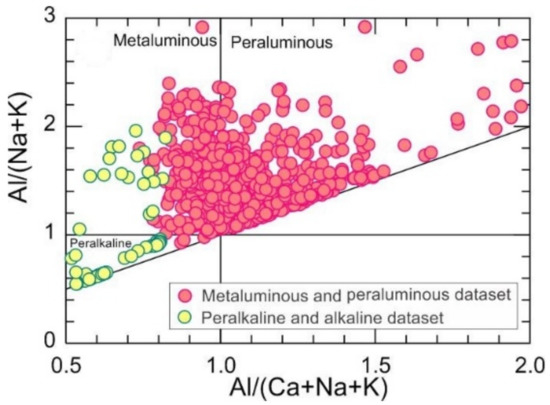
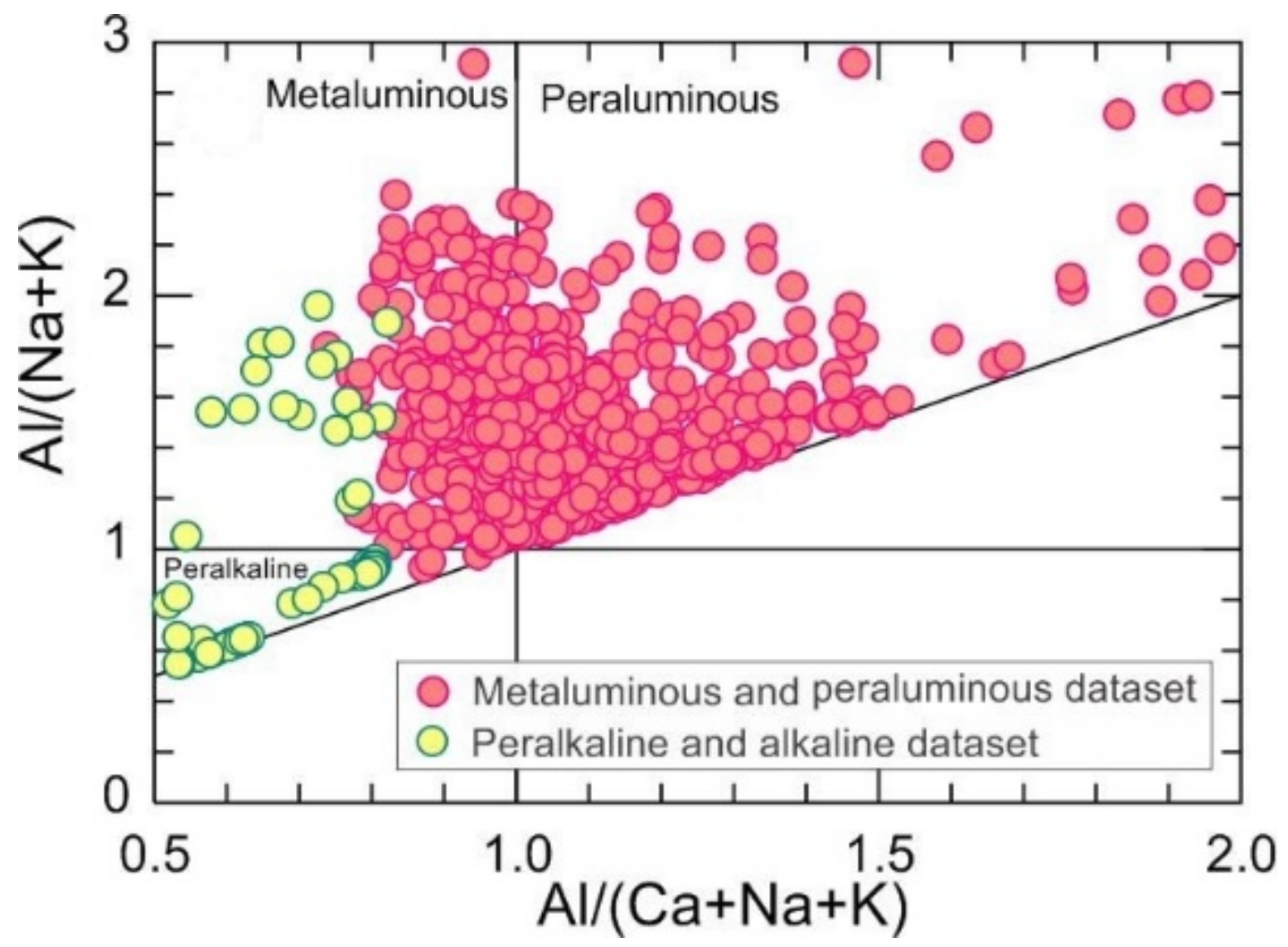
The selected samples were plotted in the metaluminous and peraluminous to peralkaline in an [Al2O3]/[(Na2O + K2O)] versus [Al2O3]/[(CaO + Na2O + K2O)] variation diagram [42] (Figure 1).
Figure 1.
Variation of Al/(Na + K) versus Al/(Ca + Na + K) [42] shows the composition of selected rocks changed from peralkaline to peraluminous. The geochemical data in use in this research was collected from 994 whole rocks datasets on the http://georoc.mpch-mainz.gwdg.de/georoc/ (accessed on 29 August 2021). The 915 databases of metaluminous and peraluminous rocks throughout the world with M < 2 [M = (Na + K + 2Ca]/(Si × Al] and SiO2 > 63% wt.% (Table S1) and the 79 peralkaline to alkaline bulk rock database with M > 2, and SiO2 > 45wt.% (Table S2).
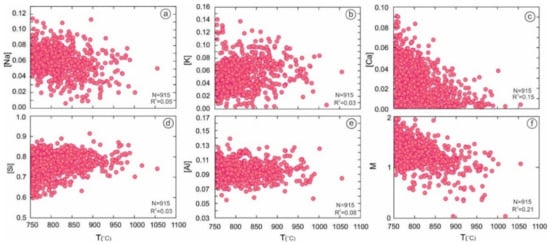
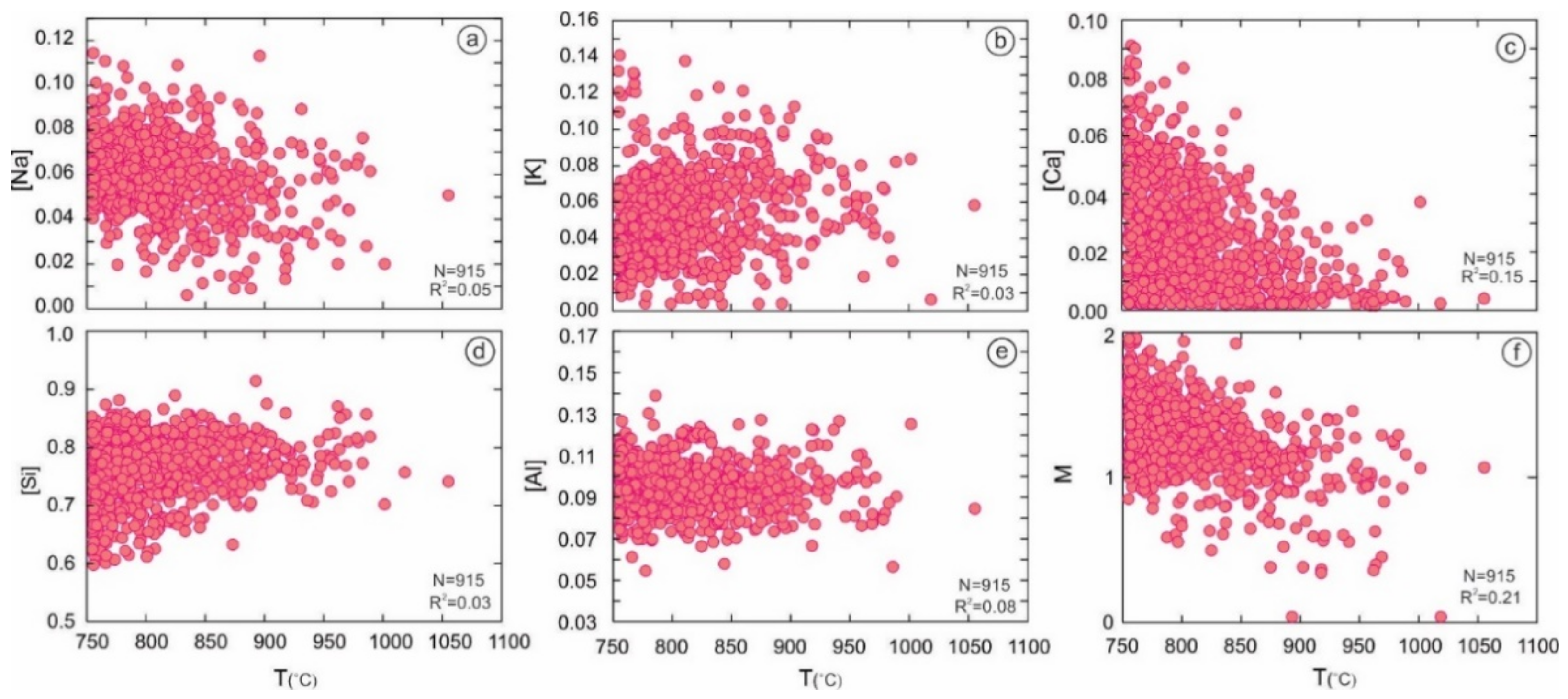
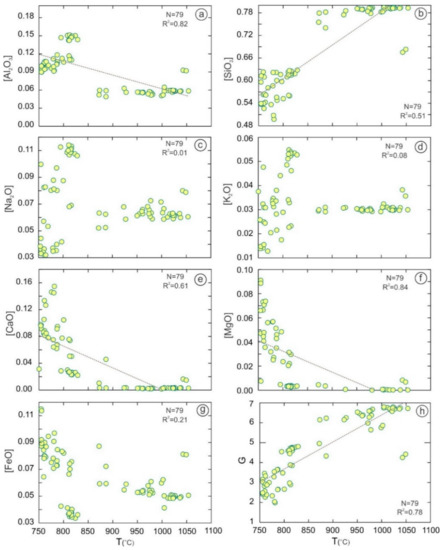
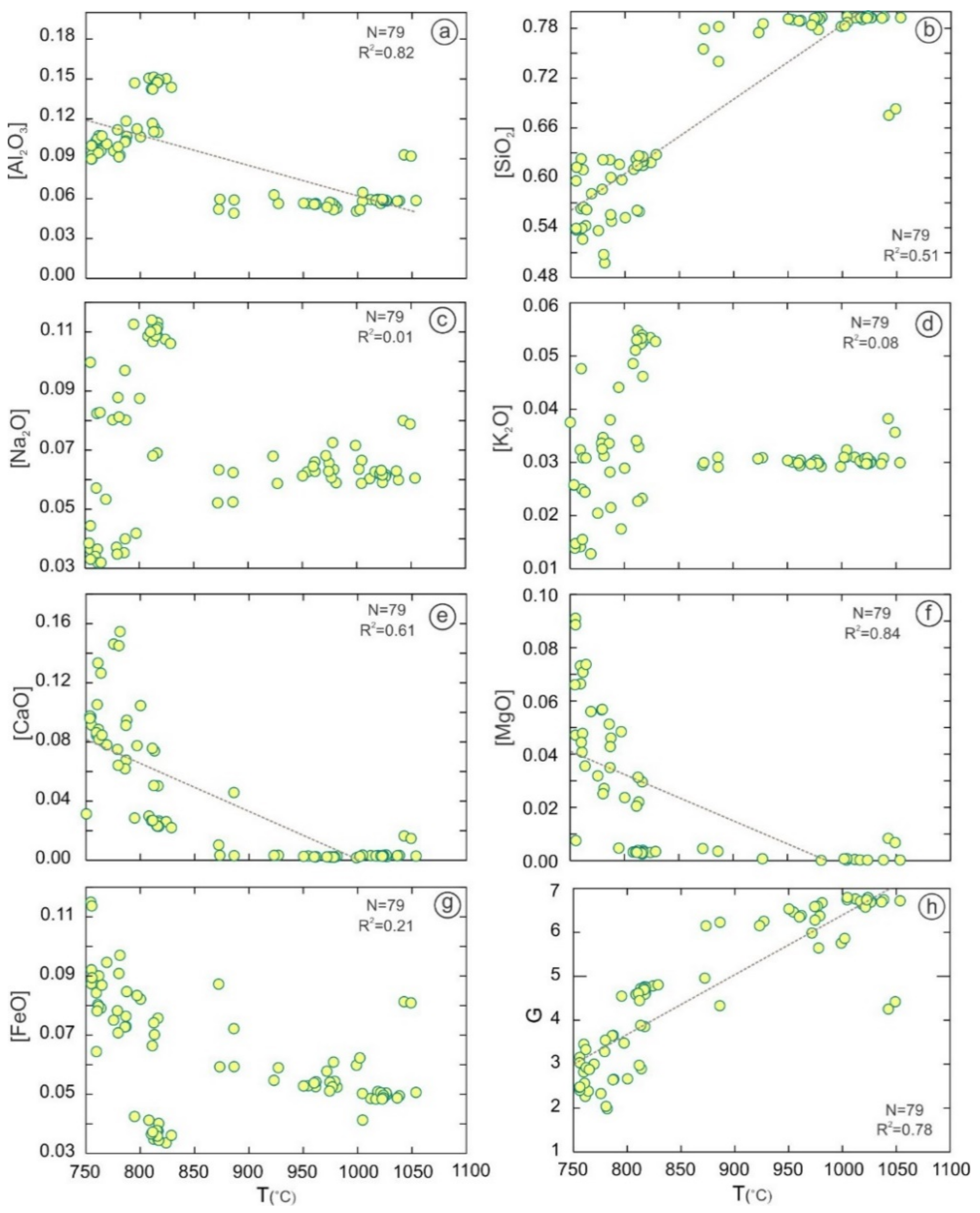
To evaluate the effect of the major components of the whole rock, M and G parameters, of the magma crystallization temperature, were calculated. Then, the M and G parameter calculated values were plotted against the temperatures (Figure 2 and Figure 3) which were calculated on the basis of the equations S20-1 and S20-2. Based on Equation (1), the M values had a clear correlation with the temperature. Here, we briefly used M∝W&H83 [18,19], and also G values were consistent with temperature based on Equation (3). G∝G16 in the calculation of Gevasoni et al. are presented in [20]. Nevertheless, our selected data showed that M was not correlated with TZr, based on equation S20-1 (R2 = 0.21; Figure 2f). Despite this, G denoted a positive correlation with TZr in the S20-2 model (R2 = 0.87, Figure 3h). Meanwhile, [SiO2] showed a high positive correlation (R2 = 0.82), [MgO], [CaO], and [Al2O3] showed a high to a moderate negative relationship (R2 = 0.84; R2 = 0.61, R2 = 0.51, respectively) with TZr. Hence, we agreed that the concept of TZr and its experimental calibration in the calculation of zircon saturation thermometry by Watson and Harrison [18] and all revisions of TZr were robust. However, its application in bulk rock composition (M) has some errors, which were recently discussed by Duan et al. [40].
Figure 2.
(a–f) Plot of the main members of whole rocks M value [(Na + K + 2Ca]/(Si × Al] (cation ratio) versus TZr for the metaluminous to peraluminous dataset (Temperature is estimated by S20-1); (n = 915 from metaluminous and peraluminous with M < 2 and SiO2 > 63% wt.%, table, accessed on 29 August 2021).
Figure 3.
(a–h) G variation (3[Al2O3] + [SiO2])/([Na2O] + [K2O] + [CaO] + [MgO] + [FeO]) versus the TZr (which calculated based on the Equation (S20-2)) in peralkaline to alkaline dataset. G∝G16 in experimental data of Gervasoni et al. [20];. Nevertheless, there was a clear relationship among the [Al2O3], [SiO2], [CaO], [MgO], and G versus TZr (n = 79 peralkaline to alkaline rocks with M > 2, and SiO2 > 45wt.%, http://georoc.mpch-mainz.gwdg.de/georoc/, accessed on 29 August 2021).
4.2. HFSEs Considerations in Magma Crystallization Temperature
All HFSEs are typically incompatible and are generally concentrated in accessory minerals. Zircon is the main host for HFSEs (Nb, Ta, Zr, Hf, Th, U), and Ti is widely used for determining the temperature of magma when zircon is saturated [18]. Therefore, the behavior of Zr in granitic melts is an important factor to estimation of zircon saturation temperature. In the following, we present some geochemical pairs of Nb-Ta, Zr-Hf, and Th-U with some petrogenesis index, such as Zr/TiO2 and Zr + Nb + Ce + Y, to show how the distribution of the HFSEs in the melts are controlled by temperature.
4.2.1. Nb and Ta’s Relationship with TZr
The elements Nb and Ta are not fractionated during most geological processes [43] and are poorly soluble in solution [44]. The contents of Nb and Ta in the bulk crust are approximately 8 and 0.7 ppm, respectively [45]. Niobium (Nb) is mostly concentrated in alkaline rocks, such as alkali granite and alkaline mafic and ultramafic rocks, and Ta accompanies Nb with abundances of one-tenth to one-fifteenth [46].
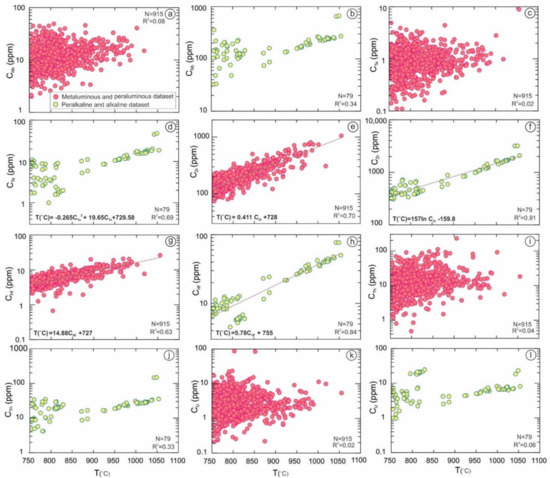
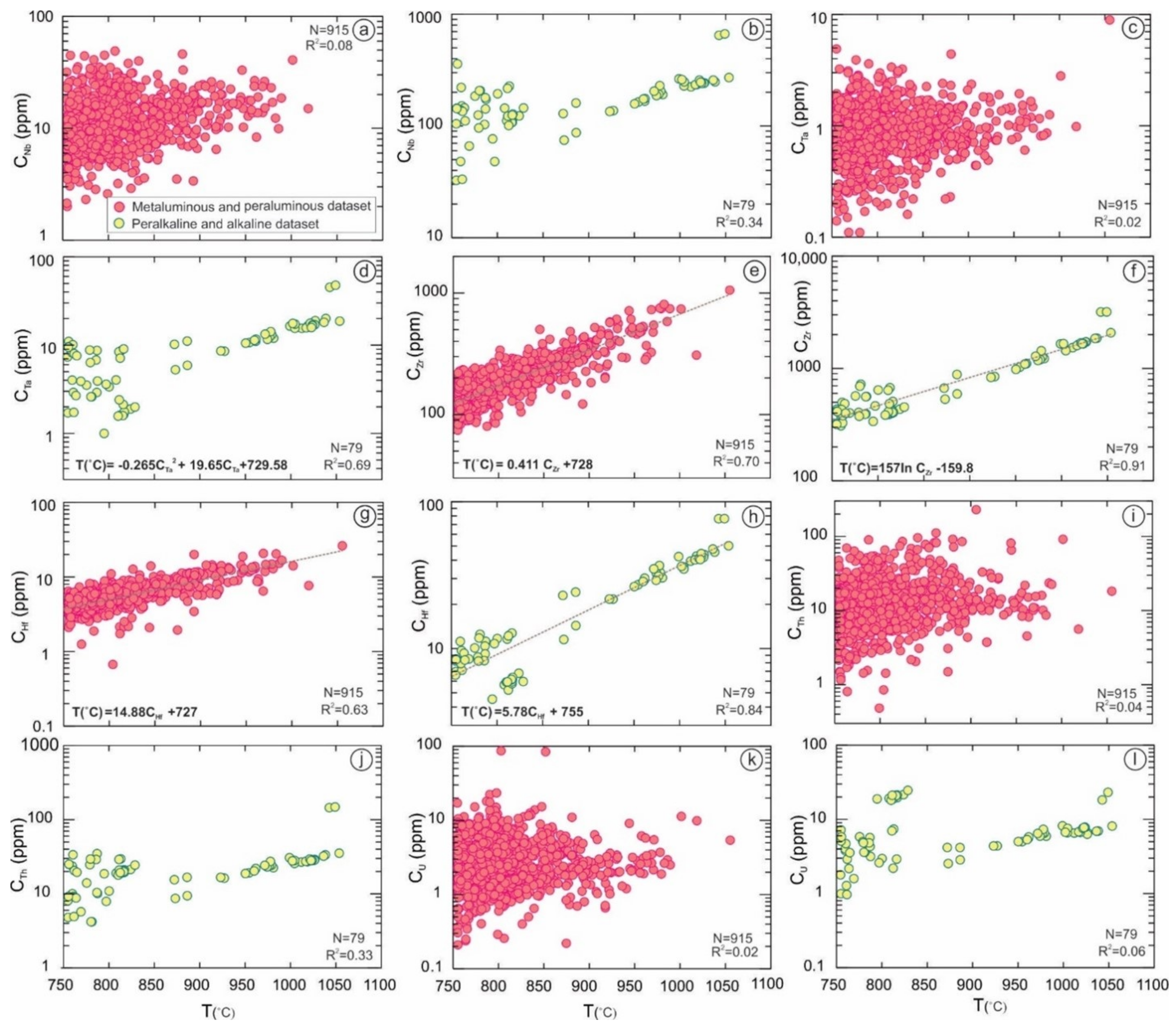
To evaluate the relationship between the temperature and Nb and Ta concentrations, the temperature was calculated based on WandH83 [18], G16 [20], and S20 [36] (Tables S1 and S2). In Nb-Tzr in Figure 4a–d there is no evidence of aa significant relationship between zircon saturation temperature and Nb (R2 = 0.08, Figure 4a; R2 = 0.34, Figure 4b). Meanwhile, there is a frail positive and linear correlation between Ta concentration and temperature in the metaluminous and peraluminous datasets (R2 = 0.02; Figure 4c) (here, T is estimated from the zircon saturation thermometer in Equation (5)). Nevertheless, a positive linear correlation between TZr and CTa (R2 = 0.69) appears in the alkaline and peralkaline rocks (Figure 4d) with Equation (7) as follows:
T(°C) = −0.265CTa(ppm)2 + 19.65CTa + 729.58
Figure 4.
(a,b) Nb versus the temperature (a) in the metaluminous to peraluminous rocks, (b) Peralkaline to the alkaline dataset. (c,d) CTa versus the temperature (c) in metaluminous to the peraluminous dataset, (d) in peralkaline to the alkaline dataset. CNb is not correlated to the temperature but Ta∝T in the peralkaline to the alkaline dataset. CZr versus the temperature (e), in metaluminous to the peraluminous dataset, (f) in peralkaline to alkaline Plot CHf versus the temperature (g) in metaluminous to the peraluminous dataset, (h) in peralkaline to the alkaline dataset. The pattern shows that the temperature in whole rocks has a strong positive relationship with Zr and Hf in both datasets. CTh versus the temperature in the metaluminous to peraluminous dataset (i), and in the peralkaline to alkaline dataset (j) (Temperature is estimated by S20-2). U abundances versus the temperature in metaluminous to peraluminous (k) and in peralkaline to alkaline dataset (l). CTh and CU are depended on the temperature in bulk composition. (Note: Temperature calculated based on the S20-1 in metaluminous to peraluminous dataset (n = 915) and Equation (S20-2) for the peralkaline to alkaline (n =179) dataset, n = 994, http://georoc.mpch-mainz.gwdg.de/georoc/, accessed on 29 August 2021).
CTa = Ta values (ppm) in whole rock.
4.2.2. Zr-Hf of Whole Rocks and Their Relationship to the TZr
Accessory minerals, such as zircon and ilmenite, can control the concentrations of Zr and Hf during partial melting and magma differentiation [47]. Additionally, Zr and Hf are immobile [48]. The plotting of the Zr-Hf versus the calculated temperature shows a positive correlation between Zr and Hf contained in the whole-rock composition and temperature (Figure 4e–h). In the peraluminous and metaluminous datasets, there was a positive linear regression (R2 = 0.71) between temperature and Zr at the >99% confidence level (p < 0.01) (Figure 4e) (Equation (8)). The correlation diagrams and equations appear as follows:
T(°C) = 0.411 CZr(ppm) + 728
As shown in Figure 4f, alkaline and peralkaline rocks showed a higher correlation (R2 = 0.91) between TZr and Zr, and Equation (9) describes the trend (Figure 4f):
T(°C) = 157ln CZr(ppm) − 159.8
Moreover, there was a significant positive correlation between the zircon saturation temperature and Hf (R2 = 0.63) (p ≤ 0.001, Figure 4g) for the peraluminous and metaluminous rocks:
T(°C) = 14.88CHf (ppm) + 727
These equations show T∝Zr and T∝Hf.
4.2.3. Th and U of Whole Rocks and Their Relationship to Tzr
U + 4 and Th + 4 with an ionic radii of 1.00 A° and 1.05 A° [49] are common substitutes for Zr + 4 in zircon grains [50].
Plotting of Th and U of the bulk rocks versus the Tzr did not confirm a significant correlation for the metaluminous to peraluminous, and also for the peralkaline to alkaline rocks (Figure 4i–l). The scattering of Th and U (Figure 4i–l), showed that their concentrations in the magma were not affected by melt temperature.
4.3. Geochemical Index Relationship to TZr
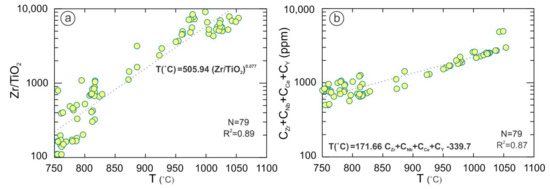
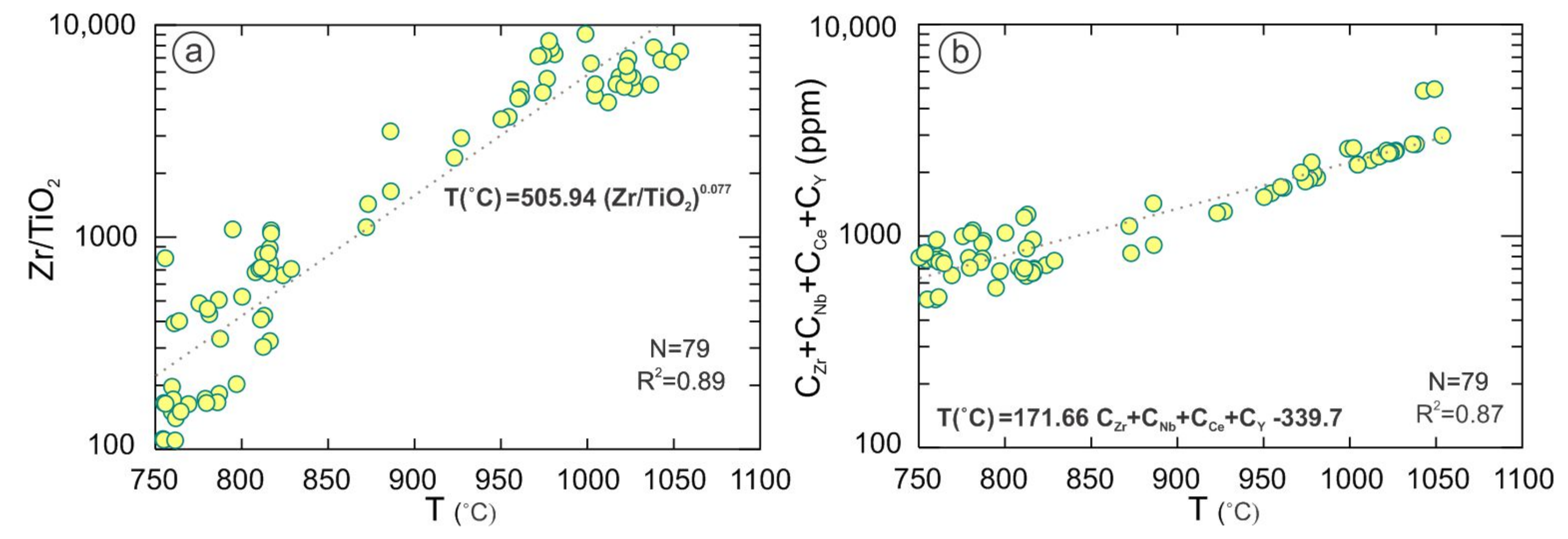
The immobile elements, especially HFSEs, are good indicators for discriminating geological classification and geotectonic signatures [51,52]. The Zr/TiO2 ratios showed a robust positive correlation (R2 = 0.90) with estimated temperature from zircon saturation thermometry at the >99% confidence level (p ≤ 0.001, Figure 5a) in the alkaline and peralkaline databases. This meant that the Zr/TiO2∝ TZr and Zr/TiO2 ratio increased with rising temperatures of magma (Figure 5a), according to the following equation:
T(°C) = 505.94 (Zr/TiO2)0.077
Figure 5.
HFSE- based parameters (a) Zr/TiO2 and (b) CZr + CNb + CCe + CY versus T (°C) with a strong correlation with temperature in peralkaline and alkaline rocks (n = 79 peralkaline to alkaline rocks with M > 2, and SiO2 > 45wt.%, http://georoc.mpch-mainz.gwdg.de/georoc/, accessed on 29 August 2021.
Immobile elements, such as Zr, Y, and Nb, are mainly used for discriminating geological settings, especially in alkaline rocks. Ce increases during the magma differentiation in alkaline rocks [53]. Zr + Nb + Ce + Y versus TZr variation (Figure 5b) showed a strong positive correlation (R2 = 0.87) in the alkaline rocks at the >99% confidence level (p ≤ 0.001) with a simple equation as follows:
T(°C) = 171.66 (CZr + CNb + CCe + CY) − 339.7
5. Discussion
Due to the diffusion rates in tetravalent cations, such as Zr, Hf, Th, U, Ce, Ga, and Ti, being too slow, with low immobility of these elements during the geological process, they are worthy geochemical tracers [54] and geothermometers. Zirconium and Ti have known elements for geothermometric assessment, by using Ti substances in zircon, quartz and also Zr values in rutile, and Ti contents in quartz [1,55,56,57,58]. The rest of the HFSEs show similar characteristics. Here, we discuss and highlight how the HFSE abundances are controlled by magma temperature.
5.1. Nb-Ta, Zr-Hf, and Th-U Values Are Related to Magma Composition and Temperature
The contents of Nb and Ta (Tables S1 and S2) in the alkaline rocks were much higher than those in the other igneous rocks (Table S2). Tantalum and Nb, with large ionic charges, large ionic radials, and also low partition coefficients, cannot enter the crystal lattices of the main rocks forming minerals. Therefore, their abundances increase in the melts. Furthermore, too low degrees of partial melting or highly fractionated magmas can be rich in these two elements [32,59]. Niobium (Nb) is usually concentrated in peralkaline granites [60], whereas Ta is concentrated in peraluminous granite and pegmatite [61]. The concentrations of Nb and Ta are too low in the bulk rock composition (Table S1 and S2) and their contents do not show a clear correlation with temperature in metaluminous to peralkaline rocks (Figure 4a–d). Nonetheless, Ta has a lower coefficient than Nb [62], and Ta contents in peralkaline and alkaline samples showed a clear relationship with temperature (Figure 4d).
5.2. Zr and Hf’s Relationship to the Magma Composition
Zirconium and Hf were more concentrated in the igneous alkaline rocks (Table S2). Zirconium, Hf, Nb, and Ta abundances are controlled by the crystallization of accessory minerals, such as zircon, baddeleyite, perovskite, and pyrochlore [63]. Zr solubility in alkaline melts is high [64]. Hf solubility is higher than that of Zr in peraluminous magma [62]. Hafnium and Zr have similar solid/melt distribution coefficients Dzr = DHf [32], and they also showed a strong relation with magma temperature (Figure 4e–h)
5.3. Th and U Relationship to Whole-Rock and Magma Crystallization Temperatures
Thorium (Th) and U are incompatible during the melting of the mantle and increase in felsic rocks [65]. Thorium and U enter accessory minerals, such as zircon, monazite, apatite, and allanite, without a clear relationship to magma temperature (Figure 4i–l). Nevertheless, their abundances increase in high degrees of fractional crystallization [66]. In highly evolved magma, the distribution coefficient for both Th and U is high, and TZr is overestimated in relation to the temperature of magma [39]. Hence, highly evolved magma was ignored in this research.
5.4. Suggestion Geothermometer
To check the applicability of the relationship between HFSEs and zircon saturation temperatures, we collected various compositions from mafic to felsic and peralkaline to peraluminous compositions around the world (http://georoc.mpch-mainz.gwdg.de/georoc/, accessed on 29 August 2021). Here, we summarize our findings for metaluminous to peraluminous and peralkaline to alkaline compositions rocks.
5.4.1. (Zr-Hf) Metalumous–Peralumous Temperature Model
As shown in Figure 6, the lnCZr + 0.964(M − 1) value for the whole rocks was related to temperature. Herein, by fitting 915 samples of metaluminous and peraluminous composition, we developed a new equation between lnCZr + 0.964(M-1), lnCZr, LnCHf, and 1000/T as follows:
lnCZr(ppm)-0.964(M − 1) = 0.9369 × lnCZr(ppm) + 0.0956
R2 = 0.71, (Figure 7a).
T(K) = −8392.3/(lnCZr(ppm) − 12.8)
R2 = 0.71, (Figure 7b).
lnCZr (ppm) − 0.964(M − 1) = 0.7543lnCHf (ppm) + 3.7516
R2 = 0.58, (Figure 7c)
T(K) = −7721.8/(lnCHf (ppm) − 7.7897)
R2 = 0.58, (Figure 7d).
Figure 6.
Variation of −lnCZr + 0.964(M − 1) vs. 1000/T (TK) to refine the zircon saturation for metaluminous to peraluminous rocks which are modeled by the equation of S20-1.
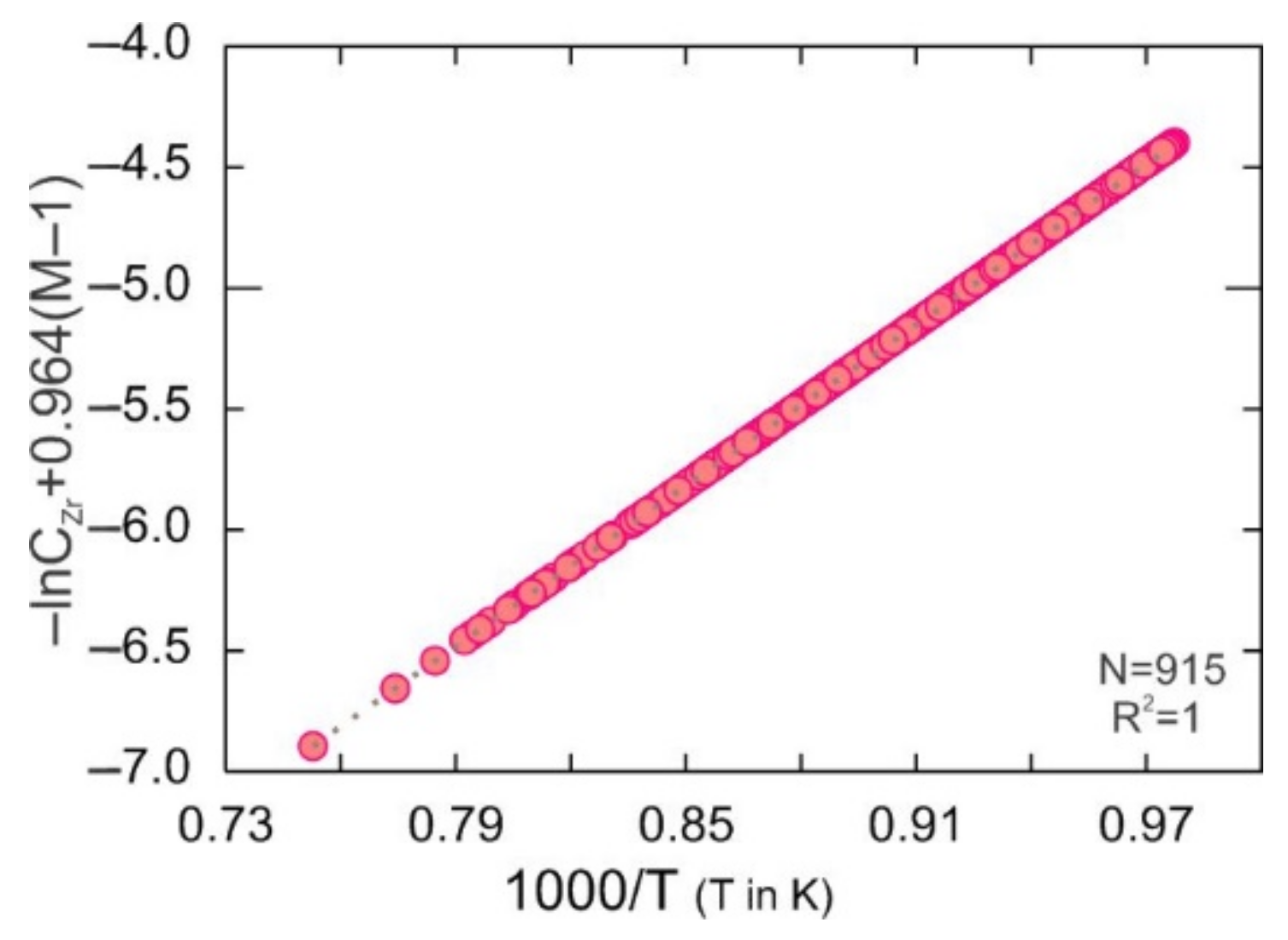
Figure 7.
(a–d) lnCZr, lnCHf vs. −lnCZr + 0.964(M − 1) and 1000/T (T in K) are plotted for the metaluminous to peraluminous rocks. InCZr and lnCHf to lnCZr + 0.964(M − 1) and 1000/T (T in K) infer a negative correlation (n = 915, and M < 2. http://georoc.mpch-mainz.gwdg.de/georoc/, accessed on 29 August 2021).
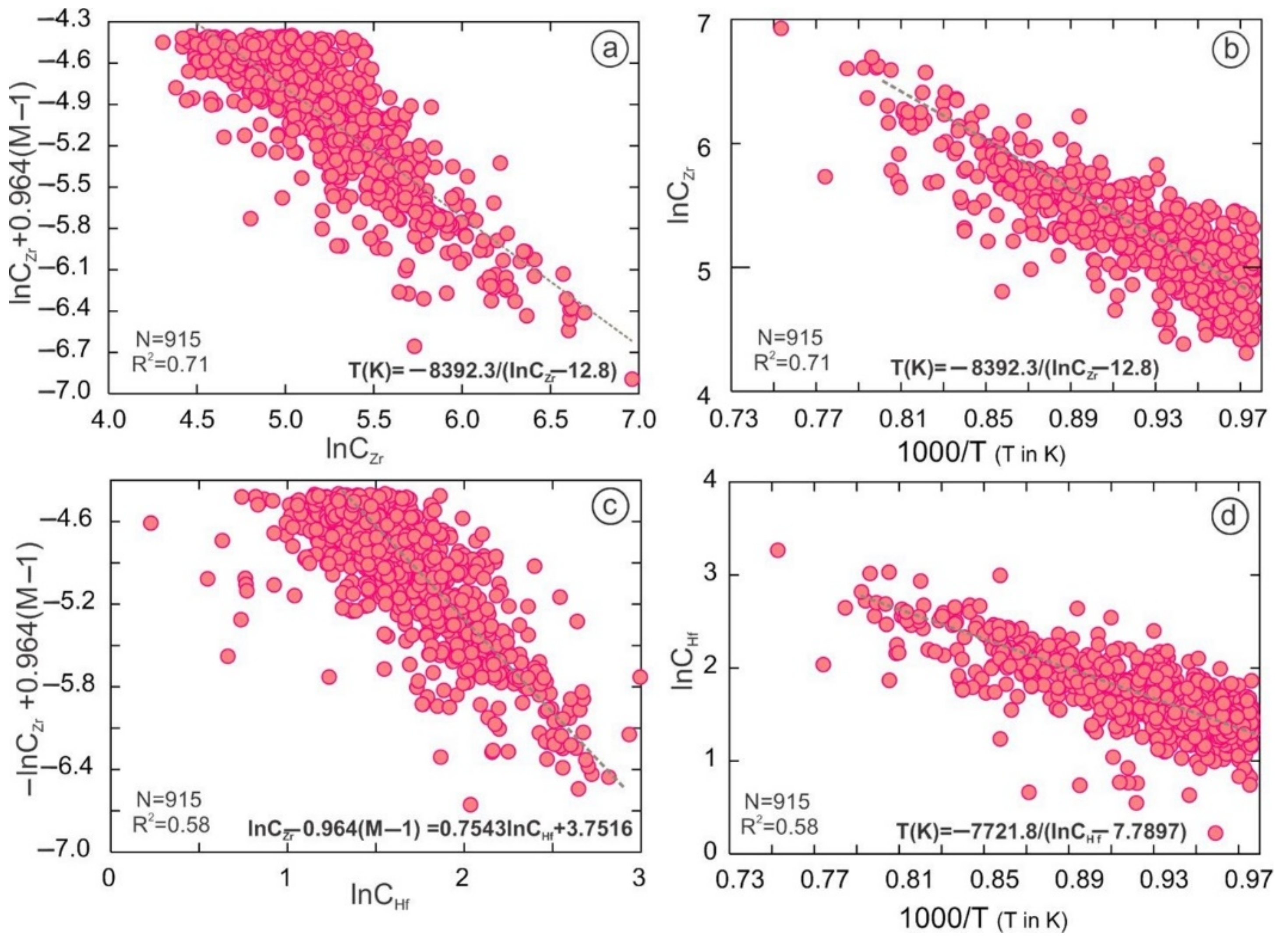
The concentrations of Zr and Hf in the whole rocks, calculated based on equation S20-1 (Equations (14)–(17)), showed a strong positive regression with the temperature (Figure 7a–d). Therefore, Equations (14) and (16) were combined to evaluate the relationship between the composition and CZr + CHf in the metaluminous to the peraluminous dataset, as follows:
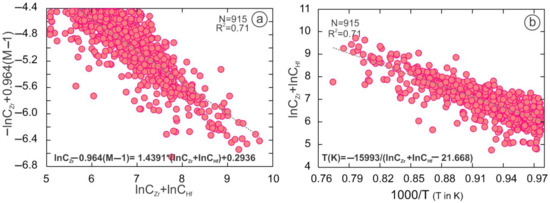
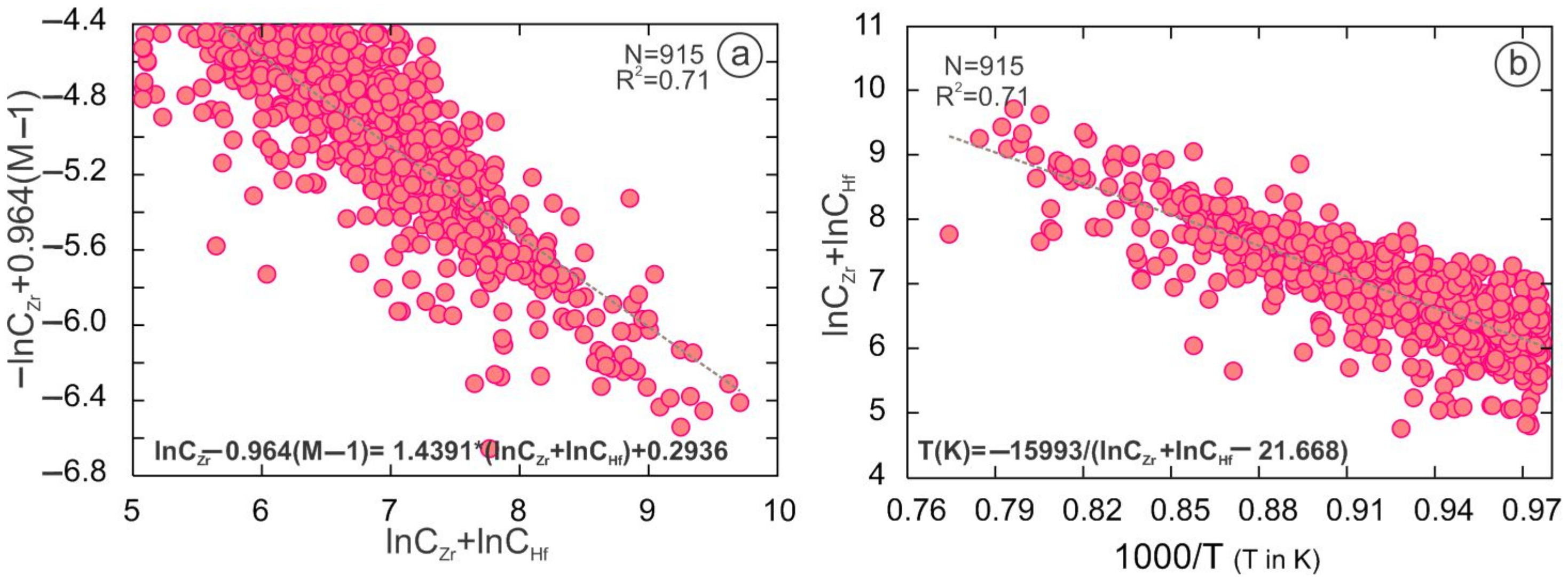
lnCZr (ppm) − 0.964(M −1) = 1.4391 × (lnCZr(ppm) + lnCHf(ppm) + 0.2936
R2 = 0.71, (Figure 8a)
Figure 8.
(a) lnCZr + lnCHf to lnCZr + 0.964(M–1) and 1000/T (T in K) show a negative correlation (b) Accordingly, CZr + CHf in bulk composition could be related to the temperature. (n = 915, and M < 2 http://georoc.mpch-mainz.gwdg.de/georoc/, accessed on 29 August 2021).
The concentration of Zr and Hf in the whole rock in the metaluminous to the peraluminous rocks showed a good correlation with the main components of the S20-1 and magma crystallization temperatures (Equations (14)–(17)). Therefore, we tried to obtain an equation based on Zr-Hf abundances in the whole rock data in the metaluminous to the peraluminous rocks based on a linear correlation between the lnCZr (ppm) + lnCHf (ppm) and temperature. Finally, by fitting the 915 samples, we proposed a temperature model in the metaluminous to the peraluminous rocks by using the abundances of the Zr and Hf in the whole rock as follows (Equation (19)) (p value < 0.001) (Figure 8b):
T(K) = −15993/(lnCZr (ppm) + lnCHf (ppm) − 21.668)
It is notable that the estimation of the temperature was done based on the HFSE contents in the whole rock and calibrated based on the S20-1 and was appropriate for a temperature from 750 to 1400 °C, M < 2, and SiO2 > 63 wt.%.
5.4.2. Temperature Model Based on the HFSE Abundances in the Peralkaline–Alkaline Rocks
Alkaline magmas have a high contents of Na+, K+, Ca+2, and M+2, which are network modifiers and are known to breakdown silicate bonds and make non-bridging oxygen [67]. Additionally, alkaline melts have an open structure chain, and the sheet is kept apart because they are less polymerized with low viscosity. Accordingly, it is difficult for Zr+4 to combine with SiO4 tetrahedra and crystallize zircon [68]. Perhaps, this could explain the higher contents of Zr in the alkaline melts. In the alkaline and peralkaline melts, concerning increasing TZr, several parameters were proposed to increase, including Zr, Hf, Zr/TiO2, and Ce + Y + Nb + Zr.
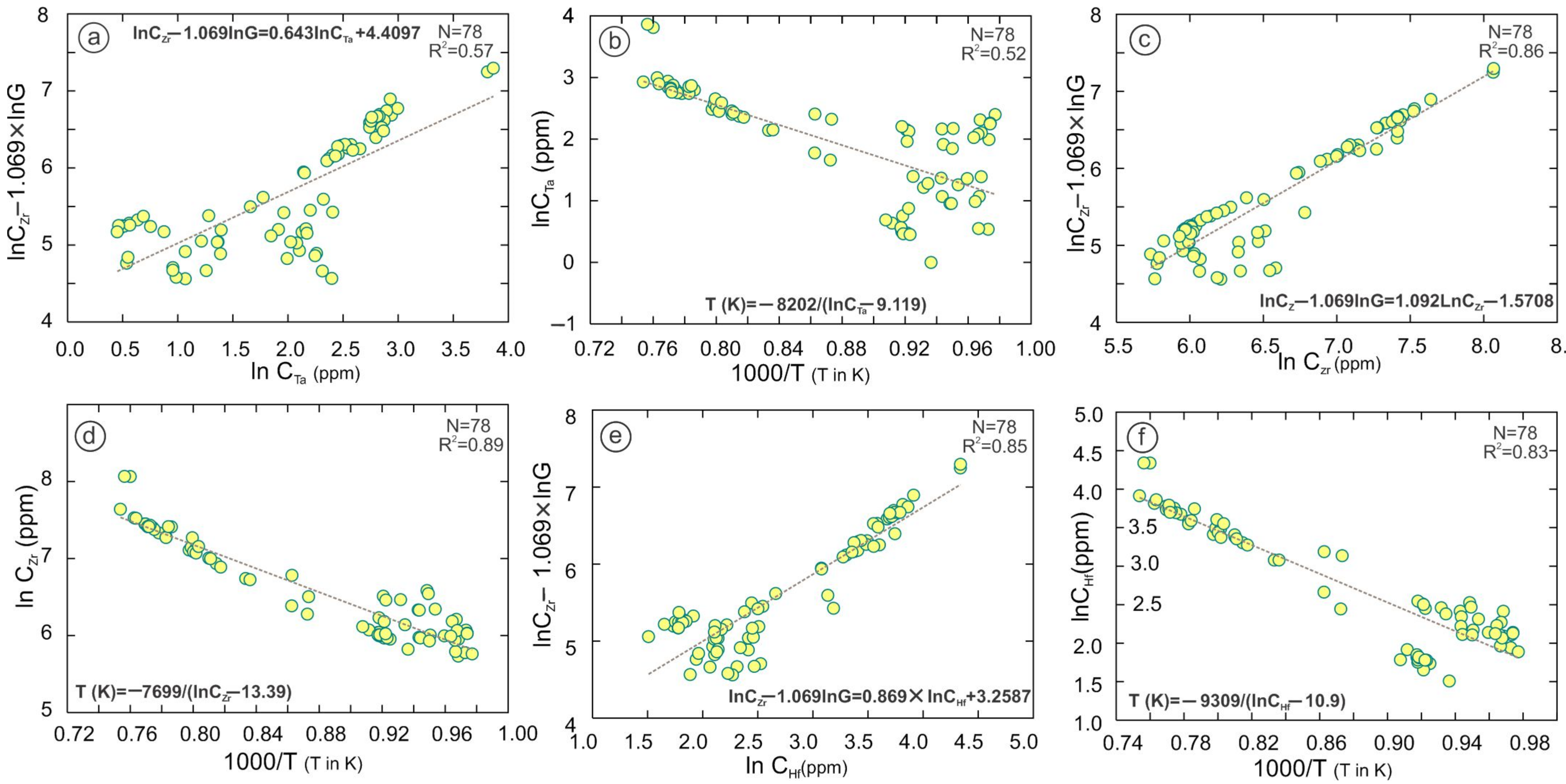
As shown in Figure 9, the lnCZr + 1.069lnG value was related to the temperature (R2 = 0.99). To check the applicability of using HFSE abundances in the whole rocks to the main component of S20-2 and temperature, we plotted the contents of Zr, Hf, Zr/TiO2, and Zr + Nb + Ce + Y versus the lnCZr −1.069lnG and 1000/TK. (the main parameters of S20-2 equation) as below:
lnCZr (ppm) − 1.069lnG = 0.643lnCTa (ppm) + 4.4097
R2 = 0.57, (Figure 10a)
T (K) = −8202/(lnCTa(ppm) − 9.119)
R2 = 0.52, (Figure 10b).
lnCZr(ppm) − 1.069lnG = 1.092LnCZr(ppm) − 1.5708
R2 = 0.87, (Figure 10c).
T (K) = −7699/(lnCZr(ppm) − 13.39)
R2 = 0.89, (Figure 10d)
lnCZr(ppm) − 1.069lnG = 0.869 × lnCHf(ppm) + 3.2587
R2 = 0.85, (Figure 10e).
T (K) = −9309/(lnCHf(ppm) − ;10.9)
R2 = 0.83, (Figure 10f).
Figure 9.
lnCZr + 1.069lnG vs. 1000/T (T in K) based on Equation (S20-2) for the peralkaline to alkaline rocks.
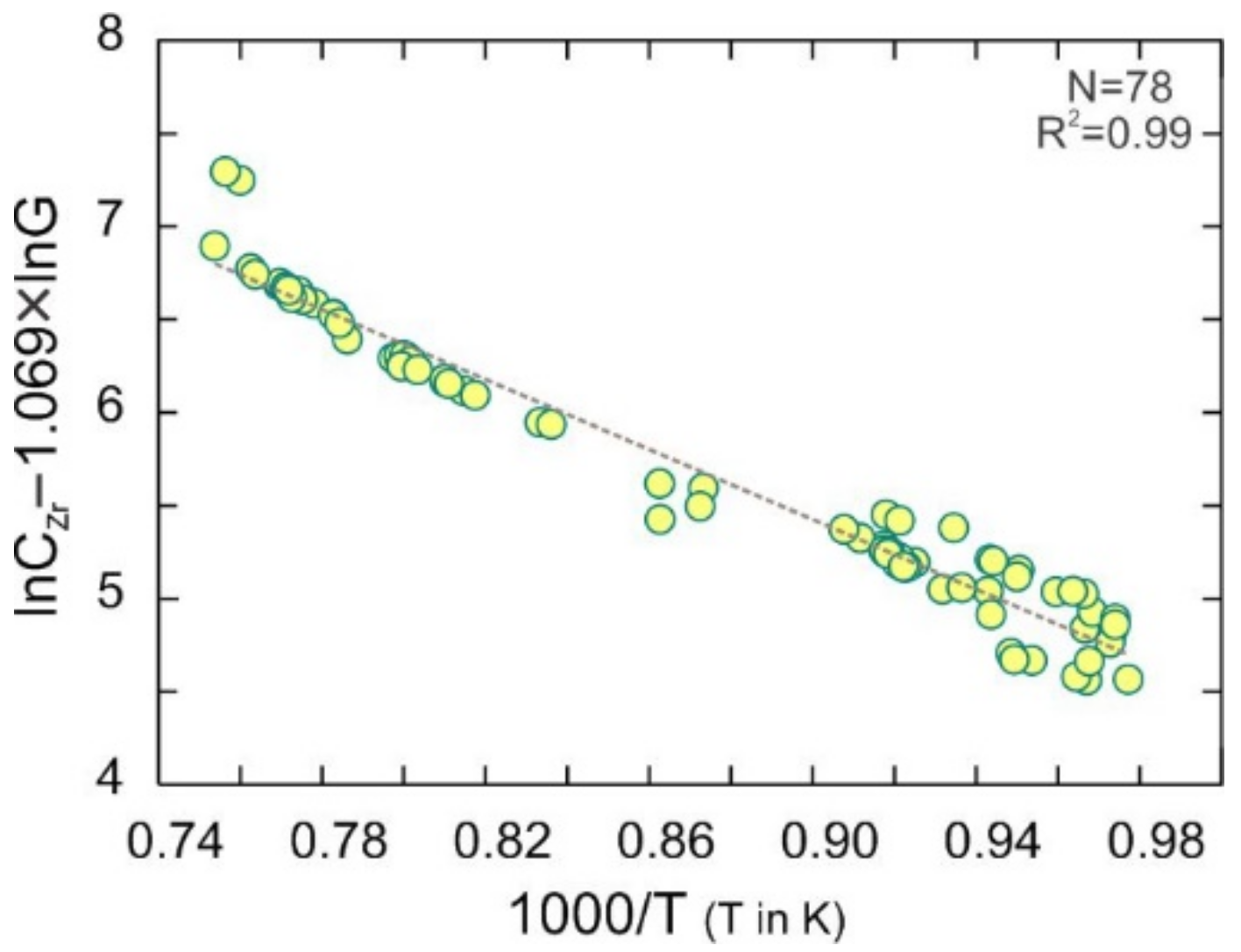
Figure 10.
(a–f) Plot lnCTa, lnCZr, and lnCHf versus the lnCZr–1.069lnG and 1000/T in the peralkaline to alkaline rocks which is showing a clear correlation except for CTa.
lnCZr(ppm) -1.069lnG = 0.4622(ln(CZr(ppm)/TiO2(wt.%)) + 2.375
R2 = 0.64, (Figure 11a).
T(K) = −14507/((lnZr(ppm)/TiO2(wt.% in bulk rock) –19.89)
R2 = 0.76, (Figure 11b).
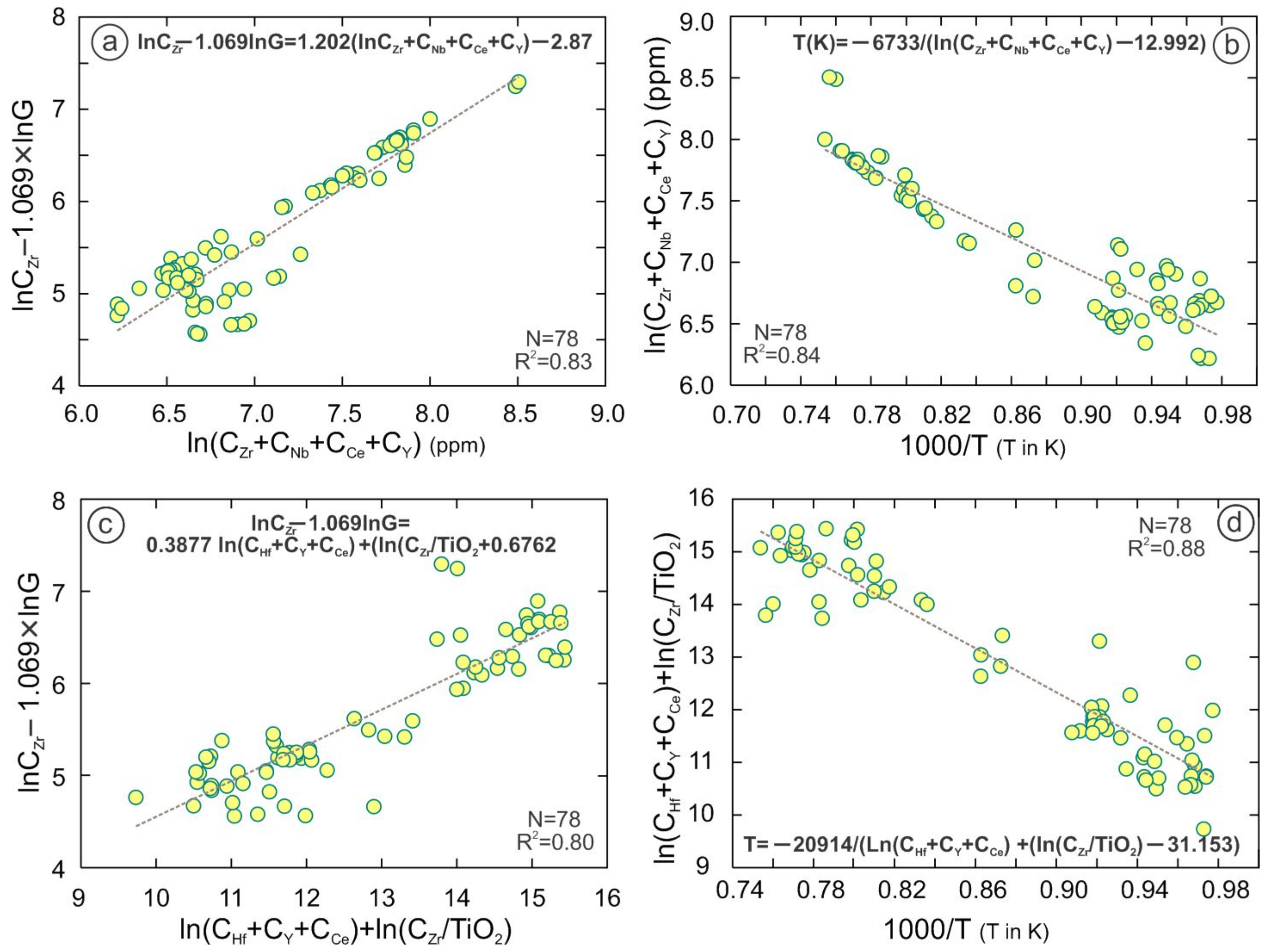
lnCZr(ppm)-1.069lnG = 1.202(lnCZr + CNb + CCe + CY) (ppm) −2.87
R2 = 0.83, (Figure 12a).
T(K) = −6733/(ln(CZr + CNb + CCe + CY) (ppm) − 12.992)
R2 = 0.85, (Figure 12b).
Concerning the temperature, four parameters were proposed, including Zr, Hf, (Zr + Nb + Ce + Y), and Zr/TiO2. As discussed previously, the abundances of Hf, Nb, Ce, Y and Zr/TiO2 showed a clear correlation with temperature (Equations (21)–(29). Herein, we tried to find an equation for estimating magma crystallization temperature based on HFSE abundances in the peralkaline to alkaline rocks, based on Equations (21)–(29). To optimize the calculation of the coefficient, Nb and Ta were ignored. Using Equations (21) to (29) we obtained the following:
lnCZr(ppm)− 1.069lnG = 0.3877 ln(CHf + CY + CCe) (ppm) + (ln(CZr(ppm)/TiO2(wt.%)) + 0.6762
R2 = 0.80, (Figure 12c)
The abundances of Hf, Nb, Ce, Y and Zr/TiO2 ratios in in the peralkaline to alkaline rocks showed a clear relationship to the main parameters of the S20-2 equation. So, herein, due to the strong correlation between the ln(CHf + CY + CCe) (ppm) + (ln(CZr(ppm)/TiO2(wt.%)) and temperature (TK), the following equation could be suggested for estimating the magma temperature for these rocks (Equation (31)):
T(K) = −20914/(ln (CHf + CY + CCe) (ppm) + (ln(CZr(ppm)/TiO2(wt.%)) − 31.153)
R2 = 0.88, (Figure 12d).
This model is appropriate for obtaining the temperature of magma for a wide range of compositions of mafic to felsic peralkaline and peraluminous whole-rock data (M > 2) and is calibrated, based on S20-2 Equation 6 and for T > 750 °C to <1400 °C.
Figure 11.
(a,b) ln(CZr/TiO2) in bulk composition correlate to lnCZr − 1.069lnG and 1000/T.
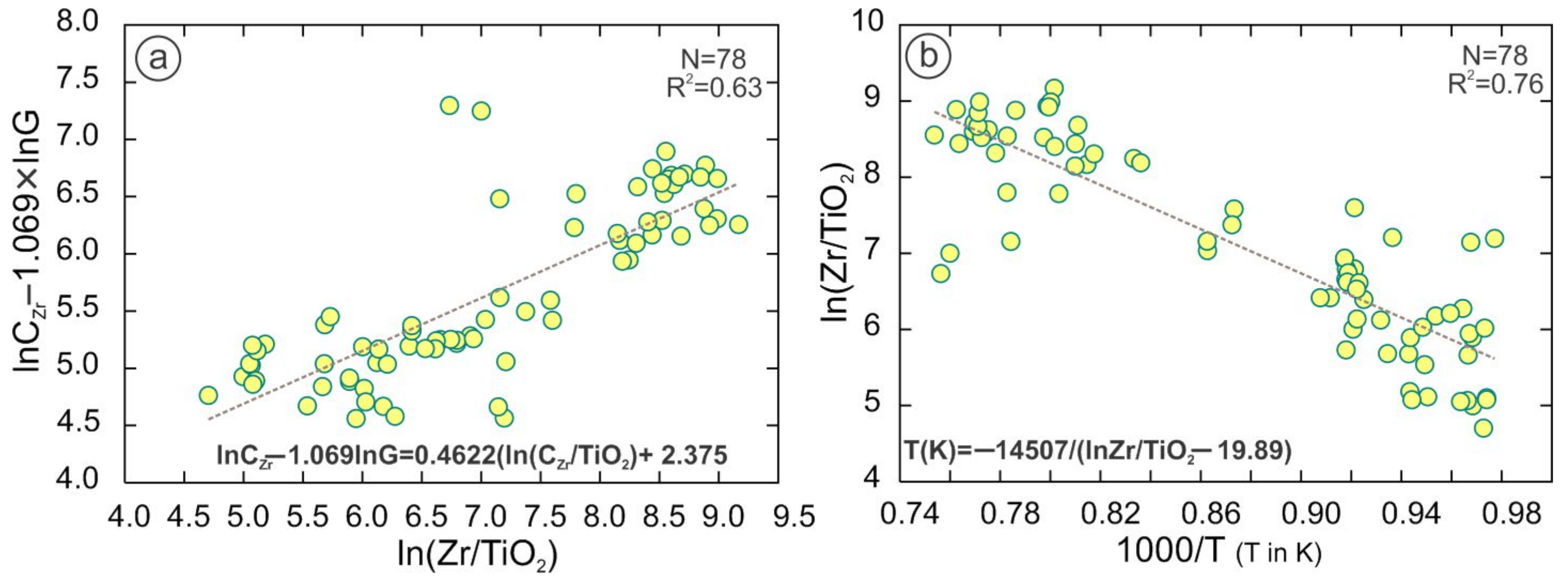
Figure 12.
(a,b) ln (CZr + CNb + CCe + CY) correlate to lnCZr − 1.069lnG and 1000/T. (c,d) The suggesting HFSEs parameter ln(CZr + CNb + CCe + CY) + ln(CZr/TiO2) versus the lnCZr − 1.069lnG and 1000/T indicate that this parameter could be dependent on the temperature.
5.5. Testing the Equations
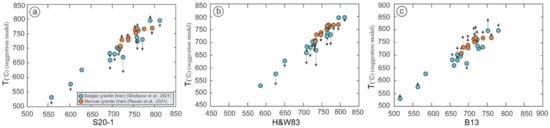
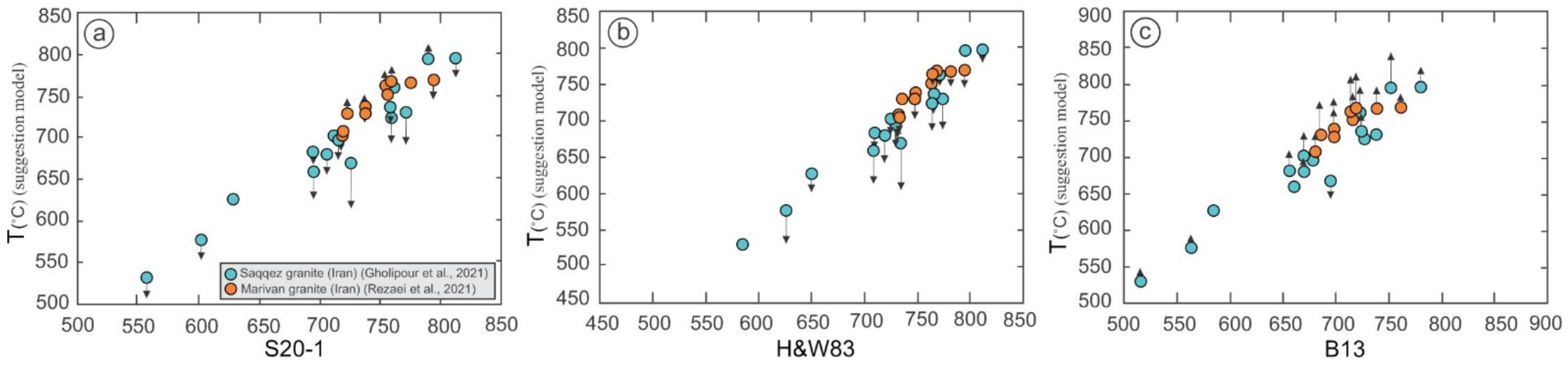
To test our suggested equations in the metaluminous and peraluminous rocks (Equation 19), we selected the peraluminous granite in southern Saqqez, northeast of Iran [69] (Table 1). These samples were plutonic (granite and granodiorite) to volcanic (andesite, rhyolite, and dacite). The pluton displayed M = 1.08 to 1.74, which were within the experimental range of WandH83 and B13. We calculated TZr for these rocks based on equations WandH83, B13, S20-1, and our suggested equations (Figure 13a–c, Table 1). For fifteen samples, the average temperature of our model (Equation 19), based on HFSEs in whole rock, was 692°C (531 °C–792 °C) and, calculated by S20-1, it was 712 °C (556 °C–812 °C), calculated by WH83 it was 723 °C (584 °C–810 °C) and calculated by B13 it was 675 °C (515 °C–779 °C) (Figure 13a–c).
Table 1.
Chemical composition of 18 selected peraluminous granite in southern Saqqez, northeast of Iran [69,70]. Temperatures are estimated from the revised TZr (temperature of zircon saturation) by Watson and Harrison [18], Boenke et al. [19] and Shao [36address metaluminous to peraluminous rocks with] and suggested model for metaluminous and peraluminous rocks in degrees Celsius. [M = (Na + K + 2Ca]/(Si × Al).
Figure 13.
The correlation of the present suggested model temperature with the previously published equations (a) S20-1 [36], (b) W&H83 [18], and (c) B13 [19] for some metaluminous to peraluminous igneous rocks [69,70]. That shows the HFSEs in bulk rocks chemistry have a clear relation to the magma crystallization temperature and it is more consistent with zircon saturation temperature at higher than 750 °C. The length of the arrow shows the differences in the suggested temperature here with T(S20-1), W&H83, and B13, respectively.
Notably, our model for estimating the temperature in the metaluminous to peraluminous rocks was calibrated by the S20-1 limitation of 750 °C to 1400 °C, M < 2, and SiO2 > 63%. In this study, only three samples showed temperatures higher than 750 °C, and the calculated temperatures based on our model, S20-1, WandH83, and B13, in these samples included PKM4 sample (granite): our model: 796 °C, S20-1: 789 °C; WandH83: 794 °C and B13: 751 °C. PGM-30 (rhyolite) our model: 761 °C, S20-1: 761 °C, WandH83: 769 °C, B13: 723 °C. PKH-2 (granodiorite): Our equation: 796 °C, S20-1: 812 °C, WandH83: 810 °C and B13: 779 °C (Table 1). The difference range of our suggested model was −56 to 8, −64 to 3, and −25 to 45 with S20-1, WandH83, and B13 (Figure 13; Table 1). Based on a comparison of these new equations with the previous models, our result was consistent with S20-1, WandH83, and B13 and suggested the possibility of using HFSE concentrations in whole-rock data for the estimation of temperature.
Another example for the testing of our model was Marivan granitoid body in the northern part of the Sanandaj-Sirjan zone [70]. Ten peraluminous granite samples with SiO2 > 63% were selected. Zircon U–Pb dating indicated the late Eocene age for this body [70]. The range of Zr abundances changed from 73.9 to 140 ppm. This pluton had M values that changed from 1.08-1.46, all of which were within the experimental range specified by the WandH83, B13, S20-1, and our suggestion model (Figure 13a–c). Zircon saturation temperatures from this pluton were calculated by using WandH83, B13, and S20-1 equations, and our suggested equation. For the ten samples, the average of our model was 743°C (702°C-770 °C), of S20-1, it was 747 °C (717 °C–793 °C), of WandH13, 756 °C (730 °C-794 °C) and of B13, 709 °C (680 °C–761 °C) (Table 1). As mentioned before, just 5 samples indicated temperatures higher than 750 °C. KMG-9: our model: 752 °C, S20-1: 755 °C, W&H83: 763 °C, B13:716 °C. KMG-11: our model: 770 °C, S20-1: 793 °C; WH83:794 °C: B13: 761 °C. KMG-19: our model: 763 °C; S20-1: 753 °C; WH83: 762 °C; B13: 713 °C (Table 1). MGF-10: our model: 768 °C, S20-1: 759 °C; WH83: 767 °C: B13: 718 °C. MGF-7: our model: 768 °C, S20-1: 775 °C; W&H83; 780 °C: B13: 739 °C (Table 1). The difference range of our suggested model in Marivan granitoid was −23 to 10, −29 to 2, and 9 to 50 °C (Figure 13; Table 1). By using Equation (30), in general, our model yielded temperatures between those of previous models (WH, B13, S20-1) and they overlapped with each other.
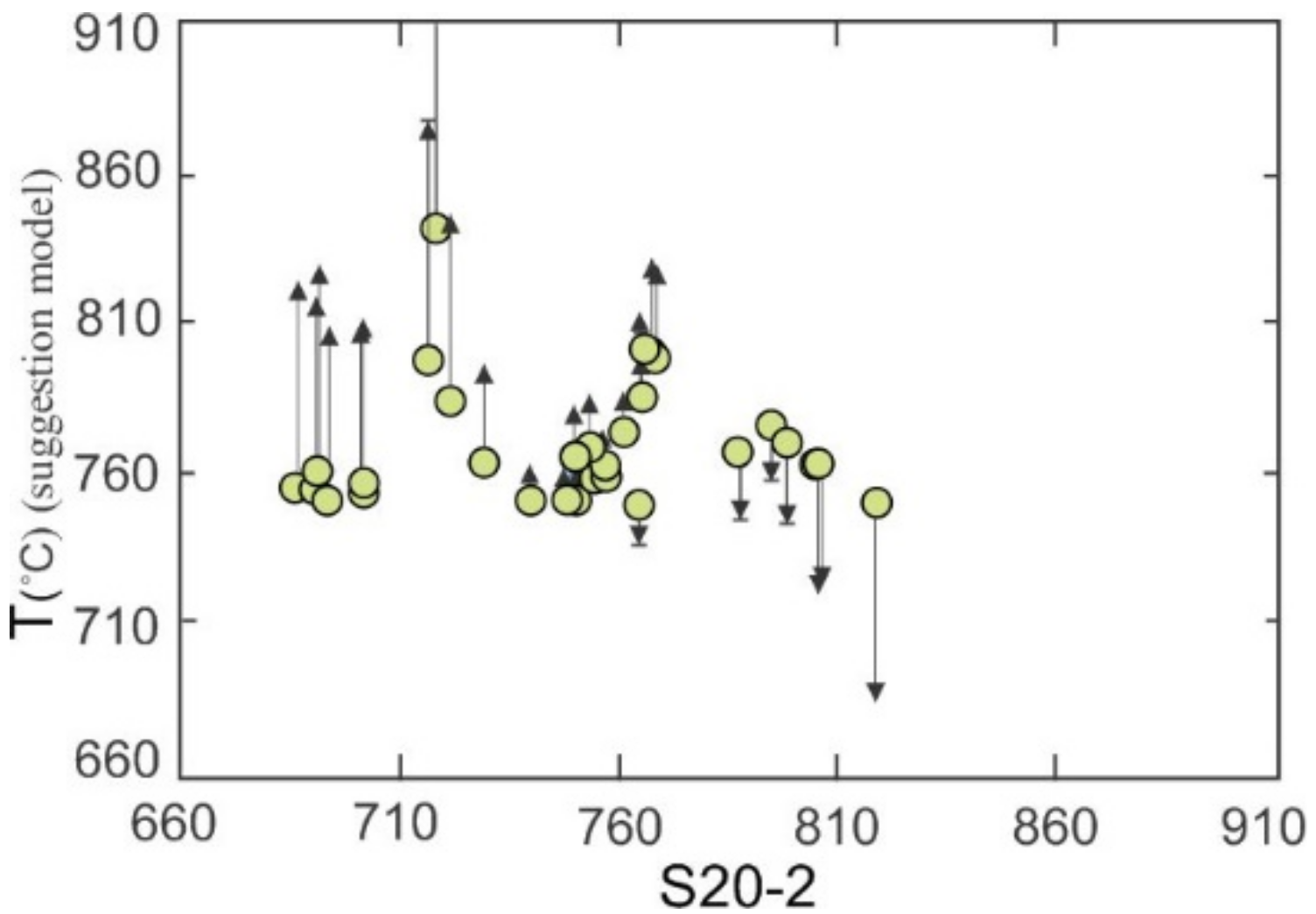
To assess the applicability of our model in alkaline igneous rocks, 26 samples from the Basin and Range from geochemical data (http://georoc.mpch-mainz.gwdg.de/georoc/, accessed on 29 August 2021, were selected [71,72,73,74,75,76,77,78,79,80,81] (Figure 14, Table 2). These data had SiO2 ranging from 40.5 to 67.7 wt.% and M > 2, and all had the specified range of S20-2 and our model. The temperature was calculated by the suggested model in peralkaline to alkaline rocks (Equation 31) and the results compared with the results using S20-2 (Table 2). The results are presented in Table 2 and Figure 14. As shown in Figure 14, the temperature was calculated based on equation S20-2, and our model was more consistent.
Figure 14.
The assessment of estimated temperature in the suggested model for peralkaline to alkaline rocks versus estimated temperature by using S20-1. The correlation shows that HFSE-based thermometry mode could be used to estimate temperature and it is extremely close to zircon saturation temperature for peralkaline to alkaline data. The length of the arrow shows the differences in suggested temperature in here with S20-2 (n = 26 sample alkaline of Basin and Range from geochemical data http://georoc.mpch-mainz.gwdg.de/georoc/, accessed on 29 August 2021 [71,72,73,74,75,76,77,78,79,80,81]).
Table 2.
The chemical composition of 26 alkaline selected samples from the Basin and Range from geochemical data (http://georoc.mpch-mainz.gwdg.de/georoc/, accessed on 29 August 2021). Temperatures are estimated from the revised TZr (temperature of zircon saturation) by Shao [36] (S20-2) and our suggested model for alkaline and peralkaline composition rock in degrees Celsius.
6. Conclusions
Most previous models for magma crystallization temperature were based on the mineral composition and Zr saturation index. Here, we present two simple models, using whole-rocks chemistry without any complicated calculations. Whole-rock chemistry, especially HSFE abundances, can be considered a new method for estimating the magma temperature for intermediate to felsic rocks and entire alkaline rocks. The estimation temperature by using our suggested models shows similar ranges to the zircon saturation temperature.
Supplementary Materials
The following supporting information can be downloaded at: https://www.mdpi.com/article/10.3390/min12101260/s1, Table S1: Chemical composition of 915 metaluminous and peraluminous rock selected from http://georoc.mpch-mainz.gwdg.de/georoc/ (accessed on 29 August 2021). Major elements reported in percent and trace elements in ppm. Temperatures are estimated from the revised TZr (temperature of zircon saturation) by Shao (2020) (S20-1) in Kelvin and degree Celsius; Table S2: Chemical composition of 79 peralkaline to alkaline rock selected from http://georoc.mpch-mainz.gwdg.de/georoc/ (accessed on 29 August 2021). Major elements reported in percent and trace elements in ppm. Temperatures are estimated from the revised TZr (temperature of zircon saturation) by Shao (2020) (S20-2) in Kelvin and degree Celsius.
Author Contributions
Conceptualization, N.D.; Data curation, N.D. and H.A.; Methodology, H.A. and N.D. Writing—review & editing, H.A., N.D. and M.T. All authors have read and agreed to the published version of the manuscript.
Funding
This research received no external funding.
Data Availability Statement
All data derived from this research are presented in the enclosed figures and tables and two Supplementary Tables S1 and S2 which can be downloaded at: https://www.mdpi.com/article/10.3390/min12101260/s1.
Acknowledgments
This is a part of the N.D post-doc project at the University of Kurdistan. GEOROC (Geochemistry of Rock of the Oceans and Continents) website (http://georoc.mpch-mainz.gwdg.de/georoc/, accessed on 29 August 2021) is widely used in this research. This version much improved based on the two anonymous reviewer’s great comments.
Conflicts of Interest
The authors declare no conflict of interest.
References
- Watson, E.B.; Wark, D.A.; Thomas, J.B. Crystallization thermometers for zircon and rutile. Contrib. Mineral. Petrol. 2006, 151, 413–433. [Google Scholar] [CrossRef] [Scilit]
- Wark, D.A.; Watson, E.B. TitaniQ: A titanium-in-quartz geothermometer. Contrib. Mineral. Petrol. 2006, 152, 743–754. [Google Scholar] [CrossRef] [Scilit]
- Essene, E.J. The current status of thermobarometry in metamorphic rocks. Geol. Soc. Spec. Publ. 1989, 43, 1–44. [Google Scholar] [CrossRef] [Scilit]
- Tollari, N.; Toplis, M.J.; Barnes, S. Predicting phosphate saturation in silicate magmas: An experimental study of the effects of melt composition and temperature. Geochim. Cosmochim. Acta 2006, 70, 1518–1536. [Google Scholar] [CrossRef] [Scilit]
- Anderson, J.L. Status of thermobarometry in granitic batholiths. Earth Environ. Sci. Trans. R. Soc. Edinburgh 1996, 87, 125–138. [Google Scholar] [CrossRef] [Scilit]
- Brown, W.L.; Parsons, I. Towards a more practical two-feldspar geothermometer. Contrib. Mineral. Petrol. 1981, 76, 369–377. [Google Scholar] [CrossRef] [Scilit]
- Green, N.L.; Usdansky, S.I. Ternary-feldspar mixing relations and thermobarometry. Am. Mineral. 1986, 71, 1100–1108. [Google Scholar]
- Fuhrman, M.L.; Lindsley, D.H. Ternary-feldspar modeling and thermometry. Am. Mineral. 1988, 73, 201–215. [Google Scholar]
- Powell, R.; Holland, T.J.B. An internally consistent thermodynamic dataset with uncertainties and correlations: 1. Methods and a worked example. J. Metamorph. Geol. 1985, 3, 327–342. [Google Scholar] [CrossRef] [Scilit]
- Holland, T.J.B.; Powell, R. An internally consistent thermodynamic data set for phases of petrological interest. J. Metamorph. Geol. 1998, 16, 309–343. [Google Scholar] [CrossRef] [Scilit]
- Powell, R.; Holland, T. Calculated mineral equilibria in the pelite system, KFMASH (K2O-FeO-MgO-Al2O3-SiO2-H2O). Am. Mineral. 1990, 75, 367–380. [Google Scholar]
- Zack, T.; von Eynatten, H.; Kronz, A. Rutile geochemistry and its potential use in quantitative provenance studies. Sediment. Geol. 2004, 171, 37–58. [Google Scholar] [CrossRef] [Scilit]
- Glazner, A.F. Activities of olivine and plagioclase components in silicate melts and their application to geothermometry. Contrib. Mineral. Petrol. 1984, 88, 260–268. [Google Scholar] [CrossRef] [Scilit]
- Putirka, K.D. Igneous thermometers and barometers based on plagioclase + liquid equilibria: Tests of some existing models and new calibrations. Am. J. Sci. 2005, 90, 336–346. [Google Scholar] [CrossRef] [Scilit]
- Putirka, K.D. Thermometers and barometers for volcanic systems. Rev. Mineral. Geochem. 2008, 69, 61–120. [Google Scholar] [CrossRef] [Scilit]
- Waters, L.E.; Lange, R.A. An updated calibration of the plagioclase-liquid hygrometer-thermometer applicable to basalts through rhyolites. Am. Mineral. 2015, 100, 2172–2184. [Google Scholar] [CrossRef] [Scilit]
- Ghiorso, M.S.; Evans, B.W. Thermodynamics of rhombohedral oxide solid solutions and a revision of the Fe-Ti two-oxide geothermometer and oxygen-barometer. Am. J. Sci. 2008, 308, 957–1039. [Google Scholar] [CrossRef] [Scilit]
- Watson, E.B.; Harrison, T.M. Zircon saturation revisited: Temperature and composition effects in a variety of crustal magma types. Earth Planet. Sci. Lett. 1983, 64, 295–304. [Google Scholar] [CrossRef] [Scilit]
- Boehnke, P.; Watson, E.B.; Trail, D.; Harrison, T.M.; Schmitt, A.K. Zircon saturation re-revisited. Chem. Geol. 2013, 351, 324–334. [Google Scholar] [CrossRef] [Scilit]
- Gervasoni, F.; Klemme, S.; Rocha-Júnior, E.R.V.; Berndt, J. Zircon saturation in silicate melts: A new and improved model for aluminous and alkaline melts. Contrib. Mineral. Petrol. 2016, 171, 12. [Google Scholar] [CrossRef] [Scilit]
- Niu, Y.; Zhao, Z.; Zhu, D.; Mo, X. Continental collision zones are primary sites for net continental crust growth—A testable hypothesis. Earth Sci. Rev. 2013, 127, 96–110. [Google Scholar] [CrossRef] [Scilit]
- Barnes, C.G.; Werts, K.; Memeti, V.; Ardill, K. Most Granitoid Rocks are Cumulates: Deductions from Hornblende Compositions and Zircon Saturation. J. Petrol. 2020, 60, 2227–2240. [Google Scholar] [CrossRef] [Scilit]
- Clemens, J.D.; Stevens, G. What controls chemical variation in granitic magmas? Lithos 2012, 134–135, 317–329. [Google Scholar] [CrossRef] [Scilit]
- Anderson, J.; Barth, P.; Wooden, J.L.; Mazdab, F. Thermometers and thermobarometers in Granitic Systems. Rev. Mineral. Geochem. 2008, 69, 121–142. [Google Scholar] [CrossRef] [Scilit]
- Benisek, A.; Dachs, E.; Kroll, H. A ternary feldspar-mixing model based on calorimetric data: Development and application. Contrib. Mineral. Petrol. 2010, 160, 327–337. [Google Scholar] [CrossRef] [Scilit]
- Siegel, C.; Bryan, S.; Gust, D. Use and abuse of zircon-based thermometers: A critical review and a recommended approach to identify antecrystic zircons. Earth-Sci. Rev. 2018, 176, 87–116. [Google Scholar] [CrossRef] [Scilit]
- Fourcade, S.; Allegre, C.J. Trace elements behavior in granite genesis: A case study The calc-alkaline plutonic association from the Querigut complex (Pyrénées, France). Contrib. Mineral. Petrol. 1981, 76, 177–195. [Google Scholar] [CrossRef] [Scilit]
- Gromet, L.P.; Silver, L.T. Rare earth element distributions among minerals in a granodiorite and their petrogenetic implications. Geochim. Cosmochim. Acta 1983, 47, 925–939. [Google Scholar] [CrossRef] [Scilit]
- Harrison, T.M.; Watson, E.B.; Rapp, R.P. Does anatexis deplete the lower crust in heat-producing elements? Implications from experimental studies. Eos 1986, 67, 386. [Google Scholar]
- Liu, H.; Sun, W.; Zartman, R.; Tang, M. Continuous plate subduction marked by the rise of alkali magmatism 2.1 billion years ago. Nat. Commun. 2019, 10, 3408. [Google Scholar] [CrossRef] [Scilit] [PubMed]
- Weyer, S.; Münker, C.; Mezger, K. Nb/Ta, Zr/Hf and REE in the depleted mantle: Implications for the differentiation history of the crust-mantle system. Earth Planet. Sci. Lett. 2003, 205, 309–324. [Google Scholar] [CrossRef] [Scilit]
- Green, T.H. Significance of Nb/Ta as an indicator of geochemical processes in the crust-mantle system. Chem. Geol. 1995, 120, 347–359. [Google Scholar] [CrossRef] [Scilit]
- Kolmogorov, A. Sulla determinazione empirica di una lgge di distribuzione. Inst. Ital. Attuari Giorn. 1933, 4, 83–91. [Google Scholar]
- Baker, D.R.; Conte, A.; Freda, C.; Ottolini, L. The effect of halogens on Zr diffusion and zircon dissolution in hydrous metaluminous granitic melts. Contrib. Mineral. Petrol. 2002, 142, 666–678. [Google Scholar] [CrossRef] [Scilit]
- Zen, E.-A. Aluminum enrichment in silicate melts by fractional crystallization: Some mineralogic and petrographic constraints. J. Petrol. 1986, 27, 1095–1117. [Google Scholar] [CrossRef] [Scilit]
- Shao, T.; Xia, Y.; Ding, X.; Cai, Y.; Song, M. Zircon saturation model in silicate melts: A review and update. Acta Geochim. 2020, 39, 387–403. [Google Scholar] [CrossRef] [Scilit]
- Shao, T.; Xia, Y.; Ding, X.; Cai, Y.; Song, M. Zircon saturation in terrestrial basaltic melts and its geological implications. Solid Earth Sci. 2019, 4, 27–42. [Google Scholar] [CrossRef] [Scilit]
- Collins, W.J.; Huang, H.Q.; Jiang, X. Water-fluxed crustal melting produces Cordilleran batholiths. Geology 2016, 44, 143–146. [Google Scholar] [CrossRef] [Scilit]
- Miller, C.F.; McDowell, S.M.; Mapes, R.W. Hot and cold granites: Implications of zircon saturation temperatures and preservation of inheritance. Geology 2003, 31, 529–532. [Google Scholar] [CrossRef] [Scilit]
- Duan, M.; Niu, Y.L.; Sun, P.; Chen, S.; Kong, J.J.; Li, J.Y.; Zhang, Y.; Hu, Y.; Shao, F.L. A simple and robust method for calculating temperatures of granitoid magmas. Mineral. Petrol. 2021, 116, 93–103. [Google Scholar] [CrossRef] [Scilit]
- Harrison, T.M.; Watson, E.B.; Aikman, A.B. Temperature spectra of zircon crystallization in plutonic rocks. Geology 2007, 35, 635–638. [Google Scholar] [CrossRef] [Scilit]
- Shand, S.J. Eruptive rocks: Their genesis, composition, classification, and their relation to ore deposits with a chaper on meteorites. J. Geol. 1943, 56, 593. [Google Scholar] [CrossRef] [Scilit]
- Goldschmidt, V.M. The principles of distribution of chemical elements in minerals and rocks. The seventh Hugo Müller Lecture, delivered before the Chemical Society on March 17th, 1937. J. Chem. Soc. 1937, 74, 655–673. [Google Scholar] [CrossRef] [Scilit]
- Zaraisky, G.P.; Korzhinskaya, V. Experimental studies of Ta2O5 and columbite–tantalite solubility in fluoride solutions from 300 to 550 °C and 50 to 100 MPa. Mineral. Petrol. 2010, 99, 287–300. [Google Scholar] [CrossRef] [Scilit]
- Barth, M.G.; Mcdonough, W.F.; Rudnick, R.L. Tracking the budget of Nb and Ta in the continental crust. Chem. Geol. 2000, 165, 197–213. [Google Scholar] [CrossRef] [Scilit]
- Parker, R.L.; Fleischer, M. Geochemistry of niobium and tantalum. US Geol. Surv. Prof. Pap. 1968, 612. [Google Scholar] [CrossRef] [Scilit]
- Linnen, R.L.; Samson, I.M.; Chakhmouradian, A.R. Geochemistry of the REE, Nb, Ta, Hf, and Zr Deposits, 2nd ed.; Elsevier Ltd.: Amsterdam, The Netherlands, 2014; ISBN 9780080959757. [Google Scholar]
- Richards, J.P.; Porter, T.M. Cumulative factors in the genration of giant calc-alkaline porphyry Cu deposits. In Super Porphyry Copper and Gold Deposits: A Global Perspective; Porter Geoscience Consulting Publishing: Adelaide, Australia, 2004; pp. 7–25. [Google Scholar]
- Shannon, R.D. Revised Effective Ionic Radii and Systematic Study of Inter Atomic Distances in Halides and Chalcogenides in Halides and Chaleogenides. Acta Cryst. 1976, 32, 751–767. [Google Scholar] [CrossRef] [Scilit]
- Hoskin, P.W.O.; Schaltegger, U. The Composition of Zircon and Igneous and Metamorphic Petrogenesis Metamorphic Petrogenesis. Rev. Mineral. Geochem. 2003, 53, 27–62. [Google Scholar] [CrossRef] [Scilit]
- Pearce, J. Sources and settings of granitic rocks. Episodes 1996, 19, 120–125. [Google Scholar] [CrossRef] [Scilit]
- Pearce, J.A.; Harris, N.B.W.; Tindle, A.G. Trace element discrimination diagrams for the tectonic interpretation of granitic rocks. J. Petrol. 1984, 25, 956–983. [Google Scholar] [CrossRef] [Scilit]
- Winchester, J.A.; Floyd, P.A. Geochemical discrimination of different magma series and their differentiation products using immobile elements. Chem. Geol. 1977, 20, 325–343. [Google Scholar] [CrossRef] [Scilit]
- Cherniak, D.J.; Hanchar, J.M.; Watson, E.B. Diffusion of tetravalent cations in zircon. Contrib. Mineral. Petrol. 1997, 127, 383–390. [Google Scholar] [CrossRef] [Scilit]
- Troitzsch, U.; Ellis, D.J. Crystal structural changes in titanite along the join TiO-AlF High-PT study of solid solutions in the system ZrO2-TiO2: The stability of srilankite. Eur. J. Mineral. 2004, 16, 577–584. [Google Scholar] [CrossRef] [Scilit]
- Zack, T.; Moraes, R.; Kronz, A. Temperature dependence of Zr in rutile: Empirical calibration of a rutile thermometer. Contrib. Mineral. Petrol. 2004, 148, 471–488. [Google Scholar] [CrossRef] [Scilit]
- Miller, C.; Zanetti, A.; Thoni, M.; Konzett, J. Eclogitisation of gabbroic rocks: Redistribution of trace elements and Zr in rutile thermometry in an Eo-Alpine subduction zone (Eastern Alps). Chem. Geol. 2007, 239, 96–123. [Google Scholar] [CrossRef] [Scilit]
- Hayden, L.A.; Watson, E.B.; Wark, D.A. A thermobarometer for sphene (titanite). Contrib. Mineral. Petrol. 2008, 155, 529–540. [Google Scholar] [CrossRef] [Scilit]
- Sweeney, R.J.; Prozesky, V.; Przybylowicz, W. Selected trace and minor element partitioning between peridotite minerals and carbonatite melts at 18–46 kb pressure. Geochim. Cosmochim. Acta 1995, 59, 3671–3683. [Google Scholar] [CrossRef] [Scilit]
- Salvi, S.; Williams-Jones, A.E. Alkaline granite-syenite-hosted rare metal deposits. Rare-Elem. Geochem. Mineral. Depos. Geol. Assoc. Can. GAC Short Course Notes 2005, 17, 269–297. [Google Scholar]
- Linnen, R.L.; Cuney, M. Granite-related rare-element deposits and experimental constraints on Ta-Nb-W-Sn-Zr-Hf mineralization. In Rare-Element Geochemistry and Mineral Deposits; Short Course; Linnen, R.L., Samson, I.M., Eds.; Geological Association of Canada (GAC): Ottawa, ON, Canada, 2005. [Google Scholar]
- Linnen, R.L.; Keppler, H. Columbite solubility in granitic melts: Consequences for the enrichment and fractionation of Nb and Ta in the Earth’s crust. Contrib. Mineral. Petrol. 1997, 128, 213–227. [Google Scholar] [CrossRef] [Scilit]
- Chakhmouradian, A.R. High-field-strength elements in carbonatitic rocks: Geochemistry, crystal chemistry and significance for constraining the sources of carbonatites. Chem. Geol. 2006, 235, 138–160. [Google Scholar] [CrossRef] [Scilit]
- Linnen, R.L.; Keppler, H. Melt composition control of Zr/Hf fractionation in magmatic processes. Geochim. Cosmochim. Acta 2002, 66, 3293–3301. [Google Scholar] [CrossRef] [Scilit]
- Vilà, M.; Fernández, M.; Jiménez-Munt, I. Radiogenic heat production variability of some common lithological groups and its significance to lithospheric thermal modeling. Tectonophysics 2010, 490, 152–164. [Google Scholar] [CrossRef] [Scilit]
- Schofield, A. Potential for Magmatic-Related Uranium Mineral Systems in Australia. Geoscience Australia: Canberra, Australia, 2010. [Google Scholar]
- Mysen, B.O. The structure of silicate melts. Annu. Rev. Earth Planet. Sci. 1983, 11, 75–97. [Google Scholar] [CrossRef] [Scilit]
- Linthout, K. Alkali-zirconosilicates in peralkaline rocks. Contrib. Mineral. Petrol. 1984, 86, 155–158. [Google Scholar] [CrossRef] [Scilit]
- Gholipour, S.; Azizi, H.; Masoudi, F.; Asahara, Y.; Tsuboi, M. Zircon U-Pb ages, geochemistry, and Sr-Nd isotope ratios for early cretaceous magmatic rocks, southern Saqqez, northwestern Iran. Geochemistry 2021, 81, 125687. [Google Scholar] [CrossRef] [Scilit]
- Rezaei, F.; Azizi, H.; Asahara, Y. Tectonic significance of the late Eocene (Bartonian) calc-alkaline granitoid body in the Marivan area, Zagros suture zone, northwest Iran. Int. Geol. Rev. 2021, 64, 1081–1096. [Google Scholar] [CrossRef] [Scilit]
- Mcdowell, S.M.; Overton, S.; Fisher, C.M.; Frazier, W.O.; Miller, C.F.; Miller, J.S.; Economos, R.C. Hafnium, oxygen, neodymium, strontium, and lead isotopic constraints on magmatic evolution of the supereruptive southern Black Mountains volcanic center, Arizona, USA: A combined LASS zircon-whole-rock study. Am. Mineral. 2016, 101, 311–327. [Google Scholar] [CrossRef] [Scilit]
- Vogel, T.A.; Noble, D.C.; Younker, L.W. Evolution of a chemically zoned magma body: Black Mountain volcanic center, southwestern Nevada. J. Geophys. Res. 1989, 94, 6041–6058. [Google Scholar] [CrossRef] [Scilit]
- MacDonald, R.; Bagiński, B.; Belkin, H.E.; White, J.C.; Noble, D.C. The Gold Flat Tuff, Nevada: Insights into the evolution of peralkaline silicic magmas. Lithos 2019, 328, 1–13. [Google Scholar] [CrossRef] [Scilit]
- Cousens, B.L.; Henry, C.D.; Stevens, C.; Varve, S.; John, D.A.; Wetmore, S. Igneous rocks in the Fish Creek Mountains and environs, Battle Mountain area, north-central Nevada: A microcosm of Cenozoic igneous activity in the northern Great Basin, Basin and Range Province, USA. Earth-Sci. Rev. 2019, 192, 403–444. [Google Scholar] [CrossRef] [Scilit]
- Germa, A.; Koebli, D.; Wetmore, P.; Atlas, Z.; Arias, A.; Savov, I.P.; Diez, M.; Greaves, V.; Gallant, E. Crystallization and Segregation of Syenite in Shallow Mafic Sills: Insights from the San Rafael Subvolcanic Field, Utah. J. Petrol. 2020, 61, egaa092. [Google Scholar] [CrossRef] [Scilit]
- Bradshaw, T.K.; Hawkesworth, C.J.; Gallagher, K. Basaltic volcanism in the Southern Basin and Range: No role for a mantle plume. Earth Planet. Sci. Lett. 1993, 116, 45–62. [Google Scholar] [CrossRef] [Scilit]
- Van Kooten, G.K. Mineralogy, petrology, and geochemistry of an ultrapotassic basaltic suite, central Sierra Nevada, California, USA. J. Petrol. 1980, 21, 651–684. [Google Scholar] [CrossRef] [Scilit]
- Farmer, G.L.; Glazner, A.F.; Manley, C.R. Did lithospheric delamination trigger late Cenozoic potassic volcanism in the southern Sierra Nevada, California? Geol. Soc. Am. Bull. 2002, 114, 754–768. [Google Scholar] [CrossRef] [Scilit]
- Askren, D.R.; Roden, M.F.; Whitney, J.A. Petrogenesis of Tertiary andesite lava flows interlayered with large-volume felsic ash-flow tuffs of the western USA. J. Petrol. 1997, 38, 1021–1046. [Google Scholar] [CrossRef]
- Valentine, G.A.; Perry, F.V. Tectonically controlled, time-predictable basaltic volcanism from a lithospheric mantle source (central Basin and Range Province, USA). Earth Planet. Sci. Lett. 2007, 261, 201–216. [Google Scholar] [CrossRef] [Scilit]
- Beard, B.L.; Glazner, A.F. Petrogenesis of isotopically unusual Pliocene olivine leucitites from Deep Springs Valley, California. Contrib. Mineral. Petrol. 1998, 133, 402–417. [Google Scholar] [CrossRef] [Scilit]


Publisher’s Note: MDPI stays neutral with regard to jurisdictional claims in published maps and institutional affiliations. |
© 2022 by the authors. Licensee MDPI, Basel, Switzerland. This article is an open access article distributed under the terms and conditions of the Creative Commons Attribution (CC BY) license (https://creativecommons.org/licenses/by/4.0/).