1. Introduction
Last-mile distribution constitutes a major cost component in logistics operations, frequently accounting for more than 40% of total transportation expenditures, while also exerting a significant influence on customer satisfaction. As a result, the development of efficient vehicle routing strategies has become a critical operational decision for logistics service providers, with direct implications for delivery efficiency, service reliability, and the sustainability of urban freight systems. Since its introduction by Dantzig and Ramser [
1], the vehicle routing problem (VRP) has become a central topic in combinatorial optimization and operations research. The VRP seeks to determine a set of routes for a fleet of vehicles that serve a collection of customers with known demands, subject to operational constraints such as vehicle capacity and service time windows. The objective is commonly formulated as the minimization of total routing costs, including travel distance or travel time. As logistics operations have grown more complex in practice, many extended VRP formulations have been developed to better reflect real-world conditions. Prominent examples include the vehicle routing problem with time windows (VRPTW), VRPTW with heterogeneous fleets, dynamic VRPTW, VRPTW with simultaneous pickup and delivery, and electric vehicle routing problems [
2,
3,
4,
5,
6].
Urban freight transportation policies commonly restrict the circulation of large trucks in city centers, which has led logistics operators to rely predominantly on small delivery vehicles characterized by limited payload capacity and driving range. In last-mile distribution systems, where customers are geographically scattered and order volumes are high but individual shipments are typically small, such vehicles are often required to perform several depot-to-customer tours within a single planning horizon. As a consequence, the design of multi-trip routing plans has become an important operational issue, particularly in the context of large-scale parcel delivery systems. The rapid growth of express delivery further amplifies this challenge. According to data released by the State Post Bureau of China, the total number of express deliveries exceeded 105.17 billion by the end of October 2023, corresponding to a year-on-year increase of 17.0% [
7]. This sustained growth has generated a continuous expansion in demand for efficient last-mile delivery services.
In the Chinese urban context, traffic management policies aimed at alleviating congestion and reducing environmental impacts impose strict access limitations on heavy freight vehicles in central districts. As a result, last-mile distribution is increasingly carried out using small electric delivery trucks. Classical formulations of the VRP and the VRPTW, as well as many of their extensions, typically assume that each vehicle completes at most one route during the planning period. However, this assumption is often inconsistent with practical operations, as the limited capacity of small vehicles leads to low utilization rates when only single trips are allowed. To enhance vehicle utilization and control operating costs under constrained fleet sizes, logistics operators frequently schedule multiple return trips for individual vehicles. These operational realities have motivated the extension of the VRP and VRPTW to their multi-trip counterparts, namely the multi-trip vehicle routing problem (MTVRP) and the MTVRP with time windows (MTVRPTW). Owing to their closer alignment with last-mile delivery practices, these models offer greater practical relevance and have attracted increasing research interest in recent years [
8].
With the idea of “customer-oriented” gradually taking root in socio-economic activities, logistics companies are increasingly focusing on improving the service quality and on-time performance of “last-mile” delivery. Due to the sharp increase in express order volumes, delivery failures have become more frequent, including mismatches between delivery locations and actual delivery points, or packages being lost at collection points. These issues may arise from reasons such as recipients not being at home, incorrect addresses, or unsuitable delivery times. To address these problems, logistics companies have introduced multi-delivery address services, which better align with customers’ daily routines, thereby improving delivery success rates and customer satisfaction. Among them, UPS, DHL, and FedEx already offer services with multiple delivery options, such as home delivery, office delivery, or designated location delivery. Customers can choose the most convenient delivery address based on their needs and preferences, ensuring they receive their packages at the right time and place. From an operational perspective for logistics companies, providing multi-delivery address services enhances the flexibility and convenience of logistics distribution, optimizing delivery routes and improving efficiency. Additionally, customers may opt to receive their parcels at alternative locations, such as their homes or workplaces, allowing deliveries to better align with their daily routines. This personalized delivery service helps boost customer satisfaction and strengthens the competitiveness of logistics companies.
Therefore, this study investigates the multi-trip vehicle routing problem with multiple delivery locations (MTVRPMDL), taking into account vehicle load constraints, the unique service constraint for multiple delivery locations, time window constraints, travel time, and the maximum trip time constraint for vehicles. For smaller-scale customer deliveries, the optimization software CPLEX 12.10 can be used to solve the MTVRPMDL model. For larger-scale instances, to better address this problem, this paper designs a Greedy Iterated Local Search (GILS) algorithm based on the framework of ILS, incorporating greedy strategies with the objective of minimizing the total vehicle travel time. For initial solution generation, we developed an improved Solomon greedy insertion algorithm tailored for scenarios with multiple delivery locations and multi-trip routes. During the iterative search phase, this paper designs Or-opt, Relocate local search operators and random swap perturbation operations. By alternately applying these operators for iterative search and updating based on the initial or current best solutions, better solutions can be obtained. Computational experiments validate the performance of the proposed model and solution approach. The results show that allowing customers to have multiple delivery location options enables carriers to plan routes and choose delivery addresses more flexibly, leading to reductions in both fleet size requirements and total vehicle travel time. From a theoretical perspective, the MTVRPMDL possesses several forms of symmetry that are central to both modeling and algorithm design. First, spatial symmetry arises from the existence of multiple delivery locations for each customer, where alternative locations may lead to equivalent service outcomes under different route configurations. Second, decision symmetry exists due to the interchangeability of vehicle trips and route segments, as permuting trips of the same vehicle or reassigning customers among feasible trips may not change the objective value. Third, the depot-return structure induces temporal symmetry across multiple trips within the planning horizon. Recognizing and appropriately handling these symmetries is crucial, as ignoring them may lead to redundant search efforts and degraded computational performance. This study explicitly incorporates symmetry considerations into both the mathematical formulation and the heuristic solution process, thereby aligning the proposed approach with symmetry-aware optimization principles.
The main contributions of this paper can be summarized as follows:
(i) New problem definition: We formally introduce the MTVRPMDL, which, to the best of our knowledge, is the first model that jointly integrates multi-trip routing decisions and flexible delivery location selection within a unified last-mile delivery framework. This fills a gap between the MTVRP literature and the VRP with flexible delivery locations literature, which have, so far, treated these features separately.
(ii) MILP formulation with symmetry considerations: We propose a mixed-integer linear programming model that simultaneously determines vehicle trip schedules and delivery location selection under time window and capacity constraints. We further highlight the intrinsic spatial, temporal, and decision symmetries induced by interchangeable trips and alternative delivery locations, which distinguish the structure of MTVRPMDL from standard MTVRP and VRP variants.
(iii) Tailored GILS heuristic for MTVRPMDL: We design a problem-specific Greedy Iterated Local Search (GILS) algorithm that explicitly accounts for the presence of multiple delivery locations and multi-trip structures. This includes (1) an improved Solomon greedy insertion procedure adapted to flexible delivery locations and multi-trip routes, (2) customized Or-opt and Relocate operators that reselect delivery locations and redistribute customers across trips, and (3) perturbation mechanisms that implicitly break symmetry and enhance diversification.
(iv) Computational evidence and managerial insights: Through extensive experiments and a direct comparison with the MTVRPTW, we demonstrate that allowing multiple delivery locations can significantly reduce total travel time and improve routing flexibility. These results provide both quantitative validation of the model and actionable insights for last-mile logistics operators.
The remainder of this paper is structured as follows:
Section 2 gives relevant studies on MTVRPs and VRP with multiple delivery addresses.
Section 3 introduces the MTVRPMDL and presents its mixed-integer linear programming formulation.
Section 4 details the proposed GILS-based solution approach. We present and discuss the computational results in
Section 5.
Section 6 concludes the paper and gives future research directions.
3. Problem Description and Formulation
This section formally defines the MTVRPMDL and presents its MILP formulation.
3.1. Notation Definition
To better describe the MTVRPMDL problem and construct its mixed-integer programming model, the following notations are defined in
Table 1.
3.2. Problem Description
The MTVRPMDL is defined on a directed graph , where the vertex set is given by with denoting the collection of all customer delivery addresses, 0 represents the depot and represents a duplicate of the depot. The arc set is defined as . The set represents the customers to be served. Each customer has alternative delivery addresses, and the set of delivery addresses for customer is denoted as with . Each delivery address is associated with a time window , indicating the time window for customer at delivery address . The transportation demand for customer is , and the service time is . Vehicles must serve each customer at one of their delivery addresses within the time window . If a vehicle arrives at customer point i earlier than , it must wait until to begin service. The time when vehicle starts serving customer in trip is denoted as . Vehicles are not allowed to serve customer c later than . The travel time between each arc is , which is assumed to satisfy the triangle inequality, i.e., . The depot has identical vehicles with a capacity of . The depot’s working time window is . Vehicles depart from the depot, visit several customer points, and must return to the depot before time , with multiple trips allowed. The set of trips for vehicles is , where is the upper bound on the number of trips a vehicle can perform. Without loss of generality, this paper sets , , and .
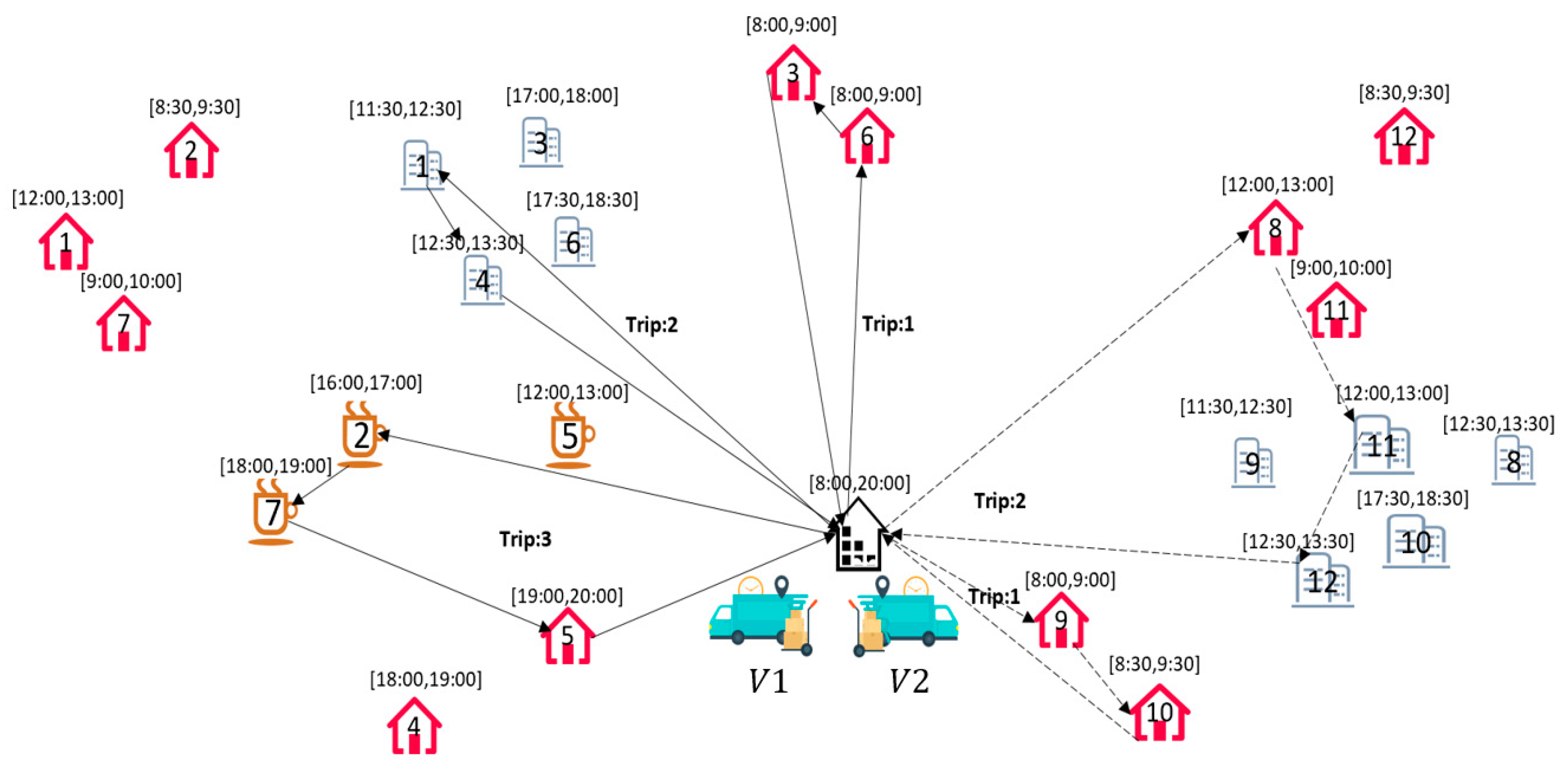
To better illustrate the MTVRPMDL problem studied in this paper, an example will be used to briefly explain the issue. This example simulates the last-mile vehicle delivery scenario in real-life practice, as shown in
Figure 1. The example depicts the delivery process of two vehicles. The depot operates from 8:00 to 20:00, and the vehicles need to serve 12 customers. Each customer has two delivery addresses, representing their home, workplace, or a third social location. Each delivery address is associated with a time window. The vehicles depart from the depot and follow the optimal route to visit unserved customers in sequence. Only one delivery address per customer is provided with door-to-door delivery service, and the vehicles eventually return to the warehouse. During this process, multiple round trips between the depot and customers are allowed. In the example, Vehicle
completes 3 trips, while Vehicle
completes 2 trips. The route for Vehicle
is: Depot
Depot
Depot
Depot. The route for Vehicle
is: Depot
Depot
Depot.
This paper considers the following assumptions for the MTVRPMDL:
There is a single depot. Each vehicle trip departs from the depot, serves the assigned customer nodes along its planned route, and finally returns to the depot.
The demand of customers is known.
Only one of the multiple delivery addresses of each customer can be served.
The total cargo volume of each trip cannot exceed the vehicle load capacity Q.
Customers are not allowed to be absent during the time window at the delivery address.
Vehicles cannot be late when providing services to customers.
3.3. Model Formulation
We develop the following MILP model, the MTVRPMDL.
The objective function (1) minimizes the total travel time of vehicles. Constraint (2) ensures that among multiple delivery locations of each customer, only one delivery location is visited by a vehicle and is served in exactly one trip of one vehicle. Constraint (3) enforces flow balance along each route. Specifically, if a delivery location is visited during the -th trip of vehicle , the number of arcs entering node must equal the number of arcs leaving it. When corresponds to the depot , the constraint ensures that the number of incoming arcs equals the number of outgoing arcs at the depot. Constraint (4) restricts the total demand served in each trip of a vehicle to be within the vehicle capacity . Constraints (5) and (6) define the relationship between the arrival times at points and when they are sequentially visited in the -th trip of a vehicle, that is, when . Constraints (7) and (8) ensure temporal consistency between trips: for each vehicle , the departure time from the depot in trip cannot exceed the corresponding return time, and the return time at the end of trip must be no later than the departure time at the beginning of trip . Constraint (9) limits the completion time of each vehicle trip to not exceed the planning horizon . Constraint (10) requires that when vehicle serves customer in trip , the service must be provided within the time window of its delivery address. Constraints (11)–(13) define the value ranges of the decision variables , , and .
The proposed formulation admits multiple symmetric optimal solutions due to interchangeable vehicle trips and alternative delivery location choices for each customer. (1) Vehicle-index symmetry: In particular, if two vehicles execute different sets of trips and routes with the same total travel time and feasibility, then simply swapping their vehicle indices produces a distinct MILP solution that is operationally identical. The following Constraint (14) is a symmetry-breaking constraint that removes vehicle-index symmetry. This constraint ensures that the lower-indexed vehicles are used first. (2) Delivery-location symmetry: When a customer has multiple feasible delivery addresses with similar time windows and spatial positions, selecting different addresses may lead to nearly identical or identical route costs, again generating multiple equivalent optimal solutions. These symmetries do not affect optimality but significantly enlarge the feasible solution space, thereby weakening LP relaxations and slowing convergence. While the MILP model preserves all symmetric solutions, the heuristic approach introduced in
Section 4 is specifically designed to navigate symmetric neighborhoods efficiently and reduce redundant explorations.
4. GILS Algorithm for the MTVRPMDL
Compared to the MTVRP and its variants, including MTVRPMTW, which is an NP-hard problem, solving MTVRPMDL is more complex. MTVRPMDL considers providing customers with multiple delivery addresses, which means the number of addresses involved in planning doubles or even multiplies compared to the standard vehicle routing problem. MTVRPMDL must ensure that each customer is served at only one delivery address and that service is provided within the associated time window. When the problem size is large, optimization solvers (such as CPLEX, Gurobi) struggle to find an exact solution for the MTVRPMDL problem within a short time. Therefore, to solve the MTVRPMDL problem more efficiently, problem-specific heuristics can be designed to address the unique challenges of MTVRPMDL. ILS is a simple yet robust and efficient metaheuristic [
44]. Its fundamental principle involves starting from an initial solution, which is then improved through a local search procedure. The resulting locally optimized solution is subsequently perturbed to escape local optima, after which local search is applied again. This cycle—local search followed by perturbation—is repeated iteratively, with each iteration using the outcome of the previous search as the new starting point, until a predefined stopping condition is satisfied. ILS has been successfully employed to solve a variety of combinatorial optimization problems, including the traveling salesman problem [
45,
46,
47] and the VRP along with its variants [
48,
49,
50,
51]. Based on the ILS algorithm framework, this paper designs a tailored GILS algorithm for the MTVRPMDL with the following specific steps:
Step 1: Generate an initial solution using Solomon’s greedy insertion algorithm.
Step 2: Before the termination criteria are met, the following steps are executed:
Local search: The current solution is refined using Or-opt and Relocate operators. The Or-opt operator aims to minimize the total travel time of the vehicles, yielding a locally improved solution. The Relocate operator then works on this solution to reduce the number of vehicles used.
Perturbation: If the current solution becomes trapped in a local optimum, a Random Exchange perturbation is applied to escape it and diversify the search.
Termination criteria: The algorithm terminates when the number of iterations exceeds a specified threshold. Upon termination, the best solution found is returned.
4.1. GILS Procedure
Algorithm 1 presents the overall framework of the GILS heuristic for solving the MTVRPMDL. The stopping criterion is defined by a maximum number of iterations, denoted as
. Once this limit is reached, the algorithm terminates and returns the best solution found. The GILS procedure operates as follows. An initial solution is first generated using the improved Solomon greedy insertion algorithm (Steps 1–3). The algorithm then enters the local search phase, where the Or-opt operator is applied to refine vehicle routes, while the Relocate operator is used to reduce the number of vehicles and further improve total travel time (Steps 4–12). These operators, together with the perturbation mechanisms, are structured to break symmetry implicitly by reselecting delivery locations, reordering trip sequences, and redistributing customers across trips, thereby promoting diversification while preserving feasibility. When no further reduction in the number of vehicles can be achieved, the search is considered to have reached a local optimum. At this stage, perturbation strategies are triggered, including a random exchange operation (Steps 13–15) and a stronger 2-opt* perturbation (Steps 16–17). Subsequently, solutions using the minimum number of vehicles are selected, and an Exchange procedure is applied to further optimize their routing structures. Acceptance and selection rules are based solely on the number of vehicles and total travel time, not on trip indices or address labels, which prevents the algorithm from treating symmetric encodings as distinct high-quality solutions. Finally, the solution with the lowest total travel time among this subset is returned (Steps 18–24).
| Algorithm 1: The GILS for the MTVRPMDL |
| Input: Instance of the MTVRPMDL, maximum iteration number Max_IT and maximum perturbation count G |
| Output: Delivery location selection for each customer, vehicle routes, Total vehicle travel time |
| 1: | Generate initial solution s0 by improved Solomon insertion method//see Section 4.2 |
| 2: | Define S to be the Local optimal solution set, |
| 3: | The best solution , Iteration count , Perturbation count |
| 4: | while t < Max_IT and g < G do |
| 5: | |
| 6: | Update Or-opt (s0)//see Section 4.3 |
| 7: | Update |
| 8: | Relocate (s*)//see Section 4.3 |
| 9: | if vehicle number of s′ < vehicle number of s* then |
| 10: | s* ← s′, initialize , initialize |
| 11: | continue |
| 12: | else |
| 13: | Perturbation operation: Random exchange //see Section 4.4
|
| 14: | Accept all perturbation solution |
| 15: | end if |
| 16: | Strong perturbation operation 2-opt*(s′)//see Section 4.4 |
| 17: | end while |
| 18: | The minimum number of vehicles from set S |
| 19: | |
| 20: | in do |
| 21: | Optimize vehicle routing: Exchange (s) |
| 22: | end for |
| 23: | solution in S* with minimum travel times |
| 24: | Return s* |
4.2. Initial Solution Generation
Before constructing an initial solution for the MTVRPMDL, several preprocessing steps are required: (1) Node representation: Treat each delivery address (customer delivery point) as a node, and also treat the warehouse location as a node. All these nodes together form the solution space of the problem. (2) Distance matrix calculation: Calculate the distances between all nodes, including the distances from the warehouse to each node and the mutual distances between nodes. This distance information will help determine the vehicle travel time cost in route planning.
The improved Solomon greedy insertion algorithm used to generate the initial solution for the MTVRPMDL proceeds as follows:
Step 1: Initialization of customer delivery addresses.
For each customer with multiple delivery addresses, first determine which delivery address should be prioritized as the initial delivery address for the customer. To do this, we sort the customer’s delivery addresses based on their distance from the warehouse and select the address closest to the warehouse as the initial delivery address.
Step 2: Initialization of vehicle routes.
A vehicle route is initialized by including the depot, the initial delivery address of a selected seed customer, and a copy of the depot as the return node. The seed customer is chosen as the one whose initial delivery address is farthest from the depot.
Step 3: Route construction.
Starting from the seed node, the vehicle route is extended using a greedy insertion strategy. While respecting vehicle capacity constraints and customer time windows, the algorithm iteratively selects the most suitable unvisited customer, determines the best delivery address for that customer, and identifies the optimal insertion position in the current route. This process follows two decision rules.
Rule 1: This rule is largely consistent with the ILS-based insertion strategy proposed by Wu et al. (2024) [
52]. For each unvisited customer point
, the algorithm evaluates all feasible insertion positions in the current route to determine the optimal predecessor and successor nodes, denoted by
and
, based on Equations (15)–(18). Equation (15) minimizes the time cost when inserting customer
. By sequentially testing all insertion positions, subject to capacity and time window feasibility, the algorithm identifies the optimal insertion location and the corresponding time window. Here,
represents the index of points in the existing route, and
represents the total number of nodes in the route, including the depot copy. Equation (16) defines a weighted combination of the increase in travel time and the additional service delay caused by inserting customer
, which together quantify the time-related cost of the insertion. The parameters
and
denote the corresponding weight coefficients. Equation (17) measures the additional travel distance resulting from inserting customer
, where
represents the travel time between nodes
and
, and
is the weight assigned to the travel time between the selected insertion positions
and
. Equation (18) captures the shift in service start time of the subsequent node due to the insertion, where
and
denote the service start times of that node before and after inserting customer
, respectively.
Rule 2: Based on the optimal insertion position determined by Rule 1, we comprehensively consider the distance between the initial delivery address of customer point
and the depot, prioritizing the insertion of delivery addresses that are farther from the warehouse to maximize route efficiency and minimize total travel costs. Specifically, we define Equations (19) and (20) to represent the vehicle’s travel costs before and after inserting point
, where
denotes the distance between the initial delivery address of customer point
and the depot, and
represents the coefficient of
, which is used to calculate the distance cost generated by inserting the initial delivery address of point
. Equation (18) uses Equation (19) to identify the customer point with the highest
value among all unvisited customers’ initial delivery addresses as the optimal insertion point.
Select the best customer point from the unvisited ones and insert it at its optimal insertion position, applying a greedy strategy during insertion. Calculate the start service time for each delivery address after insertion based on the distance between the best customer point u and the previous node, as well as the time window of the delivery address. Prioritize the delivery address with the earliest start service time. Continuously update the route information during insertion to ensure the constructed vehicle route meets the vehicle load capacity and does not violate customer time windows. The insertion selects one delivery address per customer based on depot proximity and feasibility, thereby collapsing many delivery-location-symmetric alternatives at the construction stage. If no feasible customer can be selected for further insertion, a virtual depot is inserted to terminate the current trip and initiate a new one. This process continues until no additional trips can be created. A new vehicle is then introduced, and the procedure is repeated until all customers have been served.
4.3. Local Search
In the MTVRPMDL problem, each customer point has multiple delivery addresses, so when inserting a customer point into a route, multiple attempts can be made, prioritizing the selection of the optimal delivery address for insertion. This removal and reinsertion operation of customer points can effectively expand the local search scope, increase search diversity, and improve solution quality. In the GILS algorithm for the MTVRPMDL problem, we first use the Or-opt operator to perform local search within a single route to broaden the search range. Subsequently, the Relocate operator is employed to optimize searches both within a single route and between different routes, aiming to further refine the solutions obtained from the Or-opt local search and escape local optima. The role of the Relocate operator also includes reducing vehicle travel time costs and minimizing the number of vehicles used, thereby comprehensively optimizing the delivery plan.
Or-opt Operator: Or-opt operator is one of the commonly used local search operators in vehicle routing optimization problems. The Or-opt operator in the GILS algorithm for MTVRPMDL focuses on reducing route costs, reconstructing the current route, and reselecting delivery addresses for all customer points in the reconstructed route to generate a candidate solution set for local search. Specifically, the implementation steps of the Or-opt operator in the MTVRPMDL problem include removing three sub-paths from the original route, cyclically swapping the endpoints of these sub-paths, and connecting them to form a complete new route. This new route undergoes an initialization process where the nearest feasible delivery address, within the time window or before it, is sequentially selected for each point. When the vehicle reaches its maximum load capacity, it returns to the depot and starts a new trip, repeating the process until the vehicle serves the last customer on the route and returns to the depot. After computing the total travel time of each feasible solution, the route is updated if an improvement is obtained, and the search then moves to the next route.
Relocate Operator: The Relocate operator employs two strategies in the GILS algorithm for solving MTVRPMDL: one involves adjustments within a single path, while the other modifies between different paths.
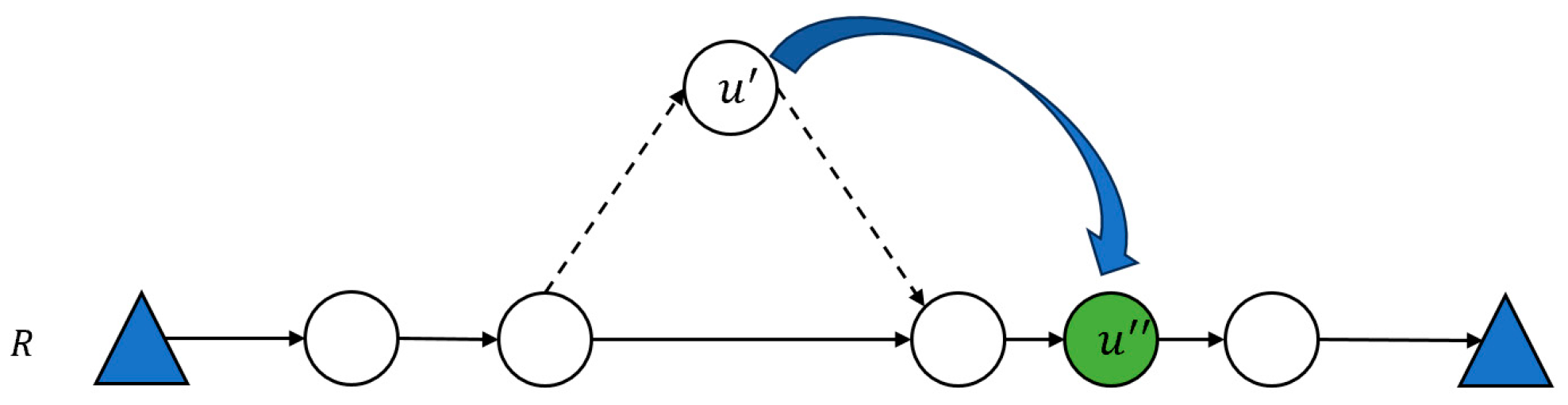
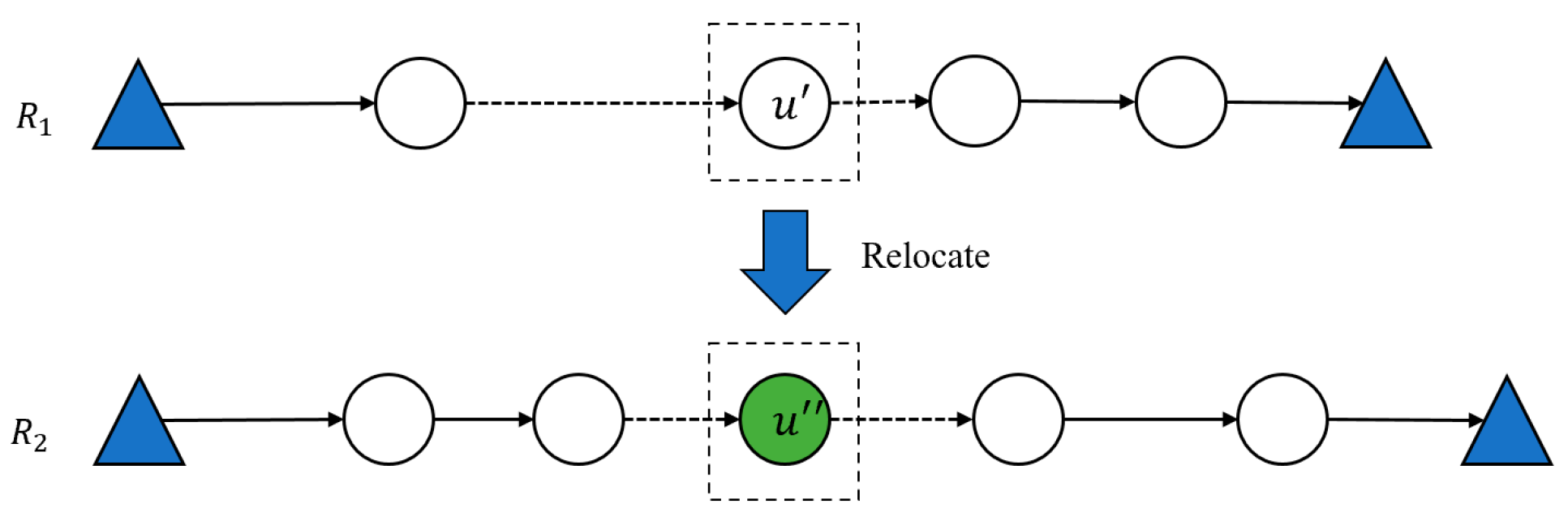
Figure 2 and
Figure 3 illustrate the implementation of the Relocate operator in this algorithm. In route
, “△” represents the depot, and “◯” represents the customer.
For the intra-route operations for
Figure 2, the detailed steps of the Relocate operator are as follows: for each route in the current solution, perform the following operations sequentially—take out a route R from the solution, remove customers in the order of vehicle service, and attempt to insert each delivery address of the removed customers into other positions in the route one by one, checking the feasibility of the route. If feasible, calculate the total travel time of the vehicle for each new solution, compare all solutions to find the one that reduces the total travel time the most, and accept and update the route accordingly.
In the inter-route operations for
Figure 3, the Relocate operator transfers customer points from one vehicle’s route to another to optimize the overall vehicle scheduling plan. Therefore, during implementation, multiple delivery addresses of each removed customer need to be inserted into different positions in other routes one by one, prioritizing solutions that reduce the number of vehicles used, followed by those that reduce the total travel time. This complex process ensures an improvement in the overall efficiency of the vehicle scheduling plan. The Or-opt and Relocate operators reconstruct routes while reselecting delivery addresses and redistributing customers across trips, which naturally merges symmetric solutions into a single representative configuration.
4.4. Perturbation Operation
To ensure that the perturbation operation can cover a broader solution space and increase the chances of finding better solutions, we need to design more flexible and diverse perturbation strategies to fully explore different solutions. To avoid premature convergence to local optima, a certain level of randomness or heuristic guidance is introduced into the perturbation phase, enabling the search to escape local optima and continue exploring improved solutions. For the MTVRPMDL problem, this paper designs weak and strong perturbation strategies. Among them, the weak perturbation adopts the Random exchange method, while the strong perturbation employs the 2-opt* method.
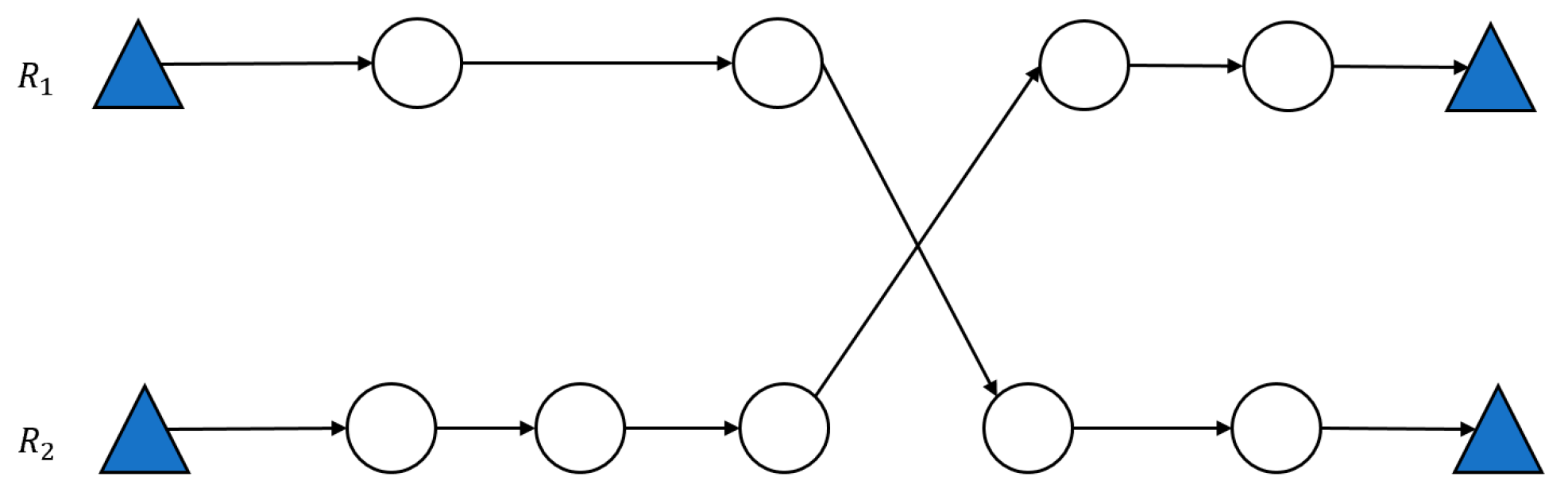
Figure 4 illustrates a schematic diagram of the 2-opt* implementation.
The weak perturbation’s Random Exchange shares the same fundamental approach as the perturbation operation for solving MTVRPMTW in Wu et al. (2024) [
52], with the difference being that when exchanging customer nodes, multiple deliverable addresses of the exchanged nodes must be considered. The selection is based on the calculation of travel time costs, choosing the feasible delivery address with the lowest post-exchange cost. 2-opt* is one of the common methods in the field of vehicle route optimization. Its basic idea is to cross two existing routes to optimize the vehicle path. The specific implementation process of 2-opt* in this algorithm is as follows: sequentially select two routes from the current solution, perform all possible crossover operations, and check the newly generated routes post-crossover to determine if they are feasible solutions. If feasible, record the reduction in time cost compared to the original routes, and execute the 2-opt* operation that yields the greatest reduction in time cost. It should be noted that, in the MTVRPMDL, the 2-opt* operator preserves the original delivery address assignments.
Vehicle route optimization: After multiple iterations of search and perturbation operations, we obtained a set of relatively stable and high-quality solutions. To further optimize the total travel time of vehicles, we introduced the Exchange algorithm to refine the current solution set. The core idea of the Exchange algorithm is similar to random swapping, but its uniqueness lies in attempting to remove all customer points from every route and sequentially reinsert their corresponding delivery addresses into any position of other routes. As long as the generated route is feasible and the solution quality improves, the new solution will be accepted. The Exchange algorithm enhances solution space exploration and improves overall solution quality by further optimizing total vehicle travel time.
5. Numerical Experiments
This section validates the effectiveness of the proposed MTVRPMDL model and GILS heuristic through numerical experiments. Based on the examples from Dumez et al. (2021) [
39], we designed two types of instances, totaling 48. For small-scale examples, CPLEX was used for solving. By comparing the solutions of the MTVRPMDL and MTVRPTW problems, we analyzed the performance improvement of introducing multiple delivery addresses. We also investigate the applicability and solving performance of the GILS algorithm for these instances. All computational experiments in the case study were implemented in Java, with IBM ILOG CPLEX 12.10 employed as the optimization solver. The experiments were executed on a standard desktop computer featuring a 2.60 GHz processor and 32 GB of memory.
5.1. Instances Generation
Since MTVRPMDL is a new combinatorial optimization problem with no benchmark instances in the literature, this study adopts the instance generation methodology of Dumez et al. (2021) [
39] originally developed for VRP with multiple delivery options. By modifying parameters such as vehicle capacity and delivery locations to suit the multi-trip and multi-delivery-location attributes of MTVRPMDL, we generated two types of test instance sets: one with narrower time windows and another with wider time windows. These two categories include 16 smaller-scale instances with customer counts of 10 and 15, as well as 32 larger-scale instances with customer counts of 25, 50, 100, and 200. Considering that real-world scenarios typically involve two delivery addresses per customer, all 48 instance sets were configured with two delivery addresses per customer. The relevant parameters and construction methods for the instance sets are as follows:
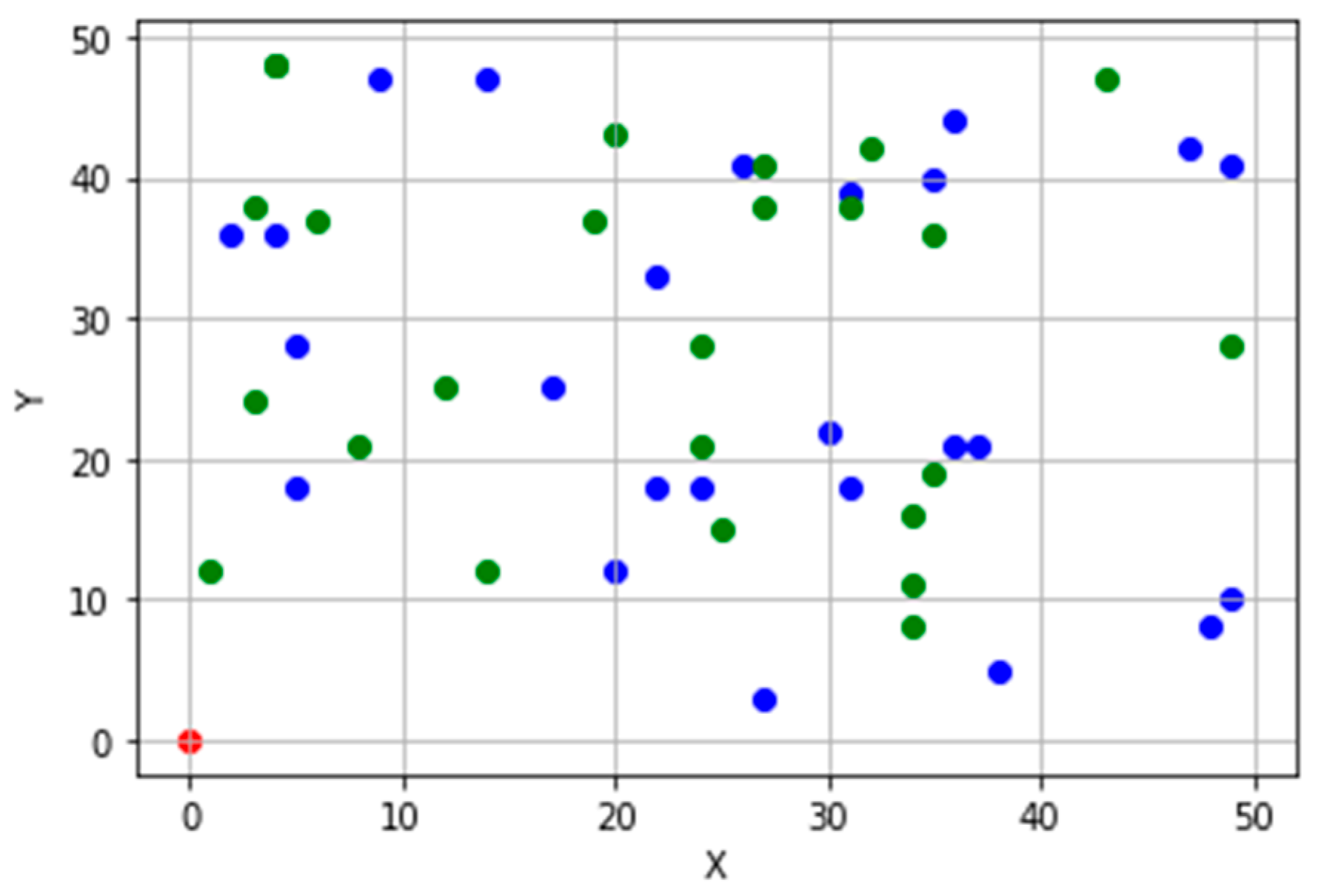
(1) All customer delivery addresses are randomly distributed within a 50 × 50 square area, with the depot located at (0, 0). The depot’s time window is set to [0, 720], and Euclidean distance is used for distance calculations.
(2) Each customer has two delivery addresses, with their associated time windows assigned to morning and afternoon periods, respectively. For the morning/afternoon time window , a random number is selected from the intervals [0, 240] or [360, 600] as the start time of the time window for delivery address of customer . The end time is then determined by adding the time window width to .
(3) Time windows are categorized into narrow and wide types. Narrow time windows have widths of 60 or 120, while wide time windows have widths of 120 or 180.
(4) The service time per customer is set to 10, and customer demand is a random integer between [10, 20]. The vehicle capacity is 100 in all cases.
Figure 5 shows the scatter plot of 25 customers and 50 delivery addresses in one group of the examples, where the red dots represent warehouses, the blue dots represent one of the customers’ delivery addresses, and the green dots represent another delivery address of the customer. From
Figure 5, it can be seen that the 50 delivery addresses are evenly distributed in this area. However, when planning the vehicle route, the vehicle only needs to deliver to one of the two delivery addresses of the customer. Compared to a single delivery address, considering multiple delivery addresses gives the carrier more flexibility.
5.2. Comparison with MTVRPTW
To assess the benefits of incorporating multiple delivery addresses, we compare the solutions obtained for small instances using the MTVRPMDL model with those derived from the MTVRPTW model. The MTVRPTW formulation follows Wu et al. (2024) [
52]. Since the MTVRPTW and MTVRPMDL models do not impose any restrictions on the number of vehicles, we will first determine the minimum number of vehicles required for each set of instances under both problems through multiple experiments. The solution results for MTVRPTW and MTVRPMDL are shown in
Table 2. Here,
represents the minimum number of vehicles used,
indicates the maximum number of trips among all vehicles,
and
denote the total travel time of vehicles for MTVRPMDL and MTVRPTW, respectively. Due to the high complexity of the MTVRPMDL problem, as the number of customers increases, some instances cannot be solved precisely within a short time. Therefore, for such instances, we set the number of vehicles to be the same as that under the MTVRPMDL problem solved by the GILS heuristic algorithm, using the lower bound obtained after 3 h as the benchmark for comparison.
represents the proportional difference in total travel time between the MTVRPMDL and MTVRPTW models under the same set of instances, calculated using formula (21).
As can be seen from
Table 2, among these 16 instances, the instances with 10 customers for both the MTVRPTW and MTVRPMDL problems can obtain exact solutions within 3 h. The number of vehicles used and the maximum number of trips are the same. However, compared to the total vehicle travel time of MTVRPTW, the total vehicle travel time of MTVRPMDL, which considers multiple delivery addresses, can be reduced by at least 29.2%. In the case u_s_10_02, the total vehicle travel time of MTVRPMDL was reduced by 74.4%. On average, the MTVRPMDL model with 10 customers reduced the total travel time by 49.5% compared to MTVRPTW. For the instances with 15 customers, only one instance of MTVRPMDL obtained an exact solution within 3 h, while MTVRPTW consistently found exact solutions quickly. In some cases, MTVRPMDL used fewer vehicles than MTVRPTW. Compared to the optimal solutions of MTVRPTW, the feasible solutions of MTVRPMDL could reduce the total vehicle travel time by up to 51.7%. These results demonstrate that considering multiple delivery addresses is effective for MTVRPs. The setting of multiple delivery addresses can directly reduce logistics costs for carriers and increase the flexibility of vehicle route planning.
5.3. Performance of the GILS Algorithm
This section reports numerical experiments on the small- and large-scale cases introduced earlier. The GILS is benchmarked against exact solutions from CPLEX (small instances). By comparing the exact solution results obtained from CPLEX with those from the GILS algorithm, the performance of GILS in solving MTVRPMDL is validated. In the GILS algorithm, multiple sets of values were assigned to , , , and : (1,1,1,0), (2,1,1,0), (1,0,1,0), (2,0,1,1), (1,0.5,1,0.5), and (2,0.5,1,0.5). During the initial solution generation process, these parameters were sequentially configured, and the solution yielding the minimal vehicle travel time under the minimum number of vehicles was selected as the final output initial solution. The GILS algorithm involves several parameters related to the initial solution construction. Since no prior benchmark exists for the MTVRPMDL, these parameters were selected based on preliminary computational experiments. Specifically, multiple candidate parameter combinations were tested sequentially during the initial solution generation phase. For each instance, the combination that produced the minimum total travel time under the minimum number of vehicles was chosen as the starting solution for the subsequent GILS iterations. Our experiments indicate that the algorithm is relatively insensitive to moderate parameter variations, as the local search and perturbation phases dominate the overall optimization process. This strategy balances solution quality and computational efficiency while avoiding instance-specific overfitting of parameters.
Table 3 presents the results of CPLEX and GILS for solving the MTVRPMDL for instances with 10 and 15 customers. Here,
denotes the number of vehicles,
represents vehicle capacity,
indicates the number of vehicles used,
specifies the maximum number of trips per vehicle,
and
represent the objective function values for CPLEX and GILS solutions, respectively.
and
denote the computation times for CPLEX and GILS, respectively. Due to the high complexity of the problem, CPLEX failed to obtain exact solutions for some 15-customer instances within 3 h. Thus, feasible solutions obtained after 3 h of CPLEX runtime were used as benchmarks, marked with “*” above the objective function values.
indicates the difference in objective function values between GILS and CPLEX solutions for MTVRPMDL, calculated as
−
)/
.
As shown in
Table 3, CPLEX is able to obtain optimal solutions for all eight instances with both wide and narrow time windows involving 10 customers within a limited computation time, with an average solution time of 115 s. Compared to CPLEX, GILS has a shorter solution time and can find the optimal solution within 0.2 s, showing significant improvement in solution time. Additionally, the average objective function difference between GILS and CPLEX for solving MTVRPMDL is 18%. For the 8 sets of instances with 15 customers, CPLEX fails to obtain exact solutions within the specified time, while GILS can find the optimal solution within 0.3 s, again demonstrating substantial improvement in solution time. CPLEX uses feasible solutions obtained after 3 h of runtime as a benchmark for comparison, and the average objective function difference between GILS and CPLEX for solving MTVRPMDL is 8%, indicating better solution quality. Across both time window configurations, instances with wide time windows for 10 and 15 customers consistently produce better solutions than their narrow time window counterparts, as the expanded time windows allow greater flexibility in the search process.
Given that CPLEX struggled to obtain exact solutions within the 3 h limit for instances with 15 customers (see
Table 3), solving the larger instances (
) to optimality with an exact solver was deemed computationally intractable. Therefore, to assess the scalability and performance of our proposed method on realistic problem sizes, we evaluated the GILS algorithm exclusively on these larger instance sets. The results are presented in
Table 4.
Table 4 presents the solving results of the GILS algorithm under different customer scales (25, 50, 100, 200). The results show that as the problem size increases, the solving time exhibits a gradually increasing trend. For instances with 25 customers and 50 delivery addresses, the solving time is within 1 s; for instances with 50 customers and 100 delivery addresses, the solving time is within 3 s. When the customer count reaches 100 and the total delivery addresses reach 200, the solving time begins to increase rapidly, with an average solving time of 1741 s. When the customer scale increases to 200 and the total delivery address scale reaches 400, all 8 sets of instances can still find the optimal solution within 6 min, indicating that the algorithm has high solving efficiency. Additionally, as the number of customers increases, the average maximum number of vehicle trips also gradually increases, with the average vehicle trips being around 4. When the number of customers reaches 200, vehicles can perform up to 6 trips, reaching the maximum vehicle trips and optimal vehicle utilization. An increase in the average number of vehicle trips implies a reduction in the number of vehicles required. Therefore, in actual logistics operations, companies should focus on increasing the number of vehicle trips to improve vehicle utilization and thereby reduce fixed cost expenditures.
To our knowledge, there is currently no publicly available state-of-the-art (SOTA) heuristic tailored to the multi-trip vehicle routing problem with multiple delivery locations and time windows. Although powerful metaheuristics such as adaptive large neighborhood search (ALNS) and variable neighborhood search (VNS) have been successfully applied to various VRP variants, directly applying these frameworks to the MTVRPMDL is not straightforward. In particular, destroy–repair or neighborhood operators must be redesigned to simultaneously handle multi-trip sequencing, delivery-location reselection, and time window feasibility, which fundamentally alters the algorithmic structure and computational behavior. Without such problem-specific adaptations, a direct comparison with generic SOTA implementations would not be methodologically fair and may lead to misleading conclusions. Therefore, this study focuses on validating the proposed GILS framework through exact benchmarks on small instances and model-based baselines, while the development of delivery-location-aware ALNS/VNS algorithms and their systematic comparison with GILS is left as an important direction for future research.
6. Conclusions
This paper addresses the challenges of improving last-mile logistics delivery satisfaction in urban areas and solving the MTVRPMDL. We develop an MILP model aimed at minimizing the total vehicle travel time. Two types of instances are designed for this problem, and exact solutions are obtained using CPLEX. The computational results indicate that allowing multiple delivery locations consistently reduces total travel distance and, in several cases, decreases the number of vehicles required compared with the MTVRPTW baseline. For small instances, the proposed GILS algorithm achieves optimal or near-optimal solutions with very small optimality gaps relative to CPLEX. For larger instances, GILS remains computationally efficient and robust, producing high-quality solutions within short time limits, while exact solvers become intractable. These results confirm both the modeling benefits of flexible delivery locations and the effectiveness of the proposed symmetry-aware heuristic framework.
Future work could expand in several promising directions. One key area involves introducing customer preference and service priority into the multiple-delivery-location framework. By assigning different priority levels to various delivery time windows or locations, models could be developed that jointly optimize logistical efficiency and a quantified measure of customer satisfaction, better reflecting real-world service trade-offs. It is also necessary to incorporate simultaneous pickup and delivery operations, leading to a multi-trip vehicle routing problem with multiple delivery locations and pickup–delivery interactions. This would require joint load-flow modeling and redesigned symmetry-aware heuristic operators, and is left for future research. Secondly, the problem formulation could be enriched by incorporating alternative delivery modalities, such as shared collection points or parcel lockers, alongside traditional door-to-door service. This extension would require modeling the capacity constraints of shared locations and analyzing the cost–benefit dynamics between different delivery options. Thirdly, an important extension of this work is to adapt widely used metaheuristics such as ALNS and VNS to the MTVRPMDL and conduct a systematic performance comparison under identical instance sets and stopping conditions. Certainly, devising specialized exact solution methods, such as branch-and-price algorithms tailored to this problem’s characteristics, would be valuable for generating optimal benchmarks for larger instances and further validating the performance of heuristic approaches. Finally, in this study, we assume a homogeneous fleet of identical vehicles. This assumption allows us to focus on the core interaction between multi-trip routing decisions and flexible delivery location selection, and helps keep both the MILP formulation and the heuristic design computationally tractable. However, in practical urban logistics operations, fleets are often heterogeneous, with vehicles differing in capacity, operating cost, energy consumption, or accessibility restrictions. Extending the proposed MTVRPMDL to heterogeneous fleets represents an important direction for future research. Such an extension would require vehicle-specific parameters in the model and corresponding adaptations of the GILS operators to handle heterogeneous feasibility and cost structures. Incorporating fleet heterogeneity would further enhance the realism and applicability of the proposed framework.