


Abstract
In this work, we introduce the conformabletriple Laplace–Sumudu transform (CTLST), a novel integral transform designed to solve both linear and nonlinear conformable FPDEs. This new approach builds on the recent development of the triple Laplace–Sumudu transform and incorporates the conformable derivative to extend its applicability to fractional models. We first present the foundational definitions and key properties of the CTLST, followed by its application to a variety of two- and three-dimensional conformable FPDEs. The effectiveness of the proposed method is demonstrated through several examples, where exact and approximate solutions are derived, illustrative 3D plots are presented, and symmetry analysis is employed to verify the obtained results. The CTLST provides a promising analytical tool for tackling complex conformable FPDEs in mathematical physics and engineering.
1. Introduction
Fractional partial differential equations (FPDEs) have become a central topic of research in mathematics and applied sciences due to their ability to model complex systems with memory and hereditary properties [1]. Their applications span a broad range of fields, including fluid mechanics, physics, biology, chemistry, economics, electromagnetic theory, and signal processing [2].
Solution methods play a vital role in the analysis and classification of differential equations. Integral transforms such as the Laplace, Fourier, Mellin, Hankel, and Sumudu transforms are among the most powerful tools for solving both ordinary and partial differential equations [3,4,5]. However, when solutions are not expressible in Taylor series form or the Laplace transform becomes difficult to compute, alternative approaches are needed.
In response to such challenges, the conformable fractional derivative (CFD) was introduced as a more accessible form of fractional calculus [6]. Defined using a limit-based approach, the CFD has attracted attention for its simplicity and effectiveness in modeling and analysis across numerous disciplines [7].
The Laplace transform remains widely used for solving fractional differential equations (FDEs), including both exact and approximate solutions [8,9]. To further extend its applicability, the single conformable Laplace transform (SCLT) was introduced in [10] as a natural adaptation of the classical Laplace transform to conformable derivatives.
Subsequent advancements include numerical methods for time–space FPDEs involving the spectral fractional Laplacian [11], and the introduction of the conformable double Laplace transform (CDLT) for solving more complex fractional models [12]. In parallel, the double Sumudu and Laplace–Sumudu transforms have been successfully applied to wave equations and other partial differential equations [13,14,15,16].
More recently, the combination of conformable transforms with decomposition methods has been employed to solve nonlinear FPDEs [17,18], and the triple Laplace–Sumudu transform was introduced in [19] to handle heat and wave equations with boundary conditions. Another significant approach is Lie symmetry analysis, which is used to investigate the invariance properties of nonlinear FPDEs involving conformable fractional derivatives in both time and space. This technique has been applied to generalized forms of classical equations such as the Korteweg–de Vries, Burgers, and modified Burgers equations [20].
In this paper, we build upon these developments and introduce the CTLST, a new analytical tool designed to solve both linear and nonlinear conformable FPDEs. We present the foundational definitions of the conformable Laplace transform, the conformable Sumudu transform, and the proposed CTLST. We then establish the core properties of the CTLST and apply it to a range of fractional partial differential equations. Illustrative examples and 3D plots are included to demonstrate the effectiveness of the method.
2. Terminology and Properties
In this section, we review the definitions of key integral transforms used in this work, including the conformable Laplace transform, the conformable Sumudu transform, and the conformable double Laplace transform. We then introduce the CTLST, which plays a central role in our proposed methodology.
Before proceeding with these definitions, we recall the concept of a function of exponential order. A function is said to be of exponential order i with respect to , and of order j with respect to , if there exists a constant such that for all and , the inequality
holds [21].
Definition 1
(Definition 4 [22]). Let f be a continuous function on . The conformable Sumudu transform (CST) of is defined as
where , , and .
Definition 2.
Let g: be a real-valued function. The conformable Laplace transform (CLT) of is given by
for all values of , provided the integral exists.
Definition 3
(Definition 5 [21]). Let be a piecewise continuous function on and of exponential order. The CDLT is defined as
where and .
We now introduce the definition of the conformable triple Laplace–Sumudu transform (CTLST), along with its inverse.
Definition 4.
Let be a piecewise continuous function of exponential order. The conformable triple Laplace–Sumudu transform (CTLST), denoted by , is defined as
where , , , , and .
Definition 5.
The inverse conformable triple Laplace–Sumudu transform (ICTLST), denoted by , of a function is defined by
Now, we give the definitions of the conformable partial fractional derivatives and apply the CTLST to the partial derivatives of the function Also, we establish several key operational properties of the transform.
Definition 6.
Let : be a function. Then the conformable partial fractional derivatives of the order , and δ of the function Φ are defined by
where and
Theorem 1.
Let be a differentiable function at Then
Definition 6 and Theorem 1 are extensions of Definition 2 and Theorem 1 in [23]. For further details, the reader is referred to [24].
Theorem 2.
Let
for Then the CTLST of the functions , and are given by the following identities:
Proof.
The proof is an extension of Theorem 1 in [21]. Here, we prove (6) and (9), and leave the remaining identities to the reader. Starting from the definition of the CTLST, we have
To evaluate the inner integral, we use integration by parts, with the assumptions and . Thus,
To prove (9), we apply the same technique recursively:
□
Theorem 3.
Let where be a real-valued piecewise continuous function and of exponential order. If and then the CTLST of conformable partial derivatives of the order , and is given by
Proof.
The proof is a generalization of the proof of Theorem 2 and the proofs of Theorem 1 in [19] and Theorem 1 in [21]. □
Theorem 4.
Let Φ and Θ be piecewise continuous functions on the interval and of exponential order. If
and
where and and are constants, then the CTLST of the following functions is
- , where ζ is constant,
- , where are positive integers,
Proof.
From the definition of the CTLST, the proof of the first point is clear. For the proof of
When the CTLST is applied on it gives the following:
which is the proof of Also, when we get the following:
By the same way of proving 3 and we can prove and ; we leave these for the reader.
For we apply the CTLST on
so we get
By the same method, we can prove □
3. Solving Two-Dimensional Fractional Partial Differential Equations Using the CTLST
In this section, we demonstrate the effectiveness of the triple Laplace–Sumudu transform (CTLST) technique for solving a class of two-dimensional time-fractional partial differential equations. This approach integrates the Laplace and Sumudu transforms into a triple structure tailored to fractional differential operators in multiple variables, offering a systematic way to handle linear and nonlinear terms within a unified transform domain.
We consider the following nonlinear time-fractional partial differential equation, as studied in [25]:
subject to the initial condition
where , is a linear differential operator, is a nonlinear operator, f is a source term, and .
Step 1: Apply the CTLST to both sides of Equation (15). This results in the transformed form
Step 2: By applying the operational rules of the CTLST, we obtain
Step 4: Applying the inverse CTLST to (19), we obtain
Assume that the solution can be expressed as a series:
Then the nonlinear term can be decomposed as
where are the Adomian polynomials given by
Substituting (21) and (22) into (20) gives
The recursive relations are then given by
and for ,
Finally, the approximate solution of (15) is given by the infinite series
This method efficiently constructs a series solution for the given FPDE, capturing both linear and nonlinear behaviors across multiple fractional dimensions through an integrated transform-decomposition framework.
4. Illustrative Examples
In this section, we apply the CTLST to solve linear and nonlinear fractional partial differential equations. The first example is taken from [26], and the equation is a Poisson partial differential equation. The second example is conformable Laplace partial differential equation [26], and the third example is a conformable nonlinear wave equation [27].
Example 1.
We consider the following Poisson partial differential equation:
with the initial and boundary conditions
First step: Applying the CTLST on both sides of (25) gives the following:
Second step: From the derivative properties of the CTLST, we find that
When we apply the CTLST on the initial and boundary conditions, we get following:
By substituting (31), (32), (33), (34), (35), and (36) into (30), we get
by arranging the above equation, we find
and so
Third step: In this step, we apply the inverse of the CTLST to (39):
and from Theorem (4), the inverse of the CTLST in (40) becomes
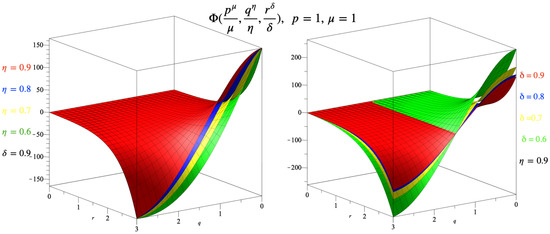
Figure 1 illustrates the 3D plots of the approximation solutions of at , and different values of δ and η. The exact solution of (25) is when in (41), and it is
Figure 1.
The 3D plots of the approximation solutions of in Example 1.
Example 2.
Consider the following conformable Laplace partial differential equation, Example 4 in [26]:
subject to the initial and boundary conditions
First step: Applying the CTLST on both sides of (42) leads to
Second step: By applying the properties of the CTLST, Theorem we find that
Applying the transform on the initial and boundary conditions leads to
After substituting (48), (49), (50), (51), (52), and (53) into (47), we get
By rearranging the above equation, we have
and simplifying Equation (55) leads to
Third step: Applying the inverse of the CTLST of (56) gives
and hence the conformable solution becomes
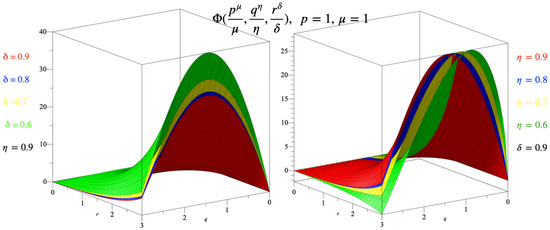
Figure 2 presents the 3D surface plots of the approximate solutions of evaluated at and , while varying the values of δ and η. The exact solution of (42) is given by
when in (58).
Figure 2.
The 3D plots of the approximation solutions of in Example 2.
Example 3.
Consider the following two-dimensional conformable nonlinear wave equation, Example 7 in [27]:
with the initial condition
To find solutions for the equation, we implement the following steps:
First step: Apply the CTLST on both sides of (59), so we get
Second step: By using the partial derivatives properties of the CTLST, we find
By applying the transform to the initial conditions, we get
After substituting (63) and (64) into (62), we obtain
By arranging the terms of (65), the function becomes
Third step: Apply the inverse of the CTLST to (66) to get the following function:
From Theorem 4, we find that
Suppose that
When we apply the fractional derivatives, which are in (59) on (69), we get
where and are called Adomian polynomials, which can be calculated as follows:
and
where
and
After substituting (69) and (70) into (68), one can get
The recursive relations are
When then
and so
At we get
We continue in this manner to obtain
Therefore, the approximate solution of (59) is
Hence, the solution of (59) is
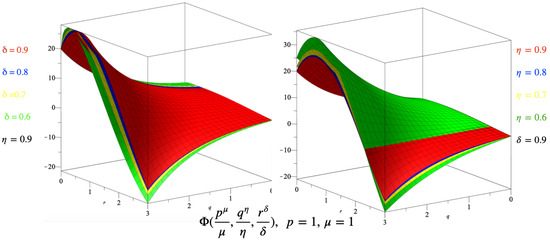
Figure 3 displays the three-dimensional plots of the approximate solutions of for fixed values and , with various choices of δ and η. The exact solution of (59) is
when in (77).
Figure 3.
The 3D plots of the approximate solutions of in Example 3.
5. Conclusions
In this paper, we introduce the conformable triple Laplace–Sumudu transform and apply it to both linear and nonlinear conformable fractional partial differential equations. The effectiveness of the CTLST is demonstrated through illustrative examples, including the wave and Poisson equations. The results highlight the simplicity and efficiency of the proposed method in handling various types of fractional partial differential equations. Future research will focus on extending this approach to three-dimensional conformable fractional partial differential equations.
Author Contributions
Conceptualization, M.R.G.; Methodology, S.A. and M.R.G.; Formal analysis, M.R.G.; Investigation, S.A. and M.R.G.; Resources, S.A. and M.R.G.; Writing—original draft, S.A. and M.R.G.; Writing—review and editing, M.R.G.; Funding acquisition, S.A. All authors have read and agreed to the published version of the manuscript.
Funding
This work is supported by the Ongoing Research Funding program (ORF-2025-839), King Saud University, Riyadh, Saudi Arabia.
Data Availability Statement
No new data were created or analyzed in this study.
Acknowledgments
The authors would like to extend their sincere appreciation to the Ongoing Research Funding program (ORF-2025-839), King Saud University, Riyadh, Saudi Arabia.
Conflicts of Interest
The authors declare no conflicts of interest.
References
- Nieto, J.; Rodríguez-López, R. Fractional Differential Equations: Theory, Methods and Applications; MDPI: Basel, Switzerland, 2019. [Google Scholar]
- Chakraverty, S.; Mahato, N.; Karunakar, P.; Rao, T. Advanced Numerical and Semi-Analytical Methods for Differential Equations; John Wiley & Sons: Hoboken, NJ, USA, 2019. [Google Scholar]
- Kilbas, A.; Srivastava, H.; Trujillo, J. Theory and Applications of Fractional Differential Equations; Elsevier: Amsterdam, The Netherlands, 2006; Volume 204. [Google Scholar]
- Schiff, J. The Laplace Transform: Theory and Applications; Springer Science & Business Media: New York, NY, USA, 1999. [Google Scholar]
- Rezaei, H.; Jung, S.; Rassias, T. Laplace transform and Hyers–Ulam stability of linear differential equations. J. Math. Anal. Appl. 2013, 403, 244–251. [Google Scholar] [CrossRef]
- Khalil, R.; Al Horani, M.; Yousef, A.; Sababheh, M. A new definition of fractional derivative. J. Comput. Appl. Math. 2014, 264, 65–70. [Google Scholar] [CrossRef]
- Thabet, H.; Kendre, S. Analytical solutions for conformable space-time fractional partial differential equations via fractional differential transform. Chaos Solitons Fractals 2018, 109, 238–245. [Google Scholar] [CrossRef]
- Alfaqeih, S.; Kayijuka, I. Solving system of conformable fractional differential equations by conformable double Laplace decomposition method. J. Partial Differ. Equ. 2020, 33, 275–290. [Google Scholar] [CrossRef]
- Kilicman, A.; Gadain, H. An application of double Laplace transform and double Sumudu transform. Lobachevskii J. Math. 2009, 30, 214–223. [Google Scholar] [CrossRef]
- Abdeljawad, T. On conformable fractional calculus. J. Comput. Appl. Math. 2015, 279, 57–66. [Google Scholar] [CrossRef]
- Difonzo, F.; Garrappa, R. A numerical procedure for fractional-time-space differential equations with the spectral fractional Laplacian. In Proceedings of the INdAM workshop on Fractional Differential Equations: Modeling, Discretization, and Numerical Solvers, Roma, Italy, 12–14 July 2021; Springer: Berlin/Heidelberg, Germany, 2021; pp. 29–51. [Google Scholar]
- Özkan, O.; Kurt, A. On conformable double Laplace transform. Opt. Quantum Electron. 2018, 50, 103. [Google Scholar] [CrossRef]
- Kılıçman, A.; Gadain, H. On the applications of Laplace and Sumudu transforms. J. Frankl. Inst. 2010, 347, 848–862. [Google Scholar] [CrossRef]
- Weerakoon, S. Application of Sumudu transform to partial differential equations. Int. J. Math. Educ. Sci. Technol. 1994, 25, 277–283. [Google Scholar] [CrossRef]
- Ziane, D.; Baleanu, D.; Belghaba, K.; Cherif, M. Local fractional Sumudu decomposition method for linear partial differential equations with local fractional derivative. J. King Saud Univ.-Sci. 2019, 31, 83–88. [Google Scholar] [CrossRef]
- Elzaki, T.; Ahmed, S.; Areshi, M.; Chamekh, M. Fractional partial differential equations and novel double integral transform. J. King Saud Univ.-Sci. 2022, 34, 101832. [Google Scholar] [CrossRef]
- Ahmed, S.; Saadeh, R.; Qazza, A.; Elzaki, T. Modified conformable double Laplace–Sumudu approach with applications. Heliyon 2023, 9, e15891. [Google Scholar] [CrossRef] [PubMed]
- Watugala, G. Sumudu transform: A new integral transform to solve differential equations and control engineering problems. Integr. Educ. 1993, 24, 35–43. [Google Scholar] [CrossRef]
- Wang, C.; Xu, T. Triple Mixed Integral Transformation and Applications for Initial-Boundary Value Problems. J. Nonlinear Math. Phys. 2024, 31, 39. [Google Scholar] [CrossRef]
- Tayyan, B.; Sakka, A. Lie symmetry analysis of some conformable fractional partial differential equations. Arab. J. Math. 2020, 9, 201–212. [Google Scholar] [CrossRef]
- Eltayeb, H.; Bachar, I.; Kılıçman, A. On conformable double laplace transform and one dimensional fractional coupled burgers’ equation. Symmetry 2019, 11, 417. [Google Scholar] [CrossRef]
- Hamza, A.; Mohamed, M.; Abd Elmohmoud, E.; Magzoub, M. Conformable Sumudu Transform of Space-Time Fractional Telegraph Equation. In Abstract and Applied Analysis; Wiley Online Library: Hoboken, NJ, USA, 2021; Volume 2021, p. 6682994. [Google Scholar]
- Ahmed, S.; Qazza, A.; Saadeh, R.; Elzaki, T. Conformable double laplace–sumudu iterative method. Symmetry 2022, 15, 78. [Google Scholar] [CrossRef]
- Bhanotar, S.; Belgacem, F. Theory and applications of distinctive conformable triple Laplace and Sumudu transforms decomposition methods. J. Partial Differ. Equ. 2021, 35, 49–77. [Google Scholar] [CrossRef]
- Baleanu, D.; Jassim, H. Exact solution of two-dimensional fractional partial differential equations. Fractal Fract. 2020, 4, 21. [Google Scholar] [CrossRef]
- Saadah, R.; Amleh, M.; Qazza, A.; Al-Omari, S.; Akdemir, A. Results Involving Partial Differential Equations and Their Solution by Certain Integral Transform. CMES-Comput. Model. Eng. Sci. 2024, 140, 1594–1616. [Google Scholar] [CrossRef]
- Khan, H.; Shah, R.; Kumam, P.; Arif, M. Analytical solutions of fractional-order heat and wave equations by the natural transform decomposition method. Entropy 2019, 21, 597. [Google Scholar] [CrossRef] [PubMed]
Disclaimer/Publisher’s Note: The statements, opinions and data contained in all publications are solely those of the individual author(s) and contributor(s) and not of MDPI and/or the editor(s). MDPI and/or the editor(s) disclaim responsibility for any injury to people or property resulting from any ideas, methods, instructions or products referred to in the content. |
© 2025 by the authors. Licensee MDPI, Basel, Switzerland. This article is an open access article distributed under the terms and conditions of the Creative Commons Attribution (CC BY) license (https://creativecommons.org/licenses/by/4.0/).