Dombi Aggregation of Trapezoidal Neutrosophic Number for Charging Station Decision-Making

Abstract
1. Introduction
1.1. Review of the Literature
1.2. Motivation of the Study
1.3. Research Gap
1.4. Significance of the Research
- Based on and , we develop new operations of TzVNFNs and the proposed operators preserve algebraic symmetry through commutative property.
- We propose three accumulation procedures: TzVNFDWG, TzVNFDOWG, and TzVNFDHG of TzVNFN class.
- Using the suggested operators, we propose a trapezoidal-valued neutrosophic fuzzy MAGDM (TzVNFMAGDM) algorithm.
- Lastly, a comparison study is carried out by evaluating the results of numerical examples with those of other methods that are currently in use.
1.5. Organization of the Paper
2. Preliminaries
- 1.
- if and only if
- 2.
- if and only if
3. An Operational Rule Depending on and of the Set of
- (i)
- .
- (ii)
- .
- (iii)
- .
- (iv)
- .
4. Proposed Accumulation Operators
4.1. Trapezoidal Neutrosophic Dombi Weighted Geometric Operator
- Now, for , we have
- Let be the collection of s. Let and .
- Then,
4.2. Trapezoidal Neutrosophic Dombi Ordered Weighted Geometric Operator
- are equal and for all where then,
4.3. Trapezoidal-Valued Neutrosophic Dombi Hybrid Geometric Operator
5. A Trapezoidal-Valued Neutrosophic Multi-Attribute Group Decision-Making Method
- Step 1:
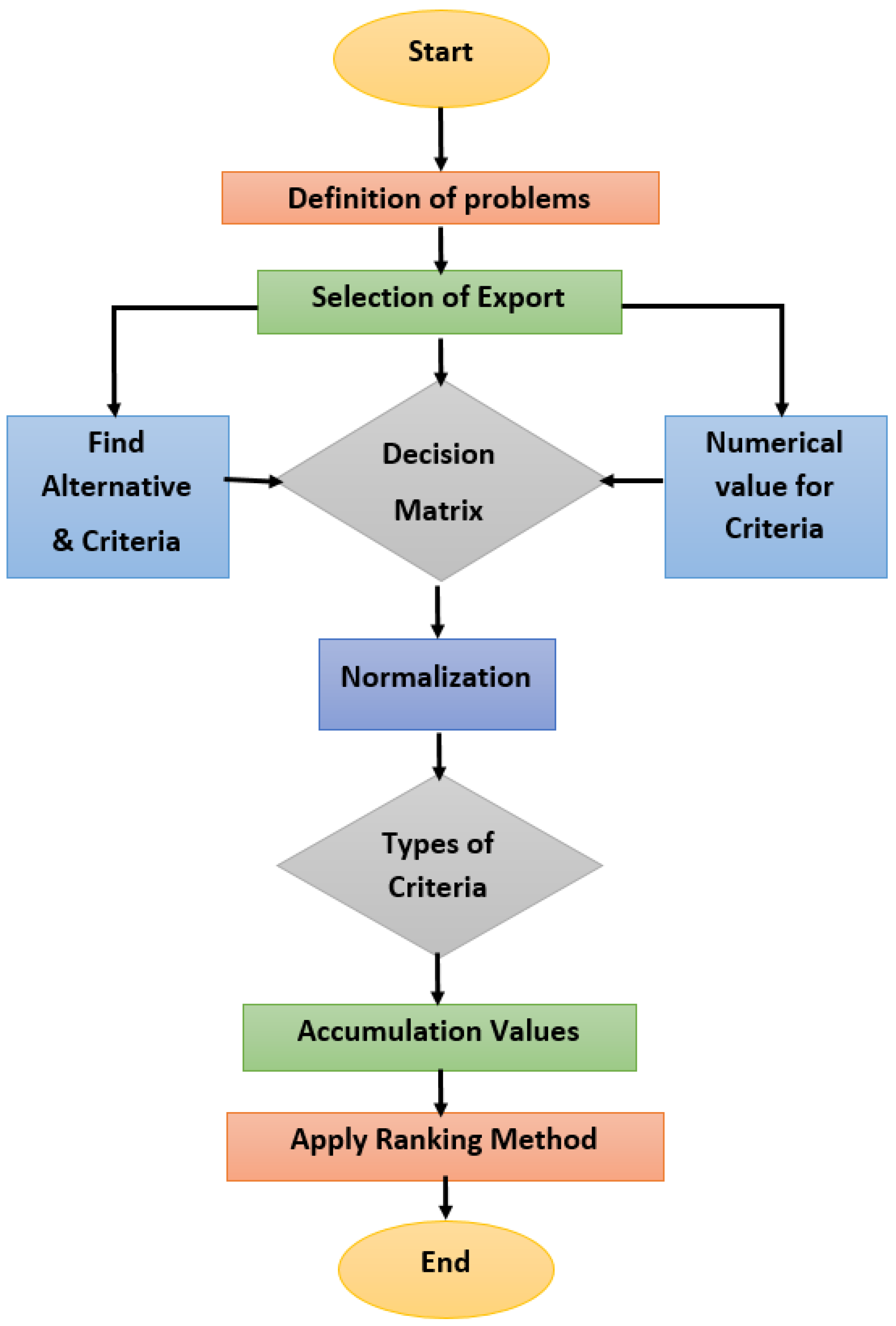
- Collection of data: Linguistic terms are used to collect data from decision-making. Using Table 1, linguistic terms can be transformed into trapezoidal-valued neutrosophic numbers and represented as a matrix for decisions and preserves symmetry in fuzzy evaluations and input weights.
- Step 2:
- Normalisation of the neutrosophic choice matrix using trapezoidal values: The trapezoidal-valued neutrosophic decision matrix acquired in Step 1 is normalized toby the following equation.In other words, the normalization indicates that
- 1
- The membership value of is changed to non membership value , and the non-membership value is changed to if the condition falls into the cost category.
- 2
- if the criteria is inside the benefit category. If every criterion taken into account for the problem is a benefit criterion, then this step can be omitted.
- Step 3:
- Accumulated performance
- (a)
- Transformation of multi-attribute group decision matrix into an aggregated decision matrix: This is carried out by the use of the operators from Equation (2). Is,
- (b)
- Aggregated performance of alternatives regarding all the criteria. This is derived by using the operator from (2) on every row of the combined matrix of decisions that was produced in Step 3(a).
- Step 4:
- Score Matrix: Employ the scoring functions specified in Definition (8) to obtain the score for each alternative aggregated performance acquired in Step 3(b).
- Step 5:
- Alternatives Ranking: According to the ranking concept, the options are ranked.
5.1. Problem Description
5.2. Solving the Proposed Trapezoidal-Valued Neutrosophic Multi-Attribute Group Decision-Making Algorithm
- Step 1:
- Data Collection: A panel of three experts is considered, which assesses the performance of five alternatives based on eight attributes. Data from the panel is gathered using the seven-point linguistic scale displayed in Table 3. as indicated in Table 2. It displays the information gathered from the decision-makers. The linguistic words derived from the panel’s data are then transformed into with the help of Table 3. For instance, upon gathering the information from every expert, we acquired the linguistic term for alternative 1 concerning criterion 1 for expert 1 as , which is also displayed in Table 2. Therefore, this linguistic term is substituted with the Table 3 provides definitions for terms.
- Step 2:
- Normalization: Since every criterion in this particular instance is benefit type, no normalizing procedure is required.
- Step 3:
- (a) Accumulated Decision Matrix: The accumulated decision matrix is derived in this step by utilizing Equation (2). This stage yields an accumulated choice matrix, which Table 3 displays. As an example, see Table 2. We establish criterion 1 and combine the value for alternative 1 in relation to the provided values from every specialist. In other words, employing Formula (4) , we obtain Table 4’s first row and first column entry as . In a similar manner, we can compute every other entry in Table 4.
- Step 3:
- (b) Accumulated performance of Alternatives: To obtain the accumulated performance of each alternative with regard to the four criteria, as shown in Table 5, apply Equation (2) to each row in Table 4. For instance, we accumulate the value of each criterion with respect to Table 5 in order to produce the first option ., that is, , , , using Equation (2). The weights of each criterion that we took into account while determining the overall performance of the options are listed below: and .
- Step 4:
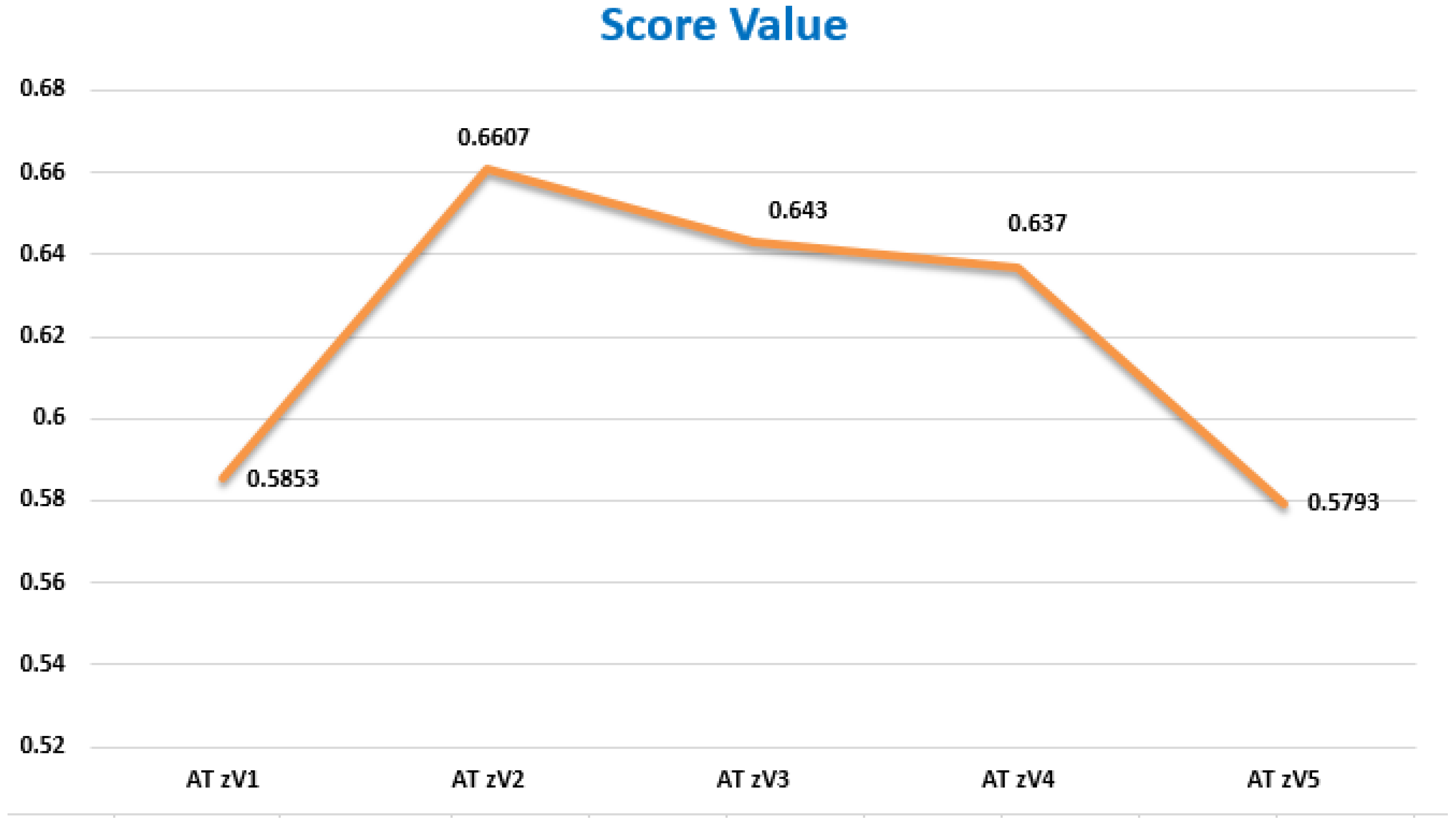
- Score Values: The second column of Table 5 shows the total efficiency of the four options with respect to the four criteria. We may obtain the score value for each option by applying the ranking principle and scoring function to each entry in the second column, as indicated in Table 5’s third column. The final scores for the four choices are as follows:
- Step 5:
- Alternatives ranking: We rank the options as follows using the score values that were supplied in Step 4. Below is the final ranking of the choices,
5.3. Comparative Analysis
5.4. Sensitive Analysis
5.5. Advantages of the Suggested MAGDM Strategy
- To begin, the entire ordering principle on TzVNFNs is used in our suggested MAGDM technique, which is a broad category encompassing TNFNs, NFNs, and IVNFNs. Thus, real-valued NFNs, IVNFNs, and TNFNs are among the issues that can be solved using the algorithm suggested in the subclass context.
- Second, our suggested approach can always rank the two distinct TzVNFNs since the MAGDM algorithm incorporates the entire ordering principle. In other words, two distinct options (different performances according to separate criteria) will never be ranked as equal by the suggested MAGDM technique.
- Thirdly, by adjusting the Dombi variable, the and oriented aggregating operator provides the benefit of making the aggregating procedure simpler. Flexibility may be achieved by altering the Dombi operator variable. Because of its adjustable parameters, it is adaptable to other t norms and t-conorms that are currently in use. We may modify the norm used for accumulation by changing the variable’s Dombi accumulation operator value, which also changes the parameter’s operational behavior. The primary benefit of this technique is that the evaluation takes into account the imprecision and ambiguity present in the real-time data.
6. Conclusions
Limitations and Future Scope
Funding
Data Availability Statement
Conflicts of Interest
Appendix A
- 1.
- 2.
- 3.
- 4.
- Solution for example 1
- (i)
- (ii)
- (iii)
- If
- (iv)
- If
Appendix B. (Proof of Theorem 1)
- (i)
- (ii)
- (iii)
- Now,
- (iv)
Appendix C. (Proof of Theorem 3)
Appendix D. (Proof of Theorem 4)
Appendix E. (Proof of Theorem 5)
- where
References
- Zadeh, L.A. Fuzzy sets. Inf. Control 1965, 8, 338–353. [Google Scholar] [CrossRef]
- Atanassov, K.T. Intuitionistic fuzzy sets. Fuzzy Sets Syst. 1986, 20, 87–96. [Google Scholar] [CrossRef]
- Smarandache, F. A Unifying Field in Logics. Neutrosophy: Neutrosophic Probability, Set and Logic; American Research Press: Rehoboth, DE, USA, 1999. [Google Scholar]
- Ye, J. An extended TOPSIS method for multiple attribute group decision making based on single valued neutrosophic linguistic numbers. J. Intell. Fuzzy Syst. 2015, 28, 247–255. [Google Scholar] [CrossRef]
- Chi, P.; Liu, P. An extended TOPSIS method for the multiple attribute decision making problems based on interval neutrosophic set. Neutrosophic Sets Syst. 2013, 1, 63–70. [Google Scholar]
- Ali, M.; Hussain, Z.; Yang, M.-S. Hausdorff distance and similarity measures for single-valued neutrosophic sets with application in multi-criteria decision making. Electronics 2022, 12, 201. [Google Scholar] [CrossRef]
- Dombi, J. A general class of fuzzy operators, the DeMorgan class of fuzzy operators and fuzziness measures induced by fuzzy operators. Fuzzy Sets Syst. 1982, 8, 149–163. [Google Scholar] [CrossRef]
- Liu, P.; Liu, J.; Chen, S.-M. Some intuitionistic fuzzy Dombi Bonferroni mean operators and their application to multi-attribute group decision making. J. Oper. Res. Soc. 2018, 69, 1–24. [Google Scholar] [CrossRef]
- Chen, J.; Ye, J. Some single-valued neutrosophic Dombi weighted accumulation Operators for multiple attribute decision-making. Symmetry 2017, 9, 82. [Google Scholar] [CrossRef]
- Seikh, M.R.; Mandal, U. Intuitionistic fuzzy Dombi accumulation Operators and their application to multiple attribute decision-making. Granul. Comput. 2021, 6, 473–488. [Google Scholar] [CrossRef]
- Shi, L.; Ye, J. Dombi Aggregation Operators of Neutrosophic Cubic Sets for Multiple Attribute Decision-Making. Algorithms 2018, 11, 29. [Google Scholar] [CrossRef]
- Shao, Y.; Zhuo, J. Improved q-rung orthopair fuzzy line integral accumulation Operators and their applications for multiple attribute decision making. Artif. Intell. Rev. 2021, 54, 5163–5204. [Google Scholar] [CrossRef]
- Deveci, M.; Gokasar, I.; Castillo, O.; Daim, T. Evaluation of metaverse integration of freight fluidity measurement alternatives using fuzzy Dombi EDAS model. Comput. Ind. Eng. 2022, 174, 108773. [Google Scholar] [CrossRef]
- Jana, C.; Senapati, T.; Pal, M.; Yager, R.R. Picture fuzzy Dombi accumulation Operators: Application to MADM process. Appl. Soft Comput. 2019, 74, 99–109. [Google Scholar] [CrossRef]
- Kumar, R.; Pamucar, D. A comprehensive and systematic review of multi-criteria decision-making (MCDM) methods to solve decision-making problems: Two decades from 2004 to 2024. Spectr. Decis. Mak. Appl. 2025, 2, 178–197. [Google Scholar] [CrossRef]
- Asif, M.; Ishtiaq, U.; Argyros, I.K. Hamacher accumulation Operators for Pythagorean fuzzy set and its application in multi-attribute decision-making problem. Spectr. Oper. Res. 2025, 2, 27–40. [Google Scholar] [CrossRef]
- Ali, A.; Ullah, K.; Hussain, A. An approach to multi-attribute decision-making based on intuitionistic fuzzy soft information and Aczel-Alsina operational laws. J. Decis. Anal. Intell. Comput. 2023, 3, 80–89. [Google Scholar] [CrossRef]
- Meher, B.B.; Jeevaraj, S. Interval-valued Fermatean fuzzy Aczel-Alsina geometric accumulation Operators and their applications to group decision-making. Phys. Scr. 2024, 99, 095027. [Google Scholar] [CrossRef]
- Sahoo, S.K.; Pamucar, D.; Goswami, S.S. A review of multi-criteria decision-making applications to solve energy management problems from 2010–2025: Current state and future research. Spectr. Decis. Mak. Appl. 2025, 2, 219–241. [Google Scholar] [CrossRef]
- Naeem, M.; Ali, J. A novel multi-criteria group decision-making method based on Aczel-Alsina spherical fuzzy accumulation Operators: Application to evaluation of solar energy cells. Phys. Scr. 2022, 97, 085203. [Google Scholar] [CrossRef]
- Khatter, K. Interval-valued trapezoidal neutrosophic set: Multi-attribute decision making for prioritization of non-functional requirements. J. Ambient Intell. Hum. Comput. 2021, 12, 1039–1055. [Google Scholar] [CrossRef]
- Nayagam, V.L.; Jeevaraj, S.; Dhanasekaran, P. An improved ranking method for comparing trapezoidal intuitionistic fuzzy numbers and its applications to multicriteria decision making. Neural Comput. Appl. 2018, 30, 671–682. [Google Scholar] [CrossRef]
- Meher, B.B.; Jeevaraj, S.; Alrasheedi, M. Dombi weighted geometric aggregation operators on the class of trapezoidal-valued intuitionistic fuzzy numbers and their applications to multi-attribute group decision-making. Artif. Intell. Rev. 2025, 58, 205. [Google Scholar] [CrossRef]
- Bihari, R.; Jeevaraj, S.; Kumar, A. A new ranking principle for ordering generalized trapezoidal fuzzy numbers based on diagonal distance, mean and its applications to supplier selection. Soft Comput. 2023. [Google Scholar] [CrossRef]
- Senapati, T.; Chen, G.; Mesiar, R.; Yager, R.R. Novel Aczel–Alsina operations-based interval-valued intuitionistic fuzzy aggregation operators and their applications in multiple attribute decision-making process. Int. J. Intell. Syst. 2022, 37, 5059–5081. [Google Scholar] [CrossRef]
- Senapati, T.; Mesiar, R.; Simic, V.; Iampan, A.; Chinram, R.; Ali, R. Analysis of interval-valued intuitionistic fuzzy Aczel–Alsina geometric aggregation operators and their application to multiple attribute decision-making. Axioms 2022, 11, 258. [Google Scholar] [CrossRef]


| Symbol | Description |
|---|---|
| Trapezoidal-Valued Neutrosophic Fuzzy Number | |
| Weight of the ith attribute or expert | |
| Control parameter in Dombi aggregation | |
| Truth component of the TzVNFN | |
| Indeterminacy component of the TzVNFN | |
| Falsity component of the TzVNFN | |
| Trapezoidal Neutrosophic Dombi Weighted Geometric operator | |
| Trapezoidal Neutrosophic Dombi Ordered Weighted Geometric operator | |
| Trapezoidal Neutrosophic Dombi Hybrid Geometric operator | |
| General scalar or normalization constant |
| Experts | Alternatives | Attribute | |||
|---|---|---|---|---|---|
| AE | F | AF | HF | ||
| E | HF | AE | E | ||
| HF | AF | F | AE | ||
| E | AF | H | AE | ||
| F | H | E | F | ||
| AF | AE | HF | E | ||
| F | E | AF | F | ||
| HF | F | E | AE | ||
| AF | AE | AF | H | ||
| E | H | E | F | ||
| AE | F | AF | HF | ||
| E | HF | AE | E | ||
| HF | AF | F | AE | ||
| AE | F | E | H | ||
| H | AF | AE | E | ||
| Linguistic Variables | s |
|---|---|
| E (Empty) | (0.21, 0.26, 0.31, 0.35), (0.11, 0.23, 0.32, 0.42), (0.64, 0.73, 0.79, 0.81) |
| AE (almost empty) | (0.41, 0.39, 0.56, 0.59), (0.31, 0.38, 0.42, 0.17), (0.82, 0.91, 0.72) |
| H (Half) | (0.52, 0.59, 0.45, 0.55), (0.53, 0.49, 0.61, 0.39), (0.55, 0.45, 0.35, 0.65) |
| AF (almost full) | (0.64, 0.57, 0.49, 0.81), (0.71, 0.62, 0.73, 0.61), (0.12, 0.15, 0.21, 0.31) |
| F (Full) | (0.81, 0.90, 0.82, 0.79), (0.80, 0.70, 0.60, 0.50), (0.15, 0.20, 0.30, 0.35) |
| Alternative | Attribute () |
|---|---|
| (0.575, 0.521, 0.502, 0.753), (0.564, 0.550, 0.636, 0.401), (0.477, 0.461, 0.344, 0.386) | |
| (0.393, 0.419, 0.525, 0.555), (0.262, 0.382, 0.431, 0.248), (0.322, 0.411, 0.478, 0.522) | |
| (0.633, 0.712, 0.581, 0.648), (0.637, 0.576, 0.604, 0.438), (0.216, 0.162, 0.124, 0.304) | |
| (0.378, 0.387, 0.465, 0.558), (0.259, 0.374, 0.449, 0.255), (0.727, 0.731, 0.679, 0.713) | |
| (0.379, 0.449, 0.430, 0.495), (0.255, 0.383, 0.478, 0.417), (0.541, 0.559, 0.597, 0.698) | |
| Alternative | Attribute () |
| (0.297, 0.343, 0.417, 0.456), (0.173, 0.307, 0.383, 0.298), (0.555, 0.640, 0.605, 0.669) | |
| (0.360, 0.427, 0.396, 0.469), (0.247, 0.365, 0.479, 0.398), (0.363, 0.331, 0.291, 0.609) | |
| (0.326, 0.383, 0.418, 0.486), (0.192, 0.341, 0.427, 0.472), (0.069, 0.120, 0.227, 0.302) | |
| (0.663, 0.706, 0.593, 0.701), (0.679, 0.606, 0.625, 0.476), (0.325, 0.288, 0.300, 0.478) | |
| (0526, 0.5036, 0.499, 0.671), (0.487, 0.498, 0.579, 0.322), (0.626, 0.604, 0.502, 0.599) | |
| Alternative | Attribute () |
| (0.540, 0.585, 0.467, 0.587), (0.558, 0.511, 0.630, 0.420), (0.200, 0.119, 0.088, 0.377) | |
| (0.635, 0.627, 0.633, 0.745), (0.590, 0.579, 0.581, 0.374), (0.477, 0.462, 0.346, 0.388) | |
| (0.407, 0.443, 0.448, 0.578), (0.271, 0.417, 0.511, 0.517), (0.418, 0.557, 0.690, 0.755) | |
| (0.318, 0.385, 0.412, 0.460), (0.188, 0.332, 0.418, 0.434), (0.542, 0.613, 0.679, 0.727) | |
| (0.378, 0.387, 0.465, 0.558), (0.259, 0.374, 0.449, 0.255), (0.727, 0.731, 0.679, 0.713) | |
| Alternative | Attribute () |
| (0.238, 0.292, 0.330, 0.377), (0.130, 0.257, 0.353, 0.413), (0.418, 0.557, 0.690, 0.755) | |
| (0.475, 0.505, 0.492, 0.637), (0.345, 0.475, 0.552, 0.527), (0.264, 0.353, 0.434, 0.470 | |
| (0.458, 0.469, 0.499, 0.569), (0.391, 0.428, 0.497, 0.236), (0.635, 0.579, 0.419, 0.589) | |
| (0.458, 0.469, 0.499, 0.569), (0.391, 0.428, 0.497, 0.236), (0.742, 0.717, 0.608, 0.708) | |
| (0.312, 0.376, 0.396, 0.448), (0.186, 0.325, 0.418, 0.423), (0.563, 0.622, 0.680, 0.736) |
| Alternatives Final Aggregated Value | Score Value |
|---|---|
| (0.4125, 0.4352, 0.4265, 0.5432), (0.3562, 0.4062, 0.5005, 0.383), (0.4125, 0.4442, 0.4317, 0.546) | 0.528 |
| (0.4657, 0.4945, 0.5115, 0.607), (0.4185, 0.472, 0.506, 0.359), (0.3565, 0.3892, 0.3875, 0.4977) | 0.558 |
| (0.456, 0.5017, 0.4865, 0.5702), (0.3727, 0.4405, 0.5097, 0.4157), (0.3345, 0.3545, 0.345, 0.4875) | 0.563 |
| (0.4542, 0.4867, 0.4922, 0.572), (0.3792, 0.435, 0.4972, 0.3502), (0.584, 0.587, 0.566, 0.6565) | 0.495 |
| (0.3987, 0.4289, 0.4475, 0.572), (0.2967, 0.3951, 0.4810, 0.3544), (0.6142, 0.629, 0.6145, 0.6865) | 0.481 |
| (0.49, 0.81), (0.73, 0.61), (0.21, 0.31) | (0.49, 0.81), (0.73, 0.61), (0.21, 0.31) | (0.45, 0.55), (0.61, 0.39), (0.35, 0.65) |
| (0.56, 0.59), (0.42, 0.17), (0.91, 0.72) | (0.31, 0.35), (0.32, 0.42), (0.79, 0.81) | (0.45, 0.55), (0.61, 0.39), (0.35, 0.65) |
| (0.31, 0.35), (0.32, 0.42), (0.79, 0.81) | (0.45, 0.55), (0.61, 0.39), (0.35, 0.65) | (0.56, 0.59), (0.42, 0.17), (0.91, 0.72) |
Disclaimer/Publisher’s Note: The statements, opinions and data contained in all publications are solely those of the individual author(s) and contributor(s) and not of MDPI and/or the editor(s). MDPI and/or the editor(s) disclaim responsibility for any injury to people or property resulting from any ideas, methods, instructions or products referred to in the content. |
© 2025 by the author. Licensee MDPI, Basel, Switzerland. This article is an open access article distributed under the terms and conditions of the Creative Commons Attribution (CC BY) license (https://creativecommons.org/licenses/by/4.0/).
Share and Cite
Alqahtani, M. Dombi Aggregation of Trapezoidal Neutrosophic Number for Charging Station Decision-Making. Symmetry 2025, 17, 1195. https://doi.org/10.3390/sym17081195
Alqahtani M. Dombi Aggregation of Trapezoidal Neutrosophic Number for Charging Station Decision-Making. Symmetry. 2025; 17(8):1195. https://doi.org/10.3390/sym17081195
Chicago/Turabian StyleAlqahtani, Mohammed. 2025. "Dombi Aggregation of Trapezoidal Neutrosophic Number for Charging Station Decision-Making" Symmetry 17, no. 8: 1195. https://doi.org/10.3390/sym17081195
APA StyleAlqahtani, M. (2025). Dombi Aggregation of Trapezoidal Neutrosophic Number for Charging Station Decision-Making. Symmetry, 17(8), 1195. https://doi.org/10.3390/sym17081195