


Abstract
Extra edge connectivity is an important parameter for measuring the reliability of interconnection networks. Given a graph G and a non-negative integer h, the h-extra edge connectivity of G, denoted by , is the minimum cardinality of a set of edges in G (if it exists) whose deletion disconnects G such that each remaining component contains at least vertices. In this paper, we obtain the h-extra edge connectivity of Cayley graphs generated by transposition trees for . As byproducts, we derive the h-extra edge connectivity of the star graph and the bubble-sort graph for .
1. Introduction
The interconnection network plays a crucial role in multiprocessor systems. It is rarely possible to make sure that a multiprocessor system is fault-free at all times, so reliability assessment is particularly important in the process of designing and maintaining multiprocessor systems. To analyze multiprocessor system properties, the interconnection network can be modeled by a graph , where V is the set of processors and E is the set of communication links in the network.
The edge connectivity of a connected graph G, denoted by , is the minimum number of edges whose removal disconnects G. In general, a higher indicates greater network reliability, making it a traditional measurement for reliability evaluation. However, this measurement relies on the assumption that any subset of system components is likely to be faulty simultaneously, which is impossible in real applications.
To compensate for this shortcoming, many researchers have made improvements. By imposing additional constraints on disconnected components, Harary [1] introduced the concept of conditional connectivity. Following this idea, Esfahanian [2] proposed restricted edge connectivity, which is defined as the minimum size of the edges whose removal disconnects the interconnection network while restricting the candidate edge sets to some subsets of the system. This concept was further generalized by Latifi et al. [3] to h-edge connectivity, which requires that each vertex of every remaining component has at least h fault-free neighbors. For a connected graph G, an edge set F is called an edge-cut of G if is disconnected. An h-edge-cut of G is an edge-cutF of G for which every component of has a minimum degree of at least h. The h-edge connectivity of G, denoted by , is the minimum cardinality of an h-edge-cut (when such a cut exists). Analogously, we can define h-connectivity when F is a vertex cut set. These refined connectivity parameters provide more accurate measures for the fault tolerance of the networks, as they avoid the unrealistic assumption that arbitrary subsets of components may fail simultaneously.
Meanwhile, Fábrega and Fiol [4] proposed extra edge connectivity in 1996. For a non-negative integer h, an h-extra edge-cut of a connected graph G is defined as an edge set F of graph G whose deletion disconnects G, with each resulting component of containing at least vertices. The h-extra edge connectivity of a connected graph G, denoted by , is the minimum cardinality of such edge cuts of G. For a graph G, it is obvious that , , and for . As a generalization of traditional edge connectivity, extra edge connectivity can better measure the fault tolerance of interconnection networks. Consequently, this parameter has attracted significant research attention, with numerous studies investigating the extra edge connectivity for various interconnection network topologies [4,5,6,7,8,9,10,11,12,13,14,15,16,17,18,19,20].
Given a finite group and a nonempty subset S of , the Cayley graph of relative to S is defined as the graph with vertex set and an edge set consisting of all ordered pairs such that for some . If the set S is inverse-closed (i.e., leads to ), becomes an undirected graph. Cayley graphs form an important class of interconnection networks, encompassing some well-known networks including hypercubes , k-ary n-cubes , star graphs , and bubble-sort graphs . Due to their symmetric properties and applications in parallel computing, the Cayley graphs of groups have been extensively studied (see [21]). For example, the Cayley graph has been utilized to build the architecture of a known supercomputer, the Fujitsu Tofu interconnect D [22].
For a given integer , let denote the set and denote the group of permutations on . Let be a subset of transpositions in and be a graph on with edge if and only if transposition . If is a tree, then is called a transposition-generating tree and is a Cayley graph generated by a transposition tree. If is isomorphic to the star , is the star graph ; if not, it will be denoted by . Note that the graph is called a star, instead of a star graph. For , the star graph has a girth of 6, while has a girth of 4, where the girth is the length of the shortest cycle (see [23]). Various fault tolerances and reliability in this class of Cayley graph have received much attention, such as Hamiltonian laceability [24], linearly many faults [25], component connectivity [26], error detecting [27], two-edge connectivity [28], and so on. Yang et al. [28] showed that for .
In this paper, we extend these results and determine the exact values of the h-extra edge connectivity of Cayley graphs generated by transposition trees for an h less than 6. For an integer , if and , then ; if or , then . For an integer , if , then ; ; ; and .
For a vertex subset X and a vertex v in a graph G, denotes the number of neighbors of v in X, denotes the subgraph of G induced by X, denotes the minimum degree of , and denotes the set of edges between X and . A path with h vertices is called an h-path, denoted by . A cycle with h vertices is called an h-cycle, denoted by . When it is clear from the context, we do not distinguish between a vertex set and its induced subgraph. Undefined graph terminology follows Xu [29].
2. The Extra Edge Connectivity of Star Graphs
Using the group theoretical model, Akers and Krishnamurthy [21] proposed the star graph , which is one of the most promising interconnection networks. Compared to alternative networks, it has a superior degree and diameter while maintaining excellent hierarchical and symmetric characteristics. The n-dimensional star graph is a Cayley graph , where the set of transpositions is . That is, is isomorphic to a star (see Figure 1). The following definition gives an easy way to understand the star graph :
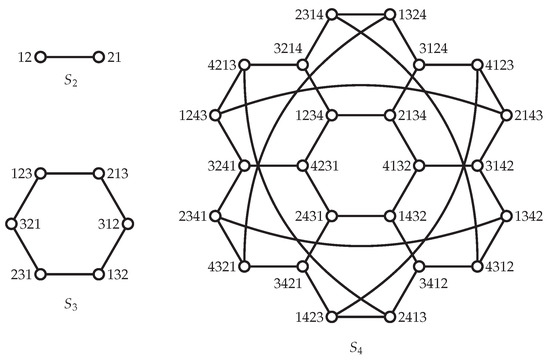
Figure 1.
The 2,3,4-dimensional star graphs.
Definition 1.
An n-dimensional star graph is a graph with vertices labeled with permutations in . There is an edge between two vertices in if and only if one vertex can be obtained from another one by swapping the symbol of the first position and the i-th position where .
Moreover, the star graph is a vertex- and edge-transitive graph with regular degree (see Figure 1).
Lemma 1
([30]). If , then the girth of is 6.
Lemma 2
([28,31]). If , then .
Lemma 3.
For two non-negative integers and , the h-extra edge connectivity of n-dimensional star graph satisfies that
Proof.
If and , let X be an -path in . By Lemma 1, the induced subgraph is also an -path. Assume that F is the set of edges with exactly one end in X. Then, we have
It is easy to see that has exactly two components, one of which is the -path X. Since for , F is an h-extra edge-cut of . Therefore,
If or , let X be a 6-cycle in , and F be the set of edges with exactly one end in X. Then, we have .
Clearly, has two components, one of which is the 6-cycle X. Since for , F is an h-extra edge-cut of . Hence,
By (1) and (2), the lemma follows. □
Theorem 1.
For two non-negative integers and , the h-extra edge connectivity of n-dimensional star graph is
Proof.
Let F be a minimum h-extra edge-cut of . Then, . Clearly, there are exactly two components in , denoted by X and Y, respectively. We assume without loss of generality.
By Lemma 3, we only need to show that
Based on the minimum degree of X and Y, we consider the following two cases:
Case 1. and .
Notice that F is also a 2-edge-cut of . By Lemma 2, we know that the size of a minimum 2-edge-cut of is . Then, we have .
If and the inequality holds. Therefore,
Case 2. or .
Without loss of generality, suppose that a vertex v in X satisfies .
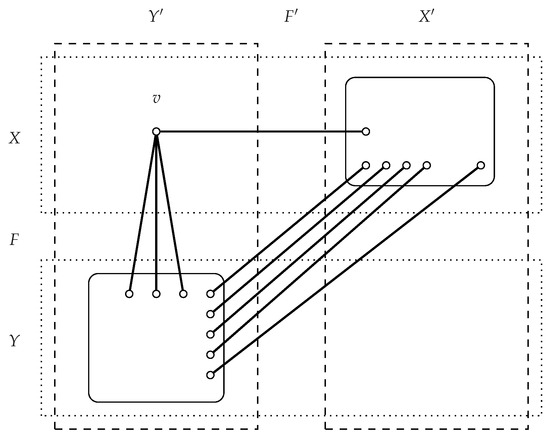
Since F is an h-extra edge-cut of , and . If then . Let , . Clearly, since . Let be the set of edges between and . Then, we have . One can see that for (see Figure 2). Therefore, is a smaller set of the h-extra edge-cut than F, a contradiction. It follows that . By Lemma 1 and , the subgraph of induced by X is a tree. Therefore, .
Figure 2.
An illustration for the proof of Case 2 of Theorem 1.
If and we have
If or , we have that the inequality holds. Hence,
By (4)–(6), the inequality (3) is satisfied. Hence, the theorem follows. □
Corollary 1
([28]). If , then , .
Corollary 2.
If , then , . If , then . Moreover, .
3. Extra Edge Connectivity of
In this section, we focus on the h-extra edge connectivity of Cayley graphs generated by transposition trees other than the star.
Lemma 4
([23]). If , then the girth of is 4, and .
Lemma 5
([28]). If , then .
Lemma 6.
For two non-negative integers and , the h-extra edge connectivity of satisfies
Proof.
If and , let X be an -path in . Let F be the set of edges with exactly one end in X. Then, we have .
Clearly, has two components, one of which is the -path X. Since for , F is an h-extra edge-cut of for . Thus, we have
If or , suppose that X is a 4-cycle of . Let F be the set of edges with exactly one end in X. Then, we have . Clearly, has exactly two components, including the 4-cycle X and a large component . Since for , F is an h-extra edge-cut of . Thus, we have
By (7) and (8), the lemma holds. □
Theorem 2.
For two non-negative integers and , the h-extra edge connectivity of is
Proof.
Let F be a minimum h-extra edge-cut of . Then, . By Lemma 6, we only need to show that
Since F is a minimum h-extra edge-cut, there are exactly two components in , denoted by X and Y, respectively. And assume without loss of generality. According to the minimum degree of the graphs X and Y, we discuss the following two cases:
Case 1. and .
Notice that F is also a 2-extra edge-cut of . By Lemma 5, we know that the size of a minimum 2-extra edge-cut in is . Thus, .
If and , then the inequality holds. Hence,
If or , we have
Case 2. or .
Without loss of generality, suppose that and there exists a vertex v in X such that . An analysis similar to that in the proof of Theorem 1 shows that . By Lemma 4 and the fact that , we know that the subgraph induced by X is a tree. Thus, we have
Hence, if or , we have
By (10)–(13), the inequality (9) holds. Hence, the theorem holds. □
Corollary 3
([28]). If , then . Moreover, .
The n-dimensional bubble-sort graph was first introduced by Akers et al. [21]. It has high symmetry and a hierarchical structure [32]. In addition, is a Cayley graph , where is an n-path; thus, belongs to . In other words, an n-dimensional bubble-sort graph is a graph with vertices labeled with permutations on where two vertices are adjacent in if and only if there exists such that one vertex can be obtained from another by swapping the symbol of the i-th position and the -th position (see Figure 3). Many properties of have been explored, such as the h-connectivity [33], embedded connectivity [34,35], and conditional diagnosability [36].
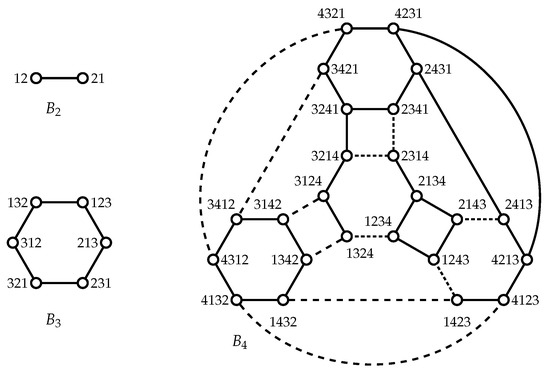
Figure 3.
The -dimensional bubble-sort graphs.
For , let be the subgraph of induced by the vertices with i in the n-th position. Then, is also a Cayley graph generated by a transposition tree. The collection } forms a decomposition of with dimension n. For a vertex , we call the neighbors of u in external neighbors of u. Moreover, for , we call the edges between and crossing edges.
Lemma 7
([25]). For two distinct integers in , the following is true:
(1) Each vertex in has exactly one external neighbor.
(2) There are independent edges between and .
Let F be an h-extra edge-cut of with minimum cardinality. Let X be a connected component in and Y be the subgraph . For any , let
Let , , and .
Let , , and . Then, . By the symmetry of X and Y, we assume that . Let F be a minimum h-extra edge-cut of such that and is as large as possible. Let denote all the crossing edges between X and Y. For and , by Lemma 7, there are independent edges between and . Therefore,
Because , is isomorphic to and is not connected, by Lemma 4, we have
Theorem 3.
, .
Proof.
For , let X be the subgraph in induced by and F be the edges between X and (see the dotted edges in Figure 3). It is easy to see that F is a 4-extra edge-cut in , that is, .
For , let X be the subgraph induced by . Let F be the edges between X and (see the dashed edges in Figure 3). It is easy to see that F is a 5-extra edge-cut in , that is, .
Now we only need to prove that , . For , let F be a minimum h-extra egde-cut in . It suffices to show that . We consider two cases as follows:
Case 1. .
In this case, note that ; hence, . Note that . Recalling that , by (14) and (15), we have,
Case 2. .
In this case, .
If , without loss of generality, we assume that X is contained in . Then, . Therefore, .
If , assume that . Then, . Thus, . That is to say, there are at most edges between and . By Lemma 7, there are eight independent edges between and . Therefore, there are at least edges between and . Then, . Hence, .
If , by (15), we have .
That is to say, , and the theorem follows. □
Lemma 8.
If , then and .
Proof.
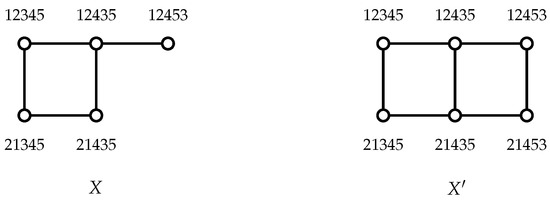
Since is not , contains two disjoint subgraphs isomorphic to and , respectively. Without loss of generality, assume that is the edge in , and are the two edges in .
For , let X be the subgraph in induced by the five vertices, which have the first five positions with 12,345, 12,435, 21,435, 21,345, 12,453 and the last positions with . Note that , , and are the edges in . Let F be the edges between X and . Note that has no odd cycle, and there are no edges linking 21,345 and 12,453 since we cannot obtain the vertex 21,345 by swapping two symbols in the vertex 12,453. Thus, there are exactly five edges in X (see Figure 4). Therefore, . We can also obtain that has two components, and both of them contain at least five vertices. Hence, F is a 4-extra edge-cut in , that is, .
Figure 4.
The subgraph in .
For , let be the subgraph induced by the six vertices which have the first five positions with 12,345, 12,435, 12,453, 21,453, 21,435, 21,345 and the last positions with (see Figure 4). Let F be the edges between and . Note that , , and are the edges in , and there are exactly seven edges in (see Figure 4). Therefore, . Therefore, F is a 5-extra edge-cut in , that is, . □
Lemma 9.
If , , F is a minimum h-extra edge-cut in , then .
Proof.
If , then , that is to say, .
Note that ; hence, . Note that . By (14) and (15), we have,
Together with Lemma 8, we have and , a contradiction. □
Theorem 4.
If , then and .
Proof.
By Lemma 8, it suffices to show that
We prove (16) by induction on n. When , note that is not . Then, is isomorphic to a path , and thus is four-dimensional bubble-sort graph. By Theorem 3, the conclusion (16) is correct. Assume (16) holds for with .
Let F be a minimum h-extra edge-cut in . It suffices to show that for and for .
By Lemma 9, we have . For each , let be a connected component in with minimum cardinality. We first show that
For each , if there exists a component in that has at most h vertices, we contract the component to a new vertex . Eventually, we obtain a new graph from Y, and assume that has the largest distance to the old vertices in . Then, is connected.
Let . If and , by Theorem 2, we have . If or , by Theorem 2, we have . If , by the inductive hypothesis, we have . Note that , and we always have . Then, is also an h-extra edge-cut in , and , but the component has a larger size, a contradiction. Thus, (17) always holds. Therefore, for , if is a connected component in and , then is an -extra edge-cut in .
In the following, we consider the case of . The proof of the case of is similar.
If , assume that . Then, . By (17), we have that every component in has at least five vertices. Then, is a 4-extra edge-cut in . We have by an inductive hypothesis. Note that each vertex in X has an external neighbor in . Then, . Hence, .
If , assume and . If then . Thus, is a 3-extra edge-cut in . Hence, . Note that has at least three external neighbors in . Therefore, .
If , then is a 1-extra edge-cut in ; thus, . Since , we have . Then, is a 2-extra edge-cut in . By Theorem 2, we have or , , and the graph induced by in is a 4-cycle graph. Note that has at least external neighbors in , that is, . Consequently, . Therefore, .
If , then ; thus, is a 2-extra edge-cut in , respectively. If , by Theorem 2, we have and . Therefore, . Now assume . If and , then and . Thus, the conclusion holds. If or , then induces a 4-cycle in or induces a in . We suppose the former one without loss of generality. Note that when , is isomorphic to . Each in has at most two external neighbors in for (see Figure 3). Thus, has at most two neighbors in . Therefore, . Then, .
If , assume and . If , for , is a 1-extra edge-cut in . Note that . We have . If , then or . In both cases, we have . Then, .
If , then . □
4. Conclusions
The extra edge connectivity serves as a crucial reliability measure for interconnection networks. This paper deals with the h-extra edge connectivity of Cayley graphs generated by transposition trees, focusing on the case where h is less than 6. As a key contribution, we establish the h-extra edge connectivity for both the star graph and the bubble-sort graph for all integers . These results provide fundamental reliability measures that will facilitate future applications of and as topological models for large-scale parallel processing systems. When , novel methods will be needed to study these parameters. For a Cayley graph generated by transposition trees, we believe that there exists a close relationship between extra edge connectivity and h-edge connectivity. Observe that and , that is, for , has a minimum degree h is equivalent to has a minimum connected component which is isomorphic to . Note that has vertices. We conjecture that for .
In addition, there are several other connectivities on graphs, such as component connectivity [26] and algebraic connectivity [37]. To study these parameters for the reliability of Cayley graphs generated by transposition trees is also of interest.
Author Contributions
Conceptualization, X.-J.L. and L.-F.D.; methodology, L.-F.D., L.-X.Q., and C.S.; validation, L.-F.D. and X.-J.L.; formal analysis, L.-F.D., L.-X.Q., and C.S.; investigation, L.-X.Q.; writing—original draft preparation, L.-F.D. and C.S.; writing—review and editing, X.-J.L. and M.-J.M.; visualization, L.-F.D.; supervision, X.-J.L. and M.-J.M. All authors have read and agreed to the published version of the manuscript.
Funding
This research was funded by the National Natural Science Foundation of China (12461045, 62076039) the Shandong Provincial Natural Science Foundation (ZR2021MF012), and the Training Program for Innovation of Yangtze University (202410489021).
Data Availability Statement
Data is contained within the article.
Conflicts of Interest
The authors declare no conflicts of interest.
References
- Harary, F. Conditional connectivity. Networks 1983, 13, 347–357. [Google Scholar] [CrossRef]
- Esfahanian, A.H. Generalized measures of fault tolerance with application to n-cube networks. IEEE Trans. Comput. 1989, 38, 1586–1591. [Google Scholar] [CrossRef]
- Latifi, S.; Hedge, M.; Naraghi-Pour, M. Conditional connectivity measures for a large multiprocessor systems. IEEE Traábrega Jns. Comput. 1994, 43, 218–222. [Google Scholar] [CrossRef]
- Fàbrega, J.; Fiol, M.A. On the extraconnectivity of graphs. Discret. Math. 1996, 155, 49–57. [Google Scholar] [CrossRef]
- Balbuena, C.; Garcia-Vázquez, P. Edge fault tolerance analysis of super k-restricted connected network. Appl. Math. Comput. 2010, 216, 506–513. [Google Scholar] [CrossRef]
- Chang, N.-W.; Tsai, C.-Y.; Hsieh, S.-Y. On 3-extra connectivity and 3-extra edge connectivity of folded hypercubes. IEEE Trans. Comput. 2014, 63, 1594–1600. [Google Scholar] [CrossRef]
- Hellwig, A.; Volkmann, L. Sufficient conditions for graphs to be λ’-optimal, super-edge-connected, and maximally edge-connected. J. Graph Theor. 2005, 48, 228–246. [Google Scholar] [CrossRef]
- Gu, M.; Hao, R.; Feng, Y.-Q.; Yu, A.-M. The 3-extra connectivity and faulty diagnosability. Comput. J. 2018, 61, 672–686. [Google Scholar] [CrossRef]
- Gu, M.; Hao, R.; Cheng, E. Note on Applications of Linearly Many Faults. Comput. J. 2020, 63, 1406–1416. [Google Scholar] [CrossRef]
- Li, X.-J.; Xu, J.-M. Edge-fault tolerance of hypercube-like networks. Inf. Process. Lett. 2013, 113, 760–763. [Google Scholar] [CrossRef][Green Version]
- Li, H.; Yang, W. Bounding the size of the subgraph induced by m vertices and extra edge-connectivity of hypercubes. Discret. Appl. Math. 2013, 161, 2753–2757. [Google Scholar] [CrossRef]
- Meng, J.; Ji, Y. On a kind of restricted edge connectivity of graphs. Discret. Appl. Math. 2002, 117, 183–193. [Google Scholar] [CrossRef]
- Yang, W.; Li, H. On reliability of the folded hypercubes in terms of the extra edge-connectivity. Inf. Sci. 2014, 272, 238–243. [Google Scholar] [CrossRef]
- Yang, W.; Lin, H. Reliability evaluation of BC networks in terms of the extra vertex- and edge-connectivity. IEEE Trans. Comput. 2014, 63, 2540–2548. [Google Scholar] [CrossRef]
- Zhang, Z. Sufficient conditions for restricted-edge-connectivity to be optimal. Discret. Math. 2007, 307, 2891–2899. [Google Scholar] [CrossRef]
- Zhang, M.; Meng, J.; Yang, W.; Tian, Y. Reliability analysis of bijective connection networks in terms of the extra edge-connectivity. Inf. Sci. 2014, 279, 374–382. [Google Scholar] [CrossRef]
- Zhu, Q.; Xu, J.-M. On restricted edge connectivity and extra edge connectivity of hypercubes and folded hypercubes. J. Univ. Sci. Technol. China 2006, 36, 249–253. [Google Scholar]
- Zhu, Q.; Xu, J.-M.; Hou, X.; Xu, M. On reliability of the folded hypercubes. Inf. Sci. 2007, 177, 1782–1788. [Google Scholar] [CrossRef]
- Zhang, M.; Zhang, L.; Feng, X. Reliability measures in relation to the h-extra edge-connectivity of folded hypercubes. Theor. Comput. Sci. 2016, 615, 71–77. [Google Scholar] [CrossRef]
- Zhang, M.; Zhang, L.; Feng, X.; Lai, H.-J. An O(log2(N)) algorithm for reliability evaluation of h-extra edge-connectivity of folded hypercubes. IEEE Trans. Reliab. 2018, 67, 297–307. [Google Scholar] [CrossRef]
- Akers, S.B.; Krishnamurthy, B. A group-theoretic model for symmetric interconnection networks. IEEE Trans. Comput. 1989, 38, 555–566. [Google Scholar] [CrossRef]
- Ajima, Y.; Kawashima, T.; Okamoto, T.; Shida, N.; Hirai, K.; Shimizu, T.; Hiramoto, S.; Ikeda, Y.; Yoshikawa, T.; Uchida, K.; et al. The tofu interconnect D. In Proceedings of the IEEE International Conference on Cluster Computing, Belfast, UK, 10–13 September 2018; pp. 646–654. [Google Scholar]
- Cheng, E.; Lipták, L.; Shawash, N. Orienting Cayley graphs generated by transposition trees. Comput. Math. Appl. 2008, 55, 2662–2672. [Google Scholar] [CrossRef]
- Araki, T. Hyper hamiltonian laceability of Cayley graphs generated by transpositions. Networks 2006, 48, 121–124. [Google Scholar] [CrossRef]
- Cheng, E.; Lipták, L. Linearly many faults in Cayley graphs generated by transposition trees. Inf. Sci. 2007, 177, 4877–4882. [Google Scholar] [CrossRef]
- Guo, L.; Zhang, M.; Zhai, S.; Xu, L. Relation of Extra Edge Connectivity and Component Edge Connectivity for Regular Networks. Int. J. Found. Comput. Sci. 2021, 32, 137–149. [Google Scholar] [CrossRef]
- El-Shanawany, R.; El-Sheikh, S.A.; Halawa, S.R.; Shabana, H. Graph Based Approach for Error-Detecting and Correcting Codes. Appl. Math. Inf. Sci. 2022, 16, 995–1003. [Google Scholar]
- Yang, W.; Li, H.; Meng, J. Conditional connectivity of Cayley graphs generated by transposition trees. Inf. Process. Lett. 2010, 110, 1027–1030. [Google Scholar] [CrossRef]
- Xu, J.-M. Topological Structure and Analysis of Interconnection Networks; Springer: New York, NY, USA, 2010; pp. 1–38. [Google Scholar]
- Cheng, E.; Lipman, M.J.; Lipták, L. Strong structural properties of unidirectional star graphs. Discret. Appl. Math. 2008, 156, 2939–2949. [Google Scholar] [CrossRef]
- Li, X.-J.; Xu, J.-M. Generalized measures for fault tolerance of star networks. Networks 2014, 63, 225–230. [Google Scholar] [CrossRef]
- Lakshmivarahan, S.; Jwo, J.-S.; Dhall, S.K. Symmetry in interconnection networks based on Cayley graphs of permutation groups: A survey. Parallel Comput. 1993, 19, 361–407. [Google Scholar] [CrossRef]
- Li, X.-J.; Zeng, X.-Q.; Xu, J.-M. Generalized measures of fault tolerance for bubble sort networks. Appl. Math. Comput. 2019, 363, 124630. [Google Scholar] [CrossRef]
- Li, X.-J.; Dong, Q.-Q.; Yan, Z.; Xu, J.-M. Embedded connectivity of recursive networks. Theor. Comput. Sci. 2016, 653, 79–86. [Google Scholar] [CrossRef]
- Yang, Y.; Wang, S.; Li, J. Conditional connectivity of recursive interconnection networks respect to embedding restriction. Inf. Sci. 2014, 279, 273–279. [Google Scholar] [CrossRef]
- Zhou, S.; Wang, J.; Xu, X.; Xu, J.-M. Conditional fault diagnosis of bubble sort graphs under the PMC model. Adv. Intell. Syst. Comput. 2013, 180, 53–59. [Google Scholar]
- Lin, Z.; Zhang, R.; Wang, J. Some New Lower Bounds on the Algebraic Connectivity of Graphs. Contrib. Math. 2023, 7, 53–59. [Google Scholar] [CrossRef]
Disclaimer/Publisher’s Note: The statements, opinions and data contained in all publications are solely those of the individual author(s) and contributor(s) and not of MDPI and/or the editor(s). MDPI and/or the editor(s) disclaim responsibility for any injury to people or property resulting from any ideas, methods, instructions or products referred to in the content. |
© 2025 by the authors. Licensee MDPI, Basel, Switzerland. This article is an open access article distributed under the terms and conditions of the Creative Commons Attribution (CC BY) license (https://creativecommons.org/licenses/by/4.0/).