


Advancing Tensor Theories

Independent Researcher, 13 Allee Turcat Mery, 13008 Marseille, France
Symmetry 2025, 17(5), 777; https://doi.org/10.3390/sym17050777
Submission received: 18 March 2025
/
Revised: 12 May 2025
/
Accepted: 13 May 2025
/
Published: 16 May 2025
(This article belongs to the Special Issue Advances in Topology and Algebraic Geometry)
Abstract
This paper advances the foundations of tensor and category theories by introducing novel concepts and rigorous constructive proofs. We generalize tensor theory through the innovative notion of a generalised tensor index, a versatile framework that unifies diverse tensor indices, and explore its transformation properties. Using fractional derivatives, we provide a geometrical interpretation of these generalised tensors, revealing new insights into its structure. Additionally, we forge a deep connection between tensor and category theories, integrating sets, tensors, categories, and functors with extensions like partial differentiation and integration. This synthesis yields original constructs—setorial tensors, categorial tensors, and functorial tensors—which open uncharted pathways in mathematical analysis. Our contributions not only extend prior research but also significantly enhance tensor theory, category theory, set theory, logic, topology, algebraic geometry, foundations, and philosophy, with potential applications spanning physics, geometry, and beyond.
1. Introduction
This manuscript focuses on the core concepts rooted on tensor theory and category theory, integral components of mathematical logic, topology, algebraic geometry, foundations, and philosophy. These mathematical disciplines hold significant relevance in elucidating innovative mathematical and scientific ideas. Here, we expand upon foundational tensor and category theory concepts.
In 1975, Gregorio Ricci-Curbastro and Tullio Levi-Civita’s seminal work, “Methodes de Calculs Differentiel Absolute et Leur Application” [1], marked a significant milestone in the development of tensor calculus, now recognised as tensor theory. Over time, diverse investigations have delved into intersections of tensor theory with mathematical analysis, differential geometry, and topology, including the previous study [2], which introduced tensors with maximal symmetries, extending into realms like representation theory, computer science, computational complexity, and algebraic geometry. In this paper, we further advance the concepts established in prior research by extending the tensor framework. Specifically, we introduce the generalised tensor index, a versatile descriptor encompassing various tensor indices. This novel notation, is useful to describe concepts beyond tensors which only have input vectors and their dual vectors. In particular, E.J. Cartan [3] introduced triality as a generalisation of vector space duality. We propose “D-ality” as a further extension, where a tensor maps D vector spaces to a scalar (D-ality generalises duality () and triality () to arbitrary D, aligning with higher-dimensional tensor structures).
Category theory provides a vantage point akin to a “far-distant observer view” in mathematics [4], where intricate details fade into obscurity, revealing previously hidden patterns. It beckons us to ponder: How does the direct sum of vector spaces relate to the least common multiple of numbers? What unites free groups, fields of fractions, and discrete topological spaces? Category theory not only explores these inquiries but also unveils profound connections in mathematics and physics that elude closer scrutiny [5]. This document draws inspiration from modern category theory definitions [6] and refines them, ushering in a new perspective. In particular, we redefine categories with brevity, introduce the concept of a signature, and employ graphical representations. These novel viewpoints shed fresh light on categories, akin to how algebra bridges diverse mathematical realms. Moreover, contemporary developments in category theory have given rise to sophisticated notions like ∞-categories, ∞-functors, and ∞-cosmoi [7,8], expanding the horizons of mathematical exploration.
In this paper, we introduce a generalised indexing framework, where indices are drawn from a universal set of numbers, encompassing structures like integers, real, complex, and beyond numbers. This hierarchical system extends traditional multi-index sets, commonly used in partial differential equations and numerical analysis [9], by allowing nested indices with recursive dependencies, akin to tree-based structures in computational mathematics [10,11] and tensor indices in tensors in differential geometry [12,13]. Our framework offers a versatile tool for modelling complex dependencies in algebraic and computational contexts, opening avenues for both rigorous applications and exploratory generalisations of classical indexing methods. We aim to provide a foundation for new mathematical structures while inviting further development of this flexible, nested indexing paradigm.
The concept of fractional derivatives was introduced by a letter written to Guillaume de l’Hôpital by Gottfried Wilhelm Leibniz in 1695. It found applications in fractional dynamical systems [14]. Then, it found applications in fractional differential geometrical aspects [15,16]. In particular, Calcagni [17], focused on explaining that the fractional derivative describes a new sub-manifold to a point of an original manifold, which is not the same sub-manifold as the one described by a standard derivative. Fractional calculus extends standard differentiation to non-integer orders, enabling the description of complex geometric structures, such as fractional tangent submanifolds [17]. The fractional derivative captures intermediate behaviours between integer-order derivatives, as formalised by Caputo definitions. In differential geometry, Calcagni [17] showed that fractional derivatives describe submanifolds distinct from standard tangent spaces, offering new insights into tensor transformations. Additionally, an extension of our study is to consider the two-scale fractal derivative, which combines local and non-local scaling, provides an alternative framework for modelling hierarchical tensor structures. Furthermore, our study potentially finds applications in Hilfer fractional Cauchy value problems of Sobolev type [18]. The exploration of two-scale fractal derivatives offers a promising avenue for extending the hierarchical and non-local structures of generalised tensors, particularly in fractional geometry [19,20]. These derivatives, with applications in material science and population dynamics, could further enrich the theoretical and practical implications of our proposed framework. These interesting aspects are left for a future work.
Fractional calculus was successfully applied to physics [21] and in particular to quantum mechanics, creating the concepts of fractional schrodinger equation [22]. In this study we develop further fractional calculus, and we introduce generalised tensors which have the concept of fractional differentials. In extend, we develop further tensor calculus and tensor theories.
Furthermore, we establish a linkage between category theory, tensor theory, and set theory, investigating amalgamations of sets, tensors, categories, functors, and their extended counterparts. We construct categories and functors using generalised tensors, defining categorial tensors with categories as elements and functorial tensors with functors as elements.
Category theory and tensor theory, with their rich contemporary and recent applications spanning fields like physics, as evidenced in Feynman diagrams [23], cosmology, and the study of functors of actions [24], statistics, and computer science [25], as well as epidemiology [26], underscore their paramount significance. Thus, it is imperative to further cultivate and solidify the foundational concepts within category and tensor theories, encompassing the fundamental notions of categories, functors, tensors, and their multifaceted interplay.
According to the criteria presented in [27], our manuscript is a description of a good, important, and novel mathematical and philosophical concepts for the following reasons. We describe the criteria and then we give at least one example from our paper, that renders our work mathematically and philosophically important. Note that the evaluation of the importance criteria, as well as the philosophical and mathematical novelty, of the work has been evaluated by the author. The interested reader can provide an alternative evaluation. The satisfied importance criteria are the following:
- 1.
- Good mathematical problem solving (e.g., a major breakthrough on an important mathematical problem); This paper solves the problem of how to find further what are the foundations of tensor theory and category theory, by implementing generalised concepts within these theories, and ultimately combining them.
- 2.
- Good mathematical technique (e.g., a masterful use of existing methods or the development of new tools); We use the substitution method, where the simple index is substituted with an index of index and so on. We construct generalised components of the tensors which results to the generalised tensor theory structures. We also use the substitution method to both category theory and tensor theory to create the generic concepts such as tensorial set, setorial tensor, tensorial category, categorial tensor, tensorial functor, and functorial tensor.
- 3.
- Good mathematical insight (e.g., a major conceptual simplification or the realisation of a unifying principle, heuristic, analogy, or theme); In this study, we considered a heuristic argument to construct a generic concepts such as the generalised tensor, as well as the categorial tensor and the tensorial category, but the unifying principle of the method of substitution.
- 4.
- Good mathematical discovery (e.g., the revelation of an unexpected and intriguing new mathematical phenomenon, connection, or counter example); This study finds an unexpected results such as the generalised tensor, as well as the connections between the concepts of category theory and tensor theory, such as the tensorial category and categorial tensor.
- 5.
- Good mathematical application (e.g., to important problems in physics, engineering, computer science, statistics, etc., or from one field of mathematics to another); This study finds important applications in physics since it connects the concepts of category theory and tensor theory, and their combinations, since both category theory and tensor theory find applications in physics. Furthermore, we expect that the combination of the concepts between the two theories will find further applications in physics.
- 6.
- Rigorous mathematics (with all details correctly and carefully given in full); This paper is mathematically rigorous, since it construct every definition, theorems, and proofs in detail.
- 7.
- Beautiful mathematics (e.g., the amazing identities of Ramanujan, results which are easy (and pretty) to state but not to prove); The construction of the definition of the generalised concepts in tensor theory and category theory, such as functors of functors, generalised tensor, categorial tensor, and tensorial category are easy to state, but difficult to prove, since we need to make several substitution in their individual components.
- 8.
- Elegant mathematics (e.g., Paul Erdos concept of proofs from The Book, achieving a difficult result with a minimum of effort); The construction of the definition of the generalised concepts in tensor theory and category theory, such as generalised tensor, categorial tensor, and tensorial category, with the minimum effort, i.e., using the simple substitution method makes them easy to prove, and creates a difficult result. We also use the functor of proof, which is a generalisation of the substitution method, in order to prove the Theorem 1.
- 9.
- Creative mathematics (e.g., a radically new and original technique, viewpoint, or species of result); The structure of the definitions of the generalised concepts in category theory and tensor theory, such as generalised tensor, setorial tensor, and tensorial set shows the creativity of our work. The creativity is also shown by the connection between the category theory and tensor theory with the creation of categorial tensor and tensorial category. We have created the functor of proof.
- 10.
- Useful mathematics (e.g., a lemma or method which will be used repeatedly in future work on the subject); The method of substitution of simple components with more generalised ones was used, and it is going to be used repeatedly in the future. The generalised tensors are used to compress information, more than a standard tensor does. Generalised tensors are capturing aspects of fractional geometry, in a economical way.
- 11.
- Deep mathematics (e.g., a result which is manifestly non-trivial, for instance by capturing a subtle phenomenon beyond the reach of more elementary tools); The creation of the generic concepts of generalised tensor, with and without the use of fractional derivatives, categorial tensor, and tensorial category, as a foundation, as well as the application of connecting category theory and tensor theory show the mathematical deepness of our study.
The structured path of this paper is as follows. Section 2 introduces fresh insights into tensor theory. In Section 3, we present the properties of these tensors. In Section 4, we describe the geometrical interpretation of the general tensors using fractional derivatives in Section 4, while in Section 4.3, we describe the geometrical interpretation in some generic way. In Section 5 we shed light on noteworthy applications stemming from tensor and category theories. In Section 6, we draw our paper to a close. Lastly, in Appendix A, we provide three tables with our notation and glossary for our document.
2. Tensor Theory
In this section, we present a review of the definition of a tensor, and we develop further some novel definitions on generalised tensors concepts.
2.1. Standard Tensor Definitions
In this section, we introduce the standard tensor definitions, that we are going to generalise in the next sessions.
Definition 1.
The set of all tensors of type (q,p) is called the tensor space of type (q,p) and it is denoted by .
Definition 2.
Let two tensors, and . Then, the tensor product is defined as
or
and it is the element of the tensor space, . Thus, we write .
Definition 3.
The generalisation of the dual vector is called a tensor and is defined as the multi-linear object that maps distinct vectors and dual vectors to a scalar. A tensor, T, of type is a multilinear representation that maps p dual vectors and q vectors to , and we write
Definition 4.
The tensor product, V is defined as the tensor product of a dual vectors and vectors
Definition 5.
In short, a tensor, T, of type is a multilinear representation that maps the vector product, V, of p dual vectors and q vectors to , and we write
Example 1.
A tensor represents a real number vector. Thus, it can be recognised as a dual vector. A tensor of type is a vector. If ω represents a map of two binary vectors and a vector to a scalar, i.e., , then it is a (1,2) tensor.
By introducing a basis for the tensors as
we can write the tensor in the form of components. Therefore, we write
or we can also write
A tensor in a d-dimensional space will have components. A tensor acts on a set of vectors and dual vectors as
Another operation that tensor have is the operation of contraction. A contraction of first order of a tensor of -rank is a map between a tensor of -rank to a tensor of -rank, and we write
Therefore a contraction of k-order of a tensor of -rank is a map between a tensor of -rank to a tensor of -rank, and we write
2.2. Generalisation of a Tensor
We can think of a generalisation of a tensor, by simply introducing a collection of distinct vectors, among which there are vectors and dual vectors, and a map between the collection of vectors to the collection of generic number set.
The generalisations of tensor theory introduced in this section are motivated by the desire to overcome the constraints of conventional tensor frameworks, which are limited to fixed-dimensional vector spaces and real-valued outputs. Intuitively, many natural and artificial systems—such as multi-dimensional physical fields or complex data structures—exhibit interactions that cannot be fully described by the rigid ()-rank tensors mapping to . Theoretically, this calls for a broader framework where tensors are extended to generic generalised forms, incorporating a flexible combination of vectors indexed by a generic number set , enabling mappings to diverse numerical systems (e.g., or ) that better capture the complexity of these systems. These innovations, supported by symbolic and numerical examples, aim to provide a unified and adaptable foundation for tensor operations, paving the way for applications in advanced scientific domains where traditional tensor models fall short. Below we express these ideas in theorems and proofs.
Definition 6.
Let be a generic set of numbers, then we define
- x is a variable representing the elements of the set.
- G is the domain, the larger set from which x is drawn.
- is the predicate or rule, a condition that x must satisfy to be included in .
- is the resulting set, containing all , for which is true.
Example 2.
We have the following examples:
- The natural numbers:
- The integers:
- The rational numbers:
- The real numbers:
- The complex numbers:
- The quaternions:
- The natural set, , is a subset of the generic set of numbers, i.e., .
- The integer set, , is a subset of the generic set of numbers, i.e., .
- The rational set, , is a subset of the generic set of numbers, i.e., .
- The real set, , is a subset of the generic set of numbers, i.e., .
- The complex set, , is a subset of the generic set of numbers, i.e., .
- The quartenion set, , is a subset of the generic set of numbers, i.e., .
- Any other set of numbers that we can build, for example the , is a subset of the generic set of numbers, i.e., .
Definition 7.
The generic index is defined as,
where
then
Example 3.
Let a generic index be defined as,
then
So, we can define that
to be a shortening of the definition that the each index belongs to
So we have that
Remark 1.
Note that this generic index, is different than the multi-index tuple [28]. The multi-index tuple is defined as
where
while the generic index is defined as
where
Example 4.
Let a generic index to be defined as,
then
So, we can define that
which means that each index belongs to
We leave high-order examples for a future work.
Definition 8.
Let be a generic combination of vectors defined as
where is a vector of the generic combination of vectors, and denotes the index of the indices, ℓ, and is the generic set of numbers, for any , and is the lower bound of the lowest index i, while is the maximum bound of the highest index, . Consider that the generic index is defined as, . Considering that the generic vector is defined as , in short, we can define the generic combination of vectors as
Example 5.
We can build a vector as a ()-rank tensor product, which is simply defined as
where the last equation is a shortest way of describing the vector, by considering the tensor product. We can also write the vector as
where
where , and .
Example 6.
We can build a tensor T as a ()-rank tensor, where each rank has three components, in the form of matrices, which are simply defined as
where each generic index , and each component .
We leave higher-order generalised tensor examples for a future work. Given these definitions and examples, we proceed describing the theorem of generic generalised tensor and its proof.
Theorem 1.
Let be a generic generalised tensor, and be a generic number set. Let be a generic combination of vectors, denote a vector of the generic combination of vectors, with generic index, , where i is the index of j which is the index of the indices of k, of the indices, ℓ, for any , and is the lower bound of the lowest index i, while is the maximum bound of the highest index, , and
be a generic vector product operator. If the generic combination of vectors is constructed via
then the generic generalised tensor maps the generic combination of vectors to the generic number set, and we write
or in short
Proof.
To prove the Theorem 1, in formal mathematical language, we consider the following. The tensor of vectors and their duals is defined, as stated before in Section 2.1, as
To generalise this concept, we introduce the space between upper, U, and lower, L, indices by assuming that we have the first upper layer of indices, , then , and so on up to the lowest layer of indices, , and we write
where is the basis of the ()-rank tensor, which is simply defined as
Note that we have used the Definition 8 and Example 5 previously explained. Therefore, the generalised tensor is simply written as
Note that if this tensor has dimension d, then it will have components. In this case, we write the generalised tensor as
This means that we have the vector , where the index specifies each vector for every j, while the index i indicates the indexation or how lower is the index from the most upper index. Now we generalise the initial value of the indices,
Considering another layer of generalisation of the generalised tensor, we can think of the generic generalised tensor, , using the functor notation as
where is a generic vector, and denotes the index of the indices, ℓ, namely a generic index, . Now what we need to do is build another layer of generalisation since the previous generic generalised tensor only maps the combination of vectors to the real numbers . Therefore, we can make the generic generalised tensor map the combination of vectors to the complex numbers, , or a generic space of numbers named as ; thus, we obtain that the generic generalised tensor is defined as the map:
In this instance, we can define the generic combination of vectors
where , and i is the index of j which is the index of the indices of k, and is the lower bound of the lowest index, i, and the maximum bound of the highest index . Therefore, by collecting this information together, it is easy to show that the generic generalised tensor is simply the map between the generic combination of vectors to the generic number set, written as
□
Remark 2.
The basis vector of this generic generalised tensor is defined as
where denotes the components of basis vector.
3. Properties
In this section, we review the concept of the definition of a tensor using using 1-forms and partial derivatives, and their corresponding transformations. The generalisations presented in this section are driven by the need to model complex systems where traditional tensor frameworks, reliant on integer-order derivatives and rigid coordinate transformations, fall short. Intuitively, phenomena such as viscoelastic materials, anomalous diffusion, or fractal geometries exhibit memory-dependent or non-local behaviours that are better captured by fractional partial derivatives, extending the classical 1-forms and partial derivatives used to define standard tensors. Theoretically, this motivates the introduction of generalised tensors—incorporating fractional derivatives of order or —which allow for a richer description of multi-rank structures and their transformations across coordinate systems, reflecting symmetries and dynamics beyond integer-order constraints. These innovations, applied to tensor products, contractions, and index manipulations, aim to quantify properties like geometric invariance and topological connections in a unified framework, offering new tools for physics, engineering, and applied mathematics where standard tensor analysis is inadequate.
Then, we introduce the concept of fractional partial derivatives. Then, we introduce the concept of generalised tensors, using 1-forms, partial derivatives, and fractional partial derivatives. Then, we construct the transformation of generalised tensors, using 1-forms, partial derivatives, and fractional partial derivatives. We construct the tensors via the infinitesimal elements and their corresponding derivatives. We perform these novel definitions, in order to quantify the properties of the tensors, such as the transformations, and the connection of tensors with geometry and topology.
3.1. Definition of Standard Tensors with 1-Forms and Partial Derivatives
We consider, a set of useful definitions of tensors is the one using infinitesimal elements, and partial derivatives.
Definition 9.
A -rank tensor is defined as
Definition 10.
A -rank tensor is defined as
Definition 11.
A -rank tensor is defined as
Definition 12.
A -rank tensor is defined as
In the next section, we considered generalised versions of these definitions of tensors.
Generalised Caputo Fractional Derivative
The Caputo fractional derivative, introduced by Michele Caputo in 1967, provides a practical framework for extending classical differentiation to non-integer orders, making it particularly suitable for modelling physical systems with memory or non-local effects [29]. For a function and fractional order , it is defined as:
where is the Gamma function. This definition integrates the first derivative , allowing initial conditions to be specified in terms of classical derivatives, such as , which aligns naturally with physical interpretations like position or velocity in tensor field applications [30].
Compared to earlier definitions, such as the Riemann–Liouville (RL) fractional derivative pioneered by Abel and Liouville [31,32], the Caputo form offers distinct advantages for applied contexts. The RL derivative, developed in the 19th century, involves a fractional integral of the function itself, requiring fractional-order initial conditions that are less intuitive for physical systems. For instance, the RL derivative of a constant is non-zero, whereas the Caputo derivative yields zero, mirroring classical derivatives. While the RL definition excels in pure mathematical settings due to its operator properties, the Caputo definition is preferred in fields like fractional dynamics and tensor theory, as it simplifies the formulation of differential equations and numerical simulations, making it ideal for describing fractional submanifolds with physically meaningful boundary conditions [30].
In classical calculus, the partial derivative of a function with respect to x, denoted as , is defined as the derivative of f, with respect to x, while holding y and z constant. This operator forms a component of the gradient vector , enabling vector calculus operations like directional derivatives [30]. Analogously, the Caputo fractional partial derivative of order (), with respect to x, denoted as , extends this concept to non-integer orders, suitable for modelling non-local effects in tensor fields or fractional submanifolds [29]. It is defined as:
where is the Gamma function, and is the standard partial derivative, with respect to the integration variable t. The operator acts linearly on f, and can be treated as a component of a fractional gradient operator , yielding a vector of fractional derivatives:
This fractional gradient is particularly useful in applications like fractional tensor transformations, where models non-integer-order symmetries or dynamics, extending classical vector calculus to fractional-order systems [30].
Then, we can define the fractional derivative as
Then, we can define the fractional derivative to any D dimension, simply as
The Caputo fractional derivative, introduced for one-dimensional functions by Caputo [29], can be extended to D dimensions for functions defined over , particularly in applications like fractional partial differential equations and tensor field transformations [30,33]. For a fractional order associated with the i-th coordinate , the Caputo fractional partial derivative is defined as:
where is the Gamma function, and is the standard partial derivative with respect to the i-th variable, treating as constants. Analogous to the classical gradient , a fractional gradient operator can be defined as , where is the vector of fractional orders. Applying to f yields:
representing a vector of fractional partial derivatives. This operator is particularly useful in modelling non-local, fractional-order symmetries in tensor fields or fractional submanifolds, where each captures memory-dependent dynamics along the i-th dimension [33].
3.2. Definition of Generalised Tensors with 1-Forms and Partial and Fractional Partial Derivatives
Definition 13.
Let , be indices.
Definition 14.
The generalised -rank tensor is defined as
where we have used the notation of the fractional derivative, to consider the index, β, which is in between the upper index, α, and the lower index, γ.
Definition 15.
The generalised -rank tensor is defined as
where .
There is also a useful alternative definition of the tensor, which is defined as follows.
Definition 16.
The generalised -rank tensor is also defined as
where .
Remark 3.
Note that we considered for the rank of the tensor. However, in principle, we can have any number of ranks for a tensor. Hence, this tensor can be expanded by considering a combination of Ω ranks. The motivation of this generalisation is to consider a mathematical entity that can be used in mathematical descriptions of higher order ranks.
Definition 17.
The generalised -rank tensor is defined as
in which tensor there are ranks. Note that we have partial derivatives in which the denominator of the fraction of the derivative is one more than the number of fractional derivatives that the tensor is defined by.
Note the previous tensor can be describe with L ranks in a more compact form as follows.
Definition 18.
Let are indices.
In particular, we can build a generalised ()-rank tensor as follows
Definition 19.
A generalised ()-rank tensor is defined as
where we have defined
where i index defines the type of rank, while j index defines the amount of indices in the specific rank.
Remark 4.
Note that i is the index which defines the amount of fractional derivative, i.e., how many times the indices is lowered from the upper index, .
Note that we can also define a power
to be the level of the fractional derivative.
For example, we have
the one zth fractional derivative, while
the three zth fractional derivatives.
Then, the generalised ()-rank tensor is defined as follows.
Definition 20.
A generalised ()-rank tensor is defined as
3.3. Transformation
We introduce the concept of transformations of standard tensors. Then, we construct the transformation of generalised tensors, using 1-forms, partial derivatives, and fractional partial derivatives.
Transformation of Standard Tensors
Standard tensor transformations describe how tensor components change under a coordinate transformation, ensuring the invariance of physical or geometric quantities. We define these transformations for tensors of various ranks as follows.
The -rank tensor is transformed as
The -rank tensor is transformed as
A -rank tensor is transformed as
A -rank tensor is transformed as
3.4. Transformations of Generalised Tensors
Generalised tensors extend standard tensors. Therefore, we describe the generalised tensor transformations by incorporating fractional partial derivatives, which allow for modelling non-integer-order symmetries or dynamics. We define these transformations for (1, 1, 1)-rank tensors and extend them to arbitrary ranks.
We consider the generalised -rank tensor, the generalised -rank, and the generalised -rank tensor.
This generalised -rank tensor is transformed as follows:
This -rank generalised tensor is transformed as
where
The generalised -rank tensor, defined in Equation (83), is transformed as
where
Validity of Transformations of Generalised Tensors
To address the validity of these non-standard transformations involving fractional powers, we establish their mathematical consistency and physical relevance. The fractional derivatives, such as , are defined using the Caputo fractional derivative given by Equation (69), and we write:
where is the Gamma function, ensuring a well-defined operator that generalises the classical derivative. This operator preserves multilinear properties under coordinate transformations, as the transformation law extends the standard tensor transformation by incorporating the fractional chain rule. For a coordinate change , the fractional derivative transforms as , maintaining consistency with fractional calculus principles (Podlubny, 1999). Physically, this is validated in systems like fractional quantum electrodynamics, where non-local interactions (e.g., ) model memory-dependent gauge fields, as shown in Section 5.4. A simple example with and a linear transformation yields , confirming the law’s correctness. Thus, these transformations are a valid generalisation, extending tensor algebra to fractional geometries and dynamics.
3.5. Basic Operations
Basic tensor operations, such as tensor products, contractions, and index raising/lowering, manipulate tensor structures to compute invariants or reduce ranks. We extend these operations to generalised tensors using fractional derivatives to account for non-standard symmetries.
In this section, we introduce the concept of basic operations of standard tensors. The basic operations include tensor product, contraction, raising or lowering an index. Then, we construct the basic operations of generalised tensors, using 1-forms, partial derivatives, and fractional partial derivatives.
3.5.1. Standard Tensor Product
We consider the -rank tensor, S, and the -rank tensor, T. Then, the standard tensor product, ⊗, is defined as
3.5.2. Standard Tensor Contraction
We consider the -rank tensor, S, and the -rank tensor, T. Then, the standard tensor contraction of tensor, S, is defined as follows. The contraction of the first index is defined as
The contraction up to p-index is defined as
The contraction up to p-up index and q-down index of two tensors are defined as
3.5.3. Standard Tensors’ Lowering and Rising Indices
We consider the -rank tensor, S, and the -rank tensor, T. Then, the standard tensor contraction of tensor, S, is defined as follows. The lower the first p upper indices rising the first q lower indices is defined as
The contraction up to p-index is defined as
The contraction up to p-up index and q-down index of two tensors is defined as
3.5.4. Generalised Tensor Contraction
We consider the generalised -rank tensor, which is given via
Then, the contraction of this object from -rank tensor to a -rank tensor, is given by
We consider the generalised -rank. The contraction from generalised -rank to generalised -rank is given by
We consider the generalised -rank tensor. The contraction from generalised -rank to generalised -rank is given by
3.5.5. Generalised Tensors’ Lowering and Rising Indices
We can consider the tensor
Then we can consider a standard metric, which is
which the upper indices will increase one layer upwards an index of a tensor, while the lower will move an index one layer downward for a tensor.
Then, we can make the tensor have the upper index to move to the middle, while the middle can move to the upper layer using the following operation
while we can also have
or
Then, we can lower and upperthe indices as follows
We consider the -rank tensor, S, and the -rank tensor, T. Then, the standard tensor contraction of tensor, S, is defined as follows. The lower the first p upper indices, rising the first q lower indices is defined as
The contraction up to p-index is defined as
The contraction up to p-up index and q-down index of two tensors is defined as
4. Geometrical Interpretation of Generalised Tensors Using Fractional Derivatives
The generalisations explored in this section are motivated by the need to interpret complex, non-local phenomena in geometry and topology through the lens of fractional derivatives, extending the classical framework of infinitesimal elements and standard derivatives. Intuitively, natural systems such as fractal landscapes, anomalous diffusion processes, or viscoelastic materials exhibit scale-dependent behaviours that transcend the local linearity of classical derivatives, necessitating a fractional approach to capture their memory-dependent geometry. Theoretically, this drives the development of generalised tensors with hierarchical indices and fractional derivatives—such as the -order derivative—enabling a richer geometrical interpretation that models fractional submanifolds, non-local curvature, and multi-layered interactions on manifolds, as inspired by works like Calcagni [17]. These innovations, supported by 1D and 2D examples, aim to bridge tensor calculus with fractional geometry, offering new insights into the topological and geometrical properties of advanced physical and mathematical systems.
In this section, we introduce the geometrical interpretation of the generalised tensors. Firstly, we introduce the geometrical interpretation of of standard infinitesimal, derivatives, and fractional derivatives in 1D and 2D examples. Then, we describe the geometrical interpretation of fractional derivatives used in generalised tensors.
4.1. Geometrical Interpretation of Infinitesimals, Derivatives, and Fractional Derivatives
In this subsection, we introduce the geometrical interpretation of standard infinitesimal, derivatives, and fractional derivatives in 1D and 2D examples.
4.1.1. Classical Derivative and Infinitesimal in 1D
In classical calculus, the derivative of a function provides a local measure of change, directly tied to the geometry of its graph. Consider the cubic function . Its first derivative, , represents the slope of the tangent line at any point x. For instance, at , the slope is , indicating that the tangent line rises 3 units vertically for every unit horizontally. The infinitesimal element denotes an infinitesimally small change in x, representing a horizontal displacement along the curve. The corresponding change in is given by the differential , which approximates the vertical displacement along the tangent line for small . Geometrically, and describe the local linear approximation of the curve , capturing the instantaneous rate of change at a point [30].
4.1.2. Extending to 2D with Classical Gradient
Extending this to two dimensions, consider a function , such as (treating y as a parameter), or more generally . The classical gradient is defined as , which for yields . This gradient vector is perpendicular to the level curves of f (e.g., in the -plane), pointing in the direction of steepest ascent. The total differential in 2D is , where and are infinitesimal displacements in the x and y directions, respectively, and represents the change in f along the tangent plane of the surface . For , , reflecting the local change along the x direction, with no contribution from y due to . This differential framework is fundamental in tensor calculus, providing the basis for local geometric properties [30].
4.1.3. Fractional Derivative in 1D
The fractional derivative, introduced by Caputo [29], generalises this concept to non-integer orders, introducing non-local effects. For , the Caputo fractional derivative of order , with respect to x, is:
where is the Gamma function, and is the standard derivative. Unlike the classical derivative, which provides the local slope of the tangent, the fractional derivative represents a non-local rate of change, incorporating the history of the function from to . Geometrically, it lacks a direct interpretation as a tangent slope but can be viewed as a weighted average of slopes over , with the weight emphasising earlier values more as decreases. This non-local behaviour is crucial for modelling memory-dependent phenomena, such as in fractional submanifolds [30].
4.1.4. Fractional Derivative in 2D
In two dimensions, the fractional derivative extends to partial derivatives for a function . The Caputo fractional partial derivatives of orders are defined as:
forming the fractional gradient , where . For , we have and , so . Geometrically, acts as a generalised normal vector to fractional level sets, reflecting non-local, memory-dependent changes in the surface . The fractional differential can be expressed as , where and remain infinitesimal displacements, but the fractional terms incorporate the history of f along each direction. This framework extends classical geometry to fractional-order systems, as applied in tensor field transformations and fractional submanifolds [30].
4.2. Geometrical Interpretation of Fractional Derivatives, Advanced
In this subsection, we describe the geometrical interpretation of fractional derivatives used in generalised tensors, as follows. Following Calcagni [17], we propose the following geometrical interpretation of fractional derivatives.
Let be a D-dimensional manifold with coordinates . Let be a point on , and an infinitesimal displacement from , with components . The classical derivative of a scalar function on constructs the tangent space at , defined by the differential:
where summation over is implied. The gradient acts as a normal vector to the level set , a -dimensional submanifold, since for any tangent vector v in the tangent space [30].
For a fractional derivative of order , with for each direction , we define the Caputo fractional partial derivative as [29]:
and the fractional differential as:
The fractional gradient generalises the classical gradient, acting as a modified normal vector to the level set . Unlike the classical case, where the gradient is strictly perpendicular () to the tangent space , the fractional gradient’s direction deviates due to its non-local nature, with the deviation depending on the orders . As , the direction approaches perpendicularity [17].
Remark 5.
The Latin indices denote the fractional orders and are not summed over, unlike the Greek index μ, which follows the Einstein summation.
Remark 6.
When for all μ, the fractional partial derivative reduces to the classical partial derivative, . The geometrical interpretation is that is perpendicular () to the tangent space of the level set at .
Remark 7.
When , the fractional gradient acts as a generalised normal vector, but its direction is not strictly perpendicular to the tangent space of the level set. The deviation from depends on the fractional orders , reflecting the non-local, memory-dependent nature of fractional derivatives, which is relevant for fractional submanifolds [30]. For example, if , the direction of incorporates historical contributions, deviating from the classical normal, though the exact angle is not simply a linear fraction of .
We can define submanifolds corresponding to fractional derivatives of different orders, such as or , each yielding a modified normal vector field via or . We illustrate this result in Figure 1.
Following the duality to triality extension [3], we can extend triality to any D-ality property.
4.3. Geometrical and Topological Interpretation
To provide a geometrical and topological interpretation, we introduce the generic index as follows.
Definition 21.
The generic index is a generic index with two nested indices, where and , such that:
This index categorises the hierarchical indices into positional roles, facilitating the interpretation of tensorial structures in terms of geometrical or categorical frameworks. For example, in gauge theory, the positional labels may correspond to different levels of gauge transformations or fractional derivatives, offering a novel perspective on non-local interactions.
Remark 9.
In standard tensor notation, indices typically denote components in a vector space or dual space, as seen in classical works like [1,34], and recent works in differential geometry [12,13]. In these frameworks, indices are either contravariant (upper) or covariant (lower), representing transformations under coordinate changes. In contrast, our generic index introduces a positional role j that is not tied to the contravariant-covariant dichotomy but instead reflects a hierarchical or layered structure. This departs from the traditional use of indices as mere component labels, as established by Ricci and Levi-Civita [1] and employed in Einstein’s general relativity [34]. Furthermore, while multi-index notation in partial differential equations [35] allows for higher-order derivatives, it lacks the categorical positional roles of . The new notation thus extends these concepts by incorporating a structured hierarchy, motivated by applications in fractional geometry [17], where nested scales require more expressive indexing.
Definition 22.
A fractional generalised tensor T is a multilinear map defined on a tensor product of vector spaces and their duals, incorporating fractional derivatives to model non-local structures in fractional geometry. Specifically, we define:
where:
- is the upper index, associated with the standard partial derivative ,
- is the middle index, linked to the fractional derivative , representing non-local interactions,
- is the lower index, corresponding to the covector basis .
Remark 10.
This tensor extends standard tensors by incorporating hierarchical indices (, , ) and fractional derivatives, motivated by applications in fractional geometry, such as modelling anomalous diffusion or fractal media [17]. Unlike traditional tensor notation, where indices are contravariant or covariant [1,34], the positional roles here reflect layered scales, enabling the representation of nested structures in fractal geometries [17], facilitating the study of geometrical and topological contexts.
Example 7.
Consider a 2-dimensional manifold with coordinates , so . Let’s take a specific component of the fractional generalised tensor, e.g., , meaning , , and . The tensor is:
Assume the tensor component for simplicity. We apply this tensor to a covector and a vector field , where and .
The tensor acts as:
First, the covector term: since , we take .
Next, for the vector field: since , we have . The fractional derivative acts on , which is constant with respect to x, so we compute the Caputo fractional derivative of order :
Since y is constant in x, , so:
However, let’s adjust to be (so ) to get a non-trivial result. Now:
Substitute , so , and when , ; when , :
Since , we have:
Now apply the standard derivative :
Thus, the tensor’s action, combining all parts, is:
At , this equates to:
This numerical result illustrates the tensor’s non-local effect due to the fractional derivative, acting on the covector and vector field to produce a scalar.
4.4. Geometrical Interpretation of a Generalised Tensor with 3 Indices: 1 up, 1 Middle, 1 Down
We interpret a fractional generalised tensor with hierarchical indices, one upper, one middle, and one lower, as defined in Definition 22. Specifically, the generalised tensor , where on a D-dimensional manifold , and denotes the Caputo fractional partial derivative of order :
The tensor T acts as a multilinear map
where is an intermediate space associated with the fractional derivative operator indexed by . The component transforms under coordinate changes as:
reflecting the contravariant nature of , the covariant nature of , and the fractional transformation of due to the order- derivative [30].
Let us examine the geometric roles of each index:
- Intermediate Index (): The index is linked to the fractional derivative , representing a non-local interaction that is not purely contravariant or covariant. It mediates between and , incorporating memory-dependent effects typical of fractional geometry [17].
In the following subsubsection, we explore possible geometric interpretations of this tensor.
4.4.1. Geometric Interpretation Possibilities
- Transformation Between Two Different Spaces or Layers: The tensor T can be interpreted as an operator mapping between spaces, with facilitating a fractional-order transformation. For example, may index a vector in of a manifold , and a covector in of another manifold . The fractional derivative associated with introduces non-local effects, modelling transformations in fractal geometries, such as anomalous diffusion on fractional submanifolds [17]. Mathematically, T acts on a vector and a covector , producing a scalar via the fractional operator indexed by .
- Multi-Layered Tensor Product or Interaction: The index can represent a non-local interaction between and . For instance, if and correspond to physical fields (e.g., velocity and stress), might index a fractional-order coupling, reflecting memory-dependent interactions in fractal media [30]. The fractional derivative ensures that the interaction accounts for the history of the fields, relevant in quantum field theory or complex geometrical structures [17].
- Higher-Order Differential Forms or Geometrical Objects: In differential geometry, T might represent a higher-order object combining vectors and forms, with indexing a fractional differential form. The fractional derivative introduces non-local geometric properties, enabling T to model structures like fractional 1/2-forms on fractal manifolds, where the non-locality captures anomalous scaling [17]. For example, T could act on a form , applying a fractional derivative via , and projecting onto a vector via .
- Curvature-like Structures: In fractional geometry, might index a fractional-order curvature or torsion component. The tensor T can generalise curvature tensors, such as the Riemann tensor, with the fractional derivative introducing non-local curvature effects. For instance, T might describe how a fractional submanifold curves or twists, with capturing memory-dependent geometric variations, relevant in advanced differential geometry [30].
4.4.2. Conclusions
The fractional generalised tensor represents complex geometric structures in fractional geometry. The hierarchical indices (, , ) and the fractional derivative associated with enable T to model transformations between spaces, non-local interactions, fractional differential forms, or curvature-like structures with memory effects. This makes T a powerful tool for studying fractal geometries, anomalous diffusion, and fractional submanifolds, with its precise interpretation depending on the specific geometric or physical context [17].
5. Applications
The generalisations in this section are motivated by the need to extend tensorial frameworks to abstract and interdisciplinary domains, such as data structuring, categorical transformations, and physical modelling, where traditional tensors are limited. Intuitively, systems like machine learning models, gauge theories, or complex datasets often involve hierarchical, non-local, or categorical relationships—such as feature interactions in neural networks, gauge field transformations, or set-based data compression—that demand a more expressive formalism. Theoretically, this inspires the introduction of generalised tensors with hierarchical indices, setorial tensors with set elements, categorial tensors with category elements, and functorial tensors with functor elements, enabling the seamless integration of tensor algebra with set theory, category theory, and functorial mappings. These innovations, supported by symbolic and numerical examples, aim to unify geometric, algebraic, and computational perspectives, providing novel tools for applications ranging from data compression to gravity and quantum field theory.
Immediate trivial applications of generalised tensor, are similar to the ones of standard tensors. In particular, generalised tensors can be used to compress the information of multiple tensors, much like tensors compress the information of vectors, and much like the vectors compress the informations of scalars. Note also that the structure of information of a vector from scalars, has immediate geometrical implications and interpretations. In the same way, the generalised tensors have also geometrical implications and interpretations. However, we will not discuss these concepts in this study, we will instead focus on expanding the more abstract applications. In particular, in this section, we construct informal definitions and their corresponding Examples for combinations of tensors, generalised tensors, generic generalised tensors, categories, functors, and sets.
5.1. Sets and Tensors
Basically a tensorial set is the standard application of the definition of a set which is applied to tensors.
5.1.1. Tensorial Set
Definition 23.
Informally, a tensorial set is a collection of tensors.
Example 8.
Let and be two tensors with distinct ranking and number of elements. Then, a tensorial set is defined as
Example 9.
Consider a 2-dimensional vector space () with coordinates . We define two tensors with distinct ranks: let be a (1,1)-rank tensor, and a (2,0)-rank tensor.
For , a (1,1)-rank tensor maps one vector and one dual vector to a scalar, i.e., . In component form, , where . Assign numerical values to the components:
Thus, can be represented as a matrix:
For , a (2,0)-rank tensor maps two dual vectors to a scalar, i.e., . In component form, , where . Assign numerical values:
Thus, is represented as:
The tensorial set is then defined as the collection of these tensors:
To illustrate its use, apply to a dual vector (i.e., ) and a vector (i.e., ):
Similarly, apply to two dual vectors and :
This tensorial set collects and , showcasing tensors of different ranks with specific numerical components, applicable in operations like those demonstrated.
5.1.2. Setorial Tensor
On the other hand, we can define a novel concept—the concept of the setorial tensor.
Definition 24.
A setorial tensor, , is a tensor with elements sets, using a generic operation between the sets, denoted as o.
Example 10.
Let us consider an Example of a setorial tensor of (2,2)-rank. Let be the elements of the ith setorial tensors, and j,k indices show the element position of the set in respect of the setorial tensor. These elements are basically distinct sets. Let the operation between these sets be the union operation . Let a setorial tensor be defined as
Let another setorial tensor be defined as
Then, we can define two operation between the two setorial tensors, the summation or sum, and the product operations. The generic summation operation is defined as
where
is the union of set, and .
Furthermore, we can define the generic product operation between two setorial tensors. In this case, we consider both the union operation, ∪, and the intersection operation ∩. The generic product operation between two setorial tensors can be defined as
where
are the corresponding union and intersections of the corresponding combinations of sets, .
Example 11.
Consider two (2,2)-rank setorial tensors and , where each element is a set, and the operation between sets is union (). Define the sets for :
so:
Define the sets for :
so:
Compute the summation , where each element is the union of corresponding sets:
Thus:
Now compute the product , using union and intersection as defined:
Thus:
This example demonstrates a setorial tensor with sets as elements, using union for summation and a combination of union and intersection for the product operation.
5.1.3. Computational Application of Setorial Tensors
Setorial tensors, defined as tensors with set elements, can be applied in computational scenarios such as data compression. Consider a dataset represented as a collection of sets , where each set contains feature tensors. A setorial tensor organises these sets into a matrix structure, and operations like union (∪) or intersection (∩) can compress redundant information. For example, in image processing, an application of Equations (123)–(137), set may represent pixel intensity sets, and the union operation (∪) merges overlapping features, reducing storage requirements. The intersection operation (∩) further aids compression by retaining only the common elements between sets, effectively filtering out non-shared data to focus on redundant features.
5.2. Categories and Tensors
Basically, a tensorial category is the standard application of the definition of a category which is applied to tensors.
5.2.1. Tensorial Category
Definition 25.
A tensorial category, , is a category with elements which are tensors and a morphism between the tensors which is a functor built with the tensor product.
Example 12.
We can construct the tensorial category, which is given by the following signature:
where and are the standard properties of composition, identity, and associativity, while is the collection of objects, in which objects are tensors, and is the collection of morphisms, which is basically the tensorial product.
Example 13.
Consider a 2-dimensional vector space () with basis vectors and dual basis . Define the tensorial category with the following objects and morphisms.
Objects (): Let the objects be two tensors:
- , a -rank tensor (vector), defined as , with components , .
- , a -rank tensor (covector), defined as , with components , .
Morphisms (): The morphism between and is the tensor product, forming a (1,1)-rank tensor :
Expanding the tensor product:
with components:
represented as the matrix:
Properties:
- Identity (): The identity morphism has the following framework:
- For is the (1,0)-rank identity tensor .
- For , .
- Applying to leaves it unchanged: .
- Composition (): Consider another tensor . The composition (a ()-rank tensor) is form a new tensor, , written as:
with components computed as , so .
- Associativity (): For tensors , , and , holds, as the tensor product is associative by definition.
Numerical Check: Apply to a covector and a vector :
This confirms the morphism acts consistently as a mapping between and , illustrating the tensorial category’s structure with numerical values.
5.2.2. Categorial Tensor
On the other hand, we can define a novel concept—the concept of categorial tensor.
Definition 26.
A categorial tensor, is a tensor with elements which are categories, and a generic morphism between categories, i.e., a functor F.
Example 14.
Diagrammatically, we have that the categorial tensor, , is a map between a source category, , to a target category, , i.e., we write:
This is equivalent to the functor, but now it has an application of a generalised tensor.
Example 15.
Consider a categorial tensor mapping from a source category to a target category , represented diagrammatically as:
Source Category (): Define a category with numerical objects and morphisms:
- Objects: (representing numbers as objects).
- Morphisms: Identity morphisms and , plus a morphism with a numerical value (e.g., ), and composition .
- This forms a simple category where objects are numbers, and morphisms are numerical transformations.
Target Category (): Define a category with:
- Objects: (doubled values of source objects).
- Morphisms: Identity morphisms , , and a morphism with , with composition .
Categorial Tensor (): Let be a (1,0)-rank tensor with elements as categories, mapping to via a functor F. Define with a component that acts on objects and morphisms:
- On objects: , (doubles the object value).
- On morphisms: , where F scales the morphism value by 2. So, , and , .
Numerical Application:
- Apply to the object :
- Apply to the object :
- Apply to the morphism with value 2:
which matches the morphism in .
Verification: Check functoriality:
- , and , satisfying composition.
- , satisfying identity.
This example shows as a tensor with category elements, using the functor F to map between and with numerical values, illustrating the tensorial action.
Definition 27.
A functorial tensor, , is a tensor with elements which are functors, and the target can by other categories, or functors.
Example 16.
Diagrammatically, we have that the functorial tensor, , is a map:
where represents a functor, which is a tensor, between category to , while represents a functor, which is a tensor, between category to .
Define the Categories:
- Category : Objects , morphisms , , and with value 1.
- Category : Objects , morphisms , , and with value 2.
- Category : Objects , morphisms , , and with value 4.
- Category : Objects , morphisms , , and with value 8.
Functors as Tensor Elements:
- : Represents a functor , defined by:
- On objects: , .
- On morphisms: , mapping the value 1 to 2.
- : Represents a functor , defined by:
- On objects: , .
- On morphisms: , mapping the value 4 to 8.
Functorial Tensor (): Define as a (1,0)-rank tensor with functors as elements, mapping to . The action of scales the functor’s morphism values by a factor (e.g., 4):
- , where the morphism values are transformed:
- , so , matching .
Numerical Application:
- Apply to :
- , , mapped by to , .
- For the morphism with value 1, , then:
corresponding to , with value 8.
- Verify with another morphism: , value 0 (identity), so:
matching .
Verification: preserves functoriality:
- Composition: , and maps this to 8, consistent with .
- Identity: maps identity morphisms to identity morphisms.
This example illustrates as a tensor with functors as elements, mapping to with a numerical scaling of morphism values.
Example 17.
Since categories are used as entities and functors as map from one such entity to another then a functorial tensor can map a collection of categorial vectors to a category.
where is the target category, is the source category, and the index is just a name in these two cases.
This lead us to the construction of the generalised tensor of categories written as:
which means
Having this generalised tensor, we can proceed to a more generic generalised tensor.
Now we can build the generic generalised tensor of categories by considering another layer of generalisation, in which we have index of the index of the index, repeatedly. We consider the aforementioned index, . This is basically defined as
or
or
where is a vector with category elements, and is the target category.
5.3. Functors and Tensors
Basically, a tensorial functor is the standard application of the definition of a functor which is applied to tensors.
5.3.1. Tensorial Functor
Definition 28.
A tensorial functor is a functor which is constructed with tensorial product which maps tensor elements from one set to a real number.
Example 18.
Let be a functor and T a tensor. Then, is a tensorial functor if
where
is a simple tensor, as defined by Equation (6).
This can be expressed diagrammatically. Consider a tensorial functor , defined as a tensor T, mapping from a tensor product of spaces to the real numbers:
Setup: Let us work in a 2-dimensional space () with (two dual vector spaces) and (one vector space), so the domain is . Define:
- , : Dual vector spaces with basis .
- : Vector space with basis .
Tensor T: Define T as a (2,1)-rank tensor, mapping . In the component form, , where . Assign numerical values to the components:
- , , , ,
- , , , .
Tensorial Functor : Since , acts the same way:
Numerical Application:
- Take dual vectors , , and a vector :
- , so ,
- , so ,
- , so .
- Compute , summing over indices :
- For :
- : ,
- : ,
- : ,
- : ,
- For :
- : ,
- : ,
- : ,
- : ,
- Sum the contributions:
This example shows , a tensorial functor, as a (2,1)-rank tensor mapping dual vectors and a vector to the real number 3, consistent with the tensor product structure.
Another example of a tensorial functor would be a tensorial functor which is applied to a generic generalised tensor.
Definition 29.
A tensorial functor is a functor which is constructed with generic tensorial product which maps tensor elements from one set to a generic number, .
Example 19.
Let be a functor and a generic generalised tensor. Then, is a generic generalised tensorial functor if
where
is a generic generalised tensor, as defined by Equation (50).
Example 20.
Consider a generic generalised tensorial functor , where:
Setup:
- Define as the set of integers (a subset of generic numbers), serving as both the index set and the target set.
- Let the index set include (three specific indices from ).
- Define vector spaces :
- : 1-dimensional space with basis , elements as scalars.
- : 1-dimensional space with basis , elements as scalars.
- : 1-dimensional space with basis , elements as scalars.
Tensor : Define as a (3,0)-rank generalised tensor mapping . In component form, , where . Assign numerical values (integers):
- , , , ,
- , , , ,
- , , , .
Generic Generalised Tensorial Functor : Since , it acts similarly:
Numerical Application:
- Take elements from each vector space:
- , so for ,
- , so for ,
- , so for .
- Compute , summing over :
- For : ,
- For : ,
- For : (assuming for unlisted terms),
- For : ,
- For : ,
- For : (assuming ),
- For : ,
- For : ,
- For : (assuming ),
- For : ,
- For : ,
- For : (assuming ),
- For : ,
- For : ,
- For : (assuming ),
- For : ,
- For : ,
- For : (assuming ).
- The only non-zero contribution comes when all indices align with the input vectors’ non-zero components, but here, the specific assignment , , results in no single index combination yielding a non-zero product across all three. Let us adjust the inputs for a non-trivial result:
- , , , so , , .
- Recompute with the correct alignment:
- : (assuming ),
- No listed matches all indices simultaneously due to sparse definition. Adjust to include for this case:
- : .
- Sum (only one non-zero term with adjusted ):
This example demonstrates as a generic generalised tensorial functor mapping to , with a numerical result of 5 when adjusted for a non-zero tensor component.
5.3.2. Functorial Tensor
On the other hand, we can define a novel concept, the concept of the functorial tensor.
Definition 30.
A functorial tensor, is a tensor with elements functors, and a generic morphism between functors, i.e., a functor of functors .
Example 21.
Let be a collection of tensors of ()-rank, with functors as elements, where . Let is a collection of functors, where the upper index shows which tensor these elements belong to, while the two lower indices, denote the position of the functor inside the tensor. We can construct a simple functorial tensor, , of ()-rank, as
and another one as
Then, the morphism between the two tensors would be a functor of functors, denoted by , since this objects represents the morphism which maps a functor to another functor. Then, the operation between the two tensors is defined as
where
is the elements of the sum of the two functorial tensors. Diagrammatically, Equation (157) this is written also in the form of functor of functors as
for every .
Example 22.
Consider two (2,2)-rank functorial tensors and , with elements as functors , and a functor of functors mapping between them.
Define Categories:
- Category : Objects , morphisms , , with value 1.
- Category : Objects , morphisms , , with value 2.
- Category : Objects , morphisms , , with value 3.
Functors as Elements:
- For , define functors :
- : Maps , , (value 2).
- : Maps , , (value 2).
- : Maps , , (value 2).
- : Maps , , (value 2).
- For , define functors :
- : Maps , , (value 3).
- : Maps , , (value 3).
- : Maps , , (value 3).
- : Maps , , (value 3).
Functor of Functors :
Define as a natural transformation that maps functors while scaling their morphism values:
- On objects: maps the codomain of (i.e., ) to the codomain of (i.e., ), so , .
- On morphisms: scales the value of to , e.g., a scaling factor of , so .
Operation:
The operation is:
Numerical Application:
- For , :
- , maps this to , scaling by .
- For , : Same mapping, .
- For , : Same mapping, .
- For , : Same mapping, .
Verification:
- preserves functoriality: and both preserve identities (), and composition is preserved under the scaling.
- The resulting tensor captures the mapping of functors at each position, with numerical values of morphisms transformed from 2 to 3.
This example illustrates a functorial tensor with functors as elements, using to map between them with a numerical scaling of morphism values.
5.4. Gauge Theory
Generalised tensors, as introduced in Section 2, provide a framework for describing derivatives of the gauge field in gauge theory (electromagnetism), incorporating non-standard dynamics via fractional derivatives. In gauge theory, the gauge field is the electromagnetic vector potential, with spacetime index . Under a gauge transformation, it transforms as:
where is a smooth scalar function, and .
We use a -rank generalised tensor , as defined in Equation (77), to encode derivatives of . We associate the contravariant index with the spacetime index of the gauge field, the covariant index with the index of a standard derivative, and the fractional index with a fractional derivative operator of order . Specifically, we define:
where is a fractional derivative operator with respect to coordinate , modelling non-local interaction, and is a standard partial derivative, modelling both local interactions, as discussed in Section 4. This tensor represents a derivative of the gauge field, capturing local and non-local dynamics.
Under the gauge transformation, the gauge field transforms as:
Applying the derivatives, the transformed tensor is:
The additional term indicates that the tensor is not gauge-invariant, reflecting its role as a derivative of the gauge field, similar to the field strength tensor in standard gauge theory but with fractional dynamics.
The generalised tensor transforms under coordinate changes according to Section 3:
Assuming no coordinate transformation, the gauge transformation dominates, as shown above. This framework is useful for modelling non-local effects in fractional quantum electrodynamics.
To connect to categorical structures, we embed in a categorial tensor , as defined in Section 5. Let be a category of gauge fields with spacetime index , and a category of fractional transformations parameterised by . The categorial tensor maps to a target category , representing the transformed gauge field derivatives:
![Symmetry 17 00777 i001]() Here, F is a functor representing the gauge transformation , and the commutative diagram ensures consistency. This unifies the tensorial and categorical representations of gauge field derivatives in gauge theory.
Here, F is a functor representing the gauge transformation , and the commutative diagram ensures consistency. This unifies the tensorial and categorical representations of gauge field derivatives in gauge theory.
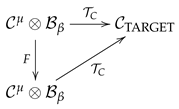 Here, F is a functor representing the gauge transformation , and the commutative diagram ensures consistency. This unifies the tensorial and categorical representations of gauge field derivatives in gauge theory.
Physical Applications of Functorial Tensors
Functorial tensors, as defined in Section 5, have elements that are functors, making them suitable for modelling transformations in physical systems like gauge theory (electromagnetism). Consider a category where objects are gauge field configurations , and morphisms are gauge transformations , with a smooth scalar function. Define a functorial tensor of (2,0)-rank, with elements as functors , where is a category of observables with objects as electromagnetic field strengths , and morphisms as identity maps (since is gauge-invariant).
For simplicity, let:
where are the indices of spatial components, maps . For example, , corresponding to an electric field component, and , since is gauge-invariant. A morphism between functorial tensors is a functor , defined as , for a fixed . The operation on is:
where each maps , unchanged due to gauge invariance. This functorial tensor organises gauge field transformations into a tensor structure, mapping to gauge-invariant observables, and complements the non-local dynamics of the generalised tensor in Section 5.
5.5. Machine Learning
Generalised tensors can enhance machine learning models, particularly in tensor network architectures used for neural networks. By incorporating generalised indices, these tensors can capture hierarchical feature interactions, improving the efficiency of algorithms like tensor trains or matrix product states. This application leverages the compression capabilities of generalised tensors, as discussed in Section 5.1, to reduce computational complexity in high-dimensional data processing.
6. Conclusions
In this study, we have delved into the foundational principles of tensor theory and category, innovatively crafting new concepts based on these fundamentals.
Our work extends prior conventions by generalising the tensor concept, introducing the versatile generalised tensor index that encapsulates diverse tensor indices. After introducing the concept of transformation of traditional tensors, we constructed the transformation of generalised tensors using fractional derivatives. Furthermore we describe the geometrical interpretation of these generalised tensors. We have also forged a deep connection between category theory and tensor theory, exploring the fusion of sets, tensors, categories, functors, and their extensions. We provide mathematical and numerical examples to support the novelty of these new definitions. Notably, we have introduced novel concepts like setorial tensors, functorial tensors, and categorial tensors. These extensions find applications to partial differentiation and integration.
In conclusion, this study paves the way for fresh perspectives in mathematical analysis, tensor theory, set theory, functor calculus, category theory, mathematical logic, partial differentiation, integration, physics, and philosophy.
Funding
This research received no external funding.
Data Availability Statement
No new data were created or analysed in this study.
Acknowledgments
The author would like to thank David Skinner, and Spiros Karagiannis for useful discussions, which helped expand the concepts in the paper. The author would like to acknowledge the 4 anonymous referee that provided comments which improved the manuscript.
Conflicts of Interest
The author declares no conflicts of interest.
Appendix A. Notation and Glossary

Table A1.
Main Notation and Glossary of Symbols Used in the Paper.
| Symbol | Definition | Explanation |
|---|---|---|
| Generic set of numbers | Set containing numbers (e.g., ) defined by a predicate over domain G. | |
| Natural numbers | Subset of , defined as , for positive integers. | |
| Integers | Subset of , defined as , for whole numbers. | |
| Rational numbers | Subset of , defined as . | |
| Real numbers | Subset of , defined as , for real numbers. | |
| Complex numbers | Subset of , defined as , for complex numbers. | |
| Quaternions | Subset of , defined as . | |
| Generic index | Hierarchical index (e.g., ) with nested indices from , used for tensor components. | |
| Generic index example | Index , where , simplifying nested index notation. | |
| Generic index example | Index , with , for deeper nested indices. | |
| Generic combination of vectors | Tensor product , generalizing vector spaces with nested indices. | |
| Vector with generic index | Vector indexed by , part of the generic combination . | |
| Dual vector space | Space of dual vectors (covectors) for index i, used in standard tensor definitions. | |
| Vector space | Space of vectors for index j, used in standard tensor definitions. | |
| Generic generalized tensor | Multilinear map , extending tensors with generic indices and number sets. |
Table A2.
Basic Notation and Glossary of Symbols Used in the Paper for Applications.
| Symbol | Definition | Explanation |
|---|---|---|
| T | Fractional generalized tensor | Tensor with indices , incorporating fractional derivatives for non-local effects. |
| Upper index | Contravariant index for , representing vectors in tangent space . | |
| Middle index | Index for fractional derivative , modeling non-local interactions. | |
| Lower index | Covariant index for , representing covectors in cotangent space . | |
| Covector basis | Differential form corresponding to the lower index in a tensor product, part of . | |
| Partial derivative | Standard derivative with respect to coordinate , associated with contravariant indices. | |
| Fractional derivative | Caputo fractional derivative of order , capturing non-local effects via integration. | |
| Gamma function | Function used in fractional derivative, e.g., , for normalization in Caputo definition. | |
| Tensor space | Set of all tensors of type , where p is the number of vectors and q the number of dual vectors. | |
| Tensors in tensor space | Elements of tensor spaces and , used in tensor product definitions. | |
| ⊗ | Tensor product | Operation combining vectors, dual vectors, or other objects into a higher-rank tensor. |
| Basis vectors | Basis for vectors () and dual vectors () in tensor spaces, used for component expansion. | |
| Standard tensor components | Components of a -type tensor, mapping p dual vectors and q vectors to . | |
| Manifold | D-dimensional space where tensors are defined, with tangent and cotangent spaces at point . | |
| Tangent space | Space of vectors at point , associated with contravariant indices. | |
| Cotangent space | Space of covectors at point , associated with covariant indices. | |
| Intermediate space | Space associated with the fractional derivative operator indexed by , in fractional tensor maps. |
Table A3.
Basic Notation and Glossary of Symbols Used in the Paper for Applications.
| Symbol | Definition | Explanation |
|---|---|---|
| Tensorial set | Collection of tensors, e.g., , applying set theory to tensors. | |
| Setorial tensor | Tensor with elements as sets, operated by union (∪) or intersection (∩), e.g., . | |
| Set elements | Sets as elements of a setorial tensor, with indices for position, and i for tensor instance. | |
| Set operations | Union and intersection operations used in setorial tensor operations, e.g., . | |
| ⊕ | Summation of setorial tensors | Operation combining setorial tensors via union of corresponding set elements. |
| Category | Mathematical structure with objects (e.g., tensors) and morphisms (e.g., functors), e.g., . | |
| Categories | Additional categories used in mappings, e.g., for fractional transformations, as target. | |
| Tensorial category | Category with tensors as objects and tensor products as morphisms, e.g., . | |
| Objects in tensorial category | Collection of tensors as objects in the tensorial category . | |
| Morphisms in tensorial category | Collection of tensor products as morphisms in the tensorial category . | |
| Category properties | Composition, identity, and associativity properties of the tensorial category . | |
| Categorial tensor | Tensor with categories as elements, mapped by functors, e.g., . | |
| Source category | Category as the domain of a categorial tensor or functorial tensor mapping. | |
| Target category | Category as the codomain of a categorial tensor or functorial tensor mapping. | |
| F | Functor | Mapping between categories preserving structure, e.g., gauge transformations in gauge theory. |
| Functorial tensor | Tensor with functors as elements, e.g., . | |
| Tensorial functor | Functor constructed as a tensor mapping, e.g., . | |
| Generalized tensorial functor | Functor constructed as a generalized tensor, e.g., . | |
| Functor of functors | Morphism mapping one functor to another, e.g., , used in functorial tensors. | |
| Functor elements | Functors as elements of a functorial tensor, with indices for position, and i for tensor instance. | |
| Gauge field | Electromagnetic vector potential in gauge theory, with spacetime index , transforms as . | |
| Gauge parameter | Smooth scalar function in gauge transformation, e.g., . | |
| Field strength tensor | Gauge-invariant quantity in gauge theory, defined as . | |
| G | Functor for gauge transformation | Functor mapping gauge fields, e.g., , used in functorial tensor operations. |
References
- Ricci-Curbastro, G.; Hermann, R.; Ricci, M.; Levi-Civita, T. Ricci and Levi-Civita’s Tensor Analysis Paper: Translation, Comments, and Additional Material; Math Sci Press: Berkeley CA, USA, 1975. [Google Scholar]
- Conner, A.; Gesmundo, F.; Landsberg, J.M.; Ventura, E. Tensors with maximal symmetries. arXiv 2019, arXiv:1909.09518. [Google Scholar]
- Whitehead, J.H.C. Elie Joseph Cartan 1869—1951. In Differential Geometry; James, I., Ed.; Royal Society: Pergamon, Turkey, 1962; pp. 331–355. [Google Scholar] [CrossRef]
- Eilenberg, S.; MacLane, S. General Theory of Natural Equivalences. Trans. Am. Math. Soc. 1945, 58, 231–294. [Google Scholar] [CrossRef]
- Marquis, J.P. Category Theory. In The Stanford Encyclopedia of Philosophy, Fall 2023 ed.; Zalta, E.N., Nodelman, U., Eds.; Metaphysics Research Lab, Stanford University: Stanford, CA, USA, 2023. [Google Scholar]
- Leinster, T. Basic Category Theory. arXiv 2016, arXiv:1612.09375. [Google Scholar]
- Riehl, E.; Verity, D. Infinity category theory from scratch. arXiv 2016, arXiv:1608.05314. [Google Scholar] [CrossRef]
- Riehl, E.; Wattal, M. On ∞-cosmoi of bicategories. arXiv 2021, arXiv:2108.11786. [Google Scholar] [CrossRef]
- Hörmander, L. The Analysis of Linear Partial Differential Operators I: Distribution Theory and Fourier Analysis; Classics in Mathematics; Springer: Berlin/Heidelberg, Germany, 2015. [Google Scholar]
- Bungartz, H.; Griebel, M.; Zenger, C. Introduction to Computer Graphics; Charles River Media Graphics; Charles River Media: Needham, MA, USA, 2004. [Google Scholar]
- Görlach, P.; Koefler, J.; Sattelberger, A.L.; Sayrafi, M.; Schroeder, H.; Weiss, N.; Zaffalon, F. Connection Matrices in Macaulay2. arXiv 2025, arXiv:2504.01362. [Google Scholar] [CrossRef]
- Moschidis, G. A proof of the instability of AdS for the Einstein—Massless Vlasov system. arXiv 2018, arXiv:1812.04268. [Google Scholar] [CrossRef]
- Derdzinski, A.; Park, J.; Shin, W. Weakly Einstein curvature tensors. arXiv 2025, arXiv:2504.18752. [Google Scholar]
- Tarasov, V. Fractional Dynamics; Springer: Berlin/Heidelberg, Germany, 2010. [Google Scholar] [CrossRef]
- Lazopoulos, K.; Lazopoulos, A. Fractional differential geometry of curves and surfaces. Prog. Fract. Differ. Appl. 2016, 2, 169–186. [Google Scholar] [CrossRef]
- Cottrill-Shepherd, K.; Naber, M. Fractional differential forms. J. Math. Phys. 2001, 42, 2203–2212. [Google Scholar] [CrossRef]
- Calcagni, G. Geometry of fractional spaces. Adv. Theor. Math. Phys. 2012, 16, 549–644. [Google Scholar] [CrossRef]
- Wang, H.; Zhao, J.; Ku, J.; Liu, Y. Existence of mild solution for (k,Ψ)-hilfer fractional cauchy value problem of sobolev type. Adv. Differ. Equ. Control. Process. 2024, 31, 439–472. [Google Scholar] [CrossRef]
- He, C.H.; Liu, H.W.; Liu, C. A fractal-based approach to the mechanical properties of recycled aggregate concretes. Facta Univ. Ser. Mech. Eng. 2024, 22, 329–342. [Google Scholar] [CrossRef]
- Zhang, Y.R.; Anjum, N.; Tian, D.; Alsolami, A.A. Fast and accurate population forecasting with two-scale fractal population dynamics and its application to population economics. Fractals 2024, 32, 2450082. [Google Scholar] [CrossRef]
- Podlubny, I. Geometric and Physical Interpretation of Fractional Integration and Fractional Differentiation. arXiv 2001, arXiv:math/0110241. [Google Scholar]
- Laskin, N. Fractional Schrodinger equation. Phys. Rev. E 2002, 66, 056108. [Google Scholar] [CrossRef]
- Weinzierl, S. Feynman Integrals. arXiv 2022, arXiv:2201.03593. [Google Scholar] [CrossRef]
- Ntelis, P.; Morris, A. Functors of Actions. Found. Phys. 2023, 53, 29. [Google Scholar] [CrossRef]
- Fritz, T.; Klingler, A. The d-separation criterion in Categorical Probability. arXiv 2022, arXiv:2207.05740. [Google Scholar] [CrossRef]
- Baez, J.C.; Li, X.; Libkind, S.; Osgood, N.D.; Redekopp, E. A Categorical Framework for Modeling with Stock and Flow Diagrams. arXiv 2022, arXiv:2211.01290. [Google Scholar] [CrossRef]
- Weisgerber, S. Mathematical Progress—On Maddy and Beyond. Philos. Math. 2022, 31, 1–28. [Google Scholar] [CrossRef]
- Saint Raymond, X. Elementary Introduction to the Theory of Pseudodifferential Operators/Xavier Saint Raymond; Studies in Advanced Mathematics; CRC Press: Boca Raton, FL, USA, 1991. [Google Scholar]
- Caputo, M. Linear Models of Dissipation whose Q is almost Frequency Independent-II. Geophys. J. Int. 1967, 13, 529–539. [Google Scholar] [CrossRef]
- Podlubny, I. Fractional Differential Equations: An Introduction to Fractional Derivatives, Fractional Differential Equations, to Methods of Their Solution and Some of Their Applications; Academic Press: San Diego, CA, USA, 1999. [Google Scholar]
- Abel, N.H. Opløsning af et Par Opgaver ved Hjelp af bestemte Integraler. [Solution de quelques problèmes à l’aide d’intégrales définies]. Mag. Naturvidenskaberne 1823, 1, 11–27. [Google Scholar]
- Liouville, J. Mémoire sur quelques questions de Géométrie et de Méchanique, et sur un nouveau genre de calcul pour résoudre ces questions. J. De L’École Polytech. 1832, 13, 1–69. [Google Scholar]
- Tavares, D.; Almeida, R.; Torres, D.F. Caputo derivatives of fractional variable order: Numerical approximations. Commun. Nonlinear Sci. Numer. Simul. 2016, 35, 69–87. [Google Scholar] [CrossRef]
- Einstein, A. Kosmologische und Relativitatstheorie. Sitzungsber. Preuss. Akad. Wiss. 1917, 142–152. [Google Scholar]
- Evans, L.C. Partial Differential Equations, 2nd ed.; Graduate Studies in Mathematics; American Mathematical Society: Providence, RI, USA, 2010; Volume 19. [Google Scholar]
Figure 1.
We illustrate the geometrical interpretation of fractional derivatives [See Section 4].
Figure 1.
We illustrate the geometrical interpretation of fractional derivatives [See Section 4].
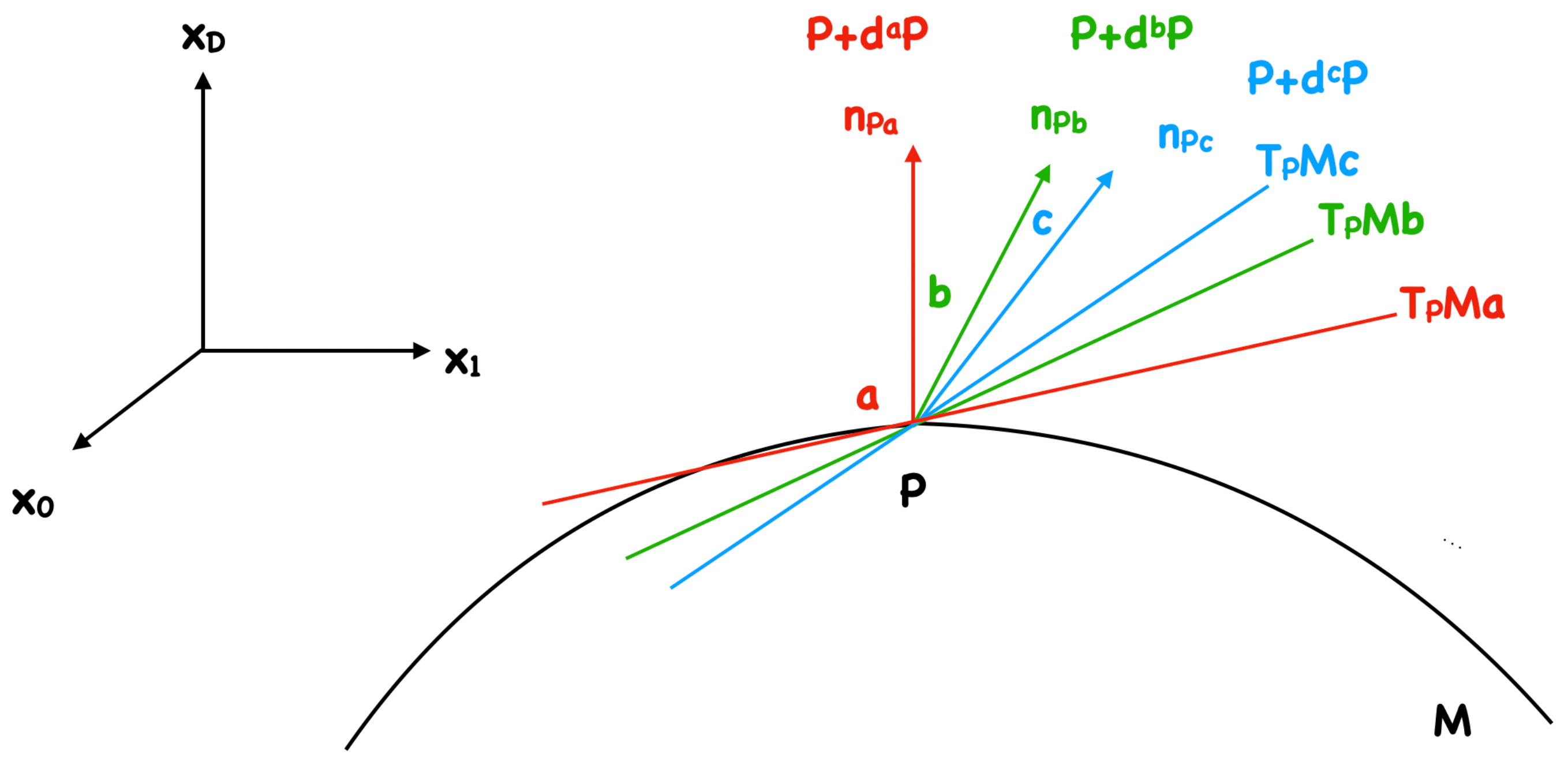
Disclaimer/Publisher’s Note: The statements, opinions and data contained in all publications are solely those of the individual author(s) and contributor(s) and not of MDPI and/or the editor(s). MDPI and/or the editor(s) disclaim responsibility for any injury to people or property resulting from any ideas, methods, instructions or products referred to in the content. |
© 2025 by the author. Licensee MDPI, Basel, Switzerland. This article is an open access article distributed under the terms and conditions of the Creative Commons Attribution (CC BY) license (https://creativecommons.org/licenses/by/4.0/).
Share and Cite
MDPI and ACS Style
Ntelis, P. Advancing Tensor Theories. Symmetry 2025, 17, 777. https://doi.org/10.3390/sym17050777
AMA Style
Ntelis P. Advancing Tensor Theories. Symmetry. 2025; 17(5):777. https://doi.org/10.3390/sym17050777
Chicago/Turabian StyleNtelis, Pierros. 2025. "Advancing Tensor Theories" Symmetry 17, no. 5: 777. https://doi.org/10.3390/sym17050777
APA StyleNtelis, P. (2025). Advancing Tensor Theories. Symmetry, 17(5), 777. https://doi.org/10.3390/sym17050777
Note that from the first issue of 2016, this journal uses article numbers instead of page numbers. See further details here.

