A Deep Random Forest Model with Symmetry Analysis for Hyperspectral Image Data Classification Based on Feature Importance

Abstract
1. Introduction
2. Related Works
2.1. Adaboost
| Algorithm 1: Adaboost |
Input: Training data set ; Base learning model ; Number of boosting iterations T; Initialization: Initialize sample weights for all . Iterative Process: for to T do 1. Train the weak classifier: ; 2. Compute the weighted classification error: 3. if then exit the loop; 4. Compute the classifier weight: 5. Update the sample weights according to the rule: where is the normalization constant ensuring that the sum of equals 1. end Output: The final classifier is given by: |
2.2. Bagging
| Algorithm 2: Bagging |
Input: Training data set ; Base learning method ; Number of boosting iterations T; Iterative Process: for to T do 1. Draw a bootstrap sample from S; 2. Train a weak classifier ; end Output: The ensemble classifier is: |
2.3. Random Forest
| Algorithm 3: Random forest |
Input: Data set ; Base decision tree algorithm ; Number of decision trees T; Number of features sampled at each split k. Initialization: . Iterative process: for to T do 1. Bootstrap Sampling: Draw a sample set with replacement from S, size m; 2. Build Decision Tree: Use to train a decision tree on . At each node split, randomly select k features and choose the optimal one for splitting. end Output: For classification: For regression: |
2.4. Deep Forest
| Algorithm 4: Deep Forest |
Input: Data set ; Base decision tree algorithm ; Number of cascade levels L; Number of random forests in each level T; Number of features sampled at each tree split k. Initialization: Split S into training set and validation set ; Initialize cascade structure: , each level contains T random forests. Iterative process: for to L do 1. Train Random Forests in Current Level: For each random forest in : Use to train on the current data representation. 2. Extract Prediction Features: For each sample x, collect prediction probabilities or predictions from all forests in , concatenate these with the original features to form a new feature representation. 3. Early Stopping Check: If the performance on stops improving, break the cascade loop. end Output: The final prediction is given by the last cascade level’s aggregated output. |
3. Proposed Method
3.1. Feature Importance in Deep Random Forests
3.2. Double Ensemble Classification Based on Deep Random Forests
- Random Forest: The baseline ensemble model consisting of multiple decision trees trained on bootstrapped subsets of the feature space. The ultimate class label is determined by aggregating individual tree outputs via a majority rule, while the random subspace strategy promotes diversity among constituent models.
- Deep Random Forest: An extension of the standard RF that performs layer-wise iterative learning. Each layer refines the feature representation by integrating pseudo-labels from the preceding stage, thus progressively capturing higher-order feature interactions before final aggregation.
- Bagging-based DRF Ensemble: In this configuration, multiple DRF models are trained on different bootstrap samples of the training set. The final output is produced by averaging or voting over the predictions of all sub-models:where M denotes the number of base DRF learners. This approach effectively reduces variance and mitigates overfitting while maintaining the depth-aware representation capability.
- Boosting-based DRF Ensemble: To further enhance discriminative power, a sequential ensemble of DRF models is constructed where each learner focuses on the misclassified samples of its predecessors. The final prediction is expressed as a weighted combination:where represents the adaptive weight determined by the performance of the m-th DRF learner. This mechanism improves classification accuracy through iterative error correction and feature reweighting across layers.
| Algorithm 5: Deep Random Forest (DRF) with Ensemble Feature Importance Calculation |
Inputs:
Process:
End Output: Ensemble classifier that integrates multi-level pseudo-label representations with feature selection and enhanced discriminative learning. |
4. Experimental Study
4.1. Evaluative Performance Metrics
- Notations. Assume an L-class classification problem and let denote the number of samples whose true label is class i but are predicted as class j. Let be the size of the training set.
- Overall accuracy (OA). We define OA as an overall correctness indicator derived from the collection of per-class recalls:The recall of class i (also called class-wise accuracy) is computed from the confusion counts as
- Average accuracy (AA). To avoid dominance by majority classes, AA assigns identical importance to each class by averaging recalls:
- F-Measure. For imbalanced learning, we additionally report an F-type score that combines recall and precision. It is written aswhere the class-i precision is defined by .
- G-mean. As another imbalance-sensitive criterion, G-mean summarizes the recalls through a geometric aggregation:
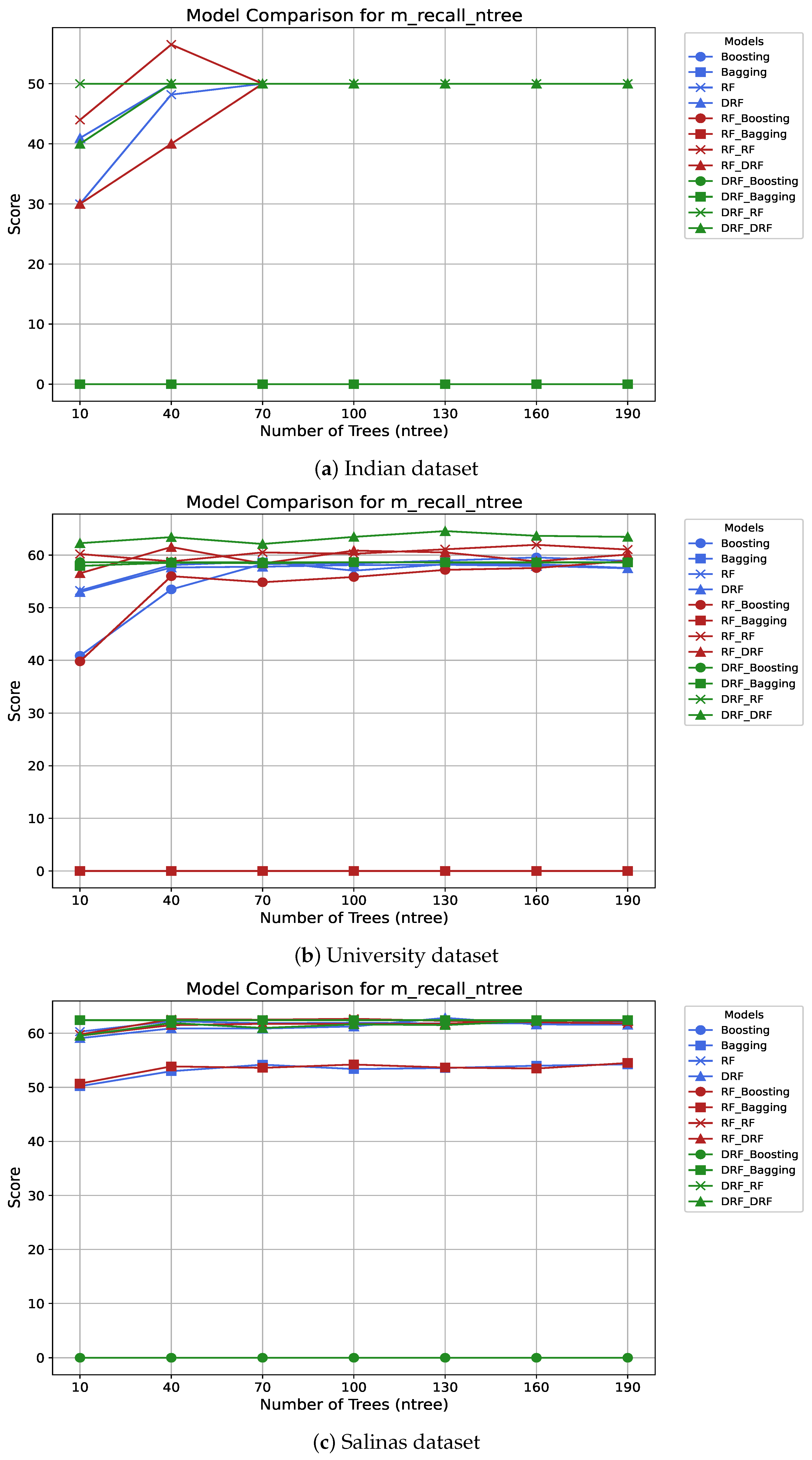
- M-recall. To provide a macro-level view of sensitivity over all categories, we compute M-recall as the mean of the class-wise recall values:
4.2. Data Information
4.3. Results and Analysis
- Examine how the DRF-FI model performs on the benchmark hyperspectral datasets.
- Compare the DRF-FI approach against several data sampling strategies to assess its robustness.
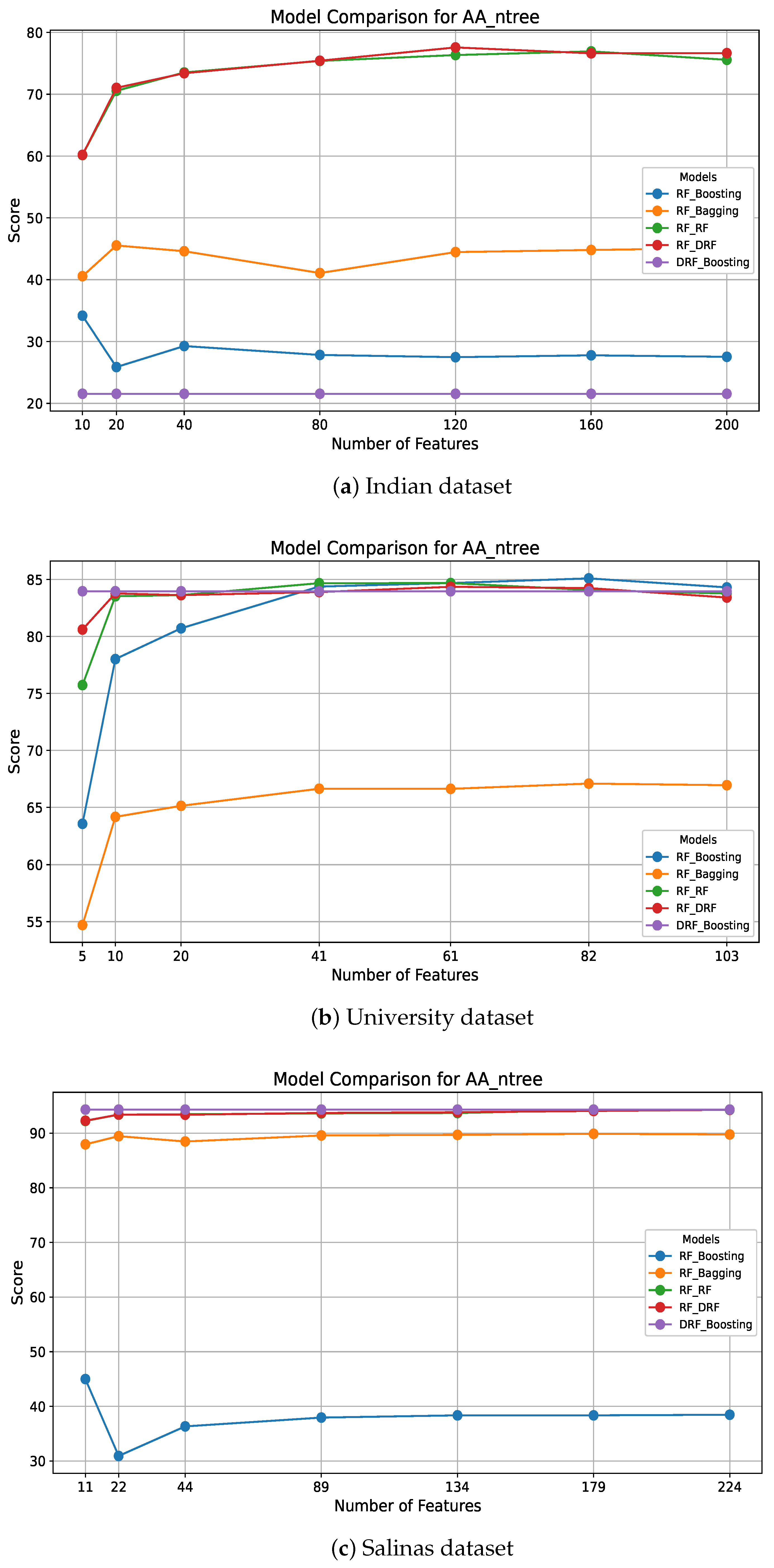
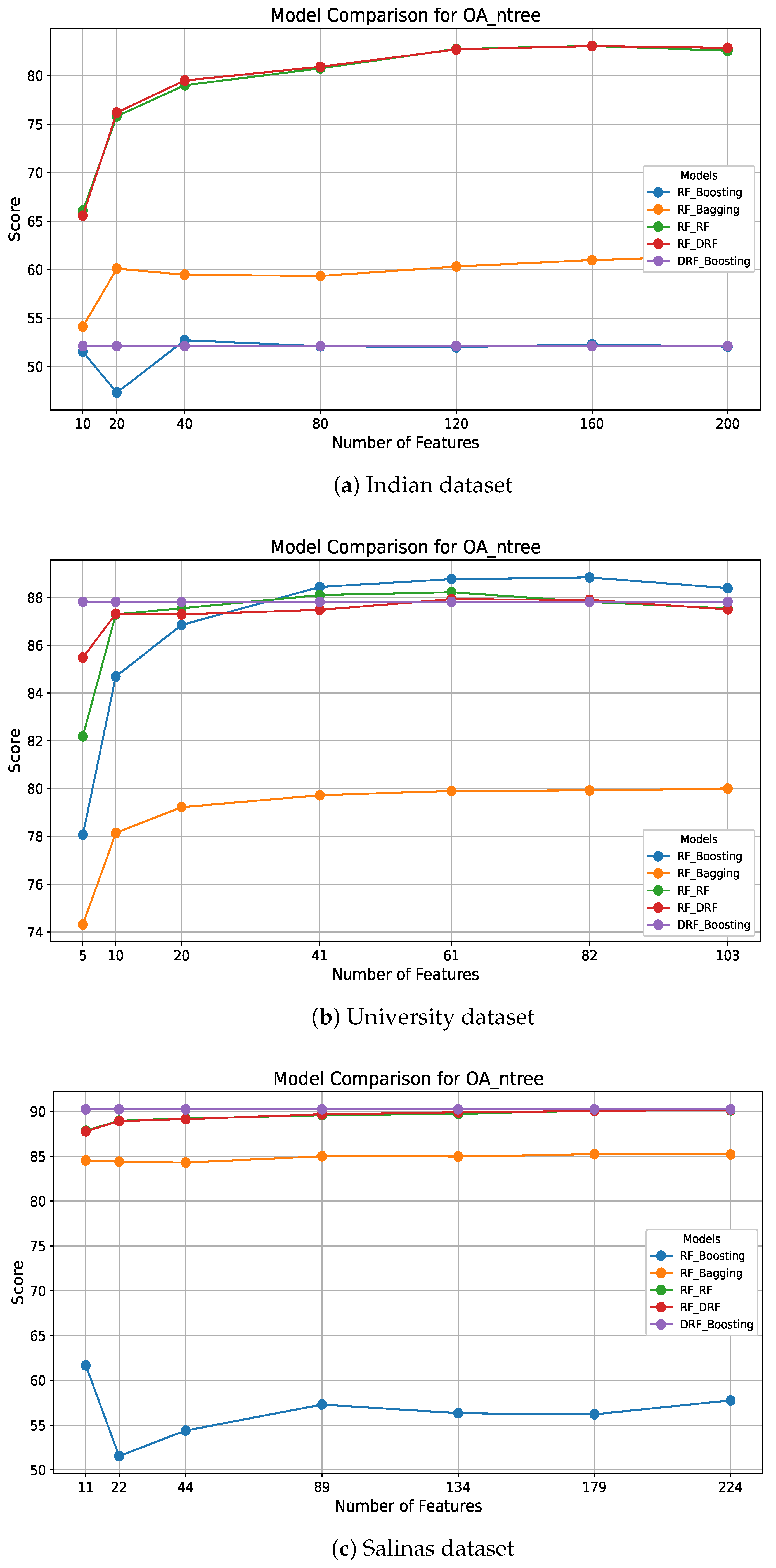
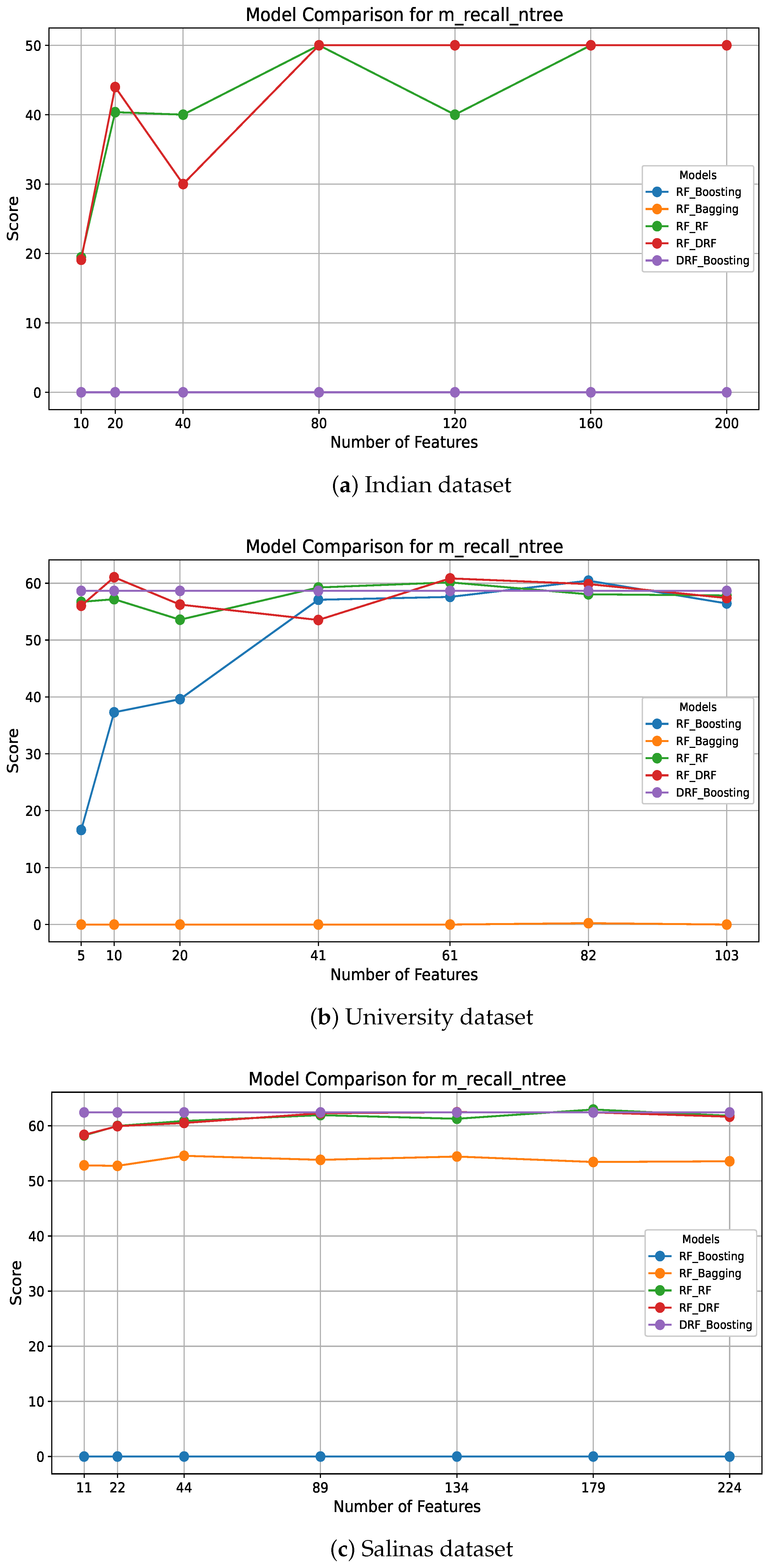
- Investigate the sensitivity of the DRF-FI model to key parameter settings.
4.4. Parameter Analysis
5. Discussion
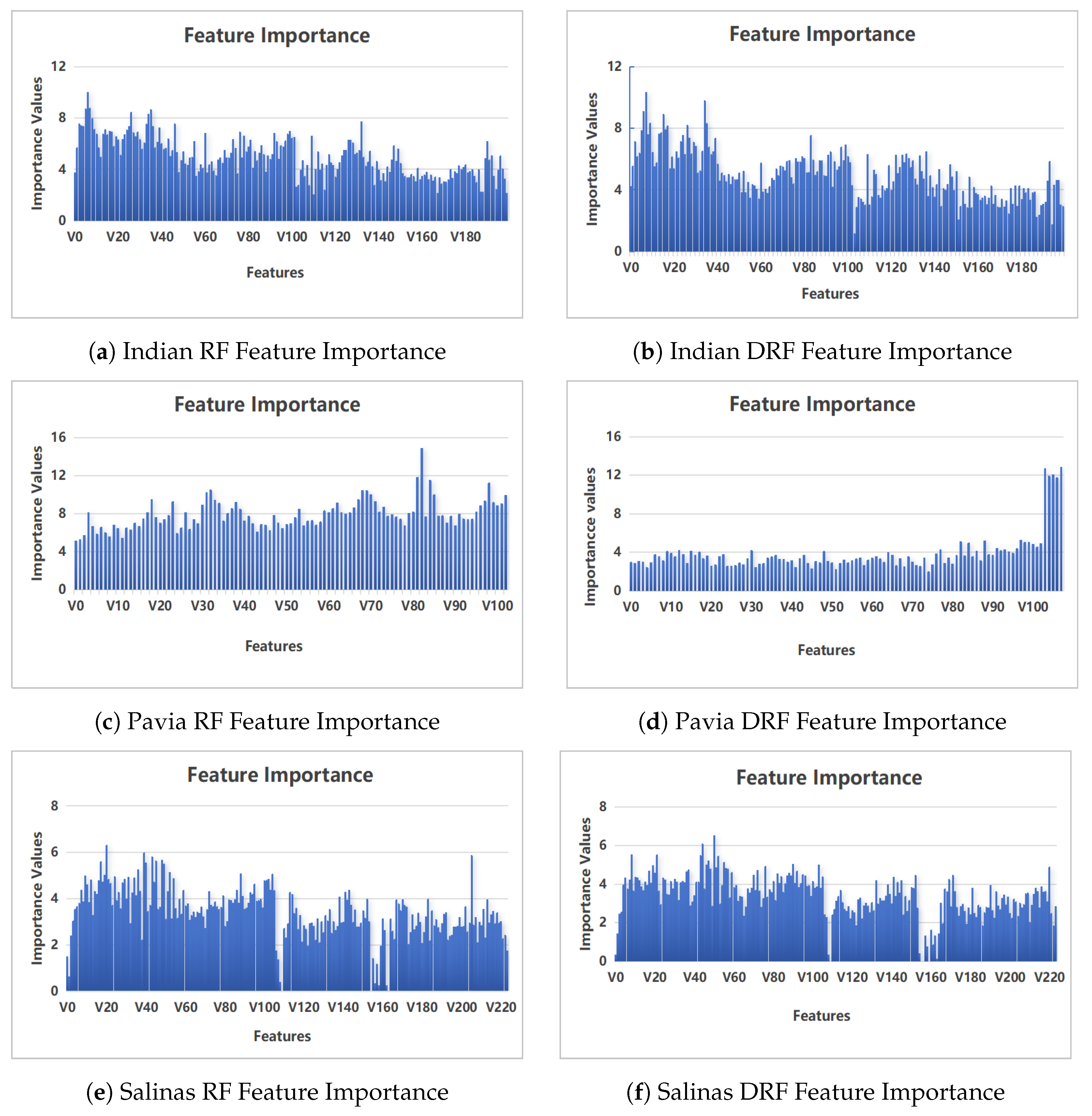
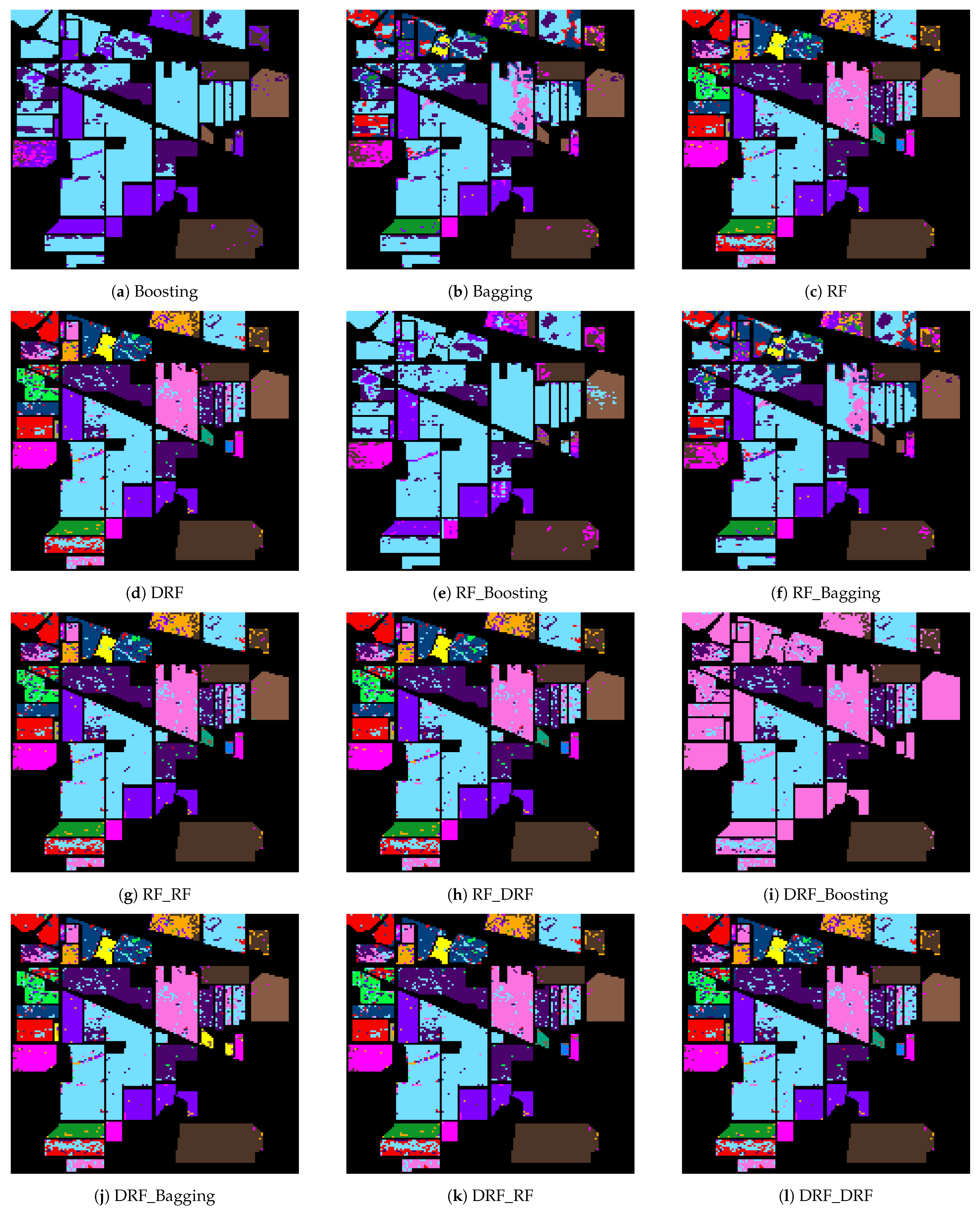
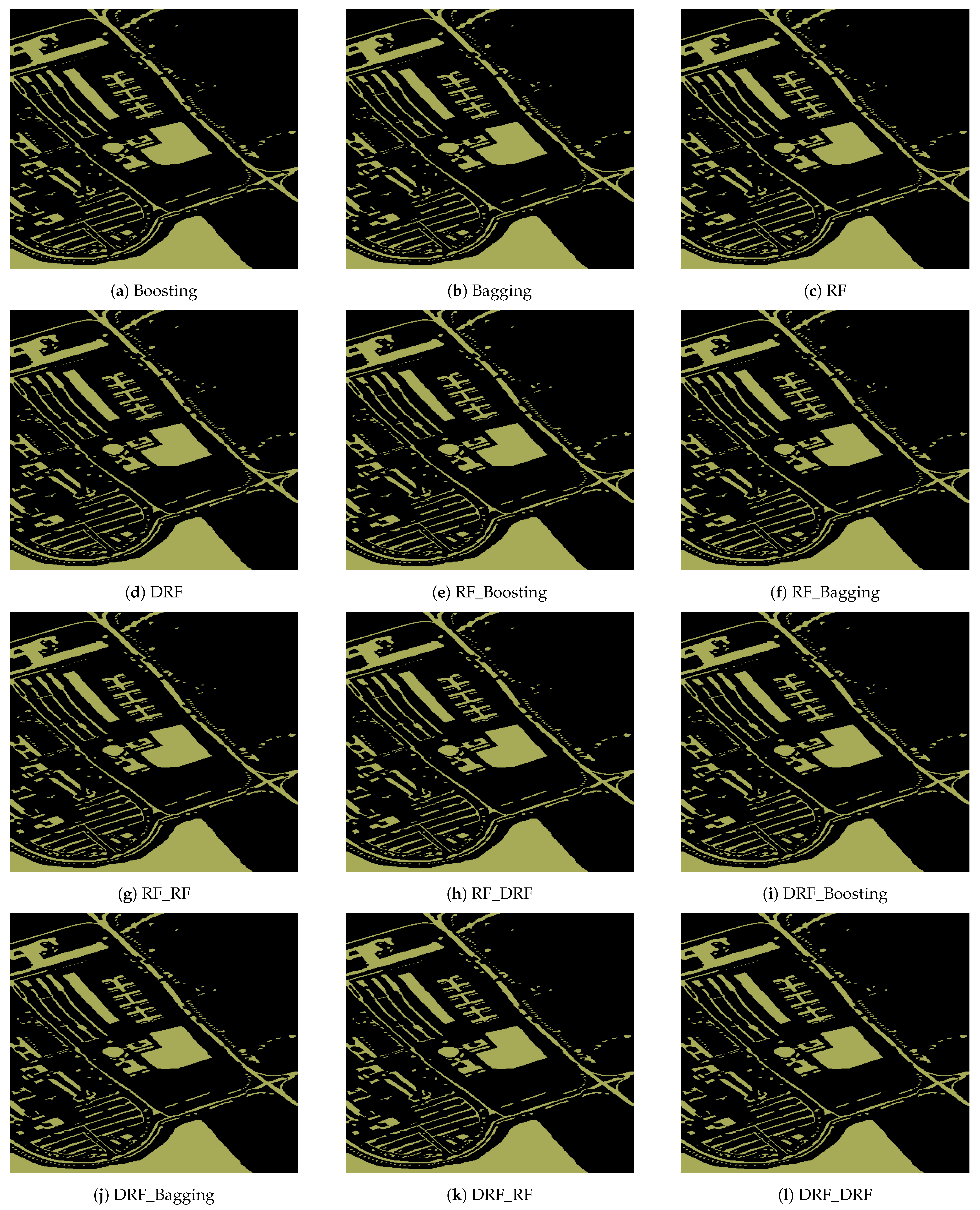
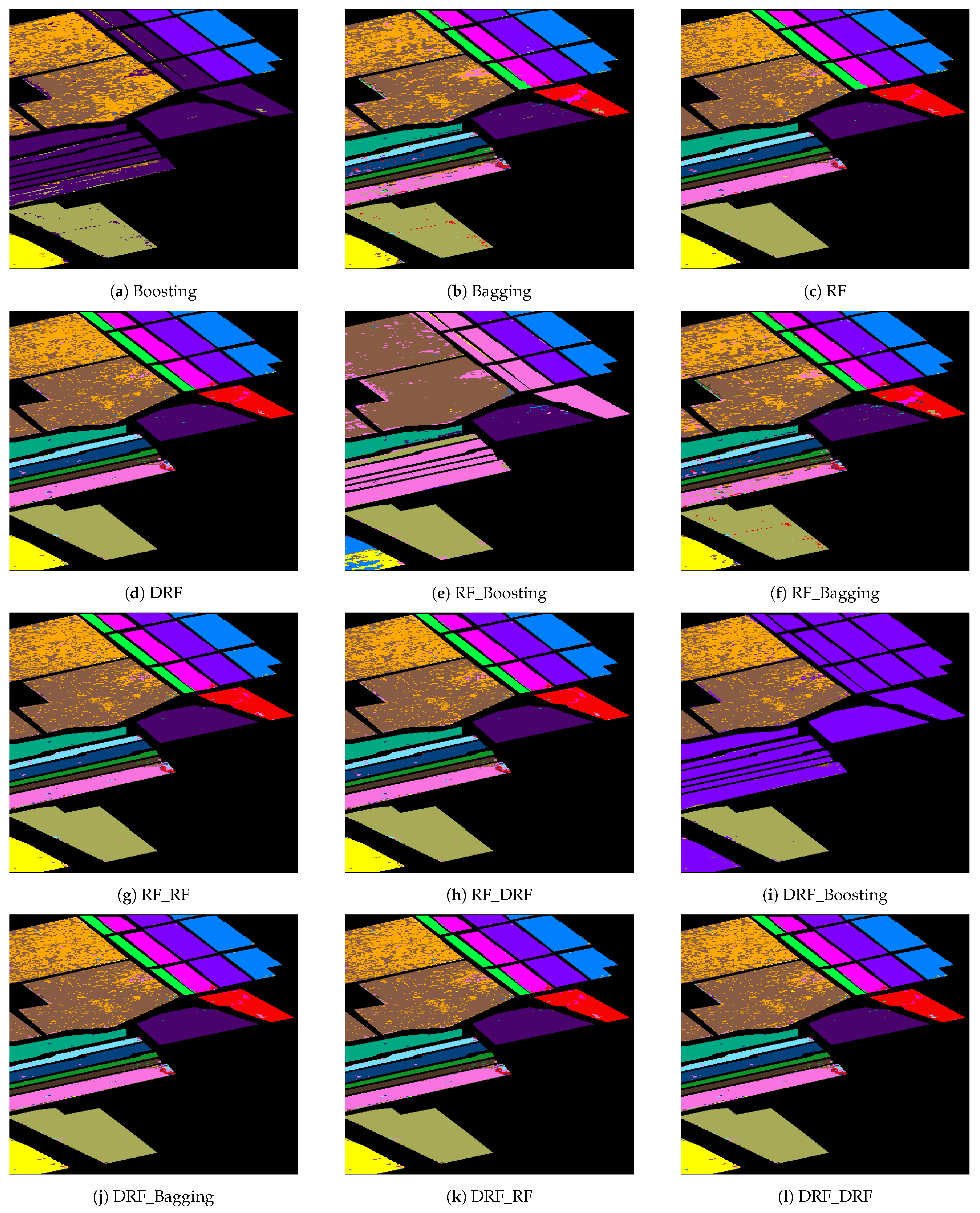
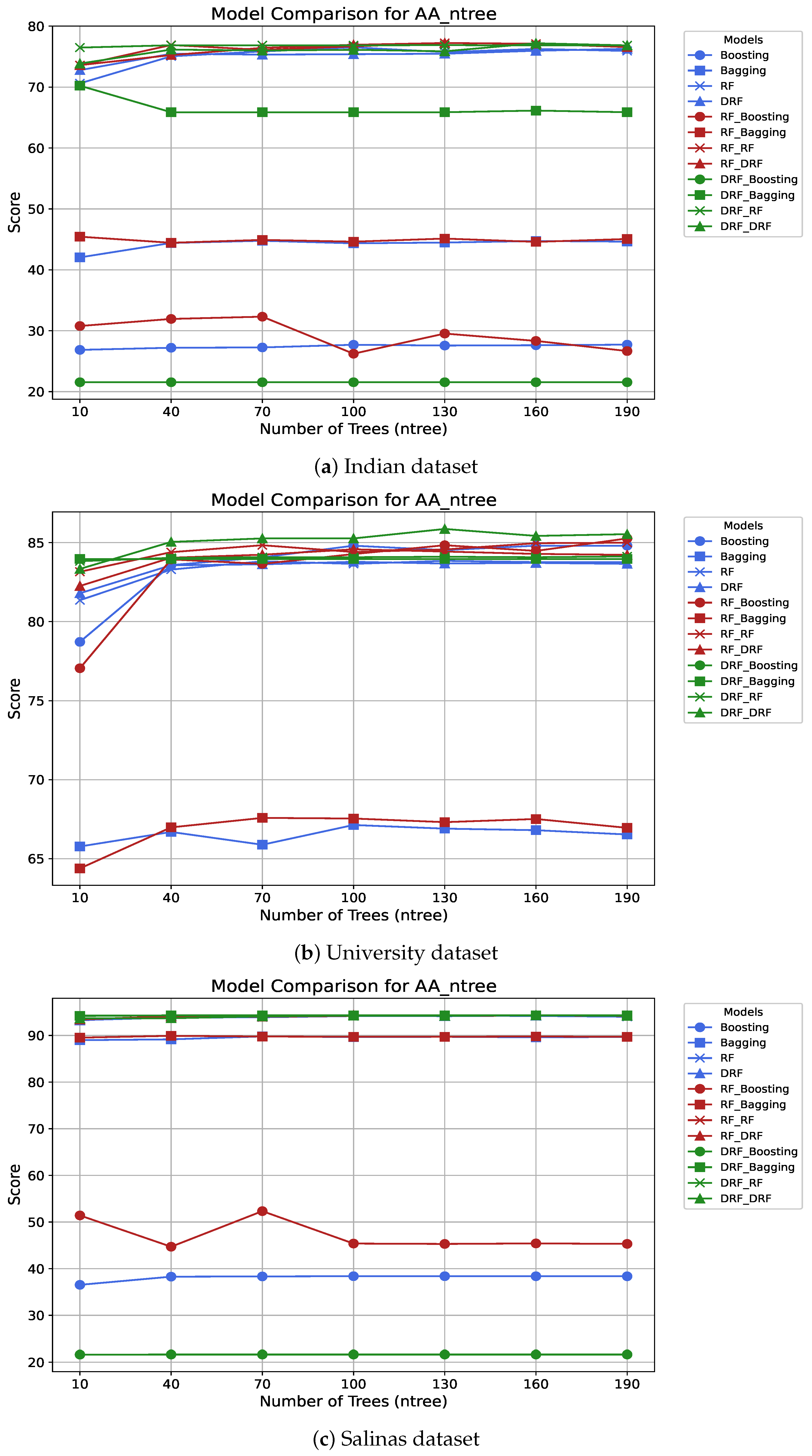
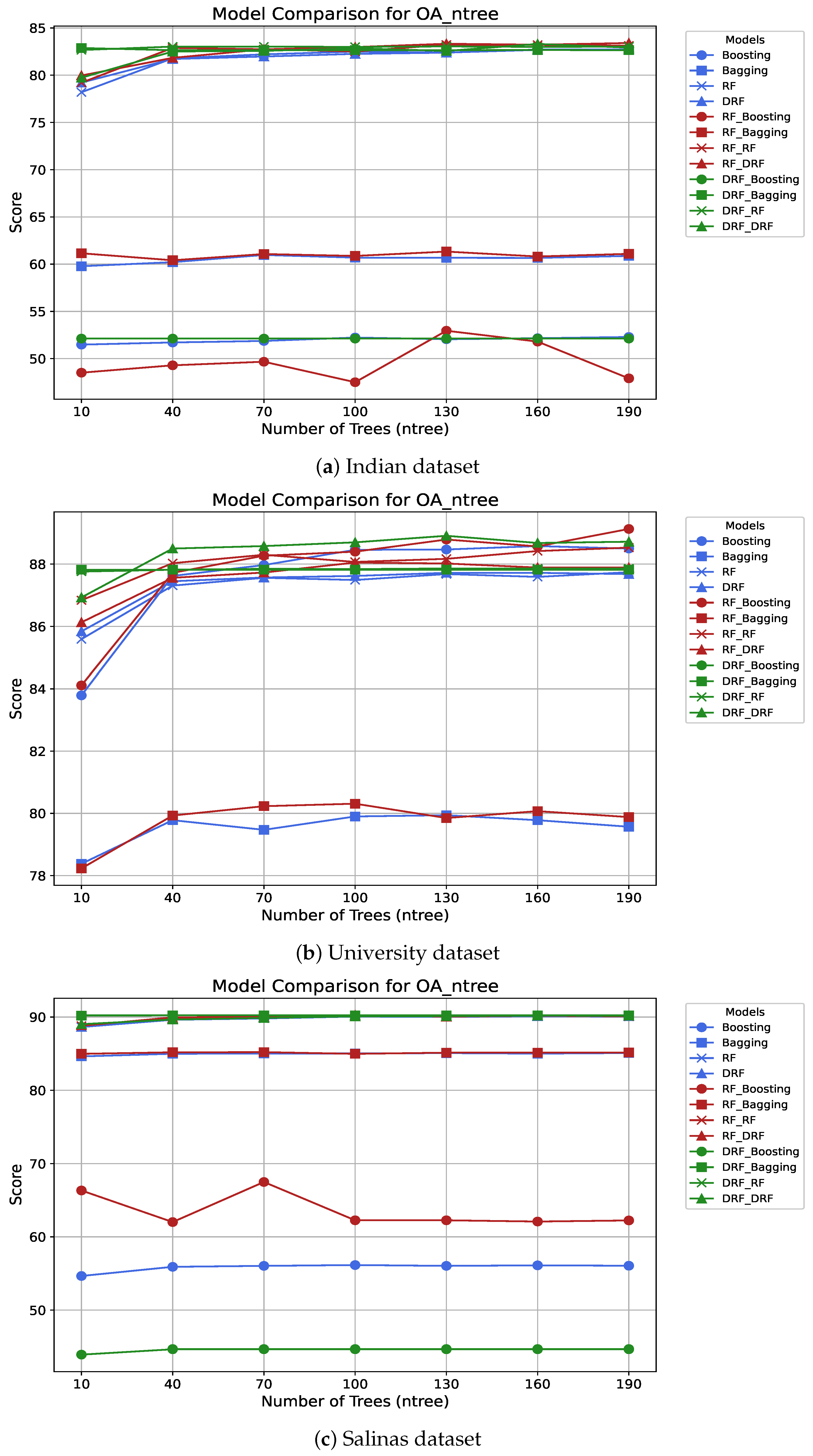
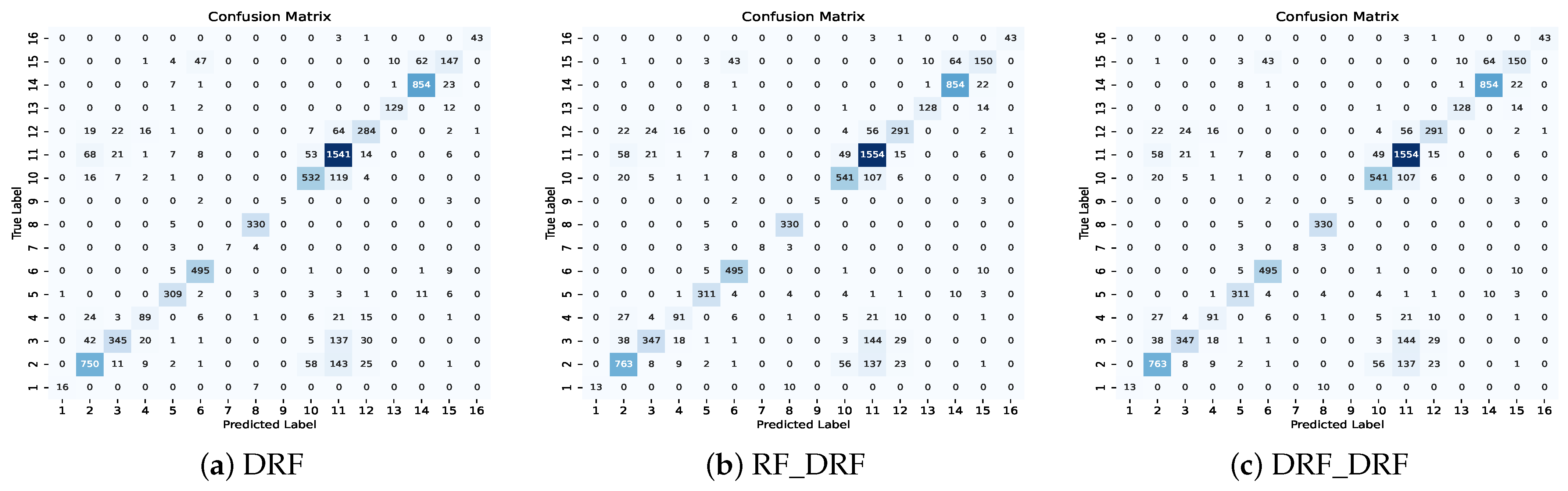
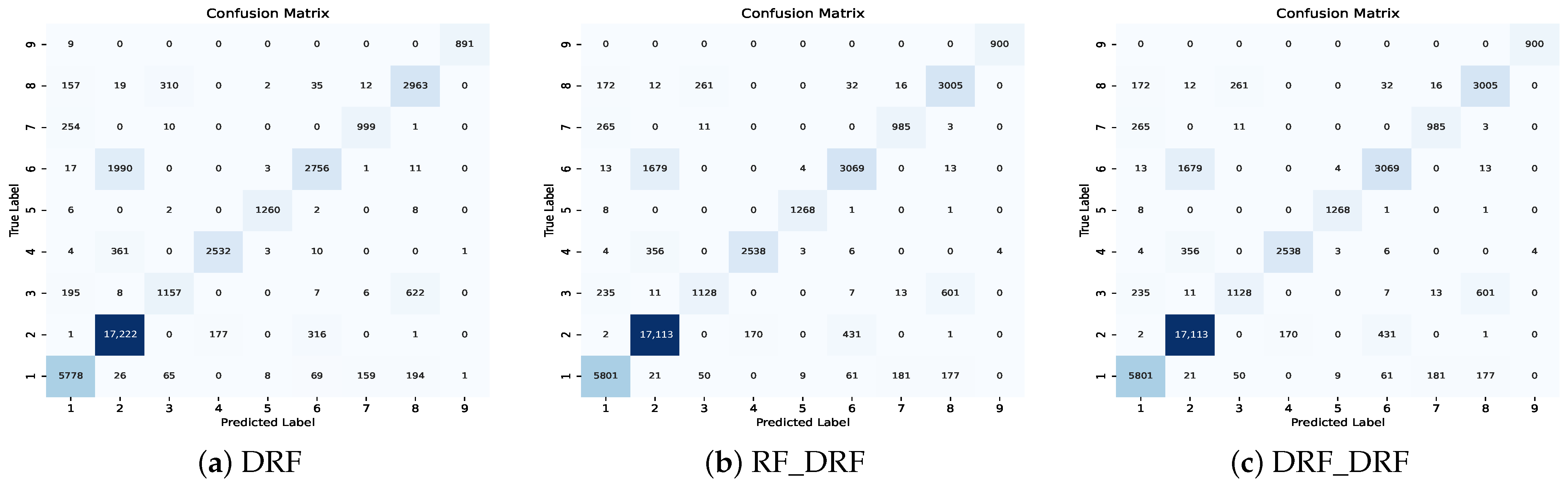
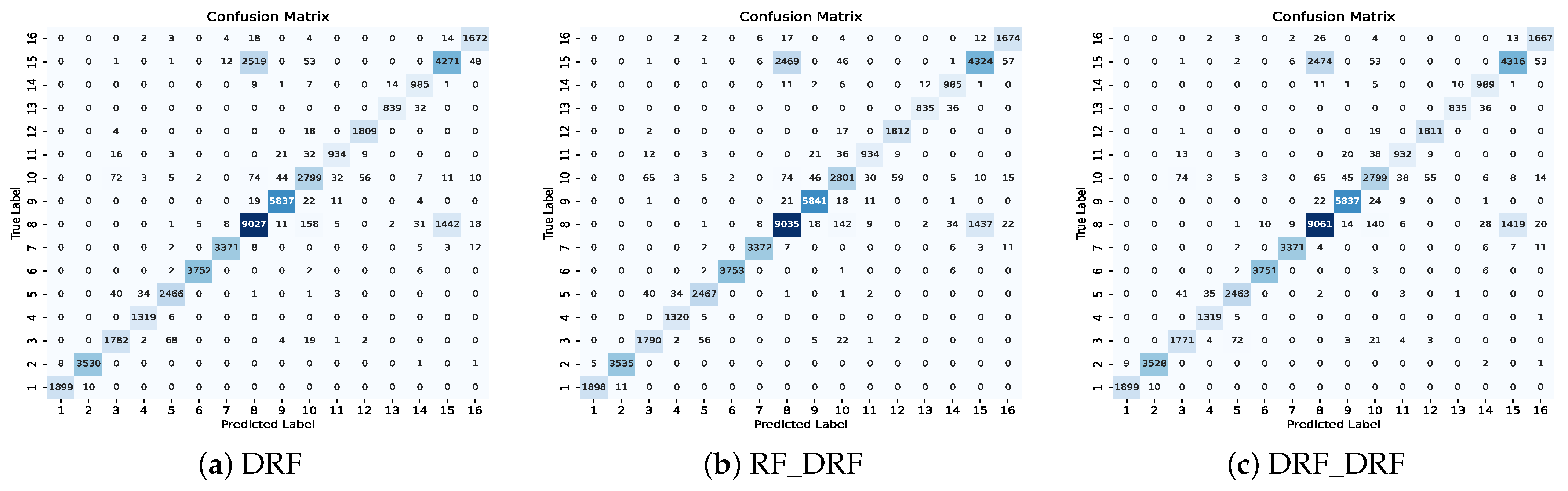
- The experimental results presented in Section 4 demonstrate that the proposed DRF-Fl framework substantially improves the classification of multi-class imbalanced hyperspectral data. Beyond the numerical advantages reflected in AA, OA, F-measure, and G-mean across three benchmark datasets, several underlying mechanisms explain why the method achieves these consistent gains. First, by integrating feature importance-guided feature selection with oversampling-based ensemble learning, DRF-Fl effectively enhances the discriminative capacity of spectral bands most relevant to minority classes. As shown in Figure 2, the importance values across spectral bands vary significantly, especially for the Indian Pines and Salinas datasets, indicating that feature redundancy and noise are non-negligible. By selecting the most informative spectral features before training, the DRF-Fl framework lowers the overlap that appears within the same class. It also reduces the bias that noise may introduce. As a result, the ensemble becomes more stable when the data distribution is skewed, and the model can handle such imbalance more effectively. To further analyze the class-wise behavior of the competing methods, we present the confusion matrices of DRF, RF_DRF, and DRF_DRF for the three hyperspectral datasets, as shown in Figure 12, Figure 13 and Figure 14. Compared with DRF and RF_DRF, the proposed DRF_DRF exhibits reduced off-diagonal errors, especially for minority classes, indicating improved discrimination under severe class imbalance.
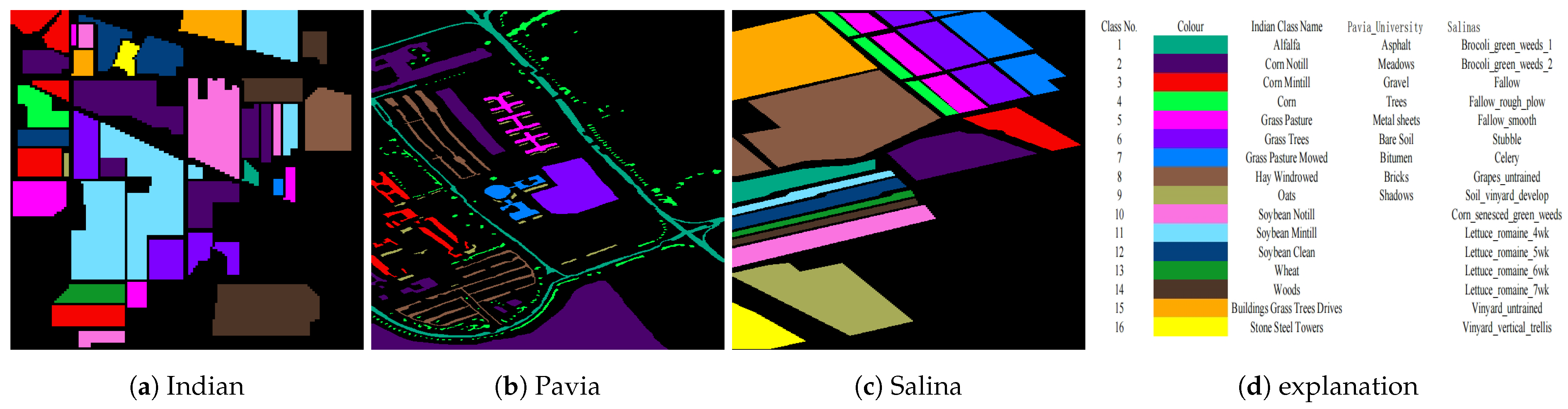
- The class-wise analysis reveals that the performance improvement is not uniformly distributed across categories. The greatest gains are consistently observed in minority classes, which traditionally pose the greatest challenges for standard RF, Bagging, and Boosting methods. This trend is evident in Table 2, Table 3 and Table 4, where DRF-Fl substantially elevates the recall and F-measure of small classes without sacrificing majority-class accuracy. The adaptive oversampling mechanism ensures that minority samples are sufficiently represented in each bootstrap subset, enabling base classifiers to better capture their decision boundaries. Nevertheless, certain extremely scarce classes—such as Oats in the Indian Pines dataset and several highly fragmented categories in the University of Pavia scene—still exhibit limited improvement. This suggests that oversampling alone cannot fully compensate for severely insufficient or highly noisy samples, and highlights the need for more advanced minority-class enhancement strategies in future work.
- The findings of this study align with and extend prior research on ensemble-based imbalance learning. Earlier studies have shown that Bagging extensions, SMOTE-based ensembles, and DRF variants can mitigate class imbalance by increasing sample diversity or adjusting decision boundaries. However, these methods rarely address the high-dimensional nature of hyperspectral data. Compared with traditional random forests and earlier DRF-style models, DRF-Fl introduces an explicit feature importance-guided mechanism that simultaneously promotes dimensionality reduction and noise suppression prior to ensemble construction. This hybrid design not only reduces computational burden (as discussed in Section 4.4), but also enhances minority-class recognition more effectively than purely sampling-based or algorithm-level methods. In addition, studies on multi-class imbalanced data point out that some samples are more difficult to learn. William et al. [35] stress this idea and show that these hard instances need special attention. DRF-Fl inherently incorporates this notion by amplifying the representation of difficult minority instances through informed oversampling and feature refinement. As a result, the method bridges the gap between feature-level and data-level imbalance mitigation, offering a more comprehensive and effective learning framework compared with existing approaches.
- Deep learning models have been used in hyperspectral image classification, including 3D-CNNs, hybrid CNN designs, and Transformer-based networks. These methods can reach very high accuracy. However, they often rely on many parameters. They also require strong GPU support and long training time, which limits their practical use. Moreover, they generally rely on significantly larger proportions of labeled samples (often 10–40%), and their performance gains often stem from exploiting joint spatial–spectral information. Representative examples include 3D-CNN models [20] (requiring approximately 10% labeled samples), Hybrid 3D–2D CNNs [21] (around 20% labeled samples), SpectralFormer Transformers [46] (about 30% labeled samples), SSFTT spectral–spatial token Transformers [47], and graph-based convolutional networks such as SGC/GCN [18], all of which generally depend on either substantial annotation ratios or spatial-context construction.Such assumptions are fundamentally different from the setting of this study, where only spectral features are modeled, making direct comparisons under identical conditions neither fair nor meaningful. The goal of this work is not to compete with large-scale deep learning architectures under fully supervised settings, but rather to develop a non-parametric, lightweight, interpretable, and robust framework suitable for small-sample and highly imbalanced scenarios. Unlike deep networks, the proposed method does not depend on gradient-based training or heavy annotation requirements, and it maintains stable performance even without spatial context. Therefore, classical ensemble models such as Boosting, Bagging, RF, and DRF are selected as baselines to ensure comparability in terms of data assumptions, computational cost, and methodological principles. Nonetheless, integrating DRF-Fl with modern deep spectral–spatial feature extraction architectures or benchmarking against deep learning models under controlled and comparable settings remains an important direction for future research. Additionally, exploring more advanced generative oversampling techniques or uncertainty-aware ensemble mechanisms may further enhance the applicability of the proposed framework to highly imbalanced and noise-prone hyperspectral scenes.Future research directions will extend towards deep learning models in order to obtain more comprehensive classification algorithms for processing hyperspectral data.
6. Conclusions
Author Contributions
Funding
Data Availability Statement
Acknowledgments
Conflicts of Interest
References
- Cao, X.; Yao, J.; Xu, Z.; Meng, D. Hyperspectral Image Classification with Convolutional Neural Network and Active Learning. IEEE Trans. Geosci. Remote Sens. 2020, 58, 4604–4616. [Google Scholar] [CrossRef] [Scilit]
- Yao, J.; Hong, D.; Li, C.; Chanussot, J. SpectralMamba: Efficient Mamba for Hyperspectral Image Classification. arXiv 2024, arXiv:2404.08489. [Google Scholar] [CrossRef] [Scilit]
- Li, S.; Song, W.; Fang, L.; Chen, Y.; Ghamisi, P.; Benediktsson, J. Deep Learning for Hyperspectral Image Classification: An Overview. IEEE Trans. Geosci. Remote Sens. 2019, 57, 6690–6709. [Google Scholar] [CrossRef] [Scilit]
- Yang, J.; Wu, C.; Du, B.; Zhang, L. Enhanced Multiscale Feature Fusion Network for HSI Classification. IEEE Trans. Geosci. Remote Sens. 2021, 59, 10328–10347. [Google Scholar] [CrossRef] [Scilit]
- Feng, W.; Huang, W.; Ren, J. Class Imbalance Ensemble Learning Based on the Margin Theory. Appl. Sci. 2018, 8, 815. [Google Scholar] [CrossRef] [Scilit]
- Paoletti, M.; Haut, J.; Plaza, J.; Plaza, A. Deep learning classifiers for hyperspectral imaging: A review. ISPRS J. Photogramm. Remote Sens. 2019, 158, 279–317. [Google Scholar] [CrossRef] [Scilit]
- Tao, C.; Pan, H.; Li, Y.; Zou, Z. Unsupervised Spectral-patial Feature Learning with Stacked Sparse Autoencoder for Hyperspectral Imagery Classification. IEEE Geosci. Remote Sens. Lett. 2015, 12, 2438–2442. [Google Scholar] [CrossRef] [Scilit]
- He, Z.; Liu, H.; Wang, Y.; Hu, J. Generative Adversarial Networks-Based Semi-Supervised Learning for Hyperspectral Image Classification. Remote Sens. 2017, 9, 1042. [Google Scholar] [CrossRef] [Scilit]
- Garcia, S.; Zhang, Z.; Altalhi, A.; Alshomrani, S.; Herrera, F. Dynamic ensemble selection for multi-class imbalanced datasets. Inf. Sci. 2018, 445–446, 22–37. [Google Scholar] [CrossRef] [Scilit]
- Sun, T.; Jiao, L.; Feng, J.; Liu, F.; Zhang, X. Imbalanced Hyperspectral Image Classification Based on Maximum Margin. IEEE Geosci. Remote Sens. Lett. 2015, 12, 522–526. [Google Scholar] [CrossRef] [Scilit]
- Feng, W.; Dauphin, G.; Huang, W.; Quan, Y.; Liao, W. New Margin-Based Subsampling Iterative Technique In Modified Random Forests For Classification. Knowl.-Based Syst. 2019, 182, 104845. [Google Scholar] [CrossRef] [Scilit]
- Zhu, J.; Fang, L.; Ghamisi, P. Deformable Convolutional Neural Networks for Hyperspectral Image Classification. IEEE Geosci. Remote Sens. Lett. 2018, 15, 1254–1258. [Google Scholar] [CrossRef] [Scilit]
- Roy, S.K.; Haut, J.M.; Paoletti, M.E.; Dubey, S.R.; Plaza, A. Generative Adversarial Minority Oversampling for Spectral-patial Hyperspectral Image Classification. IEEE Trans. Geosci. Remote Sens. 2022, 60, 1–15. [Google Scholar] [CrossRef] [Scilit]
- Li, Z.; Liu, F.; Yang, W.; Peng, S.; Zhou, J. A Survey of Convolutional Neural Networks: Analysis, Applications, and Prospects. IEEE Trans. Neural Netw. Learn. Syst. 2022, 33, 6999–7019. [Google Scholar] [CrossRef] [Scilit]
- Krichen, M. Convolutional Neural Networks: A Survey. Computers 2023, 12, 151. [Google Scholar] [CrossRef] [Scilit]
- Taye, M.M. Theoretical Understanding of Convolutional Neural Network: Concepts, Architectures, Applications, Future Directions. Computation 2023, 11, 52. [Google Scholar] [CrossRef] [Scilit]
- Zhang, S.; Tong, H.; Xu, J.; Maciejewski, R. Graph convolutional networks: A comprehensive review. Comput. Soc. Netw. 2019, 6, 11. [Google Scholar] [CrossRef] [Scilit]
- Wu, F.; Souza, A.; Zhang, T.; Fifty, C.; Yu, T.; Weinberger, K. Simplifying Graph Convolutional Networks. In Proceedings of the 36th International Conference on Machine Learning, Long Beach, CA, USA, 9–15 June 2019; Chaudhuri, K., Salakhutdinov, R., Eds.; Proceedings of Machine Learning Research (PMLR). Volume 97, pp. 6861–6871. [Google Scholar]
- Vaswani, A.; Shazeer, N.; Parmar, N.; Uszkoreit, J.; Jones, L.; Gomez, A.N.; Kaiser, L.; Polosukhin, I. Attention Is All You Need. In Proceedings of the 31st International Conference on Neural Information Processing Systems, NIPS’17, Long Beach, CA, USA, 4–9 December 2017; pp. 6000–6010. [Google Scholar]
- Sellami, A.; Farah, M.; Riadh Farah, I.; Solaiman, B. Hyperspectral imagery classification based on semi-supervised 3-D deep neural network and adaptive band selection. Expert Syst. Appl. 2019, 129, 246–259. [Google Scholar] [CrossRef] [Scilit]
- Ghaderizadeh, S.; Abbasi-Moghadam, D.; Sharifi, A.; Zhao, N.; Tariq, A. Hyperspectral Image Classification Using a Hybrid 3D-2D Convolutional Neural Networks. IEEE J. Sel. Top. Appl. Earth Obs. Remote Sens. 2021, 14, 7570–7588. [Google Scholar] [CrossRef] [Scilit]
- Ding, Y.; Zhang, Z.; Zhao, X.; Hong, D.; Cai, W.; Yang, N.; Wang, B. Multi-scale receptive fields: Graph attention neural network for hyperspectral image classification. Expert Syst. Appl. 2023, 223, 119858. [Google Scholar] [CrossRef] [Scilit]
- Chen, Y.; Wei, M.; Chen, Y. A method based on hybrid cross-multiscale spectral-spatial transformer network for hyperspectral and multispectral image fusion. Expert Syst. Appl. 2025, 263, 125742. [Google Scholar] [CrossRef] [Scilit]
- Niu, D.; Zhang, X.; Li, L.; Zhou, Y. HSI-SSTRANS: Hyperspectral Image Classification with Spectral and Space Transformer. In Proceedings of the IGARSS 2023—2023 IEEE International Geoscience and Remote Sensing Symposium, Pasadena, CA, USA, 16–21 July 2023; pp. 7625–7628. [Google Scholar] [CrossRef] [Scilit]
- Ahmad, M.; Ghous, U.; Usama, M.; Mazzara, M. WaveFormer: Spectral–Spatial Wavelet Transformer for Hyperspectral Image Classification. IEEE Geosci. Remote Sens. Lett. 2024, 21, 1–5. [Google Scholar] [CrossRef] [Scilit]
- Hu, S.; Gao, F.; Zhou, X.; Dong, J.; Du, Q. Hybrid Convolutional and Attention Network for Hyperspectral Image Denoising. IEEE Geosci. Remote Sens. Lett. 2024, 21, 1–5. [Google Scholar] [CrossRef] [Scilit]
- Tong, Y.; Quan, Y.; Feng, W.; Dauphin, G.; Wang, Y.; Wu, P.; Xing, M. Multi-Scale Feature Extraction and Total Variation Based Fusion Method For HSI and Lidar Data Classification. In Proceedings of the 2021 IEEE International Geoscience and Remote Sensing Symposium IGARSS, Brussels, Belgium, 11–16 July 2021; pp. 5433–5436. [Google Scholar] [CrossRef] [Scilit]
- Ahmad, M.; Distefano, S.; Khan, A.M.; Mazzara, M.; Li, C.; Li, H.; Aryal, J.; Ding, Y.; Vivone, G.; Hong, D. A comprehensive survey for Hyperspectral Image Classification: The evolution from conventional to transformers and Mamba models. Neurocomputing 2025, 644, 130428. [Google Scholar] [CrossRef] [Scilit]
- Zhang, Z.; Jiang, F.; Zhong, C.; Ma, Q. HorD2CN: High-order deformable differential convolution network for hyperspectral image classification. Expert Syst. Appl. 2026, 296, 129198. [Google Scholar] [CrossRef] [Scilit]
- Feng, W.; Gao, X.; Dauphin, G.; Quan, Y. Rotation XGBoost Based Method for Hyperspectral Image Classification with Limited Training Samples. In Proceedings of the 2023 IEEE International Conference on Image Processing (ICIP), Kuala Lumpur, Malaysia, 8–11 October 2023; pp. 900–904. [Google Scholar] [CrossRef] [Scilit]
- Quan, Y.; Zhong, X.; Feng, W.; Chan, J.C.W.; Li, Q.; Xing, M. SMOTE-Based Weighted Deep Rotation Forest for the Imbalanced Hyperspectral Data Classification. Remote Sens. 2021, 13, 464. [Google Scholar] [CrossRef] [Scilit]
- Tong, F.; Zhang, Y. Exploiting Spectral–Spatial Information Using Deep Random Forest for Hyperspectral Imagery Classification. IEEE Geosci. Remote Sens. Lett. 2022, 19, 1–5. [Google Scholar] [CrossRef] [Scilit]
- Zhang, X.; Wang, Y.; Zhang, N.; Xu, D.; Luo, H.; Chen, B.; Ben, G. Spectral–Spatial Fractal Residual Convolutional Neural Network with Data Balance Augmentation for Hyperspectral Classification. IEEE Trans. Geosci. Remote Sens. 2021, 59, 10473–10487. [Google Scholar] [CrossRef] [Scilit]
- Liu, W.; Zhang, H.; Ding, Z.; Liu, Q.; Zhu, C. A comprehensive active learning method for multiclass imbalanced data streams with concept drift. Knowl.-Based Syst. 2021, 215, 106778. [Google Scholar] [CrossRef] [Scilit]
- William, I.V.; Krawczyk, B. Multi-class imbalanced big data classification on Spark. Knowl.-Based Syst. 2020, 212, 106598. [Google Scholar]
- Abdi, L.; Hashemi, S. To combat multi-class imbalanced problems by means of over-sampling and boosting techniques. Soft Comput. 2015, 19, 3369–3385. [Google Scholar] [CrossRef] [Scilit]
- Janicka, M.; Lango, M.; Stefanowski, J. Using Information on Class Interrelations to Improve Classification of Multiclass Imbalanced Data: A New Resampling Algorithm. Int. J. Appl. Math. Comput. Sci. 2019, 29, 769–781. [Google Scholar] [CrossRef] [Scilit]
- Freund, Y.; Schapire, R. A decision-theoretic generalization of on-line learning and an application to boosting. J. Comput. Syst. Sci. 1997, 55, 119–139. [Google Scholar] [CrossRef] [Scilit]
- Wang, S.; Yao, X. Multiclass Imbalance Problems: Analysis and Potential Solutions. IEEE Trans. Syst. Man Cybern. Part B (Cybern.) 2012, 42, 1119–1130. [Google Scholar] [CrossRef] [Scilit]
- Breiman, L. Bagging Predictors. Mach. Learn. 1996, 24, 123–140. [Google Scholar] [CrossRef] [Scilit]
- Liu, X.Y.; Zhou, Z.H. Ensemble Methods for Class Imbalance Learning. In Imbalanced Learning: Foundations, Algorithms, and Applications; He, H., Ma, Y., Eds.; Wiley-IEEE Press: Hoboken, NJ, USA, 2013; pp. 61–82. [Google Scholar]
- Zhou, Z.H. Ensemble Methods: Foundations and Algorithms; CRC Press: Boca Raton, FL, USA, 2025. [Google Scholar]
- Zhou, Z.H.; Feng, J. Deep forest. Natl. Sci. Rev. 2019, 6, 74–86. [Google Scholar] [CrossRef] [Scilit]
- Liu, F.T.; Ting, K.M.; Zhou, Z.H. Isolation forest. In Proceedings of the 2008 Eighth IEEE International Conference on Data Mining, Pisa, Italy, 15–19 December 2008; IEEE: Pisa, Italy, 2008; pp. 413–422. [Google Scholar]
- Hastie, T.; Tibshirani, R.; Friedman, J. The Elements of Statistical Learning: Data Mining, Inference, and Prediction, 2nd ed.; Springer: New York, NY, USA, 2009. [Google Scholar]
- Hong, D.; Han, Z.; Yao, J.; Gao, L.; Zhang, B.; Plaza, A.; Chanussot, J. SpectralFormer: A Transformer-based hyperspectral image classifier. arXiv 2022, arXiv:2107.02988. [Google Scholar]
- Sun, L.; Zhao, G.; Zheng, Y.; Wu, Z. Spectral–Spatial Feature Tokenization Transformer for Hyperspectral Image Classification. IEEE Trans. Geosci. Remote Sens. 2022, 60, 1–14. [Google Scholar] [CrossRef] [Scilit]



| Indian Pines AVRIS | University of Pavia ROSIS | Salinas | |||||||
|---|---|---|---|---|---|---|---|---|---|
| Train. | Test | Train. | Test | Train. | Test | ||||
| 1 | Alfalfa | 23 | 23 | Asphalt | 331 | 6300 | Brocoli_green_weeds_1 | 100 | 1909 |
| 2 | Corn-notill | 428 | 1000 | Meadows | 932 | 17,717 | Brocoli_green_weeds_2 | 186 | 3540 |
| 3 | Corn-mintill | 249 | 581 | Gravel | 104 | 1995 | Fallow | 98 | 1878 |
| 4 | Corn | 71 | 166 | Trees | 153 | 2911 | Fallow_rough_plow | 69 | 1325 |
| 5 | Grass-pasture | 144 | 339 | Painted metal sheets | 67 | 1278 | Fallow_smooth | 133 | 2545 |
| 6 | Grass-trees | 219 | 511 | Bare Soil | 251 | 4778 | Stubble | 197 | 3762 |
| 7 | Grass-pasture-mowed | 14 | 14 | Bitumen | 66 | 1264 | Celery | 178 | 3401 |
| 8 | Hay-windrowed | 143 | 335 | Self-Blocking Bricks | 184 | 3498 | Grapes_untrained | 563 | 10,708 |
| 9 | Oats | 10 | 10 | Shadows | 47 | 900 | Soil_vinyard_develop | 310 | 5893 |
| 10 | Soybean-notill | 291 | 681 | Corn_senesced green_weeds | 163 | 3115 | |||
| 11 | Soybean-mintill | 736 | 1719 | Lettuce_romaine_4wk | 53 | 1015 | |||
| 12 | Soybean-clean | 177 | 416 | Lettuce_romaine_5wk | 96 | 1831 | |||
| 13 | Wheat | 61 | 144 | Lettuce_romaine_6wk | 45 | 871 | |||
| 14 | Woods | 379 | 886 | Lettuce_romaine_7wk | 53 | 1017 | |||
| 15 | Buildings-Grass | 115 | 271 | Vinyard | 363 | 6905 | |||
| Trees-Drives | untrained | ||||||||
| 16 | Stone-Steel-Towers | 46 | 47 | Vinyard_vertical_trellis | 90 | 1717 | |||
| Total | 3106 | 7143 | 2135 | 40,641 | 2697 | 51,432 | |||
| Class | Boosting | Bagging | RF | DRF | RF | DRF | ||||||
|---|---|---|---|---|---|---|---|---|---|---|---|---|
| RF_Boosting | RF_Bagging | RF_RF | RF_DRF | DRF_Boosting | DRF_Bagging | DRF_RF | DRF_DRF | |||||
| 1 | 0 | 0 | 65.22 | 69.57 | 0 | 0 | 65.22 | 65.22 | 0 | 69.57 | 69.57 | 56.52 |
| 2 | 40 | 43 | 77.3 | 77.1 | 33.7 | 43.3 | 76.4 | 77.1 | 76.6 | 76.3 | 76.4 | 75.8 |
| 3 | 0 | 26.33 | 59.21 | 60.41 | 0 | 27.88 | 60.76 | 61.27 | 0 | 60.93 | 61.1 | 63.51 |
| 4 | 0 | 0 | 57.23 | 54.82 | 0 | 0 | 61.45 | 53.61 | 0 | 57.83 | 57.83 | 58.43 |
| 5 | 20.06 | 66.67 | 89.68 | 92.04 | 71.68 | 69.03 | 91.74 | 90.86 | 0 | 90.56 | 90.56 | 90.86 |
| 6 | 99.8 | 97.46 | 97.06 | 96.67 | 92.56 | 97.85 | 96.87 | 97.06 | 0 | 96.48 | 96.67 | 96.28 |
| 7 | 0 | 0 | 57.14 | 57.14 | 0 | 0 | 57.14 | 57.14 | 0 | 0 | 57.14 | 57.14 |
| 8 | 94.03 | 93.43 | 98.81 | 98.51 | 85.97 | 95.22 | 98.51 | 98.21 | 0 | 98.51 | 98.81 | 98.21 |
| 9 | 0 | 0 | 50 | 50 | 0 | 0 | 50 | 50 | 0 | 0 | 50 | 60 |
| 10 | 0 | 24.38 | 79.59 | 79.44 | 0 | 24.96 | 79.74 | 80.62 | 82.09 | 80.47 | 80.18 | 81.79 |
| 11 | 93.31 | 82.78 | 89.41 | 89.76 | 94.94 | 83.25 | 89.99 | 89.53 | 89.88 | 89.94 | 89.94 | 89.3 |
| 12 | 0 | 28.37 | 68.51 | 70.19 | 0 | 27.64 | 69.71 | 70.91 | 0 | 70.19 | 69.95 | 70.91 |
| 13 | 0 | 92.36 | 88.89 | 89.58 | 0 | 92.36 | 90.28 | 88.89 | 0 | 89.58 | 89.58 | 90.97 |
| 14 | 93.57 | 93.68 | 95.94 | 96.28 | 89.39 | 93.23 | 96.28 | 96.61 | 96.28 | 96.28 | 96.28 | 96.16 |
| 15 | 0 | 11.07 | 52.4 | 54.98 | 0 | 14.02 | 53.14 | 53.14 | 0 | 55.35 | 54.98 | 55.35 |
| 16 | 0 | 48.94 | 91.49 | 91.49 | 0 | 53.19 | 93.62 | 95.74 | 0 | 91.49 | 91.49 | 91.49 |
| OA | 52.16 | 60.8 | 82.57 | 82.99 | 52.71 | 61.4 | 83.07 | 83.06 | 52.12 | 82.88 | 83.06 | 83.2 |
| AA | 27.55 | 44.28 | 76.12 | 76.75 | 29.27 | 45.12 | 76.93 | 76.62 | 21.55 | 70.22 | 76.9 | 77.05 |
| F_measure | 26.29 | 46.96 | 80.75 | 81.69 | 26.25 | 47.56 | 81.25 | 81.3 | 18.86 | 71.06 | 81.62 | 81.25 |
| G_mean | 0 | 0 | 74.16 | 74.83 | 0 | 0 | 75.02 | 74.57 | 0 | 0 | 75.06 | 75.33 |
| M_recall | 0 | 0 | 50 | 50 | 0 | 0 | 50 | 50 | 0 | 0 | 50 | 55.35 |
| Runtime | 159.46 | 119.04 | 3.63 | 58.78 | 559.74 | 859.27 | 22.09 | 342.25 | 745.80 | 707.00 | 284.83 | 4323.52 |
| Class | Boosting | Bagging | RF | DRF | RF | DRF | ||||||
|---|---|---|---|---|---|---|---|---|---|---|---|---|
| RF_FE_Boosting | RF_FE_Bagging | RF_FE_RF | RF_FE_DRF | DRF_FE_Boosting | DRF_FE_Bagging | DRF_FE_RF | DRF_FE_DRF | |||||
| 1 | 92.65 | 93.52 | 92.19 | 92.32 | 93.92 | 93.6 | 92.29 | 92.14 | 92.22 | 92.22 | 92.19 | 92.22 |
| 2 | 95.59 | 97.31 | 97.15 | 97.27 | 96.78 | 97.16 | 96.87 | 96.61 | 97.23 | 97.23 | 97.23 | 97.23 |
| 3 | 0 | 21.55 | 57.39 | 58.55 | 1.5 | 13.73 | 60.15 | 60.85 | 58.65 | 58.65 | 58.5 | 58.65 |
| 4 | 67.67 | 79.7 | 86.57 | 86.5 | 67.78 | 81.9 | 86.91 | 86.71 | 86.71 | 86.71 | 86.64 | 86.71 |
| 5 | 96.4 | 96.56 | 98.83 | 98.51 | 94.13 | 96.32 | 99.14 | 99.06 | 98.75 | 98.75 | 99.06 | 98.75 |
| 6 | 22.96 | 28.07 | 59.42 | 58.31 | 24.4 | 31.06 | 62.75 | 62.35 | 58.83 | 58.83 | 58.87 | 58.83 |
| 7 | 0 | 0 | 77.14 | 78.88 | 0 | 0 | 78.72 | 76.9 | 78.32 | 78.32 | 78.16 | 78.32 |
| 8 | 92.48 | 88.05 | 85.53 | 85.33 | 90.85 | 89.65 | 85.45 | 84.56 | 85.91 | 85.91 | 86.05 | 85.91 |
| 9 | 98.33 | 99 | 99 | 99.11 | 99.67 | 99.11 | 99.89 | 100 | 99 | 99 | 100 | 99 |
| OA | 76.75 | 79.79 | 87.71 | 87.73 | 77.54 | 80 | 88.22 | 87.93 | 87.82 | 87.82 | 90.2 | 88.57 |
| AA | 62.9 | 67.08 | 83.69 | 83.86 | 63.23 | 66.95 | 84.68 | 84.35 | 83.96 | 83.96 | 94.2 | 85.1 |
| F_measure | 62.76 | 70.26 | 86.04 | 86.24 | 67.93 | 70.56 | 86.69 | 86.26 | 86.3 | 86.3 | 94.08 | 86.81 |
| G_mean | 0 | 0 | 82.16 | 82.36 | 0 | 0 | 83.41 | 83.08 | 82.47 | 82.47 | 93.64 | 84.05 |
| m_recall | 0 | 0 | 57.39 | 58.31 | 0 | 0 | 60.15 | 60.85 | 58.65 | 58.65 | 62.09 | 62.31 |
| Runtime | 54.11 | 51.44 | 1.65 | 18.37 | 259.25 | 346.18 | 10.73 | 92.56 | 343.42 | 282.03 | 90.96 | 192.66 |
| Class | Boosting | Bagging | RF | DRF | RF | DRF | ||||||
|---|---|---|---|---|---|---|---|---|---|---|---|---|
| RF_Boosting | RF_Bagging | RF_RF | RF_DRF | DRF_Boosting | DRF_Bagging | DRF_RF | DRF_DRF | |||||
| 1 | 0 | 97.28 | 99.48 | 99.48 | 93.14 | 97.43 | 99.48 | 99.48 | 0 | 99.48 | 99.48 | 99.48 |
| 2 | 99.72 | 98.64 | 99.77 | 99.75 | 98.47 | 98.59 | 99.83 | 99.75 | 0 | 99.75 | 99.75 | 99.75 |
| 3 | 0 | 86.79 | 95.37 | 95.85 | 0 | 86.79 | 96.96 | 95.9 | 0 | 95.74 | 95.74 | 95.69 |
| 4 | 0 | 91.62 | 99.62 | 99.62 | 0 | 92.45 | 99.62 | 99.55 | 0 | 99.55 | 99.62 | 99.47 |
| 5 | 0 | 95.01 | 96.9 | 96.74 | 0 | 95.6 | 96.94 | 96.9 | 0 | 96.78 | 96.78 | 96.9 |
| 6 | 99.12 | 99.15 | 99.68 | 99.73 | 99.34 | 99.15 | 99.71 | 99.73 | 100 | 99.71 | 99.71 | 99.73 |
| 7 | 99.18 | 99 | 99 | 99.12 | 99.5 | 99.26 | 99.12 | 99.29 | 0 | 99.06 | 99.15 | 99.24 |
| 8 | 60.63 | 76.97 | 83.83 | 84.67 | 91.64 | 77.83 | 84.53 | 84.85 | 84.63 | 84.81 | 84.81 | 84.41 |
| 9 | 97.18 | 97.69 | 99.13 | 99.1 | 98.42 | 97.68 | 99.03 | 99.08 | 99.13 | 99.1 | 99.1 | 99.08 |
| 10 | 0 | 72.62 | 89.6 | 89.76 | 94.96 | 72.36 | 89.66 | 89.47 | 0 | 89.7 | 89.7 | 89.66 |
| 11 | 0 | 86.21 | 91.23 | 92.71 | 0 | 86.5 | 92.51 | 93.89 | 0 | 93.79 | 93.3 | 93.1 |
| 12 | 0 | 95.3 | 98.63 | 98.96 | 0 | 95.58 | 98.96 | 98.74 | 0 | 98.91 | 98.91 | 98.96 |
| 13 | 0 | 95.18 | 95.64 | 95.87 | 0 | 95.18 | 95.87 | 95.87 | 0 | 95.98 | 95.98 | 96.33 |
| 14 | 0 | 94.2 | 96.85 | 96.66 | 0 | 95.28 | 96.76 | 96.95 | 0 | 96.76 | 96.76 | 96.66 |
| 15 | 62.81 | 53.98 | 62.2 | 62.04 | 0 | 53.43 | 61.81 | 61.65 | 62.52 | 62.42 | 62.43 | 62.82 |
| 16 | 95.22 | 94.93 | 97.5 | 97.55 | 44.44 | 94.99 | 97.15 | 97.32 | 0 | 97.44 | 97.5 | 97.73 |
| OA | 56.04 | 85.03 | 89.93 | 90.15 | 61.67 | 85.23 | 90.12 | 90.15 | 44.69 | 90.24 | 90.24 | 90.22 |
| AA | 38.37 | 89.66 | 94.03 | 94.22 | 44.99 | 89.88 | 94.25 | 94.28 | 21.64 | 94.31 | 94.29 | 94.31 |
| F_measure | 35.59 | 89.19 | 93.87 | 94.04 | 41.88 | 89.4 | 94.08 | 94.12 | 18.76 | 94.13 | 94.12 | 94.15 |
| G_mean | 0 | 88.69 | 93.47 | 93.67 | 0 | 88.88 | 93.68 | 93.71 | 0 | 93.77 | 93.75 | 93.78 |
| M_recall | 0 | 53.98 | 62.2 | 62.04 | 0 | 53.43 | 61.81 | 61.65 | 0 | 62.42 | 62.43 | 62.82 |
| Runtime | 102.81 | 92.59 | 5.94 | 102.87 | 494.50 | 371.18 | 31.25 | 579.96 | 681.52 | 662.66 | 273.86 | 633.64 |
| t_value | Boosting | Bagging | RF | DRF | RF_Boosting | RF_Bagging | RF_RF | RF_DRF |
| DRF_RF | 3.52 | 2.24 | 2.98 | 7.79 | 3.60 | 2.24 | −0.60 | 0.00 |
| DRF_DRF | 3.67 | 2.31 | 3.58 | 1.58 | 3.77 | 2.31 | 2.45 | 1.58 |
| p_value | Boosting | Bagging | RF | DRF | RF_Boosting | RF_Bagging | RF_RF | RF_DRF |
| DRF_RF | 0.072 | 0.155 | 0.105 | 0.049 | 0.069 | 0.155 | 0.539 | 0.776 |
| DRF_DRF | 0.067 | 0.147 | 0.070 | 0.256 | 0.064 | 0.148 | 0.134 | 0.255 |
| t_value | Boosting | Bagging | RF | DRF | RF_Boosting | RF_Bagging | RF_RF | RF_DRF |
| DRF_RF | 3.96 | 2.23 | 3.05 | 3.38 | 4.26 | 2.25 | −0.97 | 0.04 |
| DRF_DRF | 4.11 | 2.28 | 2.67 | 1.54 | 4.45 | 2.29 | 1.80 | 1.94 |
| p_value | Boosting | Bagging | RF | DRF | RF_Boosting | RF_Bagging | RF_RF | RF_DRF |
| DRF_RF | 0.058 | 0.155 | 0.093 | 0.077 | 0.051 | 0.154 | 0.434 | 0.970 |
| DRF_DRF | 0.054 | 0.151 | 0.117 | 0.264 | 0.047 | 0.149 | 0.214 | 0.192 |
| t_value | Boosting | Bagging | RF | DRF | RF_Boosting | RF_Bagging | RF_RF | RF_DRF |
| DRF_RF | 15.53 | 2.52 | 1.32 | 1.72 | 15.53 | 2.56 | −0.51 | −0.56 |
| DRF_DRF | 24.97 | 2.51 | 2.40 | 2.49 | 24.97 | 2.55 | 2.19 | 1.97 |
| p_value | Boosting | Bagging | RF | DRF | RF_Boosting | RF_Bagging | RF_RF | RF_DRF |
| DRF_RF | 0.058 | 0.155 | 0.093 | 0.077 | 0.051 | 0.154 | 0.434 | 0.970 |
| DRF_DRF | 0.054 | 0.151 | 0.117 | 0.264 | 0.047 | 0.149 | 0.214 | 0.192 |
Disclaimer/Publisher’s Note: The statements, opinions and data contained in all publications are solely those of the individual author(s) and contributor(s) and not of MDPI and/or the editor(s). MDPI and/or the editor(s) disclaim responsibility for any injury to people or property resulting from any ideas, methods, instructions or products referred to in the content. |
© 2025 by the authors. Licensee MDPI, Basel, Switzerland. This article is an open access article distributed under the terms and conditions of the Creative Commons Attribution (CC BY) license (https://creativecommons.org/licenses/by/4.0/).
Share and Cite
Lian, J.; Feng, W.; Wang, Q.; Dong, Y.; Dauphin, G.; Bai, J. A Deep Random Forest Model with Symmetry Analysis for Hyperspectral Image Data Classification Based on Feature Importance. Symmetry 2025, 17, 2172. https://doi.org/10.3390/sym17122172
Lian J, Feng W, Wang Q, Dong Y, Dauphin G, Bai J. A Deep Random Forest Model with Symmetry Analysis for Hyperspectral Image Data Classification Based on Feature Importance. Symmetry. 2025; 17(12):2172. https://doi.org/10.3390/sym17122172
Chicago/Turabian StyleLian, Jie, Wei Feng, Qing Wang, Yuhang Dong, Gabriel Dauphin, and Jian Bai. 2025. "A Deep Random Forest Model with Symmetry Analysis for Hyperspectral Image Data Classification Based on Feature Importance" Symmetry 17, no. 12: 2172. https://doi.org/10.3390/sym17122172
APA StyleLian, J., Feng, W., Wang, Q., Dong, Y., Dauphin, G., & Bai, J. (2025). A Deep Random Forest Model with Symmetry Analysis for Hyperspectral Image Data Classification Based on Feature Importance. Symmetry, 17(12), 2172. https://doi.org/10.3390/sym17122172