Diversity of Optical Soliton Solutions of Akbota Models in the Application of Heisenberg Ferromagnet


Abstract
1. Introduction
- If , the Akbota equation reduces to the Nonlinear Schrödinger equation.
- If , the Akbota equation reduces to the Kuralay equation.
2. Reduction of Governing Model
Bilinear Form
3. M-Shaped Rational Solution
4. Periodic Cross-Rational Solution
5. Periodic Cross-Kink Wave Solution
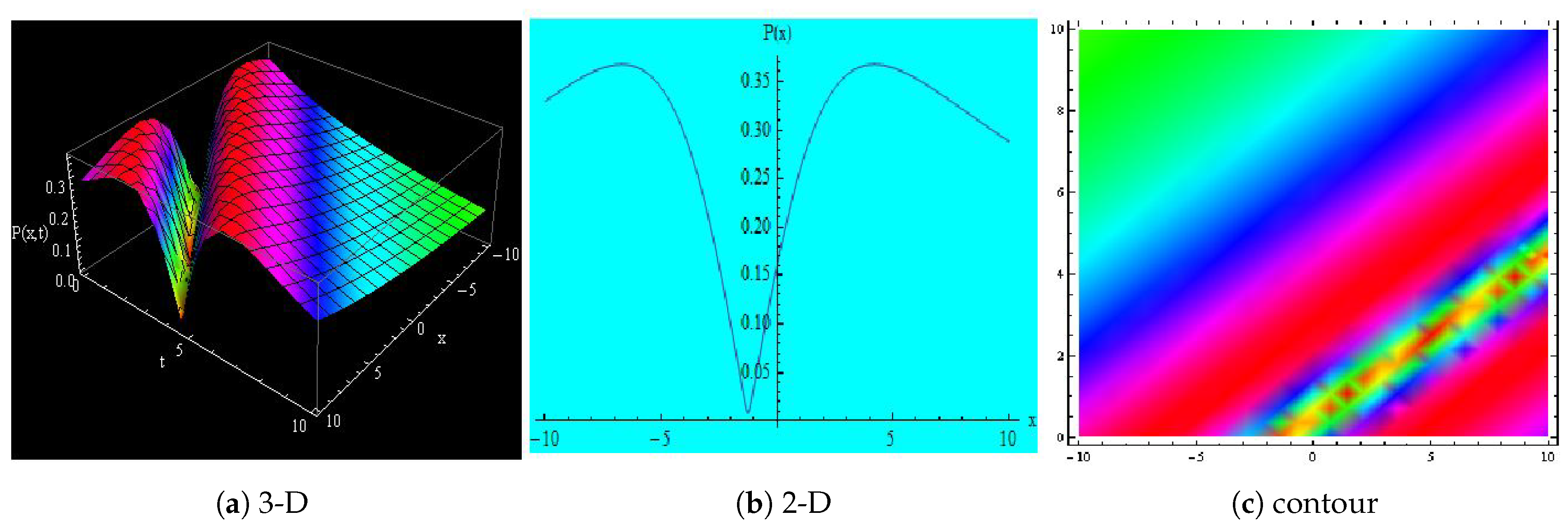
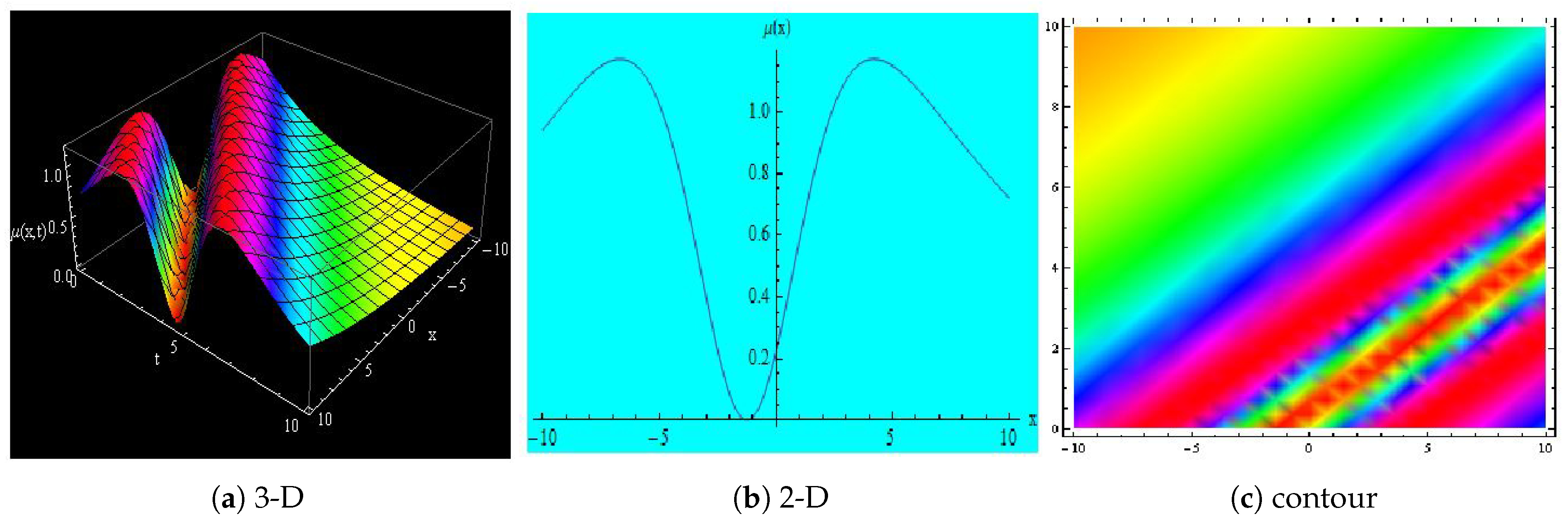
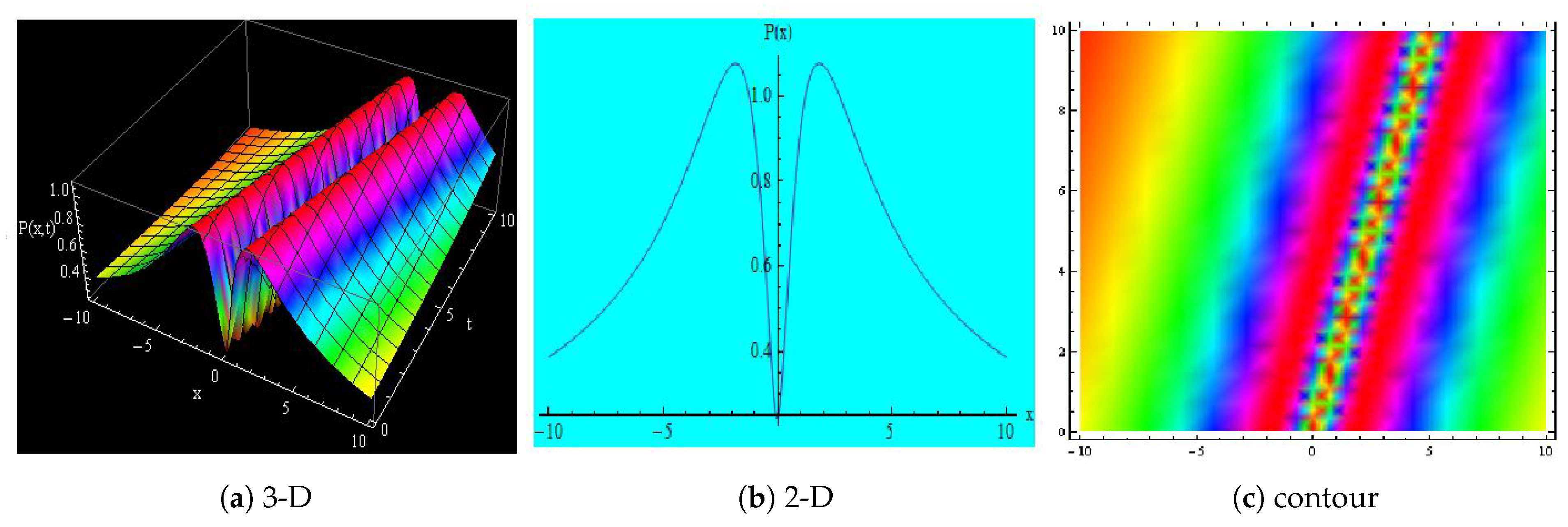
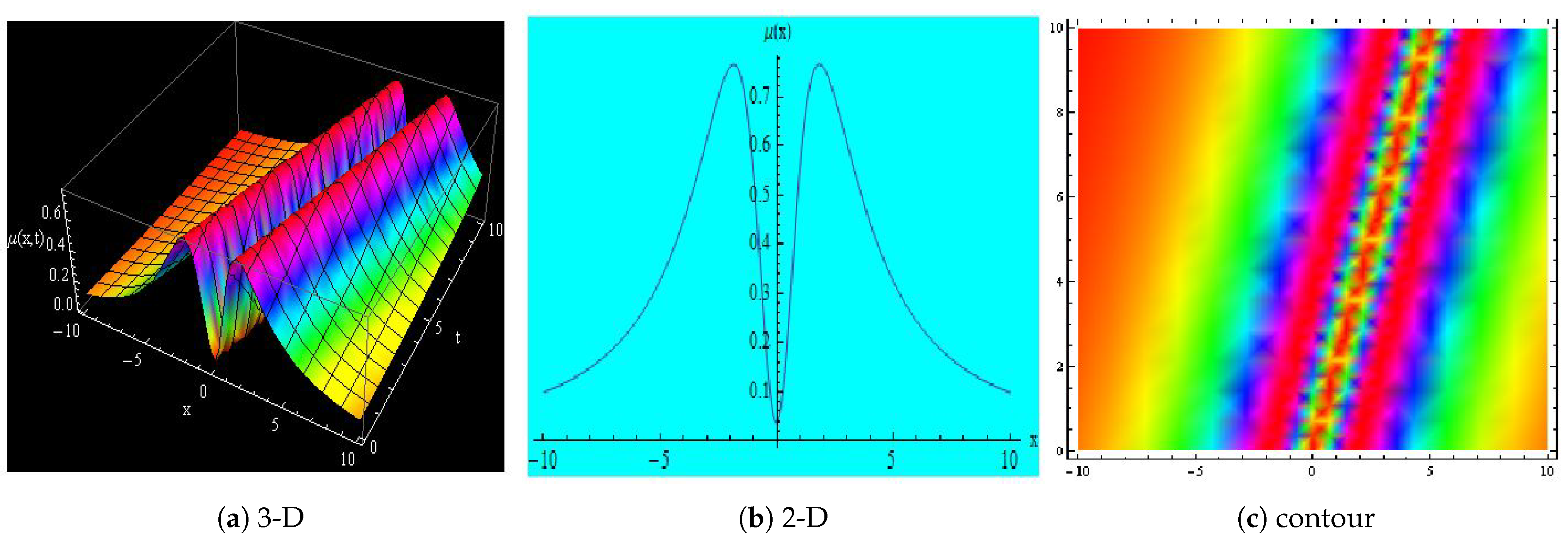
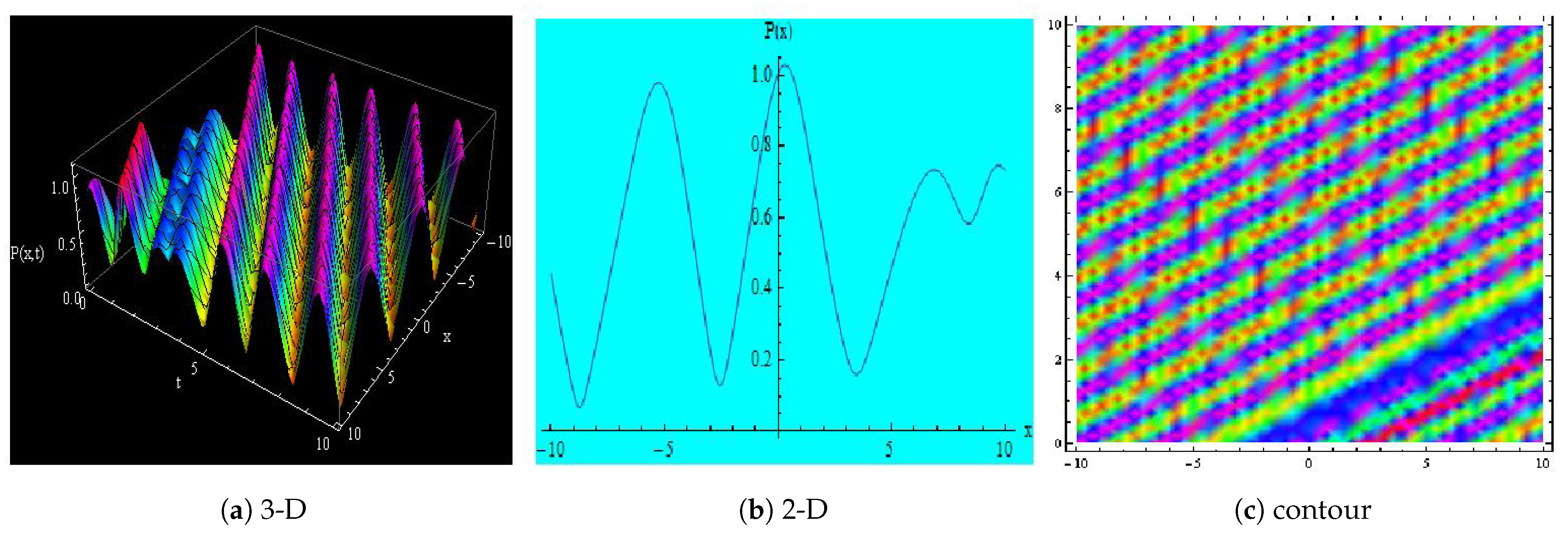
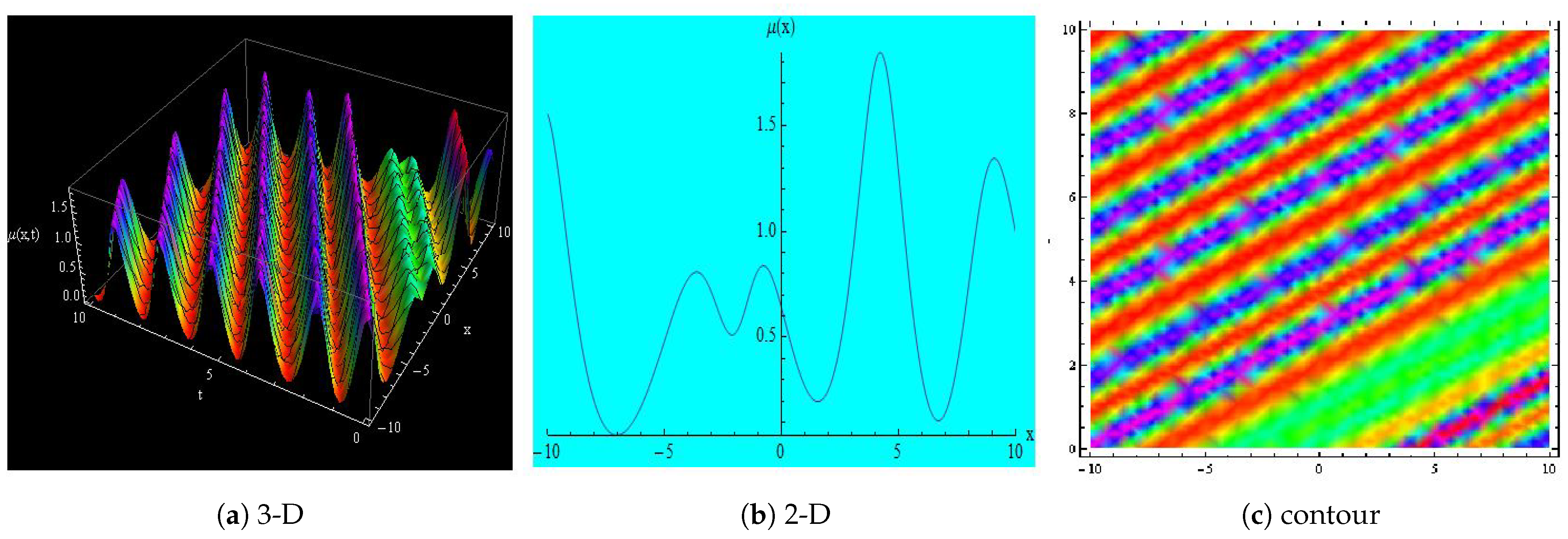
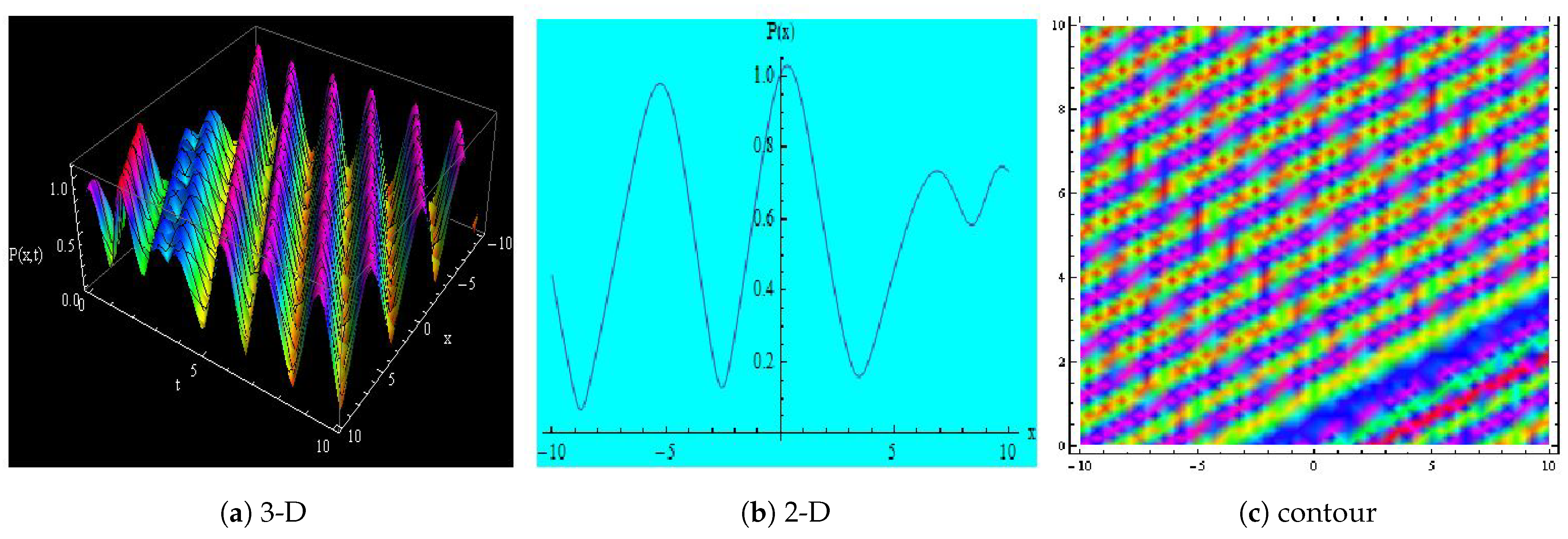
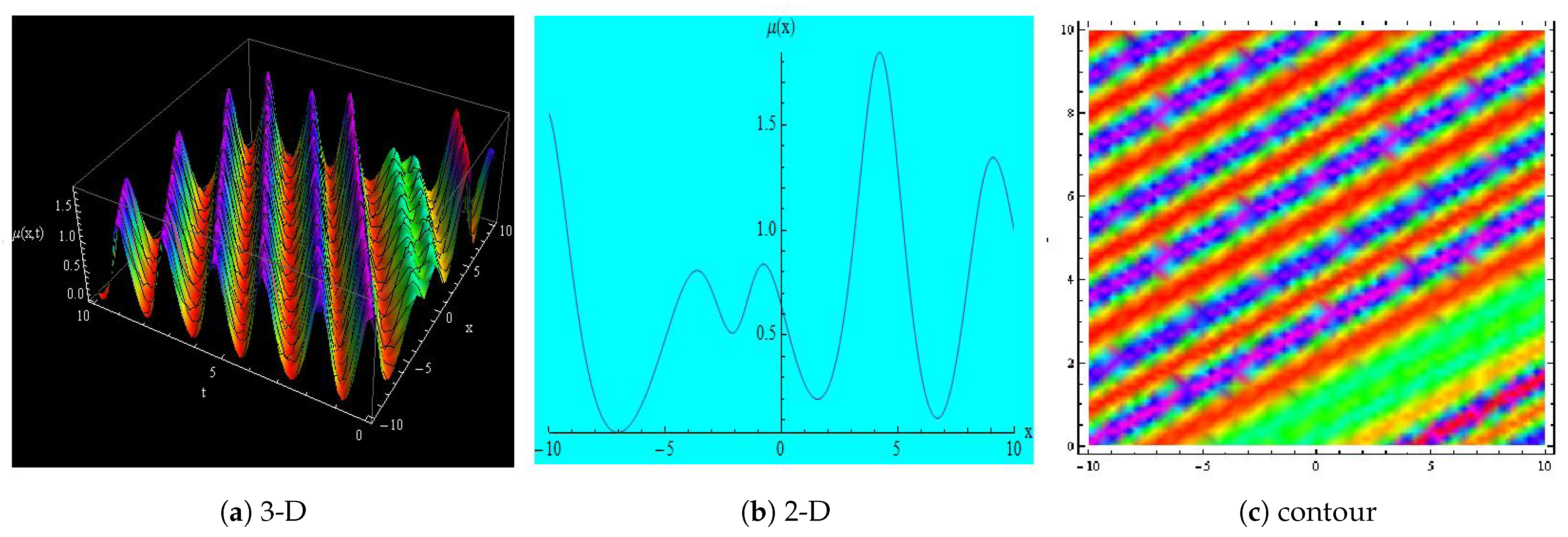
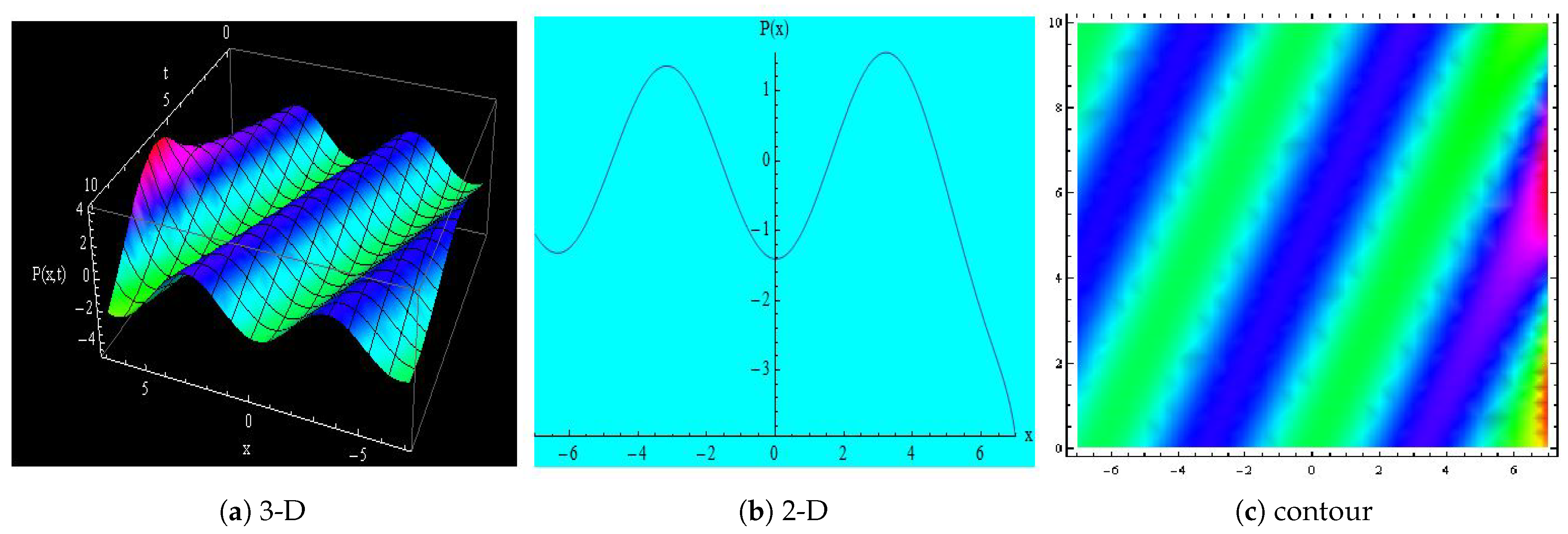
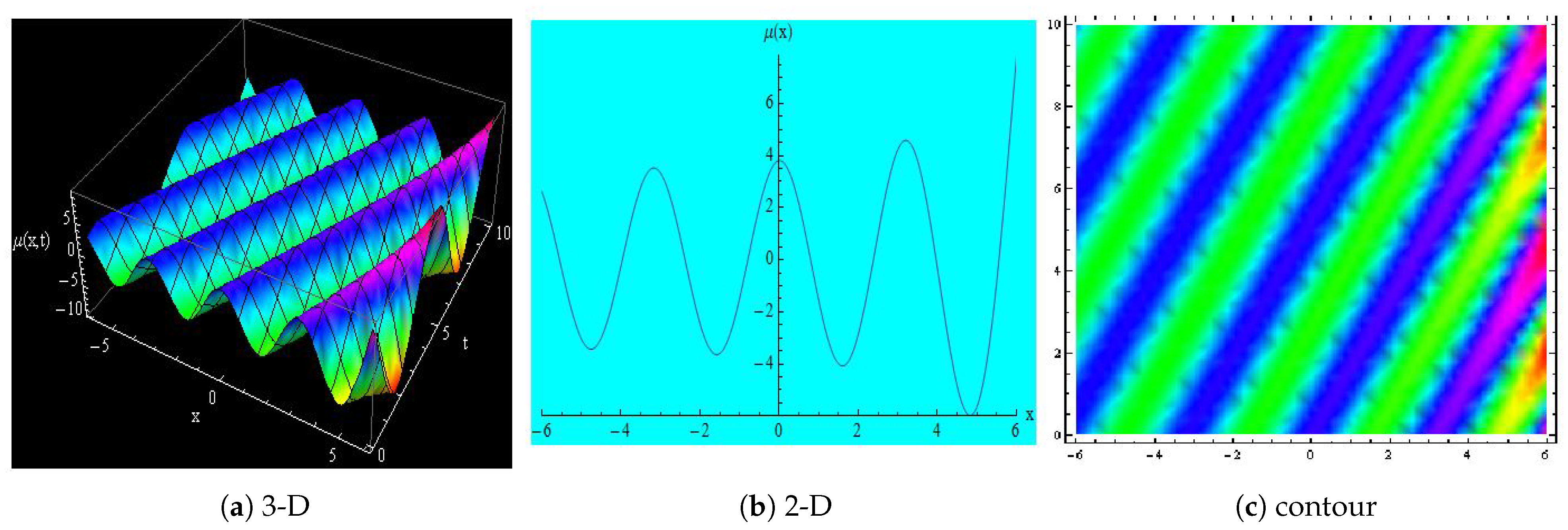
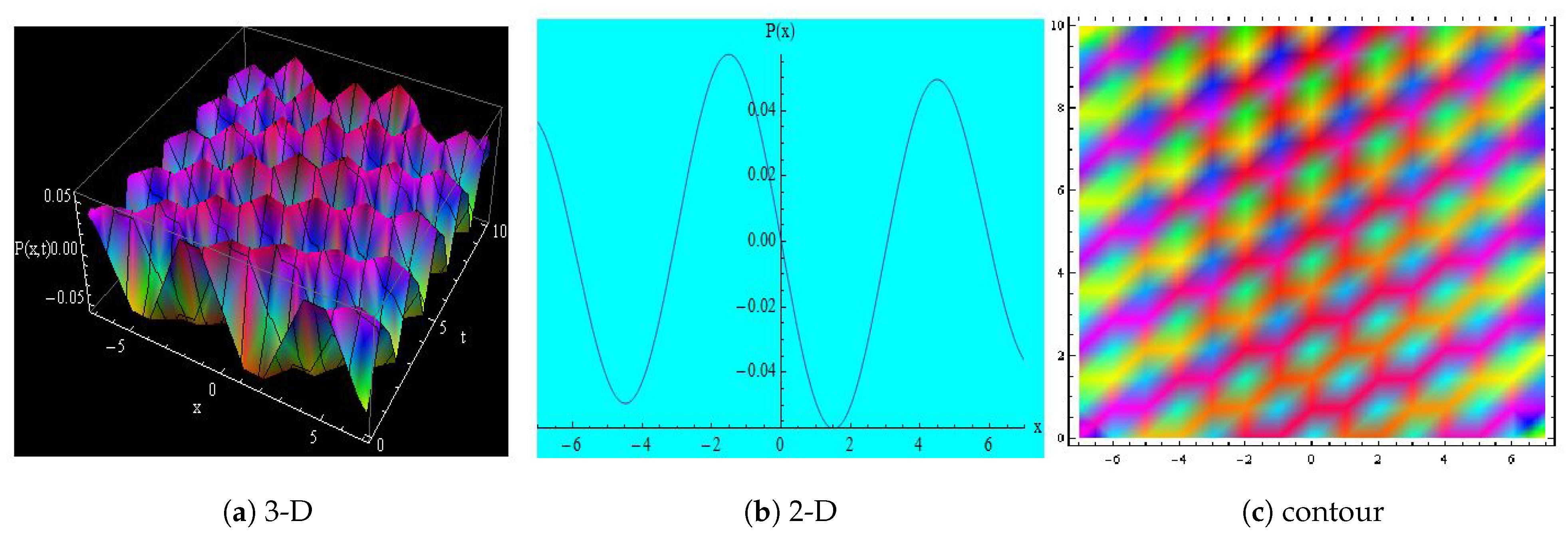
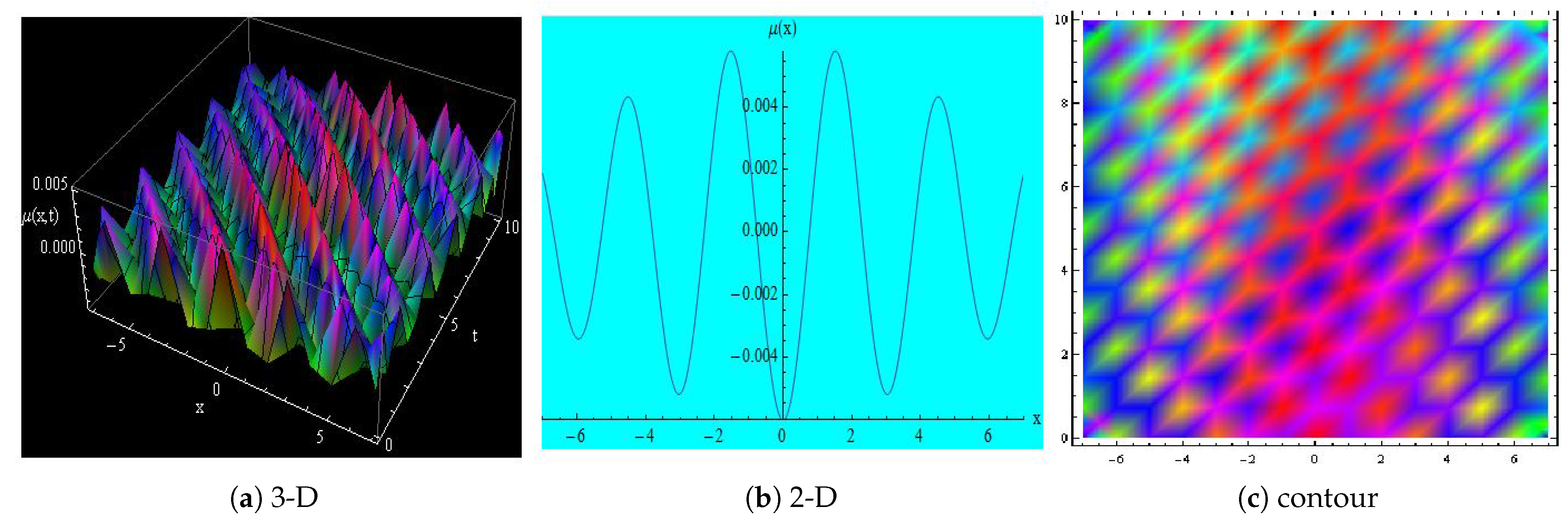
6. Graphical Analysis
7. Conclusions
Author Contributions
Funding
Data Availability Statement
Conflicts of Interest
References
- Arshed, S.; Akram, G.; Sadaf, M.; Nabi, A.; Alzaidi, A.S.M. Optical soliton solutions of perturbed nonlinear schrödinger equation with parabolic law nonlinearity. Opt. Quantum Electron. 2024, 56, 50. [Google Scholar] [CrossRef]
- Rezazadeh, H.; Inc, M.; Baleanu, D. New solitary wave solutions for variants of (3+1)-dimensional wazwaz-benjamin-bona-mahony equations. Front. Phys. 2020, 8, 332. [Google Scholar] [CrossRef]
- Yang, H. Symmetry reductions and exact solutions to the kudryashov-sinelshchikov equation. Z. Naturforschung A 2016, 71, 1059–1065. [Google Scholar] [CrossRef]
- Dehghan, M.; Heris, J.M.; Saadatmandi, A. Application of the exp-function method for solving a partial differential equation arising in biology and population genetics. Int. J. Numer. Methods Heat Fluid Flow 2011, 21, 736–753. [Google Scholar] [CrossRef]
- Wazwaz, A.M. Multiple-soliton solutions for the kp equation by hirota’s bilinear method and by the tanh-coth method. Appl. Math. Comput. 2007, 190, 633–640. [Google Scholar] [CrossRef]
- Lü, X.; Chen, S.J. Interaction solutions to nonlinear partial differential equations via hirota bilinear forms: One-lump-multi-stripe and one-lump-multi-soliton types. Nonlinear Dyn. 2021, 103, 947–977. [Google Scholar] [CrossRef]
- Lu, D.C.; Hong, B.; Tian, L. Backlund transformation and n-soliton-like solutions to the combined kdv-burgers equation with variable coefficients. Int. J. Nonlinear Sci. 2006, 2, 3–10. [Google Scholar]
- Yin, Y.H.; Lü, X.; Ma, W.X. Bäcklund transformation, exact solutions and diverse interaction phenomena to a (3+1)-dimensional nonlinear evolution equation. Nonlinear Dyn. 2022, 108, 4181–4194. [Google Scholar] [CrossRef]
- Fan, E.; Zhang, H. A note on the homogeneous balance method. Phys. Lett. A 1998, 246, 403–406. [Google Scholar] [CrossRef]
- Wazwaz, A.M. The tanh-coth method for new compactons and solitons solutions for the k (n,n) and the k (n+1,n+1) equations. Appl. Math. Comput. 2007, 188, 1930–1940. [Google Scholar] [CrossRef]
- Mohyud-Din, S.T.; Noor, M.A.; Noor, K.I. Modified variational iteration method for solving sine gordon equations. World Appl. Sci. J. 2009, 6, 999–1004. [Google Scholar]
- Hosseini, K.; Hincal, E.; Salahshour, S.; Mirzazadeh, M.; Dehingia, K.; Nath, B.J. On the dynamics of soliton waves in a generalized nonlinear schrödinger equation. Optik 2023, 272, 170215. [Google Scholar] [CrossRef]
- Zhang, J.L.; Wang, M.L.; Wang, Y.M.; Fang, Z.D. The improved f-expansion method and its applications. Phys. Lett. A 2006, 350, 103–109. [Google Scholar] [CrossRef]
- Zhao, Y.W.; Xia, J.W.; Lü, X. The variable separation solution, fractal and chaos in an extended coupled (2+1)-dimensional burgers system. Nonlinear Dyn. 2022, 108, 4195–4205. [Google Scholar] [CrossRef]
- Ablowitz, M.J.; Segur, H. Solitons and the Inverse Scattering Transform; SIAM: Singapore, 1981. [Google Scholar]
- Raees, N.; Mahmood, I.; Hussain, E.; Younas, U.; Elansary, H.O.; Mumtaz, S. Dynamics of optical solitons and sensitivity analysis in fiber optics. Phys. Lett. A 2024, 528, 130031. [Google Scholar] [CrossRef]
- Muhammad, T.; Hamoud, A.A.; Emadifar, H.; Hamasalh, F.K.; Azizi, H.; Khademi, M. Traveling wave solutions to the boussinesq equation via sardar sub-equation technique. AIMS Math 2022, 7, 11134–11149. [Google Scholar]
- Murad, M.A.S.; Ismael, H.F.; Sulaiman, T.A. Various exact solutions to the time-fractional nonlinear schrödinger equation via the new modified sardar sub-equation method. Phys. Scr. 2024, 99, 085252. [Google Scholar] [CrossRef]
- Al, A.; Mohammed, O. Exact solutions of the generalized (2+1)-dimensional nonlinear evolution equations via the modified simple equation method. Comput. Math. Appl. 2015, 69, 390–397. [Google Scholar]
- Ejaz, H.; Yasir, A.; Sandeep, M.; Fehaid, S.A. The (2+1)-Dimensional Chiral Nonlinear Schrödinger Equation: Extraction of Soliton Solutions and Sensitivity Analysis. Axioms 2025, 14, 422. [Google Scholar]
- Hussain, E.; Tedjani, A.H.; Farooq, K. Beenish, Modeling and Exploration of Localized Wave Phenomena in Optical Fibers Using the Generalized Kundu–Eckhaus Equation for Femtosecond Pulse Transmission. Axioms 2025, 14, 513. [Google Scholar] [CrossRef]
- Farooq, K.; Hussain, E.; Younas, U.; Mukalazi, H.; Khalaf, T.M.; Mutlib, A.; Shah, S.A.A. Exploring the Wave’s Structures to the Nonlinear Coupled System Arising in Surface Geometry. Sci. Rep. 2025, 15, 11624. [Google Scholar] [CrossRef]
- Khizar, F.; Ali, H.T.; Zhao, L.; Ejaz, H. Soliton Dynamics of the Nonlinear Kodama Equation with M-Truncated Derivative via Two Innovative Schemes: The Generalized Arnous Method and the Kudryashov Method. Fractal Fract. 2025, 9, 436. [Google Scholar] [CrossRef]
- Shah, S.A.A.; Hussain, E.; Ma, W.X.; Li, Z.; Ragab, A.E.; Khalaf, T.M. Qualitative Analysis and New Variety of Solitons Profiles for the (1+1)-Dimensional Modified Equal Width Equation. Chaos Solitons Fractals 2024, 187, 115353. [Google Scholar] [CrossRef]
- Hussain, E.; Malik, S.; Yadav, A.; Shah, S.A.A.; Iqbal, M.A.B.; Ragab, A.E.; Mahmoud, H.M. Qualitative Analysis and Soliton Solutions of Nonlinear Extended Quantum Zakharov–Kuznetsov Equation. Nonlinear Dyn. 2024, 112, 19295–19310. [Google Scholar] [CrossRef]
- Binder, P.; Abraimov, D.; Ustinov, A.V.; Flach, S.; Zolotaryuk, Y. Observation of breathers in josephson ladders. Phys. Rev. Lett. 2000, 84, 745. [Google Scholar] [CrossRef] [PubMed]
- Tao, Y.; He, J. Multisolitons, breathers, and rogue waves for the hirota equation generated by the darboux transformation. Phys. Rev. E—Stat. Nonlinear Soft Matter Phys. 2012, 85, 026601. [Google Scholar] [CrossRef]
- Chabchoub, A.; Hoffmann, N.; Onorato, M.; Akhmediev, N. Super rogue waves: Observation of a higher-order breather in water waves. Phys. Rev. X 2012, 2, 011015. [Google Scholar] [CrossRef]
- Li, B.Q.; Ma, Y.L. Extended generalized darboux transformation to hybrid rogue wave and breather solutions for a nonlinear schrödinger equation. Appl. Math. Comput. 2020, 386, 125469. [Google Scholar] [CrossRef]
- Dudley, J.M.; Dias, F.; Erkintalo, M.; Genty, G. Instabilities, breathers and rogue waves in optics. Nat. Photonics 2014, 8, 755–764. [Google Scholar] [CrossRef]
- Zakharov, V.E.; Gelash, A.A. Nonlinear stage of modulation instability. Phys. Rev. Lett. 2013, 111, 054101. [Google Scholar] [CrossRef]
- Akhmediev, N.N.; Eleonskii, V.M.; Kulagin, N.E. Exact first-order solutions of the nonlinear schrödinger equation. Theor. Math. Phys. 1987, 72, 809–818. [Google Scholar] [CrossRef]
- Guan, W.Y.; Li, B.Q. New observation on the breather for a generalized nonlinear schrödinger system with two higher-order dispersion operators in inhomogeneous optical fiber. Optik 2019, 181, 853–861. [Google Scholar] [CrossRef]
- Kuznetsov, E.A. Solitons in a parametrically unstable plasma. In Akademiia Nauk SSSR Doklady; Akademiia Nauk SSSR: Moscow, Russia, 1977; Volume 236, pp. 575–577. [Google Scholar]
- Seadawy, A.R.; Rizvi, S.T.R.; Ahmad, S.; Younis, M.; Baleanu, D. Lump, lump-one stripe, multiwave and breather solutions for the hunter–saxton equation. Open Phys. 2021, 19, 1–10. [Google Scholar] [CrossRef]
- Dieu, G.; Tiofack, C.G.L.; Seadawy, A.; Hubert, M.B.; Betchewe, G.; Serge, D.Y. Propagation of w-shaped, m-shaped and other exotic optical solitons in the perturbed fokas-lenells equation. Eur. Phys. J. Plus 2020, 135, 1–18. [Google Scholar]
- Seadawy, A.R.; Rehman, S.U.; Younis, M.; Rizvi, S.T.R.; Althobaiti, S.; Makhlouf, M.M. Modulation instability analysis and longitudinal wave propagation in an elastic cylindrical rod modelled with pochhammer-chree equation. Phys. Scr. 2021, 96, 045202. [Google Scholar] [CrossRef]
- Mathanaranjan, T.; Myrzakulov, R. Integrable akbota equation: Conservation laws, optical soliton solutions and stability analysis. Opt. Quantum Electron. 2024, 56, 564. [Google Scholar] [CrossRef]
- Tariq, M.M.; Riaz, M.B.; Muhammad, A.R. Investigation of space-time dynamics of akbota equation using sardar sub-equation and khater methods: Unveiling bifurcation and chaotic structure. Int. J. Theor. Phys. 2024, 63, 210. [Google Scholar] [CrossRef]
- Mahmood, I. Lax pair representation and darboux transformation of noncommutative painlevé’s second equation. J. Geom. Phys. 2012, 62, 1575–1582. [Google Scholar] [CrossRef]
- Mahmood, I. Quasideterminant solutions of nc painlevé ii equation with the toda solution at n = 1 as a seed solution in its darboux transformation. J. Geom. Phys. 2015, 95, 127–136. [Google Scholar] [CrossRef]
- Rizvi, S.T.R.; Seadawy, A.R.; Ashraf, M.A.; Younis, M.; Khaliq, A.; Baleanu, D. Rogue, multi-wave, homoclinic breather, m-shaped rational and periodic-kink solutions for a nonlinear model describing vibrations. Results Phys. 2021, 29, 104654. [Google Scholar] [CrossRef]


Disclaimer/Publisher’s Note: The statements, opinions and data contained in all publications are solely those of the individual author(s) and contributor(s) and not of MDPI and/or the editor(s). MDPI and/or the editor(s) disclaim responsibility for any injury to people or property resulting from any ideas, methods, instructions or products referred to in the content. |
© 2025 by the authors. Licensee MDPI, Basel, Switzerland. This article is an open access article distributed under the terms and conditions of the Creative Commons Attribution (CC BY) license (https://creativecommons.org/licenses/by/4.0/).
Share and Cite
Raees, N.; Tedjani, A.H.; Mahmood, I.; Hussain, E. Diversity of Optical Soliton Solutions of Akbota Models in the Application of Heisenberg Ferromagnet. Symmetry 2025, 17, 2149. https://doi.org/10.3390/sym17122149
Raees N, Tedjani AH, Mahmood I, Hussain E. Diversity of Optical Soliton Solutions of Akbota Models in the Application of Heisenberg Ferromagnet. Symmetry. 2025; 17(12):2149. https://doi.org/10.3390/sym17122149
Chicago/Turabian StyleRaees, Nida, Ali. H. Tedjani, Irfan Mahmood, and Ejaz Hussain. 2025. "Diversity of Optical Soliton Solutions of Akbota Models in the Application of Heisenberg Ferromagnet" Symmetry 17, no. 12: 2149. https://doi.org/10.3390/sym17122149
APA StyleRaees, N., Tedjani, A. H., Mahmood, I., & Hussain, E. (2025). Diversity of Optical Soliton Solutions of Akbota Models in the Application of Heisenberg Ferromagnet. Symmetry, 17(12), 2149. https://doi.org/10.3390/sym17122149