3. Results and Analysis
The transverse momentum
distributions of different particles (hadrons), such as
,
,
, and
produced in symmetric
p–
p collisions at
= 0.9 TeV and 7 TeV, are described by experimental data taken from the ALICE collaboration at the CERN Large Hadron Collider (LHC) [
25,
26,
27,
28,
29] and displayed in
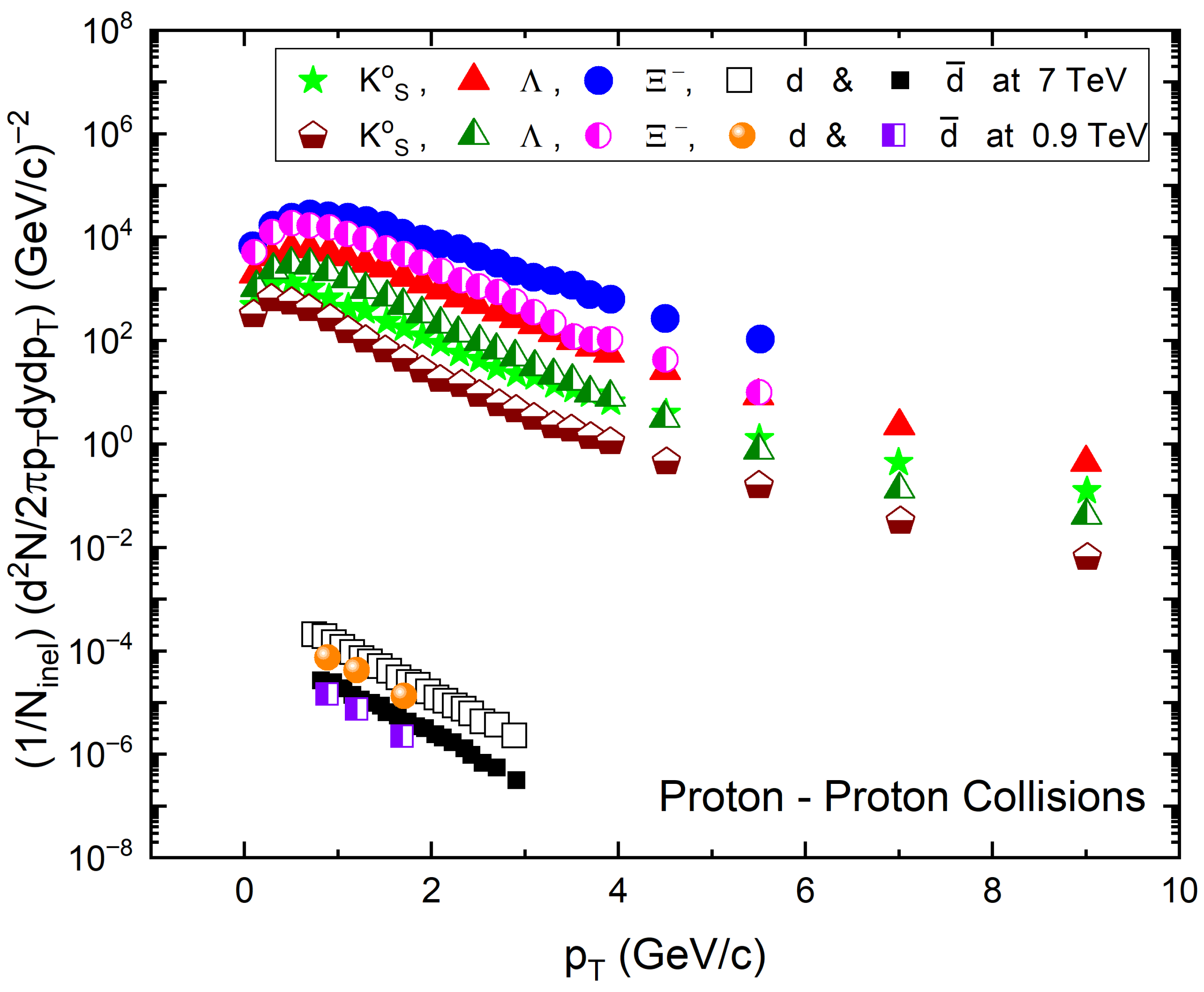
Figure 1, which displays all the particles at both energies on a single plot to demonstrate the hierarchy of yields and the scale difference between 0.9 TeV and 7 TeV. At 7 TeV, there are significantly higher yields (upper distributions) than in the case of 0.9 TeV (lower distributions). The yield decreases as
increases, and the spectra are generally harder for the higher mass particles (i.e., the decrease with
is slower at high
, like
or
compared to
). The distinct ordering of the yields of these strange hadrons (e.g.,
) provides crucial information about strangeness production mechanisms in
p–
p collisions, which is essential as a baseline for comparison with heavy-ion collisions. The invariant yields generally follow an approximate exponential decay with increasing
, and a transition to a power-law decay at high
is observed. Furthermore,
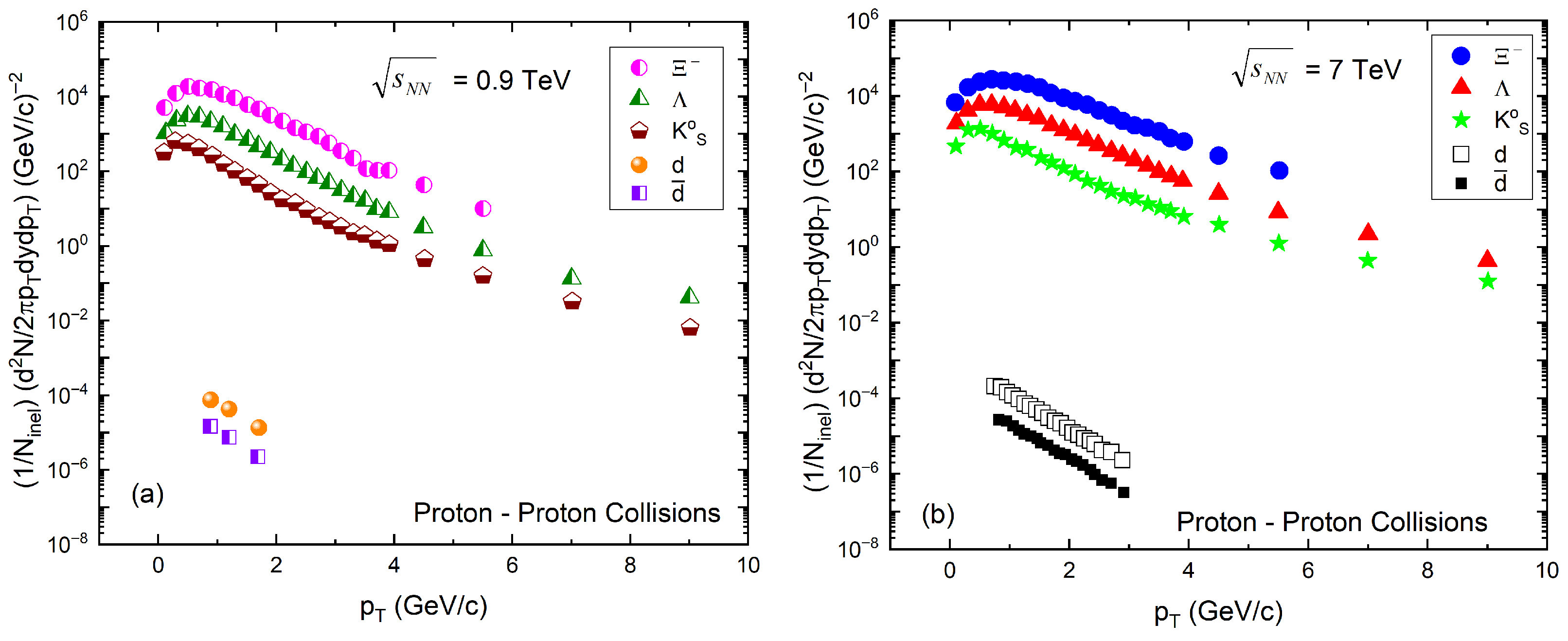
Figure 2 visualizes the distributions of both datasets (0.9 TeV and 7 TeV) independently. It separates the particles to allow for a clearer view of the spectral shapes of individual species without visual overcrowding. The individual plots are made for the purpose of comparison, allowing us to analyze the trends within each dataset. In
Figure 2a, the normalized invariant yield (
) is presented as a function of transverse momentum
for
p–
p collisions at
= 0.9 TeV. At low
values, the particle yields are ordered as
. This ordering reflects the strangeness content of the particles: the single-strange
or
is produced at a greater rate than the double-strange
. The yields exhibit a sharp, approximately exponential fall-off as
increases. In addition, the behavior at low
is primarily governed by soft physics processes like thermal production and collective effects. These distributions serve as a baseline for hadronic production in symmetric
p–
p collisions at a moderate Large Hadron Collider (LHC) energy. The yields for the presumed
are several orders of magnitude lower than the strange hadrons, indicating their production is far less common. The data points are relatively scattered at high
, particularly for the multi-strange
, suggesting that the production cross-section becomes very low at large transverse momenta for these low-energy collisions. In
Figure 2b, the normalized invariant yield (
) is also presented as a function of transverse momentum
for
p–
p collisions at
= 7 TeV. Similar to 0.9 TeV, the low
particle yield ordering is observed as
. The slopes of the
distributions are less steep compared to the 0.9 TeV distributions, meaning the yields do not drop quickly as the
increases. Additionally, the comparison between the two plots highlights the strong energy dependence of particle production in
p–
p collisions. The invariant yields at 7 TeV are significantly higher than those at 0.9 TeV by factors ranging from tens to hundreds across all
values. This increase in particle yields is expected due to the larger phase space available for particle production at higher center-of-mass energy. Furthermore, the
distributions are significantly harder at 7 TeV, while they fall more steeply with
at 0.9 TeV. This confirms the dominance of hard scattering (jet-like) processes as the collision energy increases. The ordering of strange hadron yields (
) is maintained at both energies, indicating that the fundamental mechanisms for strangeness production are qualitatively similar in
p–
p collisions across this energy range, although the rates are much higher. These
p–
p results are essential as a reference for Heavy-Ion (
A–
A) collisions (e.g.,
–
). For instance, any deviation in the yield or the spectral shape in
A–
A data (such as the strangeness enhancement) is interpreted relative to these
p–
p baseline measurements to diagnose the formation of the Quark-Gluon Plasma (QGP).
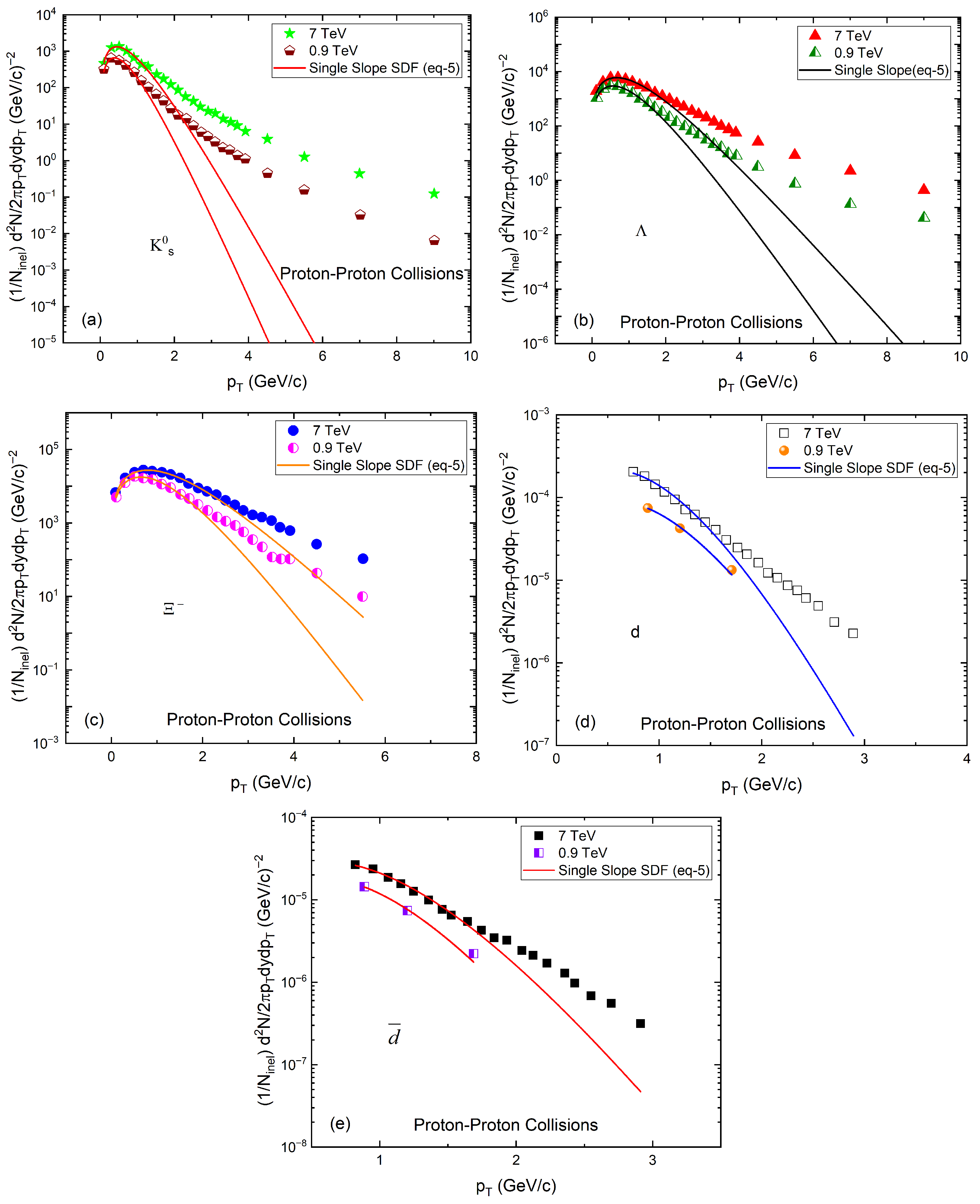
Figure 3 presents the transverse momentum
distributions of
,
,
,
d, and
produced in
p–
p collisions at
= 0.9 TeV and 7 TeV, plotted as subfigures a, b, c, d, and e, respectively. The distributions are plotted on a semi-log scale, with the y-axis showing the differential yield and the x-axis showing
in GeV/c. The Single-Slope Standard Distribution Function (Equation (
5)) is applied as a fit function (where
= 0) and compared to the experimental data. In
Figure 3a, the yield of
mesons is significantly higher at 7 TeV as compared to 0.9 TeV throughout the
range. This is consistent with the expectation from quantum chromodynamics (QCD) that the production cross-section increases at higher collision energies for all particle species. In both energies, the distribution exhibits a steep drop at low
followed by a shallower slope at intermediate
. The data clearly deviates from the Single-Slope SDF fit for
GeV/c. This hardening of the spectrum at higher
is also a common feature in
p–
p collisions, indicative of the transition from soft-physics (low
) to hard-scattering processes (high
), which is better described by power-law functions like the Hagedorn and Tsallis distributions or by pQCD calculations. In
Figure 3b, similar to
, the 7 TeV distribution is consistently higher than the 0.9 TeV distribution. This confirms the increased production with higher center-of-mass energy. The
spectrum also shows a clear deviation from the Single-Slope SDF fit at high
; a deviation that is even more pronounced than for the
. This deviation is particularly important for baryons (such as
) because their production at intermediate
is strongly influenced by baryon-meson chemistry and collective effects (if any, though less expected in
p–
p collisions than in heavy-ion collisions), which can lead to a phenomenon known as baryon-to-meson enhancement at intermediate
relative to the exponential fit. In
Figure 3c, the production yield of
at 7 TeV is notably higher than at 0.9 TeV. The data points at the two energies appear quite close, suggesting a less steep rise in production yield with energy compared to the lighter particles, especially at low
. The overall
spectrum is steeper than for
and
, indicating that the average
is lower. The Single-Slope SDF fit performs reasonably well over the measured range up to
GeV/c, but the data still show a slight deviation or hardening at the highest measured
values.
Figure 3d,e shows that both distributions of
are very steep, and the production yield is substantially lower than for the primary hadrons. The
distributions are nearly identical, particularly at low
, which is an expected outcome due to charge-conjugation (
C) symmetry in
p–
p collisions. The Single-Slope SDF fit provides a reasonable description of these steep, low-yield distributions over the limited measured range. The fit parameters, such as volume
V, effective temperature
T, and chi-square
values, are extracted from each subfigure to describe the data best at each center-of-mass energy, given in
Table 1. The data demonstrates a clear dependence on both volume and effective temperature on center-of-mass energy, with elevated values at higher center-of-mass energies; i.e., higher energy collisions create a hotter and denser medium. This increment is indicative of higher effective thermal excitation and greater phase space occupancy at higher energies.
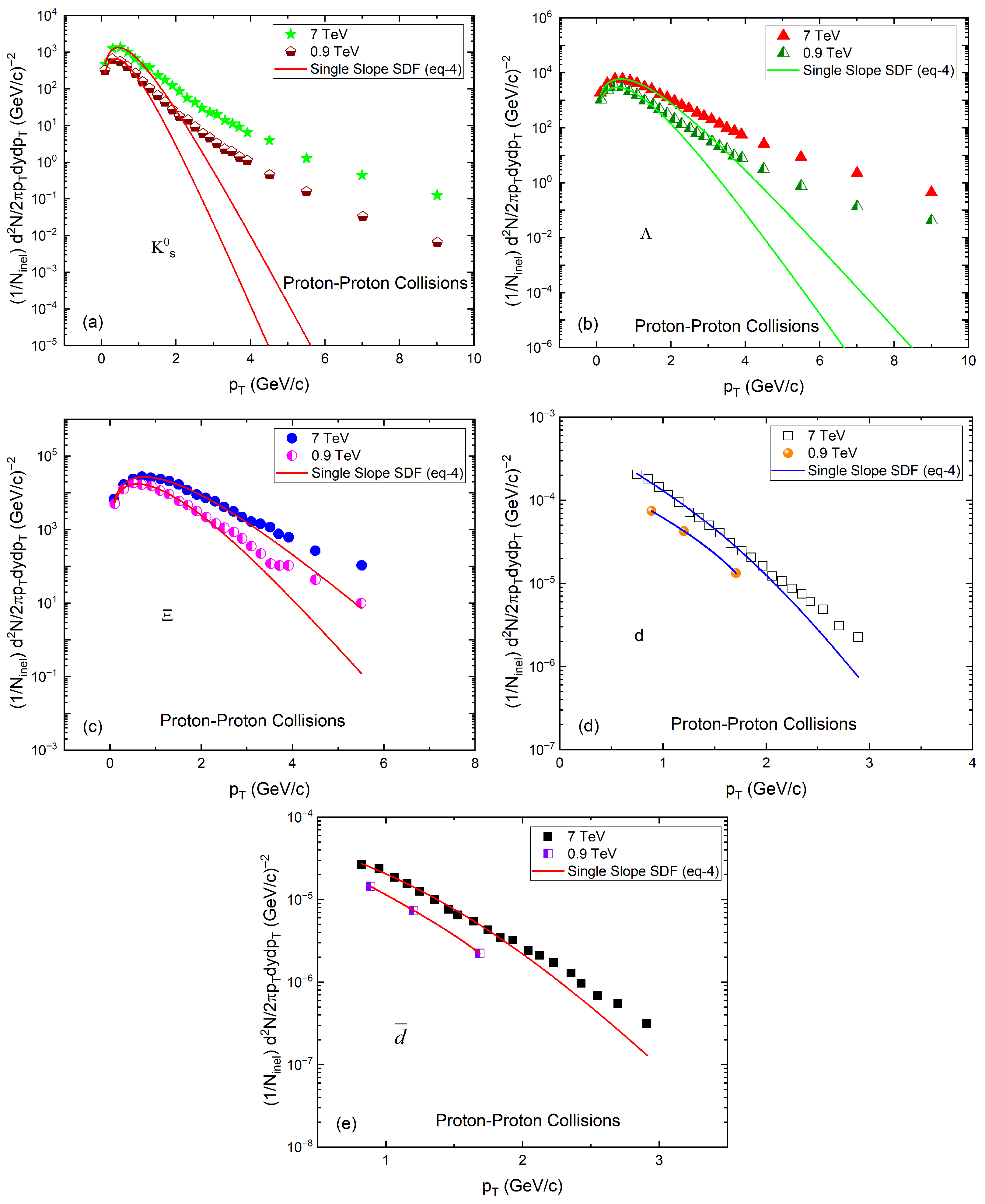
In
Figure 4, the Single-Slope Standard Distribution Function (Equation (
4), considering chemical potential (
)), is used to fit the transverse momentum
distributions of
,
,
,
d, and
, then compared to the experimental data. Similar to
Figure 3, the distributions are plotted on a semi-log scale, with the y-axis showing the differential yield and the x-axis showing
in GeV/c. In
Figure 4a, the
distributions of
show a significant increase in production yield as the collision energy rises from 0.9 TeV to 7 TeV. This reflects the larger phase space and higher hard-scattering probability at higher energy in Quantum Chromodynamics (QCD). There is the clear deviation of the data from the Single-Slope SDF fit for
values beyond ~2 GeV/c. This hardening of the distributions at intermediate-to-high
is a signature of the transition from soft particle production mechanisms, which are well-modeled by the exponential fit, to hard-scattering processes where partonic interactions dominate and the cross-section follows a power law. In
Figure 4b,
exhibits a similar energy dependence, with the 7 TeV yield consistently exceeding the 0.9 TeV yield across the measured
range. The distribution is also visually steeper than the
distribution at low
. However, this Single-Slope SDF fit fails to describe the data at high
(e.g.,
GeV/c). This pronounced deviation suggests the presence of mechanisms that favor the production of baryons over mesons at intermediate
, a phenomenon often linked to hadronization via coalescence/recombination or specific quark-level effects, which needs more sophisticated theoretical modeling than a simple thermal description. In
Figure 4c, the
distributions of
show that the production yield of
at 7 TeV is greater than at 0.9 TeV. Being a heavier particle than
, the
spectrum is steeper and the overall production yield is lower. Although this Single-Slope SDF fit describes the low
data relatively well, at the highest measured
(e.g.,
GeV/c), the data points clearly fall above the fit, once again highlighting the limitation of a single exponential model to describe the full range of particle production, which extends into the hard-scattering regime. In
Figure 4d, the yield of
d is several orders of magnitude lower (down to
GeV/c) than for the elementary hadrons, which is a characteristic of coalescence. The 7 TeV data is slightly higher than 0.9 TeV, demonstrating an energy dependence for this secondary production mechanism. The sharp steepening of the spectrum indicates that the probability for two nucleons to coalesce decreases rapidly with the deuteron’s
. Therefore, this Single-Slope SDF fit (Equation (
4)) provides a fair, though not perfect, representation of this steep fall-off. In
Figure 4e, the distribution of
is nearly identical in shape and yield to the
d distribution, consistent with the expectation of charge-conjugation (
C) symmetry in
p–
p collisions, where the production of matter and antimatter nuclei should be equal. Like the deuteron, the antideuteron production yield is extremely low and the spectrum is very steep. The failure of the Single-Slope fit demonstrates that the system cannot be described by a simple static thermal source, and therefore, more complex models are presented later in this paper. The fit parameters, such as volume
V, effective temperature
T, chemical potential
, and
, are extracted from each subfigure, as given in
Table 2. Both the volume and effective temperature increase proportionally to the rise of center-of-mass energy, while the chemical potential
decreases. The gradual increase in
T and decrease in
are consistent with higher kinetic freeze-out temperatures and lower net baryon density at high center-of-mass energies. In addition, the increase in volume
V confirms that the expected system is expanded at higher center-of-mass energies. The fit of the extracted temperature and volume reveals a marginal increase in thermalization and system size, which corroborates the onset of a near-equilibrated hadronic phase.
In parallel to the previous two fit functions, a third approach was employed to characterize the transverse momentum
distributions of
,
,
,
d, and
, which were then compared to the experimental data.
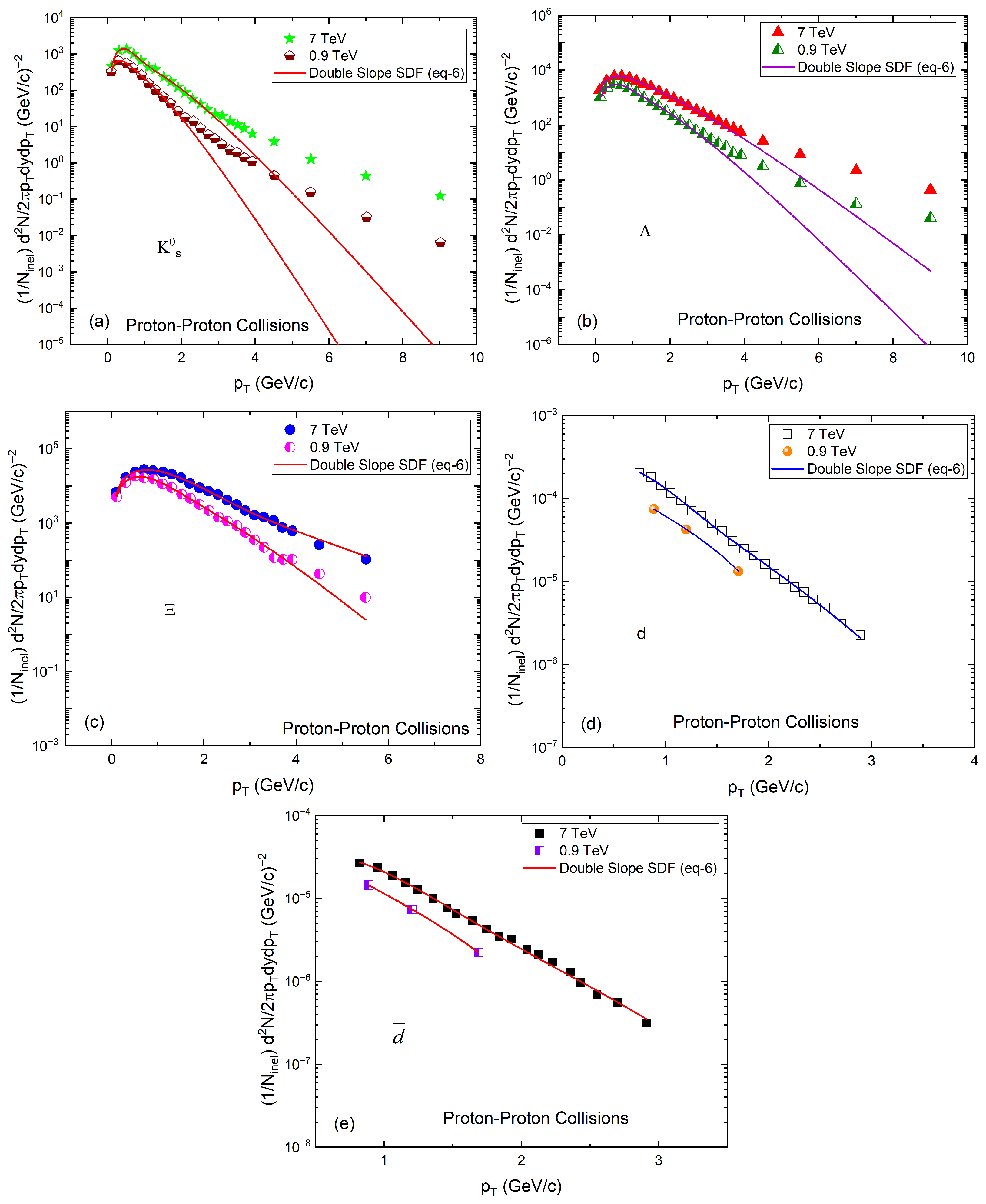
Figure 5 presents the results obtained by fitting the distributions with the Double-Slope Standard Distribution Function (Equation (
6)), which generally parameterizes the low
soft physics component and the high
hard scattering component with separate inverse slope parameters. In
Figure 5a, the
distribution of
at 7 TeV shows a higher yield than at 0.9 TeV across the measured
range, reflecting the expected increase in the production cross-section with energy. A stronger representation of the data is obtained with Double-Slope SDF, which is eventually designed to better capture the spectral shape compared to the Single-Slope SDF. The fit follows the steep initial drop (soft component) and successfully incorporates the shallower slope, or spectral hardening, observed at
GeV/c (hard component). The agreement suggests that the two primary production mechanisms (soft thermal/statistical processes and hard pQCD scattering) are well-modeled by the two exponential or power-law terms of the Double-Slope SDF. Likewise, in
Figure 5b, the
distributions of
baryon also show the expected increase in yield from 0.9 TeV to 7 TeV. The Double-Slope SDF presents a much better parametrization than the Single-Slope SDF fit. This improved fit is crucial because
production, particularly at intermediate
, is sensitive to hadronization mechanisms like recombination/coalescence, which could enhance the baryon yield relative to mesons. The success of the Double-Slope SDF fit function suggests that this framework is robust enough to model the
distributions of both mesons and baryons by accommodating the shift in dynamics between the low and high
regions. In a parallel manner, for
in
Figure 5, the
distributions continue to show a higher
production of at 7 TeV as compared to 0.9 TeV. The
yield is lower and the distribution is steeper than for
due to its larger mass and higher strangeness content. The Double-Slope SDF provides a good fit across the measured
range. This consistency across various hadron masses and strangeness (from
to
) suggests that the underlying dynamics, which necessitate a two-component description, are universal for primary hadron production in
p–
p collisions. In
Figure 5d,e,
have significantly lower yields and much steeper
distributions than the primary hadrons. The distributions of
are dominated by a very steep drop. The Double-Slope SDF provides a very good fit over the narrow measured
range. These distributions are primarily determined by the momentum-space overlap of the constituent nucleons, and the sharp fall-off essentially acts as the soft component, even up to the highest measured
. The spectra for
(matter and antimatter) are almost perfectly superimposed, confirming Charge-conjugation (
C) symmetry in
p–
p collisions for light nuclei production, where the net baryon number is zero at mid-rapidity. The fit parameters are given in
Table 3. The two extracted temperatures
and
represent the kinetic freeze-out features, with
characterizing the bulk medium and
hinting at a higher-temperature tail due to semi-hard partonic scatterings. The extracted volume
V grows with
, which is consistent with an expanding fireball at higher center-of-mass energies. The low
values (fit quality) show the best fitting of the Double-Slope SDF.
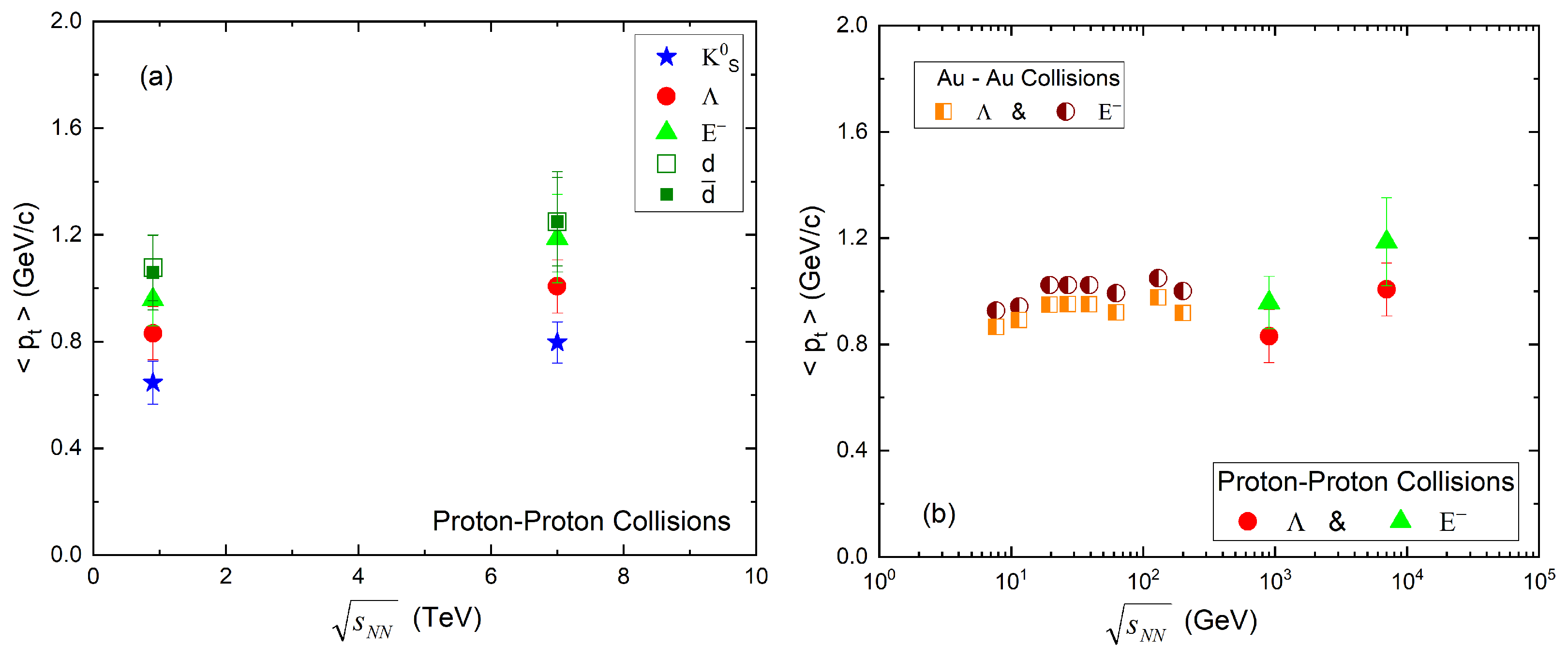
Figure 6a presents the dependence of average transverse momentum
on center-of-mass energy for
,
,
, and
produced in
p–
p collisions at
= 0.9 TeV and 7 TeV. Here, the
spectra are presented as a function of
. The most apparent feature is the general increase in
with increasing
for all types of particles. This trend is expected in QCD, as higher collision energy leads to more hard scattering processes, resulting in the production of particles with higher momentum components, including the transverse momentum. For a given
, heavier particles generally exhibit higher
values than lighter ones (i.e.,
). This mass ordering is a characteristic feature of hadronization in a vacuum and can be partially explained by kinematic effects and the different quark content of the particles. Additionally, for comparison purposes, the
spectra of
and
obtained from
collisions (heavy-ion collisions [
24,
36,
37,
38]) are shown in
Figure 6b.
collisions create a high-energy density medium, often referred to as a quark gluon plasma (QGP), especially at higher
values. In
p–
p collisions, the collisions serve as a baseline to understand particle production without the effects of the extended, thermalized medium present in heavy-ion collisions. For both systems,
generally increases with increasing
. This is expected, as higher collision energy translates to higher available energy for particle production and greater momentum transfer. In both
and
p–
p collision systems, the
distribution of
(heavy and has two strange quarks) is consistently higher than
(lighter and has one strange quark);
. This trend is a well-known feature of particle production, often related to the mass of the produced particle. At lower energies (
below ∼100 GeV), the
values for
and
p–
p are comparable. At higher energies (
∼ at
GeV), the
values for particles in
collisions tend to be significantly enhanced compared to the
p–
p baseline. This enhancement of
in heavy-ion collisions, particularly for heavier and multi-strange hadrons, is a classic signature of the collective radial flow (hydrodynamic expansion) of the medium created in
collisions. The pressure gradients in the QGP push the particles outward, boosting their transverse momentum. Thus, the data clearly illustrate the transition from a regime where particle production is dominated by elementary interactions to a hydrodynamically expanding medium (QGP) at higher collision energies in heavy-ion collisions, indicated by the collective
enhancement. The average transverse momentum
values at
= 0.9 TeV and 7 TeV are given in
Table 4.
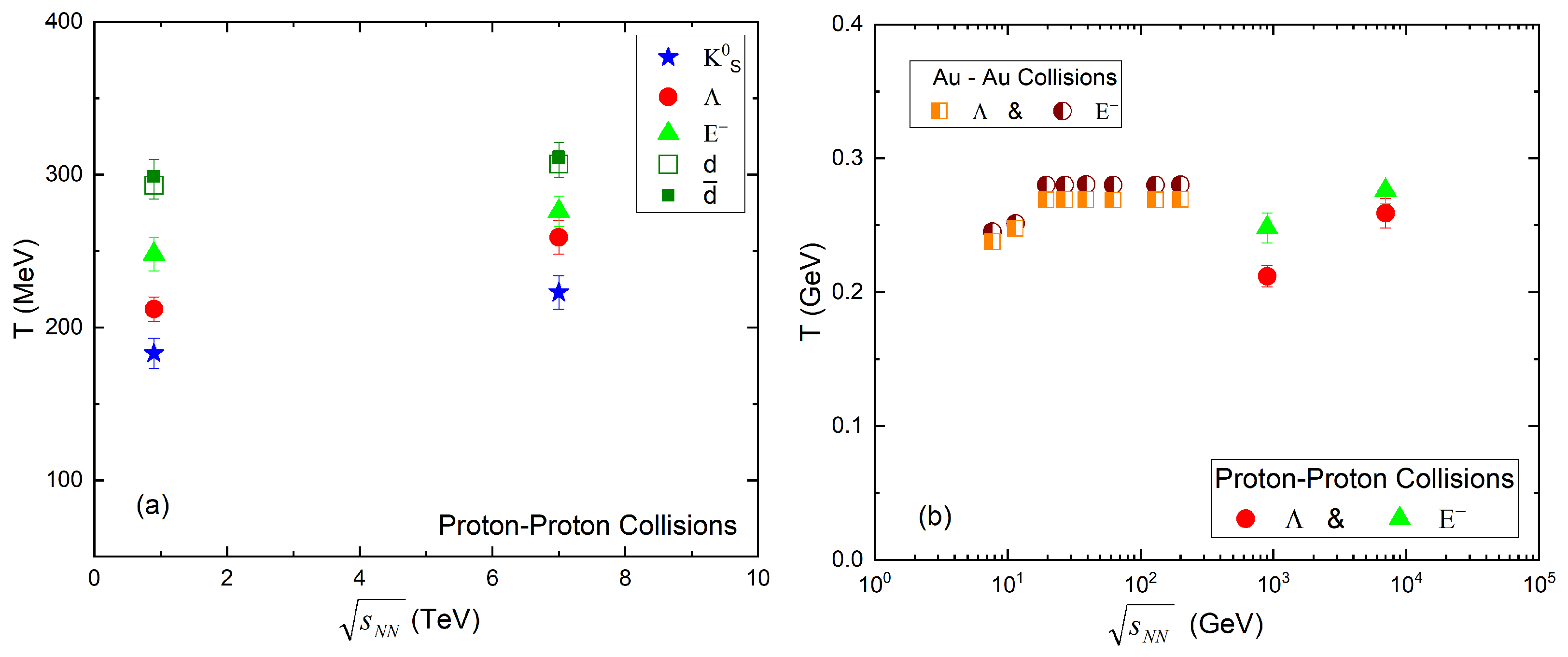
Figure 7a presents the dependence of the effective temperature
T on center-of-mass energy
for
,
,
, and
produced in
p–
p collisions at
= 0.9 TeV and 7 TeV. It shows
T for
,
,
, and
as a function of
. For all types of particles, there is a direct dependence of
T on energy (
= [0.9–7] TeV), with the former exhibiting a clear increase in response to the latter. This suggests that at higher collision energies, the system formed in
p–
p interactions becomes harder, implying greater kinetic energy imparted to the produced particles. It also indicates that, even in
p–
p collisions, a degree of collectivity or increasing phase-space density influences the particle spectra. Additionally, for comparison purposes, the effective temperature spectra of
and
obtained from
collisions [
24,
36,
37,
38] are shown in
Figure 7b. The plot superimposes the effective temperature data for
and
from both heavy-ion
and
p–
p collisions. A striking observation is the significantly higher effective temperatures obtained in
collisions compared to
p–
p collisions for both particles, particularly for the heavier particle. Thus, the plots collectively highlight the fundamental difference between
p–
p collisions and
collision systems.
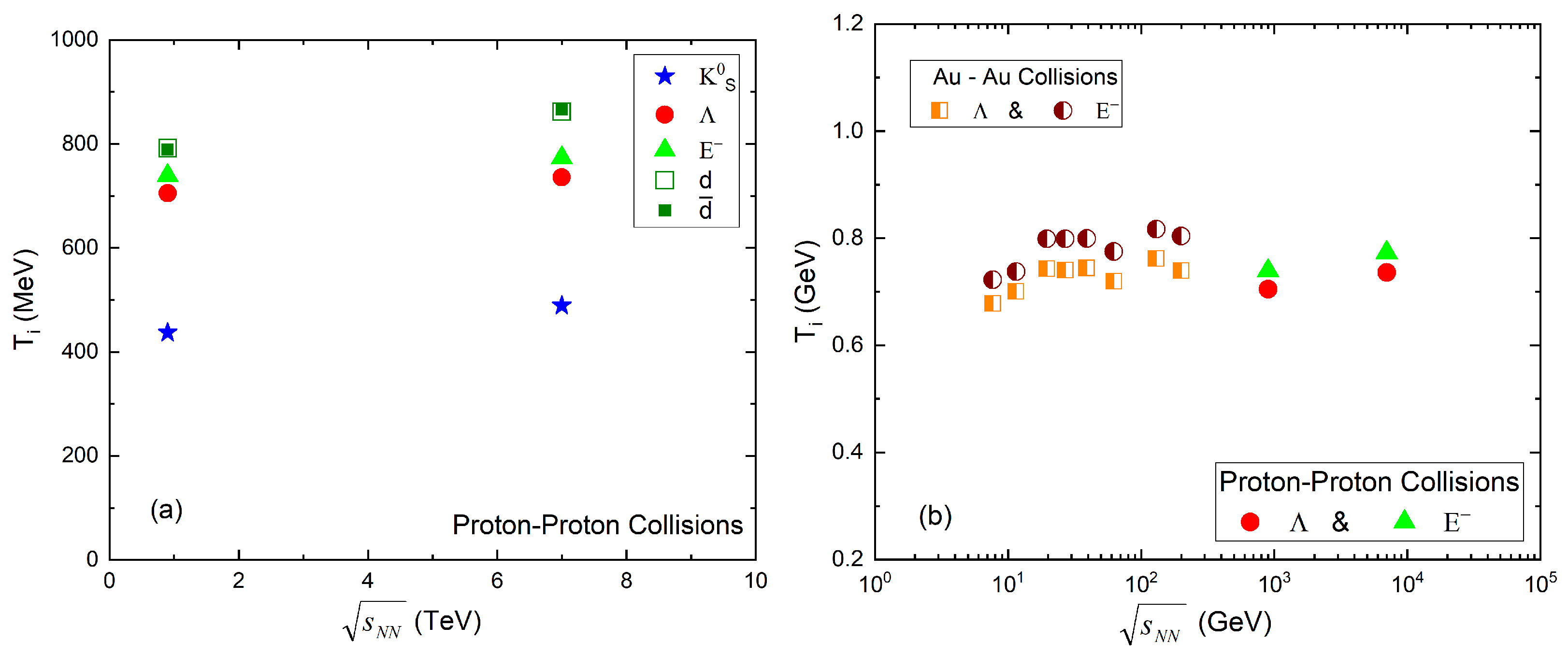
Figure 8a presents the dependence of the initial temperature
on center-of-mass energy
for
,
,
, and
produced in
p–
p collisions at
= 0.9 TeV and 7 TeV. For all types of particles, a direct dependence is evident between
(0.9 and 7 TeV) and
, with the latter exhibiting a clear increase in response to the former. This shows that as
increases, the initial conditions of the
p–
p collisions become hotter, i.e., higher-energy collisions lead to harder scattering processes and a higher density of produced partons.
Figure 8b provides a comparison of
for
and
between
collisions [
24,
36,
37,
38] and
p–
p collisions. A prominent feature is the significantly higher initial temperatures observed in
collisions compared to
p–
p collisions, especially for heavier particles. This substantial enhancement of
in
collisions is a crucial piece of evidence for the formation of a de-confined state of matter (QGP). In
collisions,
reflects the energy density that is achieved in the first stages of the collisions, which is much higher due to the greater number of participating nucleons. The mass ordering of
is also important in
collisions, supporting the idea of a collectively expanding medium where particles of various masses acquire different kinetic energies from the radial flow, which influences the extracted temperature. The initial temperature in
collisions generally shows a plateau or a weaker dependence on
at higher energies, suggesting that the system reaches a maximum temperature or that the extraction method becomes less sensitive to further increases in collision energy. The large disparity in
between
and
p–
p collisions underscores the qualitative difference in the systems formed: a hot, dense, and collectively expanding medium in heavy-ion collisions versus more localized, string-like, or jet-like fragmentation in
p–
p collisions.
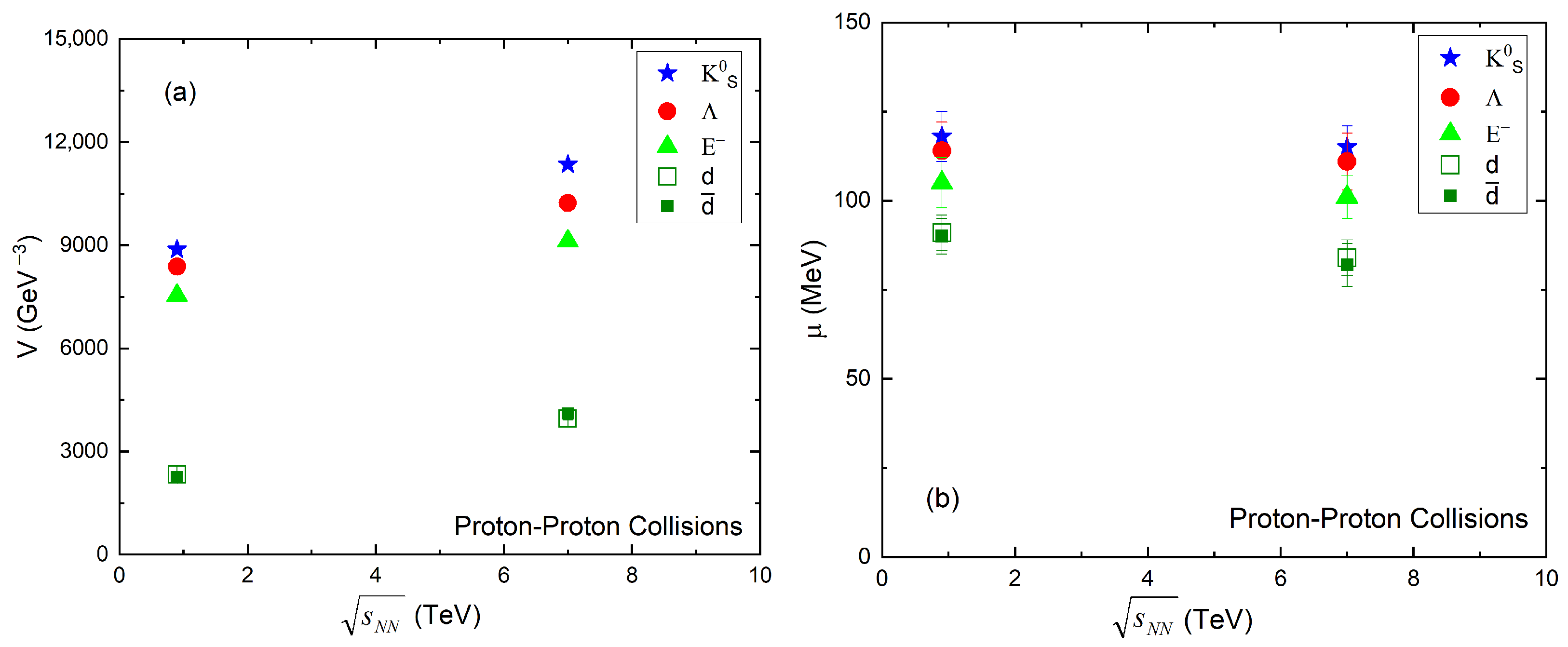
In
Figure 9a, the dependence of the system freeze-out volume
V on the center-of-mass energy
is displayed for
,
,
, and
produced in
p–
p collisions at
= 0.9 TeV and 7 TeV. A direct correlation is clearly observed between
V and
across all types of particles. As
increases to a few TeV, a larger energy deposition produces denser and more extended systems, and the freeze-out volume becomes large, indicating a system transitioning toward a thermally equilibrated medium with extensive spatial dimensions. This rise in volume is also consistent with the hydrodynamic expansion of the system. Caution must be taken when comparing this extracted volume to heavy-ion geometric volumes, as it is derived from spectral normalization. Moreover, in
Figure 9b, the dependence of the chemical potential
on the center-of-mass energy
is shown for
,
,
, and
produced in
p–
p collisions at
= 0.9 TeV and 7 TeV. An inverse correlation is clearly observed between
and
across all types of particles. As the energy increases, collisions become more transparent, resulting in a dilute baryon environment with
approaching zero. It is important to note that at LHC energies, the physical baryon chemical potential is expected to be near zero. The non-zero values extracted here should be interpreted as effective parameters required by the specific shape of the chosen fit function, rather than the global thermodynamic potential of the system.
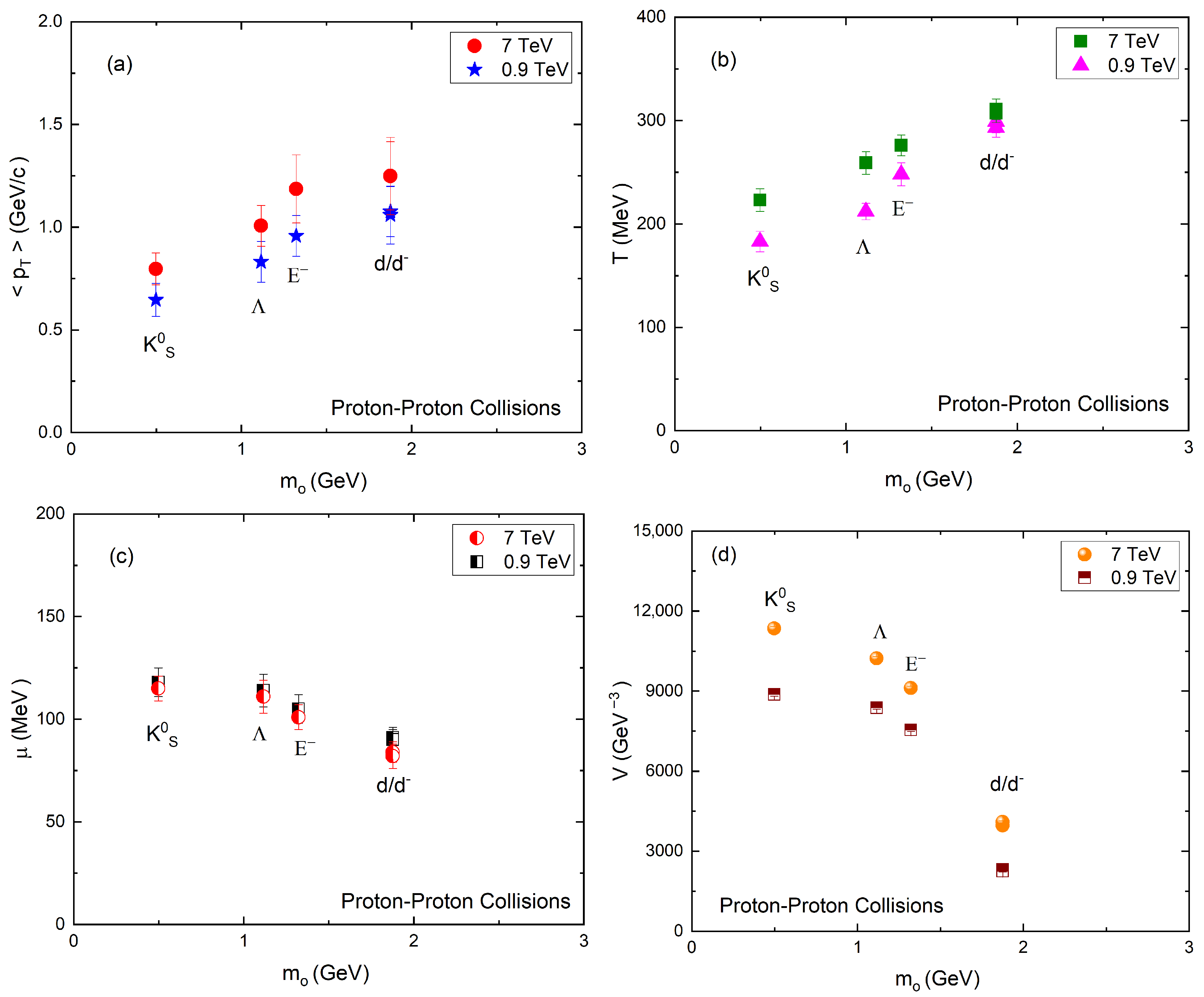
Figure 10 presents the dependence of
, the effective temperature
T, the chemical potential
, and the volume of the system
V, on the rest mass
for
,
,
, and
produced in
p–
p collisions at
= 0.9 TeV and 7 TeV.
Figure 10a shows an increase in
with increasing
for each value of
. It suggests that heavier mass particles tend to gain more
than lighter mass particles. Because of the large inertia in heavy mass particles, they retain more of the
from the hard scattering explained partially by kinematic effects. Furthermore, in
p–
p collisions, if there is even a small degree of collective expansion or mini-flow; heavier particles would gain more
from this collective velocity boost. Similar to
,
Figure 10b shows a general increase in
T with increasing
for each value of
. This mass dependence of the effective temperature is another strong indicator of the underlying dynamics. If the system undergoes a collective expansion, heavier particles, having more inertia, gain a larger kinetic energy component from the collective velocity, thus appearing hotter when their spectra are fitted with a thermal distribution. On the other hand,
Figure 10c shows that the values of
are generally small and exhibit little to no significant dependence on the particle mass. Slight variations are observed in chemical potentials with different energies of collisions, reflecting the different initial energy densities and subsequent hadronization conditions, but the overall trend across masses remains flat. This suggests that the chemical freeze-out temperature, which dictates the particle productions, is relatively uniform across different masses of hadron for these types of collisions. Finally,
Figure 10d, presents the volume of the system
V as a function of
for all types of particles. The lack of a strong mass dependence or a consistent trend might indicate that the emission volume is not primarily determined by the particle’s mass in
p–
p collisions or that the extraction methods are sensitive to other factors. The values for
V are relatively small, as expected for
p–
p collisions, where a large, extended medium like in heavy-ion collisions is not formed. The different collision energies show some variations in the extracted volume, possibly reflecting the expansion dynamics at different initial energy densities. However, without more context on the specific model used to extract these volume parameters, a definitive interpretation is challenging beyond stating the observed lack of a strong mass dependency.
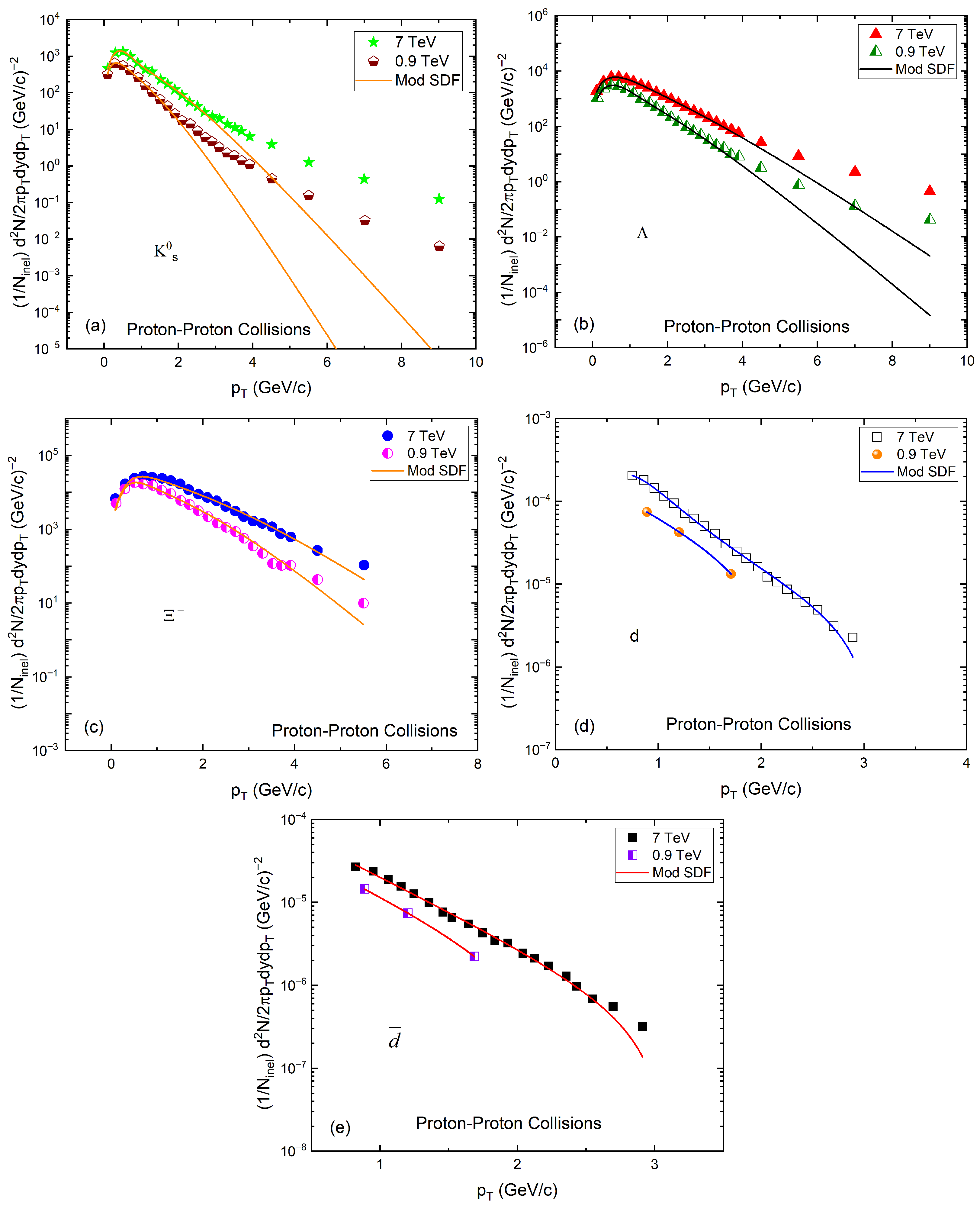
Furthermore, the modified Standard Distribution Function (Equation (
15)) is also applied to fit
distributions of
,
,
,
d, and
produced in
p–
p collisions at
= 0.9 TeV and 7 TeV, as shown in
Figure 11. The general shape of all spectra is characterized by a rapid, exponential-like decrease in the differential yield as
increases, which is a common feature of particle production in high-energy hadronic collisions. In
Figure 11a,b, the plots show the distributions for the
meson and the
baryon, respectively. A notable observation is the increase in the yield (the vertical shift) at the higher collision energy
= 7 TeV. This behavior is expected, as higher collision energy leads to greater energy available for particle production. The spectra for
appear slightly harder (slower fall-off with
) than those for
at higher
.
Figure 11c–e show the distributions for the
baryon, light deuteron (
d), and anti-deuteron (
), respectively. The
and
d distributions also exhibit the expected increase in yield with collision energy. The remarkable similarity between the
d and
distributions in
Figure 11d,e, particularly in the 7 TeV data, highlights the principle of charge conjugation symmetry in particle production, where the production of a nucleus and its anti-nucleus are similar. For all types of particles, the differential yield is consistently higher at 7 TeV than at 0.9 TeV, reflecting the increased kinetic energy available to the produced particles. The spectral shapes for a given particle and energy are well-described by the modified SDF, and they provide an excellent fit to the experimental data points across all analyzed particle species and energies. In the context of particle and heavy-ion physics, such functions are often rooted in the hydrodynamical or thermal models (like the Blast-Wave model or Hagedorn’s thermal model) that describe particle production from a collectively expanding, thermalized medium (fireball). The core concept is that particles are emitted from a thermal source that has an overall transverse collective flow. The high-quality fit (low
) supports the fitness of the function, which is extracted and given in
Table 5.
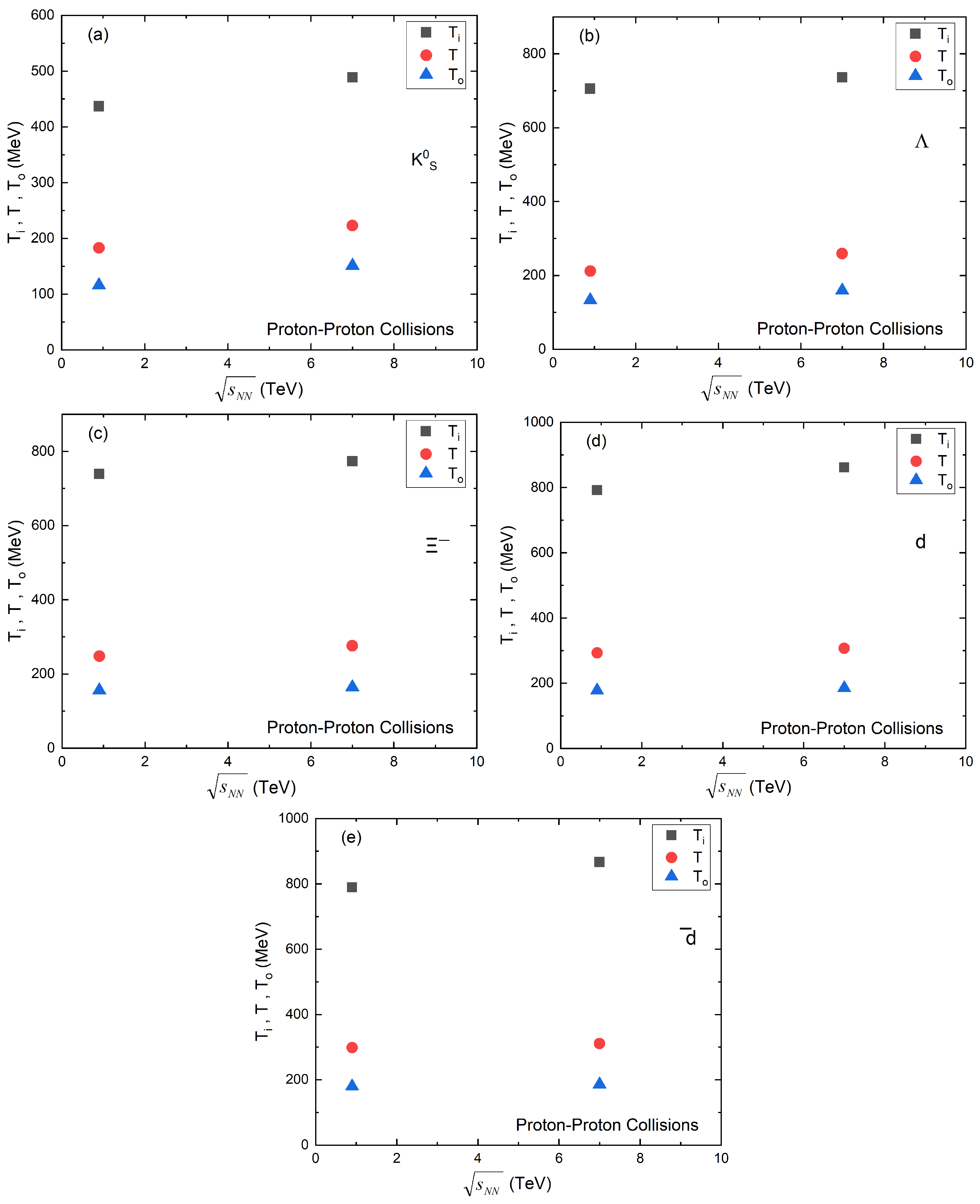
To further investigate the thermodynamic properties of these particles, we extract the
,
T, and
at both energies. The variation in these parameters is presented in
Figure 12.
shows a gradual increase with the increase in
, signifying higher energy densities at early stages of
p–
p collisions. Meanwhile,
T, often linked to both kinetic motion and radial flow, also increases but more gently, indicating growing transverse collective expansion. On the other hand,
, representing the point where particles decouple, remains significantly lower and more stable, indicating that even as collisions grow more energetic, the system cools to a similar temperature before freeze-out. The clear separation between these temperatures (
) indicates a three-stage freeze-out scenario, representing small systems with strong collective effects. For
and
, all parameters increase weakly with
, suggesting a slight increase in the energy density or lifetime of the system.
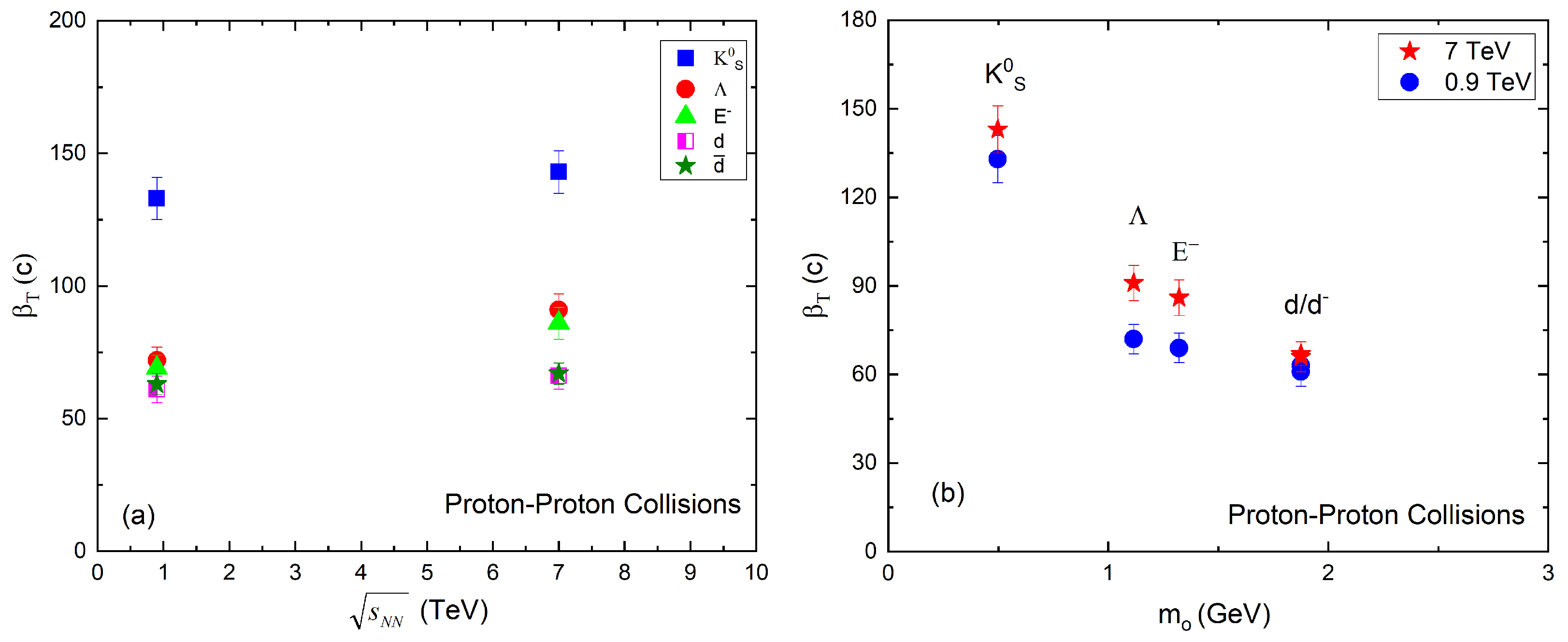
It is also important to investigate the dependence of the transverse flow velocity and center-of-mass energy, as this can provide key information for understanding the evolution of the system from initial to final states. This is shown in
Figure 13a for all types of particles (
,
, and
) and for both energies. As
increases,
also steadily increases, indicating that higher
values generate systems with stronger collective transverse expansion. This behavior is a signature of increased initial pressure gradients and partonic activity at higher
values, contributing to stronger radial flow velocity. The trend is evident across all types of particles and emphasizes the role of energy density in driving collective phenomena, even in small systems of collisions like
p–
p collisions.
Figure 13b shows the inverse relationship between
and the rest mass
for all types of particles (
,
,
, and
) and both energies. It is clear from the plot that light mass particles (
) have higher
values, and heavier mass particles (
) receive a lower
value. The inverse relationship between
and
signifies that lighter particles (
) exhibit higher transverse flow velocities compared to heavier particles (
,
, and
). This mass-dependent flow is a hallmark of hydrodynamic expansion, where the lighter particles are more effectively pushed by the collective pressure gradient of the expanding medium.
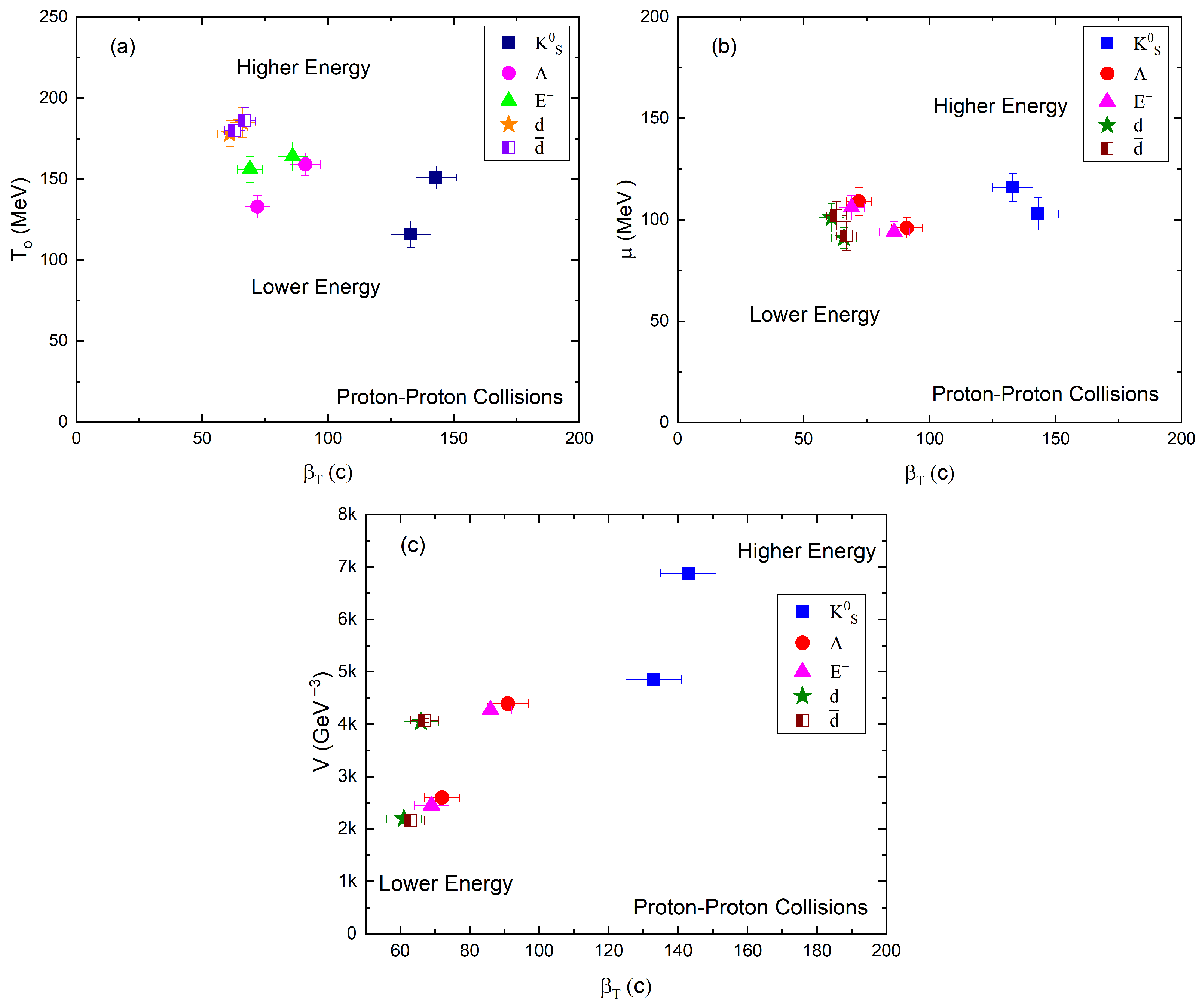
Another classic study in relativistic heavy-ion physics is to investigate the relationship between
and
for all types of particles under study and at both energies, as this provides insight into the thermodynamic and collective properties of the system at the point where particle interactions cease (freeze-out). This relationship is displayed in
Figure 14a, which shows that the studied particles do not all freeze-out at a single, universal (
,
) point, suggesting a non-equilibrium or multi-stage freeze-out scenario. At high
and low
,
and
data points show a clear increase in
with a corresponding decrease in
. In addition, higher
values signify stronger collective expansion or hydrodynamic flow in the system. The inverse correlation suggests that particles that experience more collective push (higher
) decouple from the system when it is cooler (lower
). At low
and high
,
,
, and
points clustered around
70–100, possibly indicating a chemical freeze-out or a thermal freeze-out that happens earlier, when the system is hotter and less expanded (lower
). In the meantime,
and
points in the high
region may represent the kinetic freeze-out, where elastic interactions cease. On the other hand,
data points are notably distinct, suggesting that they might have different freeze-out dynamics compared to the mesons and baryons, possibly forming via coalescence at a later, cooler stage. Furthermore,
Figure 14b presents the dependence of
on
for all particles under study and at both energies
= 0.9 TeV and 7 TeV. We observe that as
increases,
decreases, which is consistent with the expectations from statistical hadronization models and the phase diagram of QCD. At lower collision energies, the system is characterized by a higher net-baryon density (hence a larger
). As
increases, the system becomes more symmetric in terms of matter–antimatter production, leading to a decrease in the net-baryon density (hence a lower
). The increase in
with decreasing
further supports the concept that higher
values lead to a larger and longer-lived system that undergoes more significant collective expansion before hadronization and kinetic freeze-out. This also provides insights into the evolution of the QCD matter from a baryon-rich to a more meson-dominated environment as
increases. Finally,
Figure 14c displays a direct relationship between
V and
for all types of particles under study and at both energies
= 0.9 TeV and 7 TeV. It is clear from the data that
V and
are directly proportional to each other, which signifies that stronger flow is associated with larger particle-emitting sources. This is acceptable, as higher
produce more particles, leading to an expanded freeze-out volume. This direct relationship supports hydrodynamic expansion models, where larger systems tend to exhibit more pronounced collective behavior, even in small collision systems like
p–
p collisions.
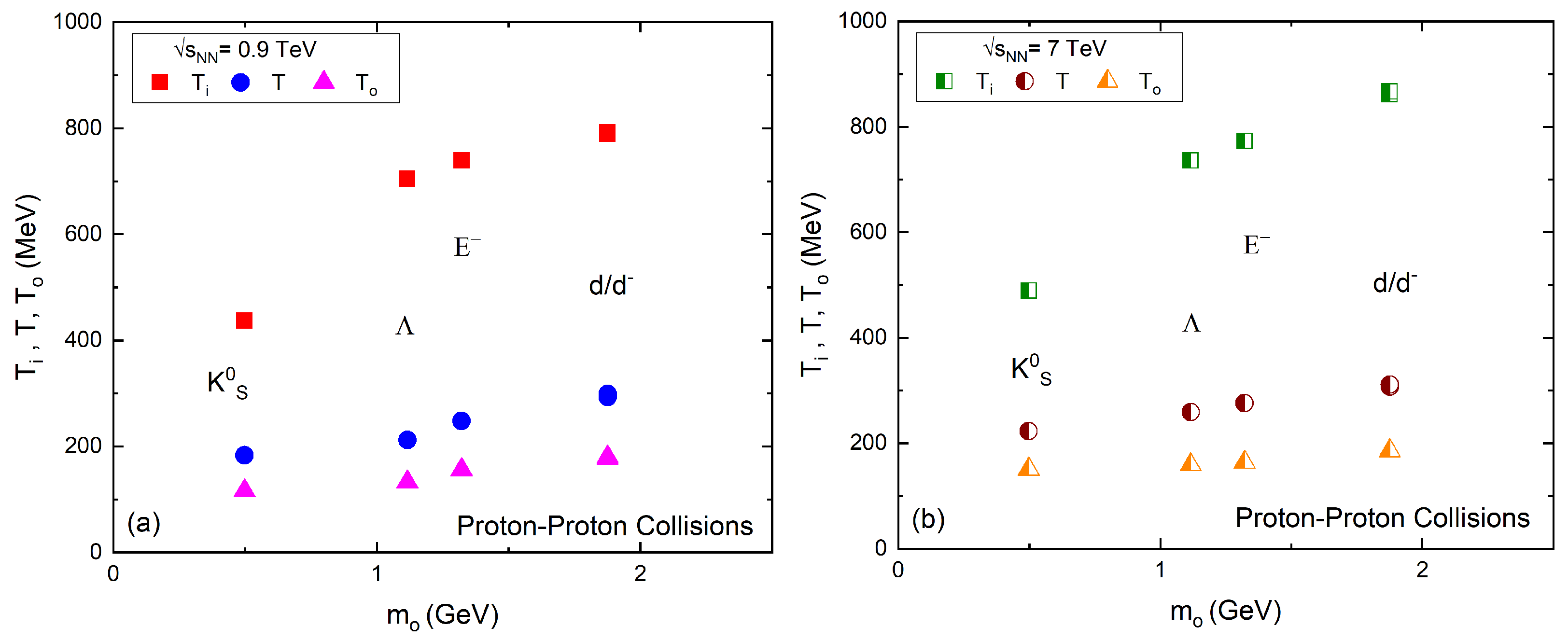
Finally, in
Figure 15, we investigated the variation in
,
T, and
with rest mass
for all studied particles at the two energies,
= 0.9 TeV and 7 TeV. It is generally observed that
at both energy levels. This order is physically very important; the system cools as it expands, leading to a hierarchy of temperatures from the initial hot and dense state to the final freeze-out state where interactions cease. It is also usually observed from both the subfigures that
,
T, and
increase with the increase in rest mass of the given particles.
is consistently the lowest, reflecting the point at which particles cease to interact strongly and their yields become fixed. The values of
are generally in the range of typical hadronic freeze-out temperatures, further supporting the interpretation of a hadron gas phase. These systematic studies are vital for understanding the thermodynamic properties of the strongly interacting matter created in proton–proton collisions and for establishing a baseline for comparisons with heavy-ion collisions, where the formation of a quark-gluon plasma is expected. The values of
,
T, and
are given in
Table 6.