Video Frame Interpolation for Extreme Motion Scenes Based on Dual Alignment and Region-Adaptive Interaction

Abstract
1. Introduction
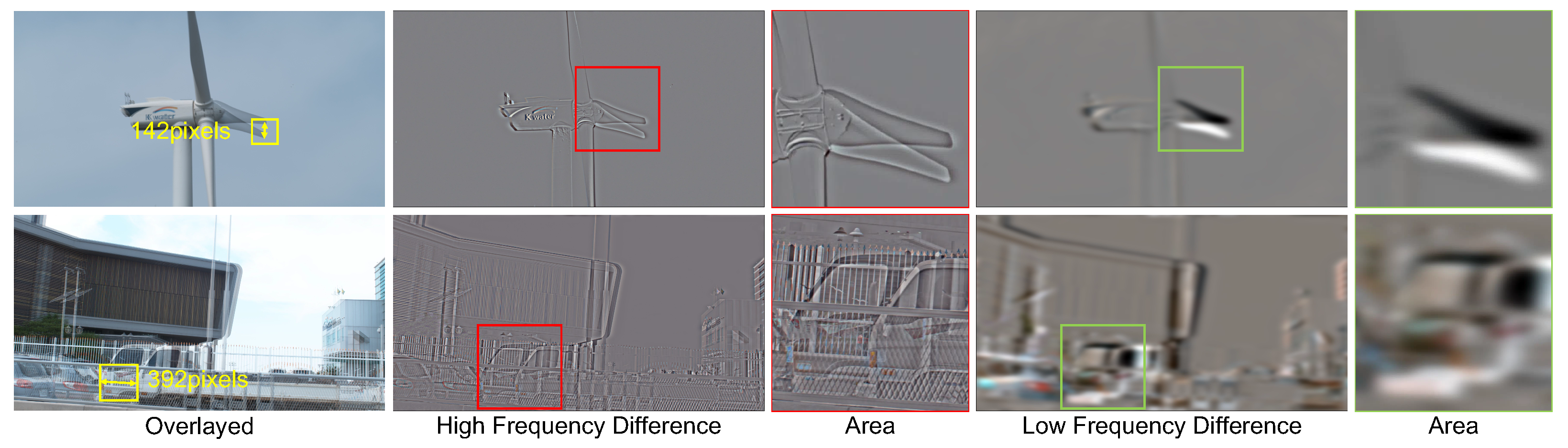
- We propose a novel video frame interpolation method for extreme motion scenes in UHD videos.
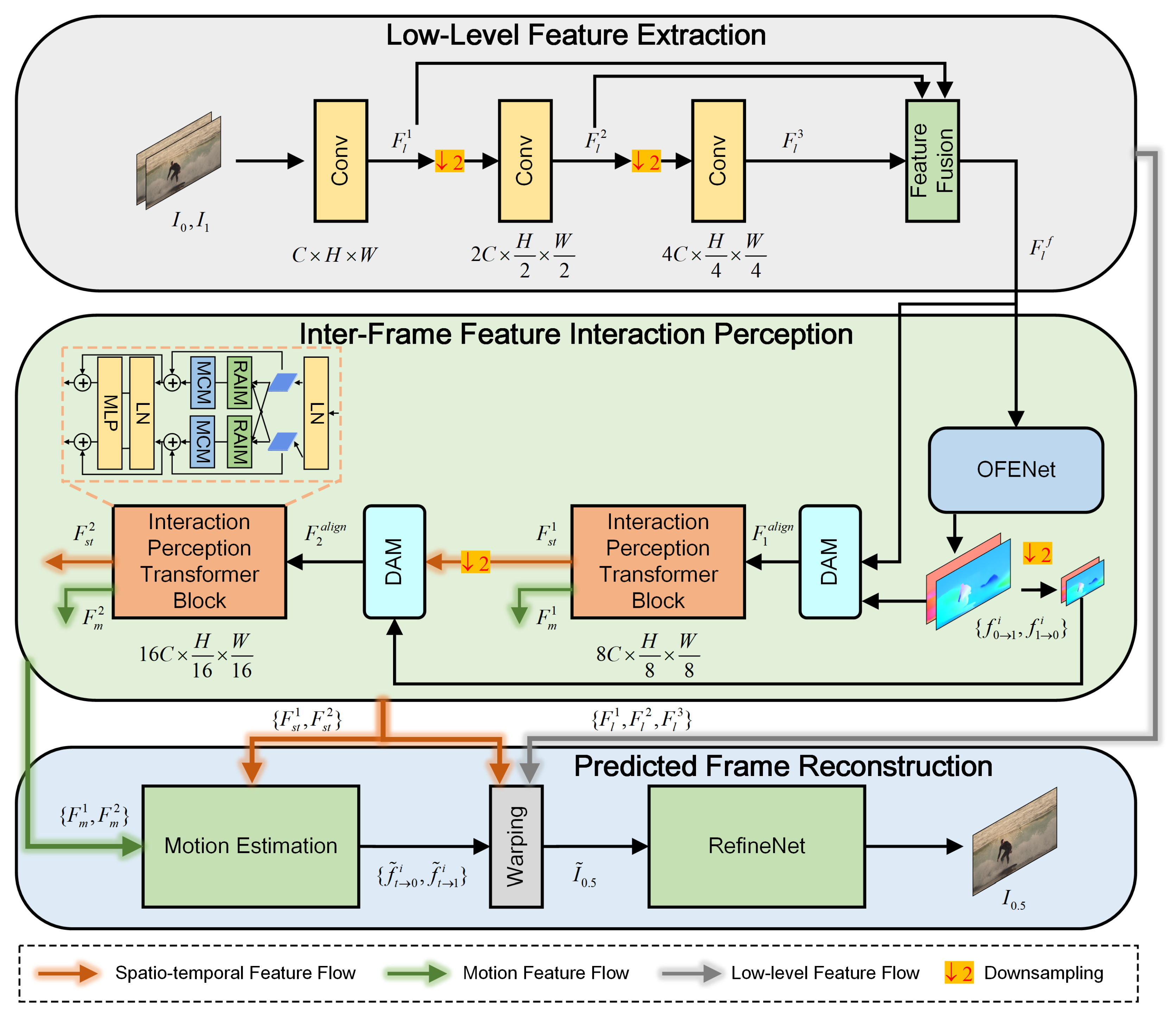
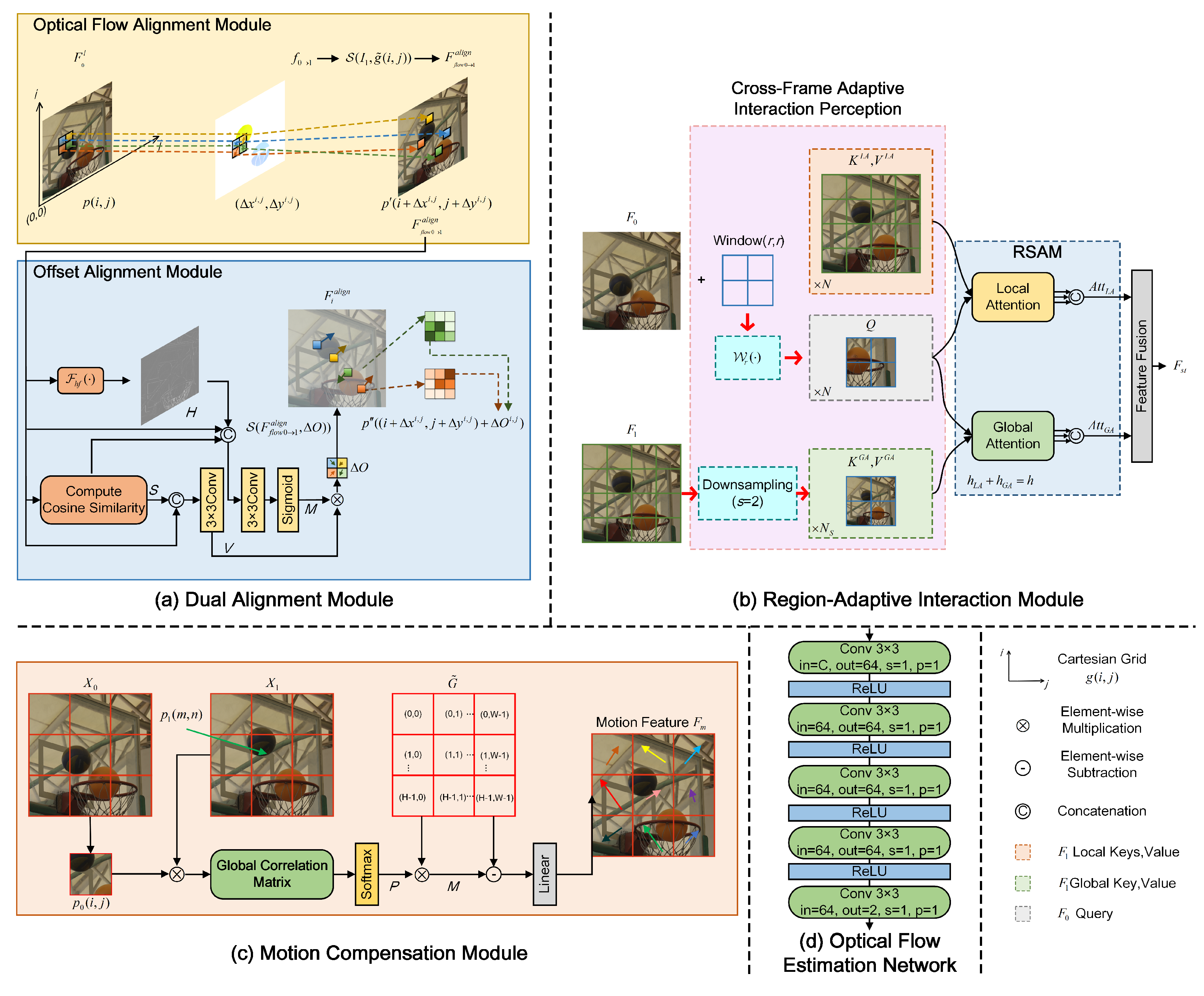
- We design a DAM to reduce pixel localization difficulty through dual motion information, prevent motion error accumulation, and guide spatiotemporal information aggregation across frames.
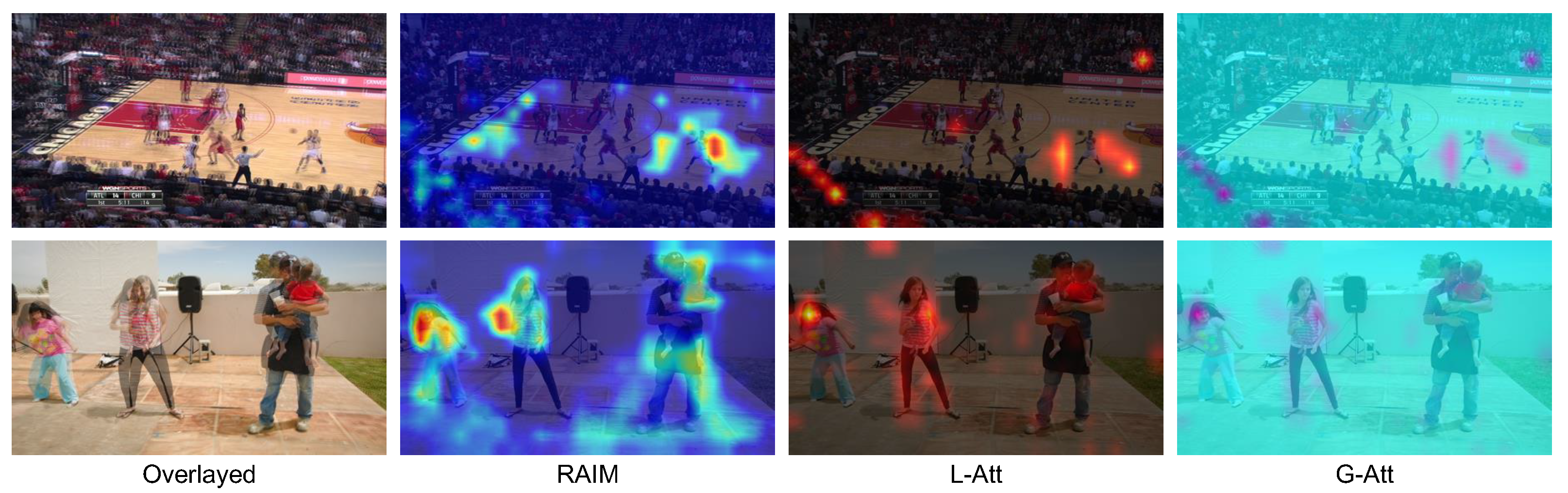
- We propose an RAIM that learns different timestamp information through adaptive interaction between motion regions of varying scales in neighboring frames, effectively enhancing the perception of the overall structure and texture details.
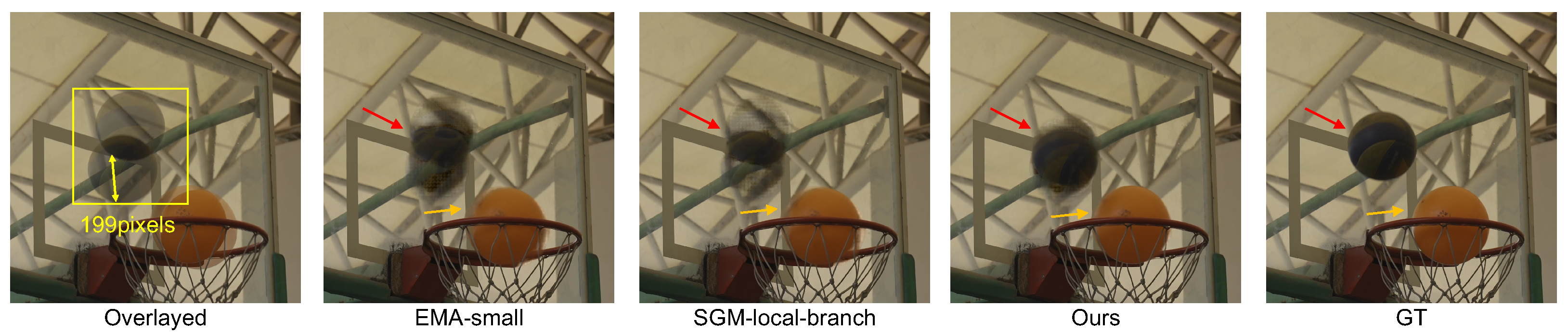
- Through experiments, our method achieves superior interpolation performance in high-resolution, extreme motion scenes and exhibits stronger robustness and stability in cross-scene generalization.
2. Related Work
2.1. Flow-Based Methods
2.2. Kernel-Based Methods
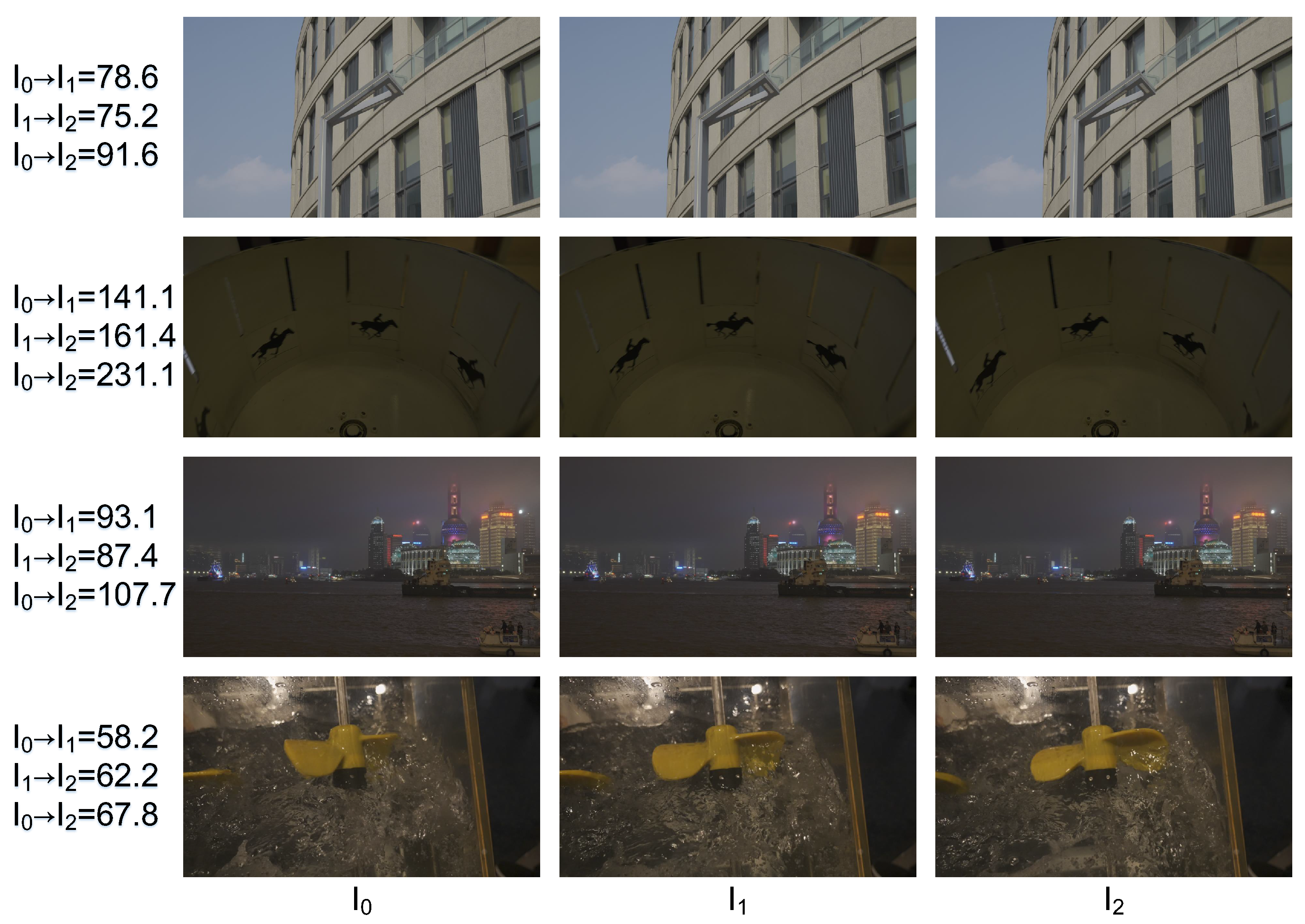
3. UHD4K120FPS-N Dataset
4. Methods
4.1. Dual Alignment Module
4.1.1. Optical Flow Alignment Module
4.1.2. Offset Alignment Module
4.2. Region-Adaptive Interaction Module
4.2.1. Assigning the Attention Head
4.2.2. L-Att Branch
4.2.3. G-Att Branch
4.3. Motion Compensation Module
4.4. Optical Flow Estimation Network
5. Experiment
5.1. Datasets and Evaluation Metrics
5.1.1. Datasets
- UHD4K120FPS-N. This dataset is a 4K dataset covering extreme motion scenes, containing triplets from 15 different scenes, where and are the input frames, and is the ground truth.
- Vimeo90K [31]. This contains 3782 triplets with a resolution of .
- UCF101 [33]. This contains 379 video sequences with a resolution of 256 × 256.
- Middlebury [34]. We evaluate on the Middlebury OTHER, which contains 12 sequences from different scenes with a resolution of approximately .
- X4K1000FPS [6]. This is commonly used to evaluate 4K video frame interpolation tasks. XTest contains 15 consecutive 33-frame 4K video sequences. Following the settings in [10], we select the 0th and 32nd frames from each sequence as input and evaluate the quality of the generated 16th frame. This new test set is denoted as XTest-L.
5.1.2. Evaluation Metrics
5.2. Implementation Details
5.2.1. Training Details
5.2.2. Network Architecture
5.3. Quantitative Comparison with Previous Methods
5.3.1. Comparison in UHD Extreme Motion Scenes
5.3.2. Comparison on Low-Resolution Benchmarks

| Method | Vimeo90K | UCF101 | Middlebury | ||
|---|---|---|---|---|---|
| PSNR ↑ | SSIM ↑ | PSNR ↑ | SSIM ↑ | IE ↓ | |
| Other | |||||
| CAIN [14] | 34.65 | 0.9730 | 34.91 | 0.9690 | 2.28 |
| FLAVR [41] | 36.30 | 0.9750 | 33.33 | 0.9710 | - |
| Kernel-base | |||||
| SepConv [12] | 33.79 | 0.9702 | 34.78 | 0.9669 | 2.27 |
| AdaCoF [13] | 34.47 | 0.9730 | 34.90 | 0.9680 | 2.24 |
| CDFI [27] | 35.17 | 0.9770 | 35.21 | 0.9690 | 1.98 |
| EDSC- [25] | 34.84 | 0.9750 | 35.13 | 0.9680 | 2.02 |
| Flow-base | |||||
| SoftSplat [45] | 36.10 | 0.9700 | 35.39 | 0.9520 | 1.81 |
| ToFlow [31] | 33.73 | 0.9682 | 34.58 | 0.9667 | 2.15 |
| BMBC [38] | 35.01 | 0.9764 | 35.15 | 0.9689 | 2.04 |
| XVFIv [6] | 35.07 | 0.9681 | 35.18 | 0.9519 | - |
| DAIN [15] | 34.71 | 0.9756 | 34.99 | 0.9683 | 2.04 |
| ABME [46] | 36.18 | 0.9805 | 35.38 | 0.9698 | 2.01 |
| IFRNet [42] | 35.80 | 0.9794 | 35.29 | 0.9693 | 1.95 |
| UPR-base [20] | 36.03 | 0.9801 | 35.41 | 0.9698 | - |
| EMA-small [9] | 36.07 | 0.9797 | 35.34 | 0.9696 | 1.94 |
| RIFE [11] | 35.61 | 0.9779 | 35.28 | 0.9690 | 1.96 |
| EBME-H* [19] | 36.19 | 0.9807 | 35.41 | 0.9697 | - |
| FGDCN-S [43] | 36.24 | 0.9806 | 35.42 | 0.9698 | 1.94 |
| VFIFT-Conv [44] | 36.02 | 0.9798 | 35.65 | 0.9793 | - |
| M2M-PWC [40] | 35.47 | 0.9778 | 35.28 | 0.9694 | 2.09 |
| Ours | 36.39 | 0.9811 | 35.46 | 0.9700 | 2.01 |
5.4. Qualitative Comparison with Previous Methods
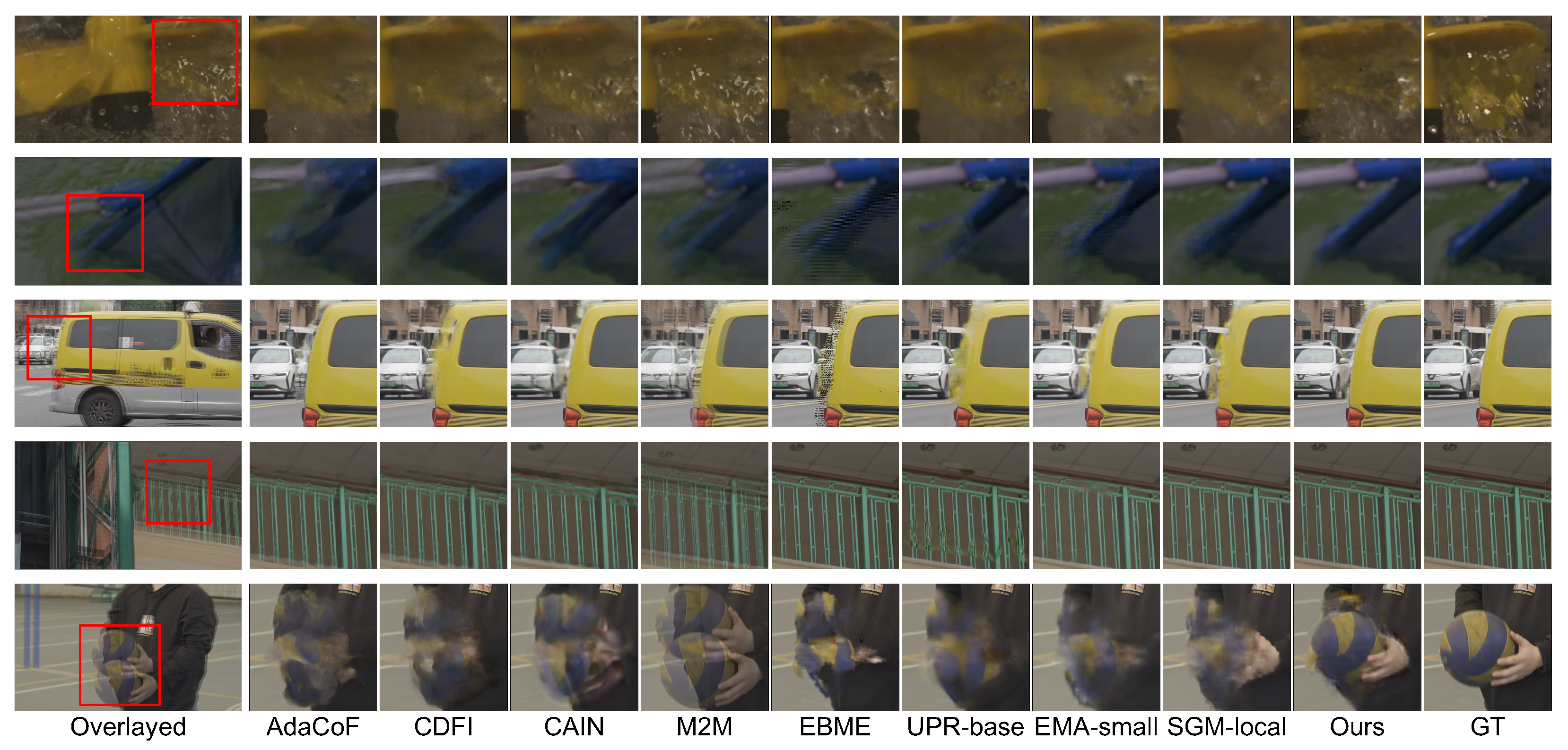
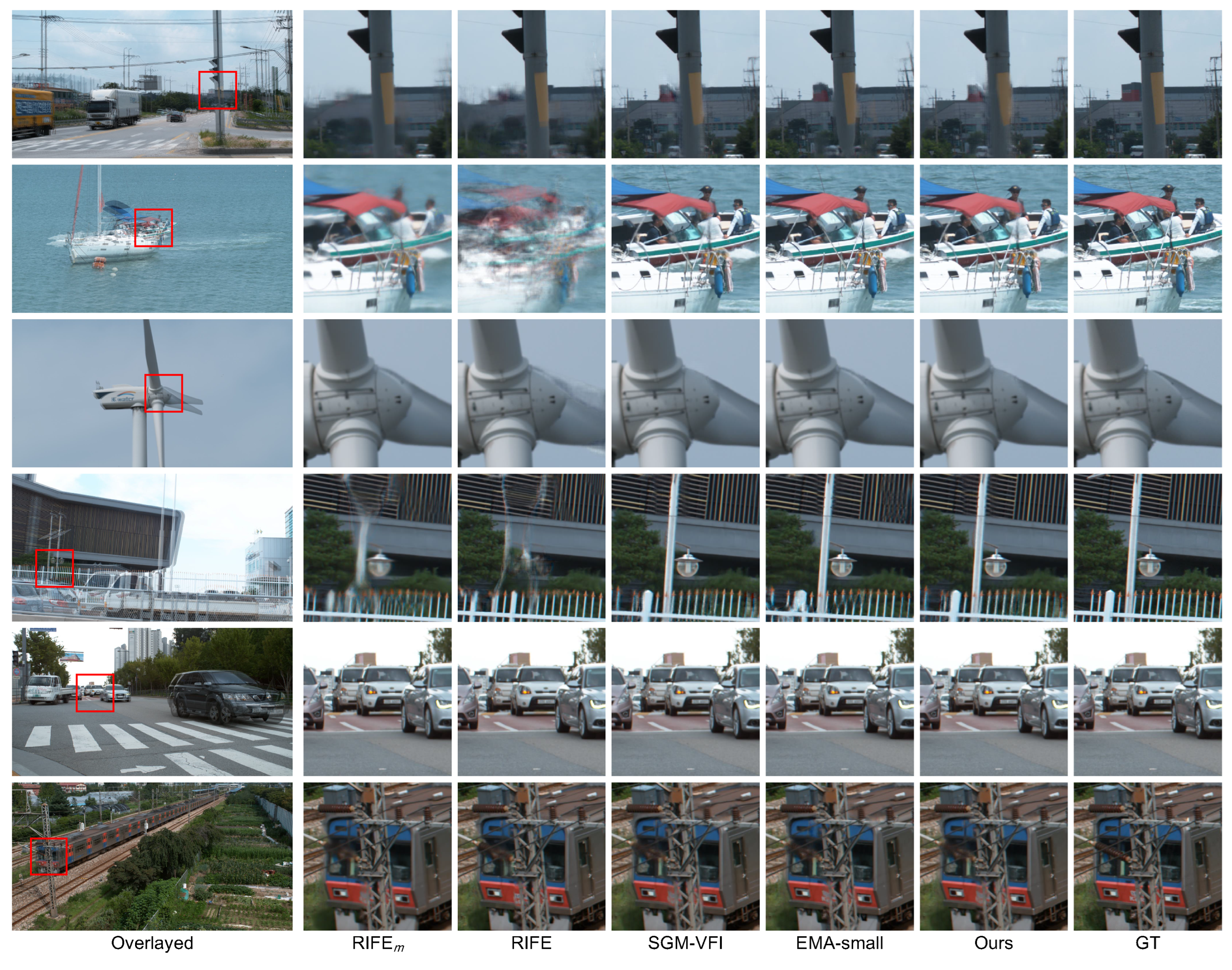
5.4.1. Visual Comparison in UHD Extreme Motion Scenes
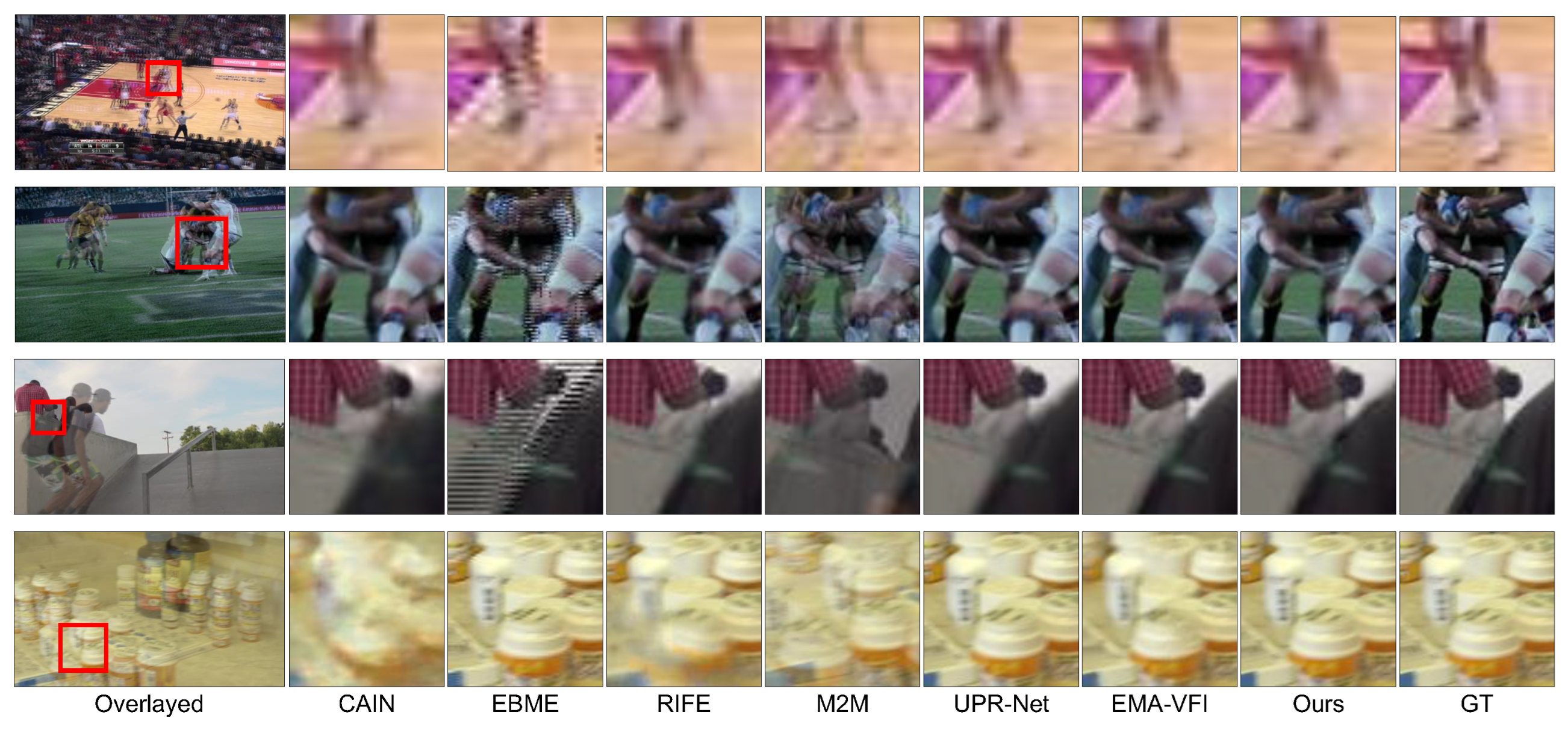
5.4.2. Visual Comparison on Low-Resolution Benchmarks
5.5. Ablation Study
5.5.1. Ablation Study of Dual Alignment Module
5.5.2. Ablation Study of Region-Adaptive Interaction Module
5.5.3. Ablation Study of Motion Compensation Module
5.5.4. Computational Complexity Analysis of the Region-Separated Attention Mechanism
5.5.5. Visual Analysis of the Region-Adaptive Interaction Module
6. Conclusions
Author Contributions
Funding
Data Availability Statement
Conflicts of Interest
References
- Jiang, W.; Li, J.; Zhang, K.; Zhang, L. Ecvc: Exploiting non-local correlations in multiple frames for contextual video compression. In Proceedings of the Computer Vision and Pattern Recognition Conference, Jammu, India, 16–18 July 2025; pp. 7331–7341. [Google Scholar]
- Liao, G.; Li, Q.; Bao, Z.; Qiu, G.; Liu, K. Spc-gs: Gaussian splatting with semantic-prompt consistency for indoor open-world free-view synthesis from sparse inputs. In Proceedings of the Computer Vision and Pattern Recognition Conference, Jammu, India, 16–18 July 2025; pp. 11264–11274. [Google Scholar]
- Kim, E.; Kim, H.; Jin, K.H.; Yoo, J. BF-STVSR: B-Splines and Fourier—Best Friends for High Fidelity Spatial-Temporal Video Super-Resolution. In Proceedings of the Computer Vision and Pattern Recognition Conference, Jammu, India, 16–18 July 2025; pp. 28009–28018. [Google Scholar]
- Shen, W.; Bao, W.; Zhai, G.; Chen, L.; Min, X.; Gao, Z. Blurry video frame interpolation. In Proceedings of the IEEE/CVF Conference on Computer Vision and Pattern Recognition, Virtual, 13–19 June 2020; pp. 5114–5123. [Google Scholar]
- Yan, Z.; Lei, P.; Wang, T.; Fang, F.; Zhang, J.; Huang, Y.; Song, H. Explicit Depth-Aware Blurry Video Frame Interpolation Guided by Differential Curves. In Proceedings of the Computer Vision and Pattern Recognition Conference, Jammu, India, 16–18 July 2025; pp. 1994–2004. [Google Scholar]
- Sim, H.; Oh, J.; Kim, M. Xvfi: Extreme video frame interpolation. In Proceedings of the IEEE/CVF International Conference on Computer Vision, Montreal, QC, Canada, 10–17 October 2021; pp. 14489–14498. [Google Scholar]
- Ahn, H.E.; Jeong, J.; Kim, J.W. A fast 4k video frame interpolation using a hybrid task-based convolutional neural network. Symmetry 2019, 11, 619. [Google Scholar] [CrossRef]
- Park, J.; Kim, J.; Kim, C.S. Biformer: Learning bilateral motion estimation via bilateral transformer for 4k video frame interpolation. In Proceedings of the IEEE/CVF Conference on Computer Vision and Pattern Recognition, Vancouver, BC, Canada, 17–24 June 2023; pp. 1568–1577. [Google Scholar]
- Zhang, G.; Zhu, Y.; Wang, H.; Chen, Y.; Wu, G.; Wang, L. Extracting motion and appearance via inter-frame attention for efficient video frame interpolation. In Proceedings of the IEEE/CVF Conference on Computer Vision and Pattern Recognition, Vancouver, BC, Canada, 17–24 June 2023; pp. 5682–5692. [Google Scholar]
- Liu, C.; Zhang, G.; Zhao, R.; Wang, L. Sparse global matching for video frame interpolation with large motion. In Proceedings of the IEEE/CVF Conference on Computer Vision and Pattern Recognition, Seattle, WA, USA, 16–22 June 2024; pp. 19125–19134. [Google Scholar]
- Huang, Z.; Zhang, T.; Heng, W.; Shi, B.; Zhou, S. Real-time intermediate flow estimation for video frame interpolation. In Proceedings of the European Conference on Computer Vision, Tel Aviv, Israel, 23–27 October 2022; Springer: Berlin/Heidelberg, Germany, 2022; pp. 624–642. [Google Scholar]
- Niklaus, S.; Mai, L.; Liu, F. Video frame interpolation via adaptive separable convolution. In Proceedings of the IEEE International Conference on Computer Vision, Venice, Italy, 22–29 October 2017; pp. 261–270. [Google Scholar]
- Lee, H.; Kim, T.; Chung, T.y.; Pak, D.; Ban, Y.; Lee, S. Adacof: Adaptive collaboration of flows for video frame interpolation. In Proceedings of the IEEE/CVF Conference on Computer Vision and Pattern Recognition, Virtual, 13–19 June 2020; pp. 5316–5325. [Google Scholar]
- Choi, M.; Kim, H.; Han, B.; Xu, N.; Lee, K.M. Channel attention is all you need for video frame interpolation. Proc. AAAI Conf. Artif. Intell. 2020, 34, 10663–10671. [Google Scholar] [CrossRef]
- Bao, W.; Lai, W.S.; Ma, C.; Zhang, X.; Gao, Z.; Yang, M.H. Depth-aware video frame interpolation. In Proceedings of the IEEE/CVF Conference on Computer Vision and Pattern Recognition, Long Beach, CA, USA, 15–20 June 2019; pp. 3703–3712. [Google Scholar]
- Jiang, H.; Sun, D.; Jampani, V.; Yang, M.H.; Learned-Miller, E.; Kautz, J. Super slomo: High quality estimation of multiple intermediate frames for video interpolation. In Proceedings of the IEEE Conference on Computer Vision and Pattern Recognition, Salt Lake City, UT, USA, 18–23 June 2018; pp. 9000–9008. [Google Scholar]
- Xu, X.; Siyao, L.; Sun, W.; Yin, Q.; Yang, M.H. Quadratic video interpolation. In Advances in Neural Information Processing Systems; Curran Associates, Inc.: Red Hook, NY, USA, 2019; Volume 32. [Google Scholar]
- Xiao, J.; Xu, K.; Hu, M.; Liao, L.; Wang, Z.; Lin, C.W.; Wang, M.; Satoh, S. Progressive motion boosting for video frame interpolation. IEEE Trans. Multimed. 2022, 25, 8076–8090. [Google Scholar] [CrossRef]
- Jin, X.; Wu, L.; Shen, G.; Chen, Y.; Chen, J.; Koo, J.; Hahm, C.h. Enhanced bi-directional motion estimation for video frame interpolation. In Proceedings of the IEEE/CVF Winter Conference on Applications of Computer Vision, Waikoloa, HI, USA, 2–7 January 2023; pp. 5049–5057. [Google Scholar]
- Jin, X.; Wu, L.; Chen, J.; Chen, Y.; Koo, J.; Hahm, C.h. A unified pyramid recurrent network for video frame interpolation. In Proceedings of the IEEE/CVF Conference on Computer Vision and Pattern Recognition, Vancouver, BC, Canada, 17–24 June 2023; pp. 1578–1587. [Google Scholar]
- Shen, T.; Li, D.; Gao, Z.; Tian, L.; Barsoum, E. Ladder: An efficient framework for video frame interpolation. arXiv 2024, arXiv:2404.11108. [Google Scholar] [CrossRef]
- Niklaus, S.; Mai, L.; Liu, F. Video frame interpolation via adaptive convolution. In Proceedings of the IEEE Conference on Computer Vision and Pattern Recognition, Honolulu, HI, USA, 21–26 July 2017; pp. 670–679. [Google Scholar]
- Dai, J.; Qi, H.; Xiong, Y.; Li, Y.; Zhang, G.; Hu, H.; Wei, Y. Deformable convolutional networks. In Proceedings of the IEEE International Conference on Computer Vision, Venice, Italy, 22–29 October 2017; pp. 764–773. [Google Scholar]
- Cheng, X.; Chen, Z. Video frame interpolation via deformable separable convolution. Proc. AAAI Conf. Artif. Intell. 2020, 34, 10607–10614. [Google Scholar] [CrossRef]
- Cheng, X.; Chen, Z. Multiple video frame interpolation via enhanced deformable separable convolution. IEEE Trans. Pattern Anal. Mach. Intell. 2021, 44, 7029–7045. [Google Scholar] [CrossRef] [PubMed]
- Shi, Z.; Liu, X.; Shi, K.; Dai, L.; Chen, J. Video frame interpolation via generalized deformable convolution. IEEE Trans. Multimed. 2021, 24, 426–439. [Google Scholar] [CrossRef]
- Ding, T.; Liang, L.; Zhu, Z.; Zharkov, I. Cdfi: Compression-driven network design for frame interpolation. In Proceedings of the IEEE/CVF Conference on Computer Vision and Pattern Recognition, Virtual, 19–25 June 2021; pp. 8001–8011. [Google Scholar]
- Han, K.; Wang, Y.; Chen, H.; Chen, X.; Guo, J.; Liu, Z.; Tang, Y.; Xiao, A.; Xu, C.; Xu, Y.; et al. A survey on vision transformer. IEEE Trans. Pattern Anal. Mach. Intell. 2022, 45, 87–110. [Google Scholar] [CrossRef] [PubMed]
- Huang, F.; Zhang, X.; Xu, Y.; Wang, X.; Wu, X. Video Frame Interpolation for Polarization via Swin-Transformer. arXiv 2024, arXiv:2406.11371. [Google Scholar] [CrossRef]
- Shi, Z.; Xu, X.; Liu, X.; Chen, J.; Yang, M.H. Video frame interpolation transformer. In Proceedings of the IEEE/CVF Conference on Computer Vision and Pattern Recognition, New Orleans, LA, USA, 19–20 June 2022; pp. 17482–17491. [Google Scholar]
- Xue, T.; Chen, B.; Wu, J.; Wei, D.; Freeman, W.T. Video enhancement with task-oriented flow. Int. J. Comput. Vis. 2019, 127, 1106–1125. [Google Scholar] [CrossRef]
- Teed, Z.; Deng, J. Raft: Recurrent all-pairs field transforms for optical flow. In Proceedings of the European Conference on Computer Vision, Glasgow, UK, 23–28 August 2020; Springer: Berlin/Heidelberg, Germany, 2020; pp. 402–419. [Google Scholar]
- Soomro, K.; Zamir, A.R.; Shah, M. Ucf101: A dataset of 101 human actions classes from videos in the wild. arXiv 2012, arXiv:1212.0402. [Google Scholar] [CrossRef]
- Baker, S.; Scharstein, D.; Lewis, J.P.; Roth, S.; Black, M.J.; Szeliski, R. A database and evaluation methodology for optical flow. Int. J. Comput. Vis. 2011, 92, 1–31. [Google Scholar] [CrossRef]
- Montgomery, C.; Lars, H. Xiph. org video test media (derf’s collection). Online 1994, 6, 1. Available online: https://media.xiph.org/video/derf (accessed on 1 April 2025).
- Feijoo, D.; Benito, J.C.; Garcia, A.; Conde, M.V. Darkir: Robust low-light image restoration. In Proceedings of the Computer Vision and Pattern Recognition Conference, Jammu, India, 16–18 July 2025; pp. 10879–10889. [Google Scholar]
- Loshchilov, I.; Hutter, F. Fixing weight decay regularization in adam. arXiv 2017, arXiv:1711.05101. [Google Scholar]
- Park, J.; Ko, K.; Lee, C.; Kim, C.S. Bmbc: Bilateral motion estimation with bilateral cost volume for video interpolation. In Proceedings of the European Conference on Computer Vision, Glasgow, UK, 23–28 August 2020; Springer: Berlin/Heidelberg, Germany, 2020; pp. 109–125. [Google Scholar]
- Reda, F.; Kontkanen, J.; Tabellion, E.; Sun, D.; Pantofaru, C.; Curless, B. Film: Frame interpolation for large motion. In Proceedings of the European Conference on Computer Vision, Tel Aviv, Israel, 23–27 October 2022; Springer: Berlin/Heidelberg, Germany, 2022; pp. 250–266. [Google Scholar]
- Hu, P.; Niklaus, S.; Sclaroff, S.; Saenko, K. Many-to-many splatting for efficient video frame interpolation. In Proceedings of the IEEE/CVF Conference on Computer Vision and Pattern Recognition, New Orleans, LA, USA, 19–20 June 2022; pp. 3553–3562. [Google Scholar]
- Kalluri, T.; Pathak, D.; Chandraker, M.; Tran, D. Flavr: Flow-agnostic video representations for fast frame interpolation. In Proceedings of the IEEE/CVF Winter Conference on Applications of Computer Vision, Waikoloa, HI, USA, 2–7 January 2023; pp. 2071–2082. [Google Scholar]
- Kong, L.; Jiang, B.; Luo, D.; Chu, W.; Huang, X.; Tai, Y.; Wang, C.; Yang, J. Ifrnet: Intermediate feature refine network for efficient frame interpolation. In Proceedings of the IEEE/CVF Conference on Computer Vision and Pattern Recognition, New Orleans, LA, USA, 19–20 June 2022; pp. 1969–1978. [Google Scholar]
- Lei, P.; Fang, F.; Zeng, T.; Zhang, G. Flow guidance deformable compensation network for video frame interpolation. IEEE Trans. Multimed. 2023, 26, 1801–1812. [Google Scholar] [CrossRef]
- Gao, P.; Tian, H.; Qin, J. Video frame interpolation with flow transformer. arXiv 2023, arXiv:2307.16144. [Google Scholar] [CrossRef]
- Niklaus, S.; Liu, F. Softmax splatting for video frame interpolation. In Proceedings of the IEEE/CVF Conference on Computer Vision and Pattern Recognition, Virtual, 13–19 June 2020; pp. 5437–5446. [Google Scholar]
- Park, J.; Lee, C.; Kim, C.S. Asymmetric bilateral motion estimation for video frame interpolation. In Proceedings of the IEEE/CVF International Conference on Computer Vision, Montreal, QC, Canada, 10–17 October 2021; pp. 14539–14548. [Google Scholar]
- Ranjan, A.; Black, M.J. Optical flow estimation using a spatial pyramid network. In Proceedings of the IEEE Conference on Computer Vision and Pattern Recognition, Honolulu, HI, USA, 21–26 July 2017; pp. 4161–4170. [Google Scholar]
- Xu, H.; Zhang, J.; Cai, J.; Rezatofighi, H.; Tao, D. Gmflow: Learning optical flow via global matching. In Proceedings of the IEEE/CVF Conference on Computer Vision and Pattern Recognition, New Orleans, LA, USA, 19–20 June 2022; pp. 8121–8130. [Google Scholar]


| Dataset | Optical Flow Magnitudes | High-Frequency Feature Ratios | ||||
|---|---|---|---|---|---|---|
| 25th | 50th | 75th | 25th | 50th | 75th | |
| Vimeo90K-Test [31] | 3.0 | 5.0 | 7.3 | - | - | - |
| Vimeo90K-Train [31] | 3.4 | 5.6 | 8.0 | - | - | - |
| SNU-FILM-Hard [14] | 2.7 | 5.6 | 17.1 | - | - | - |
| SNU-FILM-Extreme [14] | 5.3 | 11.9 | 34.8 | - | - | - |
| X-Test [6] | 19.2 | 75.6 | 141.0 | 0.0002 | 0.0002 | 0.0004 |
| X-Train [6] | 6.7 | 19.6 | 65.0 | 0.0001 | 0.0002 | 0.0003 |
| UHD-N-Test | 70.5 | 89.7 | 216.6 | 0.0001 | 0.0002 | 0.0004 |
| UHD-N-Train | 23.7 | 30.8 | 44.1 | 0.0002 | 0.0004 | 0.0008 |
| Method | PSNR ↑ | SSIM ↑ | Parameters (Million) | Runtime (ms) |
|---|---|---|---|---|
| Other | ||||
| CAIN [14] | 26.30 | 0.8880 | 42.8 | 37 |
| FLAVR [41] | 27.52 | 0.8901 | 42.4 | 37 |
| Kernel-base | ||||
| SepConv [12] | 24.97 | 0.8097 | 21.6 | 200 |
| AdaCoF [13] | 25.89 | 0.8874 | 22.9 | 30 |
| CDFI [27] | 26.04 | 0.8454 | 5.0 | 172 |
| Flow-base | ||||
| ToFlow [31] | 24.56 | 0.8042 | 1.1 | 84 |
| BMBC [38] | 26.08 | 0.8432 | 11.0 | 822 |
| XVFIv [6] | 26.21 | 0.8559 | 5.5 | 98 |
| DAIN [15] | 25.45 | 0.8448 | 24.0 | 151 |
| UPR-base [20] | 26.94 | 0.8972 | 1.7 | 42 |
| UPR-large [20] | 23.60 | 0.8331 | 3.7 | 62 |
| RIFEm [11] | 28.41 | 0.9104 | 9.8 | 12 |
| EBME-H [19] | 23.46 | 0.7829 | 3.9 | 40 |
| EBME [19] | 26.76 | 0.8910 | 3.9 | 20 |
| M2M-PWC [40] | 23.62 | 0.8350 | 7.6 | 32 |
| FILM- [39] | 27.89 | 0.8937 | 34.4 | 101 |
| EMA-small [9] | 26.88 | 0.8951 | 14.5 | 30 |
| SGM-local-branch [10] | 26.68 | 0.9057 | 15.4 | 57 |
| SGM-small-1/2-points [10] | 26.86 | 0.8901 | 20.8 | 56 |
| Ours | 28.46 | 0.9110 | 29.8 | 42 |
| Method | XTest-L-2K | XTest-L-4K | Xiph-L-2K | Xiph-L-4K | ||||
|---|---|---|---|---|---|---|---|---|
| PSNR ↑ | SSIM ↑ | PSNR ↑ | SSIM ↑ | PSNR ↑ | SSIM ↑ | PSNR ↑ | SSIM ↑ | |
| XVFI [6] | 29.82 | 0.8951 | 29.02 | 0.8866 | 29.17 | 0.8449 | 28.09 | 0.7889 |
| RIFE [11] | 29.87 | 0.8805 | 28.98 | 0.8756 | 30.18 | 0.8633 | 28.07 | 0.7982 |
| EMA-small [9] | 29.51 | 0.8775 | 28.60 | 0.8733 | 30.54 | 0.8718 | 28.40 | 0.8109 |
| SGM-local-branch [10] | 30.39 | 0.8946 | 29.25 | 0.8861 | 30.89 | 0.8745 | 28.59 | 0.8115 |
| Ours | 30.45 | 0.8961 | 29.70 | 0.8908 | 30.86 | 0.8746 | 28.87 | 0.8134 |
| DAIN [15] | IFRNet [42] | XVFI † [6] | EMA-Small [9] | M2M [40] | Ours | |
|---|---|---|---|---|---|---|
| 2K | 29.33 | 31.53 | 30.85 | 31.89 | 32.13 | 32.41 |
| 4K | 26.78 | 30.46 | 30.12 | 30.89 | 30.88 | 31.23 |
| Method | UHD-N-Test | Vimeo90K | ||
|---|---|---|---|---|
| PSNR ↑ | SSIM ↑ | PSNR ↑ | SSIM ↑ | |
| SPyNet [47] | 27.94 | 0.9090 | 36.15 | 0.9801 |
| RAFT [32] | 28.05 | 0.9098 | 36.18 | 0.9806 |
| GMFlow [48] | 28.21 | 0.9104 | 36.21 | 0.9805 |
| w/o OAM | 28.17 | 0.9107 | 36.26 | 0.9805 |
| Ours | 28.46 | 0.9110 | 36.39 | 0.9811 |
| Method | UHD-N-Test | Vimeo90K | ||
|---|---|---|---|---|
| PSNR ↑ | SSIM ↑ | PSNR ↑ | SSIM ↑ | |
| 3 × 3 Window | 26.42 | 0.8535 | 35.70 | 0.9780 |
| 1 × 1 Window (Global) | 26.31 | 0.8600 | 35.66 | 0.9780 |
| w/o MCM | 27.20 | 0.8627 | 35.75 | 0.9788 |
| Cross-Attention | 27.02 | 0.8643 | 35.68 | 0.9779 |
| Ours | 27.31 | 0.8654 | 35.84 | 0.9795 |
| Method | Theoretical | Actual | |||
|---|---|---|---|---|---|
| FLOPs | Parameters (M) | FLOPs (G) | |||
| 16 × 16 | 32 × 32 | 16 × 16 | 32 × 32 | ||
| L-Att | 1.84 | 0.46 | 0.47 (61%) | 0.47 (47%) | |
| G-Att | 1.84 | 0.46 | 0.30 (39%) | 0.54 (53%) | |
| RSAM | 3.68 | 0.92 | 0.77 | 1.01 | |
| Total | - | 29.87 | 182 | ||
Disclaimer/Publisher’s Note: The statements, opinions and data contained in all publications are solely those of the individual author(s) and contributor(s) and not of MDPI and/or the editor(s). MDPI and/or the editor(s) disclaim responsibility for any injury to people or property resulting from any ideas, methods, instructions or products referred to in the content. |
© 2025 by the authors. Licensee MDPI, Basel, Switzerland. This article is an open access article distributed under the terms and conditions of the Creative Commons Attribution (CC BY) license (https://creativecommons.org/licenses/by/4.0/).
Share and Cite
Ning, X.; Qu, J.; Duan, J.; Yang, K.; Ding, Y. Video Frame Interpolation for Extreme Motion Scenes Based on Dual Alignment and Region-Adaptive Interaction. Symmetry 2025, 17, 2097. https://doi.org/10.3390/sym17122097
Ning X, Qu J, Duan J, Yang K, Ding Y. Video Frame Interpolation for Extreme Motion Scenes Based on Dual Alignment and Region-Adaptive Interaction. Symmetry. 2025; 17(12):2097. https://doi.org/10.3390/sym17122097
Chicago/Turabian StyleNing, Xin, Jiantao Qu, Junyi Duan, Kun Yang, and Youdong Ding. 2025. "Video Frame Interpolation for Extreme Motion Scenes Based on Dual Alignment and Region-Adaptive Interaction" Symmetry 17, no. 12: 2097. https://doi.org/10.3390/sym17122097
APA StyleNing, X., Qu, J., Duan, J., Yang, K., & Ding, Y. (2025). Video Frame Interpolation for Extreme Motion Scenes Based on Dual Alignment and Region-Adaptive Interaction. Symmetry, 17(12), 2097. https://doi.org/10.3390/sym17122097