Reexamining Key Applications of the Poisson Distribution


Abstract
1. Introduction
2. Literature Survey
| Algorithm 1: Knuth’s [7] algorithm on generating a Poisson-distributed series |
| Input: z //Real value, see Equation (3) |
| Algorithm 2: Devroye’s [8] algorithm on generating a Poisson-distributed series |
| Input:
z //Real value, see Equation (3) |
2.1. Physics and Engineering
2.1.1. A First Case Study of Poisson Distribution Use in Physics
2.1.2. A Second Case Study of Poisson Distribution Use in Physics
2.1.3. A Case Study of Poisson Distribution Use in Engineering
2.2. Transportation and Network Systems
2.2.1. A Case Study of Poisson Distribution Use in Transportation
2.2.2. A Case Study of the Poisson Distribution Use in Network Systems
2.3. Biology and Medicine
2.3.1. A Case Study of Poisson Distribution Use in Biology
2.3.2. A Case Study of Poisson Distribution Use in Medicine
2.4. Economics and Commerce
2.4.1. A Case Study of Poisson Distribution Use in Economics
2.4.2. A Case Study of Poisson Distribution Use in Commerce
3. Testing for Poisson Distribution
- is conditional (chi-squared) statistic, relying on the fact that, under null hypothesis, the conditional distribution of , …, given is multinomial (each of the draws having chance);
- has an approximately non-central distribution with non-centrality parameter ;
- , or, even better, , with N being the normal distribution and t being the student distribution.
4. Working with the Poisson Distribution for Unique Observations
- The working hypothesis (what is known) is that the observed number of events follows the Poisson distribution;
- It is not a repeated experiment; more precisely, the repetition of the experiment was not performed;
- As stated in the Poisson experiment, the population (of the occurring events) is infinite, but even so, only one observation was made (the occurrence of y events was observed);
- The parameter of the distribution (z in Equation (3)) is unknown and we need to estimate it.
4.1. Algorithm for CI
| Algorithm 3: Algorithm for minimal effort (adapted from A1 in [123]) |
| Input data: x, α // the Poisson parameter, the significance level Output data: nl, nu, ne // the CI boundaries, the true coverage //See Equation (11) //Always |
| Algorithm 4: Algorithm for minimal departure (adapted from A2 in [123]) |
| // the Poisson parameter, the significance level // the CI boundaries, the true coverage //See Equation (11) |
| Algorithm 5: Algorithm for the closest but not greater significance (adapted from A3 in [123]) |
| // the Poisson parameter, the significance level // the CI boundaries, the true coverage //See Equation (11) |
4.2. Theoretical Analysis of Algorithms 3–5
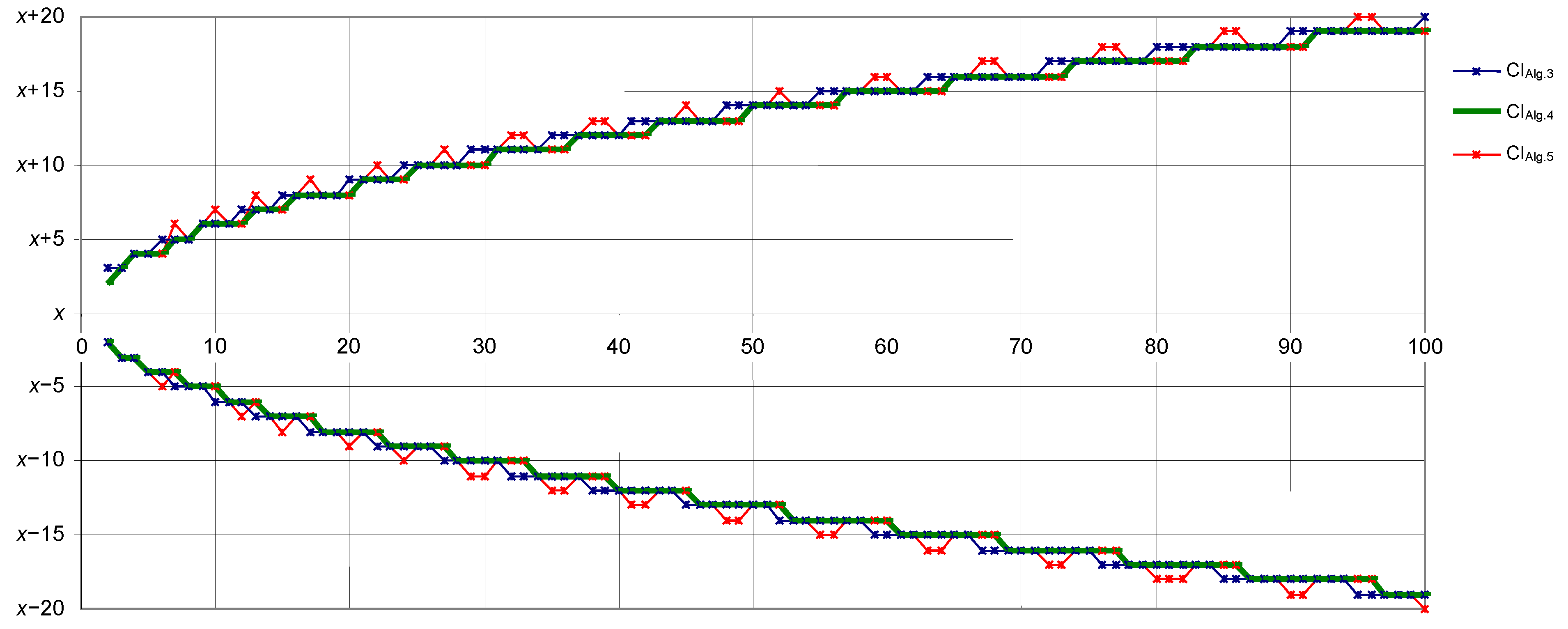
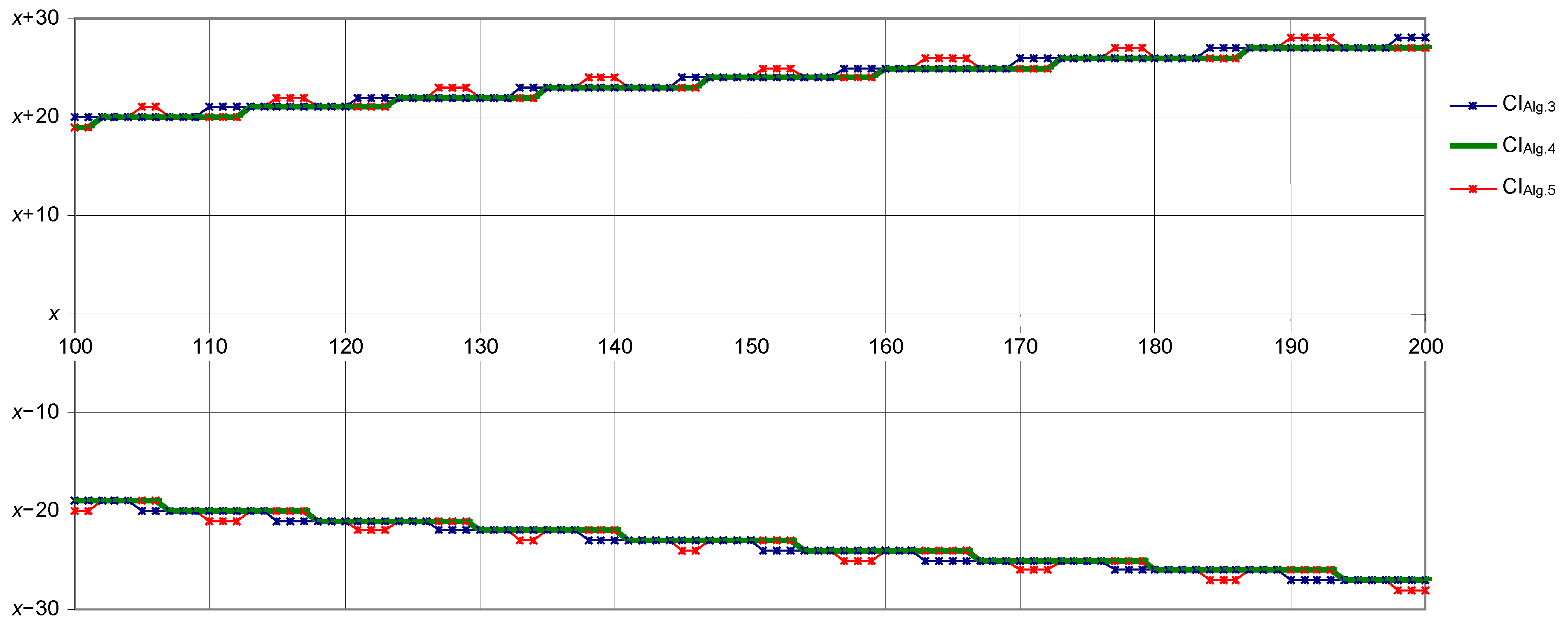
4.3. Graphical Representations of the Confidence Intervals
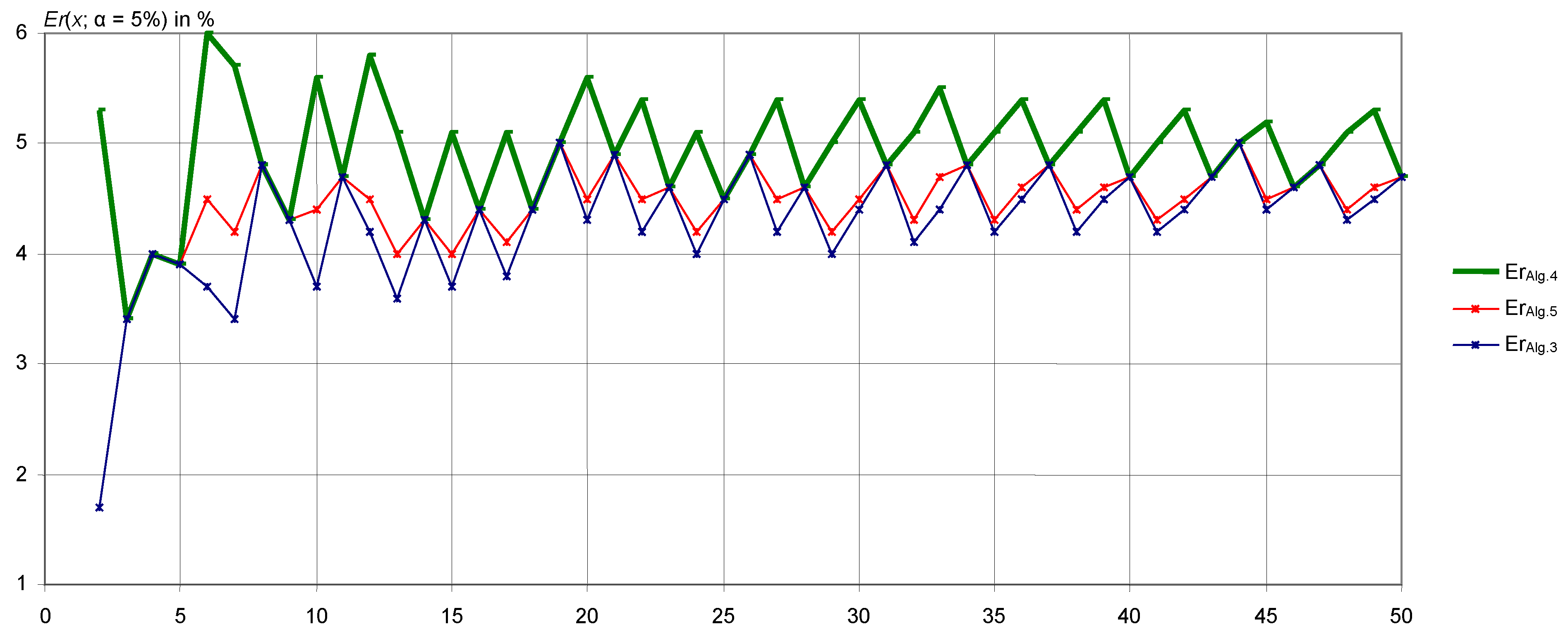
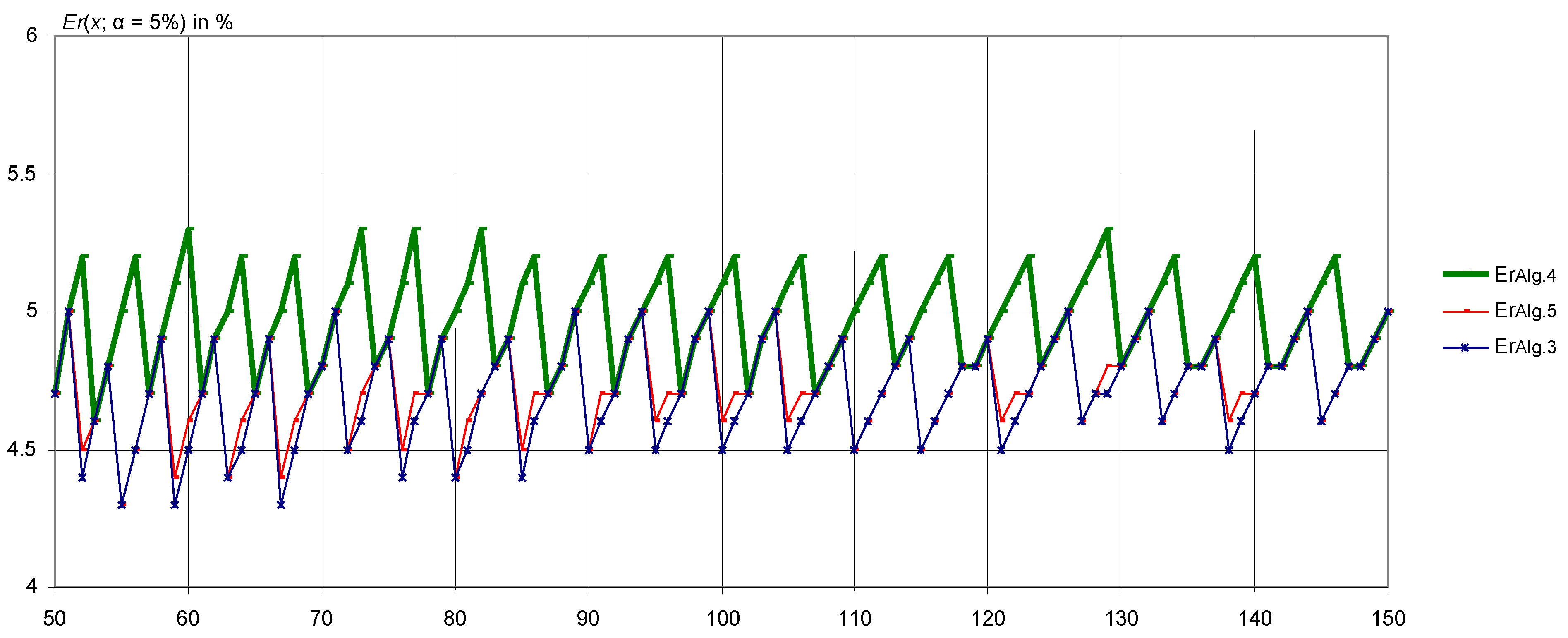
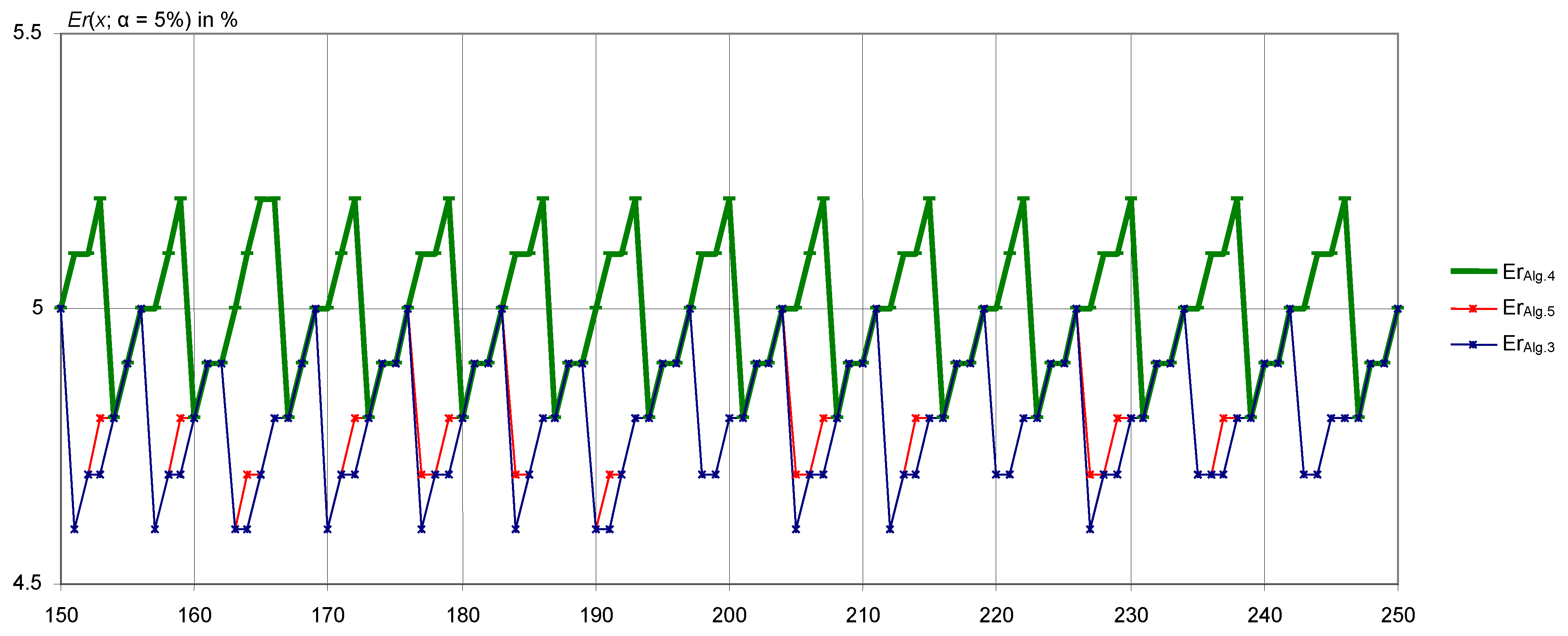
4.4. Graphical Representations of the Error Bounds
5. Modifications to the Poisson Distribution
5.1. Zero-Inflated Poisson (ZIP) Distribution
5.2. Conway–Maxwell–Poisson (CMP) Distribution
5.3. Consul–Jain–Poisson (CJP) Distribution
5.4. Pólya–Aeppli–Poisson (PAP) Distribution
5.5. Snyder–Ord–Beaumont (SOB) Distribution
5.6. Other Modifications
5.7. Alternatives to the Poisson Distribution
5.8. Connections with Other Distributions
6. Conclusions
Funding
Data Availability Statement
Conflicts of Interest
Abbreviations
| Level of significance (usually set to 0.05; 0.2, 0.1, 0.01, 0.005, 0.002, 0.001 also in use) | |
| CDF | Cumulative distribution function |
| CI | Confidence interval |
| True significance (as observed, when expected significance is ) | |
| PMF | Probability mass function |
| Poisson | Poisson distribution PMF |
| ZIP | Zero-inflated Poisson distribution PMF |
| CMP | Conway–Maxwell–Poisson distribution PMF |
| CJP | Consul–Jain–Poisson distribution PMF |
| PAP | Pólya–Aeppli–Poisson distribution PMF |
| SOB | Snyder–Ord–Beaumont distribution PMF |
| EP | Exponentiated Poisson distribution PMF |
| TP | Transmutated Poisson distribution PMF |
| ZMP | Zero-modified Poisson distribution PMF |
| ZTP | Zero-truncated Poisson distribution PMF |
| & | Null and alternative hypotheses |
| Conditional chi-squared statistic | |
| Likelihood ratio statistic | |
| Barlett–Anscombe statistic | |
| Normality statistic | |
| HG | Hypergeometric distribution PMF |
| Count | Count function, counting the elements in an array |
Appendix A. Raw Data for 95% CI from Algorithms 3–5

| Alg. 3 | Alg. 4 | Alg. 5 | ||||
|---|---|---|---|---|---|---|
| 2 | 0 | 5 | 0 | 4 | 0 | 5 |
| 3 | 0 | 6 | 0 | 6 | 0 | 6 |
| 4 | 1 | 8 | 1 | 8 | 1 | 8 |
| 5 | 1 | 9 | 1 | 9 | 1 | 9 |
| 6 | 2 | 11 | 2 | 10 | 1 | 10 |
| 7 | 2 | 12 | 3 | 12 | 3 | 13 |
| 8 | 3 | 13 | 3 | 13 | 3 | 13 |
| 9 | 4 | 15 | 4 | 15 | 4 | 15 |
| 10 | 4 | 16 | 5 | 16 | 5 | 17 |
| 11 | 5 | 17 | 5 | 17 | 5 | 17 |
| 12 | 6 | 19 | 6 | 18 | 5 | 18 |
| 13 | 6 | 20 | 7 | 20 | 7 | 21 |
| 14 | 7 | 21 | 7 | 21 | 7 | 21 |
| 15 | 8 | 23 | 8 | 22 | 7 | 22 |
| 16 | 9 | 24 | 9 | 24 | 9 | 24 |
| 17 | 9 | 25 | 10 | 25 | 10 | 26 |
| 18 | 10 | 26 | 10 | 26 | 10 | 26 |
| 19 | 11 | 27 | 11 | 27 | 11 | 27 |
| 20 | 12 | 29 | 12 | 28 | 11 | 28 |
| 21 | 13 | 30 | 13 | 30 | 13 | 30 |
| 22 | 13 | 31 | 14 | 31 | 14 | 32 |
| 23 | 14 | 32 | 14 | 32 | 14 | 32 |
| 24 | 15 | 34 | 15 | 33 | 14 | 33 |
| 25 | 16 | 35 | 16 | 35 | 16 | 35 |
| 26 | 17 | 36 | 17 | 36 | 17 | 36 |
| 27 | 17 | 37 | 18 | 37 | 18 | 38 |
| 28 | 18 | 38 | 18 | 38 | 18 | 38 |
| 29 | 19 | 40 | 19 | 39 | 18 | 39 |
| 30 | 20 | 41 | 20 | 40 | 19 | 40 |
| 31 | 21 | 42 | 21 | 42 | 21 | 42 |
| 32 | 21 | 43 | 22 | 43 | 22 | 44 |
| 33 | 22 | 44 | 23 | 44 | 23 | 45 |
| 34 | 23 | 45 | 23 | 45 | 23 | 45 |
| 35 | 24 | 47 | 24 | 46 | 23 | 46 |
| 36 | 25 | 48 | 25 | 47 | 24 | 47 |
| 37 | 26 | 49 | 26 | 49 | 26 | 49 |
| 38 | 26 | 50 | 27 | 50 | 27 | 51 |
| 39 | 27 | 51 | 28 | 51 | 28 | 52 |
| 40 | 28 | 52 | 28 | 52 | 28 | 52 |
| 41 | 29 | 54 | 29 | 53 | 28 | 53 |
| 42 | 30 | 55 | 30 | 54 | 29 | 54 |
| 43 | 31 | 56 | 31 | 56 | 31 | 56 |
| 44 | 32 | 57 | 32 | 57 | 32 | 57 |
| 45 | 32 | 58 | 33 | 58 | 33 | 59 |
| 46 | 33 | 59 | 33 | 59 | 33 | 59 |
| 47 | 34 | 60 | 34 | 60 | 34 | 60 |
| 48 | 35 | 62 | 35 | 61 | 34 | 61 |
| 49 | 36 | 63 | 36 | 62 | 35 | 62 |
| 50 | 37 | 64 | 37 | 64 | 37 | 64 |
| 51 | 38 | 65 | 38 | 65 | 38 | 65 |
| 52 | 38 | 66 | 39 | 66 | 39 | 67 |
| 53 | 39 | 67 | 39 | 67 | 39 | 67 |
| 54 | 40 | 68 | 40 | 68 | 40 | 68 |
| 55 | 41 | 70 | 41 | 69 | 40 | 69 |
| 56 | 42 | 71 | 42 | 70 | 41 | 70 |
| 57 | 43 | 72 | 43 | 72 | 43 | 72 |
| 58 | 44 | 73 | 44 | 73 | 44 | 73 |
| 59 | 44 | 74 | 45 | 74 | 45 | 75 |
| 60 | 45 | 75 | 46 | 75 | 46 | 76 |
| 61 | 46 | 76 | 46 | 76 | 46 | 76 |
| 62 | 47 | 77 | 47 | 77 | 47 | 77 |
| 63 | 48 | 79 | 48 | 78 | 47 | 78 |
| 64 | 49 | 80 | 49 | 79 | 48 | 79 |
| 65 | 50 | 81 | 50 | 81 | 50 | 81 |
| 66 | 51 | 82 | 51 | 82 | 51 | 82 |
| 67 | 51 | 83 | 52 | 83 | 52 | 84 |
| 68 | 52 | 84 | 53 | 84 | 53 | 85 |
| 69 | 53 | 85 | 53 | 85 | 53 | 85 |
| 70 | 54 | 86 | 54 | 86 | 54 | 86 |
| 71 | 55 | 87 | 55 | 87 | 55 | 87 |
| 72 | 56 | 89 | 56 | 88 | 55 | 88 |
| 73 | 57 | 90 | 57 | 89 | 56 | 89 |
| 74 | 58 | 91 | 58 | 91 | 58 | 91 |
| 75 | 59 | 92 | 59 | 92 | 59 | 92 |
| 76 | 59 | 93 | 60 | 93 | 60 | 94 |
| 77 | 60 | 94 | 61 | 94 | 61 | 95 |
| 78 | 61 | 95 | 61 | 95 | 61 | 95 |
| 79 | 62 | 96 | 62 | 96 | 62 | 96 |
| 80 | 63 | 98 | 63 | 97 | 62 | 97 |
| 81 | 64 | 99 | 64 | 98 | 63 | 98 |
| 82 | 65 | 100 | 65 | 99 | 64 | 99 |
| 83 | 66 | 101 | 66 | 101 | 66 | 101 |
| 84 | 67 | 102 | 67 | 102 | 67 | 102 |
| 85 | 67 | 103 | 68 | 103 | 68 | 104 |
| 86 | 68 | 104 | 69 | 104 | 69 | 105 |
| 87 | 69 | 105 | 69 | 105 | 69 | 105 |
| 88 | 70 | 106 | 70 | 106 | 70 | 106 |
| 89 | 71 | 107 | 71 | 107 | 71 | 107 |
| 90 | 72 | 109 | 72 | 108 | 71 | 108 |
| 91 | 73 | 110 | 73 | 109 | 72 | 109 |
| 92 | 74 | 111 | 74 | 111 | 74 | 111 |
| 93 | 75 | 112 | 75 | 112 | 75 | 112 |
| 94 | 76 | 113 | 76 | 113 | 76 | 113 |
| 95 | 76 | 114 | 77 | 114 | 77 | 115 |
| 96 | 77 | 115 | 78 | 115 | 78 | 116 |
| 97 | 78 | 116 | 78 | 116 | 78 | 116 |
| 98 | 79 | 117 | 79 | 117 | 79 | 117 |
| 99 | 80 | 118 | 80 | 118 | 80 | 118 |
| 100 | 81 | 120 | 81 | 119 | 80 | 119 |
References
- Taylor, B. Methodus Incrementorum Directa & Inversa; Gulielmi Innys: London, UK, 1715; Available online: http://books.google.com/books?id=r-Gq9YyZYXYC (accessed on 18 August 2025).
- Maclaurin, C. A Treatise of Fluxions in Two Books; Ruddimans: Edinburgh, UK, 1742; Available online: http://archive.org/details/bim_eighteenth-century_a-treatise-of-fluxions-_maclaurin-colin-profes_1742_1 (accessed on 18 August 2025).
- Euler, L. Methodus universalis series summandi ulterius promota. Comment. Acad. Sci. Petropolitanae 1741, 8, 147–158. Available online: http://scholarlycommons.pacific.edu/euler-works/55/ (accessed on 18 August 2025).
- Poisson, S.D. Probabilité des Jugements en Matière Criminelle et en Matière Civile, Précédées des Règles Générales du Calcul des Probabilités; Bachelier: Paris, France, 1839; Available online: http://gallica.bnf.fr/ark:/12148/bpt6k110193z (accessed on 18 August 2025).
- Newcomb, S. Notes on the theory of probabilities. Math. Montly 1860, 2, 134–140. Available online: http://jhanley.biostat.mcgill.ca/bios601/Intensity-Rate/Newcomb1860.pdf (accessed on 18 August 2025).
- von Bortkiewitsch, L. Das Gesetz der Kleinen Zahlen; B.G. Teubner: Leipzig, Germany, 1839; Available online: http://archive.org/details/dasgesetzderklei00bortrich (accessed on 18 August 2025).
- Knuth, D.E. Seminumerical Algorithms. The Art of Computer Programming, 3rd ed.; Addison-Wesley: Reading, MA, USA, 1969; Volume 2. Available online: https://lccn.loc.gov/97002147 (accessed on 18 August 2025).
- Devroye, L. Discrete Univariate Distributions. In Non-Uniform Random Variate Generation; Springer: New York, NY, USA, 1986; Chapter 10; pp. 485–553. [Google Scholar] [CrossRef]
- Hall, P. On continuum percolation. Ann. Probab. 1985, 13, 1250–1266. [Google Scholar] [CrossRef]
- Vedder, J.D. Asteroid collisions: Estimating their probabilities and velocity distributions. Icarus 1996, 123, 436–449. [Google Scholar] [CrossRef]
- Nota, A.; Velázquez, J.J.L. On the growth of a particle coalescing in a Poisson distribution of obstacles. Commun. Math. Phys. 2017, 354, 957–1013. [Google Scholar] [CrossRef]
- Alscher, A.; Hencken, K.; Trautmann, D.; Baur, G. Multiple electromagnetic electron-positron pair production in relativistic heavy-ion collisions. Phys. Rev. A 1997, 55, 396. [Google Scholar] [CrossRef]
- Baquero-Ruiz, M.; Manke, F.; Furno, I.; Fasoli, A.; Ricci, P. Particle transport at arbitrary timescales with Poisson-distributed collisions. Phys. Rev. E 2019, 100, 052134. [Google Scholar] [CrossRef]
- Wielinga, B.; Milburn, G.J. Effect of dissipation and measurement on a tunneling system. Phys. Rev. A 1995, 52, 3323. [Google Scholar] [CrossRef]
- Chun, K.; Birge, N.O. Dissipative quantum tunneling of a single defect in a disordered metal. Phys. Rev. B 1996, 54, 4629. [Google Scholar] [CrossRef]
- Flores, J.C. Mesoscopic capacitor and zero-point energy: Poisson’s distribution for virtual charges, pressure, and decoherence control. Mod. Phys. Lett. B 2014, 28, 1450181. [Google Scholar] [CrossRef]
- Kong, L.; Gong, Z.; Wu, B. Quantum dynamical tunneling breaks classical conserved quantities. Phys. Rev. E 2024, 109, 054113. [Google Scholar] [CrossRef]
- McGill, M.; Markus, T.; Scott, V.S.; Neumann, T. The Multiple Altimeter Beam Experimental Lidar (MABEL): An airborne simulator for the ICESat-2 mission. J. Atmos. Ocean. Technol. 2013, 30, 345–352. [Google Scholar] [CrossRef]
- Neumann, T.A.; Brenner, A.; Hancock, D.; Robbins, J.; Gibbons, A.; Lee, J.; Harbeck, K.; Saba, J.; Luthcke, S.; Rebold, T. Ice, Cloud, and Land Elevation Satellite (ICESat-2) Project: Algorithm Theoretical Basis Document (ATBD) for Global Geolocated Photons; ATL03, Version 6. ICESat-2 Project; Goddard Space Flight Center: Greenbelt, MD, USA, 2022. [Google Scholar] [CrossRef]
- Loredo, T.J.; Wolpert, R.L. Bayesian inference: More than Bayes’s theorem. Front. Astron. Space Sci. 2024, 11, 1326926. [Google Scholar] [CrossRef]
- Ananthamoorthy, B.; Bhattacharya, D.; Sreekumar, P.; Swathi, B. Detection of Faint Sources by the UltraViolet Imaging Telescope Onboard AstroSat Using Poisson Distribution of Background. Astronom. J. 2024, 168, 22. [Google Scholar] [CrossRef]
- Green, M.; Colwell, J.; Esposito, L.; Jerousek, R. Particle sizes in Saturn’s rings from UVIS stellar occultations 2. Outlier Populations in the C ring and Cassini Division. Icarus 2024, 416, 116081. [Google Scholar] [CrossRef]
- Rahman, O.; Sauer, K.D.; Bouman, C.A.; Melnyk, R.; Nett, B. Statistically adaptive filtering for low signal correction in x-ray computed tomography. In Proceedings of the Medical Imaging 2021: Physics of Medical Imaging; Bosmans, H., Zhao, W., Yu, L., Eds.; International Society for Optics and Photonics, SPIE: Bellingham, WA, USA, 2021; Volume 11595, pp. 618–623. [Google Scholar] [CrossRef]
- Liu, B.; Liang, Z.; Huang, W.; Gao, F.; Yuan, J.; Xu, B. Decoy-state quantum-key-distribution-based quantum private query with error tolerance bound. Phys. Rev. A 2024, 109, 052442. [Google Scholar] [CrossRef]
- Ruark, A.; Devol, L. The General Theory of Fluctuations in Radioactive Disintegration. Phys. Rev. 1936, 49, 355–367. [Google Scholar] [CrossRef]
- Matthews, I.; Kouris, K.; Jones, M.; Spyrou, N. Theoretical and experimental investigations on the applicability of the Poisson and Ruark-Devol statistical density functions in the theory of radioactive decay and counting. Nucl. Instrum. Methods Phys. Res. A 1980, 171, 369–375. [Google Scholar] [CrossRef]
- Foster, J.; Kouris, K.; Matthews, I.P.; Spyrou, N.M. Binomial vs poisson statistics in radiation studies. Nucl. Instrum. Methods Phys. Res. B 1983, 212, 301–305. [Google Scholar] [CrossRef]
- Sitek, A.; Celler, A.M. Limitations of Poisson statistics in describing radioactive decay. Phys. Medica 2015, 31, 1105–1107. [Google Scholar] [CrossRef]
- Jokipii, J. Stochastic variations of cosmic rays in the solar system. Astrophys. J. 1969, 156, 1107–1116. [Google Scholar] [CrossRef]
- Fodor, Z.; Katz, S. Ultrahigh energy cosmic rays from compact sources. Phys. Rev. D 2000, 63, 023002. [Google Scholar] [CrossRef][Green Version]
- Kitamura, T.; Ohara, S.; Konishi, T.; Tsuji, K.; Chikawa, M.; Unno, W.; Masaki, I.; Urata, K.; Kato, Y. Chaos in cosmic ray air showers. Astropart. Phys. 1997, 6, 279–291. [Google Scholar] [CrossRef]
- Dubovsky, S.; Tinyakov, P.; Tkachev, I. Statistics of clustering of ultrahigh energy cosmic rays and the number of their sources. Phys. Rev. Lett. 2000, 85, 1154. [Google Scholar] [CrossRef]
- Ding, S.; Lavaux, G.; Jasche, J. PineTree: A generative, fast, and differentiable halo model for wide-field galaxy surveys. Astron. Astrophys. 2024, 690, A236. [Google Scholar] [CrossRef]
- Stasenko, V. Redshift evolution of primordial black hole merger rate. Phys. Rev. D 2024, 109, 123546. [Google Scholar] [CrossRef]
- Vos-Gines, B.; Avila, S.; Gonzalez-Perez, V.; Yepes, G. Improving and extending non-Poissonian distributions for satellite galaxies sampling in HOD: Applications to eBOSS ELGs. Mon. Not. R. Astron. Soc. 2024, 530, 3458–3476. [Google Scholar] [CrossRef]
- Lacki, B.C. Artificial Broadcasts as Galactic Populations. I. A Point Process Formalism for Extraterrestrial Intelligences and Their Broadcasts. Astrophys. J. 2024, 966, 182. [Google Scholar] [CrossRef]
- Tan, J.; Lim, J.; Kwon, J.H.; Naik, V.B.; Raghavan, N.; Pey, K.L. Backhopping-based STT-MRAM Poisson Spiking Neuron for Neuromorphic Computation. In Proceedings of the 2023 IEEE International Reliability Physics Symposium (IRPS), Monterey, CA, USA, 26–30 March 2023; IEEE: Piscataway, NJ, USA, 2023; pp. 1–6. [Google Scholar] [CrossRef]
- Skucha, K.; Gambini, S.; Liu, P.; Megens, M.; Kim, J.; Boser, B. Design considerations for CMOS-integrated Hall-effect magnetic bead detectors for biosensor applications. J. Microelectromechanical Syst. 2013, 22, 1327–1338. [Google Scholar] [CrossRef]
- Fujihashi, C. All Error Detecting Modified Hamming Codes for Ideal Optical Channel and Application to Practical System. Acad. Rep. Fac. Eng. Tokyo Polytech. Univ. 2008, 31, 18–26. [Google Scholar]
- Kim, K.O. Effects of manufacturing defects on the device failure rate. J. Korean Phys. Soc. 2013, 42, 481–495. [Google Scholar] [CrossRef]
- Yuan, T.; Bae, S.J.; Kuo, Y. Defects Driven Yield and Reliability Modeling for Semiconductor Manufacturing. In Statistical Quality Technologies: Theory and Practice; Springer International Publishing: Cham, Switzerland, 2019; Chapter 16; pp. 375–393. [Google Scholar] [CrossRef]
- Rafsanjani, H.M.; Sørensen, J.D. Effect of Defects Distribution on Fatigue Life of Wind Turbine Components. Procedia IUTAM 2015, 13, 144–150. [Google Scholar] [CrossRef][Green Version]
- Yli-Renko, H.; Janakiraman, R. How customer portfolio affects new product development in technology-based entrepreneurial firms. J. Mark. 2008, 72, 131–148. [Google Scholar] [CrossRef]
- Lin, Y.; Li, L.; Ren, P.; Wang, Y.; Szeto, W. From aircraft tracking data to network delay model: A data-driven approach considering en-route congestion. Transp. Res. C Emerg. Technol. 2021, 131, 103329. [Google Scholar] [CrossRef]
- Cruz, F.R.; Almeida, M.A.; D’Angelo, M.F.; van Woensel, T. Traffic intensity estimation in finite Markovian queueing systems. Math. Probl. Eng. 2018, 2018, 3018758. [Google Scholar] [CrossRef]
- Plumlee, C.H. Optimum size seaport. J. Waterw. Harb. Div. 1966, 92, 1–24. [Google Scholar] [CrossRef]
- Nicolaou, S.N. Berth planning by evaluation of congestion and cost. J. Waterw. Harb. Div. 1967, 93, 107–132. [Google Scholar] [CrossRef]
- Noritake, M.; Kimura, S. Optimum number and capacity of seaport berths. J. Waterw. Port Coast. Ocean Eng. 1983, 109, 323–339. [Google Scholar] [CrossRef]
- Kuo, T.C.; Huang, W.C.; Wu, S.C.; Cheng, P.L. A case study of inter-arrival time distributions of container ships. J. Mar. Sci. Technol. 2006, 14, 4. [Google Scholar] [CrossRef]
- Saeed, N.; Larsen, O.I. Application of queuing methodology to analyze congestion: A case study of the Manila International Container Terminal, Philippines. Case Stud. Transp. Policy 2016, 4, 143–149. [Google Scholar] [CrossRef]
- Lall, A. Delays in the New York city metroplex. Transp. Res. A Policy Pract. 2018, 114, 139–153. [Google Scholar] [CrossRef]
- Chen, C.; Li, C.; Chen, J.; Wang, C. VFDP: Visual analysis of flight delay and propagation on a geographical map. IEEE Trans. Intell. Transp. Syst. 2020, 23, 3510–3521. [Google Scholar] [CrossRef]
- Bombelli, A.; Sallan, J.M. Analysis of the effect of extreme weather on the US domestic air network. A delay and cancellation propagation network approach. J. Transp. Geogr. 2023, 107, 103541. [Google Scholar] [CrossRef]
- Wang, T.; Zheng, Y.; Xu, H. A review of flight delay prediction methods. In Proceedings of the 2022 2nd International Conference on Big Data Engineering and Education (BDEE), Chengdu, China, 5–7 August 2022; IEEE: Piscataway, NJ, USA, 2022; pp. 135–141. [Google Scholar] [CrossRef]
- Daley, D.J.; Vere-Jones, D. An Introduction to the Theory of Point Processes: Volume I: Elementary Theory and Methods; Springer: Cham, Switzerland, 2003. [Google Scholar]
- Ross, S.M. Introduction to Probability Models; Academic Press: Cambridge, MA, USA, 2014. [Google Scholar]
- Weiss, G.; Herman, R. Statistical properties of low-density traffic. Q. Appl. Math. 1962, 20, 121–130. [Google Scholar] [CrossRef][Green Version]
- Ashton, W.D. Distributions for gaps in road traffic. IMA J. Appl. Math. 1971, 7, 37–46. [Google Scholar] [CrossRef]
- Shuoxian, W. A simple method for predicting kerbside L10 level from a free multi-type vehicular flow. Appl. Acoust. 1987, 20, 15–22. [Google Scholar] [CrossRef]
- de Donato, S.R.; Morri, B. A statistical model for predicting road traffic noise based on Poisson type traffic flow. Noise Control Eng. J. 2001, 49, 137–143. [Google Scholar] [CrossRef]
- Abul-Magd, A.Y. Modeling highway-traffic headway distributions using superstatistics. Phys. Rev. E. 2007, 76, 057101. [Google Scholar] [CrossRef]
- Mensah, E.K. Mathematical Analysis of Traffic Flow Behaviour of the internet At Ghana Technology University College. Math. Theory Model. 2018, 8, 8–26. [Google Scholar]
- Paxson, V.; Floyd, S. Wide area traffic: The failure of Poisson modeling. IEEE/ACM Trans. Netw. 1995, 3, 226–244. [Google Scholar] [CrossRef]
- Surrey, K.; Song, L.; Hongwei, L.; Randall, P. Analyzing Network Traffic for Malicious Activity. Can. Appl. Math. Q. 2004, 12, 479–489. [Google Scholar]
- Andrews, J.G.; Baccelli, F.; Ganti, R.K. A tractable approach to coverage and rate in cellular networks. IEEE Trans. Commun. 2011, 59, 3122–3134. [Google Scholar] [CrossRef]
- Mao, X.; Cheng, H.; Long, F.; Yang, A. The statistics and analysis of packet traffic distribution characters in access network based on NetMagic platform. In Proceedings of the 2012 2nd International Conference on Consumer Electronics, Communications and Networks (CECNet), Yichang, China, 21–23 April 2012; IEEE: Piscataway, NJ, USA, 2012; pp. 1468–1472. [Google Scholar] [CrossRef]
- Roels, G.; Fridgeirsdottir, K. Dynamic revenue management for online display advertising. J. Revenue Pricing Manag. 2009, 8, 452–466. [Google Scholar] [CrossRef]
- Duan, Z.; Dong, Y.; Gopalan, K. DMTP: Controlling spam through message delivery differentiation. Comput. Netw. 2007, 51, 2616–2630. [Google Scholar] [CrossRef]
- Hao, S.; Thomas, M.; Paxson, V.; Feamster, N.; Kreibich, C.; Grier, C.; Hollenbeck, S. Understanding the domain registration behavior of spammers. In Proceedings of the 2013 Conference on Internet Measurement Conference, Barcelona, Spain, 23–25 October 2013; pp. 63–76. [Google Scholar] [CrossRef]
- Markel, W.D. The Poisson Distribution: Probability Function with an Identity Crisis. Sch. Sci. Math. 1989, 89, 583–589. [Google Scholar] [CrossRef]
- Haddad, M.R.; Baazaoui, H.; Ziou, D.; Ghezala, H.B. A predictive model for recurrent consumption behavior: An application on phone calls. Knowl. Based Syst. 2014, 64, 32–43. [Google Scholar] [CrossRef]
- Ivanovich, M.; Hesse, M.; Fitzpatrick, P. Paging performance in GSM networks: Analysis and simulation. In Teletraffic Science and Engineering; Elsevier: Amsterdam, The Netherlands, 2003; Volume 5, pp. 751–760. [Google Scholar] [CrossRef]
- Bregni, S.; Cioffi, R.; Decina, M. An empirical study on time-correlation of GSM telephone traffic. IEEE Trans. Wirel. Commun. 2008, 7, 3428–3435. [Google Scholar] [CrossRef]
- Russo, M.; Šolić, P.; Stella, M. Probabilistic modeling of harvested GSM energy and its application in extending UHF RFID tags reading range. J. Electromagn. Waves Appl. 2013, 27, 473–484. [Google Scholar] [CrossRef]
- He, Q.Q.; Yang, W.C.; Hu, Y.X. Accurate method to estimate EM radiation from a GSM base station. Prog. Electromagn. Res. M 2013, 34, 19–27. [Google Scholar] [CrossRef]
- Nicholson, A. Analysis of spatial distributions of accidents. Saf. Sci. 1998, 31, 71–91. [Google Scholar] [CrossRef]
- Carleton, J. Non-random accident distributions and the Poisson series. In Proceedings of the Casualty Actuarial Society; Casualty Actuarial Society: Arlington County, VA, USA, 1945; Volume 32, p. 21. [Google Scholar]
- Seong, K.M.; Park, H.; Kim, S.J.; Ha, H.N.; Lee, J.Y.; Kim, J. A new method for the construction of a mutant library with a predictable occurrence rate using Poisson distribution. J. Microbiol. Methods 2007, 69, 442–450. [Google Scholar] [CrossRef]
- Nishino, H.; Schaid, D.J.; Buettner, V.L.; Haavik, J.; Sommer, S.S. Mutational specificity: Mutation frequencies but not mutant frequencies in Big Blue® mice fit a Poisson distribution. Environ. Mol. Mutagen. 1996, 28, 414–417. [Google Scholar] [CrossRef]
- Luria, S.E.; Delbrück, M. Mutations of bacteria from virus sensitivity to virus resistance. Genetics 1943, 28, 491–511. [Google Scholar] [CrossRef]
- Zheng, Q. Progress of a half century in the study of the Luria–Delbrück distribution. Math. Biosci. 1999, 162, 1–32. [Google Scholar] [CrossRef] [PubMed]
- Hudson, R.E.; Bergthorsson, U.; Roth, J.R.; Ochman, H. Effect of Chromosome Location on Bacterial Mutation Rates. Mol. Biol. Evol. 2002, 19, 85–92. [Google Scholar] [CrossRef] [PubMed][Green Version]
- Wu, X.; Strome, E.D.; Meng, Q.; Hastings, P.J.; Plon, S.E.; Kimmel, M. A robust estimator of mutation rates. Mutat. Res. Fundam. Mol. Mech. Mutagen. 2009, 661, 101–109. [Google Scholar] [CrossRef] [PubMed]
- Cordoni, F.G.; Missiaggia, M.; Scifoni, E.; La Tessa, C. Cell survival computation via the generalized stochastic microdosimetric model (GSM2); part I: The theoretical framework. Radiat. Res. 2022, 197, 218–232. [Google Scholar] [CrossRef]
- Akiyama, M.; Kyoizumi, S.; Hirai, Y.; Kusunoki, Y.; Iwamoto, K.S.; Nakamura, N. Mutation frequency in human blood cells increases with age. Mutat. Res. DNAging 1995, 338, 141–149. [Google Scholar] [CrossRef]
- Kim, S.H.; Whitt, W. Are Call Center and Hospital Arrivals Well Modeled by Nonhomogeneous Poisson Processes? Manuf. Serv. Oper. Manag. 2014, 16, 464–480. [Google Scholar] [CrossRef]
- Takagi, H.; Kanai, Y.; Misue, K. Queueing network model for obstetric patient flow in a hospital. Health Care Manag. Sci. 2017, 20, 433–451. [Google Scholar] [CrossRef]
- Zhao, Y.; Zeng, D.; Herring, A.H.; Ising, A.; Waller, A.; Richardson, D.; Kosorok, M.R. Detecting Disease Outbreaks Using Local Spatiotemporal Methods. Biometrics 2011, 67, 1508–1517. [Google Scholar] [CrossRef]
- Luna, J.; Leleu, J.P.; Preux, P.M.; Corcia, P.; Couratier, P.; Marin, B.; Boumediene, F.; Marin, B.; Couratier, P.; Preux, P.M.; et al. Residential exposure to ultra high frequency electromagnetic fields emitted by Global System for Mobile (GSM) antennas and amyotrophic lateral sclerosis incidence: A geo-epidemiological population-based study. Environ. Res. 2019, 176, 108525. [Google Scholar] [CrossRef]
- Whitt, W.; Zhang, X. A data-driven model of an emergency department. Oper. Res. Health Care 2017, 12, 1–15. [Google Scholar] [CrossRef]
- Egorov, A.; Naumova, E.; Tereschenko, A.; Kislitsin, V.; Ford, T. Daily variations in effluent water turbidity and diarrhoeal illness in a Russian city. Int. J. Environ. Health Res. 2003, 13, 81–94. [Google Scholar] [CrossRef] [PubMed]
- Naumova, E.N.; MacNeill, I.B. Time-distributed effect of exposure and infectious outbreaks. Environmetrics 2009, 20, 235–248. [Google Scholar] [CrossRef] [PubMed]
- Kulldorff, M.; Heffernan, R.; Hartman, J.; Assunção, R.; Mostashari, F. A Space–Time Permutation Scan Statistic for Disease Outbreak Detection. PLoS Med. 2005, 2, e59. [Google Scholar] [CrossRef] [PubMed]
- Chen, Y.; Broman, A.T.; Priest, G.; Landrigan, C.P.; Rahman, S.A.; Lockley, S.W. The effect of blue-enriched lighting on medical error rate in a university hospital ICU. Jt. Comm. J. Qual. Patient Saf. 2021, 47, 165–175. [Google Scholar] [CrossRef]
- Tanaka, K.; Takahashi, M.; Hiro, H.; Kakinuma, M.; Tanaka, M.; Kamata, N.; Miyaoka, H. Differences in medical error risk among nurses working two-and three-shift systems at teaching hospitals: A six-month prospective study. Ind. Health 2010, 48, 357–364. [Google Scholar] [CrossRef]
- Camargo, C.A., Jr.; Tsai, C.L.; Sullivan, A.F.; Cleary, P.D.; Gordon, J.A.; Guadagnoli, E.; Kaushal, R.; Magid, D.J.; Rao, S.R.; Blumenthal, D. Safety climate and medical errors in 62 US emergency departments. Ann. Emerg. Med. 2012, 60, 555–563. [Google Scholar] [CrossRef]
- Maslach, C.; Jackson, S.E. The measurement of experienced burnout. J. Organ. Behav. 1981, 2, 99–113. [Google Scholar] [CrossRef]
- Baer, L.; Jacobs, D.G.; Meszler-Reizes, J.; Blais, M.; Fava, M.; Kessler, R.; Magruder, K.; Murphy, J.; Kopans, B.; Cukor, P.; et al. Development of a brief screening instrument: The HANDS. Psychother. Psychosom. 2000, 69, 35–41. [Google Scholar] [CrossRef]
- Fahrenkopf, A.M.; Sectish, T.C.; Barger, L.K.; Sharek, P.J.; Lewin, D.; Chiang, V.W.; Edwards, S.; Wiedermann, B.L.; Landrigan, C.P. Rates of medication errors among depressed and burnt out residents: Prospective cohort study. Br. Med. J. 2008, 336, 488–491. [Google Scholar] [CrossRef]
- Dalelane, C.; Deutschländer, T. A robust estimator for the intensity of the Poisson point process of extreme weather events. Weather Clim. Extrem. 2013, 1, 69–76. [Google Scholar] [CrossRef]
- Orui, M.; Suzuki, Y.; Maeda, M.; Yasumura, S. Suicide rates in evacuation areas after the Fukushima Daiichi nuclear disaster. Crisis 2018, 39, 353–363. [Google Scholar] [CrossRef] [PubMed]
- Pitt, D.; Trück, S.; van den Honert, R.; Wong, W.W. Modeling risks from natural hazards with generalized additive models for location, scale and shape. J. Environ. Manag. 2020, 275, 111075. [Google Scholar] [CrossRef] [PubMed]
- Aggarwal, C.C.; Yu, P.S. A new framework for itemset generation. In Proceedings of the Seventeenth ACM SIGACT-SIGMOD-SIGART Symposium on Principles of Database Systems, Seattle, WA, USA, 1–3 June 1998; pp. 18–24. [Google Scholar] [CrossRef]
- Jonathan Weinberg, L.D.B.; Stroud, J.R. Bayesian Forecasting of an Inhomogeneous Poisson Process with Applications to Call Center Data. J. Am. Stat. Assoc. 2007, 102, 1185–1198. [Google Scholar] [CrossRef]
- Fader, P.S.; Hardie, B.G.; Lee, K.L. “Counting your customers” the easy way: An alternative to the Pareto/NBD model. Mark. Sci. 2005, 24, 275–284. [Google Scholar] [CrossRef]
- Wu, J.; Cook, V.J., Jr.; Strong, E.C. A two-stage model of the promotional performance of pure online firms. Inf. Syst. Res. 2005, 16, 334–351. [Google Scholar] [CrossRef][Green Version]
- Ferguson, M.E.; Fleischmann, M.; Souza, G.C. A profit-maximizing approach to disposition decisions for product returns. Decis. Sci. 2011, 42, 773–798. [Google Scholar] [CrossRef]
- Predić, B.; Radosavljević, N.; Stojčić, A. Time series analysis: Forecasting sales periods in wholesale systems. Facta Univ. Ser. Autom. Control Robot. 2020, 18, 177–188. [Google Scholar] [CrossRef]
- Bell, D.R.; Corsten, D.; Knox, G. From point of purchase to path to purchase: How preshopping factors drive unplanned buying. J. Mark. 2011, 75, 31–45. [Google Scholar] [CrossRef]
- Li, Z.; Lu, Q.; Talebian, M. Online versus bricks-and-mortar retailing: A comparison of price, assortment and delivery time. Int. J. Prod. Res. 2015, 53, 3823–3835. [Google Scholar] [CrossRef]
- Timonina-Farkas, A.; Katsifou, A.; Seifert, R.W. Product assortment and space allocation strategies to attract loyal and non-loyal customers. Eur. J. Oper. Res. 2020, 285, 1058–1076. [Google Scholar] [CrossRef]
- Guo, J.; He, J.; Wu, X. Shopping trip recommendations: A novel deep learning-enhanced global planning approach. Decis. Support Syst. 2024, 182, 114238. [Google Scholar] [CrossRef]
- Kiesmüller, G.P.; Van der Laan, E.A. An inventory model with dependent product demands and returns. Int. J. Prod. Econ. 2001, 72, 73–87. [Google Scholar] [CrossRef]
- de Brito, M.P.; Dekker, R. Modelling product returns in inventory control—exploring the validity of general assumptions. Int. J. Prod. Econ. 2003, 81, 225–241. [Google Scholar] [CrossRef]
- Krapp, M.; Nebel, J.; Sahamie, R. Forecasting product returns in closed-loop supply chains. Int. J. Phys. Distrib. Logist. Manag. 2013, 43, 614–637. [Google Scholar] [CrossRef]
- Eruguz, A.S.; Karabağ, O.; Tetteroo, E.; van Heijst, C.; van den Heuvel, W.; Dekker, R. Customer-to-customer returns logistics: Can it mitigate the negative impact of online returns? Omega 2024, 128, 103127. [Google Scholar] [CrossRef]
- Avramidis, A.N.; Deslauriers, A.; L’Ecuyer, P. Modeling Daily Arrivals to a Telephone Call Center. Manag. Sci. 2004, 50, 896–908. [Google Scholar] [CrossRef]
- Anscombe, F.J. The transformation of Poisson, binomial and negative-binomial data. Biometrika 1948, 35, 246–254. [Google Scholar] [CrossRef]
- Brown, L.D.; Zhao, L.H. A test for the Poisson distribution. Sankhyā: Indian J. Stat. Ser. A 2002, 64, 611–625. [Google Scholar]
- Bartlett, M.S. The use of transformations. Biometrics 1947, 3, 39–52. [Google Scholar] [CrossRef]
- Adell, J.A.; Jodrá, P. The median of the Poisson distribution. Metrika 2005, 61, 337–346. [Google Scholar] [CrossRef]
- Choi, K.P. On the medians of gamma distributions and an equation of Ramanujan. Proc. Am. Math. Soc. 1994, 121, 245–251. [Google Scholar] [CrossRef]
- Jäntschi, L. Binomial distributed data confidence interval calculation: Formulas, algorithms and examples. Symmetry 2022, 14, 1104. [Google Scholar] [CrossRef]
- Lambert, D. Zero-Inflated Poisson Regression, with an Application to Defects in Manufacturing. Technometrics 1992, 34, 1–14. [Google Scholar] [CrossRef]
- Boucher, J.P.; Denuit, M.; Guillen, M. Number of accidents or number of claims? An approach with zero-inflated Poisson models for panel data. J. Risk Insur. 2009, 76, 821–846. [Google Scholar] [CrossRef]
- Arab, A.; Holan, S.H.; Wikle, C.K.; Wildhaber, M.L. Semiparametric bivariate zero-inflated Poisson models with application to studies of abundance for multiple species. Environmetrics 2012, 23, 183–196. [Google Scholar] [CrossRef]
- Costantino, F.; Di Gravio, G.; Patriarca, R.; Petrella, L. Spare parts management for irregular demand items. Omega 2018, 81, 57–66. [Google Scholar] [CrossRef]
- Kukar-Kinney, M.; Scheinbaum, A.C.; Orimoloye, L.O.; Carlson, J.R.; He, H. A model of online shopping cart abandonment: Evidence from e-tail clickstream data. J. Acad. Mark. Sci. 2022, 50, 961–980. [Google Scholar] [CrossRef]
- Conway, R. A queueing model with state dependent service rate. J. Ind. Eng. 1961, 12, 132. [Google Scholar]
- Shmueli, G.; Minka, T.P.; Kadane, J.B.; Borle, S.; Boatwright, P. A useful distribution for fitting discrete data: Revival of the Conway–Maxwell–Poisson distribution. J. R. Stat. Soc. C Appl. Stat. 2005, 54, 127–142. [Google Scholar] [CrossRef]
- Boatwright, P.; Borle, S.; Kadane, J.B.; Minka, T.P.; Shmueli, G. Conjugate analysis of the Conway-Maxwell-Poisson distribution. Bayesian Anal. 2006, 1, 363–374. [Google Scholar] [CrossRef]
- Lord, D.; Guikema, S.D.; Geedipally, S.R. Application of the Conway–Maxwell–Poisson generalized linear model for analyzing motor vehicle crashes. Accid. Anal. Prev. 2008, 40, 1123–1134. [Google Scholar] [CrossRef]
- Consul, P.C.; Jain, G.C. A generalization of the Poisson distribution. Technometrics 1973, 15, 791–799. [Google Scholar] [CrossRef]
- Jain, G.; Consul, P. A generalized negative binomial distribution. SIAM J. Appl. Math. 1971, 21, 501–513. [Google Scholar] [CrossRef]
- Inouye, D.I.; Yang, E.; Allen, G.I.; Ravikumar, P. A review of multivariate distributions for count data derived from the Poisson distribution. Wiley Interdiscip. Rev. Comput. Stat. 2017, 9, e1398. [Google Scholar] [CrossRef]
- Tuenter, H.J.H. On the generalized Poisson distribution. Stat. Neerl. 2000, 54, 374–376. [Google Scholar] [CrossRef]
- Aeppli, A. Zur Theorie Verketteter Wahrscheinlichkeiten: Markoffsche Ketten höherer Ordnung. Ph.D. Thesis (Supervisors: G. Pólya and H. Weyl), ETH Zürich, Zurich, Switzerland, 1924. [Google Scholar] [CrossRef]
- Pólya, G. Eine wahrscheinlichkeitsaufgabe in der kundenwerbung. Z. Angew. Math. Mech. 1930, 10, 96–97. [Google Scholar] [CrossRef]
- Pólya, G. Sur quelques points de la théorie des probabilités. Ann. Inst. Henri Poincare 1930, 1, 117–161. [Google Scholar]
- Ayala, G.; Epifanio, I.; Simó, A.; Zapater, V. Clustering of spatial point patterns. Comput. Stat. Data Anal. 2006, 50, 1016–1032. [Google Scholar] [CrossRef]
- Chau, L.L.; Huang, D.W. Ising fluctuations for the intermittent and scaling behaviors of high energy multiparticle productions. Phys. Lett. B 1992, 283, 1–7. [Google Scholar] [CrossRef]
- Chau, L.L.; Huang, D.W. Salient features of high-energy multiparticle distributions learned from exact solutions of the one-dimensional Ising model. Phys. Rev. Lett. 1993, 70, 3380. [Google Scholar] [CrossRef] [PubMed]
- Huang, D.W. On multiplicity distributions. Mod. Phys. Lett. A 1996, 11, 2681–2692. [Google Scholar] [CrossRef]
- Nair, R.R.; Wilk, G.; Włodarczyk, Z. Geometric Poisson distribution of photons produced in the ultrarelativistic hadronic collisions. Eur. Phys. J. A 2023, 59, 203. [Google Scholar] [CrossRef]
- Snyder, R.D.; Ord, J.K.; Beaumont, A. Forecasting the intermittent demand for slow-moving inventories: A modelling approach. Int. J. Forecast. 2012, 28, 485–496. [Google Scholar] [CrossRef]
- Kuş, C. A new lifetime distribution. Comput. Stat. Data Anal. 2007, 51, 4497–4509. [Google Scholar] [CrossRef]
- Jiang, R. Discrete competing risk model with application to modeling bus-motor failure data. Reliab. Eng. Syst. Saf. 2010, 95, 981–988. [Google Scholar] [CrossRef]
- Louzada, F.; Luiz Ramos, P.; Henrique Ferreira, P. Exponential-Poisson distribution: Estimation and applications to rainfall and aircraft data with zero occurrence. Commun. Stat.-Simul. Comput. 2020, 49, 1024–1043. [Google Scholar] [CrossRef]
- Shaw, W.T.; Buckley, I.R. The alchemy of probability distributions: Beyond Gram-Charlier expansions, and a skew-kurtotic-normal distribution from a rank transmutation map. arXiv 2009, arXiv:0901.0434. [Google Scholar] [CrossRef]
- Dahiya, R.C.; Gross, A.J. Estimating the zero class from a truncated Poisson sample. J. Am. Stat. Assoc. 1973, 68, 731–733. [Google Scholar] [CrossRef]
- Dietz, E.; Böhning, D. On estimation of the Poisson parameter in zero-modified Poisson models. Comput. Stat. Data Anal. 2000, 34, 441–459. [Google Scholar] [CrossRef]
- Cameron, A.C.; Trivedi, P.K. Regression Analysis of Count Data; Number 53 in Econometric Society Monographs; Cambridge University Press: Cambridge, UK, 2013. [Google Scholar] [CrossRef]
- Conceição, K.S.; Andrade, M.G.; Louzada, F. On the zero-modified Poisson model: Bayesian analysis and posterior divergence measure. Comput. Stat. 2014, 29, 959–980. [Google Scholar] [CrossRef]
- Hirche, C.F.; Bijmolt, T.H.; Gijsenberg, M.J. When offline stores reduce online returns. Sustainability 2022, 14, 7829. [Google Scholar] [CrossRef]
- Harvey, A.C.; Fernandes, C. Time series models for count or qualitative observations. J. Bus. Econ. Stat. 1989, 7, 407–417. [Google Scholar] [CrossRef]
- Yelland, P.M. Bayesian forecasting for low-count time series using state-space models: An empirical evaluation for inventory management. Int. J. Prod. Econ. 2009, 118, 95–103. [Google Scholar] [CrossRef]
- Zhang, S.; Zhao, Z.; Guan, H.; Yang, H. A modified poisson distribution for smartphone background traffic in cellular networks. Int. J. Commun. Syst. 2017, 30, e3117. [Google Scholar] [CrossRef]
- Goloboff, P.A. Parsimony, likelihood, and simplicity. Cladistics 2003, 19, 91–103. [Google Scholar] [CrossRef]
- Werner, K.; Kutschera, M. On the origin of negative binomial multiplicity distributions in proton-nucleus collisions. Phys. Lett. B 1989, 220, 243–246. [Google Scholar] [CrossRef]
- Al-Mandhari, A.S.; Al-Shafaee, M.A.; Al-Azri, M.H.; Al-Zakwani, I.S.; Khan, M.; Al-Waily, A.M.; Rizvi, S. A survey of community members’ perceptions of medical errors in Oman. BMC Med. Ethics 2008, 9, 13. [Google Scholar] [CrossRef]
- Cook, R.M.; Jones, S.; Williams, G.C.; Worsley, D.; Walker, R.; Radford, M.; Leary, A. An observational study on the rate of reporting of adverse event on healthcare staff in a mental health setting: An application of Poisson expectation maximisation analysis on nurse staffing data. Health Inform. J. 2020, 26, 1333–1346. [Google Scholar] [CrossRef]
- Crijns, T.J.; Kortlever, J.T.; Guitton, T.G.; Ring, D.; Barron, G.C. Symptoms of burnout among surgeons are correlated with a higher incidence of perceived medical errors. HSS J. 2020, 16, 305–310. [Google Scholar] [CrossRef] [PubMed]
- Leviatan, I.; Oberman, B.; Zimlichman, E.; Stein, G.Y. Associations of physicians’ prescribing experience, work hours, and workload with prescription errors. J. Am. Med. Inform. Assoc. 2021, 28, 1074–1080. [Google Scholar] [CrossRef] [PubMed]
- Panichpapiboon, S.; Khunsri, K. Characterizing the Distributions of Taxi Demand: Is Poisson the Right Model? IEEE Access 2024, 12, 60973–60985. [Google Scholar] [CrossRef]
- Zhang, W.; Yang, Y.; Qian, H.; Zhang, Y.; Jiao, M.; Yang, T. Macroscopic traffic flow models for Shanghai. In Proceedings of the 2012 IEEE International Conference on Communications (ICC), Ottawa, ON, Canada, 10–15 June 2012; IEEE: Piscataway, NJ, USA, 2012; pp. 799–803. [Google Scholar] [CrossRef]
- Falaki, S.; Sørensen, S.A. Traffic measurements on a local area computer network. Comput. Commun. 1992, 15, 192–197. [Google Scholar] [CrossRef]
- Benson, D.A.; Schumer, R.; Meerschaert, M.M. Recurrence of extreme events with power-law interarrival times. Geophys. Res. Lett. 2007, 34, L16494. [Google Scholar] [CrossRef]
- Ali, S.; Pievatolo, A. High quality process monitoring using a class of inter-arrival time distributions of the renewal process. Comput. Ind. Eng. 2016, 94, 45–62. [Google Scholar] [CrossRef]
- Pajevic, L.; Fodor, V.; Karlsson, G. Revisiting the modeling of user association patterns in a university wireless network. In Proceedings of the 2018 IEEE Wireless Communications and Networking Conference (WCNC), Barcelona, Spain, 15–18 April 2018; IEEE: Piscataway, NJ, USA, 2018; pp. 1–6. [Google Scholar] [CrossRef]


| x | 0 | 1 | 2 | 3 | 4 | 5 | … |
|---|---|---|---|---|---|---|---|
| PMF | 0.13534… | 0.27067… | 0.27067… | 0.18045… | 0.09022… | 0.03609… | … |
| CDF | 0.13534… | 0.40601… | 0.67668… | 0.85612… | 0.94735… | 0.98334… | … |
| 1−CDF | 0.86466… | 0.59399… | 0.32332… | 0.14288… | 0.05265… | 0.01656… | … |
| For | Algorithm 3 | Algorithm 4 | Algorithm 5 | ||||||
|---|---|---|---|---|---|---|---|---|---|
| 2 | 0 | 5 | 1.7 | 0 | 4 | 5.3 | 0 | 5 | 1.7 |
| 3 | 0 | 6 | 3.4 | 0 | 6 | 3.4 | 0 | 6 | 3.4 |
| 4 | 1 | 8 | 4.0 | 1 | 8 | 4.0 | 1 | 8 | 4.0 |
| 5 | 1 | 9 | 3.9 | 1 | 9 | 3.9 | 1 | 9 | 3.9 |
| 6 | 2 | 11 | 3.7 | 2 | 10 | 6.0 | 1 | 10 | 4.5 |
| 7 | 2 | 12 | 3.4 | 3 | 12 | 5.7 | 3 | 13 | 4.2 |
| 8 | 3 | 13 | 4.8 | 3 | 13 | 4.8 | 3 | 13 | 4.8 |
| 9 | 4 | 15 | 4.3 | 4 | 15 | 4.3 | 4 | 15 | 4.3 |
| 10 | 4 | 16 | 3.7 | 5 | 16 | 5.6 | 5 | 17 | 4.4 |
| Alg. 3 | Alg. 4 | Alg. 5 | Alg. 3 | Alg. 4 | Alg. 5 | Alg. 3 | Alg. 4 | Alg. 5 | |
|---|---|---|---|---|---|---|---|---|---|
| 5 | 3.25 | 4.15 | 3.25 | 1.07 | 0.81 | 1.07 | 1.98 | 1.10 | 1.98 |
| 10 | 3.66 | 4.78 | 3.91 | 0.86 | 0.92 | 0.92 | 1.57 | 0.90 | 1.39 |
| 50 | 4.29 | 4.95 | 4.42 | 0.56 | 0.50 | 0.50 | 0.90 | 0.50 | 0.76 |
| 100 | 4.48 | 4.96 | 4.56 | 0.46 | 0.38 | 0.40 | 0.69 | 0.38 | 0.59 |
| 500 | 4.76 | 4.99 | 4.78 | 0.27 | 0.20 | 0.23 | 0.36 | 0.20 | 0.32 |
Disclaimer/Publisher’s Note: The statements, opinions and data contained in all publications are solely those of the individual author(s) and contributor(s) and not of MDPI and/or the editor(s). MDPI and/or the editor(s) disclaim responsibility for any injury to people or property resulting from any ideas, methods, instructions or products referred to in the content. |
© 2025 by the author. Licensee MDPI, Basel, Switzerland. This article is an open access article distributed under the terms and conditions of the Creative Commons Attribution (CC BY) license (https://creativecommons.org/licenses/by/4.0/).
Share and Cite
Jäntschi, L. Reexamining Key Applications of the Poisson Distribution. Symmetry 2025, 17, 1828. https://doi.org/10.3390/sym17111828
Jäntschi L. Reexamining Key Applications of the Poisson Distribution. Symmetry. 2025; 17(11):1828. https://doi.org/10.3390/sym17111828
Chicago/Turabian StyleJäntschi, Lorentz. 2025. "Reexamining Key Applications of the Poisson Distribution" Symmetry 17, no. 11: 1828. https://doi.org/10.3390/sym17111828
APA StyleJäntschi, L. (2025). Reexamining Key Applications of the Poisson Distribution. Symmetry, 17(11), 1828. https://doi.org/10.3390/sym17111828