You are currently viewing a new version of our website. To view the old version click .
Symmetry
  • Article
  • Open Access

11 July 2024

Product Form Design and Evaluation Method Based on Improved Form Aesthetic Formula

,
and
1
Department of Industrial Design, Dalian University of Technology, Dalian 116024, China
2
Department of Product Design, Dalian Polytechnic University, Dalian 116034, China
*
Authors to whom correspondence should be addressed.
This article belongs to the Section Engineering and Materials

Abstract

Form aesthetic principles represent an aesthetic consciousness developed through long-term human labor practices, which are crucial for the design and evaluation of product form. The equilibrium aesthetic principle is a vital component of the form aesthetic principles, significantly influencing other form aesthetic principles. This study introduces a method for product form design and evaluation using an improved equilibrium measurement formula that incorporates the number of form elements and is structured in three phases: design (phase 1), evaluation (phase 2), and analysis (phase 3). In phase 1, the primary functional units (form elements) of the target product are identified, and its potential spatial arrangements are analyzed. Clay models, 2D wireframes, and 3D models are constructed based on spatial layout schemes, yielding several alternatives. In phase 2, the original equilibrium measurement formula (E_I), the improved equilibrium measurement formula (E_II), and expert perceptual questionnaires (E_III) are applied to evaluate the alternatives, obtaining their respective rankings. In phase 3, a Pearson correlation analysis is conducted on the three evaluation results, followed by a discussion of the research findings. The results show a significant correlation between E_II and E_III, with a correlation coefficient of 0.986, enabling the selection of the optimal design solution based on their rankings. The findings indicate that incorporating the number of form elements as a new parameter in the measurement formula enhances the accuracy and effectiveness of form aesthetic measurement. This paper uses the bladeless fan as an example to demonstrate the proposed method, offering product designers a novel approach to enhance form aesthetic measurement.

1. Introduction

Against the backdrop of global economic integration, the contemporary market environment manifests intense competition and pronounced instability, consequently leading to a significant contraction in product life cycles [1,2]. Within a consumer-centric market paradigm, product design is tasked with meeting consumers’ practical functional demands and fulfilling their aesthetic needs regarding product appearance (i.e., form, color-matching, and texture) [3,4,5]. Furthermore, with the widespread adoption of rapid manufacturing and 3D printing technologies, standing out based on functional technology among similar products becomes challenging, whereas achieving diversity in product appearance is comparatively more straightforward [6,7,8]. Therefore, accurately designing product appearances that satisfy consumer aesthetic requirements is critically important in the current market context. Within the domain of product aesthetics, the form constitutes a crucial determinant of consumers’ initial impressions, directly influencing their purchasing motivation [9,10,11]. Typically, the creation of product forms imbued with aesthetic appeal is contingent upon designers who have undergone systematic training in aesthetics, accumulating substantial aesthetic sensibility and literacy through their design practice. However, design practices are frequently influenced by factors such as time costs and the aesthetic proficiency of designers, rendering it challenging to concurrently ensure design efficiency and create product forms that are both aesthetically appealing and functional.
Throughout prolonged labor practices, humans have developed an aesthetic consciousness towards the form and compositional relationships of form elements, identified as form aesthetic principles [12]. These principles comprise various aesthetic principles, including equilibrium, symmetry, balance, proportion, unity, minimalism, order, rhythm, and contrast [13]. Adhering to these universal laws of form aesthetic principles in product development enables the creation of product forms that meet consumer aesthetic needs. Several scholars have proposed mathematical models to quantify these form aesthetic principles to assist engineering designers lacking formal aesthetic training in designing and evaluating product forms. Lo and Hsiao [14] developed a mathematical model quantifying the aesthetic principle of symmetry using the form of pushpins as a case study. Similarly, Ko and Lo [15] proposed a mathematical model for quantifying the unity aesthetic principle using pushpins. Following this, Lo et al. [16] and Lo [17] systematically introduced mathematical models for principles such as equilibrium, balance, and unity, applying them to the design of stereos and vases. Such studies have quantified consumers’ aesthetic consciousness towards product forms through mathematical models of form aesthetic principles, providing novel methods for the aesthetic measurement evaluation of product forms.
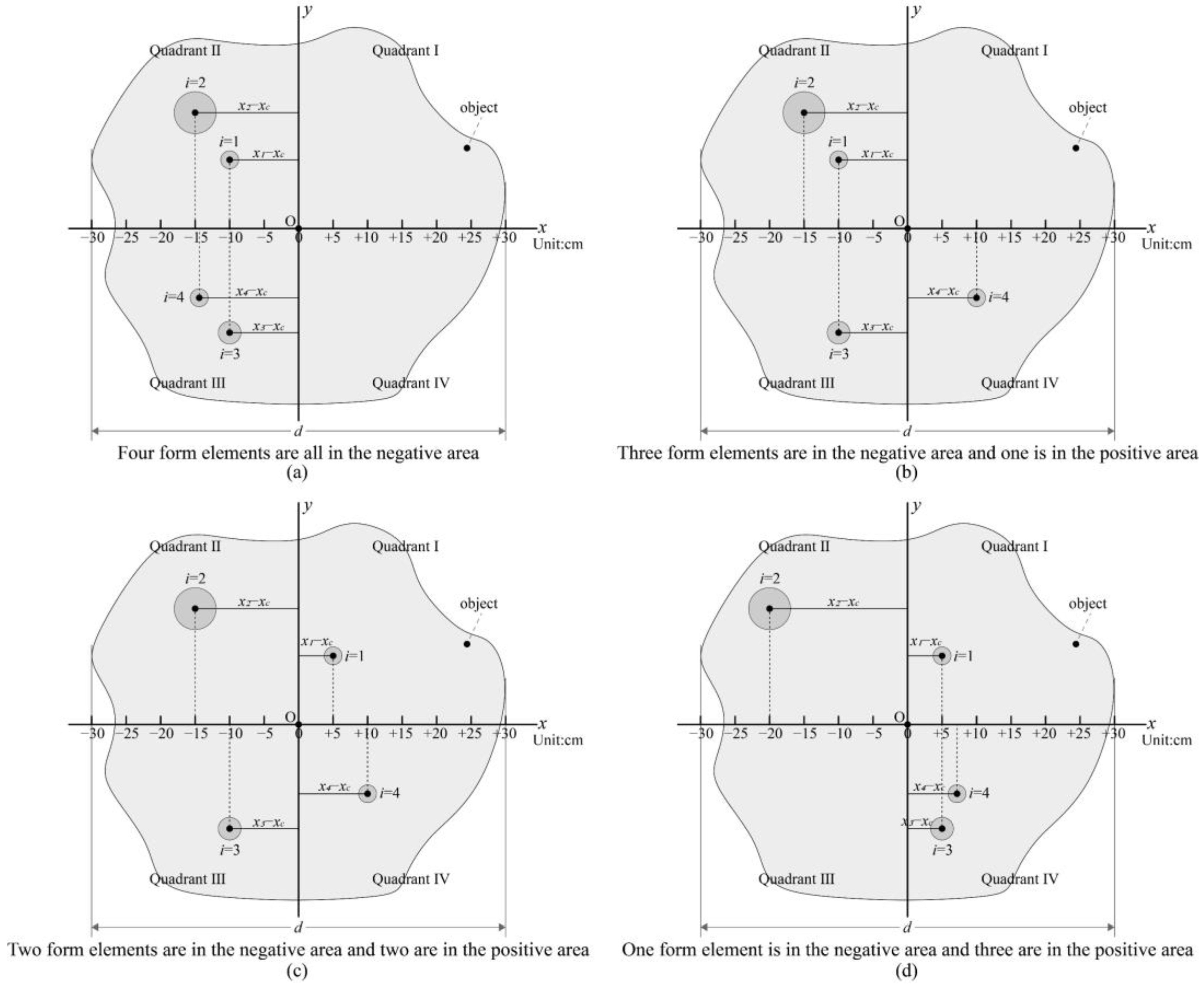
Within form aesthetic principles, the equilibrium aesthetic principle has garnered significant attention [16,17,18,19]. Deng and Wang [19] highlighted that equilibrium is a macro-level concept that can elucidate other form aesthetic principles, thereby demonstrating their collective contribution to the overall form. Previous research by Lo et al. [16] and Lo [17] introduced an equilibrium measurement formula for evaluating product form aesthetic measurement, initially validating its effectiveness with simple product forms (i.e., vases and stereos). However, it was found that when assessing complex products composed of multiple form elements, this equilibrium measurement formula loses its referential value for certain specific distributions of form elements. Therefore, further exploration and improvement of the existing equilibrium measurement calculation model is necessary to ensure its universality. Additionally, while scholars typically investigate how to use mathematical models of form aesthetic principles for evaluating the aesthetic measurement of product form element distribution, few scholars have shown how to rationally design product shapes based on form elements. Therefore, this study focuses on improving the original equilibrium measurement formula and presenting a design process based on product form elements.
In summary, this study aims to introduce a method based on the form aesthetic principle for product form design and evaluation, aimed at creating product forms that meet consumer aesthetic needs and validate its effectiveness through both quantitative and qualitative assessments. This method comprises three phases: design, evaluation, and analysis. In the subsequent section, Section 2 elaborates on the theories involved in this study and proposes an improved equilibrium measurement formula. Section 3 presents the generalized execution process for the proposed design and evaluation method. Section 4 details a case study of a bladeless fan, demonstrating the application of the proposed method and analyzing its outcomes. Finally, the conclusion summarizes the practical value and theoretical contributions of this study and looks forward to further research.

3. Implementation Procedures of the Design and Evaluation Method

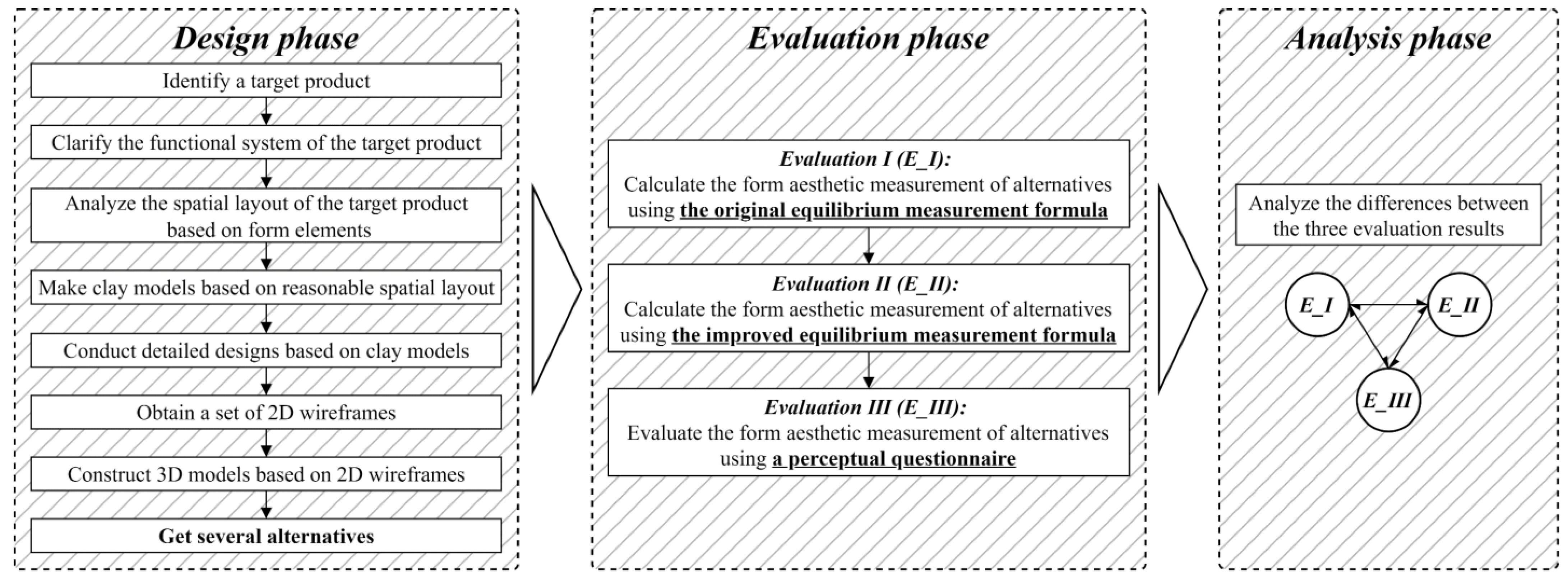
Based on the form aesthetic principles, the mathematical model of the equilibrium aesthetic principle, and as elucidated in Section 2, this section outlines the implementation procedures for a generalized methodology in product form design and evaluation. Specifically, this method comprises three main phases: design, evaluation, and analysis. The research flowchart is presented in Figure 3, with the detailed execution steps described as follows.
Figure 3. A framework of the proposed design and evaluation method.

3.1. Design Phase

This phase is dedicated to generating several product form alternatives through a series of operations, including functional system decomposition, spatial layout analysis, clay model creation, two-dimensional wireframe drawing, and three-dimensional model construction. Initially, adhering to the fundamental principle of product design that “function determines form”, the target product’s functional system is clarified and decomposed into a combination of subfunction units (form elements) based on FSM. Subsequently, based on the form elements, various potential spatial layout schemes are systematically analyzed, and viable spatial layouts are rapidly transformed into clay models with form details. Finally, two-dimensional drawing tools like Photoshop are employed to refine the product’s form details, and software like Rhino 8.1 is used to construct three-dimensional models of the form design alternatives.

3.2. Evaluation Phase

This phase aims to evaluate form design alternatives using quantitative and qualitative methods to select the optimal form that meets consumer aesthetic needs. The quantitative evaluation encompasses two methods: the original equilibrium measurement formula (E_I) and the improved equilibrium measurement formula (E_II). The qualitative evaluation method involves consumer perceptual evaluation questionnaires (E_III). In E_I, projections of each alternative onto the xy, xz, and yz planes are initially conducted to determine the coordinates of the form elements, their maximum extent along each axis, and the count of the form elements. Subsequently, these parameters are sequentially substituted into Equations (1)–(4) to calculate the equilibrium measurement (EM) of the alternatives. In E_II, the collection of parameters is the same as in E_I, but the parameters are then substituted into Equations (5)–(8) to determine the equilibrium measurement (EM’). In E_III, participants are invited to assess the form aesthetic measurement of the alternatives.

3.3. Analysis Phase

This phase aims to analyze and discuss the differences and correlations among the evaluation results, thereby selecting the optimal design solution. Initially, a comparative analysis of the results from the two quantitative evaluations (E_I and E_II) is conducted. A comparison of the quantitative and qualitative evaluation outcomes follows this. Concurrently, the correlation among evaluation results is verified through Pearson correlation analysis. Finally, the optimal design solution is chosen by integrating various evaluation outcomes and statistical analysis, with a subsequent discussion and summary of the results.

4. Case Studies

Drawing upon the generalized implementation procedures outlined in Section 3, and the research flowchart depicted in Figure 3, this section employs the bladeless fan as a case study to demonstrate the application process and validate the effectiveness of the proposed design and evaluation method. The bladeless fan, also known as an air multiplier, represents a revolutionary type of fan introduced by the British inventor James Dyson in 2009. Compared to cases previously studied (i.e., pushpin, stereos, and vase), the bladeless fan encompasses a greater number and complexity of form elements, making it a more representative case for analysis. This section aims to utilize the proposed design and evaluation methods starting from the bladeless fan’s form elements to derive an optimal form that adheres to form aesthetic principles and meets consumer aesthetic needs. The detailed implementation is as follows.

4.1. Design Phase: Obtains: Different Forms of Bladeless Fans

4.1.1. Clarify the Functional System of Bladeless Fans

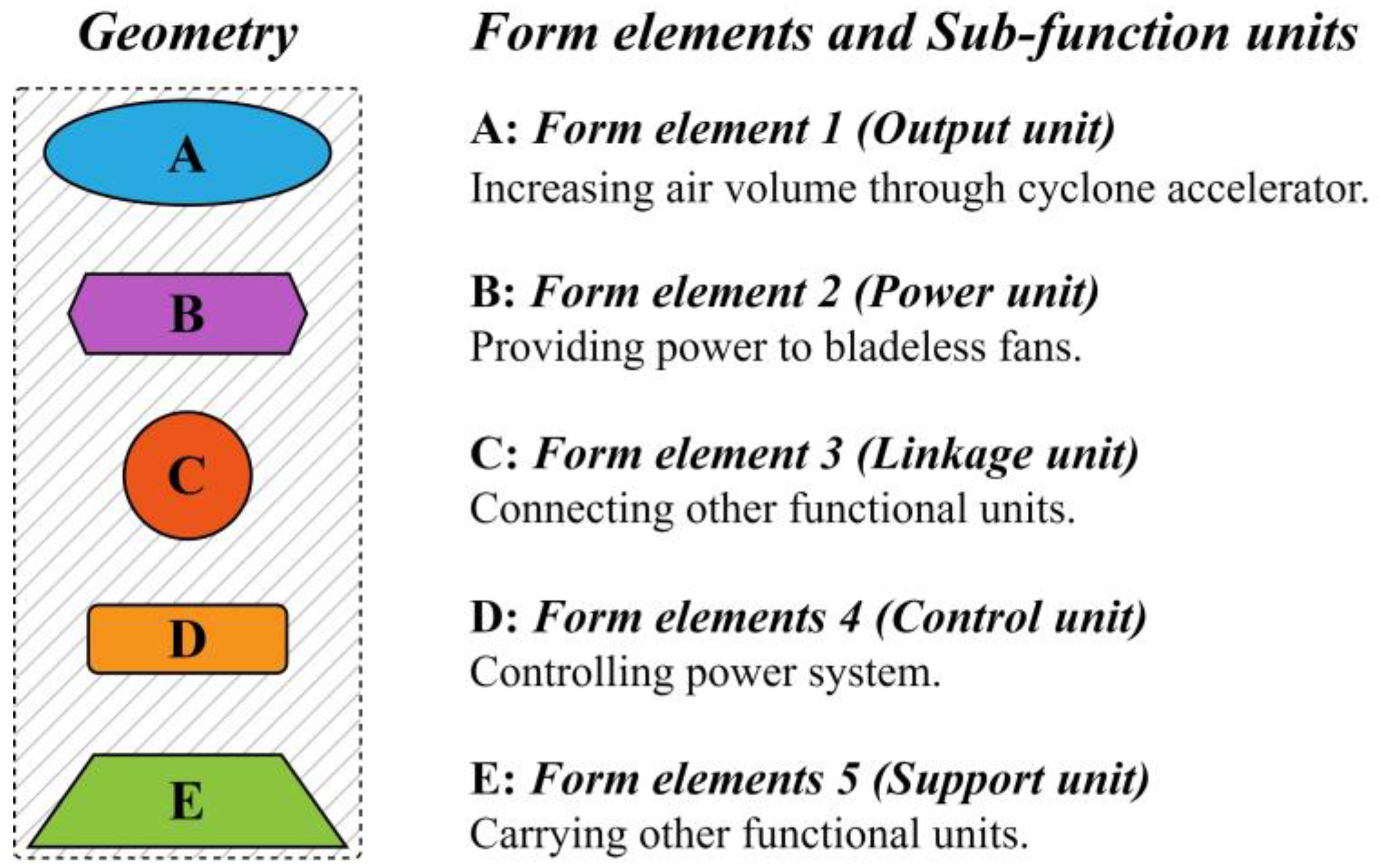
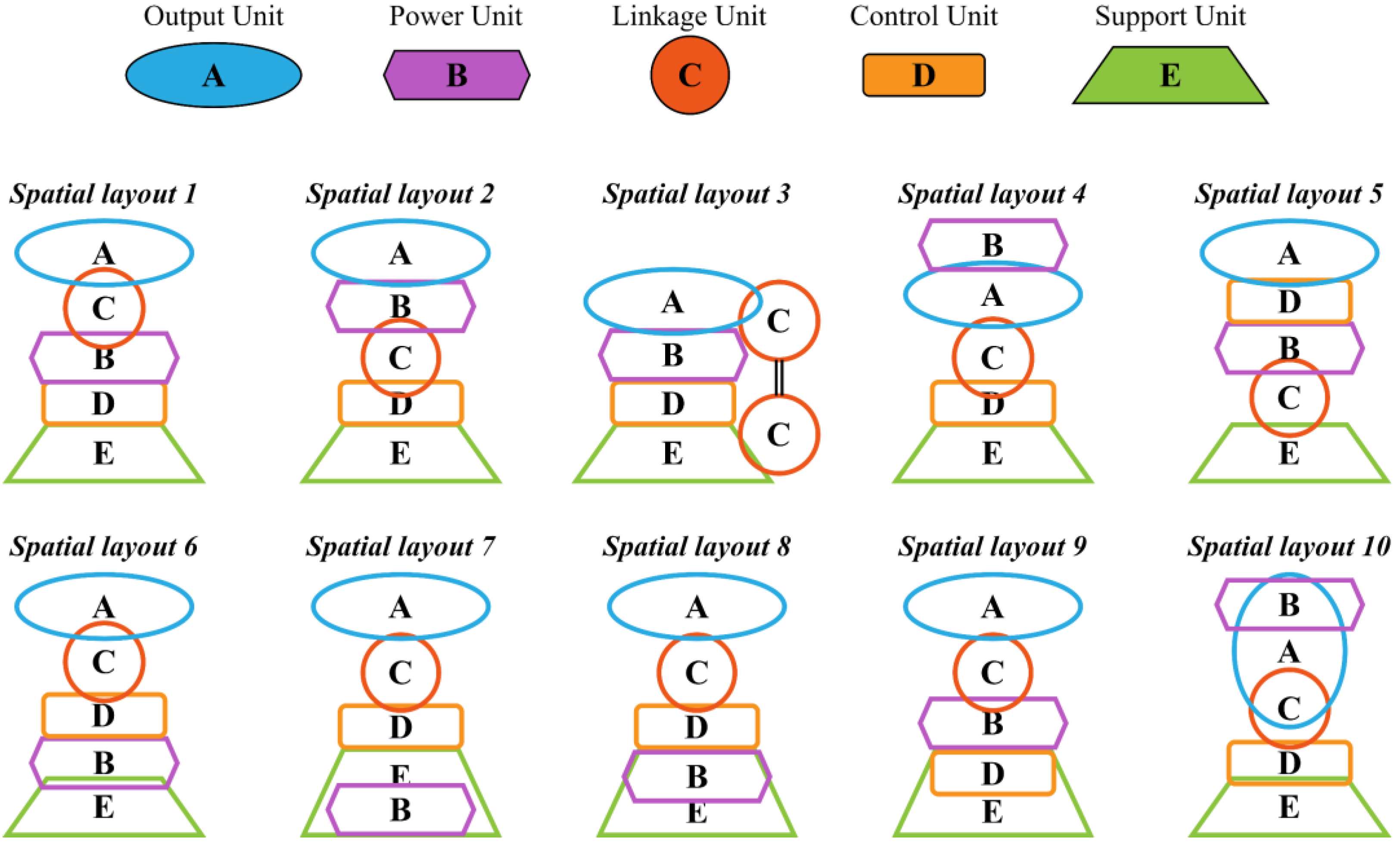
Based on the FSM execution steps, the functional system of the bladeless fan is decomposed into five subfunctional units. These subfunction units are considered critical elements defining the bladeless fan’s form. The specific role of each subfunction (form element) is illustrated in Figure 4. Furthermore, to facilitate distinction, different colors and geometric shapes are employed to represent the five form elements, which are labeled as A (output unit), B (power unit), C (linkage unit), D (control unit), and E (support unit).
Figure 4. Main subfunction units (form elements) of a bladeless fan.

4.1.2. Analyze Various Possible Spatial Layouts of Bladeless Fans

As illustrated in Figure 5, by strategically rearranging the geometric shapes (i.e., form elements) within a two-dimensional space, a total of ten distinct spatial layout schemes were generated, each differing from the others. For the support unit (E), its position is fixed at the bottom of the form. Regarding the control unit (D), its placement can be either inside the support unit (e.g., spatial layout 9) or above it (e.g., spatial layouts 1 and 5). Similarly, the position of the power unit (B) can be either inside (e.g., spatial layouts 7 and 8) or above the support unit (e.g., spatial layouts 1, 4, and 10). The output unit (A) is generally positioned at the top. The linkage unit (C) has a relatively flexible positioning, typically adjacent to the output unit (e.g., spatial layouts 1, 4, 6, 7, 8, 9, and 10) but can also be next to the support unit (e.g., spatial layouts 3 and 5).
Figure 5. Spatial layout analysis of bladeless fans.

4.1.3. Carry out Detailed Design and Generate Alternatives

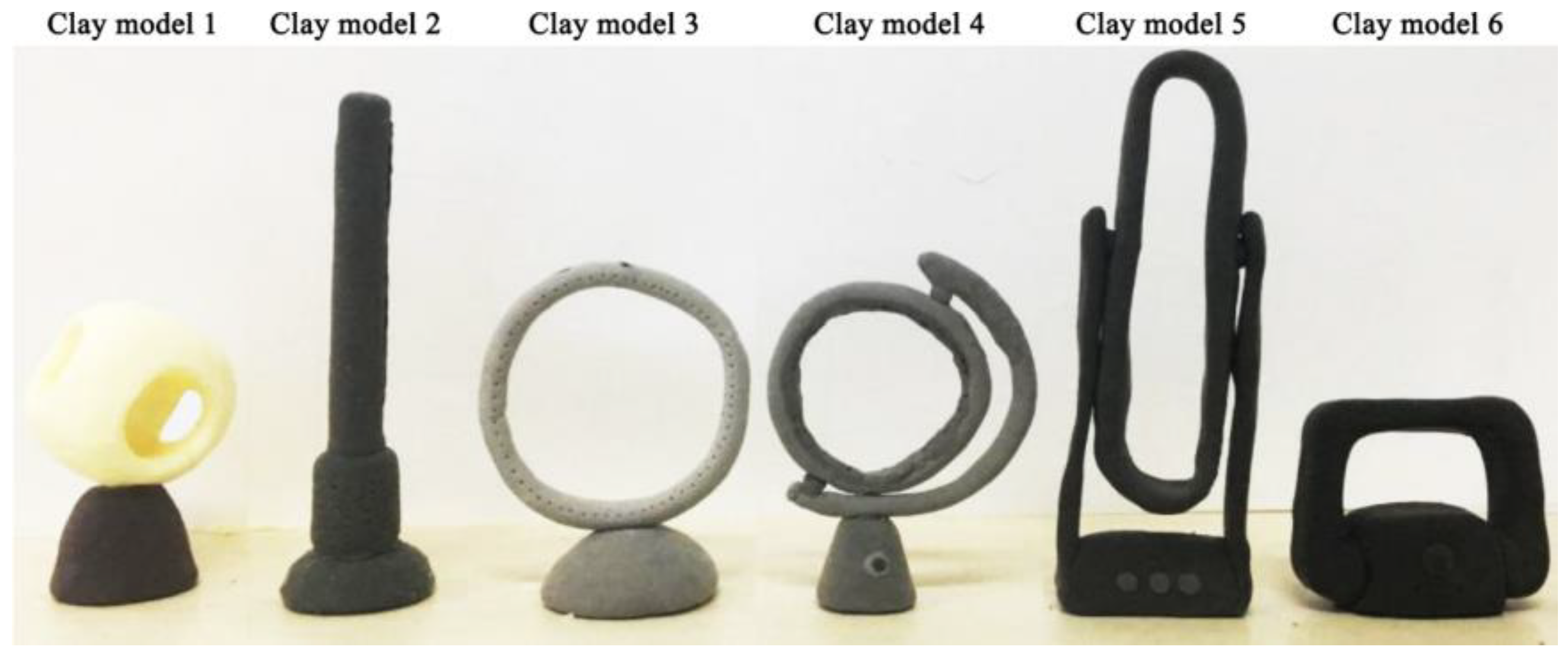
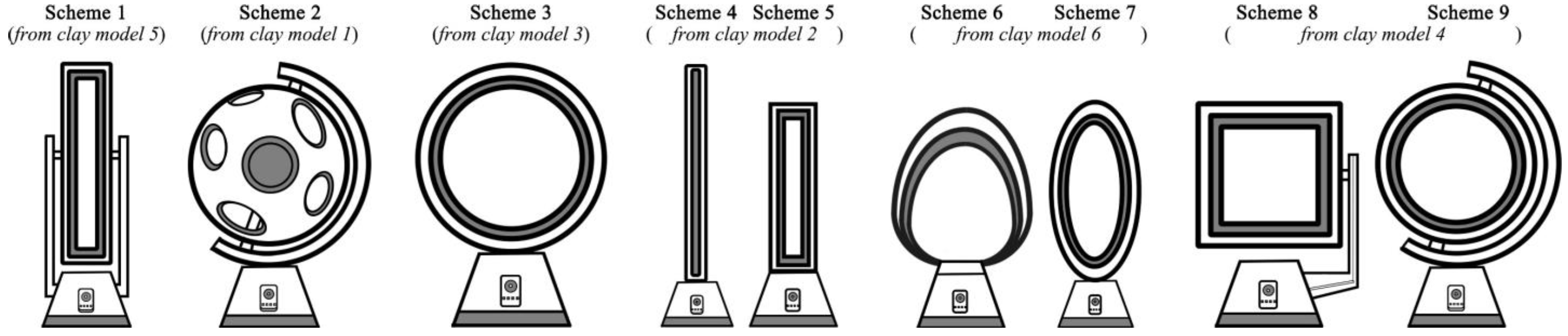
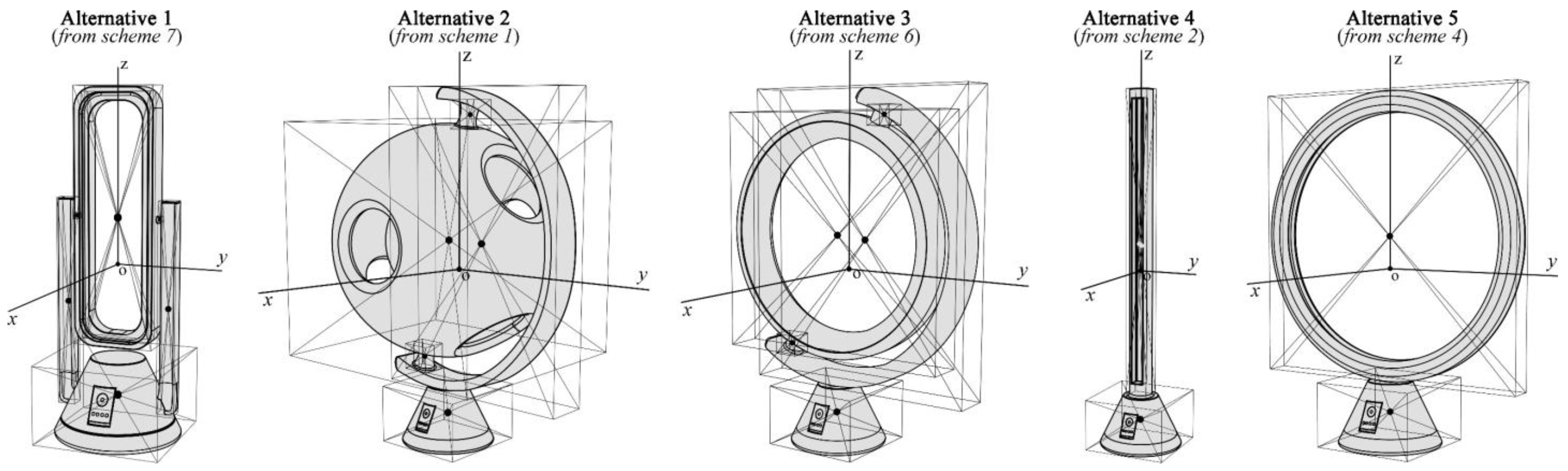
The ten spatial layout schemes depicted in Figure 5 establish the structural framework for the bladeless fan’s design. Building upon this, the section progresses through a systematic process of “clay model creation—two-dimensional wireframe drawing—three-dimensional model construction” to refine the form details of the bladeless fan. Initially, to accurately gauge the overall dimensions and the relative proportions among the form elements, six clay models were crafted using recyclable clay, as shown in Figure 6. Subsequently, to further detail the form of the bladeless fan, nine two-dimensional wireframe schemes were developed based on the six clay models using Photoshop, as illustrated in Figure 7. Specifically, wireframe schemes 1, 2, and 3 elaborate on clay models 5, 1, and 3, respectively; wireframe schemes 4 and 5 refine clay model 2; wireframe schemes 6 and 7 further detail clay model 6; and wireframe schemes 8 and 9 refine clay model 4. Finally, to ensure the structural feasibility and ease of operation of the bladeless fan design, five three-dimensional models were constructed based on the nine wireframe schemes using the computer-aided design tool Rhino, serving as form design alternatives, as shown in Figure 8.
Figure 6. Six clay models of bladeless fans.
Figure 7. Nine two-dimensional wireframe schemes of bladeless fans.
Figure 8. Five form alternatives of bladeless fans.

4.2. Evaluation Phase: Evaluate the Form Aesthetic Measurement of the Alternatives

4.2.1. E_I: Evaluate the Equilibrium Measurement of Alternatives Using the Original Formula

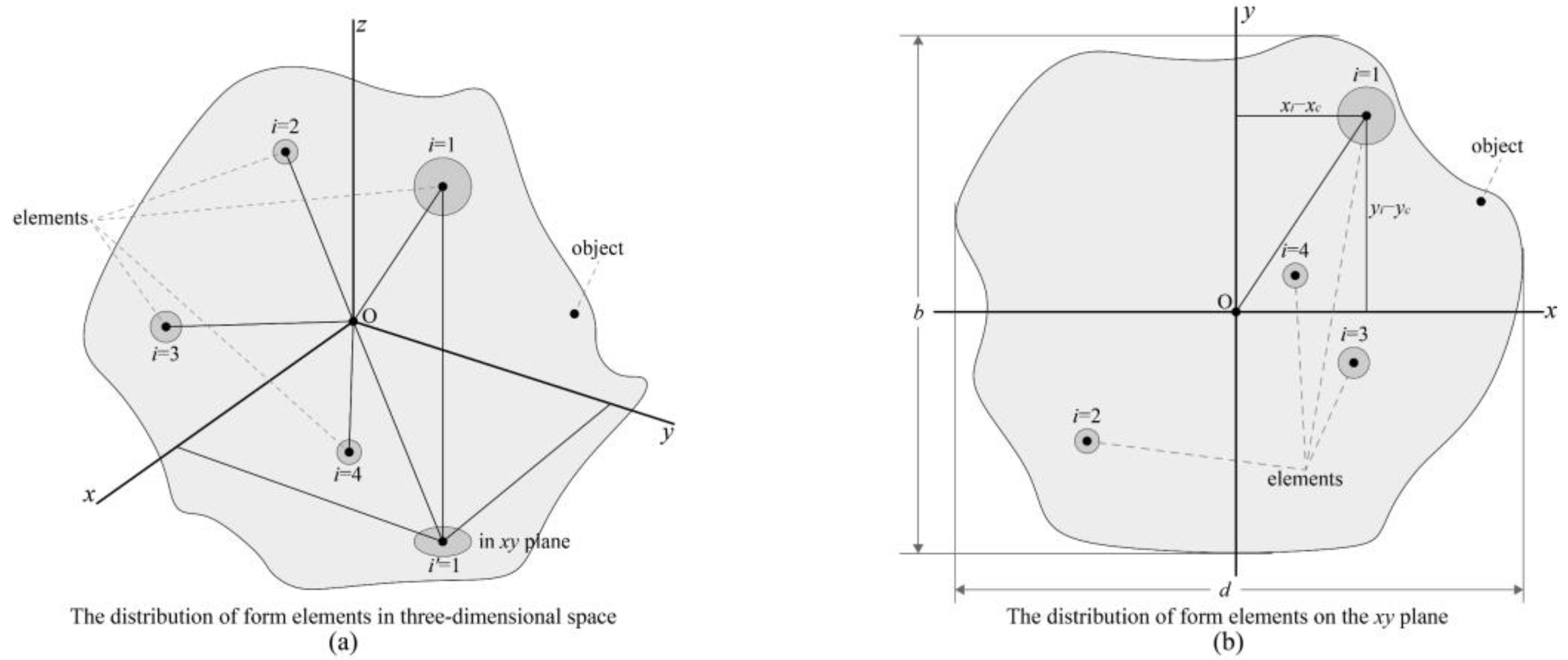
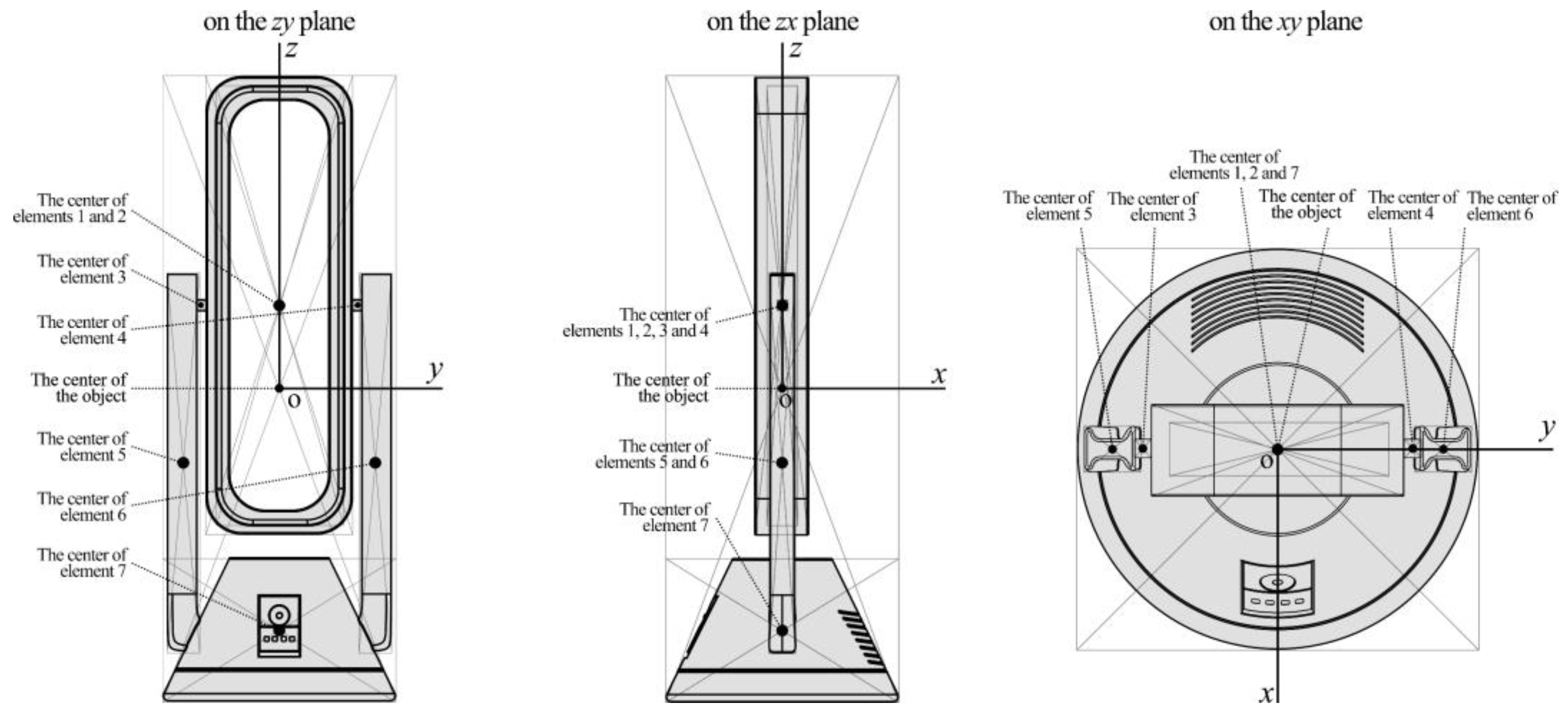
This section employs the original equilibrium measurement formula to compute the equilibrium measurement of the five form alternatives depicted in Figure 8. Taking Alternative 1 as an illustrative example, the detailed computational procedure is delineated as follows. Initially, in the Rhino environment, the central coordinate O (xc, yc, zc) of the overall form of alternative 1 is established, along with the central coordinates (xi, yi, zi) of each form element (subfunction unit), as depicted in Figure 8. Subsequently, alternative 1 is sequentially projected onto the zy, zx, and xy planes to ascertain its maximum spans on the x, y, and z axes (i.e., d, b, and h), as depicted in Figure 9. Finally, by substituting (xi, yi, zi), (xc, yc, zc), d, b, h, and the number of form elements (i.e., n) into Equations (1)–(4), the equilibrium measurement (EM) of alternative 1 can be computed.
Figure 9. Projection of Alternative 1 on the zy, zx, and xy planes.
Given that alternative 1 has maximum spans on the x, y, and z axes as follows: d = 19.25, b = 19.25, h = 51.86, and the total number of form elements n = 7, with the coordinates of form elements being element 3 = (0, 6.46, 6.93), element 4 = (0, −6.46, 6.93), element 5 = (0, 7.92, −6.11), element 6 = (0, −7.92, −6.11), and element 7 = (0, 0, −19.99). Therefore, the values of Ex, Ey, Ez, and EM are as follows:
E x = 1 i = 1 n x i x c d = 1
E y = 1 i = 1 n y i y c b = 1
E z = 1 i = 1 n z i z c h = 1.087
E M = 1 E x + E y + E z 3 = 1 3.087 3 = 0.029
Similarly, employing the same computational procedure yields the equilibrium measurement for the remaining four bladeless fan form alternatives. Ultimately, the aesthetic measurement results and ranking for the five alternatives are presented in Table 1.
Table 1. Calculation results of aesthetic measurement based on the original equilibrium measurement formula (E_I).

4.2.2. E_II: Evaluate the Equilibrium Measure of Alternatives Using the Improved Formula

This section aims to apply the improved equilibrium measurement formula to compute the equilibrium measurement of the five form alternatives depicted in Figure 8. For illustrative purposes, we continue with alternative 1. As discussed in Section 4.2.1, by projecting alternative 1 onto the zy, zx, and xy planes, the maximum spans along the three axes, the number of elements, the central coordinates of the overall form, and the central coordinates of all form elements were obtained, denoted as d, b, h, n, (xc, yc, zc), and (xi, yi, zi), respectively. Subsequently, by substituting these parameters into Equations (5)–(8), the equilibrium measurement (EM′) of alternative 1 can be computed. The detailed computational results are presented below.
E x = i = 1 n x i x c n d = 0
E y = i = 1 n y i y c n b = 28.76 7 × 19.25 = 0.213
E z = i = 1 n z i z c n h = 59.93 7 × 51.86 = 0.165
E M = 1 E x + E y + E z 3 = 1 0.37848 3 = 0.874
After the same calculation process, the aesthetic measurement results and ranking of the five alternatives are shown in Table 2.
Table 2. Calculation results of aesthetic measurement based on the improved equilibrium measurement formula (E_II).

4.2.3. E_III: Evaluate the Form Aesthetic Measurement of Alternatives Using the Consumer Perceptual Questionnaire

A consumer perceptual evaluation questionnaire was designed using multi-angle images of the alternatives as stimuli. Participants were asked to evaluate the form aesthetic measurement of the bladeless fan based on their subjective perceptions, using a rating scale ranging from 0 to 1. Out of 97 questionnaires disseminated, 88 were returned with valid responses, yielding an effective response rate of 90.7%. The outcomes of the perceptual evaluation questionnaire are presented in Table 3.
Table 3. Statistical results of the perceptual evaluation questionnaire (E_III).

4.3. Analysis Phase: Analyze Evaluation Results and Discussion

4.3.1. Pearson Correlation Analysis

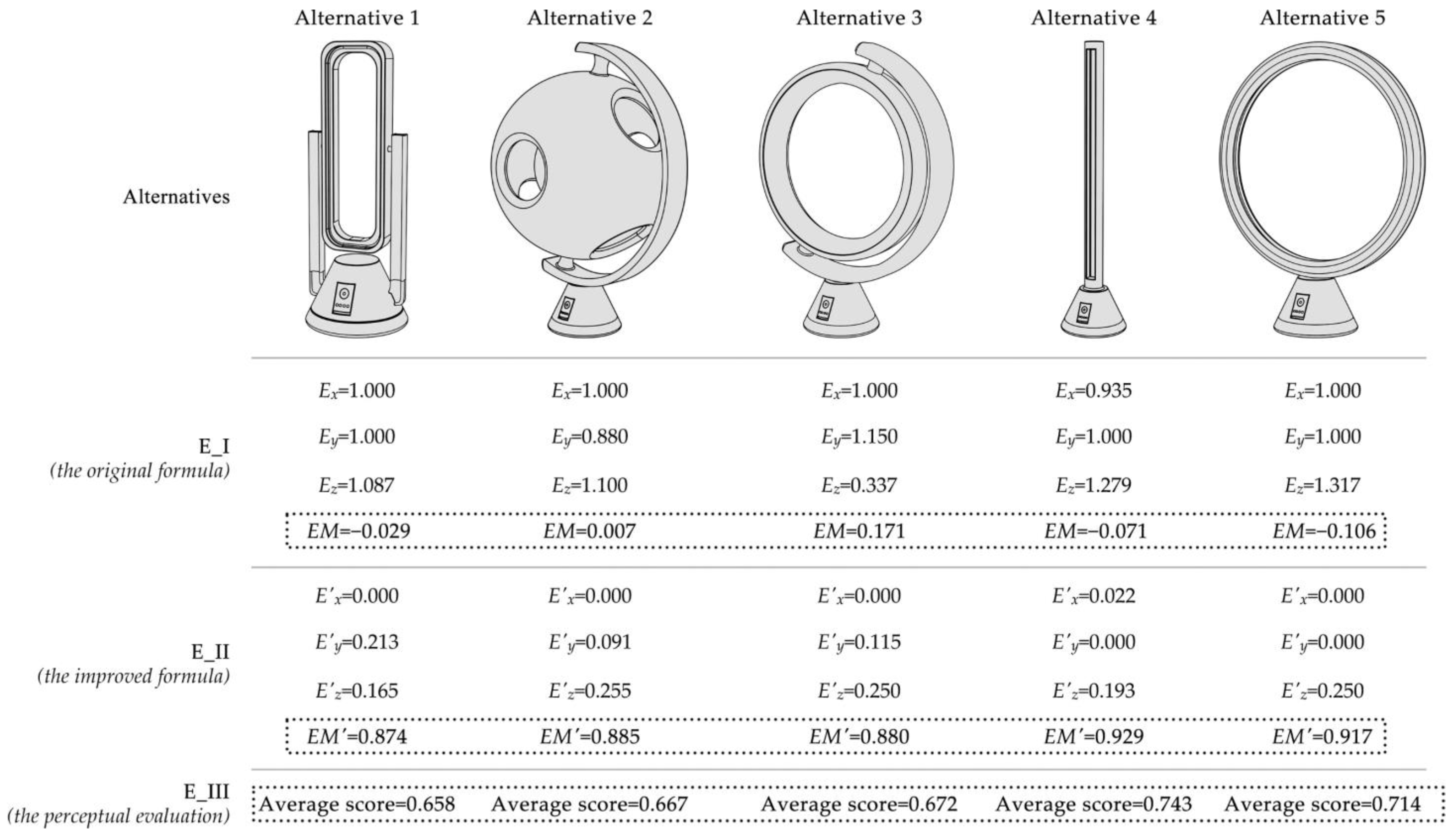
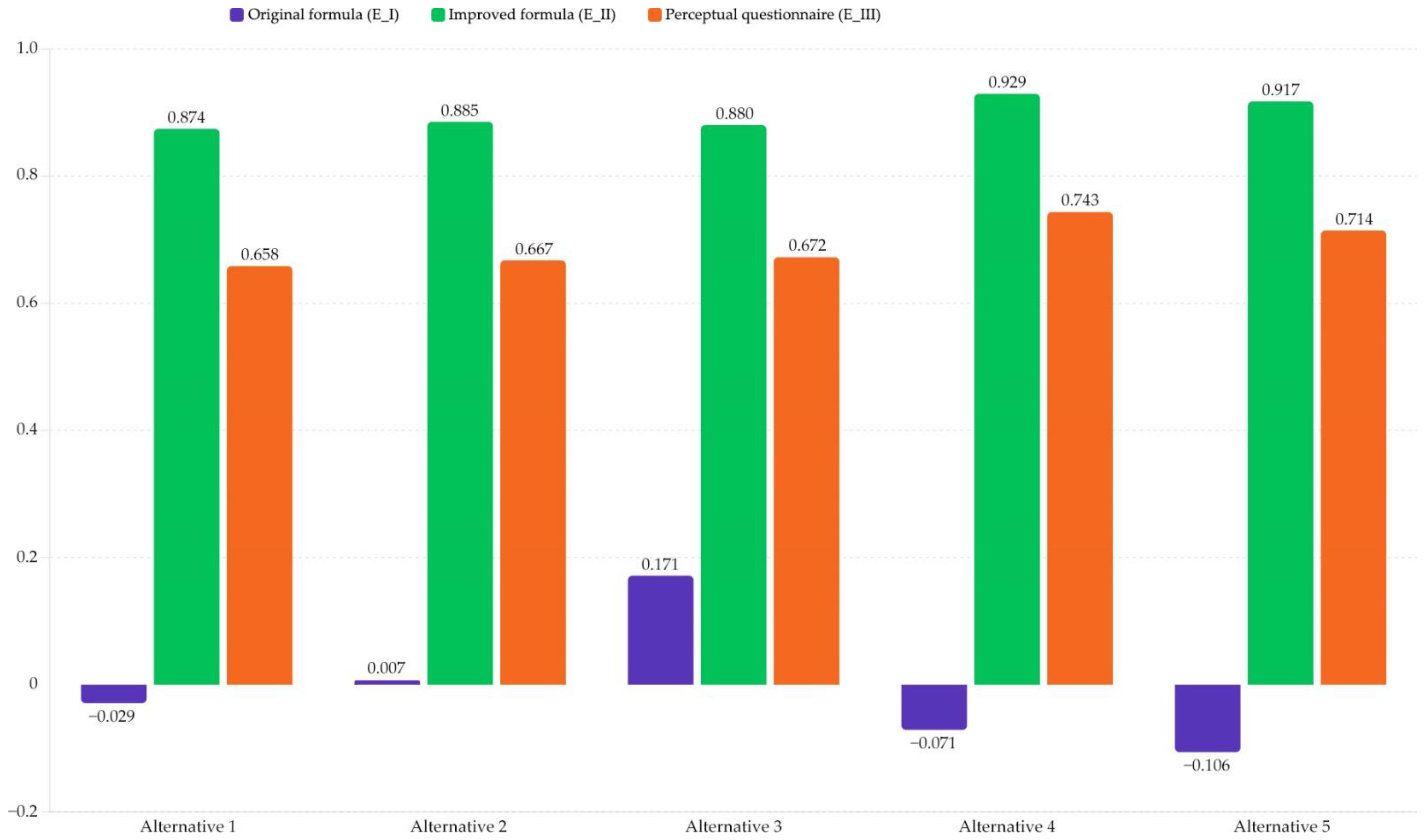
Figure 10 presents a detailed overview of the evaluation outcomes of the aesthetic measurement of the bladeless fan form alternatives, as assessed by the quantitative calculation formulas (E_I and E_II) and the consumer perceptual questionnaire (E_III). To further examine the correlations among E_I, E_II, and E_III, this study employed a multi-factor Pearson correlation analysis to validate the associations between pairwise evaluation results. The analytical findings are summarized in Table 4 and the bar chart analysis results are shown in Figure 11.
Figure 10. Statistical results of three evaluations.
Table 4. Results of multi-factor correlation analysis.
Figure 11. Bar chart analysis of the three evaluation results.

4.3.2. Results and Discussion

Regarding the Pearson correlation analysis results (refer to Table 4), the correlation coefficient between E_II and E_III is 0.986, with a significance (Sig) value less than 0.01, indicating a significant positive correlation between E_II and E_III. Conversely, the correlation coefficients between E_I and both E_II and E_III are −0.639 and −0.551, respectively, but with Sig values (i.e., 0.245 and 0.336) exceeding 0.05, suggesting no significant correlation between E_I and either E_II or E_III. Therefore, compared to the original equilibrium measurement formula (i.e., Equations (1)–(4)), the improved equilibrium measurement formula (i.e., Equations (5)–(8)) more effectively quantifies the aesthetic needs of consumers toward product form.
In terms of evaluation outcomes, the equilibrium measurements (EMs) calculated using the original formula [16,17] included negative values (refer to Table 1), rendering the results from E_I non-referential. Conversely, the equilibrium measurements (EMs′) obtained with the improved formula fell within the range of 0 to 1 (refer to Table 2) and exhibited a significant positive correlation with the results of consumer perceptual evaluations (refer to Table 3). Therefore, the evaluations from E_II and E_III can serve as a reference for selecting the optimal design solution.
As demonstrated in Figure 10 and Figure 11, the ranking of the five form alternatives based on E_II’s evaluation results is as follows: Alternative 4 > Alternative 5 > Alternative 2 > Alternative 3 > Alternative 1. According to the results from E_III, the priority order is as follows: Alternative 4 > Alternative 5 > Alternative 3 > Alternative 2 > Alternative 1. Notably, Alternative 4 consistently ranks first in both sets of evaluation outcomes, thereby identifying it as the optimal design solution. Alternative 5, consistently ranking second and with a marginal difference from the first rank, also emerges as a viable optimal design solution. Furthermore, the evaluation outcomes of E_II and E_III are not entirely congruent, indicating discrepancies. Consequently, future research on mathematical models for quantifying product form aesthetics should incorporate a broader range of effective form parameters to minimize the divergence between consumer perceptual cognition and quantitative evaluations.
In the evaluation results of E_II, Alternatives 4 and 5 scored above 0.9, while Alternatives 2, 3, and 1 had scores ranging from 0.87 to 0.89. In the outcomes of E_III, Alternatives 4 and 5 each scored above 0.7, with Alternatives 3, 2, and 1 scoring between 0.65 and 0.68. Consequently, Alternatives 4 and 5 are considered the top-tier group in terms of form aesthetic measurement, with Alternatives 1, 2, and 3 forming the second tier. Notably, the top-tier Alternatives 4 and 5 comprise 2 and 3 form elements, respectively, whereas the second-tier Alternatives 1, 2, and 3 contain 7, 5, and 5 form elements, respectively. This observation suggests that a product form with fewer form elements tends to have a higher form aesthetic measurement. Therefore, to enhance the overall aesthetics of a product’s form in practical applications, minimizing the number of form elements used is advisable.

5. Conclusions

This research has introduced a comprehensive method for designing and evaluating product forms, rooted in form aesthetic principles, and encompassing design, evaluation, and analysis phases. A case study of the bladeless fan was utilized to elaborate on the implementation process of this method and confirm its effectiveness. The design phase is characterized by a systematic approach involving “functional system decomposition, spatial layout analysis, clay model creation, two-dimensional wireframe drafting, and three-dimensional model construction”, successively concretizing the form of the bladeless fan into various form alternatives. In the evaluation phase, both quantitative analyses (E_I and E_II) and a qualitative approach (E_III) were applied to evaluate the form alternatives’ aesthetic measurement. In the analysis phase, multi-factor Pearson correlation analysis was used to examine the correlation between paired evaluation results. The statistical results show a high correlation between E_II (improved formula) and E_III (perceptual evaluation), with a correlation coefficient of 0.986 (p < 0.01) (see Table 4). Conversely, the correlation between E_I (original formula) and both E_III and E_II was insignificant. Additionally, the bar chart analysis (see Figure 11) shows that the results of E_II and E_III are both positive and exceed 0.6, indicating their reliability. In contrast, the values for alternatives 1, 4, and 5 in E_I are negative (i.e., −0.029, −0.071, and −0.106), rendering them less reliable.
The distinctive contributions of this study are summarized as follows: An enhanced mathematical model has been introduced for the evaluation of form aesthetic measurement, suitable for examining the spatial distribution of various form elements and effectively eliminating the potential for negative aesthetic measurement calculations. The scholarly merit of this research is highlighted by the refinement of the form aesthetic measurement theory, which lays an academic groundwork for further exploration within this field. On a practical level, this research offers a novel approach for product form design and evaluation to engineering designers lacking formal aesthetics training. This method assists in developing product forms that meet consumer aesthetic preferences and select the optimal design solution, thereby bridging the gap between theoretical aesthetics and applied design practice.
Despite these findings, this study has several potential limitations. First, while the proposed method offers a novel approach for product engineers to evaluate product aesthetics, it does not ensure the creativity of product designs during the design phase. Consequently, the improved measurement method introduced for the evaluation phase should complement existing product aesthetics evaluation methods and consider the assessments of product designers in practical applications. Future research could integrate other creative methods to stimulate the creative thinking of engineers, thereby bridging the creativity gap between product engineers and designers. Second, although the improved quantitative model in this study uses the number of product form elements and their distribution along three coordinate axes to evaluate product aesthetics, it cannot fully capture human aesthetic perceptions and creativity. The evaluation results from E_II and E_III indicate discrepancies between the quantitative model and human perceptions. Therefore, future research should consider incorporating additional relevant form parameters to enhance the accuracy of the quantitative model. Lastly, this study evaluates product aesthetics by calculating the distribution of form elements across three projection angles (zy, zx, and xy). However, the orthodox or optimal viewing angle of the product may not align with these three angles. In future research, an additional orthodox angle could be defined prior to calculating product aesthetics to further explore the accuracy of the quantitative model.

Author Contributions

Conceptualization, P.L. and J.T.; methodology, P.L. and F.W.; investigation, P.L., F.W. and J.T.; writing—original draft preparation, P.L. and F.W.; writing—review and editing, P.L., F.W. and J.T.; supervision, J.T. and F.W.; funding acquisition, P.L. All authors have read and agreed to the published version of the manuscript.

Funding

This research received no external funding.

Data Availability Statement

Data are contained within the article.

Acknowledgments

The authors would like to thank the Liaoning Provincial Key Laboratory of Urban Green Health Design and Technology for its support.

Conflicts of Interest

The authors declare no conflicts of interest.

Appendix A

To elucidate the mathematical model for calculating product aesthetics more clearly, the symbols and their meanings used in this study are presented in the table below.
Table A1. Symbols of mathematical models and their meanings.
SymbolsMeanings
xiCoordinate value of form element i along the x-axis
yiCoordinate value of form element i along the y-axis
ziCoordinate value of form element i along the z-axis
xcCoordinate value of the object’s centroid (O) along x-axis
ycCoordinate value of the object’s centroid (O) along y-axis
zcCoordinate value of the object’s centroid (O) along z-axis
dMaximum span of the object along the x-axis
bMaximum span of the object along the y-axis
hMaximum span of the object along the z-axis
nCount of form elements
ExDispersion of form elements along the x-axis
EyDispersion of form elements along the y-axis
EzDispersion of form elements along the z-axis
EMEquilibrium aesthetic measurement
E′xMean spread of form elements along the x-axis
E′yMean spread of form elements along the y-axis
E′zMean spread of form elements along the z-axis
EM′Improved equilibrium aesthetic measurement

References

  1. Klepper, S. Entry, exit, growth, and innovation over the product life cycle. Am. Econ. Rev. 1996, 86, 562–583. Available online: https://www.jstor.org/stable/2118212 (accessed on 30 May 2024).
  2. Eslami, S.P.; Ghasemaghaei, M.; Hassanein, K. Understanding consumer engagement in social media: The role of product lifecycle. Decis. Support Syst. 2022, 162, 113707. [Google Scholar] [CrossRef]
  3. Wu, F.; Hsiao, S.W.; Lu, P. An AIGC-empowered methodology to product color matching design. Displays 2024, 81, 102623. [Google Scholar] [CrossRef]
  4. Ding, M.; Qin, H.; Zhang, X.; Ma, L. Designing the color of electric motorcycle products emotionally based on the dynamic field theory and deep learning. Displays 2024, 81, 102584. [Google Scholar] [CrossRef]
  5. Ding, M.; Sun, M.; Luo, S. Product color emotional design based on 3D knowledge graph. Displays 2024, 81, 102622. [Google Scholar] [CrossRef]
  6. Orth, A.; Sampson, K.L.; Zhang, Y.; Ting, K.; van Egmond, D.A.; Laqua, K.; Lacelle, T.; Webber, D.; Fatehi, D.; Boisvert, J.; et al. On-the-fly 3D metrology of volumetric additive manufacturing. Addit. Manuf. 2022, 56, 102869. [Google Scholar] [CrossRef]
  7. Wu, F.; Lu, P.; Lin, Y.C. Research on the influence of wheelsets on the visual imagery of city bicycles. Sustainability 2022, 14, 2762. [Google Scholar] [CrossRef]
  8. Dharmdas, A.; Patil, A.Y.; Baig, A.; Hosmani, O.Z.; Mathad, S.N.; Patil, M.B.; Kumar, R.; Kotturshettar, B.B.; Fattah, I.M.R. An experimental and simulation study of the active camber morphing concept on airfoils using bio-inspired structures. Biomimetics 2023, 8, 251. [Google Scholar] [CrossRef]
  9. Lu, P.; Hsiao, S.W.; Wu, F. A product shape design and evaluation model based on morphology preference and macroscopic shape information. Entropy 2021, 23, 639. [Google Scholar] [CrossRef]
  10. Hsu, C.C.; Fann, S.C.; Chuang, M.C. Relationship between eye fixation patterns and Kansei evaluation of 3D chair forms. Displays 2017, 50, 21–34. [Google Scholar] [CrossRef]
  11. Zhang, X.; Li, Y.; Dong, S.; Di, C.; Ding, M. The influence of user cognition on consumption decision-making from the perspective of bounded rationality. Displays 2023, 77, 102392. [Google Scholar] [CrossRef]
  12. Pang, Z.C.; Yu, H.L.; Chen, S.J. Industrial Modeling Design; Tsinghua University Press: Beijing, China, 1998. [Google Scholar]
  13. Qi, T.G. Aesthetics: Aesthetic Theory; North China Normal University Press: Jilin, China, 1989. [Google Scholar]
  14. Lo, C.H.; Hsiao, S.W. An evaluation model for product aesthetic measures constructed by aesthetics principles of symmetry. J. Art Des. 2014, 4, 23–41. [Google Scholar]
  15. Ke, Y.C.; Lo, C.H. Establishing aesthetic evaluation of products by applying uniform beauty. Des. Soc. Repub China 2015, 5, 81–86. [Google Scholar]
  16. Lo, C.H.; Ko, Y.C.; Hsiao, S.W. A study that applies aesthetic theory and genetic algorithms to product form optimization. Adv. Eng. Inform. 2015, 29, 662–679. [Google Scholar] [CrossRef]
  17. Lo, C.H. Application of aesthetic principles to the study of consumer preference models for vase forms. Appl. Sci. 2018, 8, 1199. [Google Scholar] [CrossRef]
  18. Ngo, D.C.L.; Lian, S.T.; Byrne, J.G. Evaluating interface esthetics. Knowl. Inf. Syst. 2002, 4, 46–79. [Google Scholar] [CrossRef]
  19. Deng, L.; Wang, G. Quantitative evaluation of visual aesthetics of human-machine interaction interface layout. Comput. Intell. Neurosci. 2020, 2020, 9815937. [Google Scholar] [CrossRef] [PubMed]
  20. Huang, Z.Z. On Aesthetic Essentials; Hunan Publishing House: Changsha, China, 1995. [Google Scholar]
  21. Yang, X.; Gan, L. New Edition of Aesthetic Principles; Peking University Press: Beijing, China, 1996. [Google Scholar]
  22. Zhang, F. Introduction to Aesthetics; Renmin University Press: Beijing, China, 2011. [Google Scholar]
  23. Hsiao, S.W.; Chou, J.R. A creativity-based design process for innovative product design. Int. J. Ind. Ergon. 2004, 34, 421–443. [Google Scholar] [CrossRef]
  24. Chou, J.R.; Hsiao, S.W. An anthropometric measurement for developing an electric scooter. Int. J. Ind. Ergon. 2005, 35, 1047–1063. [Google Scholar] [CrossRef]
  25. Uribe, S.; Álvarez, F.; Menéndez, J.M. User’s web page aesthetics opinion: A matter of low-level image descriptors based on MPEG-7. ACM Trans. Web 2017, 11, 1–25. [Google Scholar] [CrossRef]
  26. Dames, H.; Hirschfeld, G.; Sackmann, T.; Thielsch, M.T. Searching vs. browsing—The influence of consumers’ goal directedness on website evaluations. Interact. Comput. 2019, 31, 95–112. [Google Scholar] [CrossRef]
  27. Maity, R.; Bhattacharya, S. Is my interface beautiful?—A computational model-based approach. IEEE Trans. Comput. Soc. Syst. 2019, 6, 149–161. [Google Scholar] [CrossRef]
  28. Birkhoff, G.D. Aesthetic Measure; Harvard University Press: Cambridge, MA, USA; London, UK, 1933. [Google Scholar]
  29. Davis, R.C. An evaluation and test of Birkhoff’s aesthetic measure and formula. J. Gen. Psychol. 1936, 15, 231–240. [Google Scholar] [CrossRef]
  30. Moon, P.; Spencer, D.E. Aesthetic measure applied to color harmony. J. Opt. Soc. Am. 1944, 34, 234–242. [Google Scholar] [CrossRef]
  31. Staudek, T. On Birkhoff’s Aesthetic Measure of Vases; Masaryk University, Faculty of Informatics: Brno, Czechia, 1999. [Google Scholar]
  32. Hsiao, S.W.; Lin, J.Y.; Lo, C.H.; Ko, Y.C. Application of aesthetic measurement theory to product form design. Int. J. Creat. Res. 2011, 1, 85–105. [Google Scholar]
  33. Zhou, A.; Ouyang, J.; Su, J.; Zhang, S.; Yan, S. Multimodal optimisation design of product forms based on aesthetic evaluation. Int. J. Arts Technol. 2020, 12, 128–154. [Google Scholar] [CrossRef]
  34. Patil, A.Y.; Kundu, T.; Kumar, R. Finite element analysis megatrends: A road less traveled. Comput. Appl. Eng. Educ. 2024, 32, e22721. [Google Scholar] [CrossRef]
  35. Carrasco-López, S.; Herrera-Trejo, M.; Castro-Román, M.; Castro-Uresti, F.; Castro-Cedeño, E.I. Analysis of the steelmaking process via data mining and pearson correlation. Materials 2024, 17, 2786. [Google Scholar] [CrossRef]
Disclaimer/Publisher’s Note: The statements, opinions and data contained in all publications are solely those of the individual author(s) and contributor(s) and not of MDPI and/or the editor(s). MDPI and/or the editor(s) disclaim responsibility for any injury to people or property resulting from any ideas, methods, instructions or products referred to in the content.

Article Metrics

Citations

Article Access Statistics

Multiple requests from the same IP address are counted as one view.