Abstract
The lack of an S-Box in some lightweight cryptography algorithms, like Speck and Tiny Encryption Algorithm, or the presence of a fixed S-Box in others, like Advanced Encryption Standard, makes them more vulnerable to attacks. This proposal presents a novel approach to creating two dynamic 8-bit S-Boxes (16 × 16). The generation process for each S-Box consists of two phases. Initially, the number initialization phase involves generating sequence numbers 1, sequence numbers 2, and shift values for S-Box1 using the 2D Tinkerbell map. Additionally, sequence numbers 3, sequence numbers 4, and shift values for S-Box2 are generated using the 2D Duffing map. Subsequently, the S-Box construction phase involves the construction of S-Box1 and S-Box2. The effectiveness of the newly proposed S-Boxes was evaluated based on various criteria, including the bijective property, balance, fixed points, and strict avalanche criteria. It was observed that S-Box1 achieved a remarkable linear and differential branch number of 4, surpassing any previous studies. Furthermore, it exhibited a non-linearity of 105.50, a differential uniformity of 12, and an algebraic degree of 7. Similarly, S-Box2 also achieved a linear and differential branch number of 4, a non-linearity of 105.25, a differential uniformity of 14, and an algebraic degree of 7. Moreover, the reduction in the number of linear and nonlinear operations for both S-Boxes makes them suitable for lightweight algorithms. The architecture of the proposed S-Boxes demonstrates robustness, with a total of 3.35 × 10504 possible S-Boxes, providing protection against algebraic attacks.
1. Introduction
Lightweight cryptographic algorithms, like lightweight block ciphers designed for use in limited resource environments such as radio-frequency identification (RFID), sensor networks, and healthcare systems, rely heavily on the substitution box (S-Box) [1]. The S-Box, as the only nonlinear component in modern block ciphers, plays a key role in creating a complex relationship between plaintext and ciphertext. This role is also known as confusion [2]. This relationship has a significant impact on both hardware consumption and the critical path delay of a block cipher, making an efficiently structured S-Box crucial for optimal implementation performance [3].
The security of a block cipher depends on the confusion in the ciphertext caused by an S-Box. Therefore, researchers are developing new S-Box designs and assessing their strength using common benchmarks [4]. The advanced encryption standard (AES) utilizes a highly secure 8-bit S-Box based on perfect nonlinear transformation, but it is static and requires a minimum of 35 nonlinear operations for implementation [5]. In 2021, Kim, H. et al. proposed various methods for constructing S-Boxes from smaller S-Boxes, establishing criteria for ensuring a minimum linear and differential branch number of 3. However, some of these S-Boxes exhibit high fixed points and high differential uniformity and still demand a high number of linear operations for implementation, all while remaining static [6]. Block ciphers such as Fantomas [7], Robin [7], Scream v3 [8], FLY [9], and PIPO [10] employ 8-bit S-Boxes composed of three smaller S-Boxes but also demonstrate a static nature requiring numerous linear operations for implementation, with a linear and differential branch number of 2. M. Sajjad et al. [11] proposed designing a pair of nonlinear components of a block cipher over quaternion integers. Jassim, S. A. and Farhan, A. K. [12] proposed designing a novel efficient substitution box by using a flower pollination algorithm and chaos system. Sajjad, M. et al. [13] proposed designing a pair of nonlinear components of a block cipher over gaussian integers. Zahid, A. H. and Arshad, M. J. [14] proposed an innovative design of substitution boxes using cubic polynomial mapping. Sajjad, M. et al. [15] proposed a novel approach for constructing substitution boxes (S-boxes) over Gaussian integers, which are complex numbers with integer coefficients.
This paper introduces a new method for constructing two dynamic, lightweight 8-bit S-Boxes (16 × 16) in HEX format, based on the 2D Tinkerbell map and the 2D Duffing map. The process of generating each S-Box has two phases. First is the initialization phase. This involves generating sequence numbers 1, sequence numbers 2, and shift values (buffer 1 and buffer 2) for S-Box1 using the 2D Tinkerbell map and generating sequence numbers 3, sequence numbers 4, and shift values (buffer 3 and buffer 4) for S-Box2 using the 2D Duffing map. Second is the S-Box construction phase. This involves constructing S-Boxes’ values depending on the results from the number initialization phase. This methodology enables both linear and differential branch numbers of at least four, and this enhances security. In addition, high non-linearity, low fixed points, a high algebraic degree, high strict avalanche criteria, low differential uniformity, and reducing the number of linear and nonlinear operations required to implement the S-Boxes.
The paper is organized as follows: Section 2 introduces an overview; Section 3 presents the proposed method of constructing a new S-Box; Section 4 assesses the proposed S-Boxes and provides a comparison of our proposed S-Box and existing S-Boxes; and Section 5 presents the conclusions and directions for future work. Appendix A shows a complete example.
2. Overview of Chaotic Systems (the 2D Tinkerbell Map and the 2D Duffing Map) and Deoxyribose Nucleic Acid (DNA)
2.1. Chaotic Systems
A mathematical behavior that is both nonlinear and deterministic is the foundation of the chaos theory [16]. It has a higher sensitivity to any change in initial conditions, including the control parameters and initial values. Consequently, a slight alteration to the beginning values or control settings causes a large alteration in the chaotic outputs [17]. The properties of a good cipher in cryptography, such as confusion and diffusion, are linked to those of chaotic systems, aiding researchers in improving the security of cryptographic systems [18]. In this study, two chaotic maps are used: the 2D Tinkerbell map and the 2D Duffing map.
- ✓
- The 2D Tinkerbell map. Equation (1) shows the formal definition of the 2D Tinkerbell map iterator [19]:
There are four parameters: a, b, c, and d. The range of parameters is unbounded. The typical values of a, b, c, and d are: a = 0.9, b = 0.6013, c = 2, and d = 0.5, or a = 0.3, b = 0.6, c = 2, and d = 0.27. The range of the initial values is between x0 and y0 [−1, 1].
- ✓
- The 2D Duffing map. Equation (2) shows the formal definition of the 2D Duffing map iterator [20]:
There are two parameters: a and b. The range of parameters is unbounded. The range of the initial values is between x0 and y0 [−1, 1].
2.2. Deoxyribose Nucleic Acid (DNA)
The DNA sequence consists of four main nucleic acid cores: A (adenine), C (cytosine), G (guanine), and T (thymine). A and T correspond to each other, as do G and C [21]. When applying encoded function on the combinations 00, 01, 10, and 11 using the four cores A, C, G, and T, there are 24 different coding manners [22]. However, only eight coding manners adhere to the Watson–Crick complement law, which can be seen in Table 1.
Table 1.
Eight map rules.
The binary string is transformed into a DNA sequence by taking the intersection of the row and column for every 2 bits from Table 1 as shown in Algorithm 1.
| Algorithm 1 Present DNA codes |
| Input: String. Output: DNA codes. begin
|
For example, if the user inputs the string “book”, here are the detailed steps of how to convert the string into DNA codes.
| String | book | |||||||||||||||
| Binary string | 01100010011011110110111101101011 | |||||||||||||||
| Split into 2 bits | 01 | 10 | 00 | 10 | 01 | 10 | 11 | 11 | 01 | 10 | 11 | 11 | 01 | 10 | 10 | 11 |
| Value of each 2 bits | 1 | 2 | 0 | 2 | 1 | 2 | 3 | 3 | 1 | 2 | 3 | 3 | 1 | 2 | 2 | 3 |
| Location | 1 | 2 | 3 | 4 | 5 | 6 | 7 | 8 | 1 | 2 | 3 | 4 | 5 | 6 | 7 | 8 |
| DNA codes | C | C | C | A | A | A | A | A | C | C | G | G | A | A | G | A |
3. The Proposed Method
This paper presents a novel approach to constructing two dynamic S-Boxes that are responsible for creating confusion in block ciphers. The generation process of the two S-Boxes goes through two stages.
- A.
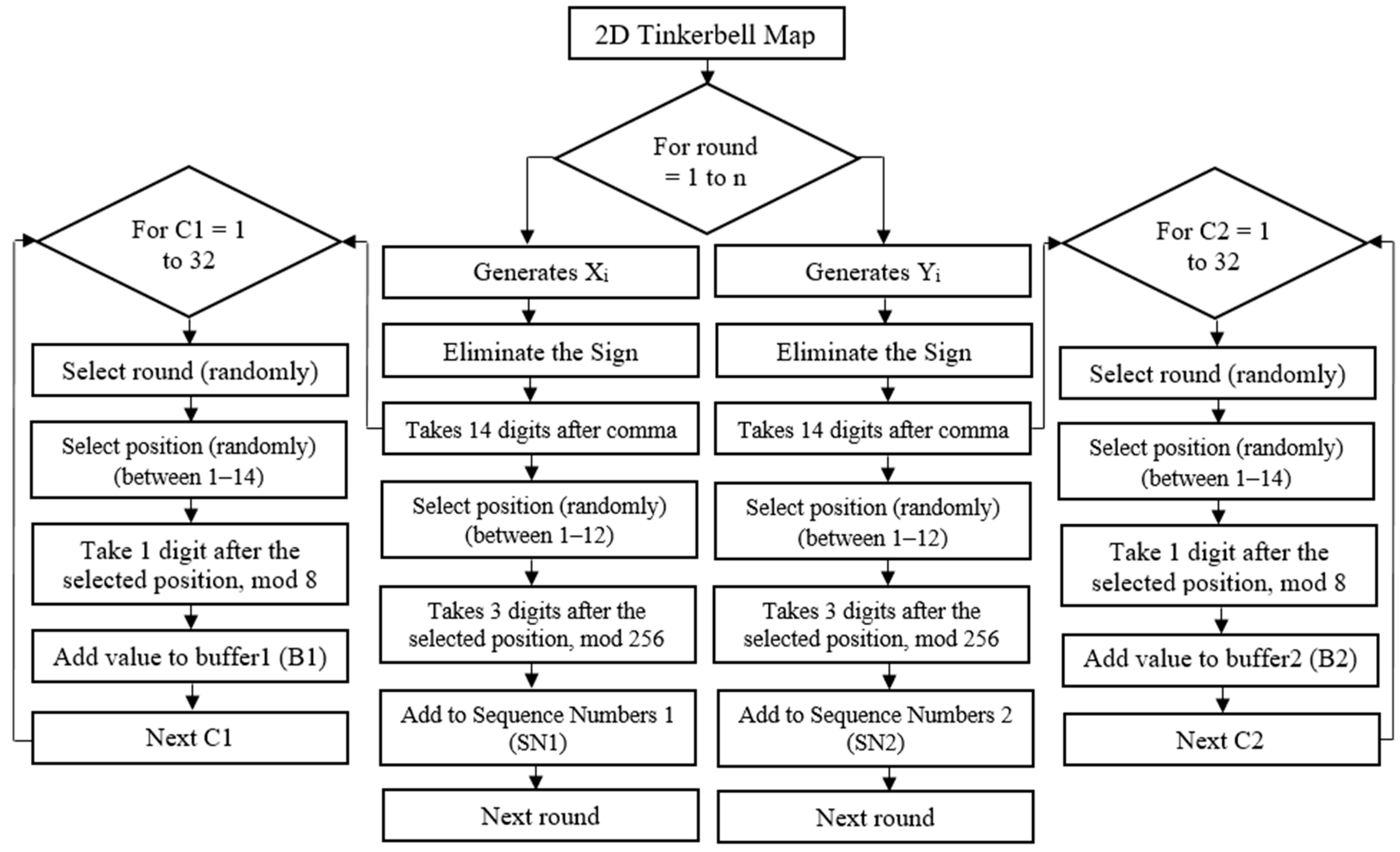
- The initialization phase includes generating sequence numbers 1, sequence numbers 2, and shift values (buffer 1, buffer 2) based on the 2D Tinkerbell map for S-Box1 by using Equation (1), as shown in Figure 1 and Algorithm 2.
Figure 1. Generating sequence numbers 1, 2, and shift values using the 2D Tinkerbell map.
| Algorithm 2 Generating sequence numbers 1, 2, and buffers 1 and 2 based on the 2D Tinkerbell map |
| Input: Initial conditions for the 2D Tinkerbell map (a, b, c, d, X0, and Y0) Output: Generates sequence numbers 1, sequence numbers 2 and shift values (buffer 1 and buffer 2) Begin
|
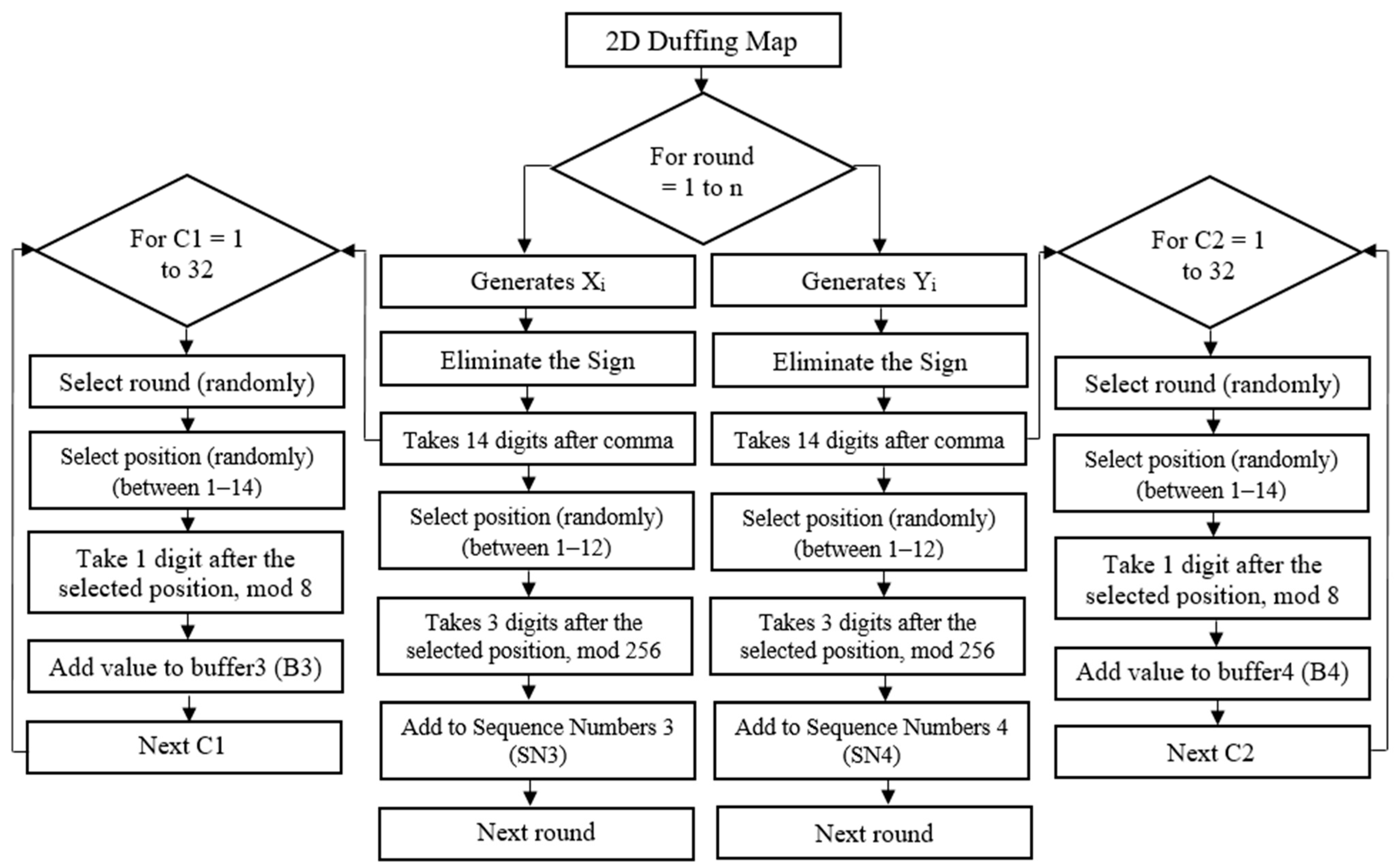
The same steps of Algorithm 2 can be followed to generate sequence numbers 3, sequence numbers 4, and shift values (buffer 3, buffer 4) based on the 2D Duffing map for S-Box2 by using Equation (2), as shown in Figure 2.
Figure 2.
Generating sequence numbers 3, 4, and shift values using the 2D Duffing map.
- B.
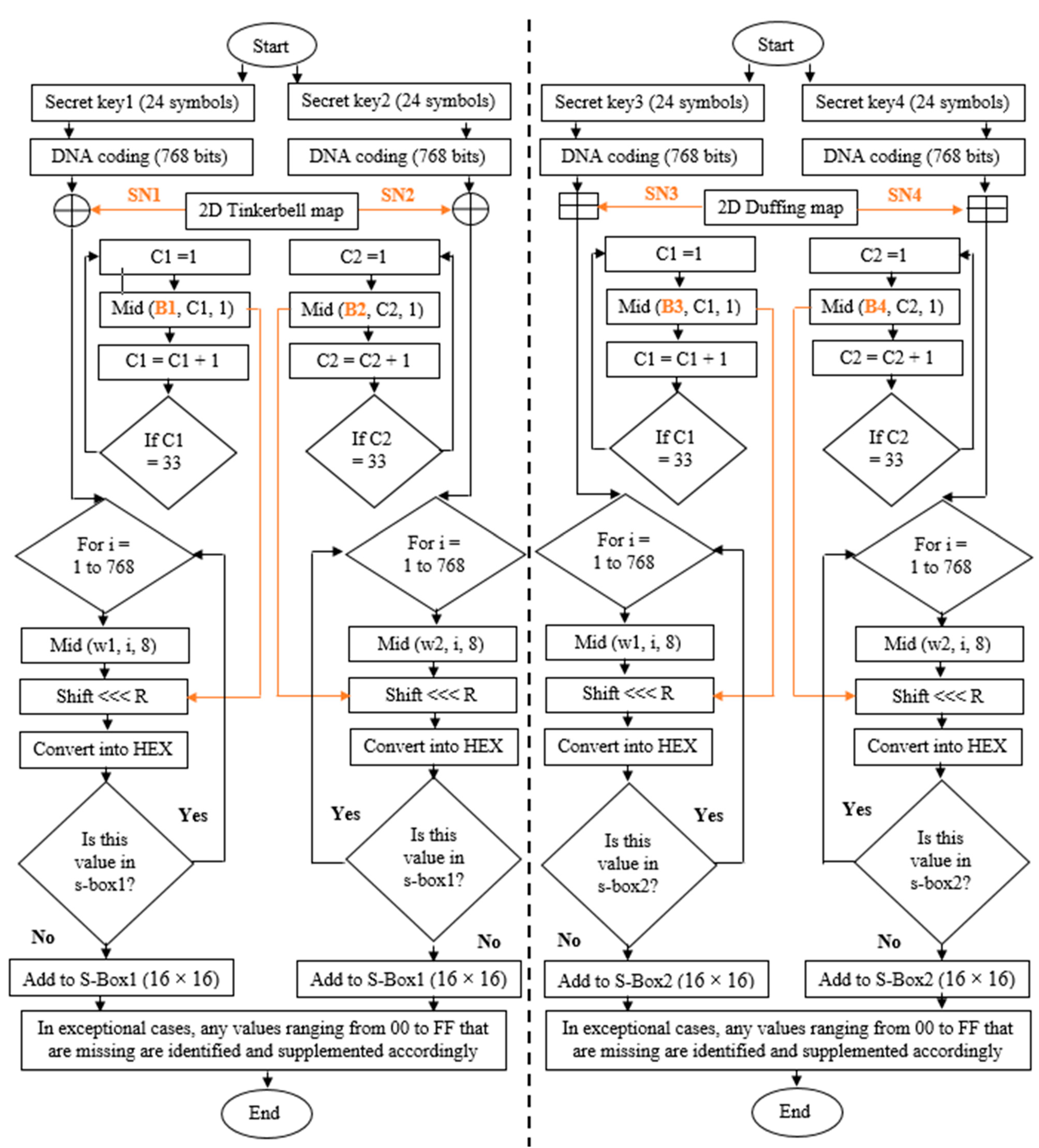
- The construction phase includes the construction of the two dynamic S-Boxes. To construct S-Box1 (16 × 16), the user randomly inputs secret key1 and secret key2, each consisting of 24 symbols. These secret keys are then transformed into a binary strings of 192 bits. The binary strings are then converted into a DNA coding of 768 bits. The DNA coding of secret key1 is XORed with sequence number 1 and shifted by buffer 1; each value is converted into HEX format, eliminating duplicate values, and adding the values to S-Box1 in the order of their appearance. On the other hand, the DNA coding of secret key2 is XORed with sequence numbers 2 and shifted by buffer 2; each value is converted into HEX format, eliminating duplicate values, and adding only values not already present in S-Box1. In cases where values ranging from 00 to FF are missing, they are identified and added accordingly, as illustrated in Figure 3 and Algorithm 3.
Figure 3. Construction phase of S-Box1 and S-Box2.
| Algorithm 3 Construction of S-Box1 |
| Input: Secret key1 (24 symbols), secret key2 (24 symbols), buffer 1, buffer 2. Output: S-Box1 (16 × 16). Begin
|
The construction process of S-Box2 (16 × 16) involves the user randomly inputting secret key3 and secret key4, each consisting of 24 symbols. These secret keys are then converted into a binary string of 192 bits. Subsequently, the binary strings are transformed into a DNA coding of 768 bits. The DNA coding of secret key3 is additive with sequence number 3, shifted by buffer 3, converting each value into HEX format, eliminating duplicate values, and adding the values to S-Box2 in the order of their appearance. Similarly, the DNA coding of secret key4 is additive with sequence numbers 4, shifted by buffer 4, converting each value into HEX format, eliminating duplicate values, and adding only values that are not already presented in S-Box2. In exceptional cases, any values ranging from 00 to FF that are missing are identified and supplemented accordingly. Depending on the inputs provided, the construction of S-Box2 can follow the same steps as algorithm 3, with the only difference being that in step 2, the XOR process is replaced by the additive process, as depicted in Figure 3.
4. Performance Evaluation
This section demonstrates the security strength of the proposed 8-bit S-Box, measured over balanced, bijective property, strict avalanche criteria, linear branch number, differential branch number, differential uniformity, non-linearity, fixed points, linear and nonlinear operations, algebraic degree, and algebraic attacks. It also compares the cryptanalysis of the proposed 8-bit S-Box with other 8-bit S-Box such as AES [5], Kim, H. et al. [6], Fantomas [7], Robin [7], Scream v3 [8], FLY [9], and Sajjad, M. et al [11,13,15].
- A.
- Balanced
The obtained S-Box is balanced since it contains an equal number of 1s and 0s in the corresponding truth table of Galois field (GF) (28).
- B.
- Bijective property
The obtained S-Box is bijective by balancing 0s and 1s. The Hamming weight of all Boolean functions is [128 128 128 128 128 128 128 128].
- C.
- Strict Avalanche Criteria (SAC)
If any individual input bit is altered, it should affect approximately half of the output bits [23]. An SAC score of around 0.5 is considered sufficient. Table 2 and Table 3 illustrate the dependency matrix of SAC scores for the proposed S-Boxes. Our S-Box1 has an average SAC score of 0.57645, while our S-Box2 has an average SAC score of 0.57227. Table 4 compares the average SAC score of our proposed S-Boxes with other S-Boxes in the literature.
Table 2.
Dependency matrix of proposed S-Box1.
Table 3.
Dependency matrix of proposed S-Box2.
Table 4.
Constituent Boolean functions and NL scores.
- D.
- Linear Branch Number
The linear branch number (LBN) of an S-Box [24] is defined as
The upper bound of LBN ≤ n − 1, where n is input bits. A higher LBN enhances the system’s resistance against linear attacks [25]. The proposed S-Box1 and S-Box2 have an LBN of 4, as shown in Table 4, a milestone not attained by any other research to date.
- E.
- Differential Branch Number
The differential branch number (DBN) of an S-Box [26] is defined as
The user calculates all possible XORs between the Galois field (GF) (2n) entries and then all possible XORs between the S-Box entries. Finally, the user calculates their Hamming weights and compute the minimum value. The upper bound of DBN is [], where n is input bits. A higher DBN enhances the resistance of the system against differential attacks [27]. The proposed S-Box1 and S-Box2 have a DBN of 4, as shown in Table 4, a milestone not attained by any other research to date.
- F.
- Differential Uniformity
The differential uniformity (DU) of an S-Box [28] is defined as
The lower the DU, the better the resistance to differential attack [29]. The lowest possible DU is two [30]. The proposed S-Box1 achieved a maximum DU score of 12, while S-Box2 achieved a score of 14. This low score affirms the potential of the proposed S-Boxes to resist differential cryptanalysis effectively. Furthermore, Table 4 compares the DU scores of the proposed S-Boxes with those found in the existing literature. This comparison underscores the efficacy of our S-Boxes in thwarting attempts at differential cryptanalysis.
- G.
- Non-Linearity
The non-linearity (NL) of an S-Box [26] is defined as
where “·” is the inner product in the respective Galois field. A higher NL implies greater complexity and unpredictability in the relationship between inputs and outputs, which enhances the resistance of the cryptographic algorithm against various attacks, including differential cryptanalysis and linear cryptanalysis [31]. The maximum NL in the GF (2n) is (a) for n = even is − and (b) for n = odd is −. The proposed S-Box1 attained an NL of 105.50, while the proposed S-Box2 attained an NL of 105.25, as demonstrated in Table 4 and Table 5. However, it is worth noting that some S-Boxes have higher non-linearity but are static, which poses a significant weakness.
Table 5.
Comparison of the cryptographic characteristics and operation counts of 8-bit S-Boxes.
- H.
- Fixed Points (FP)
If an S-Box returns the same value as its input (S-Box (m) = m), it is said to contain an FP [31]. An S-Box with fewer FPs is more resistant to attacks. The proposed S-Box1 possesses one FP, while the proposed S-Box2 is free of any FP. Table 4 compares the FP of the proposed S-Boxes with other S-Boxes in the literature.
- I.
- Linear and Nonlinear Operations
The fewer linear (XOR, NOT) and nonlinear (AND, OR) operations, the better. In this method, the proposed S-Box1 does not utilize nonlinear operations but employs two linear operations, whereas the proposed S-Box2 utilizes two nonlinear operations and no linear operations, as shown in Table 4.
- J.
- Algebraic Degree
The algebraic degree is the number of variables in the highest order term with non-zero coefficients. The maximum algebraic degree can be denoted as deg (f) = n − 1. A higher algebraic degree is preferable [30]. The proposed S-Box1 and S-Box2 achieved a favorable algebraic degree of 7, as evidenced in Table 4.
- K.
- Algebraic Attacks
The structure of the proposed S-Box is robust. The total number of possible S-Boxes is 3.35 × 10504, which is massive and noticeably greater than the 6-bit S-Box (63! ≈ 1.98 × 1087), 5-bit S-Box (31! ≈ 8.22 × 1033), and 4-bit S-Box (15! ≈ 1.3 × 10¹²). Furthermore, the proposed 8-bit S-Box uses a dynamic chaotic system to introduce randomness into the S-Box’s elements, making it difficult to break through.
5. Conclusions
This research introduces a novel approach to constructing dynamic S-Boxes by utilizing the 2D Tinkerbell map and the 2D Duffing map. The resulting S-Boxes, namely S-Box1 and S-Box2, achieved a remarkable linear and differential branch number of four, surpassing any previous studies. In the symmetry analysis, the reduction in the number of linear and nonlinear operations for both S-Boxes makes them suitable for lightweight algorithms. This increased robustness improves resistance against various attacks, especially linear and differential attacks. The generation of any S-Box1 value relies on the initial values of the 2D Tinkerbell map, secret keys 1 and 2, the rounds, and the selected positions to generate shift values. Similarly, the generation of any S-Box2 value depends on the initial values of the 2D Duffing map, secret keys 3 and 4, the rounds, and the selected positions to generate shift values. Consequently, any straightforward manipulation could potentially result in a collapse of the S-Box values. Subsequent studies might incorporate these S-Boxes into lightweight algorithms that currently lack S-Boxes, such as Tiny Encryption Algorithm, Lightweight Encryption Algorithm, etc., or into algorithms with static S-Boxes. Subsequently, they can compare the algorithmic results before and after the incorporation of these S-Boxes.
Author Contributions
Conceptualization, A.T.K.; software, A.T.K.; validation, A.T.K., A.T.M. and E.K.G.; formal analysis, A.T.K.; investigation, A.T.K., A.T.M. and E.K.G.; resources, A.T.K.; data curation, A.T.K.; writing—original draft, A.T.K.; writing—review and editing, A.T.K., A.T.M. and E.K.G.; visualization, A.T.K., A.T.M. and E.K.G.; supervision, A.T.M. and E.K.G.; project administration, A.T.K., A.T.M. and E.K.G.; funding acquisition, A.T.K. and E.K.G. All authors have read and agreed to the published version of the manuscript.
Funding
The authors received no specific funding for this study.
Data Availability Statement
Data sharing is not applicable to this article as no datasets were generated or analyzed during the current study.
Conflicts of Interest
The authors declare no conflicts of interest.
Appendix A
- ➢
- A complete example of the generation of S-Boxe1 employing the 2D Tinkerbell map is shown below:
- Initialization phase:
- Run the 2D Tinkerbell map using a = 0.9, b = −0.6013, c = 2, d = 0.5, X0 = −0.721, and Y0 = −0.64
- When i = 1, X1 = (−0.721)2 − (−0.64)2 + 0.9 × (−0.721) + (−0.6013) × (−0.64) = −0.153827
- Y1 = 2 × (−0.153827) × (−0.64) + 2 × (−0.153827) + 0.5 × (−0.64) = −0.43075544
- ❖
- The process of generating the first sequence number from Xi: the value of X1 is −0.153827, eliminate from sign, comma and take 14 digits after comma; the result is 153827. Select position randomly and take 3 digits after the selected position mod 256, assume position 2 is selected so, 538 mod 256 = 26, convert to 8-bit binary; the result is 00011010.
- ❖
- The process of generating the first sequence number from Yi: the value of Y1 is −0.43075544, eliminate from sign, comma and take 14 digits after comma; the result is 43075544. Select position randomly and take 3 digits after the selected position mod 256, assume position 1 is selected so, 430 mod 256 = 174, convert to 8-bit binary; the result is 10101110.
- ❖
Table A1.
Generate Xi and Yi using the 2D Tinkerbell map.
Table A1.
Generate Xi and Yi using the 2D Tinkerbell map.
| Number of i | Xi | Yi |
|---|---|---|
| 1 | −0.153827 | −0.43075544 |
| 2 | −0.041318557088593721 | −0.26241844769946288 |
| 3 | 0.053449292688840327 | −0.052362799308130245 |
| 4 | 0.0797050787814888 | 0.12488159582076486 |
| 5 | −0.012599246054863504 | 0.03409547789371576 |
| 6 | −0.032844692918518312 | −0.050881357892837195 |
| … | … | … |
Table A2.
Eliminate from sign, comma and takes 14 digits after comma for Xi and Yi.
Table A2.
Eliminate from sign, comma and takes 14 digits after comma for Xi and Yi.
| Number of i | Eliminate from the Sign, Comma and Takes 14 Digits after Comma | Eliminate from the Sign, Comma and Takes 14 Digits after Comma |
|---|---|---|
| 1 | 153827 | 43075544 |
| 2 | 04131855708859 | 26241844769946 |
| 3 | 05344929268884 | 05236279930813 |
| 4 | 07970507878148 | 12488159582076 |
| 5 | 01259924605486 | 03409547789371 |
| 6 | 03284469291851 | 05088135789283 |
| … | … | … |
Table A3.
Generates sequence numbers based on Xi and Yi values.
Table A3.
Generates sequence numbers based on Xi and Yi values.
| Number of i | Takes Digits in Positions (2, 3 and 4) Mod 256 | Sequence Numbers 1 | Takes Digits in Positions (1, 2 and 3) Mod 256 | Sequence Numbers 2 |
|---|---|---|---|---|
| 1 | 538 mod 256 = 26 | 00011010 | 430 mod 256 = 174 | 10101110 |
| 2 | 413 mod 256 = 157 | 10011101 | 262 mod 256 = 6 | 00000110 |
| 3 | 534 mod 256 = 22 | 00010110 | 052 mod 256 = 52 | 00110100 |
| 4 | 797 mod 256 = 29 | 00011101 | 124 mod 256 = 124 | 01111100 |
| 5 | 125 mod 256 = 125 | 01111101 | 034 mod 256 = 34 | 00100010 |
| 6 | 328 mod 256 = 72 | 01001000 | 050 mod 256 = 50 | 00110010 |
| … | … | … | … | … |
- ❖
- Assuming both the sender and recipient agree to randomly choose rounds and position values. Table A4 illustrates the process of generating the shift values (buffer 1 and buffer 2).
Table A4.
Generates shift values (buffer 1 and buffer 2) using the 2D Tinkerbell map.
Table A4.
Generates shift values (buffer 1 and buffer 2) using the 2D Tinkerbell map.
| Round | Value of Round in (Xi) | Selected Position | Value (Buffer 1) | Round | Value of Round in (Yi) | Selected Position | Value (Buffer 2) |
|---|---|---|---|---|---|---|---|
| 2 | 04131855708859 | 4 | 3 | 9 | 01568453777318 | 6 | 4 |
| 19 | 00018347337203 | 9 | 3 | 20 | 00019622033453 | 4 | 1 |
| 123 | 75223450882507 | 2 | 5 | 51 | 63146373964369 | 2 | 3 |
| 199 | 59499357900227 | 11 | 0 | 99 | 32777311612723 | 7 | 1 |
| 205 | 08597748105963 | 1 | 0 | 190 | 44559510179214 | 9 | 1 |
| 218 | 81183553962828 | 7 | 5 | 203 | 04531685949465 | 4 | 3 |
| 301 | 17178211627398 | 6 | 2 | 230 | 44786377288332 | 2 | 4 |
| 316 | 14931033209777 | 7 | 3 | 256 | 60070844814028 | 3 | 0 |
| 326 | 11189268962787 | 6 | 2 | 309 | 67067293115831 | 8 | 3 |
| 370 | 52787277277676 | 5 | 7 | 380 | 28479188740166 | 12 | 1 |
| 376 | 90536667489769 | 4 | 3 | 399 | 68019348527224 | 11 | 7 |
| 400 | 36643941799131 | 1 | 3 | 405 | 43036508653834 | 13 | 3 |
| 410 | 00739259397935 | 1 | 0 | 485 | 12763746694896 | 2 | 2 |
| 450 | 08732526297793 | 6 | 5 | 499 | 76687040131334 | 4 | 8 |
| 503 | 96344266362421 | 5 | 4 | 501 | 65037364263293 | 6 | 3 |
| 511 | 36736606881193 | 9 | 8 | 520 | 98220759711907 | 9 | 7 |
| 520 | 34170755924225 | 8 | 5 | 548 | 11941949554439 | 10 | 5 |
| 535 | 14015253078072 | 3 | 0 | 612 | 60421367553936 | 4 | 2 |
| 561 | 68493424111307 | 5 | 3 | 677 | 97731066803722 | 12 | 7 |
| 585 | 62020371657689 | 4 | 2 | 710 | 16644013610951 | 1 | 1 |
| 598 | 16238900523974 | 10 | 2 | 712 | 51771151090968 | 1 | 5 |
| 613 | 91604236453256 | 10 | 5 | 750 | 07844990204257 | 4 | 4 |
| 625 | 35244705821893 | 3 | 2 | 798 | 93234377567065 | 10 | 6 |
| 650 | 32228600805274 | 11 | 5 | 803 | 32948913215751 | 13 | 5 |
| 670 | 10410926177084 | 3 | 4 | 820 | 16515109042643 | 4 | 1 |
| 701 | 55864934042596 | 5 | 4 | 870 | 41410722474031 | 3 | 4 |
| 742 | 71939806374998 | 7 | 0 | 942 | 47286654332096 | 7 | 5 |
| 799 | 51070276089034 | 8 | 6 | 950 | 44747327706102 | 3 | 7 |
| 804 | 52392921118775 | 12 | 7 | 965 | 29190505354133 | 10 | 5 |
| 865 | 43691118433292 | 6 | 1 | 970 | 63734618050187 | 8 | 8 |
| 916 | 87231473813097 | 13 | 9 | 994 | 15885221704716 | 6 | 2 |
| 981 | 73962678859339 | 8 | 8 | 1000 | 51922620430956 | 8 | 0 |
The values of buffer 1 are “33500523273305485032252544067198”; whereas, buffer 2 contains the values “41311340317328375271546514575820”
The construction phase:
- ✓
- Assume user input secret key1 “ph.d in computer science”. secret key2 “how_may i assist you now”
- ✓
- DNA coding of secret key1:
CTCCAAGTACGAAACTACCCAAGGCCGAGATTCCCGAAAACCGTACTTCTATACCTCCATACTCACCCACTACCCGAAGGCCATAAACCCCGAACG
- ✓
- DNA coding of secret key2:
CCTCAAAACTAGATAACCGTAATGCTTTGATTCCTTGATTCCCTACTACTCGAAGGCTCGACCTACCCACGGCCGGACCGACCCAAACCCGGACCA
- ✓
- XOR operation between binary of DNA coding of secret key1 and sequence numbers 1, the result is
“010110011100100101010101010111100011110000001001010000111100011101100110011111100101110001010100010100000100011101001011010101010100010100111101010000101111001001110000011110010001101011011000010100101110001101101100100010100001011000011100110011001000000111101100110111001000111111010110010001001010010010010001110100101101001000000001011110000000001100110000011101111010101101011110011011000010001110011000000010010100000110011110001100101111101001110001001011110001101110010101100000110111100011010001111000101101001111101010100101111111010000001010111110001011110111100001010001101100110011001111001010101010100101101110101000010110111010001100100101100110110001011011000000010100010111001111001001111110101100010111111111011111101111101110100001110100011001110101”
- ✓
- XOR operation between binary of DNA coding of secret key2 and sequence numbers 2, the result is
“111011010100010101100000001111110110001101110011010110110100111001001100010100000100011001000111010000100101010001000000010000010100001101000011010001110101010011111011101110011101011111101010001111110001000111100110000001110000000111110011101110000010011110011010000000101110001111110010100111100011010100011010110010111001001011011001001001110101011101000110110101101111011111011011010110111000110100110100101100111001001101100110001101111101000011000111001101011000000111110110001010010100110001100110010101100101100000000110001101111100001010111010011010001001000001010010101110100101111101001001110101010010010000000101100010111111011101001110001110111001000000001110100100000000010101010110010100111100111110000000100010010010011010101000110111100100110101010110”
Eliminate duplicate values in Table A5, and add the values to S-Box1 in the order of their appearance. Proceed similarly with Table A6, ensuring the values are added to S-Box1 sequentially and only if they are not already present. In exceptional instances, identify any values ranging from 00 to FF that are absent and supplement them accordingly, as shown in Table A7.
Table A5.
Shift above result from XOR operation depending on buffer 1.
Table A5.
Shift above result from XOR operation depending on buffer 1.
| 8-Bit Binary | Value of Shift (Buffer 1) | 8-Bit after Shifted | Convert to HEX Format |
|---|---|---|---|
| 01011001 | 3 | 00101011 | 2B |
| 10110011 | 3 | 01110110 | 76 |
| 01100111 | 5 | 00111011 | 3B |
| 11001110 | 0 | 11001110 | CE |
| 10011100 | 0 | 10011100 | 9C |
| 00111001 | 5 | 11001001 | C9 |
| 01110010 | 2 | 10011100 | 9C |
| … | … | … | … |
Table A6.
Shift above result from XOR operation depending on buffer 2.
Table A6.
Shift above result from XOR operation depending on buffer 2.
| 8-Bit Binary | Value of Shift (Buffer 2) | 8-Bit after Shifted | Convert to HEX Format |
|---|---|---|---|
| 11101101 | 4 | 11011110 | DE |
| 11011010 | 1 | 01101101 | 6D |
| 10110101 | 3 | 10110110 | B6 |
| 01101010 | 1 | 00110101 | 35 |
| 11010100 | 1 | 01101010 | 6A |
| 10101000 | 3 | 00010101 | 15 |
| 01010001 | 4 | 00010101 | 15 |
| … | … | … | … |
Table A7.
S-Box 1.
Table A7.
S-Box 1.
| 2B | 76 | 3B | CE | 9C | C9 | 72 | 25 | A4 | 49 | 95 | 51 | 55 | AA | 5D | D5 |
| 7D | E5 | CB | 78 | C7 | E3 | 1E | 87 | 0F | E0 | C0 | 0C | 80 | 42 | 24 | 94 |
| 41 | 05 | A1 | 1A | E1 | C3 | 7C | 1F | E8 | 1D | EC | B3 | CC | 99 | 33 | 67 |
| 7E | E7 | 9F | F9 | 3F | 5E | 79 | 2E | E2 | B8 | 71 | 54 | 45 | 8A | 0A | 28 |
| 14 | 82 | 04 | 40 | 44 | 64 | D1 | A3 | 47 | 74 | 4F | 2D | A5 | 5A | 96 | 6D |
| 53 | 75 | A8 | A2 | A0 | 29 | 3D | D3 | F4 | BE | D4 | 12 | 85 | 61 | C5 | F2 |
| 2F | 4E | 27 | 38 | 0E | 1C | 83 | 07 | 19 | 91 | 8D | D0 | 35 | B5 | 6B | DA |
| AD | 63 | 0B | 4A | B4 | 97 | F8 | B1 | 36 | BD | B6 | D9 | 56 | 32 | 8C | 88 |
| 2A | 43 | 21 | C2 | B0 | C1 | 6E | DC | 66 | 46 | 84 | 08 | 02 | 18 | 30 | 3C |
| 9E | F6 | 9D | CD | 37 | 73 | C8 | 7F | D7 | 5F | CA | 59 | 22 | 31 | 90 | 92 |
| 52 | 48 | 23 | 4B | 69 | 20 | 00 | 17 | BC | F0 | 60 | 98 | 06 | 70 | DD | DF |
| DB | B7 | 7A | AF | AE | 5B | F5 | CF | E6 | 1B | 8E | 39 | 9B | C4 | A7 | 3E |
| 65 | FA | EB | E9 | 5C | 26 | 89 | D2 | F1 | 6C | D8 | 93 | B2 | 58 | 68 | 7B |
| 8F | 8B | BA | AB | A9 | EF | F7 | 01 | 57 | ED | FE | FB | 2C | AC | D6 | BB |
| EA | A6 | 50 | 0D | B9 | FC | 13 | FF | FD | BF | 86 | DE | 6A | 15 | 03 | 4D |
| E4 | 4C | 34 | 09 | 11 | 3A | 9A | EE | F3 | 10 | 81 | 77 | 16 | C6 | 6F | 62 |
- ➢
- A complete example of the generation of S-Box2 employing the 2D Duffing map is shown below:
- Initialization phase:
- Run the 2D Duffing map using a = 2.75, b = 0.15, X0 = 0.7, and Y0 = 0.93
- When i = 1, X1 = 0.93 and Y1 = (−0.15 × 0.93) + (2.75 × 0.93) − (0.93)3 = 1.613643
- ❖
- The process of generating first sequence number from Xi: the value of X1 is 0.93, eliminate from sign, comma and takes 14 digits after comma; the result is 93. Select position randomly and takes 3 digits after the selected position mod 256, assume position 2 is selected so, 3 mod 256 = 3, convert to 8-bit binary; the result is 00000011.
- ❖
- The process of generates first sequence number from Yi: the value of Y1 is 1.613643, eliminate from sign, comma and take 14 digits after comma; the result is 613643. Select position randomly take 3 digits after the selected position mod 256, assume position 2 is selected so, 136 mod 256 = 136, convert to 8-bit binary; the result is 10001000.
- ❖
Table A8.
Generates Xi and Yi using the 2D duffing map.
Table A8.
Generates Xi and Yi using the 2D duffing map.
| Number of i | Xi | Yi |
|---|---|---|
| 1 | 0.93 | 1.613643 |
| 2 | 1.613643 | 0.0062024103465603275 |
| 3 | 0.0062024103465603275 | 0.016126028294987611 |
| 4 | 0.016126028294987611 | 0.041923480012845224 |
| 5 | 0.041923480012845224 | 0.10892736423984879 |
| 6 | 0.10892736423984879 | 0.28191870525515228 |
| … | … | … |
Table A9.
Eliminate from sign, comma and takes 14 digits after comma for Xi and Yi.
Table A9.
Eliminate from sign, comma and takes 14 digits after comma for Xi and Yi.
| Number of i | Eliminate from the Sign, Comma and Takes 14 Digits after Comma | Eliminate from the Sign, Comma and Takes 14 Digits after Comma |
|---|---|---|
| 1 | 93 | 613643 |
| 2 | 613643 | 00620241034656 |
| 3 | 00620241034656 | 01612602829498 |
| 4 | 01612602829498 | 04192348001284 |
| 5 | 04192348001284 | 10892736423984 |
| 6 | 10892736423984 | 28191870525515 |
| … | … | … |
Table A10.
Generates sequence numbers based on Xi and Yi values.
Table A10.
Generates sequence numbers based on Xi and Yi values.
| Number of i | takes Digits in Positions (2, 3 and 4) Mod 256 | Sequence Numbers 3 | Takes Digits in Positions (2, 3 and 4) Mod 256 | Sequence Numbers 4 |
|---|---|---|---|---|
| 1 | 3 mod 256 = 3 | 00000011 | 136 mod 256 = 136 | 10001000 |
| 2 | 136 mod 256 = 136 | 10001000 | 062 mod 256 = 62 | 00111110 |
| 3 | 062 mod 256 = 62 | 00111110 | 161 mod 256 = 161 | 10100001 |
| 4 | 161 mod 256 = 161 | 10100001 | 419 mod 256 = 163 | 10100011 |
| 5 | 419 mod 256 = 163 | 10100011 | 089 mod 256 = 89 | 01011001 |
| 6 | 089 mod 256 = 89 | 01011001 | 819 mod 256 = 51 | 00110011 |
| … | … | … | … | … |
- ❖
- Assuming both the sender and recipient agree to randomly choose rounds and position values. Table A11 illustrates the process of generating shift values (buffer 3 and buffer 4).
Table A11.
Generates shift values (buffer 3 and buffer 4) using the 2D Duffing map.
Table A11.
Generates shift values (buffer 3 and buffer 4) using the 2D Duffing map.
| Round | Value of Round in (Xi) | Selected Position | Value (Buffer 3) | Round | Value of Round in (Yi) | Selected Position | Value (Buffer 4) |
|---|---|---|---|---|---|---|---|
| 12 | 18593214845466 | 4 | 9 | 3 | 01612602829498 | 4 | 1 |
| 20 | 87506258198913 | 3 | 5 | 15 | 09793636228533 | 7 | 3 |
| 55 | 09271183018619 | 10 | 1 | 46 | 44124453946982 | 9 | 9 |
| 77 | 50990559007907 | 9 | 0 | 90 | 42973302791717 | 10 | 9 |
| 109 | 31943524005919 | 2 | 1 | 100 | 26723979306017 | 12 | 0 |
| 121 | 52316639095945 | 8 | 9 | 146 | 08900254185067 | 2 | 8 |
| 152 | 50782431167485 | 11 | 7 | 186 | 60088395125526 | 11 | 5 |
| 160 | 0929663449005 | 9 | 4 | 200 | 30318210376056 | 9 | 3 |
| 200 | 57393877668195 | 3 | 3 | 254 | 19127253136421 | 7 | 5 |
| 225 | 59362969399894 | 2 | 9 | 265 | 36508183684438 | 1 | 3 |
| 280 | 23088588434095 | 1 | 2 | 300 | 11837154607203 | 2 | 1 |
| 296 | 01044509908869 | 7 | 0 | 358 | 15884583637967 | 6 | 5 |
| 311 | 47513618864565 | 6 | 6 | 362 | 63540556201264 | 12 | 2 |
| 320 | 28191118809258 | 7 | 1 | 398 | 4257080980998 | 9 | 8 |
| 370 | 00444277740266 | 9 | 7 | 400 | 57385140618546 | 1 | 5 |
| 385 | 24263067398517 | 12 | 5 | 450 | 26548713745428 | 8 | 3 |
| 429 | 73911240108350 | 1 | 7 | 475 | 94224920230115 | 1 | 9 |
| 508 | 61215313640466 | 9 | 6 | 529 | 6105155976966 | 5 | 1 |
| 563 | 18884661563008 | 5 | 4 | 546 | 11132497372232 | 10 | 7 |
| 570 | 02926268812163 | 9 | 8 | 566 | 06371251418742 | 9 | 4 |
| 577 | 13054739937274 | 10 | 3 | 629 | 55551098903416 | 13 | 1 |
| 602 | 85593287759666 | 13 | 6 | 659 | 38522228867594 | 3 | 5 |
| 619 | 15499671076079 | 3 | 4 | 700 | 32320716990016 | 9 | 9 |
| 630 | 55551098903416 | 8 | 8 | 748 | 59543463057901 | 7 | 6 |
| 688 | 60283888109877 | 11 | 9 | 845 | 94505758387023 | 8 | 8 |
| 700 | 1250627843833 | 9 | 4 | 866 | 02976949427003 | 12 | 0 |
| 722 | 19564417742130 | 7 | 1 | 900 | 99953422006350 | 1 | 9 |
| 800 | 15017038758020 | 9 | 7 | 932 | 41741358037506 | 9 | 0 |
| 809 | 21073689470264 | 8 | 9 | 965 | 96475683417404 | 6 | 6 |
| 900 | 36705585508974 | 12 | 9 | 979 | 77274787232493 | 9 | 2 |
| 944 | 13491602891716 | 6 | 6 | 988 | 61324593262502 | 8 | 3 |
| 956 | 60348754062882 | 8 | 4 | 999 | 99884485431275 | 3 | 8 |
The values of buffer 3 are “95101974392061757648364894179964”. Whereas buffer 4 contains the values “13990853531528539174159680906238”.
The construction phase:
- ✓
- Assume user input secret key3 “Life’s a journey, enjoy!” and secret key4 “Dream Big, achieve more”.
- ✓
- DNA coding of secret key3:
CAGCAAGGCCAAAACGACAGACTAACCCAATGACCCAAGCCCGGACCGCTCAAAACCCATACGGACGCGATTCCATAAACCCTAAAAACTTTGATG
- ✓
- DNA coding of secret key4:
CAACACTCCCATAATGCCGTGATTCACAAAGGCCAGGAATACCCAATGCCCGAAGTCCTTAACGCTAAAACGACCCAAAGCCGGACTCCCATGAAC
- ✓
- Additive operation between binary of DNA coding of secret key3 and sequence numbers3, the result is
“010001101100100110000101111001001110010010011010011110101011000010111010000010110001110110011100110110111111101011100111000110100101100111110011100000000011010101110011101111100010111001101101001000001100000101011011000100010100001000100101110001000000001100100011000101001010110110100010001110101100100111110001100010101111110000111111011100101101001010011000000010001101111110101100110000101110110110111110101100101100001011110000111000001101010110101110100111000000100011100000101010001001100100000100000101111001111010111100001000100100111100100100011001010110101011110001001010010101100011001010100010011010010010000011111110000100011111101110111110101110110101011110001010010100111001011010111100100101110011110010011111011100111101101011101010001111000010100000”
- ✓
- Additive operation between binary of DNA coding of secret key4 and sequence numbers 4, the result is
“110010110111111111100010111001101001101001110110101111011011101000001011000111111001110011101110111110101110010100100111010111111111001110000010001101011000011011000010000110111000000000110011110000010101100100010001010000100010010110110001000000110010100100010100101011011010000001000000110011111110101110001000000011010011110101101110110011101001101000000110110111011011100111000110110111001011111010110100110010001111000011100000110110011011111110011100000010101110000010111011100101111111111000010011101001001011110000101111010011010001111001100101010101111110000000101101010101101100110001111000101001101000001111111000010001011111001011111010110111000110010000101111010011100101110000000101010111001110000101101100101111000111100010101110110111011001101000000100”
Eliminate duplicate values in Table A12, and add the values to S-Box2 in the order of their appearance. Proceed similarly with Table A13, ensuring the values are added to S-Box2 sequentially and only if they are not already present. In exceptional instances, identify any values ranging from 00 to FF that are missing and supplement them accordingly, as shown in Table A14.
Table A12.
Shift above result from additive operation depending on buffer 3.
Table A12.
Shift above result from additive operation depending on buffer 3.
| 8-Bit Binary | Value of Shift (Buffer 3) | 8-Bits after Shifted | Convert To HEX Format |
|---|---|---|---|
| 01000110 | 9 mod 8 = 1 | 00100011 | 23 |
| 10001101 | 5 | 01101100 | 6C |
| 00011011 | 1 | 10001101 | 8D |
| 00110110 | 0 | 00110110 | 36 |
| 01101100 | 1 | 00110110 | 36 |
| 11011001 | 9 mod 8 = 1 | 11101100 | EC |
| 10110010 | 7 | 01100101 | 65 |
| … | … | … | … |
Table A13.
Shift above result from additive operation depending on buffer 4.
Table A13.
Shift above result from additive operation depending on buffer 4.
| 8-Bit Binary | Value of Shift (Buffer 4) | 8-Bits after Shifted | Convert to HEX Format |
|---|---|---|---|
| 11001011 | 1 | 11100101 | E5 |
| 10010110 | 3 | 11010010 | D2 |
| 00101101 | 9 mod 8 = 1 | 10010110 | 96 |
| 01011011 | 9 mod 8 = 1 | 10101101 | AD |
| 10110111 | 0 | 10110111 | B7 |
| 01101111 | 8 mod 8 = 0 | 01101111 | 6F |
| 11011111 | 5 | 11111110 | FE |
| … | … | … | … |
Table A14.
S-Box 2.
Table A14.
S-Box 2.
| 23 | 6C | 8D | 36 | EC | 65 | 46 | 39 | C9 | 89 | 4C | 62 | 18 | C2 | 16 | 0B |
| 2C | 71 | 2F | CB | F2 | 97 | 72 | 9C | 4E | 27 | E4 | 49 | 24 | A4 | D4 | 53 |
| 1A | 5A | D3 | 9E | A7 | 3D | E9 | F4 | D7 | AE | D5 | 75 | 59 | CA | 58 | 61 |
| 85 | 8B | B8 | 5D | A3 | 74 | D0 | 50 | A0 | 05 | C6 | B1 | 8F | 3A | 67 | 3B |
| CE | 76 | 93 | B9 | CD | E6 | D8 | D6 | ED | BD | B7 | DF | BF | FD | 5F | FA |
| BA | 2E | 73 | 9B | CF | 38 | 0D | 43 | B4 | A5 | D2 | AC | 9D | B3 | 1F | F8 |
| 9F | 7E | F3 | E0 | C1 | 06 | 01 | 00 | 60 | 9A | A6 | EA | 57 | AB | 3F | BB |
| 3E | F1 | E2 | 17 | 5C | DC | 37 | B6 | AD | 69 | 52 | 21 | 09 | 10 | 0A | 0C |
| 41 | 54 | 95 | 6D | DA | 88 | 22 | A2 | 15 | 14 | 04 | 11 | 13 | E5 | 20 | 08 |
| 02 | 81 | 32 | 19 | 91 | 98 | 31 | A8 | 82 | 94 | 29 | 56 | B2 | 5B | 6B | 86 |
| D1 | 51 | 44 | 1D | F5 | 4F | C7 | E3 | 8C | 03 | C4 | 26 | C5 | 45 | AF | FE |
| E7 | 78 | E1 | C3 | 1E | 7F | FB | 77 | BC | 96 | 4B | 25 | A9 | 30 | C0 | 40 |
| 80 | C8 | 6E | 7B | BE | D9 | CC | 66 | 6F | DB | DE | 7D | 2D | 79 | 87 | F0 |
| 0E | 70 | 83 | 07 | A1 | 68 | 6A | 2B | 1C | 47 | 8A | 33 | 42 | 28 | F9 | FC |
| EB | 3C | 12 | 84 | 92 | 4A | 64 | 2A | 4D | 48 | 90 | EF | EE | DD | F7 | 7A |
| 5E | F6 | B5 | E8 | 0F | FF | 34 | 63 | B0 | 1B | 35 | 7C | 55 | AA | 8E | 99 |

References
- Bogdanov, A.; Knudsen, L.R.; Leander, G.; Paar, C.; Poschmann, A.; Robshaw, M.J.B.; Seurin, Y.; Vikkelsoe, C. Present: An Ultra-Lightweight Block Cipher; Springer: Cham, Switzerland, 2007; Volume 4727, pp. 450–466. [Google Scholar]
- Basha, H.A.; Mohra, A.S.; Diab, T.O.; Sobky, W.I. Efficient Image Encryption Based on New Substitution Box Using DNA Coding and Bent Function. IEEE Access. 2022, 10, 66409–66429. [Google Scholar] [CrossRef]
- Afify, E.W.; Sobky, W.I.; Khalil, A.T.; Alez, R.A.; Wahba, E.; El, W.I.; Twakol, A. Algebraic construction of powerful substitution box. Int. J. Recent Technol. Eng. 2020, 8, 405–409. [Google Scholar] [CrossRef]
- Abd Zaid, M.; Hassan, S. Proposal Framework to Light Weight Cryptography Primitives. Eng. Technol. J. 2022, 40, 516–526. [Google Scholar] [CrossRef]
- Daemen, J.; Rijmen, V. The Design of Rijndael: AES—The Advanced Encryption Standard, 2nd ed.; Information Security and Cryptography; Springer: Berlin/Heidelberg, Germany, 2020. [Google Scholar]
- Kim, H.; Jeon, Y.; Kim, G.; Kim, J.; Sim, B.; Han, D.; Seo, H.; Kim, S.; Hong, S.; Sung, J.; et al. A New Method for Designing Lightweight S-Boxes with High Differential and Linear Branch Numbers, and its Application. IEEE Access 2021, 9, 150592–150607. [Google Scholar] [CrossRef]
- Grosso, V.; Leurent, G.; Standaert, F.; Varici, K. Ls-Designs: Bitslice Encryption for Efficient Masked Software Implementations; FSE Springer: Berlin/Heidelberg, Germany, 2014; Volume 8540, pp. 18–37. [Google Scholar]
- Adomnicai, A.; Berger, T.P.; Clavier, C.; Francq, J.; Paul, H.L.V.; Gouguec, K.L.; Minier, M.; Reynaud, L.; Thomas, G. Lilliput-AE: A New Lightweight Tweakable Block Cipher for Authenticated Encryption with Associated Data Submitted to NIST Lightweight Cryptography Standardization Process; Université de Lorraine: Lorraine, France, 2019. [Google Scholar]
- Karpman, P.; Grégoire, B. The littlun s-box and the fly block cipher. In Lightweight Cryptography Workshop; hal.science: Gaithersburg, MD, USA, 2016. [Google Scholar]
- Kim, H.; Jeon, Y.; Kim, G.; Kim, J.; Sim, B.; Han, D.; Seo, H.; Kim, S.; Hong, S.; Sung, J.; et al. PIPO: A Lightweight Block Cipher with Efficient Higher-Order Masking Software Implementations. Int. Conf. Inf. Secur. Cryptol. 2020, 12593, 99–122. [Google Scholar] [CrossRef]
- Sajjad, M.; Shah, T.; Alsaud, H.; Alammari, M. Designing pair of nonlinear components of a block cipher over quaternion integers. AIMS Math. 2023, 8, 21089–21105. [Google Scholar] [CrossRef]
- Jassim, S.; Farhan, A.K. Designing a Novel Efficient Substitution-Box by Using a Flower Pollination Algorithm and Chaos System. Int. J. Intell. Eng. Systems. 2022, 15, 176–187. [Google Scholar]
- Sajjad, M.; Shah, T.; Serna, R.J. Designing pair of nonlinear components of a block cipher over gaussian integers. Comput. Mater. Contin. 2023, 75, 5287–5305. [Google Scholar] [CrossRef]
- Zahid, A.H.; Arshad, M.J. An Innovative Design of Substitution-Boxes Using Cubic Polynomial Mapping. Symmetry 2019, 11, 437. [Google Scholar] [CrossRef]
- Sajjad, M.; Shah, T.; ul Haq, T.; Almutairi, B.; Xin, Q. SPN based RGB image encryption over Gaussian integers. Heliyon 2024, 10, e30353. [Google Scholar] [CrossRef]
- Kudhair, A.T.; Gbashi, E.K.; Maolood, A.T. Novel Dynamic S-Box Based on Password Key and Circle Map. Iraqi J. Sci. 2023, 64, 4767–4778. [Google Scholar] [CrossRef]
- Gbashi, E.K.; Maolood, A.T.; Jurn, Y.N. Privacy Security System for Video Data Transmission in Edge-Fog-cloud Environment. Int. J. Intell. Eng. Syst. 2023, 16, 307–318. [Google Scholar]
- Abeer, T.M.; Ekhlas, K.G.; Eman, S.M. Novel lightweight video encryption method based on ChaCha20 stream cipher and hybrid chaotic map. Int. J. Electr. Comput. Eng. 2022, 12, 4988–5000. [Google Scholar]
- Pal, P.K.; Kumar, D.; Agarwal, V. Efficient image encryption using the Tinkerbell map in conjunction with linear feedback shift registers. Multimed. Tools Appl. 2023, 83, 44903–44932. [Google Scholar] [CrossRef]
- Natiq, H.; Roy, A.; Banerjee, S.; Misra, A.P.; Fataf, N.A.A. Enhancing chaos in multistability regions of Duffing map for an asymmetric image encryption algorithm. Soft Comput. 2023, 27, 19025–19043. [Google Scholar] [CrossRef]
- Farhan, A.K.; Subhi, R.; Yassein, H.R.; Mohammed, N.; Al-Saidi, G.; Hameed, G. A new approach to generate multi Sboxes based on RNA computing. Int. J. Innov. Comput. Inf. Control. 2020, 16, 331–348. [Google Scholar]
- Alawi, A.R.; Hassan, N.F. A Proposal Video Encryption Using Light Stream Algorithm. Eng. Technol. J. 2021, 39, 184–196. [Google Scholar] [CrossRef]
- Abdallah, A.A.; Farhan, A.K. New S-Box Design for Image Encryption Based on Multi-Chaotic System. Eng. Technol. J. 2023, 41, 1211–1219. [Google Scholar] [CrossRef]
- Ishfaq, F. A MATLAB Tool for the Analysis of Cryptographic Properties of S-Boxes. Master’s Thesis, Department of Mathematics, Capital University of Science & Technology, Islamabad, Pakistan, 2018. [Google Scholar]
- Khan, M.A.M.; Azam, N.A.; Hayat, U.; Kamarulhaili, H. A novel deterministic substitution box generator over elliptic curves for real-time applications. J. King Saud Univ. Comput. Inf. Sci. 2023, 35, 219–236. [Google Scholar] [CrossRef]
- Yang, Y.; Dong, H.; Li, Z.; Xiao, S. LWED: Lightweight white-box encryption communication system for drones over CARX algorithm. J. King Saud Univ. Comput. Inf. Sci. 2023, 35, 101727. [Google Scholar] [CrossRef]
- Zhu, D.; Tong, X.; Zhang, M.; Wang, Z. A New S-Box Generation Method and Advanced Design Based on Combined Chaotic System. Symmetry 2020, 12, 2087. [Google Scholar] [CrossRef]
- Özkaynak, F. On the effect of chaotic system in performance characteristics of chaos based s-box designs. Phys. A Stat. Mech. Its Appl. 2020, 550, 124072. [Google Scholar] [CrossRef]
- Hussain, I.; Anees, A.; Al-Maadeed, T.A.; Mustafa, M.T. Construction of S-Box Based on Chaotic Map and Algebraic Structures. Symmetry 2019, 11, 351. [Google Scholar] [CrossRef]
- Zahid, A.H.; Arshad, M.J.; Musheer Ahmad, M.; Soliman, N.F.; El-Shafai, W. Dynamic S-Box Generation Using Novel Chaotic Map with Nonlinearity Tweaking. Comput. Mater. Contin. 2023, 75, 3011–3026. [Google Scholar]
- Steiner, M.J. A lower bound for differential uniformity by multiplicative complexity & bijective functions of multiplicative complexity 1 over finite fields. Cryptogr. Commun. 2024, 16, 285–308. [Google Scholar]
Disclaimer/Publisher’s Note: The statements, opinions and data contained in all publications are solely those of the individual author(s) and contributor(s) and not of MDPI and/or the editor(s). MDPI and/or the editor(s) disclaim responsibility for any injury to people or property resulting from any ideas, methods, instructions or products referred to in the content. |
© 2024 by the authors. Licensee MDPI, Basel, Switzerland. This article is an open access article distributed under the terms and conditions of the Creative Commons Attribution (CC BY) license (https://creativecommons.org/licenses/by/4.0/).