Abstract
In this article, our objective is to define and study a new subclass of analytic functions associated with the q-analogue of the sine function, operating in conjunction with a convolution operator. By manipulating the parameter q, we observe that the image of the unit disc under the q-sine function exhibits a visually appealing resemblance to a figure-eight shape that is symmetric about the real axis. Additionally, we investigate some important geometrical problems like necessary and sufficient conditions, coefficient bounds, Fekete-Szegö inequality, and partial sum results for the functions belonging to this newly defined subclass.
1. Introduction
Let denote the class of all analytic functions defined in the open unit disk and and having the Taylor series representation at given as
with conditions of normalization and . A subclass of contains all the functions which are univalent (one-to-one) in . The fundamental and important subclasess of are and , which represent the classes of starlike and convex functions, respectively.
Let and be two analytic functions in , then can be said to subordinate (written as if there exists a Schwarz function which is also analytic and satisfies the conditions , , and In addition, if the function is univalent in , then
see [1].
The convolution of two functions and that are analytic in with the series representation of , is provided in (1) and is defined as
It is worth mentioning that the convolution operator has emerged as an important and attractive tool in the field of Geometric Function Theory. This mathematical technique has not only opened a new direction to introduce new operators but also to define interesting subclasses of analytic functions. Important geometrical problems like necessary and sufficient conditions, coefficient bounds, growth and distortion results can also be explored by the applications of convolution technique.
Quantum calculus is the study of ordinary calculus without the notation of limit. Due to vast applications in the fields of mathematics, quantum physics, hyper-geometric functions, mechanics and operator theory, quantum calculus has gained significant interest among researchers, leading to rapid advancement in this field.
Jackson [2,3] was the first who provided the q-analogue of differential and integral operators. In the field of Geometric Function Theory, Ismail et al. [4] introduced the idea of q-calculus and made transformations of starlike functions to q-starlike functions. On the other hand, in [5] this concept is discussed in order terminology. Ashis and Sarasvati [6] used q-trigonometric functions along with q-hyper geometric series to derive the recursion formulas. Amini et al. [7] made an important contribution to the field by using the q-Salagean operator to investigate important differential subordination results for a certain subclass of univalent functions.
More recently, Noor et al. [8] demonstrated important geometrical problems for a q-generalized subclass of close-to-convex functions connected with a parabolic domain. Meanwhile, Shaikh et al. [9] gave some applications of analogues of differential and integral operators for new subclasses of q-starlike and q-convex functions. Similarly, by generalizing a class of close-to-convex functions using the q-Srivastava–Attiya operator, Barez et al. [10] made considerable developments in this field. In a similar manner, Cotîrlâ et al. [11] and Mahmood et al. [12] investigated a number of geometric problems related to the subclasses of analytic functions using the Ruscheweyh q-differential operator associated with Janowksi and conical domains, respectively. Sokól and Stankiewicz [13] also defined and studied a new subclass of analytic functions in a specific domain.
Furthermore, Saliu et al. [14] introduced a new subclass related to the lemniscate of Bernoulli, which are connected to q-Janowski type functions. Alsoboh et al. [15] advanced this field of study by presenting a new class of analytic functions, which is defined by making use of the q-differential operator with respect to —symmetric points. The role of q-operators and their consequences on analytic functions has extended the limits of our understanding.
To put our findings in a clear perspective, we present the following preliminaries.
Definition 1
([2]). For the q-difference operator of a function is defined as
and we can also observe that
For and , we can see that
where is the q-number and is defined as
Definition 2
([16]). For the q-generalization of factorial notation is defined as
Definition 3.
For the q-generalization of the Pochammar symbol is defined as
Definition 4
([17]). For , the q-logarithmic function is defined as
It can be easily observed that .
Definition 5
([18]). For , the q-exponential function is defined as
and we can see that ; also,
Definition 6.
For a function , Jackson [3] was the first to introduce the q-integral operator as
For a function , we have
also
and
Let , and then the function is defined as
also, let be defined as
For , consider the q-integral operator : , given as
The q-integral operator and are defined in [19], where
When , the operator reduces to the well-known operator defined in [20]. From (5), it can easily be seen that
It can also be noted that
Ma and Minda [21] defined a general form of a family of starlike functions as
with in . Geometrically, the function maps onto a star-shaped region whose image domain is also starlike with respect to and symmetric about the real axis.
Seoudy and Aouf [22] extended the work of [21] and introduced a generic form of q-starlike functions associated with the q-difference operator, which is defined as
Several authors have defined and investigated new subclasses of analytic and univalent functions by applying different q-operators and setting generalized domains in . For the most recent work on certain q-subclasses of analytic functions, see [23,24,25,26].
Motivated by the above cited work, we define a new q-subclass of starlike functions by using the q-analogue of the sine function, that is, and q-integral operator , as follows:
Definition 7.
and equivalently,
Let and be as given in (1). Then, if
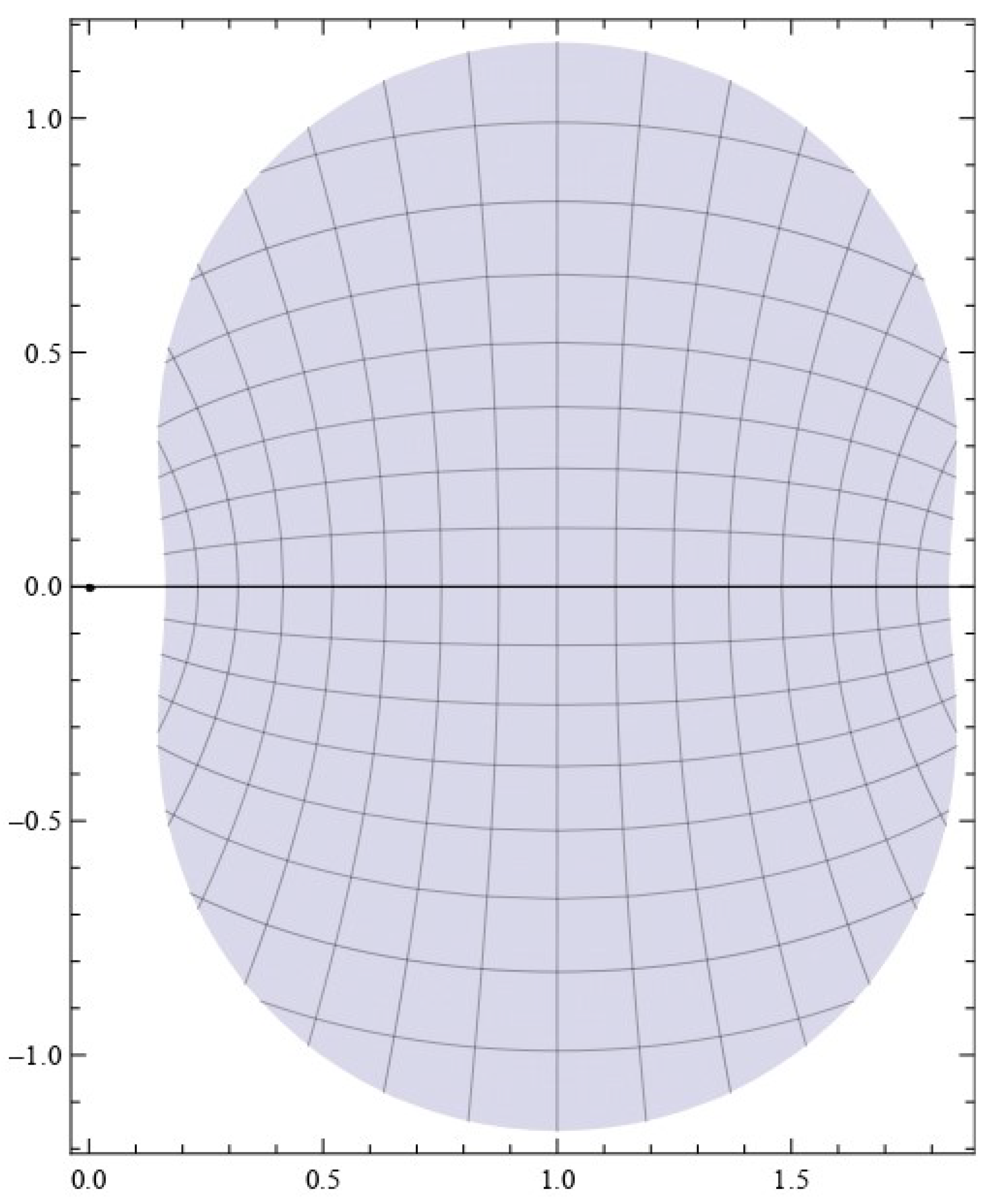
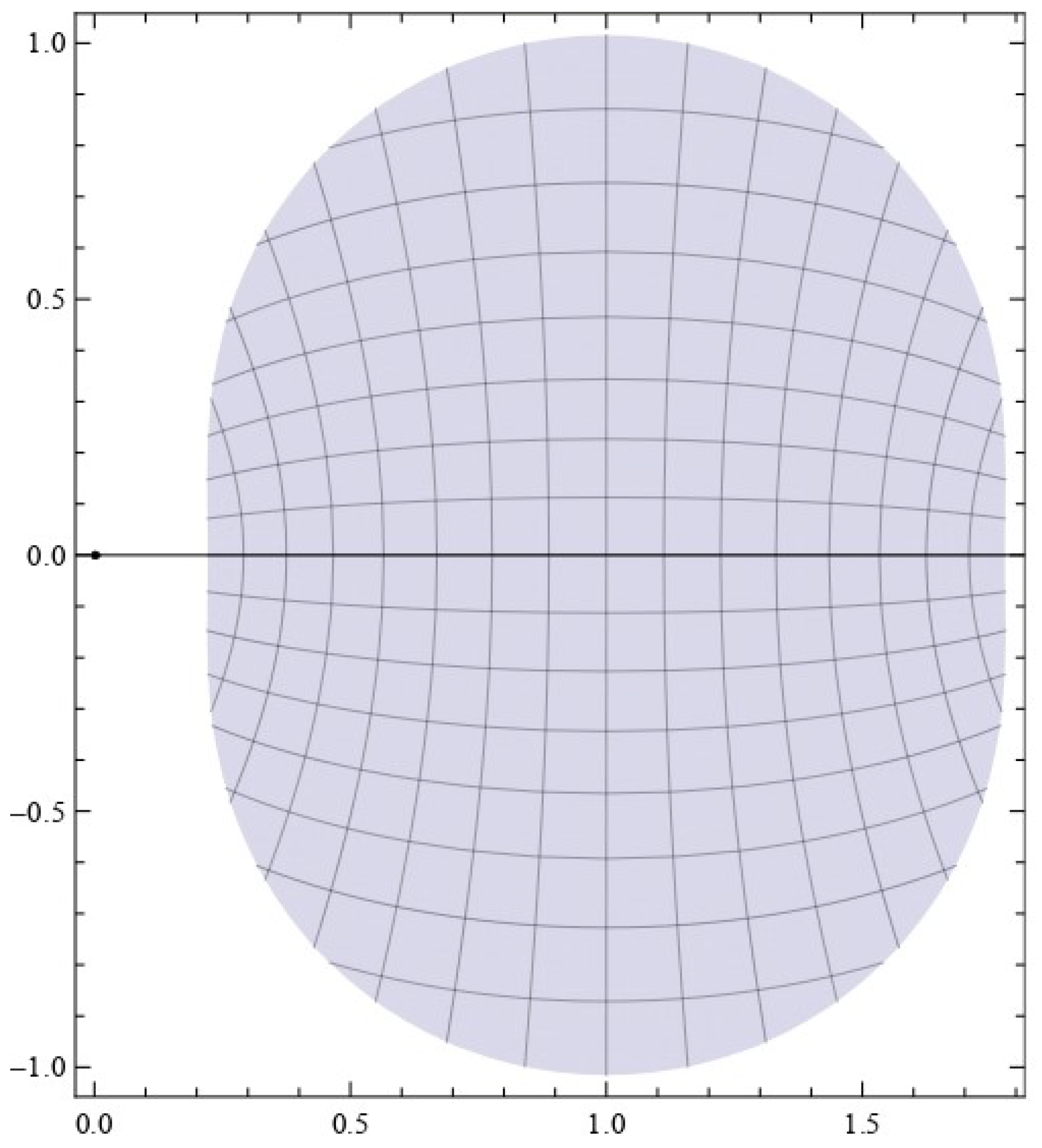
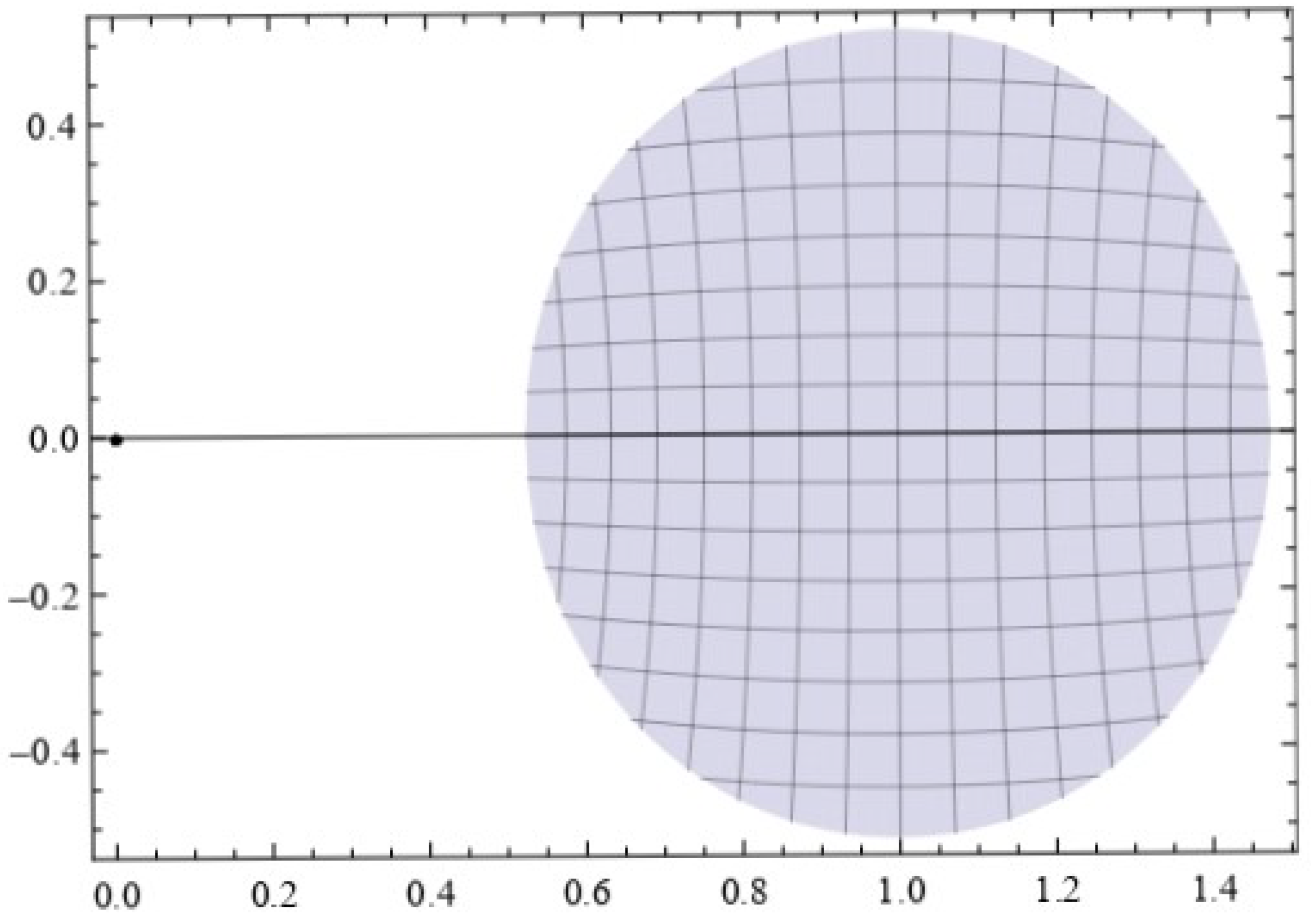
Geometrically, the class contains all the functions such that the image domain of under is contained in the image domain of under . For different values of q, the image domains of unit disk under are shown below (see Figure 1, Figure 2 and Figure 3):
Figure 1.
.
Figure 2.
.
Figure 3.
.
It can be noted that as , the image domain of the unit disk under takes the shape of a curve with an eight-shaped geometry.
Example 1.
Let
then
Proof.
For and , we can see that
After some simple calculations, we have
Also for , we have
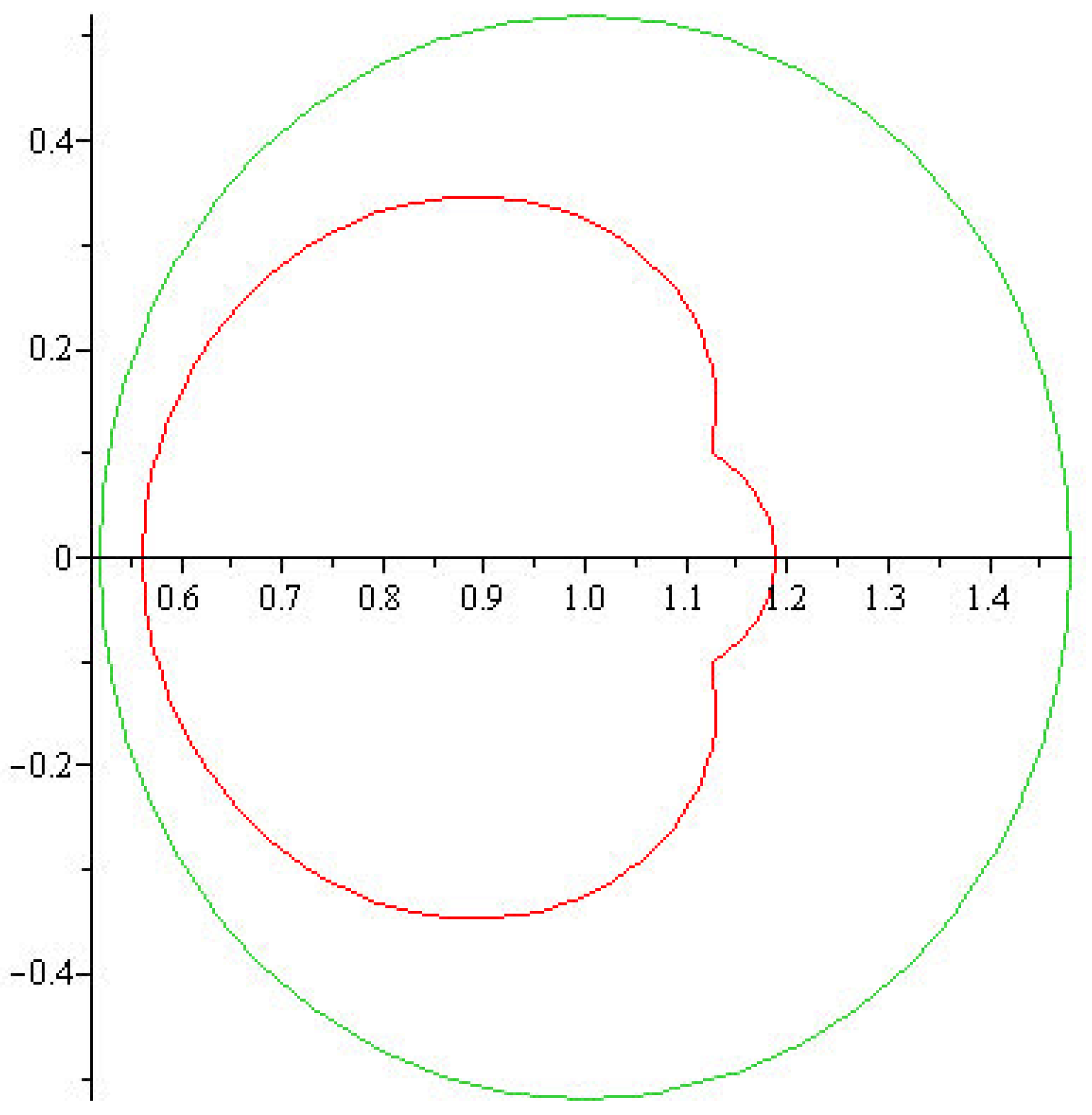
By the univalance of “” along with the fact that and , as shown in the Figure 4,
Figure 4.
The inner and outer curves show the image of unit disc under the and functions, respectively.
Then by definition of subordination, we have
which implies This example shows that class is non-empty. □
2. A Set of Lemmas
Let represent the class of analytic functions with , and meeting the constraint , with the series forming
Let us have and with the series representation given in (1) and (12), respectively. Then, the class is defined in [27] as
where
The following Lemmas will be useful in demonstrating our key findings.
Lemma 1
For the given inequality gives sharp bounds if
In the case of or , equality holds for the function or one of its rotation. For the inequality is sharp for or one of its rotation. For sharpness exists if and only if is reciprocal of the functions that give equality for
Lemma 2
([27]). Let and for (k = 2, 3). Then,
and
where
3. Main Results
Theorem 1.
Let . Then,
for as well as .
Proof.
Let . Then, is an analytic in and for all , so it follows that for all r in , which shows that the condition in (14) is true for On the other hand, according to (9) and using the definition of subordination, we have
where is the Schwarz function with and Consider , , and then
that is,
After some simple calculations, we obtain
and this expression can be written as
which leads to (14).
Conversely, suppose that the condition (14) holds. Let be analytic in along with , and additionally suppose that , . Since the conditions given in (14) and (15) are identical, then from (15), we can say that . Therefore, the simply connected component contains the domain , which is also connected. Now, according to the univalence of “”, together with the assumption , it is clear that , which means that . □
Corollary 1.
Proof.
Let , then according to Theorem 1, we have
which is equivalent to
Now, using the properties of convolution given in (17), we have
Since
Putting these values in (19), we have
Using the value of from Theorem 1, we obtain
□
Corollary 2.
Theorem 2.
Let then the integral representation of is given as
with and , such that .
Proof.
Let then according to (9), we have
where is the Schwarz function with and By taking q-integration, we have
By using the property of q-integration, we have
After some simplifications, we obtain
□
3.1. Coefficient Estimates and the Fekete–Szegö Problem
Let , with the series representation given in (1). Then, for any parameter (real or complex), the factor is known as the Fekete–Szegö problem. As a special case, that is, for , this functional plays an important role in the study of the sharp coefficient problems of Hankel and Toeplitz determinants, as well as generalized Zalcman conjectures and more useful inequalities. In the recent past, many authors have studied this inequality for various classes of analytic functions; see ([28,29,30]). In this section, we find the bounds of the Fekete–Szegö inequality for functions belonging to the class .
Proof.
Using the value of in (25), and after some simplifications, we obtain
Similarly,
Therefore,
Using the definition of q-number and by applying Lemma 1, we have
This is equivalent to
□
In our next result, we will discuss the Fekete–Szegö problem for a complex parameter . Before proving the Fekete–Szegö result, it is important to mention that for having the series representation given in (1), along with
also
and
From (30)–(34), we have
thus, we conclude that the newly defined class is a particular case of the class , that is,
Moreover, by applying Lemma 2 on (35), we have the following corollary.
3.2. Partial Sums Results
In Geometric Function Theory, the partial sum of the series form of analytic and univalent functions plays a crucial role in our understanding of the behaviour of these functions, especially convergence and divergence. In terms of geometric properties, partial sums are used to study coefficient bounds, distortion and growth problems, and radius problems, as well as subordination and superordination results.
Silverman [31] was the first who found the sharp bounds for the ratio of a function to its partial sums for the subclasses of analytic functions. In this portion, we find some lower bound results of the function defined in (1) to its partial sum, which is defined as
Theorem 4.
Proof.
Consider
and after some simple calculations, we have
which gives
By taking the modulus and applying the triangular inequality, we obtain
To prove the required result, that is, in we just need to show in . Therefore, gives
Since satisfies (21), then to prove (37), it would be enough to show that the left-hand side of (41) is bounded above by and is equal to
On account of inequality (42), we can obtain the required result.
Therefore,
Now, one can see that if and only if
To ensure that the function defined in (40) gives sharp bounds, we set , and then
This implies
Similarly, the sharpness for (38) can be proved. □
Theorem 5.
Proof.
The proof follows by working on similar lines as in Theorem 4. □
4. Conclusions
In this article, considering the importance and applications of q-calculus, we used the q-trigonometric function and q-integral operator to define and investigate a new subclass of normalized analytic functions in the open unit disc . We obtained several interesting results of analytic functions belonging to this newly defined class. In this article, our findings include necessary and sufficient conditions for a function to be in the class . Moreover, we drew the image domains of unit disc under different functions, and found the integral representation, coefficient estimates, Fekete–Szegö problems and partial sum results for the function satisfying certain condition in the class . Hopefully, the research carried out in this article will be beneficial for researchers working in GFT, quantum calculus and related areas.
Author Contributions
Conceptualization, A.A. (Adeel Ahmad), A.A. (Asad Ali), A.R., H.L., S.H. and S.O.H.; Methodology, A.A. (Adeel Ahmad), A.A. (Asad Ali), A.R. and S.H.; Formal analysis, S.H., S.O.H. and A.Y.A.-R.; Investigation, A.R. and H.L.; Writing—original draft, A.A. (Adeel Ahmad) and A.R.; Writing—review and editing, A.A. (Adeel Ahmad), S.H. and A.Y.A.-R.; Supervision, A.A. (Asad Ali), A.R. and S.H. All authors have read and agreed to the published version of the manuscript.
Funding
The authors extend their appreciation to the Deanship of Research and Graduate Studies at King Khalid University for funding this work through the Large Research Project under grant number RGP2/115/45. The authors extend their appreciation to the Deanship of Scientific Research at Northern Border University, Arar, KSA, for funding this research work through the project number NBU-FFR-2024-2920-07; this study is also supported via funding from Prince Sattam bin Abdulaziz University project number (PSAU/2024/R/1445).
Data Availability Statement
Data is contained within the article.
Conflicts of Interest
The authors declare no conflicts of interest.
References
- Miller, S.S.; Mocanu, P.T. Differential subordinations theory and applications. In Monographs and Textbooks in Pure and Applied Mathematics; Marcel Dekker: New York, NY, USA, 2000; p. 225. [Google Scholar]
- Jackson, F.H. On q-functions and certain difference operator. Trans. R. Soc. Edinb. 1909, 46, 253–281. [Google Scholar] [CrossRef]
- Jackson, F.H. On q-definite integrals. Quart. J. Pure Appl. Math. 1910, 41, 193–203. [Google Scholar]
- Ismail, M.E.H.; Merkes, E.; Styer, D. A generalization of starlike functions. Complex Var. 1990, 14, 77–84. [Google Scholar] [CrossRef]
- Agrawal, S.; Sahoo, S.K. A generalization of starlike functions of order α. Hokkaido Math. 2017, 46, 15–27. [Google Scholar] [CrossRef]
- Ashish, V.; Sarasvati, Y. Recursion formulas for Srivastava’s general triple q-hypergeometric series. Afr. Mat. 2020, 31, 869–885. [Google Scholar]
- Amini, E.; Fardi, M.; Al-Omari, S.; Saadeh, R. Certain differential subordination results for univalent functions associated with q-Salagean operators. Aims Math. 2023, 8, 15892–15906. [Google Scholar] [CrossRef]
- Noor, K.I.; Lupas, A.A.; Shah, S.A.; Sibih, A.M.; A-Khalek, S. Study of generalized q-close-to-convex functions related to parabolic domain. Funct. Spaces 2023, 2023, 2608060. [Google Scholar] [CrossRef]
- Shaikh, S.B.; Abubaker, A.A.; Matarneh, K.; Khan, M.F. Some new applications of the q-analogues of differential and integral operators for new subclasses of q-starlike and q-convex functions. Fractal Fract. 2023, 7, 411. [Google Scholar] [CrossRef]
- Breaz, D.; Alahmari, A.A.; Cotîrlâ, L.I.; Shah, S.A. On generalizations of the close-to-convex functions associated with q-Srivastava-Attiya operator. Mathematics 2023, 11, 2022. [Google Scholar] [CrossRef]
- Cotîrlâ, L.-I.; Murugusundaramoorthy, G. Starlike functions based on Ruscheweyh q-differential operator defined in Janowski Domain. Fractal Fract. 2023, 7, 148. [Google Scholar] [CrossRef]
- Mahmood, S.; Sokół, J. New subclass of analytic functions in conical domain associated with Ruscheweyh q-differential operator. Res. Math. 2017, 71, 1345–1357. [Google Scholar] [CrossRef]
- Sokól, J.; Stankiewicz, J. Radius of convexity of some subclasses of strongly starlike functions. Zesz. Nauk. Politech. Rzesz. Mater. 1996, 19, 101–105. [Google Scholar]
- Saliu, A.; Oladejo, S.O. On lemniscate of Bernoulli of q-Janowski type. J. Nig. Soc. Phy. Sci. 2022, 4, 961. [Google Scholar] [CrossRef]
- Alsoboh, A.; Darus, M. New subclass of analytic functions defined by q-differential Operator with respect to k-symmetric points. Int. Math Comp. Sci. 2019, 14, 761–773. [Google Scholar]
- Gasper, G.; Rahman, M. Basic Hypergeometric Series; Cambridge University Press: Cambridge, UK, 2004; p. 96. [Google Scholar]
- Yamanoa, T. Some properties of q-logarithm and q-exponential functions in tsallis statistics. Phys. A 2002, 305, 486–496. [Google Scholar] [CrossRef]
- Srivastava, H.M.; Khan, B.; Khan, N.; Tahir, M.; Ahmad, S.; Khan, N. Upper bound of the third Hankel determinant for a subclass of q-starlike functions associated with the q-exponential function. Bull. Sci. Math. 2021, 167, 102942. [Google Scholar] [CrossRef]
- Shi, L.; Khan, M.G.; Ahmad, B. Some geometric properties of a family of analytic functions involving a generalized q-operator. Symmetry 2020, 12, 291. [Google Scholar] [CrossRef]
- Noor, K.I. On new classes of integral operators. J. Nat. Geom. 2013, 65, 454–465. [Google Scholar]
- Ma, W.; Minda, D.A. Unified treatment of some special classes of univalent functions. In Proceedings of the Conference on Complex Analysis, Tianjin, China, 19–23 June 1992; Li, Z., Ren, F., Yang, L., Zhang, S., Eds.; International Press: Cambridge, MA, USA, 1994; pp. 157–169. [Google Scholar]
- Seoudy, T.M.; Aouf, M.K. Coefficient estimates of new classes of q-starlike and q-convex functions of complex order. J. Mathe. Ineq. 2016, 10, 135–145. [Google Scholar] [CrossRef]
- Ahmad, A.; Gong, J.; Rasheed, A.; Hussain, S.; Ali, A.; Cheikh, Z. Sharp results for a new class of analytic functions associated with the q-differential operator and the symmetric balloon-shaped domain. Symmetry 2024, 16, 1134. [Google Scholar] [CrossRef]
- Taj, Y.; Zainab, S.; Xin, Q.; Ferdous, M.O.; Tawfiq; Raza, M.; Malik, S.N. Certain coefficient problems for q-starlike functions associated with q-analogue of sine function. Symmetry 2022, 14, 2200. [Google Scholar] [CrossRef]
- Jabeen, M.; Malik, S.N.; Mahmood, S.; Riaz, S.Ṁ.J.; Ali, M.S. On q-convex functions defined by the q-Ruscheweyh derivative operator in conic regions. J. Math. 2022, 2022, 2681798. [Google Scholar] [CrossRef]
- Mahmood, M.; Jabeen, M.; Malik, S.N.; Srivastava, H.M.; Manzoor, R.; Riaz, S.M.J. Some coefficient inequalities of q-starlike functions associated with conic domain defined by q-derivative. Funct. Spaces 2018, 2018, 8492072. [Google Scholar] [CrossRef]
- Dziok, J. A general solution of the Fekete–Szegö problem, Bound. Value Probl. 2013, 2013, 98. [Google Scholar] [CrossRef]
- Ravichandran, V.; Darus, M.; Khan, M.H.; Subramanian, K.G. Fekete-Szegö inequality for certain class of analytic functions. Aust. J. Math. Anal. Appl. 2004, 1, 1–7. [Google Scholar]
- Ravichandran, V.; Gangadharan, A.; Darus, M. Fekete-Szegö inequality for certain class of Bazilevic functions. Far East J. Math. Sci. 2004, 15, 171–180. [Google Scholar]
- Shanmugam, T.N.; Sivassubramanian, S.; Darus, M. Fekete-Szegö inequality for certain class of Bazilevic functions. Int. Math. 2006, 34, 283–290. [Google Scholar]
- Silverman, H. Partial sums of starlike and convex functions. J. Math. Anal. Appl. 1997, 209, 221–227. [Google Scholar] [CrossRef]
Disclaimer/Publisher’s Note: The statements, opinions and data contained in all publications are solely those of the individual author(s) and contributor(s) and not of MDPI and/or the editor(s). MDPI and/or the editor(s) disclaim responsibility for any injury to people or property resulting from any ideas, methods, instructions or products referred to in the content. |
© 2024 by the authors. Licensee MDPI, Basel, Switzerland. This article is an open access article distributed under the terms and conditions of the Creative Commons Attribution (CC BY) license (https://creativecommons.org/licenses/by/4.0/).