Abstract
In this article, we mainly consider the dynamic analysis of a stochastic infectious disease model with negative feedback, a symmetric and compatible distribution family. Based on the sir epidemic model taking into account the isolation (y) and the death (v), we consider adding a new variable (w) to control the information of non-drug interventions, which measures transformations in isolation performance that determine the epidemic, and establish a new model. We have demonstrated various properties of the model solution using Lyapunov functions for this model. To begin with, we demonstrate the existence and uniqueness of the global positive solution. After that, we obtained the conditions that need to be met for the extinction of the disease and verified the correctness of the conclusion by simulating numerical values. Afterwards, we prove the stochastic boundedness and stationary distribution of the model solution.
1. Introduction
Infectious diseases are still a significant issue that seriously endangers human health and life safety, and the harm of contagious diseases is a global public health problem that needs to be addressed. From smallpox, cholera, SARS, AIDS, and H1N1 to COVID-19, infectious diseases have greatly threatened people’s physical and mental health. Therefore, preventing and treating infectious diseases has always been an essential aspect of building a good living environment, and researchers from various disciplines use different methods to study infectious diseases. In the field of biomathematics, Tillett and Ruan et al. [1,2,3] applied mathematical modeling methods to study infectious diseases. Through dynamic analysis of infectious disease models, they dynamically simulate the development of infectious diseases, make predictions based on actual infection data, and based on the conclusions drawn from the research, corresponding recommendations for infectious disease prevention and control are proposed. Many infectious disease models are deterministic [4,5,6,7,8,9], including various features such as time delay, immunity, multi-group, network, etc., making the established mathematical models close to the natural propagation process. However, deterministic models have to some extent simplified the model of transmission process of infectious diseases. Because in actual living environments, various environmental factors can interfere with the spread of infectious diseases, thereby affecting their development. Therefore, considering stochastic Brownian motion [10,11,12,13,14] in the deterministic system will help the model to more accurately predict the dynamic behavior of infectious diseases and provide help for the precaution and containment of infectious diseases.
With the advancement of science, vaccination has been widely applied, and for some diseases, vaccination is an effective means of prevention and control. However, when a newly emerging infectious disease begins to spread in a region, vaccines cannot quickly control the spread of the disease. Furthermore, some non-drug interventions (such as isolation, media promotion, etc.) are very important. Isolation is an incipient precaution measure, while treatment is a later means of treating patients who have already fallen ill. Even if effective medications can be used to treat infectious diseases, a large patient population can never be treated without causing the emergence of new cases. And because isolation and anti-epidemic measures are considerably more crucial in the absence of specific treatments and vaccinations, prevention will save hundreds or even thousands of lives more often. Taking China’s COVID-19 epidemic as an example. Since COVID-19 broke out in 2019, China always adhered to the concept of “people first and life first”, actively, scientifically, and orderly formulated epidemic prevention policies, and constantly optimized and adjusted policies based on the development and changes of the epidemic. So as to win a window period for vaccine drug research and development, and ensure people’s life safety to the greatest extent. Isolation and control are also key measures to block the hidden spread of the epidemic and achieve “social zero”. For isolated personnel, exact health examination and NAT during isolation can realize earlier investigation, estimation, and settlement to avoid illness delay. For others, isolating close contacts of infectious diseases can prevent further spread of the virus and contain the spread of the outbreak.
However, since the COVID-19 epidemic in Europe and the US, protests against quarantine laws, pleas for freedom, and rallies have persisted from Italy to the US to Australia and Brazil. The main reasons for people’s collective protests are: first, in terms of the economy, many enterprises were forced to lay off workers due to the outbreak of the epidemic, resulting in continuously high unemployment rates. Many people had no source of income and no savings and could only hope for government relief. Even though the government has offered pandemic subsidies to the populace, they are insufficient to address long-term living issues. The best solution is to resume work and restore income as soon as possible, so some people are also unwilling to quarantine at home. Second, in terms of culture, some citizens’ values of freedom and democracy have become deeply ingrained. They interpret the epidemic prevention and control measures taken by various states, such as home quarantine and maintaining social distancing, as violating their human rights and causing them to lose their freedom. Thirdly, in terms of hygiene, many people are concerned that inadequate disinfection and other measures during quarantine may further increase the risk of infection. This negative information will affect the implementation of quarantine measures. In light of the aforementioned factors, we present and investigate an infectious illness stochastic differential equation model in this study, taking into account the impact of information exponential function and negative feedback on non-drug treatment parameters (such as isolation and quarantine).
Some literature has analyzed the impact of negative feedback on disease occurrence [15,16,17,18,19]. D’Onof Rio et al. [15] investigated the SIR model, while Vargas and D’Onof Rio [16] discussed the SEIR model. At the same time, they all considered negative feedback factors. They proposed three descriptions of information linear indexes and analyzed the model through ordinary differential equations. Due to factors such as the ecological environment, various antiviral drugs, and biological evolution, the variation of pathogens is more frequent. The variation of pathogens increases the duration of host infection. Therefore, the mutation of pathogens can have a huge impact on the prevention and reign of infectious diseases. Establishing a mathematical model for the spread of infectious diseases based on the actual situation, analyzing the modifies in the number of infected persons, and simulating the development and epidemic trend of infectious diseases should play a positive guiding role in the precaution and containment of infectious diseases, and the mathematical model can aid us to understand and analyze the transmission behavior of infectious diseases from a broader perspective. In addition, considering the effect of different individual immunizations on the incubation period of infectious diseases, this will take some time for the susceptible to become infectious after being infected. The delay of infectious diseases is generally 2–14 days, such as cholera in about 2 days, and COVID-19 in 14 days [20,21]. These all indicate that the infection of a disease exhibits hysteresis and is continuous during the infection period [22,23], so the distribution delay can better reflect its hysteresis. In this article, we think about a stochastic distributed time-delay infectious disease model with a negative feedback isolation rate based on a nonlinear information index.
Due to Roxana López-Cruz and Alberto D’Onofrio’s insightful work [15,24], we have now established a stochastic infectious disease model with negative information feedback. Firstly, on account of the sir infectious disease model, we think about the divided population (y) and the demised population (v) and find an infectious disease model with temporary isolation for a period of time.
This system can better describe the epidemic trend of a class of infectious diseases requiring isolation measures, such as COVID-19. During the epidemic of COVID-19, due to the interference of various factors, people have some concerns. In this article, we call these concerns negative information feedback. Then, adding negative feedback variables of information index to the model, which reflects how incorrect information affects non-drug (segregation, etc.) or drug steps (immunization, etc.). We incorporate these factors into the pandemic dynamics caused by infectious diseases and set up a new infectious disease model with a temporary isolation period and negative feedback.
Among them, , , , , and are the number of susceptible, divided, infected, recovered, and demised populations at time t, respectively, and is the information index at time t (regarding the corresponding disease), is the birth rate or natural mortality rate of each individual, is the effective contact rate, and is the desertion of a non-pharmaceutical intervention rate, is recovery rate, is the mortality rate caused by infection, is a delay in the feedback effect of information in the isolation policy for susceptible populations to avoid the transmission of diseases, is a delayed selection kernel. In this study, we apply the weak delay kernel , where is a constant, representing the reciprocal of the average delay of the collected information about the disease. is the impact of information feedback on disease isolation rate, where is a positive function for modeling isolated susceptible populations, , is existing and historical information independent of the prevalence level in the relevant disease population, is a modeling of the proportion of isolated susceptible populations based on social alerts caused by diseases, represents the impact of susceptibility and the number of infected individuals in information dynamics, considering information variable as the state function , [15] of the past values of state variables x and z, and propose the following assumptions [15]:
- (1):
- , for ∀,
- (2):
- , , for ∀, , .
Due to the fact that the dynamic behavior of the population density of recovered (u) and deceased individuals (v) does not affect other populations, through this selection and assumption, the system (2) is equivalent to the following nonlinear differential systems:
In addition, Øksendal’s research [25] indicates that environmental changes have a big influence on the spread of infectious diseases. For the spread of infectious diseases, due to the unpredictability caused by humankind, the variation and transmission of diseases are essentially random, resulting in continuous interference with population size [26,27]. Therefore, the stochastic differential Equation (SDE) model is more practical in modeling infectious diseases in infectious disease dynamics. At the same time, a deterministic system can evolve into a stochastic epidemic model. Brownian motion is essentially a continuous stochastic process. A stochastic process is a group of random variables that appear sequentially in the time or space domain. It represents a random fluctuation phenomenon, and its theory has important applications in other fields. Symmetry is an important property of Brownian motion. When we study stochastic differential equations, we can use symmetry to solve some simple problems, which is conducive to the study of stochastic processes. Presuming that the coefficient of model (3) is effected by Brownian motion, then model (3) changes into a random model:
among represent the intensities of the white noises, are mutually independent standard Brownian motions. Nevertheless, in practical situations, the populations of x, y, z, and w are usually affected by random factors. Therefore, in non-general cases, it is assumed that these five types of random disturbance noise are uncorrelated. We make , then model (4) changes into:
Let be a complete probability space with the filtration satisfying the usual condition (i.e., is increasing and right continuous while contains all -null sets). To simplify the description, we denote .
This article provides a detailed discussion on the existence and uniqueness of global solutions, disease extinction, random ultimate boundedness and stationary distribution of the model (5). The analysis model (5) has two random reproduction numbers and , if , the disease vanishes. If , the system (5) is evenly distributed, meaning that the disease will persist. We believe that non-drug control can strain the spread of infectious diseases and the effect of index formation on the decision to isolate susceptible populations. This is crucial for understanding the characteristics of the disease. This will help people analyze the development process of infectious diseases, predict transmission trends, and analyze key factors such as the medium of disease transmission.
The primary compositions of this article are as below: In Section 2, we have verified the existence and uniqueness of global positive solutions for model (5). In Section 3, we are committed to proving extinction and providing an example to support our discovery. In Section 4, we demonstrate the stochastic boundedness of the solution. In Section 5, we are committed to proving the stationary distribution. In Section 6, we briefly discussed and summarized the main results.
2. The Existence and Uniqueness of Global Positive Solutions
Thanks to Lan et al. [28] for their fruitful research results on Theorem 3.1. Since system (5) is an infectious disease model, where variables represent various populations, we first need to ensure the existence and uniqueness of the positive solution of system (5). This property also lays the foundation for us to study more properties of the system further (5) in .
Theorem 1.
For initial value , the system (5) has a unique positive solution, that is , for any , is true almost everywhere.
Proof.
For initial value , it is obvious that the coefficients of model (5) satisfy the local Lipschitz condition. Hence, there exists a unique local solution for system (5) on , where is the blowup time. To demonstrate the globality of the solution, we just need to prove that a.s. Let is a adequately large positive integer, then making , , , , for any integer , defining downtime:
Here we define Ø as an empty set and .
Therefore, it is likely to obtain that as monotonic increase. Permitting , there is , a.s. we only demand proving . Otherwise, there are two constants , , so that . So there is an integer , that holds
First, we define a function V::
where .
Allowing formula [29], it can be concluded that
where
therefore, we can obtain
Integrate from 0 to both sides of Equation (8) simultaneously, taking expectations and obtaining
3. Extinction of Disease
3.1. The Extinction of Diseases
Thanks to the research results of Tan et al. in Section 3 of [30], Dieu et al. in Section 2 of [31] and Liu et al. in Theorem 3.3 of [32]. This section, demonstrates that when the noise is large enough to satisfy , the infected population will become extinct exponentially.
To further earn the properties of the solution, we prove the bounds of the first equation of model (5):
According to the research results of Theorem 1.16 in P.C. Kiessler [33], we have,
Let be the solution of model (11) and have an initial value of . In the light of the comparison theorem that for all . By resolving the Fokker–Planck equation, the solution has a unique stationary distribution and the probability density is . Then, according to the law of strong numbers, we obtain
Theorem 2.
If and , then almost certainly converges to 0 at an exponential rate. This means that both the infected population and the information index will tend to become extinct, i.e.,
which implies the disease and the negative feedback of information disappears.
Proof.
Let . For using formula, then we gain,
where and .
After that, simultaneously integrating both ends of the inequality from 0 to t and dividing by t at the same time, we receive
On the basis of the strong law of large numbers , we obtain
For ∀, from (13), it can be seen that there is a condition where causes , among
Therefore, can almost certainly converge to 0 at an exponential rate. □
3.2. Numerical Simulation
Thanks to the Milstein method mentioned in Higham [34], model (5) can be reworked as the following discretization equation:
where are gaussian random variables. The following graph was drawn using a numerical example using a MATLAB program.
Example 1.
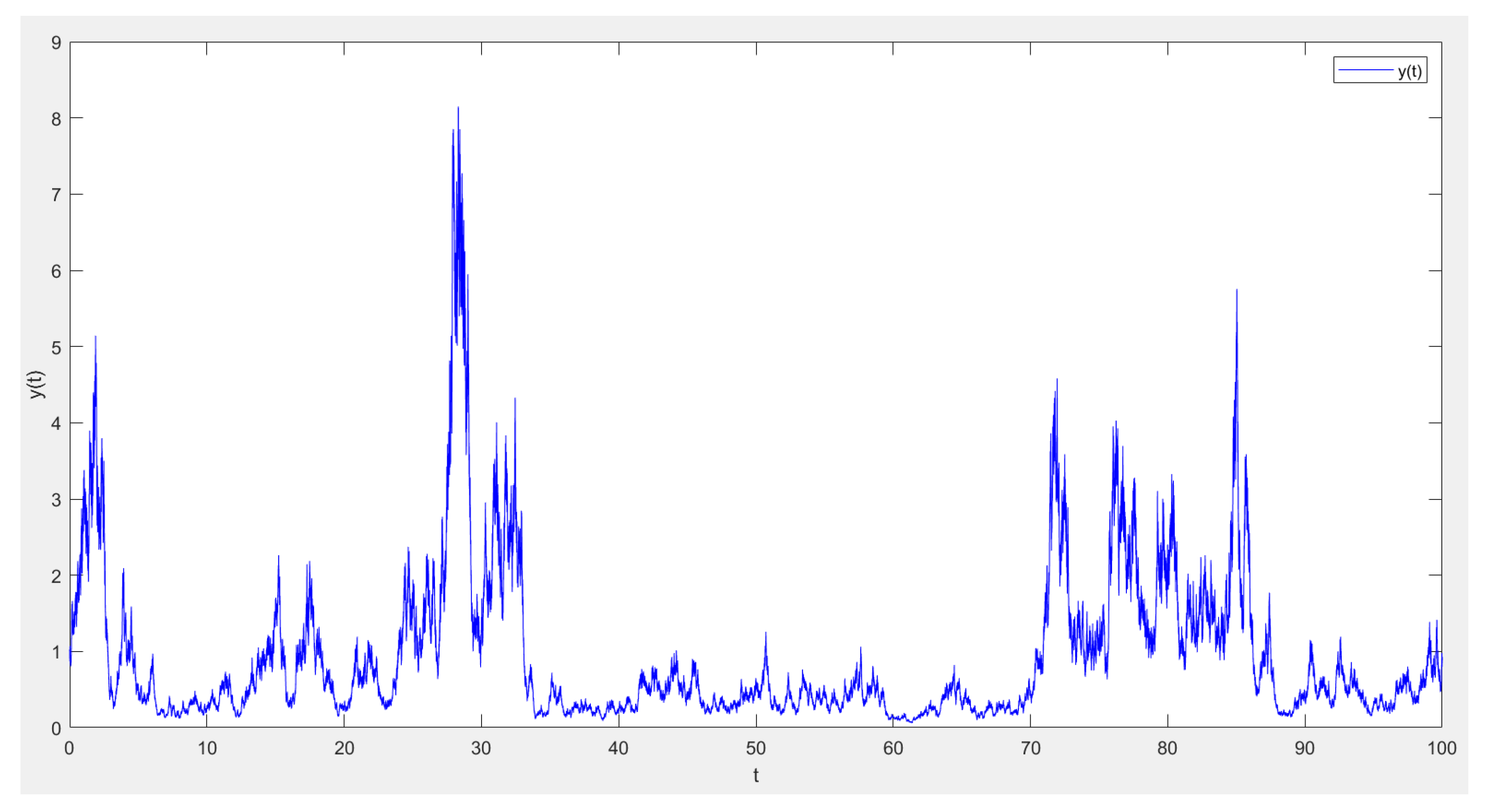
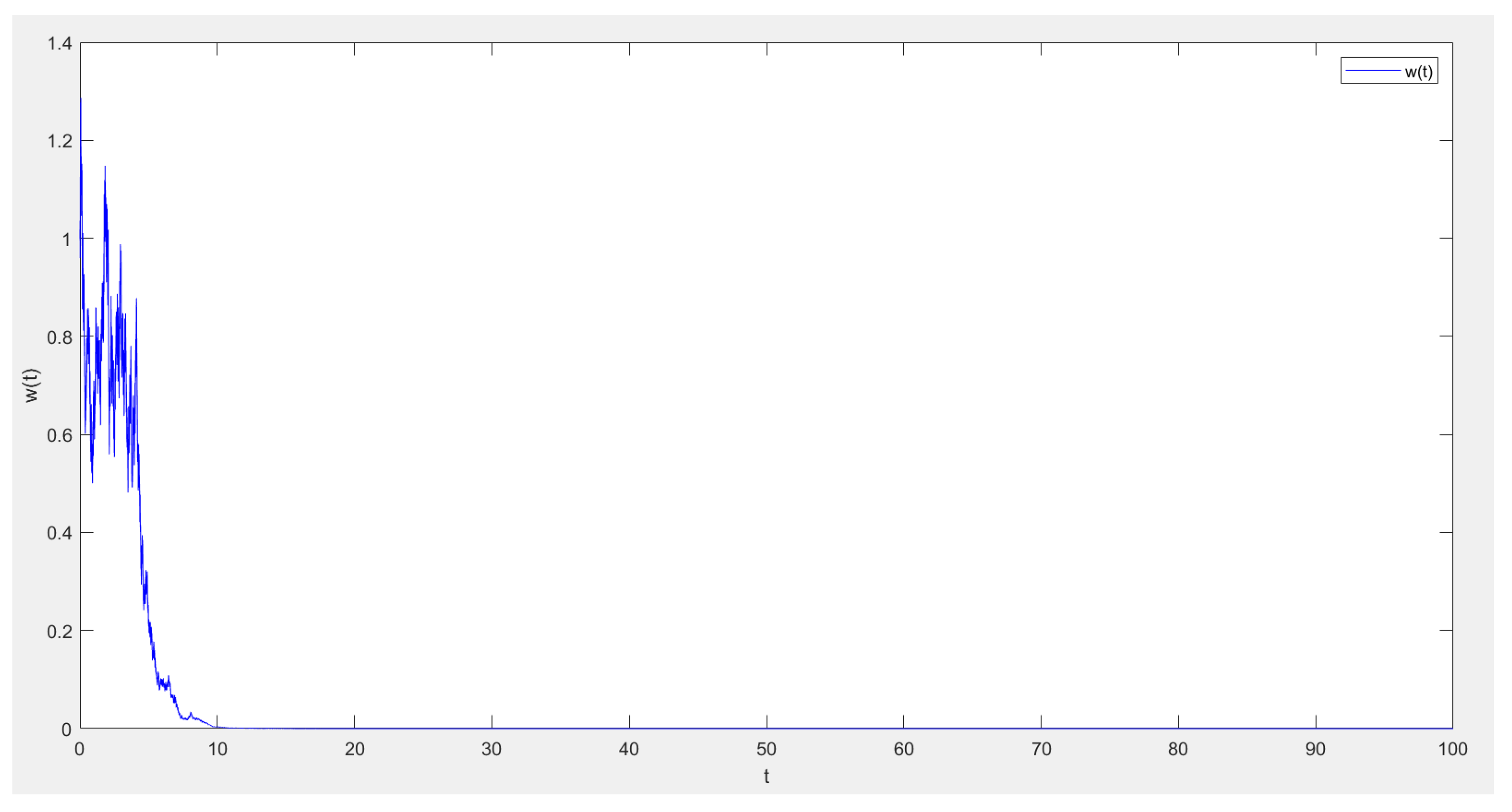
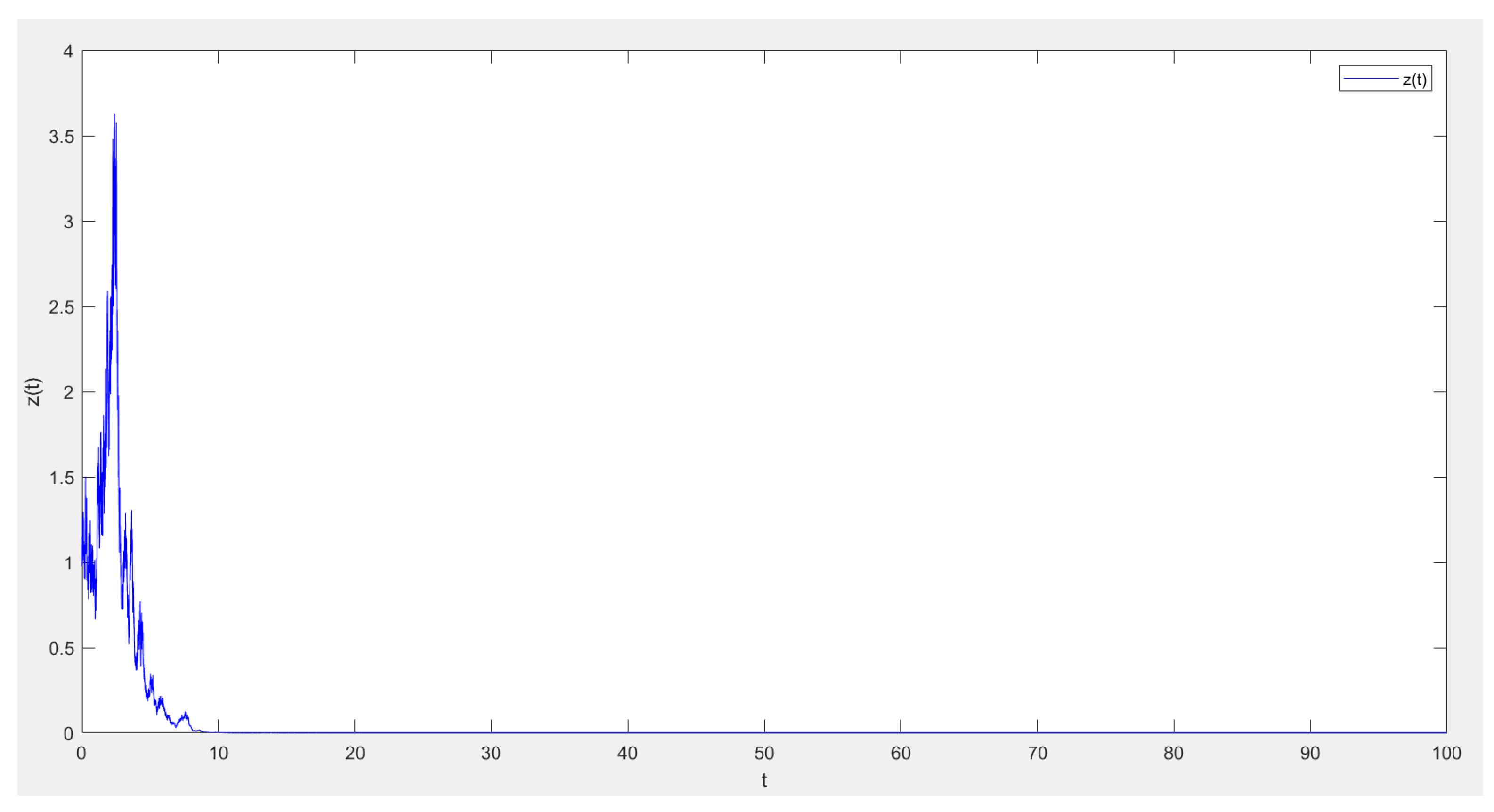
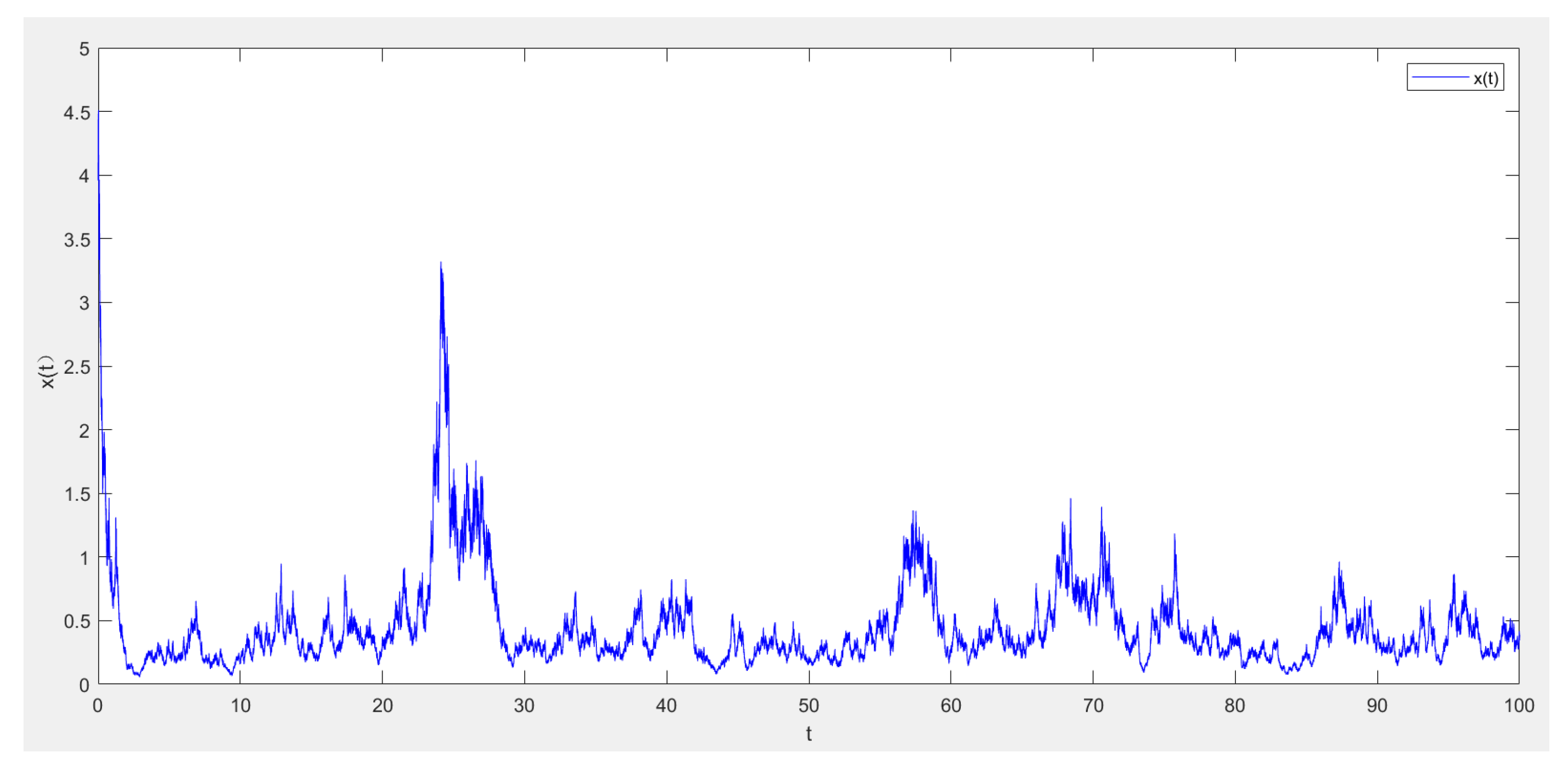
Theorem 2 indicates that when the parameters satisfy the above conditions, the population of the system (5) will become extinct. In order to prove the validity of the theorem, the parameter set is taken , , and the condition satisfies Theorem 2. And the time interval is discretized into , where the time step is a constant. The numerical simulation is shown in Figure 1, Figure 2, Figure 3 and Figure 4.
Figure 1.
The sample path of x(t).
Figure 2.
The sample path of y(t).
Figure 3.
The sample path of z(t).
Figure 4.
The sample path of w(t).
4. Random Ultimate Boundedness
The previous reasoning indicates that the solution of the system (5) will not explode to infinity in a finite time. Referencing Cai’s fruitful research results [35], we can derive the solution of the system is bounded randomly, and under certain conditions is ultimately bounded.
Theorem 3.
Assuming and holding, then for any initial value , the solution of system (5) is random and ultimately bounded for ∀.
Proof.
For , defining
where .
In line with the formula has
and there are
where , let , obviously, has a supremum, so making , we can obtain
By (14), we can obtain
Let , by the formula has
By integrating both sides of Equation (15) from 0 to t and taking the mean, we obtain:
Accordingly, there are
then
For ∀, let us obtain from the Chebyshev inequality, we have
so that
So the solution of system (5) is random and ultimately bounded. □
5. Stationary Distribution
Inspired by the research results of Han and Zuo et al. [36,37], in this section, we investigate the existence of stationary distributions in the system (5). Next, we consider Theorem 3.3 and Theorem 3.4 in integral Equation [38]:
Lemma 1.
Let the vectors be continuous functions of , such that for some constant B the following conditions hold in the entire domain of definition [38]:
In addition, there exists a non-negative function , such that
where D is a compact subset defined on .
Afterwards the Markov process (16) on has at least one stationary solution .
Theorem 4.
Assuming , the model (5) is a Markov process, which means that the disease persists.
Proof.
By Lemma 1 and Theorem 1, we found a function :
where , , with D, are determined later, using to replace with . Employing the formula to , we can obtain
Because , so , by (19) we have
where , and similarly
where ,
where .
As a result
where .
Making H big enough to make , then
where .
It only needs to be small enough for any , where , we have . This completes the proof. □
6. Conclusions and Discussion
Starting from the practical issues of warning and government of infectious diseases, and considering the lag of disease infection, the negative impact of negative media reports, forced isolation, and environmental impacts, this article establishes a model that can depict susceptible (non-isolated) populations (x), divided populations (y), infected populations (z), recovered populations (u), and demised populations (v), as well as the stochastic infectious disease model with the distributed delay that the information index (about the aspect of the corresponding disease) variable (w) interacts with each other, using the existing stochastic differential equation theory, develop new qualitative analysis methods and numerical simulation skills of the model, and apply the obtained theory and numerical results to the precaution and reign of infectious diseases. The details are as follows:
First, we analyze the existence and uniqueness of positive global solutions of the model, and focys on the application of the Lyapunov function, lemma, local solution existence and uniqueness theorem, strong law of large numbers, etc. in stochastic differential systems. Second, the analysis model has two random reproduction numbers , , which proves that when , the disease tends to extinct and develop corresponding numerical simulation methods to supply a basis for the precaution and reign of infectious diseases; when , the system is evenly distributed, meaning that the disease will persist. Finally, we prove the stochastic ultimate boundedness of the solution of the model (5).
The precaution and settlement of infectious diseases, as well as the lag in disease infection, have driven the development of this article. In view of the previous work, we will further use the existing infectious disease models, stochastic differential equation, distributed delay and other theories to develop a new class of stochastic infectious disease models with distributed delay and theoretical analysis methods, reveal the dynamic laws of infectious disease transmission and prevention, and provide new ideas and the theoretical foundation of the precaution and settlement of infectious diseases.
Author Contributions
Formal analysis, W.W. and H.C.; software, Y.Z.; validation, W.L. All authors contributed equally and significantly to this paper. All authors have read and agreed to the published version of the manuscript.
Funding
This work is supported by Youth Talent of Xingdian Talent Support Program (Xuewen Tan, Wenjie Qin) and the National Natural Science Foundation of China (No. 12261104).
Data Availability Statement
Data sharing is not applicable to this article as no data sets were generated or analyzed during the current study.
Conflicts of Interest
The authors declare no conflict of interest.
References
- Tillett, H.E. Infectious diseases of humans: Dynamics and control. Epidemiol. Infect. 1992, 108, 211–212. [Google Scholar] [CrossRef]
- Ruan, S.G.; Wang, W.D. Dynamical behavior of an epidemic model with a nonlinear incidence rate. J. Dierential Equ. 2003, 188, 135–163. [Google Scholar] [CrossRef]
- Funk, S.; Salath, M.; Jansen, V.A. Modelling the inuence of human behaviour on the spread of infectious diseases: A review. J. R. Soc. Interface 2010, 7, 1247–1256. [Google Scholar] [CrossRef] [PubMed]
- Guo, H.B.; Michael, Y.L.; Shuai, Z.S. A graph-theoretic approach to the method of global Lyapunov functions. Proc. Am. Math. Soc. 2018, 136, 2793–2802. [Google Scholar] [CrossRef]
- Sun, R.Y. Global stability of the endemic equilibrium of multigroup SIR models with nonlinear incidence. Comput. Math. Appl. 2010, 60, 2286–2291. [Google Scholar] [CrossRef]
- Sun, G.Q.; Zhang, H.T.; Wang, J.S.; Li, J.; Wang, Y.; Li, L.; Wu, Y.P.; Feng, G.L.; Jin, Z. Mathematical modeling and mechanisms of pattern formation in ecological systems: A review. Nonlinear Dyn. 2021, 104, 1677–1696. [Google Scholar] [CrossRef]
- Liu, M.X.; Fu, X.J. Dynamical analysis of an SIS epidemic model with migration and residence time. Int. J. Biomath. 2021, 14, 141–158. [Google Scholar] [CrossRef]
- Li, Z.; Teng, Z.; Feng, X.; Li, Y.; Zhang, H. Dynamical analysis of an SEIT epidemic model with application to ebola virus transmission in Guinea. Comput. Math. Methods Med. 2015, 2015, 582625. [Google Scholar] [CrossRef]
- Gao, S.; Teng, Z.; Nieto, J.J.; Torres, A. Analysis of an SIR epidemic model with pulse vaccination and distributed time delay. J. Biomed. Biotechnol. 2007, 2007, 064870. [Google Scholar] [CrossRef]
- Zhang, Y.; Fan, K.G.; Gau, S.J.; Chen, S. A remark on stationary distribution of a stochastic SIR epidemic model with double saturated rates. Appl. Math. Lett. 2018, 76, 46–52. [Google Scholar] [CrossRef]
- Zhang, X.B.; Chang, S.Q.; Shi, Q.H.; Huo, H.F. Qualitative study of a stochastic SIS epidemic model with vertical transmission. Phys. A Stat. Mech. Its Appl. 2018, 505, 805–817. [Google Scholar] [CrossRef]
- Wang, F.; Wang, S.; Peng, Y. Asymptotic behavior of multigroup SEIR model with nonlinear incidence rates under stochastic perturbations. Discret. Dyn. Nat. Soc. 2020, 2020, 1–12. [Google Scholar] [CrossRef]
- Liu, Q.; Jiang, D.Q.; Shi, N.Z.; Hayat, T.; Alsaedi, A. Stationary distribution and extinction of a stochastic SIRS epidemic model with standard incidence. Phys. A Stat. Mech. Its Appl. 2017, 409, 510–517. [Google Scholar] [CrossRef]
- Zhao, Y.N.; Jiang, D.Q. The threshold of a stochastic SIRS epidemic model with saturated incidence. Appl. Math. Lett. 2014, 34, 90–93. [Google Scholar] [CrossRef]
- d’Onofrio, A.; Manfredi, P.; Salinelli, E. Vaccinating behaviour, information, and the dynamics of sir vaccine preventable diseases. Theor. Popul. Biol. 2007, 71, 301–317. [Google Scholar] [CrossRef] [PubMed]
- Vargas, D.L.C.; D’Onofrio, A. Global stability of infectious disease models with contact rate as a function of prevalence index. Math. Biosci. Eng. 2017, 14, 1019. [Google Scholar] [CrossRef]
- Hu, R.; Liu, L.; Ren, X.; Liu, X. Global stability of an information-related epidemic model with age-dependent latency and relapse. Ecol. Comple 2018, 36, 30–47. [Google Scholar] [CrossRef]
- Buonomo, B.; d’Onofrio, A.; Lacitignola, D. Global stability of an sir epidemic model with information dependent vaccination. Math. Biosci. 2008, 216, 9–16. [Google Scholar] [CrossRef]
- Buonomo, B.; d’Onofrio, A.; Lacitignola, D. Globally stable endemicity for infectious diseases with information-related changes in contact patterns. Appl. Math. Lett. 2012, 25, 1056–1060. [Google Scholar] [CrossRef]
- Wang, W.D.; Ruan, S.G. Simulating the SARS outbreak in Beijing with limited data. J. Theor. Biol. 2004, 227, 369–379. [Google Scholar] [CrossRef]
- Meyer, K.C. The role of immunity and inflammation in lung senescence and susceptibility to infection in the elderly. Semin. Respir. Crit. Care Med. 2010, 31, 561–574. [Google Scholar] [CrossRef] [PubMed]
- McCluskey, C.C. Complete global stability for an SIR epidemic model with delay–Distributed or discrete—ScienceDirect. Nonlinear Anal. Real World Appl. 2010, 11, 55–59. [Google Scholar] [CrossRef]
- Sun, X.; Zuo, W.; Jiang, D.; Hayat, T. Unique stationary distribution and ergodicity of a stochastic Logistic model with distributed delay. Phys. A Stat. Mech. Its Appl. 2018, 512, 864–881. [Google Scholar] [CrossRef]
- Roxana, L.C. Global stability of an SAIRD epidemiological model with negative feedback. In Advances in Continuous and Discrete Models; Springer: Cham, Switzerland, 2022; p. 41. [Google Scholar]
- ksendal, B. Stochastic differential equations: An introduction with applications. J. Am. Stat. Assoc. 2006, 51, 1731–1732. [Google Scholar]
- Allen, L.J.S. An introduction to stochastic epidemic models. In Mathematical Epidemiology; Springer: Berlin/Heidelberg, Germany, 2008; pp. 81–130. [Google Scholar]
- Beddington, J.R.; May, R.M. Harvesting natural populations in a randomly fluctuating environment. Science 1977, 197, 463–465. [Google Scholar] [CrossRef]
- Lan, G.; Huang, Y.; Wei, C.; Zhang, S. A stochastic SIS epidemic model with saturating contact rate. Phys. A Stat. Mech. Its Appl. 2019, 529, 121504. [Google Scholar] [CrossRef]
- Mao, X.R. Stochastic Differential Equations and Applications; Elsevier: Amsterdam, The Netherlands, 2011; pp. 47–90. [Google Scholar]
- Tan, Y.P.; Cai, Y.L.; Wang, X.Q.; Peng, Z.H.; Wang, K.; Ya, R.X.; Wang, W.M. Stochastic dynamics of an SIS epidemiological model with media coverage. Math. Comput. Simul. 2023, 204, 1–27. [Google Scholar] [CrossRef]
- Dieu, N.T.; Nguyen, D.H.; Du, N.H.; Yin, G. Classification of asymptotic behavior in a stochastic SIR Model. Soc. Ind. Appl. Math. 2015, 15, 1062–1084. [Google Scholar] [CrossRef]
- Liu, W.; Zheng, Q. A stochastic SIS epidemic model incorporating media coverage in a two patch setting. Appl. Math. Comput. 2015, 262, 160–168. [Google Scholar] [CrossRef]
- Kiessler, P.C. Statistical Inference for Ergodic Diffusion Processes; Springer: New York, NY, USA, 2004. [Google Scholar]
- Higham, D.J. An algorithmic introduction to numerical simulation of stochastic differential equations. Siam Rev. 2001, 43, 525–546. [Google Scholar] [CrossRef]
- Cai, Y.; Wang, X.; Wang, W.; Zhao, M. Stochastic dynamics of a SIRS epidemic model with ratio-dependent incidence rate. Abstr. Appl. Anal. 2013, 2013, 415–425. [Google Scholar] [CrossRef]
- Han, T. Stationary solution, extinction and density function for a high-dimensional stochastic SEI epidemic model with general distributed delay. Appl. Math. Comput. 2021, 405, 126236. [Google Scholar] [CrossRef]
- Zuo, W.; Zhou, Y. Density function and stationary distribution of a stochastic SIR model with distributed delay. Appl. Math. Lett. 2022, 129, 107931. [Google Scholar] [CrossRef]
- Khasminskii, R. Stochastic Stability of Differential Equations; Springer: New York, NY, USA, 2011; pp. 70–73. [Google Scholar]
Disclaimer/Publisher’s Note: The statements, opinions and data contained in all publications are solely those of the individual author(s) and contributor(s) and not of MDPI and/or the editor(s). MDPI and/or the editor(s) disclaim responsibility for any injury to people or property resulting from any ideas, methods, instructions or products referred to in the content. |
© 2023 by the authors. Licensee MDPI, Basel, Switzerland. This article is an open access article distributed under the terms and conditions of the Creative Commons Attribution (CC BY) license (https://creativecommons.org/licenses/by/4.0/).