Abstract
The Bzier-type operator has become a powerful tool in operator theory, neural networks, curve and surface design and representation because of its good shape-preserving properties. Motivated by the improvements of the operator in computational disciplines, we investigate some elementary properties of two kinds of modified Szsz type basis functions, depending on non-negative parameters. Using the derivative, the symmetry of variables, the modulus of continuity and the concave continuous modulus, we study some shape preserving properties of these operators concerning monotonicity, convexity, starshapedness, semi-additivity and the preservation of smoothness. Moreover, some illustrative examples are provided to demonstrate the approximation behavior of the proposed operators and the classical ones.
1. Introduction
As parametric operators, Bzier operators are described by the Bernstein’s basis polynomials and are the elements of a computer-aided geometric design (CAGD) [1,2,3,4,5,6]. The basis functions of these type of operators have many good properties suitable for modeling, such as shape-preserving properties, convex hull constraints, symmetry, etc. There has been a lot of research on parametric operators [7,8,9,10,11]. Due to their controllable shape parameters, these operators have potential applications in fields such as computer graphics, engineering problems and industrial applications. In recent years, the shape-preserving properties of various operators have been deeply studied [12,13,14,15,16,17,18,19,20,21,22,23].
From this point of view, studying the shape preserving properties of operators is a very important part of the function approximation theory. In order to be more effectively applied to CAGD on infinite intervals, some kinds of Szsz operators based on non-negative parameters were introduced [7,8,9,10,11,24,25,26]. In 1998, Carbone et al. obtained the shape preserving properties of the Szsz operators by probabilistic methods [16,17,18]. In 2005, Zhang Chungou [23] studied the shape preserving properties of the classical Szsz-Kantorovich operators. In 2022, Huang Jieyu and Qi Qiulan [26] constructed Szsz-type operators that hold the functions of and and studied their uniform approximation and statistical approximation properties. Through reading the above references, we have found that most of them only study the monotonicity and convexity preservation of classical operators. However, research on shape preserving properties of semi-additivity, starshapedness and smoothness is not in-depth enough. Few people have used analytical methods to study the shape preserving properties of Szsz operators in semi-additivity, starshapedness and smoothness, etc. Motivated by the work of Huang Jieyu et al. [26], in this paper, we conduct more in-depth research on the Szsz type operators which preserve the functions with the help of the method of analysis. First of all, we discuss some important properties of the basis functions and the corresponding operators, such as the endpoint properties, the maximum value of the basis functions, the endpoint interpolation, the linearity of the operators and so on. We also show the change tendency of the basis functions with the change of the shape parameters. The methods of proving shape preserving properties, such as starshapedness, semi-addivability and smoothness are relatively novel. We apply the derivative and the symmetry of variables to obtain these conclusions. The preservation of smoothness is proved by combining the relationship between the ordinary modulus and concave modulus.
The aim of this paper is to show some shape-preserving properties of these parametric Szsz type operators. The complete structure of the manuscript constitutes six sections. The rest of this paper is constructed as follows. In Section 2, the fundamental facts are summarized for use in the sequel. In Section 3, we shall prove that the operators preserve monotonicity, convexity, starshapedness and semi-additivity. In Section 4, we investigate the preservation of smoothness. In Section 5, we will demonstrate some numerical experiments which verify the validity of the theoretical results and the potential superiority of these new operators. Finally, in Section 6, some conclusions are provided.
2. Fundamental Properties of the Basis Functions and the Operators
In this section, some basic facts that will be used in the following sections are given.
Let denote the space of continuous functions on , and be the space of bounded functions in the space of endowed with the norm: . Let denote the subclasses of
where is said to be the super-additive on , if for any , . In addition, by ([20] Theorem 5), we find that .
On the other hand, stand for the other three subsets:
where is said to be the semi-additive on , if for any , .
Remark 1.
If , we say that is a star-shapedness function with respect to the origin.
The parametric Szsz type operators are defined by [7,26]:
where
- (1)
- For , the operators preserve and ;
- (2)
- For , the operators preserve and .
Remark 2
([7] Lemma 3; [26] Remark 1).
Remark 3
([7] Lemma 2; [26] Lemma 2.1, Lemma 2.2). For
Remark 4
([7] Theorem 3; [26] Theorem 3.1). For exists and is finite}, one has the sequence and converges to uniformly.
For , the new basis functions are defined by
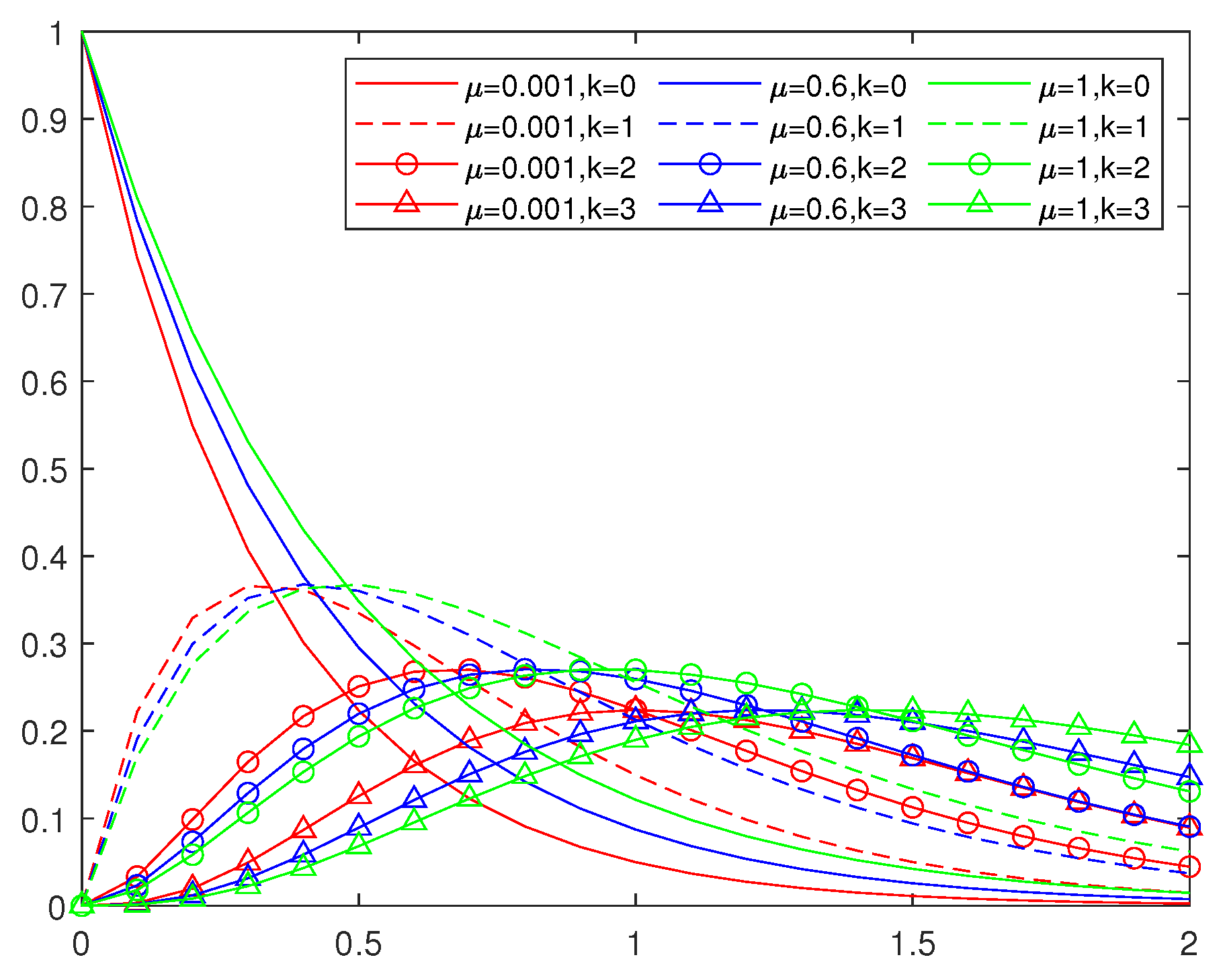
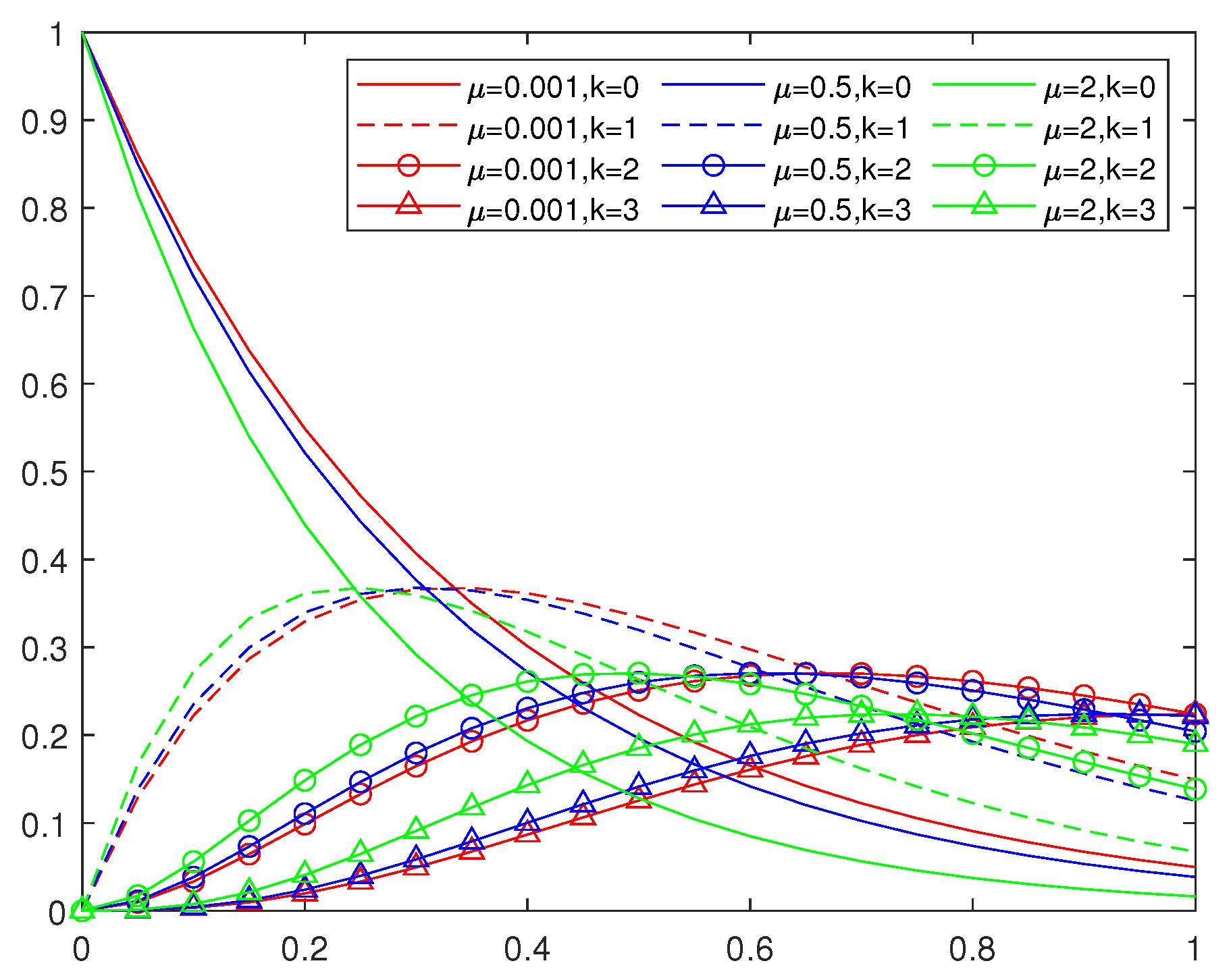
Figure 1 shows the Szsz type basis functions with of degree three, and Figure 2 shows the Szsz type basis functions with of degree three. We can observe the variation of the basis functions with parameters .
Figure 1.
The cubic Szsz basis functions with ,.
Figure 2.
The cubic Szsz basis functions with ,.
The new basis functions hold the following properties:
Lemma 1.
Non-negativity: For
Partition of unity:
Properties at the endpoint:
Integrals:
Derivative:
Maximum value: has only one local maximum at and for and , respectively.
For the operators , we can deduce the following geometric properties from those of the Szsz basis functions.
Lemma 2.
Normativity and boundedness:
Endpoint interpolation:
Linearity: For all real numbers , and functions , , one has
3. Shape Preservation
First, let us consider the monotonicity and convexity for the operators
Theorem 1
(Monotonicity). Let ; if is monotonically increasing (or decreasing) on , for so are all the operators
Proof.
We write
Noting that if is monotonically increasing, then the derivative of the operators is non-negative on , and so is monotonically increasing.
Similarly, we see that if is monotonically decreasing on , so are the operators . □
Theorem 2
(Convexity). Let ; if is convex (or concave), so are all the operators .
Proof.
Now let us take the second order derivative of . It follows from (1) that
If is the convex on , all second order derivatives of in (2) are non-negative, which implies the convexity of .
Similarly, we see that if is the concave on , so are the operators . □
Next, we turn to the starshapedness and semi-additivity.
Theorem 3
(starshapedness). If (or ), then for , (or ).
Proof.
We shall use the representation
noting that
let
which yields,
If is decreasing on , then , i.e., the derivative of , is negative on , and so is decreasing.
Similarly, we see that if is increasing on , then , and so is . □
Theorem 4
(Semi-additivity). If (or ), then for , (or ).
Proof.
We only take as an example to prove the semi-additivity; the case is similar. , ,
let , , then
If is the semi-additive on , one has
which implies is the semi-additive on . Similarly, if is the super-additive on , so is , and thus, the proof is completed. □
Remark 5.
When applying binomial expansion, it does not affect the proof process due to the symmetry between x and y.
4. Preservation of Smoothness
For , the continuous modulus is defined as [27]:
A function on is called a modulus of continuity if is continuous, nondecreasing, semi-additive and [28].
Lemma 3
([28]). For any continuous (not identical to 0), there exists a concave continuous modulus such that for and one has , where the constant 2 can not be any smaller.
Lemma 4.
Let be a sequence of linear positive operators from to , where I is a finite or infinite interval, and , . If is a concave, monotonically increasing and continuous function on I, then .
Remark 6.
We can obtain Lemma 4 by imitating the proof of the Lemma in ref. [21]. Here, we omit the details.
Theorem 5.
For , , one has .
Proof.
As before, we only prove the case ; the case is similar. Since
for , from (3), we write
and then the desired result is obtained. □
Due to the use of Lemma 4 in Theorems 6 and 7 below, noting that , , the following two theorems thus only hold for the case .
Theorem 6.
(i) For , then
(ii) If , then ; here, n is big enough.
Proof.
(i) For the case , , , from (4), and using Lemma 3, we have
and here, we use Lemma 4 for .
(ii) If , then
We have ; here, n is big enough. □
Remark 7.
If , then , here, n is big enough.
Theorem 7.
For any modulus of continuity , is also a modulus of continuity; here, only is considered.
Proof.
For any modulus of continuity, , is continuous, non-decreasing and
Combining the semi-additivity of and , we deduce that is a modulus of continuity. □
5. Illustrative Examples
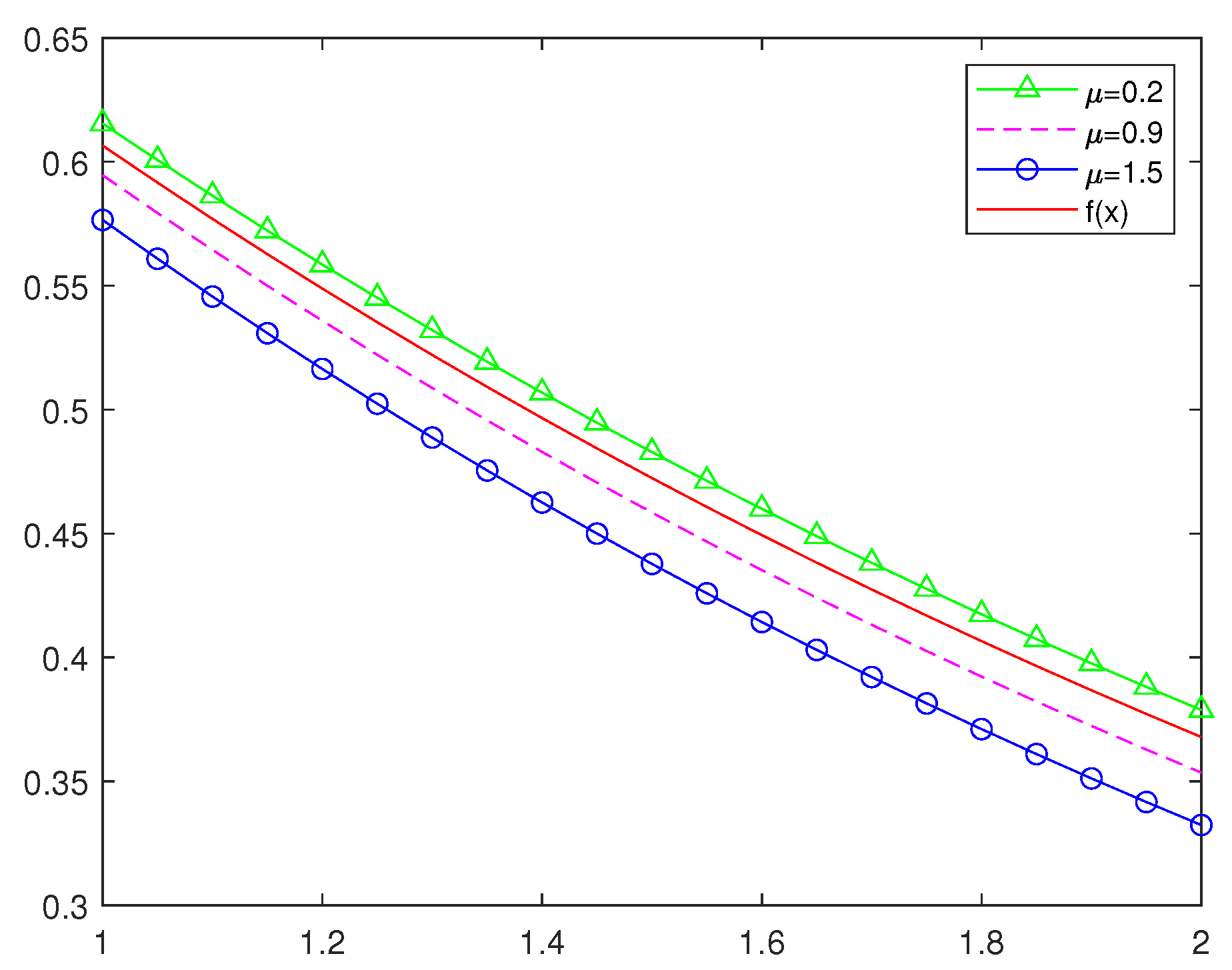
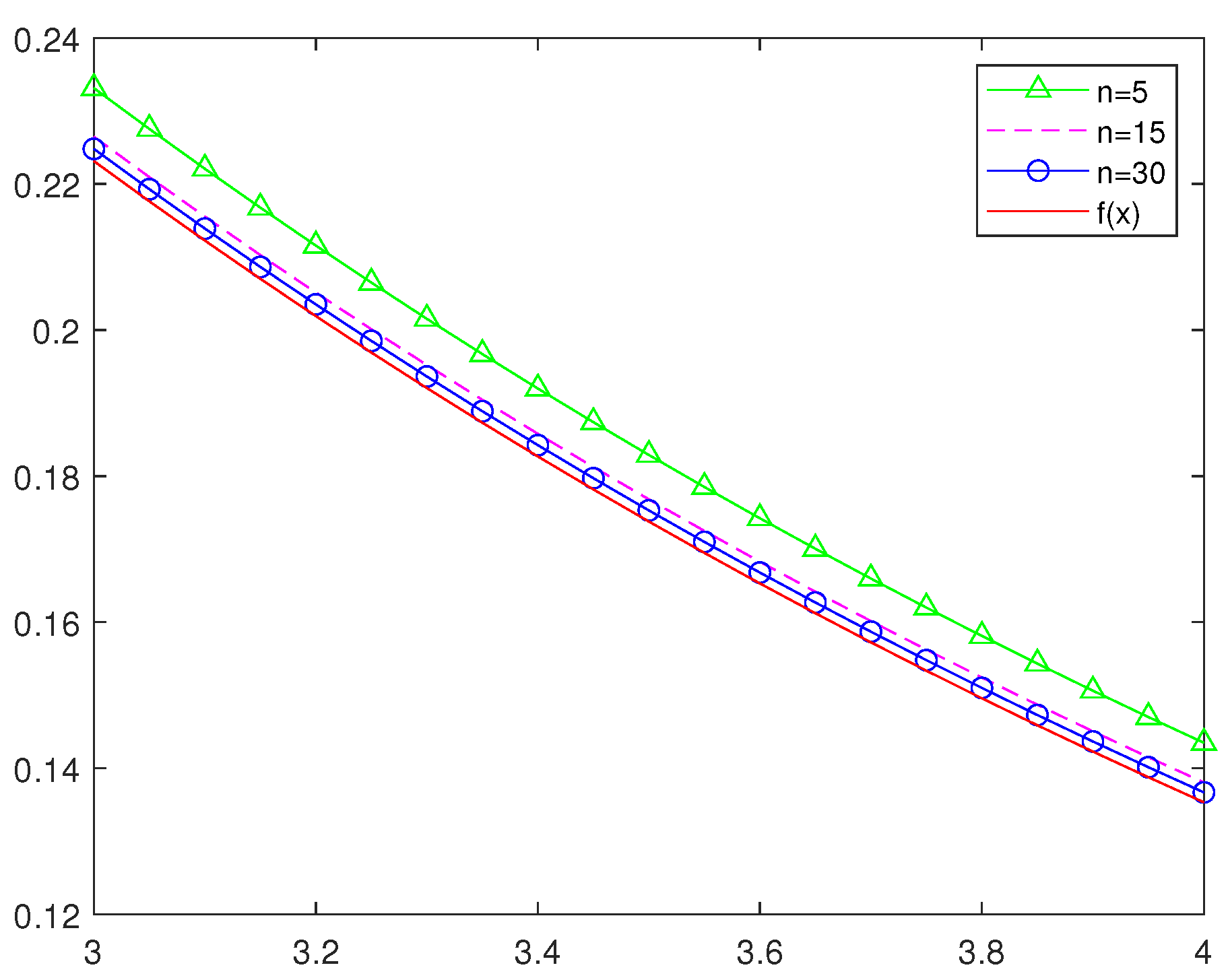
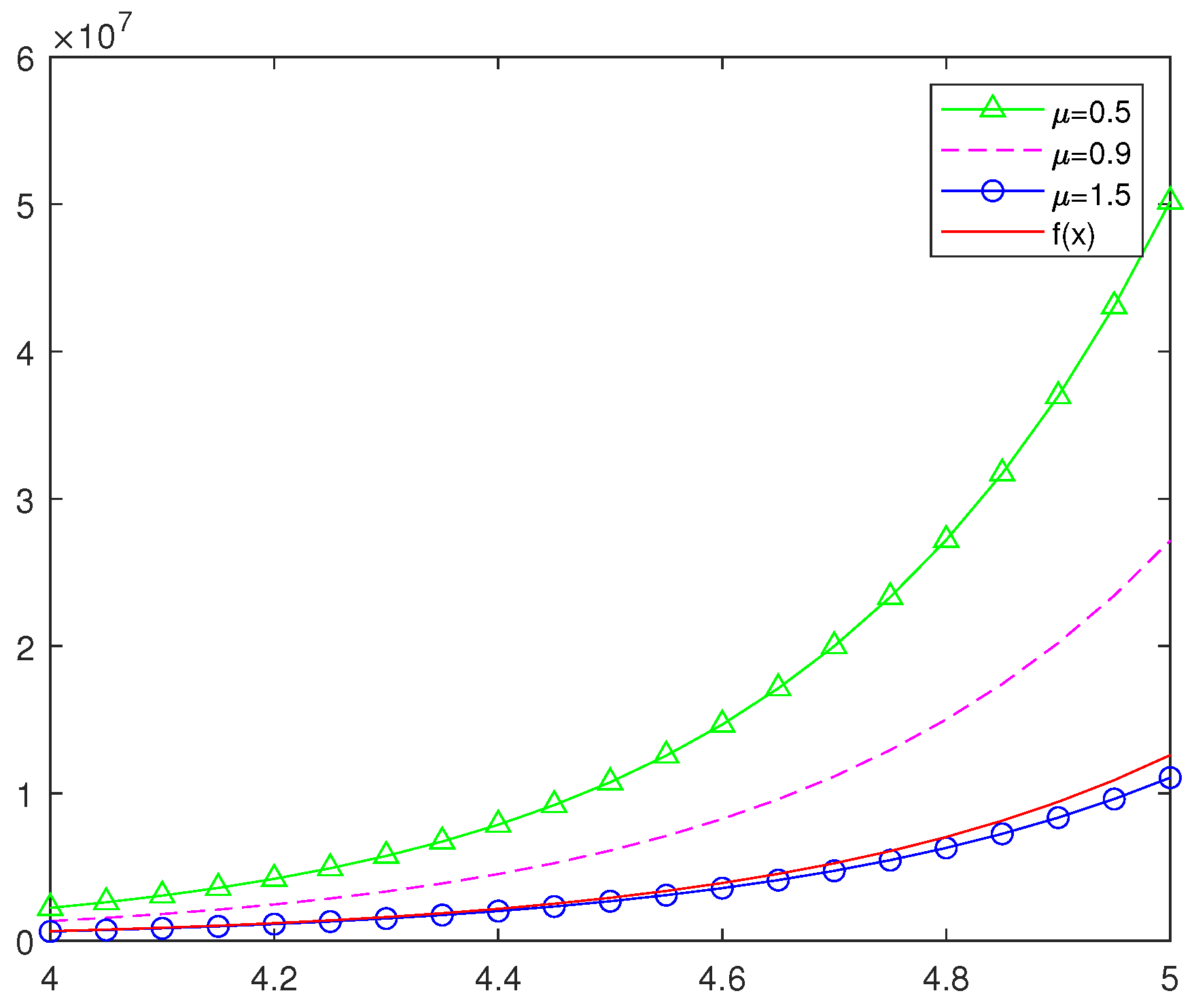
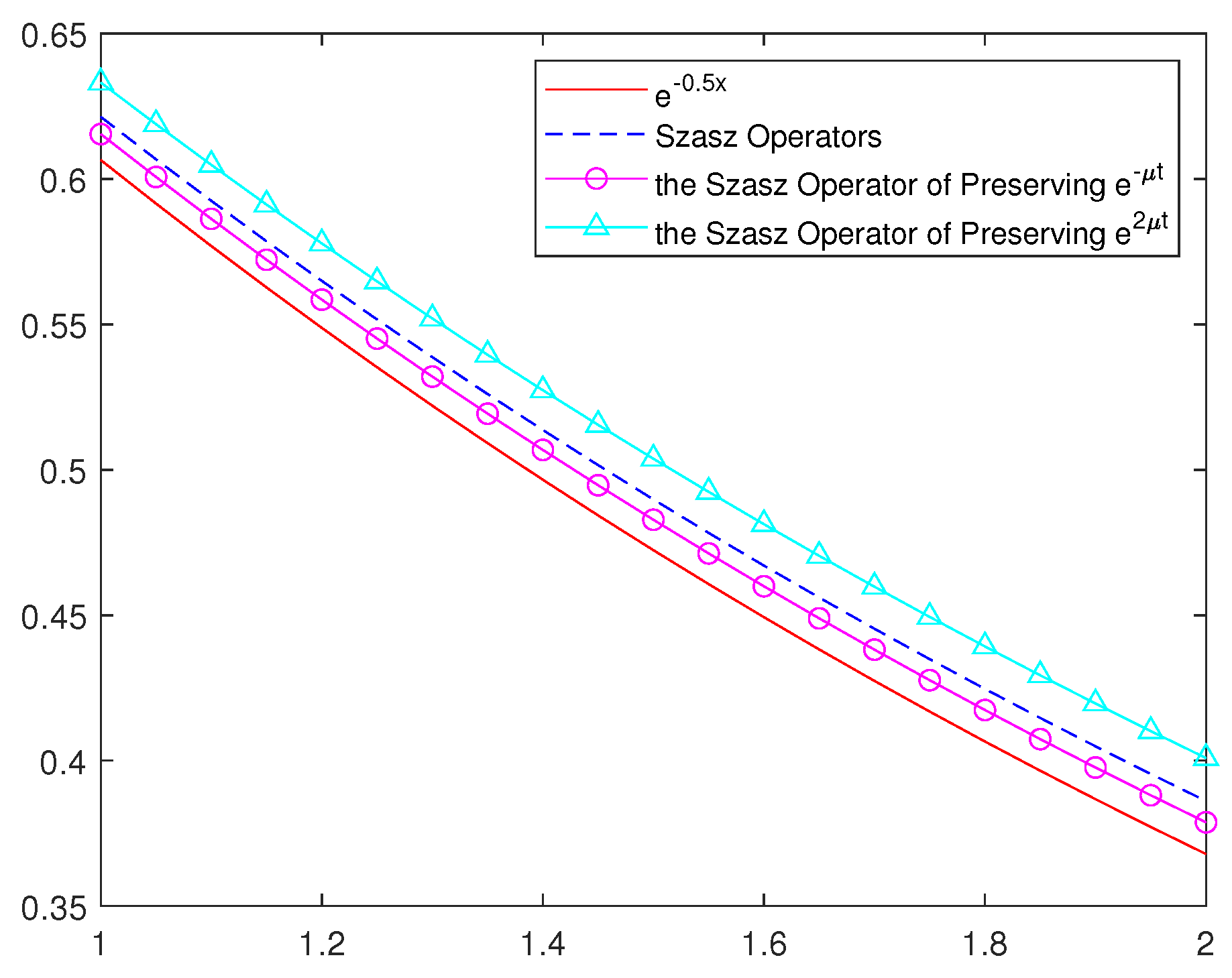
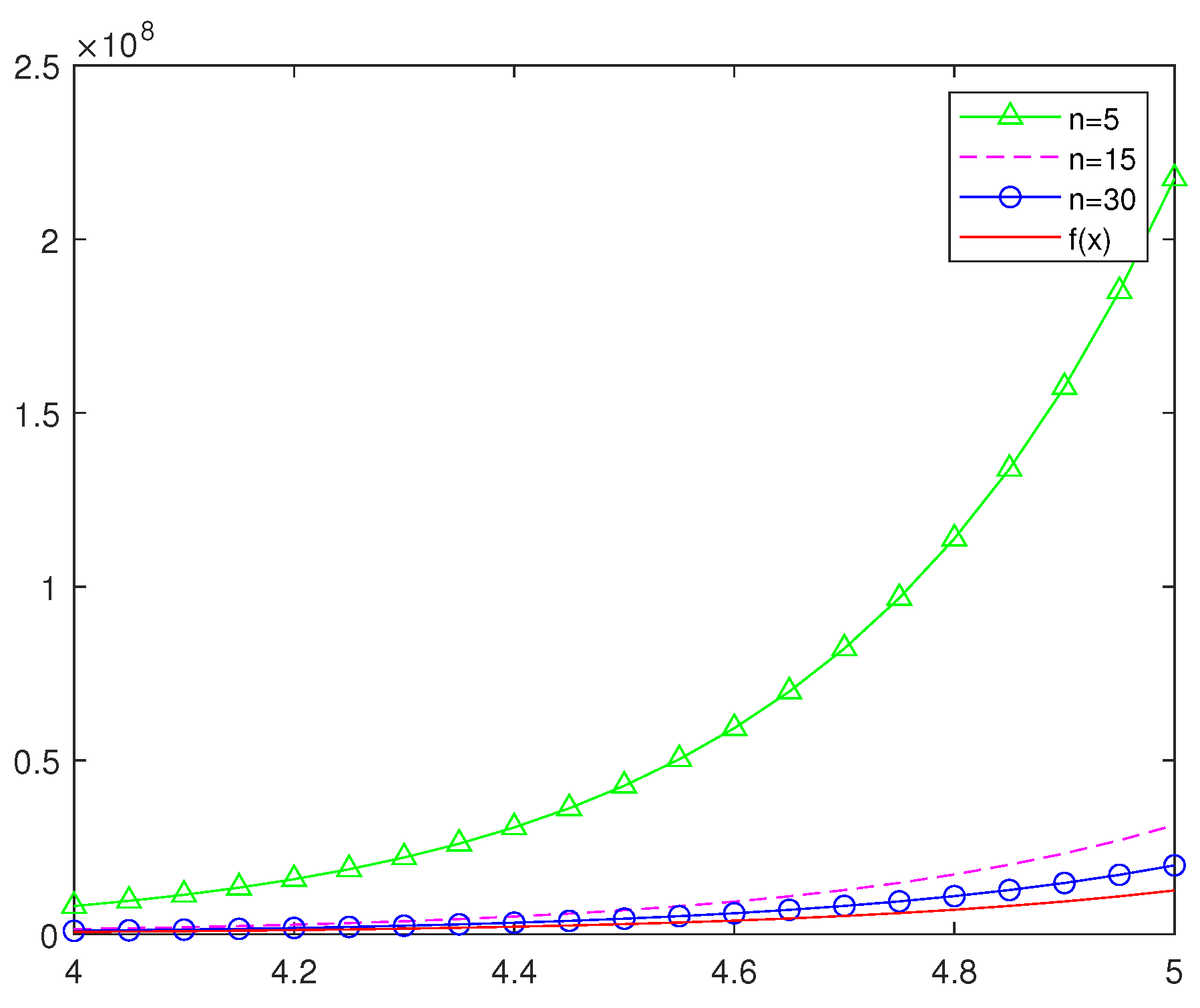
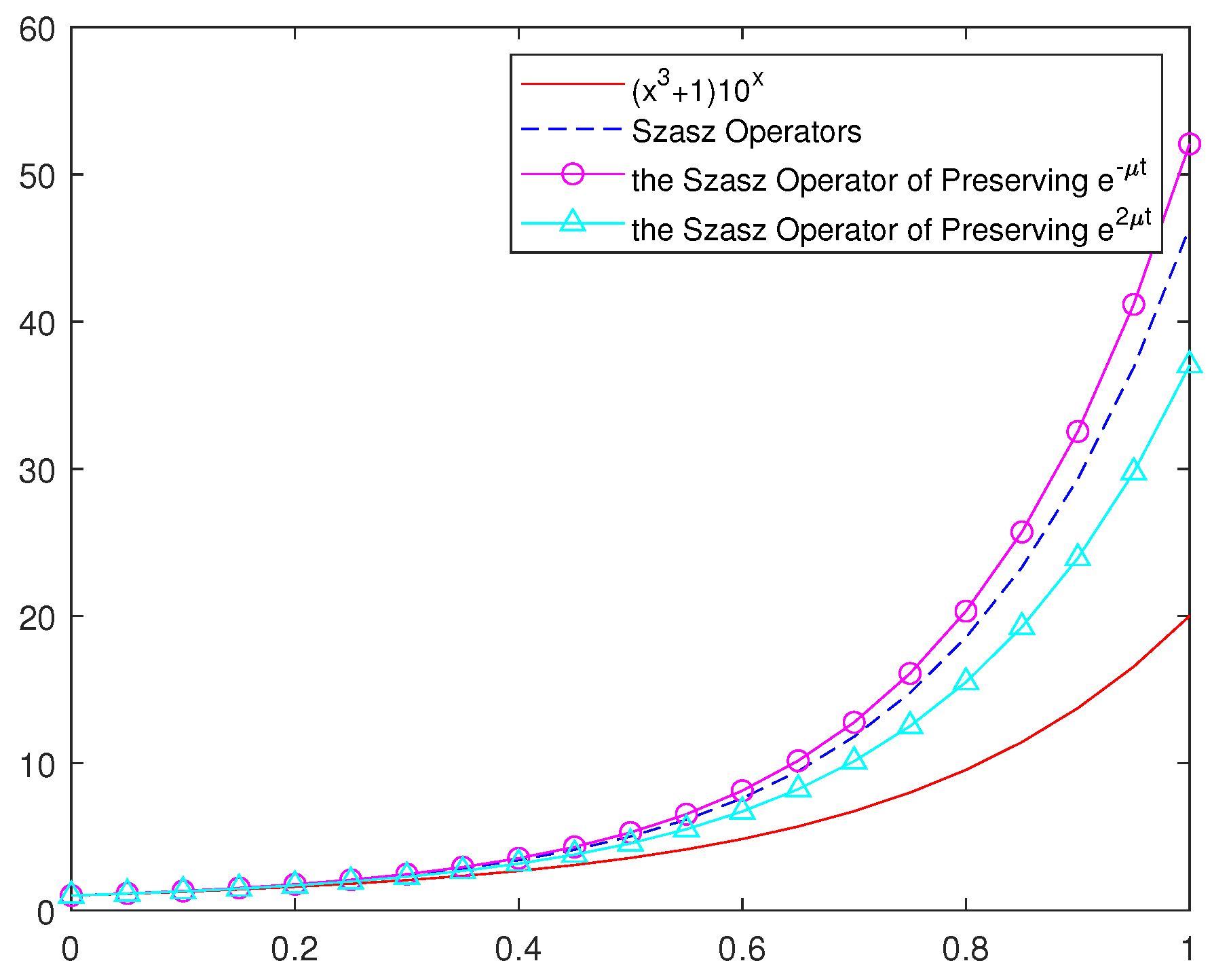
In order to more intuitively understand the approximation effect of classic Szsz operators and several new Szsz operators acting on functions, in this section, we will draw some graphs of different values of and different values of n with the help of Matlab software. Figure 3 and Figure 4 show the approximation of , i.e., the Szsz operators of preserving to the function , where and n take different values; Figure 5 and Figure 6 show the approximation of , i.e., the Szsz operators of preserving to the function , where and n take different values; Figure 7 and Figure 8 show the approximation of the classic Szsz operators, the new Szsz operators of preserving , to the functions and . At the same time, the root mean square errors of their approximation are calculated (See Table 1 and Table 2).
Figure 3.
The approximation of the Szsz operators of preserving to the function , where .
Figure 4.
The approximation of the Szsz operators of preserving to the function , where .
Figure 5.
The approximation of the Szsz operators of preserving to the function , where .
Figure 6.
The approximation of the Szsz operators of preserving to the function , where .
Figure 7.
The approximation of the classic Szsz operators, the Szsz operator of preserving and the Szsz operator of preserving to the function , where .
Figure 8.
The approximation of the classic Szsz operators, the Szsz operator of preserving and the Szsz operator of preserving to the function , where .
Table 1.
Root mean square errors of approximation of four classes of operators to the function , .
Table 2.
Root mean square errors of approximation of four classes of operators to the function , .
6. Conclusions
In this paper, some fundamental facts of two kinds of parametric Szsz type operators are presented. The shape preserving properties, such as linearity, monotonicity, convexity, starshapedness and semi-additivity are examined. Furthermore, with the help of the continuous modulus, the preservation of smoothness is discussed. Finally, illustrative examples are used to verify the validity of the theoretical results and some potential superiorities of our new operators. If we look on future work of the above-defined operators, we can see towards some converse theorems. The results are so beneficial that these can be used in other fields, such as mathematical physics, automobile industry, etc.
Author Contributions
Conceptualization, writing-review and editing, visualization, H.D.; Conceptualization, formal analysis, writing-review and editing, Q.Q. All authors have read and agreed to the published version of the manuscript.
Funding
This research was funded by the Science and Technology Project of Hebei Education Department (No. ZD2019053) and Science Foundation of Hebei Normal University (No. L2020203).
Data Availability Statement
Not applicable.
Acknowledgments
The authors are grateful to the responsible Editor and the anonymous reviewers for their valuable comments and suggestions, which have greatly improved this paper.
Conflicts of Interest
The authors declare no conflict of interest.
References
- Farin, G. Curves and Surfaces for Computer-Aided Geometric Design, 5th ed.; Elsevier Inc.: San Diego, CA, USA, 2002. [Google Scholar]
- Marsh, D. Applied Geometry for Computer Graphics and CAD; Springer: Berlin/Heidelberg, Germany, 2005. [Google Scholar]
- Ye, Z.; Long, X.; Zeng, X.M. Adjustment Algorithms for Bézier Curve and Surface; IEEE: Piscataway, NJ, USA, 2010; pp. 1712–1716. [Google Scholar]
- Chang, G.Z. Generalized Bernstein-Bézier polynomial. J. Comput. Math. 1983, 1, 322–327. [Google Scholar]
- Chang, G.Z.; Wu, J.H. Mathematical foundations of Bézier technique. Comput.-Aided Des. 1981, 13, 133–136. [Google Scholar] [CrossRef]
- Zeeshan; Ahammad, N.A.; Rasheed, H.U.; El-Deeb, A.A.; Almarri, B.; Shah, N.A. A Numerical Intuition of Activation Energy in Transient Micropolar Nanofluid Flow Configured by an Exponentially Extended Plat Surface with Thermal Radiation Effects. Mathematics 2022, 10, 4046. [Google Scholar] [CrossRef]
- Acar, T.; Aral, A.; Gonska, H. On Szász-Mirakyan operators preserving e2ax(a>0). Mediterr. J. Math. 2017, 14, 1–14. [Google Scholar]
- Acar, T.; Aral, A.; Morales, D.C.; Garrancho, P. Szász-Mirakyan type operators which fix exponentials. Results Math. 2017, 72, 93–104. [Google Scholar] [CrossRef]
- Duman, O.; Özarslan, M.A. Szász-Mirakyan type operators providing a better error estimation. Appl. Math. Lett. 2007, 20, 1184–1188. [Google Scholar] [CrossRef]
- Duman, O.; Özarslan, M.A.; Vecchia, B.D. Modified Szász-Mirakyan-Kantorovich operators preserving linear functions. Turk. J. Math. 2009, 33, 151–158. [Google Scholar]
- Gupta, V.; Malik, N. Approximation with certain Szász-Mirakyan operators. Khayyam J. Math. 2017, 2, 90–97. [Google Scholar]
- Bloom, W.R.; Elliott, D. The modulus of continuity of the remainder in the approximation of Lipschitz functions. J. Approx. Theory 1981, 31, 59–66. [Google Scholar] [CrossRef]
- Brown, B.M.; Elliott, D.; Paget, D.F. Lipschitz constants for the Bernstein polynomials of a Lipschitz continuous function. J. Approx. Theory 1987, 49, 196–199. [Google Scholar] [CrossRef]
- Chang, G.Z.; Davis, P.J. The convexity of Bernstein polynomials over triaugles. J. Approx. Theory 1984, 40, 11–28. [Google Scholar] [CrossRef]
- Li, Z.K. Bernstein ploynomials and modulus of continuity. J. Approx. Theory 2000, 102, 171–174. [Google Scholar] [CrossRef][Green Version]
- Khan, M.K.; Vecchia, B.D.; Fassih, A. On the monotonicity of positive linear operators. J. Approx. Theory 1998, 92, 22–37. [Google Scholar] [CrossRef][Green Version]
- Carbone, I. Shape proserving properties of some positive linear operators on unbounded intervals. J. Approx. Theory 1998, 93, 140–156. [Google Scholar] [CrossRef]
- Adell, J.A.; Palomares, A.P. Best constants in preservation inequalities concerning the first modulus and Lipschitz classes for Bernstein-type operators. J. Approx. Theory 1998, 93, 128–139. [Google Scholar] [CrossRef]
- Cal, J.D.L.; Cácomo, J. On certain best constants for Bernstein-type operators. J. Approx. Theory 2001, 113, 189–206. [Google Scholar] [CrossRef]
- Bruckner, A.M.; Ostrow, E. Some function classes related to the class of convex functions. Pac. J. Math. 1962, 12, 1203–1215. [Google Scholar] [CrossRef]
- Hou, X.Q.; Xue, Y.C. On the property of some linear positive operators preserving the class Λω(A). J. Ningxia Univ. (Nat. Sci. Ed.) 1995, 16, 11–16. (In Chinese) [Google Scholar]
- Zhang, C.Z.; Zhu, Z.H. Preservation properties of the Baskakov-Kantorovich operators. Comput. Math. Appl. 2009, 57, 1450–1455. [Google Scholar] [CrossRef]
- Zhang, C.G. Shape preserving properties of a class of Szász-Kantorovich operators. Acta Math. Appl. Sin. 2005, 28, 497–505. [Google Scholar]
- Sabancigil, P.; Kara, M.; Mahmudov, N.I. Higher order Kantorovich-type Szász-Mirakjan operators. J. Inequalities Appl. 2022, 91. [Google Scholar] [CrossRef]
- Szász, O. Generalization of S. Bernstein’s polynomials to the infinite interval. J. Res. Natl. Bur. Stand. 1950, 45, 239–245. [Google Scholar]
- Huang, J.Y.; Qi, Q.L.; Yang, G. Approximation properties of a modified Szász type operators. Pure Math. 2022, 12, 803–813. [Google Scholar] [CrossRef]
- Ditzian, Z.; Totik, V. Moduli of Smoothness; Springer: New York, NY, USA, 1987. [Google Scholar]
- Chen, W.Z. Approximation Theory of Operators; Xiamen University Press: Xiamen, China, 1989. [Google Scholar]
Disclaimer/Publisher’s Note: The statements, opinions and data contained in all publications are solely those of the individual author(s) and contributor(s) and not of MDPI and/or the editor(s). MDPI and/or the editor(s) disclaim responsibility for any injury to people or property resulting from any ideas, methods, instructions or products referred to in the content. |
© 2023 by the authors. Licensee MDPI, Basel, Switzerland. This article is an open access article distributed under the terms and conditions of the Creative Commons Attribution (CC BY) license (https://creativecommons.org/licenses/by/4.0/).