


Abstract
In recent years, the theory of convex mappings has gained much more attention due to its massive utility in different fields of mathematics. It has been characterized by different approaches. In 1929, G. H. Hardy, J. E. Littlewood, and G. Polya established another characterization of convex mappings involving an ordering relationship defined over known as majorization theory. Using this theory many inequalities have been obtained in the literature. In this paper, we study Hermite–Hadamard type inequalities using the Jensen–Mercer inequality in the frame of -calculus and majorized l-tuples. Firstly we derive -Hermite–Hadamard–Jensen–Mercer (H.H.J.M) type inequalities with the help of Mercer’s inequality and its weighted form. To obtain some new generalized (H.H.J.M)-type inequalities, we prove a generalized quantum identity for -differentiable mappings. Next, we obtain some estimation-type results; for this purpose, we consider -identity, fundamental inequalities and the convexity property of mappings. Later on, We offer some applications to special means that demonstrate the importance of our main results. With the help of numerical examples, we also check the validity of our main outcomes. Along with this, we present some graphical analyses of our main results so that readers may easily grasp the results of this paper.
MSC:
05A30; 26A51; 26D10; 26D15
1. Introduction and Preliminaries
A set is said to be convex, if
A mapping is said to be convex or , if
These classical concepts of convexity have held a widespread position in the different areas of pure and applied sciences, for example, they play fundamental roles in optimization theory, majorization theory, operations research, and mathematical economics. Convexity has also close a relationship with the idea of symmetry. It is also worth mentioning right here that quite a few big properties of symmetric convex sets can be discovered in the literature. A beneficial factor of viewing this relationship is that we work on one and practice it to the other. For some greater useful information, see [1,2]. Moreover, this principle of convexity additionally has a pivotal role in developing the theory of inequalities. A wide type of inequalities has direct consequences for the purposes of the convexity property of the mappings. One of the most studied effects in the concept of inequalities pertaining to convex mappings is Hermite–Hadamard’s inequality. It reads as:
Let on , then
Another significant result related to the convexity property of the mappings is Jensen’s inequality, which reads as:
Let , and let nonnegative weights such that . If on , then
where , and , . For more detail, see [3].
In Mercer et al. [4] another significant inequality known as Jensen–Mercer inequality was proven.
Let on , then
for each and , with .
By using inequality (1), Kian and Moslehian prove the Hermite–Jensen–Mercer inequality in [5]. Recently, several papers have been devoted to the generalization of the Hermite–Jensen–Mercer inequality. For more recent and related results connected with the Jensen–Mercer inequality and the Hermite–Jensen–Mercer inequality, see [6,7,8,9,10].
One of the most investigated and studied generalizations of calculus in the last few decades is known as -calculus. It is some sort of special case of time scale calculus with domain . It has numerous applications in number theory, combinatorics, special mappings, mathematical analysis, etc. It works as a bridge between mathematics and physics. Now, we describe some basics notions of -calculus that are necessary for further discussion.
Tariboon and Ntouyas have defined the -derivative as:
Definition 1
([11]). Assume is a continuous mapping and suppose , then
We say that is –differentiable on J provided exists for all . Note that if in (1), then , where is the well-known classical -derivative of the mapping defined by
Next, we recall the well-known number:
The -Jackson integral from 0 to for is defined as:
provided the sum converges absolutely. Jackson also gave the –Jackson integral on a generic interval as:
We now rewrite the definition of a -definite integral.
Definition 2
([11]). Let be a continuous mapping. Then, the -definite integral on is defined as:
The following is the quantum analogue of Hermite–Hadamard’s inequality:
Theorem 1.
Let be a convex mapping, then for , we have
We now present the definition of the -definite integral.
Definition 3
([12]). Let be a continuous mapping. Then, the -definite integral on is defined as:
Using Definition 3, one can have the following quantum version of the Hermite–Hadamard’s inequality.
Theorem 2
([13]). Let be a convex mapping, then for , we have
In recent years, we have seen that a variety of different approaches have been used in obtaining new analogues of classical inequalities. For instance, many researchers have used the concepts of quantum calculus. Ref. [14] established some variants of the Holder’s, power–mean, and Hermite–Hadamard’s inequalities. After this, Noor et al. [15] derived some -estimation type results regarding H.H.I. In the following perspective, Alp et al. [13] formulated some -mid-point H.H type inequalities and provided the correct proof of -H.H.I. In Ref. [16], the authors obtained some Anderson-like inequalities through h and integrals. Ref. [17] Arunrat et al. derived the quantum analogues of the Chebychev inequalities. In ref. [18], Almtairi analysed the -integral inequalities via convexity. In Ref. [19], Kalssom et al. obtained some new generalizations of the Ostrowski-type inequalities via generalized convex mappings.
For some recent studies and more details, see [20,21,22].
Majorization is the characterization of convex mappings the through partial ordered relationship of two l-tuples and , if , then, geometrically, it can be viewed as a component of that is less spread out then u. Now we recall the majorization theorem due to Hardy Littlewood and Polya [23].
Theorem 3.
Let and be two real l-tuples such that . Then
is valid for each continuous convex mapping if and only if .
The weighted version of the above theorem is given as:
Theorem 4
([24]). Let be continuous convex mapping and and be the three l-tuples such that . If u is a decreasing l-tuple and
then
Theorem 5
([25]). Suppose that is a real valued convex mapping, is a real matrix, and is a l-tuple such that for all for with . If u majorizes every row of , then
Now we provide a weighted version of Theorem 5.
Theorem 6
([26]). Suppose that is a real valued convex mapping is a real matrix and and are two l-tuples such that , with and for with . If u majorizes every row of and
then
The theories of majorization and convexity are interlinked with each other and have significant impacts on the theories of inequalities and linear algebra as well. Many researchers have devoted their efforts to generalizing the existing inequalities. Interested readers are referred to [27,28,29,30,31,32].
The main objective of this paper is to derive some new quantum analogues of a generalized Hermite–Hadamard–Jensen–Mercer type of inequalities essentially using -differentiable convex mappings and majorization theory. We discuss some applications to special means, which demonstrate the significance of our main results. We would like to mention here that, to the best of our knowledge, this is the first study of quantum analogues of certain classical inequalities via the theory of majorization. We hope that the ideas and techniques in this paper will inspire interested readers working in this field.
2. Main Results
In this section, we will discuss our main results.
Theorem 7.
Suppose that is real valued convex mapping and are three l-tuples for all . If and , then
Proof.
Let , then we may write
For this, let and for . Then we derive
Since and , then, from the definition of majorization, we have and that is
and
However, and , then by using (11), we have
Hence . Similarly, we can show that . Then, by using Theorem 5 for :
Now, taking -integration of (12) with respect to , we obtain
which gives the first inequality in (7). To obtain the second inequality, we use the left sides of Hermite–Hadamard’s inequalities (4) and (5). Thus, we have
and
This gives the second inequality in (7).
To prove our next relation, we use the following expression
From the convexity of , we have
Adding to both sides of (15), we obtain the required result. □
Remark 1.
If we choose in Theorem 7, then we have the following inequalities
which are proved by Budak and Kara in [22].
Theorem 8.
Suppose that is real valued convex mapping and are three l-tuples for all with , and . If Υ and Ξ are decreasing tuples and
and
Then we have
Proof.
Let , then we may write
Let and for . By using the similar technique as in Theorem 7, we can show that r and z satisfy the following conditions , for and ,
By -integrating the inequality (18) with respect to , we have
From the inequalities (19) and (20), we can write
which gives the second inequality in (16). The last inequality in (16) is obvious from the fact that
The proof is completed. □
We will now derive a new -integral identity. This result will serve as an auxiliary result for our coming results.
Lemma 1.
p Let , and be the three l-tuples such that for all and be a continuous mapping and . If is an integrable mapping on J, then
where
Proof.
This completes the proof. □
If we take , then the above identity gains the following form:
where
Theorem 9.
Let be a continuous mapping. If is convex and integrable on J, then
Proof.
By using Lemma 1, we have
Since is convex, using Jensen–Mercer inequality, we obtain
The proof is completed. □
If we choose , then Theorem 9 reduces to the following relation:
Theorem 10.
Let be a continuous mapping. If is convex and integrable on J, and , then
Proof.
Using the power–mean inequality in (24), we obtain
As is convex, using Jensen–Mercer inequality, it follows that
If we choose , then Theorem 10 yields the following inequality:
Theorem 11.
Let be a continuous mapping. If is convex and integrable on J, then we have
where , , and
Proof.
By applying Hölder’s inequality in (24) and using the Jensen–Mercer inequality, it follows that
It is easy to check that
This completes the proof. □
If we choose , then Theorem 11 reduces to:
3. Applications
In this section, we present some applications to special means of arbitrary positive real numbers and give the numerical verification of our main outcomes. Furthermore, we give the graphical analysis of our results. Now, we recall some well-known means of positive real numbers.
For arbitrary real numbers, we consider the following means:
The arithmetic mean: .
The generalized -mean: .
where , , .
Now, we present an application of Theorem 9 to special means.
Proposition 1.
Let , , then
Proof.
The proof is obvious from Theorem 9, applied thus, . □
Example 1.
If we take with and in Theorem 9, then we have.
Now, we provide a graphical demonstration of Theorem 9 in Figure 1. For this, we consider with and in Theorem 9, then

Figure 1.
This is an image showing the comparison between left and right sides of Theorem 9.
Now, we present an application of Theorem 10 to special means.
Proposition 2.
Let , , then
Proof.
The proof is obvious from Theorem 10, applied thus, . □
Now, we check the validity of Theorem 10 through numerical example.
Example 2.
If we take
with and In Theorem 10, then we have.
Now, we give graphical demonstration of Theorem 10 in Figure 2. For this, we consider with , and in Theorem 10, then
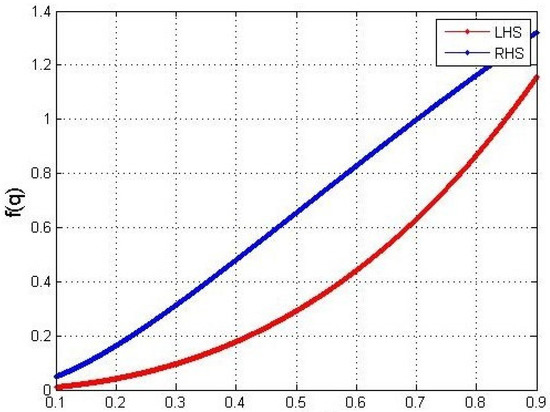
Figure 2.
This is an image showing the comparison between left and right sides of Theorem 10.
Next, we present an application of Theorem 11 to special means.
Proposition 3.
Let , , then
Proof.
The proof is obvious from Theorem 11, applied thus, . □
In the support of Theorem 11, we discuss a numerical example.
Example 3.
If we take with and In Theorem 11, then we have.
Now, we give graphical demonstration of Theorem 11 in Figure 3. For this, we consider with , and in Theorem 11, then
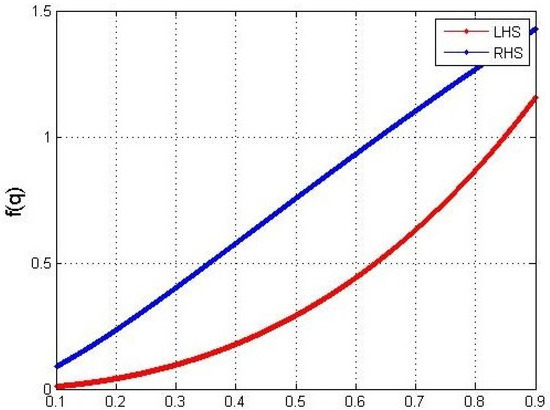
Figure 3.
This is an image showing the comparison between left and right sides of Theorem 11.
4. Conclusions
In this article, we analyzed the -H.H.J.M type inequalities via majorized l-tuples. Moreover, we established some right estimation type results regarding the -H.H.J.M inequality. In the later sections, we presented some applications to means, numerical examples, and graphical illustrations. In the future, we will extend some other well-known inequalities such as the Simpson–Mercer-type inequalities and the Ostrowski–Mercer-type inequalities through generalized quantum integrals. We expect that the combined study of the theory of majorization and calculus will open a new venue for further research in this field.
Author Contributions
All investigations were done by B.B.-M., M.Z.J., M.U.A., H.B., H.K. and M.A.N. All authors have read and agreed to the published version of the manuscript.
Funding
This research was funded by King Saud University grant number RSP-2021/158.
Institutional Review Board Statement
Not applicable.
Informed Consent Statement
Not applicable.
Data Availability Statement
Not applicable.
Acknowledgments
The authors are grateful to the editor and anonymous reviewers for their valuable comments and suggestions. Muhammad Uzair Awan is thankful to the Higher Education Commission of Pakistan.
Conflicts of Interest
The authors declare no conflict of interest.
References
- Anderson, T.W. Some inequalities for symmetric convex sets with applications. Ann. Stat. 1996, 24, 753–762. [Google Scholar] [CrossRef]
- Boltyanski, V.G.; Castro, J.J. Centrally symmetric convex sets. J. Convex Anal. 2007, 14, 345–351. [Google Scholar]
- Dragomir, S.S.; Pearce, C.E.M. Selected Topics on Hermite–Hadamard Inequalities and Applications; Victoria University: Footscray, Australia, 2000. [Google Scholar]
- Mercer, A.M. A variant of Jensen’s inequality. J. Inequal. Pure Appl. Math. 2003, 4, 73. [Google Scholar]
- Kian, M.; Moslehian, M.S. Refinements of the operator Jensen–Mercer inequality. Electron. J. Linear Algebra 2013, 26, 742–753. [Google Scholar] [CrossRef]
- Ali, M.M.; Khan, A.R. Generalized integral Mercer’s inequality and integral means. J. Inequal. Spec. Funct. 2019, 10, 60–76. [Google Scholar]
- Butt, S.I.; Kashuri, A.; Umar, M.; Aslam, A.; Gao, W. Hermite–Jensen–Mercer type inequalities via ψ-Riemann-Liouville k-fractional integrals. AIMS Math. 2020, 5, 5193–5220. [Google Scholar] [CrossRef]
- Butt, S.I.; Umar, M.; Rashid, S.; Akdemir, A.O.; Chu, Y.M. New Hermite–Jensen–Mercer-type inequalities via k-fractional integrals. Adv. Differ. Equ. 2020, 2020, 635. [Google Scholar] [CrossRef]
- HChu, H.; Rashid, S.; Hammouch, Z.; Chu, Y.M. New fractional estimates for Hermite–Hadamard-Mercer’s type inequalities. Alex. Eng. J. 2020, 59, 3079–3089. [Google Scholar]
- Ogulmus, H.; Sarikaya, M.Z. Hermite–Hadamard-Mercer type inequalities for fractional integrals. Filomat 2021, 35, 2425–2436. [Google Scholar] [CrossRef]
- Tariboon, J.; Ntouyas, S.K. Quantum calculus on finite intervals and applications to impulsive difference equations. Adv. Differ. Equ. 2013, 2013, 282. [Google Scholar] [CrossRef]
- Bermudo, S.; Korus, P.; Valdes, J.N. On q-Hermite–Hadamard inequalities for general convex functions. Acta Math. Hung. 2020, 162, 364–374. [Google Scholar] [CrossRef]
- Alp, N.; Sarıkaya, M.Z.; Kunt, M.; İşcan, İ. q-Hermite Hadamard inequalities and quantum estimates for midpoint type inequalities via convex and quasi-convex functions. J. King Saud Univ.-Sci. 2018, 30, 193–203. [Google Scholar] [CrossRef]
- Sudsutad, W.; Ntouyas, S.K.; Tariboon, J. Quantum integral inequalities for convex functions. J. Math. Inequal. 2015, 9, 781–793. [Google Scholar] [CrossRef]
- Noor, M.A.; Noor, K.I.; Awan, M.U. Some Quantum estimates for Hermite–Hadamard inequalities. Appl. Math. Comput. 2015, 251, 675–679. [Google Scholar] [CrossRef]
- Abbas, M.A.; Chen, L.; Khan, A.R.; Muhammad, G.; Sun, B.; Hussain, S.; Rasool, A.U. Some new Anderson type h and q integral inequalities in quantum calculus. Symmetry 2022, 14, 1294. [Google Scholar] [CrossRef]
- Arunrat, N.; Nakprasit, K.M.; Nonlaopon, K.; Agarwal, P.; Ntouyas, S.K. Post-Quantum Chebyshev-type integral inequalities for synchronous functions. Mathematics 2022, 10, 468. [Google Scholar] [CrossRef]
- Almutairi, O.B. Quantum estimates for different type intequalities through generalized convexity. Entropy 2022, 24, 728. [Google Scholar] [CrossRef]
- Kalsoom, H.; Vivas-Cortez, M. (q1, q2)-Ostrowski-type integral inequalities involving property of generalized higher–order strongly n–polynomial preinvexity. Symmetry 2022, 14, 717. [Google Scholar] [CrossRef]
- Kunt, M.; Aljasem, M. Fractional quantum Hermite–Hadamard type inequalities. Konuralp J. Math. 2020, 8, 122–136. [Google Scholar]
- Zhang, Y.; Du, T.-S.; Wang, H.; Shen, Y.-J. Different types of quantum integral inequalities via (α, m)-convexity. J. Inequal. Appl. 2018, 2018, 264. [Google Scholar] [CrossRef]
- Budak, H.; Kara, H. On quantum Hermite–Jensen–Mercer Inequalities, Submitted. 2020. Available online: https://www.researchgate.net/publication/347834994 (accessed on 31 July 2022).
- Hardy, G.H.; Littlewood, J.E.; Polya, G. Inequalities; Cambridge University Press: Cambridge, UK, 1952. [Google Scholar]
- Latif, N.; Pecaric, J.; Peric, I. On discrete Farvald’s and Bervald’s inequalities. Commun. Math. Anal. 2012, 12, 34–57. [Google Scholar]
- Niezgoda, M. A generalization of Mercer’s result on convex functions. Nonlinear Anal. 2009, 71, 2771–2779. [Google Scholar] [CrossRef]
- Faisal, S.; Khan, M.A.; Iqbal, S. Generalized Hermite–Hadamard-Mercer type inequalities via majorization. Filomat 2022, 36, 469–483. [Google Scholar] [CrossRef]
- Abouelregal, A.E.; Marin, M. The size-dependent thermoelastic vibrations of nanobeams subjepcted to harmonic excitation and rectified sine wave heating. Mathematics 2020, 8, 1128. [Google Scholar] [CrossRef]
- Zhang, L.; Bhatti, M.M.; Michaelides, E.E.; Marin, M.; Ellahi, R. Hybrid nanofluid flow towards an elastic surface with tantalum and nickel nanoparticles, under the influence of an induced magnetic field. Eur. Phys. J. Spec. Top. 2022, 231, 521–533. [Google Scholar] [CrossRef]
- Marshall, A.W.; Olkin, I. Inequalities: Theory of Majorization and Its Applications; Academic Press: New York, NY, USA, 1979. [Google Scholar]
- Dragomir, S.S. Some majorisation type discrete inequalities for convex functions. Math. Inequal. Appl. 2004, 7, 207–216. [Google Scholar] [CrossRef] [Green Version]
- Siddique, N.; Imran, M.; Khan, K.A.; Pecaric, J. Difference equations related to majorization theorems via Montgomery identity and Green’s functions with application to the Shannon entropy. Adv. Differ. Equ. 2020, 2020, 430. [Google Scholar] [CrossRef]
- Faisal, S.; Khan, M.A.; Khna, T.U.; Saeed, T.; Alshehri, A.M.; Nwaeze, E.R. New conticrete Hermite–Hadamard–Jensen–Mercer fractional inequalities. Symmetry 2022, 14, 294. [Google Scholar] [CrossRef]
Publisher’s Note: MDPI stays neutral with regard to jurisdictional claims in published maps and institutional affiliations. |
© 2022 by the authors. Licensee MDPI, Basel, Switzerland. This article is an open access article distributed under the terms and conditions of the Creative Commons Attribution (CC BY) license (https://creativecommons.org/licenses/by/4.0/).