


Abstract
In the numerical integration of the second-order nonlinear boundary value problem (BVP), the right boundary condition plays the role as a target equation, which is solved either by the half-interval method (HIM) or a new derivative-free Newton method (DFNM) to be presented in the paper. With the help of a boundary shape function, we can transform the BVP to an initial value problem (IVP) for a new variable. The terminal value of the new variable is expressed as a function of the missing initial value of the original variable, which is determined through a few integrations of the IVP to match the target equation. In the new boundary shape function method (NBSFM), we solve the target equation to obtain a highly accurate missing initial value, and then compute a precise solution. The DFNM can find more accurate left boundary values, whose performance is superior than HIM. Apparently, DFNM converges faster than HIM. Then, we modify the Lie-group shooting method and combine it to the BSFM for solving the nonlinear BVP with Robin boundary conditions. Numerical examples are examined, which assure that the proposed methods together with DFNM can successfully solve the nonlinear BVPs with high accuracy.
1. Introduction
There are numerous numerical methods to tackle the boundary value problems (BVPs) in [1,2,3,4,5,6,7,8,9,10]. The present paper will derive a very powerful numerical solver with a derivative-free Newton method to solve the target equation in terms of the Robin type boundary conditions. Recently, Liu and Li [11] designed the bases of solution by transforming the nonhomogeneous Robin boundary conditions to the homogeneous ones by using the homogenization function technique, and then seeking the polynomial bases to satisfy the homogeneous Robin boundary conditions. They introduced the energetic Robin boundary functions as the bases, whose processes are quite complicated.
For the first-order system of ordinary differential equations (ODEs), the group-preserving scheme (GPS) has been developed by Liu [12] for the solutions of initial value problems (IVPs). The main difference between the GPS and the traditional numerical integration methods is that those schemes are all formulated directly in the usual Euclidean space, while the GPS is formulated in the Minkowski space. A major advantage of the formulation of ODEs in the Minkowski space is that we can develop group preserving schemes to retain the inherent Lie-symmetry of the augmented ODEs in the Minkowski space. Recently, Xu and Wu [13] combined the GPS with a midpoint technique to improve the accuracy and convergence property. Liu [14] extended and modified the GPS for solving second-order BVPs, based on the Lie-symmetry of the proper orthochronous Lorentz group, who introduced one-step GPS by utilizing the closure property of the Lie-group and labelled it as the Lie-group shooting method (LGSM). Moreover, Liu [15] developed the LGSM for solving nonlinear singularly perturbed boundary value problems. Recently, Hajiketabi and Abbasbandy [16] developed a simple, efficient and accurate Lie-group shooting method for solving nonlinear boundary value problems.
The paper is outlined as follows. In Section 2, the boundary shape function for automatically satisfying the Robin boundary conditions is introduced, where two cases are considered. In Section 3, we transform the BVP to a new IVP for the new variable , with its terminal value being expressed as a function of the missing initial value of the original variable . This new version is a modification of the original boundary shape function method (BSFM). In Section 4, we develop an iterative algorithm relying on the new boundary shape function method (NBSFM), and the half-interval method (HIM) is used to solve the target equation. In Section 5, the Lie-group shooting method is combined with the BSFM for developing a new iterative algorithm of LGSBSFM. Here, a main contribution is developing a derivative-free Newton method to solve the target equation. In Section 6, we test numerical examples by using these algorithms. We introduce the general Robin boundary value problems in Section 7, the corresponding NBSFM is derived, and two numerical examples are given. Finally, Section 8 makes the conclusions.
2. Boundary Shape Function
Consider the boundary value problem (BVP):
A more general BVP with two-side Robin boundary conditions will be considered in Section 7. We first discuss the right boundary condition with . For , the processes are similar.
For Equation (2), we consider two cases: (a) and (b) . Suppose that
For cases (a) and (b), we have, respectively,
A translation function in terms of and reads as
where is a new variable.
Theorem 1.
The boundary shape function is given by
which satisfies
Proof.
Inserting into Equation (9) and using Equation (8),
Taking the differential of Equation (9), inserting and using Equation (8), we have
A combination of Equations (11) and (12) leads to
by Equations (4) and (5), which becomes
Inserting into Equation (9) and using Equation (8),
which, due to Equations (4) and (5), becomes
The proof of Equation (10) is ended. □
3. The Initial Value Problem
For Equation (1), if very accurate initial conditions and are determined, one can obtain a very precise solution of by using a higher order numerical integrator to integrate the ODE. Therefore, it is an important topic to precisely determine and by an efficient numerical method. Based on Theorem 1, we can develop an iterative algorithm to solve Equation (1) subjected to Equations (2) and (3). Inserting Equation (9) for into Equation (1), we can achieve
where involves as unknown constant in Equation (8), but and are given initial values.
In order to calculate the unknown value in Equation (16) and achieve a deeper analysis, we carry out the following works. If , we assume that
is a constant to be determined and is given by . Alternatively, if , we assume that
is a constant to be determined and is given by .
Under the condition for case (a), it follows from Equations (6), (9) and (17) that
For case (b), it follows from Equations (7), (9) and (17), that
On the other hand, under the condition and for case (a), it follows from Equations (6), (9) and (18) that
For case (b), it follows from Equations (7), (9) and (18) that
The above equations reveal that can be computed from or . Inserting these into Equation (16), we can obtain a definite ODE in terms of or :
which, upon giving and , are initial value problems (IVPs) endowed with one unknown parameter or to be determined.
Notice that in the original BSFM developed in [17], in Equation (8) is determined by an iterative method, which repeatedly integrates Equation (16) to obtain the new value of until convergence. To improve the slower convergence and slightly lower accuracy of the original BSFM, we recast Equation (16) to Equation (23) or (24), which may be called a new boundary shape function method (NBSFM). Powerful methods will be developed below to determine or by solving the target equation. Deng et al. [18] have extended the BSFM to solve the nonlinear BVP under nonlinear boundary conditions.
4. The Iterative Algorithm of NBSFM
Because the initial values are given, we can integrate Equation (23) or (24) from to , with a given or to obtain and ; hence, inserting into Equation (9) and using Equations (8) and (3) yields
which can determine or by solving a scalar equation, where and are obtained by integrating Equation (23) or (24).
The curve of vs. or vs. is a curve of a target function. We can adjust the value of or until or satisfies or , where is a given tolerance of the error to mismatch the right-end boundary condition (3), which is an implicit equation to determine or . We can apply the half-interval method to solve Equation (25) or (26), where we repeatedly integrate Equation (23) or (24) with N steps from to to obtain and , and then by Equation (25) or by Equation (26).
The half-interval method (HIM) is described as follows. We can decide two initial guesses and A, such that . Then, we repeat the following process until convergence:
In the half-interval method twice integrations to obtain the right-end values of u at each iteration are required.
The processes to solve are summarized as follows:
- (i)
- Give , the initial guesses of and A, , and .
- (ii)
- Integrate Equation (23) to to obtain and apply the HIM to solve Equation (25) until .
The process to determine can be done similarly, by using Equations (24) and (26).
5. Lie-Group Shooting BSFM
5.1. A Combination of LGSM and BSFM
The original Lie-group shooting method developed by Liu [14] was applicable to the nonlinear BVP with simple Dirichlet or Neumann boundary conditions. For solving Equations (1)–(3), we can combine the Lie-group shooting method and the BSFM as a new Lie-group shooting boundary shape function method (LGSBSFM), which is used to solve in Equation (16). Here, with case (a) and as a demonstrative case, we let
where A and B are two unknown constants, and c is a given constant.
Based on the Lie-group shooting method [14], without going into the details, we can derive A for the case :
where
and for the case :
For a trial , we can iteratively solve A from Equations (33), (34), and (37). The advantage is that we can determine the slope of the new variable in terms of a factor r within a unit interval, which, however, has a drawback of the Lie-group shooting method to iteratively solve A for each r. As a modification, we directly determine A by integrating Equations (27)–(30) to obtain the right-end value , and then compare it to the desired one . If is smaller than a given error tolerance , then the process to find A is finished. Similarly, the iteration process can be performed by HIM to find a suitable value of A by starting from two given values and with .
When is determined, we can obtain by . On the other hand, according to Equations (19), (29), and (30), we can derive
wherein c is eliminated and is used. The initial conditions for are available as follows:
In addition, then, we can integrate Equation (1) using the derived initial conditions and to obtain .
5.2. A Derivative-Free Newton Method
We can counter the number of iterations for the half-interval method (HIM), which needs 50 iterations for reducing an initial error 1 to a final error with . If the error tolerance is to satisfy the right boundary condition, the HIM will spend steps in the numerical integrations of the ODE to obtain the right-end values. To reduce the computational burden, a derivative-free Newton method (DFNM) for solving a scalar equation is motivated by the Newton iterative method:
Unfortunately, the derivative term hinders the use of the Newton method in LGSBSFM, since the scalar target equation is an implicit function of A.
Suppose that is a simple root with and . In order to get rid of the derivative term in Equation (40), we consider
Neglecting the higher-order terms and inserting it into Equation (40), we have
On the other hand, we have
Neglecting the higher-order terms and replacing in Equation (42) by , we can derive a derivative-free Newton method (DFNM):
where
Next, we turn our attention to the determination of a and b in Equation (45), whose values will influence the convergence speed. Like the half-interval method, the first step is choosing two initial guesses and such that to render . Then, we take . As the approximations of a and b in Equation (45), we can evaluate them by using the technique of finite difference:
In summary, the procedures of the DFNM are given as follows:
- (i)
- Give the initial guesses of and to render .
- (ii)
- Compute a and b by Equation (46).
- (iii)
- For n = 0,1,…, doing
The LGSBSFM together with the DFNM for solving in Equations (1)–(3) is summarized as follows:
- (i)
- Give , the initial guesses of and to render , and give , and .
- (ii)
- Compute , , and a and b by
- (iii)
- Let and for n = 0,1,…, doinguntil .
In each iteration, the integration of Equations (27)–(30) to obtain the right-end value is required, which is saving more than twice the integrations at each iteration used in the HIM. For saving computational time, the DFNM is suggested to be used.
For solving a scalar equation , the numerically computed order of convergence (COC) is approximated by [19,20]
where r is a solution of and the sequence is generated from an iterative scheme. In the computation of COC, we store the values of where , and take , with the number of iterations for the convergence.
6. Examples
To solve Equations (1)–(3), we have developed two iterative algorithms of the NBSFM and LGSBSFM, which can be combined with the HIM or DFNM to solve the target equation. Some examples are given below to explore the performance of these algorithms.
6.1. Example 1
The following BVP is given in [21]:
An exact solution is
6.1.1. Case (a)
Instead of Equation (49), we consider a left Robin boundary condition:
Due to , , and , this is a case (a) problem in Section 2 and Section 3.
By using the conventional shooting method, we take
where is an unknown constant to match the target equation . We can employ HIM to solve the scalar equation . Under and , we find that the conventional shooting method does not converge within 1000 iterations, although the solution of is accurate with the maximum error (ME) being .
In the NBSFM with HIM, we take , , and
Under the parameters , , and , the NBSFM with HIM converges with 42 iterations with ME = . The result is more accurate than that in [14]. If we raise , the ME is reduced to , and it is with 48 iterations for convergence. If we employ the NBSFM with DFNM, it is convergent with 14 iterations to obtain the same results. Since only 14 iterations are required, the CPU time is short with 0.6 s. Although with the HIM the CPU time is 0.9 s, its number of iterations is 42. COC = 1.6122 obtained by DFNM reveals that the present method is convergent very fast.
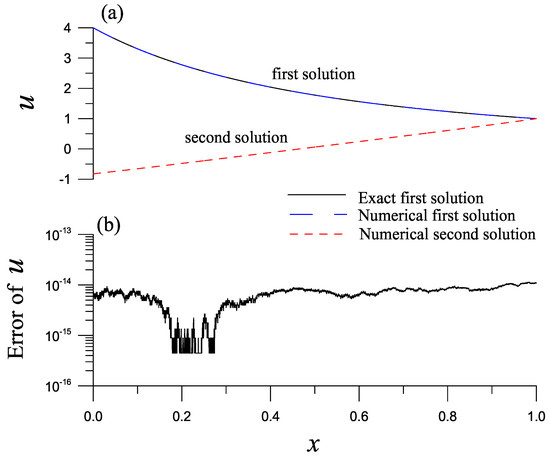
Next, we apply the LGSBSFM in Section 5 together with HIM to solve this problem with , , , , and , which is convergent with 48 iterations, and the numerical solution coincides wth the exact one as shown in Figure 1a, whose errors are plotted in Figure 1b with ME = . If we employ the LGSBSFM with DFNM, it is convergent with 10 iterations to obtain the same results with ME = . The CPU time is very short with 0.46 s, and COC = 1.2546 is obtained, which indicates that the LGSBSFM with DFNM is effective.
Figure 1.
For example 1, (a) comparing the first and second solutions obtained by the Lie-group shooting BSFM and (b) displaying the errors of the first solution.
When we take , , , we obtain the second solution as shown in Figure 1a by dashed line. The LGSBSFM with HIM is convergent with 47 iterations and with the right boundary error being . If we employ the LGSBSFM with DFNM, it is convergent with 16 iterations and with the right boundary error being .
In Table 1, we tabulate the absolute errors and compare that obtained in [17]. The accuracy upon comparing to that computed in [17] using the boundary shape function method is raised about five orders.
Table 1.
For example 1, comparing errors at different x.
In Table 2, we tabulate the numerical value at different x and compare it to the exact one. The accuracy is up to to .
Table 2.
For example 1, list the numerical values and errors at different x.
6.1.2. Case (b)
Next, we consider other boundary conditions for Equation (48):
Due to , , and , this is a case (b) problem in Section 2 and Section 3.
By using the NBSFM with DFNM, and and is given by
Under the parameters , and , the NBSFM with DFNM converges with nine iterations with ME = . Then, we apply the LGSBSFM together with DFNM to solve this problem with , , , and , which is convergent with 13 iterations, and the numerical solution coincides with the exact one with ME = .
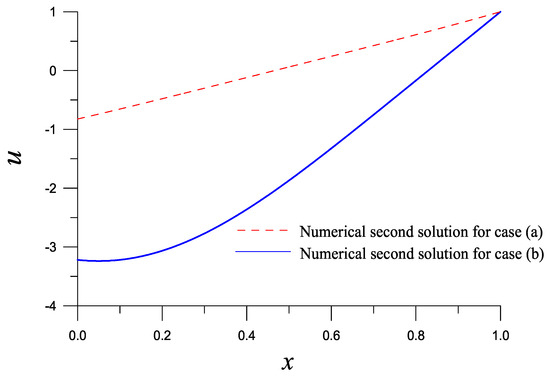
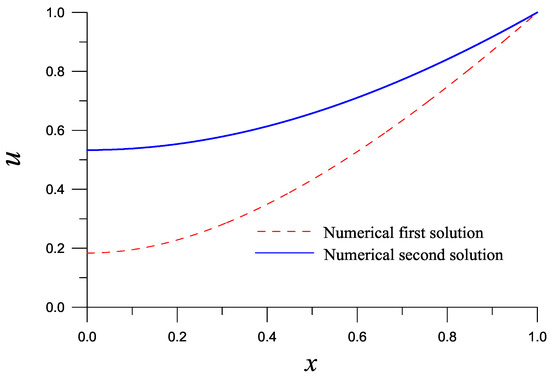
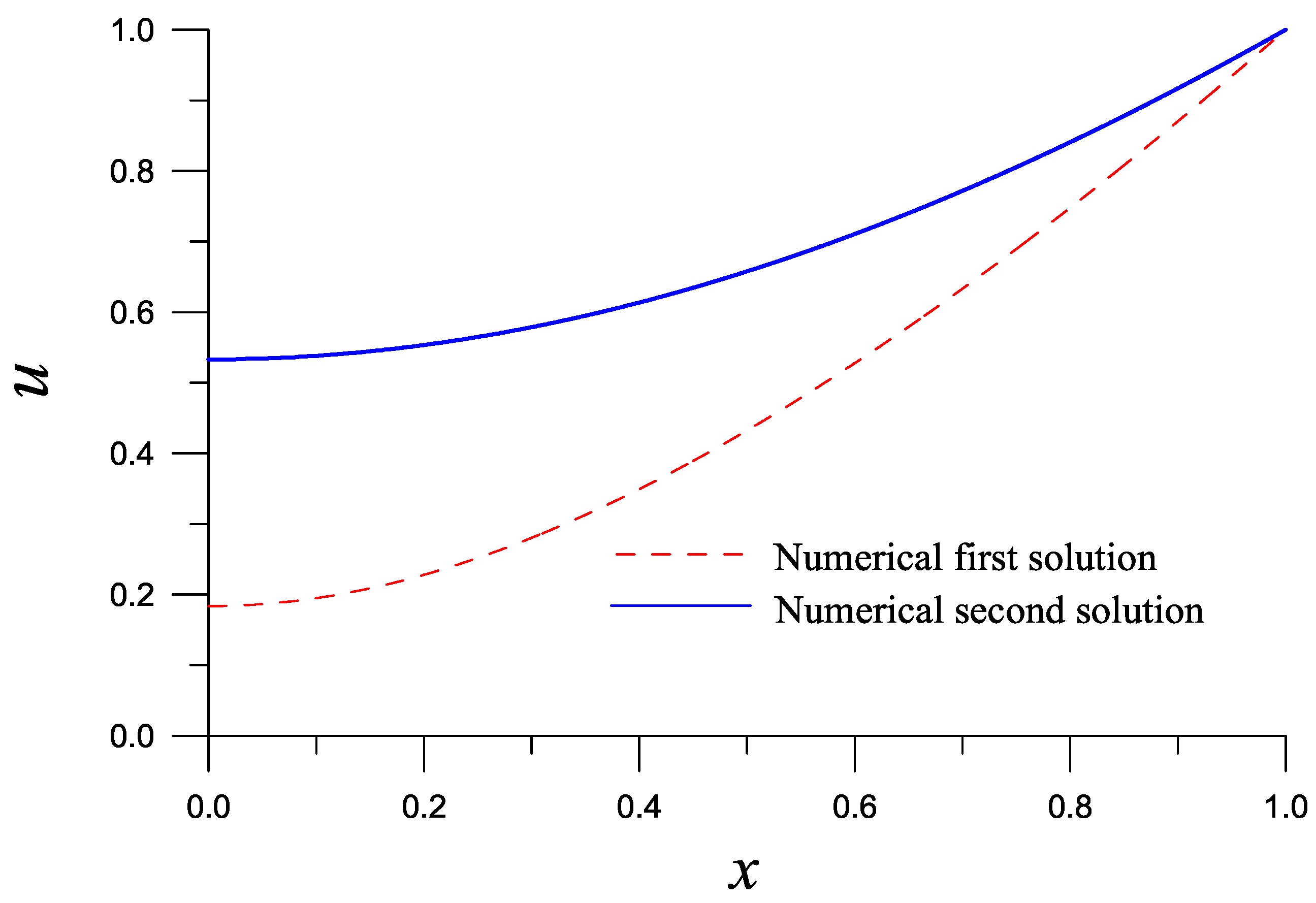
When we change c to , the LGSBSFM together with DFNM obtains the second solution, which is convergent with 10 iterations. We obtain and , and the second numerical solution of case (b) is compared to that of case (a) in Figure 2.
Figure 2.
For example 1, comparing the second solutions of cases (a) and (b) obtained by the Lie-group shooting BSFM with DFNM.
6.2. Example 2
Consider a reaction problem [22]:
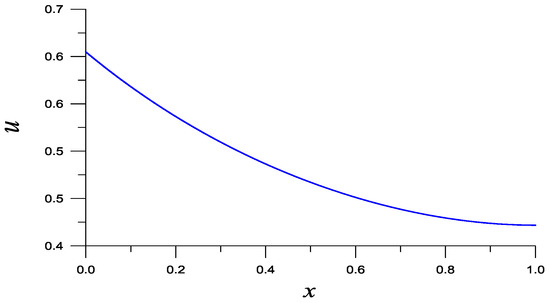
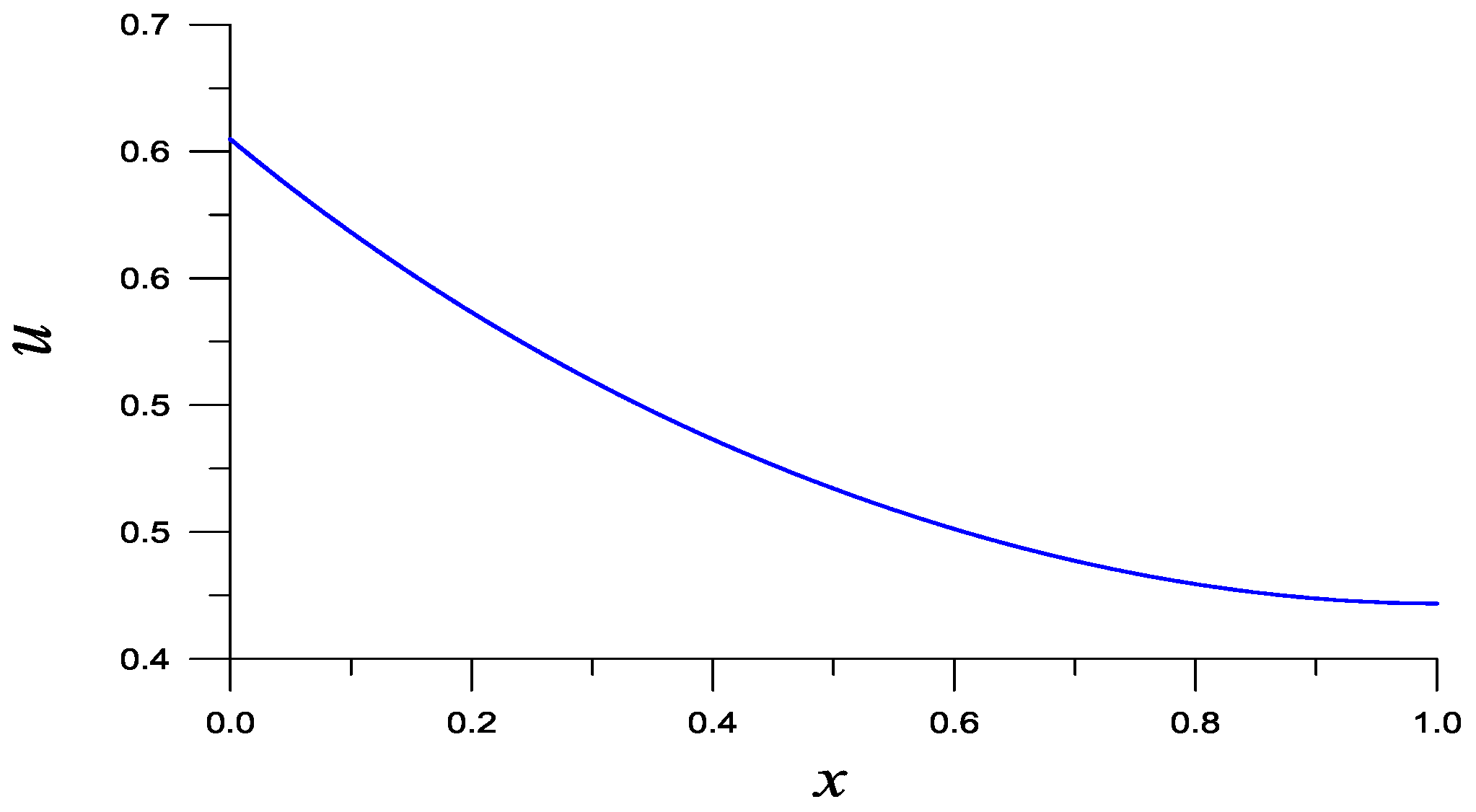
For this problem, we assume that in Equation (18) is a constant to be determined and is given by . By using the NBSFM with the DFNM, we take and and is given by
Under the parameters , , , , , and , the NBSFM with HIM by two initial guesses and to render converges with 45 iterations with the right boundary error being . In contrast, by using the NBSFM with DFNM, it converges with seven iterations with the same right boundary error . The numerical solution is plotted in Figure 3. Since only seven iterations are required, the CPU time is very short with 0.35 s, and COC = 1.0044 is obtained by DFNM.
Figure 3.
For example 2, showing the solution obtained by the NBSFM with DFNM.
6.3. Example 3
Consider a nonlinear model of diffusion and reaction in porous catalysts [23,24,25,26,27,28]:
For this problem, we assume that in Equation (18) is a constant to be determined by
where , when the LGSM is used.
Under the parameter , Magyari [26] has derived an implicit solution:
If , for the first solution and for the second solution. It is obvious that the exact value is .
With , and , the NBSFM with the HIM by two initial guesses and to render , converges with 42 iterations with the maximum error of the first solution being . Similarly, by using the NBSFM with DFNM, it converges with eight iterations with the same error.
Then, we apply the LGSBSFM together with HIM or DFNM to solve this problem with , , , , and , which is convergent with 39 iterations for the HIM, and with nine iterations for the DFNM. The numerical first solution coincides with the exact one in Equation (62) with with ME = , which is plotted in Figure 4 with the dashed line. When we take , , , and LGSBSFM together with DFNM converges with seven iterations. The second numerical solution coincides with the exact one in Equation (62) with with ME = , which is plotted in Figure 4 by the solid line. The accuracy is better than that obtained in [16] about five orders.
Figure 4.
For example 3, comparing the first and second solutions obtained by the Lie-group shooting BSFM with DFNM.
6.4. Example 4
Let us solve the Bratu equation [29]:
which has an exact solution:
where satisfies
The Bratu problem has zero, one, and two solutions when , and , respectively, where .
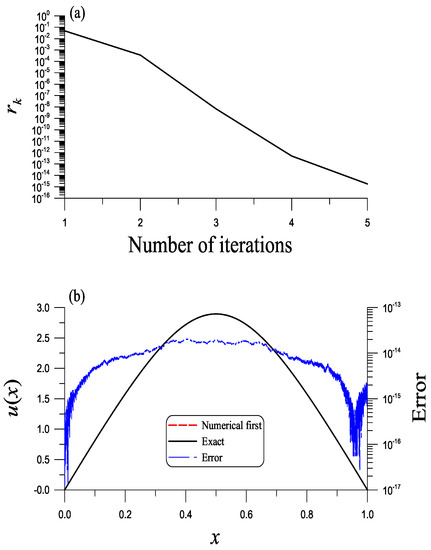
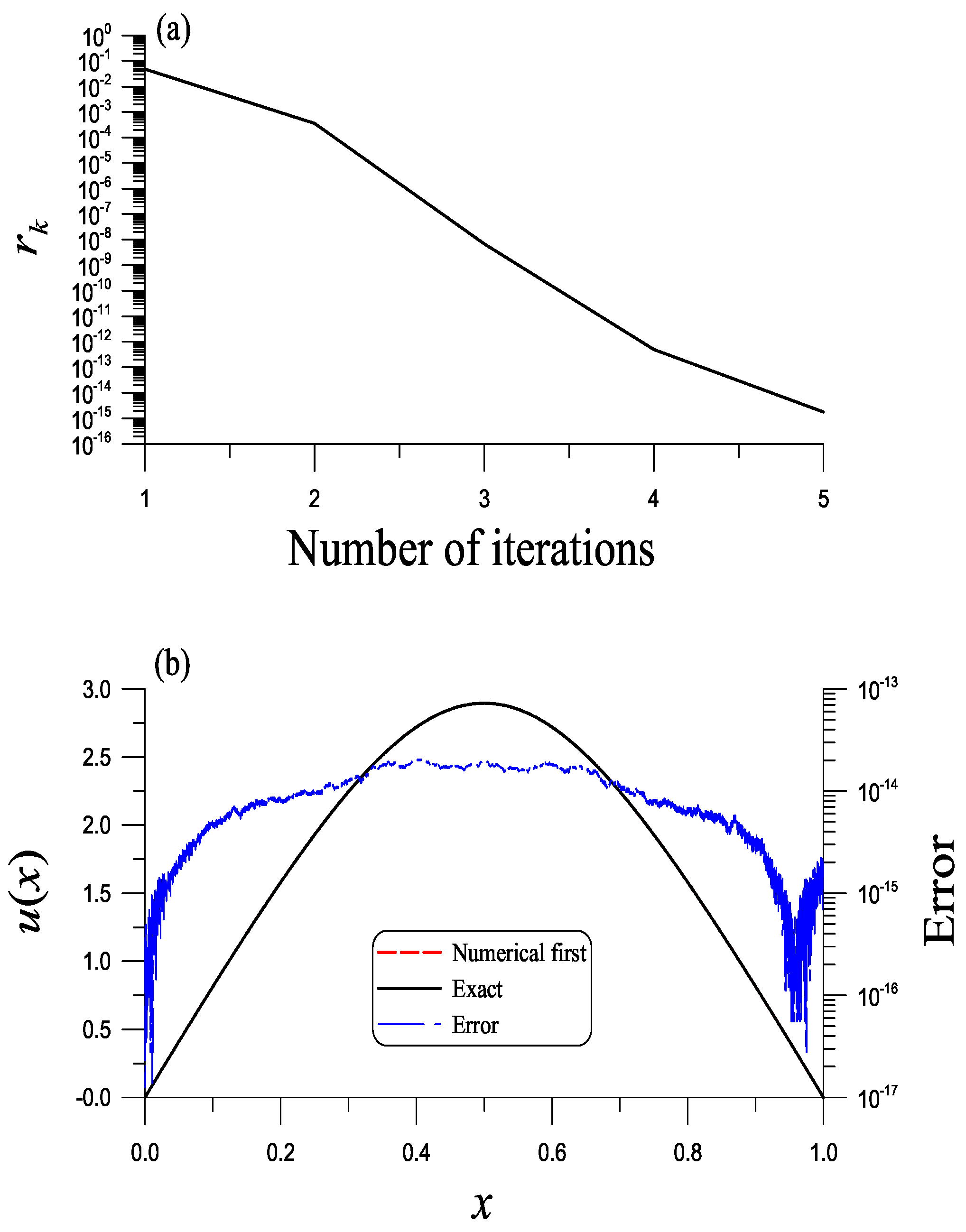
In the NBSFM with DFNM, we assume that as an initial slope to be determined. We take , , and , obtaining , which is very close to the exact one with an error . With five iterations as shown in Figure 5 for the convergence, we obtain the solution as shown in Figure 5b by a solid line. Since only five iterations are required, the CPU time is very short with 0.49 s, and COC=1.0204 reveals that the present method is convergent fast—although, for HIM, the CPU time is 0.87 s. The numerical solution coincides with the exact one in Equation (65), and the numerical error is shown in Figure 5b by a dotted-dashed line with ME = .
Figure 5.
For example 4, (a) convergence rate and (b) comparing the present solution obtained by the NBSFM with DFNM to the exact one and showing error.
Table 3.
For example 4 with , comparing errors at different x.
7. Two-Side Robin Boundary Conditions and Examples
In this section, we extend the NBSFM and DFNM to the following nonlinear BVP under the two-side Robin boundary conditions:
7.1. A New Methodology
As that done in [17], two shape functions are determined by
Then, the following variable transformation is employed:
which guarantees that satisfies Equation (68) when is solved.
In [17], the authors determine and in Equation (71) by the iteration method until the convergence of and . Here, we let
where is an unknown constant to be determined.
As before, we let be an unknown constant to be determined, and, after inserting , it follows from Equation (73) that
Like that in Equations (19)–(22), where is expressed in terms of or , for the present BVP with a right Robin boundary condition, as a combination of and is expressed in terms of in Equation (74) or as follows:
which is obtained by inserting into the differential of Equation (73).
Inserting Equation (74) into Equation (73) yields
where
In addition, then inserting into Equation (67), a new ODE for is generated, like that in Equation (16), which through involves A as a parameter. Then, we employ the DFNM in Section 5.2 to iteratively determine A by matching the Robin type target equation:
The numerical procedure is similar if we employ Equation (75) to express .
We can also develop a similar LGSBSFM for solving the BVP with two-side Robin boundary conditions by
where c and A are given constants and is determined by matching the Dirichlet type target equation:
7.2. Example 5
Following [21], we consider a second-order BVP:
The exact solution is given in Equation (50).
We apply the NBSFM together with DFNM to solve this problem, where and . With , , , and , we take , and the DFNM is convergent with eight iterations, where COC = 1.0379 and the CPU time is 0.53 s. The numerical solution coincides with the exact one (50) with ME = .
By using the LGSBSFM and DFNM with and , it is convergent with eight iterations. The numerical solution coincides with the exact one in Equation (50) with ME = . The CPU time is very short with 0.35 s for eight iterations, and COC = 1.17223 is obtained by DFNM.
7.3. Example 6
We calculate a nonlinear singular perturbation problem:
The exact solution is
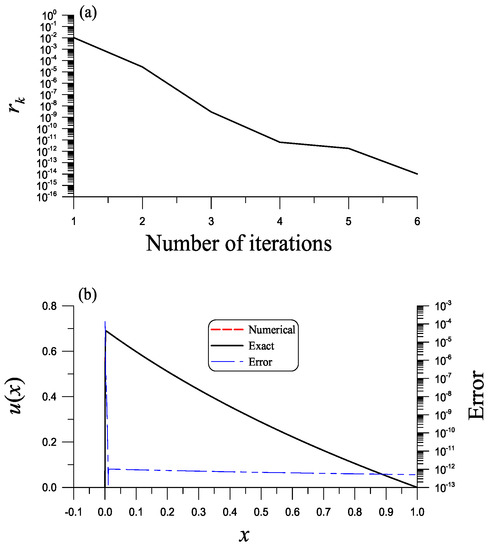
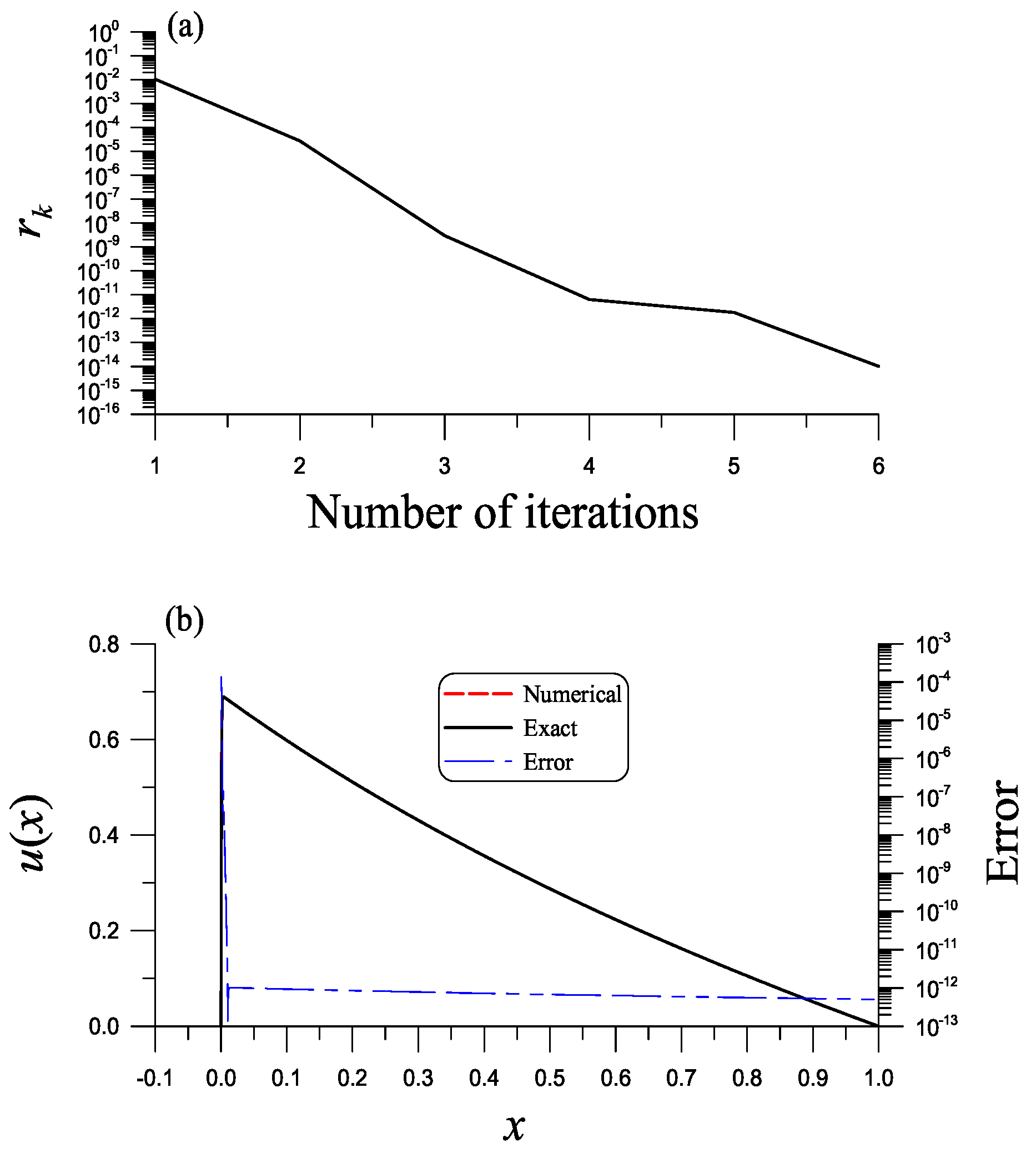
Using the original boundary shape function method through 221 iterations, Liu and Chang [17] find the numerical solution with ME = for . Here, we consider a severely singular case with . With and , , , , and , and , the DFNM is convergent with six iterations as shown in Figure 6a. We obtain the solution as shown in Figure 6b by a solid line, which coincides with the exact one in Equation (85), and, in Figure 6b, the numerical error is shown by a dotted-dashed line with ME = . The CPU time is very short with 0.32 s for six iterations, and COC = 1.5375 is obtained by DFNM.
Figure 6.
For example 6 of a highly singular problem, (a) the convergence rate and (b) comparing the solution obtained by the NBSFM with DFNM to the exact one and showing error.
In Table 4, we tabulate the numerical value at different x and compare it to the exact value. Besides at the point within the boundary layer, the accuracy is up to to .
Table 4.
For example 6 with list errors at different x.
8. Conclusions
In the numerical integration of nonlinear BVP, a key issue is how to determine the missing initial value or quickly and accurately. In the present paper, we have further modified the boundary shape function method (BSFM) for a new variable, of which the resulting initial value problem with its ODE involves the missing initial value of the original variable as a parameter. Owing to the implicit and nonlinear property of the target equation, we employed a new derivative free Newton method (DFNM) to solve the target equation, which can find very accurate left boundary values within a few iterations, and its performance is better than the half-interval method. In the new boundary shape function method (NBSFM), we solve a target equation to render a highly precise missing initial value and then the solution obtained is very accurate. Through the tests of numerical examples, we found that the CPU time is less than one second, and the COC is located between one and two. We combined the techniques of the Lie-group shooting method to the BSFM, whose advantage is that we can determine the missing slope of the new variable or missing initial value of the original variable in terms of a simple Dirichlet type target equation. Furthermore, we can easily find the multiple solutions of the considered problems. These numerical results clearly showed that the proposed methods can provide excellent approximation to the true solution of the nonlinear BVP with high accuracy.
Author Contributions
Conceptualization, C.-S.L.; Data curation, C.-S.L.; Formal analysis, C.-S.L.; Funding acquisition, C.-W.C.; Investigation, C.-W.C.; Methodology, C.-S.L.; Project administration, C.-W.C.; Resources, C.-S.L.; Software, C.-W.C.; Supervision, C.-S.L. and C.-W.C.; Validation, C.-W.C.; Visualization, C.-W.C.; Writing—original draft, C.-S.L.; Writing—review & editing, C.-W.C. All authors have read and agreed to the published version of the manuscript.
Funding
This work was financially supported by the National United University [grant numbers 111-NUUPRJ-04].
Institutional Review Board Statement
Not applicable.
Informed Consent Statement
Not applicable.
Data Availability Statement
Not applicable.
Conflicts of Interest
The authors declare no conflict of interest.
References
- Agarwal, R.P. Boundary Value Problems for High Order Differential Equations; World Scientific: Singapore, 1986. [Google Scholar]
- Kubíček, M.; Hlaváxcxek, V. Numerical Solution of Nonlinear Boundary Value Problems with Applications; Prentice-Hall: New York, NY, USA, 1983. [Google Scholar]
- Keller, H.B. Numerical Methods for Two-Point Boundary Value Problems; Dover: New York, NY, USA, 1992. [Google Scholar]
- Ascher, U.M.; Mattheij, R.M.M.; Russell, R.D. Numerical Solution of Boundary Value Problems for Ordinary Differential Equations; SIAM: Philadelphia, PA, USA, 1995. [Google Scholar]
- Awoke, A.; Reddy, Y.N. An exponentially fitted special second-order finite difference method for solving singular perturbation problems. Appl. Math. Comput. 2007, 190, 1767–1782. [Google Scholar] [CrossRef] [Scilit]
- Patidar, K.C. High order parameter uniform numerical method for singular perturbation problems. Appl. Math. Comput. 2007, 188, 720–733. [Google Scholar] [CrossRef] [Scilit]
- Vigo-Aguiar, J.; Natesan, S. An efficient numerical method for singular perturbation problems. J. Comput. Appl. Math. 2006, 192, 132–141. [Google Scholar] [CrossRef] [Scilit]
- Lin, T.C.; Schultza, D.H.; Zhang, W. Numerical solutions of linear and nonlinear singular perturbation problems. Comput. Math. Appl. 2008, 55, 2574–2592. [Google Scholar] [CrossRef] [Scilit]
- Khuri, S.A.; Sayfy, A. Self-adjoint singularly perturbed boundary value problems: An adaptive variational approach. Math. Method Appl. Sci. 2013, 36, 1070–1079. [Google Scholar] [CrossRef] [Scilit]
- Dogan, N.; Erturk, V.S.; Akin, O. Numerical treatment of singularly perturbed two-point boundary value problems by using differential transformation method. Discret. Dyn. Nat. Soc. 2012, 2012, 579431. [Google Scholar] [CrossRef] [Scilit]
- Liu, C.-S.; Li, B. Solving second-order singularly perturbed ODE by the collocation method based on energetic Robin boundary functions. Appl. Math. 2019, 64, 679–693. [Google Scholar] [CrossRef] [Scilit]
- Liu, C.-S. Cone of nonlinear dynamical system and group preserving schemes. Int. J. Non-Linear Mech. 2001, 36, 1047–1068. [Google Scholar] [CrossRef] [Scilit]
- Xu, Z.; Wu, J. MGPS: Midpoint-series group preserving scheme for discretizing nonlinear dynamics. Symmetry 2022, 14, 365. [Google Scholar] [CrossRef] [Scilit]
- Liu, C.-S. The Lie-group shooting method for nonlinear two-point boundary value problems exhibiting multiple solutions. Comput. Model. Eng. Sci. 2006, 13, 149–163. [Google Scholar]
- Liu, C.-S. The Lie-group shooting method for solving nonlinear singularly perturbed boundary value problems. Commun. Nonlinear Sci. Numer. Simulat. 2012, 17, 1506–1521. [Google Scholar] [CrossRef] [Scilit]
- Hajiketabi, M.; Abbasbandy, S. A simple, efficient and accurate new Lie-group shooting method for solving nonlinear boundary value problems. Int. J. Nonlinear Anal. Appl. 2021, 12, 761–781. [Google Scholar]
- Liu, C.-S.; Chang, J.R. Boundary shape functions methods for solving the nonlinear singularly perturbed problems with Robin boundary conditions. Int. J. Nonlinear Sci. Numer. Simul. 2020, 21, 797–806. [Google Scholar] [CrossRef] [Scilit]
- Deng, A.; Lin, J.; Liu, C.-S. Boundary shape function iterative method for nonlinear second-order boundary value problem with nonlinear boundary conditions. Math. Comput. Simul. 2022, 194, 539–551. [Google Scholar] [CrossRef] [Scilit]
- Weerakoon, S.; Fernando, T.G.I. A variant of Newton’s method with accelerated third-order convergence. Appl. Math. Lett. 2000, 13, 87–93. [Google Scholar] [CrossRef] [Scilit]
- Liu, C.-S.; Hong, H.K.; Lee, T.L. A splitting method to solve a single nonlinear equation with derivative-free iterative schemes. Math. Comput. Simul. 2021, 190, 837–847. [Google Scholar] [CrossRef] [Scilit]
- Ha, S.N.; Lee, C.R. Numerical study for two-point boundary value problems using Green’s functions. Comput. Math. Appl. 2002, 44, 1599–1608. [Google Scholar] [CrossRef] [Scilit]
- Finlayson, B. The Method of Weighted Residuals and Variational Principles; Academic: New York, NY, USA, 1972. [Google Scholar]
- Abbasbandy, S.; Azarnavid, B.; Alhuthali, M.S. A shooting reproducing kernel Hilbert space method for multiple solutions of nonlinear boundary value problems. J. Comput. Appl. Math. 2015, 279, 293–305. [Google Scholar] [CrossRef] [Scilit]
- Abbasbandy, S.; Shivanian, E. Prediction of multiplicity of solutions of nonlinear boundary value problems: Novel application of homotopy analysis method. Commun. Nonlinear Sci. Numer. Simulat. 2010, 15, 3830–3846. [Google Scholar] [CrossRef] [Scilit]
- Abbasbandy, S. Approximate solution for the nonlinear model of diffusion and reaction in porous catalysts by means of the homotopy analysis method. Chem. Eng. J. 2008, 136, 144–150. [Google Scholar] [CrossRef] [Scilit]
- Magyari, E. Exact analytical solution of a nonlinear reaction-diffusion model in porous catalysts. Chem. Eng. J. 2008, 143, 167–171. [Google Scholar] [CrossRef] [Scilit]
- Sun, Y.P.; Liu, S.B.; Keith, S. Approximate solution for the nonlinear model of diffusion and reaction in porous catalysts by decomposition method. Chem. Eng. J. 2004, 102, 1–10. [Google Scholar] [CrossRef] [Scilit]
- Abbasbandy, S.; Magyari, E.; Shivanian, E. The homotopy analysis method for multiple solutions of nonlinear boundary value problems. Commun. Nonlinear Sci. Numer. Simulat. 2009, 14, 3530–3536. [Google Scholar] [CrossRef] [Scilit]
- Abbasbandy, S.; Hashemi, M.S.; Liu, C.-S. The Lie-group shooting method for solving the Bratu equation. Commun. Nonlinear Sci. Numer. Simulat. 2011, 16, 4238–4249. [Google Scholar] [CrossRef] [Scilit]
- Deeba, E.; Khuri, S.A.; Xie, S. An algorithm for solving boundary value problems. J. Comput. Phys. 2000, 159, 125–138. [Google Scholar] [CrossRef] [Scilit]
- Khuri, S.A. A new approach to Bratu’s problem. Appl. Math. Comput. 2004, 147, 131–136. [Google Scholar] [CrossRef] [Scilit]

Publisher’s Note: MDPI stays neutral with regard to jurisdictional claims in published maps and institutional affiliations. |
© 2022 by the authors. Licensee MDPI, Basel, Switzerland. This article is an open access article distributed under the terms and conditions of the Creative Commons Attribution (CC BY) license (https://creativecommons.org/licenses/by/4.0/).