Abstract
In the present paper, an iterative algorithm is proposed for solving the generalized -reflexive solution group of a system of quaternion matrix equations . A generalized -reflexive solution group, as well as the least Frobenius norm generalized -reflexive solution group, can be derived by choosing appropriate initial matrices, respectively. Moreover, the optimal approximate generalized -reflexive solution group to a given matrix group can be derived by computing the least Frobenius norm generalized -reflexive solution group of a reestablished system of matrix equations. Finally, some numerical examples are given to illustrate the effectiveness of the algorithm.
1. Introduction
Throughout, and denote the set of all real matrices and the set of all matrices over the quaternion algebra |, , respectively. The identity matrix and zero matrix are denoted by I and O, respectively. A matrix with all elements equal to one is denoted by E. The real part, the trace, the transpose, the conjugate transpose, the column space, the vector formed by the vertical concatenation of the respective columns of a matrix are denoted by respectively. For , the -conjugate of is denoted by i.e.,
The Frobenius norm of A is denoted by The Kronecker matrix product and Hadmard matrix product of the matrices A and B are denoted by and respectively. A is called generalized reflexive (generalized anti-reflexive) if there are two generalized reflection matrices P and Q, i.e., and such that (). The generalized reflexive matrices have been widely used in engineering and scientific computations [1,2,3]. Throughout, () stands for the set of generalized reflexive (generalized anti-reflexive) quaternion matrices with respect to the generalized reflection matrix pair
Recently, researchers have paid much attention to the necessary and sufficient conditions for the existence of solutions as well as the general solutions to several quaternion matrix equations, which can be found in [4,5,6,7,8,9,10]. Based on the definition of the column-row determinant of quaternion matrix, Cramer’s rules for the solutions of several quaternion matrix equations are also derived in [11,12,13,14,15,16,17,18]. Moreover, the (-skew)-Hermitian solutions of some quaternion matrix equations are considered in [19,20,21,22]. Obviously, the conjugate matrix is a special case of the -conjugate matrix; therefore, it is interesting to study the -conjugate solution to some quaternion matrix equations, (see, e.g., [23,24,25,26]).
The iterative method is a very effective method for solving matrix equations. Dehghan and Shirilord [27] propose an approximation algorithm for the generalized Lyapunov matrix equations . Hajarian and Chronopoulos [28] propose the GCDs method for solving the coupled Sylvester matrix equations over partially bisymmetric matrices X and Y with a prescribed submatrix constraint. Wang and Zhang [29] propose an iterative algorithm for solving the minimum-norm pure imaginary solution of the quaternionic least squares problem. Zhang and Wang [30] propose the preconditioned BiCG and BiCR algorithms based on tensor form for the Sylvester tensor equation . Yan and Ma [31] give an iterative algorithm for the Hamiltonian solution of the generalized coupled Sylvester-conjugate matrix equations. Song and Wang [32] propose a modified CGLS iterative algorithm for solving the symmetric least squares solution of generalized Sylvester-conjugate matrix equation . Wu, Zhang and Sun [33] establish an iterative algorithm to solve the discrete Lyapunov matrix equation By making use of structure of real representation matrices, some preconditioned LSQR algorithms for quaternionic least squares problems are proposed in [34,35,36]. By extending the CGLS method, iterative algorithms for the -(anti)-Hermitian solutions of quaternionic least squares problems are proposed in [37,38,39].
As far as we know, the generalized -reflexive solution group of the system of quaternion matrix equations
has not been considered so far. Motivated by the work mentioned above, in this paper, we mainly consider an iterative algorithm for the following two problems:
Problem 1.
For given matrices and the generalized reflection matrices , find the matrix group such that
Problem 2.
If Problem 1 is consistent, and denotes its solution set. For a given matrix group find such that
2. Preliminaries
Throughout this paper, denotes the inner product space deduced by inner product
Note that then the induced matrix norm by (2) is exactly the Frobenius norm. Let denote the matrix whose entry is 1, and the other elements are zeros. For the inner product space it is easy to verify that , , is an orthonormal basis, which is saying that the dimension of is 4 mn.
Lemma 1.
Let and be two generalized reflection matrices. If then we have
Proof.
From Lemma 1 holds. □
For an quaternion matrix a real representation of A, can be defined as
From [40], satisfies the following properties:
- whereThrough a simple verification, we derive that also satisfies the following two properties which is useful for some deductions in this paper:
- where
3. The Solution of Problem 1
In this section, an algorithm is proposed to solve Problem 1 and its convergence is also proved.
Lemma 2.
Assume and , are generated by Algorithm 1, then
and for
Proof.
See Appendix A. □
Lemma 3.
Assume Problem 1 is consistent and , then, , and , generated by Algorithm 1 satisfy
Proof.
See Appendix A. □
| Algorithm 1: Iterative algorithm for Problem 1. |
1. Input 2. Calculate
3. If , or and stop; else 4. Calculate
5. Go to Step 3. |
If it appears that and then we can derive Problem 1 is inconsistent from Lemma 3, and the Algorithm 1 will stop in Step 3.
Theorem 1.
If Problem 1 is consistent, a solution group can be obtained from Algorithm 1 in no more than 4Npq steps for any , without considering roundoff errors.
Proof.
From Lemma 3, we have if then Hence and can be computed.
From Lemma 2, we have
Then is a basis of
Also by Lemma 2, we have
Since is -dimensional, it follows that which implies that is a solution group of Problem 1. □
4. The Solution of Problem 2
In this section, we first prove that Algorithm 1 will produce the least Frobenius norm generalized -reflexive solution group of (1) by inputing a group of appropriate initial matrices. Then, we solve Problem 2 by computing the least Frobenius norm generalized -reflexive solution group of a reestablished system of matrix equations.
Lemma 4
([41]). Assume that the linear system of equations has a solution , then is the least Frobenius norm solution of the system of linear equations.
Lemma 5.
Problem 1 is consistent if and only if the system of quaternion matrix equations
is consistent. Moreover, if the solution set of (8) is denoted by , then, holds.
Proof.
Assume is a solution group of Problem 1. By and we can obtain and which implies that is a solution group of quaternion matrix Equation (8), and .
Conversely, suppose (8) is consistent. Let be a solution group of (8). Set It is obvious that . Now we can write
Hence is a solution group of Problem 1. □
Lemma 6.
The system (8) is consistent if and only if the system of real matrix equations
is consistent, where 4, are submatrices of the unknown matrices. Moreover, let the solution set of (9) is denoted by we have
Proof.
See Appendix A. □
Lemma 7.
Lemma 7 can be easily demonstrated by the operating properties of ⊗ and ⊙.
Theorem 2.
Assume Problem 1 is consistent, , and can be expressed as
then, is the least Frobenius norm solution group of Problem 1.
Proof.
From the operational properties of , we derive
So, we get
By Lemma 4, is the least Frobenius norm solution of (10).
It follows from Lemmas 5–7 that is the least Frobenius norm solution group of Problem 1. □
It is obvious that if we set the initial iteration matrices in Algorithm 1 as
then all the generated have the form
Considering Theorem 2, we obtain Theorem 3.
Theorem 3.
Suppose that Problem 1 is consistent. Set the initial iteration matrices in Algorithm 1 as
where are freely selected in , then the solution group generated by Algorithm 1 is the least Frobenius norm solution group of Problem 1.
For a matrix group and it is easy to verify that and By Lemma 1, we get
Hence, Problem 2 is equivalent to finding such that Let we have
Therefore, Problem 2 is equivalent to finding the least Frobenius norm generalized -reflexive solution group of the system of quaternion matrix equations
By setting the initial iteration matrices where are freely selected in the least Frobenius norm generalized -reflexive solution group of (16) can be derived from Algorithm 1. Then, the solution group of Problem 2, can be expressed as
5. Examples
In this section, we give three examples to illustrate the efficiency of the theoretical results.
Example 1.
Consider the system of quaternion matrix equations with k-conjugate
where
We aim to find the generalized -reflexive solution group of (18), where
are generalized reflection matrices.
For the initial matrices
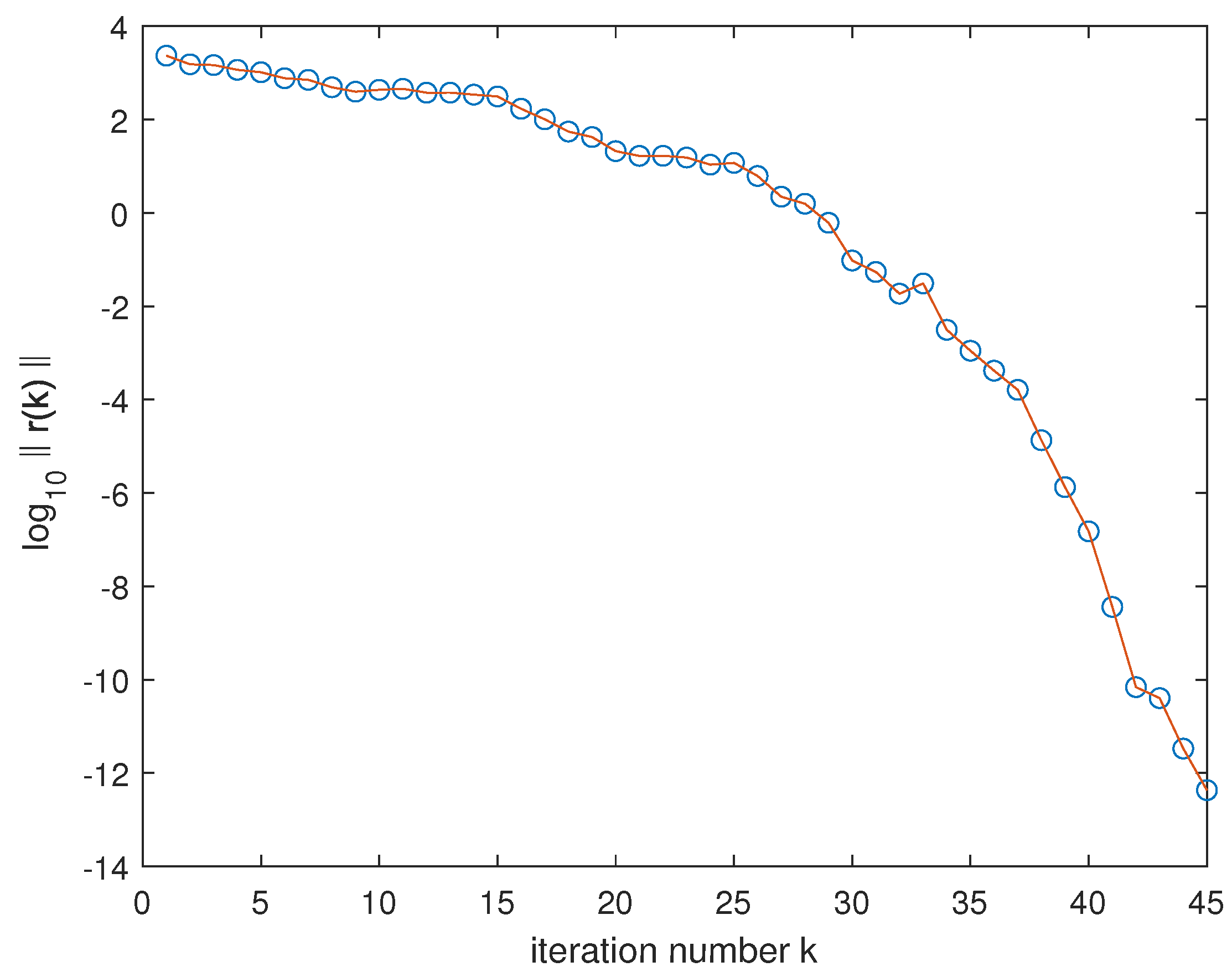
we obtain a solution group from Algorithm 1 after 45 steps,
with Figure 1 displays the convergence curve for
Figure 1.
The lagarithm of residual Frobenius norm from Example 1.
Example 2.
In this example, we aim to find the optimal approximation generalized -reflexive solution group of the system (18) to the given matrix group
Let and We apply Algorithm 1 to the system of quaternion matrix equations
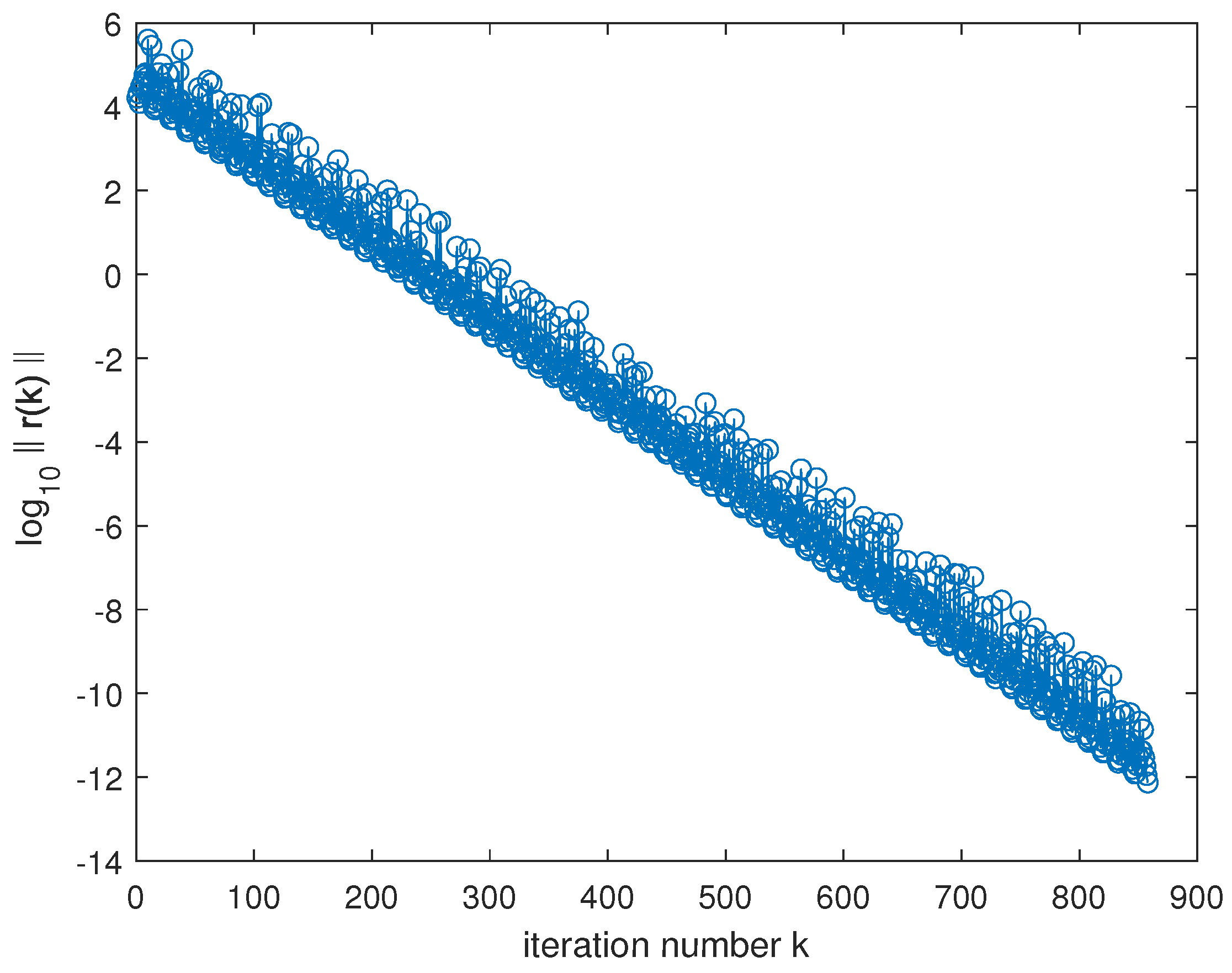
by setting the initial matrics (select in (13)). Then we obtain the least Frobenius norm generalized -reflexive solution group of (19) after 45 steps,
with Figure 2 displays the convergence curve for
Figure 2.
The lagarithm of residual Frobenius norm from Example 2.
Therefore, the optimal approximation generalized -reflexive solution group to the matrix group is
Example 3.
In this example, we solve the -reflexive solution group of the system (18) with large scale matrices, where
are random selected with real numbers of elements no more than 100, and
are generalized reflection matrices.
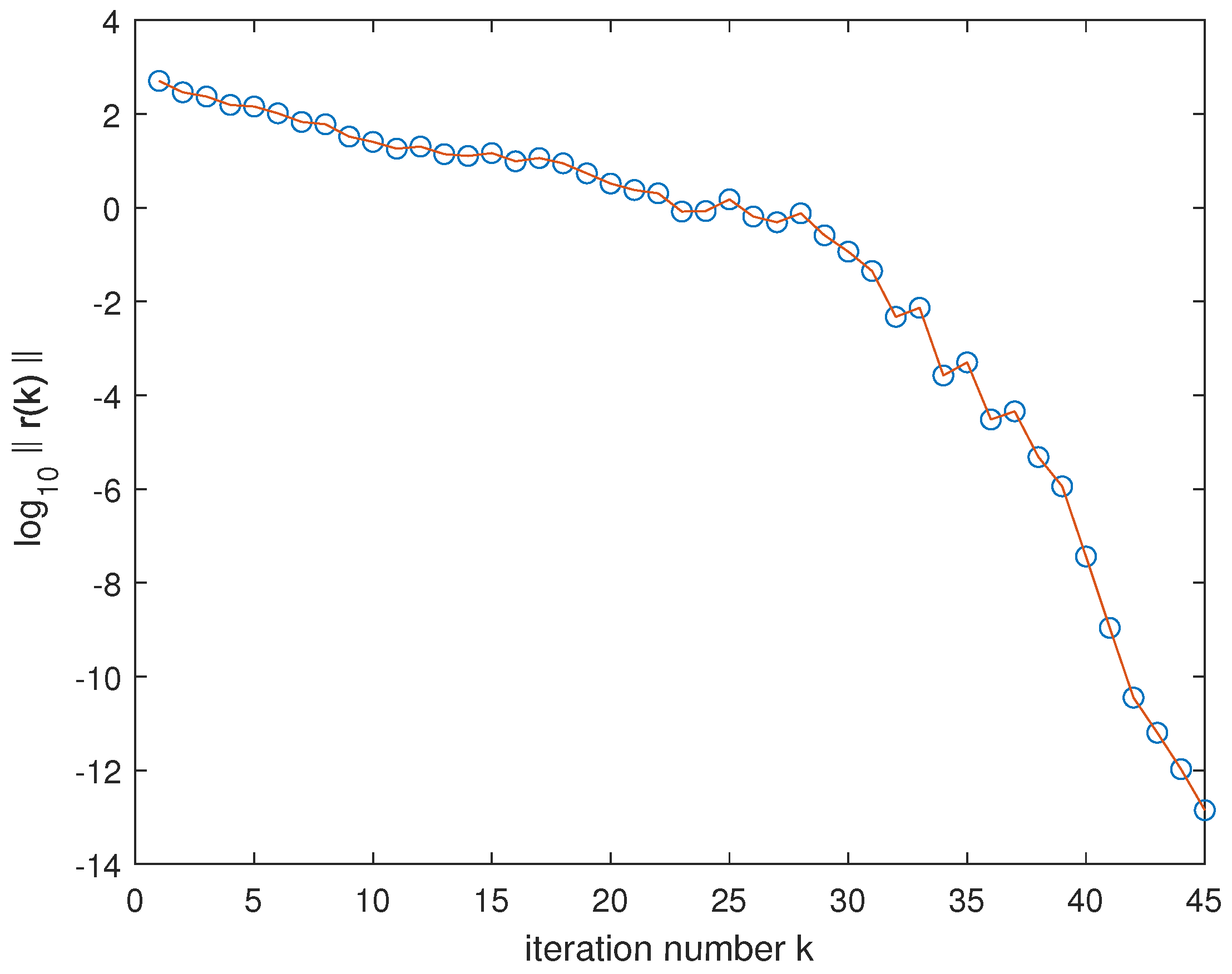
For the initial matrices we obtain a solution group after 858 steps, with . Figure 3 displays the convergence curve for The results show that Algorithm 1 is quite efficient.
Figure 3.
The lagarithm of residual Frobenius norm from Example 3.
6. Conclusions
In this paper, we have proposed an iterative algorithm for solving the generalized -reflexive solution group of the system of quaternion matrix equations , . We proved that the proposed algorithm can automatically determine the solvability of the problem, and the algorithm will generate a solution group in finite iteration steps, when the problem is solvable. We also have proved that the least Frobenius norm generalized -reflexive solution group of the system can be obtained from the algorithm, by choosing a group of appropriate initial matrices. After that, we solved the optimal approximately generalized -reflexive solution group of the system. Finally, the proposed numerical examples illustrated the effectiveness of the algorithm.
Author Contributions
Conceptualization, J.J.; methodology, N.L. All authors have read and agreed to the published version of the manuscript.
Funding
This research was funded by the Natural Science Foundation of China (No.12171278).
Institutional Review Board Statement
Institutional review board approval of our school was obtained for this study.
Informed Consent Statement
Written informed consent was obtained from all the participants prior to the enrollment of this study.
Data Availability Statement
The data used to support the findings of this study are available from the corresponding author upon request.
Conflicts of Interest
The authors declare no conflict of interest.
Appendix A
Appendix A.1. The Proof of Lemma 2
Note that and we only need to prove and for
We will use mathematical induction to show that
When we have
Assume conclusion (A1) holds for then
In addition, it can also be obtained that
Conclusion (A1) holds by mathematical induction principle.
Assume that and for and We next show that
It follows from Algorithm 1 that
and
From Algorithm 1, we have
From Algorithm 1 and (A11) ,we can write
Lemma 2 holds by mathematical induction principle.
Appendix A.2. The Proof of Lemma 3
When we have
Assume (5) holds for , that is
Then, when
So, Lemma 3 is proved by mathematical induction principle.
Appendix A.3. The Proof of Lemma 6
Suppose that (8) has a solution group Applying properties and 6 of to (8) yields
which implies that is a solution group of (9) and .
Conversely, suppose that matrix group is a solution group of (9). That is
By property 4 of , we have
which is equal to
Similarly, we get
Hence,
which implies that matrix groups
are also solutions of (9). Thus,
is a solution group of (9), where
and
Let
We can verify that
Therefore, is a solution group of (8) by property 1 of .
References
- Chen, H.C. Generalized reflexive matrices: Special properties and applications. SIAM J. Matrix Anal. Appl. 1998, 19, 140–153. [Google Scholar] [CrossRef]
- Chen, J.L.; Chen, X.H. Special Matrices; Qinghua University Press: Beijing, China, 2001. (In Chinese) [Google Scholar]
- Datta, L.; Morgera, S. On the reducibility of centrosymmetric matrices-applications in engineering problems. Circ. Syst. Signal Process. 1989, 8, 71–96. [Google Scholar] [CrossRef]
- He, Z.H.; Wang, Q.W.; Zhang, Y. A system of quaternary coupled Sylvester-type real quaternion matrix equations. Automatica 2018, 87, 25–31. [Google Scholar] [CrossRef]
- He, Z.H.; Wang, Q.W.; Zhang, Y. Constrained two-sided coupled Sylvester-type quaternion matrix equations. Automatica 2019, 101, 207–213. [Google Scholar]
- He, Z.H.; Wang, M.; Liu, X. On the general solutions to some systems of quaternion matrix equations. Rev. Real Acad. Cienc. Exactas Fis. Nat. Ser. A Mat. 2020, 114, 95. [Google Scholar] [CrossRef]
- He, Z.H.; Wang, M. Solvability conditions and general solutions to some quaternion matrix equations. Math. Meth. Appl. Sci. 2021, 44, 14274–14291. [Google Scholar] [CrossRef]
- He, Z.H.; Qin, W.L.; Wang, X.X. Some applications of a decomposition for five quaternion matrices in control system and color image processing. Comput. Appl. Math. 2021, 40, 205. [Google Scholar] [CrossRef]
- Wang, Q.W.; Wang, X. A system of coupled two-sided Sylvester-type tensor equations over the quaternion algebra. Taiwan J. Math. 2020, 24, 1399–1416. [Google Scholar] [CrossRef]
- Wang, Q.W.; Wang, X.; Zhang, Y.S. A constraint system of coupled two-sided Sylvester-like quaternion tensor equations. Comput. Appl. Math. 2020, 39, 317. [Google Scholar] [CrossRef]
- Song, G.J.; Wang, Q.W.; Yu, S.W. Cramer’s rule for a system of quaternion matrix equations with applications. Appl. Math. Comput. 2018, 336, 490–499. [Google Scholar] [CrossRef]
- Song, G.J.; Yu, S.W. Cramer’s rule for the general solution to a restricted system of quaternion matrix equations. Adv. Appl. Clifford Algebr. 2019, 29, 91. [Google Scholar] [CrossRef]
- Kyrchei, I. Cramer’s rules of η-(skew-)Hermitian solutions to the quaternion Sylvester-type matrix equations. Adv. Appl. Clifford Algebr. 2019, 29, 56. [Google Scholar] [CrossRef]
- Kyrchei, I. Determinantal representations of general and (skew-)Hermitian solutions to the generalized Sylvester-type quaternion matrix equation. Abstr. Appl. Anal. 2019, 14, 5926832. [Google Scholar] [CrossRef]
- Kyrchei, I. Determinantal representations of solutions to systems of two-sided quaternion matrix equations. Linear Multilinear Algebra 2021, 69, 648–672. [Google Scholar] [CrossRef]
- Rehman, A.; Kyrchei, I.; Ali, I.; Akram, M.; Shakoor, A. Explicit formulas and determinantal representation for η-skew-Hermitian solution to a system of quaternion matrix equations. Filomat 2020, 34, 2601–2627. [Google Scholar] [CrossRef]
- Rehman, A.; Kyrchei, I.; Ali, I.; Akram, M.; Shakoor, A. The general solution of quaternion matrix equation having η-skew-Hermicity and its Cramer’s rule. Math. Probl. Eng. 2019, 2019, 7939238. [Google Scholar] [CrossRef]
- Kyrchei, I.I.; Mosić, D.; Stanimirović, P.S. MPCEP-*CEPMP-solutions of some restricted quaternion matrix equations. Adv. Appl. Clifford Algebr. 2022, 32, 16. [Google Scholar] [CrossRef]
- Rehman, A.; Khan, I.A.; Anjum, R.; Hussain, I. Solvability conditions and general solution of a system of matrix equations involving η-skew-Hermitian quaternion matrices. Symmetry 2021, 13, 1825. [Google Scholar] [CrossRef]
- Zhang, F.X.; Wei, M.S.; Li, Y.; Zhao, J.L. An efficient real representation method for least squares problem of the quaternion constrained matrix equation AXB + CYD = E. Int. J. Comput. Math. 2021, 98, 1408–1419. [Google Scholar] [CrossRef]
- Li, M.Z.; Yuan, S.F.; Jiang, H. Direct methods on η-Hermitian solutions of the split quaternion matrix equation (AXB, CXD) = (E, F). Math. Meth. Appl. Sci. 2021, 2021, 1–20. [Google Scholar] [CrossRef]
- Tian, Y.; Liu, X.; Yuan, S.F. On Hermitian solutions of the generalized quaternion matrix equation AXB + CXD = E. Math. Probl. Eng. 2021, 2021, 1497335. [Google Scholar] [CrossRef]
- Zhang, F.X.; Wei, M.S.; Li, Y.; Zhao, J.L. An efficient method for least-squares problem of the quaternion matrix equation . Linear Multilinear Algebra 2020, 2020, 1806197. [Google Scholar] [CrossRef]
- Song, C.Q.; Chen, G.L. Solutions to matrix equations X − AXB = CY + R and X − = CY + R. J. Comput. Appl. Math. 2018, 343, 488–500. [Google Scholar] [CrossRef]
- Song, C.Q.; Feng, J.E. On solutions to the matrix equations XB − AX = CY and XB − = CY. J. Frankl. Inst. 2016, 353, 1075–1088. [Google Scholar] [CrossRef]
- Chang, H.X.; Duan, X.F.; Wang, Q.W. The Hermitian R-conjugate generalized procrustes problem. Abstr. Appl. Anal. 2013, 2013, 423605. [Google Scholar] [CrossRef]
- Dehghan, M.; Shirilord, A. A new approximation algorithm for solving generalized Lyapunov matrix equations. J. Comput. Appl. Math. 2022, 404, 113898. [Google Scholar] [CrossRef]
- Hajarian, M.; Chronopoulos, A.T. Least-squares partially bisymmetric solutions of coupled Sylvester matrix equations accompanied by a prescribed submatrix constraint. Math. Methods Appl. Sci. 2021, 44, 4297–4315. [Google Scholar] [CrossRef]
- Wang, M.H.; Zhang, J.T. On the pure imaginary quaternionic least squares solutions of matrix equation. J. Appl. Math. Inform. 2016, 34, 95–106. [Google Scholar] [CrossRef]
- Zhang, X.F.; Wang, Q.W. Developing iterative algorithms to solve Sylvester tensor equations. Appl. Math. Comput. 2021, 409, 126403. [Google Scholar] [CrossRef]
- Yan, T.X.; Ma, C.F. An iterative algorithm for generalized Hamiltonian solution of a class of generalized coupled Sylvester-conjugate matrix equations. Appl. Math. Comput. 2021, 411, 126491. [Google Scholar] [CrossRef]
- Song, C.Q.; Wang, Q.W. Modified CGLS iterative algorithm for solving the generalized Sylvester-conjugate matrix equation. Filomat 2020, 34, 1329–1346. [Google Scholar] [CrossRef]
- Wu, A.G.; Zhang, Y.; Sun, H.J. Parametric Smith iterative algorithms for discrete Lyapunov matrix equations. J. Ind. Manag. Optim. 2020, 16, 3047–3063. [Google Scholar] [CrossRef]
- Ling, S.T.; Jia, Z.G. Matrix iterative algorithms for least-squares problem in quaternionic quantum theory. Int. J. Comput. Math. 2013, 90, 727–745. [Google Scholar] [CrossRef]
- Ling, S.T.; Jia, Z.G.; Jiang, T.S. LSQR algorithm with structured preconditioner for the least squares problem in quaternionic quantum theory. Comput. Math. Appl. 2017, 73, 2208–2220. [Google Scholar] [CrossRef]
- Ling, S.T.; Jia, Z.G.; Lu, X.; Yang, B. Matrix LSQR algorithm for structured solutions to quaternionic least squares problem. Comput. Math. Appl. 2019, 77, 830–845. [Google Scholar] [CrossRef]
- Beik, F.P.A.; Ahmadi-Asl, S. An iterative algorithm for η-(Anti)-Hermitian least-squares solutions of quaternion matrix equations. Electron. J. Linear Algebra 2015, 30, 372–401. [Google Scholar] [CrossRef]
- Ahmadi-Asl, S.; Beik, F.P.A. An efficient iterative algorithm for quaternionic least-squares problems over the generalized η-(anti-)bi-Hermitian matrices. Linear Multilinear Algebra 2017, 65, 1743–1769. [Google Scholar] [CrossRef]
- Shojaei-Fard, A.; Amroudi, A.N. An efficient method for solving a quaternionic least-squares problem. Int. J. Appl. Comput. Math. 2018, 4, 48. [Google Scholar] [CrossRef]
- Wang, Q.W.; Jiang, J. Extreme ranks of (skew-)Hermitian solutions to a quaternion matrix equation. Electron. J. Linear Algebra 2010, 20, 552–573. [Google Scholar] [CrossRef][Green Version]
- Peng, Y.X.; Hu, X.Y.; Zhang, L. An iteration method for the symmetric solutions and the optimal approximation solution of the matrix equation AXB = C. Appl. Math. Comput. 2005, 160, 763–777. [Google Scholar] [CrossRef]
Publisher’s Note: MDPI stays neutral with regard to jurisdictional claims in published maps and institutional affiliations. |
© 2022 by the authors. Licensee MDPI, Basel, Switzerland. This article is an open access article distributed under the terms and conditions of the Creative Commons Attribution (CC BY) license (https://creativecommons.org/licenses/by/4.0/).