1. Introduction
Exponential distribution is widely used for modeling lifetime data. Please see Johnson and Kotz [
1], Bain [
2], Lawless and Singhal [
3] and Zelen [
4] for many applications of this distribution in the experiments of life test. In the experiments of life test,
n units of an item are placed on the life test. In some cases, the experimenter can only observe the censored failure times of products. The right type II censoring scheme is one type of frequently occurring censoring schemes. This censoring scheme terminates the experiment at the time of the
m-th (
) failure time of the unit observed instead of all failure times of
n units being observed. Then the remaining
s =
n −
m units of the item are removed and censored. Many authors, such as Mann et al. [
5], Lawless [
6] and Meeker and Escobar [
7], have studied the estimation under type II censoring with different failure time distributions. Wu [
8] proposed the interval estimation for the two-parameter exponential distribution based on the doubly type II censored sample. Wu [
9] proposed the interval estimation for the Pareto distribution based on the doubly type II censored sample. Al-Moisheer et al. [
10] investigated the properties and estimation for the mixture of two one-parameter Lindley distributions. Aslam et al. [
11] developed the Bayesian estimation and application in reliability for a two-component mixture of transmuted Frechet distributions. Younis et al. [
12] derived the new LD model with minimum posterior risk for the selection of priors for the type II hybrid censoring method. Wang et al. [
13] proposed Bayesian infinite mixture models for wind speed distribution estimation. Aslam et al. [
14] conducted a study on exponentiated Gompertz distribution under Bayesian discipline with informative priors. Heidari et al. [
15] proposed the E-Bayesian and hierarchical Bayesian estimation for the parameter of Rayleigh distribution under type II censoring. Prakash [
16] investigated the Bayesian prediction on optimum SS-PALT in a generalized inverted exponential distribution under a two-sample approach. Jana and Bera [
17] proposed the interval estimation of multicomponent stress–strength reliability for the inverse Weibull distribution. Tripathi [
18] discussed whether the types of lower and upper records affect the maximum likelihood estimates of the parameters for inverse Rayleigh and exponential distributions. Our study in this research is focusing on exponential distribution which is an asymmetric probability distribution. There are some numerical characteristics of the two-parameter exponential distribution related to these two parameters. Using a similar Bayesian approach in Wu and Chang [
19], we propose the Bayesian joint confidence region for the two parameters of the two-parameter exponential distribution under right type II censoring. The Bayesian confidence interval of the scale parameter is also proposed in this paper. In addition to the estimation of two parameters, the Bayesian predictive intervals of the future observation based on the right type II censored sample is also derived. In
Section 3, we conducted a simulation study to compare the coverage probabilities of the proposed methods and the existing methods in Wu [
8]. Our proposed interval estimation is related to the applications accross disciplines for the asymmetric exponentail distribution. One biometrical example is also given to illustrate the proposed methods in
Section 4. Finally, the conclusion is made in
Section 5.
2. Interval Estimation of Two Parameters
First, we build the interval estimation for the parameters of the two-parameter exponential distribution. Let a random variable
X have such distribution with scale parameter
and location parameter
. The probability density function (p.d.f.) of
X is given by
The cumulative distribution function is given by .
Let
be a right type II censored sample from a two-parameter exponential distribution. For simplicity, we used the notation
to represent
. The likelihood function based on the observed data is (See Balakrishnan and Aggarwala [
20])
The maximum likelihood estimators (MLEs) of and are and .
After the transformations of is a right type II censored sample from one-parameter exponential distribution Exp().
Consider the generalized spacings of
,
, …,
. Balakrishnan and Aggarwala [
20] showed that the generalized spacings
are all independent and identically distributed from
Exp(
). Then the joint p.d.f. of
is
The Bayesian approach provides the methodology incorporating previous information with the current data, and
is considered to be a random variable having some specified distribution (prior distribution). Similar to the Bayesian approach in Wu and Chang [
19], let the random variable
and assume that
is having a gamma prior distribution denoted as
. Then the p.d.f. of
is given by
.
Then the posterior probability density function (p.d.f.) of
is
Then the posterior p.d.f. of has a gamma distribution denoted as gamma(n − s + a, ).
The posterior mean of is (n − s + a).
Following the change of variables given at pp. 184–185 of Casella and Berger [
21], we let
and
.
That is, .
Hence, the following two pivotal quantities
and
are independent and have chi-square distributions with 2 and
degrees of freedom, respectively. Furthermore, the other two pivotal quantities
and
are independent, and
and
. The distributions of all pivotal quantities are independent of parameters.
Making use of the pivotal quantity , we can construct the confidence interval for the scale parameter as follows:
Theorem 1. Let be the right type II ordered sample from a two-parameter exponential distribution with parameters and . Then the ()100% Bayesian confidence intervals of the scale parameter is given bywhere is the right-tailed percentile for the chi-squared distribution with degrees of freedom. Proof 1. Since the pivotal quantity
then we have
The proof is thus obtained. □
Making use of the first set of pivotal quantities and , we can construct the Bayesian confidence region of two parameters, where , in the following theorem, and it is called Method 1.
Theorem 2. Let be the right type II ordered sample from a two-parameter exponential distribution with parameters and . Then the ()100% Bayesian joint confidence region of two parameters and is given by where and are the right-tailed and percentile for the chi-squared distribution with degrees of freedom. Proof 2. Since the first set of pivotal quantities
and
are independent and
and
, then we have
The proof is thus obtained. □
The area for the confidence region in Method 1 denoted by Area
1 is obtained as follows:
Making use of the second set of pivotal quantities and , we can construct the Bayesian confidence region of two parameters in the following theorem, and it is called Method 2.
Theorem 3. Let be the right type II ordered sample from a two-parameter exponential distribution with parameters and . Then the ()100% Bayesian joint confidence region of two parameters and is given by where and are the right-tailed and percentile for F distribution with 2 and 2() degrees of freedom; and are the right-tailed and percentile for the chi-squared distribution with degrees of freedom. Proof 3. Since the second set of pivotal quantities
and
are independent and
and
, then we have
The proof is thus obtained. □
The area for the confidence region in Method 2 denoted by Area
2 is obtained as follows:
where
,
Secondly, we are going to build the prediction interval for the future observation based on the right type II censored sample.
Based on the fact that
has a chi-square distribution with 2 degrees of freedom and
has a chi-square distribution with 2(
) degrees of freedom. Furthermore, they are independent. Therefore, the statistic
follows an
F distribution with 2 and 2(
) degrees of freedom and this statistic is utilized to build the Bayesian predictions for
in the following theorem.
Theorem 4. Let be an right type II censored sample from a two-parameter exponential distribution with parameters and. Then the ()100% Bayesian prediction interval for the future observation is given by Proof 4. Utilizing the statistic
, we have
The proof is thus obtained. □
3. Simulation Study
In this section, we use the Monte-Carlo method to simulate the coverage probabilities for the Bayesian confidence interval for
proposed in Theorem 1 under
a =
b = 1 and
a =
b = 2 and the non-Bayesian confidence interval proposed in Wu [
8]. We also simulate the coverage probabilities for the Bayesian confidence region for two parameters proposed in Theorems 2 and 3 under
a =
b = 1 and
a =
b = 2 and the non-Bayesian confidence region proposed in Wu [
8]. The software we use for the simulation study is R software. The simulation algorithm is described in the following steps:
Step 1: Give the initial values of = 0.90, 0.95, n = 20, 50, s = 3, = 0, = 1, ci1 = 0, ciw1 = 0, cr1 = 0, crw1 = 0, cr2 = 0, crw2 = 0, the number of replication = 100,000.
Step 2: Generate a random sample of size n from exp(0,1) distribution.
Step 3: If the value of
is within the confidence interval proposed in Theorem 1, ci1 = ci1 + 1/run. If the value of
is within the confidence interval rpoposed in Wu [
8], ciw1 = ciw1 + 1/run. If the values of (
,
) fall into the Bayesian confidence region proposed in Theorems 2 and 3, we have cr1 = cr1 + 1/run and cr2 = cr2 + 1/run, respectively. If the values of (
,
) fall into the non-Bayesian confidence region proposed in Wu [
8], we have crw1 = crw1 + 1/run and crw2 = crw2 + 1/run, respectively.
Step 4: Output ci1 as the coverage probabilities for Bayesian confidence interval. Output ciw1 as the coverage probabilities for non-Bayesian confidence interval. Output cr1 and cr2 as the coverage probabilities for Bayesian confidence regions based on Method 1 and Method 2. Output crw1 and crw2 as the coverage probabilities for non-Bayesian confidence regions.
The coverage probabilities are listed in
Table 1.
Table 1 shows that the Bayesian methods always have higher coverage probabilities than the one for non-Bayesian methods. We suggest users use Bayesian interval estimation instead of the non-Bayesian interval estimation. For the confidence region, the Bayesian method called Method 1 has a higher coverage probability than Method 2. For Method 1, the parameter (
a,
b) = (2,2) has a higher coverage probability than (
a,
b) = (1,1). Therefore, we recommend the users use Method 1 under (
a,
b) = (2,2) to construct the confidence region for two parameters based on the right type II censored sample.
4. A Biometrical Example
An example of the duration of remission of 20 leukemia patients treated by Drug one (see Wu [
22]) is used to demonstrate the proposed methods in Theorems 1–4. In
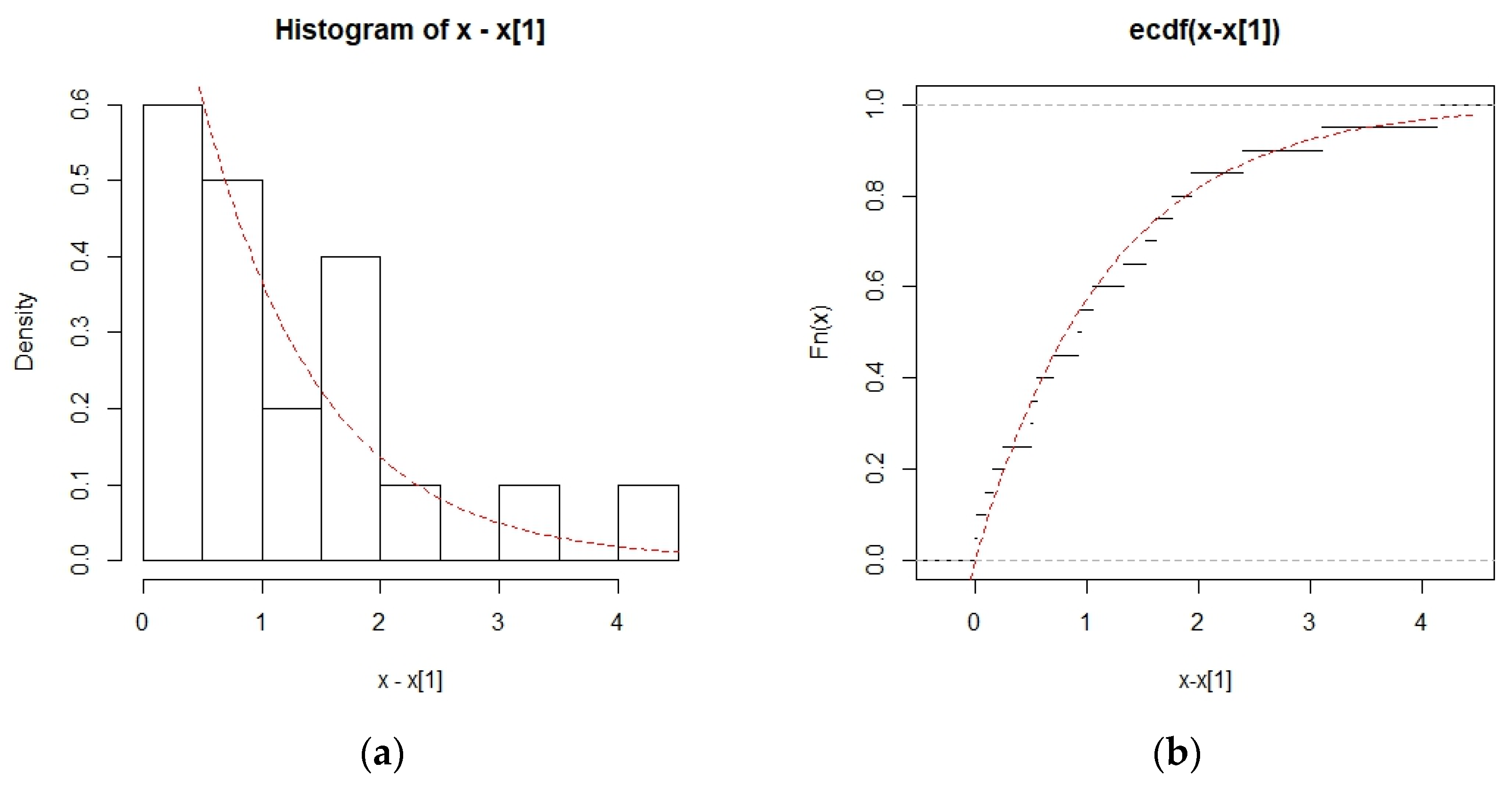
Figure 1a,b, we have plotted the histogram and the empirical cumulative distribution function (ECDF) for this data. We use the Kolmogorov–Smirnov test (KS test) to test the fitness of the exponential distribution. The
p-value of the KS test is 0.8245 > 0.05 and the result indicates that the data fits exponential distribution very well.
Considering the case of (
n,
s) = (20,3) under
a = 2 and
b = 2, the right type II censored sample is given by
= (1.013, 1.034, 1.109, 1.169, 1.266, 1.509, 1.533, 1.563, 1.716, 1.929, 1.965, 2.061, 2.344, 2.546, 2.626, 2.778, 2.951) (in years). By Theorem 1, the 95% confidence interval for
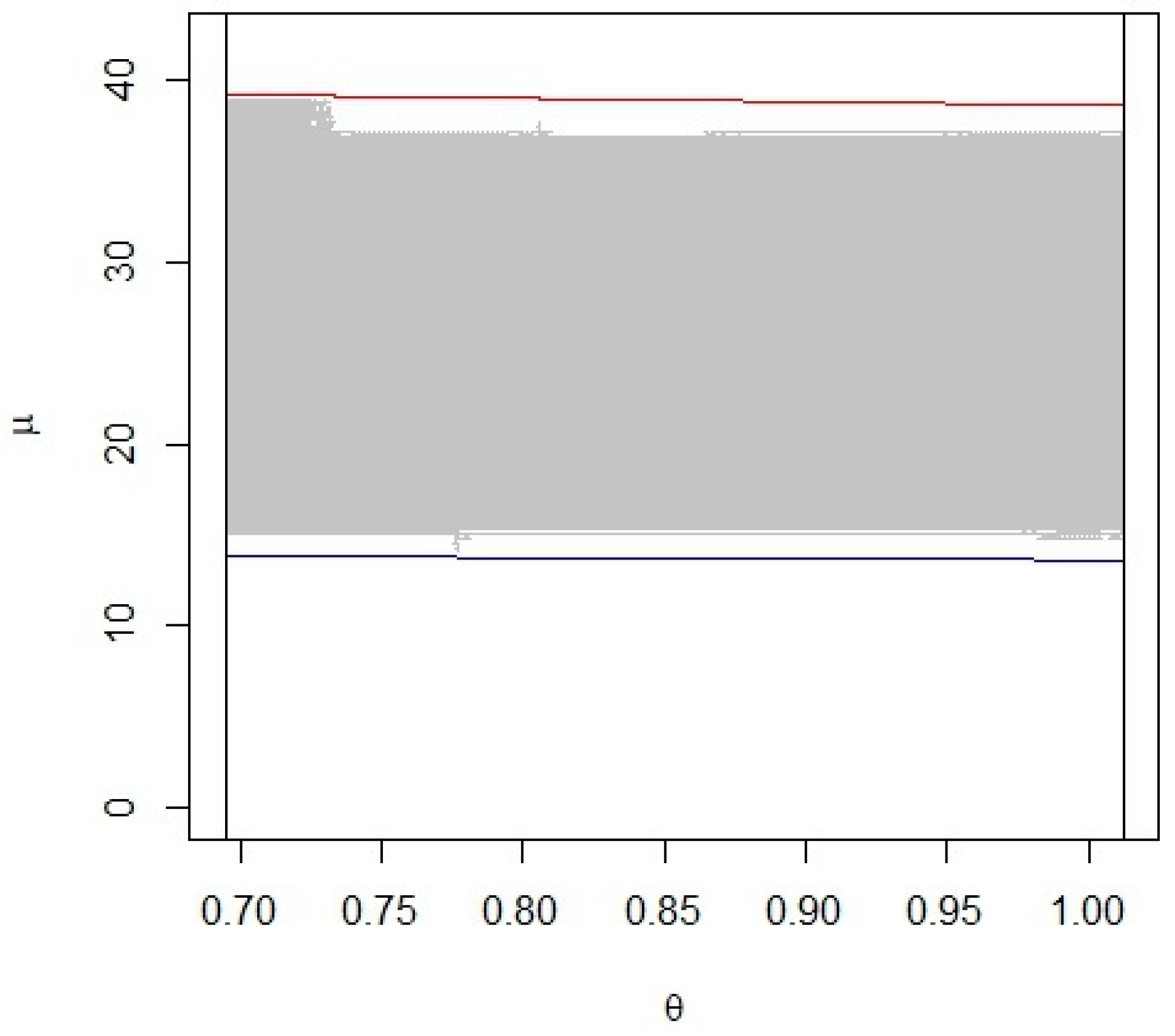
θ is obtained as (0.8507403,2.170616) with confidence length 1.319875. By Theorem 2, the 95% joint confidence region for
θ and
is given by
with area 0.5293455 and the graph of the confidence region is given in
Figure 2.
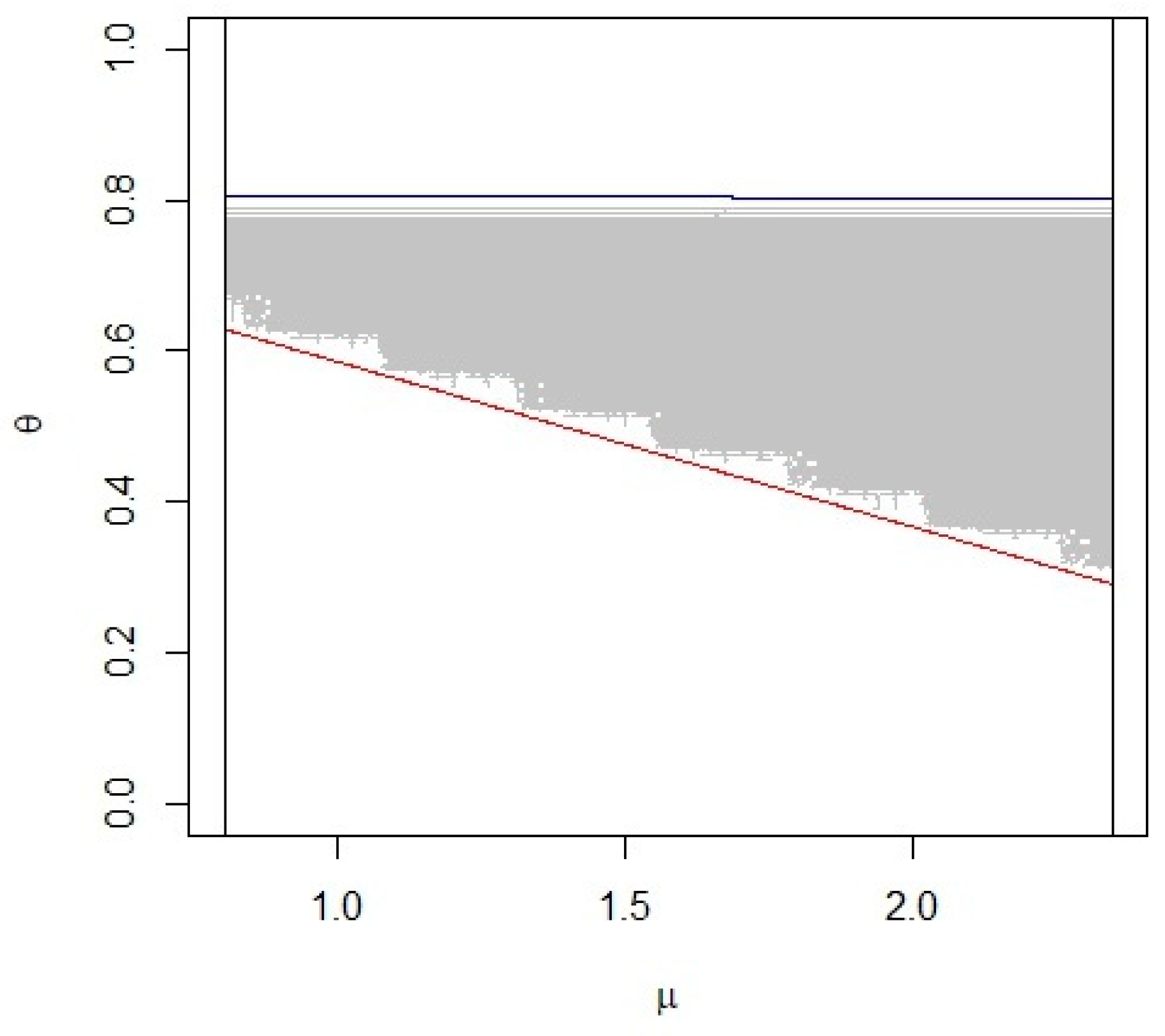
By Theorem 3, the 95% joint confidence region for
θ and
is given by
with area 0.1018587 and the graph of the confidence region is given in
Figure 3.
Even though Method 2 has a smaller area than Method 1 in this example, we still recommend the users to use Method 1 since it has a higher coverage probability.
By Theorem 4, the predictive interval for is obtained as (2.961864,4.7066).