

Abstract
Scientific progression has allowed researchers to develop novel and innovative ways to deal with uncertainty in data, allowing for the development of more precise and accurate data representation models. This paper aims to extend an already reported concept of Cubic Pythagorean fuzzy set to Cubic Pythagorean Fuzzy Soft Set as it incorporates both interval-valued Pythagorean fuzzy sets (IVPFS) and Pythagorean fuzzy sets (PFS) at the same time, providing a more targeted approach to deal with uncertainty. This hybrid structure can better handle data in comparison to the ones in the literature by having the characteristics of PFS and soft sets, leading to a more targeted approach to handle attributes in decision-making studies. In this study, we defined various internals and externals of , set operators, aggregation operators, and developed an algorithm based on distance measures for (), which are applied in a disease diagnostic decision-making problem.
1. Introduction
The terms vagueness and randomness have been used over time as an element in probability theory. The terms indeterminacy and uncertainty gained significant attention around the 1960s when they were characterized using different dimensions. This allowed for the division of the concept of uncertainty into a multitude of factors; randomness, considered to be vagueness before, is now only a small part of computing the uncertainty of a system. The term vagueness nowadays refers to the deficiency or inadequacy of information in a system. These deficiencies can be technological constraints, measurement constraints, intuitionistic constraints, time-dependent variables, and functional biological variables. Finding the optimal solution to a particular problem has become better due to recent developments in information technology and decision sciences. Theoretically, facts regarding likely selections are acquired in precise quantities, but aggregated statistics tend to hide misinformation which leads to uncertain and inaccurate results. The decision maker must re-evaluate the options based on various suggestive criteria such as intervals and figures. However, due to the record’s various feedback effects, it is sometimes impossible for one individual to take action. One explanation may be a lack of knowledge or a contradiction. As a result, a series of statements are offered to consider the measurement of the indicated unfavourable features in a scientific manner. Considering these factors, in studies involving similarity measures or in mapping studies for the determination of symmetry or pattern recognition of real systems, it is essential to determine these uncertainties as these may have implications and may lead to unrealistic results when considering numerous factors at the same time. In order to put these indeterministic factors into computational and measurable boundaries, Zadeh [1] presented the idea of a fuzzy set (FS) in 1965. It deviates from classical set theory by assigning a membership degree between [0, 1] to a given element in a set.
In classical set theory, scenarios are dealt with as exact solutions, which is not ideal for most cases as some parameters are approximations that leave room for uncertainty to hinder the final solution. FS theory allows for the computation of an approximation solution. Zadeh [2] also presented the concept of interval-valued fuzzy sets (IVFS) in 1975. The FSs are based on the membership value, but some situations are still difficult to address just by using the membership function. Here, interval-valued fuzzy is preferred to determine the membership degree as the membership value is expressed in a fuzzy interval. In 2012, Y.B. JUN [3] came up with a concept of a hybrid IVFS and FS structure to develop a Cubic Set (CS) and its associated properties. Cubic sets can be applied to address the range evaluation issue of an object at a particular event in time.
Atanassov [4] defined the term intuitionistic fuzzy set (IFS) in 1986. The membership function, non-membership function, and hesitation margins are the three parameters that define IFS, whereas the membership function is the only component that defines the FS. In IFS, each element will be allocated both membership and non-membership values which are more appropriate than others. The following factors can cause these:
- Decision makers (DMs) may lack precise or sufficient information about the problem.
- DMs may be unable to explicitly discriminate the superiority of one alternative over another [5]. In such cases, DMs may provide their assessments on alternatives to a degree rather than with complete certainty [6].
Atanassov and Gargov [7] developed the concept of interval-valued intuitionistic fuzzy set (IVIFS) in 1989, which is a further development of IFS. As a result, DMs may find it more convenient to convey their judgements using IFS rather than exact numerical values or linguistic variables [8,9], particularly IVIFSs. In reality, using membership and non-membership degrees to communicate ideas allows DMs to quickly and properly represent their judgments of decision difficulties. A significant amount of research has been performed on IVIFS in the literature, with a focus on the basic theory of IVIFS, such as the relations and operations of IVIFS [10], the correlation and correlation coefficients of IVIFS [11,12], the topology of IVIFS [13], the relationships among the IVIFS, L-fuzzy set, IFS, IVFS [14], and pattern recognition [15]. Gagandeep Kaur and Harish Garg [16,17] presented the idea of a cubic intuitionistic fuzzy set (CIFS) in 2018, characterized by two parts simultaneously, one of which expresses the membership and non-membership values by an IVIFS and the other by an IFS.
After some modernization of fuzzy sets, a soft set (SS) was introduced by Molodtsov [18] in 1999. The soft set theory defines the parameters along all elements of the universal set. With the concept of fuzzy sets and soft sets, Maji et al. [19] established the notion of fuzzy soft sets (FSS) in 2001. In everyday life, people are frequently confronted with challenges that require the use of good judgment. However, in most circumstances, it becomes perplexing to define the best answer. Several solution-related parameters must be investigated to achieve the best viable solution to these issues. In 2009, X.B. Yang et al. [20] developed a hybrid of the interval-valued fuzzy soft set (IVFSS) and defined some operations. By using interval-valued fuzzy soft set and fuzzy soft set, Muhiuddin et al. [21] introduced a new notion called cubic soft set (CSS) in 2014. A structure of intuitionistic fuzzy soft sets (IFSS) [22] was proposed by Maji et al. in 2004. Yunqiang Yin et al. [23] investigated the operation features and algebraic structure of IFSS in 2012. Yuncheng Jiang et al. proposed a combination of IVFSS and IFSS in 2010 [24], which they refer to as interval-valued intuitionistic fuzzy soft set (IVIFSS).
In 2018, by changing the function into a multi-attributive function, Florentin Smarandache [25] expanded the soft set to the hypersoft set (HSS) and presented the hybrids Crisp, Fuzzy (FHSS), Intuitionistic Fuzzy (IFHSS), Neutrosophic (NHSS), and Plithogenic Hypersoft Set (PHSS). Compared to SS and other current theories, HSS is the most appropriate to address multi-attribute decision-making problems when considering the parameters’ multi-subattributes while managing to address ambiguous and uncertain information. Several HSS extensions have been developed in the literature and have been applied in decision-making. In 2021, Amarendra babu and Siva Naga Malleswari [26] defined intuitionistic fuzzy soft cubic relations and used some examples of intuitionistic fuzzy soft cubic.
Pythagorean Fuzzy Sets lack the ability to address individual parameters in a decision-making problem with multiple parameters. Its combination with soft set theory helps to address this issue. The combination of the hybrid structure with Cubic Fuzzy Set (CFS) addresses interval values and membership and non-membership values simultaneously. This hybrid model considers two different time zones used in an experiment simultaneously. To elaborate further, consider an individual performing an experiment and observations are made at two different intervals as one of the observations may have some uncertainty. Let the observations be in the uncertain range of [0.3, 0.6] at time T1; the crisp value will either agree with the interval (P-order) or disagree (R-order). This hybrid environment greatly influences the precision of the process by enhancing the scope of the interval by considering a membership value of a fuzzy nature that corresponds to the interval. A cubic Pythagorean fuzzy soft set allows for a realm of possibilities of handling complex data types and addressing a number of time-scale problems when proper operations are defined.
The structure is particularly useful when considering data where a fuzzy value in the form of a membership and non-membership value are to be simultaneously considered with the interval from which those values are extrapolated from. The soft set aspect of the structure helps to address individual parameters in a cubic Pythagorean fuzzy format which provides a more diverse and concise analysis. This structure is particularly useful when considering data present in the form of medical tests. The test results of a patient are presented in the form of membership value that needs to be in an interval for the patient to be in a healthy condition. With the distance measures developed in the manuscript, tentative testing can be performed for proof of concept, thereby making the structure applicable in this area.
The paper is divided into the following five sections: Section 2 focuses on the preliminary definitions that are used for defining the novel concept in the paper. Section 3 presents the concept of Cubic Pythagorean Fuzzy Soft Set alongside its fundamental operations. Section 4 defines different distance measures with examples for the novel structure while Section 6 presents the application of those distance measures in developing a decision-making algorithm that is used to develop a decision-support system for medical diagnostic purposes. The conclusion section presents the summary of the work alongside the future directions that can be generated from the presented work.
2. Preliminaries
This section of the paper focuses on providing some basic definitions from the literature that have been utilized for this research.
2.1. Fuzzy Set
Introduced by Zadeh [1], fuzzy set has become a necessary tool to hold errors and vagueness in different areas.
Assume to be a universal set. Then, the fuzzy set in can be initiated by the membership function in which every element of universal set maps with the membership function whose value lies between 0 and 1.
2.2. Interval-Valued Fuzzy Set
Zadeh [2] also developed the concept of interval-valued fuzzy sets, alongside Grattan-Guiness [27], Jahn [28], Sambuc [29], in the seventies, in the same year. An interval-valued membership function defines an interval-valued fuzzy set (IVF).
Assume to be a universal set. Then, the interval-valued fuzzy set can be initiated by the membership function which is the subinterval of in which every element of universal set maps with the interval-valued degree membership.
2.3. Cubic Set
Jun et al. [3] proposed a fascinating idea known as cubic set theory. Cubic set is the hybrid of an Interval-Valued Fuzzy Set and Fuzzy Set.
where is the IVF and is the FS.
2.4. Fuzzy Soft Set
By incorporating the notions of fuzzy sets [1], Maji et al. [30] proposed the concept of fuzzy soft sets. Many intriguing applications of soft set theory have been expanded on by certain researchers utilising this notion.
A pair is said to be fuzzy soft set over
where
where
2.5. Interval-Valued Fuzzy Soft Set
The extension of fuzzy soft sets was introduced by Maji et al. [30] to interval-valued fuzzy soft sets. IVFSs were created on their own to address some of the issues with fuzzy soft sets.
Suppose to be a universal set, to be an attributive set and . Then, the pair is defined as an interval-valued fuzzy soft set with the mapping
where is the subsets of all interval-valued fuzzy elements.
A pair can be expressed as
where
and
Example 1.
Assume that is a universal set, and is an attributive set with respect to Y. Let ; then, an interval-valued fuzzy soft set can be defined as
2.6. Cubic Soft Sets
Suppose is a universal set, is an attributive set and . Then, the cubic soft set can be expressed as
where
where is interval-valued fuzzy soft set and is the fuzzy soft set with and , see [21].
Example 2.
Assume that is a universal set, and is an attributive set with respect to Ω. Let ; then, a cubic soft set C can be defined as
2.7. Intuitionistic Fuzzy Set
Atanassov [4] created the Intuitionistic Fuzzy Set (IFS), which generalises the Zadeh fuzzy set [1]. Assume to be an universal set; then, the intuitionistic fuzzy set can be generated by the membership function and the non membership function such as
where
Example 3.
Assume that be a universal set, then the IFS χ can be written as
2.8. Pythagorean Fuzzy Set
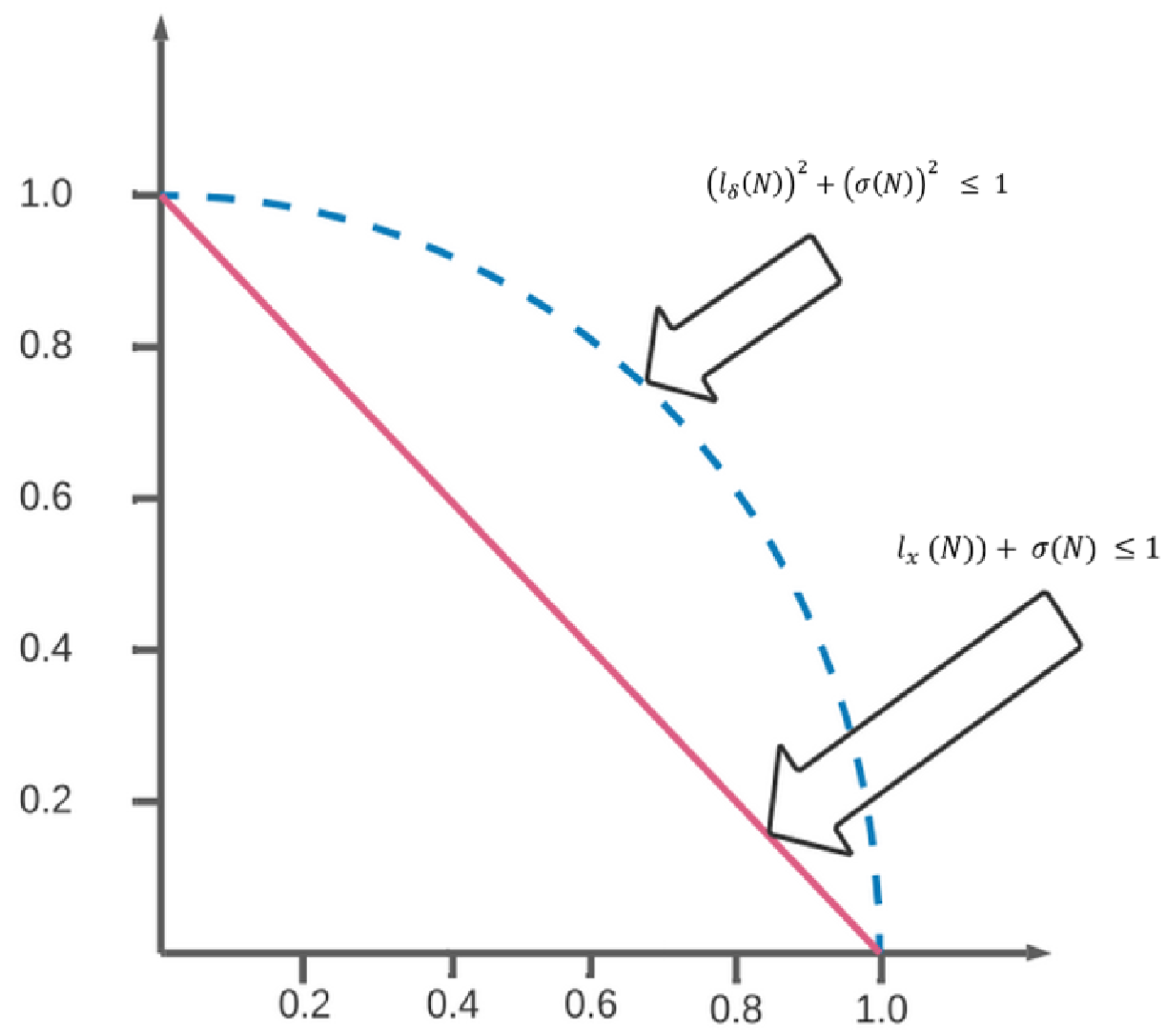
The Pythagorean fuzzy set is the extension of intuitionistic fuzzy set. However, in some problems, the sum of membership degree and non membership degree may be , but the square sum is . So, Yager [31,32] presented the idea of a Pythagorean fuzzy set (PFS). A comparison of PFS and IFS in Figure 1.
Figure 1.
Comparison of IFS and PFS.
Assume to be a universal set; then, the Pythagorean fuzzy set can be generated by the membership function and the non-membership function such as
where
and the degree of indeterminacy is
Example 4.
Let be a universal set; then, a Pythagorean fuzzy set δ can be written as follows:
2.9. Pythagorean Fuzzy Soft Set
The Pythagorean fuzzy soft set (PFSs) is a helpful expansion of the Pythagorean fuzzy set (PFS) for dealing with material that is imprecise or unclear [33]. Peng et al. [34] proposed the concept of Pythagorean fuzzy soft set by combining Ss with PFS (PFSs).
Suppose is a universal set, is an attributive set and . Then, the pair is called a Pythagorean fuzzy soft set, where its mapping is
where is the Pythagorean fuzzy subsets of . A pair can be defined as
where
if it satisfies
3. Cubic Pythagorean Fuzzy Soft Set
In this section, the cubic Pythagorean fuzzy soft set is introduced, which is a hybrid of the cubic Pythagorean fuzzy set and soft set.
Interval-Valued Pythagorean Fuzzy Soft Set
Suppose is a universal set; then, the interval-valued Pythagorean fuzzy soft set can be initiated by , which is the membership function and is the non-membership function.
where is the interval-valued Pythagorean fuzzy subset and
where
and
and , which is called an interval-valued Pythagorean fuzzy soft number.
Example 5.
Assume be a set of agricultural sites and be the expected yield of those sites. Let ; can then be written as
4. Cubic Pythagorean Fuzzy Soft Set
Suppose is a universal set, is an attributive set and , then the cubic Pythagorean fuzzy soft set can be generated as follows:
where is the cubic Pythagorean fuzzy soft set,
where is the Pythagorean fuzzy set and is the interval-valued Pythagorean fuzzy set.
Example 6.
Assume to be a set of agricultural sites and is the expected yield of those sites. Let ; then, Ç can be written as
4.1. Positive-Internal Cubic Pythagorean Fuzzy Soft Set
Suppose is the universal set; then, the positive-internal of in is said to be
Example 7.
Suppose is the universal set; then, the positive-internal of the cubic Pythagorean fuzzy soft set is
4.2. Negative-Internal of Cubic Pythagorean Fuzzy SoftSets
Suppose is the universal set; then, the negative-internal of in is said to be
Example 8.
If is the universal set, then the negative-internal of the cubic Pythagorean fuzzy soft set is
4.3. Internal Cubic Pythagorean Fuzzy Soft Set
If is the universal set, then the in is said to be the internal cubic Pythagorean fuzzy soft set if it satisfies the properties of the positive-internal of and negative-internal of .
Example 9.
If is the universal set, then the internal cubic Pythagorean fuzzy soft set is
Theorem 1
Let the universal set be and the pair be a cubic Pythagorean fuzzy soft set in ℵ. If the pair is a positive internal, then the complement of is a positive internal cubic Pythagorean fuzzy soft set in ℵ.
Proof.
Let the pair be a positive internal cubic picture fuzzy set in R. Then, by 3.2, we have ∀; this implies that ∀,
Therefore, is a positive internal cubic Pythagorean fuzzy soft set in ℵ. □
4.4. Positive-External of Cubic Pythagorean Fuzzy Soft Set
Suppose is the universal set; then, the positive-external of in is said to be
Example 10.
If is the universal set, then the positive-external of is
4.5. Negative-External of Cubic Pythagorean Fuzzy Soft Sets
If is the universal set, then the negative-internal of in is said to be
Example 11.
Suppose is the universal set; then, the negative-external of cubic Pythagorean fuzzy soft set is
4.6. External Cubic Pythagorean Fuzzy Soft Set
Suppose is the universal set; then, the in is said to be the internal cubic Pythagorean fuzzy soft set if it satisfies the properties of positive-internal of and negative-internal .
Example 12.
Suppose is the universal set; then, the external cubic Pythagorean fuzzy soft set is
4.7. Theorem
The universal set be and the pair be a cubic Pythagorean fuzzy soft set in ℵ. If the pair is a positive external, then the complement of is a positive external cubic Pythagorean fuzzy soft set in ℵ.
Proof.
Let the pair be a positive external cubic picture fuzzy set in R. Then, by 3.5, we have ∀; this implies that ∀ .
Therefore, is a positive external cubic Pythagorean fuzzy soft set in ℵ. □
4.8. Set Operators on Cubic Pythagorean Fuzzy Soft Set
We introduced some set operators in the cubic Pythagorean fuzzy soft set.
Let be a Universal set, and be an attributive set with respect to . Let .
Assume there are two cubic Pythagorean fuzzy soft sets
and
4.8.1. Addition
Example 13.
4.8.2. Multiplication
Example 14.
,
4.8.3. Union
Example 15.
,
4.8.4. Intersection
Example 16.
,
4.8.5. Direct Sum
Example 17.
,
4.8.6. Direct Product
Example 18.
,
5. Distance Measures
Assume is the family of , which is defined using ℵ.
Definition 1.
and ; the distance measure is a real-valued function satisfying the following properties
- 1.
- 2.
- if and only if
- 3.
- 4.
- If , then and .
The distance measures for the is defined as
and
Assume that the weight of the element is , where and ; then, we define the generalised weight distance measure between and as follows:
we also define the generalised Hausdorff distance measure for two of and as follows:
For , we have the following distance measures:
1. Hamming Distance
2. Normalised Hamming Distance
3. Weighted Hamming Distance
4. Hausdorff Hamming distance
Here, we define some examples:
Assume that there are three
and
Example 19.
The hamming distance for is
Example 20.
The normalised hamming distance for is
Example 21.
The weighted hamming distance for in which , and
where , and
Example 22.
The Hausdorff Hamming distance of is
For , the following distance measures are defined.
5. Euclidean Distance
6. Normalised Euclidean Distance
7. Weighted Euclidean Distance Measure
8. Hausdorff Euclidean Distance Measure
Example 23.
The euclidean distance of is
Example 24.
The normalised euclidean distance measure of is
Example 25.
The weighted euclidean distance measure of in which , and
Example 26.
The Hausdorff euclidean distance measure of is
6. Development of a Decision-Support System Using Cubic Pythagorean Fuzzy Soft Set
Based on the distance measures defined in the previous section, this section defines a decision-making algorithm utilizing the pragmatic nature of the cubic Pythagorean fuzzy soft set. The algorithm is systematically defined below:
- Step 1: Consider to be a set of “n” alternatives and to be the “m” criteria for each alternative. The ratings of every alternative are represented with the help of .denotes the IVPFS and denotes the PFS. Thus, and represent the degree of membership of the alternative for the criterion . Similarly, and represent the degree of non-membership of the alternative for the criterion . The relation between the alternatives and criteria can be initiated as follows:
- Step 2: are used to assign weights j = 1, 2, …, m; k = 1, 2, …, p to various criteria for a certain group. The weights can be initiated in matrix form as follows:
- Step 3: In Step 3, calculate the distances between the alternative ratings and the applicable criterion’s weights. The relation between the alternatives and the different groups in matrix form can be created as follows:where is the distance of the alternative from the weights of the criteria for belonging to a certain group.
- Step 4: If the distance between the alternatives is smaller, it means that the option is closer to the relevant group. As a result, the alternatives can be ranked based on their lowest distance from the reference set.
Distance measures have great significance in terms of determining the similarities between two points or events expressed in data. Hamming Distance is primarily used for the comparison of two binary strings of data of equal length. Its primary application is the detection and correction of error in large scale computer networks. This has great applications in coding theory as it provides a great way to measure two strings of data of equal length. The limitation of this distance measure is it cannot deal with data when the dimensions are not the same or the length of the string is not equal. For that purpose, the Hausdorff distance is used in the literature with applications in medical image segmentation, designing decision support systems for applications in diagnostic systems, supply chain management, and policy design. When considering multiple dimensions, Euclidean distance is best as it can deal with parameters in multiple dimensions, making it ideal for multi-attribute decision making. These distance measures when combined with fuzzy concepts can address decision-making parameters while having the advantage of tackling uncertainty as well.
7. Developing a Medical Decision-Support System for Presenting a Tentative Diagnosis Based Reference Symptomatic Set
The need for data-driven decision-support systems in the field of medicine has increased over the years due to increased complexity and the abundance of available symptomatic data. These decision-support systems help medical professionals confirm their tentative diagnosis, and in turn decrease diagnostic error and save lives. For this purpose, this section focuses on developing a medical decision-support system for presenting a tentative diagnosis based reference symptomatic set. The proposed distance measures based on are utilized for this purpose. The very first component, IVPFSs, of , is utilised to show the progression of an infectious disease in its early stage, i.e., before diagnosis; hence, the second component of PFSs is utilised to express the same disease after the diagnosis.
Let {COVID-19, Influenza, MERS} be the set of diseases, be the set of patients, let {CBC, LFT, TSH} be the set of tests, which is the universal set and let {Headache, Nausea, Dietary Problems} be the set of symptoms, which is the set of parameters.
We provide further characteristics of these parameters.
- The symptom “Headache” can cause Headaches, Seizures, Vision Changes, Hearing Changes, Drooping of the face.
- The symptom “nausea” can cause a new mole or a change in an existing mole. A sore that does not heal, Jaundice (yellowing of the skin and whites of the eyes).
- The symptom “Dietary Problems” can cause pain after eating, such as belly pain, nausea and vomiting, and appetite changes.
Our aim is to make the best decision possible for each patient ; from the set of symptoms ; and tests ; l = 1, 2, 3 for each disease ;
Step 1. In the first step, the P-T relation is given in the form of , as follows:
The matrix form of the relation is presented as follows:
where each entry (i = 1, 2, 3, 4) & (l = 1, 2, 3) denotes the for the symptoms of the patients .
Step 2. The D-T relation is presented in the form of , as follows:
The matrix form of the above relation is presented as follows:
where (k = 1, 2, 3) & (l = 1, 2, 3) are used to denote weights in the form of for each () towards the ().
Step 3. The Normalised Euclidean distance is calculated to find the distance between the and the .
given in Table 1.
Table 1.
The Normalised Euclidean Distance Measure was used to determine the distance values.
The distance between the and are calculated using the Normalised Hamming Distance
given in Table 2.
Table 2.
The Normalised Hamming Distance Measure was used to determine the distance values.
The distance between the and are calculated using the Hausdorff Hamming distance
given in Table 3.
Table 3.
The Hausdorff Hamming distance measure was used to determine the distance values.
The distances between the and the are calculated by using Hausdorff Euclidean distance measure
given in Table 4.
Table 4.
The Hausdorff Euclidean distance measure was used to determine the distance values.
Step 4. In this step, different are established based on the computed distance values for the four . The minimum distance value between the and the shows that which is suffering from the particular .
8. Discussion
Under the innovative idea of a environment, the suggested distance measurements for can be utilized for the development of a medical decision-support system for medical diagnosis provided it is trained with the aid of medical professionals from symptomatic data. The distance between the patients and the diseases are first calculated using the distance measure and the results are displayed in Table 1. Table 1 shows that the smallest distance exists between the patient and the disease COVID-19. As a result, is suffering from COVID-19 as predicted by the decision-support system. Similarly, is also suffering from COVID-19. The other patients and are suffering from Influenza. Table 2, Table 3 and Table 4 are generated, on the other hand, when the other distances , , and , are used to calculate the distances between the patients and the diseases, respectively. When comparing the data obtained using various distance measurements, the results reveal the same thing. Table 5 lists the disorders in order of severity for the selected group of patients.
Table 5.
Diseases that have been identified in the Patients.
9. Conclusions
This study focuses on developing a novel Cubic Pythagorean Fuzzy Soft Set structure and presents its set operators (addition, multiplication, union, intersection, direct sum, direct product), and distance measures (Hamming, Normalised Hamming, Weighted Hamming, Hausdorff Hamming, Euclidean, Normalised Euclidean, Weighted Euclidean, Hausdorff Euclidean). The structure is superior to the ones in the literature as it addresses the attribute data in decision making studies with the benefit of the tool of a cubic fuzzy set. Furthermore, the concept was used to develop a decision-making algorithm that has numerous applications as it has great potential for utilizing human intuition-based data. One of those applications was the development of a decision-support system which is presented for the diagnosis of infectious diseases from symptomatic data. In future, this study can be conducted with different disease diagnostic labs by considering data of actual patients and actual data can be used to verify the presented technique.
Author Contributions
Conceptualization, M.S. and R.S.; methodology, M.S. and M.H.S.; software, R.S.; validation, U.I., S.S. and M.S.; formal analysis, U.I. and F.d.M.; investigation, S.S. and F.d.M.; resources, M.S.; data curation, M.H.S.; writing—original draft preparation, M.H.S., U.I. and R.S.; writing—review and editing, M.S. and S.S.; visualization, U.I.; supervision, M.S.; project administration, M.S. and S.S.; funding acquisition, S.S. and and F.d.M. All authors have read and agreed to the published version of the manuscript.
Funding
This research received no external funding.
Institutional Review Board Statement
Not applicable.
Informed Consent Statement
Not applicable.
Data Availability Statement
Not applicable.
Conflicts of Interest
The authors declare no conflict of interest.
References
- Zadeh, L.A. Fuzzy sets. Inf. Control 1965, 8, 338–353. [Google Scholar] [CrossRef]
- Zadeh, L.A. The concept of a linguistic variable and its application to approximate reasoning—I. Inf. Sci. 1975, 8, 199–249. [Google Scholar] [CrossRef]
- Jun, Y.B.; Kim, C.S.; Yang, K.O. Cubic sets. Ann. Fuzzy Math. Inform. 2012, 4, 83–98. [Google Scholar]
- Atanasov, K.T. Intuitionistic fuzzy sets Fuzzy sets and systems. Fuzzy Sets Syst. 1986, 20, 87–96. [Google Scholar] [CrossRef]
- Herrera-Viedma, E.; Chiclana, F.; Herrera, F.; Alonso, S. Group decision-making model with incomplete fuzzy preference relations based on additive consistency. IEEE Trans. Syst. Man Cybern. Part (Cybern.) 2007, 37, 176–189. [Google Scholar] [CrossRef] [PubMed]
- Deschrijver, G.; Kerre, E.E. On the composition of intuitionistic fuzzy relations. Fuzzy Sets Syst. 2003, 136, 333–361. [Google Scholar] [CrossRef]
- Atanassov, K.T. Interval valued intuitionistic fuzzy sets. In Intuitionistic Fuzzy Sets; Physica: Heidelberg, Germany, 1999; pp. 139–177. [Google Scholar]
- Herrera, F.; Martinez, L.; Sánchez, P.J. Managing non-homogeneous information in group decision making. Eur. J. Oper. Res. 2005, 166, 115–132. [Google Scholar] [CrossRef]
- Xu, Z. Intuitionistic preference relations and their application in group decision making. Inf. Sci. 2007, 177, 2363–2379. [Google Scholar] [CrossRef]
- Atanassov, K.T. Operators over interval valued intuitionistic fuzzy sets. Fuzzy Sets Syst. 1994, 64, 159–174. [Google Scholar] [CrossRef]
- Bustince, H.; Burillo, P. Correlation of interval-valued intuitionistic fuzzy sets. Fuzzy Sets Syst. 1995, 74, 237–244. [Google Scholar] [CrossRef]
- Hong, D.H. A note on correlation of interval-valued intuitionistic fuzzy sets. Fuzzy Sets Syst. 1998, 95, 113–117. [Google Scholar] [CrossRef]
- Mondal, T.K.; Samanta, S.K. Topology of interval-valued intuitionistic fuzzy sets. Fuzzy Sets Syst. 2001, 119, 483–494. [Google Scholar] [CrossRef]
- Deschrijver, G.; Kerre, E.E. On the relationship between some extensions of fuzzy set theory. Fuzzy Sets Syst. 2003, 133, 227–235. [Google Scholar] [CrossRef]
- Xu, Z.-S. On similarity measures of interval-valued intuitionistic fuzzy sets and their application to pattern recognitions. J. Southeast Univ. (English Ed.) 2007, 23, 139–143. [Google Scholar]
- Kaur, G.; Garg, H. Multi-attribute decision-making based on Bonferroni mean operators under cubic intuitionistic fuzzy set environment. Entropy 2018, 20, 65. [Google Scholar] [CrossRef] [PubMed]
- Kaur, G.; Garg, H. Cubic intuitionistic fuzzy aggregation operators. Int. J. Uncertain. Quantif. 2018, 8, 405–427. [Google Scholar] [CrossRef]
- Molodtsov, D. Soft set theory—First results. Comput. Math. Appl. 1999, 37, 19–31. [Google Scholar] [CrossRef]
- Xu, W.; Ma, J.; Wang, S.; Hao, G. Vague soft sets and their properties. Comput. Math. Appl. 2010, 59, 787–794. [Google Scholar] [CrossRef]
- Yang, X.; Lin, T.Y.; Yang, J.; Li, Y.; Yu, D. Combination of interval-valued fuzzy set and soft set. Comput. Math. Appl. 2009, 58, 521–527. [Google Scholar] [CrossRef]
- Muhiuddin, G.; Abdullah, M.A.-R. Cubic soft sets with applications in BCK/BCI-algebras. Ann. Fuzzy Math. Inform. 2014, 8, 291–304. [Google Scholar]
- Maji, P.K.; Roy, A.R.; Biswas, R. On intuitionistic fuzzy soft sets. J. Fuzzy Math. 2004, 12, 669–684. [Google Scholar]
- Yin, Y.; Li, H.; Jun, Y.B. On algebraic structure of intuitionistic fuzzy soft sets. Comput. Math. Appl. 2012, 64, 2896–2911. [Google Scholar] [CrossRef]
- Jiang, Y.; Tang, Y.; Chen, Q.; Liu, H.; Tang, J. Interval-valued intuitionistic fuzzy soft sets and their properties. Comput. Math. Appl. 2010, 60, 906–918. [Google Scholar] [CrossRef]
- Smarandache, F. Extension of soft set to hypersoft set, and then to plithogenic hypersoft set. Neutrosophic Sets Syst. 2018, 22, 168–170. [Google Scholar]
- Babu, V.A.; Malleswari, V.S.N. Intuitionistic fuzzy soft cubic relations. Adv. Appl. Math. Sci. 2021, 20, 1021–1030. [Google Scholar]
- Grattan-Guinness, I. Fuzzy membership mapped onto intervals and many-valued quantities. Math. Log. Q. 1976, 22, 149–160. [Google Scholar] [CrossRef]
- Jahn, K.-U. Intervall-wertige Mengen. Math. Nachrichten 1975, 68, 115–132. [Google Scholar] [CrossRef]
- Sambuc, R.; Fonctions, F. Application l’Aide au Diagnostic en Pathologie Thyroidienne; Faculté de Médecine de Marseille, Aix-Marseille Université: Marseille, France, 1975. [Google Scholar]
- Maji, P.K.; Biswas, R.K.; Roy, A. Fuzzy soft sets. J. Fuzzy Math. 2001, 9, 589–602. [Google Scholar]
- Yager, R.R.; Abbasov, A.M. Pythagorean membership grades, complex numbers, and decision making. Int. J. Intell. Syst. 2013, 28, 436–452. [Google Scholar] [CrossRef]
- Yager, R.R. Pythagorean membership grades in multicriteria decision making. IEEE Trans. Fuzzy Syst. 2013, 22, 958–965. [Google Scholar] [CrossRef]
- Athira, T.M.; John, S.J.; Garg, H. A novel entropy measure of Pythagorean fuzzy soft sets. AIMS Math. 2020, 5, 1050–1061. [Google Scholar] [CrossRef]
- Peng, X.D.; Yang, Y.; Song, J.; Jiang, Y. Pythagorean fuzzy soft set and its application. Comput. Eng. 2015, 41, 224–229. [Google Scholar]
Publisher’s Note: MDPI stays neutral with regard to jurisdictional claims in published maps and institutional affiliations. |
© 2022 by the authors. Licensee MDPI, Basel, Switzerland. This article is an open access article distributed under the terms and conditions of the Creative Commons Attribution (CC BY) license (https://creativecommons.org/licenses/by/4.0/).



