Cheney–Sharma Type Operators on a Triangle with Straight Sides


Abstract
1. Introduction
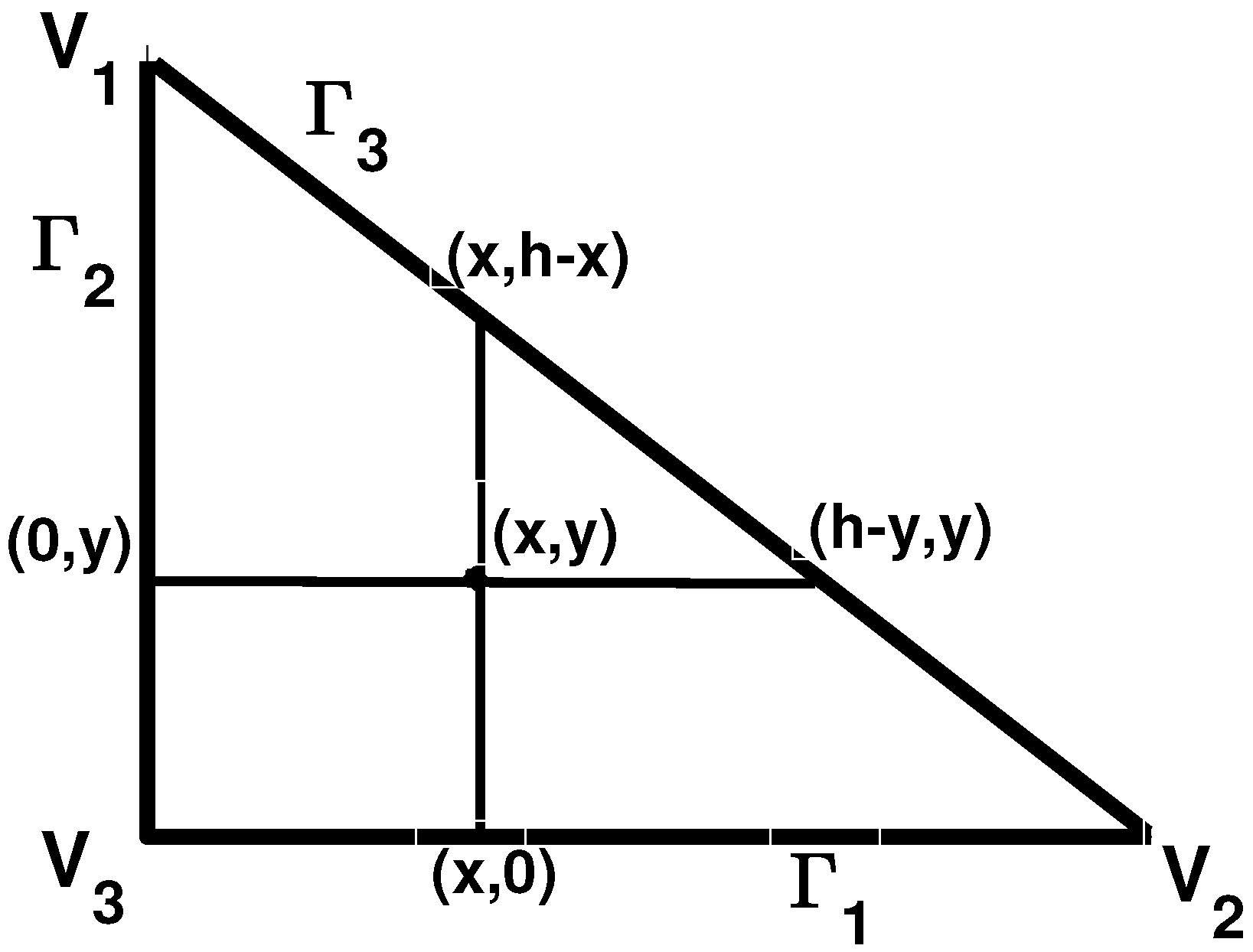
2. Cheney–Sharma Operator of the Second Kind
- (i)
- on
- (ii)
- on
- (i)
- ; ;
- (ii)
- , ; , where , .
2.1. Product Operators
- (i)
- (ii)
2.2. Boolean Sum Operators
3. Cheney–Sharma Operator of the First Kind
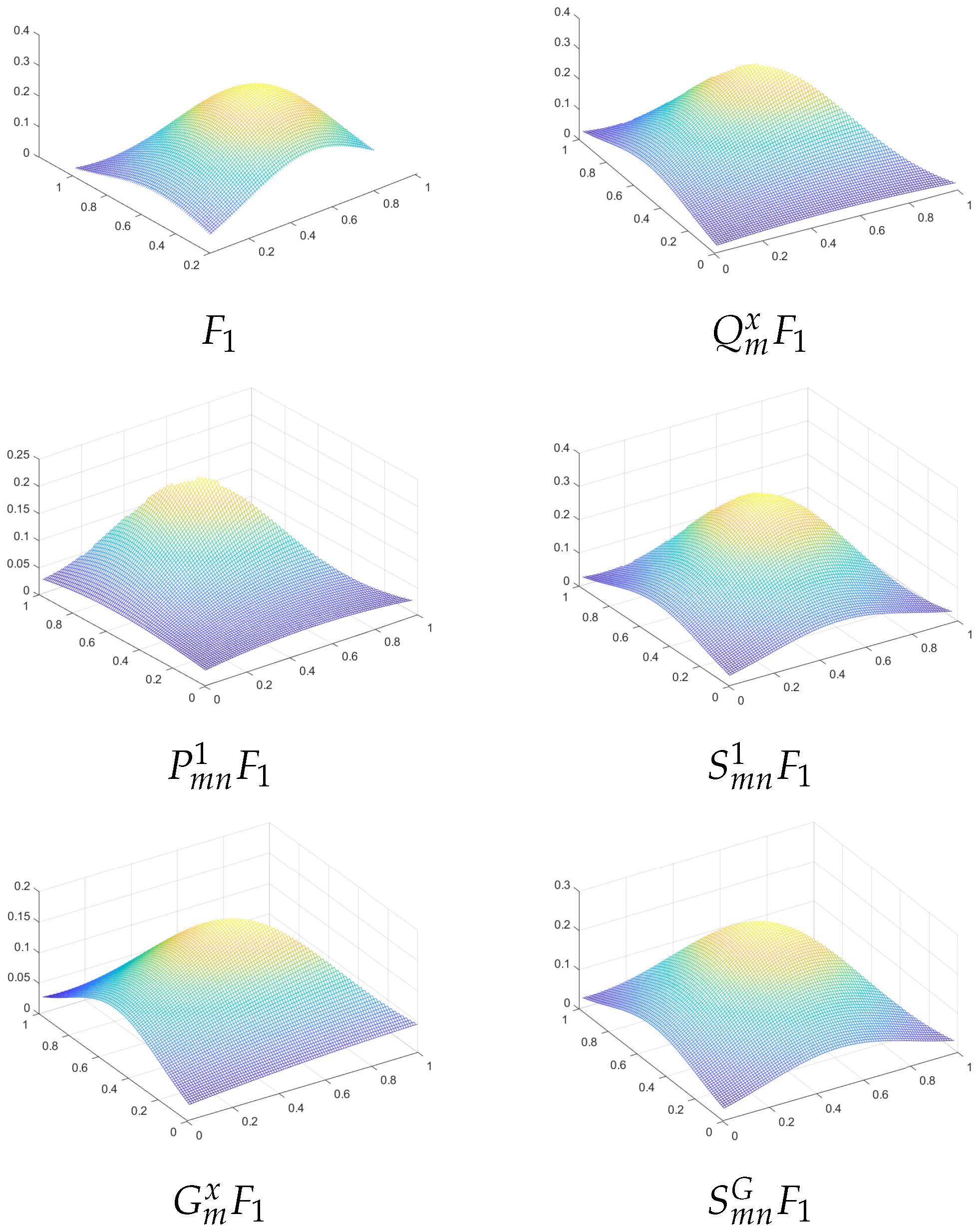
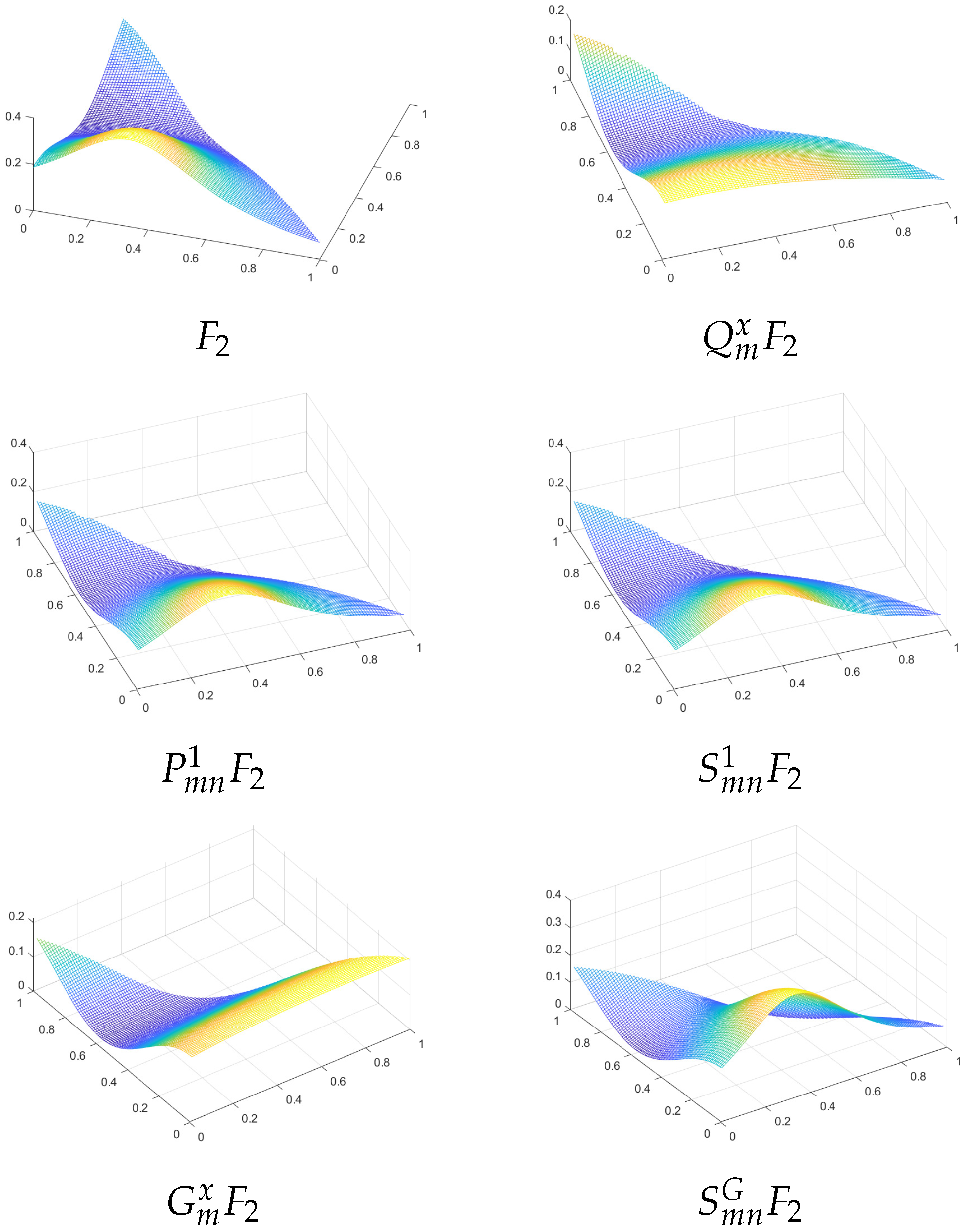
4. Numerical Examples
5. Conclusions
Funding
Data Availability Statement
Conflicts of Interest
References
- Barnhill, R.E.; Birkhoff, G.; Gordon, W.J. Smooth interpolation in triangles. J. Approx. Theory 1973, 8, 114–128. [Google Scholar] [CrossRef]
- Barnhill, R.E.; Gregory, J.A. Polynomial interpolation to boundary data on triangles. Math. Comp. 1975, 29, 726–735. [Google Scholar] [CrossRef]
- Blaga, P.; Coman, G. Bernstein-type operators on triangle. Rev. Anal. Numer. Theor. Approx. 2009, 37, 9–21. [Google Scholar]
- Böhmer, K.; Coman, G. Blending Interpolation Schemes on Triangle with Error Bounds; Lecture Notes in Mathematics, 571; Springer: Berlin/Heidelberg, Germany; New York, NY, USA, 1977; pp. 14–37. [Google Scholar]
- Cătinaş, T.; Coman, G. Some interpolation operators on a simplex domain. Stud. Univ. Babes-Bolyai Math. 2007, 52, 25–34. [Google Scholar]
- Costabile, F.A.; Dell’Accio, F. Expansions over a simplex of real functions by means of Bernoulli polynomials. Numer. Algorithms 2001, 28, 63–86. [Google Scholar] [CrossRef]
- Costabile, F.A.; Dell’Accio, F. Lidstone approximation on the triangle. Appl. Numer. Math. 2005, 52, 339–361. [Google Scholar] [CrossRef]
- Barnhill, R.E.; Gregory, J.A. Compatible smooth interpolation in triangles. J. Approx. Theory 1975, 15, 214–225. [Google Scholar] [CrossRef]
- Bernardi, C. Optimal finite-element interpolation on curved domains. SIAM J. Numer. Anal. 1989, 26, 1212–1240. [Google Scholar] [CrossRef]
- Blaga, P.; Cătinaş, T.; Coman, G. Bernstein-type operators on tetrahedrons. Stud. Univ. Babes-Bolyai Math. 2009, 54, 3–19. [Google Scholar]
- Blaga, P.; Cătinaş, T.; Coman, G. Bernstein-type operators on a square with one and two curved sides. Stud. Univ. Babes-Bolyai Math. 2010, 55, 51–67. [Google Scholar]
- Blaga, P.; Cătinaş, T.; Coman, G. Bernstein-type operators on triangle with all curved sides. Appl. Math. Comput. 2011, 218, 3072–3082. [Google Scholar] [CrossRef]
- Blaga, P.; Cătinaş, T.; Coman, G. Bernstein-type operators on triangle with one curved side. Mediterr. J. Math. 2012, 9, 843–855. [Google Scholar] [CrossRef]
- Cătinaş, T. Some classes of surfaces generated by Nielson and Marshall type operators on the triangle with one curved side. Stud. Univ. Babes-Bolyai Math. 2016, 61, 305–314. [Google Scholar]
- Cătinaş, T. Extension of some particular interpolation operators to a triangle with one curved side. Appl. Math. Comput. 2017, 315, 286–297. [Google Scholar] [CrossRef]
- Cătinaş, T. Extension of Some Cheney-Sharma Type Operators to a Triangle With One Curved Side. Miskolc Math. Notes 2020, 21, 101–111. [Google Scholar] [CrossRef]
- Cătinaş, T.; Blaga, P.; Coman, G. Surfaces generation by blending interpolation on a triangle with one curved side. Results Math. 2013, 64, 343–355. [Google Scholar] [CrossRef]
- Coman, G.; Cătinaş, T. Interpolation operators on a tetrahedron with three curved sides. Calcolo 2010, 47, 113–128. [Google Scholar] [CrossRef]
- Coman, G.; Cătinaş, T. Interpolation operators on a triangle with one curved side. BIT Numer. Math. 2010, 50, 243–267. [Google Scholar] [CrossRef]
- Marshall, J.A.; Mitchell, A.R. An exact boundary tehnique for improved accuracy in the finite element method. J. Inst. Maths. Applics. 1973, 12, 355–362. [Google Scholar] [CrossRef]
- Mitchell, A.R.; McLeod, R. Curved elements in the finite element method. In Conference on the Numerical Solution of Differential Equations; Springer: Berlin/Heidelberg, Germany, 1974; Volume 363, pp. 89–104. [Google Scholar]
- Chandra, P.; Kumar, V.D.; Naokant, D. Approximation by Durrmeyer variant of Cheney-Sharma Chlodovsky operators. Math. Found. Comput. 2022. [Google Scholar] [CrossRef]
- Cheney, E.W.; Sharma, A. On a generalization of Bernstein polynomials. Riv. Mat. Univ. Parma 1964, 5, 77–84. [Google Scholar]
- Ong, S.H.; Ng, C.M.; Yap, H.K.; Srivastava, H.M. Some Probabilistic Generalizations of the Cheney–Sharma and Bernstein Approximation Operators. Axioms 2022, 11, 537. [Google Scholar] [CrossRef]
- Stancu, D.D.; Cişmaxsxiu, C. On an approximating linear positive operator of Cheney-Sharma. Rev. Anal. Numer. Theor. Approx. 1997, 26, 221–227. [Google Scholar]
- Barnhill, R.E. Blending Function Interpolation: A Survey and Some New Results. In Numerishe Methoden der Approximationstheorie; Collatz, L., Ed.; Birkhauser-Verlag: Basel, Switzerland, 1976; Volume 30, pp. 43–89. [Google Scholar]
- Barnhill, R.E. Representation and approximation of surfaces. In Mathematical Software III; Rice, J.R., Ed.; Academic Press: New York, NY, USA, 1977; pp. 68–119. [Google Scholar]
- Barnhill, R.E.; Gregory, J.A. Sard kernels theorems on triangular domains with applications to finite element error bounds. Numer. Math. 1976, 25, 215–229. [Google Scholar] [CrossRef]
- Gordon, W.J.; Hall, C. Transfinite element methods: Blending-function interpolation over arbitrary curved element domains. Numer. Math. 1973, 21, 109–129. [Google Scholar] [CrossRef]
- Gordon, W.J.; Wixom, J.A. Pseudo-harmonic interpolation on convex domains. SIAM J. Numer. Anal. 1974, 11, 909–933. [Google Scholar] [CrossRef]
- Liu, T. A wavelet multiscale-homotopy method for the parameter identification problem of partial differential equations. Comput. Math. Appl. 2016, 71, 1519–1523. [Google Scholar] [CrossRef]
- Liu, T. A multigrid-homotopy method for nonlinear inverse problems. Comput. Math. Appl. 2020, 79, 1706–1717. [Google Scholar] [CrossRef]
- Marshall, J.A.; Mitchell, A.R. Blending interpolants in the finite element method. Int. J. Numer. Meth. Eng. 1978, 12, 77–83. [Google Scholar] [CrossRef]
- Roomi, V.; Ahmadi, H.R. Continuity and Differentiability of Solutions with Respect to Initial Conditions and Peano Theorem for Uncertain Differential Equations. Math. Interdiscip. 2022. [Google Scholar] [CrossRef]
- Agratini, O. Approximation by Linear Operators; Cluj University Press: Cluj-Napoca, Romania, 2000. [Google Scholar]
- Sard, A. Linear Approximation; American Mathematical Society: Providence, RI, USA, 1963. [Google Scholar]
- Renka, R.J.; Cline, A.K. A triangle-based C1 interpolation method. Rocky Mountain J. Math. 1984, 14, 223–237. [Google Scholar] [CrossRef]


| Max Error | ||
|---|---|---|
Publisher’s Note: MDPI stays neutral with regard to jurisdictional claims in published maps and institutional affiliations. |
© 2022 by the author. Licensee MDPI, Basel, Switzerland. This article is an open access article distributed under the terms and conditions of the Creative Commons Attribution (CC BY) license (https://creativecommons.org/licenses/by/4.0/).
Share and Cite
Cătinaş, T. Cheney–Sharma Type Operators on a Triangle with Straight Sides. Symmetry 2022, 14, 2446. https://doi.org/10.3390/sym14112446
Cătinaş T. Cheney–Sharma Type Operators on a Triangle with Straight Sides. Symmetry. 2022; 14(11):2446. https://doi.org/10.3390/sym14112446
Chicago/Turabian StyleCătinaş, Teodora. 2022. "Cheney–Sharma Type Operators on a Triangle with Straight Sides" Symmetry 14, no. 11: 2446. https://doi.org/10.3390/sym14112446
APA StyleCătinaş, T. (2022). Cheney–Sharma Type Operators on a Triangle with Straight Sides. Symmetry, 14(11), 2446. https://doi.org/10.3390/sym14112446