


Abstract
Currently, in nonlinear optics, models associated with various types of the nonlinear Schrödinger equation (scalar (NLS), vector (VNLS), derivative (DNLS)), as well as with higher and mixed equations from the corresponding hierarchies are usually studied. Typical tools for solving the problem of propagation of optical nonlinear waves are the forward and inverse nonlinear Fourier transforms. One of the methods for reconstructing a periodic nonlinear signal is based on the use of spectral data in the form of spectral curves. In this paper, we study the properties of the spectral curves for all the derivatives NLS equations simultaneously. For all the main DNLS equations (DNLSI, DNLSII, DNLSIII), we have obtained unified Lax pairs, unified hierarchies of evolutionary and stationary equations, as well as unified equations of spectral curves of multiphase solutions. It is shown that stationary and evolutionary equations have symmetries, the presence of which leads to the existence of holomorphic involutions on spectral curves. Because of this symmetry, spectral curves of genus g are covers over other curves of genus M and , where M is a number of phase of solutions. We also showed that the number of the genus g of the spectral curve is related to the number of phases M of the solution of one of the two formulas: or . The third section provides examples of the simplest solutions.
1. Introduction
The main tools for the study of nonlinear optical signals are the forward and inverse nonlinear Fourier transforms [1,2,3,4,5], and the main models of nonlinear optics are the scalar, vector, and derived nonlinear Schrödinger equations, as well as their higher forms from the corresponding hierarchies. A key feature of these equations is the fact that they are integrable nonlinear evolutionary differential equations. Integrable nonlinear equations can usually be obtained as conditions for the compatibility of two linear differential equations, called a Lax pair.
The first equation of the Lax pair for the scalar and vector Schrödinger equations has the form
where
J is some constant diagonal matrix with zero trace, is a spectral parameter. In particular, these matrices are equal to:
in the case of the scalar nonlinear Schrödinger equation and the equations from the Ablowitz-Kaup-Newell-Sigur hierarchy (AKNS) [6], and
in the case of a two-dimensional vector nonlinear Schrödinger equation (Manakov system) [7].
Since spectral curves are used to reconstruct a periodic nonlinear signal (see, for example, [8,9]), it is important to know the properties of these curves for each integrable model. More than 30 years ago, Dubrovin B.A. showed [10] that the matrix is a matrix potential associated with a spectral curve of finite genus if there exists a monodromy matrix
such that the functions and
is simultaneously the solution of the Equation (1) (see also [8]). In this case, the equation of the spectral curve associated with this matrix has the form
where I is the unit matrix. Thus, to find the equation of the spectral curve associated with the matrix Q, one must find the monodromy matrix M. Note that all the coefficients of the Equation (5) are integrals.
Since the matrix-function is solution of the Equation (1), we have
Therefore the matrix M satisfies the equation
Substituting the sum (3) into the Equation (6) and equating the matrices for all powers of the spectral parameter , we obtain the following matrix structure M
where is a constant matrix, ,
Also, the Equation (6) implies recurrent relations between the elements of the matrices . In addition, assuming in the Equation (6), we can obtain a hierarchy of corresponding stationary equations that are satisfied by multiphase finite-gap solutions and their degeneracies.
Choosing the second equation of the Lax pair in the form
from the condition of compatibility of the Equations (1) and (7) we obtain an integrable evolutionary nonlinear equation from the corresponding hierarchy. That is, using the structure of the monodromy matrix, we can construct the corresponding hierarchy of integrable nonlinear equations. For the Manakov system and the Kulish-Sklyanin model, this program was implemented in [11,12].
The first Lax pair equation for DNLS equations differs from the above equations in that the matrix U has a quadratic dependence on the spectral parameter. Therefore, the monodromy matrix has a different structure and a different relationship to the matrices (see, for example, [13]).
Let us note that three forms of the DNLS equations are most often considered:
- DNLSI or Kaup-Newell equation [13,14,15,16,17,18,19,20,21]
- DNLSII or Chen-Lee-Liu equation [16,17,18,19,21,22]
- DNLSIII or Gerdjikov-Ivanov equation [16,17,18,19,21,23,24]
which are special cases of the generalized DNLS equation [25,26,27,28]. Let us note that there are also gauge transformations that transform these equations into each other and preserve the magnitude of the solution (see, for example, [16,21,29,30,31]).
Each of these nonlinear equations corresponds to its own matrix U. In particular, this matrix is equal to
for DNLSI equation,
for DNLSII equation, and
for DNLSIII eqaution.
It is easy to see that the U matrices discussed above can be written using a single formula
where for DNLSI, for DNLSII, and for DNLSIII.
In present paper, using the matrix (11), we apply the Dubrovin’s method to construct a hierarchy of the DNLS equations and analyze the properties of multiphase solutions of this hierarchy. The Section 1 of the paper is devoted to finding the structure of the monodromy matrix and the recurrent relations between its elements. Also in the Section 1, the second Lax pair operators are proposed for constructing a hierarchy of generalized DNLS equations. In Section 2, the equations of spectral curves are considered and stationary equations are derived. A significant difference from the case of the scalar NLS equation is the difference between the genus of the spectral curve and the number of phases of the solution. Also in the Section 2, we show that the equations of spectral curves are invariant under the involution . The Section 3 provides examples of null-phase and one-phase solutions of the coupled DNLS equations.
2. Generalized DNLS Equation
Let us consider the equation
where
p and q are functions, s is a constant.
Following [13], we take the monodromy matrix as a sum
It follows from the Equation (12) that the monodromy matrix M satisfies the equation (see, for example, Equations (4) and (6))
Substituting the sum (13) in Equation (14) we have that the matrix has a form
where are some constants,
From the Equation (14) also follows the following relations on the elements of the matrices
In particular,
Taking the matrix in the form
let us define the second equation of the Lax pair
From the conditions of compatibility
of the Equations (12) and (21) the following evolutionary nonlinear equations follow
The first coupled equation from this hierarchy has the form
We believe that the Equation (23) is the most natural form of the generalized DNLS equation, since substituting and the appropriate s into it, one can get one of the Equations (8)–(10). It is not difficult to see that the Equation (23) implies three main coupled DNLS equations.
- The coupled DNLSI for
- The coupled DNLSII for
- The coupled DNLSIII for
3. Spectral Curves of the Multiphase Solutions
These equations are satisfied by multiphase solutions of the evolutionary nonlinear Equation (22). As in the case of the Kaup-Newell hierarchy [13], the multiphase solutions must also satisfy the second set of stationary equations (obtained from (24) and (25) for )
Since the equation of the spectral curve of the multiphase solution has the form
where I is the unit matrix, and since , in this case the spectral curve is given by the equation
and
where are integrals of the evolutionary nonlinear Equation (22). Since the curves (28) and (29) are hyperelliptic, their genus is and , respectively.
It follows from Equation (18) that the functions , and have the following symmetries
Therefore, the stationary and evolutionary equations are invariant with respect to the involution .
Since the matrices (17) have the symmetry , the monodromy matrix M also has this symmetry. Due to the fact that the equation of the spectral curve of multiphase solutions is invariant with respect to two involutions and simultaneously, it has the following symmetry
Therefore all coefficients () are equal to zero.
4. Examples
4.1. Case
If , then , and . Therefore, a matrix M has a form
It follows from the Equation (30) that the spectral curve is given by the equation
Therefore, the product is a constant, .
From the Equation (14) for , the following stationary equations follow
Solving these equations for , we have: ,
Substituting these expressions in Equation (23), we obtain the solution of Equation (23) in the form of a plane wave
Since and , the equation of the spectral curve of this solution has the form
4.2. Case
If , then and . Therefore, a matrix M has a form
From the Equation (14) for , the following stationary equations follow
From the Equation (33) it follows that if , then and the solution of the Equation (23) has the form of a plane wave (31). Therefore, we assume that and .
Calculating the equation of the spectral curve, we get
Since the coefficients of this equation are constant values, the equation also holds in this case. Solving the Equation (33) for , , we have
Substituting these expressions in the Equation (23), we get the solution of the Equation (23) in the form of a plane wave
This example illustrates the fact that the genus of the spectral curve in the case of DNLS equations does not coincide with the number of phases ().
4.3. Case
4.3.1. General Formulas
Let us assume , , , . Then the matrix M has the form
From the Equation (14) for , the following stationary equations follow
For , the condition of compatibility of the Equation (36) implies the constancy of the product . Therefore, we will assume that .
Calculating the equation of the spectral curve, we get
where the integrals equal to
From the Equations (36) and (37) it follows that the function satisfies the equation
or
where is the integration constant. It follows from the Equation (39) that is an elliptic function or its degeneracy.
Knowing the Wronskian of functions and their product, it is not difficult to find the functions themselves
Substituting (40) in (36), (37) and simplifying with the relations (38), (39), we get the value of :
It is not difficult to check that the corresponding onee-phase solution of the Equation (23) has the form
where , .
In this case, a spectral curve of the genus corresponds to the one-phase solution with the phase X.
4.3.2. Quasi-Rational Travelling Wave
Let us consider a degenerate spectral curve, which is given by the equation
In this case
For these parameter values, the function satisfies the equation
Solving this equation, we get
It follows from the identity
that the solution (43) of the Equation (23) can be written by the following equalities
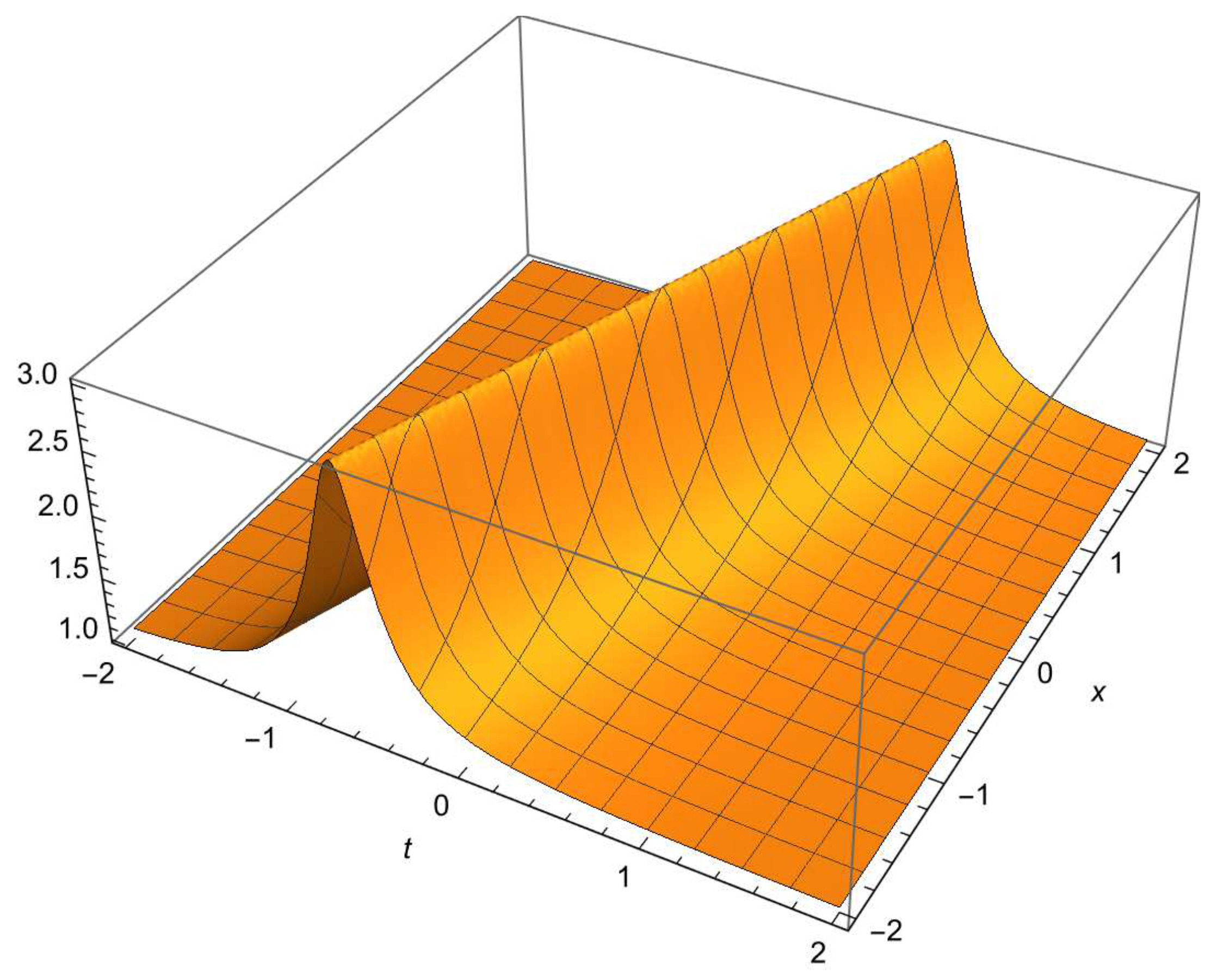
For the solution (45) is a quasi-rational travelling wave. It is easy to see that the solution (45) satisfies the condition . Figure 1 shows the magnitude of the solution (45) for .
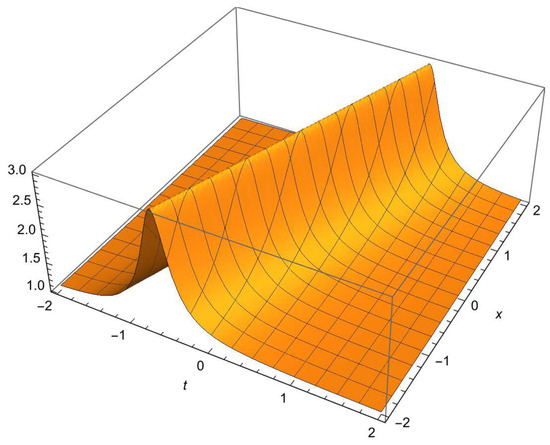
Figure 1.
A magnitude of the travelling wave (45) for .
4.4. Case
4.4.1. General Formulas
Let us assume , , . Then the matrix M has the form
From the Equations (26) and (27) it follows that to construct new solutions, ones should put . The stationary equations in this case have the form
Calculating the equation of the spectral curve, we get
where the integrals equal to
From the Equations (47) and (48) it follows that the function satisfies the equation
or
where is the integration constant. It follows from the Equation (50) that is an elliptic function or its degeneracy.
Knowing the Wronskian of functions and their product, it is not difficult to find the functions themselves
Substituting (51) in (47), (48) and simplifying with the relations (49), (50), we get the value of :
It is not difficult to check that the corresponding one-phase solution of the Equation (23) has the form
where , .
In this case, a spectral curve of the genus corresponds to the one-phase solution with phase X.
4.4.2. Soliton Solution
Let us consider a degenerate spectral curve, which is given by the equation
In this case
For these parameter values, the function satisfies the equation
Therefore,
Calculating the integral and expressing the function from it, we get
Thus, the one-phase solution of the Equation (23) constructed from the spectral curve (53) has the form
where
It follows from the identity (44) that this solution of the Equation (23) is defined by the following equalities
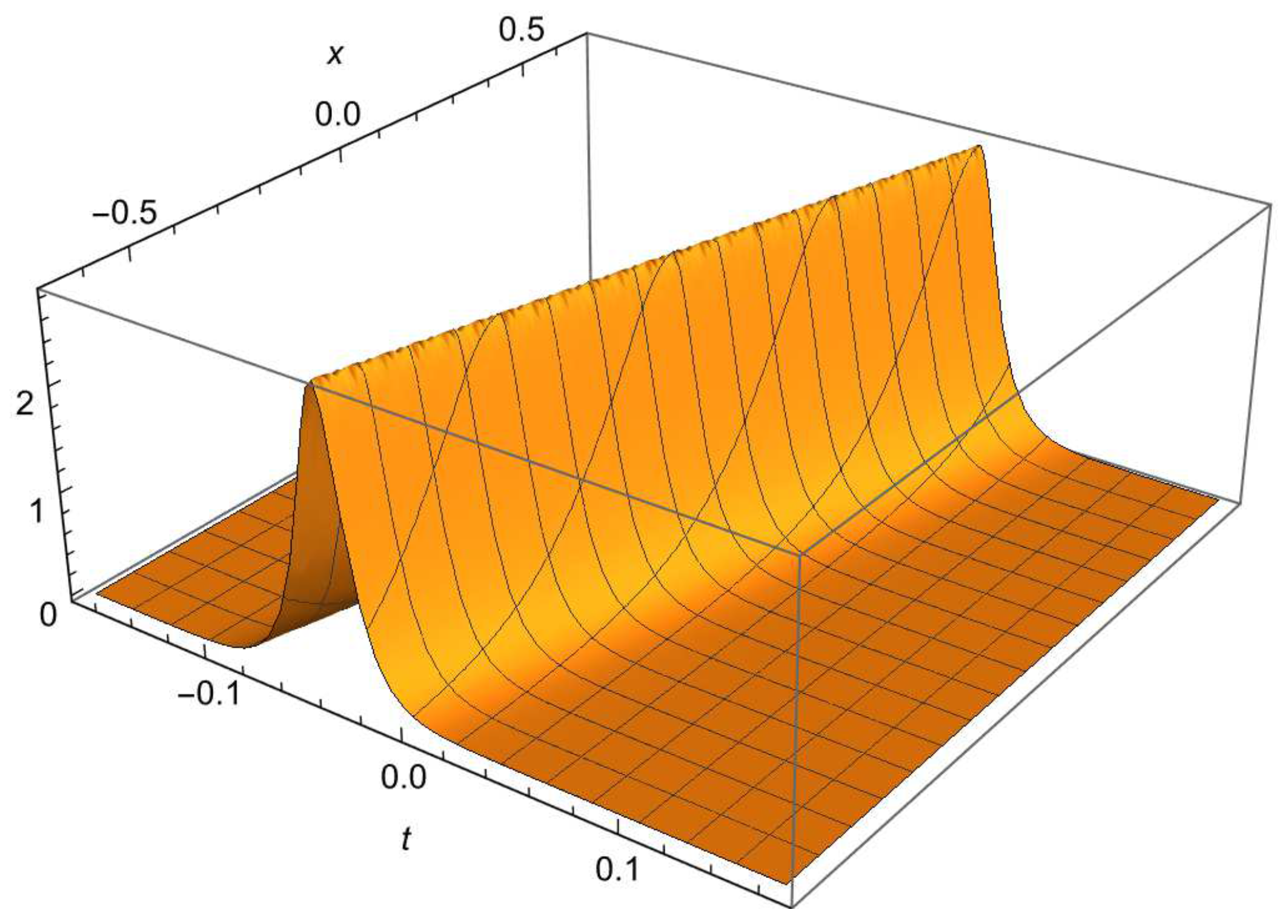
where , . For , the solution (55) satisfies the condition . Figure 2 shows the magnitude of the soliton (55) for , , .
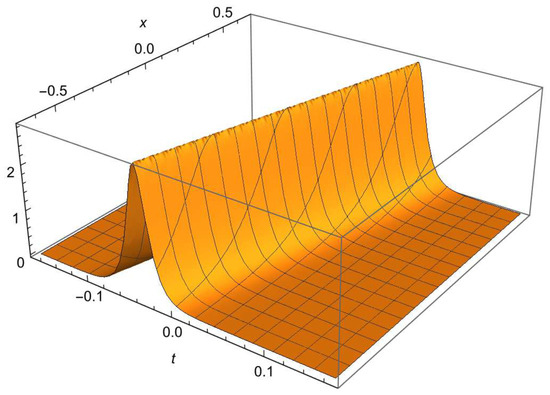
Figure 2.
A magnitude of the soliton (55) for , .
Changing the sign before the square root in the expression (54), we get
and
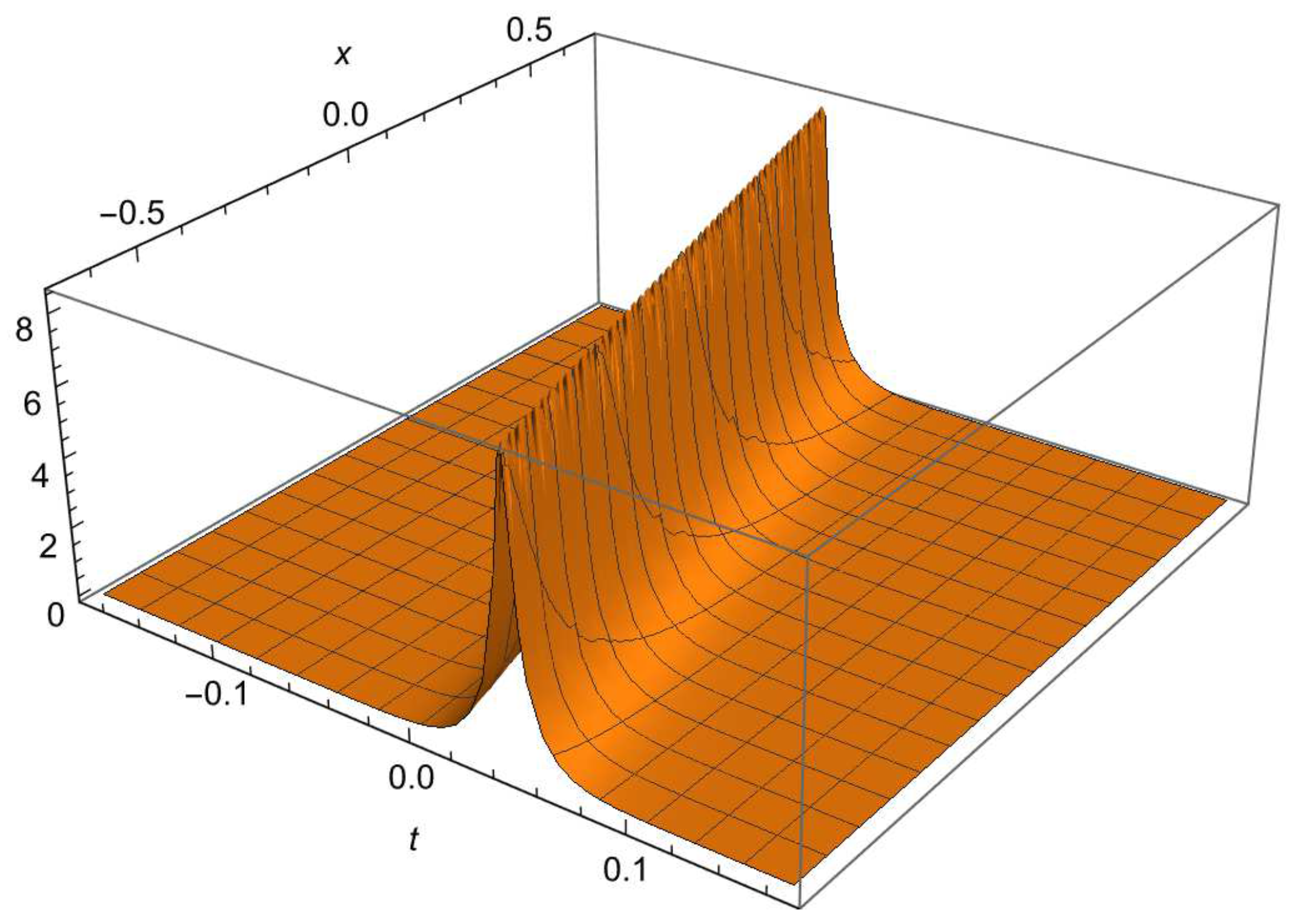
where , . For the solution (56) satisfies the condition . Figure 3 shows the magnitude of the soliton (56) for , , .
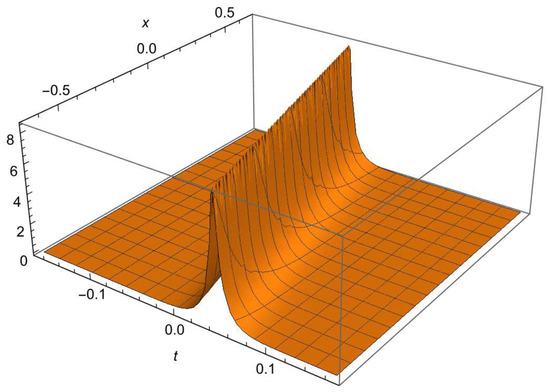
Figure 3.
A magnitude of the soliton (56) for , .
4.4.3. One-Phase Periodic Solution
Let a degenerate spectral curve be given by the equation
This equation can be obtained from (53) by replacing . It is not difficult to check that the corresponding solutions of the DNLS equations can also be obtained using this substitution:
and
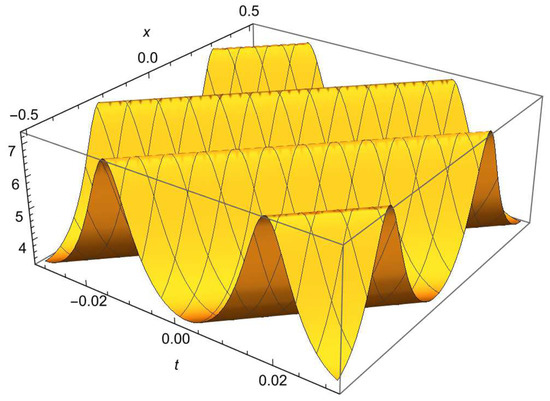
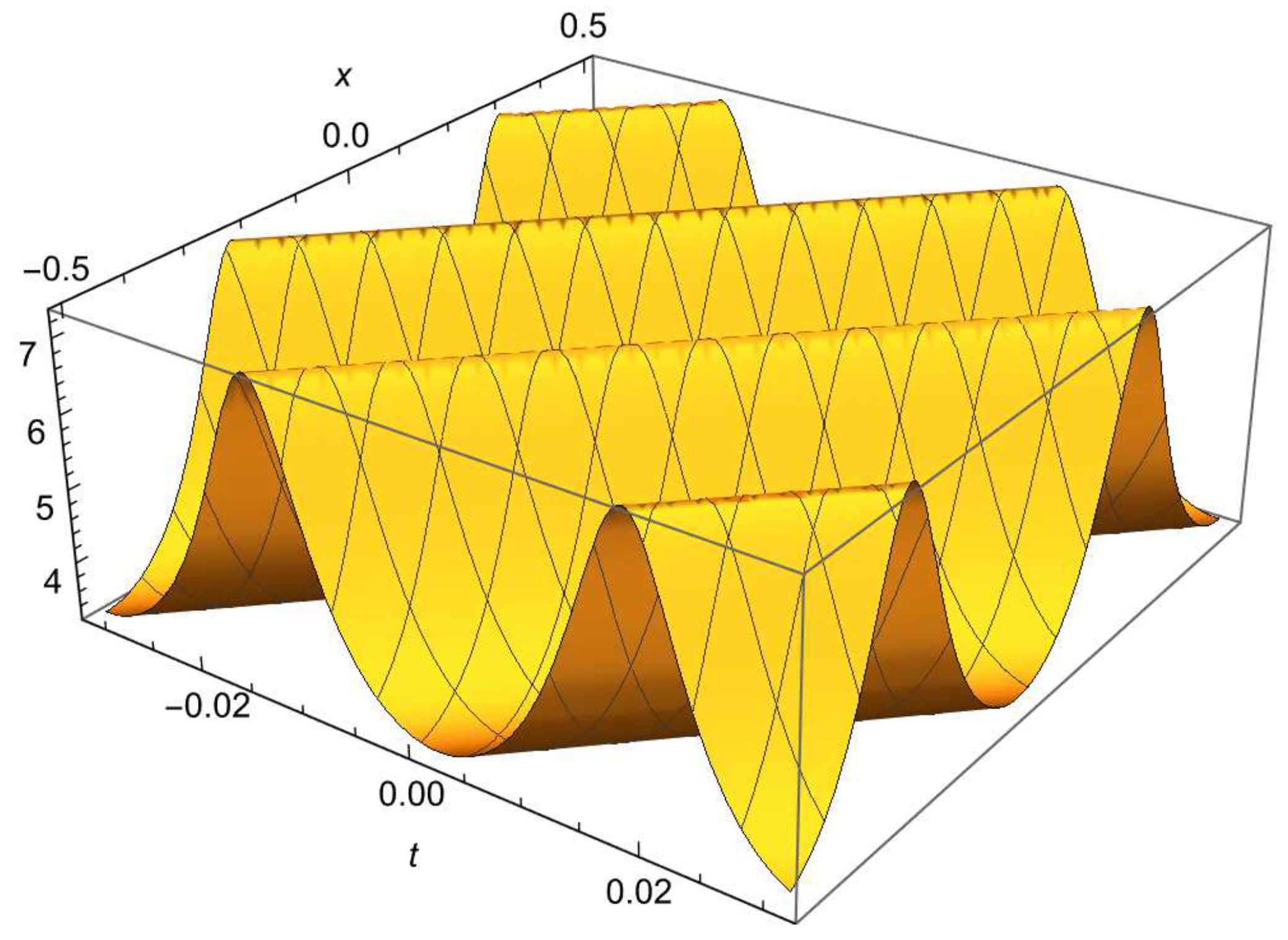
where , . For the solution (59) satisfies the equation . Figure 4 shows the magnitude of the one-phase periodic solution (59) for , , .
5. Concluding Remark
As a result of the analysis of the examples, we can make the conjecture.
Let us write the equation of the spectral curve of a M-phase solution in the following form
where is a polynomial of of degree k. Then the genus g of the spectral curve (63) is equal: for even g and for odd g. Therefore the spectral curve of a M-phase solution of the derived NLS equation is a covering of the algebraic cuve of the genus M:
Hence, it seems that finite-gap solutions should be constructed not according to curve (63), but according to curve (64).
It is well known that the presence of symmetry of the hyperelliptic curve (63) leads to the fact that it is a cover over two other curves: (64) and
where is a genus of the curve (65). In the future, we plan to investigate the roles of curves and in the process of constructing finite-gap multiphase solutions.
Funding
The article was prepared with the financial support of the Ministry of Science and Higher Education and of the Russian Federation, grant agreement No. FSRF-2020-0004.
Conflicts of Interest
The author declares no conflict of interest.
References
- Yousefi, M.I.; Kschischang, F.R. Information transmission using the nonlinear Fourier transform, part I: Mathematical tools. IEEE Trans. Inf. Theory 2014, 60, 4312–4328. [Google Scholar] [CrossRef] [Green Version]
- Yousefi, M.I.; Kschischang, F.R. Information transmission using the nonlinear Fourier transform, part II: Numerical methods. IEEE Trans. Inf. Theory 2014, 60, 4329–4345. [Google Scholar] [CrossRef]
- Yousefi, M.I.; Kschischang, F.R. Information transmission using the nonlinear Fourier transform, part III: Spectrum modulation. IEEE Trans. Inf. Theory 2014, 60, 4346–4369. [Google Scholar] [CrossRef] [Green Version]
- Goossens, J.W.; Haffermann, H.; Yousefi, M.I.; Jaouën, Y. Nonlinear Fourier Trasform in Optical Communications; Optic InfoBase Conference Papers; Part F82-CLEO_Europe 2017; European Quantum Electronics Conference: Munich, Germany, 2017. [Google Scholar]
- Goossens, J.V.; Yousefi, M.; Jaouën, Y.; Haffermann, H. Polarization-Division Multiplexing Based on the Nonlinear Fourier Transform. Opt. Express 2017, 25, 26437–26452. [Google Scholar] [CrossRef] [PubMed]
- Ablowitz, M.J.; Kaup, D.J.; Newell, A.C.; Segur, H. The Inverse Scattering Transform-Fourier Analysis for Nonlinear Problems. Stud. Appl. Math. 1974, 53, 249–315. [Google Scholar] [CrossRef]
- Manakov, S.V. On the theory of two-dimensional stationary self-focussing of electromagnetic waves. Sov. Phys. JETP 1974, 38, 248–253. [Google Scholar]
- Goossens, J.W.; Haffermann, H.; Jaouën, Y. Data Transmission based on Exact Inverse Periodic Nonlinear Fourier Transform, Part I: Theory. J. Light. Technol. 2020, 38, 6499–6519. [Google Scholar] [CrossRef]
- Goossens, J.W.; Haffermann, H.; Jaouën, Y. Data Transmission based on Exact Inverse Periodic Nonlinear Fourier Transform, Part II: Waveform Design and Experiment. J. Light. Technol. 2020, 38, 6520–6528. [Google Scholar] [CrossRef]
- Dubrovin, B.A. Matrix finite-zone operators. J. Soviet Math. 1985, 28, 20–50. [Google Scholar] [CrossRef]
- Smirnov, A.O.; Gerdjikov, V.S.; Matveev, V.B. From generalized Fourier transforms to spectral curves for the Manakov hierarchy. II. Spectral curves for the Manakov hierarchy. Eur. Phys. J. Plus 2020, 135, 561. [Google Scholar] [CrossRef]
- Smirnov, A.O.; Gerdjikov, V.S.; Aman, E.E. The Kulish-Sklyanin type hierarchy and spectral curves. IOP Conf. Ser. Mater. Sci. Eng. 2021, 1047, 012114. [Google Scholar] [CrossRef]
- Smirnov, A.O.; Filimonova, E.G.; Matveev, V.B. The spectral curve method for the Kaup-Newell hierarchy. IOP Conf. Ser. Mater. Sci. Eng. 2020, 919, 052051. [Google Scholar] [CrossRef]
- Kaup, D.J.; Newell, A.C. An exact solution for a Derivative Nonlinear Schrödinger equation. J. Math. Phys. 1978, 19, 798–801. [Google Scholar] [CrossRef]
- Kamchatnov, A.M. New approach to periodic solutions of integrable equations and nonlinear theory of modulational instability. Phys. Rep. 1997, 286, 199–270. [Google Scholar] [CrossRef]
- Xu, S.; He, J.; Wang, L. The Darboux transformation of the derivative nonlinear Schrödinger equation. J. Phys. A 2011, 44, 305203. [Google Scholar] [CrossRef] [Green Version]
- He, J.; Xu, S. The rogue wave and breather solution of the Gerdjikov-Ivanov equation. J. Math. Phys. 2012, 53, 03507. [Google Scholar]
- Guo, L.; Zhang, Y.; Xu, S.; Wu, Z.; He, J. The higher order Rogue Wave solutions of the Gerdjikov-Ivanov equation. Phys. Scr. 2014, 89, 035501. [Google Scholar] [CrossRef]
- Zhang, Y.S.; Guo, L.J.; He, J.S.; Zhou, Z.X. Darboux transformation of the second-type derivative nonlinear Schrödinger equation. Lett. Math. Phys. 2015, 105, 853–891. [Google Scholar] [CrossRef] [Green Version]
- Geng, X.G.; Li, Z.; Xue, B.; Guan, L. Explicit quasi-periodic solutions of the Kaup-Newell hierarchy. J. Math. Anal. Appl. 2015, 425, 1097–1112. [Google Scholar] [CrossRef]
- Peng, W.; Pu, J.; Chen, Y. Pinn deep learning for the Chen-Lee-Liu equation: Rogue wave on the periodic background. arXiv 2021, arXiv:2105.130527. [Google Scholar]
- Chen, H.; Lee, Y.C.; Liu, C.S. Integrability of nonlinear Hamiltonian systems by inverse scattering method. Special issue on solitons in physics. Phys. Scripta 1979, 20, 490–492. [Google Scholar] [CrossRef]
- Gerdjikov, V.S.; Ivanov, M.I. The quadratic bundle of general form and the nonlinear evolution equations. I. Expansions over the “squared” solutions are generalized Fourier transforms. Bulg. J. Phys. 1983, 10, 13–26. [Google Scholar]
- Gerdjikov, V.S.; Ivanov, M.I. A quadratic pencil of general type and nonlinear evolution equations. II. Hierarchies of Hamiltonian structures. Bulg. J. Phys. 1983, 10, 130–143. [Google Scholar]
- Kundu, A. Landau-Lifshitz and higher-order nonlinear systems gauge generated from nonlinear Schrödinger-type equations. J. Math. Phys. 1984, 25, 3433–3438. [Google Scholar] [CrossRef]
- Clarkson, P.A.; Cosgrove, C.M. Painlevé analysis of the nonlinear Schrödinger family of equations. J. Phys. A 1987, 20, 2003–2024. [Google Scholar] [CrossRef]
- Tsuchida, T.; Wadati, M. Complete integrability of derivative nonlinear Schrodinger-type equations. Inverse Probl. 1999, 15, 1363–1373. [Google Scholar] [CrossRef] [Green Version]
- Yang, B.; Chen, J.; Yang, J. Rogue Waves in the Generalized Derivative Nonlinear Schrödinger Equations. J. Nonlinear Sci. 2020, 30, 3027–3056. [Google Scholar] [CrossRef]
- Wadati, M.; Sogo, K. Gauge transformations in soliton theory. J. Phys. Soc. Jpn. 1983, 52, 394–398. [Google Scholar] [CrossRef]
- Kundu, A. Exact solutions to higher-order nonlinear equations through gauge transformation. Physica D 1987, 25, 399–406. [Google Scholar] [CrossRef]
- Zhang, G.; Yan, Z. The Derivative Nonlinear Schrödinger Equation with Zero/Nonzero Boundary Conditions: Inverse Scattering Transforms and N-Double-Pole Solutions. J. Nonlinear Sci. 2020, 30, 3089–3127. [Google Scholar] [CrossRef]
Publisher’s Note: MDPI stays neutral with regard to jurisdictional claims in published maps and institutional affiliations. |
© 2021 by the author. Licensee MDPI, Basel, Switzerland. This article is an open access article distributed under the terms and conditions of the Creative Commons Attribution (CC BY) license (https://creativecommons.org/licenses/by/4.0/).