1. Introduction
In the mathematical theory of the potential scattering, the inverse problem (at fixed energy) may be formulated as follows (see [
1]):
Problem 1. Letbe the normalized Fourier–Legendre expansion of the scattering amplitude, being the Legendre polynomials. Then, given a class of potentials, we have the following questions:
- (i)
Does there exist a potential that generates the sequence of partial-waves ?
- (ii)
Is this potential unique?
- (iii)
Does this potential depend continuously upon the given data ?
- (iv)
Can we set up an algorithm for recovering this potential from the observations? Can we show its convergence accounting also for that the actual data are either affected by noise and finite in number?
- (v)
Can we provide stability estimates for this algorithm?
Here we approach this problem assuming that
is the class of Yukawian potentials. A Yukawian potential is represented by a spherically symmetric function on
of the following form:
In the past sixties, various authors, in particular Martin and Targonski [
2], were able to give a positive answer to the second question (i.e., the question of the uniqueness) for this class of potentials. The same authors gave also a necessary, but in general not sufficient, condition on the coefficients
to guarantee the existence of the potential; hereafter, this condition will be called the M.T. condition.
The question of the existence of the potential, i.e., point (i) above, can be split into two parts:
- (a)
The existence of the spectral density
in (
2), associated with the partial-waves
and the Legendre expansion (
1).
- (b)
The convergence of integral (
2), which gives
when
has been determined from data.
Part (a) of this question can actually be solved by seeking for conditions on the partial-waves
which are sufficient to guarantee a holomorphic extension of series (
1) to a suitable slit-domain in
. This connection becomes clear if we recall that the convergence properties of expansion (
1), as described, for instance, by Walsh [
3], are strictly analogous to the well-known convergence properties of Taylor series. In the Fourier–Legendre expansions, the region of convergence, instead of being the disk of radius
of the Taylor series, is an ellipse
with foci in
and radius
(semi-minor+semi-major)-axis. The Legendre expansion converges inside the largest ellipse within which the scattering amplitude
is holomorphic (
being the complexified scattering angle). The main aim of this paper is to prove that if the partial-waves
(or a subset of them) satisfy a suitable Hausdorff-type condition, then the scattering amplitude
admits an analytic continuation to the whole complex
-plane cut from
to
. Then, the spectral density
can be iteratively reconstructed by starting from the jump function which describes the discontinuity of
across the cut. Furthermore, it is worth observing that, adopting this setting, it is possible to give a suggestive probabilistic interpretation of the Hausdorff conditions and of the partial-waves
. More precisely, we will see in
Section 2.2 that the partial-waves
can be regarded as the values of a harmonic function associated with a suitable Markov process. Part (b) of question (i) remains still unanswered.
Concerning question (iii) the answer is negative: the inverse scattering problem (at fixed energy) is known to be ill-posed in the sense of Hadamard, with the data
being necessarily affected by noise and, furthermore, the experiments can provide only a finite number of them. Nevertheless, in [
4] (see also [
5]) it has been proposed an algorithm, based on the Pollaczek polynomials, which is able to reconstruct iteratively the spectral density
starting from a finite set of noisy data
(or
), where
characterizes some kind of bound on the noise. It was furthermore possible to evaluate stability estimates and to prove that the approximation error, associated with the numerical algorithm, tends to zero in the topology of the
-norm, as the number of data tends to infinity and the bound
on the noise tends to zero. We can thus say that the questions (iii) and (v) listed above, have received a quite satisfactory answer in [
4]. However, that paper presents some limits and essentially two main defects:
- (i)
The condition imposed on the partial-waves was unnecessarily restrictive.
- (ii)
The holomorphic extension associated with the Fourier–Legendre series (
1) was only conjectured but not rigorously proved.
One of the purposes of the present paper is indeed to remedy these defects. First (see
Section 2.1), we introduce an appropriate Hausdorff-type condition on the partial-waves which allows us to prove that the set of the partial-waves admit a unique Carlsonian interpolant. Then, we study the Hardy space to which this interpolant belongs. In
Section 2.2 we give the probabilistic interpretation of the Hausdorff condition in terms of Markov processes. Next, we obtain the holomorphic extension of the scattering amplitude
to the cut
-plane, whose proof is performed in various steps. The first step consists in replacing the complex
-plane (
) with a complex hyperboloid
. The hyperboloid
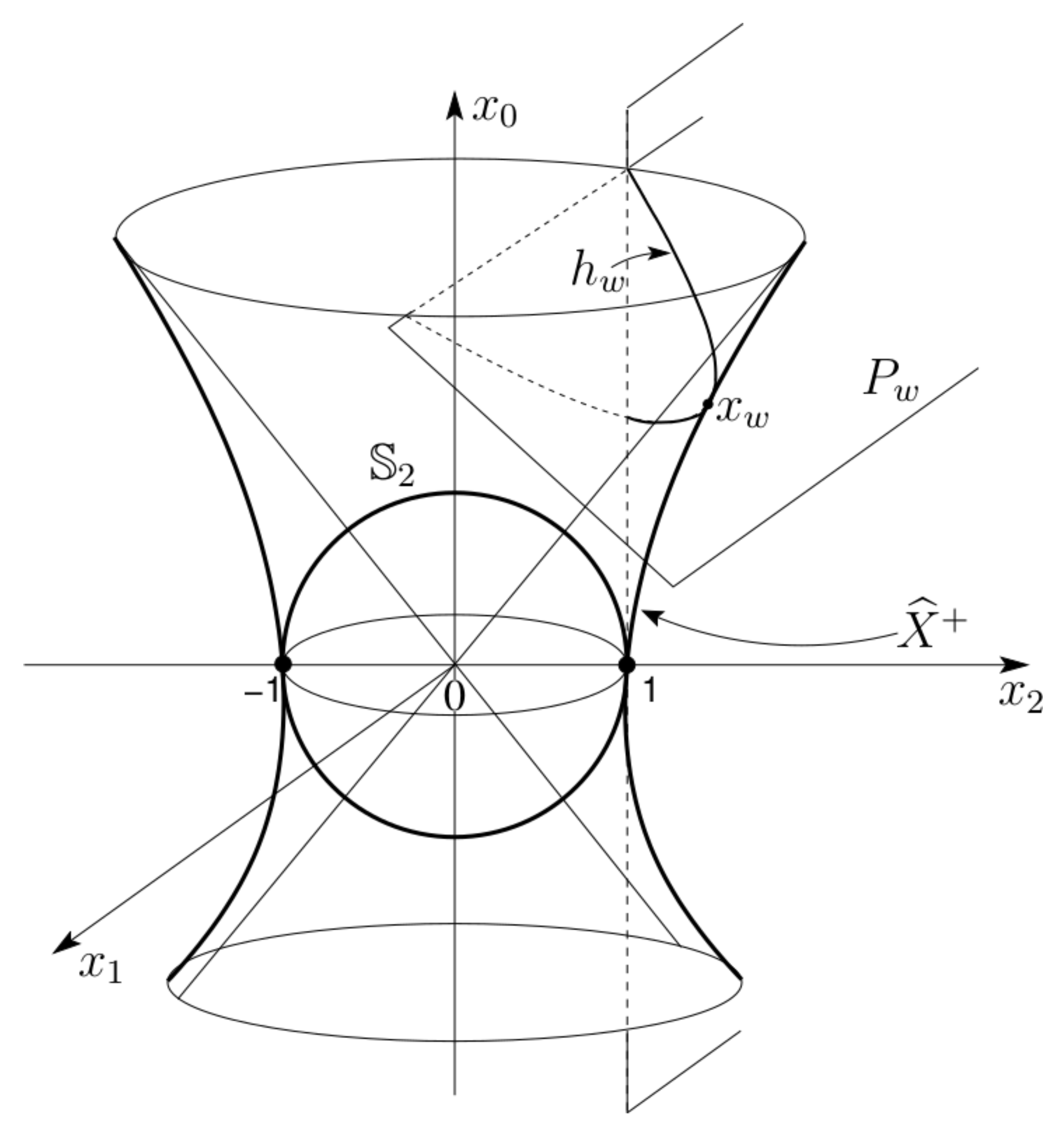
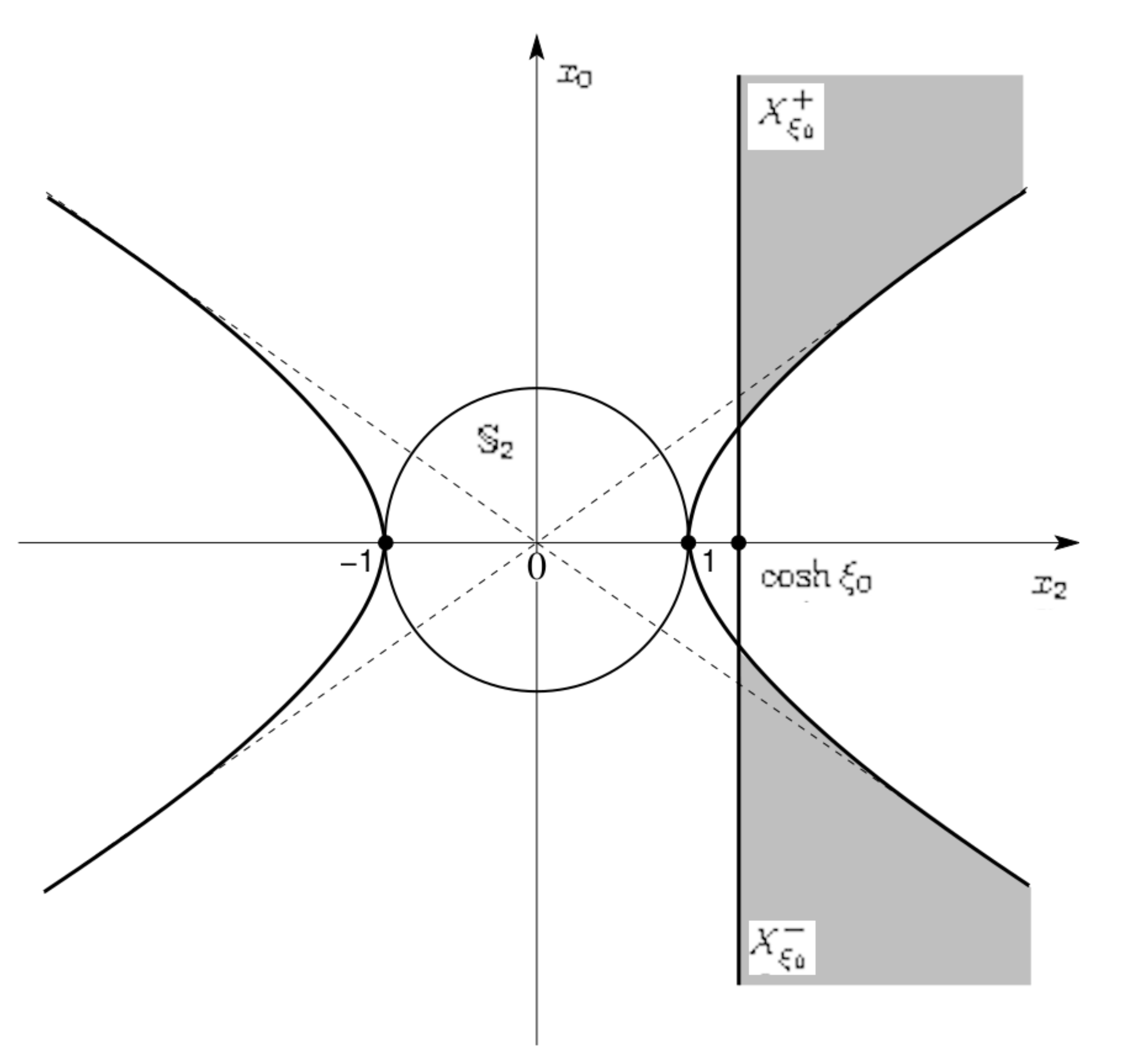
contains the following submanifolds: the Euclidean sphere
where the
harmonic analysis is done, and the real one-sheteed hyperboloid
that contains the cut support. The second step is a fibration on a meridian hyperbola of
, implemented by means of a Radon-type transformation where the role played by the planes in the ordinary Radon transformation is now played by the horocycles. By this fibration, we can thus to reduce the harmonic analysis on the complex hyperboloid to that on a complex one-dimensional hyperbola, which contains the Euclidean circle and the real hyperbola. In this way, series (
1) can be regarded as a trigonometrical series on the Euclidean circle. This last step is proved in
Appendix A, while the geometrical method we used is illustrated in
Appendix B. Once the trigonometrical series is obtained, we can prove that it admits a holomorphic extension to a complex cut-plane. This is proved in
Section 3. Finally, in
Section 4 we return back to the complex
-plane (i.e., the complex hyperboloid
) by inverting the Radon transformation, and finally prove the analytic extension of the Fourier–Legendre series (
1). The inversion of the Radon transform is analyzed in
Appendix C. The unique interpolation of the coefficients
turns out to be a Laplace-type transform (precisely, the composition of Laplace and Radon transformations) of the jump across the cut. Therefore, by inverting this transformation, we can reconstruct the discontinuity function which leads to the spectral density
. This latter step is described in
Section 5. In the same section we briefly show how the jump function across the cuts can be reconstructed by means of the Pollaczek polynomials. Finally,
Section 6 is devoted to the analysis of the connection between the first order Born approximation of the scattering amplitude and the Laplace-composed-with-Radon transform, introduced in
Appendix C.
3. Holomorphic Extension Associated with the Trigonometrical Series
In
Appendix A we show that a series expansion in terms of Legendre polynomials
can be regarded as a trigonometrical series, i.e., as a series of the type
(see Formulae (
A3), (
A4) and (
A19)). Then, it is quite natural to introduce the complex plane
of the variable
, (
), and consider in this plane the following domains (see also [
12]). For
we define:
, and
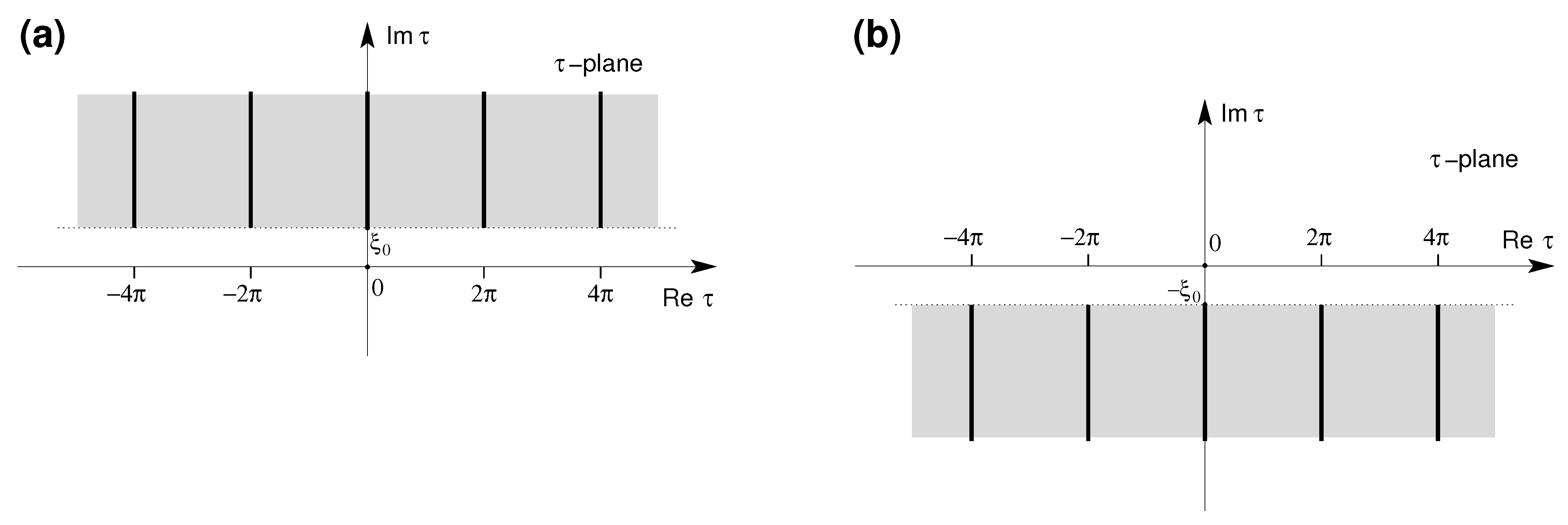
. Correspondingly, we introduce the cut-domains:
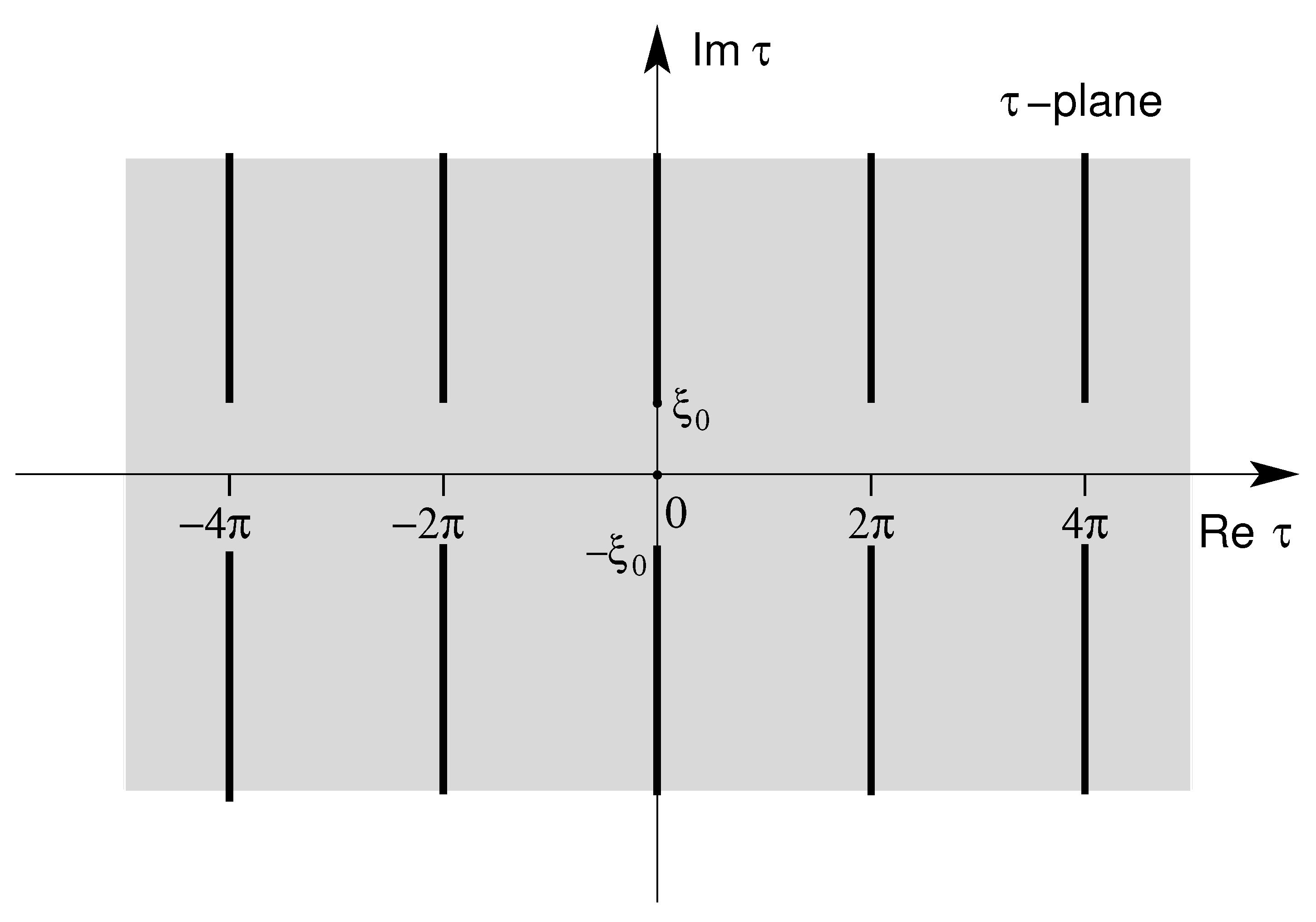
, where
(see
Figure 1a) and
, where
(see
Figure 1b). Moreover, we will use the notation
to denote every subset
A of
which is invariant under the translation group
.
We can then prove the following theorem (see also [
8]).
Theorem 2. Consider the following series:and suppose that the set of numbers , , , satisfies condition (5). Then, - (1)
The series (27) converges uniformly on any compact subdomain of to a function , analytic in and continuous on the axis . - (2)
The function can be holomorphically extended to the cut-domain (see Figure 1a), that is, it is analytic in . - (3)
The jump function describing the discontinuity of across the cuts ), is a function of class and satisfies the bound:where , , is the unique Carlsonian interpolant of the coefficients , and - (4)
is the Laplace transform of the jump function : - (5)
The following Plancherel equality holds true:
Proof. Since the set
satisfies condition (
5), then, given an arbitrary non-negative number
C, there exists an integer
m such that for
,
. Therefore, we can write:
the series on the r.h.s. of (
32) being uniformly convergent for
. On the other hand, series (
27) can be rewritten as
where
is a trigonometric polynomial. Then, for the Weierstrass theorem on the uniformly convergent series of analytic functions, we can conclude that the series (
27) converges uniformly on any compact subdomains of
to a function
holomorphic in
. Moreover,
,
, since
as
. Then, given an arbitrary constant
, there exists an integer
such that for
we have:
Then, using once again the Weierstrass theorem on the uniformly convergent series of continuous functions, the series
converges to a continuous function
. Hence, the first statement is proved. To prove the other statements, we introduce the following integral:
where
,
, is the unique Carlsonian interpolant of the sequence
, which exists in view of the fact that the set
satisfies condition (
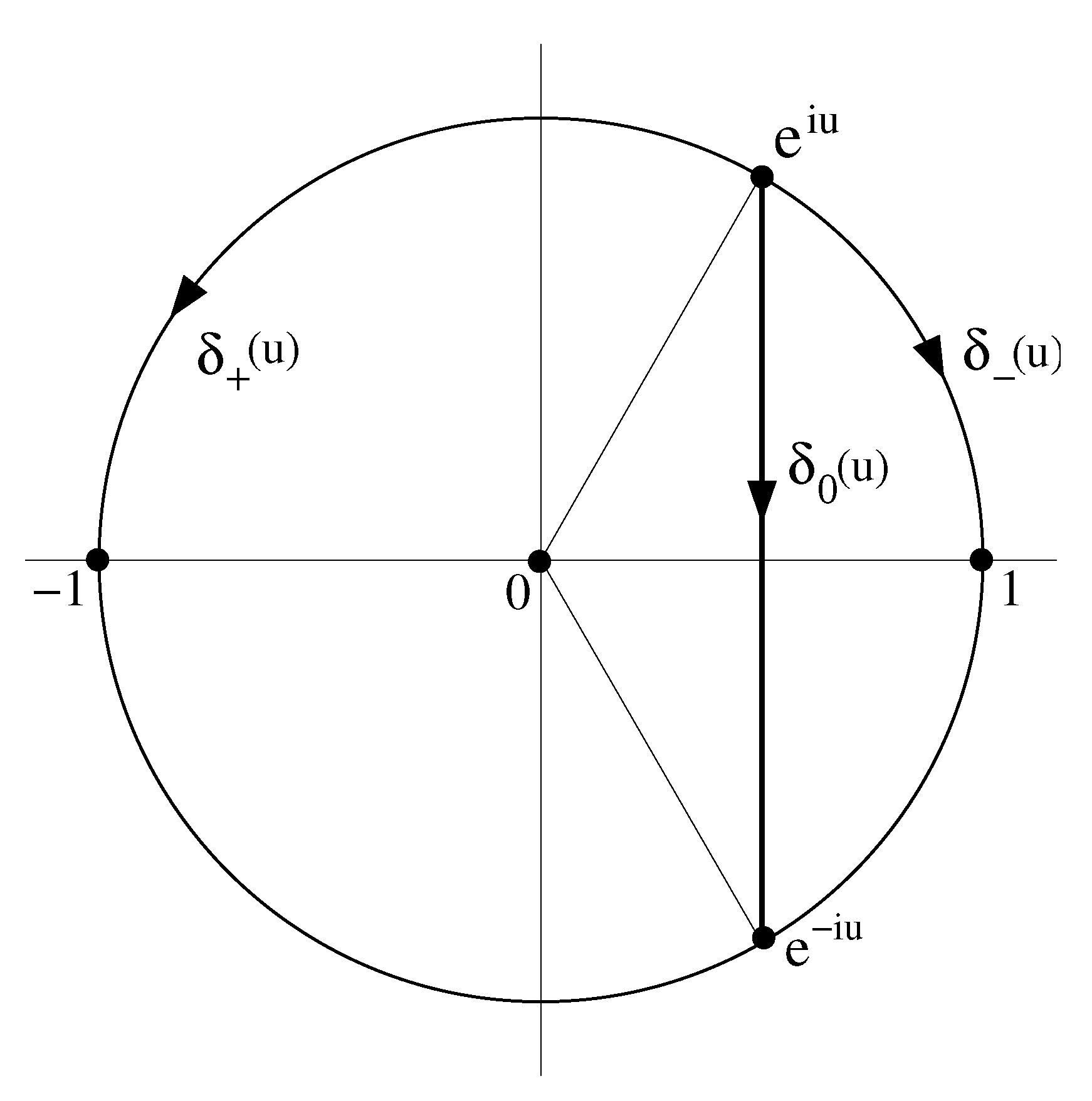
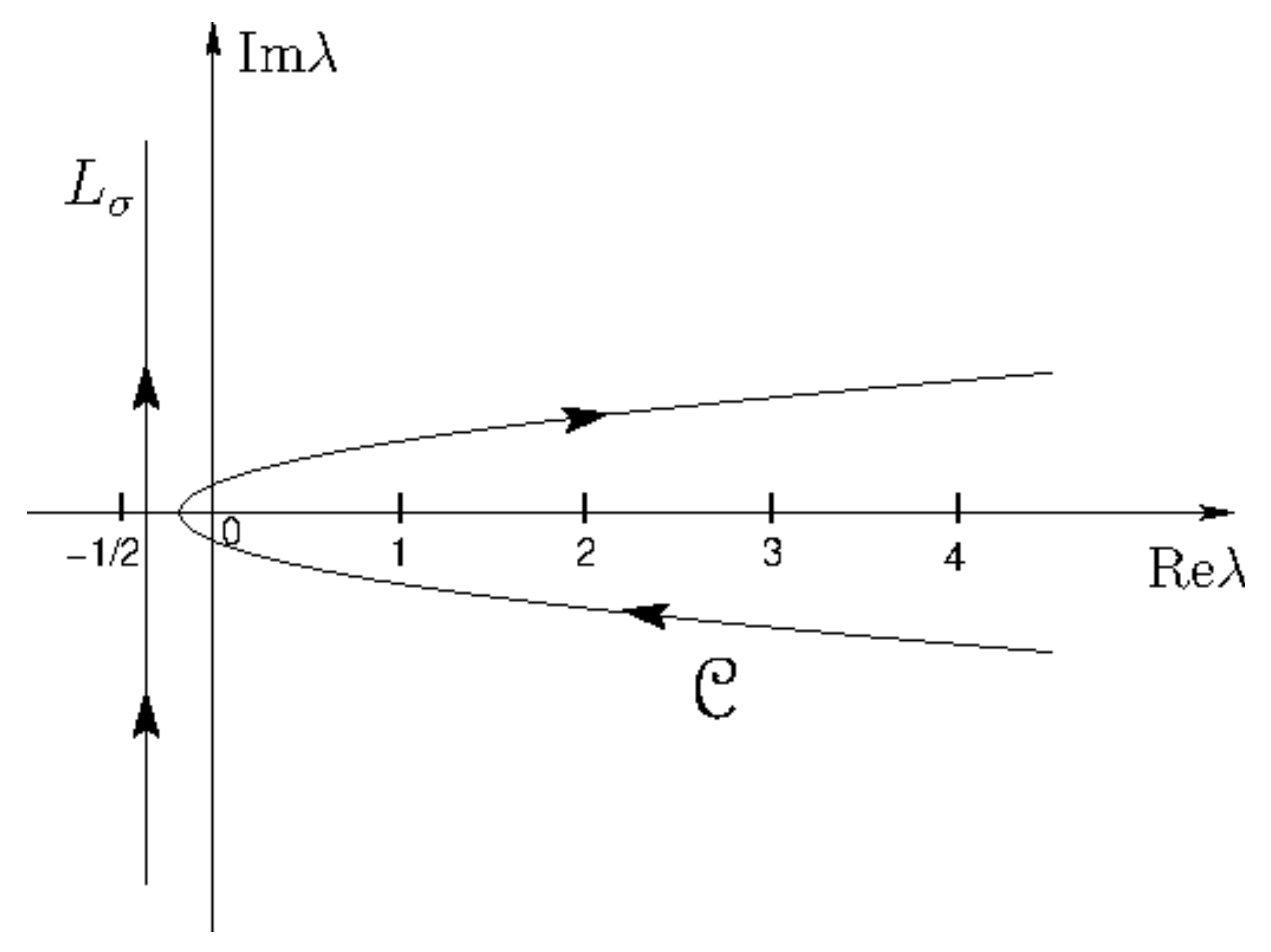
5). The contour
is contained in the half-plane
, encircles the real semi-axis with
(or a part of it), and cross this axis at a point
,
, as illustrated in
Figure 2.
Let us now consider the following inequalities, which hold true for any
:
Let us recall that
(
) tends uniformly to zero as
inside any fixed half-plane
and, moreover,
belongs to
for
. For these properties and by the use of bound (
38), the integral
,
, exists and the contour
can be deformed and replaced by the line
, provided that the real variable
(see
Figure 2). Hence, by applying the Watson resummation method [
13], we obtain for
:
with
,
if
and
if
.
Proceeding analogously for the integral
(Formulae (
35) with
), we distort similarly the contour of integration and finally obtain for
:
with
,
if
and
if
.
Now, in integral (
39) we substitute for
t the complex variable
, and see that the resulting integral provides an analytic continuation of
in the strip
, continuous in the closure of the latter. We have:
with
then, using bound (
38), and since
for any fixed value of
(see Proposition 1), the statement is proved. Similarly, the analytic continuation of the function
is defined in the strip
. We thus have proved that the function
,
, admits a holomorphic extension to the cut-domain
. The discontinuity
across the cuts can be computed by replacing
t with
in integrals (
39) and (
40). We obtain
From (
43) we derive the following bound for the jump function
:
where
, given in (
29), is guaranteed to be finite by statement (iv) of Proposition 1. Using Formulae (
43) and recalling the Riemann–Lebesgue theorem, we prove that
is a function of class
,
, since
for any
(see Proposition 1). Inverting Formulae (
43), we have:
which is the Laplace transform of the jump function
, holomorphic for
. Finally, recalling that
belongs to
for any fixed value
, we obtain the Plancherel equality (
31), which for
reads:
□
We can now state the following proposition (see also [
8]).
Proposition 4. If in the trigonometrical seriesthe coefficients satisfy the assumptions of Theorem 2, then: - (1)
the series converges to a continuous function , , and the convergence is uniform on any compact subdomain of the real line;
- (2)
the function admits a holomorphic extension to the cut-domain of the τ-plane;
- (3)
the jump function across the cuts enjoys properties strictly analogous to properties (3–5) of Theorem 2.
Proof. Statement (1) follows by observing that, in view of the hypothesis on the coefficients
, we have:
Next, in view of the Weierstrass theorem on the uniformly convergent series of continuous functions, the result follows. Statements (2) and (3) can be proved in a way completely analogous to the one followed for proving the corresponding statements of Theorem 2. □
Suppose now that the partial-waves
satisfy the following bound, which is precisely the M.T. condition [
2]:
From inequality (
49) it follows that the series (
47) converges to a function
, analytic in the strip
, the convergence being uniform in any compact subdomain of this strip. With slight modifications of Theorem 2, it is also straightforward to prove that
admits a holomorphic extension to the cut-domain
(see
Figure 3).
The physical applications could also lead to assume that only the subset
,
, satisfies condition (
5). In this case it is easy to prove that
is analytic in the half-plane
, continuous at
; furthermore, bound (
28) holds for
(instead of
). Analogous modifications must be introduced in connection with Formulae (
30) and (
31).
4. Holomorphic Extension Associated with the Legendre Series
In
Appendix B we consider a real one-sheteed hyperboloid, denoted by
X, and the associated meridian hyperbola, denoted by
. Next, we introduce through a Radon transformation a fibration with basis
. This Radon transformation allows us to pass from polar coordinates
to horocyclic coordinates
(see
Appendix B). In this transformation, the horocycles play the same role played by the planes in the ordinary Radon transform. Then, we replace the complex
-plane (see the Introduction) by a complex hyperboloid
, whose submanifolds are the real one-sheteed hyperboloid
X and the Euclidean sphere
. Next, we extend the fibration with basis
to the complex hyperboloid
and to the related complex meridian hyperbola
. This fibration is realized by a Radon transform which allows us to pass from the complex polar coordinates
,
, to the complex horocyclic coordinates
,
. Finally, in
Appendix C, we study the inversion of the Radon transformation. By using this latter, we move back from the
-plane to the
-plane (see, in particular, representation (
A53), which holds if the sequence
satisfies the Hausdorff condition (
5) with
; see
Appendix C). Then, the holomorphic extension in the
-plane, proved in the previous section, can now be re-formulated in the
-plane. More precisely, we can state the following propositions.
Proposition 5. Suppose that the sequence satisfies the Hausdorff condition (5) with and let be the function represented by the following formula (see Appendix C, Formula (A53)):where denotes the ray oriented from 0 to θ in the τ-plane. Then, is even, -periodic and holomorphic in . Proof. From the assumptions on
we can state that
is a
-periodic function holomorphic in
(see Proposition 4 and
Figure 3). Moreover, it satisfies the following symmetry property:
which follows from equality (
A17) for the uniqueness of the analytic continuation (see
Appendix B, Formulae (
A41)). These properties imply the
is of the following form:
, with
analytic in
, which is defined as:
. Now, we adopt the following parametrization for
:
, the r.h.s. of Formulae (
50) can be rewritten as
that represents an even,
-periodic function, holomorphic in
. Since we shall prove below that this function can be represented by the Fourier–Legendre expansion (
1), it can be properly denoted by
.
From formulae (
50) we can compute the boundary values
, defined as:
,
, on the semiaxis
in terms of the corresponding boundary values
, with
, provided that
satisfies a
-type regularity condition. This latter conditon is necessary in order to perform the inversion of the Radon–Abel transform at the boundary. The
-continuity of the boundary values is indeed guaranteed by the assumption that the sequence
satisfies the Hausdorff condition (
5) with
. Thus, the jump function
across the cuts in the
-plane is related to the jump function
across the cuts in the
-plane by the following Radon–Abel transformation:
with
.
We can then apply the inverse Radon–Abel transform operator, defined by Formulae (
50), to the series on the r.h.s. of Formula (
A19):
and integrate term by term for the uniform convergence of this series, which, in turn, follows from the Hausdorff condition on the coefficients
. Next, it is convenient to introduce the following functions:
which are connected with the Legendre polynomials
as follows (see Formula (II.91) of Refs. [
14,
15]):
Finally, recalling that
(
), we re-obtain the original Legendre expansion (
1):
□
Remark 1. If the partial-waves satisfy both conditions (5) and (49), then we can prove (following the arguments of Proposition 5) that the function , given in (50), is even, -periodic and holomorphic in . 5. Inversion of the Laplace–Abel Transformation by the Means of the Pollaczek Polynomials
From Formulae (
30) and (
A42) the following equality follows:
By exchanging the order of integration on the r.h.s. of (
58), we obtain for
:
Next, recalling the integral representation of the Legendre function of the second kind
:
Formula (
59) can be rewritten in the following form:
Remark 2. The Legendre function of the second kind has a logarithmic singularity at . Hence, the integral representation (60) holds if . Nevertheless, the integral on the r.h.s. of Formula (61) still converges if is regular at . If
, the function
can be split in two terms: an even (in
) part:
and an odd part:
, whose definition follows evidently from (
60):
Next, we recall the following equality [
16]:
(where we have adopted a non-standard normalization of
, which is appropriate to our joint consideration of
and
, the discrepancy with the usual notation being merely a factor
). Hence, we have the following equality which we will use later:
Now, we can prove the following proposition.
Proposition 6. If the sequence . , being the Fourier–Legendre coefficients in (1), satisfies the Hausdorff condition (5) with , then the jump function admits the following integral representation:where , and denotes the Legendre functions of the first kind. Proof. In Theorem 2 and Proposition 4 we derived the following formula:
which represents the inversion formula for the Laplace transform. This formula is obtained by evaluating the discontinuity across the semiaxis
,
, of the function
, where
. In fact, it is worth noting that the jump of
across this half-line is zero; however, its expression obtained through a vanishing Cauchy integral allows us to have another equivalent integral representation of
:
We then apply the inverse Radon–Abel transform to
(see Formula (
53)), and write:
for
. The r.h.s. of (
69) converges to
if
is of class
and
belongs to
. Both these properties follow from the assumption that the sequence
satisfies the Hausdorff condition (
5) with
. Finally, we identify in the integrand of Formula (
69) the first kind Legendre function
; in fact, we have (see Formula (II.86) of Refs. [
14,
15]):
Therefore, by substituting the l.h.s. of Formula (
70) into the integral on the r.h.s. of formula (
69), we obtain the final result, i.e., Formula (
66). □
When
, in view of the eveness with respect to
of the Legendre function
, only the odd component of
contributes to the integral on the r.h.s. of (
66). Accordingly, in view of (
65), we can rewrite the Laplace transform (
61) in terms of the ratio
, instead of
. It is easy to check that, in this case, Formulae (
61) and (
66) give (modulo normalization constants) the classical Mehler transform [
16].
Now, we can prove the following lemma.
Lemma 1. Suppose that the sequence , (), satisfies the Hausdorff condition (5) with ; then, the function can be represented by the following expansion which converges in the -norm:whereand and being the Pollaczeck and Laguerre polynomials, respectively. Proof. First, we note that
and
belong to
(see statement (iii) of Proposition 1 and Formula (
31)). Then, we can write
The Pollaczek polynomials
,
, are a set of polynomials orthogonal in
with weight function [
16,
17]
where
denotes the Euler gamma function. We put
, and in what follows we drop this superscript in the Pollaczek polynomials notation. The orthogonality relation reads:
where, now,
.
Next, we may introduce the following Pollaczek functions:
which form a complete basis in
[
18].
Since the coefficients
satisfy condition (
5), then there exists a unique Carlsonian interpolant of the sequence
, denoted
, such that
belongs to
(see Proposition 1). Therefore, the function
can be expanded in terms of Pollaczek functions as follows:
the convergence of this expansion being in the
-norm. The coefficients
are given by:
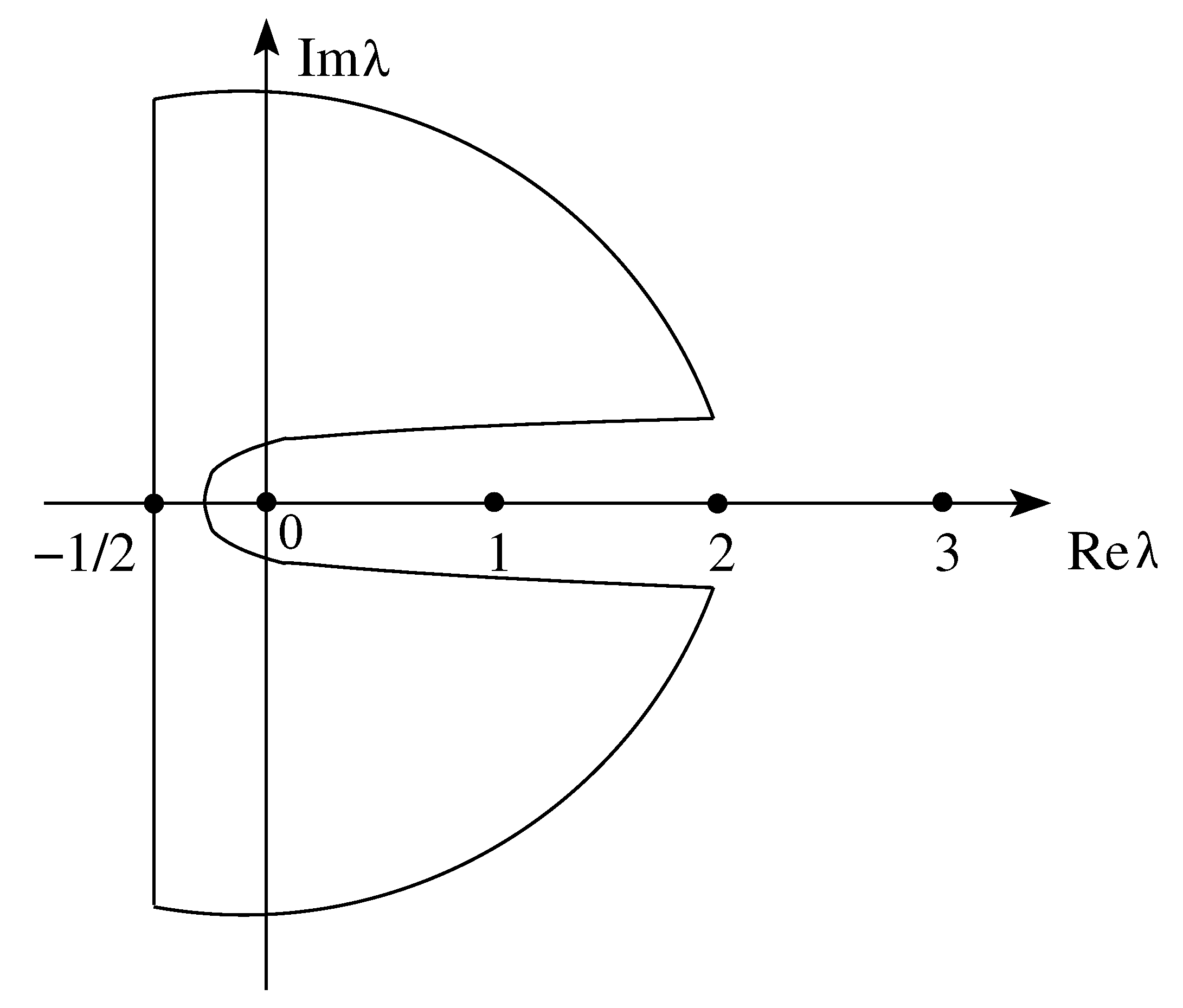
Exploiting the asymptotic behaviour of the Euler gamma function, integral (
79) can be evaluated by the contour integration method along the path shown in
Figure 4. Note that the poles of the gamma function
are located at
, and allow us to pick up correctly the input data. In fact, we have:
. We obtain:
Next, we observe that:
where
denotes the Fourier integral operator. Let us note that the function
belongs to the Schwartz space
S of the
functions that decrease with all their derivatives for
tending to
, faster than any negative power of
. Therefore we can write:
Inserting representation (
82) of the Pollaczek functions into expansion (
78), we obtain:
Now, we apply the inverse operator
to the r.h.s. of Formula (
83) and exchange the integral operator
with the sum, this operation being legitimate within the
-norm convergence. We obtain:
Finally, recalling Formula (
74), we obtain the following expansion for the function
:
the convergence being in the
-norm. It can be easily verified that:
where
denotes the Laguerre polynomials [
19].
It can be readily checked that the polynomials
are a set of polynomials orthonormal on the real line with weight function
. Consequently, the set of functions
, defined by (
73), represents an orthonormal basis in
.
Finally, from Formula (
85) we obtain:
where
, and the functions
are given by (
73). □
The successive step of the inversion procedure consists in inverting the Abel transform. Consider Formula (
A42) and put:
,
. The Abel transform can be written as a convolution product of the following form:
From (
53), we analogously obtain:
We can now prove the following Lemma (see also [
8]).
Lemma 2. If the sequence satisfies the Hausdorff condition (5) with , then the following limit holds:whereand ( is the Schwartz space of the functions that, along with all their derivatives, decrease for faster than any negative power of ), and denotes the Lebesgue integral . Proof. From (
89) and (
91) we have:
From inequality (
28) and Formula (
A42) it follows that
has a power-like behaviour in
x. Next, for the Fubini theorem, we have:
where
Next, from Schwarz’s inequality it follows:
Now, since
(see Lemma 1) and
, statement (
90) follows. □
Remarks 1. (i) As mentioned at the end of Section 3, if only a subset of partial-waves satisfy condition (49), then is analytic only in the half-plane . However, even in this case, the above inversion procedure can be applied with only minor technical modifications. (ii) So far, we have assumed that all the partial-waves are known and, in addition, that are noiseless. A much more realistic analysis accounts that only a finite number of partial-waves can actually be known and that they are inevitably affected by noise. In this case, the reconstruction of from this set of noisy data meets the difficulties related to the ill-posedness of the inverse problems. See Ref. [5] for a more detailed discussion of the algorithm of reconstruction from a finite set of noisy input data. 6. Born Approximation as a Laplace–Abel Transformation
Let us now consider the Born approximation. The partial-waves
, at the first-order Born approximation, are given (suitablly normalized) by
where
are the spherical Bessel functions of order
ℓ. Then, exploiting the following formula:
recalling that
and observing that
belongs to the Yukawian class (see representation (
2)), we obtain:
We put
and since on the cut we have
equals
, then Formula (
98) can be rewritten as
Therefore, we can see that the restriction of
to
coincides with the first-order Born approximation of the partial-waves, after the following identification (see also [
2]):
Formula (
100) allows us to recover the spectral density
from the jump function
, but only in the domain
, that is, where
coincides with the jump function associated with the first-order Born approximation (see [
2]). In fact, we can write an equation of the Lippman–Schwinger-type for the discontinuities
:
where
represents the discontinuity function associated with the first-order Born approximation. The convolution product
has as cycle of integration the compact one-shaped region determined by the support properties of the involved jump function [
20]. Equation (
101) has been investigated by many authors (see, e.g., [
2] and the references quoted therein). Here, we limit ourselves to consider the results which are worth in our case. Equation (
101) can be formally solved through the following Neumann–Born series:
where
, (
in the domain
), and
. These convolution products form an algebra, named Volterra algebra, which has found particular relevance in the study of the Bethe–Salpeter equation (see [
4,
20]). The domains on which
and
are defined permit us to implement an iterative procedure that, in principle, can reconstruct the spectral density
completely (see [
2]). In fact, if the support of
is given by the values
, then the support of
will be
. Therefore, within the interval
, the spectral density
is
This procedure can be iterated: for instance, for values of t in it involves a double convolution product. We have earlier shown that and enjoy a power-like behavior in , but the entire iterative procedure is not guaranteed to maintain this type of behavior. Therefore, the existence of cannot be proved rigorously. In other words, the behavior in of each multiple convolution product can be controlled, but when the amplitudes are restricted to be on the energy-shell, all the possible combination of the factors must be taken into consideration. This leads to an alternating series, whose global -behavior cannot be controlled.
Summarizing, we can prove the existence of a spectral density
which possesses a good local behavior and, in addition, we can reconstruct this function from the amplitudes by using an iterative procedure. Unfortunately, to date we are not able to keep under control the global
-behavior of the entire iterative procedure so to have guaranteed the convergence of integral (
2) and, consequently, the existence of the potential
.
7. Conclusions
We have shown that if the partial-waves
of the Fourier–Legendre expansion of the scattering amplitude satisfy a suitable Hausdorff condition and are exponentially bounded, then this expansion converges to an analytic function
, which can be holomorphically extended to a slit domain in the
-plane. The geometrical tool adopted to reach this result consists essentially in connecting the analysis on the complex
-plane with that on a complex hyperboloid
, which contains as submanifolds the support of the
harmonic analysis and the support of the cut. Through a suitable fibration, obtained by a Radon-type transformation, we can limit ourselves to study the harmonic analysis on a one dimensional complex hyperbola, thus allowing us to regard the Fourier–Legendre series as a trigonometrical series. The holomorphic extension of the latter can then be translated back to the slit
-plane by inverting the Radon-type transform. The jump function describing the discontinuity on the cut is found to be related to the Laplace–Radon tranform of the analytic function interpolating uniquely the partial-waves
. The inversion of this transformation finally yields the spectral density
and, under some additional restrictions, the potential
. The key ingredient to achieve this result is the Haudorff condition (
5) we imposed on the partial-waves. Such a condition, which firstly emerged in the theory of moments, calls for the analysis of the broader class of completely monotonic potentials which, in turn, find application in various problems, e.g., of extremal geometry. These issues will be the object of future investigations.