Abstract
In this manuscript, by using undetermined parameter method, an efficient iterative method with eighth-order is designed to solve nonlinear systems. The new method requires one matrix inversion per iteration, which means that computational cost of our method is low. The theoretical efficiency of the proposed method is analyzed, which is superior to other methods. Numerical results show that the proposed method can reduce the computational time, remarkably. New method is applied to solve the numerical solution of nonlinear ordinary differential equations (ODEs) and partial differential equations (PDEs). The nonlinear ODEs and PDEs are discretized by finite difference method. The validity of the new method is verified by comparison with analytic solutions.
Keywords:
ordinary differential equations; partial differential equations; nonlinear systems; convergence order; computational efficiency; computational cost MSC:
65H05; 65B99
1. Introduction
Symmetry is a fundamental topic in many areas of physics and mathematics. Many problems from engineering and mathematics possess symmetry, which can be transformed into the nonlinear systems . Some nonlinear ODEs and PDEs can be discretized into nonlinear systems. Using the iterative method to solve these nonlinear systems, we can find the numerical solution of ODEs and PDEs. Newton’s method [1,2] is the oldest and famous iterative method for the numerical solution of nonlinear systems,
where is the Jacobin matrix. Newton’s method is one-point iterative method, which is convergent quadratically. Any one-point iterative method which is constructed by F and its first derivatives cannot get higher order than r. Researchers try to improve the computational efficiency of one-point method by different ways. One effective way is to increase the iteration step of iterative method. This kind of methods are called multistep or multipoint iterative methods. It has better efficiency than one-point iterative method. For example, based on a quadrature formulae, Darvishi et al. [3] suggested an efficient multipoint method with order four that requires two F, two matrix inversions and three . Grau-Sánchez et al. [4] proposed a variant of Ostrowski’s method, which needs two matrix inversions, three F, two and one first-order divided difference. Using the pseudocompostion technique, Cordero et al. [5] presented a sixth-order Jarratt-type method that uses three , two matrix inversions and three F. They [6] also presented a four-step eighth-order method that requires the same computational cost as their sixth-order Jarratt-type method. Using the weight function technique, Sharma and Arora [7] suggested a Jarratt-type method with order six, which requires one matrix inversion, three F and two . Behl and Cordero [8] designed a sixth-order scheme that needs two matrix inversions, two F and one first-order divided difference. Behl and Arora [9] proposed a derivative-free scheme with order seven for solving nonlinear systems, which needs one matrix inversion, five F and two first-order divided differences. Using the interpolation technique, we [10] obtained a seventh-order method that is extendible to solve nonlinear systems. This method requires three matrix inversions, four F and five first-order divided differences. We [11] also obtained another seventh-order fixed-point method that needs one matrix inversion, five F and three first-order divided differences. Sharma and Aroa [12] obtained a seventh-order derivative-free method. This method requires two matrix inversions, four F and five first-order divided differences. Using the undetermined parameter technique, Narang et al. [13] designed a seventh-order method, which needs one matrix inversion, three F and two first-order divided differences per iteration.
Many efficient multipoint iterative methods for solving nonlinear equations have been proposed, see [14,15,16,17,18,19,20]. However, not all multipoint iterative methods can be extended to solve nonlinear systems. Therefore, it is an interesting research to construct multipoint iterative method for solving systems of nonlinear equations. Ham and Chun [14] proposed the following fifth-order method for solving nonlinear equations
which is called Ham-Chun’s method. We generalize Ham-Chun’s method to Banach space to solve nonlinear systems and obtain the following iterative scheme
where and . Method (3) is called HM5 in this paper, which requires two F, two matrix inversions and two per iteration. Method HM5 is not the fixed-point iterative method, so its computational efficiency is low.
In this paper, we propose an eighth-order fixed-point iterative method for the numerical solution of nonlinear systems. First, we prove the order of convergence of method HM5 in Section 2. Inspired by method HM5, we propose an eighth-order fixed-point method by using the undetermined parameter method in Section 3. The proposed method requires one LU decomposition per iteration, which means that this method has low computational cost. The computational efficiency of iterative method is analyzed in Section 4. The proposed method is used to solve the solution of nonlinear systems, nonlinear ODEs and PDEs in Section 5. Section 6 gives a short conclusion.
2. Iterative Method with Order Five for Solving Nonlinear Systems
Theorem 1.
Let be the zero of F: , be sufficiently Fréchet differentiable and be continuous and nonsingular at . Then, method HM5 converges to ξ with order five, if initial guess close to ξ.
Proof.
Let and By using the results in [15], we get
and
Let From (4)–(6), we get
Similar argument to (4), we arrive at
and
Using (3), (5), (6), (9) and (11), we obtain the error equation:
It is easy to see that method HM5 is of fifth-order convergence. □
Based on method HM5, we will give a new fixed-point method with order eight in the following section.
3. Fixed-Point Iterative Method with Order Eight
Inspired by method HM5, we design a fixed-point iterative method by using the undetermined parameter technique as follows:
where , I is an identity matrix and are constant parameters to be determined.
Theorem 2.
Let be the zero of , be sufficiently Fréchet differentiable and be continuous and nonsingular at . If , and initial guess is close to ξ, then method (13) reaches eighth-order convergence.
Proof.
From (5), (6) and (9), we obtain
Let Using (6), (8) and (14), we arrive at
and
Using (13)–(16), we can get the error equation of method (13)
Taking and , we get
It is easy see that the order of method (13) is eight. Per iteration, method (13) requires three F, two and twice LU decompositions. Compared to method HM5, method (13) only increases one function evaluation .
Thus, we get an iterative method with eighth-order as follows
where and . Method (19) is called NM8 in this paper. □
4. Computational Efficiency
The computational efficiency indexes is proposed by Grau-Sánchez et al. [4,16,17]:
where
In per iteration, represents the cost of iterative method. Parameter is the number of the scalar functions used in F and . Parameter is the number of scalar functions used in . is the number of products. The parameter l in (21) is the ratio between the divisions and products. The parameters and in (21) are the ratios between products and evaluations that are required to express in terms of products. represents the convergence order. The LU decomposition is used to solve linear systems in the processing of iteration. The following methods are used to compared the computational efficiency:
Darvishi et al. fourth-order method [3] (DM4)
Grau-Sánchez et al. sixth-order method [4] (GM6)
where and is the first-order divided difference operator.
Cordero et al. sixth-order method [5] (CM6)
where .
Cordero et al. eighth-order method [6] (CM8)
where .
The C and of different iterative methods are given below:
The computational efficiencies of different methods are compared by the ratio [4,10]
If , then method B is less efficient than method A. is the boundary between the computational efficiencies, which is an equation of as a function of m, l and . Parameters in (38) satisfy , , and , the of different methods is studied in the following result.
Theorem 3.
1. For all and , we arrive at:
- (a)
- for all .
- (b)
- for all .
- (c)
- for all .
- (d)
- for all .
2. We have for all and , where
Proof.
1. From (26), (27) and (36)–(38), we get the boundary that is given by
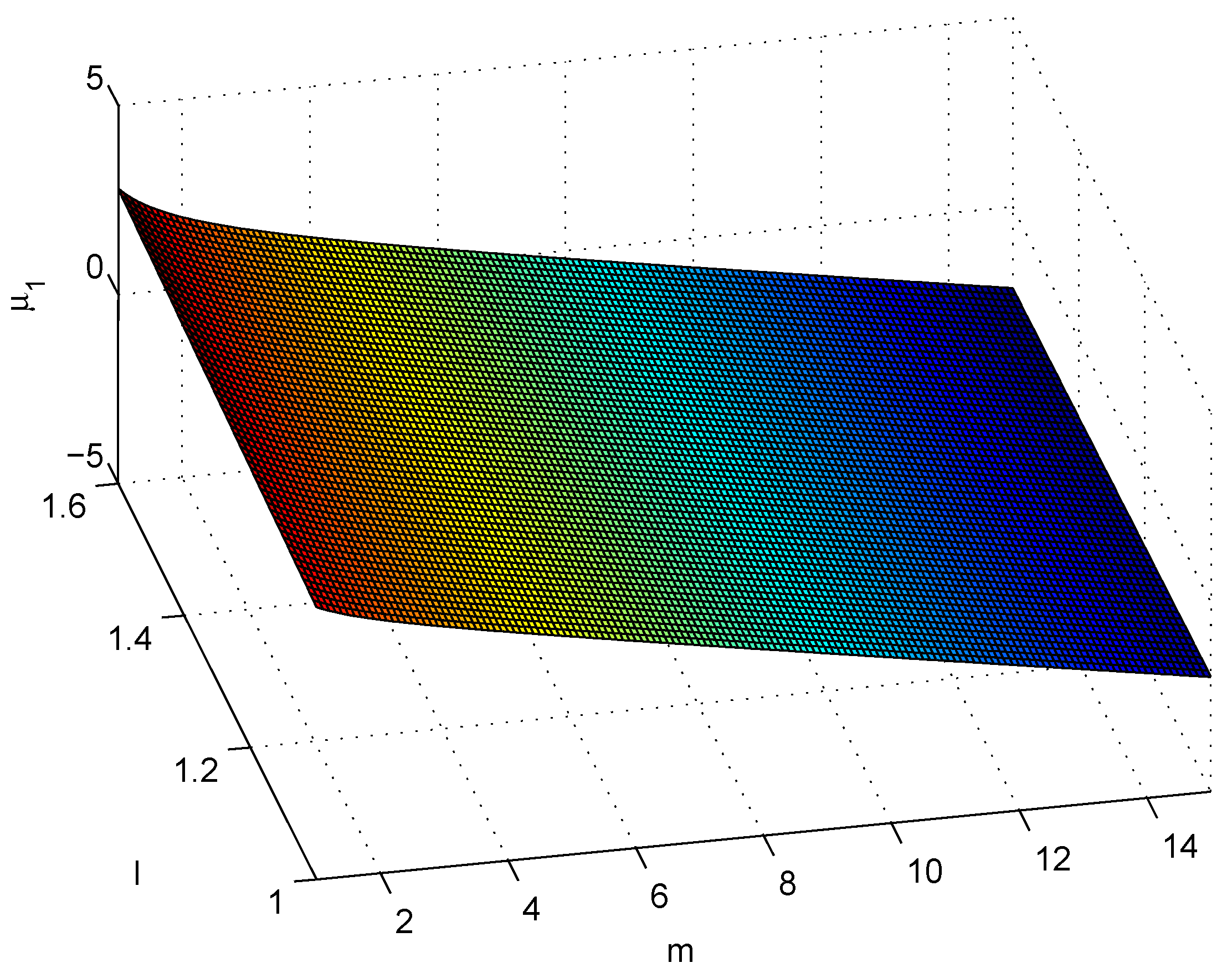
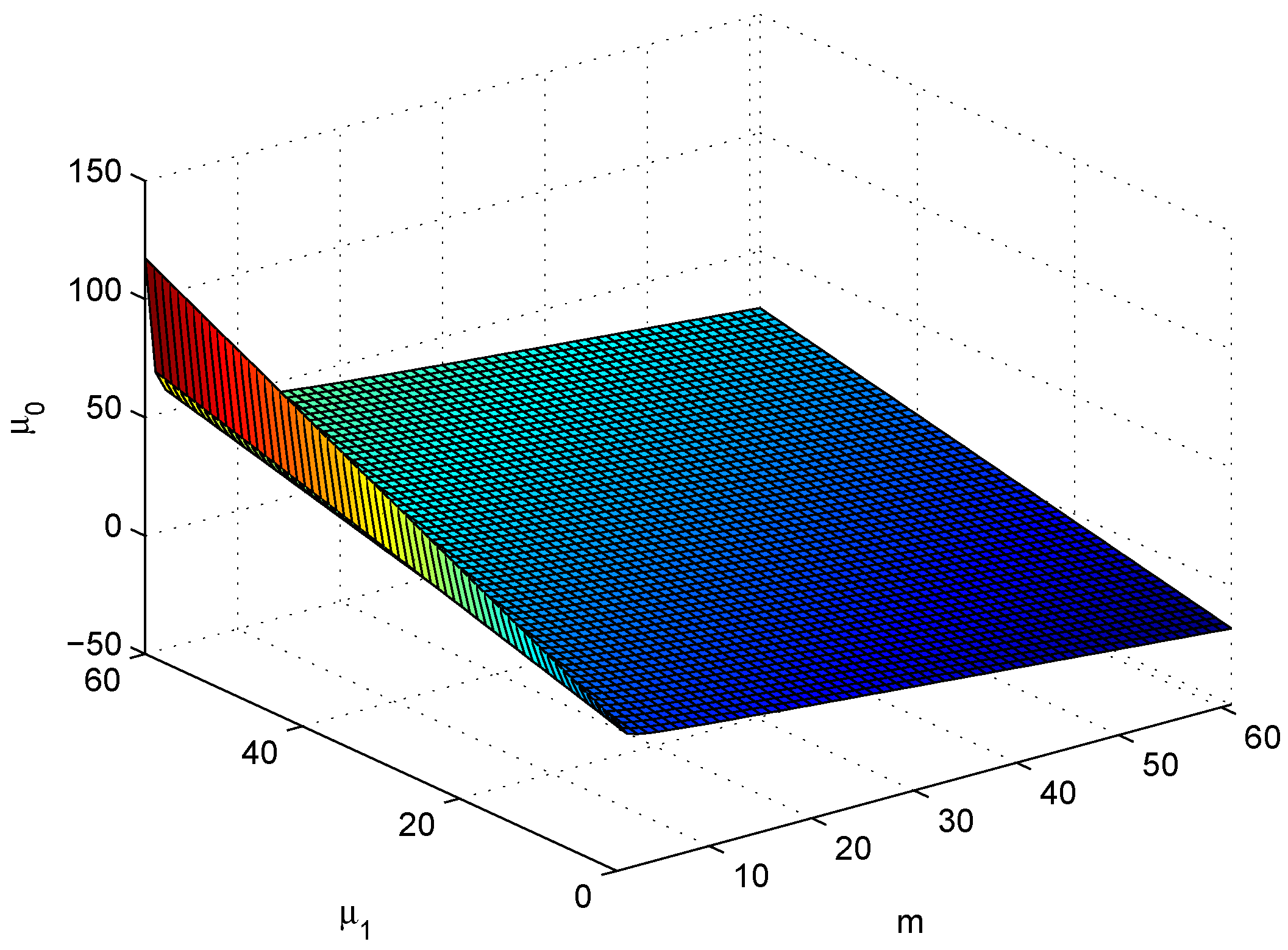
Figure 1 shows the boundary , which implies that on the above and on the below of boundary plane. Parameter , is always negative which means that DM4 is less efficient than NM8 for all and
Figure 1.
Boundary plane of .
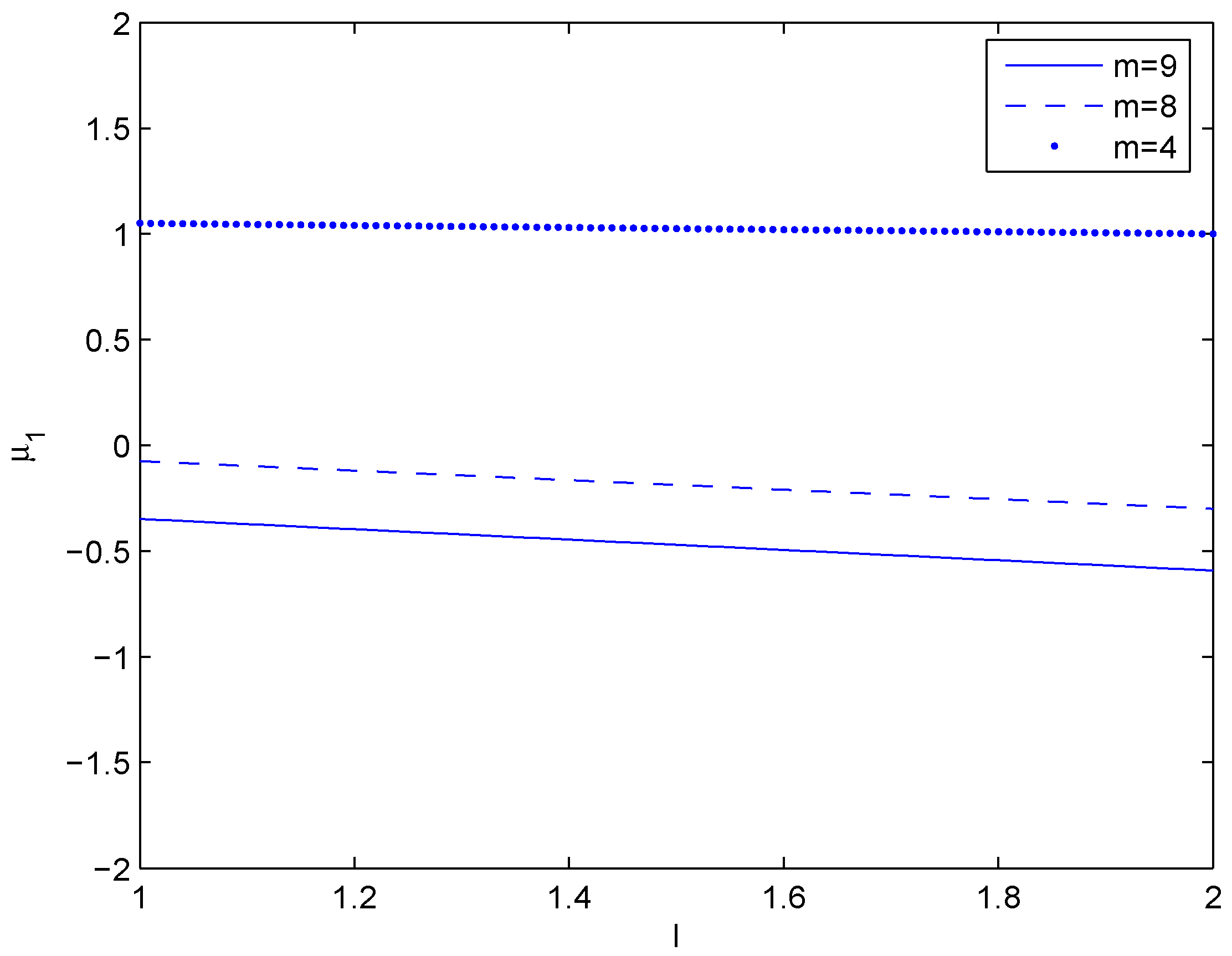
Figure 2 shows the boundary lines in -plane for and 9 which means that for and For , on the above of boundary line and on the below of boundary line.
Figure 2.
Boundary lines in -plane for m = 4, 8 and 9.
From (28), (29) and (36)–(38), we get the boundary that is given by
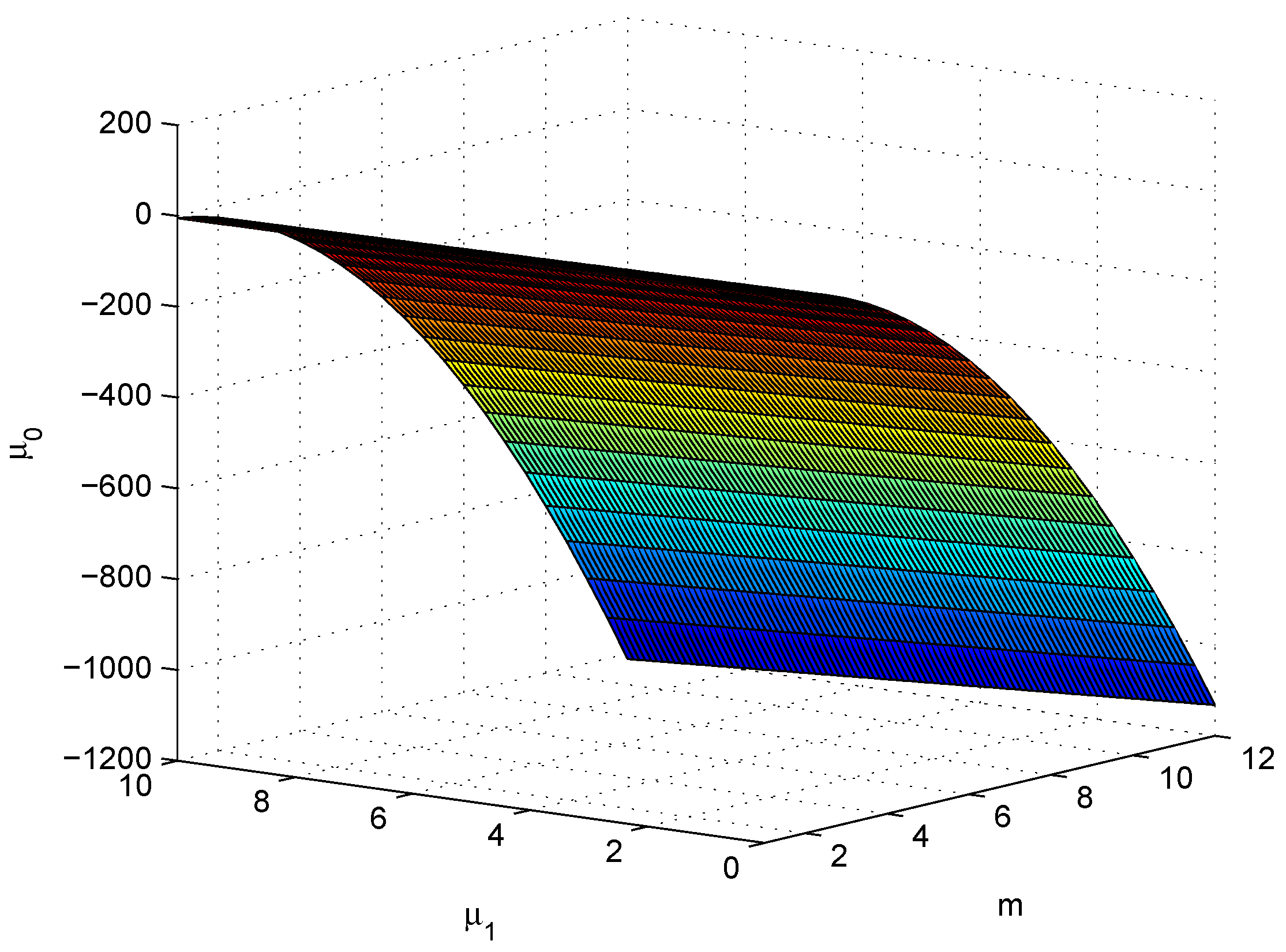
For , is always negative. Figure 3 shows the boundary for , which means that CM6 is less efficient than N8 for all and .
Figure 3.
Boundary plane of .
Using (35)–(38), we obtain the boundary that is written by
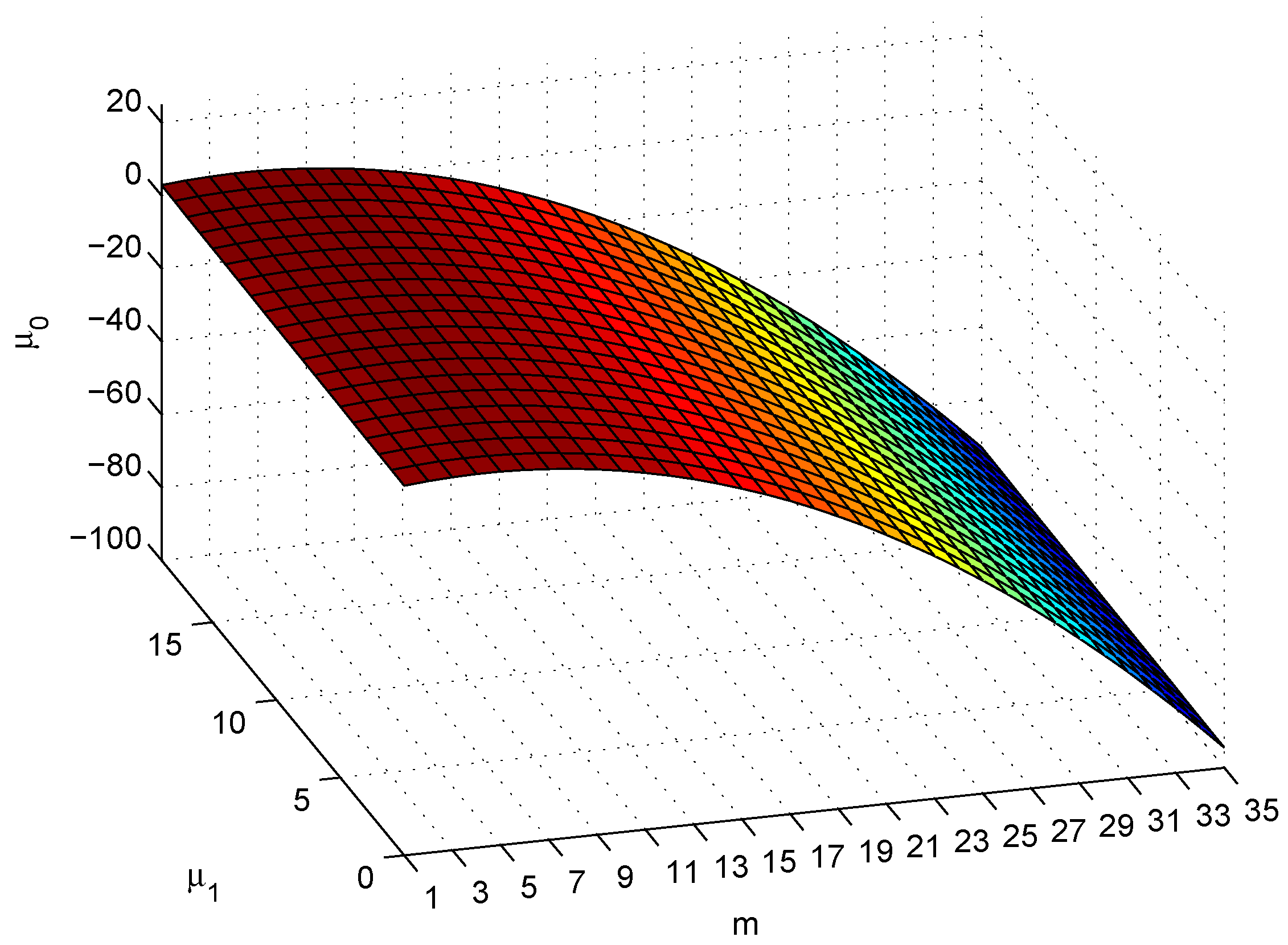
where and . For , is always negative. Figure 4 shows the boundary for , which implies that method NM8 is more efficient than method HM5 for all , and
Figure 4.
Boundary plane of .
Using (32), (33) and (36)–(38), we obtain the following relation between NM8 and CM8:
Using the numerator to subtract the denominator of (42), we get
If the expression (43) is more than zero then . Thus, we obtain that for all and .
2. From (28), (29) and (36)–(38), we get the boundary that is given by
where and
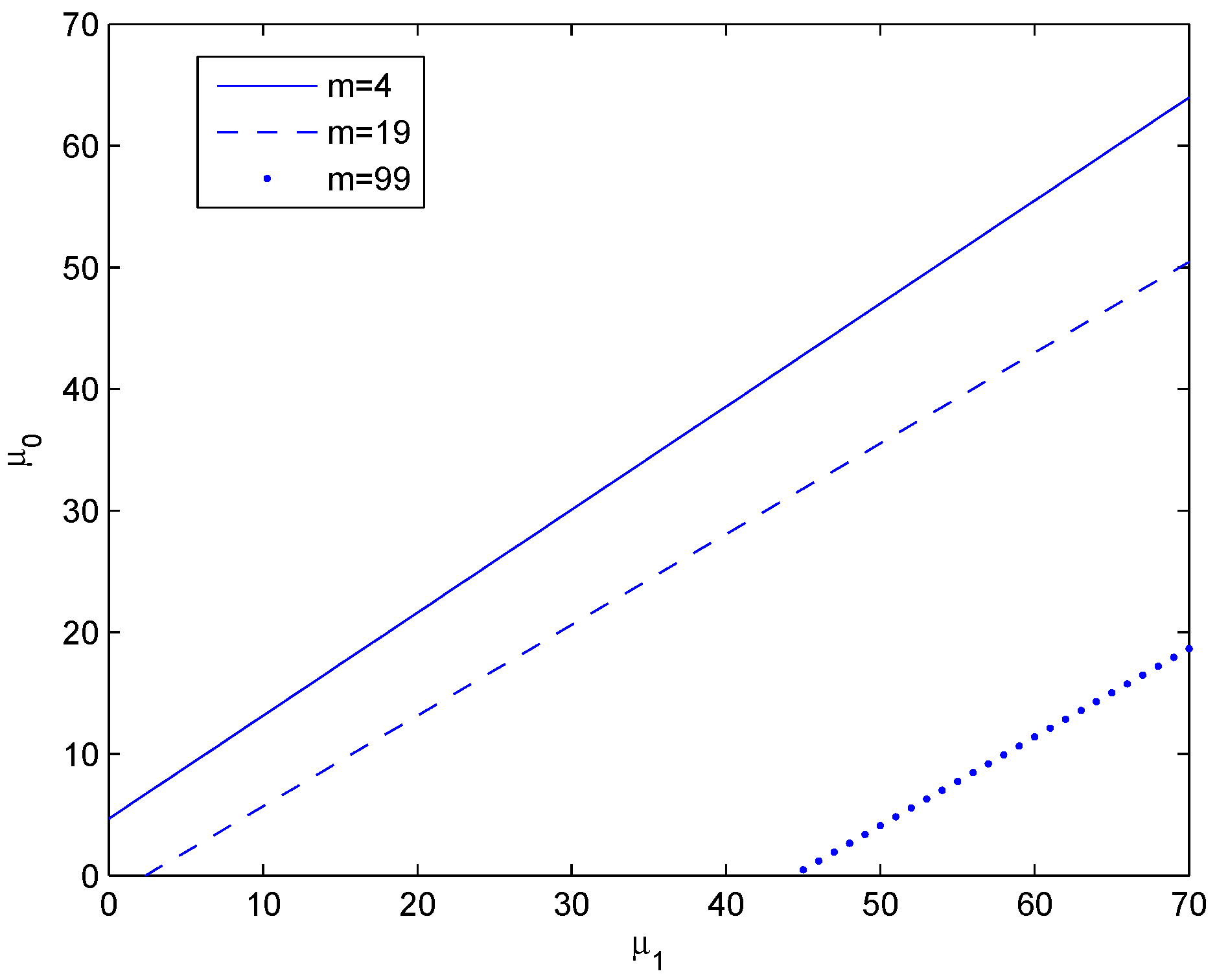
Figure 5 shows the boundary plane for Equation (44). Taking , Figure 6 shows some particular boundaries corresponding to and 99, wherein on the above and on the below of each line. □
Figure 5.
Boundary plane of .
Figure 6.
Boundary lines in -plane for and 99.
5. Numerical Results
New methods HM5 and NM8 are compared with methods DM4, GM6, CM6 and CM8 for solving some nonlinear systems. Numerical algorithms are written by the Maple 14. Table 1 shows an estimate of the cost of functions in product units.
Table 1.
Estimation of cost of elementary functions, where and .
The computational cost of elementary functions based on product is showed in Table 1. Estimation of computing time of elementary functions are computed with Maple 14 in a processor Intel R Core (TM) i3-2350M CPU, 1.79 GHz (32-bit Machine) Microsoft Windows 7 Professional. Table 1 shows that the computing time of one product is 0.110 milliseconds (ms). The computational cost of division with respect to product is and the computational cost of function with respect to product is .
In Table 2, Table 3, Table 4, Table 5, Table 6, Table 7, Table 8 and Table 9, represents the errors of function values at the last step, represents the number of iterations, represents the computational cost, represents the errors values of , represents the computational efficiency index, [17] represents the approximated computational order of convergence, represents the mean CPU time. We choose the tolerance for implementing the methods.
Table 2.
Numerical results in Example 1.
Table 3.
Numerical results in Example 2 ().
Table 4.
Numerical results in Example 2 .
Table 5.
Numerical results in Example 3 .
Table 6.
The (in seconds) in Example 3.
Table 7.
Numerical results in Example 4.
Table 8.
Numerical results in Example 5.
Table 9.
Numerical results in Example 6.
Example 1.
Nonlinear system [16]:
For this problem, we choose the parameter . For , we require four scalar cosine functions in the evaluation of vector functions F and four scalar sine functions in the evaluation of matrix . Base on (21) and Table 1, we get parameters and . For this example, we can get the computational cost of different methods by using parameters and . The solution is founded by initial guess . The results of comparisons for this example are displayed in Table 2.
Example 2.
Nonlinear system [17]:
First, we choose the parameter . Using the same calculation method as example 1, we obtain parameters and . For , the solution is founded by the initial guess . Secondly, we choose the parameters and get and . For the solution is founded by the initial guess is Table 3 and Table 4 display the numerical results.
Example 3.
Nonlinear system [8]:
Example 4.
Boundary-value problem [13]:
The first and second derivatives in this problem are discretized by difference method
and
The interval is partitioned into n smaller intervals with end points . The partition is regular, this is for all j. We get the following nonlinear systems
For the solution is founded by the initial guess Parameters and . Table 7 display the numerical results.
Example 5.
Boundary-value problem:
Using the same discretization method as problem 4, we obtain the nonlinear systems as follows:
For the solution is founded by the initial value Parameters and . Table 8 display the numerical results.
Example 6.
Nonlinear PDE problem [18]:
This PDE problem is a Heat Conduction Problems. We transform this problem to the nonlinear systems by using finite differences. The intervals and are partitioned into N smaller intervals, and get step size and in z and t directions. Let be the exact solution and . Using difference method, we use obtain approximations , and . We get a nonlinear system as follows:
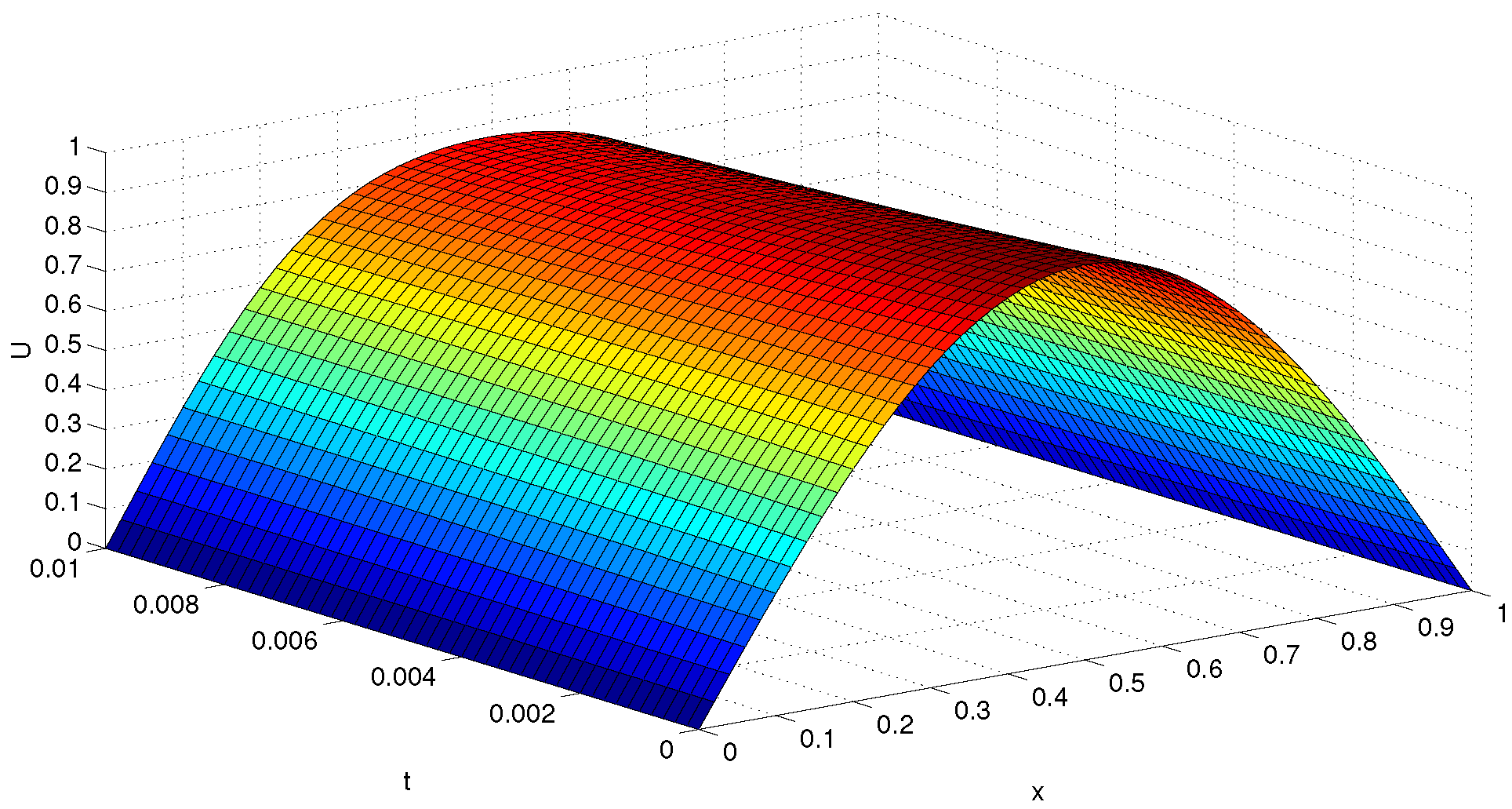
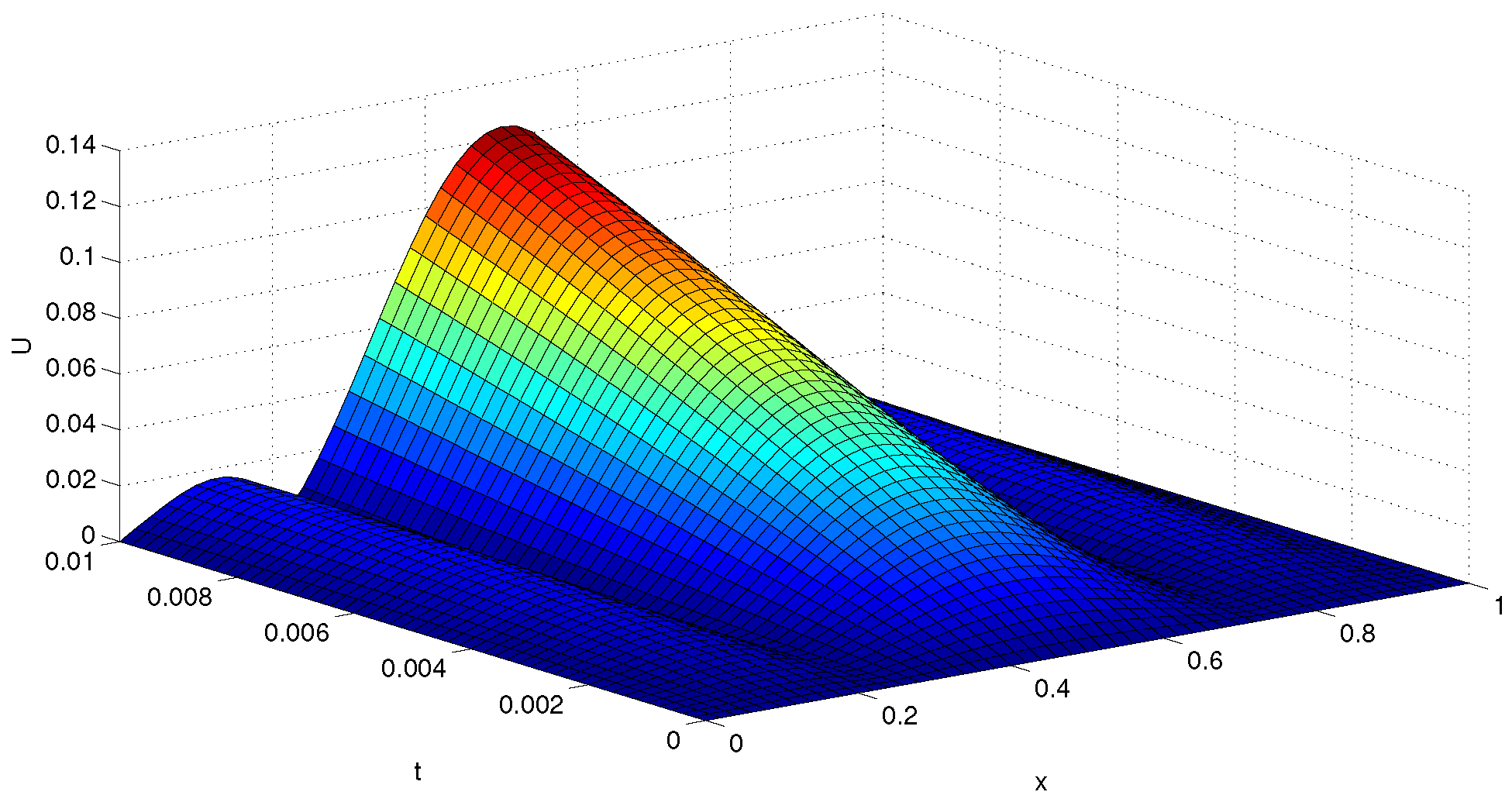
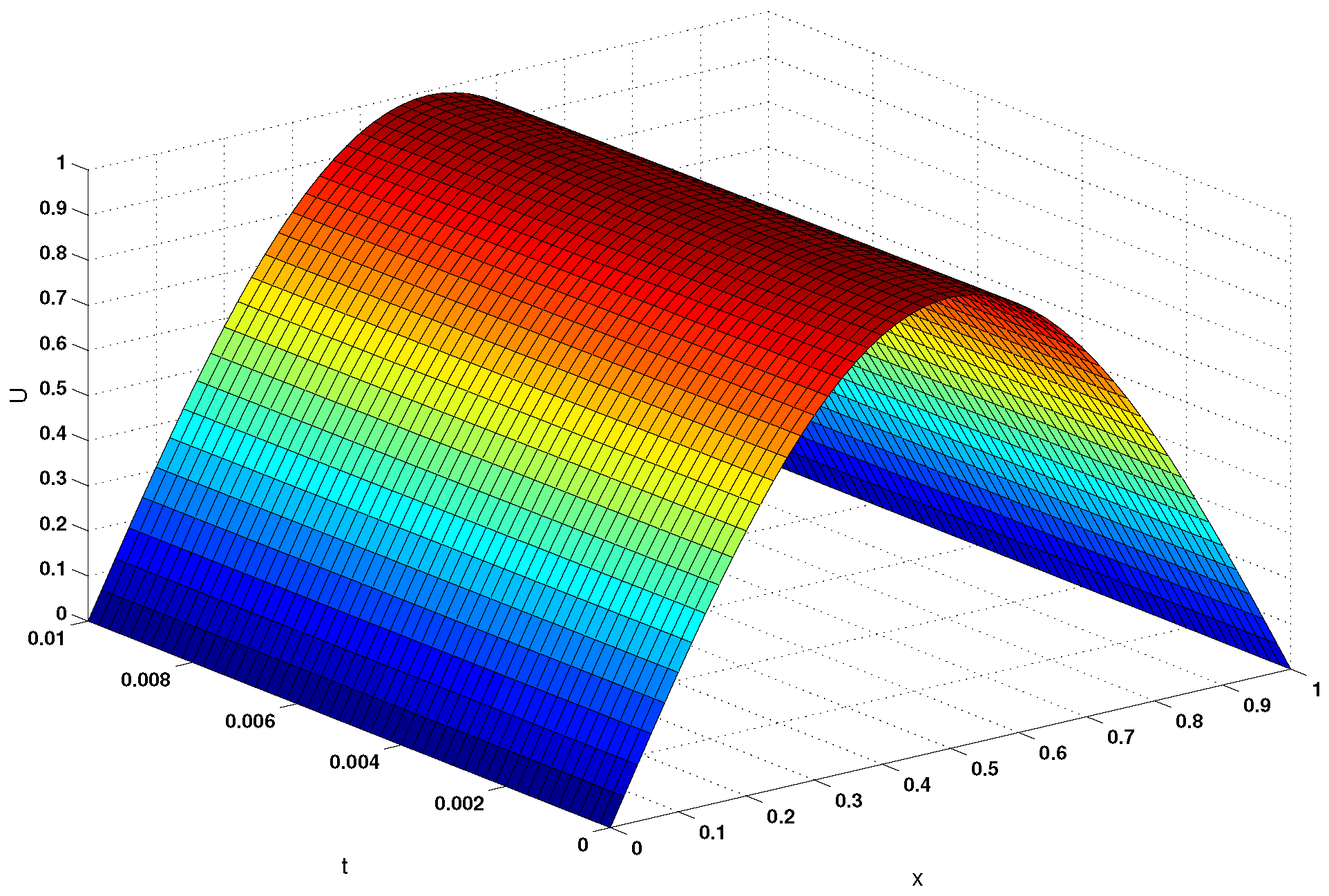
for and For fixed j, we get some nonlinear systems with size . Choosing different N and T, we solve this problem by different methods. The results are given in Table 9, where represents the number of iteration and represents the CUP time. The approximate solution and absolute value of error of this problem are shown in Figure 7 and Figure 8, when and . Figure 9 shows the exact solutions of this problems.
Figure 7.
Approximate solutions of Heat conduction equation.
Figure 8.
Absolute error of u for .
Figure 9.
The exact solutions of Heat conduction equation.
Table 2, Table 3, Table 4, Table 5, Table 6, Table 7, Table 8 and Table 9 show that compared with other methods, method NM8 has lower computational cost and higher computational efficiency. We find that method NM8 costs less computing time than other methods. This advantage is obvious for solving large scale nonlinear systems. Figure 7, Figure 8 and Figure 9 show that method NM8 can be used to solve nonlinear PDE equations with high accuracy.
6. Conclusions
We have extended the fifth-order Ham-Chun’s method to Banach space and developed an efficient method with eighth-order for solving standard nonlinear systems, nonlinear ODEs and PDEs. Our method requires three functions F, two derivatives and one matrix inversion per iteration. Table 2, Table 3, Table 4, Table 5, Table 6, Table 7, Table 8 and Table 9 show that our method NM8 show a highly efficient especially in large scale nonlinear systems. Numerical results verify that our method NM8 is better than other methods in this paper.
Funding
This research was supported by the National Natural Science Foundation of China (No. 61976027), Educational Commission Foundation of Liaoning Province of China (No. LJ2019010) and University-Industry Collaborative Education Program (Nos. 201901077017, 201902014012, 201902184038).
Conflicts of Interest
The authors declare no conflict of interest.
References
- Jelley, C.T. Solving Nonlinear Equations with Newton’s Method; SIAM: Philadelphia, PA, USA, 2003. [Google Scholar]
- Ortega, J.M.; Rheinbolt, W.C. Iterative Solution of Nonlinear Equations in Several Variables; Academic Press: New York, NY, USA, 1970. [Google Scholar]
- Darvishi, M.T.; Barati, A. A fourth-order method from quadrature formulae to solve systems of nonlinear equations. Appl. Math. Comput. 2007, 188, 257–261. [Google Scholar] [CrossRef]
- Grau-Sánchez, M.; Peris, M.P.; Gutiérrez, J.M. Accelerated iterative methods for finding solutions of system of nonlinear equations. J. Comput. Appl. Math. 2007, 190, 1815–1823. [Google Scholar] [CrossRef]
- Cordero, A.; Torregrosa, J.R.; Vassileva, M.P. Pseudocomposition: A technique to design predictor-corrector methods for systems of nonlinear equations. Appl. Math. Comput. 2012, 218, 11496–11504. [Google Scholar] [CrossRef]
- Cordero, A.; Jordán, C.; Sanabria-Codesal, E.; Torregrosa, J.R. Highly efficient iterative algorithms for solving nonlinear systems with arbitrary order of convergence p + 3, p ≥ 5. J. Comput. Appl. Math. 2018, 330, 748–758. [Google Scholar] [CrossRef]
- Sharma, J.R.; Arora, H. Efficient Jarratt-like methods for solving systems of nonlinear equations. Calcolo 2014, 51, 193–210. [Google Scholar] [CrossRef]
- Behl, R.; Cordero, A.; Torregrosa, J.R. High order family of multivariate iterative methods: Convergence and stability. J. Comput. Appl. Math. 2020, 2020, 113053. [Google Scholar] [CrossRef]
- Behl, R.; Arora, H. CMMSE: A novel scheme having seventh-order convergence for nonlinear systems. J. Comput. Appl. Math. 2020. [Google Scholar] [CrossRef]
- Wang, X.; Zhang, T. A family of Steffensen type methods with seventh-order convergence. Numer. Algorithms 2013, 62, 429–444. [Google Scholar] [CrossRef]
- Wang, X.; Zhang, T.; Teng, Q.W.; Teng, M. Seventh-order derivative-free iterative method for solving nonlinear systems. Numer. Algorithms 2015, 70, 545–558. [Google Scholar] [CrossRef]
- Sharma, J.R.; Arora, H. A novel derivative free algorithm with seventh order convergence for solving systems of nonlinear equations. Numer. Algorithms 2014, 4, 917–933. [Google Scholar] [CrossRef]
- Narang, M.; Bhatia, S.; Janwar, V. New efficient derivative free family of seventh-order methods for solving systems of nonlinear equations. Numer. Algorithms 2017, 76, 283–307. [Google Scholar] [CrossRef]
- Ham, Y.; Chun, C. A fifth-order iterative method for solving nonlinear equations. Appl. Math. Comput. 2007, 194, 287–290. [Google Scholar] [CrossRef]
- Zhanlav, T.; Otgondorj, K. Higher order Jarratt-like iterations for solving systems of nonlinear equations. Appl. Math. Comput. 2021, 395, 125849. [Google Scholar]
- Grau-Sánchez, M.; Grau, À.; Noguera, M. On the computational efficiency index and some iterative methods for solving systems of nonlinear equations. J. Comput. Appl. Math. 2011, 236, 1259–1266. [Google Scholar] [CrossRef]
- Behl, R.; Bhalla, S.; Magreñán, Á.A.; Kumar, S. An efficient high order iterative scheme for large nonliear systems with dynamics. J. Comput. Appl. Math. 2020, 113249. [Google Scholar] [CrossRef]
- Cordero, A.; Gómez, E.; Torregrosa, J.R. Efficient High-order iterative methods for solving nonlinear systems and their appliation on Heat Conduction Problems. Complexity 2017, 2017, 6457532. [Google Scholar] [CrossRef]
- Salimi, M.; Lotfi, T.; Sharifi, S.; Siegmund, S. Optimal Newton-Secant like methods without memory for solving nonlinear equations with its dynamics. Int. J. Comput. Math. 2017, 94, 1759–1777. [Google Scholar] [CrossRef]
- Behl, R.; Salimi, M.; Ferrara, M.; Sharifi, S.; Alharbi, S.K. Some Real-Life Applications of a Newly Constructed Derivative Free Iterative Scheme. Symmetry 2019, 11, 239. [Google Scholar] [CrossRef]
Publisher’s Note: MDPI stays neutral with regard to jurisdictional claims in published maps and institutional affiliations. |
© 2021 by the author. Licensee MDPI, Basel, Switzerland. This article is an open access article distributed under the terms and conditions of the Creative Commons Attribution (CC BY) license (https://creativecommons.org/licenses/by/4.0/).