


Abstract
A subset J is a --kernel of a graph if J is independent and 2-dominating simultaneously. In this paper, we consider two different generalizations of the Petersen graph and we give complete characterizations of these graphs which have --kernel. Moreover, we determine the number of --kernels of these graphs as well as their lower and upper kernel number. The property that each of the considered generalizations of the Petersen graph has a symmetric structure is useful in finding --kernels in these graphs.
1. Introduction
In general, we use the standard terminology and notation of graph theory (see [1]). Let G be an undirected, connected, and simple graph with the vertex set and the edge set . The order of the graph G is the number of vertices in G. The size of the graph G is its number of edges. By , and , , we mean a path and a cycle of order n, respectively.
Let and be two graphs. If and , then is a subgraph of G, written as . If and contain all the edges with , then is an induced subgraph of G and we write . Graphs G and are called isomorphic, and denoted by , if there exists a bijection with ⇔ for all . The complement of the graph G is a graph such that and two distinct vertices of are adjacent if and only if they are not adjacent in G. A graph G is called bipartite if admits a partition into two classes such that every edge has its ends in different classes.
A subset is a dominating set of G if each vertex of G not belonging to D is adjacent to at least one vertex of D. A subset is called an independent set of G if no two vertices of S are adjacent in G. A subset J being independent and dominating is a kernel of G.
The concept of kernels was initiated in 1953 by von Neumann and Morgenstern in digraphs with regard to game theory (see [2]). One of the pioneers studying the kernels in digraphs was C. Berge (see [3,4,5]). In literature, we can find many types and generalizations of kernels in digraphs (for results and applications, see, for example, [6,7,8,9,10,11]). The problem of the existence of kernels in undirected graphs is trivial because every maximal independent set is a kernel. Currently, distinct kind of kernels in undirected graphs are being studied quite intensively and many papers are available. For results and application, see, for example, [12,13,14,15,16,17,18]. Among many types of kernels in undirected graphs, there are kernels related to multiple domination, introduced by Fink and Jacobson in [19]. Let be an integer. A subset S is said to be p-dominating if every vertex outside S has at least p neighbors in S. If , then we obtain a dominating set in the classical sense. If , we get a 2-dominating set. A set which is 2-dominating and independent is named a 2-dominating kernel (--kernel in short). The concept of --kernels was introduced by A. Włoch in [20]. Some properties of --kernels were studied in [21,22,23,24]. In particular, in [23], it was proved that the problem of the existence of --kernels is -complete for general graphs. In [25], Nagy extended the concept of --kernels to k-dominating kernels. He considered a k-dominating set instead of the 2-dominating set, which he called k-dominating independent sets. Some properties of these sets were studied in [26,27].
The number of --kernels in the graph G is denoted by . Let G be a graph with the --kernel. The minimum cardinality of the --kernel of G is called a lower --kernel number and denoted by . The maximum cardinality of the --kernel of G is called an upper --kernel number and is denoted by .
In this paper, we consider two different generalizations of the Petersen graph. Various types of domination in the class of generalized Petersen graphs have been extensively studied in the literature (see [28,29,30,31,32]). Referring to this research, we will consider --kernels for two different generalizations of the Petersen graph. We solve the problem of the existence of --kernels, their number, and their cardinality in these graphs. Moreover, we determine a lower and an upper kernel number in these graphs. It is worth noting that each of presented generalizations of the Petersen graph has a symmetric structure. This property is useful in finding --kernels in these graphs.
2. Main Results
In this section, we consider the problem of the existence of --kernels in two different generalizations of the Petersen graph. In particular, we give complete characterizations of these generalizations, which have the --kernel. We determine the number of --kernels in these graphs as well as the lower and the upper --kernel number.
In the further part of the paper, we will use green color to mark vertices belonging to the --kernel, and red color to indicate vertices that cannot belong to it.
2.1. Generalized Petersen Graph
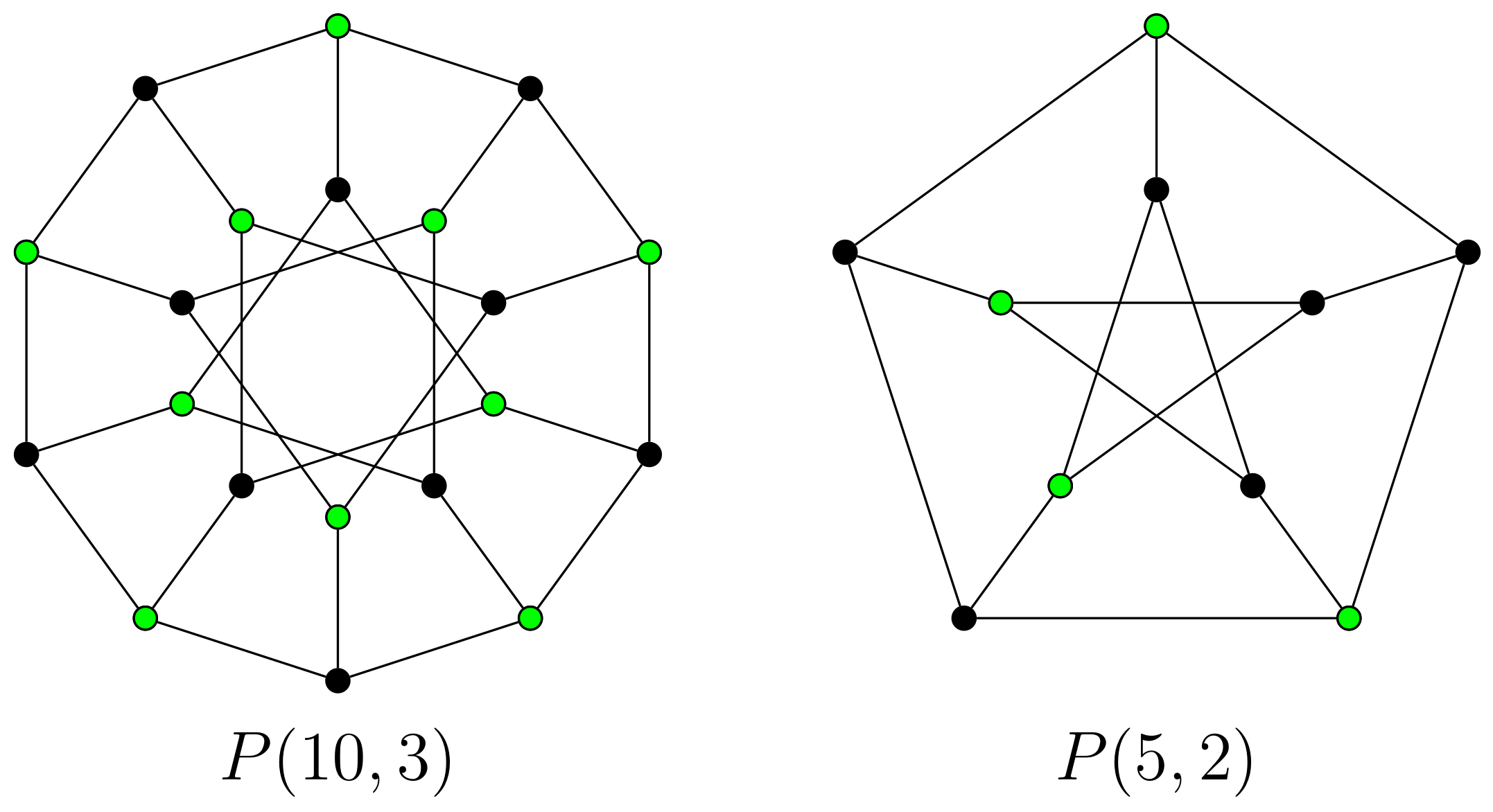
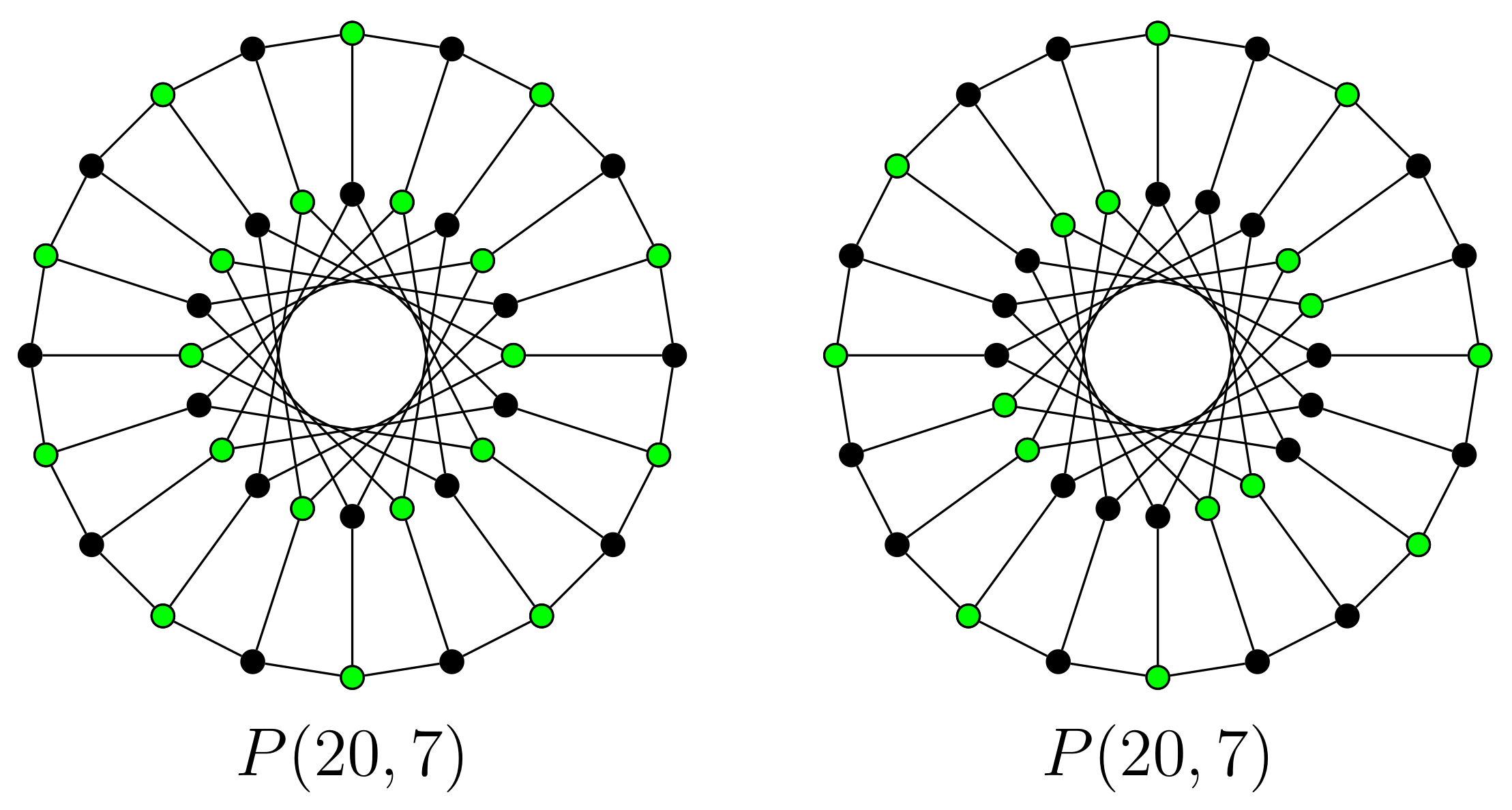
Let , be integers. The graph is called the generalized Petersen graph, if and , where subscripts are reduced modulo n. These graphs were first defined by Watkins in [33]. Figure 1 shows generalized Petersen graphs , and examples of --kernels in these graphs.

Figure 1.
Examples of --kernels in and .
We start with the problem of existence of --kernels. At the beginning, we give a sufficient condition, emerging from the property of bipartite graphs. We have the following complete characterization of bipartite generalized Petersen graphs.
Proposition 1
([34]). Let , be integers. The graph is bipartite if and only if n is even and k is odd.
From this characterization we directly obtain the sufficient condition for the existence of --kernels.
Proposition 2.
Let , be integers. If n is even and k is odd, then the graph has at least two --kernels which are a partition of the vertex set.
Proof.
Let n, k be as in the statement of the proposition. From Proposition 1, it follows that the graph is a bipartite graph. Thus, there exist two independent sets of vertices , that are a partition of the set . Moreover, the graph is a 3-regular graph. Therefore, sets , are --kernels of the graph . □
Now, we improve the above proposition to obtain the complete characterization of the generalized Petersen graph having --kernel.
Theorem 1.
Let , be integers. The graph has a --kernel if and only if
- (i)
- n is even and k is odd or
- (ii)
- and or
- (iii)
- and .
Proof.









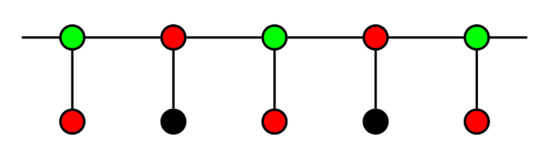






If , then the result is obvious. Let , be integers. If n is even and k is odd, then by Proposition 2, (i) follows. Let , , . We will show that the set is a --kernel of . The independence of J follows from the definition of . Let us assume that . Then, either , , , or , , , . We consider two cases.
1. .
If , then and . If , then and . If , then and .
2. .
Let . If , then and . If , then and . If , then and , , . Let . If , then and . If , then and .
Summing up all the above cases we obtain that every vertex is 2-dominated by J. Hence, J is a --kernel of .
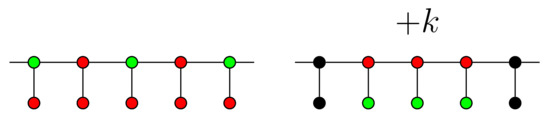
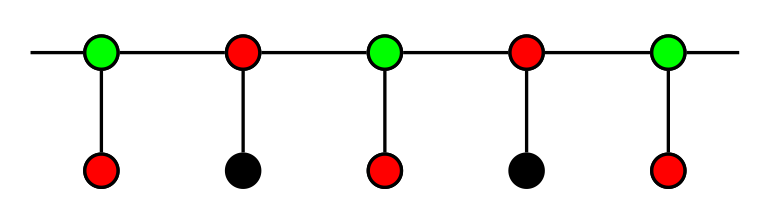
Conversely, let , , be integers and let J be a --kernel of . If , then the vertex is not 2-dominated by J. Thus, each connected component of the graph is isomorphic to either or . We will show that in the graph having a --kernel, the configurations of these paths , on the outer cycle, which are shown in the Figure 2 are forbidden.
Figure 2.
Forbidden configurations of the paths , for the graph with the --kernel.
Let us consider the following cases.
1. First, we will prove that the configuration of the paths , shown on the left side of the Figure 2 is forbidden. Suppose that for some i, as in Figure 3. Then, ; otherwise, vertices are not 2-dominated by J. Therefore, for every k vertices .
Figure 3.
The case when .
We have the next two possibilities.
1.1. for some i (see Figure 4).
Figure 4.
The case when (the first subcase).
Since , the vertex and . Then . This means that . Hence, the vertex is not 2-dominated by J, a contradiction.
1.2. for some i (see Figure 5).
Figure 5.
The case when (the second subcase).
Then, and ; otherwise, they are not 2-dominated by J. Because J is an independent set, . Moreover, to 2-dominate . Hence, . To 2-dominate , we must have . Moreover, . Since have exactly one neighbour in J, vertices and . Next, to 2-dominate and . Thus, to 2-dominate . Therefore, . This means that is not 2-dominated, a contradiction.
Hence, for each n and k, it is not possible that the vertices belong to a --kernel of .
2. Now, we will prove that the configuration of the paths , shown on the right side of the Figure 2 is forbidden. Suppose that for some i, as in Figure 6. Then, , which causes .
Figure 6.
The case when .
We consider four subcases.
2.1. for some i (see Figure 7).
Figure 7.
The case when (the first subcase).
Then, . Since must be 2-dominated, so or . Without loss of generality, assume that . Thus, . Hence, the vertex is not 2-dominated, a contradiction.
2.2. and for some i (see Figure 8).
Figure 8.
The case when (the second subcase).
Then, . Since must be 2-dominated, we obtain that or . Without loss of generality, assume that . Thus, and . Because J is an independent set and , . Therefore, , which causes . Moreover, , and finally . Hence, the vertex is not 2-dominated, a contradiction.
2.3. and for some i (see Figure 9).
Figure 9.
The case when (the third subcase).
Then, and . Since must be 2-dominated, or . Without loss of generality, assume that . Thus, . Moreover, , which causes . To 2-dominate , we must have . Then, and . From the independence of the set J, we get that . Hence, the vertex is not 2-dominated, a contradiction.
2.4. for some i.
Proving analogously as in subcase 2.3., we obtain a contradiction with the assumption that J is a --kernel.
Therefore, for each n and k, it is not possible that the vertices belong to a --kernel of .
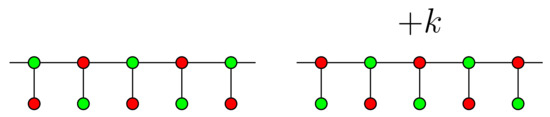
Hence, for the graph with the --kernel, the configurations of , shown in the Figure 10 are the only ones that may be possible. Now, we will show that they are indeed possible.
Figure 10.
Possible configurations of the paths , for the graph with the --kernel.
3. Suppose that for some i, as in Figure 11. Then, .
Figure 11.
The case when .
We consider four subcases.
3.1. for some i (see Figure 12).
Figure 12.
The case when (the first subcase).
Since must be 2-dominated, we obtain that or . Without loss of generality, assume that . Moreover, and . Hence, the vertex is not 2-dominated, a contradiction.
3.2. and for some i (see Figure 13).
Figure 13.
The case when (the second subcase).
Then, and . Since must be 2-dominated, or . Without loss of generality, assume that . Thus, and , which causes and . Moreover, , , , , , and . Finally, and . Hence, the vertex is not 2-dominated, a contradiction.
3.3. and for some i.
Proving analogously as in subcase 3.2., we obtain a contradiction with the assumption that J is a --kernel.
3.4. for some i (see Figure 14).
Figure 14.
The case when (the fourth subcase).
Then, . First, we will show that and must belong to a --kernel J. Suppose on contrary that . Since must be 2-dominated, . Thus, and . Moreover, and . Hence, the vertex is not 2-dominated, a contradiction.
This means that and also belong to a --kernel (see Figure 15).
Figure 15.
The case when implies that .
Hence, n must be even, and from the definition of , we conclude that k must be odd, which proves (i).
4. Suppose that for some i. Then, . Since must be 2-dominated, . First, we prove that . Suppose on contrary that , as in Figure 16. Then, . Since must be 2-dominated, or . Without loss of generality, assume that . Thus, , and . Moreover, , , , , and . Proving analogously as in subcase 3.3., we obtain a contradiction with the assumption that J is a --kernel.
Figure 16.
The case when .
Hence, (see Figure 17). Moreover, and . We consider two subcases.
Figure 17.
The case when , and .
4.1. for some i (see Figure 18).
Figure 18.
The case when (the first subcase).
Then, , , , , and . Moreover, and ; otherwise, we obtain the same configuration as in subcase 3.3.
Hence, n must be divisible by 5, and from the definition of , we conclude that , which proves (ii).
4.2. for some i (see Figure 19).
Figure 19.
The case when (the second subcase).
Then, , and . Moreover, and
Hence, n must be divisible by 5, and from the definition of , we conclude that , which proves (iii), which ends the proof. □
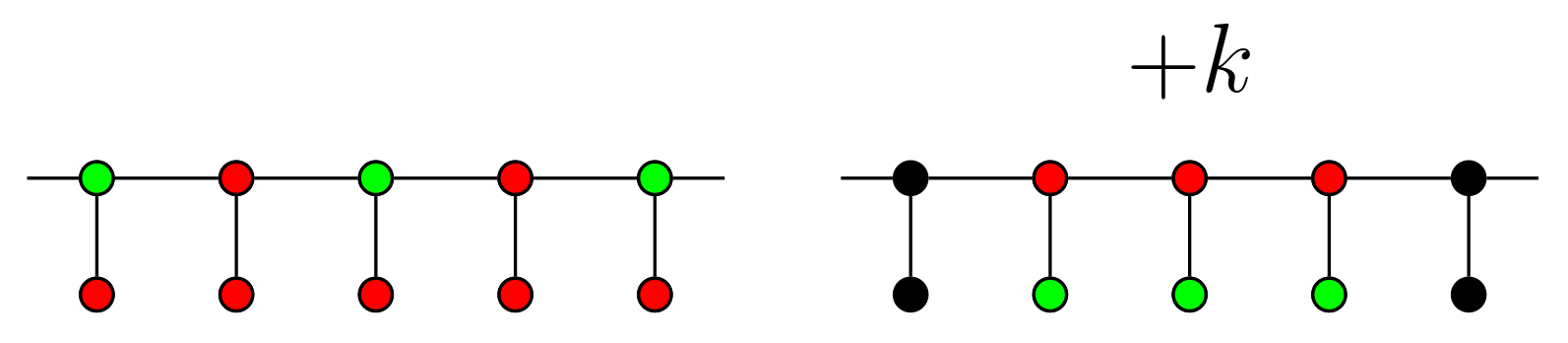
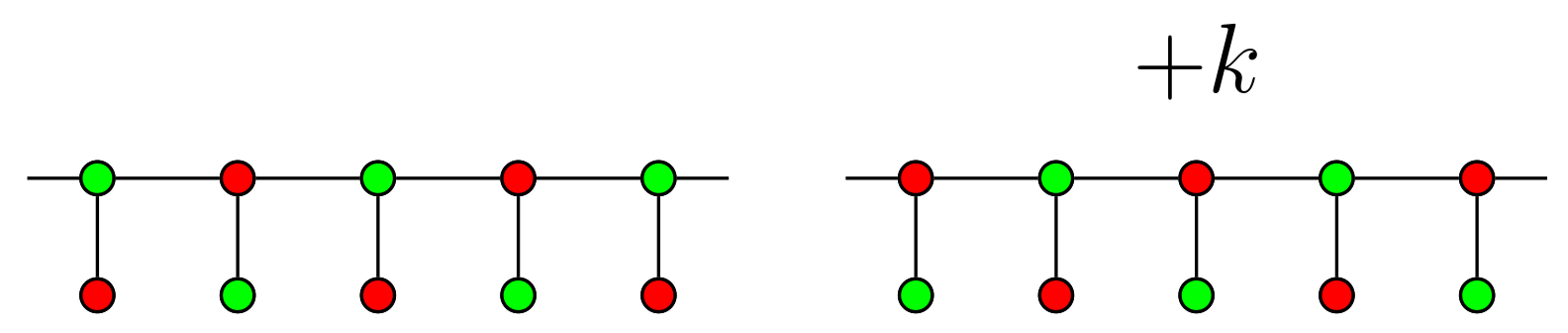
Basing on the proof of Theorem 1, the following corollaries are obtained. They concern the number of --kernels in the generalized Petersen graph as well as the lower and upper --kernel numbers. By a rotation of configurations shown on Figure 10, condition (i) of Theorem 1 gives two --kernels in generalized Petersen graph and conditions (ii) and (iii) give five --kernels. Therefore, if n and k satisfy more than one of these conditions, we obtain more --kernels. Moreover, the proof of the Theorem 1 presents the constructions of the --kernels in the generalized Petersen graph . Figure 20 shows the smallest and the largest --kernel in the graph .
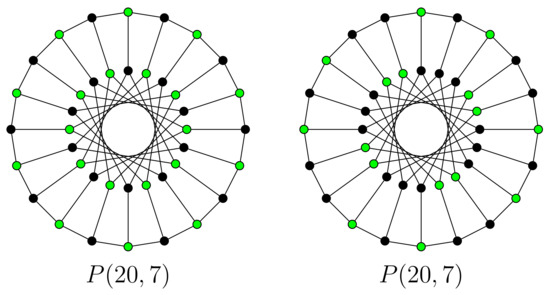
Figure 20.
The largest (left side) and the smallest (right side) --kernel in the graph .
Corollary 1.
Let , be integers. Then,
Corollary 2.
Let , be integers. If and , , then
Corollary 3.
Let , be integers. If and , or and , , then
Corollary 4.
Let , be integers. If and , or n is even, and k is odd, then
The above corollaries characterize all possible graphs , which have the --kernel.
2.2. The Second Generalization of the Petersen Graph
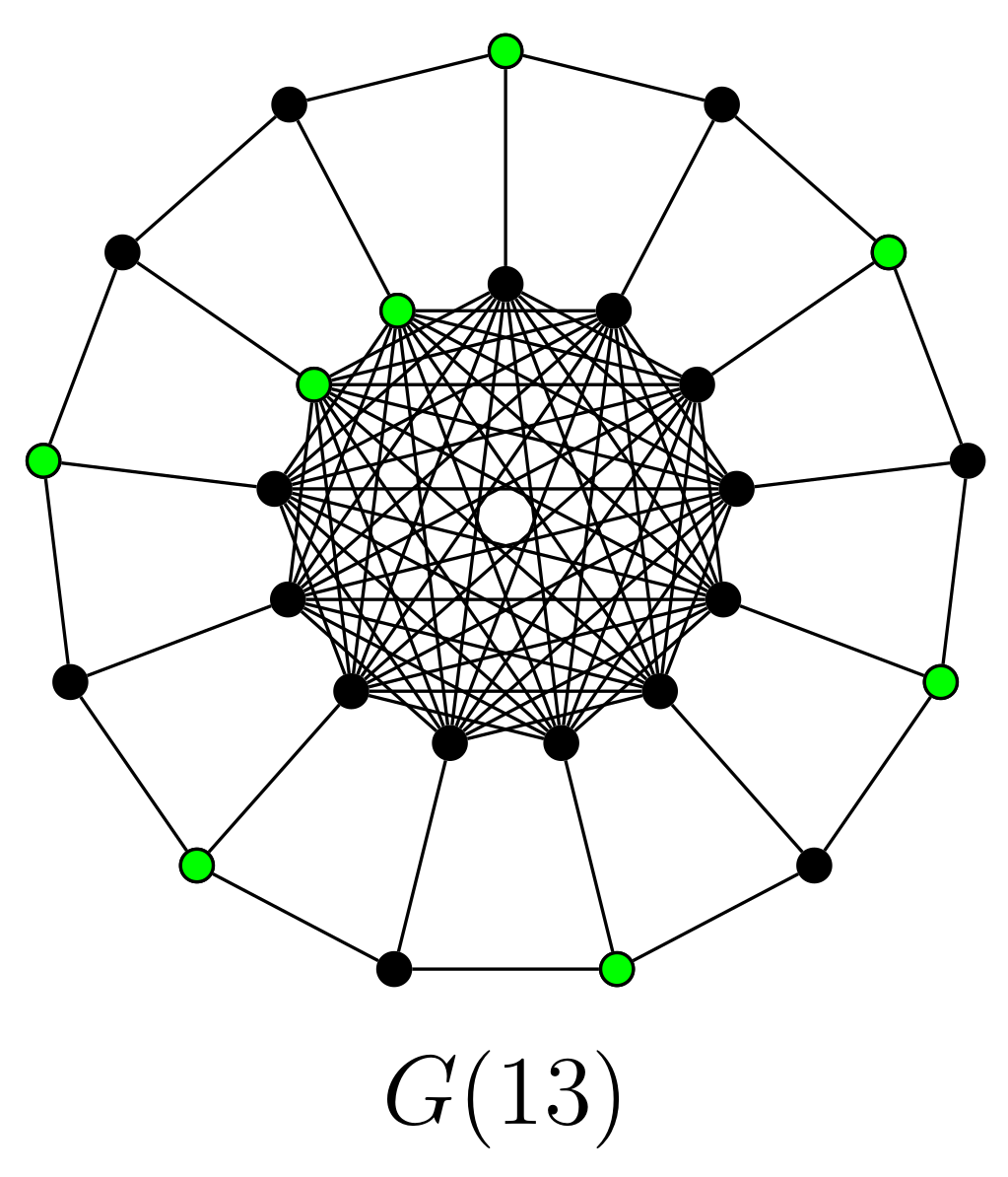
Now, we consider another generalization of the Petersen graph. Let be an integer. Let be a cycle and its complement such that , with the numbering of vertices in the natural order. Let be the graph such that and . Figure 21 shows an example of a --kernel in . It is easy to check that if , then is isomorphic to the Petersen graph.
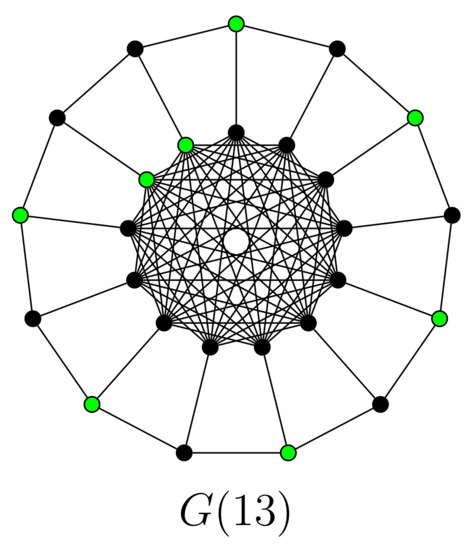
Figure 21.
An example of a --kernel in .
The next Theorem shows a complete characterization of graphs with the --kernel.
Theorem 2.
Let be integer. The graph has a --kernel if and only if n is odd.
Proof.
Let be odd. We will show that is the --kernel of the graph . The independence of J is obvious. It is sufficient to show that J is a 2-dominating set. By the definition of the graph , we can assume that . Suppose that . Hence, or . Let . Thus , . If , then there exist vertices adjacent to . If , then or . For , the vertex is adjacent to . Moreover, if , then the vertex is adjacent to . Hence, every vertex from the set is 2-dominated by the set J. Let now . Thus , . Then, the vertex , is adjacent to . If , then . Moreover, for the vertex is adjacent to . Therefore, vertices from the set are 2-dominated by J and hence J is a --kernel of .
Conversely, suppose that a graph has a --kernel J. We will show that n is odd. By the definition of the graph , we obtain that . Otherwise, vertices from the set are not 2-dominated by the set J. Let . Then either or . Otherwise, or is not 2-dominated. Hence, . Without loss of generality assume that . This means that , is 2-dominated by J and are dominated by J. Let . Then, . Since J is the --kernel, ; otherwise, are not 2-dominated by J. Therefore, the graph must have a --kernel to 2-dominate vertices from . This means that n must be odd. Thus, , which ends the proof. □
Finally, it turns out that if a graph has --kernel, then the number of --kernels depends linearly on the number of vertices. Moreover, each --kernel of has the same cardinality.
Corollary 5.
If is odd, then and
Proof.
Let be odd. From the construction of a --kernel described in the proof of Theorem 2, we conclude that exactly two not adjacent vertices from the set belong to a --kernel. The selection of these two vertices will determine the --kernel in . Since two not adjacent vertices can be chosen on n ways, . Moreover, from the construction of --kernels in , it follows that all of them have the same cardinality. Hence, , which ends the proof. □
3. Concluding Remarks
In this paper, we considered two different generalizations of the Petersen graph, and we discussed the problem of the existence of --kernels in these graphs. In particular, we determined the number of --kernels in these graphs and their lower and upper --kernel number. The generalized Petersen graphs considered in this paper are special cases of I-graphs (see, for example, [35]). The I-graph is a graph with a vertex set and an edge set , where subscripts are reduced modulo n. Because , the results obtained could be a starting point to studying and counting --kernels in I-graphs. It could also be interesting to investigate the number of --kernels in other generalizations of generalized Petersen graphs. For more generalizations, see, for example, [36].
Author Contributions
Both authors contributed equally to this work. All authors have read and agreed to the published version of the manuscript.
Funding
This research received no external funding.
Institutional Review Board Statement
Not applicable.
Informed Consent Statement
Not applicable.
Conflicts of Interest
The authors declare no conflict of interest.
References
- Diestel, R. Graph Theory, 3rd ed.; Springer: New York, NY, USA, 2005. [Google Scholar]
- Morgenstern, O.; Von Neumann, J. Theory of Games and Economic Behavior; Princeton University Press: Princeton, NJ, USA, 1944. [Google Scholar]
- Berge, C. Graphs and Hypergraphs; North-Holland Pub. Co.: Amsterdam, The Netherlands, 1973. [Google Scholar]
- Berge, C.; Duchet, P. Perfect graphs and kernels. Bull. Inst. Math. Acad. Sin. 1988, 16, 263–274. [Google Scholar]
- Berge, C.; Duchet, P. Recent problems and results about kernels in directed graphs. Discrete Math. 1990, 86, 27–31. [Google Scholar] [CrossRef][Green Version]
- Galeana-Sánchez, H.; Hernández-Cruz, C. On the existence of (k, l)-kernels in infinite digraphs: A survey. Discuss. Math. Graph Theory 2014, 34, 431–466. [Google Scholar] [CrossRef]
- Galeana-Sánchez, H.; Hernández-Cruz, C.; Arumugam, S. On the existence of (k, l)-kernels in digraphs with a given circumference. AKCE Int. J. Graphs Comb. 2013, 10, 15–28. [Google Scholar]
- Kucharska, M. On (k, l)-kernel perfectness of special classes of digraphs. Discuss. Math. Graph Theory 2005, 25, 103–119. [Google Scholar] [CrossRef]
- Włoch, I. On kernels by monochromatic paths in the corona of digraphs. Open Math. 2008, 6, 537–542. [Google Scholar] [CrossRef]
- Bai, Y.; Fujita, S.; Zhang, S. Kernels by properly colored paths in arc-colored digraphs. Discrete Math. 2018, 341, 1523–1533. [Google Scholar] [CrossRef]
- De la Maza, S.G.H.; Hernández-Cruz, C. On the complexity of the k-kernel problem on cyclically k-partite digraphs. Theoret. Comput. Sci. 2019, 795, 9–19. [Google Scholar] [CrossRef]
- Hedetniemi, S.M.; Hedetniemi, S.T.; Knisely, J.; Rall, D.F.; Haynes, T.W. Secondary domination in graphs. AKCE Int. J. Graphs Comb. 2008, 5, 103–115. [Google Scholar]
- Szumny, W.; Włoch, A.; Włoch, I. On the existence and on the number of (k, l)-kernels in the lexicographic product of graphs. Discrete Math. 2008, 308, 4616–4624. [Google Scholar] [CrossRef]
- Włoch, I. On kernels by monochromatic paths in D-join. Ars Combin. 2011, 98, 215–224. [Google Scholar]
- Bednarz, U.; Włoch, I. On strong (1;1;2)-kernels in graphs. Ars Combin. 2020, 152, 32–43. [Google Scholar]
- Bednarz, U. Strong (1;1;2)-kernels in the corona of graphs and some realization problems. Iran. J. Sci. Technol. Trans. A Sci. 2020, 44, 401–406. [Google Scholar] [CrossRef]
- Bednarz, U.; Włoch, I. Fibonacci numbers in graphs with strong (1, 1, 2)-kernels. Bol. Soc. Mat. Mex. 2021, 27, 1–12. [Google Scholar] [CrossRef]
- Michalski, A.; Włoch, I. On the existence and the number of independent (1,2)-dominating sets in the G-join of graphs. Appl. Math. Comput. 2020, 377, 125155. [Google Scholar] [CrossRef]
- Fink, J.F.; Jacobson, M.S. n-domination in graphs. In Graph Theory with Applications to Algorithms and Computer Science; John Wiley & Sons, Inc.: New York, NY, USA, 1985; pp. 283–300. [Google Scholar]
- Włoch, A. On 2-dominating kernels in graphs. Australas. J. Combin. 2012, 53, 273–284. [Google Scholar]
- Bednarz, P.; Włoch, I. An algorithm determining (2-d)-kernels in trees. Util. Math. 2017, 102, 215–222. [Google Scholar]
- Bednarz, P.; Włoch, I. On (2-d)-kernels in the cartesian product of graphs. Ann. Univ. Mariae Curie-Skłodowska Sect. A 2016, 70, 1–8. [Google Scholar] [CrossRef]
- Bednarz, P.; Hernández-Cruz, C.; Włoch, I. On the existence and the number of (2-d)-kernels in graphs. Ars Combin. 2015, 121, 341–351. [Google Scholar]
- Bednarz, P. On (2-d)-Kernels in the Tensor Product of Graphs. Symmetry 2021, 13, 230. [Google Scholar] [CrossRef]
- Nagy, Z.L. On the Number of k-Dominating Independent Sets. J. Graph Theory 2017, 84, 566–580. [Google Scholar] [CrossRef]
- Gerbner, D.; Keszegh, B.; Methuku, A.; Patkós, B.; Vizer, M. An improvement on the maximum number of k-Dominating Independent Sets. J. Graph Theory 2019, 91, 88–97. [Google Scholar] [CrossRef]
- Nagy, Z.L. Generalizing Erdős, Moon and Moser’s result—The number of k-dominating independent sets. Electron. Notes Discrete Math. 2017, 61, 909–915. [Google Scholar] [CrossRef]
- Behzad, A.; Behzad, M.; Praeger, C.E. On the domination number of the generalized Petersen graphs. Discrete Math. 2009, 308, 603–610. [Google Scholar] [CrossRef][Green Version]
- Ebrahimi, B.J.; Jahanbakht, N.; Mahmoodian, E.S. Vertex domination of generalized Petersen graphs. Discrete Math. 2009, 309, 4355–4361. [Google Scholar] [CrossRef]
- Yan, H.; Kang, L.; Xu, G. The exact domination number of the generalized Petersen graphs. Discrete Math. 2009, 309, 2596–2607. [Google Scholar] [CrossRef][Green Version]
- Gabrovšek, B.; Peperko, A.; Žerovnik, J. Independent Rainbow Domination Numbers of Generalized Petersen Graphs P(n, 2) and P(n, 3). Mathematics 2020, 8, 996. [Google Scholar] [CrossRef]
- Erveš, R.; Žerovnik, J. On 2-Rainbow Domination Number of Generalized Petersen Graphs P(5k, k). Symmetry 2021, 13, 809. [Google Scholar] [CrossRef]
- Watkins, M.E. A theorem on Tait colorings with an application to the generalized Petersen graphs. J. Combin. Theory 1969, 6, 152–164. [Google Scholar] [CrossRef]
- Alspach, B.; Liu, J. On the Hamilton connectivity of generalized Petersen graphs. Discrete Math. 2009, 309, 5461–5473. [Google Scholar] [CrossRef][Green Version]
- Boben, M.; Pisanski, T.; Žitnik, A. I-graphs and the corresponding configurations. J. Combin. Des. 2005, 13, 406–424. [Google Scholar] [CrossRef]
- Saražin, M.L.; Pacco, W.; Previtali, A. Generalizing the generalized Petersen graphs. Discrete Math. 2007, 307, 534–543. [Google Scholar] [CrossRef][Green Version]















Publisher’s Note: MDPI stays neutral with regard to jurisdictional claims in published maps and institutional affiliations. |
© 2021 by the authors. Licensee MDPI, Basel, Switzerland. This article is an open access article distributed under the terms and conditions of the Creative Commons Attribution (CC BY) license (https://creativecommons.org/licenses/by/4.0/).