You are currently viewing a new version of our website. To view the old version click .
Symmetry
  • Article
  • Open Access

13 October 2021

A Novel Algorithm for Capacitated Vehicle Routing Problem for Smart Cities
,
,
,
,
,
and
1
Department of Computer Science, Aligarh Muslim University, Aligarh 202002, India
2
School of Engineering and Applied Science, Bennett University, Greater Noida 203206, India
3
Department of Computer Science and Information Technology, Khwaja Moinuddin Chishti Language University, Luckhnow 226013, India
4
School of Computer Science, Faculty of Engineering, University of Technology Sydney, Sydney, NSW 2007, Australia
This article belongs to the Section Computer

Abstract

Smart logistics is an indispensable building block in smart cities development that requires solving the challenge of efficiently serving the demands of geographically distributed customers by a fleet of vehicles. It consists of a very well-known NP-hard complex optimization problem, which is known as the capacitated vehicle routing problem (CVRP). The CVRP has widespread real-life applications such as delivery in smart logistics, the pharmaceutical distribution of vacancies, disaster relief efforts, and others. In this work, a novel giant tour best cost crossover (GTBCX) operator is proposed which works stochastically to search for the optimal solutions of the CVRP. An NSGA-II-based routing algorithm employing GTBCX is also proposed to solve the CVRP to minimize the total distance traveled as well as to minimize the longest route length. The simulated study is performed on 88 benchmark CVRP instances to validate the success of our proposed GTBCX operator against the nearest neighbor crossover (NNX) and edge assembly crossover (EAX) operators. The rigorous simulation study shows that the GTBCX is a powerful operator and helps to find results that are superior in terms of the overall distance traveled, length of the longest route, quality, and number of Pareto solutions. This work employs a multi-objective optimization algorithm to solve the capacitated vehicle routing problem (CVRP), where the CVRP is represented in the form of a two-dimensional graph. To compute the values’ objective functions, the distance between two nodes in the graph is considered symmetric. This indicates that the genetic algorithm complex optimization algorithm is employed to solve CVRP, which is a symmetry distance-based graph.

1. Introduction

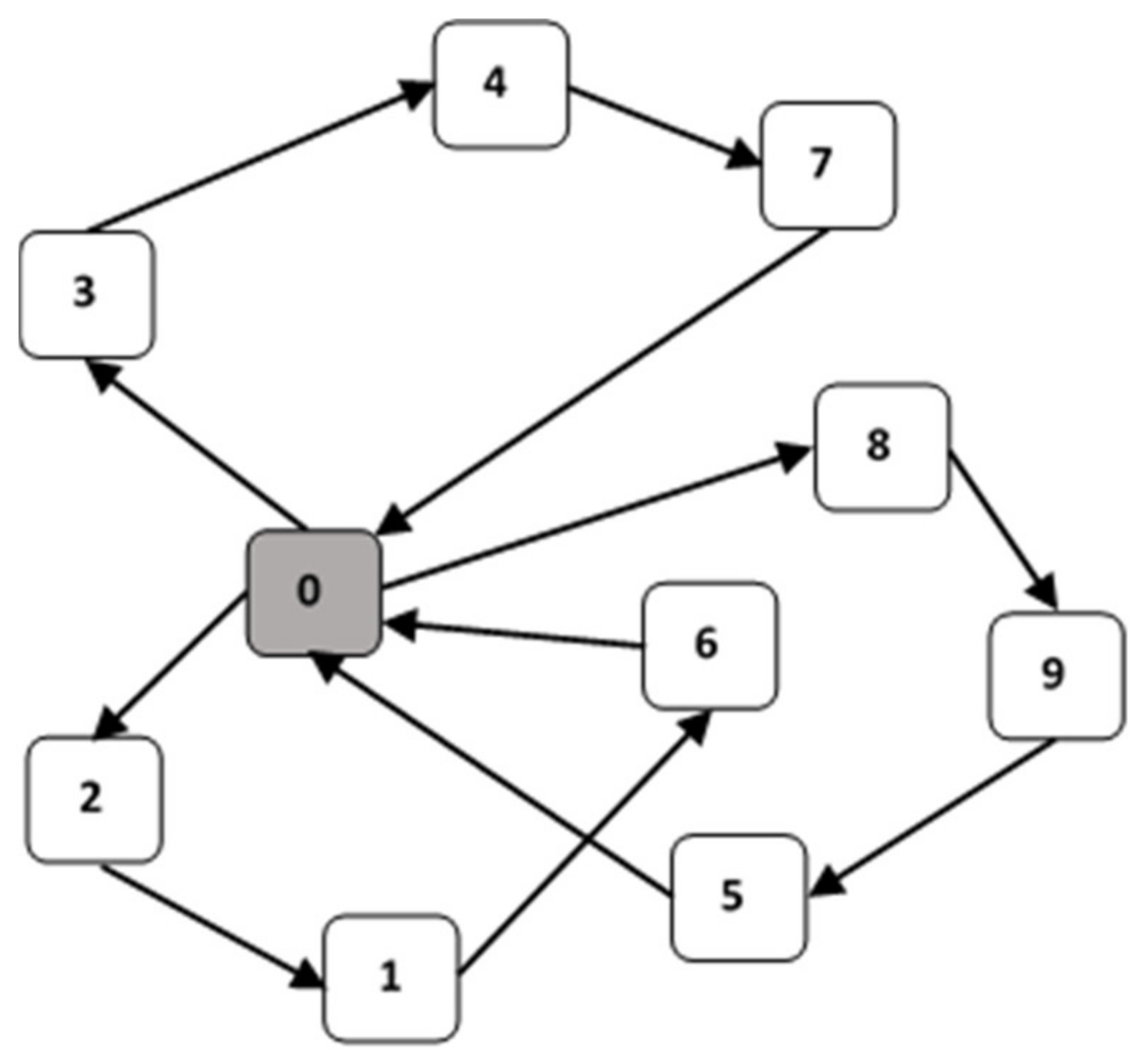
Smart logistics is an indispensable building block in developing smart cities, and the efficient delivery of the demands of geographically distributed customers plays a major role [1,2,3]. As depicted in Figure 1, the CVRP problem is concerned with discovering the optimal paths for a given fleet of motor vehicles to fulfill the demands of physically distributed customers [3]. The CVRP and its variants are widely used in many real-life applications, such as smart logistics [1,2], critical data collection in IoT platforms [4], renting-sharing problems for urban bicycles [5], the routing and scheduling of chains of retail stores [6], distributing medical supplies for emergencies [7], crop harvesting and transportation [8], and the dynamic vehicle routing problem with traffic congestion to name a few. The CVRP is a widely-discussed NP-hard [3] problem, and therefore, optimization methods including exact methods (dynamic programming, branch-and-bound); heuristics (the Fisher–Jaikumar algorithm and the Clarke–Wright saving algorithm); swarm and evolutionary algorithms (GA, ACO, and firefly algorithms); local search operators (swap, inversion, scramble) and hybrid approaches have widely been employed to crack the CVRP problem [3,8,9,10,11,12,13,14]. In the CVRP, multiple vehicles are required to serve the customers in different routes, and only minimizing the overall distances traveled by all vehicles may severely affect the distance traveled by individual vehicles. The minimization of the total traveled distance with all motor vehicles may lead to route imbalance, i.e., one vehicle is required to travel a higher distance to serve the assigned customers on the longest route. On the longest route, the vehicle spends more time delivering the items, and customers also experience deliveries with longer waiting times than customers on other, shorter routes. The optimization of total traveled distance and the longest route provides balanced routes and shorter distances travelled by all vehicles, leading to fair optimization behavior with respect to each of the three stakeholders–the depot’s owners, the vehicle’s owner/driver, and customers. The optimization of the total traveled distance and the length of the longest route comes into conflict with each other, because minimization of one negatively affects the other. The optimization of two objectives invites the application of multi-criteria optimization methods, such as NSGA-II, NSGA-III, HypE, SMS-EMOA, EMOA/D, etc. [15]. Elitist and fast multi-criteria evolutionary algorithms, such as the non-dominated sorting genetic algorithm-II (NSGA-II), have proven their strength in the optimization field and have successfully resolved various complex optimization problems, such as scheduling, routing problems, wireless routing problems, and others [15,16,17,18]. However, the performance of the swarm and evolutionary algorithms heavily depends on genetic operators (i.e., recombination and mutation operators) according to the problem solved [19]. Therefore, it is required to design appropriate operators to search for the optimal solutions of CVRP using evolutionary algorithms.
Figure 1. Graphical representation of the CVRP.
This work considers the bi-objective version of the CVRP for minimizing the overall distance traveled by the fleet of vehicles and the length of the route with the longest distance. For solving the bi-objective CVRP, a novel giant tour best cost crossover (GTBCX) operator is proposed. The GTBCX operator is employed in NSGA-II to solve the CVRP to reduce the total distance traveled and to minimize the longest route’s length. The GTBCX operator was designed intelligently to avoid the generation of infeasible solutions which may be generated during the crossover process. It also avoids premature convergence and advances to the optimum problem solution with respect to all objectives. The unique contributions of our research work are as follows:
  • A problem-specific crossover operator is proposed, i.e., giant tour best cost crossover (GTBCX) operator for the CVRP.
  • The routing algorithm, which combines NSGA-II and GTBCX, is proposed to resolve the bi-objective CVRP.
  • The performance of GTBCX is evaluated against the nearest neighbor crossover (NNX) and edge assembly crossover (EAX) crossover operators [3,20,21].
  • An extensive simulation is performed on 88 CVRP benchmark instances to check the efficacy of the proposed GTBCX operator and routing algorithm by the number and quality of Pareto solutions offered.
This research work focuses on the development of an optimization algorithm-based genetic algorithm which is employed to solve the CVRP. The CVRP is modeled as a two-dimensional graph in which the distance between two nodes is considered symmetric. As the problem is complex, the genetic algorithm-based search algorithm employs non-dominated sorting, crowding comparison operators, and genetic operators to perform the global search. It also includes local search operators, i.e., swap, relocate, and 2-opt* operators to search the neighborhood solutions of the given solution. This work explores a complex algorithm to solve the capacitated vehicle routing problem, which is an application of graph theory and symmetric in nature.
The remainder of this paper is divided into six sections. Section 2 discusses the related literature focusing on different dimensions of the capacitated vehicle routing problem (CVRP) as well as NSGA-II. In Section 3, we present problem formulation corresponding to the bi-objective CVRP. Section 4 presents the proposed work, including an overview of the NSGA-II-based routing algorithm, GTBCX, and mutation operators. Section 5 presents an extensive simulation study for benchmark CVRP instances. Finally, Section 6 puts forward the conclusion and future research directions.

3. Bi-Objective Capacitated Vehicle Routing Problem

The bi-objective CVRP can be formally described as a tuple of nodes and a fleet of vehicles. Assume G = (C, A) represents the Euclidian graph consisting of two elements. The set C = c i : 0 i n consists of total of n + 1 nodes. Node c 0 C represents the central depot, while the remaining nodes represent n customers from c 1 , c 2 c i   c n   C . For each node c i C , the geographic coordinates x i , y i and the demand δ i are given. All customers have non-zero positive demands, i.e., δ i > 0 ,   i > 0 whereas the central depot c 0 has zero demand. The set A = i , j :   c i ,   c j C ,   c i c j represents the set of edges between nodes and the distance between node c i and c j is represented by Euclidean distance d i j . The fleet of identical vehicles V = v k :   1 k m is also given, and all vehicles are assumed to be homogeneous with the same capacity limit Q.
In the bi-objective CVRP, it is required to employ the fleet of m identical vehicles and deliver the demands of all n customers with objectives to minimize the overall distance traveled by the fleet of vehicles as well as the length of the route with the longest distance. It is also mandatory that the capacity limit of each vehicle must be observed, and the demand of every customer is fulfilled by one vehicle without splitting the demand. The vehicle always begins and ends the journey at the central depot [3,20].
The model has a decision variable X i j k for each vehicle v k V in order to move from node c i C to a different node c j C . The value of the decision variable X i j   k may be either 0 or 1. Whenever the vehicle v k V travels from node c i C to the next unvisited node c j C , the value of X i j k will be 1, and otherwise it will be 0.
To deliver the demands of the physical distributed customers allocated to a vehicle v k V , the distance traveled f k by the vehicle v k can be computed as
f k = c i ϵ C c j ϵ   C d i j X i j k
The longest route among all the routes is given by
f 1 = m a x f k :   v k V = m a x c i ϵ C c j ϵ   C d i j X i j k : v k V
To fulfill the demands of all physically distributed customers, the overall traveled distance by the given fleet of vehicles is given by
f 2 = v k ϵ V f k = v k ϵ V c i ϵ C c j ϵ   C d i j X i j k
The two objectives are to optimize the overall distance traveled by the fleet of vehicles and the length of the longest route. The objective function can be mathematically formulated as:
M i n   f 1 = m a x c i ϵ C c j ϵ   C d i j X i j k : v k V f 2 = v k ϵ V c i ϵ C c j ϵ   C d i j X i j k
With the following constraints
v k   ϵ   V c j   ϵ   C X i j k = 1 ,   c i C
v k   ϵ   V c i   ϵ   C X i j k = 1 ,   c j C
c i ϵ   C c 0 δ i c j   ϵ   C X i j k Q ,   v k V
c j   ϵ   C X 0 j k = 1 ,   v k V
c i ϵ   C X i j k c j ϵ   C X i j k = 0 ,   c h C c 0 ,     v k V
c i ϵ C X i 0 k = 1 ,   v k V
X i j k   ε   0 ,   1 ,   c i ,   c j C ,     v k V
Equation (4) states that the two objectives of bi-objective CVRP must be minimized. Equations (5) and (6) ensure that every customer must be visited once and just by one vehicle, and Equation (7) ensures that each vehicle must not be allocated a quantity greater than Q. Equations (8)–(10) ensure flow constraints, such that each vehicle starts the journey from the central depot c 0 , leaves the customer after delivering the demand δ i , and finally comes back to the central depot c 0 . Constraints (11) ensure the integrity of the decision variable X i j k .

4. The Proposed Work

This section discusses the proposed GTBCX operator and the NSGA-II-based routing algorithm (i.e., NSGA-II_GTBCX) in the context of solving bi-objective CVRP. The population initialization strategy, selection operator and the mutation operator are also discussed.

4.1. NSGA-II-Based Routing Algorithm

The proposed routing algorithm employs NSGA-II and the GTBCX operator to search the optimal solution consisting of effective routes corresponding to the bi-objective CVRP. The multi-criteria NSGA-II combines the non-dominated sorting and genetic algorithm for optimization of different objectives. It consists of three special features, i.e., non-dominated sorting, the fast-crowding distance estimation procedure, and the simple crowding comparison operator [18].
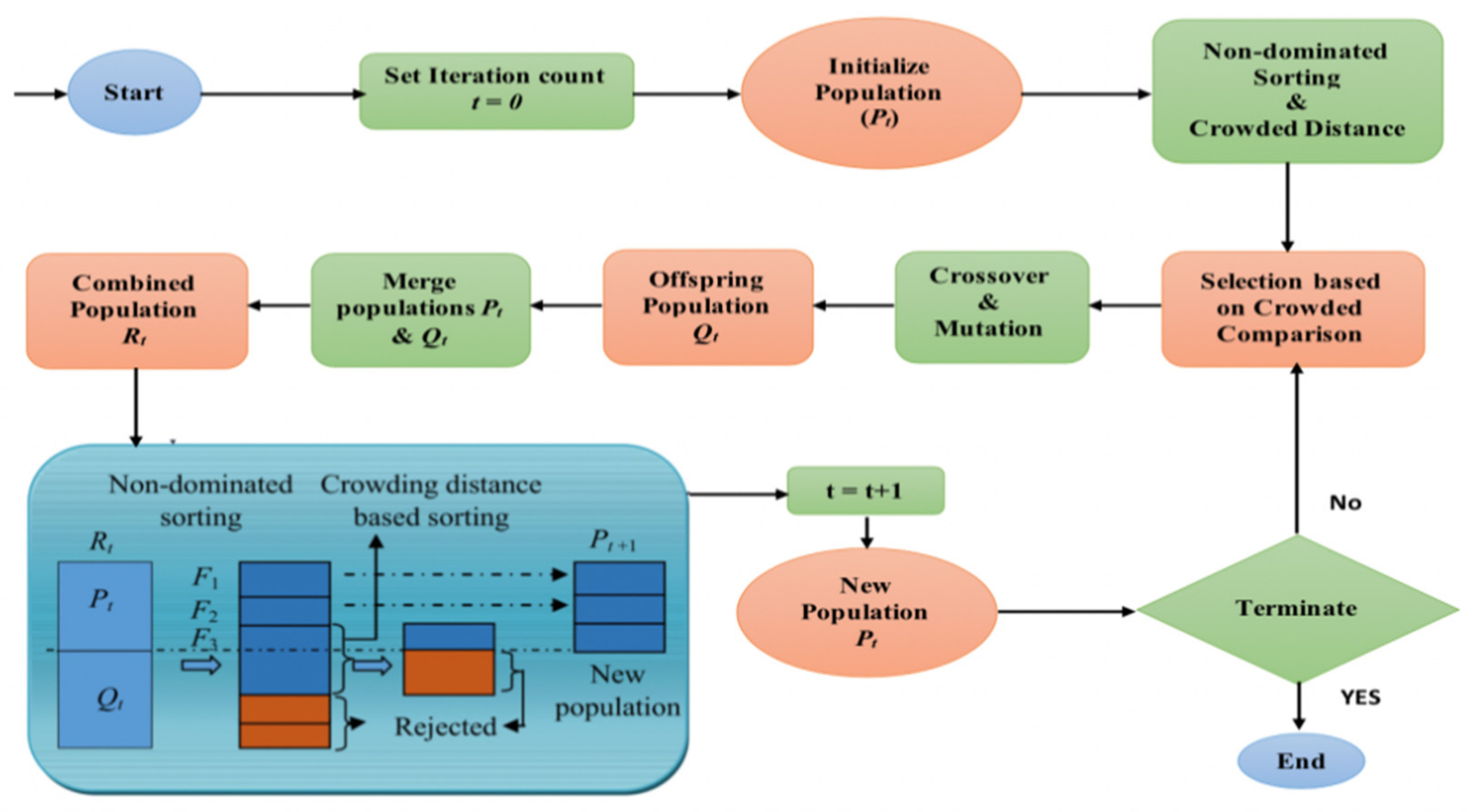
As shown in Figure 2, the proposed routing algorithm initially sets the maximum iteration count, and the population Pt of η solutions (chromosomes) is generated randomly. After initialization, the fitness values of all chromosomes are computed, i.e., the values of the overall distance traveled and longest route are computed using a cluster-first route-second approach [3,20]. Next, the population Pt is sorted and decomposed into Pareto fronts using a non-dominated sorting approach. Pareto fronts are groups of chromosomes based on the objective values. The first front ρ0 consists of the best chromosomes of the population, i.e., it consists of all non-dominated solutions whose fitness values are better than or equal to the remaining solutions. The next front ρ1 consists of all chromosomes which are dominated by the chromosomes of first from ρ0 but non-dominated with respect to all remaining chromosomes. The last front ρl-1 consists of all chromosomes dominated by all chromosomes in other fronts from ρ0 to ρl-2. After non-dominated sorting, another parameter, i.e., crowding distance, is assigned to all chromosomes in every front. In each front, the chromosome with a higher crowding distance is better than the chromosome with a lower crowding distance. The process of generating the offspring population Qt begins with the selection of two chromosomes from the current population Pt using their front numbers and crowding distances. Next, the GTBCX operator discussed in Section 4.3 is used on selected chromosomes to generate the two offspring chromosomes. As discussed in Section 4.4, the mutation operator is used to mutate the newly generated offspring chromosomes. To ensure elitism, the currently generated population Qt and the population Pt are combined to form a combined new population Rt. Next, the cluster-first, route-second method is employed to compute the fitness of all chromosomes in the combined population Rt. The population Rt is decomposed into Pareto fronts using non-dominated sorting, and the crowding distance is assigned to all chromosomes. For a new population Pt+1, the Pareto fronts from ρ0 to ρk are added one by one until the total number of chromosomes exceeds the population size η. To choose the chromosomes from the last front, all chromosomes are arranged in decreasing order of crowding distance, and the best chromosomes are selected to fill all population slots. The process of generating offspring population is repeated for the known number of generations (iterations).
Figure 2. Flowchart of NSGA-II.

4.2. Chromosome Initialization and Evaluation

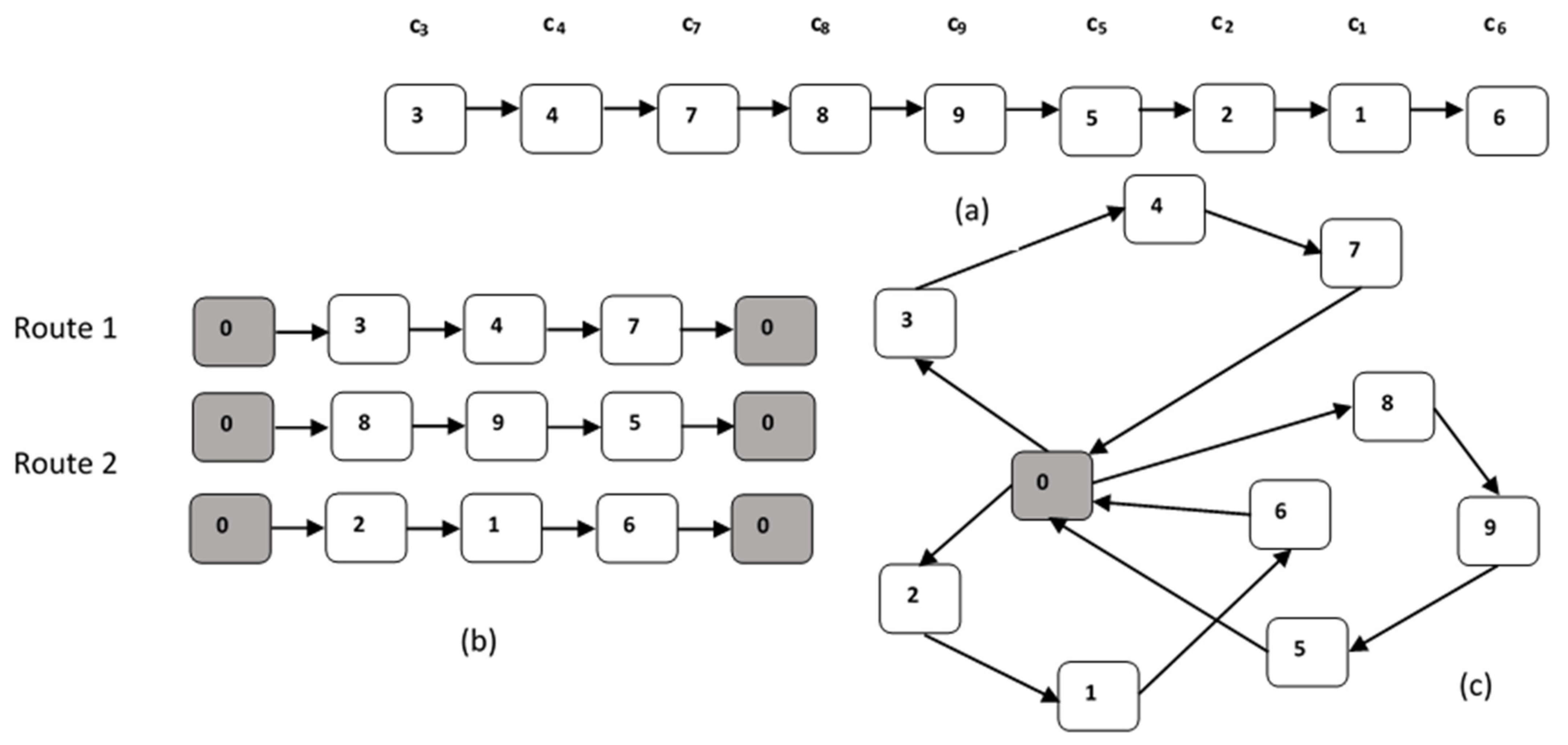
The population is initialized randomly, consisting of permutations of given customers. Each chromosome π is a random permutation of customers without trip delimiters which can be viewed as a giant tour (trip) intended for an unrestricted capacity vehicle. The total number of customers to be served is n; each chromosome π consists of a total of n genes corresponding to all given customers, and each customer appears just once in each chromosome. A typical chromosome π with nine customers representing a giant tour is shown in Figure 3a. The cluster-first, route-second method is utilized to split the giant tour into routes as per the capacity limit of vehicles, and it is followed by appending the central node 0 ( c 0 = 0 ), as depicted in Figure 3b. The corresponding graphical CVRP is given in Figure 3c.
Figure 3. (a) A random chromosome π. (b) Converting chromosome into routes. (c) Graphical CVRP.

4.3. Giant Tour Best Cost Crossover (GTBCX) Operator

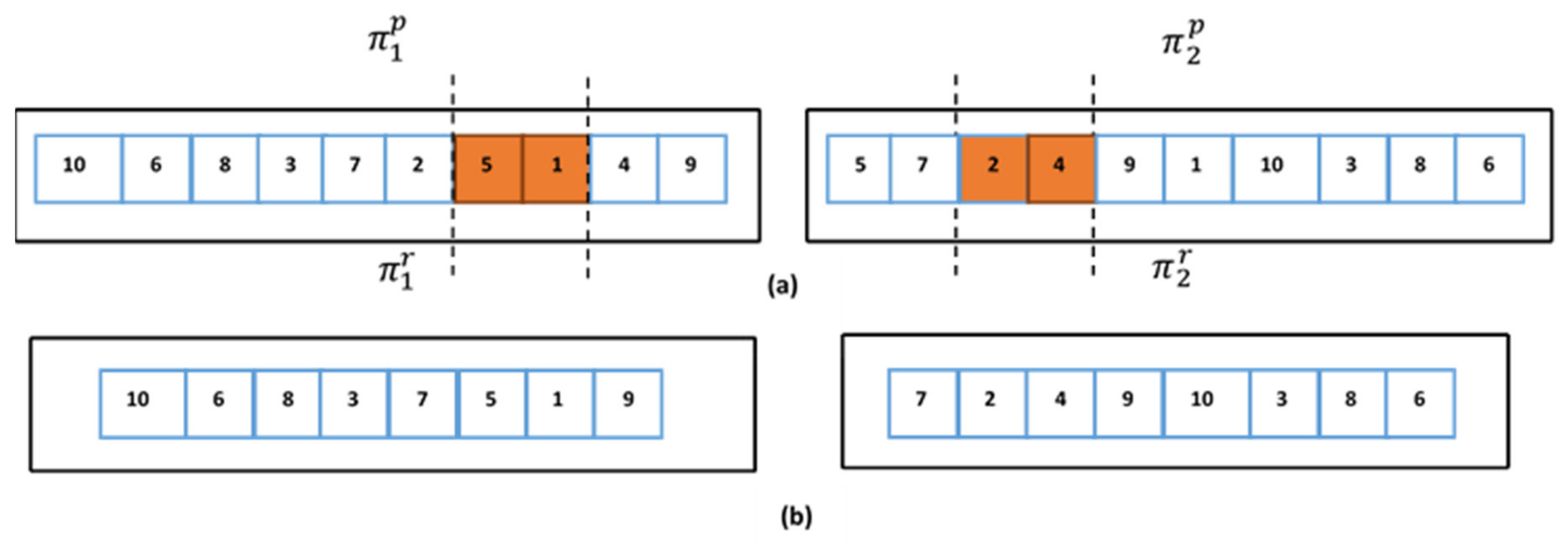
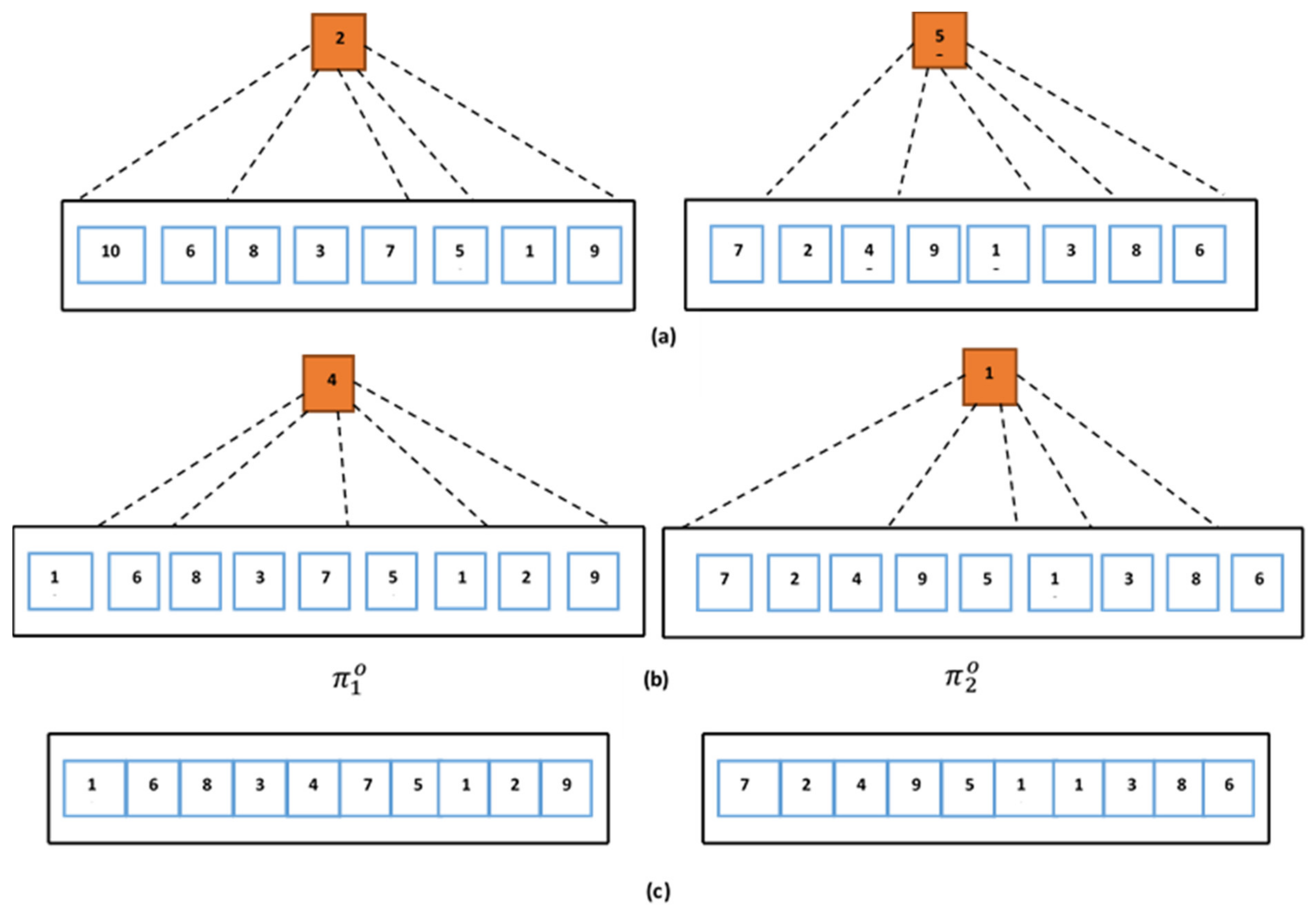
The basic idea behind the proposed giant tour best cost crossover (GTBCX) operator is that every customer must reach its global optimal position that results in the optimized total traveled distance as well as the longest route. This idea is inspired by the best cost route crossover (BCRC) [13]. The GTBCX and BCRC are different from each other, such that the former operator uses the crossover strategy without splitting the chromosome into routes, while the latter employs the crossover strategy after splitting the chromosome into routes. Therefore, GTBCX is less costly in comparison to the BCRC operator. The GTBCX operator carries forward the information from the parent chromosomes to generate the best possible offspring chromosomes, and this operator also ensures producing only feasible chromosomes. To generate two offspring chromosomes π 1   o and   π 2   o , two-parent chromosomes, π 1   p and π 2   p , are selected. Next, two consecutive customers are chosen from both parent chromosomes, π 1   p and π 2   p . The consecutive customers selected from π 1   p are removed from the other parent chromosome π 2   p , which leads to a partial giant tour π 2   r . Similarly, the consecutive customers selected from π 2   p are removed from the other parent chromosome π 1   p , which leads to the generation of a partial giant tour π 1   r . In both partial giant tours π 1   r and π 2   r , the removed customers can be inserted at n-1 positions, requiring high computational effort and ultimately a very high time complexity. In view of the time complexity, the removed customers are inserted stochastically at a constant number of positions out of all possible positions. To insert the customer, a stochastic integer k between 1 and n/2 is generated. Next, the customer is inserted at k random position in the partial chromosome, and the chromosome with the best value of total traveled distance as well as the longest route is chosen as offspring π 1   o . Similarly, the offspring π 2   o is also generated.
Figure 4 and Figure 5 show the process of generating two chromosomes (parent π 1   p and π 2   p ) using the GTBCX operator. As shown in Figure 4a, two chromosomes are selected using the eight-way tournament selection method, which is followed by the removal of two customers from both the parents as shown in Figure 4b. Next, the stochastic process is started to search the global optimal position for each removed customer. This process ensures that the GTBCX operator generates no infeasible solution. Moreover, it also searches the global position stochastically for the removed customers in constant time.
Figure 4. (a) Selected parent chromosomes π 1 p and π 2 p . (b) Partial chromosomes π 1 r and π 2 r .
Figure 5. (a) Insertion of first customer. (b) Insertion of second customer. (c) Offspring π 1 o and π 2 o .

4.4. Mutation Operator

To preserve the genetic diversity and to avoid the precipitate convergence or local optima, the mutation operator is used, which may be based on different operators depending on the problem. The proposed NSGA-II-based routing algorithm employs swap, exchange, and two-opt* operators stochastically to perform the mutation operation [3,20]. One of the three local operators is selected to perform the mutation according to the mutation probability. For given chromosome π , the swap, relocate, and two-opt* operators can be applied to compute the new chromosome π i as per Equations (12)–(14), respectively.
π 1 = π , π k = π l a n d π l = π k k ,   l   n
π 2 = π π k = π l ,   π k + 1 = π k , π k + 2 = π k + 1 ,   π l = π l 1 ,   k , l n
π 3 = π π k = π l ,   π k + 1 = π l + 1 π k + p = π l + p ;   π l = π k ,   π l + 1 = π k + 1 π l + q = π k + q f o r k , l , p , q   n
where π i represents the customer at ith index.

5. Simulation Study

The simulation study is devoted to assessing the competence of the proposed NSGA-II-based routing algorithm with GTBCX operator. The proposed routing algorithm optimizes two objectives, i.e., the overall travelled distance by all vehicles and the length of the longest route. The solutions offered by the routing algorithm are based on the trade-off between the two objectives and are represented by non-dominated and dominated solutions in the form of Pareto solutions. A solution π 1 dominates π 2 if and only if the solution π 1 is no inferior in comparison to π 2 in all objective values and solution π 1 is strictly better than π 2 in no less than one objective value. To evaluate the performance, three versions of NSGA-II based on three different crossover operators, i.e., NSGA-II_NNX, NSGA-II_GTBCX, and NSGA-II_EAX, were employed. The NSGA-II_NNX, NSGA-II_GTBCX, and NSGA-II_EAX utilize nearest-neighbour crossover (NNX), giant tour best cost route crossover (GTBCX), and edge assembly crossover (EAX) operators, respectively. The EAX operator was proposed by Y. Nagata [21], while the NNX operator is a greedy crossover operator that works based on nearest neighbour heuristics [3,20]. The three versions of NSGA-II were developed using Python 3.9.6 on DESKTOP-L9O54PJ, Intel(R) Core™ i7-8700, Windows-10.
The 88 benchmark CVRP instances from five sets, i.e., sets A, B, P, F, and E, were utilized for the simulation study. Augerat et al. proposed the sets A, B, and P, while set E and set F were proposed by Christofides and Eilon and Fisher, respectively [50]. Table 1 presents the basic information of all sets. Sets A, B, P, E, and F consist of 27, 23, 24, 11, and 3 CVRP instances, respectively. In each set, the CVRP instances are different according to the locations of customers and their demands. The minimum and maximum demands, as well as the distances of the nearest customer and the farthest customer from the central depot, are also given in Table 1. Table 2 shows the system parameters which were used for the simulation study. For every instance, the population of 200 random chromosomes was created using the Numerical Python (NumPy) library. Every chromosome was a random permutation of customers given in the CVRP instance.
Table 1. CVRP instances with demands and distances.
Table 2. System parameters.
All three versions of NSGA-II were fed with the same initial population, and they evolved over 200 generations to search near-optimal solutions with optimum values of the total travelled distance and the length of the longest route. For every CVRP instance, 10 experiments were conducted using the same population, and the best values for both objectives are reported in this paper. The values of both the objectives are also shown for 200 generations offered by NSGA-II_NNX, NSGA-II_GTBCX, and NSGA-II_EAX. All figures of vehicle routes given in this paper correspond to the best solutions among 10 experiments for all three versions of NSGA-II. For each set, the graphical results for one CVRP instance are presented, and the results offered corresponding to the remaining CVRP instances are presented in the tabular form.
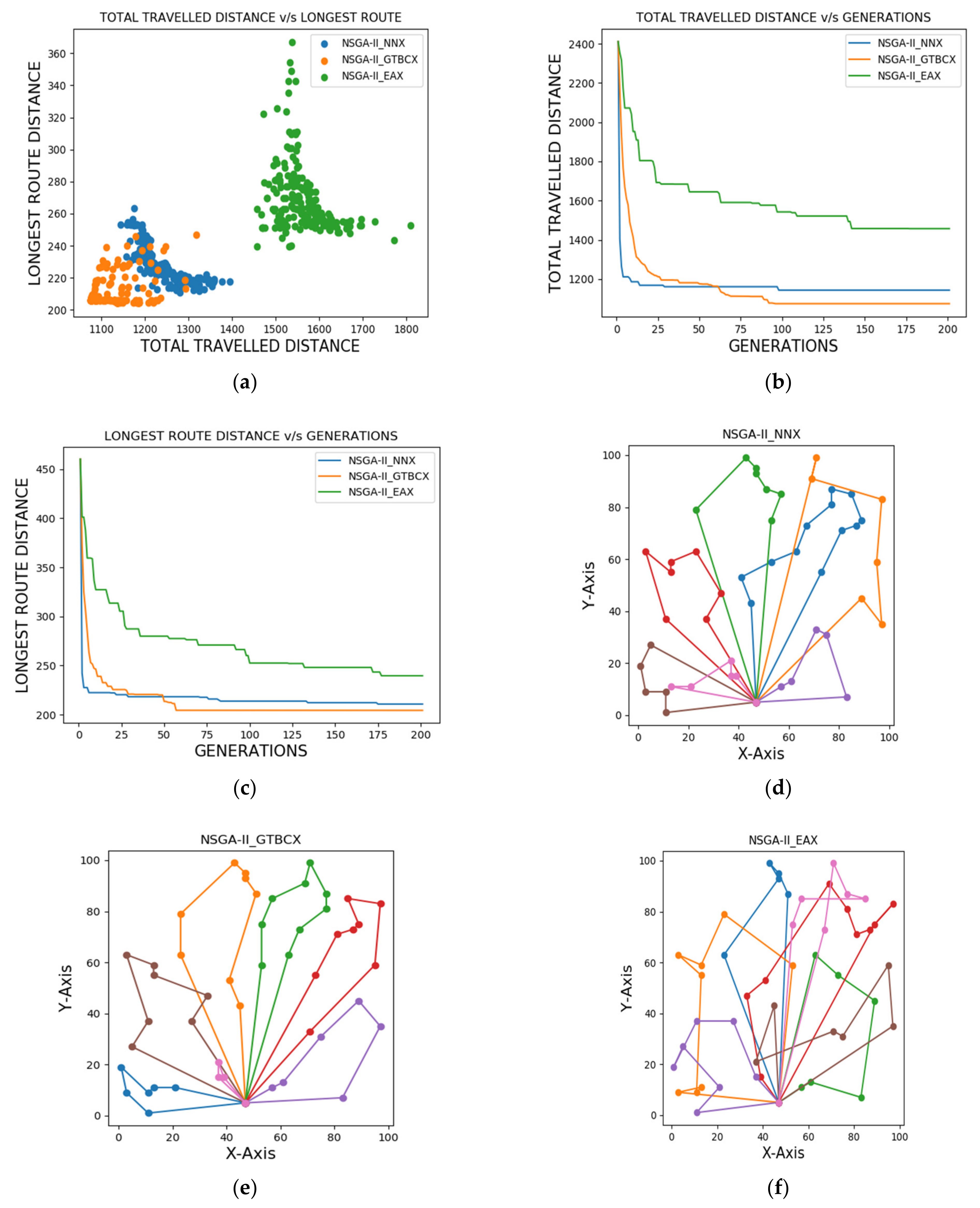
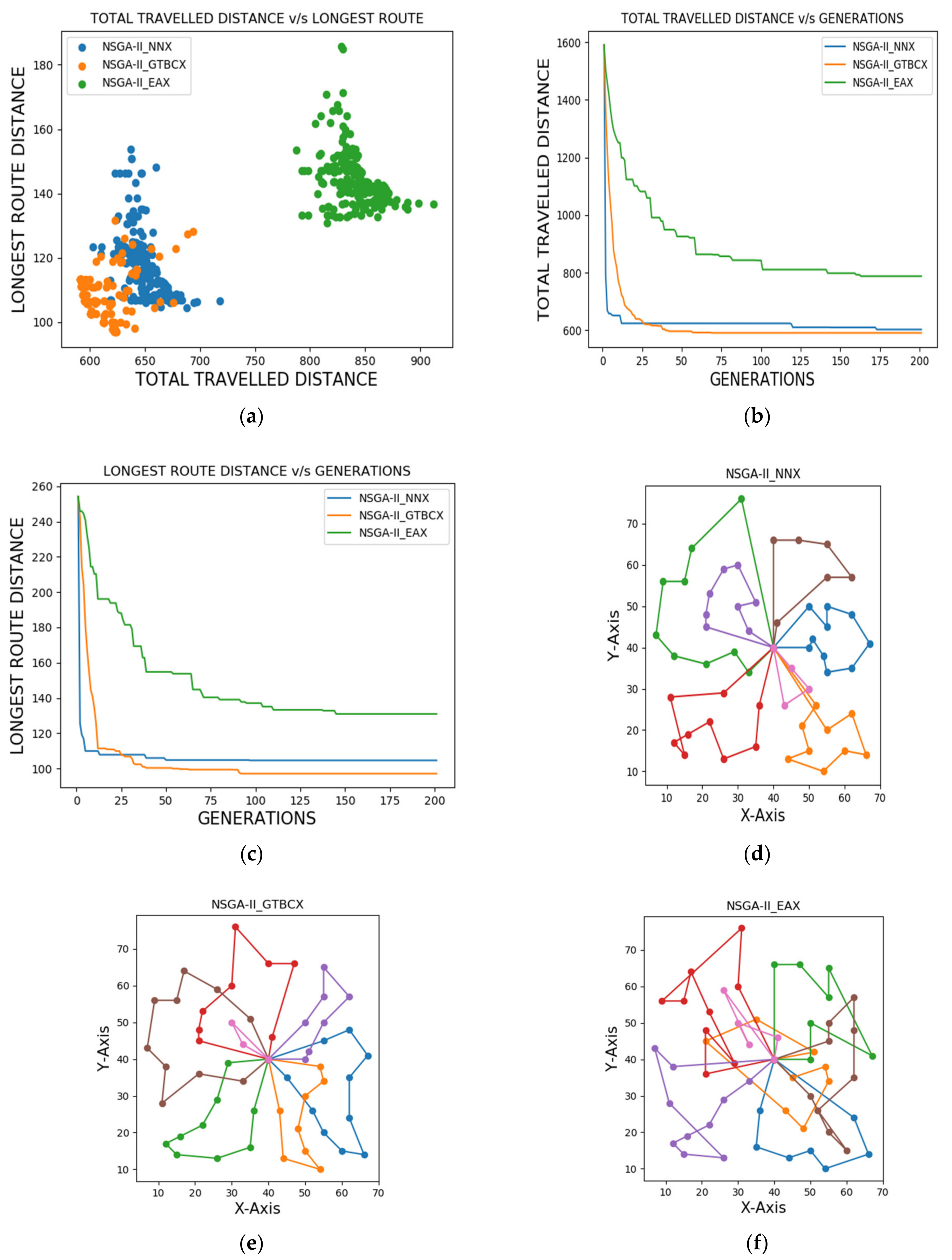
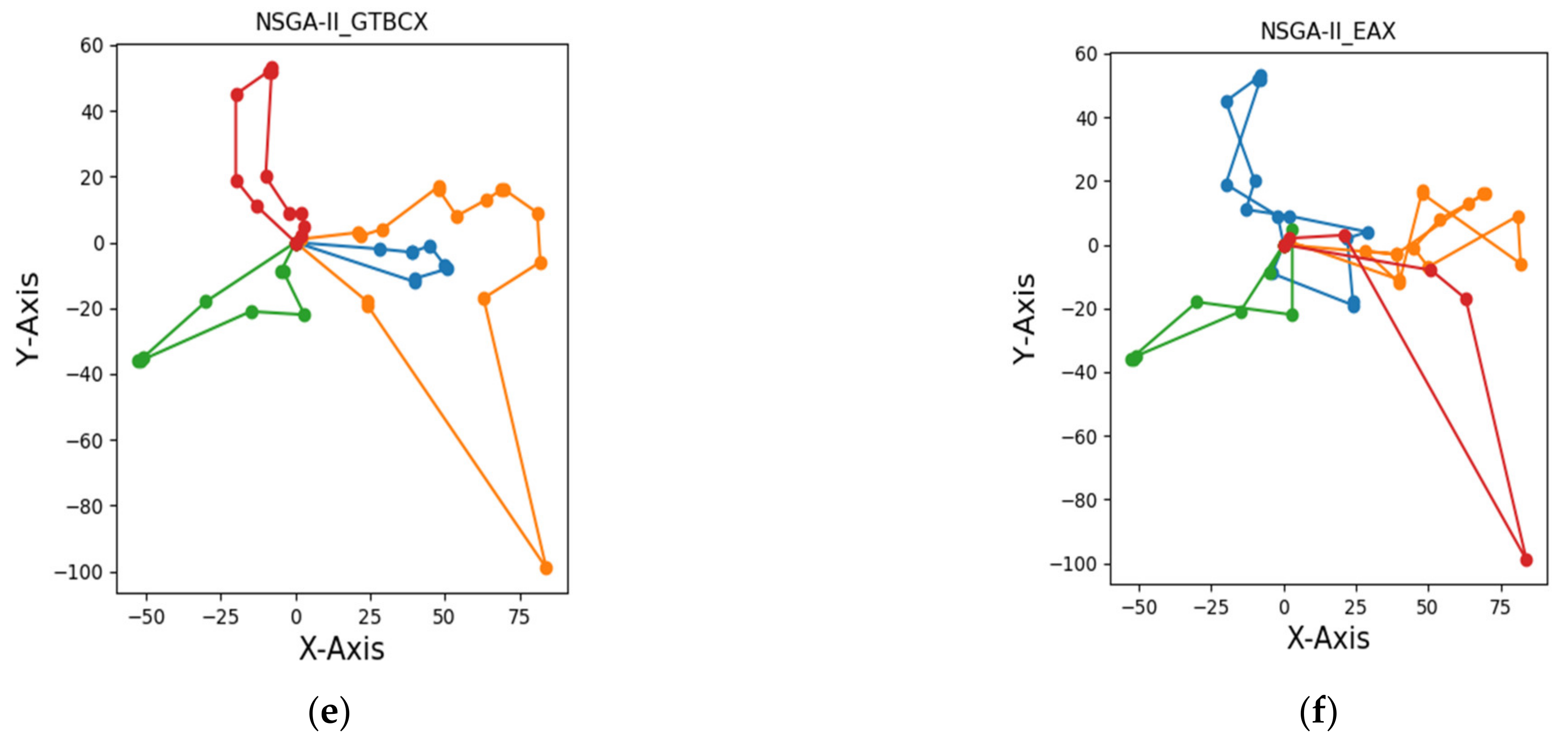
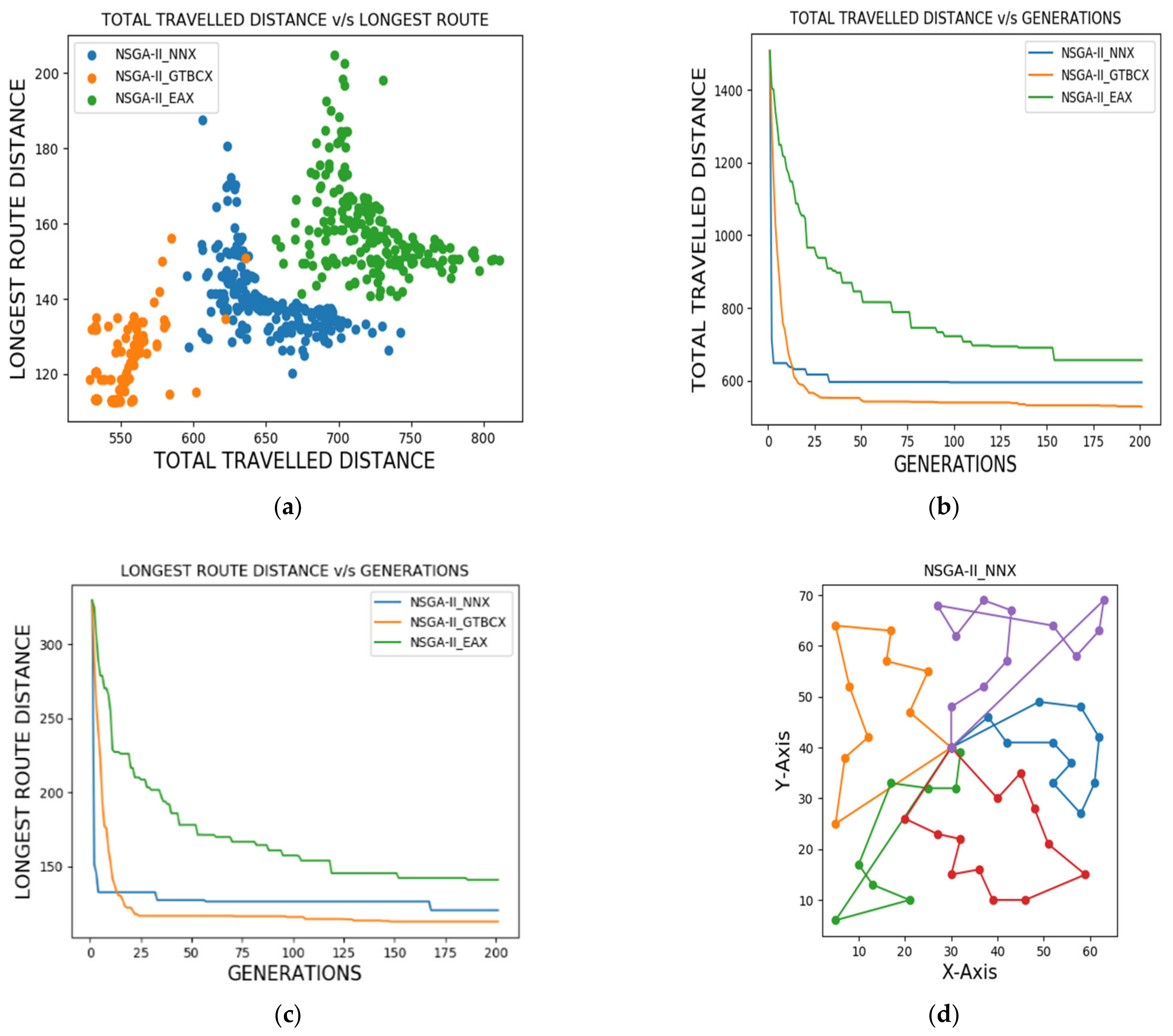
For CVRP instance A-n48-k7, Figure 6a shows the Pareto solutions offered by NSGA-II_NNX, NSGA-II_GTBCX, and NSGA-II_EAX. All Pareto solutions offered by NSGA-II_GTBCX dominate all Pareto solutions offered by NSGA-II_EAX. However, there are very few solutions offered by NSGA-II_NNX that dominate the worst Pareto solutions offered by the proposed NSGA-II_GTBCX. However, there are some solutions offered by the proposed NSGA-II_GTBCX that completely dominate all solutions of NSGA-II_NNX. Figure 6b,c show the total travelled distance and the length of the longest route for 200 generations, and it can be observed that NSGA-II_GTBCX offers better values of both objectives. The best routes offered by NSGA-II_NNX, NSGA-II_GTBCX, and NSGA-II_EAX are depicted in Figure 6d–f, respectively.
Figure 6. Optimized Outcome for instance A-n48-k7 after 200 iterations. (a) Pareto solutions; (b,c) total travelled distance and length of the longest route; (d) NSGA-II_NNX route; (e) NGSA-II_GTBCX route; (f) NSGA-II_EAX route.
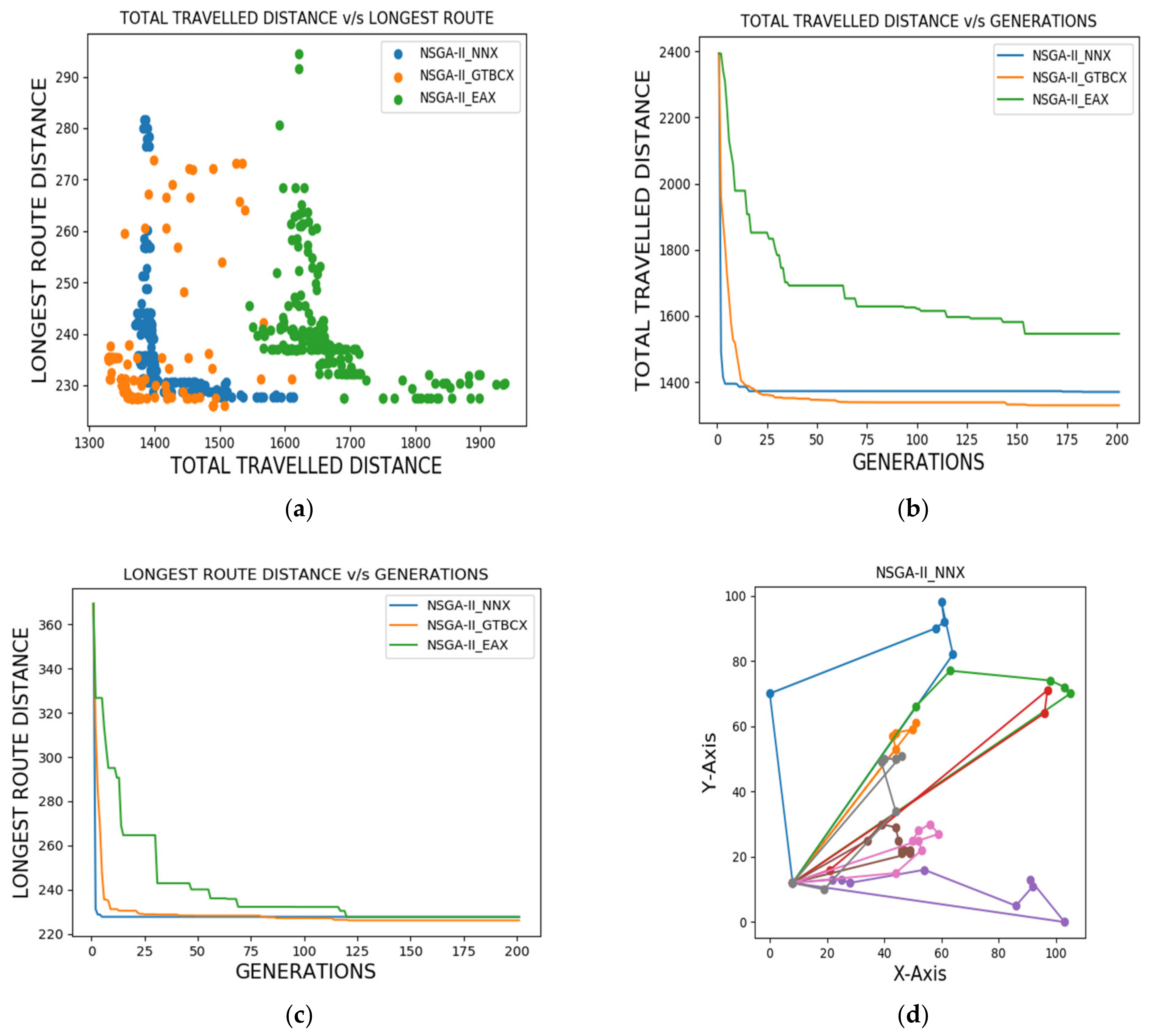
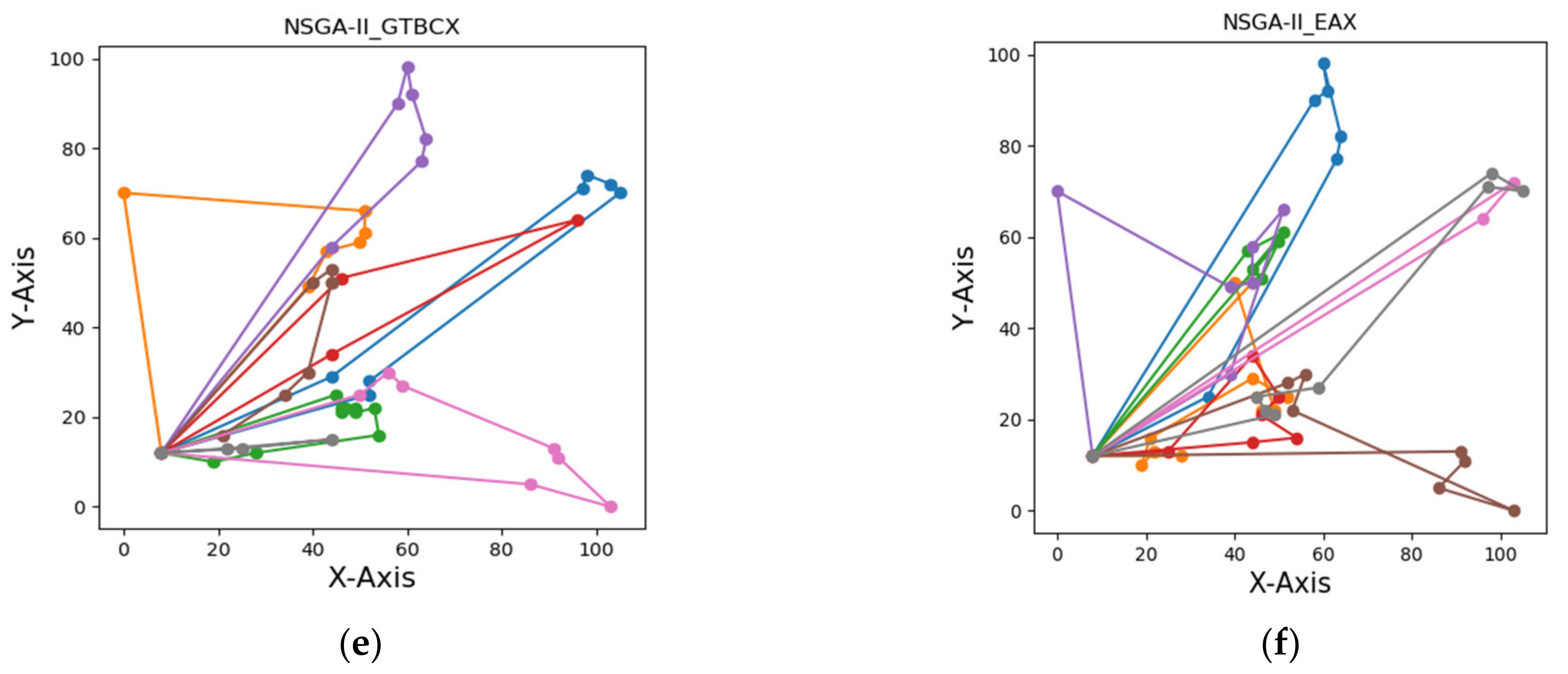
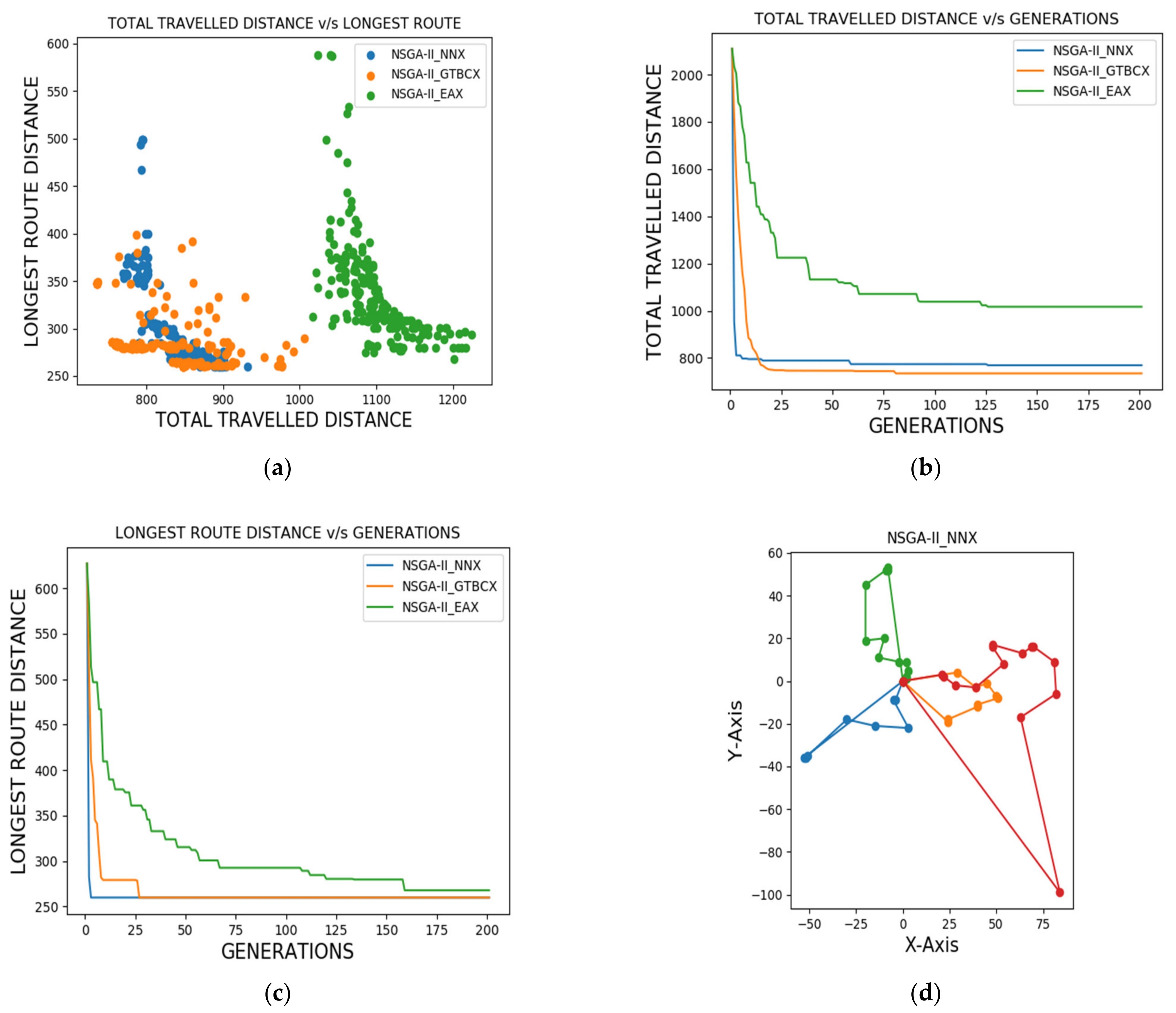
As can be observed, the overlapping of routes is minimal in the best solution provided by NSGA-II_GTBCX, while overlapping is maximal in the best solution given by NSGA-II_EAX. For CVRP instance A-n48-k7, the total travelled distances offered by NSGA-II_NNX, NSGA-II_GTBCX, and NSGA-II_EAX are 1431, 1074, and 1144, respectively. The lengths of the longest routes offered by the three versions are 210, 204, and 243, respectively. The NSGA-II_GTBCX offers the best values among the three versions of NSGA-II. However, the distance travelled for the best-known solution is 1073, but this solution is optimized in the context of the single objective optimization method, which does not consider the other objectives. Figure 7 shows the solutions offered by NSGA-II_NNX, NSGA-II_GTBCX, and NSGA-II_EAX for CVRP instance P-n55-k7. As depicted by Figure 7a, all Pareto solutions offered by NSGA-II_GTBCX completely dominate all solutions offered by NSGA-II_EAX. On the other hand, some Pareto solutions of NSGA-II_GTBCX completely dominate all the solutions of NSGA-II_NNX while there are very few solutions of NSGA-II_NNX which dominate the worst Pareto solutions offered by NSGA-II_GTBCX. Figure 7b,c show the total travelled distance and the route with the largest distance after 200 generations, and it can be observed that NSGA-II_GTBCX offers better values for both objectives. Figure 7d–f depict the best routes offered by NSGA-II_NNX, NSGA-II_GTBCX, and NSGA-II_EAX, respectively.
Figure 7. Optimized outcome for instance P-n55-k7 after 200 iterations. (a) Pareto solutions; (b,c) total travelled distance and length of the longest route; (d) NSGA-II_NNX route; (e) NGSA-II_GTBCX route; (f) NSGA-II_EAX route.
As can be observed, the overlapping of routes is minimal in the best solution given by NSGA-II_GTBCX, while it is maximal in the best solution provided by NSGA-II_EAX. For the CVRP instance P-n55-k7, NSGA-II_NNX, NSGA-II_GTBCX, and NSGA-II_EAX offered total travelled distances of 606, 579, and 796, respectively.
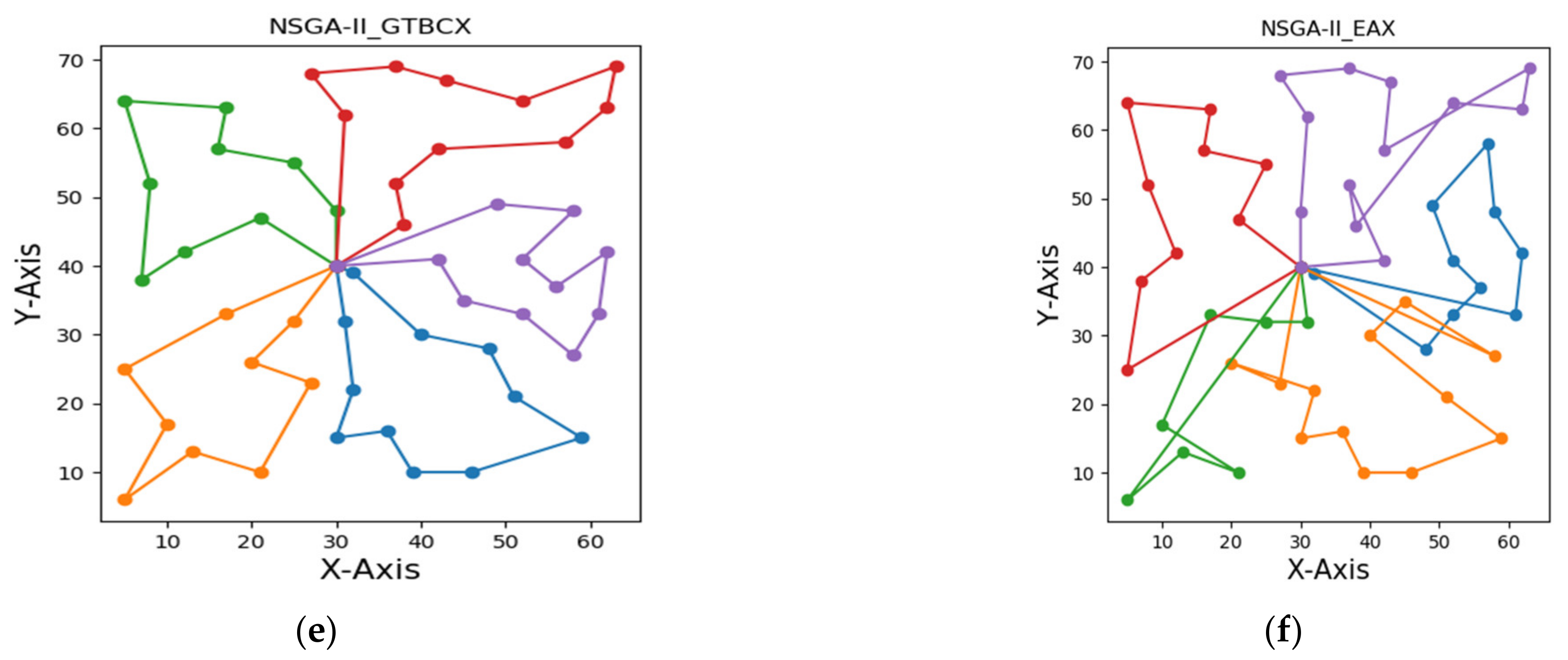
However, the lengths of the longest routes offered by the three versions are 105, 99, and 134, respectively. For CVRP instances B-n50-k8, E-n51-k5, and F-n45-k4, the solutions offered by NSGA-II_NNX, NSGA-II_GTBCX, and NSGA-II_EAX are provided in Figure 8, Figure 9 and Figure 10, respectively, and it can be seen that the behaviour of these three versions of NSGA-II for the three CVRP instances is almost similar as for the CVRP instances A-n48-k7 and P-n55-k7. As observed from Figure 8a, Figure 9a, Figure 10a, the Pareto solutions offered by NSGA-II_NNX and NSGA-II_GTBCX dominate the maximum Pareto solutions offered by NSGA-II_EAX. However, some of the worst Pareto solutions offered by NSGA-II_GTBCX are dominated by the best solutions offered by NSGA-II_NNX. For the total travelled distance and the length of the longest route, NSGA-II_GTBCX consistently offers better values of both objectives in comparison to NSGA-II_NNX and NSGA-II_EAX. The route overlapping is minimal in the best solution provided by NSGA-II_GTBCX, while it is maximal in the best solution given by NSGA-II_EAX.
Figure 8. Optimized outcome for instance B-n50-k8 after 200 iterations. (a) Pareto solutions; (b,c) total travelled distance and length of the longest route; (d) NSGA-II_NNX route; (e) NGSA-II_GTBCX route; (f) NSGA-II_EAX route.
Figure 9. Optimized outcome for instance E-n51-k5 after 200 iterations. (a) Pareto solutions; (b,c) total traveled distance and length of the longest route; (d) NSGA-II_NNX route; (e) NGSA-II_GTBCX route; (f) NSGA-II_eax Route.
Figure 10. Optimized outcome for instance F-n45-k4 after 200 iterations. (a) Pareto solutions; (b,c) total traveled distance and length of the longest route; (d) NSGA-II_NNX route; (e) NGSA-II_GTBCX route; (f) NSGA-II_EAX route.
The results for all remaining CVRP instances are given in Table 3, Table 4, Table 5, Table 6 and Table 7. In the tables, the best results are marked with a burgundy colour. As regards the results provided in Table 3, the performance order for all CVRP instances of set A is given as NSGA-II_GTBCX, NSGA-II_NNX, and NSGA-II_EAX. The NSGA-II_GTBCX offers optimized values of total travelled distance and longest distance. However, NSGA-II_NNX offers better values of the longest route for five CVRP instances, such as A-n45-k6, A-n55-k9,A-n63-k9, A-n63-k10, and A-n65-k9. However, NSGA-II_GTBCX offers better values of the total travelled distances for all CVRP instances in comparison to NSGA-II-NNX and NSGA-II_EAX. The value of the total travelled distance of the best-known solution is slightly better than the values of Pareto solutions offered by NSGA-II_BCX. The reason for this is that NSGA-II_GTBCX searches for a solution that optimizes two objectives, i.e., total travelled distance and the length of the longest route. As regards the results provided in Table 4 for set B, NSGA-II_GTBCX performs better among the three versions of NSGA-II. The performance order for set B is given as NSGA-II_GTBCX, NSGA-II_NNX and NSGA-II_EAX. However, NSGA-II_NNX offers better values of the longest distance for five CVRP instances, i.e., B-n41-k6, B-n43-k6, B-n51-k7, B-n52-k7, and B-n67-k10. As regards the results provided in Table 5 for set P, NSGA-II_GTBCX is the best performer among the three versions of NSGA-II. The performance order for set P also remains as NSGA-II_GTBCX, NSGA-II_NNX, and NSGA-II_EAX. The NSGA-II_NNX offers a better value of the total travelled distance for CVRP instance P-n55-10 and the longest distance for CVRP instance P-n20-k2. The results for sets E and F are given in Table 6 and Table 7, respectively. The NSGA-II_GTBCX performs best among the three versions of NSGA-II. The performance order for sets E and F for all instances remains NSGA-II_GTBCX, NSGA-II_NNX, and NSGA-II_EAX. However, the NSGA-II_NNX offers a better value of the longest route length than NSGA-II_GTBCX and NSGA-II_EAX.
Table 3. The outcome for set A.
Table 4. The outcome for set B.
Table 5. The outcome for set P.
Table 6. The outcome for set E.
Table 7. The outcome for set F.
The overall observations and future research directions are as follows:
  • For all sets, A, B, P, E, and F, the overall performance order from best to worst is given as NSGA-II_GTBCX, NSGA-II_NNX, and NSGA-II_EAX. Pareto solutions offered by NSGA-II_GTBCX dominates all Pareto solutions offered by NSGA-II_EAX. However, there are very few solutions offered by NSGA-II_NNX that dominate the worst Pareto solutions offered by NSGA-II_GTBCX. However, there are some solutions offered by NSGA-II_GTBCX that completely dominate all solutions of NSGA-II_NNX. For most CVRP instances, NSGA-II_GTBCX offered the total traveled distance close to the best-known solution. However, the value of the best-known solution is offered by the single objective optimization method, which does not consider the other objectives. This shows that the proposed GTBCX operator is superior to the NNX and EAX operators in the context of CVRP.
  • Since the minimal overlapping of routes leads to a better quality of solutions and helps provide better values of total traveled distance and the longest route. The overlapping of routes is minimal in the best Pareto solution offered by NSGA-II_GTBCX, while it is maximal in the best solution offered by NSGA-II_EAX. This shows that NSGA-II_GTBCX is a better performer in comparison to NSGA-II_NNX and NSGA-II_EAX.
  • As the proposed NSGA-II-based routing algorithm offers solutions with a trade-off between the overall distance traveled and the route with the longest length, the user can employ different solutions to meet their requirements.
  • It is also observed that the quality of the final solutions is affected by the quality of initial solutions. Intelligent heuristics can be developed to generate good initial solutions.
  • The duplicate solutions are also observed during the evolution process, and therefore, intelligent heuristics can be developed to deal with duplicate solutions.
  • It is also observed from the simulation study that the order of time complexity from best to worst is given as NSGA-II_NNX, NSGA-II_EAX, and NSGA-II_GTBCX. To reduce the time overheads of NSGA-II_GTBCX, the quantum-inspired algorithm can also be applied.
  • The proposed multi-objective algorithms can also be extended for different CVRP variants, i.e., CVRP with time windows, drones, multiple depots, multiple/many echelons, split deliveries, and others.
  • Cloud computing and vehicles linked through the Internet of Things can also be used for the execution of the proposed NSGA-II-based routing algorithm [51].
  • The crossover and mutation probabilities can also be learned using reinforcement learning algorithms (SARSA, Q-Learning) and another machine learning algorithms [52,53].
  • The concept of blockchain can also be incorporated in the proposed algorithm for making decisions based on trustworthy data across the transportation and logistics ecosystem.

6. Conclusions

This work proposes a giant tour best cost crossover (GTBCX) operator for capacitated vehicle routing problems (CVRP). An NSGA-II-based routing algorithm employing GTBCX is also proposed for solving the CVRP to optimize two objective values, i.e., the overall distance travelled by the given fleet of vehicles and the length of the longest route. The GTBCX employs the crossover strategy without splitting the chromosome, in comparison to other existing crossover operators that employ the crossover strategy after splitting the chromosome into routes. The GTBCX operator also avoids the generation of infeasible solutions and offers better objective values, and speed-up the convergence. The mutation operator works based on three local search operators, i.e., swap, two-opt*, and relocation, and selects one of the three stochastically to mutate the chromosome. The three versions of NSGA-II employing different crossover operators, i.e., NSGA-II_GTBCX with GTBCX, NSGA-II_NNX with nearest neighbor crossover (NNX), and NSGA-II_EAX with edge assembly crossover (EAX) operators, were compared using 88 benchmark CVRP instances. The extensive simulation study confirms that the overall performance order from the best to worst is NSGA-II_GTBCX, NSGA-II_NNX, and NSGA-II_EAX. The NSGA-II_GTBCX algorithm offers better results for the maximum number of CVRP instances. The simulation study shows that the GTBCX is a powerful operator and helps to search for better solutions in terms of the overall distance traveled, length of the longest route, and number, as well as the quality of Pareto optimal solutions.
The proposed routing algorithm can also be adopted for different CVRP variants, such as CVRPs with drones, time windows, multiple depots, many echelons, split deliveries, etc. A parallel version can also be designed for cloud computing in the context of the Internet of Vehicles (IoT). The proposed algorithm can also be extended with a resource consumption view, i.e., resource-aware vehicle routing algorithm that consume minimum resources in order to generate routes for large VRPs. The crossover and mutation probabilities can also be learned using reinforcement learning algorithms to improve the effectiveness.

Author Contributions

Investigation, V.V., M.S. and K.K.; methodology, M.S. and K.K.; writing—original draft, M.S., J.S., R.A.H., M.P., K.K. and D.G.; writing—review and editing, D.G. All authors have read and agreed to the published version of the manuscript.

Funding

This research received no external funding.

Institutional Review Board Statement

Not applicable.

Data Availability Statement

https://neo.lcc.uma.es/vrp/ (accessed on 15 August 2021).

Conflicts of Interest

The authors declare no conflict of interest.

References

  1. Liu, S.C.; Zhang, Y.F.; Liu, Y.; Wang, L.H.; Wang, X.V. An Internet of Things enabled dynamic optimization method for smart vehicles and logistics tasks. J. Clean Prod. 2019, 215, 806–820. [Google Scholar] [CrossRef] [Green Version]
  2. Liu, X.; Liu, Y.X.; Xiong, N.N.; Zhang, N.; Liu, A.F.; Shen, H.L.; Huang, C.Q. Construction of large-scale, low-cost delivery infrastructure using vehicular networks. IEEE Access 2018, 6, 21482–21497. [Google Scholar] [CrossRef]
  3. Toth, P.; Vigo, D. Vehicle Routing: Problems, Methods, and Applications, 2nd ed.; Society for Industrial and Applied Mathematics: Philadelphia, PA, USA, 2015; pp. 1–33. [Google Scholar]
  4. Goudarzi, S.; Kama, N.; Anisi, M.H.; Zeadally, S.; Mumtaz, S. Data collection using unmanned aerial vehicles for Internet of Things platforms. Comput. Electr. Eng. 2019, 75, 1–15. [Google Scholar] [CrossRef]
  5. Yao, Y.; Zhang, Y.; Tian, L.; Zhou, N.; Li, Z.; Wang, M. Analysis of Network Structure of Urban Bike-Sharing System: A Case Study Based on Real-Time Data of a Public Bicycle System. Sustainability 2019, 11, 5425. [Google Scholar] [CrossRef] [Green Version]
  6. Rahman, M.A.; Hossain, A.-A.; Debnath, B.; Zefat, Z.M.; Morshed, M.S.; Adnan, Z.H. Intelligent Vehicle Scheduling and Routing for a Chain of Retail Stores: A Case Study of Dhaka, Bangladesh. Logistics 2021, 5, 63. [Google Scholar] [CrossRef]
  7. Khan, S.I.; Qadir, Z.; Munawar, H.S.; Nayak, S.R.; Budati, A.K.; Verma, K.D.; Prakash, D. UAVs path planning architecture for effective medical emergency response in future networks. Phys. Commun. 2021, 47, 101337. [Google Scholar] [CrossRef]
  8. He, P.; Li, J. The two-echelon multi-trip vehicle routing problem with dynamic satellites for crop harvesting and transportation. Appl. Soft Comput. 2019, 77, 387–398. [Google Scholar] [CrossRef]
  9. Sabar, N.R.; Bhaskar, A.; Chung, E.; Turky, A.; Song, A. A self-adaptive evolutionary algorithm for dynamic vehicle routing problems with traffic congestion. Swarm Evol. Comput. 2019, 44, 1018–1027. [Google Scholar] [CrossRef]
  10. Potvin, J.Y. State-of-the Art Review—Evolutionary Algorithms for Vehicle Routing. INFORMS J. Comput. 2009, 21, 518–548. [Google Scholar] [CrossRef]
  11. Demir, E.; Huckle, K.; Syntetos, A.; Lahy, A.; Wilson, M. Vehicle Routing Problem: Past and Future. In Contemporary Operations and Logistics: Achieving Excellence in Turbulent Times; Wells, P., Ed.; Springer International Publishing: Cham, Switzerland, 2019; pp. 97–117. [Google Scholar]
  12. Rabbouch, B.; Saâdaoui, F.; Mraihi, F.R. Empirical-type simulated annealing for solving the capacitated vehicle routing problem. J. Exp. Theor. Artif. Intell. 2020, 32, 437–452. [Google Scholar] [CrossRef]
  13. Lin, N.; Shi, Y.; Zhang, T.; Wang, X. An effective order-aware hybrid genetic algorithm for capacitated vehicle routing problems in Internet of Things. IEEE Access 2019, 7, 86102–86114. [Google Scholar] [CrossRef]
  14. Altabeeb, A.M.; Mohsen, A.M.; Ghallab, A. An improved hybrid firefly algorithm for capacitated vehicle routing problem. Appl. Soft Comput. 2019, 84, 105728. [Google Scholar] [CrossRef]
  15. Saini, N.; Saha, S. Multi-objective optimization techniques: A survey of the state-of-the-art and applications. Eur. Phys. J. Spec. Top. 2021, 230, 2319–2335. [Google Scholar] [CrossRef]
  16. Sajid, M.; Raza, Z. Energy-efficient quantum-inspired stochastic Q-HypE algorithm for batch-of-stochastic-tasks on heterogeneous DVFS-enabled processors. Concurr. Comput. Pract. Exp. 2019, 31, e5327. [Google Scholar] [CrossRef]
  17. Sajid, M.; Raza, Z. Energy-Aware Stochastic Scheduler for Batch of Precedence-constrained Jobs on Heterogeneous Computing System. Energy 2017, 125, 258–274. [Google Scholar] [CrossRef]
  18. Deb, K.; Pratap, A.; Aggarwal, S.; Meyarivan, T. A fast elitist multi-objective genetic algorithm: NSGA-II. IEEE Trans. Evol. Comput. 2002, 6, 182–197. [Google Scholar] [CrossRef] [Green Version]
  19. Hassanat, A.; Almohammadi, K.; Alkafaween, E.; Abunawas, E.; Hammouri, A.; Prasath, V.B.S. Choosing Mutation and Crossover Ratios for Genetic Algorithms—A Review with a New Dynamic Approach. Information 2019, 10, 390. [Google Scholar] [CrossRef] [Green Version]
  20. Sajid, M.; Zafar, A.; Sharma, S. Hybrid Genetic and Simulated Annealing Algorithm for Capacitated Vehicle Routing Problem. In Proceedings of the 6th IEEE International Conference on Parallel, Distributed and Grid Computing (PDGC), JUIT Solan, India, 6–8 November 2020; pp. 131–136. [Google Scholar]
  21. Nagata, Y. Edge Assembly Crossover for the Capacitated Vehicle Routing Problem. In Evolutionary Computation in Combinatorial Optimization (EvoCOP 2007); Lecture Notes in Computer Science; Springer: Berlin/Heidelberg, Germany, 2007; Volume 4446. [Google Scholar]
  22. Whizzkids ‘96. 1996. Available online: http://www.win.tue.nl/whizzkids/1996/index.html (accessed on 29 September 2021).
  23. Applegate, D.; Cook, W.; Dash, S.; Rohe, A. Solution of a min-max vehicle routing problem. INFORMS J. on Comput. 2002, 14, 132–143. [Google Scholar] [CrossRef] [Green Version]
  24. Ren, C. Fast Taboo Search Algorithm for Solving Min-Max Vehicle Routing Problem. In Information and Management Engineering; Zhu, M., Ed.; Communications in Computer and Information Science; Springer: Berlin/Heidelberg, Germany, 2011; Volume 236. [Google Scholar]
  25. Ren, C. Solving Min-Max Vehicle Routing Problem. J. Syst. Softw. 2011, 6, 1851–1856. [Google Scholar] [CrossRef]
  26. Ren, C. New Genetic Algorithm for Min-Max Vehicle Routing Problem. In Information and Business Intelligence; Qu, X., Yang, Y., Eds.; Communications in Computer and Information Science; Springer: Berlin/Heidelberg, Germany, 2012; Volume 268. [Google Scholar]
  27. Bertazzi, L.; Golden, B.; Wang, V. Min-Max vs. Min-Sum Vehicle Routing: A Worst-Case Analysis. Eur. J. Oper. Res. 2015, 240, 372–381. [Google Scholar] [CrossRef]
  28. Yakıcı, E.; Karasakal, O. A min–max vehicle routing problem with split delivery and heterogeneous demand. Optim Lett. 2013, 7, 1611–1625. [Google Scholar] [CrossRef]
  29. Yakici, E. A Heuristic Approach for Solving a Rich Min-max Vehicle Routing Problem with Mixed Fleet and Mixed Demand. Comput. Ind. Eng. 2017, 109, 288–294. [Google Scholar] [CrossRef]
  30. Son, N.V.; Dung, P.Q.; Trung, B.Q.; Hoang, N.T. Solving Min-Max Capacitated Vehicle Routing Problem by Local Search. J. Comput. Sci. Cyber. 2017, 33, 3–18. [Google Scholar]
  31. Bahri, O.; Amor, N.B.; Talbi, E. Robust Routes for the Fuzzy Multi-objective Vehicle Routing Problem. IFAC Pap. OnLine 2016, 49, 769–774. [Google Scholar] [CrossRef]
  32. Konstantakopoulos, G.D.; Gayialis, S.P.; Kechagias, E.P.; Papadopoulos, G.A.; Tatsiopoulos, I.P. A Multiobjective Large Neighborhood Search Metaheuristic for the Vehicle Routing Problem with Time Windows. Algorithms 2020, 13, 243. [Google Scholar] [CrossRef]
  33. Fava, L.P.; Furtado, J.C.; Helfer, G.A.; Barbosa, J.L.V.; Beko, M.; Correia, S.D.; Leithardt, V.R.Q. A Multi-Start Algorithm for Solving the Capacitated Vehicle Routing Problem with Two-Dimensional Loading Constraints. Symmetry 2021, 13, 1697. [Google Scholar] [CrossRef]
  34. Buckow, J.N.; Graf, B.; Knust, S. The exponential multi-insertion neighborhood for the vehicle routing problem with unit demands. Comput. Oper. Res. 2020, 120, 104949. [Google Scholar] [CrossRef]
  35. Tirkolaee, E.B.; Hosseinabadi, A.A.R.; Soltani, M.; Sangaiah, A.K.; Wang, J. A Hybrid Genetic Algorithm for Multi-Trip Green Capacitated Arc Routing Problem in the Scope of Urban Services. Sustainability 2018, 10, 1366. [Google Scholar] [CrossRef] [Green Version]
  36. Wu, L.; He, Z.; Chen, Y.; Wu, D.; Cui, J. Brainstorming-based ant colony optimization for vehicle routing with soft time windows. IEEE Access 2019, 7, 19643–19652. [Google Scholar] [CrossRef]
  37. Zhang, J.; Yang, F.; Weng, X. An evolutionary scatter search particle swarm optimization algorithm for the vehicle routing problem with time windows. IEEE Access 2018, 6, 63468–63485. [Google Scholar] [CrossRef]
  38. Li, J.; Jing, X.; Tong, C. Modelling and Simulation of VRP in Wartime Using NSGA II. In Proceedings of the 2012 24th Chinese Control and Decision Conference (CCDC), Taiyuan, China, 23–25 May 2012. [Google Scholar]
  39. Mandal, S.K.; Pacciarelli, D.; Lokketangen, A.; Hasle, G. A memetic NSGA-II for the bi-objective mixed capacitated general routing problem. J. Heuristics 2015, 21, 359–390. [Google Scholar] [CrossRef]
  40. Psychas, I.D.; Marinaki, M.; Marinakis, Y. A Parallel Multi-Start NSGA II Algorithm for Multi-objective Energy Reduction Vehicle Routing Problem. In Evolutionary Multi-Criterion Optimization. EMO 2015; Gaspar-Cunha, A., Henggeler Antunes, C., Coello, C., Eds.; Lecture Notes in Computer Science; Springer: Cham, Switzerland, 2015; pp. 336–350. [Google Scholar]
  41. Zhao, P.X.; Luo, W.H.; Han, X. Time-dependent and bi-objective vehicle routing problem with time windows. Adv. Prod. Eng. Manag. 2019, 14, 201–212. [Google Scholar] [CrossRef]
  42. Xu, Z.; Elomri, A.; Pokharel, S.; Mutlu, F. A model for capacitated green vehicle routing problem with the time-varying vehicle speed and soft time windows. Comput. Ind. Eng. 2019, 137, 106011. [Google Scholar] [CrossRef]
  43. Jemai, J.; Zekri, M.; Mellouli, K. An NSGA-II Algorithm for the Green Vehicle Routing Problem. In Evolutionary Computation in Combinatorial Optimization; Hao, J.K., Middendorf, M., Eds.; EvoCOP 2012. Lecture Notes in Computer Science; Springer: Berlin/Heidelberg, Germany, 2012; Volume 7245. [Google Scholar]
  44. Wang, Y.; Zhang, S.; Assogba, K.; Fan, J.; Xu, M.; Wang, Y. Economic and environmental evaluations in the two-echelon collaborative multiple centres vehicle routing optimization. J. Clean Prod. 2018, 197, 443–461. [Google Scholar] [CrossRef]
  45. Rabbani, M.; Heidari, R.; Yazdanparast, R. A stochastic multi-period industrial hazardous waste location-routing problem: Integrating NSGA-II and Monte Carlo simulation. Eur. J. Oper. Res. 2019, 272, 945–961. [Google Scholar] [CrossRef]
  46. Zhang, Y.; Yuan, C.; Wu, J. Vehicle Routing Optimization of Instant Distribution Routing Based on Customer Satisfaction. Information 2020, 11, 36. [Google Scholar] [CrossRef] [Green Version]
  47. Wang, S.; Wang, X.; Liu, X.; Yu, J. A Bi-Objective Vehicle-Routing Problem with Soft Time Windows and Multiple Depots to Minimize the Total Energy Consumption and Customer Dissatisfaction. Sustainability 2018, 10, 4257. [Google Scholar] [CrossRef] [Green Version]
  48. Song, M.; Li, J.Q.; Han, Y.; Han, Y.; Liu, L.; Sun, Q. Metaheuristics for solving the vehicle routing problem with the time windows and energy consumption in cold chain logistics. Appl. Soft Comput. 2020, 90, 106561. [Google Scholar] [CrossRef]
  49. Ait Haddadene, S.R.; Labadie, N.; Prodhon, C. Bicriteria Vehicle Routing Problem with Preferences and Timing Constraints in Home Health Care Services. Algorithms 2019, 12, 152. [Google Scholar] [CrossRef] [Green Version]
  50. NEO Research Group. Available online: https://neo.lcc.uma.es/vrp/ (accessed on 15 August 2021).
  51. Abbasi, M.; Rafiee, M.; Khosravi, M.R.; Jolfaei, A.; Menon, V.G.; Koushyar, J.M. An efficient parallel genetic algorithm solution for vehicle routing problem in cloud implementation of the intelligent transportation systems. J. Cloud Comp. 2020, 9, 6. [Google Scholar] [CrossRef]
  52. Chen, R.; Yang, B.; Li, S.; Wang, S. A self-learning genetic algorithm based on reinforcement learning for flexible job-shop scheduling problem. Comput. Ind. Eng. 2020, 149, 106778. [Google Scholar] [CrossRef]
  53. Raza, S.M.; Sajid, M.; Singh, J. Vehicle Routing Problem using Reinforcement Learning: Recent Advancements. Lecture Notes in Electrical Engineering. In Proceedings of the 3rd International Conference on Machine Intelligence and Signal Processing, Itanagar, India, 23–25 September 2021; NIT: Arunachal Pradesh, India, 2021; pp. 23–27. [Google Scholar]
Publisher’s Note: MDPI stays neutral with regard to jurisdictional claims in published maps and institutional affiliations.

Article Metrics

Citations

Article Access Statistics

Multiple requests from the same IP address are counted as one view.