


Abstract
Conjectures on permanents are well-known unsettled conjectures in linear algebra. Let A be an matrix and be the symmetric group on n element set. The permanent of A is defined as The Merris conjectured that for all doubly stochastic matrices (denoted by ), , where denotes the matrix obtained from A by deleting the jth row and ith column. Foregger raised a question whether for and for all , where is a doubly stochastic matrix with each entry . The Merris conjecture is one of the well-known conjectures on permanents. This conjecture is still open for . In this paper, we prove the Merris inequality for some classes of matrices. We use the sub permanent inequalities to prove our results. Foregger’s inequality is also one of the well-known inequalities on permanents, and it is not yet proved for . Using the concepts of elementary symmetric function and subpermanents, we prove the Foregger’s inequality for in [0.25, 0.6248]. Let be the sum of all subpermanents of order k. Holens and Dokovic proposed a conjecture (Holen–Dokovic conjecture), which states that if and k is an integer, then . In this paper, we disprove the conjecture for .
1. Introduction
Let be the symmetric group on n element set and let A be an matrix. The permanent of A is defined as
A matrix A is said to be doubly stochastic if it is a real non-negative matrix with each row sum and column sum equal to 1. Let denote the set of all doubly stochastic matrices. For positive integers n and k with , denotes the set . For , let be the submatrix of A obtained by deleting the rows indexed by and columns indexed by and be the submatrix of A with rows and columns indexed by and , respectively.
For , the kth order subpermanent of A is defined by In this paper, we use the following results quoted by Minc [1]: If A and B are two matrices and , then
and
where , per when and per when .
Elliott H. Lieb [2] gave proofs of some conjectures on permanents. S G Hwang [3] proved that is the unique -maximizing matrix on . Lih and Wang [4] proved the monotonicity conjecture for . A survey on conjectures on permanents are given in [5,6].
Merris [7] conjectured that if then He also suggested a method to prove this conjecture. The conjecture is still open for Subramanian and Somasundaram [8] have proved that if and the polynomial has no root in then A satisfies Merris conjecture. Furthermore, they proved some sufficient conditions for matrices in to satisfy the Merris conjecture, where denote the set of non-negative matrices with each row sum and column sum equal to k.
In Section 2, we prove the Merris inequality for all non-negative matrices with minimum entry greater than or equal to . We prove that if A is an non-negative matrix with minimum entry greater than or equal to and maximum entry less than or equal to 1, then , where are the eigenvalues of . Furthermore, we give a sufficient condition for a doubly stochastic matrix A to satisfy the Merris conjecture.
Foregger [9] raised a question whether for , and . He proved in [9] that for , for for with equality iff or and S is (up to permutations of rows and columns) , where P is a full-cycle permutation matrix. In addition, he proved in [10] that if has all its off-diagonal entries less than or equal to and , where is the unique real root of then with equality if and only if .
Subramanian and Somasundaram [8] proved that if and the polynomial has no root in , where , then for all . In Section 3, we prove that for all and all t such that , .
Holens [11] and Dokovic [12] proposed a conjecture (Holen–Dokovic conjecture), which states that if and k is an integer, , then . S G Hwang [13] proved the conjecture for an dimensional face of . Wanless [14] disproved this conjecture by providing a counterexample of order 22. The smallest order of a counterexample has not been established. In Section 3, we prove that the Holen–Dokovic conjecture fails for and thus established that the smallest order of a counterexample to Holen–Dokovic conjecture is 4.
2. Merris Conjecture
Let denote the set of non-negative matrices with each row sum and column sum equal to k. Merris [7] conjectured that for all doubly stochastic matrices,
He also raised a question whether
The Merris conjecture is one of the well-known conjectures in linear algebra, in particular on permanent. The conjecture is still open for There is not much progress in this conjecture. Subramanian and Somasundaram [8] have proved that if and the polynomial has no root in then A satisfies the Merris conjecture, and they also proved some sufficient conditions for matrices in to satisfy the Merris conjecture.
A matrix is said to be a positive matrix if all its entries are non-negative [15]. Let be matrix, . The direct sum of the matrices is defined as follows:
, where 0 is the zero matrix.
Lemma 1.
If A is a positive matrix with minimum entry greater than or equal to , then
Proof.
- We need to find Let the maximum sum be attained in the kth column, i.e., , where . Let the entries of the kth column be . This implies that for each and hence for each . Taking the permanent along the kth column, . Multiplying by n on both sides, . Since for each and since each of the subpermanents is non-negative, this implies that . This implies that .
- From the inequality 1, .
- From the proof of the inequality 1, for each . Taking summation over running from 1 to n, . .
□
Theorem 1.
If A is a positive matrix with constant columns and maximum entry greater than or equal to then A satisfies the inequality
Proof.
Suppose for all i. Then per . where . Since, , we have Therefore, □
Theorem 2.
If A is a matrix whose minimum entry is greater than or equal to and maximum entry is less than or equal to 1 then , where is an eigenvalue of
Proof.
If A is an non-negative matrix whose minimum entry is greater than or equal to then from Lemma 1, .
.
Let be the maximum entry of A. Multiplying on both sides by ,
.
.
By the assumption .
□
Theorem 3.
Let and . If kth row of P gives the and then
Proof.
since □
Example 1.
where is the direct sum.
It is easy to see that Maximum row sum of and the minimum element of the row corresponding to the maximum row sum of . Therefore,
3. Foregger’s Inequality
Let denote the matrix with each entry equal to . Several authors have considered the problem of finding an upper bound for the permanent of a convex combination of and S, where . Lih and Wang [16] discussed convexity inequality on the permanent of doubly stochastic matrices. For example, Marcus and Minc conjectured [17] that if , then , equality holds when . If then inequality holds iff They established in [17] that the conjecture is true for or if S is positive semi-definite symmetric, or if S is in a sufficiently small neighborhood of
E.T.H.Wang conjectured [18] that and proved the Marcus and Minc conjecture for , with a revised statement of the case of equality.
Foregger [9] raised a question whether for , and . He proved in [9] that for , for for with equality iff or and S is (up to permutations of rows and columns) , where P is a full-cycle permutation matrix. In addition, he proved in [10] that if has all its off-diagonal entries less than or equal to and , where is the unique real root of then with equality iff . This Foregger inequality is not yet proved for
Subramanian and Somasundaram [8] proved that if and the polynomial has no root in where then for all . In this paper, we prove that for all and all t such that , . The following theorem is from Ebelein (Theorem 1, [19]).
Theorem 4.
Let be a real symmetric polynomial of degree at most one in each variable defined for and (γ is a real constant), then the maximum and minimum of on the set C = { and for , where is any closed interval contained in } and is assumed at least among the points whose components which are not end points are all equal. Moreover, if the maximum or minimum is attained only in the interior of C then it is assumed uniquely at the point
Let x be an n-dimensional vector. Then the elementary symmetric function of x denoted by is the sum of products of coordinates of x taken r at a time. Let . Then .
Theorem 5.
Let have all its off-diagonal entries less than or equal to and . Then
Proof.
Let . Then by Eberlein and Mudholkar ([20], p. 393)
where is the rth elementary symmetric function and is the set of sums of columns of B, taken r at a time. If then where and . Hence,
,
,
,
Similarly if then there exists such that Hence
,
,
,
After substitution and simplification we have
where
,
,
,
,
,
,
Now use the identities ([20], p. 391)
to write
for any polynomials and
where , and
We assume that all vectors in satisfy the condition , The functions and are linear combinations of elementary symmetric functions.
From Theorem 4, possible points of maximum of are , , and possible points of maximum of are ,
For each t, a set of linear inequalities must be satisfied in order for to be a maximum for and for to be a maximum for . These inequalities are solved numerically for various values of t and then interpolated to find and (details are shown in Appendix A). Substituting the values of and we obtain the values for and at different points. We have shown the values of for different values of s and for different values of r are given in the next two tables, respectively.
| s | |
| 0 | |
| r | |
In calculating the elementary symmetric functions and and at different points, MATLAB programs were used.
In the Appendix A, we have shown the curves and in Figure A1 and Figure A2, respectively. From the figures, in . Furthermore, in and in . Therefore, in the interval (0.25, 0.65),
Similarly, in the interval (0.65, 0.98), we have,
Substituting the values, we obtain in □
Holens [11] and Dokovic [12] proposed a conjecture (Holen–Dokovic conjecture), which states that if and k is an integer, then . Dokovic proved that the conjecture is true for . Kopotun [21] proved that the conjecture is true for and . Wanless [14] disproved this conjecture by providing a counterexample of order 22. The smallest order of a counterexample has not been established. In Theorem 6, we prove that the Holen–Dokovic conjecture fails for Before that, we recall that Foregger [10] proved that if has all its off-diagonal entries less than or equal to and , where is the unique real root of , then with equality if and only if .
Theorem 6.
The Holen–Dokovic conjecture fails for .
Proof.
Let .
Foregger [10] proved that in and is the unique real root of .
Now, , where
Here, and
iff for all and for all , which is not the case since for all .
Hence, for some . □
4. Conclusions
The Merris conjecture is one of the well-known conjectures in linear algebra and it is still open for . We proved the Merris inequality for all non-negative matrices with minimum entry greater than or equal to . Furthermore, we gave a sufficient condition for a doubly stochastic matrix A to satisfy the Merris conjecture. Secondly, we proved the Foregger’s inequality. That is, for all with off-diagonal entries less than or equal to and all t such that , . Finally, we proved that the Holen–Dokovic conjecture fails for and thus established that the smallest order of a counterexample to the Holen–Dokovic conjecture is .
Author Contributions
K.S. and D.K.U. conceived and designed the experiments, performed the experiments, analyzed the data, contributed reagents/materials/analysis tools and wrote the paper. Both authors have read and agreed to the published version of the manuscript.
Funding
This research received no external funding.
Institutional Review Board Statement
Not applicable.
Informed Consent Statement
Not applicable.
Data Availability Statement
Not applicable.
Acknowledgments
The authors wish to thank the anonymous reviewers for their valuable comments.
Conflicts of Interest
The authors declare no conflict of interest.
Appendix A
In this Appendix, we have shown various calculations of and values.
The inequalities and at
.
If then
We can take
The inequalities and at
If then
We can take
The inequalities and at
If then
We can take
Interpolating the values of at we obtain
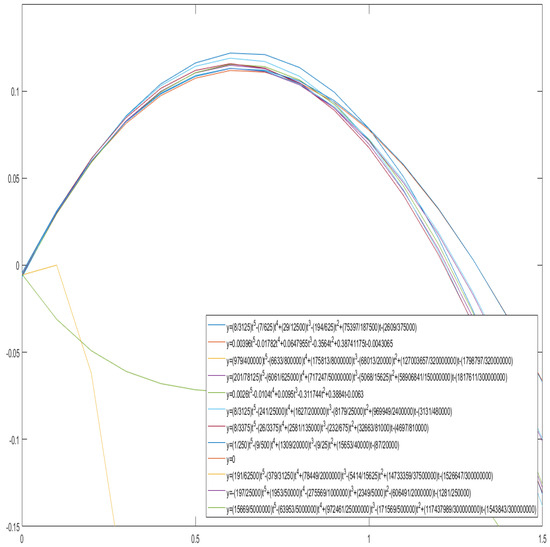
Figure A1.
Curves .
Figure A1.
Curves .
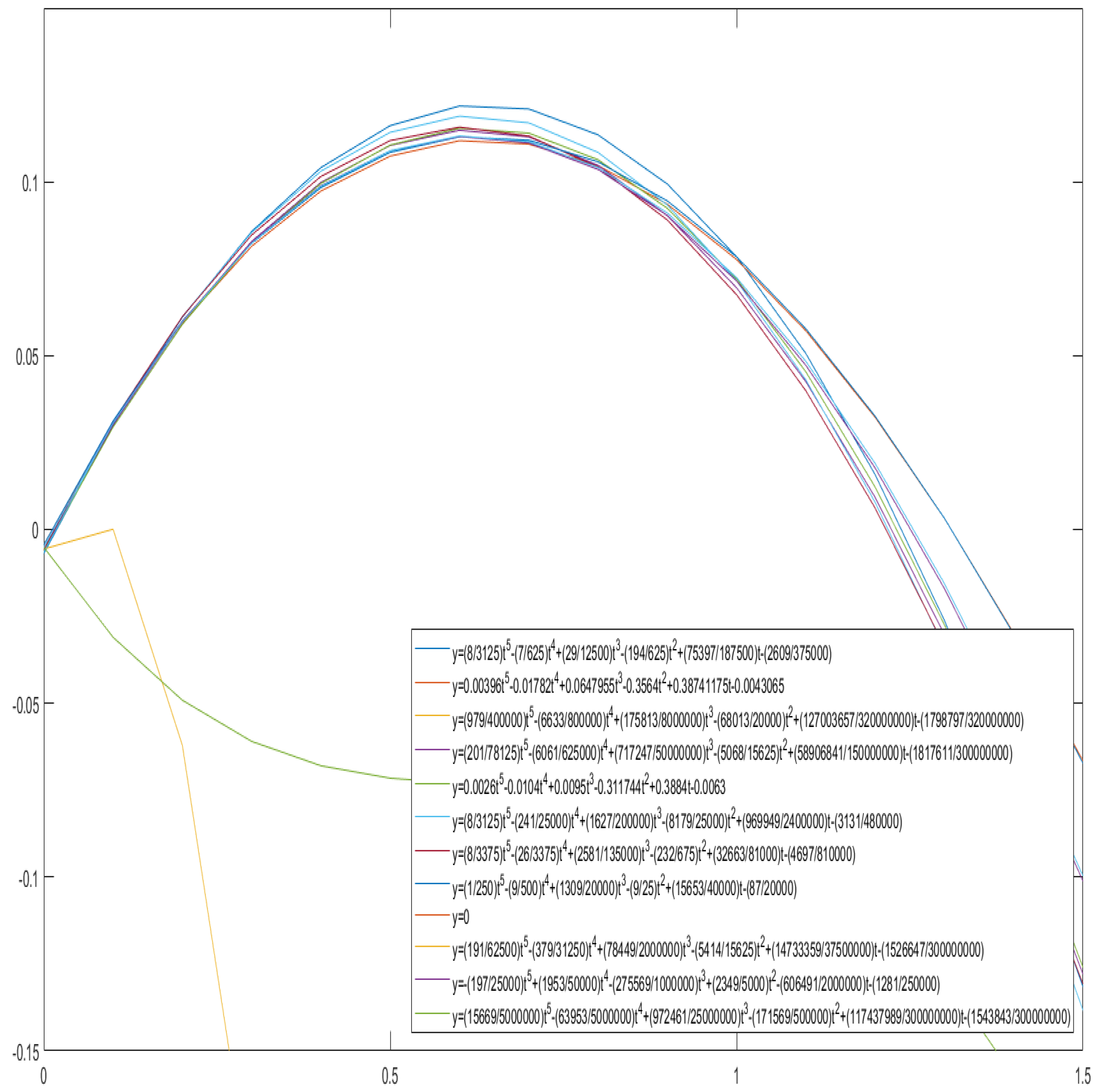
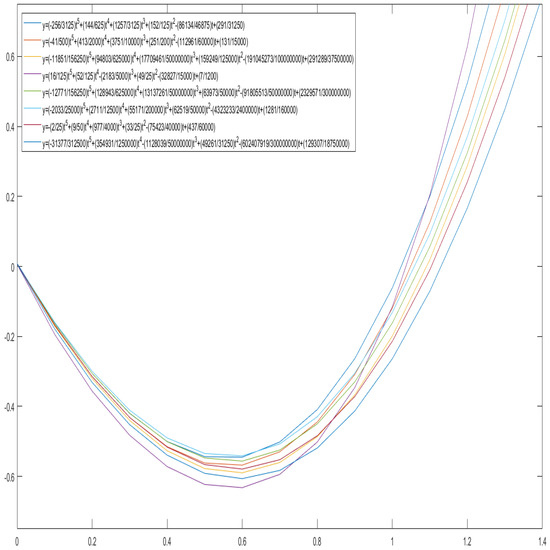
Figure A2.
Curves .
Figure A2.
Curves .
References
- Minc, H. Permanents. Encycl. Math. Its Appl. 1978, 6, 158. [Google Scholar]
- Lieb, E.H. Proofs of some conjectures on permanents. In Inequalities; Springer: Berlin/Heidelberg, Germany, 2002; pp. 101–108. [Google Scholar]
- Hwang, S.G. A note on a conjecture on permanents. Linear Algebra Its Appl. 1986, 76, 31–44. [Google Scholar] [CrossRef]
- Lih, K.W.; Wang, E.T. Monotonicity conjecture on permanents of doubly stochastic matrices. Proc. Am. Math. Soc. 1981, 82, 173–178. [Google Scholar] [CrossRef]
- Cheon, G.S.; Wanless, I.M. An update on Minc’s survey of open problems involving permanents. Linear Algebra Its Appl. 2005, 403, 314–342. [Google Scholar] [CrossRef]
- Zhang, F. An update on a few permanent conjectures. Spec. Matrices 2016, 4, 305–316. [Google Scholar] [CrossRef]
- Merris, R. The permanent of a doubly stochastic matrix. Am. Math. Mon. 1973, 80, 791–793. [Google Scholar] [CrossRef]
- Subramanian, P.; Somasundaram, K. Some conjectures on permanents of doubly stochastic matrices. J. Discret. Math. Sci. Cryptogr. 2016, 19, 997–1011. [Google Scholar] [CrossRef]
- Foregger, T.H. Remarks on a Conjecture of M. Marcus and H. Minc. Linear Multilinear Algebra 1979, 7, 123–126. [Google Scholar] [CrossRef]
- Foregger, T.H. Permanents of convex combinations of doubly stochastic matrices. Linear Multilinear Algebra 1988, 23, 79–90. [Google Scholar] [CrossRef]
- Holens, F. Two Aspects of Doubly Stochastic Matrices: Permutation Matrices and the Minimum Permanent Function. Ph.D. Thesis, University of Manitoba, Winnipeg, MB, Canada, 1964. [Google Scholar]
- Djokovic, D.Z. On a conjecture by van der Waerden. Mat. Vesnik 1967, 19, 566–569. [Google Scholar]
- Hwang, S.G. The monotonicity of and the Đoković conjectures on permanents of doubly stochastic matrices. Linear Algebra Its Appl. 1986, 79, 127–151. [Google Scholar] [CrossRef][Green Version]
- Wanless, I.M. The Holen-Dokovic conjecture on permanents fails. Linear Algebra Its Appl. 1999, 286, 273–285. [Google Scholar] [CrossRef]
- Seneta, E. Non-Negative Matrices and Markov Chains; Springer: New York, NY, USA, 1981. [Google Scholar]
- Lih, K.W.; Wang, E.T. A convexity inequality on the permanent of doubly stochastic matrices. Congr. Numer. 1982, 36, 189–198. [Google Scholar]
- Marcus, M.; Minc, H. On a conjecture of B. L. Van der Waerden. Math. Proc. Camb. Philos. Soc. 1967, 63, 305–309. [Google Scholar] [CrossRef]
- Wang, E.T. On a conjecture of M. Marcus and H. Minc. Linear Multilinear Algebra 1977, 5, 145–148. [Google Scholar] [CrossRef]
- Eberlein, P.J. Remarks on the van der Waerden conjecture II. Linear Algebra Its Appl. 1969, 2, 311–320. [Google Scholar] [CrossRef][Green Version]
- Eberlein, P.J.; Mudholkar, G.S. Some remarks on the van der Waerden conjecture. J. Comb. Theory 1968, 5, 386–396. [Google Scholar] [CrossRef]
- Kopotun, K.A. On some permanental conjectures. Linear Multilinear Algebra 1994, 36, 205–216. [Google Scholar] [CrossRef]
Publisher’s Note: MDPI stays neutral with regard to jurisdictional claims in published maps and institutional affiliations. |
© 2021 by the authors. Licensee MDPI, Basel, Switzerland. This article is an open access article distributed under the terms and conditions of the Creative Commons Attribution (CC BY) license (https://creativecommons.org/licenses/by/4.0/).