


Abstract
In 5G systems, enhancing the energy efficiency (EE) and spectrum efficiency (SE) is a significant task that is capable of fulfilling the demand of future wireless networks and providing Quality of Service (QoS) provisioning, such as high throughput with low power consumption. In the present work, a look-up table enabled a fuzzy-based approach to investigate the SE and EE issues in 5G networks and obtained an efficient symmetrical trade-off between them to enhance the system’s overall performance. We completed simulations in NS-2.31 software version 2.31, and MATLAB is used to visualize the results. The proposed model achieved maximum values of EE and SE of 0.92 bit/J/Hz with a sensing time τs(LUT) = 20 ms. Furthermore, optimizing the sensing time and the secondary user (SU) transmission power, yielded a maximum EE and provided a QoS provisioned cognitive radio-enabled 5G network.
1. Introduction
Since the inception of mobile communication networks over recent decades and with the advancement of mobile communication, the focus for research has been on achieving better connectivity, anytime anywhere, seamless connectivity, less complexity and minimum latency, while providing high-speed network services. The optimization of critical design parameters, namely spectrum efficiency (SE); energy efficiency (EE); and energy harvesting (EH) are in massive demand for future prospective wireless networks, specifically the 5G cognitive radio networks (5G-CRN) by 2021 [1,2,3,4,5]. Although in most regions, different countries face the severe problem of spectrum scarcity, there are still many regions where spectrum inefficiency is also a vital issue in the case of spectrum utilization. Thus, a tremendous amount of work is required to achieve the enhancement of spectrum efficiency techniques. Energy efficiency is another potential design parameter for the next-generation wireless networks, because of limited battery power availability in mobile devices and its inefficient utilization, as well as global environment concerns [6,7,8,9]. Practically speaking, methods that enhance the spectral efficiency, lead to a decrease in energy efficiency and vice versa. The main challenge in 5G systems is to obtain high spectral efficiency while utilizing minimal amount of energy for mobile devices. This problem is rectified by introducing an optimal trade-off between SE and EE while providing quality of service (QoS) provisioning in a 5G-CRN. Another challenge is to reduce the outage probability and provide secure, guaranteed communication. The deployment of mobile communication technologies also overcomes these challenges and meet the targets [1,2,3,4,5,6,7,8,9,10].
Cognitive radio is a concept that guarantees effective utilization of the radio spectrum through dynamic spectrum access and provides a solution to SE issues [4]. The secondary user (SU) practically does not perform sensing and accessing operations simultaneously. The SU first senses the spectrum, and only if the channel is vacant, does the SU then transmit the data. Therefore, additional sensing energy is used before the actual start of every transmission frame of data. Therefore, energy efficiency is a key issue in cognitive radio enabled networks [3,4,5]. To overcome this issue, co-operative sensing using a look-up table (LUT) performs a vital role in spectrum sensing, which is explained in subsequent sections. Researchers have paid more and more attention towards the co-operative spectrum sensing (CSS) method over the last 5–8 years because it gives good spectrum efficiency capabilities [4,5,6]. Moreover, the sensing capability of a single user is reduced by the presence of multipath fading and shadowing [5,6,7,8,9,10,11,12,13,14,15,16,17,18,19,20,21,22,23,24,25,26,27,28].
Detection of the primary user (PU) with consistent spectrum detection and data transmission is currently required and hence, a vital topic of research nowadays in cognitive radio networks [7,8,9,10,11,12,13]. Gao, Y. et al. proposed the sensing-power trade-off problem in a multi-input/multi-output cognitive radio system [7]. In [8], Stotas et al. designed a novel receiver architecture; they also developed a frame structure to overcome the issues of the sensing-throughput trade-off in CRNs and were able to achieve spectrum sensing and transmission simultaneously [9]. Tang et al. investigated the effect of PU data transmission on the sensing–transmission trade-off in the co-operative cognitive radio model [10]. They also optimized the sensing and transmission power allocation while achieving maximum throughput. Jhao et al. explained maximum throughput by minimizing sensing time with the low probability of detection [11]. Liang et al. demonstrated the effect of the secondary user’s power that is utilized for data transmission on energy efficiency [12]. In contrast, the EE design of advanced channel sensing in a cognitive radios (CR)-network was proposed by [13].
Although extensive work has been carried out on the sensing–throughput trade-off in [14,15,16,17,18,19,20,21,22,23,24,25,26,27,28]. Ref. [15] considered the SE–EE simultaneously. In other words, the proposed work listed in the literature did not consider energy-efficient models as well; most of the researchers did not even address energy constraints while considering other research objectives. As most sensing devices (energy detector, cyclostationary and matched filter) work with minimum energy requirements, this leads to a critical issue for researchers in an attempt to minimize energy consumption [16,17,18,19]. The detailed survey clearly shows an enormous scope of development of an efficient technique that jointly considers spectrum sensing, transmission, and spectrum handoff for energy-efficient 5G-CRN (problem P1). Second, EE-CRNs provide a greater spectrum for wireless portable devices while consuming less energy [20]. EE policies are becoming more critical to achieving green communication because of traditional grid-powered or replaceable battery-powered devices which emit 2% of the total CO2. Ref. [21] developed an efficient sensing time optimization algorithm, which we have modified using the concept of a look-up table and then used it throughout the study. Due to this severe issue, recently researchers have focused on developing energy harvesting wireless communication systems (LUT). On the other hand, an LUT-incorporated EH system with spectrum and energy efficiencies is yet to be explored (problem P2) [22,23,24,25,26,27,28,29,30,31,32,33,34].
Highlights of this Investigation
The highlights of this investigation are summarized as follows:
- In a traditional CSS, a large amount of time is consumed while reporting, which contributes little to the sensing performance and hence makes the system inefficient. Therefore, we have designed a novel super frame with a look-up table for reporting and hence, the ability to further reduced the sensing time. The LUT updates regularly and thus acts as a sensing database for other SUs connected in co-operative communication.
- To enhance the EE using CSS the sensing time and transmission power were jointly considered when optimizing EE under PU transmission constraints. We derived an optimized co-operative sensing model by maximizing the EE under QoS provisioning while optimizing the sensing time using an LUT. Another problem of CR with QoS provisioning is formulated, i.e., satisfying the SE requirements under the constraint of maximizing EE. For this issue, we analyzed the effect of the spectrum efficiency on the energy efficiency. The literature shows that for different SEs, different values of the sensing time are required. To overcome this problem, we optimized the LUT incorporated EH systems to obtain a trade-off between the sensing time and power utilized during transmission under EE Constraints with QoS provisioning.
- We further implemented a fuzzy-based selection switch in the proposed system to optimize sensing time to provide a symmetrical trade-off between the EE and the SE for 5G-CRN networks
2. Materials and Methods
2.1. Network Models
A look-up table based co-operative spectrum sensing technique was proposed to obtain the optimal time to achieve reasonable spectral and the energy efficiencies of a cognitive-enabled 5G network. The look-up table played a vital role in minimizing the sensing time and improving the time for data transmission and hence enhanced the system’s overall spectral efficiency. As we know, a CR does not have the facility to sense and transmit data simultaneously, giving a wide scope for co-operative spectrum sensing.
2.2. Primary Network Model
Consider a primary network that has the rights to access the spectrum allocated by the Federal Communications Commission (FCC) with bandwidth W.
The PU makes use of a slotted communication protocol with sensing time within time frame T, which is a function of Chi with Chi = 0 (for the channel in idle state) and Chi = 1 (for an occupied channel). The state diagram of the primary spectrum utilization is shown in Figure 1. In this model, the spectrum in state ”0” corresponds to idle with probability P0, and it transits from state ”0” to ”1” with probability (1 − P0). Conversely, if the spectrum is in state ”1” with probability P1 is moving towards state ”0”, with probability (1 − P1). Therefore the steady-state probability in two cases is and respectively.
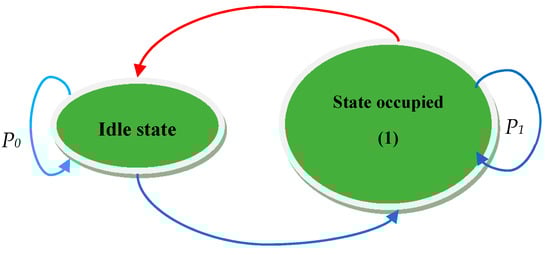
Figure 1.
State diagram of the primary network spectrum utilization.
Let be the sensing time used for a fixed sensing frame and (T − τs) be the transmission frame with total frame time duration in T. The modified sensing time is the suggested LUT time that is exploited for co-operative sensing, as shown in Figure 2. Let δmin be the minimum time frame for SUs to sense the spectrum and τR(LUT) be the reporting time to the cognitive radios base station :- for example. for T = 20 ms, the reporting time for the maximum τR(LUT) = 0.1 ms [15,21].
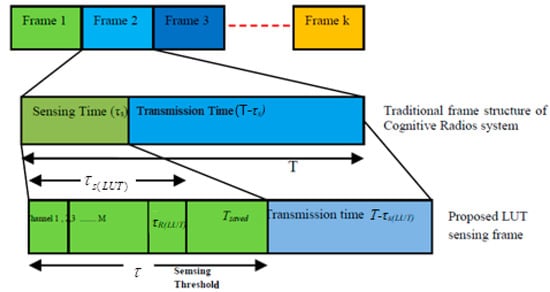
Figure 2.
Optimized sensing time framework using the Look-up table.
We review some foundation ideas of Wang et al. [15] that will be utilized throughout this study.
Let
Similarly
is a function of LUT enabled sensing time which are termed as the detection probability and false alarm respectively. Mathematically
This means that the probability of sensing a channel is 100%, i.e., the channel is genuinely sensed in the right spectrum. In contrast
Equation (3) signifies that the channel sensing is not accurate, and the probability of a false alarm is at a maximum. We can calculate PD and PFA using the following relations:
where is probability Gaussian function, fs is the sampling frequency, and γ denotes the average power consumed
where is the minimum value of sensing time to facilitate the condition of target probability of detection and target probability of false alarm.
2.3. Problem Formulation
From Equations (4) and (5) we can calculate the average SE using [12] as
where πi is the probability that the spectrum is vacant , Pt is the power utilized by the SU during transmission, hs is the CR link gain, and denotes the power due to unwanted signals (noise). During miss detection (i.e., the spectrum falsely detected as vacant), the probability is calculated as and hence the average SE, in this case, using [12] is as follows:
where πi is the probability of vacant spectrum , PPU is the power utilized by the PU during transmission, and hPU denotes PU gain. Hence the average value of the spectral efficiency is calculated as follows:
However, the energy efficiency of a 5G-CRN is obtained using
where
where Ps is the sensing power and Pc is the power consumed by the circuit. During reporting to the LUT stage, the average power consumption is , where is the power consumed during reporting to the cognitive radio-base station(CR-BS).
The problem was to optimize the sensing time using a look-up table (τs(LUT)) as well as the SUs power (Pt) use such that the energy efficiency will be maximized under the constraint that the primary user’s rights are always protected, i.e.,
such that the probability of detection (Pd) ≤ threshold detection probability ().
2.4. Solution to the Problem
We have designed a system to monitor the sensing time using the LUT concept. The proposed method first states the optimization problem (Problem P1). Then an optimal solution of P1 is provided by achieving a sensing time that provides maximum energy efficiency for a given transmission power of the SUs (Problem P1). To achieve this, we took a partial derivative of the energy efficiency w.r.t the sensing time using LUT.
Let
where
Then
.
The second-order partial derivative of (14) w.r.t τs(LUT) is equal to
Thus < 0, where decreases with . For a particular value of Pt, there must be one unique value of for which = 0.
Therefore, .
Hence there must be a unique value of the sensing time using the LUT () that maximizes the system’s energy efficiency. Similarly, the effect of the transmission power on the energy efficiency for a given sensing time should be calculated for a given optimization problem (Problem P2). Where an optimal solution of P2 is found by taking the second-order partial derivative of the energy efficiency w.r.t the transmission power.
Let
Then Obviously .
The first partial derivative of (18) w.r.t to find out the unique value of Pt for which the energy efficiency is a maximum is equal to:
where . Hence, decreases with Pt. For a particular value of Pt, there must be one unique value of for which . Therefore . Therefore the energy efficiency of the cognitive radio network has one optimal value of that maximizes .
3. Energy Efficiency-Spectrum Efficiency Trade-Off
The quality of service should be guaranteed for secondary users, while practical applications are considered. We aimed to maximize the EE while satisfying SE constraints. First, we can find out the effect of with respect to . From Equation (9), . The first partial derivative w.r.t is:
where can be calculated from Equation (15), although we have the following conditions to be satisfied, i.e., .
From limits, it is clear that increases and is a decreasing function of sensing time in the case of an immense amount of sensing time. Therefore, there should be one unique value of sensing time, that satisfies the condition of maximizing SE. It can be calculated by applying a double partial derivative of w.r.t the sensing time:
where can be evaluated from Equation (15). We can obtain that , therefore, SE is an intrusive function of the sensing time. By equating , we can get a unique sensing time value, which will generate maximum SE to satisfy the spectrum efficiency. We set the sensing efficiency greater than or equal to SE threshold .
4. LUT Enabled Energy Harvested Optimization in 5G-CRN
The energy-harvesting 5G-secondary system merged with the look-up table is as shown in Figure 3. The method comprises a primary transceiver and cognitive-based multiple transceivers. The presence of PUs is accomplished with the help of spectrum sensing. The LUT regularly updates the status of every channel. The energy harvesting concept is used, which acts as a cushion by storing the energy in the cognitive radio’s battery. To overcome a flooding situation, the capacity of these batteries is assumed to be infinite. Furthermore, energy leakage from this stored energy tank is zero.
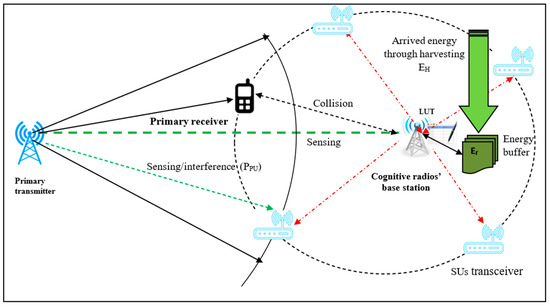
Figure 3.
Look-up table incorporated into an energy harvesting secondary user (SU) cognitive radio network (CRN) and primary user network.
EH represents the energy stored in the buffer, if the energy utilized when sensing is . M is the number of available channels, and N is the number of SUs. The Algorithm 1 for the sensing energy minimization is shown below.
| Algorithm1: Look-up-table-based minimization of the sensing energy (LUT-MSE) |
| Pre-requisites: PD, M, N, Signal to noise ratio of primary users (SNRPUs), T, SUs sensing frame (δmin) |
| Step 1: Remaining transmission time [n] = T − Ɐn |
| Step 2: for Chi = 1 to M do |
| Step 3: Sorting of all SUs sensing channels data in terms of decreasing SNRPUs. |
| Step 4: Start sensing for M channels by N SUs, for SNR = 0, k = 1 |
| Step 5: while sensing < δmin do |
| Step 6: update LUT = index [k] |
| Step 7: For each SU monitor calculate PD by applying step 3 |
| Step 8: if then |
| Step 9: if then |
| Step 10: Increment the LUT [index] = LUT [index + 1] |
| Step 11: end if |
| Step 12: k = k + 1 |
| Step 13: end while |
| Step 14 end for |
Conventionally, the radio is off at the initial level, i.e., the radio is not active (An = 0), thereby saving energy. Sensing of the channel starts immediately when the radio comes into “on” mode (An = 1) as shown in Figure 4a. While sensing if the channel is found to be busy and another channel near it is found to be idle, handoff occurs immediately to that idle channel, leading to the system’s good throughput.
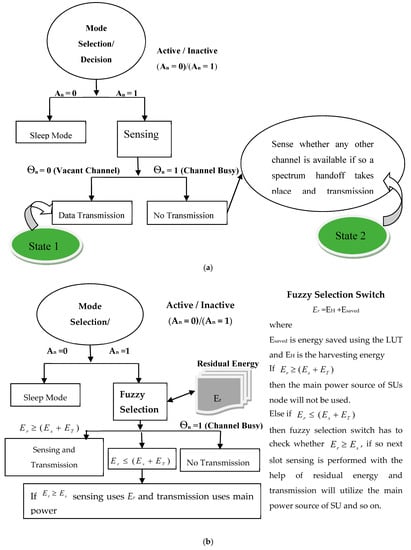
Figure 4.
Mode selection switch (a) conventional and (b) proposed method.
The transmitter of the cognitive radio utilizes accessing through the greedy spectrum, and the remaining energy is used for the consecutive frame.
such that
where the total residual energy is equal to the Harvested energy
By using the LUT-based model, less energy is utilized during the sensing period and hence saves energy (ESaved). Furthermore, the LUT incorporated EH model also saves E.H. energy also, as shown in Figure 4b. Therefore, the total energy saved (residual energy) in a fixed frame (T), depending upon the amount of residual energy Er = EH +Esaved is left in the battery unit of the SUs. helps in the calculation of the energy and the power used in sensing. Therefore minimizing will lead to overcoming two problems, namely less energy consumption while sensing and maximizing the transmission time, which improves the throughput of the system.
In the conventional approach, if Er < Es + ET, then the whole Er was left unutilized. Here we have proposed a novel fuzzy-based approach that will decide whether the residual energy is utilized for next slot sensing, transmission, or both. The fuzzy switch regularly checks whether the consumption of energy in sensing and transmitting is always less than the residual energy
As per Equation (25), if the amount of energy needed for sensing and transmitting is less than the residual energy, the Sus’ node power will not be used, and it will be saved for sensing the consecutive slot. Else if
the fuzzy switch evaluates , and if it is satisfied, the energy will be used in sensing, and energy will be saved in this way the main power is used for transmitting till the last transmission of data is complete.
5. Results
Investigations of the energy efficiency enhancement were carried out using a NS-2.31 simulator under a cognitive radio cognitive network (CRCN) environment. The effect of the sensing time on the SE and EE using different fusion rules can be observed in Figure 5. The EE and SE maximization can never co-exist, therefore, after the diligent trade-off, the optimal value of the EE and the SE is reported as 0.92 bit/J/Hz at sensing time = 20 ms.
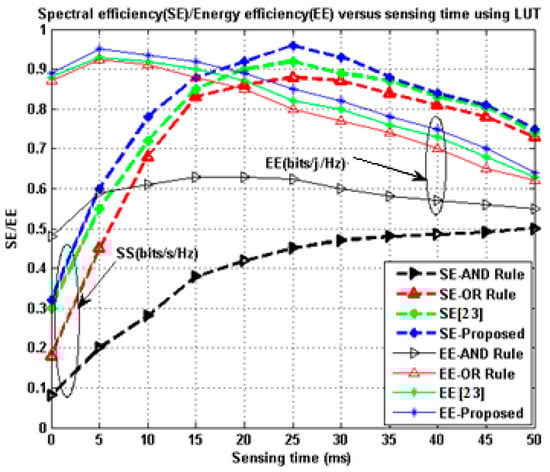
Figure 5.
SE and EE versus the sensing time using different fusion rules.
Figure 6 depicts the variation in energy efficiency w.r.t. the transmission power of SUs at different sensing time. By optimizing the sensing time, the energy efficiency of 63% was observed at a transmission power of 2 W.
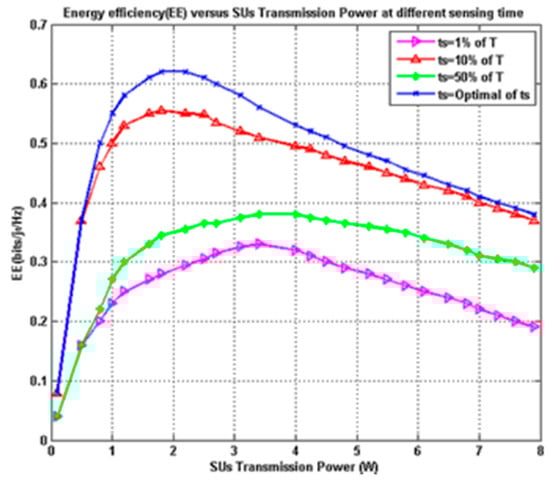
Figure 6.
Energy efficiency versus the SUs transmission power.
To enhance the energy efficiency of the system should be optimized using a neuro-fuzzy energy-aware unequal clustering scheme (NFEAUCS) algorithm for CSS in the near future.
Figure 7 shows the EE relation concerning sensing time using a LUT under different SU transmission power levels. We considered different solutions to provide EE i.e., Pt = 25%, 50%, 75% of Pt(max) and optimal transmission power. Figure 7 shows that the optimal value for the transmission power at ms yielded a maximum energy efficiency of 58–60%.
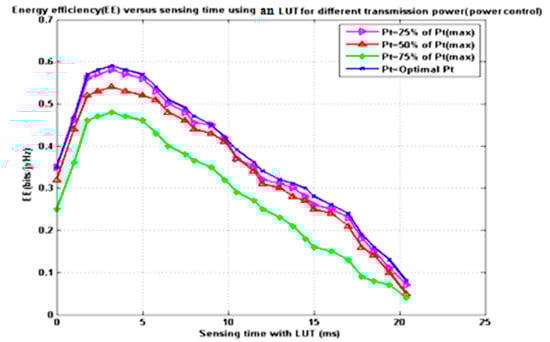
Figure 7.
Energy efficiency versus the sensing time using Lookup Table (LUT).
Figure 8 shows the effect of the SU transmission power, signal to noise ratio of SUs, and sensing time on the energy efficiency. We considered six different sensing time cases as follows: 10%, 50%, and optimal sensing time. We also considered transmission powers as follows: 10%, 50%, and 100% of Pt(max) and optimal power. Solutions 1, 2, and 4 gave the worst EE since the time and power were fixed whereas, for solutions 3 and 5, the EE increased with an increase in the signal-to-noise ratio (SNR), but was almost constant for higher SNR (SNR > 4 dB) values. In solution 6, joint optimization (optimal τs(LUT) and optimal Pt) gave better results for low and high SNR, and reached a mark of 88% at the optimal sensing time and transmission power.
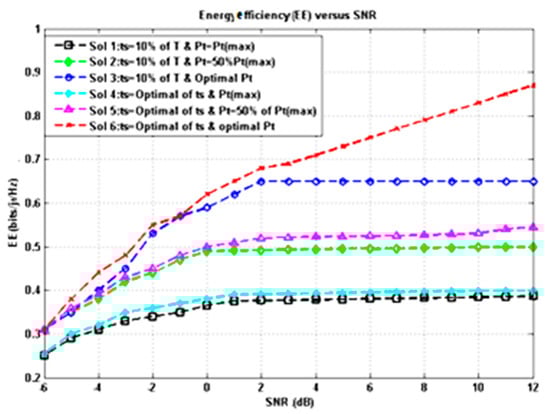
Figure 8.
Energy efficiency versus the Signal to noise ratio (dB).
6. Conclusions
A 5G-CRN network’s effectiveness depends upon its lifetime, energy consumption, and the achieved throughput of information transmitted. As far as we know, no one has yet proposed an algorithm using LUT incorporated energy harvesting CRN to optimize SE and EE, and to provide an improved throughput system. The proposed method used in this study can take advantage of a look-up table and the energy harvesting concepts. Simulations were performed, and the results showed that adopting the new technique reduced the energy consumption and improved the spectrum efficiency resulting in an improved normalized achievable throughput. From the results of the simulations, we found that the proposed method outperformed existing methods. Energy-saving, energy consumption, the EE/SE trade-off, and achievable throughput regarding the sensing time of the proposed method were calculated using the energy efficiency and spectrum efficiency w.r.t. decision threshold(M). The proposed model achieved a maximum EE and SE, which was 0.92 bit/J/Hz at = 20 ms. A further, optimal value of sensing time (typically 3 ms) was achieved, which yielded 58–60% EE.
On the other hand, 2 W for the transmission power of the SUs was the optimal power to achieve an EE of approximately 66%. Finally, we achieved a maximum energy efficiency (88%) by jointly optimizing the sensing time and optimizing the SU transmission power. This system can be used in the various real-time applications for the acquisition of data from pervasive networks. The proposed method is also helpful in telemedicine systems. The main drawback of the system is that we assumed the battery capacity to be infinite, which is an impractical scenario. This work can be further extended by taking finite batter capacity and using higher-level optimization techniques and soft computing techniques, such as NFEAUCS algorithm in the near future.
Author Contributions
Author/Contributors: O.I.K., K.A.O. and M.S. Conceptualization/investigation/Methodology/Software: M.S. Project administration: O.I.K. Visualization/Funding: K.A.O. Writing—original draft/review & editing: M.S. All authors have read and agreed to the published version of the manuscript.
Funding
This research was funded by Johannesburg University.
Conflicts of Interest
The authors declare that there is no conflict of interest regarding the publication of this paper.
References
- Haykin, S. Cognitive radio: Brain-empowered wireless communications. IEEE J. Sel. Areas Commun. 2005, 23, 201–220. [Google Scholar] [CrossRef]
- Hu, R.Q.; Qian, Y. An energy efficient and spectrum efficient wireless heterogeneous network framework for 5G systems. IEEE Commun. Mag. 2014, 52, 94–101. [Google Scholar] [CrossRef]
- Deruyck, M.; Joseph, W.; Lannoo, B.; Colle, D.; Martens, L. Designing Energy-Efficient Wireless Access Networks: LTE and LTE-Advanced. IEEE Internet Comput. 2013, 17, 39–45. [Google Scholar] [CrossRef]
- Wang, C.-X.; Haider, F.; Gao, X.; You, X.; Yang, Y.; Yuan, D.; Aggoune, H.M.; Haas, H.; Fletcher, S.; Hepsaydir, E. Cellular architecture and key technologies for 5G wireless communication networks. IEEE Commun. Mag. 2014, 52, 122–130. [Google Scholar] [CrossRef]
- Akyildiz, I.F.; Lo, B.F.; Balakrishnan, R. Cooperative spectrum sensing in cognitive radio networks: A survey. Phys. Commun. 2011, 4, 40–62. [Google Scholar] [CrossRef]
- Singh, M.; Kumar, M.; Malhotra, J. An Energy Efficient Spectrum Sensing, Access and Handoff Concept Using Look Up Table for Cognitive Radios Networks. Int. J. Adv. Res. Comp. Sci. 2017, 8, 228–238. [Google Scholar]
- Moghimi, F.; Mallik, R.K.; Schober, R. Sensing Time and Power Optimization in MIMO Cognitive Radio Networks. IEEE Trans. Wirel. Commun. 2012, 11, 3398–3408. [Google Scholar] [CrossRef]
- Stotas, S.; Nallanathan, A. Overcoming the sensing-throughput tradeoff in cognitive radio networks. In Proceedings of the 2010 IEEE International Conference on Communications, Cape Town, South Africa, 23–27 May 2010; pp. 1–5. [Google Scholar]
- Tang, L.; Chen, Y.; Hines, E.L.; Alouini, M.-S. Effect of Primary User Traffic on Sensing-Throughput Tradeoff for Cognitive Radios. IEEE Trans. Wirel. Commun. 2011, 10, 1063–1068. [Google Scholar] [CrossRef]
- Zhao, C.; Kwak, K. Joint sensing time and power allocation in cooperatively cognitive networks. IEEE Commun. Lett. 2010, 14, 163–165. [Google Scholar] [CrossRef]
- Liang, Y.-C.; Zeng, Y.; Peh, E.C.; Hoang, A.T. Sensing-Throughput Tradeoff for Cognitive Radio Networks. IEEE Trans. Wirel. Commun. 2008, 7, 1326–1337. [Google Scholar] [CrossRef]
- Ogudo, K.A.; Nestor, D.M.J.; Khalaf, O.I.; Kasmaei, H. A Device Performance and Data Analytics Concept for Smartphones’ IoT Services and Machine-Type Communication in Cellular Networks. Symmetry 2019, 11, 593. [Google Scholar] [CrossRef]
- Pei, Y.; Liang, Y.-C.; Teh, K.C.; Li, K.H. Energy-Efficient Design of Sequential Channel Sensing in Cognitive Radio Networks: Optimal Sensing Strategy, Power Allocation, and Sensing Order. IEEE J. Sel. Areas Commun. 2011, 29, 1648–1659. [Google Scholar] [CrossRef]
- Wang, S.; Wang, Y.; Coon, J.P.; Doufexi, A. Energy-efficient spectrum sensing and access for cognitive radio networks. IEEE Trans. Veh. Technol. 2011, 66, 906–912. [Google Scholar] [CrossRef]
- Khalaf, O.I.; Abdulsahib, G.M.; Sabbar, B.M. Optimization of Wireless Sensor Network Coverage using the Bee Algorithm. J. Inf. Sci. Eng. 2020, 36, 377–386. [Google Scholar]
- Yi, C.; Wang, L.; Li, Y. Energy Efficient Transmission Approach for WBAN Based on Threshold Distance. IEEE Sens. J. 2015, 15, 5133–5141. [Google Scholar] [CrossRef]
- Khalaf, O.I.; Abdulsahib, G.M.; Kasmaei, H.D.; Ogudo, K.A. A New Algorithm on Application of Blockchain Technology in Live Stream Video Transmissions and Telecommunications. Int. J. E-Collab. 2020, 16, 16–32. [Google Scholar] [CrossRef]
- Khalaf, O.I.; Abdulsahib, G.M. Frequency estimation by the method of minimum mean squared error and P-value distributed in the wireless sensor network. J. Inf. Sci. Eng. 2019, 35, 1099–1112. [Google Scholar]
- Sun, X.; Zhang, T.; Tsang, D.H. Optimal energy-efficient co-operative sensing scheduling for cognitive radio networks with qos guarantee. In Proceedings of the 2011 7th International Wireless Communications and Mobile Computing Conference, Istanbul, Turkey, 4–8 July 2011; pp. 1825–1830. [Google Scholar]
- Zhang, T.; Tsang, D.H. Optimal co-operative sensing scheduling for energy-efficient cognitive radio networks. In Proceedings of the 2011 Proceedings IEEE INFOCOMM, Shanghai, China, 10–15 April 2011; pp. 2723–2731. [Google Scholar]
- Xiong, C.; Lu, L.; Li, G.Y. Energy-Efficient Spectrum Access in Cognitive Radios. IEEE J. Sel. Areas Commun. 2014, 32, 550–562. [Google Scholar] [CrossRef]
- Hu, H.; Zhang, H.; Gao, W.; Li, L.; Wang, Q.; Guan, Y. Energy-Efficient Cooperative Spectrum Sensing with Quality-of-Service Provisioning. Wirel. Pers. Commun. 2016, 94, 1427–1442. [Google Scholar] [CrossRef]
- Singh, M.; Kumar, M.; Malhotra, J. Energy efficient cognitive body area network (CBAN) using look-up table and energy harvesting. J. Intell. Fuzzy Syst. 2018, 35, 1253–1265. [Google Scholar] [CrossRef]
- Khalaf, O.I.; Sabbar, B.M. An overview on wireless sensor networks and finding optimal location of nodes. Period. Eng. Nat. Sci. (PEN) 2019, 7, 1096–1101. [Google Scholar] [CrossRef]
- Khalaf, O.I.; Abdulsahib, G.M.; Muayed, S. A Modified Algorithm for Improving Lifetime WSN. J. Eng. Appl. Sci. 2018, 13, 9277–9282. [Google Scholar]
- Abdulsahib, G.; Khalaf, O. Comparison and Evaluation of Cloud Processing Models in Cloud-Based Networks. Int. J. Simul. Syst. Sci. Technol. 2019, 19, 26.1–26.6. [Google Scholar] [CrossRef]
- Salman, A.D.; Khalaf, O.I.; Abdulsaheb, G.M. An adaptive intelligent alarm system for wireless sensor network. Indones. J. Electr. Eng. Comput. Sci. 2019, 15, 142–147. [Google Scholar] [CrossRef]
- Türk, S.; Deveci, M.; Özcan, E.; Canıtez, F.; John, R. Interval Type-2 Fuzzy Sets Improved by Simulated Annealing for Locating the Electric Charging Stations. Inf. Sci. 2020, 547, 641–666. [Google Scholar] [CrossRef]
- Pamucar, D.; Deveci, M.; Schitea, D.; Erişkin, L.; Iordache, M.; Iordache, I. Developing a novel fuzzy neutrosophic numbers based decision making analysis for prioritizing the energy storage technologies. Int. J. Hydrogen Energy 2020, 45, 23027–23047. [Google Scholar] [CrossRef]
- D’Andreagiovanni, F.; Mannino, C.; Sassano, A. GUB Covers and Power-Indexed Formulations for Wireless Network Design. Manag. Sci. 2013, 59, 142–156. [Google Scholar] [CrossRef]
- Capone, A.; Chen, L.; Gualandi, S.; Yuan, D. A New Computational Approach for Maximum Link Activation in Wireless Networks under the SINR Model. IEEE Trans. Wirel. Commun. 2011, 10, 1368–1372. [Google Scholar] [CrossRef]
- Tang, L.; Tan, Q.; Shi, Y.; Wang, C.; Chen, Q. Adaptive Virtual Resource Allocation in 5G Network Slicing Using Constrained Markov Decision Process. IEEE Access 2018, 6, 61184–61195. [Google Scholar] [CrossRef]
- Chiaraviglio, L.; D’Andreagiovanni, F.; Rossetti, S.; Sidoretti, G.; Blefari-Melazzi, N.; Salsano, S.; Chiasserini, C.-F.; Malandrino, F. Algorithms for the design of 5G networks with VNF-based Reusable Functional Blocks. Ann. Telecommun. 2019, 74, 559–574. [Google Scholar] [CrossRef]
- EJulie, E.G.; Selvi, S.T. Development of Energy Efficient Clustering Protocol in Wireless Sensor Network Using Neuro-Fuzzy Approach. Sci. World J. 2016, 2016, 5063261. [Google Scholar] [CrossRef]
Publisher’s Note: MDPI stays neutral with regard to jurisdictional claims in published maps and institutional affiliations. |
© 2020 by the authors. Licensee MDPI, Basel, Switzerland. This article is an open access article distributed under the terms and conditions of the Creative Commons Attribution (CC BY) license (http://creativecommons.org/licenses/by/4.0/).