Abstract
The weighted Szeged index () has gained considerable attention recently because of its unusual mathematical properties. Searching for a tree (or trees) that minimizes the is still going on. Several structural details of a minimal tree were described. Here, it is shown a surprising property that these trees have maximum degree at most 16, and as a consequence, we promptly conclude that these trees are of large diameter.
MSC:
05C09; 05C92
1. Introduction
Molecular descriptors are playing a crucial role in the QSPR/QSAR researches. As a side-effect of the vigorous development of this area of science, a rise in the number of molecular descriptors has occurred. This is especially noticed among the class of the so-called topological indices. Nowadays, there are thousands of molecular descriptors. A vague idea on their number could be imagined by reading the book [1].
A number of topological descriptors have been devised as extensions or modifications of the previously known and well-performed indices (see [2,3,4,5,6,7] for the latest research on some of these descriptors). The Szeged index (1) may be regarded as a descendant of the oldest and heavily used Wiener index [8]. It is defined in the following manner:
where is cardinality of the set .
The right-hand side of the Equation (1) was firstly appeared in the seminal paper on the Wiener index [8], used for its calculation in the case of trees. More than four decades later, the researchers have started to investigate properties of this formula in the case of connected graphs other than trees, where obtained values do not coincide with those of the Wiener index. Gutman named this invariant in [9]. The Szeged index has been extensively researched both in mathematical and in chemical community, which resulted in a vast literature and several modifications (see [9,10,11,12,13,14,15] and references cited therein).
One such modification of the Szeged index was done by the Ilić and Milosavljević in [16]. This quantity is named as the weighted Szeged index (), and defined as follows:
where is degree of the vertex u.
Several papers, dealing with on graph operations, have appeared [17,18,19]. In [20] the authors proved that the star is a tree having the maximal weighted Szeged index. They also gave examples of trees of order up to 25 with minimal weighted Szeged index and described the regularities which retain in them. However, the characterization of a tree (or trees) having the minimal weighted Szeged index remains an open problem.
The impression we get from the examples of trees of minimal weighted Szeged index in [20] is that they are having one “central” vertex and branches around it with subtrees of similar shape and small diameter. That would imply that these trees have a vertex whose degree increases as the order of the trees increases. Further, the examples in [20] give an impression that the diameter of the trees of minimal weighted Szeged index is bounded. However, in the next section we show that the degree of any vertex of a tree with minimum weighted Szeged index is at most 16. Consequently, this implies that the diameter of these trees is unbounded. In the last section of the paper we provide two properties of trees having minimal weighted Szeged index, which give an idea how these trees may grow as their order increases.
2. About the Diameter of Trees with Minimum Weighted Szeged Index
In this section, by we denote a tree with the minimum possible weighted Szeged index on n vertices. As we mentioned in the previous section, we will first show that cannot have a vertex of degree greater than 16.
Theorem 1.
The degree of any vertex in is at most 16.
Proof.
Suppose that the claim of the theorem does not hold and suppose that is a counterexample, i.e., it has a vertex v of degree at least 17. Let a, b, be the adjacent vertices of v (). We denote by A, B, the set of vertices of the components of that contain a, b, respectively. Without loss of generality, we may assume .
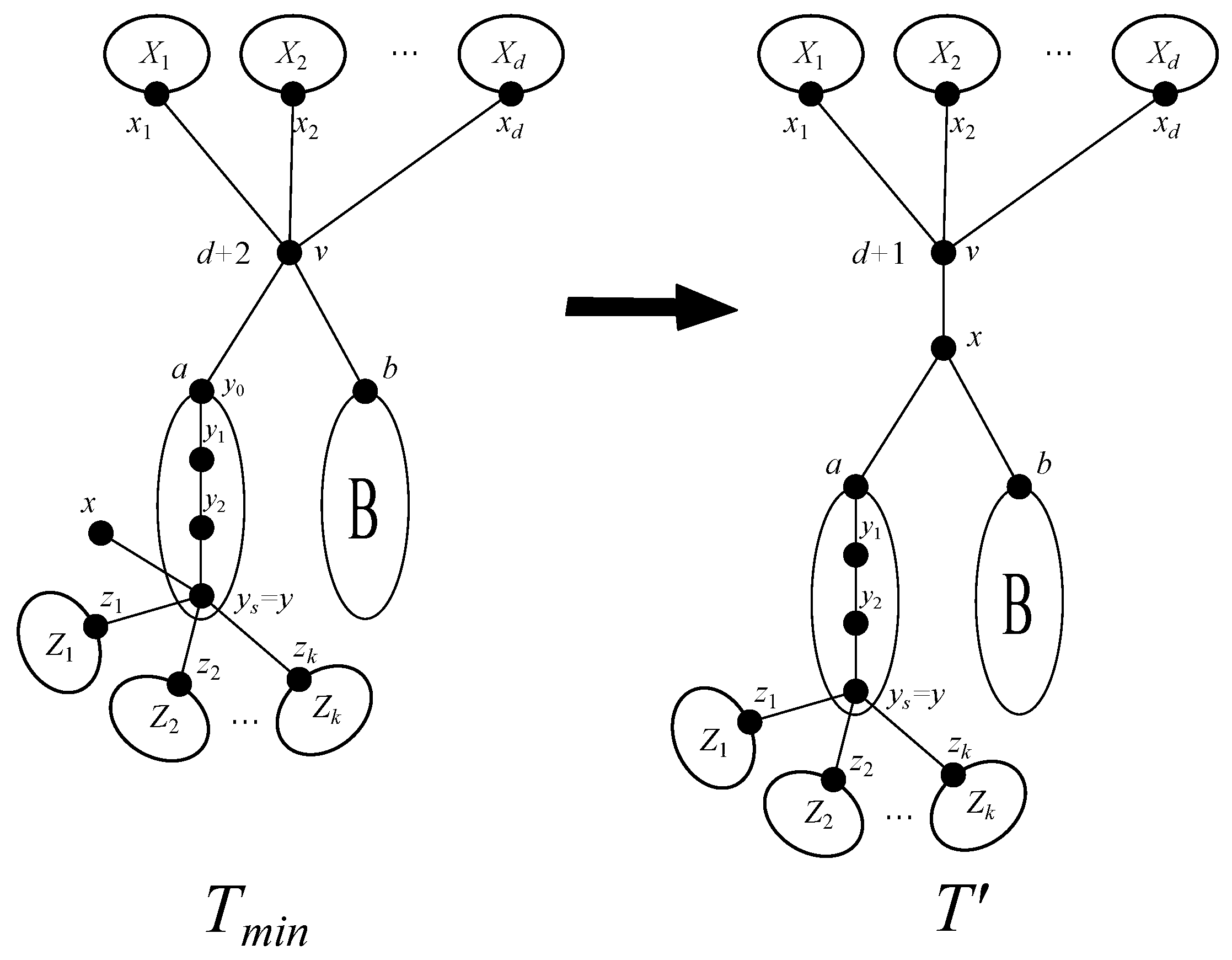
Let be a path in such that x is a leaf and . We define the tree from as follows. We remove the vertex x, we add a new vertex, denoted again by x and three edges , and as on the Figure 1.
Figure 1.
Reduction of big vertices.
Thus
Let . We want to show that . In order to do so, we first analyze the contribution of the edges of and to .
The contribution of the edges with vertices in in both and is equal. So, they will cancel out in .
The contribution of the edges to is
We consider two cases regarding the size of A. We will first consider the case and address the case later, at the end of the proof.
Case 1:. Here, we consider first the edges . As this list is non-empty. We will introduce additional notation. By we will denote the set of the vertices of the component of that contains .
The contribution of the edge with to is
The last inequality holds because of the assumptions .
If , we consider the edge (). The contribution of this edge to the difference is positive
As the degree of decreases by 1 in , it affects the contribution of all edges incident with y. Denote by all neighbors of y distinct from . Denote by the set of vertices of the component of that contains . Observe that the contribution of these edges to is positive
Next, we consider the contribution of the edges and to , and also of the edges and to . Let
Then
Thus the contribution of the edges and to is at least . Similarly, the contribution of and to equals to .
At the edges and , we have the following contribution. The edge contributes and the edge ,
Summing up all of the contributions listed above, except of some contributions that are clearly positive but possibly small, we have
which simplifies to
It is enough to show that
The last inequality is equivalent to
Since , it is enough to show
Using the well-known fact that for and , we conclude that attains its maximum value when and . For simplicity, we will increase by 1, i.e., .
Thus it is enough to show
Notice that
Since , , and , we get that
Hence it is enough to show
As it suffices to have
or equivalently
Since , we want to hold, and this holds whenever . Since , we conclude that whenever the degree of v is at least 17, we can obtain a tree with smaller weighted Szeged index than . Therefore the degree of every vertex of is at most 16. This establishes Case 1.
Case 2:. In this case, the tree has only the vertex a in the set A and, in this case, and . Then the degree of x in is 2. The contribution of the edges and in is
The contribution of the edges and in is
Thus, the contribution of these four edges is is the difference of the previous two expressions, which is
The contribution of the edges to is the same as in the previous case, i.e.
The contribution of the edges with both end-vertices in B is equal in both and , so it will be 0 in . Similarly holds for the sets . Therefore,
In the case we proved . Here, in case , we argue similarly but simpler. As , we have , and hence . Since , we have for each i. Thus, we infer
This establishes the case , and the proof of the theorem is completed. □
Now, we deduce the following interesting property of optimal trees.
Corollary 1.
As the order n of the tree with minimum weighted Szeged index increases, its diameter increases as well.
3. Two Properties of Trees Having Minimum Weighted Szeged Index
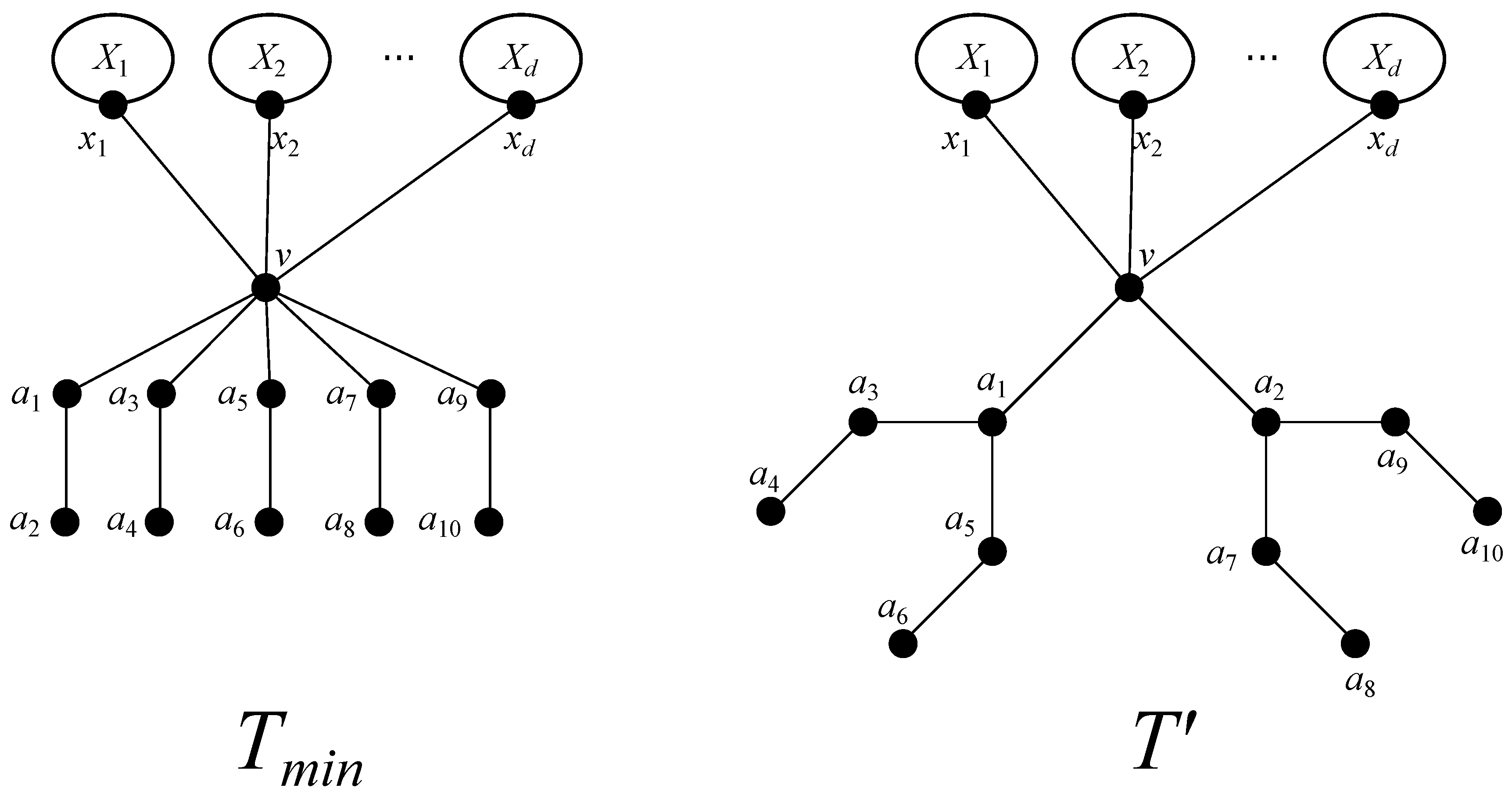
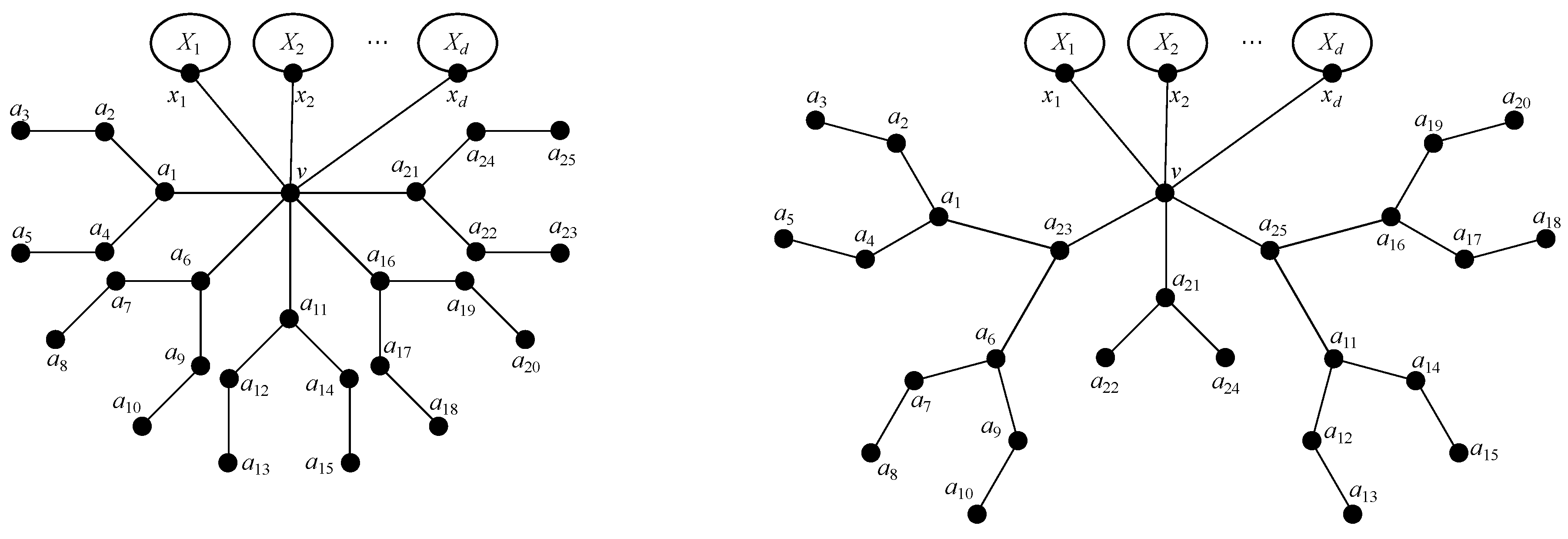
Analyzing the examples of trees of order between seven and 25 with minimal weighted Szeged index in [20], we notice that there are vertices incident to 2-rays ( attached to a vertex is called 2-ray (see Figure 2)). We also notice that the maximum number of 2-rays that a vertex is incident to is 4. As the order of the trees in those examples is at most 25, the natural question one may ask is if it is possible a tree with minimum weighted Szeged index to have a vertex incident to more that four 2-rays. The following proposition gives the answer to this question.
Figure 2.
Reduction of five 2-rays.
Proposition 1.
No vertex in is simultaneously incident to five 2-rays.
Proof.
Suppose the claim of the statement is false. Let v be a vertex of degree at least , and incident to five 2-rays. Denote the vertices of the five 2-rays incident to v by as on the figure. Denote by the vertices incident to v in . We denote by the set of vertices of the components of that contain respectively. Without loss of generality, we may assume .
We define the tree from as follows
Let . We want to show that . In order to do so, we first analyze the contribution of the edges of and to .
All edges with vertices in contribute the same values in both and . Hence they will cancel out in .
The contribution of the edges to is
The contribution of the five 2-rays of in is
while the contribution of the edges in in is
The difference of the last two expressions is . Thus
Notice that . Similarly as in the proof of Theorem 1 we conclude that attains the maximum value when and . Thus
Hence . Since , we have
Clearly for . For , the examples generated in [20] verify the statement. □
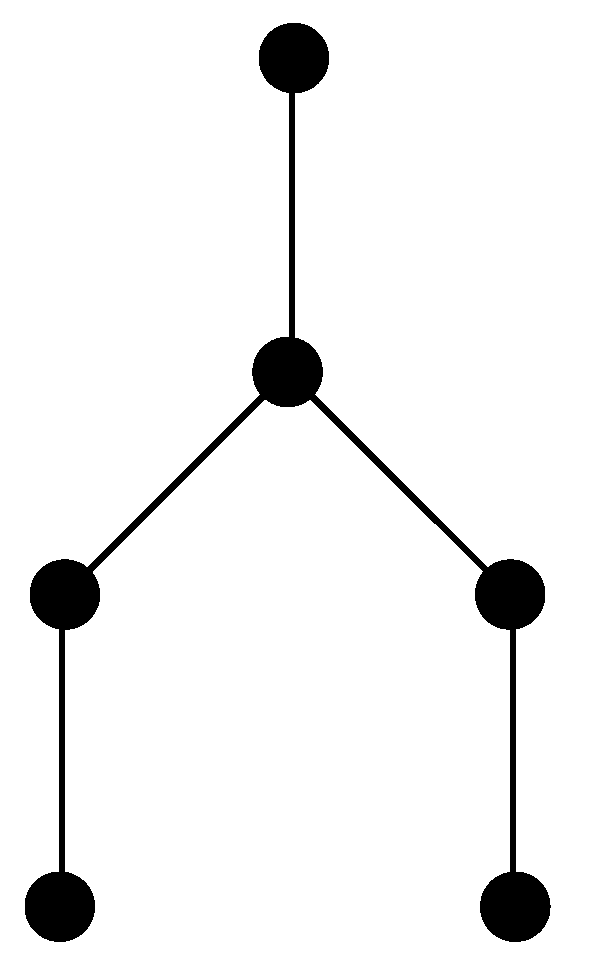
We call a branch in a tree Y-subtree, if it is isomorphic to the tree on Figure 3. We call a root the leaf of the Y-subtree incident to the vertex of degree 3, as it is attached as a branch to the tree of consideration.
Figure 3.
A Y-subtree with its root on the top.
We see Y-subtrees of in the proof of the previous proposition. We also see this type of subtrees in the examples of trees of minimal weighted Sezged index in [20]. Hence it is natural to ask if the number of Y-subtrees with a common root is bounded.
Proposition 2.
If , a tree with minimum weighted Szeged index cannot have a vertex that is a root of five Y-subtrees.
Proof.
Let . Suppose the claim of the statement is false. Let v be a vertex of degree at least , and a root to the five Y-subtrees. Denote the vertices of the five Y-subtrees by as on the Figure 4. Denote by the vertices incident to v in . We denote by the set of vertices of the components of that contain respectively. Without loss of generality, we may assume .
Figure 4.
Reduction of five Y-subtrees.
We define the tree from as follows
All edges with vertices in contribute the same values in both and . Hence they will cancel out in .
The contribution of the edges to is
We consider the edges in . Their contribution to is
Next we consider the edges in . Their contribution to is
which is equal to
Hence
Notice that . Similarly as in the proof of Theorem 1, we conclude that attains the maximum value when and . Thus
Hence
Similarly like in the proof of Proposition 1, since , it is valid for . □
4. Conclusions
Characterization of trees that minimize or maximize the value of a topological invariant is one of the crucial problems that need to be solved in order to better understand its behavior and to find its possible applications. For the majority of topological indices, the path and the star are extremal trees. However, there are topological invariants that are violating this pattern. One of them is the weighted Szeged index. Computer screening, reported in [20], shows complex structures of trees that minimize it. Nevertheless, some details are keeping constant with varying the order of trees. All trees with a minimum have a vertex with a significantly greater degree than others. It was assumed that this vertex is a single root to which all other subtrees (with some specific structural details) are attached. However, here it is proved that such vertex cannot have a degree greater than 16. This implies the large diameter of the minimum trees and the existence of more than one root vertex.
Author Contributions
Conceptualization, B.F. and R.Š.; methodology, R.Š.; investigation, R.A., R.Š. and B.F.; writing—original draft preparation, R.A.; writing—review and editing, B.F. All authors have read and agreed to the published version of the manuscript.
Funding
The contribution was partially supported by ARRS Program P1-0383 and Project J1-1692, bilateral projects BI-RS/18-19-026, BI-RS/20-21-025, and Ministry of Education, Science and Technological Development of Republic of Serbia (Agreement No. 451-03-68/2020-14/200122).
Conflicts of Interest
The authors declare no conflict of interest.
References
- Todeschini, R.; Consonni, V. Molecular Descriptors for Chemoinformatics; Wiley–VCH: Weinheim, Germany, 2009. [Google Scholar]
- Ali, A.; Zhong, L.; Gutman, I. Harmonic index and its generalizations: extremal results and bounds. MATCH Commun. Math. Comput. Chem. 2019, 81, 249–311. [Google Scholar]
- Behtoei, A. Some relations and bounds for the general first Zagreb index. MATCH Commun. Math. Comput. Chem. 2019, 81, 361–370. [Google Scholar]
- Eliasi, M. On extremal properties of general graph entropies. MATCH Commun. Math. Comput. Chem. 2018, 79, 645–657. [Google Scholar]
- Liu, J.; Zheng, R.; Chen, J.; Liu, B. The extremal general atom–bond connectivity indices of unicyclic and bicyclic graphs. MATCH Commun. Math. Comput. Chem. 2019, 81, 345–360. [Google Scholar]
- Milovanović, I.Z.; Milovanović, E.I.; Matejić, M. Some inequalities for general sum–connectivity index. MATCH Commun. Math. Comput. Chem. 2018, 79, 477–489. [Google Scholar]
- Zheng, R.; Liu, J.; Chen, J.; Liu, B. Bounds on the general atom–bond connectivity indices. MATCH Commun. Math. Comput. Chem. 2020, 83, 143–166. [Google Scholar]
- Wiener, H. Structural determination of paraffin boiling points. J. Am. Chem. Soc. 1947, 69, 17–20. [Google Scholar] [CrossRef] [PubMed]
- Gutman, I. A formula for the Wiener number of trees and its extension to graphs containing cycles. Graph. Theory Notes N. Y. 1994, 27, 9–15. [Google Scholar]
- Chiniforooshan, E.; Wu, B. Maximum values of Szeged index and edge–Szeged index of graphs. El. Notes Discr. Math. 2009, 34, 405–409. [Google Scholar] [CrossRef]
- Dobrynin, A.A. Graphs having the maximal value of the Szeged index. Croat. Chem. Acta 1997, 70, 819–825. [Google Scholar]
- Dobrynin, A.A. The Szeged and Wiener indices of line graphs. MATCH Commun. Math. Comput. Chem. 2018, 79, 743–756. [Google Scholar]
- Ji, S.; Hong, Y.; Liu, M.; Wang, J. The lower bound of revised Szeged index with respect to tricyclic graphs. MATCH Commun. Math. Comput. Chem. 2018, 79, 757–778. [Google Scholar]
- Li, X.; Zhang, M. A note on the computation of revised (edge-)Szeged index in terms of canonical isometric embedding. MATCH Commun. Math. Comput. Chem. 2019, 81, 149–162. [Google Scholar]
- Tratnik, N. The edge–Szeged index and the PI index of benzenoid systems in linear time. MATCH Commun. Math. Comput. Chem. 2017, 77, 393–406. [Google Scholar]
- Ilić, A.; Milosavljević, N. The weighted vertex PI index. Math. Comput. Modell. 2013, 57, 623–631. [Google Scholar] [CrossRef]
- Nagarajan, S.; Pattabiraman, K.; Chandrasekharan, M. Weighted Szeged index of generalized hierarchical product of graphs. Gen. Math. Notes 2014, 23, 85–95. [Google Scholar]
- Pattabiraman, K.; Kandan, P. Weighted Szeged indices of some graph operations. Trans. Comb. 2016, 5, 25–35. [Google Scholar]
- Pattabiraman, K.; Kandan, P. Weighted Szeged index of graphs. Bull. Int. Math. Virtual Inst. 2018, 8, 11–19. [Google Scholar]
- Bok, J.; Furtula, B.; Jedličková, N.; Škrekovski, R. On extremal graphs of weighted Szeged index. MATCH Commun. Math. Comput. Chem. 2019, 82, 93–109. [Google Scholar]
© 2020 by the authors. Licensee MDPI, Basel, Switzerland. This article is an open access article distributed under the terms and conditions of the Creative Commons Attribution (CC BY) license (http://creativecommons.org/licenses/by/4.0/).