


Abstract
In this paper, we consider the parametric mixed Cayley inclusion problem with Exclusive or (XOR)-operation and show its equivalence with the parametric resolvent equation problem with XOR-operation. Since the sensitivity analysis, Cayley operator, inclusion problems, and XOR-operation are all applicable for solving many problems occurring in basic and applied sciences, such as financial modeling, climate models in geography, analyzing “Black Box processes”, computer programming, economics, and engineering, etc., we study the sensitivity analysis of the parametric mixed Cayley inclusion problem with XOR-operation. For this purpose, we use the equivalence of the parametric mixed Cayley inclusion problem with XOR-operation and the parametric resolvent equation problem with XOR-operation, which is an alternative approach to study the sensitivity analysis. In support of some of the concepts used in this paper, an example is provided.
MSC:
47H05; 49H10; 47J25
1. Introduction
It is well known that the variational inequalities (inclusions) and their generalizations are applicable for dealing with a large number of problems related to mechanics, physics, optimization and control, nonlinear programming, economics, transportation equilibrium, engineering sciences, etc. (for example, see [1,2,3,4,5,6,7,8,9,10] and references therein). On the other hand, ordered variational inequalities (inclusions) are also very important from the application point of view. A suitable amount of work related to generalized variational inequalities (inclusions) in Hilbert spaces as well as in Banach spaces can be found in [11,12,13,14,15,16,17,18,19,20,21]. Let S be a symmetric operator on and express an operator as
then is the Cayley transformation of S. Cayley transformation is a mapping between skew-symmetric matrices and special orthogonal metrics. Recently, the Cayley inclusion problem with XOR-operation was considered and studied by Ali et al. [22]. They proved some properties of the Cayley operator involved in their problem.
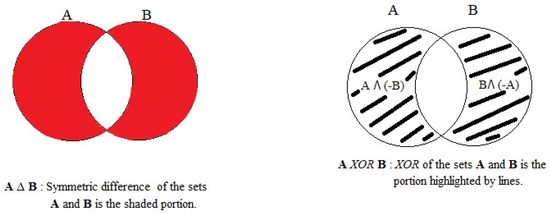
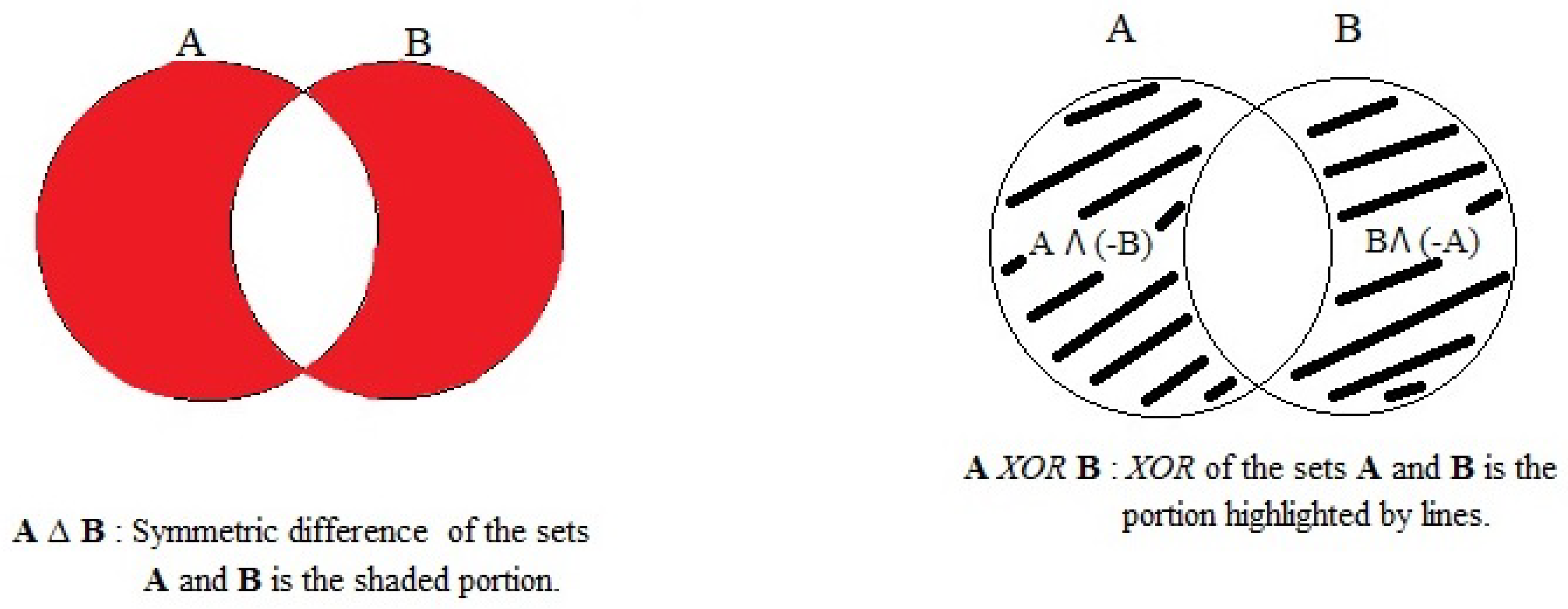
“Exclusive or” or exclusive disjunction (XOR) is a logical operation that outputs true only when inputs differ (one is true, the other is false). It gained the name “exclusive or” because the meaning of “or” is ambiguous when both operands are true, the exclusive or operator excludes that case. This is sometimes thought of as “one or the other but not both”. This could be written as “A or B, but not A and B”. It is to be noted that XOR and symmetric difference for sets use the same symbol ⊕ and the same structure, which are shown by Venn diagrams below in Figure 1.
Figure 1.
Symmetric difference and XOR of the sets A and B.
That is, XOR and symmetric difference for sets are the same. Moreover, XOR is the symmetric difference for truth values.
Let denote the symmetric difference of the sets A and B, given an object x, then
For example, is , and the symmetric difference of and is also .
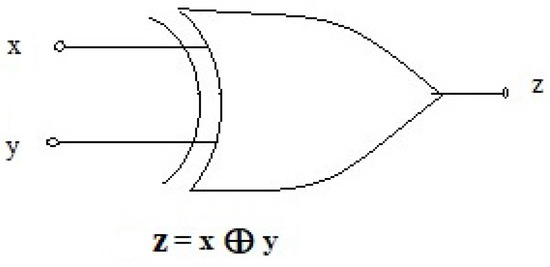
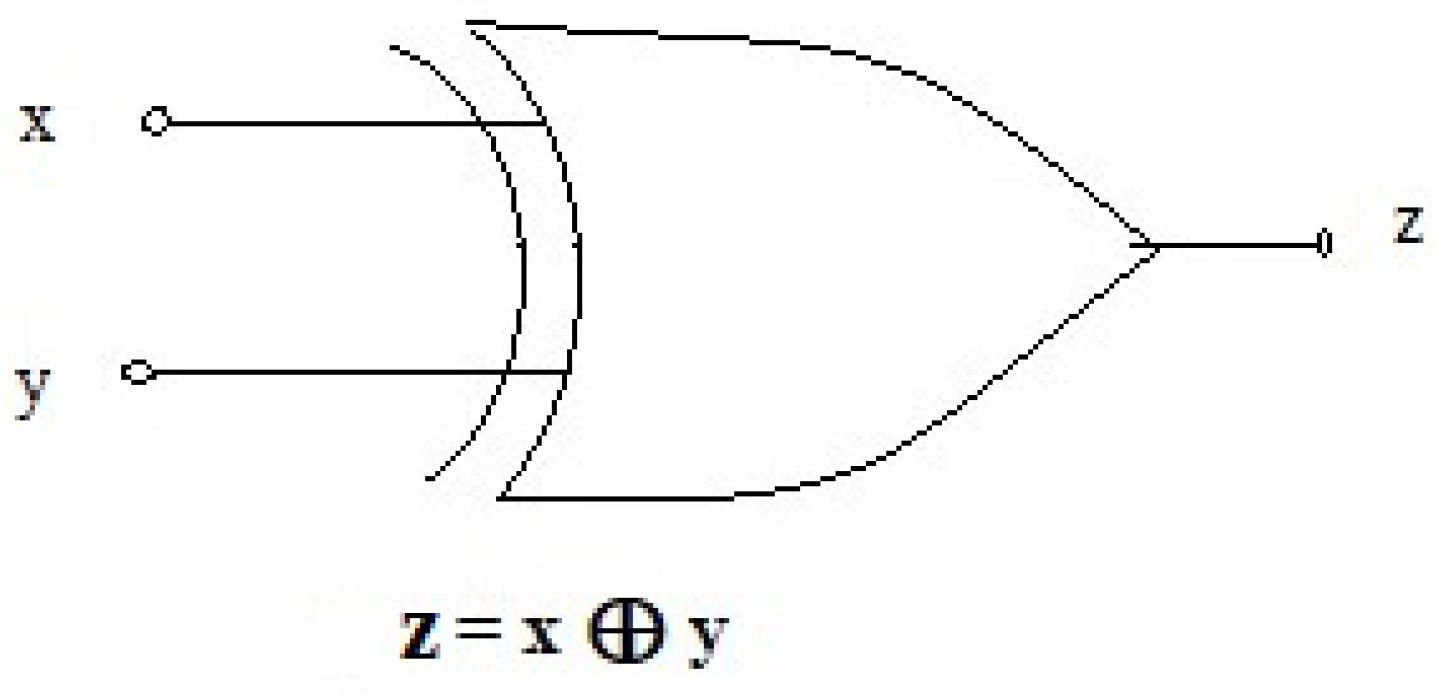
It is well known that symmetric difference as well as XOR-operation are both symmetric. The graphical representation of XOR of x and y for truth values is given by the following Figure 2.
Figure 2.
XOR Gate Symbol.
XOR-operations depict interesting facts, observations, and results to form several real-time applications; one can find its applications in digital communication, neural network, addition operation in CPU, programming contests, binary search, etc. The study of qualitative behavior of a solution of a variational inequality when the given operator and the feasible convex set vary with a parameter is known as sensitivity analysis. As sensitivity analysis is one of the important tools of functional analysis, we will mention some of its applications. It helps decision makers with more than a solution to a problem, it is used to indicate sensitivity of a simulation to uncertainties in the input values of the model; helps in assessing the risk of a strategy; helps to predict the future changes in the governing system; provides useful information for designing or planning various equilibrium systems, etc. Some applications of sensitivity analysis related to real problems are optimal control of anthroponotic cutaneous leishmania, driving conditions for active vehicle control systems, influenza model with treatment and vaccination, dengue epidemiological model, Stochastic human exposure, dose simulation models, etc., for examples, see [23,24,25,26]. Sensitivity analysis for variational inequalities (inclusions) have been studied by Tobin [27], Kyparises [28,29], Dafermos [30], Qui and Magnanti [31], Li et al. [32], Yen and Lee [33], and Agarwal et al. [34], etc. For the sensitivity analysis related to real-life problems, we refer to [35,36] and references therein.
Due to importance of the Cayley operator, inclusion problems, and XOR-operation, we combine all these concepts to introduce two new equivalent problems, that is, parametric mixed Cayley inclusion problem with XOR-operation and parametric resolvent equation problem with XOR-operation. We have established equivalence between parametric mixed Cayley inclusion problem with XOR-operation and parametric resolvent equation problem with XOR-operation. The motivation of this work is to use this equivalence to develop sensitivity analysis for parametric mixed Cayley inclusion problem with XOR-operation without using differentiability of the given data.
2. Preliminaries
Throughout the paper, we assume to be a real ordered Hilbert space with norm and inner product Let be a cone and “≤” be the ordering induced by the cone C. For arbitrary element , holds if and only if, . The relation “≤” in is called a partial ordered relation. The arbitrary elements are said to be comparable to each other if or holds and is denoted by
Definition 1
([37]). For arbitrary elements and mean the least upper bound and the greatest lower bound for the set Suppose and exist, then we have
- (i)
- (ii)
- (iii)
- (iv)
The operations ⊕, and ⊙ are called OR, AND, XOR, and XNOR operations, respectively.
Proposition 1
([37]). Let ⊕ be an XOR-operation, ⊙ be an XNOR-operation, and C be a cone. Then, for each the following relations hold:
- (i)
- (ii)
- if then
- (iii)
- (iv)
- if
- (v)
- if then , if and only if
- (vi)
- (vii)
- (viii)
- if then
Definition 2
([22]). Let be a single-valued mapping and be a multi-valued mapping, then
- (i)
- A is said to be a comparison mapping if then , , and , for all ;
- (ii)
- A is said to be strongly comparison mapping if A is a comparison mapping and , if and only if , ;
- (iii)
- M is said to be a comparison mapping if, for any and if then for any ;
- (iv)
- M is said to be weak comparison mapping if, for any , , then there exists and such that , , and ;
- (v)
- a comparison mapping M is said to be γ-ordered rectangular if there exists a constant and, for any , there exists and such that
- (vi)
- M is said to be λ-weak-ordered different comparison mapping if there exists a constant such that for any , there exists and such that ;
- (vii)
- a weak comparison mapping M is said to be a -weak-ordered rectangular different multivalued mapping, if M is a γ-ordered rectangular and ρ-weak-ordered different comparison mapping and , for .
Definition 3.
Let be a multivalued mapping. The operator defined by
is called the resolvent operator, where is a constant and I is an identity operator.
Definition 4.
The Cayley operator associated with M is defined as
It is easy to check that when , the resolvent operator defined by (1) and the Cayley operator defined by (2) are single valued as well as comparison mappings, see [22].
Lemma 1
([22]). Let be a γ-ordered rectangular multivalued mapping with respect to . Then, the resolvent operator is Lipschitz-type continuous, that is,
Lemma 2
([22]). Let be -weak-ordered rectangular different multivalued mapping with respect to and the resolvent operator is θ-Lipschitz-type-continuous. Then, the Cayley operator defined by (2) is -Lipschitz-type-continuous. That is,
Remark 1.
The resolvent operator of a multivalued mapping plays a big role in several nonlinear programmings, see [38,39,40,41] for recent related results. If , then and . By using of Proposition 1, we can write
Definition 5.
A mapping is called
- (i)
- strongly monotone, if there exists a constant such that
- (ii)
- Lipschitz continuous, if there exists a constant such that
- (iii)
- relaxed Lipschitz continuous, if there exists a constant such that
Let be a nonempty open subset of in which the parameter takes values. We define the following operators.
Definition 6.
Let be a maximal monotone multivalued mapping with respect to first argument. The implicit resolvent operator is defined as
Definition 7.
The implicit Cayley operator is defined as
3. Formulation of the Problem
Let be a real ordered Hilbert space. Let be the maximal monotone multivalued mapping and be the Cayley operator defined by (2). Let be the single valued mappings. We mention the following mixed Cayley inclusion problem (5) as well as its corresponding resolvent equation problem (6) with XOR-operation.
Find such that
Find such that
where I is the identity operator, and is a constant.
A similar version of (5) is considered by Ali et al. [22]. It is easy to show that (5) and (6) are equivalent.
The following equation is a fixed point formulation of (5), which can be shown easily by using the definition of resolvent operator given by (1).
Now, we consider the parametric version of (5) and (6). Let be a maximal monotone multivalued mapping with respect to the first argument, be the parametric Cayley operator defined by (4), , and are the single valued mappings. We consider the following problem:
Find such that
Problem (8) is called the parametric mixed Cayley inclusion problem with XOR-operation. We assume that problem (8) has a unique solution for some .
The following Lemma is a fixed point formulation of (8).
Lemma 3.
The parametric mixed Cayley inclusion Problem (8) has a solution , if and only if it satisfies the following relation:
Proof.
The proof is a direct consequence of the definition of parametric resolvent operator and hence, is omitted. □
In connection with the parametric mixed Cayley inclusion problem with XOR-operation (8), we mention its corresponding parametric resolvent equation problem with XOR-operation.
Find such that
where , I is the identity operator, and is a constant.
Lemma 4.
4. Sensitivity Analysis
We suppose that the solution of the parametric resolvent equation problem with XOR-operation (10) lies in the interior of . Using the technique of Dafermos [30], we consider the following mapping:
where .
Now, we prove that the mapping defined by (14) is a contraction mapping.
Lemma 5.
Let be relaxed Lipschitz continuous and Lipschitz continuous with respect to the first argument with constants and , respectively. Let the mapping be strongly monotone and Lipschitz continuous with constants and , repectively. Suppose that the parametric implicit Cayley operator is Lipschitz-type continuous with constant . Then, for all , and for , we have
where
for
Proof.
Using (14), for all , and as both the concepts symmetric difference △ and ⊕ operation are same, we have
As , using and of Proposition 1, (16) becomes
Since g is strongly monotone and Lipschitz continuous with constants and , respectively, we have
it follows that
Since T is relaxed Lipschitz continuous and Lipschitz continuous with respect to the first argument with constants and , respectively, we obtain
As , , using Proposition 1 and Lemma 2, we have
where ,
Remark 2.
Lemma 5 ensures that the mapping has a unique fixed point , that is, , which is a solution of the parametric resolvent equation problem with XOR-operation (10). It is easy to see that for is a fixed point of and is also a fixed point of We conclude that
Next, we prove that the solution of the parametric resolvent equation problem with XOR-operation (10) is continuous (or Lipschitz continuous).
Lemma 6.
Suppose that the function is continuous with respect to the second argument with constant and the mapping is continuous at (or Lipschitz continuous). If , , and the following condition are satisfied:
where is a constant; then , the solution of the parametric resolvent equation problem with XOR-operation (10) is continuous (or Lipschitz continuous) at
Proof.
Using of Proposition 1, for all and as both the concepts symmetric difference △ and ⊕ operation are same, we evaluate
As , using of Proposition 1 and Lemma 5, (25) becomes
where is same as in Lemma 5.
For illustration of some of the concepts used in this paper, we construct the following conjoin example.
Example 1.
Suppose and the mappings , , and are defined by
We claim that the following hold:
- (1)
- The mapping T is relaxed Lipschitz continuous, Lipschitz continuous with respect to first argument, and continuous with respect to second argument.
- (i)
- that is, is -relaxed Lipschitz continuous with respect to the first argument.
- (ii)
- that is, is -Lipschitz continuous with respect to the first argument.
- (iii)
- that is, is continuous with respect to the second argument.
- (2)
- The mapping g is Lipschitz continuous.that is, is -Lipschitz continuous.
- (3)
- In order to show that the mapping M is ordered rectangular mapping, let and , we evaluateThus, M is -ordered rectangular mapping.
- (4)
- Now, we will show that the solution of the parametric resolvent equation with XOR-operation (10) is continuous (or Lipschitz continuous). We take and evaluate implicit resolvent operator as well as the implicit Cayley operator asand
One can easily show that the implicit resolvent operator (29) and the implicit Cayley operator (30) are Lipschitz continuous. Using Equation (14), we evaluate
which is a solution of the parametric resolvent equation problem with XOR-operation (10). We verify our claim below:
Finally, we evaluate
which shows that the solution of the parametric resolvent equation problem with XOR-operation (10) is continuous (or Lipschitz continuous) at .
5. Conclusions
Sensitivity analysis is instrumental in solving many problems occurring in day-to-day life, such as global climate models, quantifying uncertainty in corporate finance, econometric models in social sciences, optimal experimental design, engineering design, multicriteria decision making, physics, chemistry, human control models, etc. Keeping in view the above mentioned applications of sensitivity analysis, in this paper, we have introduced and studied a parametric mixed Cayley inclusion problem with XOR-operation and a parametric resolvent equation problem with XOR-operation. We have shown that both the problems are equivalent and this equivalent formulation is used to develop the general framework of sensitivity analysis for parametric mixed Cayley inclusion problem with XOR-operation without using differentiability of the given data. We expect that this study will motivate and inspire other researchers of related fields to explore its applications in modern sciences.
Author Contributions
All the authors have contributed equally to this paper. All authors have read and agreed to the published version of the manuscript.
Funding
This work is supported by Ministry of Science and Technology, Taiwan [grant No. MOST 108-2115- M-037-001].
Acknowledgments
All authors are thankful to the reviewers for their valuable comments which improved this paper a lot.
Conflicts of Interest
The authors declare no conflict of interest.
References
- Qin, X.; Yao, J.C. A viscosity iterative method for a split feasibility problem. J. Nonlinear Convex Anal. 2019, 20, 1497–1506. [Google Scholar]
- An, N.T.; Nam, N.M. Solving k-center problems involving sets based on optimization techniques. J. Glob. Optim. 2019. [Google Scholar] [CrossRef] [Scilit]
- Cho, S.Y.; Qin, X. On the strong convergence of an iterative process for asymptotically strict pseudocontractions and equilibrium problems. Appl. Math. Comput. 2014, 235, 430–438. [Google Scholar] [CrossRef] [Scilit]
- Qin, X.; An, N.T. Smoothing algorithms for computing the projection onto a Minkowski sum of convex sets. Comput. Optim. Appl. 2019. [Google Scholar] [CrossRef] [Scilit]
- Takahahsi, W.; Yao, J.C. The split common fixed point problem for two finite families of nonlinear mappings in Hilbert spaces. J. Nonlinear Convex Anal. 2019, 20, 173–195. [Google Scholar]
- Takahashi, W.; Wen, C.F.; Yao, J.C. The shrinking projection method for a finite family of demimetric mappings with variational inequality problems in a Hilbert space. Fixed Point Theory 2018, 19, 407–419. [Google Scholar] [CrossRef] [Scilit]
- Cho, S.Y.; Kang, S.M. Approximation of common solutions of variational inequalities via strict pseudocontractions. Acta Math. Sci. 2012, 32, 1607–1618. [Google Scholar] [CrossRef] [Scilit]
- Chang, S.S.; Wen, C.F.; Yao, J.C. Zero point problem of accretive operators in Banach spaces. Bull. Malays. Math. Sci. Soc. 2019, 42, 105–118. [Google Scholar] [CrossRef] [Scilit]
- Chang, S.S.; Wen, C.F.; Yao, J.C. Common zero point for a finite family of inclusion problems of accretive mappings in Banach spaces. Optimization 2018, 67, 1183–1196. [Google Scholar] [CrossRef] [Scilit]
- Qin, X.; Cho, S.Y. Convergence analysis of a monotone projection algorithm in reflexive Banach spaces. Acta Math. Sci. 2017, 37, 488–502. [Google Scholar] [CrossRef] [Scilit]
- Kimura, Y.; Nakajo, K. Strong convergence for a modified forward-backward splitting method in Banach spaces. J. Nonlinear Var. Anal. 2019, 3, 5–18. [Google Scholar]
- Yang, Y.; Yuan, Q. A hybrid descent iterative algorithm for a split inclusion problem. J. Nonlinear Funct. Anal. 2018, 42. [Google Scholar]
- Qin, X.; Cho, S.Y.; Wang, L. A regularization method for treating zero points of the sum of two monotone operators. Fixed Point Theory Appl. 2014, 75. [Google Scholar] [CrossRef] [Scilit]
- Gibali, A.; Ha, N.H.; Thuong, N.T.; Trang, T.H.; Vinh, N.T. Polyak’s gradient method for solving the split convex feasibility problem and its applications. J. Appl. Numer. Optim. 2019, 1, 145–156. [Google Scholar]
- Husain, S.; Singh, N. A hybrid iterative algorithm for a split mixed equilibrium problem and a hierarchical fixed point problem. Appl. Set-Valued Anal. Optim. 2019, 1, 149–169. [Google Scholar]
- Qin, X.; Cho, S.Y.; Wang, L. Iterative algorithms with errors for zero points of m-accretive operators. Fixed Point Theory Appl. 2013, 148. [Google Scholar] [CrossRef] [Scilit]
- Cho, S.Y. Strong convergence analysis of a hybrid algorithm for nonlinear operators in a Banach space. J. Appl. Anal. Comput. 2018, 8, 19–31. [Google Scholar]
- Ahmad, I.; Pang, C.T.; Ahmad, R.; Ishtyak, M. System of Yosida inclusions involving XOR-operation. J. Nonlinear Convex Anal. 2017, 18, 831–845. [Google Scholar]
- Ahmad, I.; Rahaman, M.; Ahmad, R.; Ali, I. Convergence analysis and stability of perturbed three-step iterative algorithm for generalized mixed order quasi-variational inclusion involving XOR-operation. Optimization 2019. [Google Scholar] [CrossRef] [Scilit]
- Bin Dehaish, B.A. Weak and strong convergence of algorithms for the sum of two accretive operators with applications. J. Nonlinear Convex Anal. 2015, 16, 1321–1336. [Google Scholar]
- Qin, X.; Cho, S.Y.; Yao, J.C. Weak and strong convergence of splitting algorithms in Banach spaces. Optimization 2019. [Google Scholar] [CrossRef] [Scilit]
- Ali, I.; Ahmad, R.; Wen, C.F. Cayley Inclusion Problem Involving XOR-operation. Mathematics 2019, 7, 302. [Google Scholar] [CrossRef] [Scilit]
- Zamir, M.; Zaman, G.; Alshomrani, A.S. Sensitivity analysis and optimal control of anthroponotic cutaneous leishmania. PLoS ONE 2011, 11, e0160513. [Google Scholar] [CrossRef] [Scilit]
- Schnelle, S.; Wang, J. Sensitivity analysis of human driving characteristics on road and driving conditions for active vehicle control systems. IEEE Int. Conf. Syst. Man Cybern. SMC 2014. [Google Scholar] [CrossRef] [Scilit]
- Tchuenche, J.M.; Khamis, S.A.; Agusto, F.B.; Mpeshe, S.C. Optimal control and sensitivity analysis of an influenza model with treatment and vaccination. Acta Biotheor. 2011, 59, 1–28. [Google Scholar] [CrossRef] [Scilit]
- Rodrigues, H.S.; Monteiro, M.T.T.; Torres, D.F.M. Sensitivity analysis in a dengue epidemiological model. Conf. Pap. Math. 2013, 721406. [Google Scholar] [CrossRef] [Scilit]
- Tobin, R.L. Sensitivity analysis for variational inequalities. J. Optim. Theory Appl. 1986, 48, 191–204. [Google Scholar] [CrossRef] [Scilit]
- Kyparisis, J. Sensitivity analysis framework for variational inequalities. Math. Program. 1987, 38, 203–213. [Google Scholar] [CrossRef] [Scilit]
- Kyparisis, J. Sensitivity analysis for variational inequalities and nonlinear complementarity problems. Ann. Oper. Res. 1990, 27, 143–173. [Google Scholar] [CrossRef] [Scilit]
- Dafermos, S. Sensitivity analysis in variational inequalities. Math. Oper. Res. 1988, 13, 421–434. [Google Scholar] [CrossRef] [Scilit]
- Qui, Y.; Magnanti, T.L. Sensitivity analysis for variational inequalities defined on polyhedral sets. Math. Oper. Res. 1989, 14, 410–432. [Google Scholar]
- Li, H.G.; Li, L.P.; Zheng, J.M.; Jin, M.M. Sensitivity analysis for generalized set-valued parametric ordered variational inclusion with (α,λ)-NODSM mappings in ordered Banach spaces. Fixed Point Theory Appl. 2014, 2014, 122. [Google Scholar] [CrossRef] [Scilit]
- Yen, N.D.; Lee, G.M. Solution sensitivity of a class of variational inequalities. J. Math. Anal. Appl. 1997, 215, 48–55. [Google Scholar] [CrossRef] [Scilit]
- Agarwal, R.P.; Huang, N.J.; Tan, M.Y. Sensitivity analysis for a new system of generalized nonlinear mixed quasi-variational inclusions. Appl. Math. Lett. 2004, 17, 345–352. [Google Scholar] [CrossRef] [Scilit]
- Hsu, F.K.; Bahill, A.T.; Stark, L. Parametric sensitivity analysis of a homeomorphic model for saccadic and vergence eye movements. Comput. Programs Biomed. 1976, 6, 108–116. [Google Scholar] [CrossRef] [Scilit]
- Martínez-García, M.; Zhang, Y.; Gordon, T. Modeling Lane Keeping by a Hybrid Open-Closed-Loop Pulse Control Scheme. IEEE Trans. Ind. Inform. 2016, 12, 2256–2265. [Google Scholar] [CrossRef] [Scilit]
- Du, Y.H. Fixed points of increasing operators in ordered Banach spaces and applications. Appl. Anal. 1990, 38, 1–20. [Google Scholar] [CrossRef] [Scilit]
- Qin, X.; Petrusel, A.; Yao, J.C. CQ iterative algorithms for fixed points of nonexpansive mappings and split feasibility problems in Hilbert spaces. J. Nonlinear Convex Anal. 2018, 19, 157–165. [Google Scholar]
- Zhao, X. Linear regularity and linear convergence of projection-based methods for solving convex feasibility problems. Appl. Math. Optim. 2018, 78, 613–641. [Google Scholar] [CrossRef] [Scilit]
- Ogbuisi, F.U. Popov subgradient extragradient algorithm for pseudomonotone equilibrium problems in Banach spaces. J. Nonlinear Funct. Anal. 2019, 2019, 44. [Google Scholar]
- Ceng, L.C.; Petrusel, A.; Yao, J.C.; Yao, Y. Systems of variational inequalities with hierarchical variational inequality constraints for Lipschitzian pseudocontractions. Fixed Point Theory 2019, 20, 113–134. [Google Scholar] [CrossRef] [Scilit]
© 2020 by the authors. Licensee MDPI, Basel, Switzerland. This article is an open access article distributed under the terms and conditions of the Creative Commons Attribution (CC BY) license (http://creativecommons.org/licenses/by/4.0/).