1. Statement of the Problem
In this paper, an abstract sampling theory associated with non abelian groups is derived for the specific case of a unitary representation of a semi-direct product of groups on a separable Hilbert space. Semi-direct product of groups provide important examples of non abelian groups such as dihedral groups, infinite dihedral group, Euclidean motion groups or crystallographic groups. Concretely, let
be a unitary representation on a separable Hilbert space
of a semi-direct product
, where
N is a countable discrete LCA (locally compact abelian) group,
H is a finite group, and
denotes the action of the group
H on the group
N (see
Section 2 infra for the details); for a fixed
we consider the
U-invariant subspace in
where we assume that
is a Riesz sequence for
, i.e., a Riesz basis for
(see Ref. [
1] for a necessary and sufficient condition). Given
K elements
in
, which do not belong necessarily to
, the main goal in this paper is the stable recovery of any
from the given data (generalized samples)
where
denotes the identity element in
H. These samples are nothing but a generalization of average sampling in shift-invariant subspaces of
; see, among others, Refs. [
2,
3,
4,
5,
6,
7,
8,
9]. The case where
G is a discrete LCA group and the samples are taken at a uniform lattice of
G has been solved in Ref. [
10]; this work relies on the use of the Fourier analysis in the LCA group
G (see also Ref. [
11]). In the case involved here, a classical Fourier analysis is not available and, consequently, we need to overcome this drawback.
Having in mind the filter bank formalism in discrete LCA groups (see, for instance, Refs. [
12,
13,
14]), the given data
can be expressed as the output of a suitable
K-channel analysis filter bank corresponding to the input
in
. As a consequence, the problem consists of finding a synthesis part of the former filter bank allowing perfect reconstruction; in addition, only Fourier analysis on the LCA group
N is needed. Then, roughly speaking, substituting the output of the synthesis part in
, we will obtain the corresponding sampling formula in
.
This said, as it could be expected, the problem can be mathematically formulated as the search of dual frames for
having the form
Here,
,
and
,
, where
and
. In addition, for any
, we have the expression for its samples
Needless to say, frame theory plays a central role in what follows; the necessary background on Riesz bases or frame theory in a separable Hilbert space can be found, for instance, in Ref. [
15]. Finally, sampling formulas in
having the form
for some
,
, will come out by using, for
and
, the shifting property
that satisfies the natural isomorphism
which maps the usual orthonormal basis
for
onto the Riesz basis
for
. All these steps will be carried out throughout the remaining sections. For the sake of completeness,
Section 2 includes some basic preliminaries on semi-direct product of groups and Fourier analysis on LCA groups. The paper ends with an illustrative example involving the quasi regular representation of a crystallographic group on
; sampling formulas involving average or pointwise samples are obtained for the corresponding
U-invariant subspaces in
.
3. Filter Bank Formalism on Semi-Direct Product of Groups
In what follows, we will assume that
where
is a countable discrete abelian group and
is a finite group. Having in mind the operational calculus
,
and
, the convolution
of
can be expressed as
For a function
, its
H-decimation is defined as
for any
. Thus, we have
Defining the polyphase components of
and
as
and
respectively, we write
For a function
, its
H-expander is defined as
In case
and
belong to
we have
where
is the polyphase component of
.
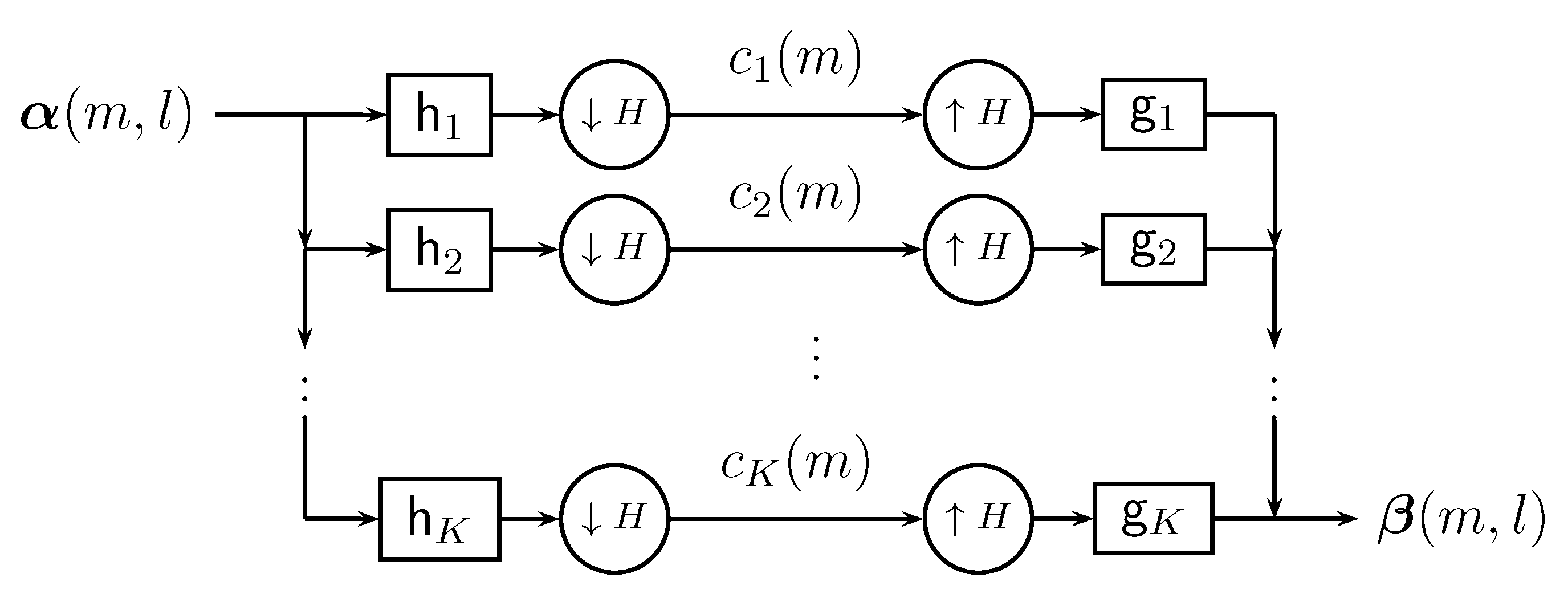
From now on, we will refer to a
K-channel filter bank with
analysis filters and
synthesis filters ,
as the one given by (see
Figure 1)
where
and
denote, respectively, the input and the output of the filter bank. In polyphase notation,
where
,
,
and
are the
polyphase components of
,
,
and
,
, respectively. We also assume that
with
for
and
; from Lemma 1, the filter bank (
3) is well defined in
.
The above
K-channel filter bank (
3) is said to be a
perfect reconstruction filter bank if and only if it satisfies
for each
, or equivalently,
for each
.
Since
N is an LCA group where a Fourier transform is available, the polyphase expression (
4) of the filter bank (
3) allows us to carry out its polyphase analysis.
Polyphase Analysis: Perfect Reconstruction Condition
For notational ease, we denote
, the order of the group
H, and its elements as
. Having in mind Lemma 1, the
N-Fourier transform in
gives
a.e.
for each
. In matrix notation,
where
,
, and
is the
matrix
where
is the Fourier transform of
.
The same procedure for
gives
a.e.
. In matrix notation,
where
,
and
is the
matrix
where
is the Fourier transform of
.
Thus, in terms of the
polyphase matrices and
the filter bank (
3) can be expressed as
As a consequence of Equation (
7), we have:
Theorem 1. The K-channel filter bank given in Equation (
3)
, where belong to and belong to for and , satisfies the perfect reconstruction property if and only if a.e. , where denotes the identity matrix of order L. Proof. First of all, note that the mapping
is a unitary operator. Indeed, for each
we have the isometry property
It is also surjective since the
N-Fourier transform is a surjective isometry between
and
. Having in mind this property, Equation (
7) tells us that the filter bank satisfies the perfect reconstruction property if and only if
a.e.
. □
Notice that, in the perfect reconstruction setting, the number of channels K must be necessarily bigger or equal that the order L of the group H, i.e., .
4. Frame Analysis
For
, the
translation operator is defined as
The
involution operator is defined as
,
. As expected, the classical relationship between convolution and translation operators holds. Thus, for the
K-channel filter bank (
3), we have (see (
2)):
In the perfect reconstruction setting, for any
we have
Given K sequences , , our main tasks now are: to characterize the sequence as a frame for , and to find its dual frames having the form .
To the first end, we consider a
K-channel analysis filter bank with analysis filters
, i.e., the involution of
,
; let
be its associated
polyphase matrix (
5). First, we check that Equation (
5) is:
where
denotes the Fourier transform in
of
in
. Indeed, for
and
, having in mind that
for analysis filters, we have
Next, we consider its associated constants
Theorem 2. For in , , consider the associated matrix given in Equation (
10)
. Then, - 1.
The sequence is a Bessel sequence for if and only if .
- 2.
The sequence is a frame for if and only if the inequalities hold.
Proof. Using Plancherel theorem ([
16], Theorem 4.25), for each
we get
where
and
denotes the
k-th row of
.
Since
is an orthonormal basis for
, in case that
we have
If
, having in mind that
, the above equality and the Rayleigh–Ritz theorem ([
18], Theorem 4.2.2) prove that
is a Bessel sequence for
with Bessel bound less or equal than
.
On the other hand, if
then there exists a set
having a strictly positive measure such that
for
. Consider
such that its associated
is 0 if
, and
is a unitary eigenvector corresponding to the largest eigenvalue of
if
. Thus, we have that
As a consequence, if , the sequence is not Bessel, and, if , the optimal bound is precisely .
Similarly, by using inequality , and that equality holds whenever is a unitary eigenvector corresponding to the smallest eigenvalue of one proves the other inequality in part 2. □
Corollary 1. The sequence is a Bessel sequence for if and only if for each and the function belongs to .
Proof. It is a direct consequence of the equivalence between the spectral and Frobenius norms for matrices [
18]. □
It is worth mentioning that
in
,
, implies that the sequence
is always a Bessel sequence for
since each function
is continuous and
is compact. In this case, the frame condition for
reduces to
for all
or, equivalently,
To the second end, a
K-channel filter bank formalism allows, in a similar manner, to obtain properties in
of the sequences
and
. In case they are Bessel sequences for
, the idea is to consider a
K-channel filter bank (
3) where the analysis filters are
and the synthesis filters are
,
. As a consequence, the corresponding polyphase matrices
and
, given in Equations (
5) and (
6), are
Theorem 3. Let and be two Bessel sequences for , and and their associated matrices (
11)
. Under the above circumstances, we have: - (a)
The sequences and are dual frames for if and only if condition a.e. holds.
- (b)
The sequences and are biorthogonal sequences in if and only if condition a.e. holds.
- (c)
The sequences and are dual Riesz bases for if and only if and a.e. .
- (d)
The sequence is an A-tight frame for if and only if condition a.e. holds.
- (e)
The sequence is an orthonormal basis for if and only if and a.e. .
Proof. Having in mind Equation (
9) and Corollary 1, part
is nothing but Theorem 1.
The output of the analysis filter bank (
3) corresponding to the input
is a
K-vector whose
k-entry is
and whose
N-Fourier transform is
a.e.
, where
is the
-column of the matrix
. Note that
and
are biorthogonal if and only if
. Therefore, the sequences
and
are biorthogonal if and only if
. Thus, we have proved
.
Having in mind ([
15], Theorem 7.1.1), from
and
we obtain
.
We can read the frame operator corresponding to the sequence
, i.e.,
as the output of the filter bank (
3), whenever
and
, for the input
. For this filter bank, the
-entry of the analysis polyphase matrix
is
and the
-entry of the synthesis polyphase matrix
is
; in other words,
. Hence, the sequence
is an
A-tight frame for
, i.e.,
if and only if
for all
. Thus, we have proved
.
Finally, from and the sequence is an orthonormal system if and only if a.e. . □
5. Getting on with Sampling
Suppose that
is a unitary representation of the group
on a separable Hilbert space
, and assume that for a fixed
the sequence
is a Riesz sequence for
(see Ref. ([
1], Theorem A)). Thus, we consider the
U-invariant subspace in
For
K fixed elements
,
, not necessarily in
, we consider for each
its generalized samples defined as
The task is the stable recovery of any from the data .
In what follows, we propose a solution involving a perfect reconstruction
K-channel filter bank. First, we express the samples in a more suitable manner. Namely, for each
in
, we have
where
, and
also belongs to
for each
.
Suppose also that there exists a perfect reconstruction
K-channel filter-bank with analysis filters the above
and synthesis filters
,
, such that the sequences
and
are Bessel sequences for
. Having in mind Equation (
9), for each
in
we have
In order to derive a sampling formula in
, we consider the natural isomorphism
which maps the usual orthonormal basis
for
onto the Riesz basis
for
, i.e.,
This isomorphism possesses the following shifting property:
Lemma 2. For each , consider the translation operator operator defined in Equation (
8)
. For each , the following shifting property holds Proof. For each
it is easy to check that
. Hence,
A continuity argument proves the result for all in . □
Now, for each
, applying the isomorphism
and the shifting property (
14) in Equation (
13), we get for each
the expansion
where
,
. In fact, the following sampling theorem in the subspace
holds:
Theorem 4. For K fixed , let be its associated U-system defined in Equation (
12)
with corresponding , . Assume that its polyphase matrix given in Equation (
5)
has all its entries in . The following statements are equivalent: - 1.
The constant .
- 2.
There exist in , , such that the associated polyphase matrix given in (
6)
has all its entries in , and it satisfies a.e. . - 3.
There exist K elements such that the sequence is a frame for and, for each , the sampling formulaholds. - 4.
There exists a frame for such that for each the expansionholds.
Proof. implies . The Moore–Penrose pseudo-inverse of is given by . Its entries are essentially bounded in since the entries of belong to and is essentially bounded since . In addition, a.e. . The inverse N-Fourier transform in of the k-th column of gives , .
implies
. According to Theorems 2 and 3, the sequences
and
form a pair of dual frames for
. We deduce the sampling expansion as in Formula (
15). In addition, the sequence
is a frame for
.
Obviously, implies . Finally, implies . Applying we get that the sequences and form a pair of dual frames for ; in particular, by using Theorem 2, we obtain that . □
All the possible solutions of a.e. with entries in are given in terms of the Moore–Penrose pseudo inverse by the matrices , where denotes any matrix with entries in .
Notice that where L is the order of the group H. In case , we obtain:
Corollary 2. In the case , assume that its polyphase matrix given in Equation (
5)
has all entries in . The following statements are equivalent: - 1.
The constant .
- 2.
There exist L unique elements , , in such that the associated sequence is a Riesz basis for and the sampling formulaholds for each .
Moreover, the interpolation property , where and , holds.
Proof. In this case, the square matrix is invertible and the result comes out from Theorem 3. From the uniqueness of the coefficients in a Riesz basis expansion, we get the interpolation property. □
Denote
; for a fixed
, we consider the samples
of any
. Since
, where
,
, we are in a particular case of Equation (
12) with
.
Notice also that the subspace
can be viewed as the multiple generated
U-invariant subspace of
with
L generators
,
, obtained from
by the action of the group
H.
5.1. An Example Involving Crystallographic Groups
The Euclidean motion group is the semi-direct product corresponding to the homomorphism given by , where and . The composition law on reads .
Let
M be a non-singular
matrix and
a finite subgroup of
of order
L such that
for each
. We consider the
crystallographic group and its quasi regular representation (see Ref. [
1]) on
For a fixed
such that the sequence
is a Riesz sequence for
(see, for instance, Refs. [
19,
20]) we consider the
U-invariant subspace in
Choosing
K functions
,
, we consider the average samples of
Under the hypotheses in Theorem 4, there exist
sampling functions
for
, such that the sequence
is a frame for
, and the sampling expansion
holds.
If the generator and the function is bounded on , a standard argument shows that is a reproducing kernel Hilbert space (RKHS) of bounded continuous functions in . As a consequence, convergence in -norm implies pointwise convergence which is absolute and uniform on .
Notice that the infinite dihedral group
is a particular crystallographic group with lattice
and
. Its quasi regular representation on
reads
Thus, we could obtain sampling formulas as (
17) for
average functions
.
The quasi regular unitary representation of a crystallographic group on motivates the next section:
5.2. The Case of Pointwise Samples
Let
be a unitary representation of the group
on the Hilbert space
. If the generator
satisfies that, for each
, the function
is continuous on
, and the condition
then the subspace
is an RKHS of bounded continuous functions in
; proceeding as in [
21], one can prove that the above conditions are also necessary.
For
K fixed points
,
, we consider for each
the new samples given by
For each
in
and
, we have
where
and
,
. Notice that
belongs to
,
. As a consequence, under the hypotheses in Theorem 4 (on these new
,
), a sampling formula such as (
16) holds for the data sequence
defined in Equation (
18).
In the particular case of the quasi regular representation of a crystallographic group
, for each
, the samples (
18) read
Thus (under hypotheses in Theorem 4), there exist
K functions
,
, such that for each
the sampling formula
holds. The convergence of the series in the
-norm sense implies pointwise convergence which is absolute and uniform on
.
6. Conclusions
In this paper, we have derived an abstract regular sampling theory associated with a unitary representation
of a group
G which is a semi-direct product of two groups,
N countable discrete abelian group and
H finite, on a separable Hilbert space
; here, regular sampling means that we are taken the samples at the group
N. Concretely, the sampling theory is obtained in the
U-invariant subspace of
generated by
that is
and the samples of
are given by
,
, where
,
, denote
K fixed elements in
which do not belong necessarily to
. We look for
K elements
such that the sequence
is a frame for
and, for each
, the sampling formula
holds.
A similar problem was solved when the group
G is a discrete LCA group and the samples are taken at a uniform lattice of
G (see Ref. [
10]). In the case of an abelian group, we have the Fourier transform, a basic tool in this previous work. In the present work, a classical Fourier analysis on
G is not available, but if
G is a semi-direct product of the form
, where
N is a countable discrete abelian group and
H is a finite group, the Fourier transform on the abelian group
N allows us to solve the problem by means of a filter bank formalism. Recalling the filter bank formalism in discrete LCA groups, the defined samples are expressed as the output of a suitable
K-channel analysis filter bank corresponding to the input
. The frame analysis of this filter bank along with the synthesis one giving perfect reconstruction allows us to obtain a pair of suitable dual frames for obtaining the desired sampling result, which is written as a list of equivalent statements (see Theorem 4).
Although the semi-direct product of groups represents, so to speak, the simplest case of non-abelian groups, this paper can be a good starting point for finding sampling theorems associated with unitary representations of non abelian groups that are not isomorphic to a semi-direct product of groups.