You are currently viewing a new version of our website. To view the old version click .
Symmetry
  • Article
  • Open Access

2 February 2019

Cross-Language End-to-End Speech Recognition Research Based on Transfer Learning for the Low-Resource Tujia Language

,
,
,
,
and
1
College of Computer & Information Engineering, Beijing Technology and Business University, Beijing 100048, China
2
Institute of Ethnology & Anthropology, Chinese Academy of Social Sciences, Beijing 100081, China
*
Author to whom correspondence should be addressed.
This article belongs to the Special Issue Information Technology and Its Applications 2021

Abstract

To rescue and preserve an endangered language, this paper studied an end-to-end speech recognition model based on sample transfer learning for the low-resource Tujia language. From the perspective of the Tujia language international phonetic alphabet (IPA) label layer, using Chinese corpus as an extension of the Tujia language can effectively solve the problem of an insufficient corpus in the Tujia language, constructing a cross-language corpus and an IPA dictionary that is unified between the Chinese and Tujia languages. The convolutional neural network (CNN) and bi-directional long short-term memory (BiLSTM) network were used to extract the cross-language acoustic features and train shared hidden layer weights for the Tujia language and Chinese phonetic corpus. In addition, the automatic speech recognition function of the Tujia language was realized using the end-to-end method that consists of symmetric encoding and decoding. Furthermore, transfer learning was used to establish the model of the cross-language end-to-end Tujia language recognition system. The experimental results showed that the recognition error rate of the proposed model is 46.19%, which is 2.11% lower than the that of the model that only used the Tujia language data for training. Therefore, this approach is feasible and effective.

1. Introduction

Endangered languages are non-renewable intangible cultural resources. The core task of salvaging and preserving endangered languages is the mechanism of recording speech, processing corpus, and preserving language information. In China, the dialects of many ethnic minorities have no texts and exist only in the form of spoken language. The number of native speakers is so small that the recordings of long natural speech are extremely limited. There are more than 130 dialects of Chinese ethnic minorities, nearly half of which are in a state of recession and dozens of which are endangered. This trend is continuing and even worsening [1]. Therefore, it is an imperative duty to protect endangered languages, maintain the diversity of language culture, and retain valuable historical cultural heritage. Automatic speech recognition of endangered languages is a new and effective way to rescue and preserve endangered languages. Because endangered languages have a low-resource attribute, speech recognition for endangered languages requires low-resource speech recognition. The Tujia language, one of the endangered languages, poses a great challenge to automatic speech recognition.
Speech signal is a non-stationary timing signal whose formation and sensing are a complex signal process. Speech recognition can be regarded as a sequence-to-sequence classification problem, in which the acoustic observation sequence X = ( x 1 , x 2 , , x T ) is mapped to the character sequence W = ( w 1 , w 2 , , w N ) and calculates the probability P ( W | X ) , where T is the time and N is the number of characters [2]. In the timing classification task, the commonly used method is to train by frame using the hidden Markov model (HMM) under the condition that the input data and the given label must be frame-level aligned in time. However, the frame-by-frame training output is the single frame probability. For timing problems, the probability of an output sequence is much more important than the probability of outputting a single frame. At present, most of the automatic speech recognition technologies at home and abroad rely on many data resources. The training of the entire model is divided into multiple stages and there are multiple optimization goals. Thus, it is difficult to find the global optimal solution. In response to this problem, recent research internationally in the field of speech recognition based on deep learning has partly focused on end-to-end speech recognition technology [3,4,5,6,7]. This method directly models between the phoneme sequence or context-dependent phone (CD-phone) sequence and the corresponding phonetic feature sequence that does not need constraint alignment to obtain frame-level annotation with HMM. Compared with the traditional acoustic models, it can provide a better performance.
Currently, few researchers are applying the end-to-end model to low-resource speech recognition. Previous research methods for low-resource speech recognition primarily included cross-language, transfer learning, and semi-supervising. The structure of a deep neural network (DNN) for cross-language speech recognition was generally that the input layer and the hidden layer were shared by all languages, whereas the output layer was not shared. Moreover, each language had its own softmax layer to estimate the posterior probability after clustering [8,9]. Transfer learning is an emerging research field in machine learning that aims to use the knowledge learned from other tasks to help solve the target tasks. Transfer learning reduced the dependence on target training data by finding the common knowledge between existing tasks and target tasks, which can help the model to learn target tasks better [10,11]. According to [12], the accuracy rate of the cross-language speech recognition model based on sequence was 6% higher than that of the speech recognition model using only a single language, but the model still needed to be improved. The attention-based connectionist temporal classification (CTC) model in [13], effectively completing the keyword search and speech recognition of low resource languages, had an insufficient effect of speech recognition. It achieved topic and keyword identification that the cross-language transfer learning method in [14] used to learn the characteristics of low-resourced languages from rich-resourced languages achieves, but it only used unsupervised learning to generate valid data due to a lack of native transcriptions. The speech emotion classification model of deep belief networks (DBNs) was trained in five types of speech databases in [15], and the transfer learning method was used to improve the speech emotion classification accuracy. The experimental results showed that the accuracy rate improved significantly.
The preservation of an endangered language corpus requires text processing, such as labelling and translation, for the recording of natural language discourses. At present, it has become a bottleneck in the protection of the Tujia language. First, much manpower and time is needed for a language protection project. Generally, at least an hour of text processing is needed for a minute of recording. Speech data without text processing has no intelligibility and preservation value. Second, few people use the Tujia language, and professionals who can process text corpus are scarce. Therefore, the achievement of the speech recognition system in this paper can help linguists to complete the work of transcribing the Tujia language, which can greatly reduce labor and time cost and has important theoretical significance and applied value.
There are two main contributions from this paper. First, speech features are extracted using a convolutional neural network. In addition, cross-language hidden layer weights are shared using a bi-directional long short-term memory network. Using Chinese speech datasets as extended datasets can solve the insufficiency of the Tujia language. The second point is to use the method of transfer learning. The initial model is built by training the Tujia language and Chinese corpus by means of modifying the softmax layer of the initial model and proceeding with sample transfer learning. Then, continuing to train with the Tujia corpus obtains the final model.
The remainder of this paper is organized as follows. Section 1 presents reviews of related deep learning algorithms. Section 2 introduces the proposed method and model. The experimental results and model parameters are presented in Section 3, and conclusions are drawn in Section 4.

3. Proposed Method

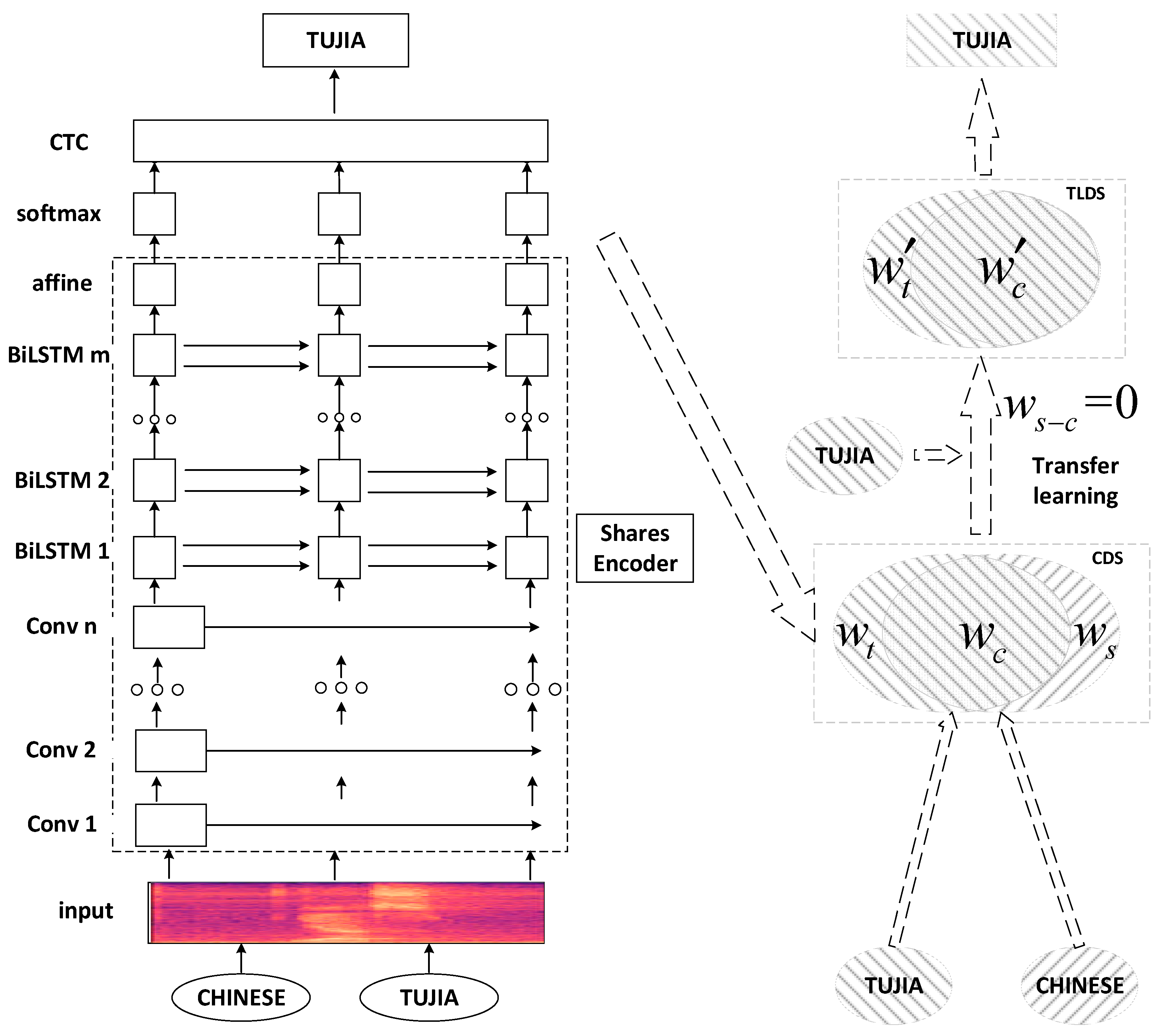
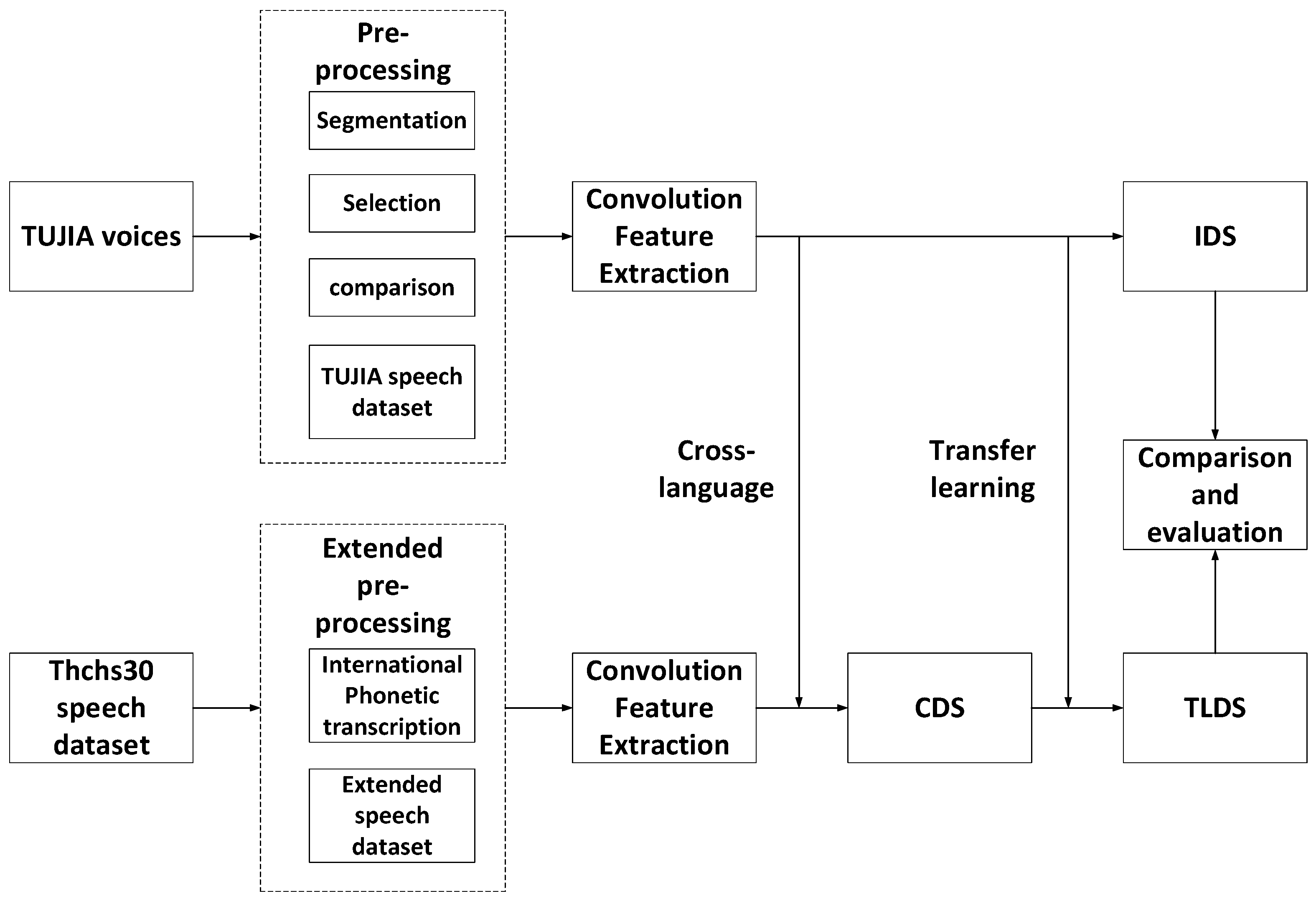
In this paper, we propose to use cross-lingual speech recognition and transfer learning to establish a Tujia language speech recognition model. The model scheme is shown in Figure 1.
Figure 1. Model scheme.
First, the Tujia language database, the extended Chinese corpus and the cross-language corpus are established successively through data pre-processing. Then, convolution features are extracted from speech data. The speech recognition model based on the BiLSTM and CTC is constructed. Hereinto, Improved Deep Speech 2 (IDS) is a model obtained using the Tujia language corpus as training data. Cross-language Deep Speech 2 (CDS) is a model obtained using the Tujia language and Chinese corpus as training data. The sample transfer learning is performed on the initial model, CDS, and the CDS-based Transfer Learning Deep Speech 2 (TLDS) is obtained from the Tujia corpus as training data. Finally, according to the experimental results, the models are compared and evaluated.

3.1. Cross-Language Data Pre-processing and Feature Extraction

3.1.1. Tujia Language Corpus

In this study, the Tujia language corpus used in the experimental part includes 19 oral corpora. There is a total of 3716 sentences, with a total duration of 2 h, 54 min, and 4 s. The manual labelling of the Tujia language is completed using the Elan tool, and its contents include spoken to broad IPA, spoken to Chinese one-to-one translation, and spoken to Chinese translation. The manual annotation content of the Tujia language is shown in Table 1.
Table 1. The manual annotation content of the Tujia language.
Table 1 shows that the text processing of the Tujia language recording materials generally includes multiple levels. First, the voice is recorded with broad IPA or Tujia dialect symbols created, and then Tujia language words are translated one by one to Chinese. Finally, the sentences of the Tujia language are translated to Chinese. For the national language rather than the pure-speech language, it is necessary to write down the voice in the national language, which is called transliteration. The meaning of the label is more general and can be used for text processing including all layers. The narrowly defined labels refer to the grammatical labelling layer including the wording, prefix, suffix, and so on. The phoneme system of the Tujia language is composed of initials and finals. The 21 initials include two semi-vowel initials. The finals consist of 6 monophthongs, 11 diphthongs, and 8 orinasals [40,41].

3.1.2. Extended Speech Corpus

The thchs30 Chinese corpus [42] was recorded by 25 people. The text labels include Chinese characters and pinyin with tones. There are 13,395 sentences in total, the total recording time is 30 h, the sampling frequency is 16 kHz, and the sampling size is 16 bits. This paper needs to convert Chinese characters into broad IPA. The IPA transcription process of the thchs30 corpus is show in Table 2.
Table 2. Extended speech corpus data processing.
First, from Chinese characters to pinyin, then to IPA. The Broad IPA are used in the process of recording the Tujia language, and the Narrow IPA are used in Chinese. Therefore, it is necessary to convert narrow IPA into broad IPA, which is consistent with the Tujia language IPA. Its conversion rules are shown in Table 3.
Table 3. The rules for converting Chinese IPA into Tujia language IPA.
The Chinese speech data set is used as the extended data of the Tujia language, which solves the problem of the insufficient voice data for the Tujia language. At the same time, a cross-language corpus is constructed and a unified IPA code dictionary for the Chinese and Tujia languages is established. This paper compares the similarities and differences between the Tujia and Chinese languages according to the Jaccard similarity coefficient [43]. The definition of the Jaccard index is as follows:
J ( A T u j i a , B C h i n e s e ) = | A T u j i a B C h i n e s e | | A T u j i a B C h i n e s e |
where A T u j i a is the IPA transcription of the Tujia language, B C h i n e s e is the Chinese IPA transcription, the denominator represents the intersection of the Tujia language IPA and the Chinese IPA, and the numerator represents the union of the Tujia language IPA and the Chinese IPA. The statistical results show that the similarity between the IPA dictionaries of the Tujia and Chinese languages is 53.33%. Therefore, according to the definition of transfer learning, the sample transfer method can be used to model the Tujia language data. In fact, the thchs30 data set is large. To ensure the normal fitting of the CDS model to the Tujia language, the experimental comparison results show that when the Tujia language and Chinese corpus are 1:1.2 in the number of sentences, the model recognition effect is optimal, so for this paper only 4460 Chinese data were used when training CDS.

3.1.3. Feature Extraction

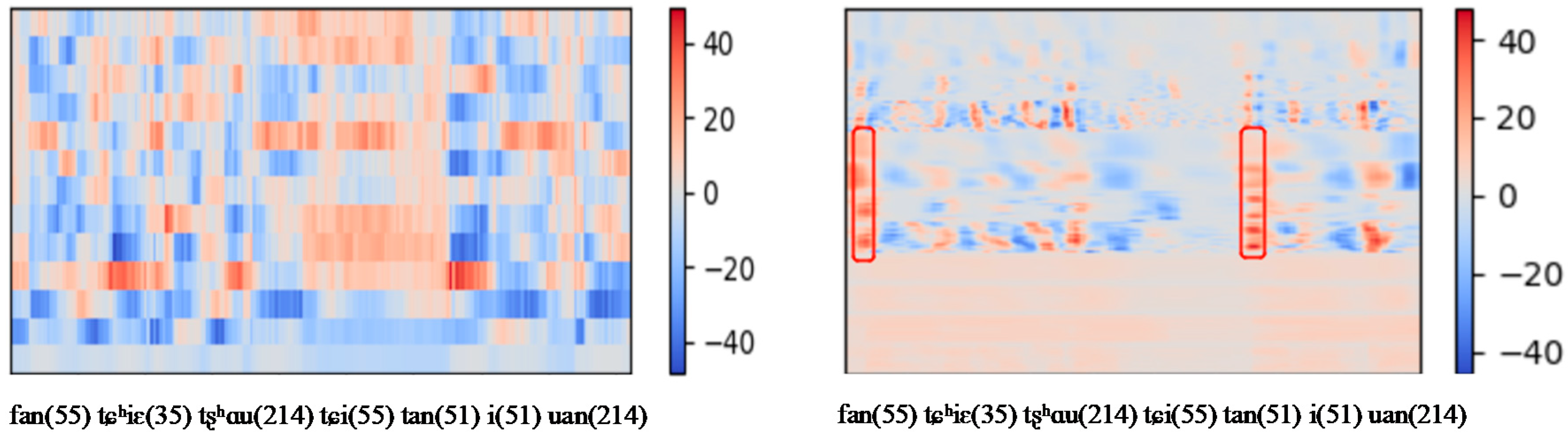
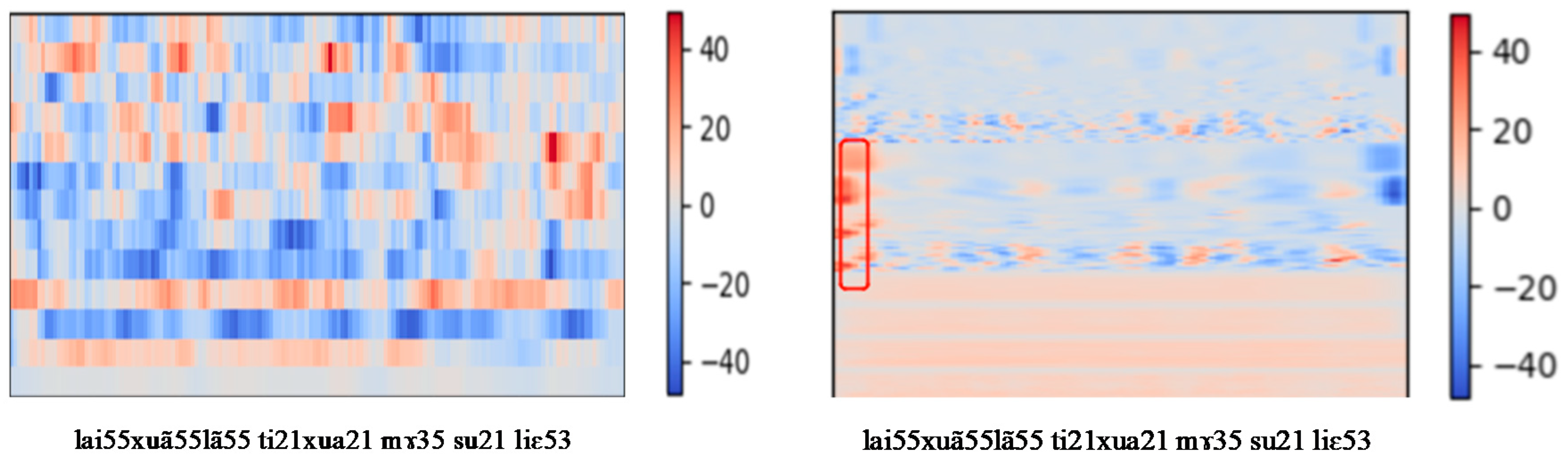
In general, speech recognition is based on the speech spectrum after the time-frequency analysis, in which the speech time spectrum is structurally characterized. To improve the speech recognition rate it is necessary to overcome the diversity of speech signals, including the diversity of speakers (between the speaker and the speaker), and the diversity of the environment. For modelling capabilities, a CNN can effectively reduce the frequency domain changes [44]. As shown in the following figure, the 768-dimensional convolution feature of Tujia and Chinese speech is compared with the traditional 13-dimensional MFCC speech features.
In Figure 2 and Figure 3, the horizontal axis is the IPA tag instead of the time, and the vertical axis is the frequency. The different colors indicate the amount of energy. As marked by a red rectangle in the above figure, the energy change is particularly noticeable after a period of silence. In addition, after the high-dimensional feature extraction of the convolutional neural network, because the feature dimension increases substantially, the frequency domain energy change is smaller than the MFCC feature, which is more conducive for the subsequent LSTM network learning.
Figure 2. Tujia MFCC feature (left) and Tujia convolution feature (right).
Figure 3. Chinese MFCC feature (left) and Chinese convolution feature (right).

3.2. End-to-End Speech Recognition Model Based on Transfer Learning

To solve the problem of the low resources of the Tujia language and establish a better speech recognition model, this paper adopts a baseline model based on Deep Speech 2 [45]. The experiments of Deep Speech 2 using English and Mandarin Chinese data show that the recognition error rate is reduced by more than 10%. In this paper, the CNN, BiLSTM, and CTC networks are also used in combination to construct a cross-language end-to-end speech recognition system. For the target domain Tujia language voice data set D t , the Chinese voice data set D s of related but different fields is used as the source domain voice data set. In the target domain speech data set, given the input sequence X t = ( x 1 , x 2 , , x n ) , its corresponding output sequence is Y t = ( y 1 , y 2 , , y m ) ; in the source domain speech data set, given the input sequence X s = ( x 1 , x 2 , , x n ) , its corresponding output sequence is Y s = ( y 1 , y 2 , , y m ) .
According to the coding dictionary of the Tujia language and Chinese IPA, that is, the category of model output, the weight of the model softmax layer can be divided into W = { w t , w s , w c } , which corresponds to the weight of the intersection of the Tujia language IPA, the Chinese IPA, and the IPA dictionary of the two languages. The output of the model’s softmax layer is defined as
P ( k | t , x ) = exp ( y t k ) k = 1 K exp ( y t k )
where K is the total number of tags, x is the feature input at time t , and y is the output at time t . In this work, the model parameters are updated immediately following the SortaGrad batch, as elaborated in Algorithm 1.
Algorithm 1 Training End-to-end Speech Recognition Model Based on Transfer Learning
Input: D t = { x n , y m } , D s = { x n , y m } , training set
    x n , x n , input features
    y m , y m , output labels
    μ , learning rate
Output: θ 1 , CDS parameters
    θ 2 , TLDS parameters
   Initialize CDS parameters θ 1
   While model does not converge θ 1 do
    Read a SortaGrad batch S = { x i , y j } b = 1 B from D t , D s
    Train model using S ,
      θ 1 θ 1 - μ B b = 1 B L C T C ( x i , y j , θ 1 )
     Calculate { w t , w s , w c } of the softmax layer using equation (5)
     Calculate L C T C using Equation (3) for S
   End while
   Initialize TLDS parameters θ 2
   While model does not converge θ 2 do
    Read a SortaGrad batch S = { x n , y m } b = 1 B from D t
    Train model using S ,
      θ 2 θ 2 - μ B b = 1 B L C T C ( x n , y m , θ 2 )
     Calculate { w t , w c } of the softmax layer using Equation (5)
      Calculate L C T C using Equation (3) for S
   End while
The cross-language end-to-end speech recognition model structure based on transfer learning is shown in Figure 4. In the training phase of CDS, the input of the model is the spectrum of the Tujia language and Chinese phonetics. After the multi-layer convolutional layer is extracted, it enters the multi-layer BiLSTM, which completes the cross-language acoustic feature extraction and the shared hidden layer weight learning. At this time, in the softmax layer of the model, the weights of the IPA of the Tujia language, the Chinese IPA, and the IPA dictionary of the two languages are { w t , w s , w c } , respectively, and finally the CTC model is used instead of the traditional HMM to calculate the transition probability between states. The recognition result is decoded by the Tujia language code dictionary, and the output of the model is the Tujia language IPA. However, sample transfer is performed on the model CDS. First, the weight w s c corresponding to the difference set of the D s dictionary with respect to the D t dictionary is set to 0. At this point, the output of the model is only the Tujia language IPA sequence, and then the model is continued using the Tujia language data. A few iterative trainings are performed to improve the generalization and stability of the model to the Tujia language data, and finally the model TLDS is obtained.
Figure 4. Cross-language end-to-end speech recognition model based on transfer learning for the Tujia language.
In the decoding phase, the CTC can be viewed as an objective function that directly optimizes the likelihood of the input sequence and the output target sequence. For this objective function, the CTC automatically learns and optimizes the correspondence between input and output sequences during the training process. The input layer of the CTC network is the softmax layer, and the number of nodes and label sequences are identical. In addition, the blank node plays an important role in solving the problem of overlays. It is difficult to give a label in one frame of data in speech recognition, but it is easy to determine the corresponding pronunciation label in tens of frames. In the CTC network, it is the existence of the blank node that can take the method of frame skipping. The CTC output and label sequence satisfy an equivalence relationship similar to the following equation [36]:
F ( a a n ) = F ( a a a n ) = a a n
where “a” and “n” are the IPA of the Tujia language, and “-” is the blank. As observed from Equation (4), multiple input sequences can be mapped to one output. Therefore, the CTC can not only increase the decoding speed but also automatically optimize the correspondence between input and output sequences during the training process.

4. Experiments and Result

4.1. Experimental Environment

In this study, the Dell PowerEdge R730 server device is used, in which the processor is Intel(R) Xeon(R) CPU E5-2643 v3 @3.40 GHz, the memory size is 64 G, the GPU is NVIDIA Tesla K40 m × 2, and the memory size is 12 GB × 2. The experimental environment for the deep learning framework installed on the Ubuntu 16.04 system is the GPU version of paddlepaddle 0.12.0.

4.2. Parameters of the Models

The output of the model is the Tujia language IPA, and the input of the model is the spectrogram of the Tujia language and Chinese phonetics. First, the spectrogram is subjected to a layer of convolution and a layer of maximum pooling, and the feature data obtained by the maximum pooling is more sensitive to the information of the texture features. Then, the output of the previous layer enters the second layer of convolution, where the input of each node is a small block of the last largest pooling layer, and each small block is further analyzed to extract more abstract features, that is, high-dimensional features. The structure of the convolutional network is shown in Table 4.
Table 4. CNN parameters.
Second, the high-dimensional features extracted by the CNN enter the 3-layer BiLSTM. The parameters are shown in Table 5. The number of hidden layer nodes is 512 in each layer, the learning rate is 0.001, and the minibatch size is 16.
Table 5. BiLSTM (Bi-directional long short-term memory)-CTC (connectionist temporal classification) parameters.
After the spectrogram passes through the CNN and BiLSTM networks, it indicates that the cross-language sharing acoustic feature extraction is completed, and the context information is fully mined and learned. The CNN trains the speech frame by frame and moves the BiLSTM to the frame-by-frame training so that the GPU can perform parallel computation at high speed. Because the Tujia language corpus has many short sentences, the CTC’s choice decoding method is beam search. At the same time, the experimental results show that the accuracy of the beam search decoding method is 3.2% higher than the best path decoding method in the Tujia language data set.
In the model training process, we use batch normalization (BN) [46] and SortaGrad [45] to optimize the model. BN is a standardized process for the input data of each layer during the training of the neural network. The traditional neural network only normalizes the sample (such as the subtraction mean) before the sample enters the input layer to reduce the difference between the samples. In BN, not only is the input data of the input layer standardized but the input for each hidden layer is also normalized. SortaGrad gradually increases the length of the sentence in the batch according to the duration of the voice data. This not only accelerates model convergence but also makes the model more stable.
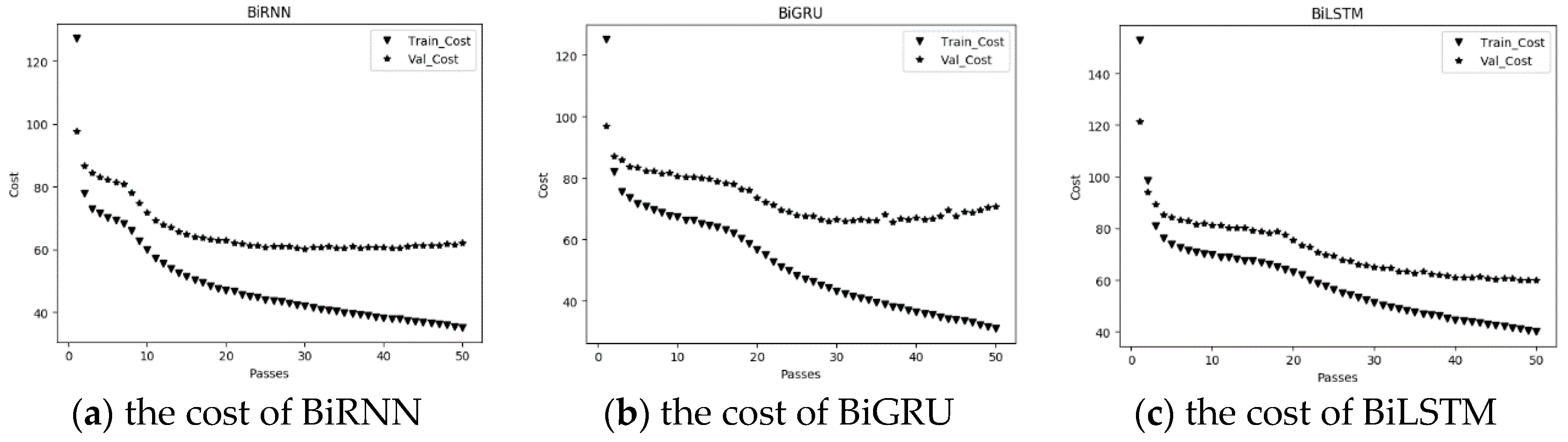
In the Tujia language corpus, when the other parameters are consistent, we modify the RNN cell state to compare the change in the loss function value during the training of the model. Finally, the result of the character error rate (CER) over the test set is shown in Figure 5.
Figure 5. The change in the cost of BiRNN, BiGRU, and BiLSTM’s as the number of training passes increases.
In Figure 5, the abscissa represents the number of iterations of the training model, and the ordinate represents the cost value of the training and validation sets.
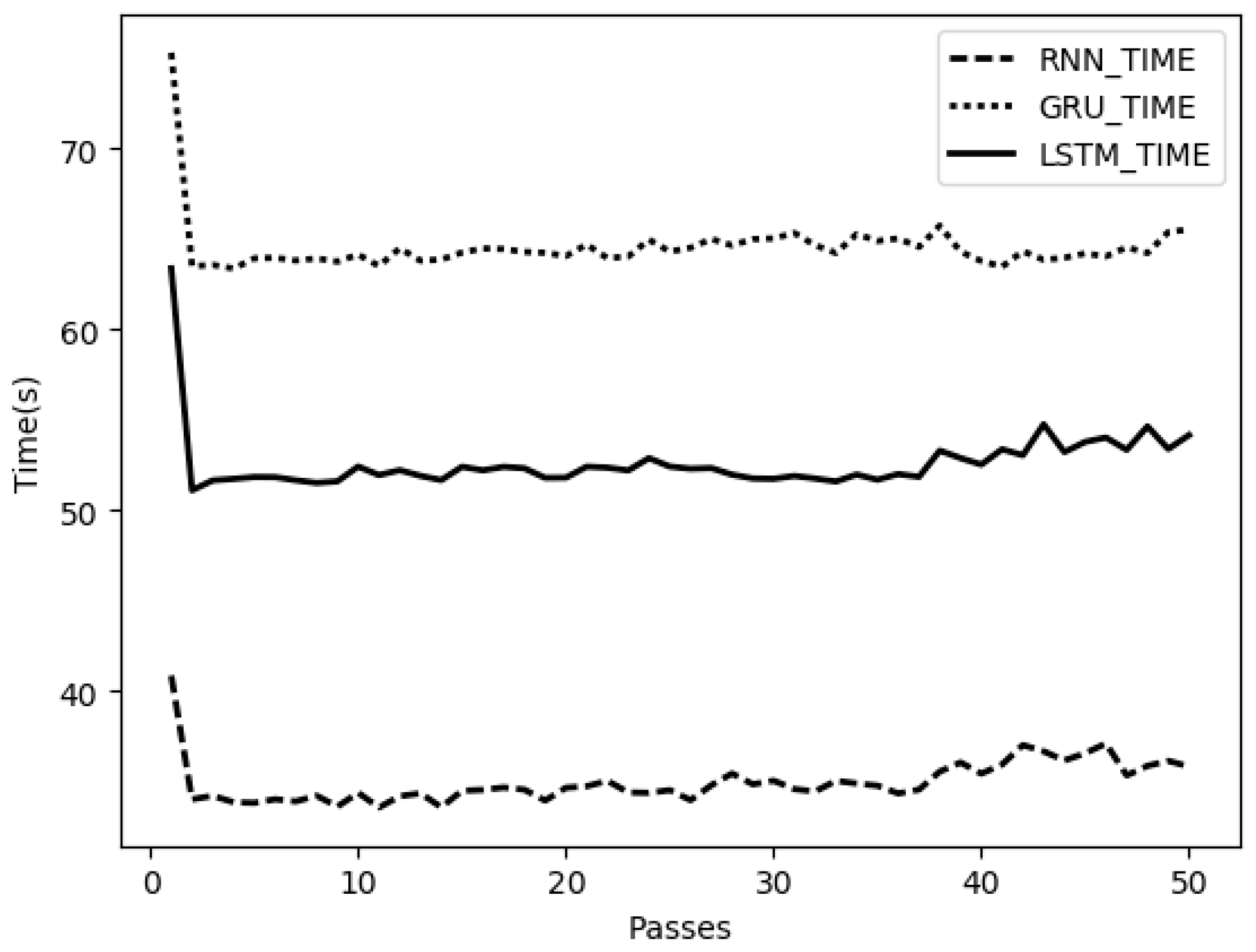
In Figure 6, the abscissa represents the number of iterations of the training model, and the ordinate represents the time of training different RNN cell states.
Figure 6. Time to train different RNN (Recurrent neural network) cell states.
Figure 5 and Figure 6 and Table 6 show that although the BiRNN network training speed is faster than that of BiGRU and BiLSTM; the final recognition accuracy rate is highest for BiLSTM. According to our actual needs, we choose to use the BiLSTM network.
Table 6. Character error rate of different RNN cells over the development and test set.

4.3. Experimental Results

The experimental results in Table 7 show that the IDS model obtained using only the Tujia corpus as the training data is better than the CDS model obtained using the Tujia language and the Chinese corpus as the training data, and the sample transfer learning is performed on the initial model CDS. The CDS-based TLDS is obtained from the Tujia corpus as training data, and its performance is better than that of IDS. Therefore, the scheme of this paper is feasible and effective for speech recognition of the Tujia language with less data.
Table 7. Tujia language recognition rate of different models.

5. Conclusions

In this paper, we combined the CNN, BiLSTM, and CTC algorithms to construct a cross-language end-to-end speech recognition system. For the low resource problem of the Tujia language, the Chinese data were used to expand the Tujia language data, the cross-language recognition method was used to share acoustic features, and the sample transfer learning method was used to optimize the model. The final recognition accuracy was increased by 4.08%. However, the Tujia language is only a spoken language, and there is no text or strict grammatical structure, so it is difficult to establish a language model. In subsequent work, we will attempt to build a dictionary model based on common spoken vocabulary in the Tujia language.

Author Contributions

Conceptualization, C.Y.; methodology, C.Y. and Y.C.; software, Y.C. and S.X. and M.K.; validation, Y.C., Y.L. and M.K.; formal analysis, C.Y. and Y.C.; investigation, Y.L. and X.L.; resources, S.X. and C.Y.; data curation, S.X.; writing—original draft preparation, Y.C.; writing—review and editing, C.Y. and Y.C.; visualization, Y.C.; supervision, C.Y.; funding acquisition, C.Y.

Funding

This research was funded by Ministry of Education Humanities and Social Sciences Research Planning Fund Project, grant number 16YJAZH072, and Major projects of the National Social Science Fund, grant number 14ZDB156.

Acknowledgments

We would like to acknowledge Beijing Key Laboratory of Big Data Technology for Food Safety and Key Laboratory of Resources utilization and Environmental Remediation for providing a research grant to conduct this work. We express gratitude to the editors for the editing assistance. Lastly, we would like to thank the reviewers for their valuable comments and suggestions on our paper.

Conflicts of Interest

The authors declare no conflict of interest.

References

  1. Xu, S. The course and prospect of endangered language studies in China. J. Northwest Univ. Natl. Philos. Soc. Sci. 2015, 83–90. [Google Scholar] [CrossRef]
  2. Rosenberg, A.; Audhkhasi, K.; Sethy, A.; Ramabhadran, B.; Picheny, M. End-to-end speech recognition and keyword search on low-resource languages. In Proceedings of the IEEE International Conference on Acoustics, Speech and Signal Processing, New Orleans, LA, USA, 5–9 March 2017; pp. 5280–5284. [Google Scholar]
  3. Hannun, A.; Case, C.; Casper, J.; Catanzaro, B.; Diamos, G.; Elsen, E.; Prenger, R.; Satheesh, S.; Sengupta, S.; Coates, A.; et al. Deep Speech: Scaling up end-to-end speech recognition. arXiv, 2014; arXiv:1412.5567. [Google Scholar]
  4. Zhang, Y.; Chan, W.; Jaitly, N. Very Deep Convolutional Networks for End-to-End Speech Recognition. In Proceedings of the 2017 IEEE International Conference on Acoustics, Speech and Signal Processing (ICASSP), New Orleans, LA, USA, 5–9 March 2017; pp. 4845–4849. [Google Scholar]
  5. Lu, L.; Kong, L.; Dyer, C.; Smith, N.A. Multitask Learning with CTC and Segmental CRF for Speech Recognition. In Proceedings of the INTERSPEECH 2017, Stockholm, Sweden, 20–24 August 2017; pp. 954–958. [Google Scholar]
  6. Ochiai, T.; Watanabe, S.; Hori, T.; Hershey, J.R. Multichannel End-to-end Speech Recognition. arXiv, 2017; arXiv:1703.04783. [Google Scholar]
  7. Parcollet, T.; Zhang, Y.; Morchid, M.; Trabelsi, C.; Linarès, G.; De Mori, R.; Bengio, Y. Quaternion Convolutional Neural Networks for End-to-End Automatic Speech Recognition. arXiv, 2018; arXiv:1806.07789. [Google Scholar]
  8. Ghoshal, A.; Swietojanski, P.; Renals, S. Multilingual training of deep neural networks. In Proceedings of the IEEE International Conference on Acoustics, Speech and Signal Processing, Vancouver, BC, Canada, 26–31 May 2013; pp. 7319–7323. [Google Scholar]
  9. Heigold, G.; Vanhoucke, V.; Senior, A.; Nguyen, P.; Ranzato, M.A.; Devin, M.; Dean, J. Multilingual acoustic models using distributed deep neural networks. In Proceedings of the IEEE International Conference on Acoustics, Speech and Signal Processing, Vancouver, BC, Canada, 26–31 May 2013; pp. 8619–8623. [Google Scholar]
  10. Evgeniou, T.; Pontil, M. Regularized multi-task learning. In Proceedings of the Tenth ACM SIGKDD International Conference on Knowledge Discovery and Data Mining, New York, NY, USA, 22–25 August 2004; pp. 109–117. [Google Scholar]
  11. Pan, S.J.; Yang, Q. A Survey on Transfer Learning. IEEE Trans. Knowl. Data Eng. 2010, 22, 1345–1359. [Google Scholar] [CrossRef]
  12. Dalmia, S.; Sanabria, R.; Metze, F.; Black, A.W. Sequence-based Multi-lingual Low Resource Speech Recognition. arXiv, 2018; arXiv:1802.07420. [Google Scholar]
  13. Kim, S.; Hori, T.; Watanabe, S. Joint CTC-Attention based End-to-End Speech Recognition using Multi-task Learning. In Proceedings of the 2017 IEEE International Conference on Acoustics, Speech and Signal Processing (ICASSP), New Orleans, LA, USA, 5–9 March 2017; pp. 4835–4839. [Google Scholar]
  14. Chen, W.; Hasegawa-Johnson, M.; Chen, N.F. Topic and Keyword Identification for Low-resourced Speech Using Cross-Language Transfer Learning. In Proceedings of the INTERSPEECH, Hyderabad, India, 2–6 September 2018; pp. 2047–2051. [Google Scholar]
  15. Latif, S.; Rana, R.; Younis, S.; Qadir, J.; Epps, J. Transfer Learning for Improving Speech Emotion Classification Accuracy. arXiv, 2018; arXiv:1801.06353. [Google Scholar]
  16. Deng, L. An Overview of Deep-Structured Learning for Information Processing. In Proceedings of the Asian-Pacific Signal and Information Processing-Annual Summit and Conference (APSIPA-ASC), Xi’an, China, 19–22 October 2011. [Google Scholar]
  17. Bengio, Y. Learning Deep Architectures for AI. Found. Trends Mach. Learn. 2009, 2, 1–127. [Google Scholar] [CrossRef]
  18. Mohamed, A.R.; Dahl, G.; Hinton, G. Deep Belief Networks for phone recognition. In Nips Workshop on Deep Learning for Speech Recognition and Related Applications; MIT Press: Whister, BC, Canada, 2009; Volume 39. [Google Scholar]
  19. Lin, H.; Ou, Z. Partial-tied-mixture Auxiliary Chain Models for Speech Recognition Based on Dynamic Bayesian Networks. In Proceedings of the IEEE International Conference on Systems, Taipei, Taiwan, 8–11 October 2006. [Google Scholar]
  20. Pundak, G.; Sainath, T.N. Lower Frame Rate Neural Network Acoustic Models. In Proceedings of the INTERSPEECH, San Francisc, CA, USA, 8–12 September 2016; pp. 22–26. [Google Scholar]
  21. WÖLfel, M.; Mcdonough, J. Speech Feature Extraction. In Distant Speech Recognition; John Wiley & Sons, Ltd.: Hoboken, NJ, USA, 2009. [Google Scholar]
  22. Lee, J.H.; Jung, H.Y.; Lee, T.W. Speech feature extraction using independent component analysis. In Proceedings of the IEEE International Conference on Acoustics, Istanbul, Turkey, 5–9 June 2000. [Google Scholar]
  23. Li, H.; Xu, X.; Wu, G.; Ding, C.; Zhao, X. Research on speech emotion feature extraction based on MFCC. J. Electron. Meas. Instrum. 2017. (In Chinese) [Google Scholar] [CrossRef]
  24. Yu, D.; Seltzer, M. Improved Bottleneck Features Using Pretrained Deep Neural Networks. In Proceedings of the Conference of the International Speech Communication Association, Florence, Italy, 27–31 August 2011; pp. 237–240. [Google Scholar]
  25. Maimaitiaili, T.; Dai, L. Deep Neural Network based Uyghur Large Vocabulary Continuous Speech Recognition. J. Data Acquis. Process. 2015, 365–371. [Google Scholar] [CrossRef]
  26. Liu, X.; Wang, N.; Guo, W. Keyword Spotting Based on Deep Neural Networks Bottleneck Feature. J. Chin. Comput. Syst. 2015, 36, 1540–1544. [Google Scholar]
  27. Ozeki, M.; Okatani, T. Understanding Convolutional Neural Networks in Terms of Category-Level Attributes. In Computer Vision—ACCV 2014; Springer International Publishing: Cham, Switzerland, 2014; pp. 362–375. [Google Scholar]
  28. Zeiler, M.D.; Fergus, R. Visualizing and Understanding Convolutional Networks. In European Conference on Computer Vision; Springer: Cham, Switzerland, 2013; Volume 8689, pp. 818–833. [Google Scholar]
  29. Abdel-Hamid, O.; Mohamed, A.R.; Jiang, H.; Penn, G. Applying Convolutional Neural Networks concepts to hybrid NN-HMM model for speech recognition. In Proceedings of the IEEE International Conference on Acoustics, Kyoto, Japan, 25–30 March 2012. [Google Scholar]
  30. Abdelhamid O Deng, L.; Yu, D. Exploring Convolutional Neural Network Structures and Optimization Techniques for Speech Recognition. In Proceedings of the INTERSPEECH, Lyon, France, 25–29 August 2013; pp. 3366–3370. [Google Scholar]
  31. Sercu, T.; Puhrsch, C.; Kingsbury, B.; LeCun, Y. Very deep multilingual convolutional neural networks for LVCSR. In Proceedings of the IEEE International Conference on Acoustics, Speech and Signal Processing, Shanghai, China, 20–25 March 2016; pp. 4955–4959. [Google Scholar]
  32. Sercu, T.; Goel, V. Advances in Very Deep Convolutional Neural Networks for LVCSR. arXiv, 2016; arXiv:1604.01792. [Google Scholar]
  33. Graves, A.; Mohamed, A.R.; Hinton, G. Speech recognition with deep recurrent neural networks. In Proceedings of the 2013 IEEE International Conference on Acoustics, Speech and Signal Processing, Vancouver, BC, Canada, 26–31 March 2013; pp. 6645–6649. [Google Scholar]
  34. Graves, A. Supervised Sequence Labelling with Recurrent Neural Networks; Springer: Berlin/Heidelberg, Germany, 2012. [Google Scholar]
  35. Chung, J.; Gulcehre, C.; Cho, K.; Bengio, Y. Empirical Evaluation of Gated Recurrent Neural Networks on Sequence Modeling. arXiv, 2014; arXiv:1412.3555. [Google Scholar]
  36. Graves, A.; Gomez, F. Connectionist temporal classification: Labelling unsegmented sequence data with recurrent neural networks. In Proceedings of the International Conference on Machine Learning, Pittsburgh, PA, USA, 25–29 June 2006; pp. 369–376. [Google Scholar]
  37. Miao, Y.; Gowayyed, M.; Metze, F. EESEN: End-to-end speech recognition using deep RNN models and WFST-based decoding. In Proceedings of the IEEE Workshop on Automatic Speech Recognition and Understanding, Scottsdale, AZ, USA, 13–17 December 2016; pp. 167–174. [Google Scholar]
  38. Zeghidour, N.; Usunier, N.; Synnaeve, G.; Collobert, R.; Dupoux, E. End-to-End Speech Recognition from the Raw Waveform. arXiv, 2018; arXiv:1806.07098. [Google Scholar]
  39. Watanabe, S.; Hori, T.; Karita, S.; Hayashi, T.; Nishitoba, J.; Unno, Y.; Soplin, N.E.Y.; Heymann, J.; Wiesner, M.; Chen, N.; et al. ESPnet: End-to-End Speech Processing Toolkit. arXiv, 2018; arXiv:1804.00015. [Google Scholar]
  40. Xu, S. Grammatical and semantic representation of spatial concepts in the Tujia language. J. Minor. Lang. China 2013, 1, 35–45. [Google Scholar]
  41. Xu, S. Features of Change in the Structure of Endangered Languages: A Case Study of the South Tujia Language. J. Yunnan Natl. Univ. (Soc. Sci.) 2012, 29. (In Chinese) [Google Scholar] [CrossRef]
  42. Wang, D.; Zhang, X. THCHS-30: A Free Chinese Speech Corpus. arXiv, 2015; arXiv:1512.01882. [Google Scholar]
  43. Wu, C.; Wang, B. Extracting Topics Based on Word2Vec and Improved Jaccard Similarity Coefficient. In Proceedings of the IEEE Second International Conference on Data Science in Cyberspace, Shenzhen, China, 26–29 June 2017. [Google Scholar]
  44. Inc, G. Convolutional, long short-term memory, fully connected deep neural networks. In Proceedings of the IEEE International Conference on Acoustics, Brisbane, Australia, 19–24 April 2015. [Google Scholar]
  45. Amodei, D.; Ananthanarayanan, S.; Anubhai, R.; Bai, J.; Battenberg, E.; Case, C.; Casper, J.; Catanzaro, B.; Cheng, Q.; Chen, G.; et al. Deep Speech 2: End-to-End Speech Recognition in English and Mandarin. arXiv, 2015; arXiv:1512.02595. [Google Scholar]
  46. Ioffe, S.; Szegedy, C. Batch normalization: Accelerating deep network training by reducing internal covariate shift. In Proceedings of the International Conference on Machine Learning, Lille, France, 6–11 July 2015; pp. 448–456. [Google Scholar]

Article Metrics

Citations

Article Access Statistics

Multiple requests from the same IP address are counted as one view.