Abstract
In this paper, a new concept of the triangular neutrosophic cubic fuzzy numbers (TNCFNs), their score and accuracy functions are introduced. Based on TNCFNs, some new Einstein aggregation operators, such as the triangular neutrosophic cubic fuzzy Einstein weighted averaging (TNCFEWA), triangular neutrosophic cubic fuzzy Einstein ordered weighted averaging (TNCFEOWA) and triangular neutrosophic cubic fuzzy Einstein hybrid weighted averaging (TNCFEHWA) operators are developed. Furthermore, their application to multiple-attribute decision-making with triangular neutrosophic cubic fuzzy (TNCF) information is discussed. Finally, a practical example is given to verify the developed approach and to demonstrate its practicality and effectiveness.
1. Introduction
Atanassov [1] introduced the IFS, which is a generalization of FS. Atanassov [2] introduced operations and relations over IFSs taking as a point of departure respective definitions of relations and operations over fuzzy sets. Bustince et al. [3] introduced the characterization of certain structures of intuitionistic relations according to the structures of two concrete fuzzy relations. Deschrijver et al. [4] established the relationships between intuitionistic fuzzy sets (Atanassov, VII ITKR’s Session, Sofia, June 1983 (Deposed in Central Sci.-Techn. Library of Bulg. Acad. of Sci., 1697/84) (in Bulgarian)), L-fuzzy sets. Deschrijver et al. [5] defined the mathematical relationship between intuitionistic fuzzy sets and other models of imprecision. Jun et al. [6] introduced the cubic set. Mohiuddin et al. [7] showed that the union of two internal cubic soft sets might not be internal. Turksen [8] showed that the proposed representation (1) exists for certain families of the conjugate pairs of t-norms and t-norms, and (2) resolves some of the difficulties associated with particular interpretations of conjunction, disjunction, and implication in fuzzy set theories.
Xu [9] developed some aggregation operators, such as the intuitionistic fuzzy weighted averaging operator, intuitionistic fuzzy ordered weighted averaging operator, and intuitionistic fuzzy hybrid aggregation operator, to aggregate intuitionistic fuzzy values. Xu et al. [10] developed some new geometric aggregation operators, such as the intuitionistic fuzzy weighted geometric (IFWG) operator and the intuitionistic fuzzy ordered weighted geometric (IFOWG) operator. Xu et al. [11] provided a survey of the aggregation techniques of intuitionistic fuzzy information and their applications in various fields, such as decision making, cluster analysis, medical diagnosis, forecasting, and manufacturing grid. Liu et al. [12] introduced and discussed the concept of intuitionistic fuzzy point operators. Zeng et al. [13] defined the situation with intuitionistic fuzzy information and developed an intuitionistic fuzzy ordered weighted distance (IFOWD) operator. The fuzzy set was introduced by Zadeh [14]. Zadeh [15] introduced the interval-valued fuzzy set Li et al. [16] proposed group decision-making methods of the interval-valued intuitionistic uncertain linguistic variable based on Archimedean t-norm and Choquet integral. Zhao et al. [17] developed some hesitant triangular fuzzy aggregation operators based on the Einstein operation: the hesitant triangular fuzzy Einstein weighted averaging (HTFEWA) operator. Xu et al. [18] introduced two new aggregation operators: dynamic intuitionistic fuzzy weighted averaging (DIFWA) operator and uncertain dynamic intuitionistic fuzzy weighted averaging (UDIFWA) operator.
The Neutrosophic Set (NS) was projected by Smarandache [19,20]. Neutrosophic sets are characterized by fact participation, an indeterminacy-enrollment work and misrepresentation participation, which are inside the ordinary or nonstandard unit interim in order to apply NS to genuine applications. In order to apply NS to real-world applications, Aliya et al. [21] introduced the concept of the triangular cubic fuzzy number. Aliya et al. [22] introduced the triangular cubic hesitant fuzzy Einstein weighted averaging (TCHFEWA) operator, triangular cubic hesitant fuzzy Einstein ordered weighted averaging (TCHFEOWA) operator and triangular cubic hesitant fuzzy Einstein hybrid weighted averaging (TCHFEHWA) operator.
Beg et al. [23] introduced a computational means to manage situations in which experts assess alternatives in possible membership and non-membership values. Przemyslaw et al. [24] introduced a simple test that sometimes might be helpful in detecting non-separability at a glance.
The differences between Reference 21, 22 and the current paper are as Table 1:
Table 1.
Difference between references 21, 22 and current paper.
Based on the above analysis, in this paper we develop TNCFNs, which is the generalization of the triangular neutrosophic intuitionistic fuzzy number and triangular neutrosophic interval fuzzy number. We perform some operations based on Einstein T-norm and Einstein T-conorm for TNCFNs. We also develop score and accuracy functions to compare two TNCFNs. Due to the developed operation, we propose the TNCFEWA operator, TNCFEOWA operator, and TNCFEHWA operator, to aggregate a collection of TNCFNs.
This paper is organized as follows. In Section 2, we define some concepts of FS, CS, and TNCFNs. In Section 3, we discuss some Einstein operations on TNCFNs and their properties. In Section 4, we first develop some novel arithmetic averaging operators, such as the TNCFEWA operator, TNCFEOWA operator, and TNCFEHWA operator, for aggregating a group of TNCFNs. In Section 5, we apply the TNCFEHWA operator to MADM with TNCFNs material. In Section 6, we offer a numerical example consistent with our approach. In Section 7, we discuss comparison analysis. In Section 8, we present a conclusion.
2. Preliminaries
Definition 1.
[15].Letbe a fixed set, a FSinis defined as:whereis a mapping from h to the closed intervaland for each, is called the degree of membership of h in H.
Definition 2.
Letis a fixed set and an interval-valued fuzzy set in is defined as , where and The is lower membership and is upper membership such that .
Definition 3.
[1]. An IFS Ð in is given by , where and , with the condition
The numbersandrepresent, respectively, the membership degree and non-membership degree of the element h to the set Ð.
Triangular Neutrosophic Cubic Fuzzy Number
Definition 4.
Let and are two TNCFNs, some operations on TNCFNs are defined as follows:
(a)iff, , , , and .
(b), , ,
Example 1.
Letandbe two TNCFSs
(a), ifand
(b)and.
Definition 5.
Letbe a TNCFN and then the score function, accuracy function, membership uncertainty indexand hesitation uncertainty indexof a TNCFNare defined by
Example 2.
Letbe a TNCFN. Then the score function, accuracy function, membership uncertainty indexand hesitation uncertainty indexof a TNCFNare defined by
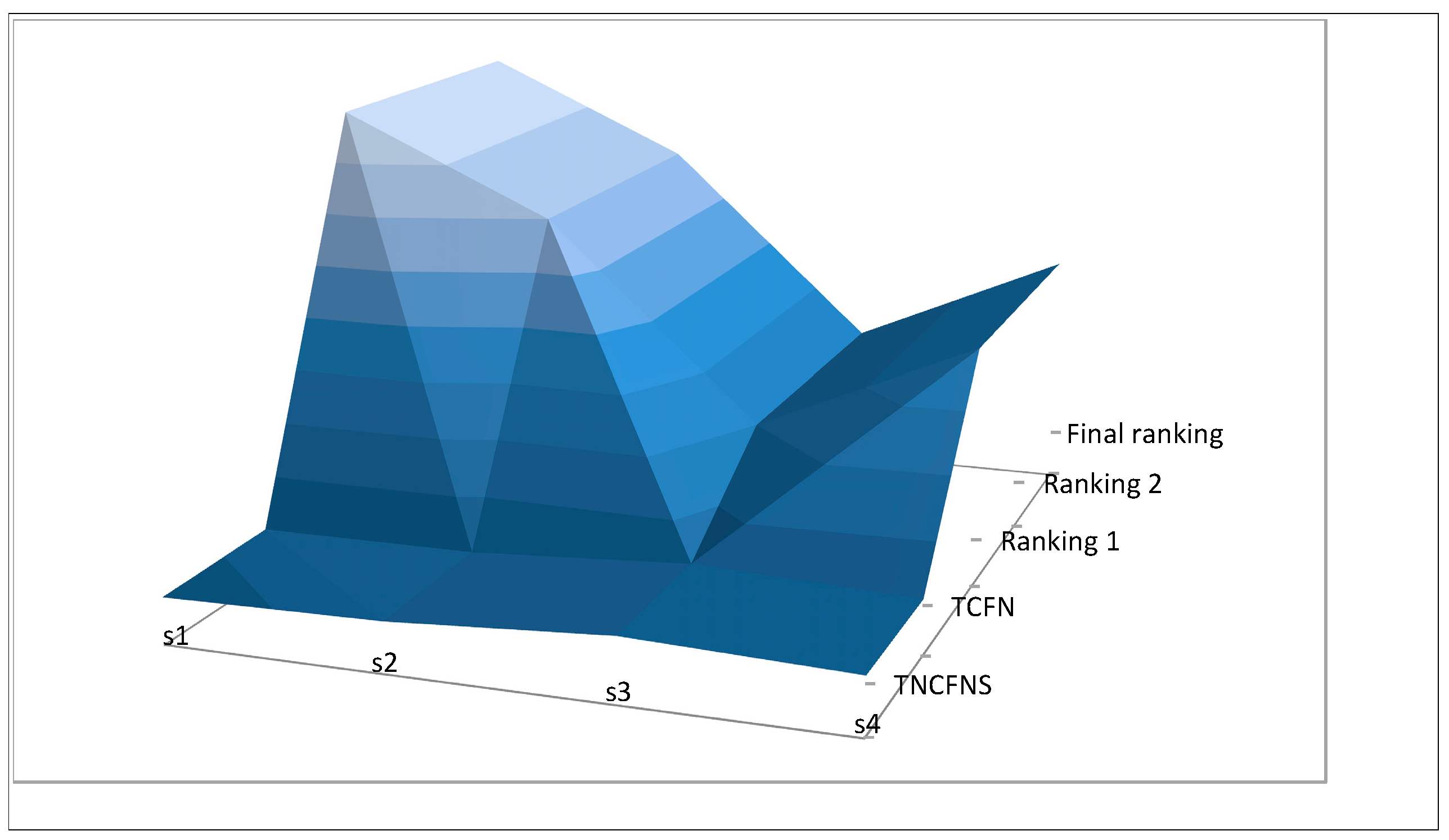
See Figure 1.
Figure 1.
The score function, accuracy function, membership uncertainty index and hesitation uncertainty index are ranking of TNCFN.
3. Some Einstein Operations on TNCFNs
Definition 6.
Let,andbe any three TNCFNs. Then some Einstein operations ofandcan be defined as:
Proposition 1.
Letandbe three TNCFNs,then we have:
(1)
(2)
(3)
Proof.
The proof of these propositions is provided in Appendix A. □
Remark 1.
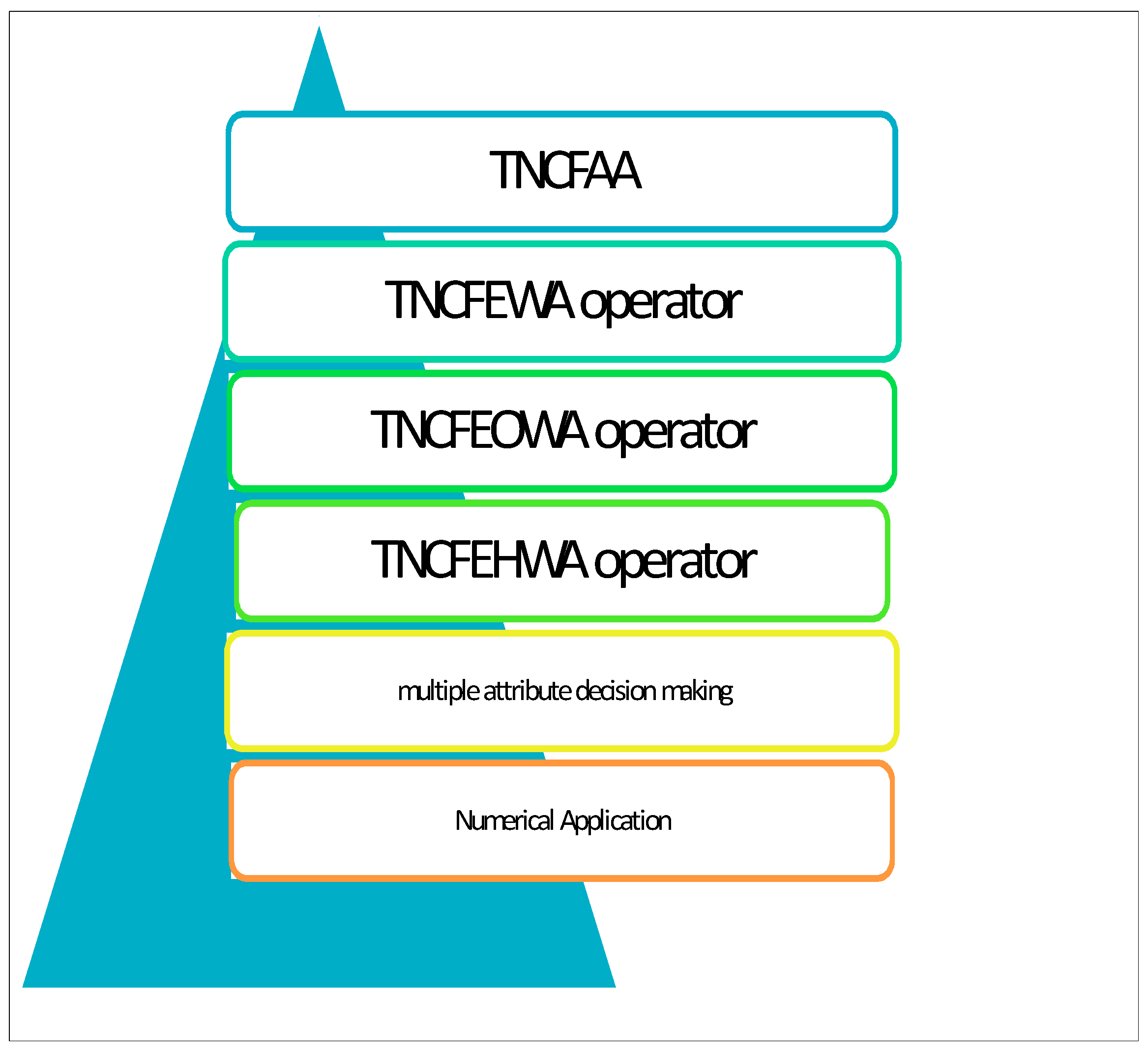
Figure 2.
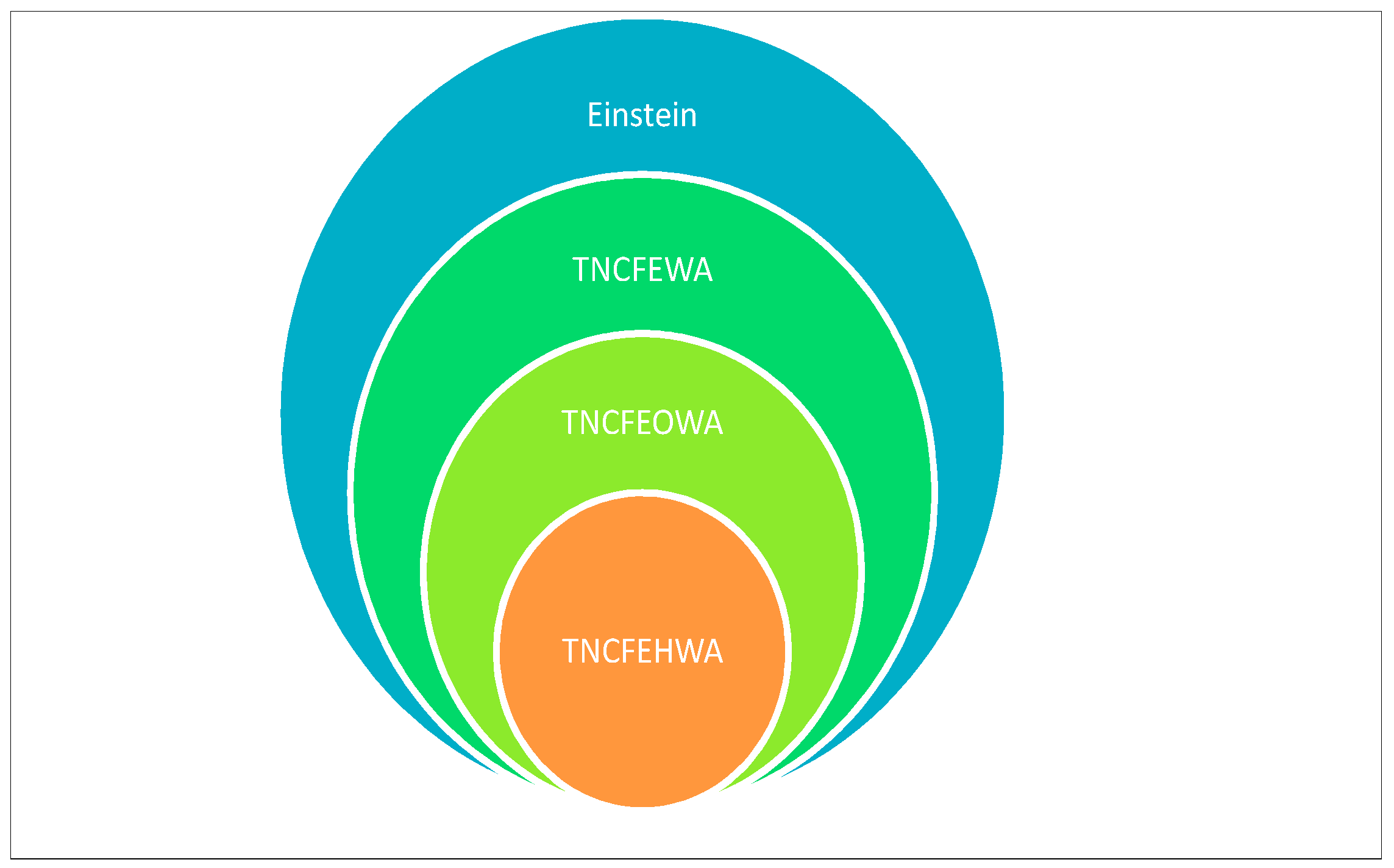
New extend aggregation operators, such as TNCFEWA, TNCFEOWA and TNCFEHWA operators.
4. Triangular Neutrosophic Cubic Fuzzy Averaging Operators Based on Einstein Operations
In this section, we define the aggregation operators.
4.1. Triangular Neutrosophic Cubic Fuzzy Einstein Weighted Averaging Operator
Definition 7.
Let be a collection of TNCFNs in and be the weight vector, with , . Hence TNCFEWA operator of dimension is a mapping and defined by .
IfHence the TNCFEWA operator is reduced to TNCFEA operator of dimension. It can be defined as follows:
Theorem 1.
Letbe a collection of TNCFNs in . The amassed an incentive by utilizing the TNCFEWA operator is additionally a TNCFN and TNCFEWA.
wherebe the weight vector ofsuch thatand. IfandThen the TNCFNare reduced to the triangular neutrosophic cubic fuzzy numbersand the TNCFEWA operator is reduced to the TNCFEWA operator.
Proof.
The proof of this theorem is provided in Appendix B. □
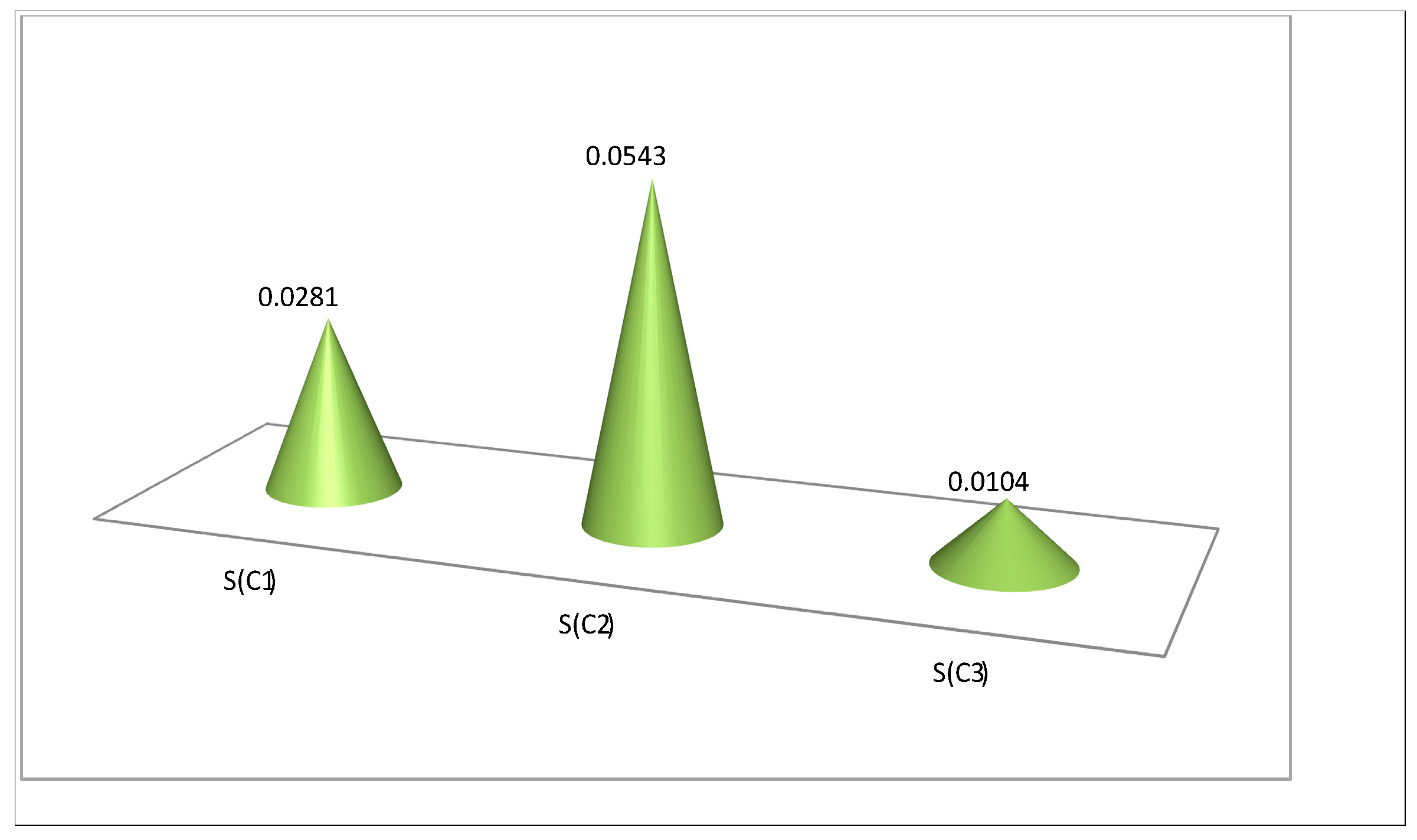
Example 3.
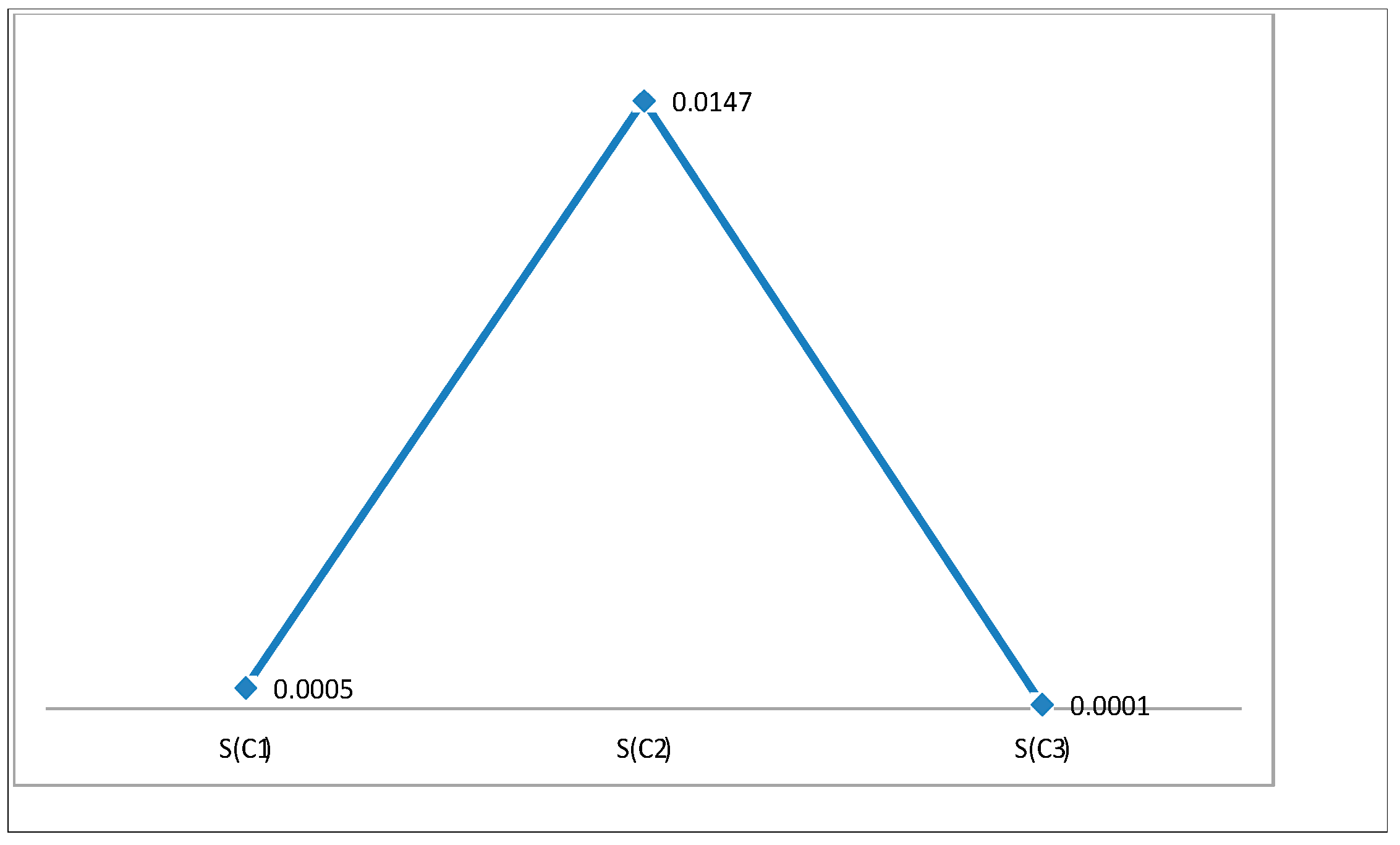
Letandbe a TNCFN. Then the score function is defined by
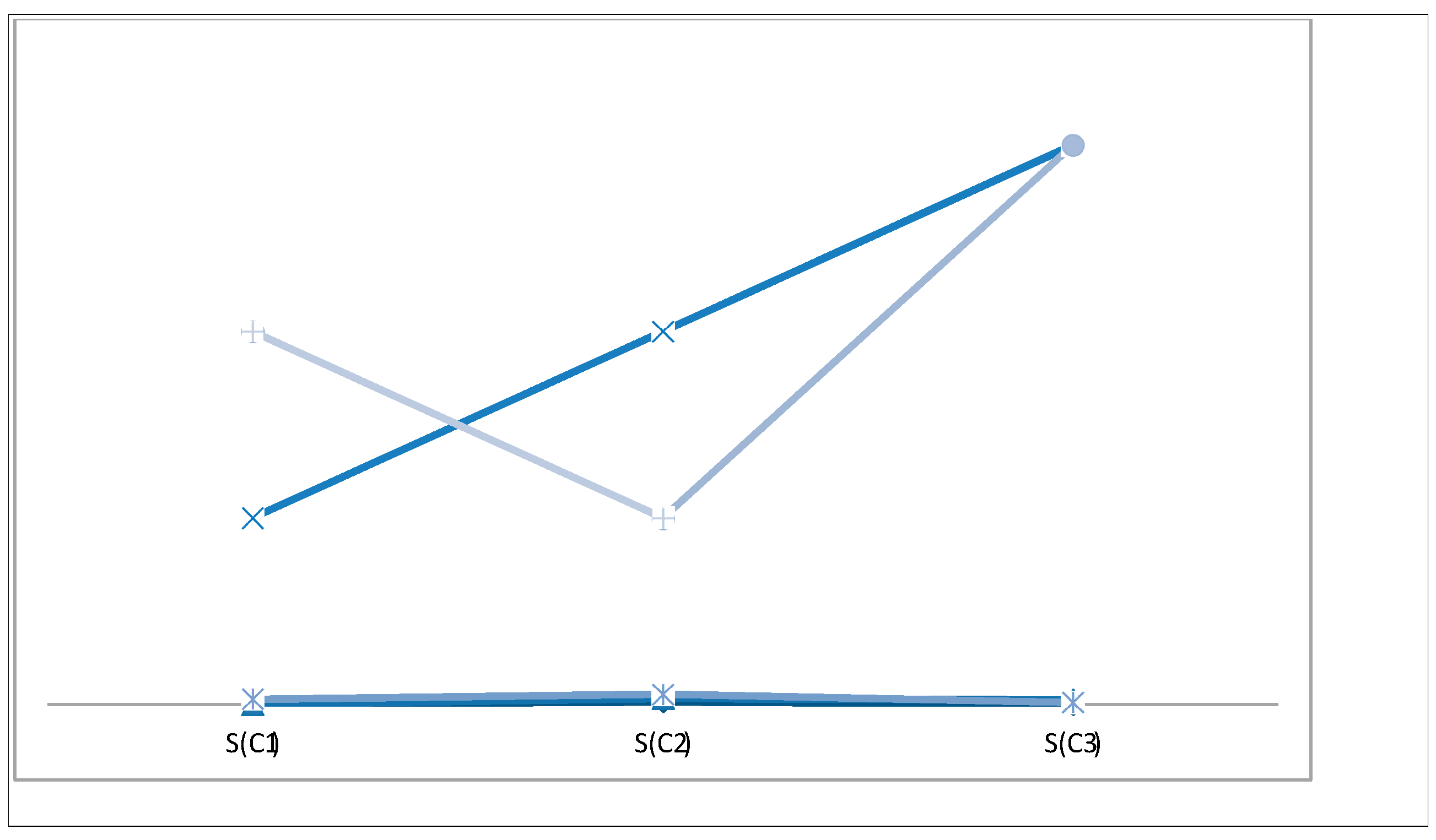
See Figure 3.
Figure 3.
S(C2) is the first score value, S(C1) is the second score value and S(C3) is the third score value.
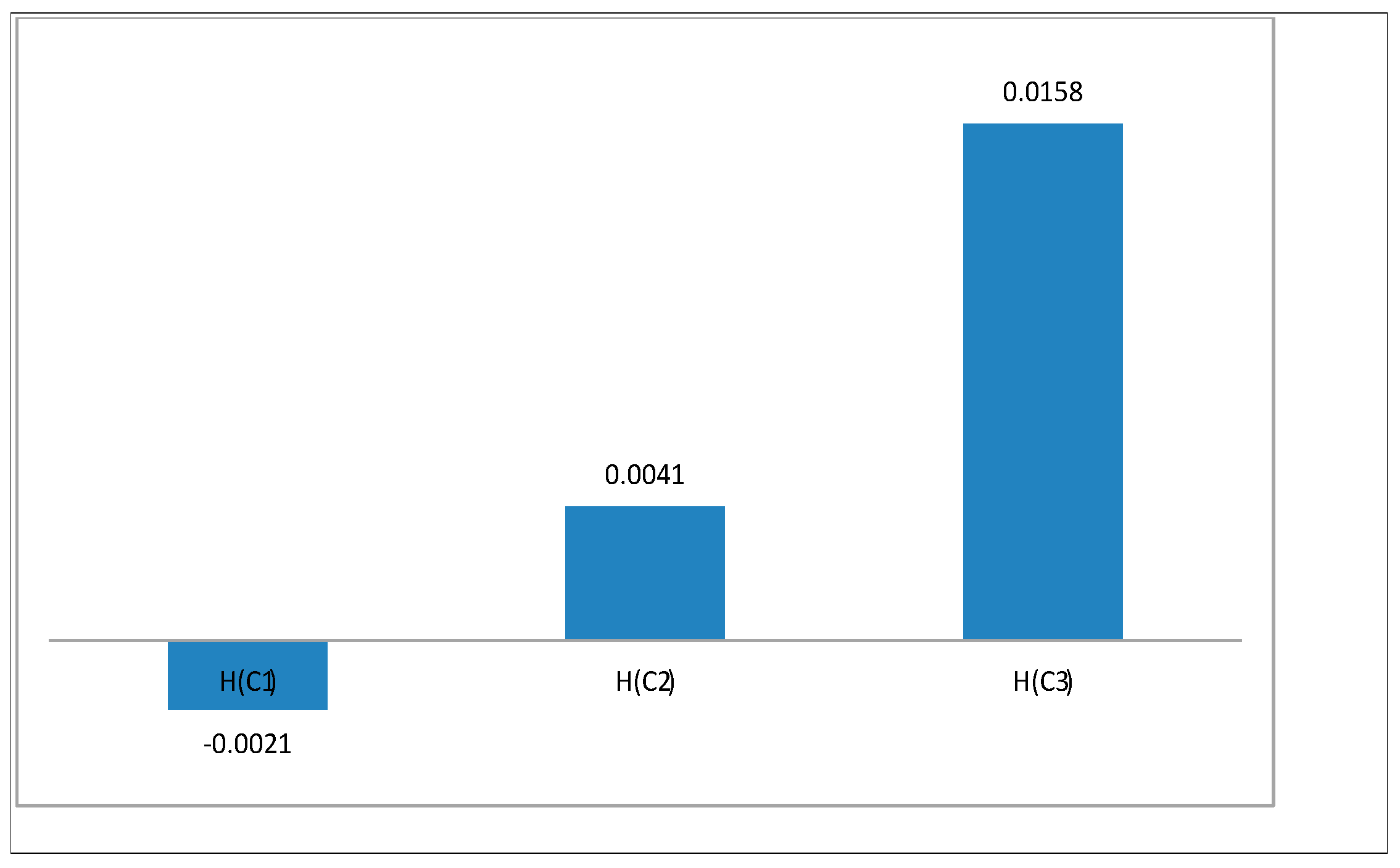
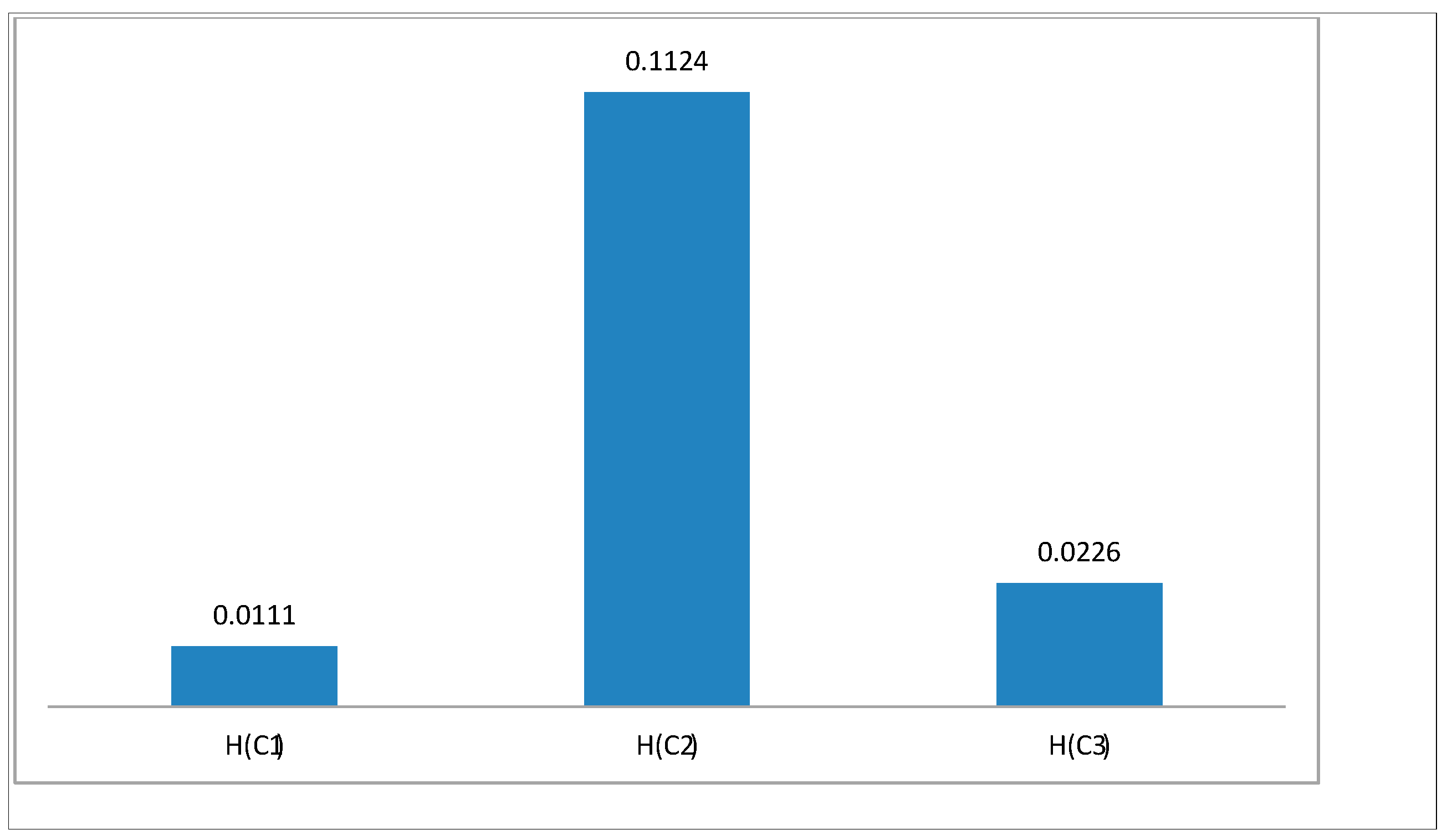
Example 4.
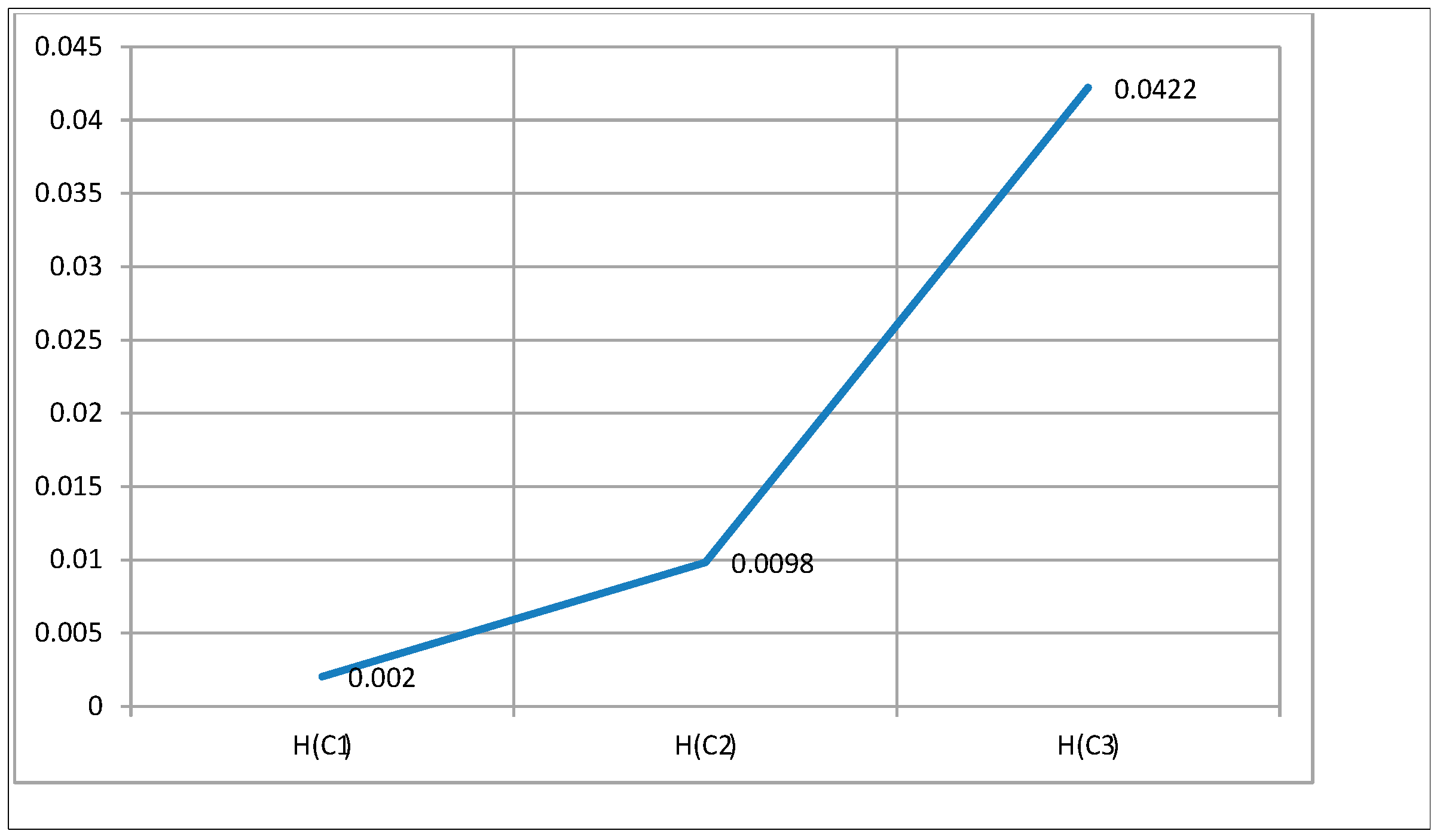
Letandbe a TNCFN. Then the accuracy function is defined by
See Figure 4.
Figure 4.
H(C2) is the first score value, H(C1) is the second score value and H(C3) is the third score value.
Proposition 2.
Letbe a collection of TNCFNs inand whereis the weight vector ofwithand.
Then (1) (Idempotency): If allare equal, i.e.,for allthen TNCFEWA
(2) (Boundary): Iffor allwe can determine that
(3) (Monotonicity): andbe two collection of TNCFNs inandi.e.,andthen TNCFEWATNCFEWA.
4.2. Triangular Neutrosophic Cubic Fuzzy Einstein Ordered Weighted Averaging Operator
Definition 8.
Letbe a collection of TNCFNs in, a TNCFEOWA operator of dimensionis a mapping TNCFEOWA:, that has an associated vectorsuch thatand. TNCFEOWA, whereis a permutation ofsuch thatfor all(i.e.,is thethe largest value in the collectionIf. Then the TNCFEOWA operator is reduced to the TCFA operator (2) of dimension.
Theorem 2.
Letbe a collection of TNCFNs in. Then their aggregated value by using the TNCFEOWA operator is also a TNCFN and TNCFEOWA
whereis a permutation ofwithfor allis the weight vector ofsuch thatandIf. Then the TNCFEOWA operator is reduced to the TNCFA operator of dimension. Whereis the weight vector ofsuch thatand. IfandThe TNCFNare reduced to the triangular neutrosophic cubic fuzzy numbers. Then the TNCFEWA operator is reduced to the triangular neutrosophic cubic fuzzy Einstein ordered weighted averaging operator.
Proof.
The process of this proof is the same as Theorem 1. □
Example 5.
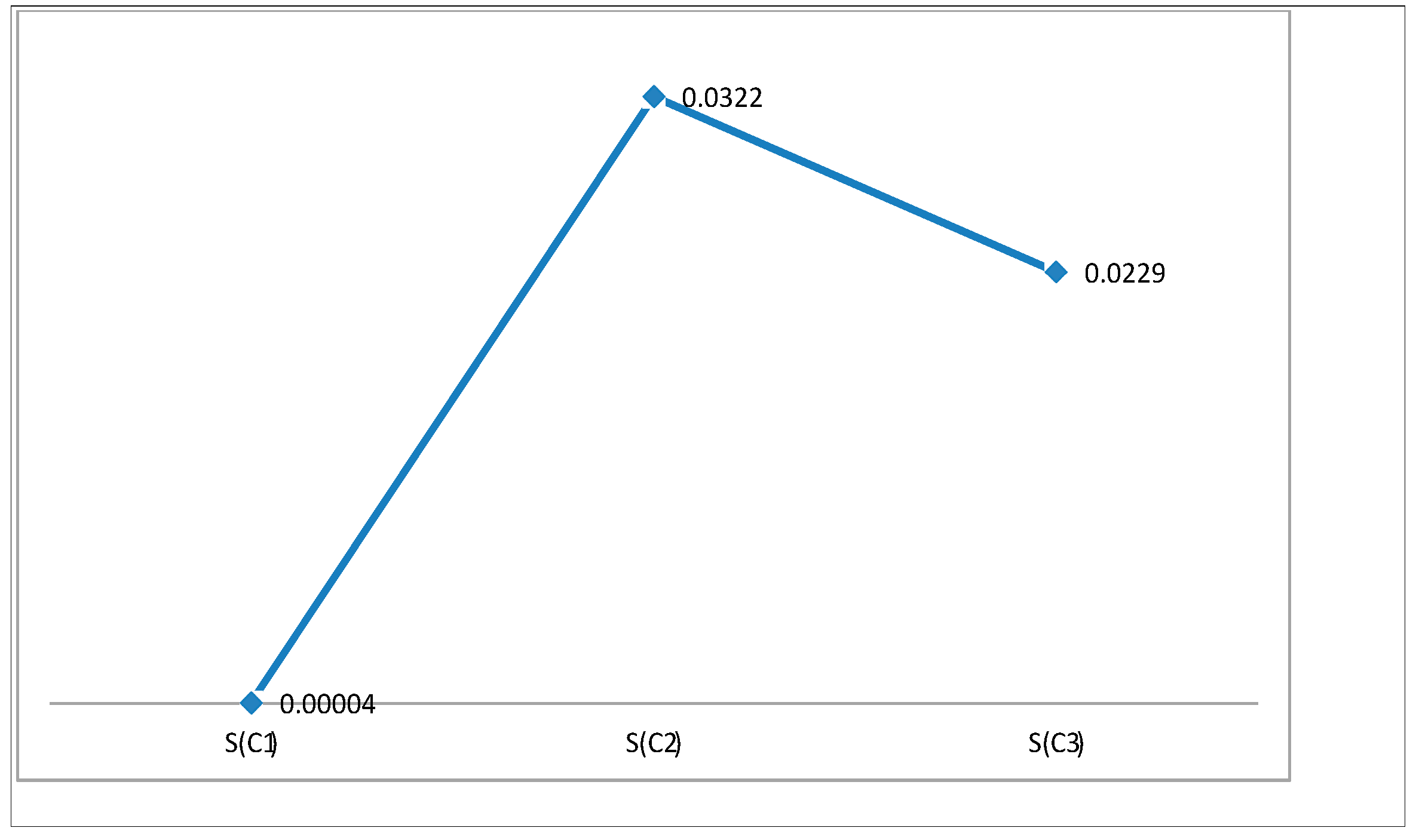
Letandbe a TNCFN. Then the score function is defined by
See Figure 5.
Figure 5.
Different score ranking of TNCFEOWA operator.
Example 6.
Letandbe a TNCFN. Then the accuracy function is defined by
See Figure 6.
Figure 6.
Different accuracy ranking of TNCFEOWA operator.
4.3. Triangular Neutrosophic Cubic Fuzzy Einstein Hybrid Weighted Averaging Operator
Definition 9.
Letbe a collection of TNCFNs inandis the weight vector ofsuch thatand. Then TNCFEHWA operator of dimensionis a mapping, that is an associated vectorsuch thatand. TNCFEHWA. Ifwith a balancing coefficient,is a permutation ofsuch thatfor all(i.e.,is theth largest value in the collection.
Example 7.
Letandbe a TNCFN. Then the score function is defined by
See Figure 7.
Figure 7.
Different score ranking of TNCFEHWA operator.
Example 8.
Let andbe a TNCFN. Then the accuracy function is defined by
See Figure 8.
Figure 8.
Different accuracy ranking of TNCFEHWA operator.
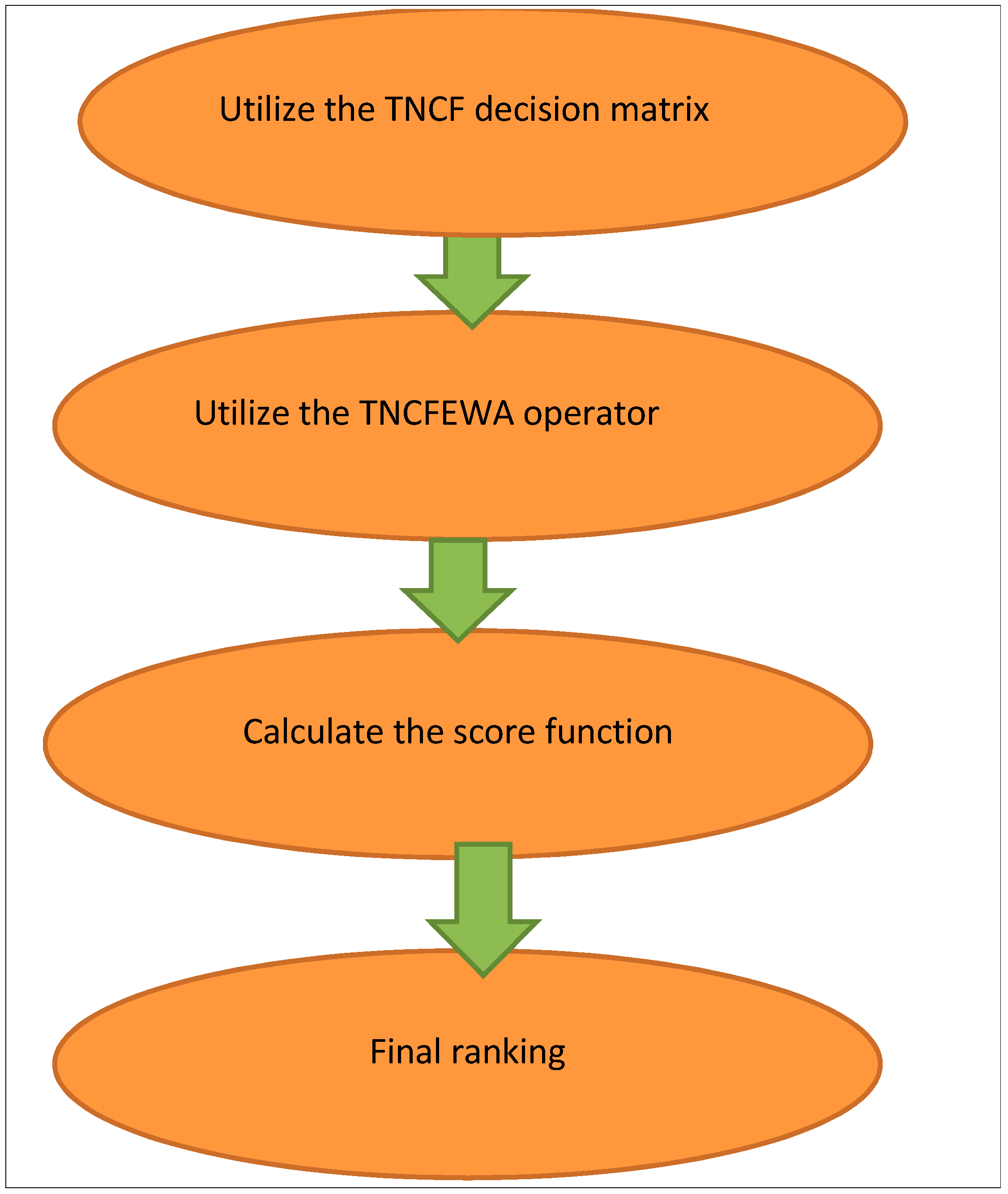
5. An Approach to MADM with TNCF Data
Let us suppose the discrete set is and are the attributes. Consider that the value of alternatives on attributes given by decision maker are TNCFNs in : , a MADM problem is expressed in the TNCF-decision matrix .
Step 1: Calculate the TNCF decision matrix.
Step 2: Utilize the TNCFEWA operator to mix all values and is the weight vector.
Step 3: Calculate the score function.
Step 4: Find the ranking.
See Figure 9.
Figure 9.
Proposed method.
6. Numerical Application
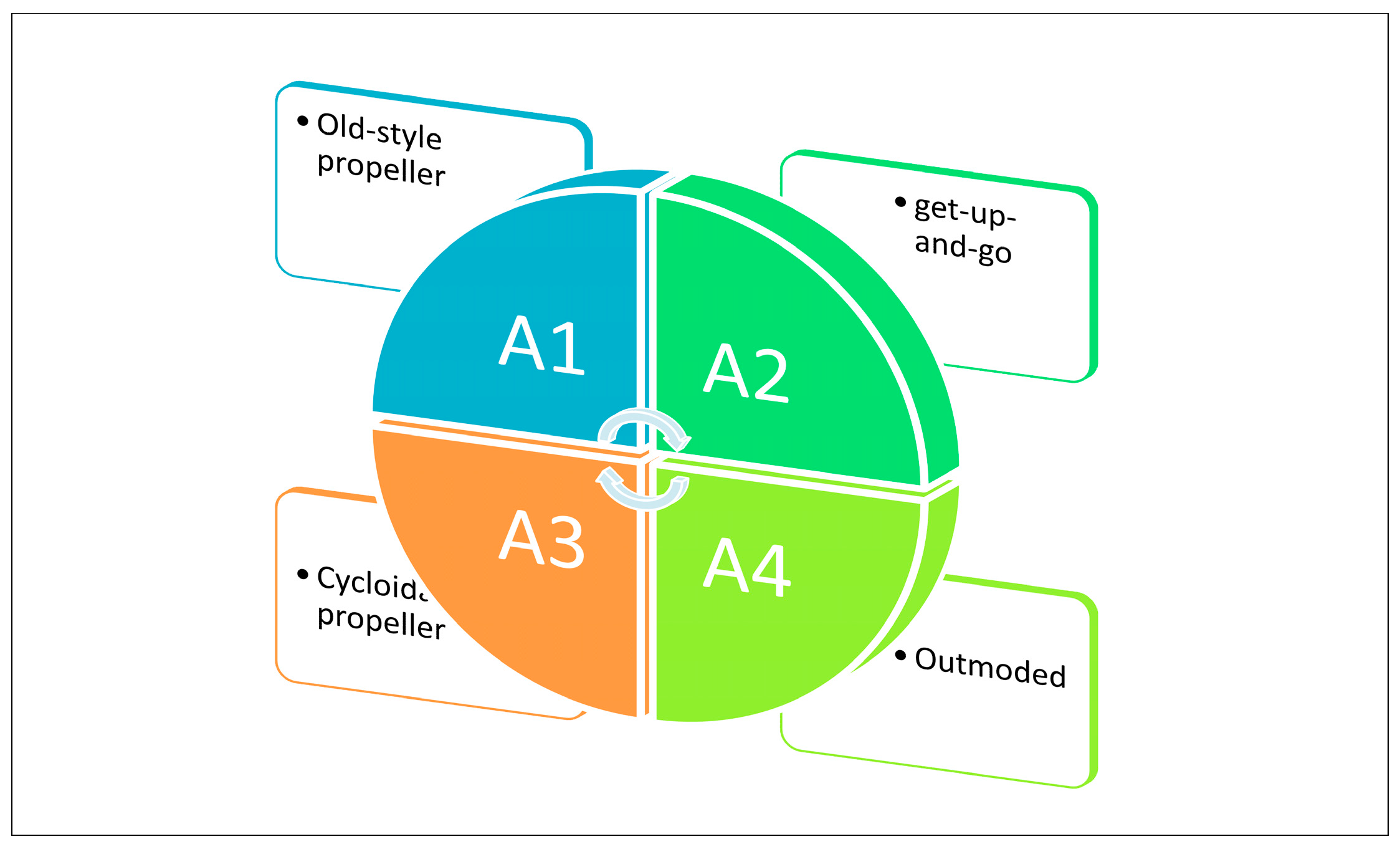
The inspiration structure is designed to be dependent upon an assessment that has been devised for the purpose of a stimulus/influencing technique of a twofold entire traveler dispersion to work over the Lahore in Faisalabad by lessening the adventure stage in extraordinarily brimful waterway movement. Inspiration structure choices are sure the settled of options
Old-style propeller and high trundle
Get-up-and-go,
Cyclonical propeller,
Outmoded
See Figure 10.
Figure 10.
Four alternatives.
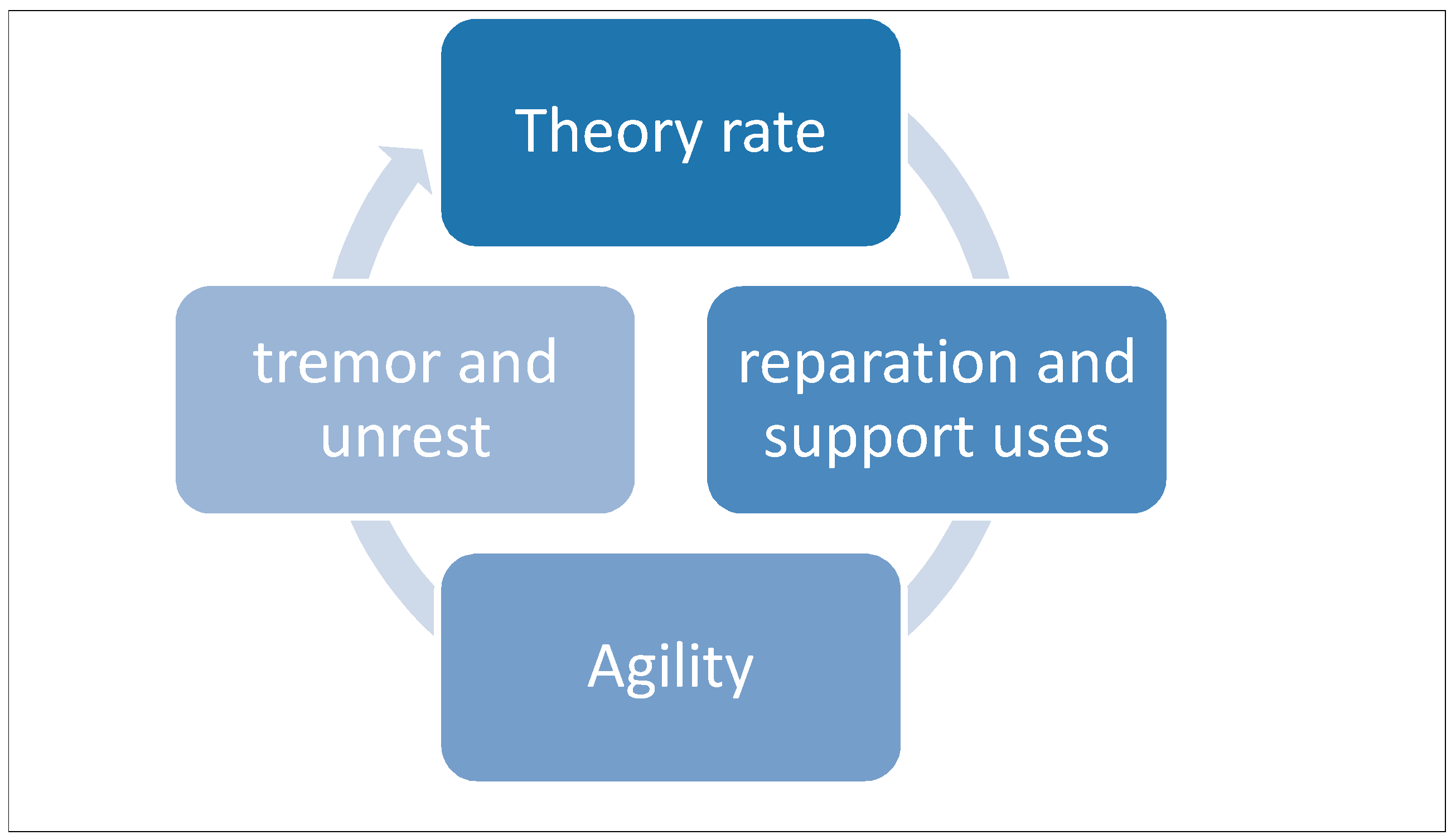
The ideal is prepared on the possibility of lone zone and four issue characteristics, which are as follows:
Theory rate
Reparation and support uses
Agility
Tremor and unrest.
See Figure 11.
Figure 11.
Different criteria.
The weight vector is . So, the triangular neutrosophic cubic fuzzy MADM issue is intended to choose the appropriate energy structure from between 3 choices.
Step 1: Calculate the TNCF decision matrix.
The TNCF decision matrix is as Table 2
Table 2.
Triangular Neutrosophic Cubic Fuzzy Decision Matrix.
Step 2: Calculate the TNCFEWA operator to total all the rating values and
The TNCFEWA operator are defined in Table 3.
Table 3.
TNCFEWA Operator.
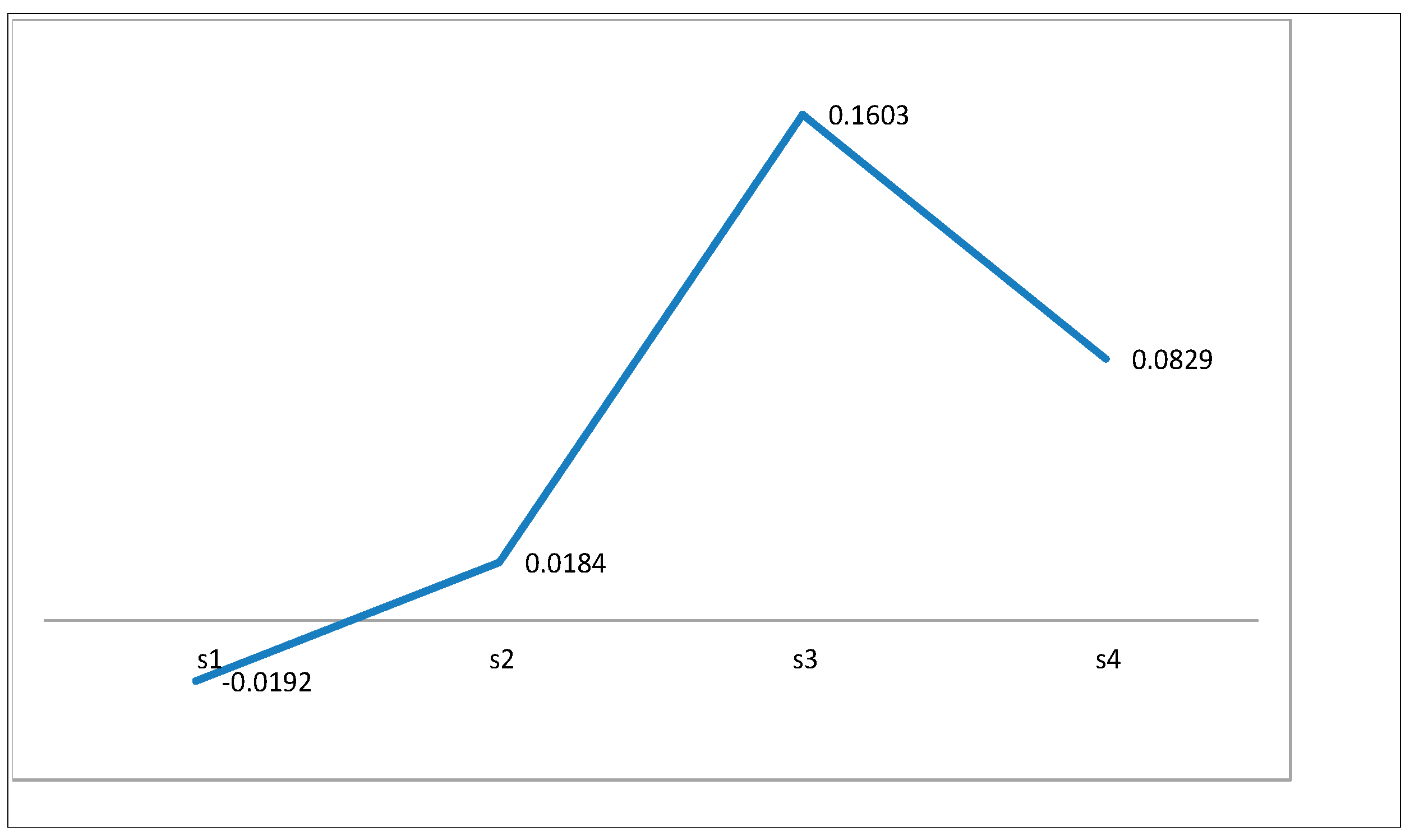
Step 3: The score value are calculated as
Step 4: Ranking
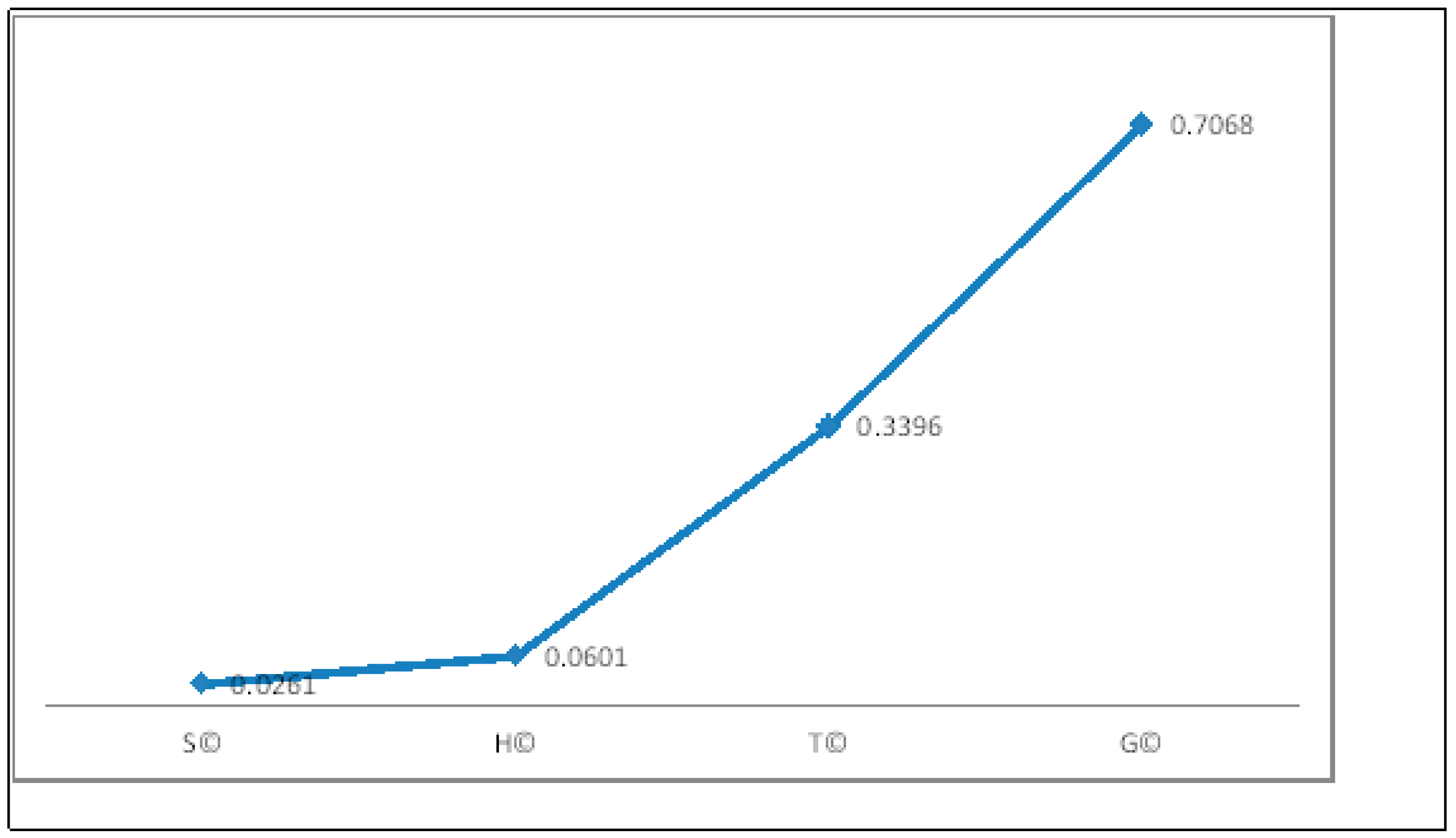
See Figure 12.
Figure 12.
Rating value different range of values.
7. Comparsion Analysis
So as to check the legitimacy and viability of the proposed methodology, a near report is led utilizing the techniques triangular cubic fuzzy number [21], which are unique instances of TNCFNs, to the equivalent illustrative model.
A Comparison Analysis with the Existing MCDM Method Triangular Cubic Fuzzy Number
Aliya et al [21] after transformation, the triangular cubic fuzzy information is given in Table 4.
Table 4.
Triangular cubic fuzzy decision matrix.
Calculate the TCFA operator and .
The TCFA operator is presented in Table 5.
Table 5.
TCFA operator.
Calculate the score function
See Figure 13.
Figure 13.
is the first ranking, is the 2nd ranking, is the third ranking and is the 4th ranking in the TCFN.
The existing Table 6 is as
Table 6.
Comparison method with existing methods.
See Figure 14.
Figure 14.
Comparison analysis with existing method.
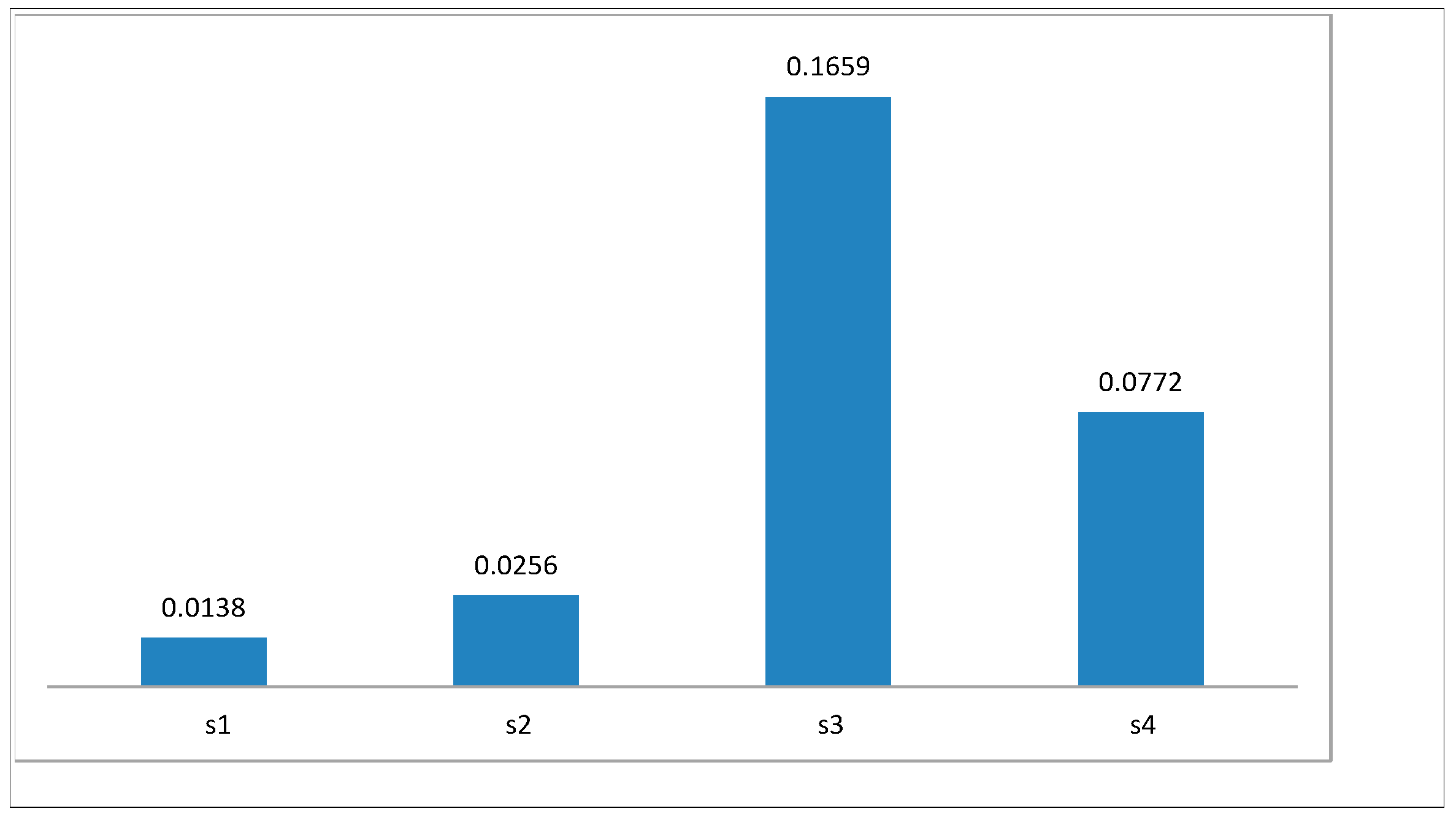
The comparison method of score function is presented in Table 7.
Table 7.
Comparison method with score function.
See Figure 15.
Figure 15.
Different score value.
8. Conclusions
In this paper, we introduce a new concept of TNCFNs and operational laws. We introduce three aggregation operators, namely, the TNCFEWA operator, TNCFEOWA operator and TNCFEWA operator. We introduce group decision making under TNCFNs. Finally, a numerical example is provided to demonstrate the utility of the established approach. In cluster decision-making issues, consultants sometimes return from completely different specialty fields and have different backgrounds and levels of data; as such, they sometimes have branching opinions. These operators may be applied to several different fields, like data fusion, data processing, and pattern recognition, triangular neutrosophic cube like linguistic fuzzy Vikor methodology and quadrangle neutrosophic cube linguistic fuzzy Vikor methodology, which may be a suitable topic for longer term analysis, see Figure 16.
Figure 16.
Flowcharts of whole papers.
Author Contributions
All authors contributed equally to this paper.
Funding
This research received no external funding.
Conflicts of Interest
The authors declare no conflict of interest.
Appendix A. Proof of Proposition 1
(1)
Hence
(2)
and we have
so, we have
(3) and
Appendix B. Proof of Theorem 1
Assume that TCFEWA
and we have
so, we have
Assume that TCFEWA
Then when we have TCFEWA TCFEWA
Especially, if then the the TNCFEWA operator is reduced to the triangular neutrosophic cubic fuzzy einstein averaging operator, which is shown as follows:
References
- Atanassov, K.T. Intuitionistic Fuzzy Sets. Fuzzy Sets Syst. 1986, 20, 87–96. [Google Scholar] [CrossRef]
- Atanassov, K.T. New Operations Defined Over the Intuitionistic Fuzzy Sets. Fuzzy Sets Syst. 1994, 61, 137–142. [Google Scholar] [CrossRef]
- Bustince, H.; Burillo, P. Structures on intuitionistic fuzzy relations. Fuzzy Sets Syst. 1996, 78, 293–303. [Google Scholar] [CrossRef]
- Deschrijver, G.; Kerre, E.E. On the relationship between some extensions of fuzzy set theory. Fuzzy Sets Syst. 2003, 133, 227–235. [Google Scholar] [CrossRef]
- Deschrijver, G.; Kerre, E.E. On the position of intuitionistic fuzzy set theory in the framework of theories modelling imprecision. Inf. Sci. 2007, 177, 1860–1866. [Google Scholar] [CrossRef]
- Jun, Y.B.; Kim, C.S.; Yang, K.O. Annals of Fuzzy Mathematics and Informatics. Cubic Sets 2011, 4, 83–98. [Google Scholar]
- Muhiuddin, G.; Feng, F.; Jun, Y.B. Subalgebras of BCK/BCI-Algebras Based on Cubic Soft Sets. Sci. World J. 2014, 2014, 458638. [Google Scholar] [CrossRef]
- Turksen, I.B. Interval valued fuzzy sets based on normal forms. Fuzzy Sets Syst. 1986, 20, 191–210. [Google Scholar] [CrossRef]
- Xu, Z.S. Intuitionistic fuzzy aggregation operators. IEEE Trans. Fuzzy Syst. 2007, 15, 1179–1187. [Google Scholar]
- Xu, Z.S.; Yager, R.R. Some geometric aggregation operators based on intuitionistic fuzzy sets. Int. J. Gener. Syst. 2006, 35, 417–433. [Google Scholar] [CrossRef]
- Xu, Z.S.; Cai, X. Recent advances in intuitionistic fuzzy information aggregation. Fuzzy Optim. Decis. Mak. 2010, 9, 359–381. [Google Scholar] [CrossRef]
- Liu, H.W.; Wang, G.-J. Multi-criteria decision-making methods based on intuitionistic fuzzy sets. Eur. J. Oper. Res. 2007, 179, 220–233. [Google Scholar] [CrossRef]
- Zeng, S.Z.; Su, W.H. Intuitionistic fuzzy ordered weighted distance operator. Knowl.-Based Syst. 2011, 24, 1224–1232. [Google Scholar] [CrossRef]
- Zadeh, L.A. Fuzzy sets. Inform. Contr. 1965, 8, 338–353. [Google Scholar] [CrossRef]
- Zadeh, L.A. Outline of a new approach to analysis of complex systems and decision processes interval-valued fuzzy sets. IEEE Trans. Syst. Man Cybern. 1973, 3, 28–44. [Google Scholar] [CrossRef]
- Li, J.; Zhang, X.L.; Gong, Z.-T. Aggregating of Interval-valued Intuitionistic Uncertain Linguistic Variables based on Archimedean t-norm and It Applications in Group Decision Makings. J. Comput. Anal. Appl. 2018, 24, 874–885. [Google Scholar]
- Zhao, X.; Lin, R.; Wei, G. Hesitant triangular fuzzy information aggregation based on Einstein operations and their application to multiple attribute decision making. Expert Syst. Appl. 2014, 41, 1086–1094. [Google Scholar] [CrossRef]
- Xu, Z.S.; Yager, R.R. Dynamic intuitionistic fuzzy multi-attribute decision making. Int. J. Approx. Reason. 2008, 48, 246–262. [Google Scholar] [CrossRef]
- Smarandache, F. Neutrosophic set—A generalization of the intuitionistic fuzzy set. In Proceedings of the 2006 IEEE International Conference on Granular Computing, Atlanta, GA, USA, 10–12 May 2006; pp. 38–42. [Google Scholar]
- Smarandache, F. A geometric interpretation of the neutrosophic set—A generalization of the intuitionistic fuzzy set. In Proceedings of the 20011 IEEE International Conference on Granular Computing (GrC), Kaohsiung, Taiwan, 8–10 November 2011; pp. 602–606. [Google Scholar]
- Fahmi, A.; Abdullah, S.; Amin, F.; Ali, A. Weighted average rating (WAR) method for solving group decision making problem using triangular cubic fuzzy hybrid aggregation (TCFHA). Punjab Univ. J. Math. 2018, 50, 23–34. [Google Scholar]
- Fahmi, A.; Amin, F.; Smarandache, F.; Khan, M.; Hassan, N. Triangular Cubic Hesitant Fuzzy Einstein Hybrid Weighted Averaging Operator and Its Application to Decision Making. Symmetry 2018, 10, 658. [Google Scholar] [CrossRef]
- Beg, I.; Rashid, T. Group decision making using intuitionistic hesitant fuzzy sets. Int. J. Fuzzy Log. Intell. Syst. 2014, 14, 181–187. [Google Scholar] [CrossRef]
- Grzegorzewski, P. On Separability of Fuzzy Relations. Int. J. Fuzzy Log. Intell. Syst. 2017, 17, 137–144. [Google Scholar] [CrossRef]
© 2019 by the authors. Licensee MDPI, Basel, Switzerland. This article is an open access article distributed under the terms and conditions of the Creative Commons Attribution (CC BY) license (http://creativecommons.org/licenses/by/4.0/).