1. Introduction
Orthogonal frequency division multiplexing (OFDM) is a multi-carrier technique that achieves a higher spectrum efficiency by using minimally spaced orthogonal subcarriers without increasing the implementation complexity. The success of OFDM is witnessed by its adoption into a lot of international digital television terrestrial broadcasting (DTTB) standards, including digital television/terrestrial multimedia broadcasting (DTMB), advanced television systems committee (ATSC) 3.0, digital video broadcasting-terrestrial-second generation (DVB-T2), and integrated services digital broadcasting-terrestrial (ISDB-T) [
1,
2,
3,
4]. Although many DTTB standards share a common OFDM framework, different technical features could be found [
5,
6]. The unique feature in ISDB-T is the use of band segmented transmission OFDM (BST-OFDM) to support different services and applications. A fundamental feature of BST-OFDM is the capability of using different coding and modulation schemes in one or more OFDM segments, which leads to the basis of hierarchical transmission [
4,
5,
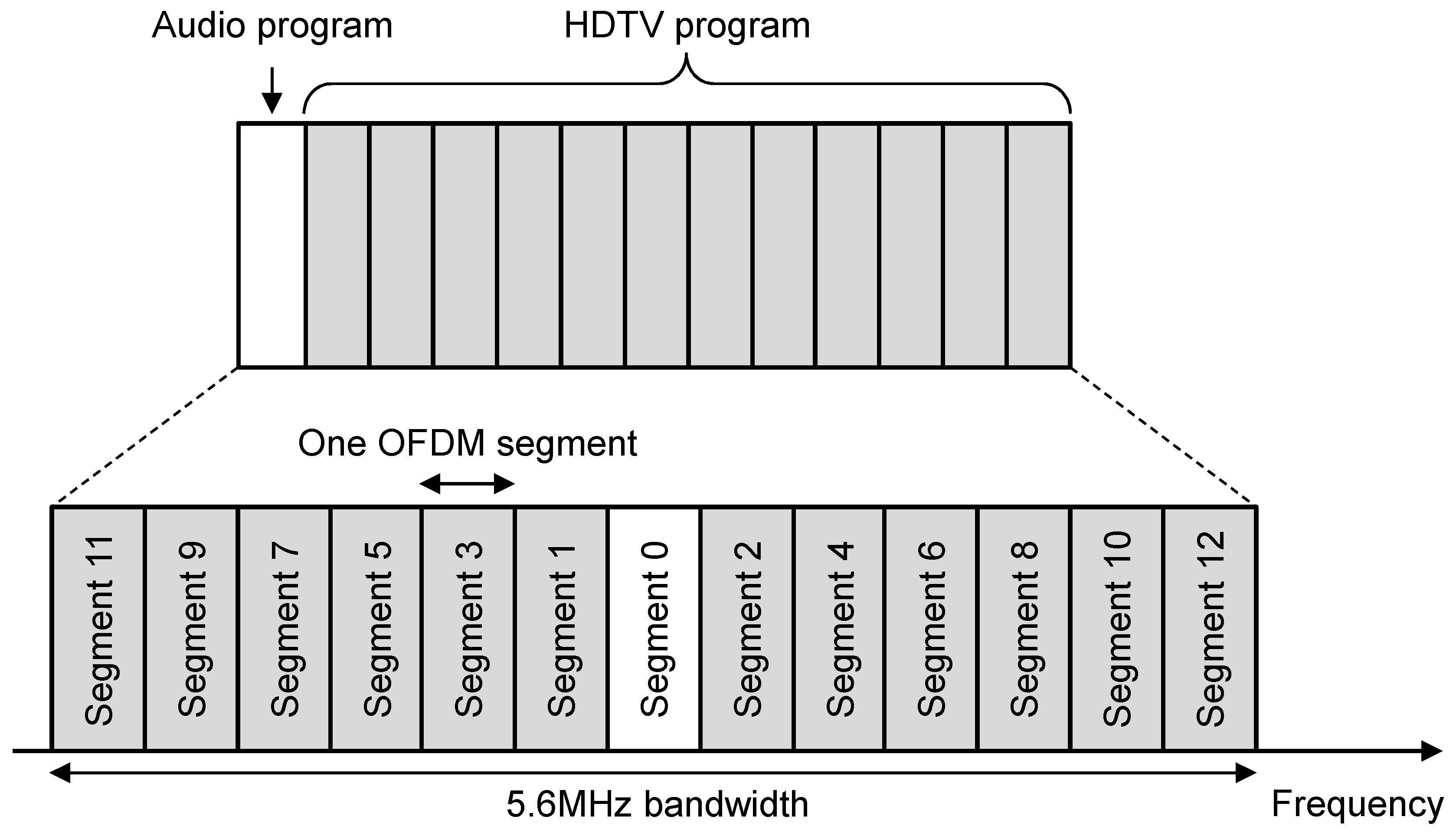
6]. In BST-OFDM, the entire band is equally divided into 13 segments with the same bandwidth, making it possible to transmit an HDTV program by combining 12 segments. Moreover, it is possible for an audio program to be received using one segment.
Besides several advantageous features, the OFDM system has some major problems that must be resolved. One of the major weakness of OFDM is its sensitivity to carrier frequency offset (CFO) and sampling frequency offset (SFO) which are caused by the mismatch between transmitter and receiver oscillators [
7,
8]. If not accurately estimated and compensated, the CFO and SFO can destroy the orthogonality among the subcarriers, leading to performance loss at the OFDM receiver [
9,
10]. In the literature, several types of pilot-aided algorithms have been proposed to perform the joint estimation of CFO and SFO, including maximum likelihood (ML) and linear least-squares (LS) strategies [
11,
12,
13,
14,
15,
16,
17,
18,
19,
20,
21,
22,
23]. The joint ML estimation scheme needs a two-dimensional search to obtain the exact estimation of CFO and SFO. Due to prohibitively high computational processing, a practical implementation of ML approaches developed in [
12,
13,
14] may become unrealistic. To account for this issue, significant attention has been paid to a simplified joint estimation of CFO and SFO using one-dimensional search or closed-form solution [
15,
16,
17,
18,
19,
20,
21,
22,
23]. Specifically, estimation of the CFO and SFO for an unknown channel’s frequency response (CFR) is first reported in [
15], which is based on the phase differences between the equidistant pilot subcarriers over two consecutive OFDM symbols. In [
16], the decision-directed estimation of CFO and SFO without the use of pilots is presented, which increases the computational complexity and suffers from error propagation. Alternative pilot-aided estimation method is proposed in [
17], applying the LS regression in the estimation of a linear combination of the CFO and SFO. In [
18,
19], the estimates over all the pilot-subcarriers are weighted using the frequency-domain channel estimates to improve the estimation accuracy. A suboptimal ML-oriented method is proposed in [
20], where the joint estimation of the CFO and SFO is performed in a decoupled manner such that only one-dimensional search is needed. Similarly, the works in [
21,
22] propose replacing the two-dimensional search of [
13] with a decoupled estimation scheme that is composed of closed-form estimation of the CFO and an approximate ML estimation for the SFO. The estimation method studied in [
23] is based on a polynomial approximation for the ML cost function and its performance comes close to ML performance without resorting to an exhaustive search.
In the ISDB-T system, various types of pilot symbols such as scattered pilot (SP), continuous pilot (CP), transmission and multiplexing configuration control (TMCC), and auxiliary channel (AC) are provided for the purpose of synchronization. Since the number of available CPs is very small and some pilot information is not revealed until the TMCC information is decoded in the ISDB-T system, a direct application of the conventional joint LS estimation scheme [
17,
18,
19] to the ISDB-T system gives rise to the loss in estimation accuracy. In particular, the numbers of CP and SP are changed according to which modulation is used in each segment. Therefore, it is of importance to make necessary changes to the conventional estimation strategy. For the purpose of accommodating the segment format, the estimation schemes [
17,
18,
19] can be modified to utilize information-conveying TMCC control signals, which are present in an equal number regardless of a segment type, instead of the limited number of explicit pilots.
In this paper, we propose an efficient joint estimation of CFO ad SFO in the BST-OFDM based HDTV broadcast system without relying on a priori knowledge of segment type. To end this, the proposed joint LS estimation of CFO and SFO uses information-bearing TMCC signals that are commonly present irrespective of a segment type. Using the repeated nature of TMCC signals to discard the phase ambiguity before decoding TMCC information, the proposed estimation scheme can be a good solution for reliable estimation of frequency offsets. We confirm via numerical simulations that the proposed joint estimation scheme has a comparable performance to the conventional estimation scheme in spite of using information-bearing TMCC signals in a blind manner.
The remainder of this paper is organized as follows. A description of signal models adopted in this paper is presented in
Section 2. In
Section 3, the conventional joint LS estimation of CFO and SFO is discussed, resulting in some limitations when applied to the ISDB-T system. In
Section 4, the effective joint LS estimation of CFO and SFO in the ISDB-T system using TMCC signals is suggested and its mean squared error (MSE) is derived.
Section 5 presents the simulation results that verify the reliable operation of the proposed joint LS estimation scheme. Conclusions are drawn in
Section 6.
2. System Model
In this paper, we consider an OFDM system using
N-point inverse fast Fourier transform (IFFT) of size
N. One OFDM symbol comprises
non-zero subcarriers, and remnant
subcarriers are assumed to be zero-inserted. After IFFT operation, the time-domain signal can be generated and a guard interval (GI) with a length of
is inserted at the front of OFDM symbols in order to remove both inter-symbol interference (ISI) and inter-carrier interference (ICI). The
l-th transmitted time domain signal can be given by
where
is the symbol transmitted at the
k-th subcarrier. Consequently, the effective duration of one OFDM symbol is
, where
is the sample time interval and
. Since our focus is on the post-FFT frequency synchronization, it is assumed that the coarse symbol timing offset (STO) and frequency offset estimation has been performed at the pre-FFT stage. Since many accurate coarse estimation schemes were studied in the literature [
24,
25], it is reasonable to assume that residual STO, CFO, and SFO are small enough after pre-FFT synchronization stage. Let
be the normalized CFO by the subcarrier spacing
and
be the normalized SFO by the sampling frequency interval
After IFFT, the received frequency-domain signal can be represented as [
20,
21,
22,
23]
where
,
is an amplitude attenuation incurred by
,
is the CFR with variance
,
is the residual STO,
is the zero-mean additive white Gaussian noise (AWGN) with variance
, and
is the frequency–offset-induced ICI with variance
. In (
2),
and
can be expressed as
and
Assuming that
are statistically independent for different
n’s and
l’s, from the central limit theorem
is treated as a zero-mean Gaussian random variable with variance [
20]
where
. Note that
and
for typical values of
and
[
9].
Figure 1 shows the assignment of an OFDM segment and program in the ISDB-T system. As shown in
Figure 1, one ISDB-T channel consists of 13 OFDM segments and up to three hierarchical layers can be supported with respect to these segments. The audio program segment is positioned in the middle of the frequency band, which is called narrowband ISDB-T. The narrowband ISDB-T mode only uses single or triple OFDM segments, whereas the wide-band ISDB-T system contains up to 13 segments and supports HDTV service.
Table 1 summarizes the basic transmission parameters of each mode for ISDB-T, where
and
are the numbers in differential-modulation and coherent-modulation segments, respectively. One OFDM frame includes 204 OFDM symbols and pilot carriers. The pilot signals include SP, CP, TMCC, and AC. The SP is present only in coherent-modulation segments in order to estimate the channel, whereas the other pilots can be mainly used to acquire time and frequency synchronization. The TMCC signal, which is inserted in the same format independent of segment types, includes system control information like the segment type and transmission parameters that the receiver has to decode first. Since the TMCC is information-bearing, the frequency estimation schemes that rely on the explicit pilots such as CP and SP are thus not adequate in this case of using TMCC signals as pilot symbols.
3. Conventional Estimation Scheme
The Post-FFT synchronization is practically performed in the frequency domain by the use of uniformly distributed pilot symbols as studied in [
20,
21,
22,
23]. Although the ISDB-T system provides periodically distributed SPs for receiver synchronization, its location will be known after decoding TMCC signals. On the other hand, the presence of CPs in many broadcast systems [
2,
3,
4] makes it possible to correlate two consecutive OFDM symbols. Considering non-periodically distributed property of CPs in the frequency direction, the frequency–offset estimation scheme performed on a per-subcarrier basis is appropriate for the ISDB-T system. Therefore, this paper considers a carrier-by-carrier estimation scheme [
17,
18,
19] that relies on the continuous-type pilot such as CP. By assuming that
and
, one obtains a conjugate product across consecutive symbols as [
20]
where
,
is the combined ICI given by
and
is the combined AWGN given by
From [
20],
behaves like zero-mean Gaussian noise with variance
. Since
, it immediately follows from (
7) and (
8) that
.
If
and
are known pilots at the receiver, by averaging the conjugate product across the multiple pilot pairs, the pilot-compensated signal is obtained as
and its argument can be expressed as
where
is the radian phase angle of the complex number
x,
is the appropriate AWGN plus ICI contribution after taking an argument, and
is the number of averaging used for mitigating interferences. Note that the effect of residual STO is cancelled out in the second term of the right-hand side (RHS) in (
6) after conjugate operation because the phase rotation due to
is not a function of time inedex
l. Since
is a linear function of
and
in (
10), the LS estimates of
and
are computed as follows [
17,
18,
19]:
and
where
is the number of CPs,
is the index of the
i-th CP subcarrier, the last terms of the RHS are the additional interference caused by the use of non-symmetrically distributed CPs, and
As reported in the literature [
17,
18,
19], the drawback of LS estimation scheme is that its performance is strongly influenced by the noise under low signal-to-noise ratio (SNR). Since the ISDB-T system has no sufficient CPs for synchronization, it gives rise to a significant loss in estimation accuracy of (
11) and (
12). To overcome such a problem, an information-carrying TMCC signal can be considered as pilot symbols for the synchronization purpose.
5. Simulation Results and Discussion
The performance of an OFDM system is evaluated with the ISDB-T transmission parameters summarized in
Table 1 and the following parameter settings: a common carrier frequency of
MHz, a sampling time of
= 63/512
s, and GI ratio of 1/8 for all tramsmission modes [
4]. The channel profile is the 6-tap Typical Urban defined in [
27], where the amplitude of each tap is Rayleigh distributed such that a non-line-of-sight (NLOS) scenario is considered. In our simulations, Doppler effects due to mobility are not considered for the purpose of verifying the accuracy of MSE analysis. For fair comparison, we consider that
for the conventional and proposed methods.
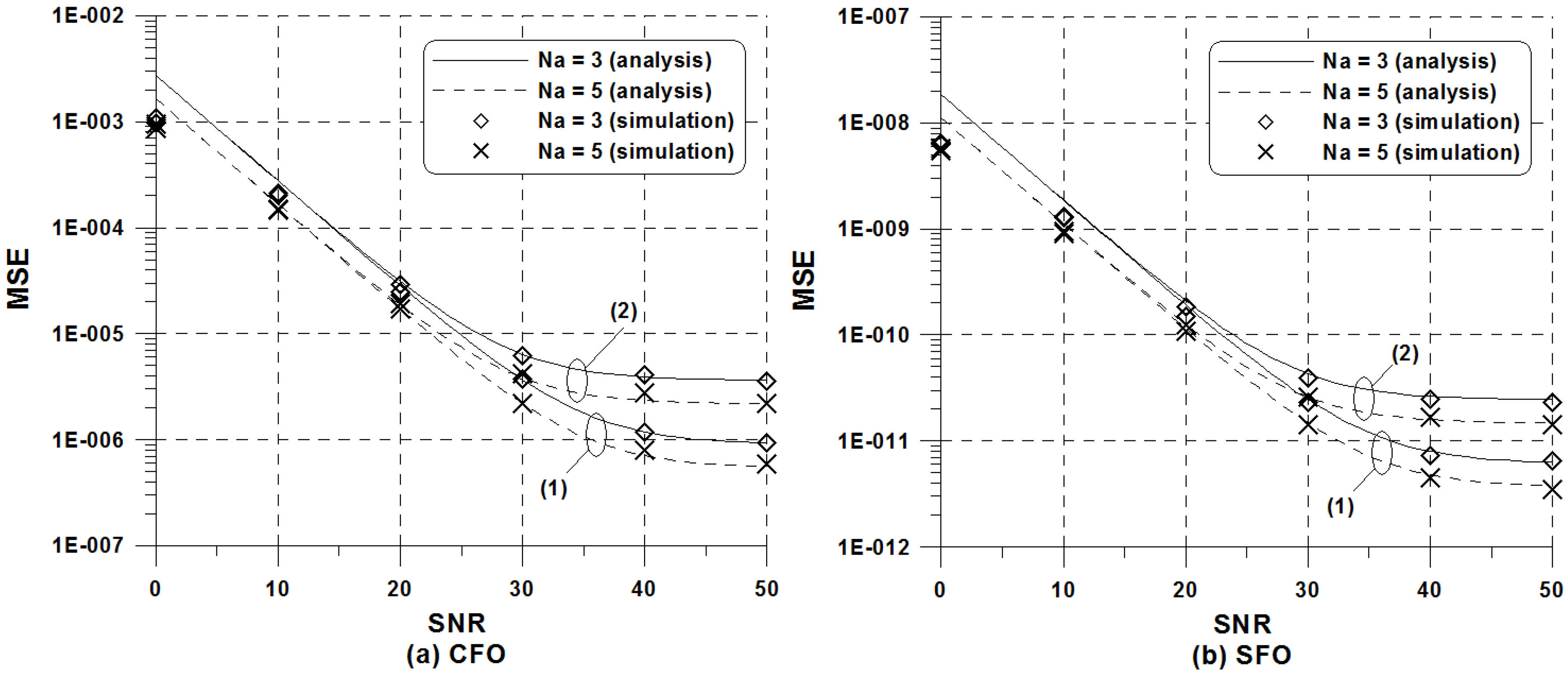
Figure 2 shows the MSE of the proposed joint LS estimator versus the number of averaging in the ISDB-T 2k mode. The probability of Rayleigh distributed random variable
exceeding a minimum level
is
such that the 99.9% level of Rayleigh fading could be achieved when
dB, which is used to calculate the MSE in (35) and (
37). It is observed that theoretical results closely match to the simulation results regardless of
and frequency offsets. There is a small gap between the simulated and analytical curves at low SNR because of the approximation used in (
23). As expected, one can see that the averaging strategy is an attractive solution to improve the estimation accuracy at the expense of computational complexity and processing delay. Nevertheless, the increase of frequency offsets leads to a severe irreducible error floor as the SNR grows.
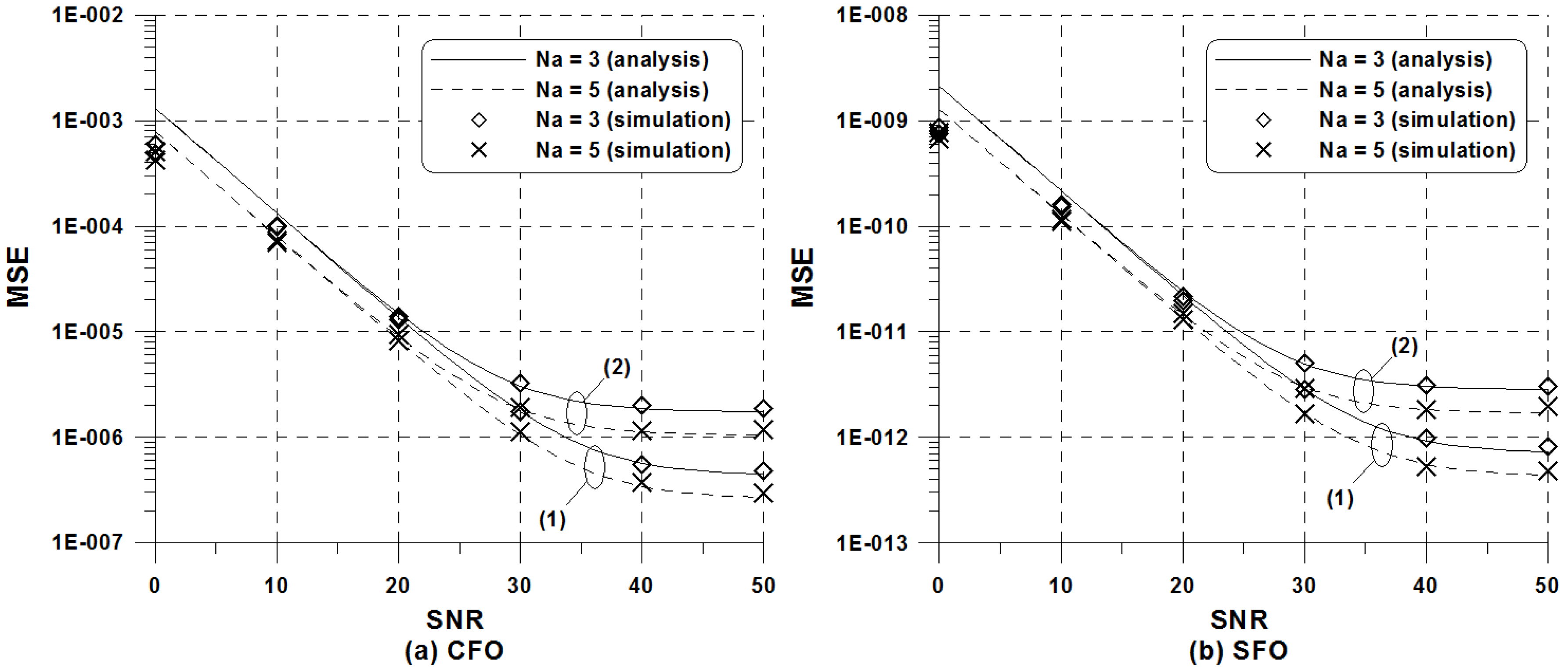
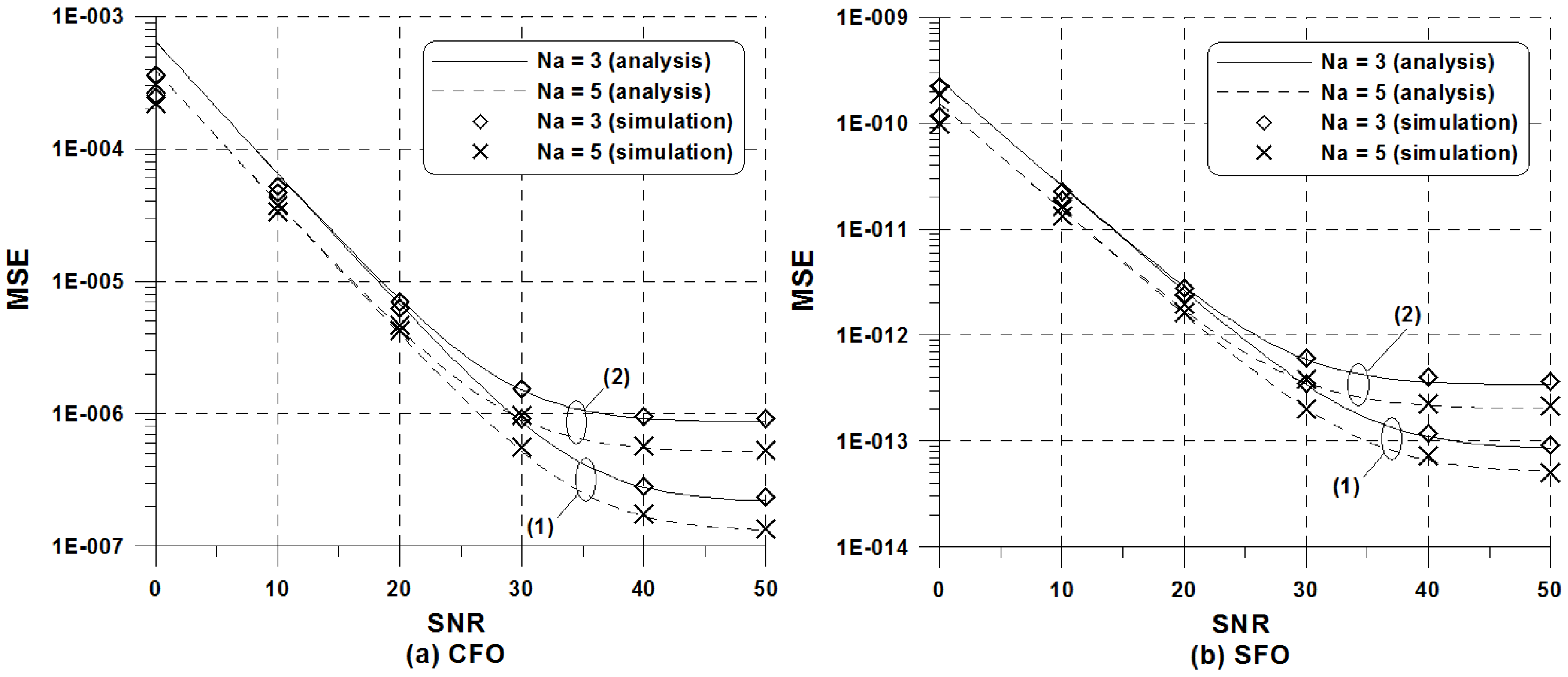
Figure 3 and
Figure 4 illustrate the MSE of the proposed joint LS estimator versus
in the ISDB-T 4k and 8k modes, respectively, under the same simulation scenarios to
Figure 2. In these examples,
for 4k mode and
for 8k mode. Here, we can see a similar trend to that of
Figure 2 where
is used in 2k mode. It is evident that the large number of TMCC signals tends to give a more accurate match between the simulated and analytical curves. The more TMCC signals available in one OFDM symbol that can take part in the joint estimation of CFO and SFO, the better the ICI can be mitigated, as the ICI is similarly treated as AWGN.
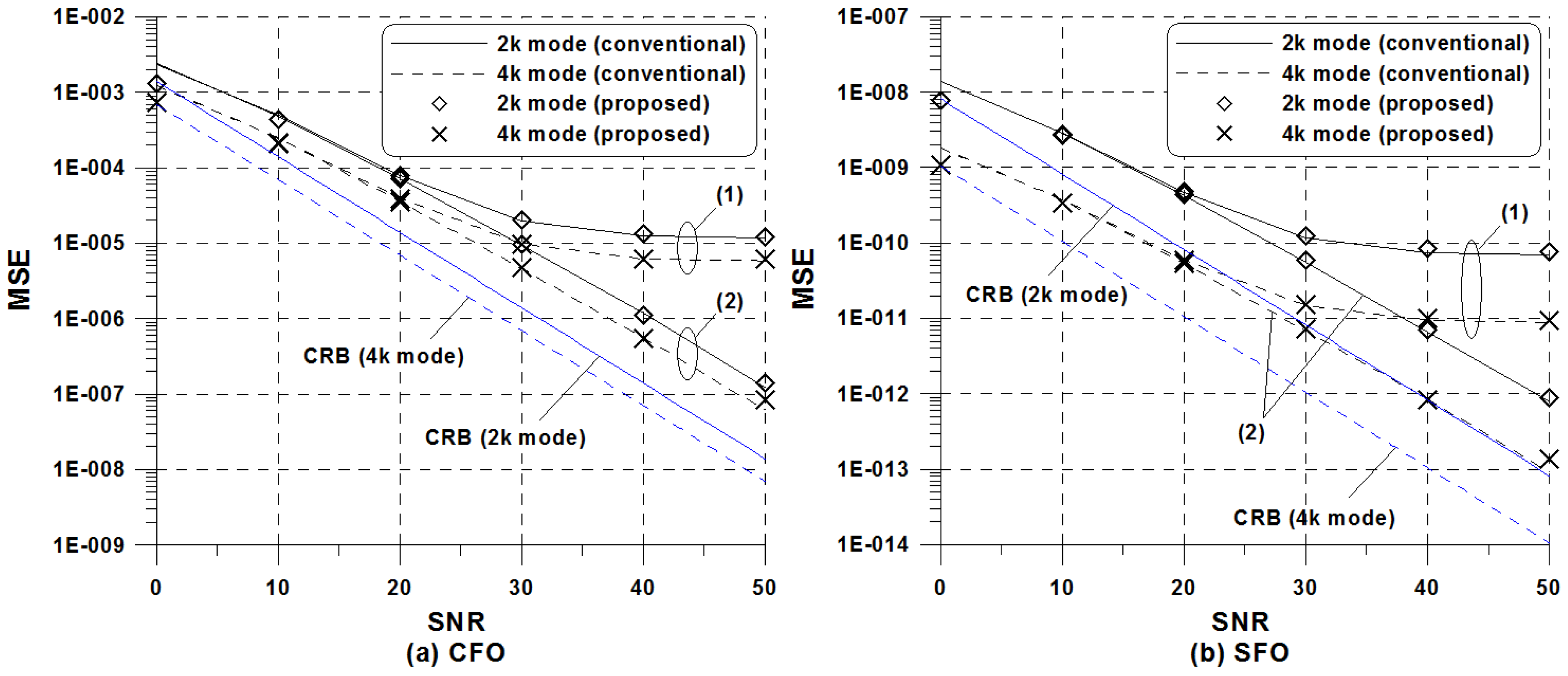
Figure 5 presents the MSE comparison between the conventional and proposed LS estimators when
,
, and
ppm. The CRBs using (
38) and (
39) are also presented as a baseline reference. It can be seen that the MSE performance is the same for both schemes and all algorithms suffer from an error floor for higher SNR values, regardless of the transmission mode. In practice, the conventional joint LS estimation scheme cannot be directly applied to the ISDB-T system because of an unknown phase of TMCC signals, whereas the proposed estimation scheme resolves this problem using the repeated property of TMCC signals as done in (
17). The performance difference between 2k and 4k modes becomes more visible in the case of SFO estimation. This is because the performance of the SFO estimation scheme relies on both the number and location of TMCC subcarriers as in (
37), whereas the CFO estimation performance is dependent on only
. In order to examine the effect of bias caused by the use of non-uniformly distributed pilot, we also consider the scenario that there is no ICI. In this case, one can see that the bias of the proposed scheme is more significant than that of the conventional scheme at the high SNR. Regarding the number of flops when
, the proposed estimation scheme needs
real flops, whereas the conventional estimation scheme requires
. Considering that
, the complexity of the proposed scheme is slightly increased by 11% and 13% in comparison with that of the conventional scheme considering 2k and 4k modes, respectively. In summary, we confirm that the information-carrying TMCC signal can be efficiently used for reliable joint LS estimation of CFO and SFO, achieving a satisfactory performance with moderate computational burden.
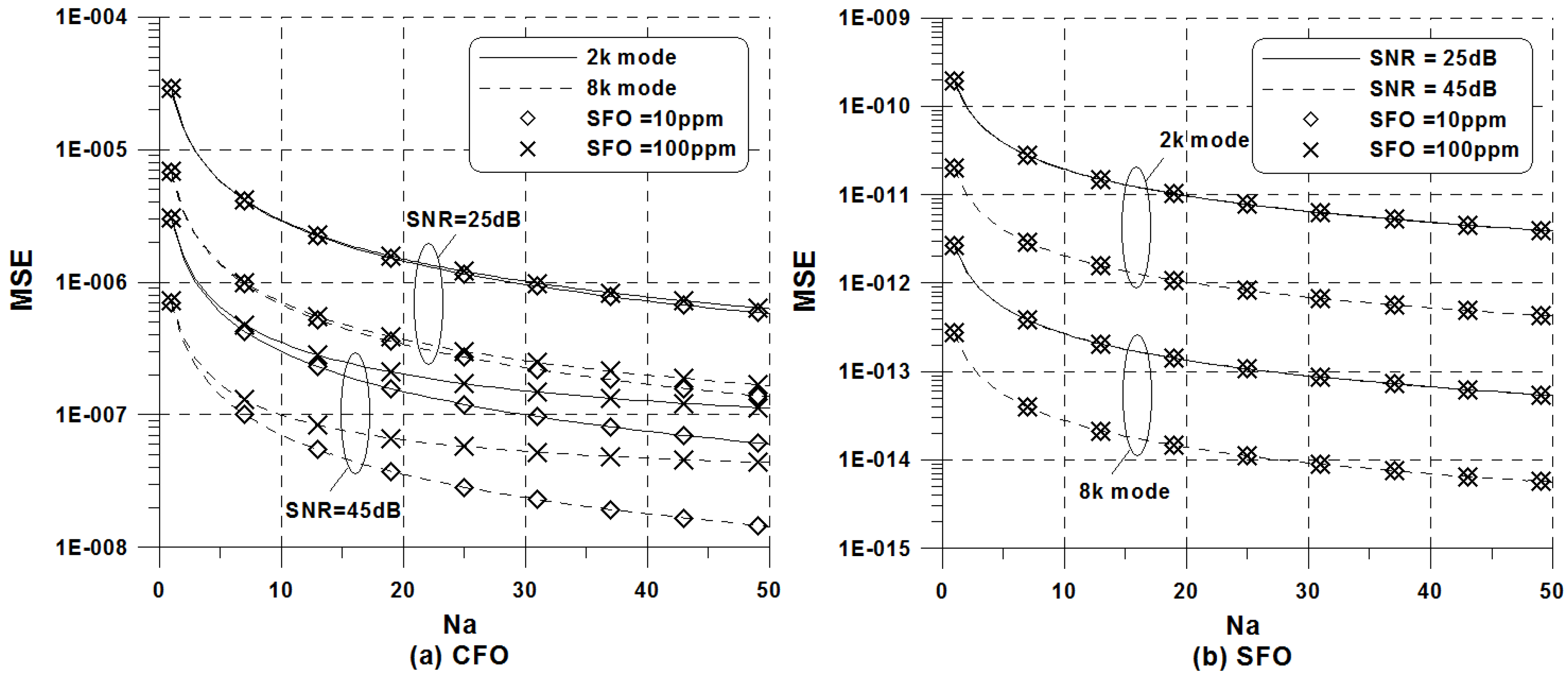
The impact of the parameter
on the performance of the proposed joint LS estimation scheme is further investigated in
Figure 6. The performance of the SFO estimator is not affected by the increase of SFO values, whereas the increased SFO leads to a severe error floor in the CFO estimation at high SNR. The reason for that primarily stems from the fact that the impact of
becomes more dominant compared to that of SFO-induced ICI at high SNR. In order to obtain the same MSE of the CFO regardless of SNR, approximately four times as many
are needed in the 2k mode, compared to 8k mode. As expected, the effect of averaging over
is pronounced for
, whereas the attainable performance gain becomes marginal when
and the price to be paid for using the averaging strategy is an increased processing delay. To account for this problem, the use of TMCC in combination with AC1, which is also present in an equal number irrespective of a segment type, can enhance the estimation accuracy because the receiver knows the locations of TMCC and AC1 subcarriers.