


Abstract
Let G = (V, E) be a connected graph and d(u, v) denote the distance between the vertices u and v in G. A set of vertices W resolves a graph G if every vertex is uniquely determined by its vector of distances to the vertices in W. A metric dimension of G is the minimum cardinality of a resolving set of G and is denoted by dim(G). Let J2n,m be a m-level gear graph obtained by m-level wheel graph W2n,m ≅ mC2n + k1 by alternatively deleting n spokes of each copy of C2n and J3n be a generalized gear graph obtained by alternately deleting 2n spokes of the wheel graph W3n. In this paper, the metric dimension of certain gear graphs J2n,m and J3n generated by wheel has been computed. Also this study extends the previous result given by Tomescu et al. in 2007.
MSC:
05C12; 05C90; 05C15; 05C62
1. Introduction and Preliminary Results
In a connected graph , where V is the set of vertices and E is the set of edges. The distance between two vertices is the length of the shortest path between them and the diameter of G denoted by is the maximum distance between pairs of vertices . Let be an order set of vertices of G and u be a vertex of G. The representation of u with respect to W is the , where W is called a resolving set or locating set if distinct vertices of G have distinct representations with respect to W. See for more results [1,2].
A resolving set of minimum cardinality is called a metric basis for G and the cardinality of a metric basis is said the metric dimension of G, denoted by , see [3]. The motivation for this topic stems from chemistry [4]. A common but important problem in the study of chemical structures is to determine ways of representing a set of chemical compounds such that distinct compounds have distinct representations. Moreover the application of this invariant to the navigation of robots in networks are discussed in [5]. The application to problems of pattern recognition and image processing, some of which involve the use of hierarchical data structures are given in [6].
For a given ordered set of vertices of a graph G, the component of is 0 if and only if . Thus, to show that W is a resolving set it suffices to verify that for each pair of distinct vertices
Motivated by the problem of determining uniquely the location of an intruder in a network, the concept of metric dimension was introduced by Slater in [7] and studied independently by Harary and Melter in [8].
Let be a family of connected graphs depending on m as follows: = cardinality of the set of vertices of any member F of and . If such that , then we shall say that has bounded metric dimension, otherwise has unbounded metric dimension. If all graphs in have the same metric dimension then F is called a family with constant metric dimension [9].
A connected graph G has if and only if G is a path [5], cycle have metric dimension 2 for every . Other families of graphs with unbounded metric dimension are regular bipartite graphs [10], wheel graph [11]. The metric dimensions of m-level wheel graphs, convex polytope graphs and antiweb gear graphs are computed in [12]. The metric dimension of honeycomb networks are computed in [13] and t he metric dimension of generators of graphs in [14]. In the following section, some results related to m-level generalized gear graph are given.
2. The Metric Dimension of Double Gear Graph J2n,m
Definition 1.
The joining of two graphs and is denoted by with the following vertex and edge sets:
Definition 2.
In graph theory, an isomorphism of graphs and is a bijection between the vertex sets of and , such that any two vertices u and v of are adjacent in if and only if and are adjacent in . If an isomorphism exists between two graphs, then the graphs are called isomorphic and denoted as .
Note that the the graph is isomorphic to wheel graph . In addition, note that mean union of two copies of that are joined with .
Definition 3.
A double-wheel graph can be obtained as join of and inductively an m-level wheel graph denoted by can be constructed as .
Definition 4.
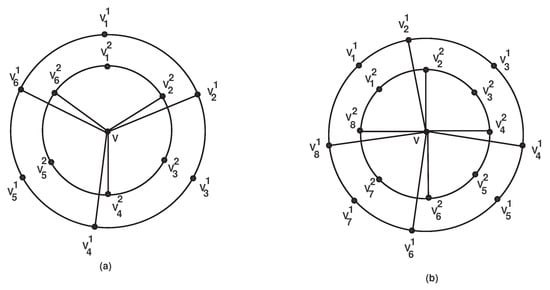
A double gear graph denoted by can be obtained from double-wheel by alternatively deleting n spokes of each copy of and inductively an m-level gear graph can be constructed from m-level wheel by alternatively deleting n spokes of each (see [15]). A double gear graph is depicted in Figure 1.
Figure 1.
(a) The double gear graph ; (b) The double gear graph .
Construction and Observations
A double gear graph (see in Figure 1) is constructed if we consider two even cycles with ,
Now take a new vertex v adjacent to n vertices of : as well as v is also adjacent to n vertices of :. Inductively we can construct an m-level gear graph denoted by by taking m even cycles .
The vertices of , in the graph are of two kinds namely the vertices of degree 2 and the vertices of degree 3. Vertices of degree 2 and 3 will be considered as minor and major vertices respectively. One can easily check that:
- When, (central vertex v with one major and minor vertex of each form basis).
- When, (central vertex v with two minor vertices of each form basis).
- When, (two minor vertices such that of with one minor vertex and two major vertices of such that form basis).
- When, (three minor vertices satisfying , of with three minor vertices and one major vertex of satisfying , and form metric basis of ).
Consider the gear graph in which is an outer cycle of length . If B is a basis of then B contains vertices of for . Suppose then vertices of B can be ordered as such that for and are called neighboring vertices. Vertices of lying between any two neighboring vertices of B are called gaps which are denoted by for and , and their cardinalities are said to be the size of gaps. One can easily observe that every vertex of B has two neighboring vertices; gaps generated by these three vertices are called neighboring gaps following a concept already exist in and . A gap determined by neighboring vertices of basis say and will be called an with when and or when and . Hence we have three kinds of gaps namely, gap, gap and gap.
For the graph central vertex v does not belong to any basis. Since ∀, , and , if central vertex v belongs to any metric basis B then there must exists two distinct vertices and for such that . Consequently, the basis vertices of belong to the cycles induced by and . It is shown in that if B is a basis of then B consist only of the vertices of that satisfy the following properties.
- If B is a basis of , then every gap, gap and gap of B contains at most 5, 4 and 3 vertices respectively.
- If B is a basis of , then it contains at most one major gap.
- If B is a basis of , then any two neighboring gaps contain together at most six vertices in which one gap is a major gap.
- If B is a basis of , then any two minor neighboring gaps contain together at most four vertices.
Lemma 1.
Let B be a basis of , , then every gap, gap and gap of B induced by and contains at most 5, 4 and 3 vertices respectively.
Proof.
Suppose the result is false and there exists a gap of size 7 say , consisting of consecutive vertices of or with then which is a contradiction. If there exists a gap of size 6 then we have a path , consisting of consecutive vertices of or with and then which is again a contradiction. The existence of a gap of size 5 say induced by or with , would imply a contradiction.
The gap gap and gap containing 5, 4 and 3 vertices respectively will be referred to as major gaps and the remaining gaps are called minor gaps. In the proof of Lemmas 2–4, the major vertices will be labeled by a star (*). □
Lemma 2.
Let B be a basis of , then it contains at most one major gap induced by the vertices of cycles and .
Proof.
Suppose B contains two distinct major gaps induced by the vertices of cycles or .
Case-(i): When both gaps are then we have two distinct paths consisting consecutive vertices and of and respectively in this case ; a contradiction.
Case-(ii): When both gaps are then we have two distinct paths consisting of consecutive vertices and of and respectively but ; a contradiction.
Case-(iii): When both gaps are then we have two distinct paths consisting of consecutive vertices and of and respectively in this case ; a contradiction.
Case-(iv): When one gap is and other is gap then we have two distinct paths and induced by and respectively but ; a contradiction.
Case-(v): When one gap is and other is gap then we have two distinct paths consisting of consecutive vertices and of and respectively but ; a contradiction.
Case-(vi): When one gap is and other is gap then we have two distinct paths consisting of consecutive vertices and of and respectively in this case ; a contradiction.
Similarly, if both major gaps are induced by then we get a contradiction and a similar contradiction arises if induced both major gaps. □
Lemma 3.
Let B be a basis of , , then any two neighboring gaps, one of which being a major gap induced by exactly one of two cycles or contain together at most six vertices.
Proof.
If the major gap is then there is nothing to prove by Lemma 2. Without loss of any generality we can say that only induced a major gap by Lemma 2. If the major gap is a gap having five vertices then its neighboring minor gap contains at most one vertex. If this statement is false and gap, minor gaps having three and two vertices respectively are neighboring gaps of major gap, then we have two paths consisting of consecutive vertices of : and , where induced by major, minor gaps and major, minor gaps respectively. In this case and ; a contradiction. The existence of major gap having four vertices is not possible if its neighboring minor gap is a gap with three vertices. If this case holds then we consider the following path: , where then ; a contradiction. □
Lemma 4.
Let B be a basis of , , then any two minor neighboring gaps induced by or contain together at most four vertices.
Proof.
To prove the statement, it is sufficient to prove two cases.
Case-(i): minor gap with three vertices cannot be neighboring gap of minor gap having three vertices, otherwise we have a path consisting of consecutive vertices of or :, where in this case .
Case-(ii): minor gap with three vertices cannot be neighboring gap of minor gap having two vertices, otherwise we have a path consisting of consecutive vertices of or : where in this case ; a contradiction. □
Theorem 1.
If be a double gear graph for , then
Proof.
We have seen that , and the central vertex v does not belong to any basis B of . Moreover
and
be the outer cycles of at level 1 and 2 respectively. First we prove that by constructing a resolving set W in with vertices.
We consider three cases according to the residue class modulo 3 to which n belongs.
Case-(i): When , then we may write , where , is even and , in this case W can be considered as:
Case-(ii): When , then we may write , where is even and , in this case W can be considered as:
Case-(iii): When , then we may write , where is even and , in this case W can be considered as:
The set W contains a unique major gap having at most five vertices and all other gaps are minor gaps which contain at most three vertices. The set W is a resolving set of since any two major or any two minor vertices respectively lying in different gaps or in the same gap are separated by at least one vertex in the set of three vertices of W generating these neighboring gaps. When gaps are not neighboring gaps, then the set of four vertices of W which generate two gaps make the representation unique of each vertex of these two gaps. Representation of central vertex v is , which is different from the representation of all other vertices of . Hence,
Now we show that . As the central vertex v does not belong to any basis of . Let B be a basis of such that then we have r gaps. By lemma 2 B contains at most one major gap, without loss of generality we can say major gap lies on . Hence B induces gaps on and gaps on .
We denote the gaps on by where and are called neighboring gaps for as well as is also neighboring gap of and the gaps on will be denoted by where and are called neighboring gaps for as well as is also neighboring gap of . By Lemma 2, suppose is a major gap. By Lemmas 3 and 4, we can write
and
We consider two cases according to the residue class modulo 2 to which r belongs.
Case-(i): When : In this case
By summing the above inequality we have
Again
Case-(ii): When : In this case and
By summing the above inequality we have
and
Theorem 2.
If be a double gear graph for , , then
Proof.
We will prove this result by induction on levels of gear graph denoted by .
When , then is obtained in .
When , then by Theorem 1.
Now we assume that the statement is true for , . we will show the result for , by using concept of Theorem 1 we have .
Now . . Hence the result is true for all positive integers . □
3. The Metric Dimension of Generalized Gear Graph
Definition 5.
To define the generalized gear graph : consider a cycle having vertices with , take a new vertex v adjacent to n vertices of . The generalized gear graph has order and size . It can be obtained from wheel graph by alternately deleting spokes.
Construction and Observations
The vertices of in the graph are of two kinds: vertices of degree 2 and 3. Vertices of degree 2 and 3 will be considered as minor and major vertices respectively. The graph is a bipartite graph in which one bipartition class contains minor vertices together with central vertex v and the second bipartition class contain major vertices. In the proof of Lemmas 5–9, major vertices will be represented by a star. One can easily check that:
- When, (one minor vertex of together with central vertex v form basis).
- When, (two minor vertices and such that form basis).
- When, (three minor vertices , and such that form basis).
For the graph central vertex v does not belong to any basis. Since ∀, , and if central vertex v belongs to any metric basis B then there must exist two distinct vertices and for such that . If B is a basis of and central vertex v does not belong to B then by using the concept of gap given in Section 2, we have again three kinds of gaps i.e gpa, gap, and gap.
Lemma 5.
If B is a basis of , then every gap, gap and gap of B contains at most 8, 7 and 5 points respectively.
Proof.
Suppose the basis set B contains a gap of nine consecutive vertices , of such that we have in this case. If gap contains more than 7 vertices then it contains 9 consecutive vertices , of such that and we have , a contradiction in this case. If a gap contains more then 5 vertices, then it contains 8 consecutive vertices such that then which is again a contradiction.
The gap, gap and gap containing 8, 7 and 5 vertices respectively will be referred to as major gaps and the remaining gaps are called minor gaps. □
Lemma 6.
If B is a basis of , , then it contains at most one major gap.
Proof.
Suppose B is basis of and it contains two distinct major gaps.
Case-(i): When both gaps are then we have two distinct paths and but .
Case-(ii): When both gaps are then we have two distinct paths and but .
Case-(iii): When both gaps are then we have two distinct paths and but .
Case-(iv): When one gap is and other is gap then we have two distinct paths and but .
Case-(v): When one gap is and other is gap then we have two distinct paths and but .
Case-(vi): When one gap is and other is gap then we have two distinct paths and but . □
Lemma 7.
If B is a basis of , , containing one major gap either gap or gap then it does not contain gap and minor gap having 7 and 6 vertices respectively.
Proof.
Case-(i): When one gap is major gap and the other is minor gap having 7 vertices, then we have two distinct paths and but .
Case-(ii): When one gap is major gap and the other is minor gap having 6 vertices, then we have two distinct paths and but .
Case-(iii): When one gap is major gap and the other is minor gap having 7 vertices, then we have two distinct paths and but .
Case-(iv): When one gap is major gap and the other is minor gap having 6 vertices, then we have two distinct paths and but . □
Lemma 8.
If B is a basis of , then any two neighboring gaps contain together at most 13 vertices in which one gap is a major gap.
Proof.
To show the statement, it is sufficient to show that a major gap with 8 vertices has a neighboring minor gap in which 6 vertices cannot occur. If it holds then we have the path with in this case , a contradiction. □
Lemma 9.
If B is a basis of , , then any two minor neighboring gaps contain together at most 11 vertices.
Proof.
To show the statement, it is sufficient to show that a gap with 6 vertices has a neighboring gap with 6 vertices cannot occur. Since gap is , both base elements must have degree 2. For two consecutive gaps having 6 vertices, we have two possible paths. (i) First possible path is with which is not possible as but .
(ii) Second possible path is with which is not possible as but . Hence two minor gap contain at most 11 vertices. □
Theorem 3.
If be the generalized gear graph for , then .
Proof.
First we prove that by constructing a resolving set W in with vertices. We consider two cases according to the residue class modulo 2 to which n belongs.
Case-(i): When then W can be considered as:
Case-(ii): When then W can be considered as:
□
The set W contains a unique major gap and all other gaps are minor gap which contain at most five vertices, only one minor gap contains six vertices. The set W is a resolving set of since any two major or any two minor vertices lying in different gaps or in the same gap are separated by at least one vertex in the set of three vertices of W generating these neighboring gaps; when gaps are not neighboring gaps then the set of four vertices of W which generate two gaps make the representation of each vertex of these two gaps unique. Representation of central vertex is , which is different from the representation of all other vertices of . Hence
Now we show that . By Lemma 5 the central vertex v does not belong to any basis of . Let B be a basis of such that . We have r gaps on generated by elements of B. We denote these gaps by where and are called neighboring gaps for as well as is also a neighboring gap of . By Lemma 6 at most one of them say is a major gap. By Lemmas 6 and 7, we have
and by Lemmas 8 and 9, we have,
By summing these inequalities, we get,
Hence .
4. Conclusions
In the foregoing section, m-level gear graph and generalized gear graph are constructed. It is proved that metric dimension of is for every and metric dimension of is for every . This section is closed by raising the following open problem.
Open Problem. Determine the metric dimension of m-level generalized gear graph .
Author Contributions
S.I. contribute for conceptualization, funding, and analyzed the data. M.K.S. and M.I. contribute for supervision, methodology, and software, validation, designing the experiments and formal analysing. M.H. and H.M.B. contribute for performed experiments, resources, some computations and wrote the initial draft of the paper. A.T. and Z.S. contribute for analyzed the data and investigated this draft and wrote the final draft. All authors read and approved the final version of the paper.
Acknowledgments
The authors are grateful to the anonymous referees for their valuable comments and suggestions that improved this paper. This research is supported by the Start-Up Research Grant 2016 of the United Arab Emirates University (UAEU), Al Ain, United Arab Emirates via Grant No. G00002233 and UPAR Grant of UAEU via Grant No. G00002590. Also This research is supported by The Higher Education Commission of Pakistan Under Research and Development Division, National Research Program for Universities via Grant No.: 5348/Federal/NRPU/R&D/HEC/2016.
Conflicts of Interest
The authors declare no conflict of interest.
References
- Tomescu, I.; Javaid, I. On the metric dimension of the jahangir graph. Bull. Math. Soc. Sci. Math. Roum. 2007, 50, 371–376. [Google Scholar]
- Chartrand, G.; Eroh, L.; Johnson, M.A.; Oellermann, O.R. Resolvability in graphs and metric dimension of a graph. Disc. Appl. Math. 2000, 105, 99–113. [Google Scholar] [CrossRef]
- Imran, M.; Baig, A.Q.; Bokhary, S.A.; Javaid, I. On the metric dimension of circulant graphs. Appl. Math. Lett. 2012, 25, 320–325. [Google Scholar] [CrossRef]
- Cameron, P.J.; Van Lint, J.H. Designs, Graphs, Codes and their Links. In London Mathematical Society Student Texts; Cambridge University Press: Cambridge, UK, 1991; Volume 22. [Google Scholar]
- Khuller, S.; Raghavachari, B.; Rosenfeld, A. Localization in Graphs; Technical Report CS-TR-3326; University of Maryland at College Park: College Park, MD, USA, 1994. [Google Scholar]
- Melter, R.A.; Tomescu, I. Metric bases in digital geometry. Graph. Image Process. 1984, 25, 113–121. [Google Scholar] [CrossRef]
- Slater, P.J. Leaves of trees. Congress 1975, 14, 549–559. [Google Scholar]
- Harary, F.; Melter, R.A. On the metric dimension of a graph. Ars Combin. 1976, 2, 191–195. [Google Scholar]
- Tomescu, I.; Imran, M. metric dimension and R-Sets of connected graph. Graphs Combin. 2011, 27, 585–591. [Google Scholar] [CrossRef]
- Bača, M.; Baskoro, E.T.; Salman, A.N.M.; Saputro, S.W.; Suprijanto, D. On metric dimension of regular bipartite graphs. Bull. Math. Soc. Sci. Math. Roum. 2011, 54, 15–28. [Google Scholar]
- Buczkowski, P.S.; Chartrand, G.; Poisson, C.; Zhang, P. On k-dimensional graphs and their bases. Perioddica Math. Hung. 2003, 46, 9–15. [Google Scholar] [CrossRef]
- Siddique, H.M.A.; Imran, M. Computing the metric dimension of wheel related graphs. Appl. Math. Comput. 2014, 242, 624–632. [Google Scholar]
- Manuel, P.; Rajan, B.; Rajasingh, I.; Monica, C. On minimum metric dimension of honeycomb networks. J. Discret. Algorithms 2008, 6, 20–27. [Google Scholar] [CrossRef]
- Sebo, A.; Tannier, E. On metric generators of graphs. Math. Oper. Res. 2004, 29, 383–393. [Google Scholar] [CrossRef]
- Bras, R.L.; Gomes, C.P.; Selman, B. Double-wheel graphs are graceful. In Proceedings of the Twenty-Third International Joint Conference on Artificial Intelligence, Beijing, China, 3–9 August 2013; pp. 587–593. [Google Scholar]
© 2018 by the authors. Licensee MDPI, Basel, Switzerland. This article is an open access article distributed under the terms and conditions of the Creative Commons Attribution (CC BY) license (http://creativecommons.org/licenses/by/4.0/).