


Abstract
Although numerous studies have examined the spatial patterns of traditional villages and their driving factors, limited attention has been devoted to the transformation of tourism. This study focused on traditional villages in Shaanxi Province, employing geodetector and grounded theory methods to analyze their spatial distribution characteristics and influencing factors. First, most traditional villages have not developed tourism. Only 11.98% reached the relatively mature tourism stage. Second, the spatial distribution of mature traditional tourism villages is scattered and primarily clustered in Liuba County, Mizhi County, and Jia County. Third, the factors influencing spatial distribution characteristics include resource endowment, transportation accessibility, and regional economic conditions. Among these factors, the level of traditional villages, village heritage values, and the local tourism environment show the strongest explanatory power. These findings can help enhance cultural resilience, promote economic transformation and upgrading, and support the sustainable development of traditional villages.
1. Introduction
Traditional villages are important components of China’s cultural heritage [1]. At the end of 2012, the Ministry of Housing and Urban-Rural Development, the Ministry of Culture, and the Ministry of Finance jointly issued a document in which traditional villages are referred to as “the villages that were formed earlier, own rich traditional resources, are relatively complete at present, and have high historical, cultural, scientific, artistic, social, and economic values” [2]. Previous studies have extensively discussed the spatial distribution characteristics, influencing factors, and mechanisms of spatial evolution at the national [3], regional [4], and provincial scales [5]. Previous studies can be broadly categorized into two approaches. The first focuses on the evolutionary mechanisms of spatial patterns, emphasizing the historical dynamics of cultural, economic, and other influencing factors [6]. The second investigated the determinants of the current spatial distribution of traditional villages by selecting relevant factors to explain the spatial distribution patterns within the study area. For instance, Liu et al. investigated the spatial patterns of traditional villages across the Qinghai–Tibet Plateau and employed regression models to determine the key determinants shaping these patterns [7].
Regarding the factors influencing spatial distribution characteristics, some indicator systems are primarily constructed based on dimensions such as topography, hydrology, transportation, vegetation, and economic level [8,9]. Socio-cultural dimensions, such as counts of intangible cultural heritage [10,11] and population concentration [12,13], have been considered in previous research. Zhu et al. (2024) examined the impact of provincial economic development levels, the scale of the tourism industry, and the strength of policy support on the spatial distribution of rural tourism villages [14].
ArcGIS spatial analysis, geodetectors, and grounded theory have always been used to analyze the spatial distribution characteristics and driving factors of traditional villages’ tourism transformation levels [15,16]. The geodetector method, developed by Wang et al., is a quantitative approach used to detect spatial differentiation and identify the underlying driving factors [17]. It is well suited for exploring spatial distribution characteristics at a regional scale. Using ArcGIS-based spatial analysis, geodetector, and MGWR, Zou et al. evaluated the spatial heterogeneity and driving forces behind the distribution of 1597 rural tourism villages and towns in China [18]. Grounded theory was originally developed through the collaborative work of Barney Glaser (University of Chicago) and Anselm Strauss (Columbia University) [19]. It enables systematic coding and conceptual abstraction of qualitative data, such as interview texts, allowing for the identification of latent factors, such as institutional arrangements [20], villagers’ willingness to participate [21], the effectiveness of policy implementation [22], and others that are difficult to capture through spatial data alone. Consequently, grounded theory is an important supplement to the geodetector method. Integrating the geodetector with grounded theory through a mixed-methods design improves both the analytical depth and reliability by linking macro-level patterns with micro-level insights (Figure 1).

Figure 1.
Technical route map.
Because of their distinctive landscapes and rich cultural heritage, traditional villages have enormous potential for developing tourism. Parts of traditional villages have become well-known tourist destinations in China due to the promotion of rural tourism and revitalization. Traditional village tourism not only showcases unique regional characteristics but also creates job opportunities [23] and improves rural poverty [24]. On the whole, several previous studies have considered traditional villages or rural tourism destinations as research subjects, however, there has been a lack of scientific discussion regarding the spatial distribution characteristics and underlying mechanisms from the perspective of traditional village tourism transformation levels. Identifying this gap would help successfully transform traditional villages into rural tourist destinations, ultimately achieving the goals of protecting cultural heritage and promoting economic prosperity.
This paper is organized into two main sections: (1) the spatial distribution characteristics of traditional villages with varying levels of tourism development and (2) the influencing factors that contribute to these characteristics.
2. Materials and Methods
2.1. Study Area
Shaanxi Province is located in central China. It has a great deal of cultural heritage, which constitutes an indispensable part of the Yellow River civilization. To date, Shaanxi Province has 501 traditional villages, including 182 at the national level and 319 at the provincial level. In the Yellow River Basin, Shaanxi is an important area where traditional villages are concentrated (Figure 2). With the promotion of rural revitalization and tourism, some traditional villages have been successfully transformed into rural tourism destinations. Simultaneously, some villages are either in the pre-stage of tourism development or are gradually declining.
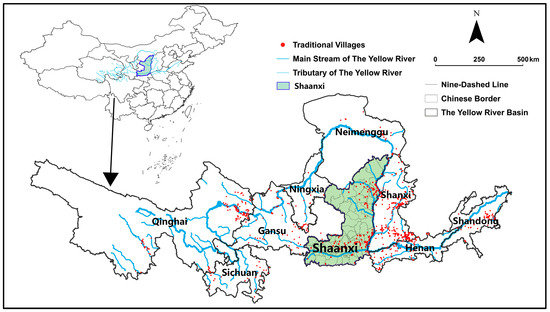
Figure 2.
Research area.
2.2. Methods
2.2.1. Geodetector
The geodetector is based on the assumption that if variable X has a significant influence on variable Y, the spatial distributions of both X and Y should be similar. The model compares the spatial consistency of the distribution of the independent variable with the geographical strata in which the potential factors exist [25]. The advantage of the geodetector lies in its flexibility and lack of presuppositions and constraints, effectively overcoming the limitations of traditional statistical analysis methods when handling categorical variables [26]. The geodetector includes four aspects: factor detection, ecological detection, risk detection, and interaction detection. In this study, we utilized a factor detector and an interaction detector.
- (1)
- Factors detector
This detector model uses the q-value to measure the explanatory power of each factor for the dependent variable Y.
where and are the variances of layer h and the Y value of the whole region. SSW and SST are the sums of the within-layer variance and the total variance in the entire region, respectively, where h = 1,…, L are the strata of the dependent variable Y, and and N are the number of units in layer h and the entire area, respectively. The value of q ranges from 0 to 1, where a higher value indicates stronger explanatory power of the influencing factor X on the dependent variable Y.
- (2)
- Interaction detector
This detector assesses the interaction between two independent factors. These interactions include enhanced, weakened, and independent types of interactions.
In this study, Y represents the proportion of traditional villages that have become rural tourism destinations in each county of Shaanxi. The formula is as follows:
All models were run using the EXCEL Geodetector software (version 1.4.0), which was downloaded from a website (http://www.geodetector.cn/ (accessed on 25 January 2025)).
2.2.2. Grounded Theory
Moreover, this study applied a three-stage coding strategy aligned with theoretical sampling—comprising open, axial, and selective coding—to facilitate theory construction [27]. NVivo 12 Plus software was used for data coding.
2.2.3. Indicator System
This study enhances the existing indicator system by conducting a thorough review of the literature on rural tourism and traditional village development to inform the selection of secondary and tertiary indicators. In constructing the indicator system, the location condition indicators (X1–X4) reflect the critical role of accessibility to transportation hubs and consumer centers [28] by utilizing actual distance or travel time to enhance measurement accuracy. Resource endowment indicators (X5–X9), grounded in landscape ecology and cultural empowerment theory, emphasize the influence of natural foundations and resource abundance on tourism development [29,30]. The tourism environment indicators (X10–X15) integrate factors such as resource synergy, infrastructure capital interaction, and local consumption capacity [31], while the policy support indicators (X16–X17) capture the effects of policy inclination through the proportion of designated demonstration villages [32]. Following the principles of comprehensiveness, scientific rigor, and feasibility, 17 independent indicators were chosen. For example, X1 represents the travel time from the traditional village to the nearest high-speed railway station (Table 1). Indicator analysis was performed using ArcGIS version 10.6.

Table 1.
Inventory of the indicator system.
3. Results
3.1. Spatial Distribution Characteristics of Traditional Villages in Shaanxi
Traditional villages in Shaanxi Province exhibit an overall spatial pattern of “dense in the east and sparse in the west.” It forms three major clusters: the “Hanbin–Hanyin” cluster in southern Shaanxi, the “Heyang–Hancheng” cluster in central Shaanxi, and the “Yanchuan–Suide” cluster in northern Shaanxi (Figure 3c).
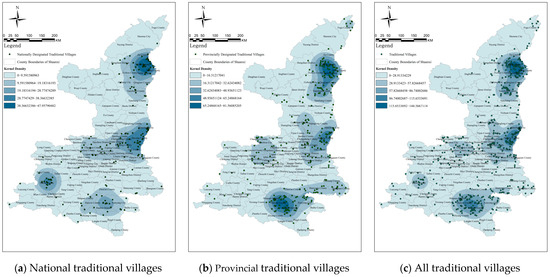
Figure 3.
Kernel density map of spatial distribution of traditional villages in Shaanxi Province: (a) nationally designated traditional villages; (b) provincially designated traditional villages; (c) overall pattern of traditional villages.
The spatial distribution of national- and provincial-level traditional villages (Figure 3b) was generally similar, with some localized differences. Specifically, national-level traditional villages form a relatively isolated “island-like” cluster in Liuba County (Figure 3a).
Tourism Village Development
- Quantitative Structural Characteristics
Among the traditional villages in Shaanxi Province, 236 (47.11%) were in the pre-tourism stage, 205 (40.92%) were in the developing tourism stage, and 60 (11.98%) had reached a relatively mature tourism stage. This distribution of quantities at different levels is similar to that of a pyramid-like structure. Additionally, 69.23% of the national-level traditional villages were in either the pre-tourism or mature tourism stages of development, whereas only 43.57% of the provincial-level traditional villages were in these stages. When the number of villages is counted in the order of “mature tourism, developing tourism, pre-tourism”, the proportion of national-level traditional villages decreases progressively, whereas that of provincial-level traditional villages increases correspondingly, rising from 43.33% to 76.27% (Figure 4).
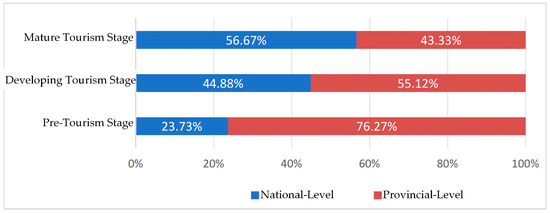
Figure 4.
Proportional distribution of traditional village categories by tourism development stage.
- 2.
- Spatial Differentiation Characteristics
The findings from the kernel density analysis and center-of-gravity model show clear differences in location between traditional villages in the mature tourism stage and those in earlier stages. Villages in the pre-tourism and developing tourism stages are predominantly clustered in areas such as the “Xunyang–Hanbin”, “Suide–Mizhi”, and “Baishui–Pucheng” regions, whereas traditional villages in the mature tourism stage are primarily concentrated in Liuba County and the “Mizhi–Jiaxian” area (Figure 5). The three types of traditional village exhibit differences in spatial concentration and dispersion; non-tourism traditional villages are relatively clustered, whereas those in the mature tourism stage are more spatially dispersed.

Figure 5.
Kernel density map of spatial distribution of traditional villages by type: (a) pre-tourism stage; (b) developing tourism stage; (c) mature tourism stage.
The tourism transformation rate is defined as the ratio of the number of villages with tourism development (including those in the developing and mature stages) to the total number of villages. A spatial analysis of the tourism transformation rate of traditional villages across the counties and districts of Shaanxi Province, based on the natural breaks (jerks) method, indicated that Liuba County, Lueyang County, Ningqiang County, Jia County, and the districts surrounding Xi’an exhibited relatively high tourism transformation rates for traditional villages. In contrast, counties such as Shiquan County, Shangzhou District, and Hengshan District showed comparatively low transformation rates (Figure 6).
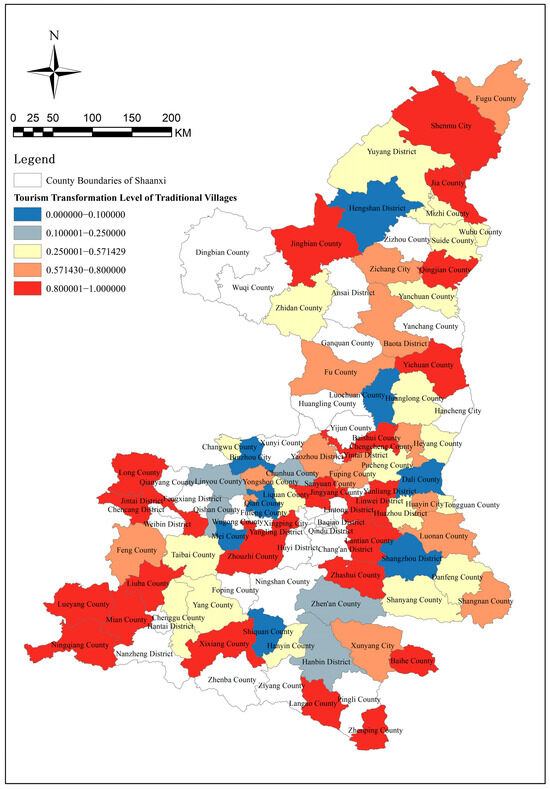
Figure 6.
Spatial distribution pattern of tourism development outcomes in traditional villages.
A detailed analysis revealed that districts and counties with greater tourism development achievements tended to have a higher proportion of traditional national-level villages. For example, in Liuba, Zhouzhi, and Jiaxian Counties, traditional national-level villages account for 100% of the total. In comparison, districts and counties with lower developmental achievements typically have smaller proportions of traditional, national-level villages (Table 2). For instance, among the 13 traditional villages in Shiquan County, only two are designated at the national level.
Table 2.
Inventory of influencing factors on tourism development outcomes in traditional villages of Shaanxi Province.
3.2. Analysis of the Influencing Factors Contributing to the Spatial Distribution Characteristics
This study employs geodetector and grounded theory methods to identify the key factors influencing the successful transformation of traditional villages into rural tourism destinations at both the meso-level of districts and counties and the micro-level of individual villages.
3.2.1. Meso-Level of Districts and Counties
- Single-Factor Analysis
This study focuses on 72 districts and counties in Shaanxi Province that include traditional villages. Taking the tourism transformation rate of traditional villages as the dependent variable, and considering 17 factors across four dimensions—village location conditions, village resource endowment, county-level tourism environment, and tourism policy support—as independent variables, the geodetector method was applied to identify the main factors influencing traditional village tourism development. The explanatory power of these dimensions, ranked from highest to lowest, is as follows: village resource endowment (0.31), county-level tourism environment (0.25), tourism policy support (0.06), and village location conditions (0.05). Among the specific indicators, the classification level of traditional villages and the county’s historical and cultural resource endowments have the most substantial impacts on tourism development. Simultaneously, external transportation conditions exerted the weakest influence (Figure 7).
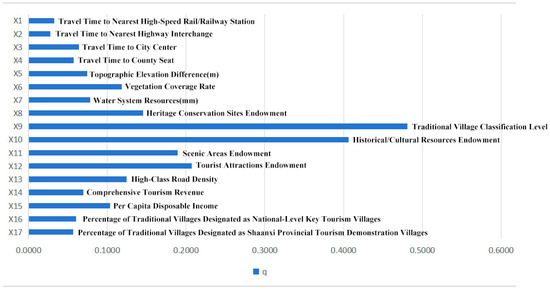
Figure 7.
Ranking of explanatory power of influencing factors on tourism development outcomes in traditional villages of Shaanxi Province.
Overall, the cultural resources of traditional villages (0.40) had a greater influence than natural resources (0.09). Regarding explanatory power, the factors were ranked as follows: X9 traditional village classification level (0.48); X8 heritage conservation site endowment (0.15); X6 vegetation coverage rate (0.12); X7 water system resources (0.08); and X5 topographic elevation (0.08). The classification level of a traditional village reflects its comprehensive value. National-level traditional villages typically possess abundant heritage resources, distinct regional characteristics, and high historical value, all of which provide favorable conditions for tourism development. Moreover, national-level traditional villages are more likely to receive special funding support from the central government than provincial-level villages. Among the natural resource indicators, vegetation coverage had a slightly greater impact on tourism development than topographic elevation and water resource systems. In general, greater vegetation coverage reflects a healthier ecological setting in traditional villages, which supports the sustainable growth of tourism.
Tourism resource base (0.30) > tourism transportation conditions (0.12) > tourism consumption conditions (0.09). The ranking was as follows: X10 historical and cultural resources (0.41), X12 tourism scenic area endowment (0.21), X11 scenic spot endowment (0.19), X13 high-grade highway network density (0.12), X15 per-capita disposable income (0.10), and X14 total tourism income (0.07). Thus, it is evident that the more abundant the tourism resources in a district, the denser the high-grade highway network, and the greater the potential for traditional villages to successfully transform into rural tourism destinations.
County-level tourism policies have positively impacted tourism development in traditional villages in the region. For traditional villages designated as key national rural tourism villages or Shaanxi Province rural tourism demonstration villages, both the national and provincial governments allocate special funds to support improvements in infrastructure, tourism facilities, and landscape greening. However, owing to the limited number of villages selected for these programs, the overall proportion of designated traditional villages remains small, leading to relatively low explanatory power. Currently, Shaanxi Province has 13 traditional villages recognized as key national rural tourism villages and eight as provincial rural tourism demonstration villages (e.g., Mafang Village in Baota District, Wangjiabao Village in Qingjian County, and Yuqu Village in Heyang County).
Currently, preserved traditional villages are often situated in areas with relatively low levels of urbanization and limited transportation accessibility. The geodetector results also indicate that village location conditions have a relatively weak impact on traditional village tourism development, with consumer location exerting a more decisive influence than external transportation locations. Regarding the explanatory power of specific indicators, the ranking is as follows: X3 travel time to the city center > X4 travel time to the county seat > X1 travel time to the nearest high-speed rail/railway station > X2 travel time to the nearest highway interchange. Road network analysis revealed that 18.74% of traditional villages are located within 60 min of the city center. However, for traditional villages in the mature tourism stage, 86.21% were located within a 30-min travel distance from the city center.
- 2.
- Interaction Analysis
The achievements in traditional village tourism development are the result of the combined influence of multiple factors. Pairwise interactions among the influencing factors exhibited either a bivariate enhancement effect or a nonlinear enhancement effect (Figure 8). Notably, variables such as the classification level of traditional villages (X9), historical and cultural resource endowments (X10), scenic area endowments (X12), and per-capita disposable income (X15) showed strong interaction effects with other factors. For example, the interaction between scenic area endowment (X12) and historical and cultural resource endowment (X10) yields an explanatory power exceeding 0.9 (Table 3).
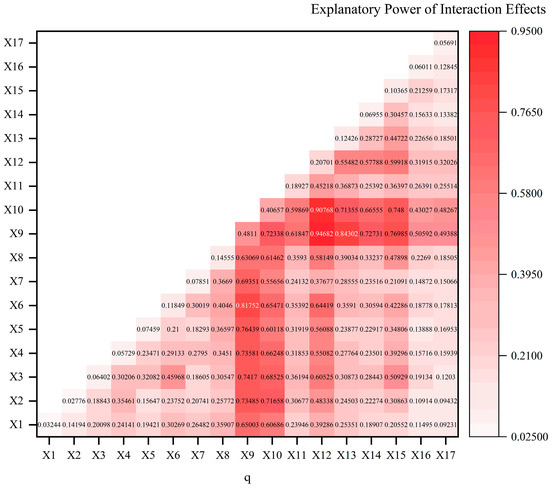
Figure 8.
Interaction detection results of influencing factors on tourism development outcomes in traditional villages of Shaanxi Province.
Table 3.
Selected interaction effects of influencing factors on tourism development outcomes in traditional villages.
3.2.2. Micro-Level of Villages
In April 2025, the research team conducted a field visit to Liuba County, where tourism development demonstrated relatively strong performance. Focusing on 14 national-level traditional villages, the team conducted semi-structured in-depth interviews centered on the theme of “factors influencing the achievements of traditional village tourism development” (see Appendix A for the full version). A total of 81 participants were interviewed, including 34 villagers, 11 government officials, 28 tourism practitioners, and eight tourists. Each interview lasted approximately 20 to 30 min, resulting in 81 audio recordings with a total transcript length of 126,000 Chinese characters.
Seventy interview samples were randomly selected and individually coded using NVivo 12 Plus. In total, 429 valid reference points were identified, from which 76 initial concepts were generated, refined, and grouped into 24 categories. Subsequently, the initial categories were refined to focus on establishing connections among individual categories, leading to the development of higher-level core categories. Based on the correlation and consistency of the different categories, the 24 initial categories were divided into nine subcategories and five core categories (Table 4).
Table 4.
Categorization process of qualitative coding for influencing factor analysis.
Based on the coding results, the underlying logical relationships among the core categories were identified. The analysis revealed that resources, people, and transportation were the core categories driving tourism development in traditional villages. Traditional villages with strong resource endowments supported by convenient transportation infrastructure have experienced rapid tourism development through the active participation of local residents under the guidance of government funding, policies, and planning initiatives. Finally, the remaining 11 interview transcripts were used as saturation test samples. The same coding process was applied and the results showed that the content of these 11 interviews largely overlapped with that of the first 70. This indicates that the data reached theoretical saturation and that the saturation test was successfully completed.
4. Discussion
4.1. Key Factors Influencing the Development of Tourism Development in Traditional Villages
Some of the current findings are consistent with previous research, indicating that the administrative level of traditional villages, the endowment of tourism resources, and the level of tourism consumption are key factors influencing the outcomes of tourism development in traditional villages. However, this study also provides new empirical evidence specific to Shaanxi Province, deepening and refining the current understanding.
Notably, while previous studies have emphasized the role of transportation infrastructure, this study found that the density of high-grade road networks and proximity to consumption centers have a substantial impact on the effectiveness of tourism development in traditional villages in Shaanxi. In contrast, external transportation conditions, such as travel time to the nearest high-speed rail or train station, exert a relatively weaker influence.
Most existing studies have explored the relationship between road network density and rural tourism destinations without a detailed delineation of locational conditions. This result contrasts with those of national-level studies that emphasize the roles of highway mileage and regional connectivity. Xie et al. (2022) confirmed that highway mileage significantly affects the spatial distribution of key rural tourism villages in city clusters in the middle reaches of the Yangtze River [33]. Tian et al. (2023) found that highway density and the distance to the nearest city are strong factors affecting the spatial distribution of key rural tourism villages in the Yellow River Basin [34].
The relatively weak explanatory power of external transportation may be attributed to the minimal variation in the average travel time from most traditional villages in Shaanxi to high-speed rail or railway stations. Moreover, as most tourists visiting these villages are from Shaanxi Province, there is a significantly greater reliance on inter-provincial transportation routes, such as national and provincial highways, rather than on external regional transportation networks.
Second, although existing studies have included both national- and provincial-level traditional villages as research subjects, they have not considered administrative classification as an independent influencing factor [35]. The results demonstrate that the administrative level of traditional villages, particularly whether they are recognized at the national level, is the most important explanatory factor. This finding supports the argument that policy designation and the associated support mechanisms play key roles in shaping village-level tourism outcomes. Traditional national-level villages often receive prioritized funding, planning, and publicity, which facilitate faster and more visible tourism transformations [36].
4.2. In-Depth Interview Findings Based on Grounded Theory
This study employed the inductive approach of grounded theory to extract public perceptions of the factors that influence the outcomes of traditional rural tourism development. The findings validate the reliability of the meso-level analysis at the county and district scales, while revealing that residents’ participatory behaviors, governmental decision-making support, and the guidance provided by tourism planning all exert positive impacts on the development of traditional rural tourism.
Specifically, villagers emphasized that favorable climatic conditions (e.g., summer coolness) and intangible cultural heritage (e.g., bamboo weaving) enhanced destination appeal, while government actions, including infrastructure funding, policy empowerment (e.g., investment attraction), and coordinated tourism planning (e.g., countywide route integration), were critical enablers. Residents’ active involvement in homestays and tourism businesses (30–40% participation rate) further reinforced community-led development.
Based on the perspectives of micro-level stakeholders and in conjunction with recent relevant government documents and tourism development initiatives in Shaanxi Province, the following development recommendations are proposed.
- (1)
- Villages with rich cultural and natural assets are prioritized for inclusion in the “Intangible Cultural Heritage Featured Demonstration Counties and Towns” program [37], which promotes the synergy between heritage preservation and tourism development, while providing financial support for immersive cultural spaces and industrial agglomeration. This aligns with the demand for enhanced cultural product innovation expressed in the interview.
- (2)
- Integrate villages into provincial tourism circuits, such as the “Sitting Trains Tour Shaanxi,” [38] and align them with seasonal consumption events to extend visitor stays and balance seasonal demand. Additionally, it leverages the Inbound Tourism Reward Scheme (2025) to encourage the targeting of international markets by offering incentives such as subsidies for overseas media campaigns and visa-free transit tours, thereby expanding the tourist base beyond local visitors.
- (3)
- Establish local incubators for specialized and innovative small- and medium-size enterprises in tourism [39] within the cultural creative industry chain framework [40], supporting resident-led homestays and handicraft businesses. Simultaneously, accelerate the implementation of “5G plus culture and tourism” projects to facilitate virtual tours and smart management, thereby mitigating revenue declines during the off-season [41].
5. Conclusions
Unlike previous studies, this research focuses on traditional villages that have developed rural tourism. By adopting the geodetector method, this study explored the spatial differentiation and driving factors of traditional village tourism transformation in Shaanxi, China. The conclusions of this study are as follows:
Traditional villages can be divided into three types according to their level of tourism development: traditional villages that have not developed tourism (Type 1), traditional villages in the initial stage of tourism development (Type 2), and those in the mature stage of tourism (Type 3). In Shaanxi Province, Type 1 was the largest, followed by Types 2 and 3. Among the Type 3 villages, national-level traditional villages constituted the majority. The proportion of provincial-level traditional villages was higher in Type 1. In contrast to the other two types, Type 3 villages were more dispersed and scattered, primarily clustered in Liuba, Mizhi, and Jia Counties.
The probability of traditional villages becoming rural tourist destinations varies depending on their heritage values, government support, and conditions of rural infrastructure. Among these factors, the level of traditional villages, village heritage value, and the local tourism environment had the greatest influence on the tourism effectiveness of traditional villages, whereas external transportation conditions had the least influence. The greater the abundance of tourism resources within a county and the denser its network of high-grade highways, the higher the potential for traditional villages to successfully transform into rural tourism destinations. In addition, the explanatory power of historical resources was greater than that of natural resources. The explanatory power of tourism resources is greater than that of transportation conditions and consumption levels. In addition, the influence of local consumption location was greater than that of external transportation location.
In terms of resource value transformation, priority should be given to enhancing the demonstration effects in traditional, national-level villages. A county-level coordination mechanism for historical and cultural resources should be established to empower tourism product innovation through the valorization of heritage resources. Villages should improve supporting infrastructure and optimize transportation networks, focusing on enhancing connectivity to consumption centers and highways, thereby reducing reliance on high-speed rail. Efforts should also be made to establish a dual-layer transportation system that encompasses both county and intra-village networks. As a vital material foundation for the tourism development of traditional villages, natural resources should be fully protected, rationally developed, and utilized. Considering the local cultural and tourism consumption levels, efforts should be made to promote the development of tourist attractions and scenic areas, leveraging their spillover effects to achieve integrated development with rural tourism in traditional villages. Particular attention should be paid to traditional villages that are in the non-tourism or developing tourism stages to facilitate the flow of people and capital and extend the industrial chain.
Advantages and Limitations
In summary, this study examines the spatial differentiation characteristics and factors influencing the effectiveness of tourism development in traditional villages, focusing on both the mesoscale (county level) and microscale (village level). This research offers theoretical innovation and practical value, provides important insights into the revitalization and sustainable utilization of traditional villages, and contributes to the broader goal of rural revitalization in China.
However, this study has certain limitations. In constructing the mesoscale indicator system, factors such as government funding and planning guidance, as well as residents’ willingness to participate, were not included due to data collection constraints. Future research should aim to further refine and expand these aspects. Seasonality and market characteristics significantly influenced tourism in Shaanxi’s traditional villages. The number of visitors increased notably during holidays, whereas tourism declined during off-peak seasons. For instance, the southern part of Shaanxi, due to the geographical barrier of the Qinling Mountains, has a climate that differs significantly from that of the northern and Guanzhong regions of Shaanxi. Many tourists choose to visit traditional villages or tourist attractions in southern Shaanxi during the summer to escape the heat.
The characteristics of the local, national, and international markets determine the types of tourists attracted to these villages. After the interviews, it was found that intra-provincial tourists tended to visit traditional villages on weekends, whereas domestic and international tourists preferred to visit during holidays, with relatively fewer international visitors traveling to traditional villages. Cultural heritage and well-preserved sites attract international tourists, whereas regional accessibility and local promotional activities are more effective at attracting domestic visitors [42].
Author Contributions
Conceptualization, H.Y.; methodology, H.J. and R.Z.; software, R.Z.; data collection, R.Z., H.J. and S.W.; writing—original draft, R.Z., H.J. and L.L.; writing—review and editing, H.J. and H.Y.; funding acquisition, H.Y. All authors have read and agreed to the published version of the manuscript.
Funding
This paper is funded by the Social Science Foundation of Shaanxi Province (No. 2023J038), the Basic Scientific research operating expenses of Northwest A&F University (No. Z1090324083), Ministry of Education Humanities and Social Sciences Research Project (24XJCH005), Guizhou Provincial Basic Research Program (No. [2024]Qing Nian 135) and the Innovation Project for College Students (No. XN2025024055).
Data Availability Statement
The data supporting this study are available upon request from the corresponding author due to confidentiality agreements.
Acknowledgments
The authors gratefully acknowledge Xin Liu for kindly providing the draft of Figure 1.
Conflicts of Interest
The authors declare no conflict of interest.
Appendix A
The appendix is a questionnaire for semi-structured in-depth interviews.
Table A1.
Interview questionnaire on the influencing factors of tourism development in traditional villages.
Table A1.
Interview questionnaire on the influencing factors of tourism development in traditional villages.
| Respondent Background Information |
| 1. Your role: Villager/Village cadre/Tourism practitioner/Other (please specify) |
| 2. Years of residence/work in this village: ______ years |
| 3. Specific role in tourism-related work: ______ |
| Current Status of Village Tourism Development |
| 4. How would you describe the overall current state of tourism development in your village? (Please comment on visitor numbers, tourism revenue, and development trends.) |
| 5. In your opinion, which key events or initiatives have significantly promoted or hindered tourism development in your village? (Please provide specific examples.) |
| Specific Conditions of Village Tourism Development |
| A. Transportation Conditions and Accessibility |
| 6. What are the main modes of transportation used by tourists to reach your village? |
| 7. What changes have occurred in transportation conditions in recent years? |
| 8. What mode of transportation is typically used to travel from your village to the nearest train station/high-speed rail station? Approximately how long does it take? In your opinion, does this accessibility influence tourists’ willingness to visit? |
| 9. Approximately how long does it take to reach the nearest expressway entrance from your village? Is it convenient to access the village from there? |
| 10. Approximately how long does it take to travel from your village to the city center? Do tourists from the city commonly visit your village? |
| 11. Approximately how long does it take to travel from your village to the county center? What is the overall state of tourism development in the county? Do you think it contributes to promoting tourism development in your village? |
| 12. (If transportation is inconvenient) Do you think limited transportation access has restricted the number of tourists? What measures do you think could be taken to improve transportation conditions? |
| 13. Village Resource Endowment and Utilization |
| 14. Which natural landscapes in your village (e.g., rivers, lakes, forests) do you consider most attractive to tourists? Are these resources adequately protected and utilized? |
| 15. Have the elevation differences in terrain (e.g., mountains, terraced fields) been developed into tourism specialty projects? How do villagers make use of these resources? |
| 16. Which other natural resources within the village do you think can be developed and utilized to support village tourism services? |
| 17. Are you aware that your village is designated as a national/provincial-level traditional village? In your opinion, how does the cultural designation of the village affect its tourism popularity? |
| 18. Are there any cultural heritage protection sites in the village? What specific conservation measures are in place, and how do they impact the village’s tourism development? |
| 19. What unique historical and cultural heritage sites or elements (such as buildings, customs, handicrafts) exist in the village? How are they integrated into tourism development? |
| B. County-Level Tourism Resource Base |
| 20. Are there any scenic spots or tourist attractions in or near your village? Do they contribute to the development of tourism in your village? |
| 21. Are there any relatively well-established county-level tourism routes that include your village? Do these routes have a positive impact on the development of tourism in your village? |
| C. Tourism Consumption Basis |
| 22. How would you describe the spending level of tourists (e.g., on dining, accommodation, shopping) based on your observations? Does the local area have the capacity to meet their needs? |
| 23. Has the development of tourism in the village generated corresponding tourism-related income for you? Which tourism projects do you think have contributed to increasing the per capita income of villagers? |
| 24. Has the growth of the county’s total tourism revenue contributed to the improvement of infrastructure in your village? |
| D. Villager Participation |
| 25. In what ways do villagers primarily participate in tourism operations (e.g., catering, homestays, guiding)? What is the level of their participation? |
| 26. Do you think villagers’ tourism service skills (such as reception and marketing) need improvement? If so, which specific skills are lacking? |
| E. Regional Policy Support |
| 27. What types of support has the government provided for tourism in your village (e.g., funding, promotion, training)? What difficulties exist in the implementation of these policies? |
| 28. In your opinion, which aspects of the current policies need improvement (e.g., land-use approval, intangible cultural heritage revitalization policies)? |
| F. Marketing Promotion and Surrounding Environment |
| 29. Through which channels do tourists primarily learn about your village? How does the village promote its unique features (e.g., social media, collaboration with travel agencies)? |
| 30. Do nearby scenic spots or county-level tourism developments act as competition or drivers for your village’s tourism? Please provide examples. |
| Open-ended Questions |
| 31. In addition to the factors discussed above, are there any other significant factors that you believe profoundly affect tourism development in your village? |
| 32. What do you consider to be the greatest obstacles currently limiting the upgrading of tourism in your village (e.g., funding, talent, infrastructure, resource conservation)? |
| 33. What are your expectations and suggestions for the future development of tourism in your village? |
References
- Sun, J. Traditional Villages: Theoretical Connotations and Development Paths. Tour. Trib. 2017, 32, 1–3. [Google Scholar]
- Guiding Opinions on Strengthening the Protection and Development of Traditional Villages. Available online: https://www.mohurd.gov.cn/gongkai/zc/wjk/art/2012/art_17339_212337.html (accessed on 3 July 2025).
- Katapidi, I. Heritage Policy Meets Community Praxis: Widening Conservation Approaches in the Traditional Villages of Central Greece. J. Rural. Stud. 2021, 81, 47–58. [Google Scholar] [CrossRef]
- Ma, H.; Tong, Y. Spatial Differentiation of Traditional Villages Using ArcGIS and GeoDa: A Case Study of Southwest China. Ecol. Inform. 2022, 68, 101416. [Google Scholar] [CrossRef]
- Du, J.; Zhao, B.; Feng, Y. Spatial Distribution and Influencing Factors of Rural Tourism: A Case Study of Henan Province. Heliyon 2024, 10, e29039. [Google Scholar] [CrossRef]
- Xu, Y.; Lu, L. Probing the Long-Term Evolution of Traditional Village Tourism Destinations from a Glocalisation Perspective: A Case Study of Wuzhen in Zhejiang Province, China. Habitat Int. 2024, 148, 103073. [Google Scholar] [CrossRef]
- Jin, L.; Wang, Z.; Chen, X. Spatial Distribution Characteristics and Influencing Factors of Traditional Villages on the Tibetan Plateau in China. Int. J. Environ. Res. Public Health 2022, 19, 13170. [Google Scholar] [CrossRef] [PubMed]
- Feng, X.; Hu, M.; Somenahalli, S.; Bian, X.; Li, M.; Zhou, Z.; Li, F.; Wang, Y. A Study of Spatio-Temporal Differentiation Characteristics and Driving Factors of Shaanxi Province’s Traditional Heritage Villages. Sustainability 2023, 15, 7797. [Google Scholar] [CrossRef]
- Wu, K.; Su, W.; Ye, S.; Li, W.; Cao, Y.; Jia, Z. Analysis on the Geographical Pattern and Driving Force of Traditional Villages Based on GIS and Geodetector: A Case Study of Guizhou, China. Sci. Rep. 2023, 13, 20659. [Google Scholar] [CrossRef]
- Karali, A.; Das, S.; Roy, H. Forty Years of the Rural Tourism Research: Reviewing the Trend, Pattern and Future Agenda. Tour. Recreat. Res. 2024, 49, 173–200. [Google Scholar] [CrossRef]
- Li, Y.; Fan, W.; Yuan, X.; Li, J. Spatial Distribution Characteristics and Influencing Factors of Traditional Villages Based on Geodetector: Jiarong Tibetan in Western Sichuan, China. Sci. Rep. 2024, 14, 11700. [Google Scholar] [CrossRef]
- Su, H.; Wang, Y.; Zhang, Z.; Dong, W. Characteristics and Influencing Factors of Traditional Village Distribution in China. Land 2022, 11, 1631. [Google Scholar] [CrossRef]
- Rodríguez Rangel, M.C.; Sánchez Rivero, M. Spatial Imbalance between Tourist Supply and Demand: The Identification of Spatial Clusters in Extremadura, Spain. Sustainability 2020, 12, 1651. [Google Scholar] [CrossRef]
- Zhu, L.; Li, Y.; Hu, J.; Xu, J.; Qing, Q. Spatial Pattern of Rural Tourism Model Villages in China and Its Influencing Factors. J. Agric. Resour. Environ. 2024, 41, 938–949. [Google Scholar]
- Sarrión-Gavilán, M.D.; Benítez-Márquez, M.D.; Mora-Rangel, E.O. Spatial Distribution of Tourism Supply in Andalusia. Tour. Manag. Perspect. 2015, 15, 29–45. [Google Scholar] [CrossRef]
- González-Ramiro, A.; Gonçalves, G.; Sánchez-Ríos, A.; Jeong, J.S. Using a VGI and GIS-Based Multicriteria Approach for Assessing the Potential of Rural Tourism in Extremadura (Spain). Sustainability 2016, 8, 1144. [Google Scholar] [CrossRef]
- Wang, J.; Xu, C. Geodetector: Principles and Prospects. Acta Geogr. Sin. 2017, 72, 116–134. [Google Scholar]
- Zou, Q.; Sun, J.; Luo, J.; Cui, J.; Kong, X. Spatial Patterns of Key Villages and Towns of Rural Tourism in China and Their Influencing Factors. Sustainability 2023, 15, 13330. [Google Scholar] [CrossRef]
- Glaser, B.G.; Strauss, A.L.; Strutzel, E. The Discovery of Grounded Theory; Strategies for Qualitative Research. Nurs. Res. 1968, 17, 364. [Google Scholar] [CrossRef]
- Rahimi-Feyzabad, F.; Yazdanpanah, M.; Gholamrezai, S.; Ahmadvand, M. Institutional Constraints to Groundwater Resource Management in Arid and Semi-Arid Regions: A Straussian Grounded Theory Study. Hydrogeol. J. 2021, 29, 925–947. [Google Scholar] [CrossRef]
- Wang, H.; Wang, H. Research on the Tourism-Promoting Rural Revitalisation Model Based on Grounded Theory: The Case of Shibadong Village in Huayuan County, Hunan Province. Sustainability 2024, 16, 10942. [Google Scholar] [CrossRef]
- Miani, A.M.; Dehkordi, M.K.; Siamian, N.; Lassois, L.; Tan, R.; Azadi, H. Toward Sustainable Rural Livelihoods Approach: Application of Grounded Theory in Ghazni Province, Afghanistan. Appl. Geogr. 2023, 154, 102915. [Google Scholar] [CrossRef]
- Fafurida, F.; Purwaningsih, Y.; Mulyanto, M.; Suryanto, S. Tourism Village Development: Measuring the Effectiveness of the Success of Village Development. Economies 2023, 11, 133. [Google Scholar] [CrossRef]
- Deller, S. Rural Poverty, Tourism and Spatial Heterogeneity. Ann. Tour. Res. 2010, 37, 180–205. [Google Scholar] [CrossRef]
- Zhu, L.; Meng, J.; Zhu, L. Applying Geodetector to Disentangle the Contributions of Natural and Anthropogenic Factors to NDVI Variations in the Middle Reaches of the Heihe River Basin. Ecol. Indic. 2020, 117, 106545. [Google Scholar] [CrossRef]
- Wang, H.; Qin, F.; Xu, C.; Li, B.; Guo, L.; Wang, Z. Evaluating the Suitability of Urban Development Land with a Geodetector. Ecol. Indic. 2021, 123, 107339. [Google Scholar] [CrossRef]
- Milliken, P.J.; Schreiber, R. Examining the Nexus between Grounded Theory and Symbolic Interactionism. Int. J. Qual. Methods 2012, 11, 684–696. [Google Scholar] [CrossRef]
- Qi, J.; Lu, Y.; Han, F.; Ma, X.; Yang, Z. Spatial Distribution Characteristics of the Rural Tourism Villages in the Qinghai-Tibetan Plateau and Its Influencing Factors. Int. J. Environ. Res. Public Health 2022, 19, 9330. [Google Scholar] [CrossRef] [PubMed]
- Zhu, Y.; Zhou, X.; Chen, S.; Tu, Z. Spatial Distribution and Influencing Factors of Key Rural Tourism Villages in China. J. Cent. China Norm. Univ. 2020, 54, 874–912. [Google Scholar] [CrossRef]
- Tao, G.; Li, X.; Tian, S.; Li, H.; Song, Y. Influence of Human Settlements Factors on the Spatial Distribution Patterns of Traditional Villages in Liaoning Province. Humanit. Soc. Sci. Commun. 2024, 11, 1757. [Google Scholar] [CrossRef]
- Hu, Q.; Yang, P.; Ma, J.; Wang, M.; He, X. The Spatial Differentiation Characteristics and Influencing Mechanisms of Intangible Cultural Heritage in China. Heliyon 2024, 10, e38689. [Google Scholar] [CrossRef]
- Gao, L.; Ariffin, N.F.M.; Hussein, M.K.; Liu, S.; Wang, B. An Integrated Approach towards Conservation of Traditional Patterns in Chinese Traditional Villages: A Systematic Literature Review. Environ. Behav. Proc. J. 2024, 9, 157–163. [Google Scholar] [CrossRef]
- Xie, Y.; Meng, X.; Cenci, J.; Zhang, J. Spatial Pattern and Formation Mechanism of Rural Tourism Resources in China: Evidence from 1470 National Leisure Villages. ISPRS Int. J. Geo-Inf. 2022, 11, 455. [Google Scholar] [CrossRef]
- Tian, C.; Guan, X.; Tian, H. Spatial distribution characteristic and its influencing factors of key rural tourism villages in the Yellow River basin. Tour. Trib. 2023, 38, 32–44. [Google Scholar] [CrossRef]
- Li, B.; Wang, J.; Jin, Y. Spatial Distribution Characteristics of Traditional Villages and Influence Factors Thereof in Hilly and Gully Areas of Northern Shaanxi. Sustainability 2022, 14, 15327. [Google Scholar] [CrossRef]
- Dai, M.L.; Fan, D.X.F.; Wang, R.; Ou, Y.H.; Ma, X.L. Does Rural Tourism Revitalize the Countryside? An Exploration of the Spatial Reconstruction through the Lens of Cultural Connotations of Rurality. J. Destin. Mark. Manag. 2023, 29, 100801. [Google Scholar] [CrossRef]
- Notice by the Shaanxi Provincial Department of Culture and Tourism on Organizing the Application and Establishment of Intangible Cultural Heritage Demonstration Counties (Cities, Districts), Demonstration Towns, and Demonstration Blocks for the Period 2023–2025. Available online: https://www.ihchina.cn/news_2_details/28057.html (accessed on 26 July 2025).
- Implementation Plan for Promoting Inbound Tourism in Shaanxi Province (2025). Available online: https://whhlyt.shaanxi.gov.cn/zfxxgk/fdzdgknr/lzyj/tzgg/202504/t20250414_3492008.html (accessed on 26 July 2025).
- Hajilo, M.; Ghadiri Masoom, M.; Motiee Langroudi, S.H.; Faraji Sabokbar, H.; Pennington-Gray, L. Spatial Analysis of the Distribution of Small Businesses in the Eastern Villages of Gilan Province with Emphasis on the Tourism Sector in Mountainous Regions. Sustainability 2017, 9, 2238. [Google Scholar] [CrossRef]
- Implementation Opinions of Shaanxi Province on Developing a Trillion-Yuan Cultural Tourism Industry (2021–2025). Available online: https://whhlyt.shaanxi.gov.cn/zfxxgk/fdzdgknr/lzyj/xzgfxwj/202209/t20220907_2578930.html (accessed on 26 July 2025).
- The 2025 Shaanxi Summer Cultural and Tourism Consumption Season and the 9th Shaanxi Tourism Consumption Season Kick-off Ceremony. Available online: https://whhlyt.shaanxi.gov.cn/sy/wlyw/202507/t20250707_3539971.html (accessed on 26 July 2025).
- Sun, T.; Li, Y.; Tai, H. Different Cultures, Different Images: A Comparison between Historic Conservation Area Destination Image Choices of Chinese and Western Tourists. J. Tour. Cult. Change 2023, 21, 110–127. [Google Scholar] [CrossRef]
Disclaimer/Publisher’s Note: The statements, opinions and data contained in all publications are solely those of the individual author(s) and contributor(s) and not of MDPI and/or the editor(s). MDPI and/or the editor(s) disclaim responsibility for any injury to people or property resulting from any ideas, methods, instructions or products referred to in the content. |
© 2025 by the authors. Licensee MDPI, Basel, Switzerland. This article is an open access article distributed under the terms and conditions of the Creative Commons Attribution (CC BY) license (https://creativecommons.org/licenses/by/4.0/).