Effectiveness of Alpine Protected Areas: An Evaluation of the Three-River-Source Nature Reserve Through Human Footprint Measurements


Abstract
1. Introduction
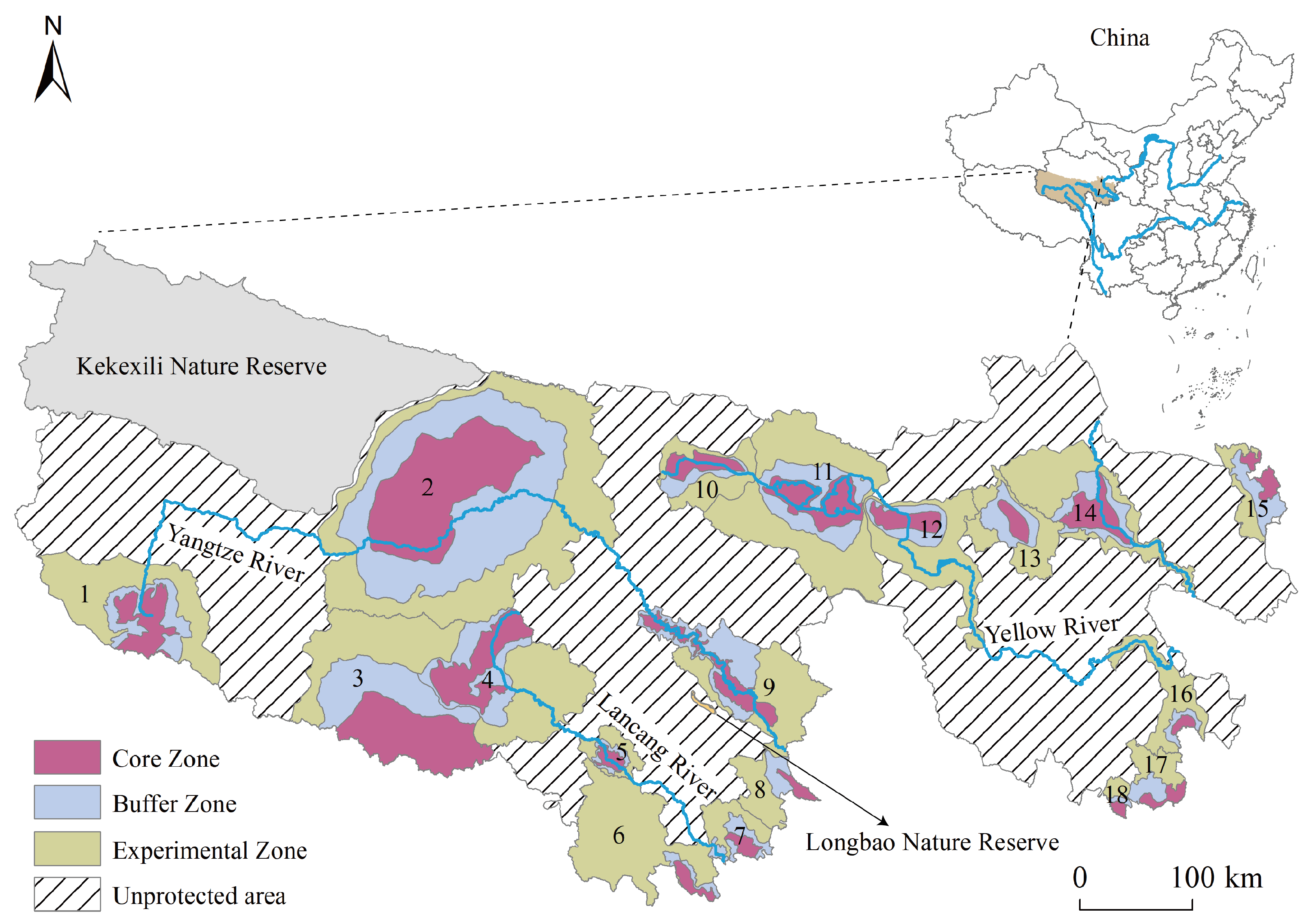
2. Study Area
2.1. The Protection Policy Evolution for the Three-River Source Nature Reserve
2.2. The Ecological Importance of the Three-River-Source Nature Reserve
3. Materials and Methods
3.1. Data Sources and Pre-Processing
3.2. Methods
3.2.1. Revision of the Human Footprint Dataset
3.2.2. Comparison of Human Footprint Changes Inside and Outside the Reserve
3.2.3. Analysis of Human Footprint Changes Across Functional Zones
3.2.4. Evaluation Based on Propensity Score Matching
4. Results
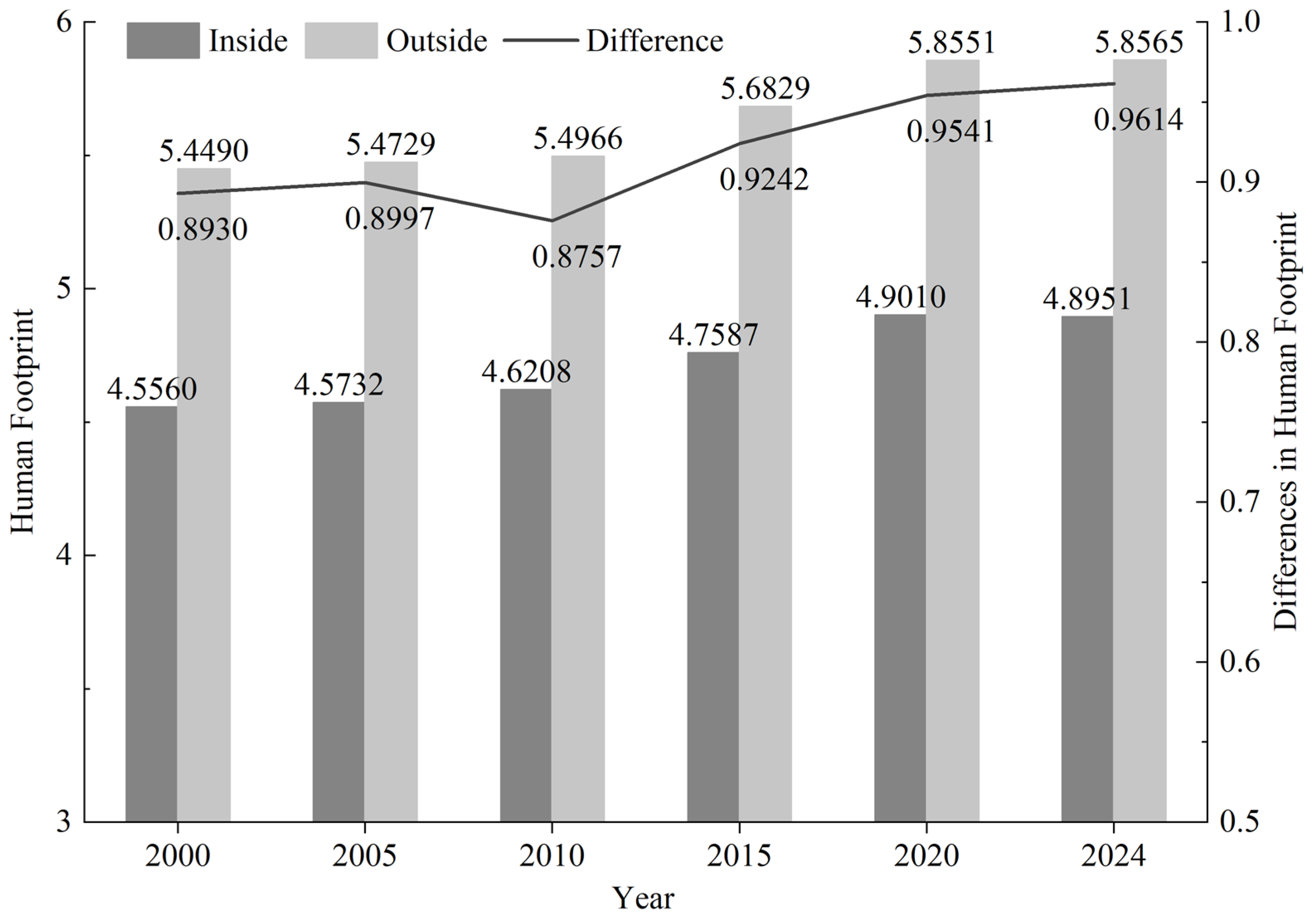
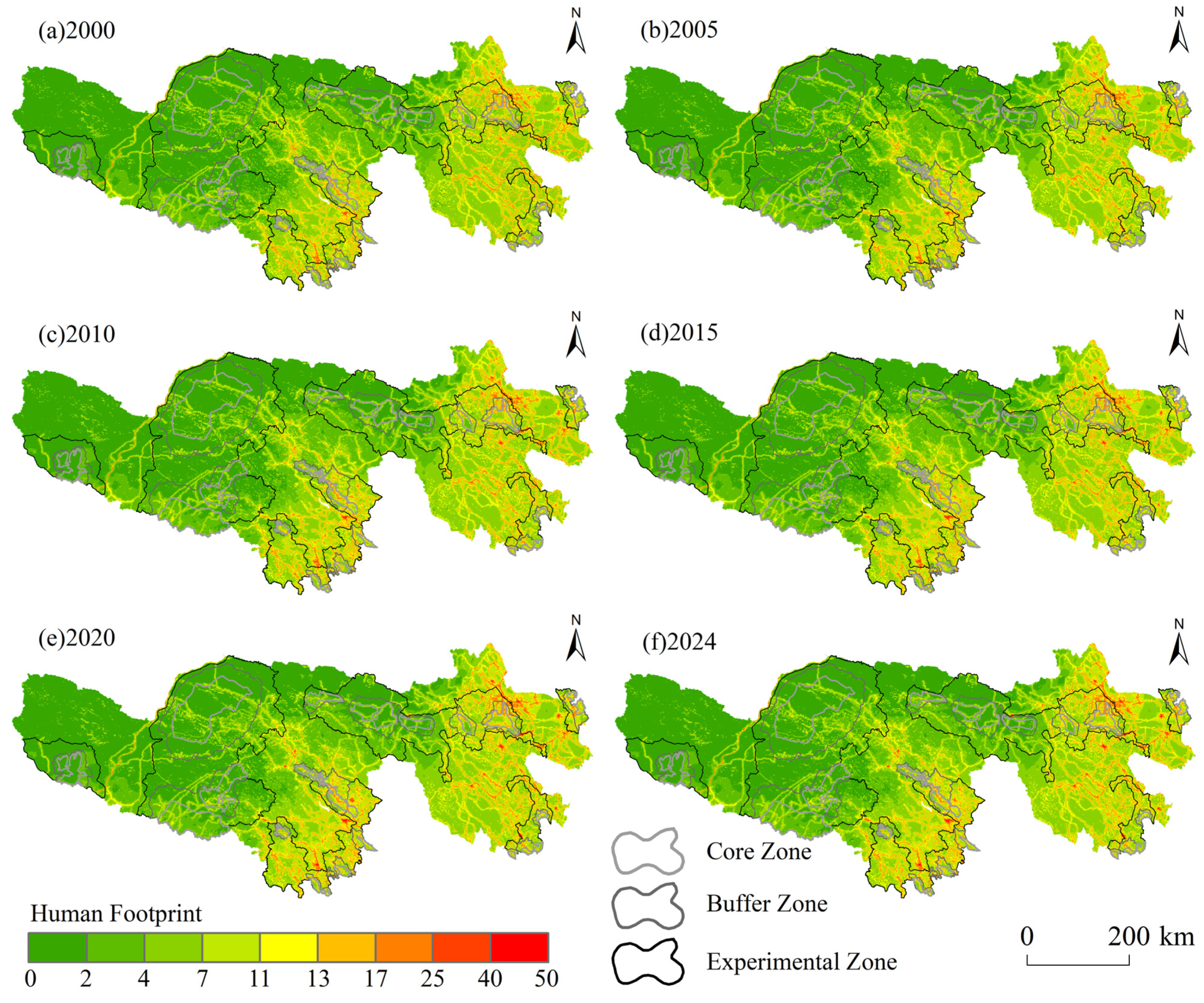
4.1. Spatiotemporal Changes and Differences in Human Footprint Inside and Outside the Three-River-Source Nature Reserve for 2000–2024
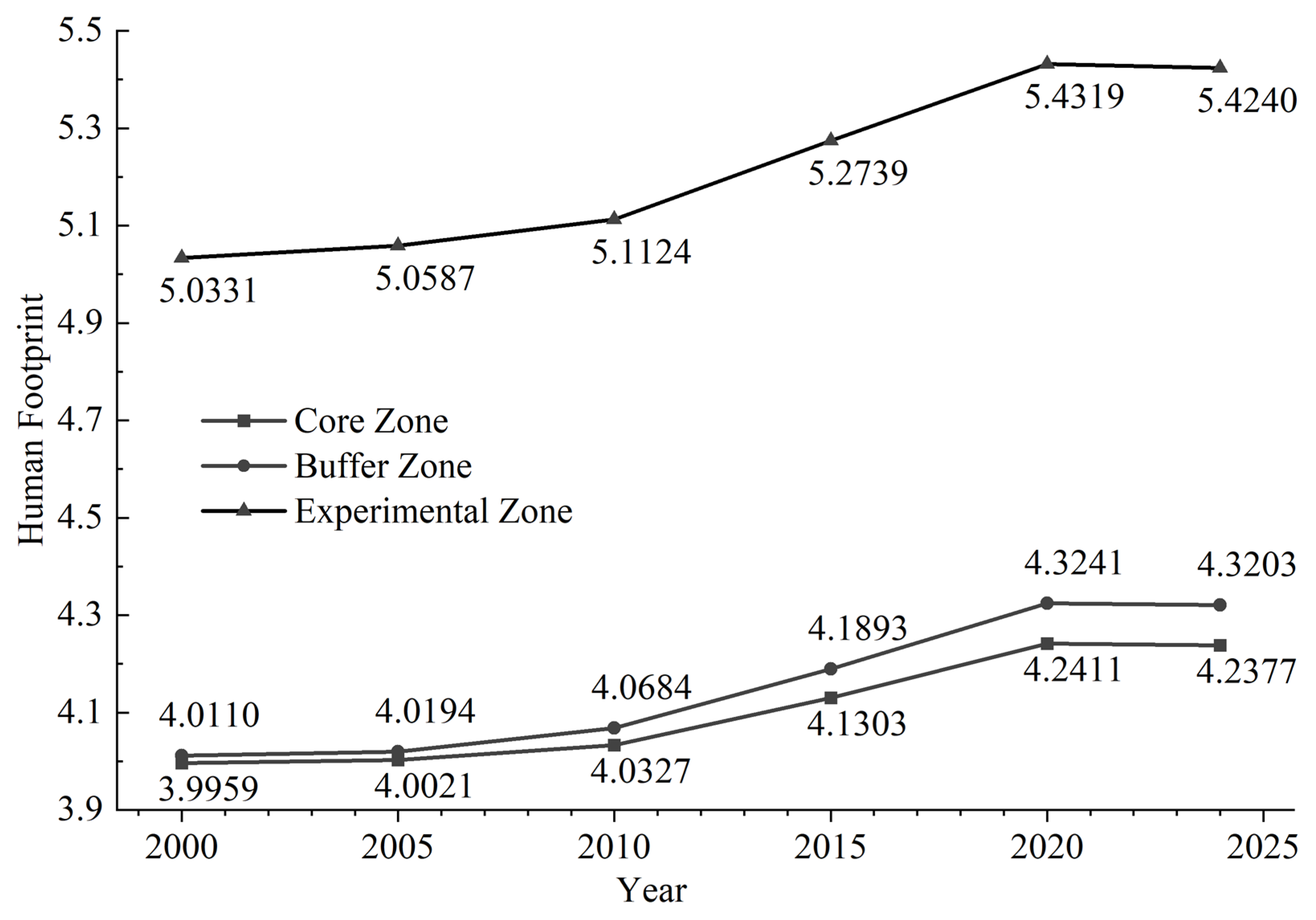
4.2. Human Footprint Dynamics Across Functional Zones of the Three-River-Source Nature Reserve for 2000–2024
4.3. Evaluation Results Based on Propensity Score Matching
4.3.1. Balance Test Results
4.3.2. Effectiveness of the Three-River-Source Nature Reserve in Alleviating Human Pressure
5. Discussion
5.1. The Use of the Human Footprint
5.2. Analysis of Conservation Effectiveness and Policy Implications
5.3. Limitations and Future Works
6. Conclusions
Author Contributions
Funding
Data Availability Statement
Conflicts of Interest
References
- Brahic, E.; Deuffic, P. Forest management in a French Natura 2000 conservation site: Integrating or keeping environmental standards at a distance? J. Nat. Conserv. 2026, 91, 127203. [Google Scholar] [CrossRef] [Scilit]
- Barth, A.; Ranacher, L.; Hesser, F.; Stern, T.; Schuster, K.C. Bridging business and biodiversity: An analysis of biodiversity assessment tools. Environ. Sustain. Indic. 2025, 26, 100682. [Google Scholar] [CrossRef] [Scilit]
- Cumming, G.S. Protected area management has significant spillover effects on vegetation. Nature 2025, 650, 642–651. [Google Scholar] [CrossRef] [Scilit]
- Rodrigues, A.S.L.; Cazalis, V. The multifaceted challenge of evaluating protected area effectiveness. Nat. Commun. 2020, 11, 5147. [Google Scholar] [CrossRef] [Scilit]
- Li, S.; Liu, Y.; Li, J.; Zhang, X. Mapping cropping patterns in the North China Plain over the past 300 years and an analysis of the drivers of change. J. Geogr. Sci. 2024, 34, 2074–2088. [Google Scholar] [CrossRef] [Scilit]
- Li, S.; Gao, D.; Zhao, Z.; Hua, L. Croplands in Canada over the past millennium: A geographically explicit reconstruction. Sci. China Earth Sci. 2025, 68, 1612–1623. [Google Scholar] [CrossRef] [Scilit]
- Yan, N.; Liu, G.; Casazza, M.; Chen, X.; Yang, Z. Towards 30 × 30 biodiversity targets: Potential contributions of ecological restoration based on biodiversity credit. Earth Crit. Zone 2025, 2, 100029. [Google Scholar] [CrossRef] [Scilit]
- Neugarten, R.A.; Chaplin-Kramer, R.; Sharp, R.P.; Schuster, R.; Strimas-Mackey, M.; Roehrdanz, P.R.; Mulligan, M.; van Soesbergen, A.; Hole, D.; Kennedy, C.M.; et al. Mapping the planet’s critical areas for biodiversity and nature’s contributions to people. Nat. Commun. 2024, 15, 261. [Google Scholar] [CrossRef] [Scilit] [PubMed]
- Shen, X.; Liu, M.; Hanson, J.O.; Wang, J.; Locke, H.; Watson, J.E.M.; Ellis, E.C.; Li, S.; Ma, K. Countries’ differentiated responsibilities to fulfill area-based conservation targets of the Kunming-Montreal Global Biodiversity Framework. One Earth 2023, 6, 548–559. [Google Scholar] [CrossRef] [Scilit]
- Keck, F.; Peller, T.; Alther, R.; Barouillet, C.; Blackman, R.; Capo, E.; Chonova, T.; Couton, M.; Fehlinger, L.; Kirschner, D.; et al. The global human impact on biodiversity. Nature 2025, 641, 395–400. [Google Scholar] [CrossRef] [Scilit] [PubMed]
- Santos Silva, A.R.; Rosa, M.R.; Vasconcelos, R.N.d. Evaluating the effectiveness of protected areas in preserving ecosystem processes via remote Sensing: A review. J. Nat. Conserv. 2025, 87, 127002. [Google Scholar] [CrossRef] [Scilit]
- Stoll-Kleemann, S. Evaluation of management effectiveness in protected areas: Methodologies and results. Basic Appl. Ecol. 2010, 11, 377–382. [Google Scholar] [CrossRef] [Scilit]
- Geldmann, J.; Manica, A.; Burgess, N.D.; Coad, L.; Balmford, A. A global-level assessment of the effectiveness of protected areas at resisting anthropogenic pressures. Proc. Natl. Acad. Sci. USA 2019, 116, 23209–23215. [Google Scholar] [CrossRef] [Scilit]
- Jones, K.R.; Venter, O.; Fuller, R.A.; Allan, J.R.; Maxwell, S.L.; Negret, P.J.; Watson, J.E.M. One-third of global protected land is under intense human pressure. Science 2018, 360, 788–791. [Google Scholar] [CrossRef] [Scilit] [PubMed]
- Li, Y.; Gong, J.; Li, S. Management Effectiveness of Protected Areas in Mitigating Human Disturbance: A Case Study of the Qilian Mountains for 2000–2022. Land 2025, 14, 2229. [Google Scholar] [CrossRef] [Scilit]
- Zhang, Z.X.; Dong, K.K.; Chen, Z.Q.; Hou, G.L.; Liu, Z.L. Comparative assessment of biodiversity conservation effectiveness across protected areas through considering both management efforts and ecological background. J. Environ. Manag. 2026, 398, 12. [Google Scholar] [CrossRef] [Scilit]
- Zhang, X.; Luo, H.; Shu, X.; Zhang, L. The ecological and economic impacts of national park pilot projects in China. Ecol. Econ. 2026, 243, 108936. [Google Scholar] [CrossRef] [Scilit]
- Jiang, M.; Zhao, X.; Wang, R.; Yin, L.; Zhang, B. Assessment of Conservation Effectiveness of the Qinghai–Tibet Plateau Nature Reserves from a Human Footprint Perspective with Global Lessons. Land 2023, 12, 869. [Google Scholar] [CrossRef] [Scilit]
- Cao, Z.Y.; Shao, M.; Lu, Z.Y.; Dong, X.Y.; Ma, C.; Yao, P. Quantitative assessment of ecological conservation effectiveness and spillover effects of China’s first group of national parks. Biol. Conserv. 2025, 308, 111242. [Google Scholar] [CrossRef] [Scilit]
- Li, J.; Hu, G.Y.; Wang, F. Evaluating China’s National Park Pilots: Constructing an Indicator System for Performance Assessment. Land 2025, 14, 2077. [Google Scholar] [CrossRef] [Scilit]
- Hu, X.; Wang, Z.; Zhang, Y.; Gong, D.; Liu, L.; Li, K. Effectiveness of Conservation Measures Based on Assessment of Grazing Intensity in the Yellow River Source Region. Land 2025, 14, 813. [Google Scholar] [CrossRef] [Scilit]
- Han, Z.; Song, W.; Deng, X.Z.; Xu, X.L. Trade-Offs and Synergies in Ecosystem Service within the Three-Rivers Headwater Region, China. Water 2017, 9, 588. [Google Scholar] [CrossRef] [Scilit]
- Yao, T.; Bolch, T.; Chen, D.; Gao, J.; Immerzeel, W.; Piao, S.; Su, F.; Thompson, L.; Wada, Y.; Wang, L.; et al. The imbalance of the Asian water tower. Nat. Rev. Earth Environ. 2022, 3, 618–632. [Google Scholar] [CrossRef] [Scilit]
- Li, S.; Zhang, H.; Zhou, X.; Yu, H.; Li, W. Enhancing protected areas for biodiversity and ecosystem services in the Qinghai–Tibet Plateau. Ecosyst. Serv. 2020, 43, 101090. [Google Scholar] [CrossRef] [Scilit]
- Zong, L. The path to effective national park conservation and management: Hainan Tropical Rainforest National Park System Pilot Area. Int. J. Geoherit. Parks 2020, 8, 225–229. [Google Scholar] [CrossRef] [Scilit]
- Liu, X.Y.; Min, Q.W.; Jiao, W.J. Revealing Changes in the Management Capacity of the Three-River-Source National Park, China: An Application of the Best Practice-Based Evaluation Method. Land 2022, 11, 1565. [Google Scholar] [CrossRef] [Scilit]
- Zhao, C.; Su, S.; Gong, Z.; Lv, C.; Li, N.; Luo, Q.; Zhou, X.; Li, S. Effectiveness of protected areas in the Three-river Source Region of the Tibetan Plateau for biodiversity and ecosystem services. Ecol. Indic. 2023, 154, 110861. [Google Scholar] [CrossRef] [Scilit]
- Tan, L.; Guo, G.; Li, S. The Sanjiangyuan Nature Reserve Is Partially Effective in Mitigating Human Pressures. Land 2022, 11, 43. [Google Scholar] [CrossRef] [Scilit]
- Shao, Q.Q.; Cao, W.; Fan, J.W.; Huang, L.; Xu, X.L. Effects of an ecological conservation and restoration project in the Three-River Source Region, China. J. Geogr. Sci. 2017, 27, 183–204. [Google Scholar] [CrossRef] [Scilit]
- Liu, L.W.; Wang, C.; Li, S.K.; Zhang, X.H.; He, M.Z. Dynamic Changes and Driving Factors of the Quality of the Ecological Environment in Sanjiangyuan National Park. Remote Sens. 2025, 17, 3587. [Google Scholar] [CrossRef] [Scilit]
- Jiang, R.; Liu, J. Characterization and projection of spatial and temporal changes in habitat quality of Sanjiangyuan based on land use change. J. Geogr. Sci. 2024, 34, 1797–1821. [Google Scholar] [CrossRef] [Scilit]
- Shao, Q.; Liu, J.; Huang, L.; Fan, J.; Xu, X.; Wang, J. Integrated assessment on the effectiveness of ecological conservation in Sanjiangyuan National Nature Reserve. Geogr. Res. 2013, 32, 1645–1656. [Google Scholar]
- Gu, C.J.; Liu, L.S.; Zhang, Y.L.; Wei, B.; Cui, B.H.; Gong, D.Q. Understanding the spatial heterogeneity of grazing pressure in the Three-River-Source Region on the Tibetan Plateau. J. Geogr. Sci. 2023, 33, 1660–1680. [Google Scholar] [CrossRef] [Scilit]
- Ji, W.; Luo, Y.; Liao, Y.; Wu, W.; Wei, X.; Yang, Y.; He, X.Z.; Shen, Y.; Ma, Q.; Yi, S.; et al. UAV Assisted Livestock Distribution Monitoring and Quantification: A Low-Cost and High-Precision Solution. Animals 2023, 13, 3069. [Google Scholar] [CrossRef] [Scilit]
- Liu, S.; Shao, Q.; Yang, F.; Guo, X.; Wang, D.; Huang, H.; Wang, Y.; Liu, J.; Fan, J.; Li, Y. Using UAVs Remote Sensing for Population and Distribution of Grazing Livestock in the Source Region of the Yellow River. J. Geo-Inf. Sci. 2021, 23, 1286–1295. [Google Scholar]
- Mu, H.; Li, X.; Wen, Y.; Huang, J.; Du, P.; Su, W.; Miao, S.; Geng, M. A global record of annual terrestrial Human Footprint dataset from 2000 to 2018. Sci. Data 2022, 9, 176. [Google Scholar] [CrossRef] [Scilit]
- Tang, X. The establishment of national park system: A new milestone for the field of nature conservation in China. Int. J. Geoherit. Parks 2020, 8, 195–202. [Google Scholar] [CrossRef] [Scilit]
- Ling, W. Three-River-Source National Park System Pilot Area’s steps toward cohesive conservation and management. Int. J. Geoherit. Parks 2020, 8, 220–224. [Google Scholar] [CrossRef] [Scilit]
- Zhang, L.; Schlaepfer, D.R.; Chen, Z.; Liu, Z.; Liu, Z.; Gu, S.; Lauenroth, W.K. Assessing Water Source Stability in the Three River Source Region: A Comprehensive 35-Year Analysis. Earth’s Future 2025, 13, e2024EF005564. [Google Scholar] [CrossRef] [Scilit]
- Xiao, Z.; Ding, M.; Li, L.; Nie, Y.; Pan, J.; Li, R.; Liu, L.; Zhang, Y. Divergent changes of surface water and its climatic drivers in the headwater region of the Three Rivers on the Qinghai-Tibet Plateau. Ecol. Indic. 2024, 158, 111615. [Google Scholar] [CrossRef] [Scilit]
- Li, L.H.; Zhang, Y.L.; Liu, L.S.; Wu, J.S.; Li, S.C.; Zhang, H.Y.; Zhang, B.H.; Ding, M.J.; Wang, Z.F.; Paudel, B. Current challenges in distinguishing climatic and anthropogenic contributions to alpine grassland variation on the Tibetan Plateau. Ecol. Evol. 2018, 8, 5949–5963. [Google Scholar] [CrossRef] [Scilit]
- Zhang, T.; Wang, W.; Emmer, A.; Jin, G.; Liu, K.; An, B.; Yao, T. Ecohydrological and geomorphological importance of glacial lakes. Earth-Sci. Rev. 2026, 273, 105356. [Google Scholar] [CrossRef] [Scilit]
- Wu, T.; Lian, X.; Li, H.; Wang, D.; Chen, J.; Miao, Z.; Zhang, T. Adaptation of migratory Tibetan antelope to infrastructure development. Ecosyst. Health Sustain. 2021, 7, 1910077. [Google Scholar] [CrossRef] [Scilit]
- Wang, S.S.; Jia, L.Z.; Cai, L.P.; Wang, Y.J.; Zhan, T.Y.; Huang, A.Q.; Fan, D.L. Assessment of Grassland Degradation on the Tibetan Plateau Based on Multi-Source Data. Remote Sens. 2022, 14, 6011. [Google Scholar] [CrossRef] [Scilit]
- Li, X.; Zhou, Y.; Zhao, M.; Zhao, X. A harmonized global nighttime light dataset 1992–2018. Sci. Data 2020, 7, 168. [Google Scholar] [CrossRef] [Scilit]
- Gong, P.; Li, X.; Wang, J.; Bai, Y.; Chen, B.; Hu, T.; Liu, X.; Xu, B.; Yang, J.; Zhang, W.; et al. Annual maps of global artificial impervious area (GAIA) between 1985 and 2018. Remote Sens. Environ. 2020, 236, 111510. [Google Scholar] [CrossRef] [Scilit]
- Venter, O.; Sanderson, E.W.; Magrach, A.; Allan, J.R.; Beher, J.; Jones, K.R.; Possingham, H.P.; Laurance, W.F.; Wood, P.; Fekete, B.M.; et al. Sixteen years of change in the global terrestrial human footprint and implications for biodiversity conservation. Nat. Commun. 2016, 7, 12558. [Google Scholar] [CrossRef] [Scilit] [PubMed]
- Venter, O.; Sanderson, E.W.; Magrach, A.; Allan, J.R.; Beher, J.; Jones, K.R.; Possingham, H.P.; Laurance, W.F.; Wood, P.; Fekete, B.M.; et al. Global terrestrial Human Footprint maps for 1993 and 2009. Sci. Data 2016, 3, 160067. [Google Scholar] [CrossRef] [Scilit]
- Zhou, J.; Niu, J.; Wu, N.; Lu, T. Annual high-resolution grazing-intensity maps on the Qinghai–Tibet Plateau from 1990 to 2020. Earth Syst. Sci. Data 2024, 16, 5171–5189. [Google Scholar] [CrossRef] [Scilit]
- Che, M.L.; Nian, Y.Y.; Wang, C.Y.; Zhang, W.H.; Chen, J.; Liao, B.Z.; Pei, T. Multi-time scale analysis of human activity patterns on the Qinghai-Tibet Plateau using location request data. Int. J. Digit. Earth 2025, 18, 2543570. [Google Scholar] [CrossRef] [Scilit]
- Gao, H.; Jiang, F.; Chi, X.; Li, G.; Cai, Z.; Qin, W.; Zhang, J.; Wu, T.; Zhang, T. The carrying pressure of livestock is higher than that of large wild herbivores in Yellow River source area, China. Ecol. Model. 2020, 431, 109163. [Google Scholar] [CrossRef] [Scilit]
- Yang, J.; Huang, X. The 30 m annual land cover dataset and its dynamics in China from 1990 to 2019. Earth Syst. Sci. Data 2021, 13, 3907–3925. [Google Scholar] [CrossRef] [Scilit]
- Wang, S.; Fan, J.; Wang, M.; Tang, R.; Jiang, N.-J. Relative contributions of climate and grazing to forage supply in the Yellow River source area. J. Environ. Manag. 2025, 374, 124141. [Google Scholar] [CrossRef] [Scilit]
- Theobald, D.M.; Oakleaf, J.R.; Moncrieff, G.; Voigt, M.; Kiesecker, J.; Kennedy, C.M. Global extent and change in human modification of terrestrial ecosystems from 1990 to 2022. Sci. Data 2025, 12, 606. [Google Scholar] [CrossRef] [Scilit] [PubMed]
- Rubin, D.B. Using Propensity Scores to Help Design Observational Studies: Application to the Tobacco Litigation. Health Serv. Outcomes Res. Methodol. 2001, 2, 169–188. [Google Scholar] [CrossRef] [Scilit]
- Wu, H.; Fang, S.; Yang, Y.; Cheng, J. Changes in habitat quality of nature reserves in depopulating areas due to anthropogenic pressure: Evidence from Northeast China, 2000–2018. Ecol. Indic. 2022, 138, 108844. [Google Scholar] [CrossRef] [Scilit]
- Kurz, C.F.; Krzywinski, M.; Altman, N. Propensity score matching. Nat. Methods 2024, 21, 1770–1772. [Google Scholar] [CrossRef] [Scilit]
- Allan, J.R.; Venter, O.; Maxwell, S.; Bertzky, B.; Jones, K.; Shi, Y.; Watson, J.E.M. Recent increases in human pressure and forest loss threaten many Natural World Heritage Sites. Biol. Conserv. 2017, 206, 47–55. [Google Scholar] [CrossRef] [Scilit]
- Di Marco, M.; Venter, O.; Possingham, H.P.; Watson, J.E.M. Changes in human footprint drive changes in species extinction risk. Nat. Commun. 2018, 9, 4621. [Google Scholar] [CrossRef] [Scilit] [PubMed]
- Sofi, I.I.; Shah, M.A.; Ganie, A.H. Integrating human footprint with ensemble modelling identifies priority habitats for conservation: A case study in the distributional range of Arnebia euchroma, a vulnerable species. Environ. Monit. Assess. 2023, 195, 914. [Google Scholar] [CrossRef] [Scilit]
- Allan, J.R.; Venter, O.; Watson, J.E.M. Temporally inter-comparable maps of terrestrial wilderness and the Last of the Wild. Sci. Data 2017, 4, 170187. [Google Scholar] [CrossRef] [Scilit] [PubMed]
- Ramankutty, N.; Evan, A.T.; Monfreda, C.; Foley, J.A. Farming the planet: 1. Geographic distribution of global agricultural lands in the year 2000. Glob. Biogeochem. Cycle 2008, 22, GB1003. [Google Scholar] [CrossRef] [Scilit]
- Mehrabi, Z.; Tong, K.; Fortin, J.; Stanimirova, R.; Friedl, M.; Ramankutty, N. Global agricultural lands in the year 2015. Earth Syst. Sci. Data 2025, 17, 3473–3496. [Google Scholar] [CrossRef] [Scilit]



| Year | Key Event | Nature of the Stage |
|---|---|---|
| 2000 | Establishment of the Three-River Source Provincial-level Nature Reserve | Initiation of local protection |
| 2003 | Upgrade to a National Nature Reserve | National-level recognition |
| 2005 | Launch of the Phase I Protection Project | Implementation of large-scale ecological projects |
| 2015–2016 | Implementation of the National Park System Pilot Program | Exploration of institutional reform |
| 2021 | Official establishment of the Three-River Source National Park | Establishment of the highest-level protected area |
| No. | Protected Section Name | Area (km2) | Primary Conservation Target |
|---|---|---|---|
| 1 | Geladandong | 10,377 | Glaciers and Wetlands |
| 2 | Suojia-Qumarhe | 41,632 | Alpine Steppe, Marsh Wetlands |
| 3 | Dangqu | 16,423 | Marsh Wetlands |
| 4 | Guozongmuchua | 11,193 | Marsh Wetlands |
| 5 | Angsai | 1512 | Forest, Shrubland |
| 6 | Baizha | 8935 | Forest, Wildlife |
| 7 | Jiangxi | 2425 | Forest, Wildlife |
| 8 | Dongzhong | 2926 | Forest, Shrubland |
| 9 | Tongtianheyan | 9595 | Forest, Shrubland |
| 10 | Yueguzonglie | 4063 | Marsh Wetlands |
| 11 | Zhaling Lake-Eling Lake | 15,507 | Water Bodies and Marsh Wetlands |
| 12 | Xingxinghai | 6906 | Water Bodies and Marsh Wetlands |
| 13 | Anyemagen | 4280 | Snow Mountain Wetlands |
| 14 | Zhongtie-Jungong | 7865 | Forest, Wildlife |
| 15 | Maixiu | 2684 | Forest, Wildlife |
| 16 | Nianbaoyuze | 3469 | Marsh Wetlands |
| 17 | Makehe | 1971 | Forest, Wildlife |
| 18 | Duokehe | 579 | Forest, Wildlife |
| Variable | Group | Mean Value | Bias (%) | Bias Reduction (%) | t-Test | ||
|---|---|---|---|---|---|---|---|
| Treated | Control | t Value | p > |t| | ||||
| Population | Unmatched | 1.4460 | 2.6551 | −16 | 87.2 | −13.88 | 0.000 |
| Matched | 1.4459 | 1.6000 | −2 | −3.43 | 0.001 | ||
| Precipitation | Unmatched | 591.40 | 604.35 | −12.7 | 97.7 | −11.17 | 0.000 |
| Matched | 591.40 | 591.70 | −0.3 | −0.25 | 0.799 | ||
| Temperature | Unmatched | −1.7881 | −1.7486 | −2 | 78.0 | −1.72 | 0.086 |
| Matched | −1.7885 | −1.7799 | −0.4 | −0.38 | 0.705 | ||
| Distance to road | Unmatched | 6.0614 | 6.2693 | −2.5 | −39.2 | −2.17 | 0.030 |
| Matched | 6.0617 | 5.7723 | 3.5 | 3.24 | 0.001 | ||
| DEM | Unmatched | 4569.0 | 4502.8 | 15.6 | 98.7 | 13.66 | 0.000 |
| Matched | 4569.0 | 4569.9 | −0.2 | −0.19 | 0.851 | ||
| Land use | Unmatched | 4.1649 | 4.0948 | 10.4 | 77.5 | 9.16 | 0.000 |
| Matched | 4.1649 | 4.1492 | 2.3 | 1.92 | 0.055 | ||
| Slope | Unmatched | 12.341 | 12.1780 | 1.7 | −163.5 | 1.48 | 0.138 |
| Matched | 12.340 | 12.7670 | −4.4 | −3.75 | 0.000 | ||
| Region | Group | Mean Human Footprint (2000) | Mean Human Footprint (2024) | Increase (2000–2024) | Difference in Increase (Treatment—Control) |
|---|---|---|---|---|---|
| Entire Reserve | Treatment | 4.5954 | 4.9361 | 0.3407 | −0.0498 |
| Control | 4.9193 | 5.3098 | 0.3905 | ||
| Core Zone | Treatment | 3.9644 | 4.1721 | 0.2077 | −0.1768 |
| Control | 4.7195 | 5.1040 | 0.3845 | ||
| Buffer Zone | Treatment | 3.9954 | 4.3394 | 0.3440 | −0.0506 |
| Control | 4.8960 | 5.2906 | 0.3946 | ||
| Experimental Zone | Treatment | 5.1198 | 5.5092 | 0.3894 | −0.0014 |
| Control | 5.0060 | 5.3968 | 0.3908 |
| Datasets | Year | Stressor Factors and Datasets | Spatial Extent |
|---|---|---|---|
| Venter et al. [47,48] | 1993, 2009 | Population density (dynamic), built environment (dynamic), cropland (dynamic), pasture (static), major roadways (static), railways (static), navigable waterways (static), nighttime lights (dynamic). | The Earth’s land areas |
| Mu et al. [36] | 2000–2024 | Based on Venter et al. [47,48], the datasets for built environment, population density, and cropland have been updated with higher precision. However, static stressor factors remain static. | The Earth’s land areas |
| Tan et al. [28] | 1995, 2000, 2005, 2010, 2015 | Population density (dynamic), land use (dynamic), grazing intensity (only available for 2000 and 2010), nighttime lights (dynamic), roads (dynamic). | The Three-River-Source region |
| This study | 2000, 2005, 2010, 2015, 2020, 2024 | Based on Mu et al. [36], but the grazing intensity dataset for the period 2000–2020 was further incorporated. | The Three-River-Source region |
Disclaimer/Publisher’s Note: The statements, opinions and data contained in all publications are solely those of the individual author(s) and contributor(s) and not of MDPI and/or the editor(s). MDPI and/or the editor(s) disclaim responsibility for any injury to people or property resulting from any ideas, methods, instructions or products referred to in the content. |
© 2026 by the authors. Licensee MDPI, Basel, Switzerland. This article is an open access article distributed under the terms and conditions of the Creative Commons Attribution (CC BY) license.
Share and Cite
Li, S.; Liang, Q.; Xu, F.; Li, J. Effectiveness of Alpine Protected Areas: An Evaluation of the Three-River-Source Nature Reserve Through Human Footprint Measurements. Land 2026, 15, 475. https://doi.org/10.3390/land15030475
Li S, Liang Q, Xu F, Li J. Effectiveness of Alpine Protected Areas: An Evaluation of the Three-River-Source Nature Reserve Through Human Footprint Measurements. Land. 2026; 15(3):475. https://doi.org/10.3390/land15030475
Chicago/Turabian StyleLi, Shicheng, Qiuyan Liang, Fei Xu, and Jiangmin Li. 2026. "Effectiveness of Alpine Protected Areas: An Evaluation of the Three-River-Source Nature Reserve Through Human Footprint Measurements" Land 15, no. 3: 475. https://doi.org/10.3390/land15030475
APA StyleLi, S., Liang, Q., Xu, F., & Li, J. (2026). Effectiveness of Alpine Protected Areas: An Evaluation of the Three-River-Source Nature Reserve Through Human Footprint Measurements. Land, 15(3), 475. https://doi.org/10.3390/land15030475