Socio-Ecological Coupling and Multifunctional Spatial Differentiation in Watershed Rural Systems: Toward Coordinated Development


Abstract
1. Introduction
1.1. Multifunctional Differentiation in Traditional Village Systems
1.2. Nonlinear Coupling in Regional Human–Land Systems
1.3. Contextual Conditions of Multifunctional Coupling in Multi-Ethnic Watershed Villages
2. Materials and Methods
2.1. Data Collection and Indicator System
2.1.1. Construction of Indicator System
2.1.2. Key Points in Data Selection
2.2. Data Preprocessing
2.3. Scoring Using the Entropy Weight Method
- : The values of this indicator are similar across all samples, indicating little variation and low information content.
- : The values of this indicator vary widely among the samples, indicating high variation and rich information content.
2.4. Coupling Evaluation Model
2.4.1. Coupling Function (C)
- : The three systems are completely uncorrelated or disconnected.
- : The three systems are fully coupled, representing the strongest coupling and optimal coordination.
- The larger the value of C, the stronger the balance among the three systems.
2.4.2. Comprehensive Coordination Index (T)
2.4.3. Calculation of the Coupling Coordination Degree (D)
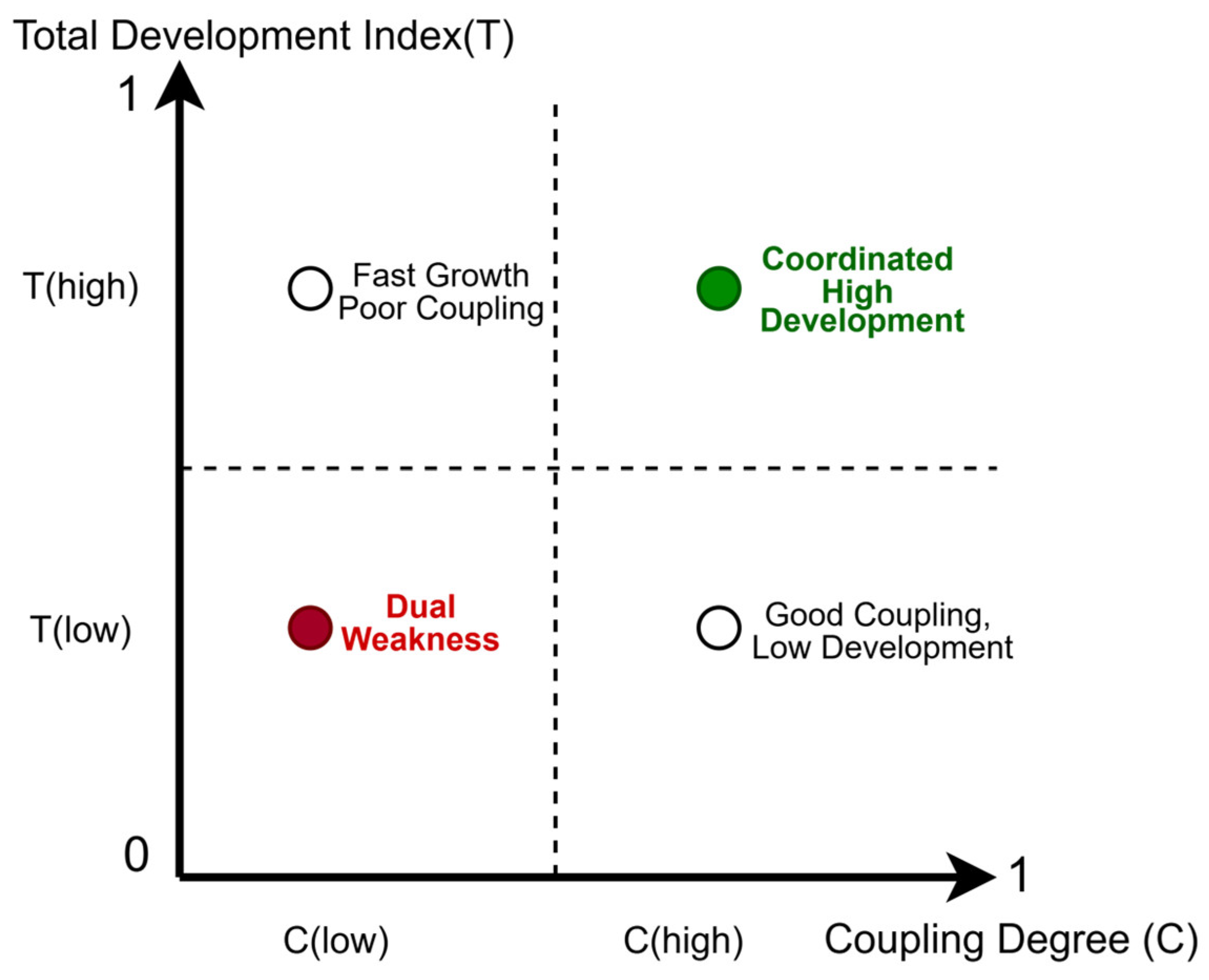
- Low C and low T: Weak coordination and unbalanced coupling.
- High C and low T: Strong coordination but limited overall development.
- Low C and high T: High development but poor coordination among systems.
- High C and high T: Both coordination and development are strong.
3. Data Analysis
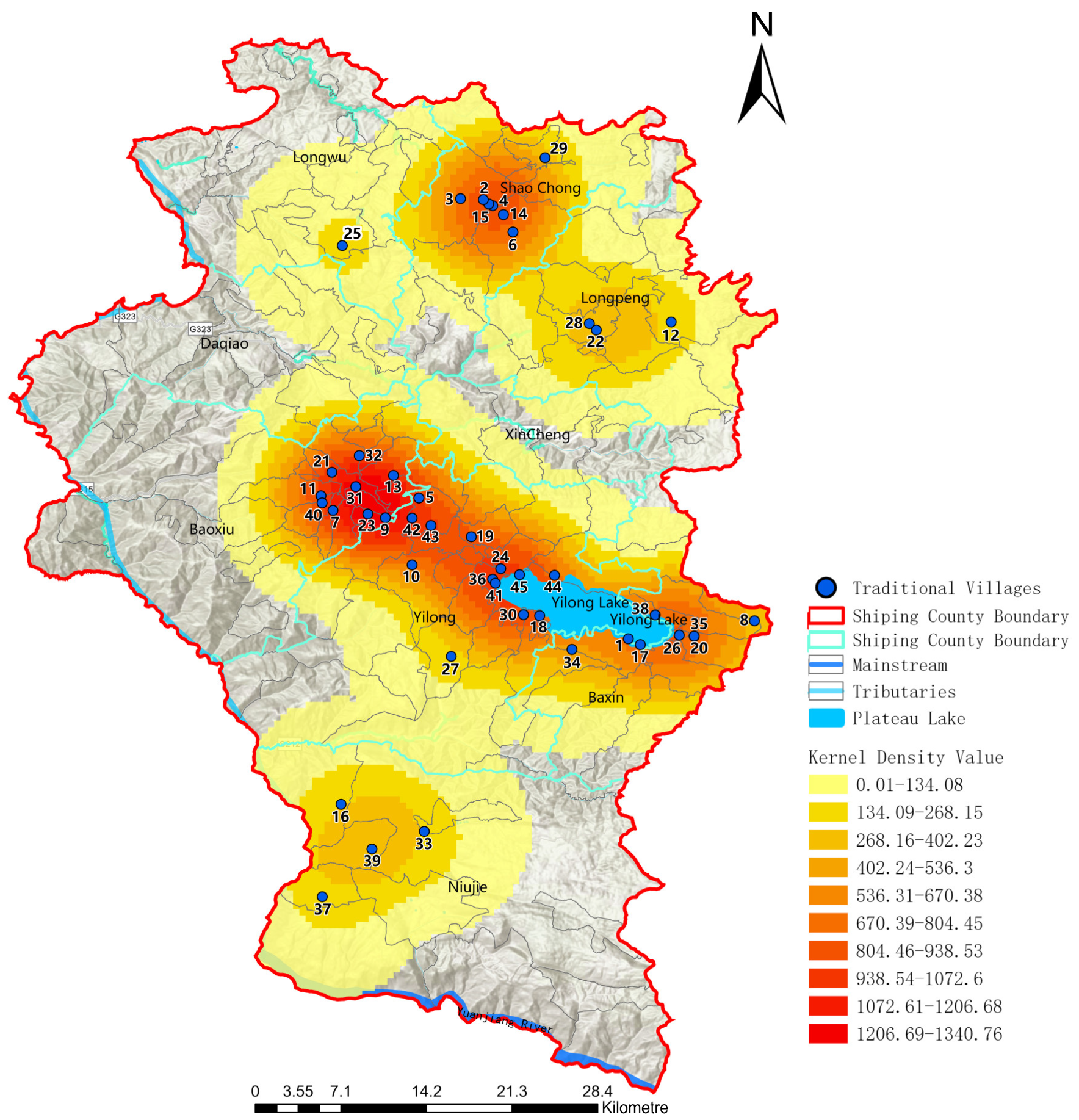
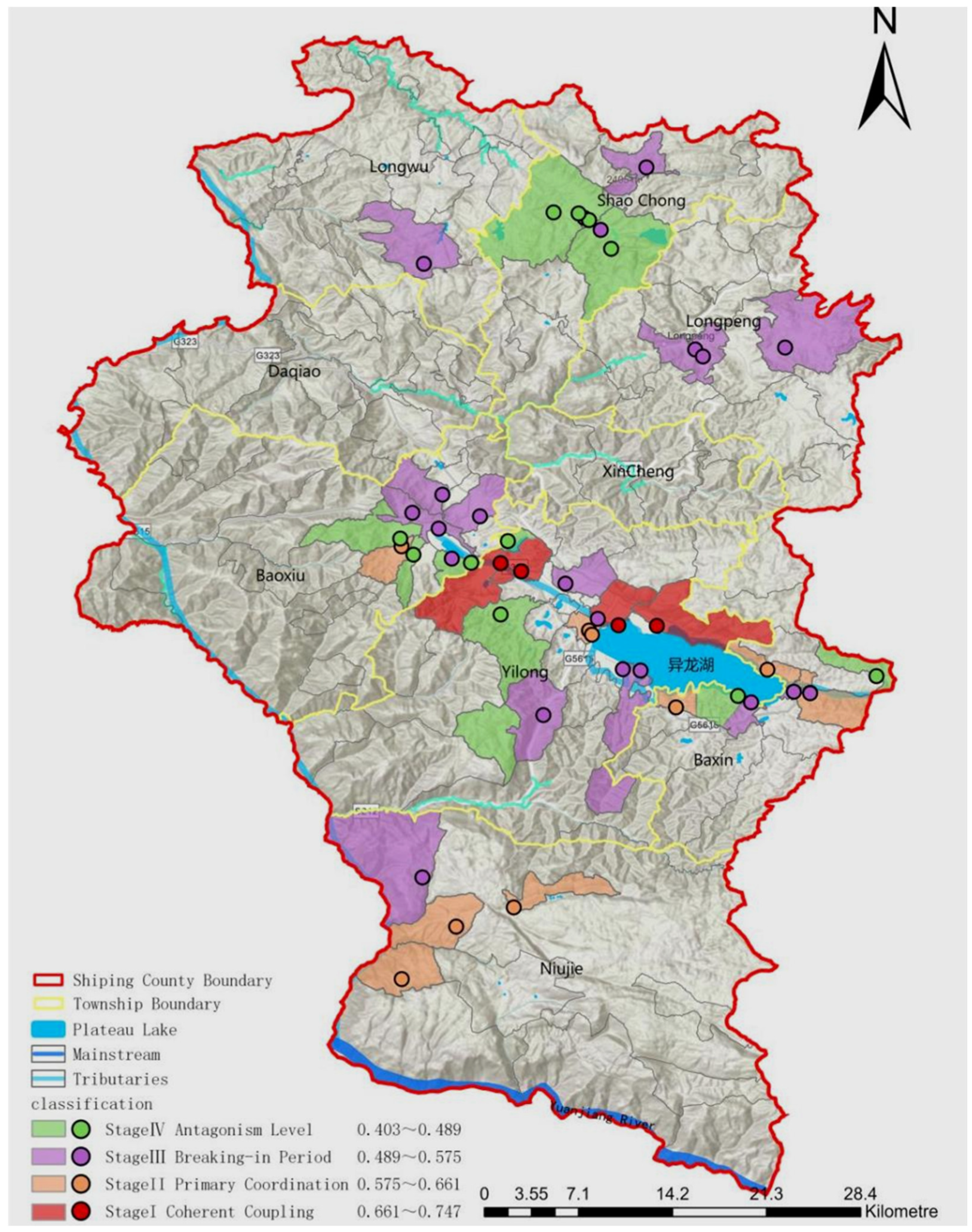
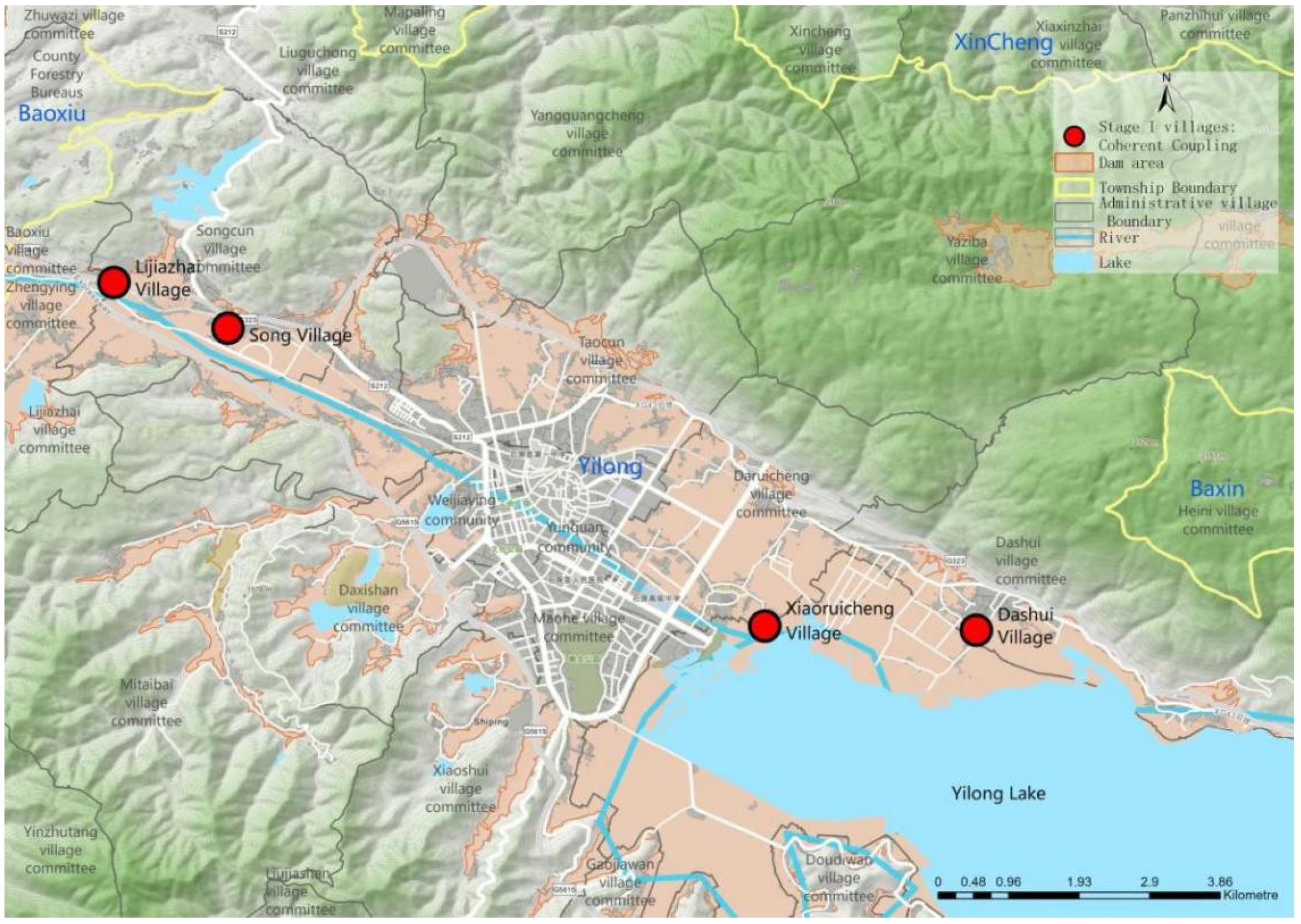
3.1. Features of Spatial Differentiation
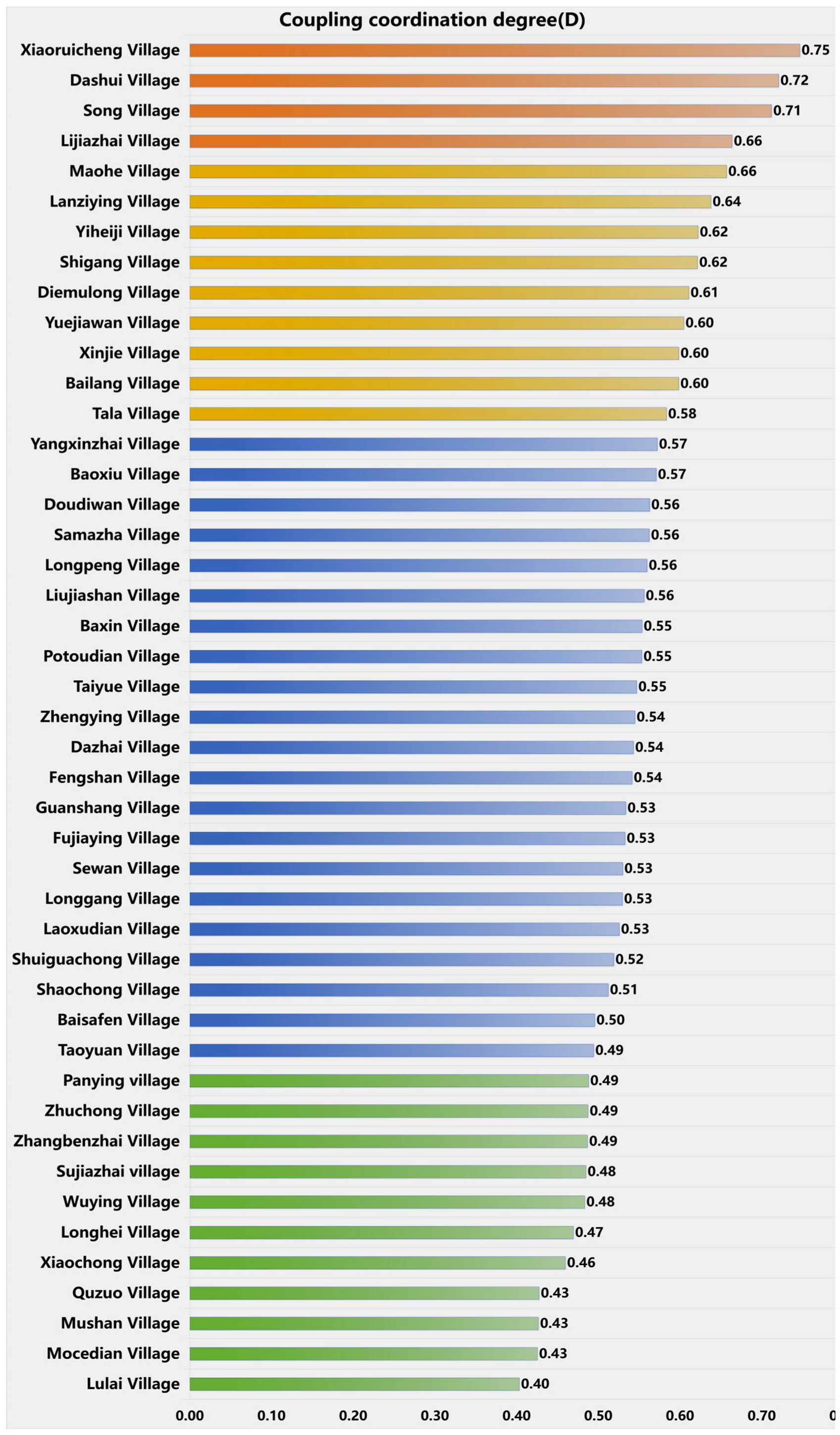
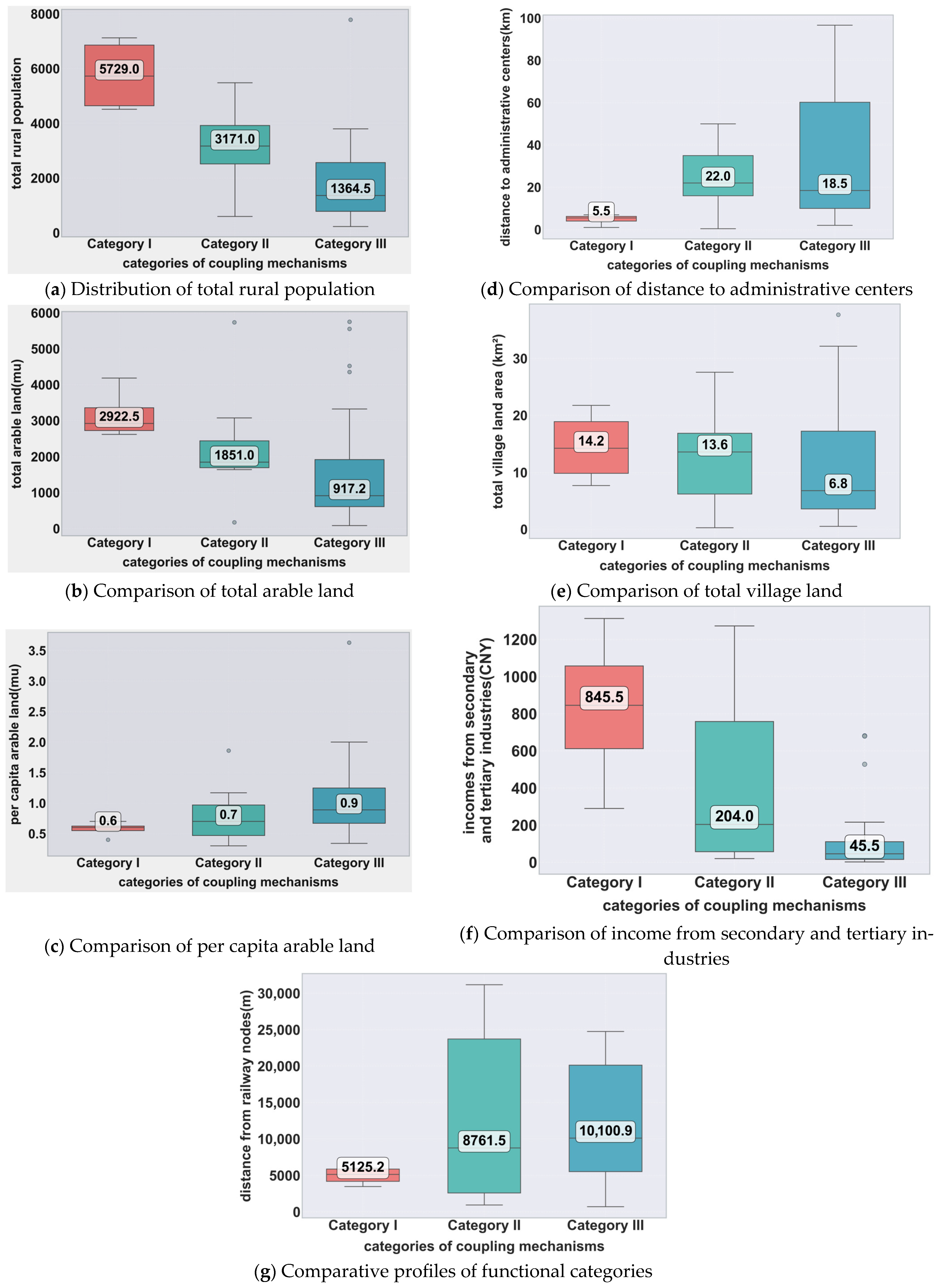
3.2. Classification of Coupling and Coordination
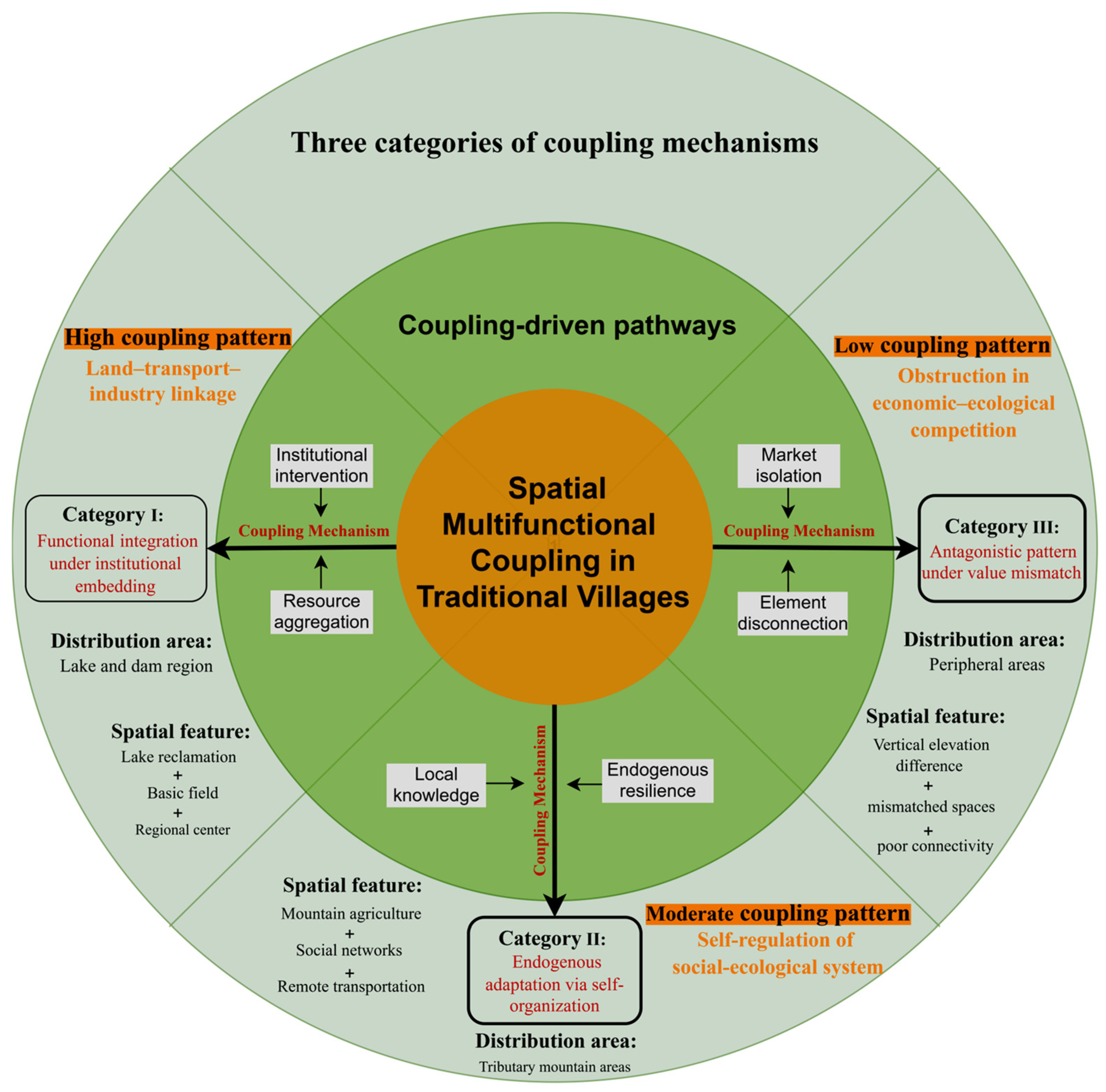
4. Results: Socio-Ecological Coupling Mechanisms and Governance Pathways
4.1. Institutional Enhancement for Coupling Optimization in Basin Core Areas
- Integrate county-level and village planning
- Foster multifunctional industries (“one village, one product” model).
- Empower stakeholders, recognize cultural inheritors, ensure cultural justice
4.2. Adaptive Allocation for Functional Transition in Semi-Peripheral Mountainous Villages
- Improve peripheral infrastructure and services through county-level compensation [72], and revitalization funds to address fragmented spatial structures.
- Build “district–village” industrial chains that integrate cultural and tourism resources, tailored to local differences and coupling degrees.
4.3. Equity Compensation for Conflict Mitigation in Mountain Hinterlands
5. Discussion
5.1. Validation of Nonlinear Multifunctional Coupling Mechanisms
5.2. Generalization of Governance Pathways and Practical Implications
5.3. Limitations
6. Conclusions
Author Contributions
Funding
Data Availability Statement
Conflicts of Interest
References
- Casey, E. Getting Back into Place: Toward a Renewed Understanding of the Place-World, 2nd ed.; Indiana University Press: Bloomington, Indiana, 1993. [Google Scholar] [CrossRef]
- Lefebvre, H. The Production of Space; Blackwell: Oxford, UK, 1991; Available online: https://monoskop.org/images/7/75/Lefebvre_Henri_The_Production_of_Space.pdf (accessed on 14 January 2026).
- Liu, S.; Ge, J.; Bai, M.; Yao, M.; He, L.; Chen, M. Toward classification-based sustainable revitalization: Assessing the vitality of traditional villages. Land Use Policy 2022, 116, 106060. [Google Scholar] [CrossRef]
- United Nations. Transforming Our World: The 2030 Agenda for Sustainable Development; Technical Report A/RES/70/1; United Nations Publications: New York, NY, USA, 2015; Available online: https://sdgs.un.org/2030agenda (accessed on 16 January 2026).
- Zasada, I. Multifunctional peri-urban agriculture—A review of societal demands and the provision of goods and services by farming. Land Use Policy 2011, 28, 639–648. [Google Scholar] [CrossRef]
- Graham, B.; Ashworth, G.; Tunbridge, J. A Geography of Heritage: Power, Culture, and Economy; Arnold: London, UK, 2000. [Google Scholar]
- González Martínez, P. The ‘preservation by relocation’ of Huizhou vernacular architecture: Shifting notions on the authenticity of rural heritage in China. Int. J. Herit. Stud. 2021, 28, 200–215. [Google Scholar] [CrossRef]
- Li, Y.F.; Hong, J.H.; Niu, F.C. Spatial distribution and influencing factors of traditional villages based on density field hot spot detection model—A case study in Southwest China. J. Southwest Univ. Nat. Sci. Ed. 2024, 46, 178–187. [Google Scholar] [CrossRef]
- Meng, Y.; Zhai, H.; Teoh, B.K.; Tiong, R.L.K.; Huang, S.; Cen, D.; Cui, C. A data-driven method for constructing the spatial database of traditional villages—A case study of courtyard residential typologies in Yunnan, China. Buildings 2023, 13, 2956. [Google Scholar] [CrossRef]
- Yunnan Provincial Department of Housing and Urban-Rural Development. The 14th Five-Year Plan for Urban–Rural Development and Historic–Cultural Heritage Protection in Yunnan Province. Available online: https://zfcxjst.yn.gov.cn/zhengfuxinxigongkai/guihuaxinxi/shisiwuzhuanxiangguihua8779/286270.html (accessed on 2 November 2025).
- Yunnan Provincial Department of Housing and Urban–Rural Development. Planning System for the Protection of Historic and Cultural Cities, Towns, Villages and Streets in Yunnan Province (Public Announcement). Available online: https://zfcxjst.yn.gov.cn/gongzuodongtai2/gongshigonggao4/287026.html (accessed on 2 November 2025).
- National Spatial Planning Bureau. Guidelines for the Practical Compilation of “Multiple-Plan Integration” Village Planning in Yunnan Province. Available online: https://dnr.yn.gov.cn/html/2023/tongzhigonggao_0307/41202.html (accessed on 2 November 2025).
- Yunnan Provincial Department of Natural Resources. Guidelines for the Special Plans of County-Level Village Layout in Yunnan Province. Available online: https://www.guoturen.com/wenku-294 (accessed on 2 November 2025).
- Yang, L.L.; He Yang, Y.D.; Tang, H.; Ming, C.C.; He, K.J. Terrain gradient effect and functional zoning of land-use change in the Red River Basin of Yunnan Province. J. Yunnan Univ. Nat. Sci. Ed. 2024, 46, 276–287. [Google Scholar] [CrossRef]
- Manning, P.; van der Plas, F.; Soliveres, S.; Allan, E.; Maestre, F.T.; Mace, G.; Whittingham, M.J.; Fischer, M. Redefining ecosystem multifunctionality. Nat. Ecol. Evol. 2018, 2, 427–436. [Google Scholar] [CrossRef]
- von Jeetze, P.J.; Weindl, I.; Johnson, J.A.; Borrelli, P.; Panagos, P.; Molina Bacca, E.J.; Karstens, K.; Humpenöder, F.; Dietrich, J.P.; Minoli, S.; et al. Projected landscape-scale repercussions of global action for climate and biodiversity protection. Nat. Commun. 2023, 14, 2609. [Google Scholar] [CrossRef]
- Zhu, H.; Cheng, F.; Wang, J.; Jiao, Y.; Zhou, J.; Sha, J.; Liu, F.; Nong, L. Variation in the ecological carrying capacity and its driving factors of the five lake basins in Central Yunnan Plateau, China. Sustainability 2023, 15, 14442. [Google Scholar] [CrossRef]
- Sun, P.; Ge, D.; Yuan, Z.; Lu, Y. Rural revitalization mechanism based on spatial governance in China: A perspective on development rights. Habitat Int. 2024, 147, 103068. [Google Scholar] [CrossRef]
- Yang, Y.; Bao, W.; Liu, Y. Coupling coordination analysis of rural production-living-ecological space in the Beijing-Tianjin-Hebei region. Ecol. Indic. 2020, 117, 106512. [Google Scholar] [CrossRef]
- Su, K.; Wu, J.; Yan, Y.; Zhang, Z.; Yang, Q. The functional value evolution of rural homesteads in different types of villages: Evidence from a Chinese traditional agricultural village and homestay village. Land 2022, 11, 903. [Google Scholar] [CrossRef]
- Chen, Y.; Wei, W. Alterations of historic rural landscape based on the multifunctional approach: The case of coastal fishing villages in the Yangtze River Basin. Sustainability 2022, 14, 7451. [Google Scholar] [CrossRef]
- Yao, Y.; Xu, C.; Yin, H.; Shao, L.; Wang, R. More visible greenspace, stronger heart? Evidence from ischaemic heart disease emergency department visits by middle-aged and older adults in Hubei, China. Landsc. Urban Plan. 2022, 224, 104444. [Google Scholar] [CrossRef]
- Ma, W.; Jiang, G.; Chen, Y.; Qu, Y.; Zhou, T.; Li, W. How feasible is regional integration for reconciling land use conflicts across the urban–rural interface? Evidence from Beijing–Tianjin–Hebei metropolitan region in China. Land Use Policy 2020, 92, 104433. [Google Scholar] [CrossRef]
- Bao, W.; Yang, Y.; Zou, L. How to reconcile land use conflicts in mega urban agglomeration? A scenario-based study in the Beijing-Tianjin-Hebei region, China. J. Environ. Manag. 2021, 296, 113168. [Google Scholar] [CrossRef]
- Yang, D.; Yang, Q.; Tong, Z.; Du, W.; Zhang, J. Coupling coordination analysis of production, living, and ecological spaces in wetlands: A case study of Xianghai Wetland nature reserve, China. Ecol. Indic. 2024, 158, 111578. [Google Scholar] [CrossRef]
- Fang, Y.; Ai, D.; Yang, Y.; Sun, W.; Zu, J. Multi-objective spatial suitability evaluation and conflict optimization considering productivity, sustainability, and livability in southwestern mountainous areas of China. Sustainability 2022, 14, 371. [Google Scholar] [CrossRef]
- Zhang, Q.H.; Wang, J.B. Multi-functional coupling-based rural ecological pattern construction and network prioritization evaluation: A case study of Jiangning District, Nanjing. Ecol. Indic. 2024, 166, 112277. [Google Scholar] [CrossRef]
- Hincks, S.; Deas, I.; Haughton, G. Real geographies, real economies and soft spatial imaginaries: Creating a ‘More than Manchester’ region. Int. J. Urban Reg. Res. 2017, 41, 642–657. [Google Scholar] [CrossRef]
- Bian, J.; Chen, W.; Zeng, J. Spatial distribution characteristics and influencing factors of traditional villages in China. Int. J. Environ. Res. Public Health 2022, 19, 4627. [Google Scholar] [CrossRef]
- Parcerisas, L.; Marull, J.; Pino, J.; Tello, E.; Coll, F.; Basnou, C. Land use changes, landscape ecology and their socioeconomic driving forces in the Spanish Mediterranean coast (El Maresme County, 1850–2005). Environ. Sci. Policy 2012, 23, 120–132. [Google Scholar] [CrossRef]
- Ma, D.; Sun, D.; Wang, Z. Exploring the rural revitalization effect under the interaction of agro-tourism integration and tourism-driven poverty reduction: Empirical evidence for China. Land 2024, 13, 60. [Google Scholar] [CrossRef]
- Pan, Y.; Zhao, X.; Zhang, Y.; Luo, H. A large-scale village classification model for tailored rural revitalization: A case study of Hubei province, China. J. Geogr. Sci. 2024, 34, 2364–2392. [Google Scholar] [CrossRef]
- Liao, X.; Qin, S.; Wang, Y.; Zhu, H.; Qi, X. Effects of land transfer on agricultural carbon productivity and its regional differentiation in China. Land 2023, 12, 1358. [Google Scholar] [CrossRef]
- Lee, Y.L.; Chang, Y.H.; Li, J.L.; Lin, C.Y. Using intelligence green building materials to evaluate color change performance. Sustainability 2020, 12, 5630. [Google Scholar] [CrossRef]
- Zerbe, S. Restoration of multifunctional cultural landscapes: Merging tradition and innovation for a sustainable future. In Landscape Series; Fürst, C., Echeverria, C., Bulley, H.N.N., Eds.; Springer International Publishing: Cham, Switzerland, 2022. [Google Scholar] [CrossRef]
- Gillson, L. Testing non-equilibrium theories in savannas: 1400 years of vegetation change in Tsavo National Park, Kenya. Ecol. Complex. 2004, 1, 281–298. [Google Scholar] [CrossRef]
- Wang, D.; Fu, J.; Xie, X.; Ding, F.; Jiang, D. Spatiotemporal evolution of urban-agricultural-ecological space in China and its driving mechanism. J. Clean. Prod. 2022, 371, 133684. [Google Scholar] [CrossRef]
- Nguyen, C.P.; Su, T.D. Alleviating energy poverty for forest conservation: It seems to work, but what are we missing? Land Use Policy 2021, 109, 105625. [Google Scholar] [CrossRef]
- Dumas, G.; Fairhurst, M.T. Reciprocity and alignment: Quantifying coupling in dynamic interactions. R. Soc. Open Sci. 2021, 8, 210138. [Google Scholar] [CrossRef]
- Qu, L.; Tu, Z.; Liu, J.; Li, Y. Coupling coordination evolution of the settlements-farming system and its optimization path: Keys to sustainable rural development in the Three Gorges Reservoir Area of China. Habitat Int. 2025, 163, 103456. [Google Scholar] [CrossRef]
- Pan, J.; Ma, Y.; Cai, S.; Chen, Y.; Chen, Y. Distribution patterns of lake-wetland cultural ecosystem services in highland. Environ. Dev. 2022, 44, 100754. [Google Scholar] [CrossRef]
- Yang, R.; Yang, D. A comparative study on the ecological sustainable development of traditional settlements—A case study in Yunnan, China. IOP Conf. Series Earth Environ. Sci. 2019, 376, 012032. [Google Scholar] [CrossRef]
- Tongur, V.; Ertunc, E.; Uyan, M. Use of the Migrating Birds Optimization (MBO) Algorithm in solving land distribution problem. Land Use Policy 2020, 94, 104550. [Google Scholar] [CrossRef]
- Ma, G.; Xiao, J.; Li, Q.; Zhang, L.; An, B.; Sun, G.; Cheng, H.; Tang, J.; Li, H. Impact of the evolution of Plateau Lake landscape pattern on ecosystem service value in the Pearl River basin: A case study of Yilong Lake Basin in Yunnan Province, China. Acta Geophys. 2022, 71, 1391–1407. [Google Scholar] [CrossRef]
- People’s Government of Honghe Prefecture. Overview of Honghe Prefecture. Available online: https://www.hh.gov.cn/zjhh/hhgk.htm (accessed on 17 January 2026).
- Gao, W.; Zhuo, X.; Xiao, D. Spatial patterns, factors, and ethnic differences: A study on ethnic minority villages in Yunnan, China. Heliyon 2024, 10, e27677. [Google Scholar] [CrossRef]
- Chen, X.H.; Wu, S.Q.; Li, X. Characteristics, types and differentiated guidance strategies of multi-functional development of traditional villages: A case study of 44 villages in Yixian county, China. J. Nat. Resour. 2024, 39, 1887–1905. [Google Scholar] [CrossRef]
- Jing, F.; Ramele Ramli, R.; Nasrudin, N. Protection of traditional villages in China: A review on the development process and policy evolution. J. Cult. Herit. Manag. Sustain. Dev. 2024, in press. [Google Scholar] [CrossRef]
- Chen, T.; Zhang, S.; Chen, J.; Duan, J.; Zhang, Y.; Yang, Y. Spatial distribution characteristics and cluster differentiation of traditional villages in the Central Yunnan Region. Land 2025, 14, 1565. [Google Scholar] [CrossRef]
- Wang, S.Y.; Sun, J.X. Bidirectional mechanisms of tourism resource (re)development and community heterogeneity: A case study of Erhai Lake region, Yunnan province. J. Nat. Resour. 2024, 39, 1531–1547. [Google Scholar] [CrossRef]
- Zhou, D.; Xu, J.; Lin, Z. Conflict or coordination? Assessing land use multi-functionalization using production-living-ecology analysis. Sci. Total Environ. 2017, 577, 136–147. [Google Scholar] [CrossRef] [PubMed]
- Zhang, Y.; Jia, D.; Zhang, H.; Tan, J.; Song, S.; Sun, R. Spatial structure of valley economic development in the mountainous areas in Beijing. J. Geogr. Sci. 2011, 21, 331–345. [Google Scholar] [CrossRef]
- Kumar, A.; Kumar, A.; Kumari, S.; Kumari, N.; Kumari, S.; Mishra, P. Sustainable livelihoods a foundation for rural development leads to sustainability. Probl. Ekorozw. 2023, 18, 128–140. [Google Scholar] [CrossRef]
- Wen, J. The supply of rural public cultural services relying on data mining technology under the rural revitalization strategy. Wirel. Commun. Mob. Comput. 2022, 2022, 2671717. [Google Scholar] [CrossRef]
- Zhang, Y.; Shang, K.; Shi, Z.; Wang, H.; Li, X. Spatial pattern of the vitality of Chinese characteristic towns: A perspective from nighttime lights. Land 2022, 11, 85. [Google Scholar] [CrossRef]
- Nishimura, Y.; Okamoto, K.; Boulidam, S. Time-geographic analysis on natural resource use in a village of the Vientiane Plain. Jpn. J. Southeast Asian Stud. 2009, 47, 426–450. [Google Scholar] [CrossRef]
- Morioka, S.N.; Bolis, I.; Evans, S.; Carvalho, M.M. Transforming sustainability challenges into competitive advantage: Multiple case studies kaleidoscope converging into sustainable business models. J. Clean. Prod. 2017, 167, 723–738. [Google Scholar] [CrossRef]
- Gan, X.; Fernandez, I.C.; Guo, J.; Wilson, M.; Zhao, Y.; Zhou, B.; Wu, J. When to use what: Methods for weighting and aggregating sustainability indicators. Ecol. Indic. 2017, 81, 491–502. [Google Scholar] [CrossRef]
- Lukinskiy, V.; Lukinskiy, V.; Bazhina, D. Refining the analytic hierarchy process: A statistical and methodological exploration of expert judgments. Alex. Eng. J. 2025, 125, 526–536. [Google Scholar] [CrossRef]
- Yang, Y.; Dong, W.; Liu, Y.; Li, X.Y. Spatial structure and evolution of traditional settlement systems in the Yilong Lake Basin, Yunnan Province. Sci. Geogr. Sin. 2016, 36, 1368–1376. [Google Scholar] [CrossRef]
- Bračko, T.; Jelušič, P.; Žlender, B. Geotechnical aspects of N(H)bSs for enhancing sub-alpine mountain climate resilience. Land 2025, 14, 512. [Google Scholar] [CrossRef]
- Li, H.; Shi, D.M.; Pan, L.D. Effects of biochar and fertilizer application on soil moisture and infiltration performance of the erosive plow layer soil in sloping farmland of purple soil. J. Southwest Univ. Nat. Sci. Ed. 2024, 46, 121–132. [Google Scholar] [CrossRef]
- Michener, C.D.; Sokal, R.R. A quantitative approach to a problem in classification. Evolution 1957, 11, 130. [Google Scholar] [CrossRef]
- Moraes-Santos, E.C.; Dias, R.A.; Balestieri, J.A.P. Groundwater and the water-food-energy nexus: The grants for water resources use and its importance and necessity of integrated management. Land Use Policy 2021, 109, 105585. [Google Scholar] [CrossRef]
- Gong, Z.; Zhang, Z.; Zhou, J.; Zhou, J.; Wang, W. The evolutionary process and mechanism of cultural landscapes: An integrated perspective of landscape ecology and evolutionary economic geography. Land 2022, 11, 2062. [Google Scholar] [CrossRef]
- Li, G.; Zhang, X. The spatial–temporal characteristics and driving forces of the coupled and coordinated development between new urbanization and rural revitalization. Sustainability 2023, 15, 16487. [Google Scholar] [CrossRef]
- Dong, Q.; Zhong, K.; Liao, Y.; Xiong, R.; Wang, F.; Pang, M. Coupling coordination degree of environment, energy, and economic growth in resource-based provinces of China. Resour. Policy 2023, 81, 103308. [Google Scholar] [CrossRef]
- Shepherd, K.; Walsh, M.; Mugo, F.; Ong, C.; Svan-Hansen, T.; Swallow, B.; Awiti, A.; Hai, M.; Nyantika, D.; Ombalo, D.; et al. Improved Land Management in the Lake Victoria Basin: Linking Land and Lake, Research and Extension, Catchment and Lake Basin; Technical Report 2000-2; International Centre for Research in Agroforestry: Nairobi, Kenya, 2000; Available online: https://ecommons.aku.edu/eastafrica_eai/13 (accessed on 20 September 2025).
- Sinclair, K.; Rawluk, A.; Kumar, S.; Curtis, A. Ways forward for resilience thinking: Lessons from the field for those exploring social-ecological systems in agriculture and natural resource management. Ecol. Soc. 2017, 22, 21. [Google Scholar] [CrossRef]
- Memela, S. Lefebvrian analysis of livestock keeping in Fingo Village, Makhanda (Grahamstown), South Africa. GeoJournal 2023, 88, 5383–5395. [Google Scholar] [CrossRef]
- People’s Government of Honghe Prefecture. Master Plan for the Protection and Development of Traditional Villages in Honghe Prefecture (2018–2035); People’s Government of Honghe Prefecture: Mengzi, China, 2018.
- Delle Rose, M. Landscape modifications ascribed to El Niño events in late pre-Hispanic coastal Peru. Land 2022, 11, 2207. [Google Scholar] [CrossRef]
- Wang, Q.; Zhan, J.; Zhang, H.; Cao, Y.; Yang, Z.; Wu, Q.; Otho, A.R. China’s carbon emissions trading market: Current situation, impact assessment, challenges, and suggestions. Land 2025, 14, 1582. [Google Scholar] [CrossRef]
- Guo, J.; Chen, Q. The sustainability impact of tourism industry agglomeration on regional economic gap. Glob. Sustain. Res. 2025, 4, 37–61. [Google Scholar] [CrossRef]
- Olson, K.R.; Frenelus, W. Environmental and human impacts of Lancang-Mekong Mainstem and tributary dams on China, Laos, Thailand, Myanmar, Cambodia, and Vietnam. Open J. Soil Sci. 2024, 14, 555–605. [Google Scholar] [CrossRef]
- Yang, Y.; Nie, X.; Cong, Z.; Pan, X.; Gong, X.; Zhang, Z. Assessing the carbon-water compound use efficiency in fragile karst region: The Yunnan-Guizhou Plateau, China. Ecol. Indic. 2024, 166, 112320. [Google Scholar] [CrossRef]
- Nicholas, K.A.; Scown, M. Rural land systems both support and hinder the Sustainable Development Goals across Europe. Commun. Earh Environ. 2024, 5, 692. [Google Scholar] [CrossRef]
- Delgado-Baquerizo, M.; Eldridge, D.J.; Liu, Y.-R.; Liu, Z.-W.; Coleine, C.; Trivedi, P. Soil biodiversity and function under global change. PLoS Biol. 2025, 23, e3003093. [Google Scholar] [CrossRef]
- Kyriazos, T.; Poga, M. Dealing with multicollinearity in factor analysis: The problem, detections, and solutions. Open J. Stat. 2023, 13, 404–424. [Google Scholar] [CrossRef]
- Wu, B.; Wang, S.; Zou, Y.; Chen, Y.; Luo, Y.; Chen, Y.; Li, Y. Multi-scenario simulation of land use spatial conflicts: A spatially explicit model integrating conflict risk and ecological impact. Environ. Dev. Sustain. 2025, 5. [Google Scholar] [CrossRef]
- Harrison, J.; Hoyler, M.; Derudder, B.; Liu, X.; Meijers, E. Governing polycentric urban regions. Territ. Polit. Gov. 2022, 11, 213–221. [Google Scholar] [CrossRef]






| System | Sub-Item | Date Source |
|---|---|---|
| Economic production | Distance to county seat (km) | China Statistical Yearbook (regional data) Yunnan Statistical Yearbook Honghe Prefecture Statistical Yearbook Shiping County Statistical Yearbook |
| Total annual economic income (10,000 CNY) | ||
| Annual per capita net income (CNY) | ||
| Total land area of the village (km2) | ||
| Rural population | ||
| Total arable land (mu) | ||
| Per capita arable land (mu) | ||
| Annual income from secondary and tertiary industries (10,000 CNY) | ||
| Socio-cultural development | Night-time light intensity (nW/cm2/sr) | NOAA National Centers for Environmental Information: https://www.ncei.noaa.gov/news/sunset-nighttime-lights-noaa (accessed on 11 January 2025) |
| Distance from national cultural relics (m) | List of national key cultural relics protection units in eight batches (State Administration of Cultural Heritage Comprehensive Administrative Management Platform): https://ncha.gjzwfw.gov.cn/ (accessed on 11 January 2025) | |
| Distance from adjacent railway stations (m) | GRDC (https://www.gis5g.com/data-resource) (accessed on 11 January 2025) 2024 vector dataset for national railways and stations (2024) | |
| Distance from adjacent roads | National Geomatics Center of China (https://www.gis5g.com/data-resource) (accessed on 11 January 2025) 2023 vector dataset for the national road network | |
| Administrative rank of adjacent roads | ||
| Potential of environmental resource | Distance from adjacent lakes (m) | GRDC (https://www.gis5g.com/data-resource) (accessed on 11 January 2025) 2024 Level-5 standard river system shapefile (SHP) data for China |
| Elevation of adjacent lakes (m) | ||
| Elevation difference between village and adjacent lake (m) | ||
| Distance from adjacent rivers (m) | ||
| Elevation difference between village and adjacent rivers (m) |
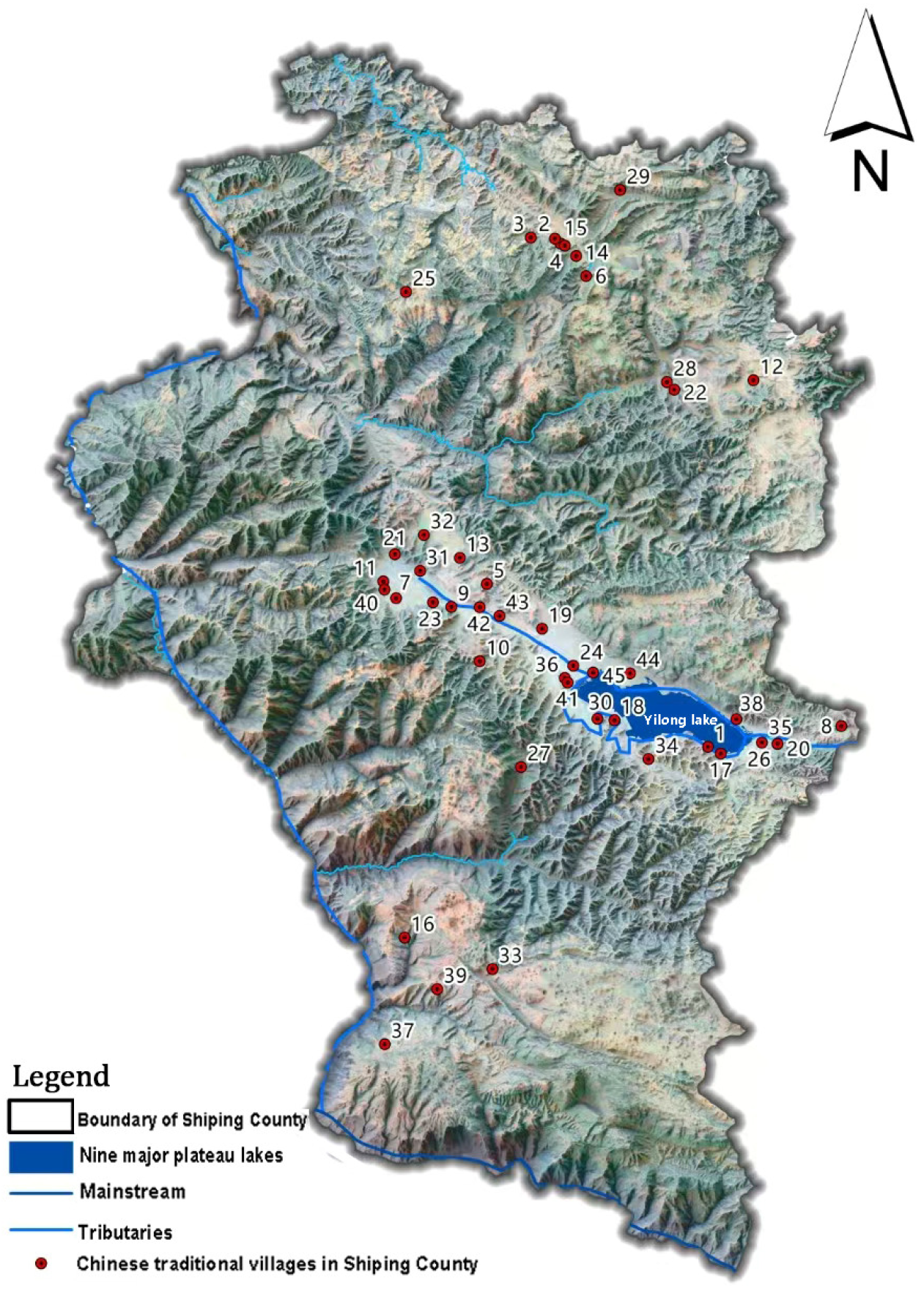
| No. | Village Name | No. | Village Name |
|---|---|---|---|
| 1 | Lulai Village | 24 | Taiyue Village |
| 2 | Mocedian Village | 25 | Potoudian Village |
| 3 | Mushan Village | 26 | Baxin Village |
| 4 | Quzuo Village | 27 | Liujiashan Village |
| 5 | Xiaochong Village | 28 | Longpeng Village |
| 6 | Longhei Village | 29 | Samazha Village |
| 7 | Wuying Village | 30 | Doudiwan Village |
| 8 | Sujiazhai Village | 31 | Baoxiu Village |
| 9 | Zhangbenzhai Village | 32 | Yangxinzhai Village |
| 10 | Zhuchong Village | 33 | Tala Village |
| 11 | Panying Village | 34 | Bailang Village |
| 12 | Taoyuan Village | 35 | Xinjie Village |
| 13 | Baisafen Village | 36 | Yuejiawan Village |
| 14 | Shaochong Village | 37 | Diemulong Village |
| 15 | Shuiguachong Village | 38 | Shigang Village |
| 16 | Laoxudian Village | 39 | Yiheiji Village |
| 17 | Longgang Village | 40 | Lanziying Village |
| 18 | Sewan Village | 41 | Maohe Village |
| 19 | Fujiaying Village | 42 | Lijiazhai Village |
| 20 | Guanshang Village | 43 | Song Village |
| 21 | Fengshan Village | 44 | Dashui Village |
| 22 | Dazhai Village | 45 | Xiaoruicheng Village |
| 23 | Zhengying Village |
| Name | Master Plan | Aerial View of Village Layout |
|---|---|---|
| Lijiazhai Village |  |  |
| Song Village |  |  |
| Dashui Village |  |  |
| Xiaoruicheng Village |  |  |
| Spatial Characteristics | Alluvial plain buffer zone | Linear extension (tributaries/roads) |
| Name | Master Plan | Aerial View of Village Layout |
|---|---|---|
| Tala Village (belt-like shape) |  |  |
| Yiheji Village (belt-like shape) |  |  |
| Belt-like Differentiation | Terrain-adapted | Contour-adapted |
| Diemulong Village (clustered shape) | 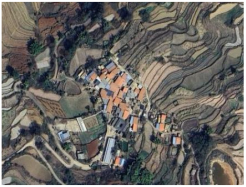 |  |
| Clustered Differentiation | High-altitude terraces | Arable–transport link |
| Traditional Village Sample | Coupling Coordination Degree (D) | Value Range | Number of Villages at Different Stages |
|---|---|---|---|
| Lulai Village | 0.4032153 | 0.40–0.48 | Stage 4: antagonistic stage, 11 villages |
| Mocedian Village | 0.4253063 | ||
| Mushan Village | 0.4265351 | ||
| Quzuo Village | 0.4274328 | ||
| Xiaochong Village | 0.459585 | ||
| Longhei Village | 0.4694006 | ||
| Wuying Village | 0.4832362 | ||
| Sujiazhai Village | 0.4846746 | ||
| Zhangbenzhai Village | 0.4866254 | ||
| Zhuchong Village | 0.4872925 | ||
| Panying Village | 0.4879586 | ||
| Taoyuan Village | 0.4941365 | 0.48–0.57 | Stage 3: breaking-in stage, 21 villages |
| Baisafen Village | 0.4954966 | ||
| Shaochong Village | 0.5120823 | ||
| Shuiguachong Village | 0.5187631 | ||
| Laoxudian Village | 0.525607 | ||
| Longgang Village | 0.5293064 | ||
| Sewan Village | 0.5297481 | ||
| Fujiaying Village | 0.5325361 | ||
| Guanshang Village | 0.5335027 | ||
| Fengshan Village | 0.5412129 | ||
| Dazhai Village | 0.5429253 | ||
| Zhengying Village | 0.5447065 | ||
| Taiyue Village | 0.5468364 | ||
| Potoudian Village | 0.5531332 | ||
| Baxin Village | 0.5533727 | ||
| Liujiashan Village | 0.5558993 | ||
| Longpeng Village | 0.5595284 | ||
| Samazha Village | 0.5622892 | ||
| Doudiwan Village | 0.5626635 | ||
| Baoxiu Village | 0.5707847 | ||
| Yangxinzhai Village | 0.5720714 | ||
| Tala Village | 0.5832748 | 0.57–0.66 | Stage 2: primary coordination stage, 9 villages |
| Bailang Village | 0.5983039 | ||
| Xinjie Village | 0.598406 | ||
| Yuejiawan Village | 0.6045035 | ||
| Diemulong Village | 0.6107176 | ||
| Shigang Village | 0.6213369 | ||
| Yiheiji Village | 0.6220282 | ||
| Lanziying Village | 0.6377032 | ||
| Maohe Village | 0.6568747 | ||
| Lijiazhai Village | 0.6636602 | 0.66–0.75 | Stage 1: coherent stage, 4 villages |
| Song Village | 0.7119327 | ||
| Dashui Village | 0.7206658 | ||
| Xiaoruicheng Village | 0.7465541 |
Disclaimer/Publisher’s Note: The statements, opinions and data contained in all publications are solely those of the individual author(s) and contributor(s) and not of MDPI and/or the editor(s). MDPI and/or the editor(s) disclaim responsibility for any injury to people or property resulting from any ideas, methods, instructions or products referred to in the content. |
© 2026 by the authors. Licensee MDPI, Basel, Switzerland. This article is an open access article distributed under the terms and conditions of the Creative Commons Attribution (CC BY) license.
Share and Cite
Meng, Y.; Zhai, H.; Xu, Y.; Teoh, B.K.; Tiong, R.L.K. Socio-Ecological Coupling and Multifunctional Spatial Differentiation in Watershed Rural Systems: Toward Coordinated Development. Land 2026, 15, 194. https://doi.org/10.3390/land15010194
Meng Y, Zhai H, Xu Y, Teoh BK, Tiong RLK. Socio-Ecological Coupling and Multifunctional Spatial Differentiation in Watershed Rural Systems: Toward Coordinated Development. Land. 2026; 15(1):194. https://doi.org/10.3390/land15010194
Chicago/Turabian StyleMeng, Yanjun, Hui Zhai, Yuhong Xu, Bak Koon Teoh, and Robert Lee Kong Tiong. 2026. "Socio-Ecological Coupling and Multifunctional Spatial Differentiation in Watershed Rural Systems: Toward Coordinated Development" Land 15, no. 1: 194. https://doi.org/10.3390/land15010194
APA StyleMeng, Y., Zhai, H., Xu, Y., Teoh, B. K., & Tiong, R. L. K. (2026). Socio-Ecological Coupling and Multifunctional Spatial Differentiation in Watershed Rural Systems: Toward Coordinated Development. Land, 15(1), 194. https://doi.org/10.3390/land15010194