Research on the Impact of the Reform of “Three Plots of Land” in the Yellow River Basin on Food Security



Abstract
1. Introduction
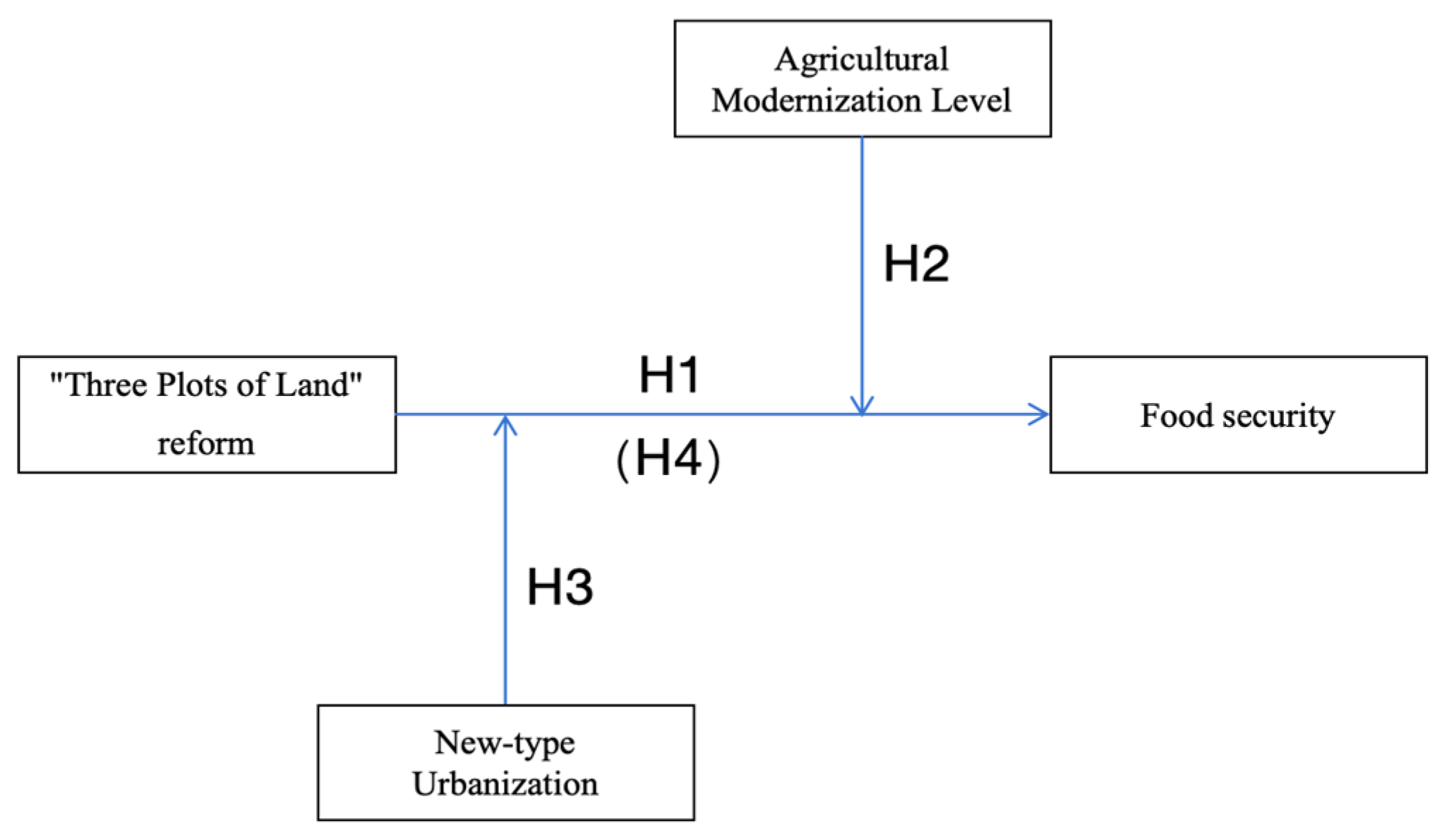
2. Theoretical Analysis and Research Hypothesis
2.1. Direct Impact of the “Three Plots of Land” Reform on Food Security
2.2. The Moderating Effect of Agricultural Modernization
2.3. The Moderating Effect of New-Type Urbanization
2.4. Regional Heterogeneity Effects of the “Three Plots of Land” Reform on Food Security
3. Materials and Methods
3.1. Data
3.2. Variable Selection
3.2.1. Core Explanatory Variable
3.2.2. Explained Variable
- Non-quantification processing;
- Data normalization processing
- Calculate the entropy of relative information;
- Calculate the redundancy and weight of information entropy
- Calculate the comprehensive score
3.2.3. Control Variables
3.2.4. Adjustment Variable
3.3. Model Construction
3.3.1. Difference-in-Differences Model
3.3.2. Moderated Effects Model
4. Empirical Results
4.1. Descriptive Statistical Analysis
4.2. Regression Analysis Results
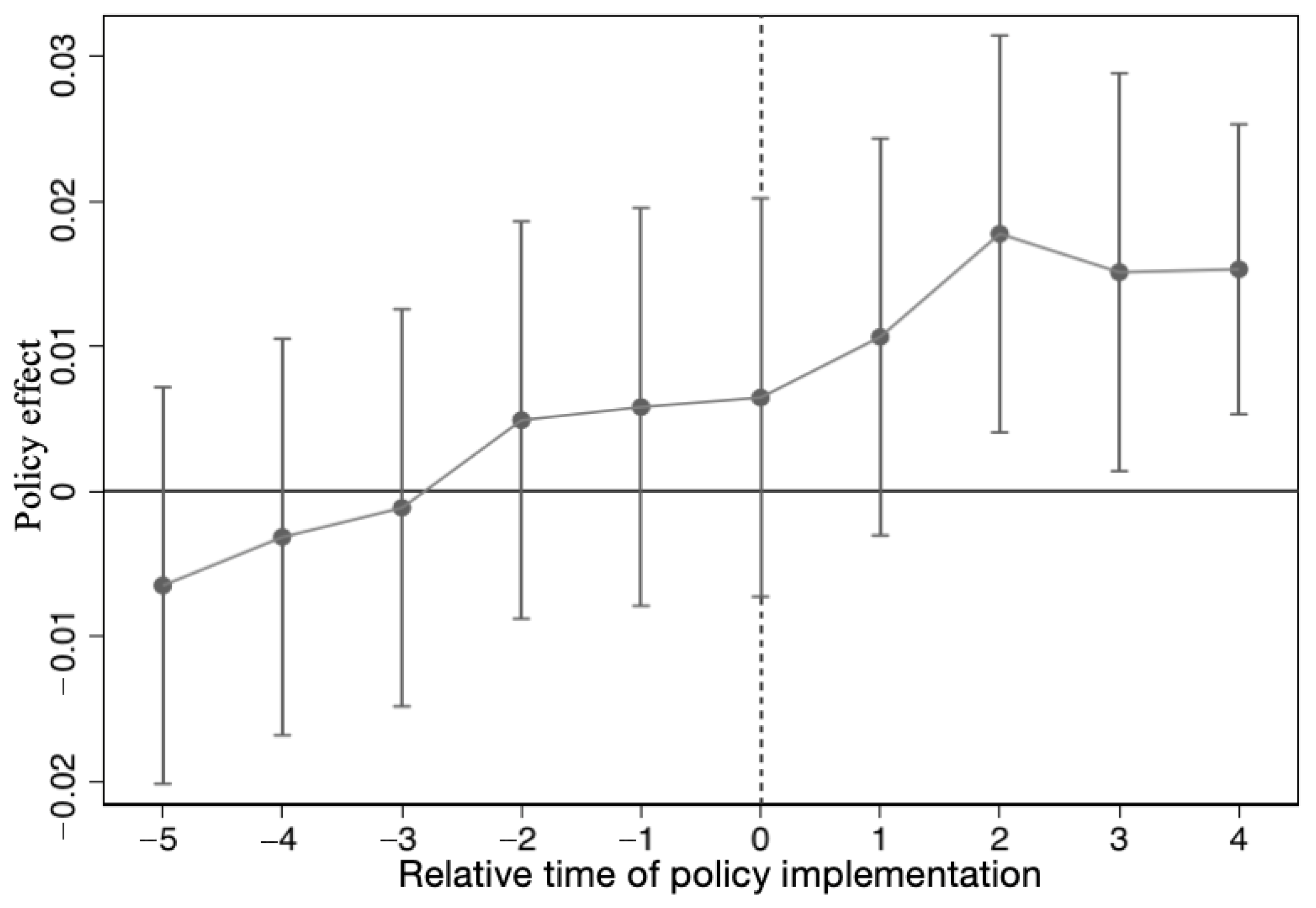
4.3. Parallel Trends Test
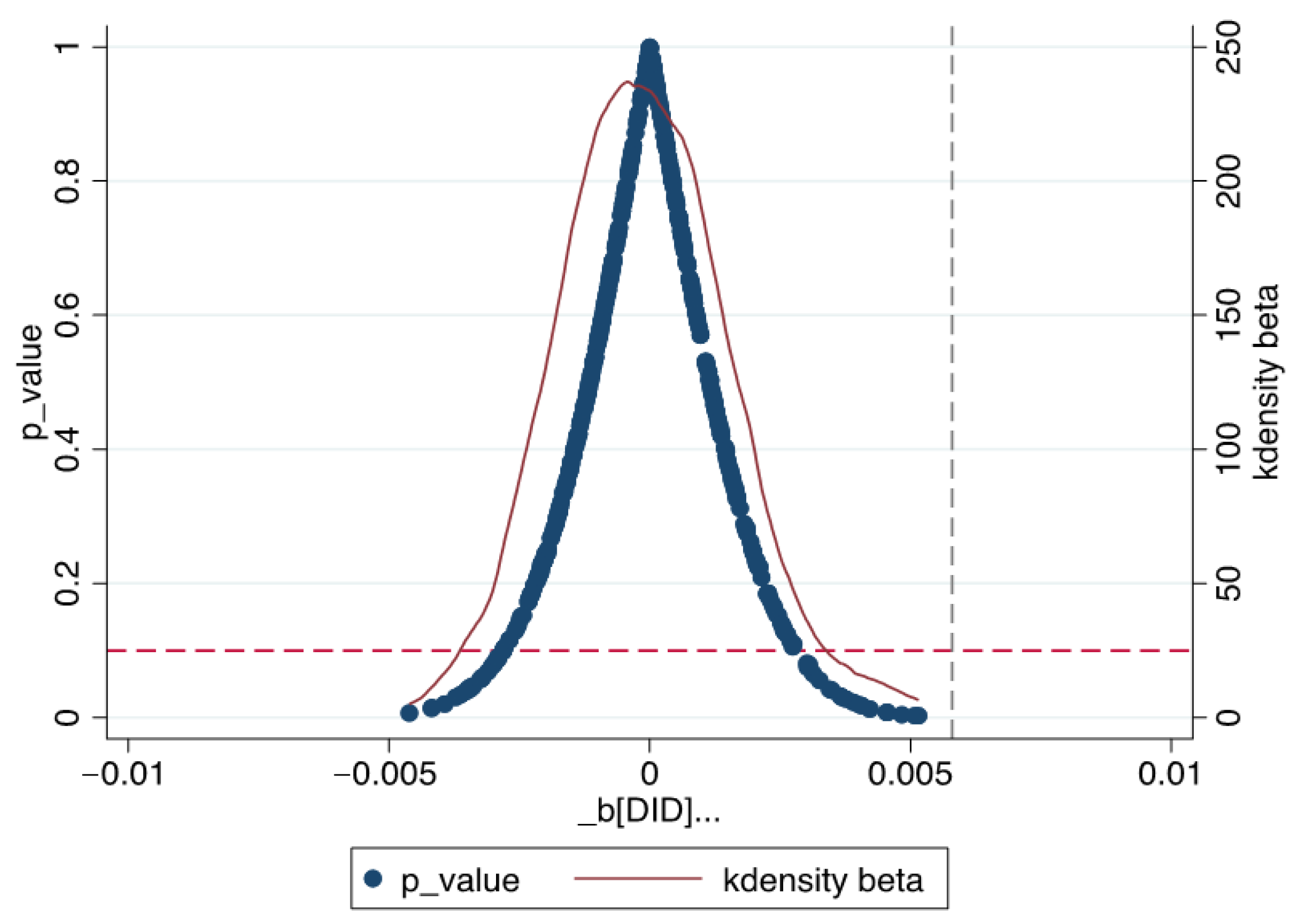
4.4. Placebo Test
4.5. Moderating Effect Analysis
4.6. Regional Heterogeneity Analysis
5. Discussion
5.1. The Positive Impact of the “Three Plots of Land” Reform on Food Security and Research Comparison
5.2. Analysis of the Positive Adjustment Role and Mechanism of New-Type Urbanization and Agricultural Modernization
5.3. Regional Heterogeneity Characteristics and Causes and Research Inspiration
6. Conclusions and Policy Recommendations
6.1. Conclusions
6.2. Policy Recommendations
6.2.1. Implement Differentiated “Three Plots of Land” Reform Strategies to Precisely Align with Regional Development Needs
6.2.2. Establish a “New-Type Urbanization + Agricultural Modernization” Synergy Mechanism to Enhance Policy Effectiveness
6.2.3. Establish Regional Coordination and Dynamic Monitoring Mechanisms to Ensure Policy Sustainability
Author Contributions
Funding
Data Availability Statement
Acknowledgments
Conflicts of Interest
References
- Hu, Y. Research on the Interaction Mechanism between Industrial Development and Urbanization-Take the Central Region as an Example. J. Chongqing Univ. Ind. Commerce. West. Forum 2004, 4, 76–82. [Google Scholar]
- Dai, B. Some thoughts on the support of Longgang in Shenzhen, which is at the forefront of the country. Pract. Theory Spec. Zone 2018, 4, 99–100. [Google Scholar]
- State Council. Opinions of the State Council on Supporting Shanxi Province to Further Deepen Reform and Promote the Transformation and Development of Resource-based Economy. Energy Sav. 2018, 2, 1. [Google Scholar]
- Zhang, A.L. The Logic of China’s Rural Land System Reform-Commentary on “The Chinese Story of Rural Land System Reform: The Logic of Local Government Behavior”. China Land Sci. 2022, 36, 135–138. [Google Scholar]
- Zhang, S.F.; Zhang, S. Strategic reflections on the reform of the rural land contracting rights system under the “three separation of powers”. Agric. Econ. Issues 2017, 38, 9–15+1. [Google Scholar]
- Zhu, J.J.; Zhang, L. Research on the impact of farmland circulation on the efficiency of grain production technology-based on the dual perspective of quantity and quality. J. Agric. For. Econ. Manag. 2019, 18, 28–35. [Google Scholar]
- Liu, S.Y. The pilot of “three plots of land” in rural areas and the possible path of land system reform. Renmin Univ. China 2019, 33, 1. [Google Scholar]
- Zheng, X.M. The logic of recursion, practical progress and trend outlook of China’s rural housing base system. Econ. Geogr. 2025, 45, 163–172. [Google Scholar]
- Liu, T.Z.; Yang, D.C. Research on the promotion mode and superposition effect of the reform of the three rural land systems-based on the empirical research of Lu County. Rural Econ. 2018, 8, 12–17. [Google Scholar]
- Gong, L.Y.; Luo, Q.Y.; Tao, T. Analysis of grain production potential in drylands in the Yellow River Basin. Agric. Technol. Econ. 1994, 4, 31–33. [Google Scholar]
- Huang, C.W. To deepen reform to stimulate the vitality of agricultural and rural development. China Party Gov. Cadre Forum 2024, 5, 12–16. [Google Scholar]
- Duan, X.M.; Zhou, H.T. Ensuring national food security with new quality productivity: Theoretical logic, practical challenges and practical path. Rural Econ. 2025, 4, 22–31. [Google Scholar]
- Chen, W.H.; Lv, P. Three reforms of rural land in the core area of grain production: Experience, difficult problems and solutions-take Henan Changyuan as an example. Rural Econ. 2019, 9, 50–56. [Google Scholar]
- Sun, F.X.; Li, Z.C. Reflections on the construction of China’s food security assessment index system. Spec. Zone Econ. 2005, 4, 176–177. [Google Scholar]
- Wu, J.C.; Yang, J.R. Weighing analysis and optimization management of land use in grain-producing areas under the background of rural revitalization. Grain Oil 2024, 37, 163–164. [Google Scholar]
- Zheng, Y.; Zhang, M.; Ren, J. Situational simulation analysis based on the changes of arable land in the Yellow River Basin and the carbon reserves of ecosystems. J. Agric. Environ. Sci. 2025, 44, 2323–2335. [Google Scholar]
- Li, T.T.; Ye, A.Z.; Zhang, Y.Y. Regional differences and source decomposition of high-quality economic development in the Yangtze River Economic Belt and the Yellow River Basin. Stat. Decis.-Mak. 2025, 22, 113–118. [Google Scholar]
- Canton, H. Food and Agriculture Organization of the United Nations—FAO//The Europa directory of International Organizations 2021; Routledge: Abingdon, UK, 2021; pp. 297–305. [Google Scholar]
- Wang, Z.F.; Xu, X.M.; Li, W.X. The impact of the market entry of rural collective management construction land on the land transfer behavior of local governments. China’s Rural Econ. 2025, 10, 54–70. [Google Scholar]
- Wang, G.Y. Research on the Innovative Path of Rural Revitalization by Agricultural Modernization Development. Feed. Res. 2023, 46, 191–194. [Google Scholar]
- Zhang, Z.X.; Sun, Z.Y.; Lin, L. Agricultural technological progress, scale efficiency and food security-take glutinous rice and corn in the three northeastern provinces as an example. Resour. Dev. Mark. 2022, 38, 178–185. [Google Scholar]
- Yang, J. The coordinated development of new urbanization and agricultural scale and specialization-a discussion based on the PVAR method. Financ. Sci. 2017, 4, 65–76. [Google Scholar]
- Chi, Y.B.; Wang, Y.H.; He, Q. Time and space evolution and impact analysis of digital economic development and food security capacity in the Yangtze River Economic Belt. Rural Econ. 2023, 2, 48–58. [Google Scholar]
- Huang, R.H.; Cui, S.M.; Wang, X.J. Spatio-temporal separation of the sustainability of the swimming-energy-food link system in the Yellow River and its obstacle mechanism. J. Water Soil. Preserv. 2025, 39, 369–379. [Google Scholar]
- Tian, S.Y.; Li, P. Changes in China’s rural land property rights system from the perspective of development-based on the comparison of two property rights theories. Acad. Mon. 2021, 53, 74–84. [Google Scholar]
- Flachsbarth, I.; Willaarts, B.; Xie, H. The role of Latin America’s land and water resources for global food security: Environmental trade-offs of future food production pathways. PLoS ONE 2015, 10, e0116733. [Google Scholar] [CrossRef] [PubMed]
- Zhang, Y.H.; Wang, Y. Study on the Impact of the “three plots of land” reform on County-Level Economic Development. J. Agric. For. Econ. Manag. 2022, 21, 754–764. [Google Scholar]
- Jiang, H.; Tian, S.Q. Innovation in Rural Land Systems and Common Prosperity for Farmers and Rural Areas in the Context of Chinese Modernization: Theoretical Logic, Practical Experience, and Reform Consensus. Agric. Econ. Issues 2024, 8, 42–58. [Google Scholar]
- Liao, K.Y.; Yang, J.X.; Zeng, J.X. Agricultural Technological Progress, Food Security, and Farmers’ Income: A Panel Data Analysis Based on China’s 31 Provinces. Rural Econ. 2020, 4, 60–67. [Google Scholar]
- Zhang, Y. Policies and Practices of Compensated Withdrawal of Rural Homestead Land: A Comparative Analysis of Pilot Regions Since 2015. J. Northwest AF Univ. 2019, 19, 83–89. [Google Scholar]
- Lin, C.; Lü, P.; Gu, W.Y. Changyuan, Henan: Explorations in Rural Land System Reform Pilot Programs in Central Plains Regions. China Land 2019, 2, 58–59. [Google Scholar]
- Long, X.C.; Ling, L.; Liu, J. Spatiotemporal Differentiation Characteristics of Agricultural Modernization in Guanzhong, Shaanxi. Trans. Chin. Soc. Agric. Eng. 2022, 38, 250–258. [Google Scholar]
- Yu, F.Y.; Li, H.S.; Lü, S.Q. Design of a Disc-Type Grain Seeder. Mech. Des. 2024, 41, 103–108. [Google Scholar]
- Zhang, Z.; Yin, G.Y.; Wei, W. Analysis of the Decision-Making Mechanism Influenced by Land Scale Operation Potential on Family Farms Joining Cooperatives or Agricultural Enterprises. Res. Agric. Mod. 2024, 45, 626–635. [Google Scholar]
- Yao, S.; Liu, P.; Wei, H.J. Research on Coupled Coordination Development and Driving Mechanisms of Agricultural Ecological Economy in the Yellow River Basin under Food Security Perspective. Chin. Agric. Resour. Reg. Plan. 2023, 44, 10–20. [Google Scholar]
- Liu, M.; Wu, J.J.; Lü, A.F. Analysis of Winter Wheat Water Stress under Rain-fed Conditions in the Huang-Huai-Hai Plain. Adv. Geogr. Sci. 2010, 29, 427–432. [Google Scholar]
- Xiong, N.N.; Xie, S.Y. Spatiotemporal Evolution of Ecological Footprint and Carrying Capacity of Water Resources in Chengdu City. J. Southwest. Univ. 2019, 41, 118–126. [Google Scholar]
- Ji, P. Farmers’ organization in the transition period from traditional urbanization to new urbanization. Acad. Exch. 2021, 6, 123–134. [Google Scholar]
- Han, X.D.; Yang, H.L.; Zheng, F.T. The urban-rural industrial coordinated development platform helps the integrated development of urban and rural areas: Theoretical mechanism, practical status and optimization direction. China’s Agric. Resour. Zoning 2025, 1–17. [Google Scholar]
- Wang, X.Y.; Shen, X.F.; Kang, X. Empirical analysis and innovation path of building a two-way flow mechanism of urban and rural elements-based on the perspective of capital elements as the core. Financ. Sci. 2022, 3, 34–48. [Google Scholar]
- Zeng, W.J. The spatial and temporal evolution and relationship between new urbanization and intensive land use. China’s Agric. Resour. Zoning 2020, 41, 109–114. [Google Scholar]
- Pang, Y.; Duan, Y. Research on the scale efficiency and structural optimization strategy of grain output in the Yellow River Basin of China. Resour. Environ. Arid. Areas 2009, 23, 1–7. [Google Scholar]
- Yang, H.H.; Dong, L.; Li, H. Research on the impact of non-agricultural employment on the willingness of farmers to withdraw from housing estates-based on the dual perspective of employment level and employment stability. Rural Econ. 2024, 12, 37–46. [Google Scholar]
- Gao, H.; Xiong, C.; Liu, Y. Promoting the revitalization of the agricultural industry with new industrialization and new urbanization-based on the perspective of human-human relations. China’s Rural Econ. 2025, 11, 3–20. [Google Scholar]
- Liu, C.; Deng, M.; Ran, C.H. Research on the coordinated development of agricultural modernization and new urbanization in the northeast region. China’s Popul. Resour. Environ. 2017, 27, 155–162. [Google Scholar]
- Zhou, H.; Qin, X.; Ma, Q.l. Spatial Reconfiguration of Cultivated Land in Henan’s Yellow River Basin Based on Water Availability: A Crop Planting Perspective. Acta Ecol. Sin. 2024, 44, 7604–7614. [Google Scholar]
- Li, Y.Z. Promoting the Transfer of Rural Land Contract Management Rights Through Multiple Measures. China Party Gov. Cadres Forum 2015, 12, 76. [Google Scholar]
- Yang, Z.Y.; Fang, C.L.; Ji, Y.Q. Business fragmentation, confirmation and agricultural restructuring: Analysis based on the land level. J. Nanjing Agric. Univ. 2021, 21, 127–137. [Google Scholar]
- Zhou, Z.; Zhang, C.; Peng, C. Agricultural mechanization and farmers’ income: Evidence from the subsidy policy for the purchase of agricultural machinery. China’s Rural Econ. 2016, 2, 68–82. [Google Scholar]
- Zhu, X.A.; Wei, G.D. Discussion on the Optimal Standard for Dimensionalization Methods in Entropy Analysis. Stat. Decis. Mak. 2015, 2, 12–15. [Google Scholar]
- Song, G.J.; Fu, Y.M.; Ma, B. Design and Empirical Discussion of an Energy Utilization Efficiency Evaluation Index System for Chinese Regions. Environ. Pollut. Prev. 2010, 32, 91–96. [Google Scholar]
- Wang, J.; Fang, F.; Wang, Y. Time-series Characteristics of Grain Crop Sown Area and Influencing Factors in Southwest and South China. Acta Ecol. Sin. 2021, 30, 2010–2025. [Google Scholar]
- Zeng, F.S.; Zheng, S.X. Coupled Evolution Characteristics and Influencing Factors of New Urbanization and Comprehensive Grain Production Capacity: An Analysis Based on Panel Data from Hunan Province, 2011–2021. J. Hunan Agric. Univ. 2023, 24, 36–46. [Google Scholar]
- Li, Z.W.; Wu, W.H.; Yao, H.G. Spatiotemporal Patterns and Driving Mechanisms of Coupling and Coordination Between New Urbanization and Agricultural Modernization in the Yellow River Basin. Arid. Zone Geogr. 2025, 1–13. [Google Scholar]
- Zhang, X.; Yang, T.; Wang, C. Digital Finance Development and Household Consumption Growth: Theory and Chinese Practice. Manag. World 2020, 36, 48–63. [Google Scholar]
- Jacobson, L.; Lalonde, R.J.; Sullivan, D.G. Earnings Losses of Displaced Workers. Am. Econ. Rev. 1993, 83, 685. [Google Scholar]
- Bai, W.P.; Guan, Q.Q. Financial Regulation and Regional Economic Development in the Digital Context: Perspectives from China’s Internet Finance Regulation. North Financ. 2022, 10, 40–45. [Google Scholar]
- Wu, H.Q.; Chen, R.G.; Li, T.F. Does Fiscal Pressure Affect Multidimensional Relative Poverty Among Rural Households? An Empirical Study Based on CFPS Panel Data. J. Financ. Sci. 2023, 4, 124–139. [Google Scholar]
- Lu, S.F.; Dong, R.Y.; Ye, C.S. Has the Belt and Road Initiative Promoted China’s High-Quality Exports? Evidence from Micro-Enterprises. China Ind. Econ. 2021, 3, 80–98. [Google Scholar]
- Luo, F.; Yang, D.D.; Liang, X.Y. How Do Regional Innovation Policies Affect Firm Innovation Performance?—An Empirical Analysis Based on the Pearl River Delta Region. Sci. Technol. Manag. 2022, 43, 68–86. [Google Scholar]
- Song, C. Analysis of problems and causes of land use in the process of rural land circulation. Agric. Econ. 2024, 3, 98–101. [Google Scholar]
- Zhang, C.; Liao, H.Y. Research on the Impact of Large-scale Management on Grain Production-Empirical Test Based on Spatial Measurement Model. J. Huazhong Norm. Univ. 2021, 55, 462–471. [Google Scholar]
- Johnson, S.; Bouzaher, A.; Carriquiry, A. Production efficiency and agricultural reform in Ukraine. Am. J. Agric. Econ. 1994, 76, 629–635. [Google Scholar] [CrossRef]
- Yao, S.; Liu, P.; He, J. Research on the coordinated development and driving mechanism of agricultural ecological economy coupling in the Yellow River Basin under the perspective of food security. China’s Agric. Resour. Zoning 2023, 44, 10–20. [Google Scholar]
- Tesfaye, B.; Lengoiboni, M.; Zevenbergen, J. Rethinking the impact of land certification on tenure security, land disputes, land management, and agricultural production: Insights from South Wello, Ethiopia. Land 2023, 12, 1713. [Google Scholar] [CrossRef]
- Li, Z.W.; Wu, W.H.; Yao, H.G. The spatial and temporal pattern and driving mechanism of the coupling and coordination of new urbanization and agricultural modernization in the Yellow River Basin. Arid. Area Geogr. 2025, 48, 1878–1891. [Google Scholar]
- Mutabazi, A. Redistributive land reform in Rwanda: The impact on household food security. Rwanda J. 2011, 22, 129–157. [Google Scholar]
- Mabvundwi, M.; Hwititi, A. Rural Land Policy: Case Comparisons of Ethiopia, Lesotho and Botswana. Rev. Rural. Resil. Prax. 2025, 4, 67–91. [Google Scholar] [CrossRef]



| Primary Indicators | Secondary Indicators | Variable Explanation | Indicator Attribute |
|---|---|---|---|
| Food supply security | Grain Sown Area | County grain sown area (million hectares) | + |
| Total Agricultural Machinery Power | Total machinery power per unit of cultivated area (kilowatts/hectare) | + | |
| Local government general budget expenditures | Total budget amount of various expenditure items (RMB 10,000) | + | |
| Food access security | Per capita grain availability | Ratio of total grain output to resident population (tons/person) | + |
| Rural per capita disposable income | Rural per capita disposable income (RMB 10,000) | + | |
| Rural Engel’s Coefficient | Proportion of rural food consumption expenditure to total consumption expenditure | − | |
| Stability and security of food production | Grain yield volatility rate | (Current year’s total grain output—Average of total grain output over the past five years)/Current year’s total grain output | − |
| Grain price volatility rate | (Current year’s grain price index—Previous year’s grain price index)/Current year’s grain price index | − | |
| Affected area of crops | Affected area of crops/Sown area of crops | − | |
| Environmental sustainability of food production | Pesticide usage | Pesticide application per unit of grain-sown area (ton/hectare) | − |
| Chemical fertilizer usage | Chemical fertilizer application per unit of grain sown area (ton/hectare) | − | |
| Plastic film usage | Plastic film application per unit of grain-sown area (ton/hectare) | − |
| Variable Type | Variable Name | Variable Definition and Unit |
|---|---|---|
| Explained variable | FS | Calculated using the entropy method |
| Core Explanatory Variable | DID | DID interaction term (post×treat) |
| Moderating variables | NTU | Calculated by the entropy method |
| AML | Calculated by the entropy method | |
| Control Variables | CAA | Crop area affected by natural disasters (e.g., drought, flood, windstorm, etc.) (hectares) |
| TSA | Total sown area of all crops (hectares) | |
| AFAFE | Number of laborers engaged in agriculture, forestry, animal husbandry, fishery production, and related services (persons) | |
| TAMP | Total power of various machinery used for agricultural production (10,000 kWs) | |
| GGBR | Income obtained for local fiscal expenditure (RMB) | |
| CCA | Land area available for normal cultivation within the specified year (hectares) | |
| PIVA | Economic value created through primary industry production activities such as agriculture, forestry, animal husbandry, and fishery (RMB) |
| Primary Indicator Level | Second-Level Indicator Layer | Unit | Direction |
|---|---|---|---|
| Population Urbanization | Urbanization rate of resident population | % | + |
| Number of students enrolled in regular institutions of higher education | 10,000 persons | + | |
| Number of employed workers in urban units | 10,000 persons | + | |
| Economic urbanization | GDP per capita | RMB/person | + |
| Added value of the secondary industry | RMB 100 million | + | |
| Added value of the tertiary industry | RMB 100 million | + | |
| Export volume | Thousand dollars | + | |
| Social Urbanization | Number of medical institution beds per 10,000 people | Beds/10,000 people | + |
| Number of various social welfare institutions | Units | + | |
| Total electricity consumption of society | 10,000 kWh | + | |
| Urban–rural income gap | RMB | − |
| Primary Indicator Level | Second-Level Indicator Layer | Variable | Direction |
|---|---|---|---|
| Agricultural production | Level of mechanization | Total power of agricultural mechanization (kW/hectare) | + |
| Level of technological advancement | Area of facility agriculture (hectares) | + | |
| Scale level | Mechanically harvested area (hectares) | + | |
| Agricultural output | Gross output value of agriculture, forestry, animal husbandry, and fishery | Gross output value of agriculture, forestry, animal husbandry, and fishery (RMB 10,000) | + |
| Level of grain output | Total grain output (tons) | + | |
| Farmer income level | Disposable income of farmers (RMB 10,000) | + | |
| Quality of labor force | Educational level of employees | Number of rural employees (persons) | + |
| Cultivated land area per laborer | Commonly used cultivated land area (hectares) | + | |
| Agricultural ecological environment | Chemical fertilizer usage | Fertilizer usage (tons/hectare) | − |
| Agricultural plastic usage | Agricultural plastic film usage (tons/hectare) | − |
| Variable | Obs | Mean | Std. Dev. | Min | Max |
|---|---|---|---|---|---|
| FS | 1530 | 0.336 | 0.077 | 0.13 | 0.574 |
| DID | 1530 | 0.052 | 0.223 | 0 | 1 |
| NTU | 1530 | 0.623 | 0.063 | 0.133 | 0.696 |
| AML | 1530 | 0.177 | 0.096 | 0.009 | 0.435 |
| CAA | 1530 | 6.775 | 0.74 | 1.099 | 8.075 |
| TSA | 1530 | 3.966 | 0.637 | 1.946 | 5.613 |
| AFAFE | 1530 | 11.428 | 0.723 | 9.178 | 13.165 |
| TAMP | 1530 | 3.548 | 0.825 | 1.099 | 5.645 |
| GGBR | 1530 | 10.797 | 1.121 | 7.279 | 14.6 |
| CCA | 1530 | 10.721 | 0.616 | 8.807 | 12.223 |
| PIVA | 1530 | 11.972 | 0.828 | 9.304 | 13.706 |
| (1) | (2) | (3) | (4) | (5) | (6) | (7) | |
|---|---|---|---|---|---|---|---|
| FS | FS | FS | FS | FS | FS | FS | |
| DID | 0.0237 *** (0.0031) | 0.0237 *** (0.0031) | 0.0182 *** (0.0030) | 0.0188 *** (0.0030) | 0.0085 *** (0.0025) | 0.0078 *** (0.0025) | 0.0058 ** (0.0024) |
| CAA | −0.0041 *** (0.0007) | −0.0041 *** (0.0007) | −0.0038 *** (0.0007) | −0.0037 *** (0.0006) | −0.0032 *** (0.0005) | −0.0032 *** (0.0005) | −0.0033 *** (0.0005) |
| TSA | 0.0089 (0.0074) | 0.0065 (0.0071) | 0.0043 (0.0070) | −0.0002 (0.0059) | −0.0005 (0.0059) | −0.0029 (0.0056) | |
| AFAFE | −0.0557 *** (0.0046) | −0.0518 *** (0.0047) | −0.0125 *** (0.0043) | −0.0131 *** (0.0043) | −0.0078 * (0.0041) | ||
| TAMP | 0.0077 *** (0.0020) | 0.0050 *** (0.0017) | 0.0049 *** (0.0017) | 0.0066 *** (0.0016) | |||
| GGBR | 0.0182 *** (0.0007) | 0.0177 *** (0.0008) | 0.0079 *** (0.0011) | ||||
| CCA | 0.0090 ** (0.0039) | 0.0028 (0.0037) | |||||
| PIVA | 0.0236 *** (0.0019) | ||||||
| Fixed Effects | Yes | Yes | Yes | Yes | Yes | Yes | Yes |
| _cons | 0.3630 *** (0.0047) | 0.3278 *** (0.0297) | 0.9715 *** (0.0607) | 0.9078 *** (0.0627) | 0.2878 *** (0.0582) | 0.2041 *** (0.0685) | 0.0373 (0.0666) |
| N | 1530 | 1530 | 1530 | 1530 | 1530 | 1530 | 1530 |
| R2 | 0.061 | 0.062 | 0.148 | 0.157 | 0.409 | 0.411 | 0.466 |
| Variable | (1) | (2) |
|---|---|---|
| DID | 0.010 * (1.654) | 0.018 *** (4.592) |
| NTU | 0.134 ** (2.231) | |
| AML | −0.018 *** (−4.628) | |
| fs × NTU | 0.416 ** (2.329) | |
| fs × AML | 0.027 * (1.659) | |
| _cons | 0.331 *** (187.810) | 0.339 *** (352.547) |
| Fixed Effects | yes | yes |
| N | 1530 | 1530 |
| R2 | −0.0228 | 0.9388 |
| (1) | (2) | (3) | |
|---|---|---|---|
| Upstream | Midstream | Downstream | |
| DID | 0.0037 (0.0026) | 0.0164 *** (0.0082) | 0.0018 ** (0.0047) |
| CAA | −0.0035 *** (0.0006) | −0.0026 * (0.0015) | −0.0038 *** (0.0010) |
| TSA | −0.0010 (0.0050) | −0.0742 * (0.0379) | 0.0307 (0.0247) |
| AFAFE | −0.0141 *** (0.0040) | −0.0040 (0.0177) | 0.0140 (0.0114) |
| TAMP | 0.0077 *** (0.0025) | 0.0093 *** (0.0030) | 0.0303 *** (0.0065) |
| GGBR | 0.0053 *** (0.0013) | 0.0007 (0.0033) | 0.0222 *** (0.0022) |
| TCCA | 0.0085 ** (0.0036) | −0.0027 (0.0137) | −0.0693 ** (0.0317) |
| PIVA | 0.0209 *** (0.0021) | 0.0375 *** (0.0052) | 0.0034 (0.0050) |
| Fixed Effects | Yes | Yes | Yes |
| _cons | 0.0965 (0.0640) | 0.2374 (0.2589) | 0.3865 (0.4203) |
| N | 870 | 330 | 330 |
| adj. R2 | 0.485 | 0.316 | 0.612 |
Disclaimer/Publisher’s Note: The statements, opinions and data contained in all publications are solely those of the individual author(s) and contributor(s) and not of MDPI and/or the editor(s). MDPI and/or the editor(s) disclaim responsibility for any injury to people or property resulting from any ideas, methods, instructions or products referred to in the content. |
© 2025 by the authors. Licensee MDPI, Basel, Switzerland. This article is an open access article distributed under the terms and conditions of the Creative Commons Attribution (CC BY) license.
Share and Cite
Shang, H.; Wang, Z.; Li, R.; Su, F. Research on the Impact of the Reform of “Three Plots of Land” in the Yellow River Basin on Food Security. Land 2026, 15, 14. https://doi.org/10.3390/land15010014
Shang H, Wang Z, Li R, Su F. Research on the Impact of the Reform of “Three Plots of Land” in the Yellow River Basin on Food Security. Land. 2026; 15(1):14. https://doi.org/10.3390/land15010014
Chicago/Turabian StyleShang, Haiyang, Zhen Wang, Rui Li, and Fang Su. 2026. "Research on the Impact of the Reform of “Three Plots of Land” in the Yellow River Basin on Food Security" Land 15, no. 1: 14. https://doi.org/10.3390/land15010014
APA StyleShang, H., Wang, Z., Li, R., & Su, F. (2026). Research on the Impact of the Reform of “Three Plots of Land” in the Yellow River Basin on Food Security. Land, 15(1), 14. https://doi.org/10.3390/land15010014