Atmospheric and Hydrospheric Characteristics in Contrasting Arctic and Intracontinental Regions of Northern Eurasia and Possible Mutual Influences

 , , and
Abstract
1. Introduction
2. Materials and Methods
2.1. The Two Study Areas and Their Changing Environments
2.1.1. The Kara Sea Study Area
2.1.2. The Caspian–Aral Region and Aralkum Desert Study Area
2.2. General Approach
2.3. Data Sources and SMOS Satellite Data Analysis Algorithm
2.4. Remote Sensing Data
2.5. Algorithm for Determining Ice Cover Periods Using SMOS Satellite Data
3. Results
3.1. Kara Sea and Yamal Tundra
3.2. Caspian–Aral Region
4. Discussion
4.1. Refined Analyses of Changes in the Kara Sea Region
4.2. Refined Analyses of Changes in the Aral Sea Area
4.3. Possible Teleconnections Between Changes in the Kara and Barents Sea Areas
4.4. Possible Implications of Changes in the Aral Sea Area for Other Regions
4.5. Societal Impacts
5. Conclusions
- The studied long-term seasonal dynamics of the brightness temperature (L-band) of the underlying surface for test sites in the catastrophically shriveled Aral Sea and the resulting Aralkum Desert indicate ongoing aridization of the area.
- Long-term trends in radiophysical criteria can be used in forecasting climate changes in Northern Eurasia to reduce impacts such as possible economical losses and minimize other social consequences of environmental changes.
- The mechanisms of proposed mutual influence of hydrological and climatic changes in the northern and southern regions of Northern Eurasia are very diverse, as shown by exploring changes in hydrology in two very different areas of Northern Eurasia—the Arctic seas and the inland Aral Sea area.
- This information has been used to hypothesize how hydrological changes in one region affect the other, and we have proposed that wind movements are the mechanisms for the teleconnections. However, these hypothesized causal teleconnections now need to be validated, for example, by investigating radioisotope signatures of precipitation and dust and by incorporating atmospheric circulation model simulations or trajectory tracking analyses to validate the north–south heat and water vapor transport pathways proposed in this study.
Author Contributions
Funding
Data Availability Statement
Acknowledgments
Conflicts of Interest
Abbreviations
| λ | Wavelength |
| BT | Brightness temperature |
| CICP | Period of complete ice cover |
| d | Ice cover thickness |
| DGG | Discrete geodetic grid |
| EB | East Basin of the SAS |
| ICFP | Period of ice cover formation |
| ICDP | Period of ice cover destruction |
| ISEA | Icosahedral Snyder equal area |
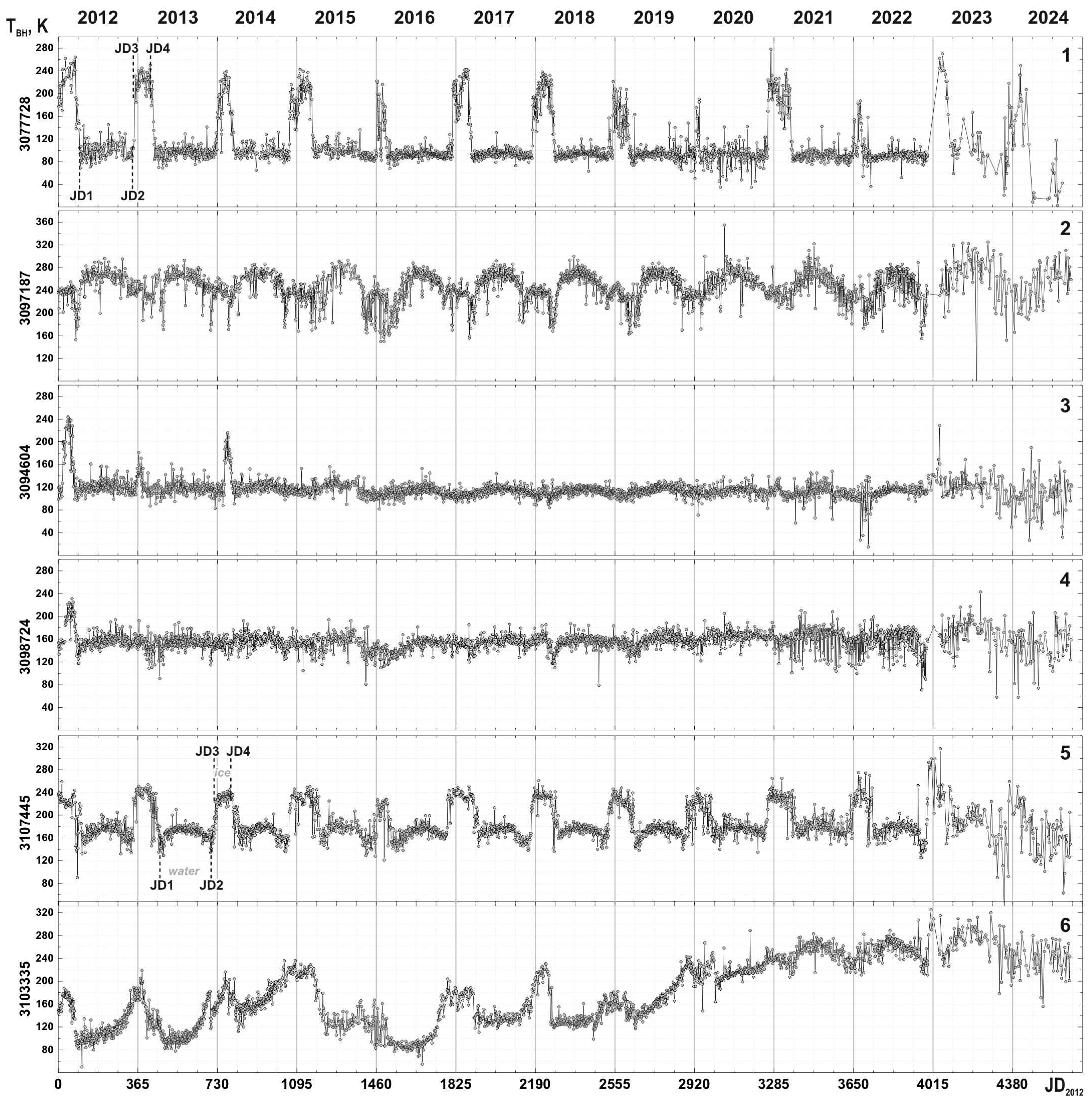
| JD | Julian day |
| L | Skin layer thickness |
| MODIS | Moderate-Resolution Imaging Spectroradiometer |
| NAS | North Aral Sea |
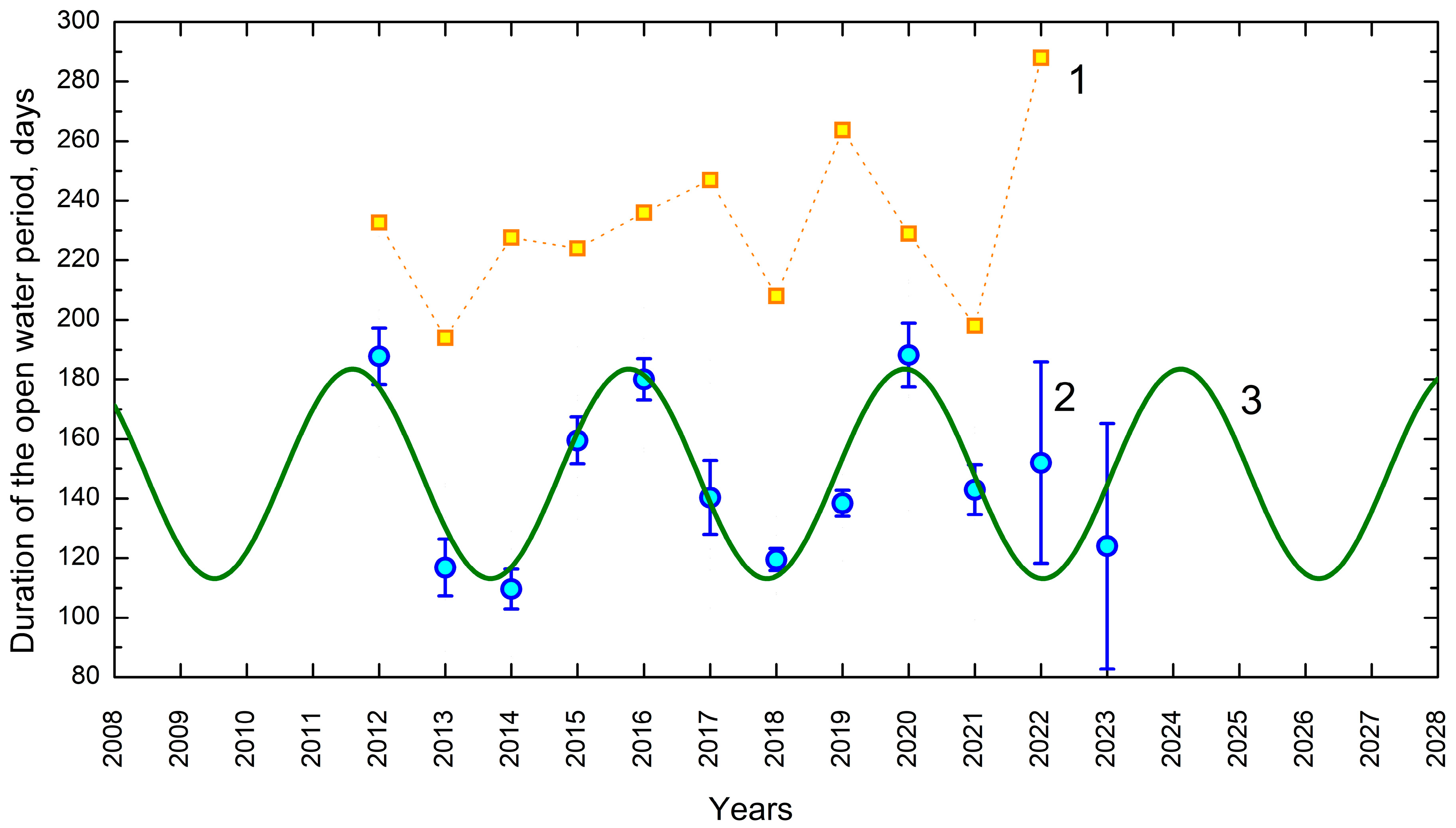
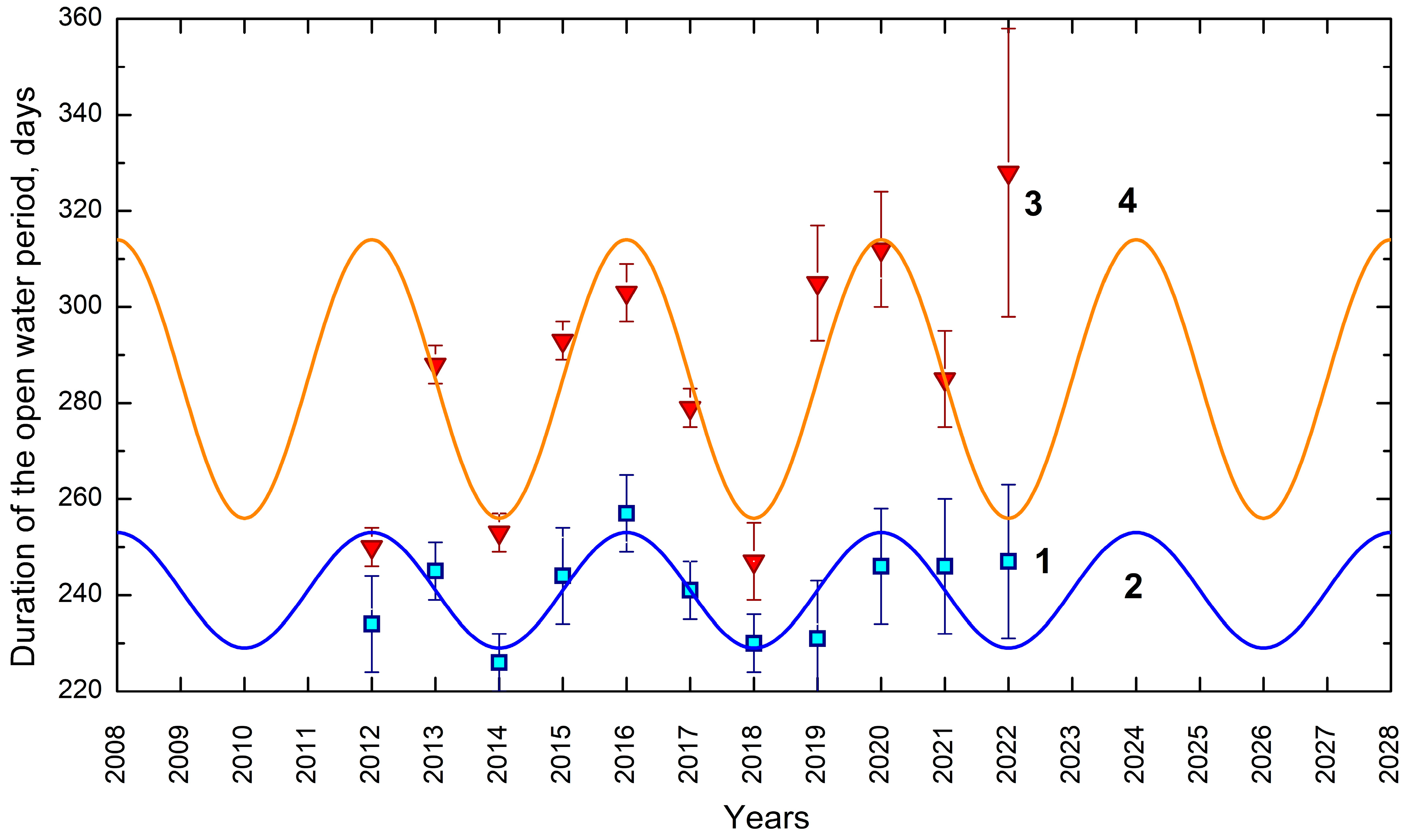
| OWP | open-water period |
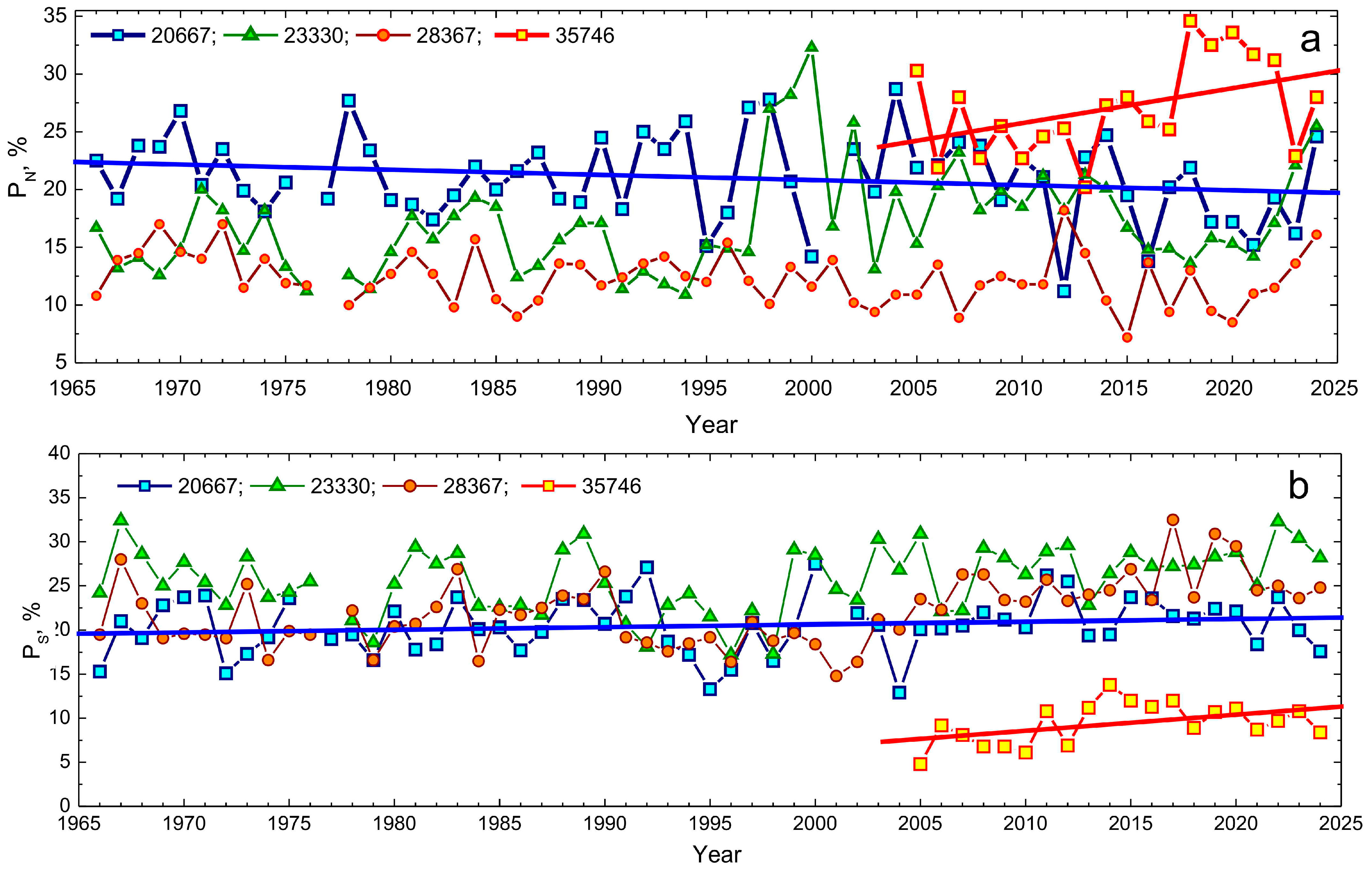
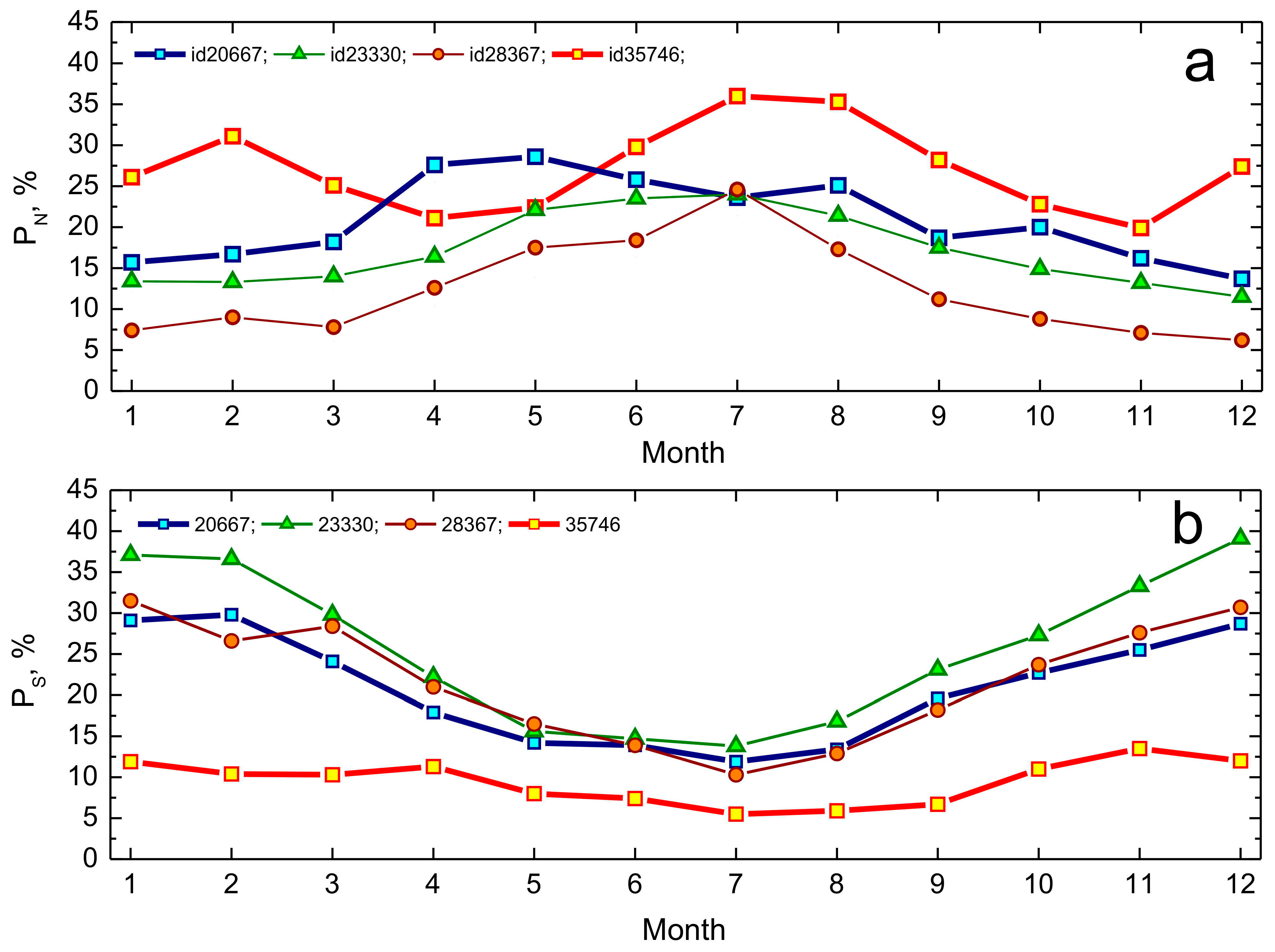
| PN | Percentages of northern winds |
| PS | Percentages of southern winds |
| S | Salinity |
| SAS | South Aral Sea |
| SFS | Seasonally frozen soils |
| SMOS | Soil Moisture and Ocean Salinity |
| T | Temperature |
| WB | West Basin of the SAS |
References
- Bjerke, J.W.; López-Blanco, E.; Tømmervik, H.; Striberny, A.; Davids, C.; Ólafsdóttir, R.; Karlsen, S.R.; Sandström, P.; Turunen, M.; Rikkonen, T.; et al. Nordic Boreo-Arctic Lands under Rapid Climatic Change: A Review of Recent and Future Trends and Extreme Events. Earth Sci. Rev. 2025, 261, 105012. [Google Scholar] [CrossRef]
- Ogunrinde, A.T.; Xian, X.; Adigun, P.; Adawa, I.S.; Zhao, D.; Xing, Z.; Temitope, I.J. Assessing Teleconnection Influences on the Spatial and Temporal Patterns of Meteorological Drought in Northwest China. Big Earth Data 2024, 8, 703–731. [Google Scholar] [CrossRef]
- Zhou, W.; Leung, L.R.; Lu, J. Steady threefold Arctic amplification of externally forced warming masked by natural variability. Nat. Geosci. 2024, 17, 508–515. [Google Scholar] [CrossRef]
- Phoenix, G.K.; Bjerke, J.W.; Björk, R.G.; Blok, D.; Bryn, A.; Callaghan, T.V.; Christiansen, C.T.; Cunliffe, A.M.; Davidson, S.J.; Epstein, H.E.; et al. Browning Events in Arctic Ecosystems: Diverse Causes with Common Consequences. PLoS Clim. 2025, 4, e0000570. [Google Scholar] [CrossRef]
- Callaghan, T.V.; Cazzolla Gatti, R.; Phoenix, G. The Need to Understand the Stability of Arctic Vegetation during Rapid Climate Change: An Assessment of Imbalance in the Literature. Ambio 2022, 51, 1034–1044. [Google Scholar] [CrossRef] [PubMed]
- Harris, C.; Arenson, L.U.; Christiansen, H.H.; Etzelmüller, B.; Frauenfelder, R.; Gruber, S.; Haeberli, W.; Hauck, C.; Hölzle, M.; Humlum, O.; et al. Permafrost and Climate in Europe: Monitoring and Modelling Thermal, Geomorphological and Geotechnical Responses. Earth-Sci. Rev. 2009, 92, 117–171. [Google Scholar] [CrossRef]
- Bring, A.; Destouni, G. Hydro-Climatic Changes and Their Monitoring in the Arctic: Observation-Model Comparisons and Prioritization Options for Monitoring Development. J. Hydrol. 2013, 492, 273–280. [Google Scholar] [CrossRef]
- Karlsson, J.M.; Jaramillo, F.; Destouni, G. Hydro-Climatic and Lake Change Patterns in Arctic Permafrost and Non-Permafrost Areas. J. Hydrol. 2015, 529, 134–145. [Google Scholar] [CrossRef]
- Karjalainen, O.; Aalto, J.; Luoto, M.; Westermann, S.; Romanovsky, V.E.; Nelson, F.E.; Etzelmüller, B.; Hjort, J. Circumpolar Permafrost Maps and Geohazard Indices for Near-Future Infrastructure Risk Assessments. Sci. Data 2019, 6, 190037. [Google Scholar] [CrossRef] [PubMed]
- Liu, Q.; Piao, S.; Janssens, I.A.; Fu, Y.; Peng, S.; Lian, X.; Ciais, P.; Myneni, R.B.; Peñuelas, J.; Wang, T. Extension of the Growing Season Increases Vegetation Exposure to Frost. Nat. Commun. 2018, 9, 426. [Google Scholar] [CrossRef]
- Intergovernmental Panel on Climate Change (IPCC). Climate Change 2022–Mitigation of Climate Change: Working Group III Contribution to the Sixth Assessment Report of the Intergovernmental Panel on Climate Change. In Intergovernmental Panel on Climate Change (Ipcc), 1st ed.; Cambridge University Press: Cambridge, UK, 2023; ISBN 978-1-009-15792-6. [Google Scholar] [CrossRef]
- Callaghan, T.V.; Shaduyko, O.; Kirpotin, S.N.; Gordov, E. Siberian Environmental Change: Synthesis of Recent Studies and Opportunities for Networking. Ambio 2021, 50, 2104–2127. [Google Scholar] [CrossRef]
- Haustein, K.; Allen, M.R.; Forster, P.M.; Otto, F.E.L.; Mitchell, D.M.; Matthews, H.D.; Frame, D.J. A Real-Time Global Warming Index. Sci. Rep. 2017, 7, 15417. [Google Scholar] [CrossRef]
- Loginov, V.F.; Brovka, Y.A. Periods of domination of the influence of natural and anthropogenic factors on climate. Hydrosphere Hazard. Process. Phenom. 2023, 4, 381–400. [Google Scholar] [CrossRef]
- Serreze, M.C.; Barry, R.G. Processes and Impacts of Arctic Amplification: A Research Synthesis. Glob. Planet. Change 2011, 77, 85–96. [Google Scholar] [CrossRef]
- Anisimov, O.; Kokorev, V.; Zhiltcova, Y. Arctic Ecosystems and Their Services Under Changing Climate: Predictive-Modeling Assessment. Geogr. Rev. 2017, 107, 108–124. [Google Scholar] [CrossRef]
- Mudryk, L.; Santolaria-Otín, M.; Krinner, G.; Ménégoz, M.; Derksen, C.; Brutel-Vuilmet, C.; Brady, M.; Essery, R. Historical Northern Hemisphere Snow Cover Trends and Projected Changes in the CMIP6 Multi-Model Ensemble. Cryosphere 2020, 14, 2495–2514. [Google Scholar] [CrossRef]
- Sato, T.; Nakamura, T.; Iijima, Y.; Hiyama, T. Enhanced Arctic Moisture Transport toward Siberia in Autumn Revealed by Tagged Moisture Transport Model Experiment. NPJ Clim. Atmos. Sci. 2022, 5, 91. [Google Scholar] [CrossRef]
- Callaghan, T.V.; Johansson, M.; Brown, R.D.; Groisman, P.Y.; Labba, N.; Radionov, V.; Bradley, R.S.; Blangy, S.; Bulygina, O.N.; Christensen, T.R.; et al. Multiple Effects of Changes in Arctic Snow Cover. Ambio 2011, 40, 32–45. [Google Scholar] [CrossRef]
- Ramage, J.; Jungsberg, L.; Wang, S.; Westermann, S.; Lantuit, H.; Heleniak, T. Population Living on Permafrost in the Arctic. Popul. Environ. 2021, 43, 22–38. [Google Scholar] [CrossRef]
- CBD (Convention on Biological Diversity). First Draft of the Post-2020 Global Biodiversity Framework; CBD: Montreal, QC, Canada, 2021. [Google Scholar]
- Loreau, M.; Hector, A.; Isbell, F. The Ecological and Societal Consequences of Biodiversity Loss; ISTE: Arlington, VI, USA; John Wiley & Sons: Hoboken, NJ, USA, 2022; 384p, ISBN 978-1-119-90290-4. [Google Scholar]
- Amirkhanov, A.M.; Zhukov, M.A.; Kershengolts, B.M.; Okhlopkov, I.M.; Romanenkov, R.L.; Sapogin, A.A.; Tishkov, A.A.; Ustinova, T.V. Conservation of Biodiversity in the Arctic. Problems, Tasks, Solutions; Fizmatkniga: Moscow, Russia, 2023; 139p, ISBN 978-5-89155-778-9. [Google Scholar]
- Stroeve, J.; Notz, D. Changing State of Arctic Sea Ice across All Seasons. Environ. Res. Lett. 2018, 13, 103001. [Google Scholar] [CrossRef]
- Luo, B.; Luo, D.; Dai, A.; Xiao, C.; Simmonds, I.; Hanna, E.; Overland, J.; Shi, J.; Chen, X.; Yao, Y.; et al. Rapid Summer Russian Arctic Sea-Ice Loss Enhances the Risk of Recent Eastern Siberian Wildfires. Nat. Commun. 2024, 15, 5399. [Google Scholar] [CrossRef]
- Liu, G.; Li, J.; Ying, T.; Dong, Y.; Zhang, Z.; Zhang, C.; Li, Q. Beaufort Sea Ice Loss Contributes to Enhanced Health Exposure to Fire Weather over Southeast Asia. NPJ Clim. Atmos. Sci. 2025, 8, 60. [Google Scholar] [CrossRef]
- Li, X.; Jin, H.; Wang, H.; Jin, X.; Bense, V.F.; Marchenko, S.S.; He, R.; Huang, Y.; Luo, D. Effects of Fire History on Thermal Regimes of Permafrost in the Northern Da Xing’anling Mountains, NE China. Geoderma 2022, 410, 115670. [Google Scholar] [CrossRef]
- Alizadeh, M.R.; Adamowski, J.; Entekhabi, D. Land and Atmosphere Precursors to Fuel Loading, Wildfire Ignition and Post-Fire Recovery. Geophys. Res. Lett. 2024, 51, e2023GL105324. [Google Scholar] [CrossRef]
- Kazakova, U.; Polukhin, A.; Shabanov, P. Origin and Evolution of the Surface Desalinated Layer of the Kara Sea during the Ice-Free Period. J. Mar. Syst. 2024, 243, 103950. [Google Scholar] [CrossRef]
- Liu, Y.; Tang, Q.; Zhang, C.; Chen, D.; Francis, J.A.; Leung, L.R.; Chen, H.W. The Disproportionate Impact of Enhanced Evaporation from Melting Arctic Sea Ice on Cold-Season Land Precipitation Trends. NPJ Clim. Atmos. Sci. 2024, 7, 126. [Google Scholar] [CrossRef]
- Wu, H.; Xu, M.; Zhu, M. Changes of Hydrological Components in Arctic Rivers Based on Multi-Source Data during 2003–2016. Water 2021, 13, 3494. [Google Scholar] [CrossRef]
- Xu, C.; Ma, J.-H.; Sun, J.-Q.; You, C.; Ma, Y.-M.; Wang, H.-J.; Wang, T. Links between Winter Dust over the Tibetan Plateau and Preceding Autumn Sea Ice Variability in the Barents and Kara Seas. Adv. Clim. Change Res. 2022, 13, 896–908. [Google Scholar] [CrossRef]
- Kok, J.F.; Storelvmo, T.; Karydis, V.A.; Adebiyi, A.A.; Mahowald, N.M.; Evan, A.T.; He, C.; Leung, D.M. Mineral Dust Aerosol Impacts on Global Climate and Climate Change. Nat. Rev. Earth Environ. 2023, 4, 71–86. [Google Scholar] [CrossRef]
- Groisman, P.; Bulygina, O.; Henebry, G.; Speranskaya, N.; Shiklomanov, A.; Chen, Y.; Tchebakova, N.; Parfenova, E.; Tilinina, N.; Zolina, O.; et al. Dryland Belt of Northern Eurasia: Contemporary Environmental Changes and Their Consequences. Environ. Res. Lett. 2018, 13, 115008. [Google Scholar] [CrossRef]
- Zhou, Y.; Wu, T.; Zhou, Y.; Zhang, J.; Zhang, F.; Su, X.; Jie, W.; Zhao, H.; Zhang, Y.; Wang, J. Can Global Warming Bring More Dust? Clim. Dyn. 2023, 61, 2693–2715. [Google Scholar] [CrossRef]
- Mao, R.; Ho, C.-H.; Shao, Y.; Gong, D.-Y.; Kim, J. Influence of Arctic Oscillation on Dust Activity over Northeast Asia. Atmos. Environ. 2011, 45, 326–337. [Google Scholar] [CrossRef]
- Nakamura, T.; Sato, T. A Possible Linkage of Eurasian Heat Wave and East Asian Heavy Rainfall in Relation to the Rapid Arctic Warming. Environ. Res. 2022, 209, 112881. [Google Scholar] [CrossRef]
- Li, X.; Guo, H.; Cheng, G.; Song, X.; Ran, Y.; Feng, M.; Che, T.; Li, X.; Wang, L.; Duan, A.; et al. Polar Regions Are Critical in Achieving Global Sustainable Development Goals. Nat. Commun. 2025, 16, 3879. [Google Scholar] [CrossRef]
- Tikhonov, V.; Khvostov, I.; Romanov, A.; Sharkov, E. Theoretical Study of Ice Cover Phenology at Large Freshwater Lakes Based on SMOS MIRAS Data. Cryosphere 2018, 12, 2727–2740. [Google Scholar] [CrossRef]
- Boyarskii, D.A.; Romanov, A.N.; Khvostov, I.V.; Tikhonov, V.V.; Sharkov, E.A. On Evaluating the Depth of Soil Freezing Based on SMOS Satellite Data. Izv. Atmos. Ocean. Phys. 2019, 55, 996–1004. [Google Scholar] [CrossRef]
- Zhurbas, N.V.; Zavialov, P.O. Effect of Stratification on Wind Drift of River Runoff in the Kara Sea. Oceanology 2015, 55, 827–831. [Google Scholar] [CrossRef]
- Romanov, A.N. Relationship between Seasonal Variations in Radio-Brightness Temperatures in the Kara Sea Area and Hydrological-Climate Changes in the Arctic. Russ. Phys. J. 2023, 66, 34–47, (In Russian with English Abstract). [Google Scholar]
- Cai, Q.; Wang, J.; Beletsky, D.; Overland, J.; Ikeda, M.; Wan, L. Accelerated Decline of Summer Arctic Sea Ice during 1850–2017 and the Amplified Arctic Warming during the Recent Decades. Environ. Res. Lett. 2021, 16, 034015. [Google Scholar] [CrossRef]
- Matveeva, T.A.; Semenov, V.A.; Astafyeva, E.S. Arctic sea ice coverage and its relation to the surface air temperature in the Northern Hemisphere. Ice Snow 2020, 60, 134–148, (In Russian with English Abstract). [Google Scholar] [CrossRef]
- Murmansk Marine Biological Institute of the Russian Academy of Sciences; Bulavina, A.S. The Effect of Fluctuations of the Ob and Yenisei Rivers Runoff on the Area of the Kara Sea Ice Cover. TKSC RAS NSH 2023, 2, 10–18. [Google Scholar] [CrossRef]
- Naumov, L.; Gordeeva, S. Variability of Ice in the Kara Sea. 2023. Available online: https://www.researchgate.net/publication/371349282_Izmencivost_ledovitosti_Karskogo_mora (accessed on 1 September 2025).
- Istomin, E.P.; Petrov, Y.A.; Martyn, I.A.; Novozhilova, E.S. Assessment of the Variability of Climatic Characteristics of the Kara Sea for the Safe and Efficient Use of the Northern Sea Route. Geoinformatika 2024, 2, 45–53. (In Russian) [Google Scholar] [CrossRef]
- Guo, H.; Bao, A.; Liu, T.; Jiapaer, G.; Ndayisaba, F.; Jiang, L.; Kurban, A.; De Maeyer, P. Spatial and Temporal Characteristics of Droughts in Central Asia during 1966–2015. Sci. Total Environ. 2018, 624, 1523–1538. [Google Scholar] [CrossRef]
- Russell, A.; Ghalaieny, M.; Gazdiyeva, B.; Zhumabayeva, S.; Kurmanbayeva, A.; Akhmetov, K.K.; Mukanov, Y.; McCann, M.; Ali, M.; Tucker, A.; et al. A Spatial Survey of Environmental Indicators for Kazakhstan: An Examination of Current Conditions and Future Needs. Int. J. Environ. Res. 2018, 12, 735–748. [Google Scholar] [CrossRef]
- Sharma, A.; Huang, H.-P.; Zavialov, P.; Khan, V. Impact of Desiccation of Aral Sea on the Regional Climate of Central Asia Using WRF Model. Pure Appl. Geophys. 2018, 175, 465–478. [Google Scholar] [CrossRef]
- Jiang, L.; Jiapaer, G.; Bao, A.; Kurban, A.; Guo, H.; Zheng, G.; De Maeyer, P. Monitoring the Long-Term Desertification Process and Assessing the Relative Roles of Its Drivers in Central Asia. Ecol. Indic. 2019, 104, 195–208. [Google Scholar] [CrossRef]
- Jiang, L.; Jiapaer, G.; Bao, A.; Li, Y.; Guo, H.; Zheng, G.; Chen, T.; De Maeyer, P. Assessing Land Degradation and Quantifying Its Drivers in the Amudarya River Delta. Ecol. Indic. 2019, 107, 105595. [Google Scholar] [CrossRef]
- Karimov, B.K.; Matthies, M.; Talskikh, V.; Plotsen, M.A.; Karimov, E.B. Salinization of River Waters and Suitability of Electric Conductivity Value for Saving Freshwater from Salts in Aral Sea Basin. Asian J. Water Environ. Pollut. 2019, 16, 109–114. [Google Scholar] [CrossRef]
- Micklin, P. The future Aral Sea: Hope and despair. Environ. Earth Sci. 2016, 75, 844. [Google Scholar] [CrossRef]
- Varotsos, C.A.; Krapivin, V.F.; Mkrtchyan, F.A. On the Recovery of the Water Balance. Water Air Soil. Pollut. 2020, 231, 170. [Google Scholar] [CrossRef]
- Database of the Aral Sea. Available online: https://www.cawater-info.net/aral/data/monitoring_amu_e.htm (accessed on 10 September 2025).
- Singh, A.; Behrangi, A.; Fisher, J.B.; Reager, J.T. On the Desiccation of the South Aral Sea Observed from Spaceborne Missions. Remote Sens. 2018, 10, 793. [Google Scholar] [CrossRef]
- Luo, S.; Song, C.; Liu, K.; Ke, L.; Ma, R. An Effective Low-Cost Remote Sensing Approach to Reconstruct the Long-Term and Dense Time Series of Area and Storage Variations for Large Lakes. Sensors 2019, 19, 4247. [Google Scholar] [CrossRef]
- Zhang, J.; Chen, Y.; Li, Z.; Song, J.; Fang, G.; Li, Y.; Zhang, Q. Study on the Utilization Efficiency of Land and Water Resources in the Aral Sea Basin, Central Asia. Sustain. Cities Soc. 2019, 51, 101693. [Google Scholar] [CrossRef]
- Zhou, C.; Gui, H.; Hu, J.; Ke, H.; Wang, Y.; Zhang, X. Detection of New Dust Sources in Central/East Asia and Their Impact on Simulations of a Severe Sand and Dust Storm. JGR Atmos. 2019, 124, 10232–10247. [Google Scholar] [CrossRef]
- Issanova, G.; Abuduwaili, J.; Galayeva, O.; Semenov, O.; Bazarbayeva, T. Aeolian Transportation of Sand and Dust in the Aral Sea Region. Int. J. Environ. Sci. Technol. 2015, 12, 3213–3224. [Google Scholar] [CrossRef]
- Indoitu, R.; Kozhoridze, G.; Batyrbaeva, M.; Vitkovskaya, I.; Orlovsky, N.; Blumberg, D.; Orlovsky, L. Dust Emission and Environmental Changes in the Dried Bottom of the Aral Sea. Aeolian Res. 2015, 17, 101–115. [Google Scholar] [CrossRef]
- Löw, F.; Navratil, P.; Kotte, K.; Schöler, H.F.; Bubenzer, O. Remote-Sensing-Based Analysis of Landscape Change in the Desiccated Seabed of the Aral Sea—A Potential Tool for Assessing the Hazard Degree of Dust and Salt Storms. Environ. Monit. Assess. 2013, 185, 8303–8319. [Google Scholar] [CrossRef]
- Breckle, S.-W.; Wucherer, W. The Aralkum, a Man-Made Desert on the Desiccated Floor of the Aral Sea (Central Asia): General Introduction and Aims of the Book. In Aralkum–A Man-Made Desert; Breckle, S.-W., Wucherer, W., Dimeyeva, L.A., Ogar, N.P., Eds.; Ecological Studies; Springer: Berlin/Heidelberg, Germany, 2012; Volume 218, pp. 1–9. ISBN 978-3-642-21116-4. [Google Scholar]
- Massakbayeva, A.; Abuduwaili, J.; Bissenbayeva, S.; Issina, B.; Smanov, Z. Water Balance of the Small Aral Sea. Environ. Earth Sci. 2020, 79, 75. [Google Scholar] [CrossRef]
- Ayzel, G.; Izhitskiy, A. Climate Change Impact Assessment on Freshwater Inflow into the Small Aral Sea. Water 2019, 11, 2377. [Google Scholar] [CrossRef]
- Sun, F.; Ma, R. Hydrologic Changes of Aral Sea: A Reveal by the Combination of Radar Altimeter Data and Optical Images. Ann. GIS 2019, 25, 247–261. [Google Scholar] [CrossRef]
- Makkaveev, P.N.; Gordeev, V.V.; Zav’yalov, P.O.; Polukhin, A.A.; Khlebopashev, P.V.; Kochenkova, A.I. Hydrochemical Characteristics of the Aral Sea in 2012–2013. Water Resour 2018, 45, 188–198. [Google Scholar] [CrossRef]
- Samarkhanov, K.; Abuduwaili, J.; Samat, A.; Issanova, G. The Spatial and Temporal Land Cover Patterns of the Qazaly Irrigation Zone in 2003–2018: The Case of Syrdarya River’s Lower Reaches, Kazakhstan. Sustainability 2019, 11, 4035. [Google Scholar] [CrossRef]
- Shen, H.; Abuduwaili, J.; Ma, L.; Samat, A. Remote Sensing-Based Land Surface Change Identification and Prediction in the Aral Sea Bed, Central Asia. Int. J. Environ. Sci. Technol. 2019, 16, 2031–2046. [Google Scholar] [CrossRef]
- Löw, F.; Prishchepov, A.V.; Waldner, F.; Dubovyk, O.; Akramkhanov, A.; Biradar, C.; Lamers, J.P.A. Mapping Cropland Abandonment in the Aral Sea Basin with MODIS Time Series. Remote Sens. 2018, 10, 159. [Google Scholar] [CrossRef]
- Gabarro, C.; Turiel, A.; Elosegui, P.; Pla-Resina, J.A.; Portabella, M. New Methodology to Estimate Arctic Sea Ice Concentration from SMOS Combining Brightness Temperature Differences in a Maximum-Likelihood Estimator. Cryosphere 2017, 11, 1987–2002. [Google Scholar] [CrossRef]
- Alekseeva, T.; Tikhonov, V.; Frolov, S.; Repina, I.; Raev, M.; Sokolova, J.; Sharkov, E.; Afanasieva, E.; Serovetnikov, S. Comparison of Arctic Sea Ice Concentrations from the NASA Team, ASI, and VASIA2 Algorithms with Summer and Winter Ship Data. Remote Sens. 2019, 11, 2481. [Google Scholar] [CrossRef]
- Tikhonov, V.V.; Raev, M.D.; Sharkov, E.A.; Boyarskii, D.A.; Repina, I.A.; Komarova, N.Y. Satellite Microwave Radiometry of Sea Ice of Polar Regions: A Review. Izv. Atmos. Ocean. Phys. 2016, 52, 1012–1030. [Google Scholar] [CrossRef]
- Kaleschke, L.; Tian-Kunze, X.; Maaß, N.; Mäkynen, M.; Drusch, M. Sea Ice Thickness Retrieval from SMOS Brightness Temperatures during the Arctic Freeze-up Period. Geophys. Res. Lett. 2012, 39, 2012GL050916. [Google Scholar] [CrossRef]
- Chen, W.; Zhou, Y.; Passe, U.; Zhang, T.; Wang, C.; Asrar, G.R.; Li, Q.; Li, H. Improving Estimation of Diurnal Land Surface Temperatures by Integrating Weather Modeling with Satellite Observations. Remote Sens. Environ. 2024, 315, 114393. [Google Scholar] [CrossRef]
- Hu, J.; Tao, T.; Jia, J.; Zhao, T.; Li, Q.; Yu, H. High-Precision Retrieval of Offshore Sea Surface Temperature: A Machine Learning Framework Based on MODIS and in-Situ Measurements. Infrared Phys. Technol. 2024, 137, 105129. [Google Scholar] [CrossRef]
- Weng, F.; Grody, N.C.; Ferraro, R.R.; Zhao, Q.; Chen, C.T. Global Cloud Water Distribution Derived from Special Sensor Microwave Imager/Sounder and Its Comparison with GCM Simulation. Adv. Space Res. 1997, 19, 407–411. [Google Scholar] [CrossRef]
- Kerr, Y.H.; Waldteufel, P.; Richaume, P.; Wigneron, J.P.; Ferrazzoli, P.; Mahmoodi, A.; Al Bitar, A.; Cabot, F.; Gruhier, C.; Juglea, S.E.; et al. The SMOS Soil Moisture Retrieval Algorithm. IEEE Trans. Geosci. Remote Sens. 2012, 50, 1384–1403. [Google Scholar] [CrossRef]
- Kim, H.; Crow, W.; Li, X.; Wagner, W.; Hahn, S.; Lakshmi, V. True Global Error Maps for SMAP, SMOS, and ASCAT Soil Moisture Data Based on Machine Learning and Triple Collocation Analysis. Remote Sens. Environ. 2023, 298, 113776. [Google Scholar] [CrossRef]
- Li, X.; Wigneron, J.-P.; Frappart, F.; Lannoy, G.D.; Fan, L.; Zhao, T.; Gao, L.; Tao, S.; Ma, H.; Peng, Z.; et al. The First Global Soil Moisture and Vegetation Optical Depth Product Retrieved from Fused SMOS and SMAP L-Band Observations. Remote Sens. Environ. 2022, 282, 113272. [Google Scholar] [CrossRef]
- Faryadi, M. Soil Security under Salt Attack: Protection of the Soil against the Salinization Caused by Drying up of Lake Urmia. Soil Secur. 2023, 13, 100113. [Google Scholar] [CrossRef]
- Poursanidis, D.; Chrysoulakis, N. Remote Sensing, Natural Hazards and the Contribution of ESA Sentinels Missions. Remote Sens. Appl. Soc. Environ. 2017, 6, 25–38. [Google Scholar] [CrossRef]
- Belchansky, G. Estimating the Time of Melt Onset and Freeze Onset over Arctic Sea-Ice Area Using Active and Passive Microwave Data. Remote Sens. Environ. 2004, 92, 21–39. [Google Scholar] [CrossRef]
- Bareiss, J.; Gorgen, K. Spatial and Temporal Variability of Sea Ice in the Laptev Sea: Analyses and Review of Satellite Passive-Microwave Data and Model Results, 1979 to 2002. Glob. Planet. Change 2005, 48, 28–54. [Google Scholar] [CrossRef]
- Drobot, S.D. Using Remote Sensing Data to Develop Seasonal Outlooks for Arctic Regional Sea-Ice Minimum Extent. Remote Sens. Environ. 2007, 111, 136–147. [Google Scholar] [CrossRef]
- Tikhonov, V.V.; Repina, I.A.; Raev, M.D.; Sharkov, E.A.; Ivanov, V.V.; Boyarskii, D.A.; Alexeeva, T.A.; Komarova, N.Y. A Physical Algorithm to Measure Sea Ice Concentration from Passive Microwave Remote Sensing Data. Adv. Space Res. 2015, 56, 1578–1589. [Google Scholar] [CrossRef]
- Richter, F.; Drusch, M.; Kaleschke, L.; Maaß, N.; Tian-Kunze, X.; Mecklenburg, S. Arctic Sea Ice Signatures: L-Band Brightness Temperature Sensitivity Comparison Using Two Radiation Transfer Models. Cryosphere 2018, 12, 921–933. [Google Scholar] [CrossRef]
- Ballabrera-Poy, J.; Mourre, B.; Garcia-Ladona, E.; Turiel, A.; Font, J. Linear and Non-Linear T–S Models for the Eastern North Atlantic from Argo Data: Role of Surface Salinity Observations. Deep Sea Res. Part. I Oceanogr. Res. Pap. 2009, 56, 1605–1614. [Google Scholar] [CrossRef]
- Talone, M.; Sabia, R.; Camps, A.; Vall-llossera, M.; Gabarró, C.; Font, J. Sea Surface Salinity Retrievals from HUT-2D L-Band Radiometric Measurements. Remote Sens. Environ. 2010, 114, 1756–1764. [Google Scholar] [CrossRef]
- Wigneron, J.-P.; Schwank, M.; Baeza, E.L.; Kerr, Y.; Novello, N.; Millan, C.; Moisy, C.; Richaume, P.; Mialon, A.; Al Bitar, A.; et al. First Evaluation of the Simultaneous SMOS and ELBARA-II Observations in the Mediterranean Region. Remote Sens. Environ. 2012, 124, 26–37. [Google Scholar] [CrossRef]
- McCulloch, M.E.; Spurgeon, P.; Chuprin, A. Have Mid-Latitude Ocean Rain-Lenses Been Seen by the SMOS Satellite? Ocean Model. 2012, 43–44, 108–111. [Google Scholar] [CrossRef]
- Olmedo, E.; Martínez, J.; Turiel, A.; Ballabrera-Poy, J.; Portabella, M. Debiased Non-Bayesian Retrieval: A Novel Approach to SMOS Sea Surface Salinity. Remote Sens. Environ. 2017, 193, 103–126. [Google Scholar] [CrossRef]
- Mulet, S.; Rio, M.-H.; Mignot, A.; Guinehut, S.; Morrow, R. A New Estimate of the Global 3D Geostrophic Ocean Circulation Based on Satellite Data and In-Situ Measurements. Deep. Sea Res. Part. II Top. Stud. Oceanogr. 2012, 77–80, 70–81. [Google Scholar] [CrossRef]
- Yin, X.; Boutin, J.; Martin, N.; Spurgeon, P.; Vergely, J.-L.; Gaillard, F. Errors in SMOS Sea Surface Salinity and Their Dependency on a Priori Wind Speed. Remote Sens. Environ. 2014, 146, 159–171. [Google Scholar] [CrossRef][Green Version]
- Prakash, S.; Gairola, R.M. Estimation of Sea Surface Salinity in the Tropical Indian Ocean by Synergistic Use of SMOS and RAMA Buoy Data. Methods Oceanogr. 2013, 8, 33–40. [Google Scholar] [CrossRef]
- Umbert, M.; Hoareau, N.; Turiel, A.; Ballabrera-Poy, J. New Blending Algorithm to Synergize Ocean Variables: The Case of SMOS Sea Surface Salinity Maps. Remote Sens. Environ. 2014, 146, 172–187. [Google Scholar] [CrossRef]
- Olmedo, E.; Martínez, J.; Umbert, M.; Hoareau, N.; Portabella, M.; Ballabrera-Poy, J.; Turiel, A. Improving Time and Space Resolution of SMOS Salinity Maps Using Multifractal Fusion. Remote Sens. Environ. 2016, 180, 246–263. [Google Scholar] [CrossRef]
- Brassington, G.B.; Divakaran, P. The Theoretical Impact of Remotely Sensed Sea Surface Salinity Observations in a Multi-Variate Assimilation System. Ocean. Model. 2009, 27, 70–81. [Google Scholar] [CrossRef]
- Hoareau, N.; Umbert, M.; Martínez, J.; Turiel, A.; Ballabrera-Poy, J. On the Potential of Data Assimilation to Generate SMOS-Level 4 Maps of Sea Surface Salinity. Remote Sens. Environ. 2014, 146, 188–200. [Google Scholar] [CrossRef]
- Ulaby, F.T.; Moor, R.K.; Fung, A.K. Microwave Remote Sensing: Active and Passive; Artech House: Norwood, MA, USA, 1982; 1645p. [Google Scholar]
- Romanov, A.N.; Khvostov, I.V.; Ryabinin, I.V.; Troshkin, D.N.; Romanov, D.A. Remote Microwave Soil Drought Index Considering Dielectric Properties of Soil. IEEE Trans. Geosci. Remote Sens. 2023, 61, 1–8. [Google Scholar] [CrossRef]
- Romanov, A.N.; Khvostov, I.V.; Tikhonov, V.V.; Sharkov, E.A. Assessing Hydrological Changes in Wetland Areas of the Russian Arctic, Subarctic, and Northern Taiga Based on Microwave Remote Sensing Data. Izv. Atmos. Ocean. Phys. 2022, 58, 1100–1110. [Google Scholar] [CrossRef]
- Kerr, Y.H.; Waldteufel, P.; Wigneron, J.-P.; Delwart, S.; Cabot, F.; Boutin, J.; Escorihuela, M.-J.; Font, J.; Reul, N.; Gruhier, C.; et al. The SMOS Mission: New Tool for Monitoring Key Elements of the Global Water Cycle. Proc. IEEE 2010, 98, 666–687. [Google Scholar] [CrossRef]
- Gutierrez, A.; Castro, R.; Vieira, P. SMOS L1 Processor L1c Data Processing Model. SO-DS-DME-L1OP-0009. No. 2.14. 2014. p 80. Available online: https://earth.esa.int/documents/10174/1854456/SMOS_L1c-Data-Processing-Models (accessed on 1 September 2025).
- Sahr, K.; White, D.; Kimerling, A.J. Geodesic Discrete Global Grid Systems. Cartogr. Geogr. Inf. Sci. 2003, 30, 121–134. [Google Scholar] [CrossRef]
- Romanov, A.N.; Khvostov, I.V. On the Validation of Satellite Microwave Remote Sensing Data under Soil Salinity Conditions. Izv. Atmos. Ocean. Phys. 2019, 55, 1033–1040. [Google Scholar] [CrossRef]
- Romanov, A.N.; Khvostov, I.V.; Ulanov, P.N.; Tikhonov, V.V.; Boyarsky, D.A.; Sharkov, E.A.; Pechkin, A.S.; Zhelezova, E.V. Assessment of Hydrological and Climatic Changes in the Arctic based on Satellite Microwave Sounding Data from the Marginal Seas of the Arctic Ocean and Adjacent Tundra. 2018. Available online: http://conf.rse.geosmis.ru/files/books/2018/6604.htm (accessed on 25 December 2025).
- Anguelova, M.D.; Gaiser, P.W. Microwave Emissivity of Sea Foam Layers with Vertically Inhomogeneous Dielectric Properties. Remote Sens. Environ. 2013, 139, 81–96. [Google Scholar] [CrossRef]
- Romanov, A.N.; Khvostov, I.V.; Ryabinin, I.V.; Tikhonov, V.V.; Sharkov, E.A. Seasonal and Interannual Dynamics of Radio Brightness Temperatures in the Waters of the Eastern Seas of the Arctic Ocean. 2021. Available online: http://conf.rse.geosmis.ru/files/books/2021/8716.htm (accessed on 25 December 2025).
- Wadhams, P. The Underside of Arctic Sea Ice Imaged by Sidescan Sonar. Nature 1988, 333, 161–164. [Google Scholar] [CrossRef]
- Anderson, M.R.; Crane, R.G.; Barry, R.G. Characteristics of Arctic Ocean Ice Determined from SMMR Data for 1979: Case Studies in the Seasonal Sea Ice Zone. Adv. Space Res. 1985, 5, 257–261. [Google Scholar] [CrossRef]
- Bardin, M.Y.; Rankova, E.Y.; Samokhina, O.F. About the Temperature Regime at the Earth’s Surface in June–July 2016. 2016. Available online: http://www.igras.ru/news/1093 (accessed on 25 December 2025).
- NASA Analysis Finds July 2016 Is Warmest on Record. 2016. Available online: https://data.giss.nasa.gov/gistemp/news/20160816/ (accessed on 25 December 2025).
- NOAA National Centers for Environmental Information, Monthly Global Climate Report for July 2016. 2016. Available online: https://www.ncei.noaa.gov/access/monitoring/monthly-report/global/201607/2016-year-to-date-temperatures-versus-previous-years (accessed on 25 December 2025).
- Troshkin, D.N.; Ryabinin, I.V.; Khvostov, I.V.; Romanov, A.N. Modeling the Characteristics of Agricultural Drought Based on the Gaussian Distribution. 2022. Available online: http://conf.rse.geosmis.ru/files/books/2022/9303.htm (accessed on 25 December 2025). (In Russian)
- Kwok, R. Arctic Sea Ice Thickness, Volume, and Multiyear Ice Coverage: Losses and Coupled Variability (1958–2018). Environ. Res. Lett. 2018, 13, 105005. [Google Scholar] [CrossRef]
- Jabbarov, Z.; Kholdorov, S.; Nomozov, U.; Makhammadiev, S.; Djalilova, G.; Abdullaev, S. The Drying of the Aral Sea: Soil Formation and Restoration Potential on the Seabed. Soil Sci. Annu. 2025, 76, 1–12. [Google Scholar] [CrossRef]
- Kumar, A. Challenge of Climate Change. In Ecosystem-Based Adaptation; Elsevier: Amsterdam, The Netherlands, 2022; pp. 39–104. ISBN 978-0-12-815025-2. [Google Scholar]
- Novikova, N.M. Ecological and Geographical Aspects of the Aral Sea Crisis. Part 2. Research of Climate Dynamics and Dried-up Sea Bottom. Ecosyst. Ecol. Dyn. 2020, 4, 96–170. [Google Scholar] [CrossRef]
- Adeniran, A.B.; Daniell, K.A. Transaqua: Power, Political Change and the Transnational Politics of a Water Megaproject. Int. J. Water Resour. Dev. 2021, 37, 234–255. [Google Scholar] [CrossRef]
- Instanes, A.; Kokorev, V.; Janowicz, R.; Bruland, O.; Sand, K.; Prowse, T. Changes to Freshwater Systems Affecting Arctic Infrastructure and Natural Resources. JGR Biogeosci. 2016, 121, 567–585. [Google Scholar] [CrossRef]
- Song, Y.; Zheng, H.; Chen, X.; Bao, A.; Lei, J.; Xu, W.; Luo, G.; Guan, Q. Desertification Extraction Based on a Microwave Backscattering Contribution Decomposition Model at the Dry Bottom of the Aral Sea. Remote Sens. 2021, 13, 4850. [Google Scholar] [CrossRef]
- Simonova, Y.V.; Kasatkina, G.A.; Charykova, M.V.; Zhunusova, O.R. Soils of the Kuchuk-Kulunda Lakeside Landscapes (Altai Krai): Morphology, Salinization, Taxonomic Attribution. POS 2025, 8, e313. (In Russian) [Google Scholar] [CrossRef]
- Romanov, A.N.; Bordonskiy, G.S.; Gurulev, A.A.; Khvostov, I.V.; Troshkin, D.N.; Peleneva, M.P.; Kazantsev, V.A.; Kozlov, A.K.; Orlov, A.O. On Some Features of Diurnal Dynamics of Solonchak Emissivity in Summer. Int. J. Remote Sens. 2025, 46, 1248–1256. [Google Scholar] [CrossRef]
- Romanov, A.N.; Khvostov, I.V.; Ryabinin, I.V.; Romanov, D.A. Analysis of Hydrological Changes in Mineral Lakes in Northern Eurasia Based on SMOS Satellite Data. Cosm. Res. 2023, 61, S80–S88. [Google Scholar] [CrossRef]
- Chen, Z.; Gao, X.; Lei, J. Dust Emission and Transport in the Aral Sea Region. Geoderma 2022, 428, 116177. [Google Scholar] [CrossRef]
- Shevchenko, V.P.; Novigatskiy, A.N. Arctic branch of the global dust cycle. Modern issues in lithology and marine geology. In Science. Training. Practice: Thesis of Reports/Scientific and Practical Forum Dedicated to the 270th Anniversary of the Lomonosov Moscow State University; MAKS Press: Moscow, Russia, 2024; 258p. (In Russian) [Google Scholar]
- Kulpin, E.S. The modern local socio-ecological crisis. Hist. Mod. 2007, 1, 146–158. (In Russian) [Google Scholar]
- Sakiev, K.Z.; Zhumabekova, G.S.; Batyrbekova, L.S.; Ibraeva, A.D.; Khaidarov, K.K. Modern health problems of Aral Sea region. Bull. Kazakh Natl. Med. Univ. 2014, 3, 220–221. (In Russian) [Google Scholar]
- Rozumbetov, K.U.; Najimov, I.I.; Nisanova, S.N.; Matchanov, A.T. Assessment of the health state of the population of the Aral Region. Sci. Prog. 2021, 2, 444–448. (In Russian) [Google Scholar]



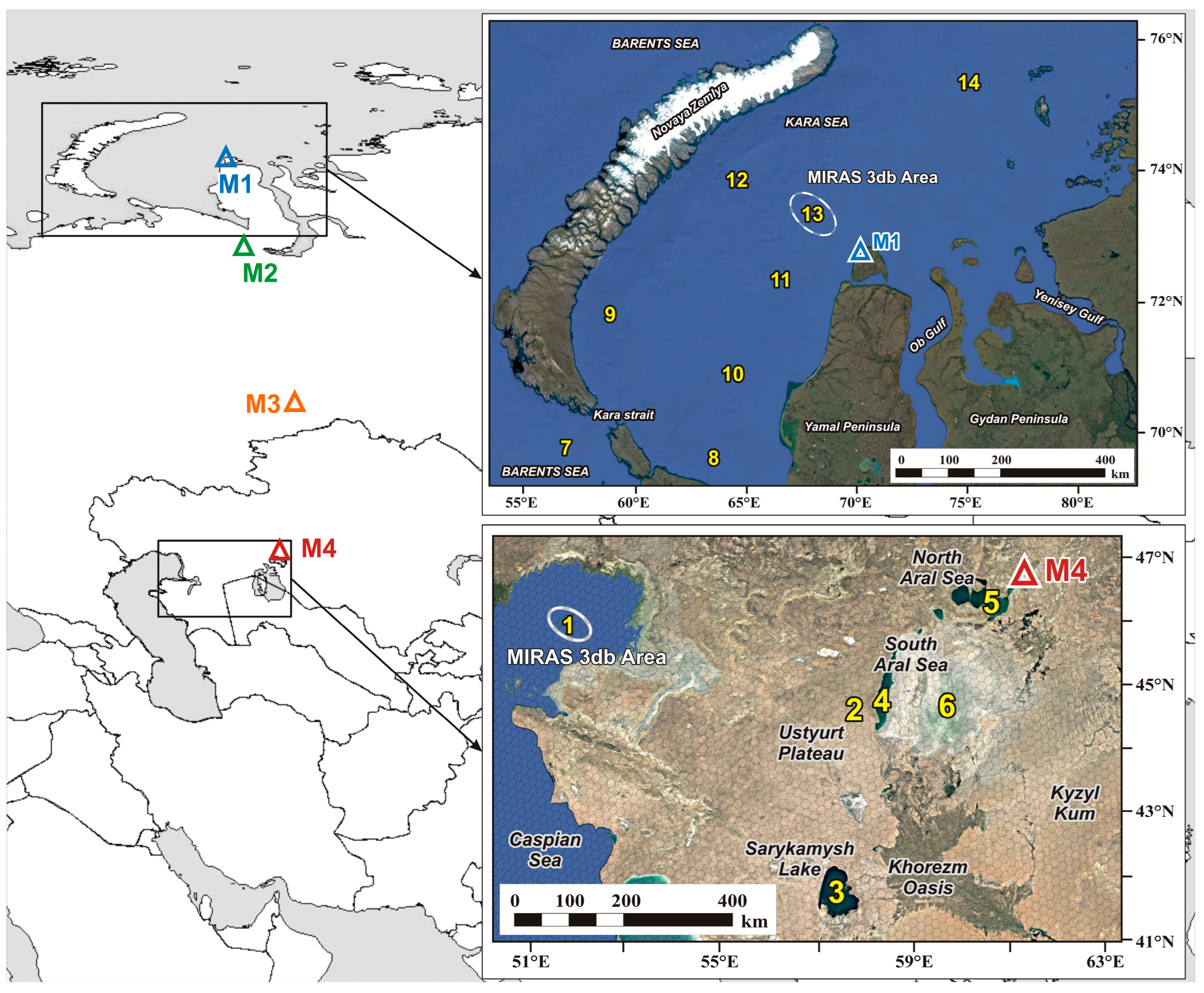
| № | DGG ID [105] | LAT | LON |
|---|---|---|---|
| 1 | 3077728 | 45.978 | 51.383 |
| 2 | 3097187 | 44.857 | 57.843 |
| 3 | 3094604 | 41.957 | 57.404 |
| 4 | 3098724 | 44.857 | 58.326 |
| 5 | 3107445 | 46.307 | 60.985 |
| 6 | 3103335 | 44.813 | 59.799 |
| 7 | 4046992 | 69.948 | 56.819 |
| 8 | 4052100 | 70.165 | 63.756 |
| 9 | 4055708 | 72.158 | 57.790 |
| 10 | 4056717 | 71.486 | 64.117 |
| 11 | 4063891 | 72.990 | 66.232 |
| 12 | 4068512 | 74.523 | 63.347 |
| 13 | 4069015 | 74.025 | 67.800 |
| 14 | 4082841 | 75.963 | 77.960 |
| Object | ||||||
|---|---|---|---|---|---|---|
| Kara Sea | 144.6 | 36.4 | 2012 | 4 | 0.83 | 160 |
| North part of Aral Sear | 240.7 | 11.75 | 2012 | 4 | 0.71 | 32 |
| North part of Caspian Sea | 285.0 | 28.75 | 2012 | 4 | 0.82 | 103 |
Disclaimer/Publisher’s Note: The statements, opinions and data contained in all publications are solely those of the individual author(s) and contributor(s) and not of MDPI and/or the editor(s). MDPI and/or the editor(s) disclaim responsibility for any injury to people or property resulting from any ideas, methods, instructions or products referred to in the content. |
© 2026 by the authors. Licensee MDPI, Basel, Switzerland. This article is an open access article distributed under the terms and conditions of the Creative Commons Attribution (CC BY) license.
Share and Cite
Callaghan, T.V.; Romanov, A.N.; Khvostov, I.V.; Ryabinin, I.V.; Tikhonov, V.V.; Shaduyko, O.M. Atmospheric and Hydrospheric Characteristics in Contrasting Arctic and Intracontinental Regions of Northern Eurasia and Possible Mutual Influences. Water 2026, 18, 251. https://doi.org/10.3390/w18020251
Callaghan TV, Romanov AN, Khvostov IV, Ryabinin IV, Tikhonov VV, Shaduyko OM. Atmospheric and Hydrospheric Characteristics in Contrasting Arctic and Intracontinental Regions of Northern Eurasia and Possible Mutual Influences. Water. 2026; 18(2):251. https://doi.org/10.3390/w18020251
Chicago/Turabian StyleCallaghan, Terry V., Andrey N. Romanov, Ilya V. Khvostov, Ivan V. Ryabinin, Vasiliy V. Tikhonov, and Olga M. Shaduyko. 2026. "Atmospheric and Hydrospheric Characteristics in Contrasting Arctic and Intracontinental Regions of Northern Eurasia and Possible Mutual Influences" Water 18, no. 2: 251. https://doi.org/10.3390/w18020251
APA StyleCallaghan, T. V., Romanov, A. N., Khvostov, I. V., Ryabinin, I. V., Tikhonov, V. V., & Shaduyko, O. M. (2026). Atmospheric and Hydrospheric Characteristics in Contrasting Arctic and Intracontinental Regions of Northern Eurasia and Possible Mutual Influences. Water, 18(2), 251. https://doi.org/10.3390/w18020251