You are currently viewing a new version of our website. To view the old version click .
Water
  • Review
  • Open Access

31 December 2025

A Comparative Trends of Watershed Health and Its Driving Forces

,
,
,
and
1
Key Laboratory of Integrated Regulation and Resources Development on Shallow Lakes, Nanjing 210098, China
2
College of Environment, Hohai University, Xi Kang Road, Nanjing 210098, China
3
Ministry of Water Resources, Nanjing Automation Institute of Water Conservancy and Hydrology, Nanjing 210012, China
4
Biosciences and Food Technology Discipline, RMIT University, La Trobe Street, Melbourne City, VIC 3000, Australia
Water2026, 18(1), 95;https://doi.org/10.3390/w18010095 
(registering DOI)
This article belongs to the Special Issue NBS for Watershed Management: From Ecological Health Assessment to Ecosystem Restoration

Abstract

In recent decades, rapid socioeconomic development and population growth have led to the degradation of river and lake health worldwide, posing severe challenges to watershed ecological management. The growing intensity of land-use has significantly contributed to the accelerated deterioration of aquatic ecosystems. River and lake health assessment has evolved from single-parameter metrics (e.g., water quality) to multidimensional frameworks integrating hydrological, biological, and anthropogenic factors. This research conducted a bibliometric analysis of 1302 publications from 1996 to 2023 in the Web of Science database to identify research trends and hotspots. Results showed that publications exhibited a three-phase growth incubation (1996–2000), expansion (2001–2012), and acceleration (2013–2023), with the U.S., China, and Australia as leading contributors characterized by regionally clustered international collaborations. Research themes have shifted from single water quality parameters to integrated assessments. “Land-use”, “water quality”, and “biotic integrity” have emerged as core hotspots, forming a synergistic assessment framework that combines physicochemical, biological, and socioeconomic factors. The research scale underwent a spatial refinement process from the whole watershed to the buffer zone of rivers and lakes, and land-use effects on aquatic ecosystems vary significantly across spatial scales (entire watershed and riparian zones). Fine-scale studies better capture localized pollution pathways, supporting targeted conservation strategies. This review systematically outlines research status, hotspots, and development directions for river and lake health studies, highlighting the need for integrated watershed management, emphasizing conservation through fine-scale land-use monitoring, and providing scientific support for integrated refined governance of watershed ecology.

1. Introduction

Rapid socioeconomic development and population growth have accelerated the degradation of river and lake health globally [1,2]. Anthropogenic pressures, including land clearing, urban expansion, and intensive agriculture, drive both point and nonpoint source pollution. These pollutants ultimately impair aquatic ecosystems [3]. Many rivers and lakes are facing situations of overdevelopment, water quality deterioration, and changes in hydrological conditions [4,5]. Anthropogenic changes in the watershed structure alter the functions of rivers and lakes from physical, chemical, and biological aspects [6]. This complicates restoration efforts to maintain water ecological health and rehabilitate degraded watersheds. Therefore, the health status of the river and lake watersheds is attracting wide attention.
River and lake health describes the favourable state of river and lake ecosystems. This state encompasses biodiversity, hydrological processes, physical structure, and chemical composition. Crucially, healthy ecosystems can continuously supply essential ecosystem services for sustainable development and human well-being [7]. Indicators for assessing the health of the watershed of rivers and lakes can include water quality indicators (i.e., concentrations of dissolved oxygen, nitrogen, phosphorus, etc.), biological indicators (i.e., fish populations, benthic fauna richness, etc.), physical indicators (i.e., water flow velocity, river channel morphology, etc.), and socio-economic indicators (i.e., the degree of riverbank development, the living environment around rivers and lakes, etc.) [8]. A comprehensive assessment of these indicators can help determine the health status of the watershed of rivers and lakes, and provide a basis for implementing corresponding protection and management measures [8]. Han et al. (2024) [9] suggested that implementing Best Management Practices (BMPs) at the watershed level is an essential means to control the intensity of nonpoint source pollution, considering the watershed as an appropriate and effective unit for managing water environmental health. Therefore, managing river and lake health within the watershed and accurately determining the current health status of rivers and lakes can alleviate the ongoing degradation of aquatic ecosystems and ultimately achieve the goal of rapid and efficient water resource management, effectively addressing current challenges [10].
Globally, river and lake health research shows spatial heterogeneity but growing interconnectedness. Bibliometric studies confirm this trend, identifying the United States, China, and Australia as core contributors [4]. These leading studies have driven methodological innovations (e.g., multi-scale land-use analysis, integrated assessment frameworks) and governance-oriented insights, with a strong focus on large watersheds such as the Mississippi, Yangtze, and Murray–Darling basins [7,11]. However, valuable research from other regions has also enriched the global knowledge base. European studies (e.g., on the Danube basin) focus on transboundary watershed management and industrialization-driven pollution [12]; African research addresses agricultural expansion and local anthropogenic disturbances in sub-Saharan freshwater systems [13]; and South American investigations explore tropical river responses to urbanization and deforestation [6]. Together, these diverse efforts reflect the universal challenge of freshwater ecosystem degradation amid varied disturbances, while advancing region-specific solutions. For decades, with the deepening understanding of river and lake health, the watershed health concept has been continually refined (Table 1). The academic evolution of this concept can be delineated into distinct developmental stages: Initially, the focus was primarily on the external manifestations of rivers and lakes, such as water turbidity and widespread eutrophication [14]. With the advancement of scientific technology, attention was shifted towards the intrinsic characteristics of river and lake ecosystems, including habitat integrity, biodiversity, and the stability of ecological processes [15,16]. The research further evolved to include assessments of ecosystem functionality, specifically examining whether rivers and lakes can sustain suitable living conditions and effectively deliver ecosystem services [17,18]. Presently, the concept of river and lake health has transcended single indicators, instead adopting a diversified assessment approach that comprehensively considers factors such as hydrology, water quality, biology, and human activities to assess and manage river and lake health more holistically and scientifically [19,20].
Table 1. The progression of the concept of river and lake health.
River and lake health provides a structured assessment framework, forming a comprehensive ecosystem assessment system that tracks long-term ecological trends under anthropogenic and natural influences [8]. Although river and lake health has garnered increasing scientific interest, a deeper understanding of how anthropogenic pressures influence watershed aquatic health remains limited. Land-use is the dominant driver of watershed health, but current management exhibits a scale mismatch between fine-scale processes (riparian, buffer-scale) and macro-level governance instruments. We, therefore, aim to link hotspots to fine watershed governance at the scales where interventions are most effective. Unlike Wen et al. (2023) [4], who focus on bibliometric structure, our contribution is explicitly governance-oriented. We synthesize hotspot evidence into a scale-explicit implementation agenda and provide a worked example to illustrate the research-to-action pathway. This review analyzes the development trend, frontier hotspots, and the evolution of river and lake health keywords through the bibliometric perspective. Overall, this work aimed to (1) show the current situation through the knowledge background of river and lake health research and (2) explore the trends, key factors, and frontiers in the field of river and lake health. The work will help researchers establish a more comprehensive perspective and provide references for better improving the ecological health of water in the watershed.

2. Data Sources and Methods

2.1. Database Collection

The data for this study was sourced from the Web of Science (WoS) database of the Institute for Scientific Information (ISI) in the United States. We used the search formula as TS = (“river health” or “valley health” or “lake health” or “watershed health” or “basin health” or “stream health” or “river ecological health” or “river ecosystem health” or “lake ecological health” or “lake ecosystem health” or “water ecosystem health”). The period was nearly 30 years, from 1 January 1996 to 31 December 2023. A total of 1503 documents were initially identified. Only research articles and reviews were retained to maintain the relevance of information, while publications irrelevant to watershed health were manually excluded. This screening process ultimately yielded a final dataset comprising 1302 documents.

2.2. Bibliometric Analysis Methods

Bibliometric analysis is a quantitative analysis of the academic literature using mathematical and statistical methods. The purpose is to evaluate the research status, trends, hotspots, and scientific frontiers [25]. This study conducted a systematic bibliometric analysis of watershed health research from 1996 to 2023. Utilizing 1302 publications from WoS, we first performed basic statistical analyses, including annual trends and country contributions. The geographical distribution of research countries is shown using Scimago Graphica software. Then, co-occurrence networks of keywords were constructed using CiteSpace6.2 and Bibliometrix4.1. The study employed the Kleinberg algorithm to detect burst terms and the LLR algorithm for thematic clustering, supplemented by a time-zone view to track the evolution of research hotspots. All analyses demonstrated significant clustering structures (modularity (Q) > 0.3, silhouette (S) > 0.7), with centrality ≥ 0.1 identifying pivotal publications [26,27]. By selecting the top 30 nodes weighted by g-index, this approach systematically reveals the field’s developmental trajectory and research frontiers.

3. Results

3.1. Publication Volume and Country Distribution Status

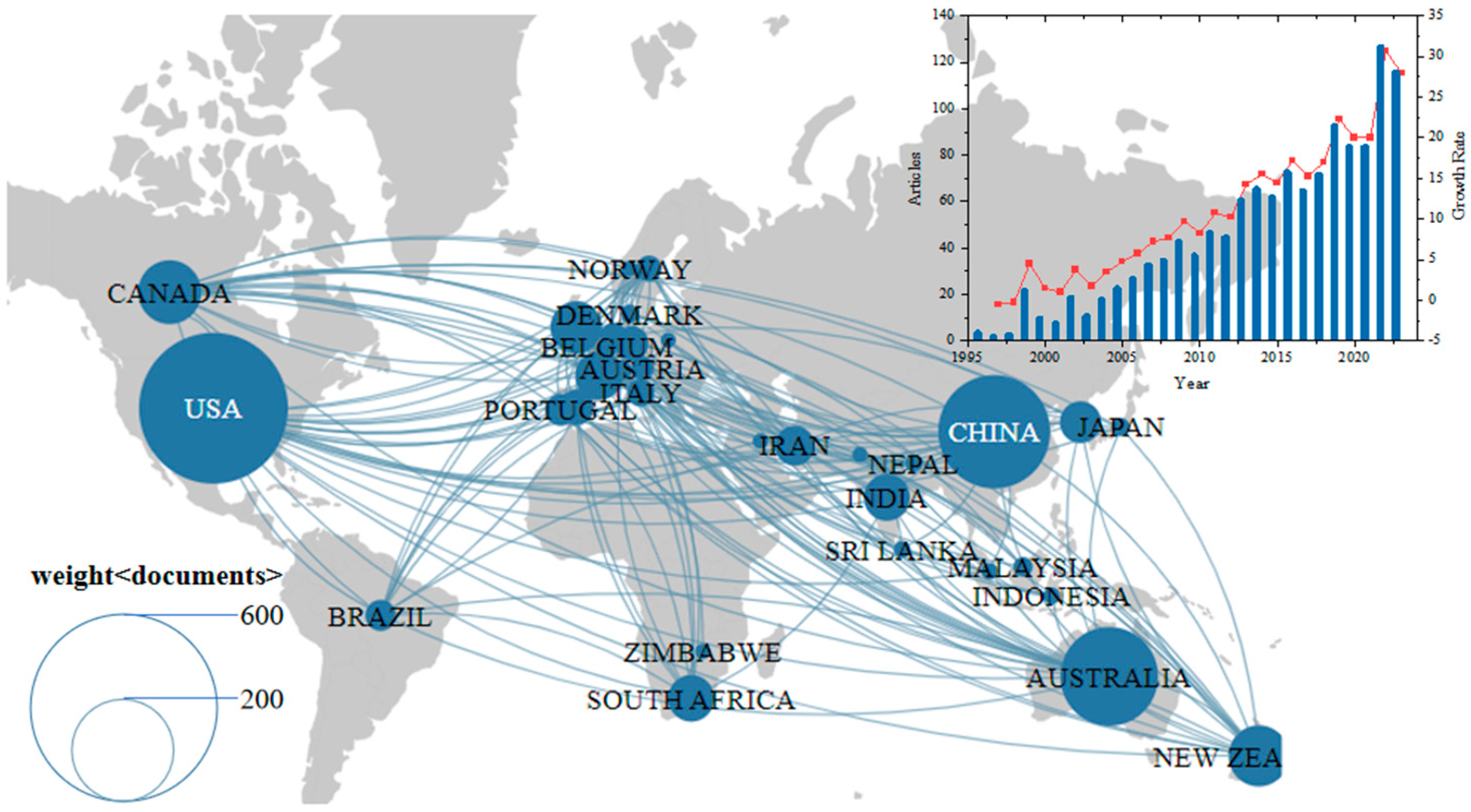
Based on the WoS core collection database, we conducted a bibliometric analysis of the literature on river and lake health between 1996 and 2023. The results demonstrate a sustained upward trend in annual publications (Figure 1), reflecting this field’s growing prominence in environmental research. The temporal evolution can be roughly categorized into three distinct phases: (1) the incubation phase (1996–2000) with limited output; (2) the expansion phase (2001–2012), marked by steady growth; and (3) the accelerated development phase (2013–2023). Notably, post 2013 publications show a surge in research activity, underscoring the global recognition of river and lake health as a critical research frontier.
Figure 1. Number of publications and country collaboration network in the field of river and lake health from 1996 to 2023. The size of each node represents the number of publications; the lines represent the collaboration between countries.
Bibliometric analysis identifies the top three contributing countries: the United States (405 articles, 31.1%), China (247 articles, 19.0%), and Australia (166 articles, 12.7%). Together, these three nations account for over 60% of total publications. These nations have established themselves as leading roles in this field, exhibiting distinct patterns of international collaboration. While the U.S. demonstrates strong research linkages with Western Europe and East Asia, China primarily collaborates with European and Asian partners, and Australia maintains close ties with New Zealand and European countries (Figure 1). This globalized cooperation framework underscores the worldwide recognition of river and lake health as critical environmental research.

3.2. Research Hotspots

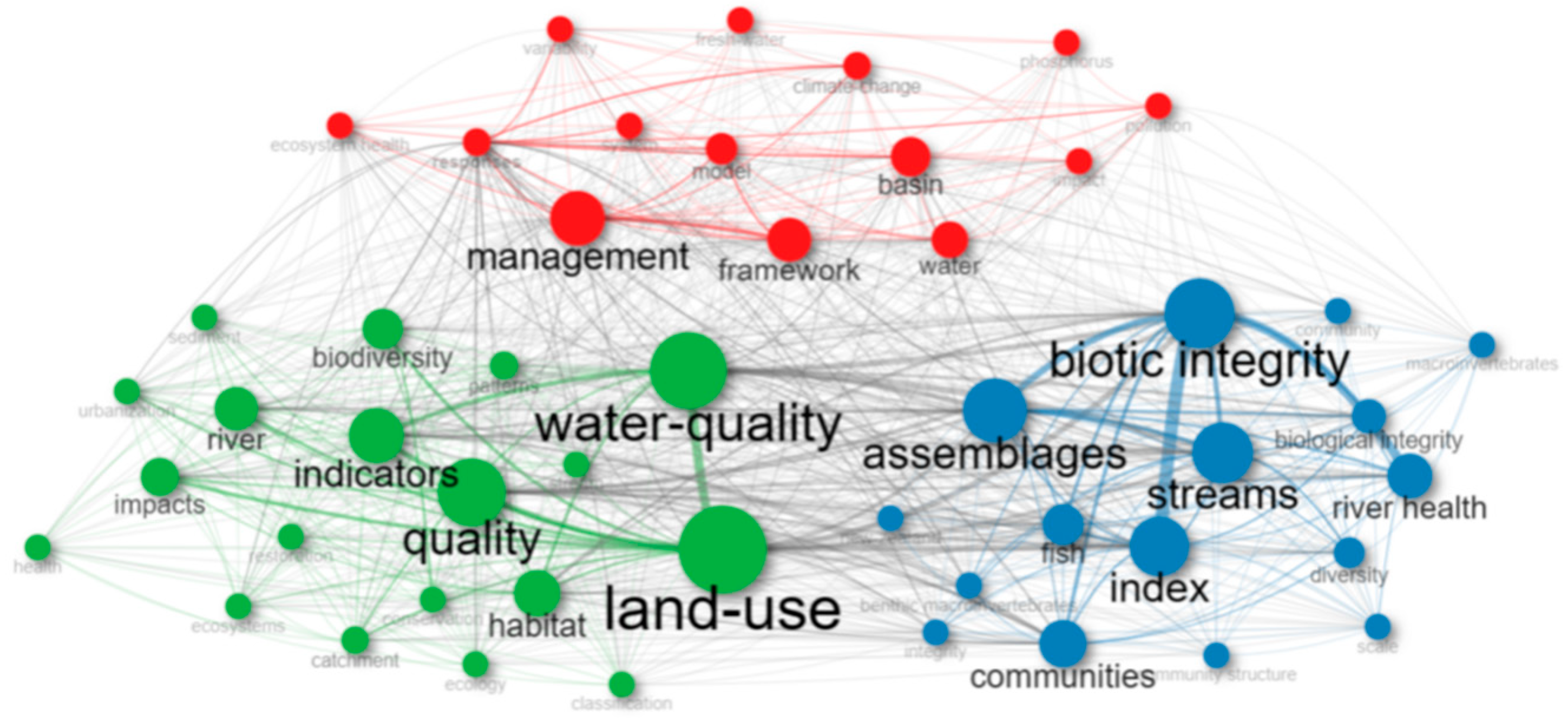
The bibliometric analysis in Figure 2 displays keyword co-occurrence patterns spanning three decades of river and lake health research. The most prominent keywords emerging from this analysis were “land-use”, “water quality”, and “biotic integrity”, with centrality measures of 0.50, 0.36, and 0.16, respectively. Centrality denotes a node’s connection strength with other key nodes, reflecting its potential network influence. These keywords formed three distinct research clusters. They reveal a shift in the field: from focusing on singular water quality parameters and biological indicators to understanding how watershed land-use patterns affect overall aquatic ecosystem health. This shift reflects the progression of scientific understanding and the growing recognition of anthropogenic factors as key determinants of freshwater ecosystem conditions.
Figure 2. Co-occurrence of keywords in the field of river and lake health. The size of each node represents the centrality measures of keywords, the lines represent the collaboration between keywords, and each colour represents different research clusters.
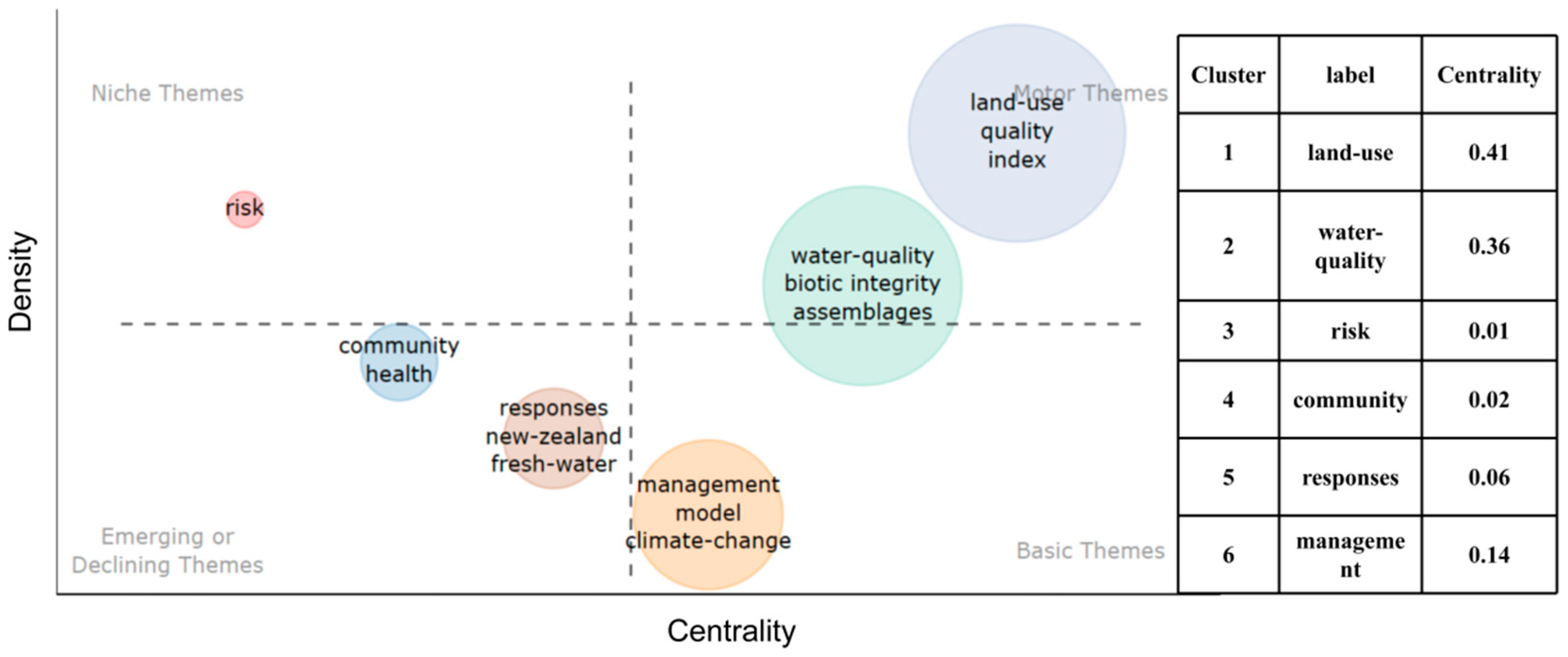
The strategic coordinate plot (Figure 3), generated through keyword clustering analysis using the Bibliometrix R package4.3.0, systematically revealing four characteristic research dimensions in river and lake health. The first quadrant contains mature core thematic clusters. Cluster 1 (“land-use”, “quality”, “index”) highlights the central role of water quality assessment under anthropogenic impacts. Consistent with Figure 2, the “land-use” node (centrality = 0.41) emerges as the most influential element in this domain, indicating its dominant position within Cluster 1. This quantitative result confirms the critical role of land-use in maintaining river and lake health. It also validates the established scientific consensus on the correlation between land-use and water quality. The dominance of land-use indicates that watershed management should be treated primarily as land-use governance. Practically, riparian buffers at fine scales are governed by local land-use regulation, planning, and governance. Targets critical land-use types and locations rather than relying solely on uniform basin. Therefore, integrate riparian and buffer standards into land-use regulation and permitting. Cluster 2, comprising “water-quality”, “biotic integrity”, and “assemblages”, represents the relationship between aquatic organisms and water quality in river and lake health research, and “water quality” demonstrates the highest centrality in this cluster.
Figure 3. Strategic coordinate plot in the field of river and lake health. Different colours represent distinct clusters of research themes, while the size of each node corresponds to the publication count within the respective cluster.
The co-occurrence of Cluster 1 and Cluster 2 in the first quadrant distinctly identifies them as current research hotspots in river and lake health assessment. The second quadrant features an isolated “risk” theme with high maturity, highlighting the essential role of risk assessment frameworks in comprehensive river and lake health evaluations. The third quadrant contains either emergent or declining research hotspots. Notably, “community” and “responses” exhibit relatively higher centrality values. The fourth quadrant encompasses less-developed research directions with low maturity, including “management”, “model”, and “climate change”. These collectively represent the frontiers requiring further river and lake health research exploration.

3.3. Frontiers of Watershed Health Research

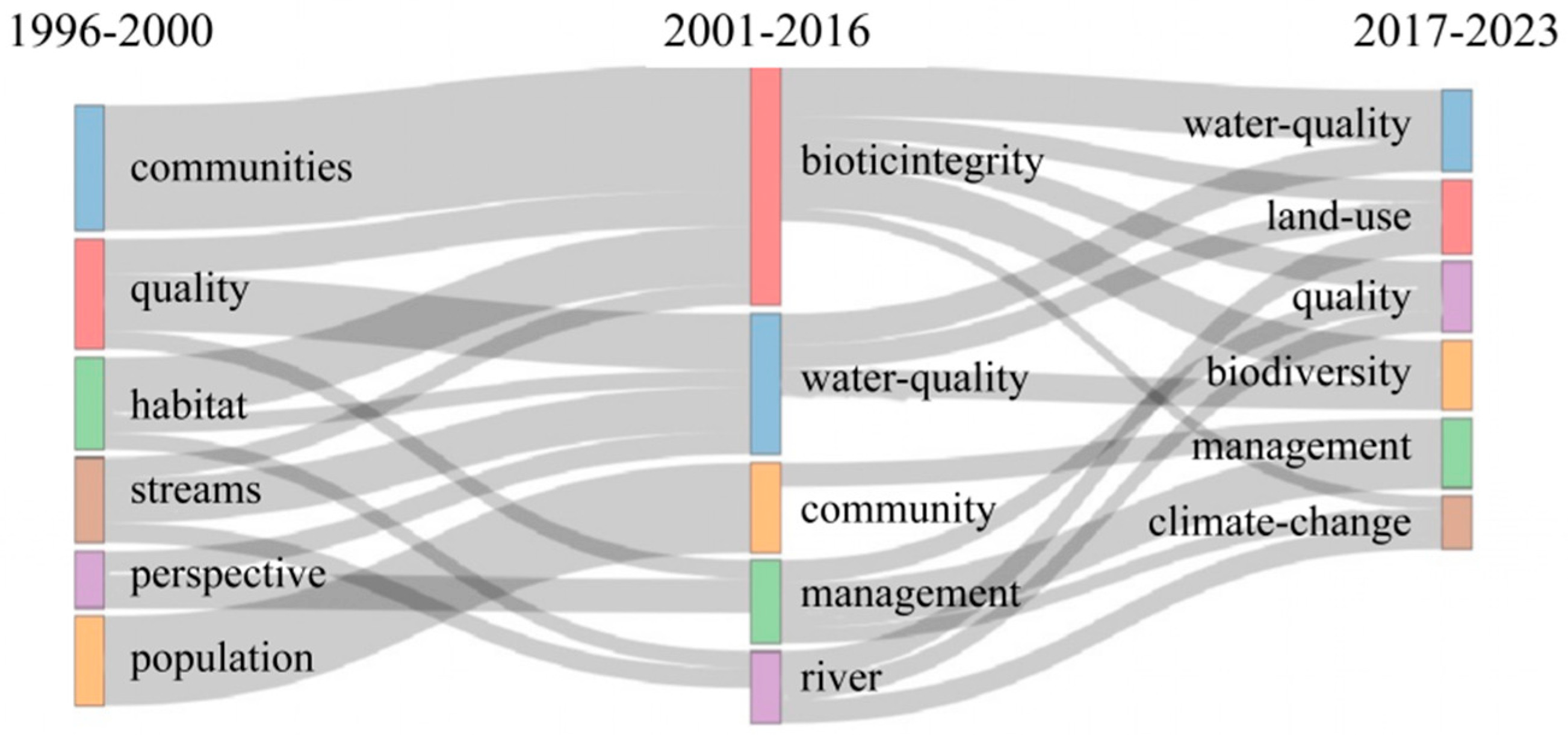
The study depicts the evolution process of themes in river and lake health (Figure 4), focusing on the evolution of keyword themes over time. Bibliometrix identifies the period from 2000 to 2016 as the dividing point for the rapid development of river and lake health research. The initial evolutionary stage spans from 1996 to 2016. From 2016 to 2023, the main evolutionary themes became “land-use” and “management”. During this evolutionary process, research terms such as “river”, “biotic integrity”, “community”, and “quality” evolve into “land-use”, and extensive evolutionary research on the impact of land-use on the river and lake health. Simultaneously, terms including “quality”, “biotic integrity”, and “classification” transform into “management”, indicating a shift from studying aquatic organisms and water quality to actively managing river and lake health through aquatic ecosystem governance. Evidently, the research focus is gradually transitioning toward perspectives of land-use and watershed ecological management.
Figure 4. Evolution process of main themes in the field of river and lake health.

4. Discussion

4.1. Development Trends of Watershed River and Lake Health Research

The research timeline can be categorized into three distinct phases. From the 20th century, studies primarily investigated how socioeconomic development influenced river and lake health. The assessment methodologies during this period were predominantly centred on physicochemical water quality parameters, including dissolved oxygen, pH, nutrients, and heavy metal concentrations. These metrics served as key indicators for evaluating the immediate effects of pollution on aquatic ecosystems [28]. However, researchers soon recognized the limitations of relying solely on water quality parameters, as they failed to provide a holistic representation of aquatic ecosystem health. This realization prompted more comprehensive evaluation frameworks incorporating biological indicators and ecosystem function assessments [29].
From 2000 to 2015, research increasingly focused on utilizing the sensitivity of aquatic organisms to organic pollution to evaluate the health of rivers and lakes [30]. Scientists realized the importance of biological integrity indicators in assessing the health of watershed of rivers and lakes [31]. During this stage, scientists also began to focus on the concept of ecosystem services, which refers to the direct and indirect benefits of aquatic ecosystems to humans. Assessment methods not only focused on biodiversity but included services such as water supply, flood regulation, cultural, and recreational values. In addition, countries have been continuously updating and improving their river and lake health assessment systems. For instance, Japan implemented a systematic watershed management approach in the Lake Biwa basin, dividing it into seven distinct sub-watersheds to optimize conservation efforts. This framework later incorporated aquatic organisms as key indicators in its lake and river health assessment system, enhancing ecological monitoring precision [32]. River biomonitoring techniques were employed to assess trait-based functional ecology of invertebrates, offering a critical functional ecological perspective for freshwater health evaluations [33]. Distinct from community ecology centred on taxonomic composition, it has been well-established in Europe, Australia, and the Americas, providing a critical functional perspective for global freshwater health evaluations.
Since 2016, the growing adoption of remote sensing technology and big data analytics has significantly enhanced the precision and comprehensiveness of watershed aquatic ecosystem assessments. Researchers rely on constantly updated new models and methods, using model and data-driven tools [34] combined with advanced remote sensing, data mining, and artificial intelligence technologies to predict and manage the health of aquatic ecosystems at different scales and times [35]. Researchers pay more attention to the ecosystem services and risk assessment brought by river and lake health, and explore key factors affecting river and lake health [18]. They all seek ways to improve the health of watershed of rivers and lakes, making watershed river and lake health assessment an important tool in water resource management and environmental protection through continuous development and improvement, providing a scientific basis for policymakers and helping achieve sustainable development of aquatic ecological health.
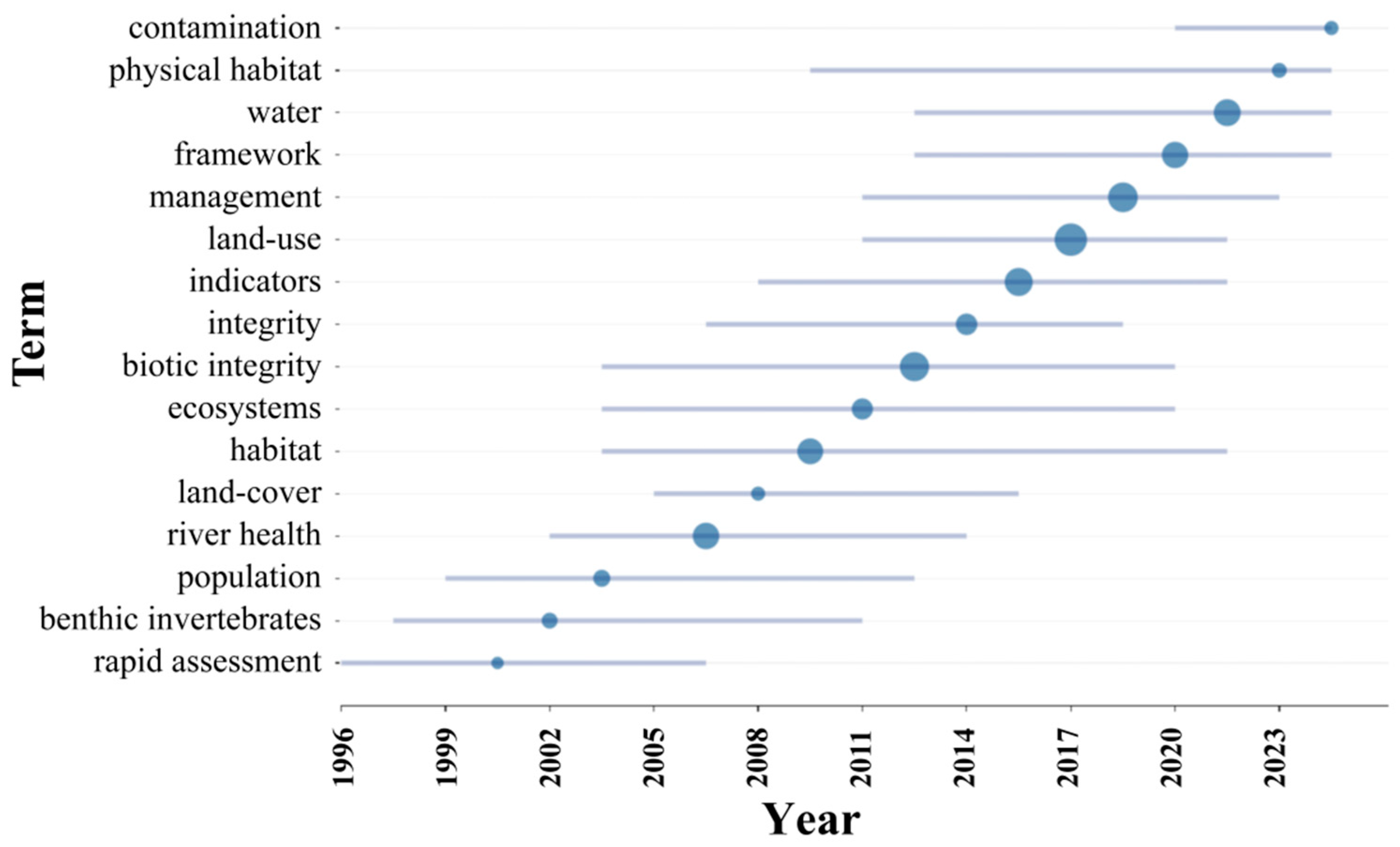
Through bibliometric analysis, we can observe that all continents, each possessing unique freshwater watersheds, are actively engaged in river and lake health research; notable examples include the Mississippi River basin in North America, the Danube River basin in Europe, and the Yangtze River basin in China [11,12,36]. However, due to disparities in scientific research capacity and socioeconomic conditions, Europe, North America, and South Asia demonstrate greater research output and management efforts in this field. Variations in research focus frequency and trend further reflect evolving global ecological and environmental science hotspots. Figure 5 illustrates a gradual shift in research hotspots. The focus has moved from early pollution issues and physical habitat management to integrated areas, such as environmental management frameworks, ecosystem integrity, and biodiversity assessment. This trend reflects the increasing attention that researchers attach to water ecological protection and sustainable development and also provides an important reference for future research directions. Notably, land-use emerged as the most frequent key factor affecting river and lake health, appearing 137 times in the analysis. This phenomenon underscores its critical role in water resources management and ecosystem research. With the increasing frequency of land-use studies, worsening water ecological problems have garnered greater research attention, particularly in the fields of land-use and ecosystem services, water environmental management, and sustainable development research [37]. This trend is also reflected in the research hotspot results (Figure 2, Figure 3 and Figure 4).
Figure 5. Trend chart of themes in the field of river and lake health. The line segments represent the time span, and the size of the circles represents the frequency of occurrence.

4.2. Watershed River and Lake Health

Watersheds are natural units for water resources and ecosystem management, including all bodies of water flowing into specific rivers and lakes and the related land. Exploring river and lake health at the watershed scale enables a holistic assessment of water quality and ecosystem drivers, including hydrologic regimes, riparian conditions, land-use patterns, and biodiversity [38]. Research and management of river and lake health at the watershed scale can promote the integrated use of resources and the restoration of ecosystems, thus achieving sustainable development of the economy, society, and environment. Previous hotspots and frontiers chapters reveal that research is increasingly adopting watershed-scale approaches. Simultaneously, growing recognition of anthropogenic impacts on aquatic ecosystems has prompted in-depth investigations into pivotal determinants (land-use and human activity intensity) of river and lake health. Furthermore, it investigates the mechanisms of affecting factors on river and lake health at watershed scales [39].

4.2.1. Affecting Factors of Watershed Land-Use

In the past, research in watershed river and lake health often focused on assessing the health status of the water body itself while overlooking the search for the root causes of aquatic ecological problems [40]. The fundamental reasons affecting river and lake health may involve various aspects, including the impact of human activities, changes in land-use, and the formulation and implementation of water resources management policies. Therefore, expanding research scopes to these deeper causal factors is imperative to understand the problem and formulate effective strategies to restore and maintain river and lake health [41].
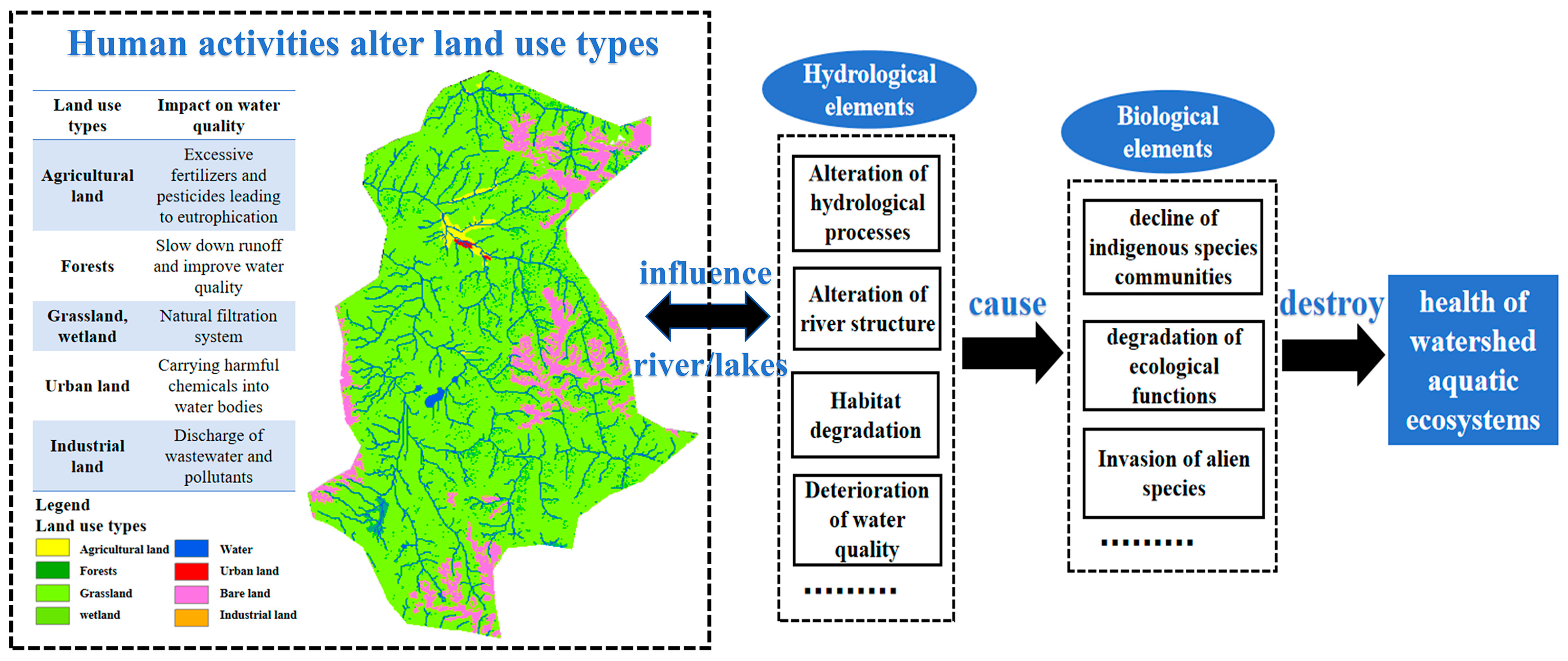
Watershed human activities exert extensive, far-reaching impacts on the health of rivers and lakes (Figure 6). For example, urbanization, industrial zone construction, and tourism development damage riparian and lakeshore ecosystems. These activities lead to vegetation and habitat loss, as well as increased erosion and sedimentation. Additionally, deforestation, wetland filling, and land reclamation alter land-use within watersheds, leading to biodiversity loss and weakened ecosystem functions, affecting the health of rivers and lakes [42]. Watershed land-use factors significantly impact the health of rivers and lakes, and different types of land-use can lead to varying degrees of water pollution. For example, agricultural activities may discharge fertilizers and pesticides into water bodies [43], industrial areas may discharge toxic substances, and urban areas may have sewage and garbage discharge [44]. Point source and nonpoint source pollution are the main ways in which changes in land-use affect the health of rivers and lakes. Point source pollution comes from discharge outlets of factories and enterprises. In contrast, nonpoint source pollution has characteristics such as randomness, lag, and wide sources, and is difficult to control; it is also influenced by various factors such as rainfall, land-use, and land surface functions [45]. These pollutants directly affect the quality of water, threatening aquatic organisms and human health. Land-use alterations can also exacerbate the degradation of riparian and littoral ecosystems. For instance, urbanization can lead to the concretization of riverbanks and lake shores, which destroys natural vegetation and habitats. This process reduces the natural filtering capacity of these areas, affects the stability of water bodies, and increases the risk of bank erosion and sedimentation [46]. Furthermore, unreasonable land-use may lead to changes in water quantity and flow, affecting the health of rivers and lakes. Overexploitation of water resources through intensive development and irrigation may induce river desiccation or significant reductions in discharge volume. Changes in river courses and the construction of dams may alter natural water flow patterns, affecting the ecosystems and hydrological cycles of rivers and lakes [47]. Loss of biodiversity is also a key factor in river and lake health deterioration. The reduction in natural vegetation cover and the fragmentation of ecological connectivity threaten the habitats of aquatic and terrestrial organisms, thereby affecting the overall health and stability of the ecosystem [16].
Figure 6. Schematic diagram of the impact of land-use types on watershed river and lake health.
Land-use is closely related to the pollution of aquatic ecosystems, and different types of land-use in human societies indirectly contribute to the deterioration of river and lake aquatic ecosystem health, leading to ecosystem fragmentation and affecting biodiversity and ecosystem services [16]. Therefore, effective management of watershed land-use is the key factor in maintaining and improving river and lake health. This requires comprehensive consideration of ecological, economic, and social aspects, as well as the formulation and implementation of appropriate land-use planning and management policies to minimize the negative impact on the health of rivers and lakes to the greatest extent possible. Considering land-use is crucial when improving the health of watershed of rivers and lakes. Measures such as guiding land-use, implementing soil and water conservation practices, and protecting and restoring wetlands can significantly enhance the health of watershed of rivers and lakes. Additionally, sustainable agricultural development, urban planning and management, and the protection of ecological corridors contribute to the sustainable use of water resources and the healthy development of ecosystems [48].

4.2.2. The Impacts of Watershed Land-Use Vary at Scales

In recent years, coupling basin river and lake health with land-use has emerged as a new hot topic in the field [6]. Extensive research has empirically demonstrated the significant impacts of land-use on river and lake health, with multidimensional effects being identified across various spatial scales [49]. Conventional studies primarily focused on single-scale analysis (e.g., riparian buffers or sub-watersheds), revealing spatial heterogeneity in ecological responses. Land-use patterns in buffer zones (e.g., cropland, built-up areas) directly affect nearshore water quality via runoff. Response thresholds differ significantly between pollutants (nitrogen vs. phosphorus) [50]. With the emergence of integrated environmental management and the development of environmental science research, people gradually realized the coupling relationship between water resources and land-use at the basin scale. The study of the Dongjiang River basin illustrated that land-use configurations (forest-agricultural) at the sub-watershed scale demonstrated greater explanatory power for water quality than buffer-scale analyses [51]. These approaches still failed to fully account for the regulating effect effects of larger-scale land-use on water quality relationships. Fundamental differences exist between localized pollution stress at buffer scales and cumulative effects at watershed scales. Wu and Lu (2021) [52] demonstrated that the influence of landscape metrics (patch density) on water quality exhibits nonlinear characteristics with scale variations. The direct pollution effect at a small scale (<1 km) is significant, while agricultural nonpoint source pollution at a large scale (>5 km) is dominant.
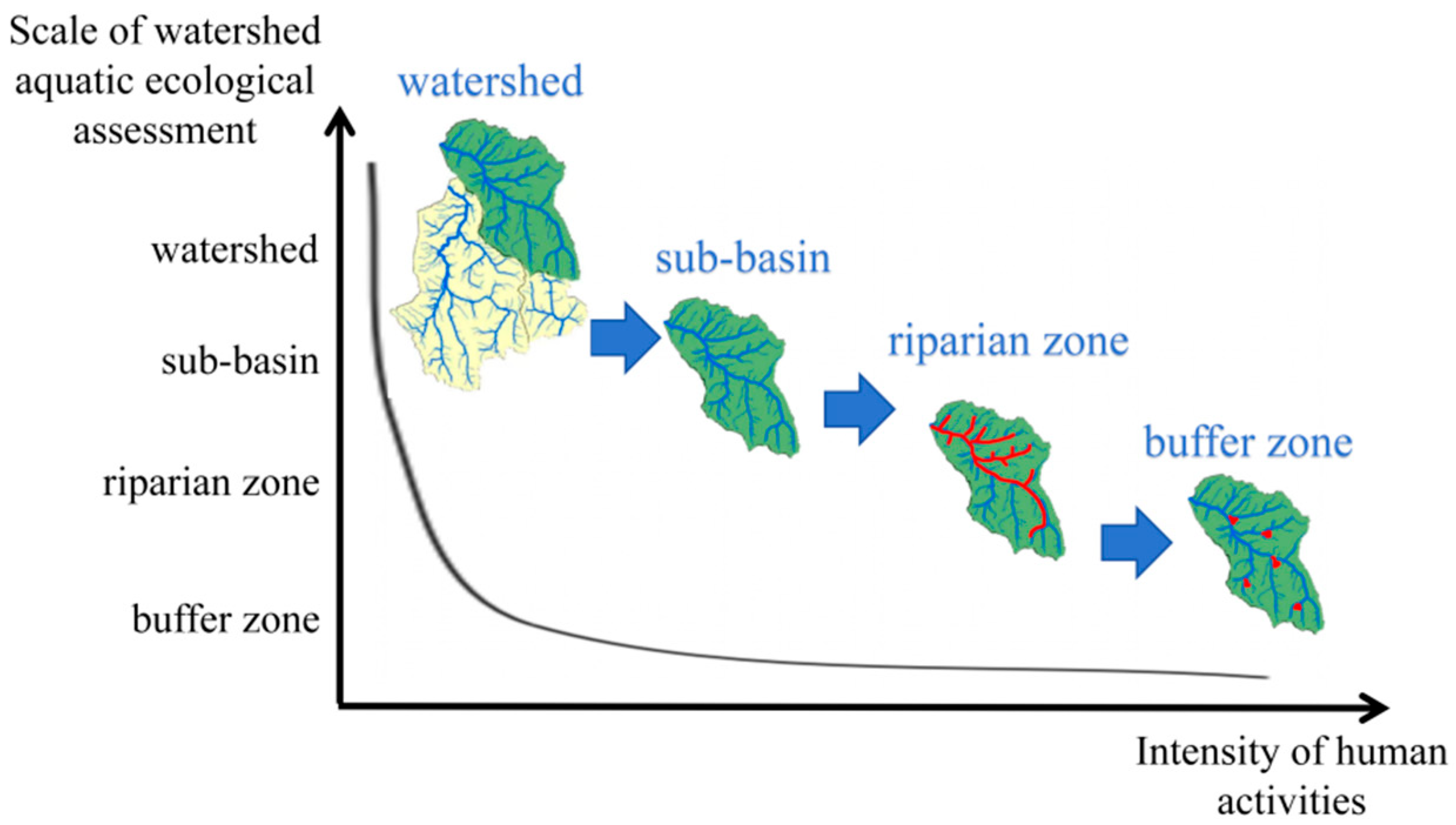
Figure 7 illustrates that heightened anthropogenic disturbance has increasingly pronounced adverse effects on the basin’s aquatic ecosystems. The effective scale of human impact on the health of rivers and lakes is shrinking, increasing pressure on the aquatic ecosystems of rivers and lakes. Consequently, aquatic ecosystem monitoring and management must adopt finer spatial scales to effectively mitigate the health of basin aquatic ecosystems through measures such as water resource management, pollution control, and ecological restoration at reasonable scales of land-use. With increased human activity intensity and exacerbation of land-use changes, researchers have shifted their focus in recent years [13]. Current research has shifted toward finer-scale assessments of river and lake health, transitioning from whole basin analyses to riparian zone studies.
Figure 7. The impact of land-use at different scales on the health of rivers and lakes.
This multi-scale approach encompasses sub-basin, lake buffer zone, and riparian zone, recognizing that localized ecosystems are more sensitive to anthropogenic disturbances such as soil erosion, water pollution, and biodiversity decline. Studies at this resolution prioritize evaluating local water quality, habitat integrity, land-use patterns, and the direct impacts of human activities on aquatic systems. Such focused assessments enable more tractable land-use management and monitoring within sub-basins. Compared to basin-scale governance, sub-basin interventions allow for targeted policy implementation, thereby enhancing water resource protection, mitigating land degradation, and restoring ecological functions. For instance, Gatgash and Sadeghi (2023) [53] demonstrated the critical role of sub-basin management in the Mikhas sub-basin (Iran), while Xu et al. (2023) [54] quantified riparian and sub-basin landscape metrics to elucidate mechanistic links between spatial patterns and river water quality. Meanwhile, the riparian zone has high ecological sensitivity due to the important ecosystem at the junction of water and land. Land-use changes within riparian zones may significantly affect water quality, biodiversity, and ecosystem function [55]. Simultaneously, the riparian zone represents a more precise and actionable spatial unit than the entire basin, offering enhanced feasibility for implementation and monitoring. Targeted land-use planning and management within riparian zones can effectively safeguard water resources and optimize ecological conditions [56]. As critical transition areas between aquatic and terrestrial ecosystems, river and lake buffers host elevated biodiversity, including endangered species and sensitive habitats, playing a pivotal role in maintaining aquatic ecosystem health [57]. Consequently, land-use modifications within these buffers are more likely to exert direct and pronounced impacts on aquatic ecosystems.
This review employs a multi-scale analysis of land-use, with its core aim being to directly bridge the implementation gap between science and governance. Watershed and sub-watershed scale assessments can identify macro-level problems, but their management recommendations are often generalized, making policy implementation challenging. In contrast, fine-scale research uncovers hydrological and ecological mechanisms, enabling precise identification of critical source areas and functional weak points. This spatial precision allows managers to implement targeted resource allocation, prioritizing the investment of limited conservation and restoration resources into specific sites with the highest ecological returns, thereby facilitating a paradigm shift from extensive management to accurate intervention. Consequently, fine-scale research is not merely a methodological choice of downscaling, but a crucial bridge transforming watershed management from conceptual planning into concrete and efficient action. With the transformation of the basin by human activities, many researchers are deeply exploring the impact of land-use at different scales within the basin on the health of rivers and lakes. They propose that land-use at different spatial scales within the basin has varying effects on aquatic ecosystems, leading to a shift in research from considering the entire basin to more detailed studies within specific areas. Lu et al. (2022) [58] quantitatively assessed the impact of the landscape structure on conventional indicators and heavy metals in water at different spatial scales, including upstream circular buffers and sub-basin scales, using methods such as principal component analysis and redundancy analysis. Shu et al. (2022) [59] studied the multi-spatial scale effects of river planktonic bacterial communities on surrounding landscapes, finding that the relationship between land-use and planktonic bacterial communities showed that the impact of the buffer zone scale was more significant than that of the sub-basin scale. Zhang et al. (2024) [49] obtained the biodiversity data of Dongting Lake and identified the need to establish a protection buffer zone to mitigate the impact of land-use on water ecological biodiversity.
Fine-scale studies enable more precise characterization of how localized land-use modifications affect aquatic systems, particularly regarding water quality parameters, hydrological regimes, and ecosystem functioning. For instance, subtle changes, such as the use of fertilizers in local farmland, changes in urban riparian zones, and land development during urbanization processes may have significant impacts on the water quality of nearby rivers and lakes [60]. Through mathematical models and statistical analysis, the degree of impact of land-use changes at small scales on the health of rivers and lakes can be quantified, and future trends can be predicted, providing a scientific basis for management decisions and formulating more refined and targeted management measures [61]. This approach effectively mitigates the adverse effects of land-use changes on aquatic ecosystem health, providing specific response measures and implementation plans for local governments and relevant departments, maximizing the protection and improvement of river and lake health [62]. Consequently, fine-scale studies provide crucial insights into the mechanisms of land-water interactions. These studies also enable the development of spatially targeted management strategies. This research approach represents a significant advancement in aquatic ecosystem conservation, offering an evidence-based framework to guide future protection and sustainable management practices.

5. Conclusions

This study employs bibliometric techniques to conduct a comprehensive analysis of the literature pertaining to river and lake health from 1996 to 2023, elucidating core advancements and future directions in this domain, including publication trends, geographical distributions, emerging research topics, and thematic evolution. The results indicate a heightened scholarly focus on river and lake health in recent years, with robust developmental momentum. The key findings are as follows:
(1)
The number of publications in river-lake health research exhibits an accelerating growth pattern, characterized by three distinct developmental phases: the initial phase (1996–2000), the expansion phase (2001–2012), and the acceleration phase (2013–2023). Notably, the United States, China, and Australia collectively contribute over 60% of global research outputs, whereas regions such as Africa and South America remain underrepresented.
(2)
River and lake health research has evolved from single water quality indices to holistic assessments. These assessments now include watershed-scale ecosystem integrity and ecosystem service functionality. Land-use stands out as a key anthropogenic driver, with different human land-use patterns strongly correlated with aquatic ecosystem degradation. Specifically, anthropogenic land modifications indirectly exacerbate the deterioration of river and lake ecosystems, leading to habitat fragmentation, biodiversity loss, and diminished ecosystem services. Consequently, the influence of land-use on aquatic health has garnered increasing scholarly attention.
(3)
Research on watershed land-use displays a trend from large-scale analysis to fine-scale monitoring. Finer spatial scales exert more pronounced impacts on fluvial and lacustrine ecosystem health. Future studies should prioritize exploring the fine scale of land-use impacts, focusing on buffer zones and riparian zones. Establish scale-transfer models to reconcile fine-scale processes with macro-level governance needs.
(4)
Africa and other regions are underrepresented in current research. Future agendas should promote global collaborative initiatives to fill these regional knowledge gaps. To translate scientific findings into actionable governance, future studies should strengthen policy effectiveness evaluation and practical tool development—this will enhance the feasibility and sustainability of watershed management measures.
Overall, the field of river and lake health has made great achievements, laying a theoretical foundation for future water pollution control in watershed ecosystems. Through quantitative analysis of the current research status and developmental trends on river and lake health, this review establishes novel research perspectives and proposes an integrated framework for watershed water pollution management. Hopefully, this research will provide essential scientific support for improving future watershed ecological conditions and offer frontier insights to guide further academic exploration.

Author Contributions

Conceptualization, L.M. and J.H.; methodology, N.M.; software, Z.Y.; validation, N.M. and Z.Y.; formal analysis, N.M.; investigation, Z.Y.; resources, L.M.; data curation, Z.Y.; writing—original draft preparation, N.M.; writing—review and editing, L.M. and T.M.A.; visualization, Z.Y.; supervision, L.M. and T.M.A.; project administration, L.M.; funding acquisition, L.M. All authors have read and agreed to the published version of the manuscript.

Funding

This research was funded by the auspices of the National Key Research and Development Program of China, grant number 2023YFC3208903, National Natural Science Foundation of China (No. 52379063) and Lhasa City Science and Technology Plan Project (LSKJ202438).

Data Availability Statement

No new data were created or analyzed in this study. Data sharing is not applicable to this article.

Conflicts of Interest

The authors declare no conflicts of interest. The funders had no role in the design of the study, or in the decision to publish the results.

References

  1. Yang, S.; Hao, H.; Liu, B.; Wang, Y.; Yang, Y.; Liang, R.; Li, K. Influence of socioeconomic development on river water quality: A case study of two river basins in China. Environ. Sci. Pollut. Res. Int. 2021, 28, 53857–53871. [Google Scholar] [CrossRef]
  2. Liu, D.; Jiang, X.; Duan, M.; Yu, S.; Bai, Y. Human and natural activities regulate organic matter transport in Chinese rivers. Water Res. 2023, 245, 120622. [Google Scholar] [CrossRef]
  3. Huang, N.; Wang, H.Y.; Lin, T.; Liu, Q.M.; Huang, Y.F.; Li, J.X. Regulation framework of watershed landscape pattern for non-point source pollution control based on ‘source-sink’ theory: A case study in the watershed of Maluan Bay, Xiamen City, China. J. Appl. Ecol. 2016, 27, 3325–3334. [Google Scholar] [CrossRef]
  4. Wen, C.; Zhen, Z.; Zhang, L.; Yan, C. A bibliometric analysis of river health based on publications in the last three decades. Environ. Sci. Pollut. Res. 2023, 30, 15400–15413. [Google Scholar] [CrossRef] [PubMed]
  5. Huo, K.; Shen, W.; Wei, J.; Zhang, L.; Feng, Q.; Zhuang, Y.; Li, S. Interpretable machine learning reveals the importance of geography and landscape arrangement for surface water quality across China. Water Res. 2025, 281, 123578. [Google Scholar] [CrossRef] [PubMed]
  6. Ly, K.; Metternicht, G.; Marshall, L. Linking changes in land cover and land use of the lower mekong basin to instream nitrate and total suspended solids variations. Sustainability 2020, 12, 2992. [Google Scholar] [CrossRef]
  7. Guo, W.; Yang, H.; Ma, Y.; Hong, F.; Wang, H. Comprehensive evaluation of the hydrological health evolution and its driving forces in the river-lake system. Ecol. Inform. 2023, 75, 102117. [Google Scholar] [CrossRef]
  8. Tao, Y.; Xu, Q.; Luo, M.; Dong, W.; Pang, Y. Assessment of water ecological health in shallow lakes: A new framework based on water resource-environment-ecology. Ecol. Indic. 2025, 174, 113498. [Google Scholar] [CrossRef]
  9. Han, F.; Tian, Q.; Chen, N.; Hu, Z.; Wang, Y.; Xiong, R.; Xu, P.; Liu, W.; Stehr, A.; Barra, R.O.; et al. Assessing ammonium pollution and mitigation measures through a modified watershed non-point source model. Water Res. 2024, 254, 121372. [Google Scholar] [CrossRef]
  10. Freeman, L.A.; Corbett, D.R.; Fitzgerald, A.M.; Lemley, D.A.; Quigg, A.; Steppe, C. Impacts of urbanization and development on estuarine ecosystems and water quality. Estuaries Coast. 2019, 42, 1821–1838. [Google Scholar] [CrossRef]
  11. Perosa, F.; Fanger, S.; Zingraff-Hamed, A.; Disse, M. A meta-analysis of the value of ecosystem services of floodplains for the Danube River Basin. Sci. Total Environ. 2021, 777, 146062. [Google Scholar] [CrossRef]
  12. Nepal, D.; Parajuli, P.B.; Ouyang, Y.; To, S.F.; Wijewardane, N. Assessing hydrological and water quality responses to dynamic landuse change at watershed scale in Mississippi. J. Hydrol. 2023, 625, 129983. [Google Scholar] [CrossRef]
  13. Mwaijengo, G.N.; Msigwa, A.; Njau, K.N.; Brendonck, L.; Vanschoenwinkel, B. Where does land use matter most? Contrasting land use effects on river quality at different spatial scales. Sci. Total Environ. 2020, 715, 134825. [Google Scholar] [CrossRef] [PubMed]
  14. Carpenter, S.R.; Caraco, N.F.; Correll, D.L.; Howarth, R.W.; Sharpley, A.N.; Smith, V. Nonpoint pollution of surface waters with phosphorus and nitrogen. Ecol. Appl. 1998, 8, 559–568. [Google Scholar] [CrossRef]
  15. Jiao, C.; Wu, X.; Song, S.; Wang, S.; Xiang, B.; Fu, B. River stabilization reshaped human-nature interactions in the Lower Yellow River Floodplain. J. Environ. Manag. 2024, 371, 122957. [Google Scholar] [CrossRef] [PubMed]
  16. Xie, H.; Ma, Y.; Jin, X.; Jia, S.; Zhao, X.; Zhao, X.; Cai, Y.; Xu, J.; Wu, F.; Giesy, J. Land use and river-lake connectivity: Biodiversity determinants of lake ecosystems. Environ. Sci. Ecotechnol. 2024, 21, 100434. [Google Scholar] [CrossRef]
  17. Wu, F.; Li, F.; Zou, Y.; Li, B.; Guo, F.; Gao, W.; Yin, Z.; Li, L.; Zhang, Y.; Water, T. Environmental DNA Reveals Multitrophic Insight into the Mechanism of Community Stability Changes in Shallow Eutrophic Lakes. ACS EST Water. 2025, 5, 4351–4363. [Google Scholar] [CrossRef]
  18. Zhao, Z.; Wei, F.; Wu, H.; Yang, M.; Jin, X.; Wang, P.; Wang, Q. A framework to comprehensively assess lake health from a perspective of ecosystem integrity and services. Ecol. Indic. 2025, 171, 113169. [Google Scholar] [CrossRef]
  19. Jin, X.; Xie, H.; Zhao, X.; He, D.; Zhan, A.; Cai, Y.; Wu, N.; Zhang, X.; Yang, J.; Wang, Y.; et al. Aquatic ecosystem health assessment in China based on metacommunity theory: From theory to practice. Carbon Res. 2025, 4, 16. [Google Scholar] [CrossRef]
  20. Foster, C.A.; Matlock, M. History of the clean water act. Water Resour. Impact 2001, 3, 26–30. [Google Scholar]
  21. Karr, J.R. Biological integrity: A long-neglected aspect of water resource management. Ecol. Appl. 1991, 1, 66–84. [Google Scholar] [CrossRef]
  22. Assessment, M.E. Ecosystems and Human Well-Being: Wetlands and Water Synthesis; World Resources Institute: Washington, DC, USA, 2005; Available online: https://vtechworks.lib.vt.edu/items/05f6e5e0-3cac-4418-bc7d-9a4edc5fbab0 (accessed on 28 December 2025).
  23. Water, U. Sustainable Development Goal 6 Synthesis Report on Water and Sanitation; United Nations New York: New York, NY, USA, 2018; Available online: https://sdgs.un.org/documents/un-water-sustainable-development-goal-6-synthesis-23600 (accessed on 28 December 2025).
  24. Liu, C.; Pang, Z.; Ni, G.; Mu, R.; Shen, X.; Gao, W.; Miao, S. A comprehensive methodology for assessing river ecological health based on subject matter knowledge and an artificial neural network. Ecol. Inform. 2023, 77, 102199. [Google Scholar] [CrossRef]
  25. Donthu, N.; Kumar, S.; Mukherjee, D.; Pandey, N.; Lim, W.M. How to conduct a bibliometric analysis: An overview and guidelines. J. Bus. Res. 2021, 133, 285–296. [Google Scholar] [CrossRef]
  26. Kleinberg, J. Bursty and hierarchical structure in streams. In Proceedings of the Eighth ACM SIGKDD International Conference on Knowledge Discovery and Data Mining, Edmonton, AB, Canada, 23–26 July 2002. [Google Scholar] [CrossRef]
  27. Chen, C. Science mapping: A systematic review of the literature. J. Data Inf. Sci. 2017, 2, 1–40. [Google Scholar] [CrossRef]
  28. Karr, J. Defining and measuring river health. Freshw. Biol. 1999, 41, 221–234. [Google Scholar] [CrossRef]
  29. Bunn, S.E.; Davies, P. Biological processes in running waters and their implications for the assessment of ecological integrity. Hydrobiologia 2000, 422, 61–70. [Google Scholar] [CrossRef]
  30. Karr, J.R.; Chu, E.W. Sustaining living rivers. Hydrobiologia 2000, 422, 1–14. [Google Scholar] [CrossRef]
  31. Verdonschot, P.F.; Moog, O. Tools for assessing European streams with macroinvertebrates: Major results and conclusions from the STAR project. Hydrobiologia 2006, 566, 299–309. [Google Scholar] [CrossRef]
  32. Yamamoto, K.; Nakamura, M. An examination of land use controls in the Lake Biwa watershed from the perspective of environmental conservation and management. Lakes Reserv. Res. Manag. 2004, 9, 217–228. [Google Scholar] [CrossRef]
  33. Menezes, S.; Baird, D.J.; Soares, A. Beyond taxonomy: A review of macroinvertebrate trait-based community descriptors as tools for freshwater biomonitoring. J. Appl. Ecol. 2010, 47, 711–719. [Google Scholar] [CrossRef]
  34. Deng, X.; Xu, Y.; Han, L.; Yu, Z.; Yang, M.; Pan, G. Assessment of river health based on an improved entropy-based fuzzy matter-element model in the Taihu Plain, China. Ecol. Indic. 2015, 57, 85–95. [Google Scholar] [CrossRef]
  35. Jabbar, F.K.; Grote, K.; Tucker, R. A novel approach for assessing watershed susceptibility using weighted overlay and analytical hierarchy process (AHP) methodology: A case study in Eagle Creek Watershed, USA. Environ. Sci. Pollut. Res. 2019, 26, 31981–31997. [Google Scholar] [CrossRef]
  36. Wu, S.; Hu, Y.; Zhao, W.; Gong, L.; Song, Y.; Li, C.; Li, X.; Hossain, M.J.; Shan, X.; Fang, J.; et al. Human flood adaptation characteristics: A comparative study of three global river deltas. J. Hydrol. 2025, 660, 133531. [Google Scholar] [CrossRef]
  37. Cao, X.; Wang, H.; Zhang, B.; Liu, J.; Yang, J. Sustainable management of land use patterns and water allocation for coordinated multidimensional development. J. Clean. Prod. 2024, 457, 142412. [Google Scholar] [CrossRef]
  38. Shu, L.; Li, X.; Chang, Y.; Meng, X.; Chen, H.; Qi, Y.; Wang, H.; Li, Z.; Lyu, S. Advancing understanding of lake–watershed hydrology: A fully coupled numerical model illustrated by Qinghai Lake. Hydrol. Earth Syst. Sci. 2024, 28, 1477–1491. [Google Scholar] [CrossRef]
  39. Zeng, X.; Zhang, S.; Li, T.; Xue, Y.; Zhao, J.; Fu, Y.; Zhang, J.; Chen, C.; Kong, X.; Zhang, J. A risk-simulation based optimization model for wetland reallocation on Yongding floodplain, China. Ecol. Indic. 2021, 123, 107342. [Google Scholar] [CrossRef]
  40. Meredith, C.; Budy, P.; Schmidt, J. Scour depths at sites selected for spawning by brown trout (Salmo trutta) along a longitudinal gradient of a North American mountain river. River Res. Appl. 2018, 34, 786–796. [Google Scholar] [CrossRef]
  41. Beecraft, L.; Watson, S.B.; Smith, R. Multi-wavelength pulse amplitude modulated fluorometry (Phyto-PAM) reveals differential effects of ultraviolet radiation on the photosynthetic physiology of phytoplankton pigment groups. Freshw. Biol. 2017, 62, 72–86. [Google Scholar] [CrossRef]
  42. Li, N.; Sun, P.; Zhang, J.; Shen, D.; Qiao, D.; Liu, Q. Impact of land use intensity changes on ecosystem services in the Yellow River Basin, China. J. Geogr. Sci. 2025, 35, 1003–1023. [Google Scholar] [CrossRef]
  43. Woznicki, S.A.; Nejadhashemi, A.P.; Tang, Y.; Wang, L. Large-scale climate change vulnerability assessment of stream health. Ecol. Indic. 2016, 69, 578–594. [Google Scholar] [CrossRef]
  44. Schürings, C.; Globevnik, L.; Lemm, J.U.; Psomas, A.; Snoj, L.; Hering, D.; Birk, S. River ecological status is shaped by agricultural land use intensity across Europe. Water Res. 2024, 251, 121136. [Google Scholar] [CrossRef]
  45. Li, Y.; Wang, H.; Deng, Y.; Liang, D.; Li, Y.; Shen, Z. How climate change and land-use evolution relates to the non-point source pollution in a typical watershed of China. Sci. Total Environ. 2022, 839, 156375. [Google Scholar] [CrossRef] [PubMed]
  46. Mandarino, A.; Brandolini, P.; Terrone, M.; Faccini, F. Effects of urbanization on river morphology in a Mediterranean coastal city (Genova, Italy). Prog. Phys. Geogr. Earth Environ. 2024, 48, 820–851. [Google Scholar] [CrossRef]
  47. Plagányi, É.; Kenyon, R.; Blamey, L.; Robins, J.; Burford, M.; Pillans, R.; Hutton, T.; Hughes, J.; Kim, S.; Deng, R.A.; et al. Integrated assessment of river development on downstream marine fisheries and ecosystems. Nat. Sustain. 2024, 7, 31–44. [Google Scholar] [CrossRef]
  48. Xu, Q.; Guo, S.; Zhai, L.; Wang, C.; Yin, Y.; Liu, H. Guiding the landscape patterns evolution is the key to mitigating river water quality degradation. Sci. Total Environ. 2023, 901, 165869. [Google Scholar] [CrossRef]
  49. Zhang, Y.; Huang, D.; Jin, X.; Li, L.; Wang, C.; Wang, Y.; Pellissier, L.; Johnson, A.C.; Wu, F.; Zhang, X. Long-term wetland biomonitoring highlights the differential impact of land use on macroinvertebrate diversity in Dongting Lake in China. Commun. Earth Environ. 2024, 5, 32. [Google Scholar] [CrossRef]
  50. Sliva, L.; Williams, D.D. Buffer zone versus whole catchment approaches to studying land use impact on river water quality. Water Res. 2001, 35, 3462–3472. [Google Scholar] [CrossRef]
  51. Ding, J.; Jiang, Y.; Liu, Q.; Hou, Z.; Liao, J.; Fu, L.; Peng, Q. Influences of the land use pattern on water quality in low-order streams of the Dongjiang River basin, China: A multi-scale analysis. Sci. Total Environ. 2016, 551, 205–216. [Google Scholar] [CrossRef]
  52. Wu, J.; Lu, J. Spatial scale effects of landscape metrics on stream water quality and their seasonal changes. Water Res. 2021, 191, 116811. [Google Scholar] [CrossRef] [PubMed]
  53. Gatgash, Z.E.; Sadeghi, S.H. Prioritization-based management of the watershed using health assessment analysis at sub-watershed scale. Environ. Dev. Sustain. 2023, 25, 9673–9702. [Google Scholar] [CrossRef]
  54. Xu, Q.; Yan, T.; Wang, C.; Hua, L.; Zhai, L. Managing landscape patterns at the riparian zone and sub-basin scale is equally important for water quality protection. Water Res. 2023, 229, 119280. [Google Scholar] [CrossRef]
  55. Cheng, X.; Chen, L.; Sun, R.; Kong, P. Land use changes and socio-economic development strongly deteriorate river ecosystem health in one of the largest basins in China. Sci. Total Environ. 2018, 616, 376–385. [Google Scholar] [CrossRef]
  56. Dang, C.; Kellner, E.; Martin, G.; Freedman, Z.B.; Hubbart, J.; Stephan, K.; Kelly, C.N.; Morrissey, E.M. Land use intensification destabilizes stream microbial biodiversity and decreases metabolic efficiency. Sci. Total Environ. 2021, 767, 145440. [Google Scholar] [CrossRef]
  57. Prichard, S.J.; Povak, N.A.; Kennedy, M.C.; Peterson, D.W. Fuel treatment effectiveness in the context of landform, vegetation, and large, wind-driven wildfires. Ecol. Appl. 2020, 30, e02104. [Google Scholar] [CrossRef]
  58. Lu, J.; Cai, H.; Fu, Y.; Zhang, X.; Zhang, W. A study on the impacts of landscape structures on water quality under different spatial scales in the Xiangjiang River Basin. Water Air Soil Pollut. 2022, 233, 164. [Google Scholar] [CrossRef]
  59. Shu, W.; Wang, P.; Xu, Q.; Zeng, T.; Ding, M.; Zhang, H.; Nie, M.; Huang, G. Coupled effects of landscape structures and water chemistry on bacterioplankton communities at multi-spatial scales. Sci. Total Environ. 2022, 811, 151350. [Google Scholar] [CrossRef] [PubMed]
  60. Wang, R.; Deng, P.; Hu, X.; Shen, C.; Dong, X.; Hu, K.; Li, R. Optimizing Watershed Land Use to Achieve the Benefits of Lake Carbon Sinks while Maintaining Water Quality. Environ. Sci. Technol. 2025, 59, 9587−9599. [Google Scholar] [CrossRef] [PubMed]
  61. Niu, H.; Xiu, Z.; Xiao, D.; Sun, G.; Chen, S. Impact of land-use change on ecological vulnerability in the Yellow River Basin based on a complex network model. Ecol. Indic. 2024, 166, 112212. [Google Scholar] [CrossRef]
  62. Menezes, J.C.; Campos, V.R. Natural biflavonoids as potential therapeutic agents against microbial diseases. Sci. Total Environ. 2021, 769, 145168. [Google Scholar] [CrossRef] [PubMed]
Disclaimer/Publisher’s Note: The statements, opinions and data contained in all publications are solely those of the individual author(s) and contributor(s) and not of MDPI and/or the editor(s). MDPI and/or the editor(s) disclaim responsibility for any injury to people or property resulting from any ideas, methods, instructions or products referred to in the content.

Article Metrics

Citations

Article Access Statistics

Article metric data becomes available approximately 24 hours after publication online.