Neglected Genetic Coefficients for Bacterial Diversity as a Supporting Tool for Public Health and Wastewater-Based Epidemiology



Abstract
1. Genetic Diversity Coefficients in Bacteria as a Support for WBE Action
2. Enzymatic Diversity About Epidemiological Interest for Public Health
3. DNA Sequence Diversity as a Valuable Indicator for Public Health and Environmental Hygiene
4. Conclusions
Author Contributions
Funding
Data Availability Statement
Conflicts of Interest
Abbreviations
| ESKAPE | An acronym comprising the scientific names of six highly virulent and antibiotic resistant bacterial pathogens |
| WBE | Wastewater based epidemiology |
| OTU | Operational taxonomic unit |
| NGS | Next-generation sequencing |
References
- Trevors, J. Bacterial population genetics. World J. Microbiol. Biotechnol. 1997, 14, 1–5. [Google Scholar] [CrossRef]
- Garcia, S.L.; Stevens, S.L.R.; Crary, B.; Martinez-Garcia, M.; Stepanauskas, R.; Woyke, T.; Tringe, S.G.; Andersson, S.G.E.; Bertilsson, S.; Malmstrom, R.R.; et al. Contrasting patterns of genome-level diversity across distinct co-occurring bacterial populations. ISME J. 2018, 12, 742–755. [Google Scholar] [CrossRef]
- Korzekwa, K. Application of DNA Markers for Assessment of Mycobacterium tuberculosis Strains. Ph.D. Thesis, Warmia and Mazury University, Olsztyn, Poland, 2005. [Google Scholar]
- Zmysłowska, I.; Korzekwa, K. Microorganisms in Biotechnology, 1st ed.; Warmia and Mazury University Press: Olsztyn, Poland, 2011; pp. 13–315. ISBN 978-83-7299-735-7. [Google Scholar]
- Pavoine, S.; Bailly, X. New analysis for consistency among markers in the study of genetic diversity: Development and application to the description of bacterial diversity. BMC Evol. Biol. 2007, 7, 156. [Google Scholar] [CrossRef] [PubMed]
- Shen, Y.; Nie, J.; Kuang, L.; Zhang, J.; Li, H. DNA sequencing, genomes and genetic markers of microbes on fruits and vegetables. Microb. Biotechnol. 2021, 14, 323–362. [Google Scholar] [CrossRef]
- Satam, H.; Joshi, K.; Mangrolia, U.; Waghoo, S.; Zaidi, G.; Rawool, S.; Thakare, R.P.; Banday, S.; Mishra, A.K.; Das, G.; et al. Next-Generation Sequencing Technology: Current Trends and Advancements. Biology 2023, 12, 997, Erratum in: Biology 2024, 13, 286. https://doi.org/10.3390/biology13050286. [Google Scholar] [CrossRef] [PubMed]
- Kuznetsov, V.; Lee, H.K.; Maurer-Stroh, S.; Molnár, M.J.; Pongor, S.; Eisenhaber, B.; Eisenhaber, F. How bioinformatics influences health informatics: Usage of biomolecular sequences, expression profiles and automated microscopic image analyses for clinical needs and public health. Health Inf. Sci. Syst. 2013, 1, 2. [Google Scholar] [CrossRef] [PubMed]
- Carriço, J.A.; Rossi, M.; Moran-Gilad, J.; Van Domselaar, G.; Ramirez, M. A primer on microbial bioinformatics for nonbioinformaticians. Clin. Microbiol. Infect. 2018, 24, 342–349. [Google Scholar] [CrossRef]
- Therrien, J.-D.; Thomson, M.; Sion, E.S.; Lee, I.; Maere, T.; Nicolaï, N.; Manuel, D.G.; Vanrolleghem, P.A. A comprehensive, open-source data model for wastewater-based epidemiology. Water Sci Technol. 2024, 89, 1–19. [Google Scholar] [CrossRef]
- Riley, L.W. Laboratory methods in molecular epidemiology: Bacterial infections. Microbiol. Spectr. 2018, 6, 6. [Google Scholar] [CrossRef]
- The Global Health Observatory. World Health Organization. Available online: https://www.who.int/data/gho (accessed on 11 December 2025).
- Tümmler, B. Molecular epidemiology in current times. Environ. Microbiol. 2020, 22, 4909–4918. [Google Scholar] [CrossRef]
- Ingelbeen, B.; van Kleef, E.; Mbala, P.; Kostas, D.; Ivalda, M.; Hens, N.; Cleynen, E.; van der Sande, M.A.B. Embedding risk monitoring in infectious disease surveillance for timely and effective outbreak prevention and control. BMJ Glob. Health 2025, 10, e016870. [Google Scholar] [CrossRef]
- Wu, L.; Ning, D.; Zhang, B.; Li, Y.; Zhang, P.; Shan, X.; Zhang, Q.; Brown, M.R.; Li, Z.; van Nostrand, J.D.; et al. Global diversity and biogeography of bacterial communities in wastewater treatment plants. Nat. Microbiol. 2019, 4, 1183–1195. [Google Scholar] [CrossRef] [PubMed]
- European Centre for Disease Prevention and Control. Available online: https://ndc.services.cdc.gov/wp-content/uploads/Antibiotic-Resistance-Threats-in-the-United-States-2019.pdf (accessed on 11 May 2025).
- de Oliveira, D.M.P.; Forde, B.M.; Kidd, T.J.; Harris, P.N.A.; Schembri, M.A.; Beatson, S.A.; Paterson, D.L.; Walker, M.J. Antimicrobial resistance in ESKAPE pathogens. Clin. Microbiol. Rev. 2020, 33, e00181-19. [Google Scholar] [CrossRef] [PubMed]
- Lenart-Boroń, A.; Wolanin, A.; Jelonkiewicz, E.; Żelazny, M. The effect of anthropogenic pressure shown by microbiological and chemical water quality indicators on the main rivers of Podhale, southern Poland. Environ. Sci. Pollut. Res. 2017, 24, 12938–12948. [Google Scholar] [CrossRef]
- Kiersztyn, B.; Chróst, R.; Kaliński, T.; Siuda, W.; Bukowska, A.; Kowalczyk, G.; Grabowska, K. Structural and functional microbial diversity along a eutrophication gradient of interconnected lakes undergoing anthropopressure. Sci. Rep. 2019, 9, 11144. [Google Scholar] [CrossRef] [PubMed]
- Jin, D.; Kong, X.; Cui, B.; Jin, S.; Xie, Y.; Wang, X.; Deng, Y. Bacterial communities and potential waterborne pathogens within the typical urban surface waters. Sci. Rep. 2018, 8, 13368. [Google Scholar] [CrossRef] [PubMed]
- Das, S.; Bombaywala, S.; Srivatsava, S.; Kapley, A.; Dhodopkar, R.; Dafale, N.A. Genome plasticity as a paradigm of antibiotic resistance spread in ESKAPE pathogens. Environ. Sci. Pollut. Res. Int. 2022, 29, 40507–40519. [Google Scholar] [CrossRef]
- Kaplan, S.; Lin, W.-Y.; Wang, Y.-C.; Fu, Y.; Lakshmi, A.; Wang, H.-Y. Antibiotic resistance diagnosis in ESKAPE pathogens—A review on proteomic perspective. Diagnostics 2023, 13, 1014. [Google Scholar] [CrossRef]
- Steinert, M.; Hentschel, U.; Hacker, J. Legionella pneumophila: An aquatic microbe goes astray. FEMS Microbiol. Rev. 2002, 26, 149–162. [Google Scholar] [CrossRef]
- O’Neill, E.; Humphreys, H. Surveillance of hospital water and primary prevention of nosocomial legionellosis: What is the evidence? J. Hosp. Infect. 2005, 59, 273–279. [Google Scholar] [CrossRef]
- Spratt, G.B.; Maiden, M.C. Bacterial population genetics, evolution and epidemiology. Philos. Trans. R. Soc. Lond. B. Biol. Sci. 1999, 354, 701–710. [Google Scholar] [CrossRef] [PubMed]
- Dykhuizen, D.; Kalia, A. The population structure of pathogenic bacteria. In Evolution in Health and Disease, 2nd ed.; Stearns, S.C., Koella, J.C., Eds.; Oxford University Press: Cabridge, UK, 2007; pp. 185–198. [Google Scholar]
- Rocha, E.P.C. Neutral Theory, Microbial Practice: Challenges in Bacterial Population Genetics. Mol. Biol. Evol. 2018, 35, 1338–1347. [Google Scholar] [CrossRef]
- Korzekwa, K.; Polok, K.; Zieliński, R. Application of DNA markers to estimate genetic diversity of Mycobacterium tuberculosis strains. Pol. J. Microbiol. 2005, 55, 19–24. [Google Scholar] [PubMed]
- Shitut, S.; van Dijk, T.; Claessen, D.; Rozen, D. Bacterial heterozygosity promotes survival under multidrug selection. Curr. Biol. 2025, 35, 1437–1445.e3. [Google Scholar] [CrossRef]
- Nei, M. Analysis of gene diversity in subdivided populations. Proc. Nat. Acad. Sci. USA 1973, 70, 3321–3323. [Google Scholar] [CrossRef]
- Nagylaki, T. The expected number of heterozygous sites in a subdivided population. Genetics 1998, 149, 1599–1604. [Google Scholar] [CrossRef]
- Dewan, I.; Uecker, H. Evolutionary rescue of bacterial populations by heterozygosity on multicopy plasmids. J. Math. Biol. 2025, 90, 26. [Google Scholar] [CrossRef]
- Schmidt, T.L.; Jasper, M.-E.; Weeks, A.R.; Hoffmann, A.A. Unbiased population heterozygosity estimates from genome-wide sequence data. Methods Ecol. Evol. 2021, 12, 1888–1898. [Google Scholar] [CrossRef]
- Nei, M. Molecular Evolutionary Genetics; Columbia University Press: New York, NY, USA, 1987; p. 512. ISBN 978-02-3106-321-0. [Google Scholar]
- Brauer, F. Mathematical epidemiology: Past, present, and future. Infect. Dis. Model. 2017, 2, 113–127. [Google Scholar] [CrossRef] [PubMed]
- Qiu, X.; Challagundla, L.; Senghore, M.; Hanage, W.P.; Robinson, D.A. Population Structure of Pathogenic Bacteria. In Genetics and Evolution of Infectious Diseases, 3rd ed.; Tibayrenc, M., Ed.; Elsevier: Amsterdam, The Netherlands, 2024; pp. 57–78. [Google Scholar] [CrossRef]
- Treskova, M.; Semenza, J.C.; Arnés-Sanz, C.; Al-Ahdal, T.; Markotter, W.; Sikkema, R.S.; Rocklöv, J. Climate change and pandemics: A call for action. Lancet Planet. Health 2025, 9, 101302. [Google Scholar] [CrossRef] [PubMed]
- Larsen, D.A.; Green, H.; Collins, M.B.; Kmush, B.L. Wastewater monitoring, surveillance and epidemiology: A review of terminology for a common understanding. FEMS Microbes 2021, 2, xtab011. [Google Scholar] [CrossRef]
- van der Waarde, J.; Krooneman, J.; Geurkink, B.; van der Werf, A.; Eikelboom, D.; Beimfohr, C.; Snaidr, J.; Levantesi, C.; Tandoi, V. Molecular monitoring of bulking sludge in industrial wastewater treatment plants. Water Sci. Technol. 2002, 46, 551–558. [Google Scholar] [CrossRef]
- Kacprzak, M.; Neczaj, E.; Okoniewska, E. The comparative mycological analysis of wastewater and sewage sludges from selected wastewater treatment plants. Desalination 2005, 185, 363–370. [Google Scholar] [CrossRef]
- Corpuz, M.V.A.; Buonerba, A.; Vigliotta, G.; Zarra, T.; Ballesteros, F., Jr.; Campiglia, P.; Belgiorno, V.; Korshin, G.; Naddeo, V. Viruses in wastewater: Occurrence, abundance and detection methods. Sci. Total Environ. 2020, 745, 140910. [Google Scholar] [CrossRef]
- Carles, L.; Wullschleger, S.; Joss, A.; Eggen, R.I.L.; Schirmer, K.; Schuwirth, N.; Stamm, C.; Tlili, A. Wastewater microorganisms impact microbial diversity and important ecological functions of stream periphyton. Water Res. 2022, 225, 119119. [Google Scholar] [CrossRef] [PubMed]
- Kaur, B.; Choudhary, R.; Sharma, G.; Brar, L.K. Sustainable and effective microorganisms method for wastewater treatment. Desalin. Water Treat. 2024, 319, 100419. [Google Scholar] [CrossRef]
- Gencel, M.; Cofino, G.M.; Hui, C.; Sahaf, Z.; Gauthier, L.; Matta, C.; Gagné-Leroux, D.; Tsang, D.K.L.; Philpott, D.P.; Ramathan, S.; et al. Quantifying the intra- and inter-species community interactions in microbiomes by dynamic covariance mapping. Nat. Commun. 2025, 16, 6314. [Google Scholar] [CrossRef]
- Kanaka, K.K.; Sukhija, N.; Goli, R.C.; Singh, S.; Ganguly, I.; Dixit, S.P.; Dash, A.; Malik, A.A. On the concepts and measures of diversity in the genomics era. Curr. Plant Biol. 2023, 33, 100278. [Google Scholar] [CrossRef]
- Mansouri, Z.; Benmalek, Y.; Korichi-Ouar, M. Antibiotic and cadmium resistance patterns in non-fermentative Gram-negative bacilli isolated from hospital and urban wastewater. Water Air Soil Pollut. 234, 389. [CrossRef]
- Boon, E.; Meehan, C.J.; Whidden, C.; Wong, D.H.; Langille, M.G.; Beiko, R.G. Interactions in the microbiome: Communities of organisms and communities of genes. FEMS Microbiol. Rev. 2014, 38, 90–118. [Google Scholar] [CrossRef]
- Boerlin, P.; Peter, O.; Bretz, A.G.; Postic, D.; Baranton, G.; Piffaretti, J.C. Population genetic analysis of Borrelia burgdorferi isolates by multilocus enzyme electrophoresis. Infect. Immun. 1992, 60, 1677–1683. [Google Scholar] [CrossRef]
- Souza, V.; Rocha, M.; Valera, A.; Eguiarte, L.E. Genetic structure of natural population of Escherichia coli in wild hosts on different continents. Appl. Environ. Microb. 1999, 65, 3373–3385. [Google Scholar] [CrossRef]
- Suerbaum, S.; Lohrengel, M.; Sonnevend, A.; Ruberg, F.; Kist, M. Allelic diversity and recombination in Campylobacter jejuni. J. Bacteriol. 2001, 183, 2553–2559. [Google Scholar] [CrossRef]
- Hampson, D.J.; Blackall, P.J.; Woodward, J.M.; Lymbery, A.J. Genetic analysis of Actinobacillus pleuropneumoniae and comparison with Haemophilus spp. taxon “minor group” and taxon C. Zentralbl. Bakteriol. 1993, 279, 83–91. [Google Scholar] [CrossRef]
- Fusté, M.C.; Pineda, M.A.; Palomar, J.; Vińas, M.; Lorén, J.G. Clonality of multidrug-resistant nontypeable strains of Haemophilus influenzae. J. Clin. Microbiol. 1996, 34, 2760–2765. [Google Scholar] [CrossRef]
- van Alphen, L.; Caugant, D.A.; Duim, B.; O’Rourke, M.; Bowler, L.D. Differences in genetic diversity of nonecapsulated Haemophilus influenzae from various diseases. Microbiology 1997, 143, 1423–1431. [Google Scholar] [CrossRef] [PubMed][Green Version]
- Martin, C.; Boyd, E.F.; Quentin, R.; Massicot, P.; Selander, R.K. Enzyme polymorphism in Pseudomonas aeruginosa strain recovered from cystic fibrosis patients in France. Microbiology 1999, 145, 2587–2594. [Google Scholar] [CrossRef] [PubMed][Green Version]
- Rius, N.; Fusté, M.C.; Guasp, C.; Lalucat, J.; Lorén, J. Clonal population structure of Pseudomonas stutzeri, a species with exeptional genetic diversity. J. Bacteriol. 2001, 183, 736–744. [Google Scholar] [CrossRef]
- Farfán, M.; Miñana, D.; Fusté, M.C.; Lorén, J.G. Genetic relationships between clinical and environmental Vibrio cholerae isolates based on multilocus enzyme electrophoresis. Microbiology 2000, 146, 2613–2626. [Google Scholar] [CrossRef][Green Version]
- Farfán, M.; Miñana-Galbis, D.; Fusté, M.C.; Lorén, J.G. Allelic diversity and population structure in Vibrio cholerae O139 Bengal based on nucleotide sequence analysis. J. Bacteriol. 2002, 184, 1304–1313. [Google Scholar] [CrossRef] [PubMed][Green Version]
- Starliper, C.E.; Schill, W.B.; Shotts, E.B.; Waltman, W.D. Isozyme analysis of Edwardsiella ictaluri. FEMS Microbiol. Lett. 1988, 37, 81–87. [Google Scholar]
- Starliper, C.E.; Phelps, S.R.; Schill, W.B. Genetic relatedness of Vibrio anguillarum and Vibrio ordalii. FEMS Microbiol. Lett. 1989, 40, 25–30. [Google Scholar]
- Caballero, M.J.; Martinez, R.E. Limited genetic diversity in the endophytic sugarcane bacterium Acetobacter diazotrophicus. Appl. Environ. Microb. 1994, 60, 1532–1537. [Google Scholar] [CrossRef] [PubMed]
- Barrera, L.L.; Trujillo, M.E.; Goodfellow, M.; Garcia, F.J.; Hernandez, L.I.; Davila, G.; Berkum, P.; Martinez, R.E. Biodiversity of Bradyrhizobia nodulating Lupinus spp. Int. J. Syst. Bacteriol. 1997, 47, 1086–1091. [Google Scholar] [CrossRef]
- Souza, V.; Eguiarte, L.; Avila, G.; Cappello, R.; Gallardo, C.; Montoya, J.; Pinero, D. Genetic structure of Rhizobium etli biovar phaseoli associated with wild and cultivated bean plants (Phaseolus vulgaris and Phaseolus coccineus) in morelos, Mexico. Appl. Environ. Microb. 1994, 60, 1260–1268. [Google Scholar] [CrossRef] [PubMed]
- Pinero, D.; Martinez, E.; Selander, R.K. Genetic diversity and relationships among isolates of Rhizobium leguminosarum biovar phaseoli. Appl. Environ. Microb. 1988, 54, 2825–2832. [Google Scholar] [CrossRef]
- Drouin, P.; Prevost, D.; Antoun, H. Classification of bacteria nodulating Lathyrus japonicus and Lathyrus pratensis in northern Quebec as strains of Rhizobium leguminosarum biovar viciae. Int. J. Syst. Bacteriol. 1996, 46, 1016–1024. [Google Scholar] [CrossRef]
- Hagen, M.J.; Hamrick, L.J. A hierarchical analysi of population genetic structure in Rhizobium leguminosarum bv. Trifolii. Mol. Ecol. 1996, 5, 177–186. [Google Scholar] [CrossRef]
- Wise, M.G.; McArthur, J.V.; Wheat, C.; Shimkets, L.J. Temporal variation in genetic diversity and structure of a lotic population of Burkholderia (Pseudomonas) cepacia. Appl. Environ. Microb. 1996, 62, 1558–1562. [Google Scholar] [CrossRef]
- Go, M.F.; Kapur, V.; Graham, D.Y.; Musser, J.M. Population genetic analysis of Helicobacter pylori by multilocus enzyme electrophoresis: Extensive allelic diversity and recombinational population structure. J. Bacteriol. 1996, 178, 3934–3938. [Google Scholar] [CrossRef]
- Fuente, L.; Vasquez, J.A. Multilocus enzyme electrophoresis of African type penicillinase-producing Neisseria gonorrhoeae (PPNG) strains isolated in Spain. Sex. Transm. Dis. 1991, 18, 150–152. [Google Scholar] [CrossRef]
- Fuente, L.; Vasquez, J.A. Analysis of genetic variability of penicillinase non-producing Neisseria gonorrhoeae strains with differen levels of resistance to penicillin. J. Med. Microbiol. 1992, 37, 96–99. [Google Scholar] [CrossRef] [PubMed][Green Version]
- Caugant, D.A.; Mocca, L.F.; Frasch, C.E.; Froholm, L.O.; Zollinger, W.D.; Selander, R.K. Genetic structure of Neisseria meningitidis populations in relation to serogroup, serotype, and outer membrane protein pattern. J. Bacteriol. 1987, 169, 2781–2792. [Google Scholar] [CrossRef]
- Hampson, D.J.; Trot, D.J.; Clarke, I.L.; Mwaniki, C.G.; Robertson, I.D. Population structure of Australian isolates of Streptococcus sius. J. Clin. Microbiol. 1993, 31, 2895–2900. [Google Scholar] [CrossRef] [PubMed]
- Li, J.; Musser, J.M.; Beltran, P.; Kline, M.W.; Selander, R.K. Genotypic heterogeneity of strains of Citrobacter diversus expressing a 32-kilodalton outer membrane protein asociated with neonatal meningitis. J. Clin. Microbiol. 1990, 28, 1760–1765. [Google Scholar] [CrossRef]
- White, D.G.; Wilson, R.A.; Gabriel, A.S.; Saco, M.; Whittam, T.S. Genetic relationships among strains of avian Escherichia coli associated with swollen-head syndrome. Infect. Immun. 1990, 58, 3613–3620. [Google Scholar] [CrossRef]
- Whittam, T.S.; Ochman, H.; Selander, R.K. Geographic components of linkage disequilibrium in natural populations of Escherichia coli. Mol. Biol. Evol. 1983, 1, 67–83. [Google Scholar] [CrossRef][Green Version]
- Woodward, J.M.; Connaughton, I.D.; Fahy, V.A.; Lymbery, A.J.; Hampson, D.J. Clonal analysis of Escherichia coli of serogroups O9, O20, and O101 isolated from Australian pigs with neonatal diarrhea. J. Clin. Microbiol. 1993, 31, 1185–1188. [Google Scholar] [CrossRef] [PubMed]
- Blackall, P.J.; Trott, D.J.; Rapp-Gabrielson, V.; Hampson, D.J. Analysis of Haemophilus parasuis by multilocus enzyme electrophoresis. Vet. Microbiol. 1997, 56, 125–134. [Google Scholar] [CrossRef]
- Gordon, D.M.; Lee, J. The genetic structure of enteric bacteria from Australian mammals. Microbiology 1999, 145, 2673–2682. [Google Scholar] [CrossRef]
- Selander, R.K.; McKinney, R.M.; Whittam, T.S.; Bibb, W.F.; Brenner, D.J.; Nolte, F.S.; Pattison, P.E. Genetic structure of populations of Legionella pneumophila. J. Bacteriol. 1985, 163, 1021–1037. [Google Scholar] [CrossRef] [PubMed]
- Blackall, P.J.; Fegan, N.; Chew, G.I.T.; Hampson, D.J. Population structure and diversity of avian isolates of Pasteurella multocida from Australia. Microbiology 1998, 144, 279–289. [Google Scholar] [CrossRef] [PubMed]
- Davies, R.L.; Arkinsaw, S.; Selander, R.K. Genetic relationship among Pasteurella trehalosi isolates based on multilocus enzyme electrophoresis. Microbiology 1997, 143, 2841–2849. [Google Scholar] [CrossRef][Green Version]
- Denny, T.P.; Gilmour, M.N.; Selandr, R.K. Genetic diversity and relationship of two pathovars of Pseudomonas syringae. J. Genet. Microbiol. 1988, 134, 1949–1960. [Google Scholar] [CrossRef]
- Reeves, M.W.; Evins, G.M.; Heiba, A.A.; Plikaytis, B.D.; Farmer, J.J. Clonal nature of Salmonella typhi and its genetic relatedness to other salmonellae as shown by multilocus enzyme electrophoresis, and proposal of Salmonella bongori comb. J. Clin. Microbiol. 1989, 27, 313–320. [Google Scholar] [CrossRef]
- Beltrán, P.; Delgado, G.; Navarro, A.; Trujillo, F.; Selander, R.K.; Cravioto, A. Genetic diversity and population structure of Vibrio cholerae. J. Clin. Microbiol. 1999, 37, 581–590. [Google Scholar] [CrossRef]
- Aeschbacher, M.; Piffaretti, J.C. Population genetics of human and animal enteric Campylobacter strains. Infect. Immun. 1989, 57, 1432–1437. [Google Scholar] [CrossRef]
- Tortora, G.J.; Funke, B.R.; Case, C.L. Microbiology: An Introduction, 10th ed.; Pearson Benjamin Cummings: San Francisco, CA, USA, 2010; pp. 210–474. ISBN 13: 978-0-321-58202-7. [Google Scholar]
- Lomholt, H. Evidence of recombination and an antigenically diverse immunoglobulin A1 protease among strains of Streptococcus pneumoniae. Infect. Immun. 1995, 63, 4238–4243. [Google Scholar] [CrossRef] [PubMed]
- Boyd, E.F.; Hiney, M.P.; Peden, J.F.; Smith, P.R.; Caugant, D.A. Assessment of genetic diversity among Aeromonas salmonicida isolates by multilocus enzyme electrophoresis. J. Fish. Dis. 1994, 17, 97–98. [Google Scholar] [CrossRef]
- Altwegg, M.; Reeves, M.W.; Altwegg-Bissig, R.; Brenner, D.J. Multilocus enzyme analysis of the genus Aeromonas and its use for species identification. Zentralbl. Bakteriol. 1991, 275, 28–45. [Google Scholar] [CrossRef]
- Pons, J.L.; Combe, M.L.; Leluan, G. Multilocus enzyme typing of human and animal strains of Clostridium perfringens. FEMS Microbiol. Lett. 1994, 121, 25–30. [Google Scholar] [CrossRef] [PubMed]
- Lukin, S.A.; Malinina, T.B.; Prozorov, A.A. Allozyme variability in strains of soil bacilli related to Bacillus subtilis. Genetika 1994, 30, 181–184. [Google Scholar] [PubMed]
- Bibb, W.F.; Schwartz, B.; Gellin, B.G.; Plikaytis, B.D.; Weaver, R.E. Analysis of Listeria monocytogenes by multilocus enzyme electrophoresis and application of the method to epidemiologic investigation. Int. J. Food. Microbiol. 1989, 8, 233–239. [Google Scholar] [CrossRef]
- Piffaretti, J.C.; Kressebuch, H.; Aeschbacher, M.; Bille, H.; Bannerman, E.; Musser, J.M.; Selander, R.K.; Rocourt, J. Genetic characterization of clones of bacterium Listeria monocytogenes causing epidemic disease. Proc. Natl. Acad. Sci. USA 1989, 86, 3818–3822. [Google Scholar] [CrossRef]
- Gilmour, M.N.; Whittam, T.S.; Kilian, M.; Selander, R.K. Genetic relationships among the oral streptococci. J. Bacteriol. 1987, 169, 5247–5257. [Google Scholar] [CrossRef]
- Starliper, C.E. Genetic diversity of North America isolates of Rhenibacterium salmoninarum. Dis. Aquat. Organ. 1996, 27, 207–213. [Google Scholar] [CrossRef]
- Trott, D.J.; Masters, A.M.; Carson, J.M.; Allis, T.M.; Hampson, D.J. Genetic analysis of Dermatophilus spp. using multilocus enzyme electrophoresis. Zentralbl. Bakteriol. 1995, 282, 24–34. [Google Scholar] [CrossRef]
- Feizabadi, M.M.; Robertson, I.D.; Cousins, D.V.; Dawson, D.J.; Chew, W.; Gilbert, G.L.; Hampson, D.J. Genetic characterization of Mycobacterium avium isolates recovered from humans and animals in Australia. Epidemiol. Infect. 1996, 116, 41–49. [Google Scholar] [CrossRef]
- Wasem, C.F.; McCarthy, C.M.; Murray, L.W. Multilocus enzyme electrophoresis analysis of the Mycobacterium avium complex and other mycobacteria. J. Clin. Microbiol. 1991, 29, 264–271. [Google Scholar] [CrossRef] [PubMed]
- Feizabadi, M.M.; Robertson, I.D.; Cousins, D.V.; Dawson, D.J.; Hampson, D.J. Use of multilocus enzyme electrophoresis to examine genetic relationships amongst isolates of Mycobacterium intracellulare and related species. Microbiology 1997, 143, 1461–1469. [Google Scholar] [CrossRef][Green Version]
- Feizabadi, M.M.; Robertson, I.D.; Cousins, D.V.; Hampson, D.J. Genomic analysis of Mycobacterium bovis and other members of the Mycobacterium tuberculosis complex by isoenzyme analysis and Pulsed-Field Gel Electrophoresis. J. Clin. Microbiol. 1996, 34, 1136–1142. [Google Scholar] [CrossRef]
- Balmelli, T.; Piffaretti, J.C. Association between different clinical manifestation of Lyme disease and different species of Borrelia burgdorferi sensu lato. Res. Microbiol. 1995, 146, 329–340. [Google Scholar] [CrossRef]
- Balmelli, T.; Piffaretti, J.C. Analysis of the genetic polymorphism of Borrelia burgdorferi sensu lato by multilocus enzyme electrophoresis. Int. J. Syst. Bacteriol. 1996, 46, 167–172. [Google Scholar] [CrossRef]
- Dahle, U.R.; Olsen, I.; Tronstad, L.; Caugant, D.A. Population genetic analysis of oral treponemes by multilocus enzyme electrophoresis. Oral Microbiol. Immun. 1995, 10, 265–270. [Google Scholar] [CrossRef] [PubMed]
- Trott, D.J.; Oxberry, S.L.; Hampson, D.J. Evidence for Serpulina hyodysenteriae being recombinant, with an epidemic population structure. Microbiology 1997, 43, 3357–3365. [Google Scholar] [CrossRef] [PubMed][Green Version]
- Trott, D.J.; Mikosza, A.S.J.; Combs, B.G.; Oxberry, S.L.; Hampson, D.J. Population genetic analysis of Serpulina hyodysenteriae and its molecular epidemiology in villages in the Eastern Highlands of Papua New Guinea. Int. J. Syst. Bacteriol. 1998, 48, 659–668. [Google Scholar] [CrossRef] [PubMed]
- Lee, J.I.; Hampson, D.J. Genetic Characterisation of intestinal spirochaetes and their association with disease. J. Med. Microbiol. 1994, 40, 365–371. [Google Scholar] [CrossRef]
- Trott, D.J.; Atyeo, R.F.; Lee, J.I.; Swayne, D.A.; Stoutenburg, J.W.; Hampson, D.J. Genetic relatedness amongst intestinal spirochaetes isolated from rats and birds. Lett. Appl. Microbiol. 1996, 23, 431–436. [Google Scholar] [CrossRef]
- Han, S.-R.; Zschausch, H.-C.; Meyer, H.-G.; Schneider, T.; Loos, M.; Bhakdi, S.; Maeurer, M.J. Helicobacter pylori: Clonal population structure and restricted transmission within families revealed by molecular typing. J. Clin. Microbiol. 2000, 38, 3646–3651. [Google Scholar] [CrossRef]
- Gutacker, M.; Valsangiacomo, C.; Piffaretti, J.-C. Identification of two genetic groups in Bacteroides fragilis by multilocus enzyme electrophoresis: Distribution of antibiotic resistance (cfiA, cepA) and enterotoxin (bft) encoding genes. Microbiology 2000, 146, 1241–1254. [Google Scholar] [CrossRef]
- Gordon, D.M. The genetic structure of Escherichia coli population in feral house mice. Microbiology 1997, 143, 2039–2045. [Google Scholar] [CrossRef]
- Selander, R.S.; Levin, B.R. Genetic diversity and structure in Escherichia coli populations. Science 1980, 210, 545–547. [Google Scholar] [CrossRef]
- Fang, Z.; Morrison, N.; Watt, B.; Doig, C.; Forbes, K.J. IS6110 transposition and evolutionary scenario of the direct repeat locus in a group of closely related Mycobacterium tuberculosis strains. J. Bacteriol. 1998, 180, 2102–2109. [Google Scholar] [CrossRef]
- Yang, Z.H.; Ijaz, K.; Bates, J.H.; Eisenach, K.D.; Cave, M.D. Spoligotyping and polymorphic GC-rich repetitive sequence fingerprinting of Mycobacterium tuberculosis strains having few copies of IS6110. J. Clin. Microbiol. 2000, 38, 3572–3576. [Google Scholar] [CrossRef]
- Embden, J.D.A.; Gorkom, T.; Kremer, K.; Jansen, R.; Zeijst, B.A.M.; Schouls, L.M. Genetic variation and evolutionary origin of the direct repeat locus of Mycobacterium tuberculosis complex bacteria. J. Bacteriol. 2000, 182, 2393–2401. [Google Scholar] [CrossRef] [PubMed]
- Kato-Maeda, M.; Bifani, P.J.; Kreiswirth, B.N.; Small, P.M. The nature and consequence of genetic variability within Mycobacterium tuberculosis. J. Clin. Investig. 2001, 107, 533–537. [Google Scholar] [CrossRef]
- Sreevatsan, S.; Pan, X.; Stockauer, K.E.; Connel, N.D.; Kreiswirth, B.N.; Whittam, T.S.; Musser, J.M. Restricted structural gene polymorphism in the Mycobacterium tuberculosis complex indicates evolutionarily recent global dissemination. Proc. Natl. Acad. Sci. USA 1997, 94, 9869–9874. [Google Scholar] [CrossRef] [PubMed]
- Nierman, W.C.; Feldblyum, T.V.; Laub, M.T.; Paulsen, I.T.; Nelson, K.E.; Eisen, J.A.; Heidelberg, J.F.; Alley, M.R.; Ohta, N.; Maddock, J.R.; et al. Complete genome sequence of Caulobacter crescentus. Proc. Natl. Acad. Sci. USA 2001, 98, 4136–4141. [Google Scholar] [CrossRef] [PubMed]
- Parkhill, J.; Wren, B.W.; Mungall, K.; Ketley, J.M.; Churcher, C.; Basham, D.; Chillingworth, T.; Davies, R.M.; Feltwell, T.; Holroyd, S.; et al. The genome sequence of the food-borne pathogen Campylobacter jejuni reveals hypervariable sequences. Nature 2000, 403, 665–668. [Google Scholar] [CrossRef]
- Hayashi, T.; Makino, K.; Ohnishi, M.; Kurokawa, K.; Ishii, K.; Yokoyama, K.; Han, C.-G.; Ohtsubo, E.; Nakayama, K.; Murata, T.; et al. Complete genome sequence of enterohemorrhagic Escherichia coli O157:H7 and genomic comparison with a laboratory strain K-12. DNA Res. 2001, 28, 11–22. [Google Scholar] [CrossRef]
- Perna, N.T.; Plunkett, G.; Burland, V.; Mau, B.; Glasner, J.D.; Rose, D.J.; Mayhew, G.F.; Evans, P.S.; Gregor, J.; Kirkpatrick, H.A.; et al. Genome sequence of enterohaemorrhagic Escherichia coli O157:H7. Nature 2001, 409, 529–533. [Google Scholar] [CrossRef] [PubMed]
- Nölling, J.; Breton, G.; Omelchenko, M.V.; Makarova, K.S.; Zeng, Q.; Gibson, R.; Lee, H.M.; Dubois, J.; Qiu, D.; Hitti, J.; et al. Genome sequence and comparative analysis of the solvent-producing bacterium Clostridium acetobutylicum. J. Bacteriol. 2001, 183, 4823–4837. [Google Scholar] [CrossRef]
- Kman, N.E.; Bachmann, D.J. Biosurveillance: A Review and Update. Adv. Prev. Med. 2012, 2012, 301408. [Google Scholar] [CrossRef]
- Balfourier, F.; Charmet, G.; Ravel, C. Genetic differentiation within and between natural populations of perennial and annual ryegrass (Lolium perenne and L. rigidum). Heredity 1998, 81, 100–110. [Google Scholar] [CrossRef]
- Mata, A.S.; Dourado, S.M.P. Mathematical modeling applied to epidemics: An overview. Sao Paulo J. Math. Sci. 2021, 15, 1025–1044. [Google Scholar] [CrossRef] [PubMed]



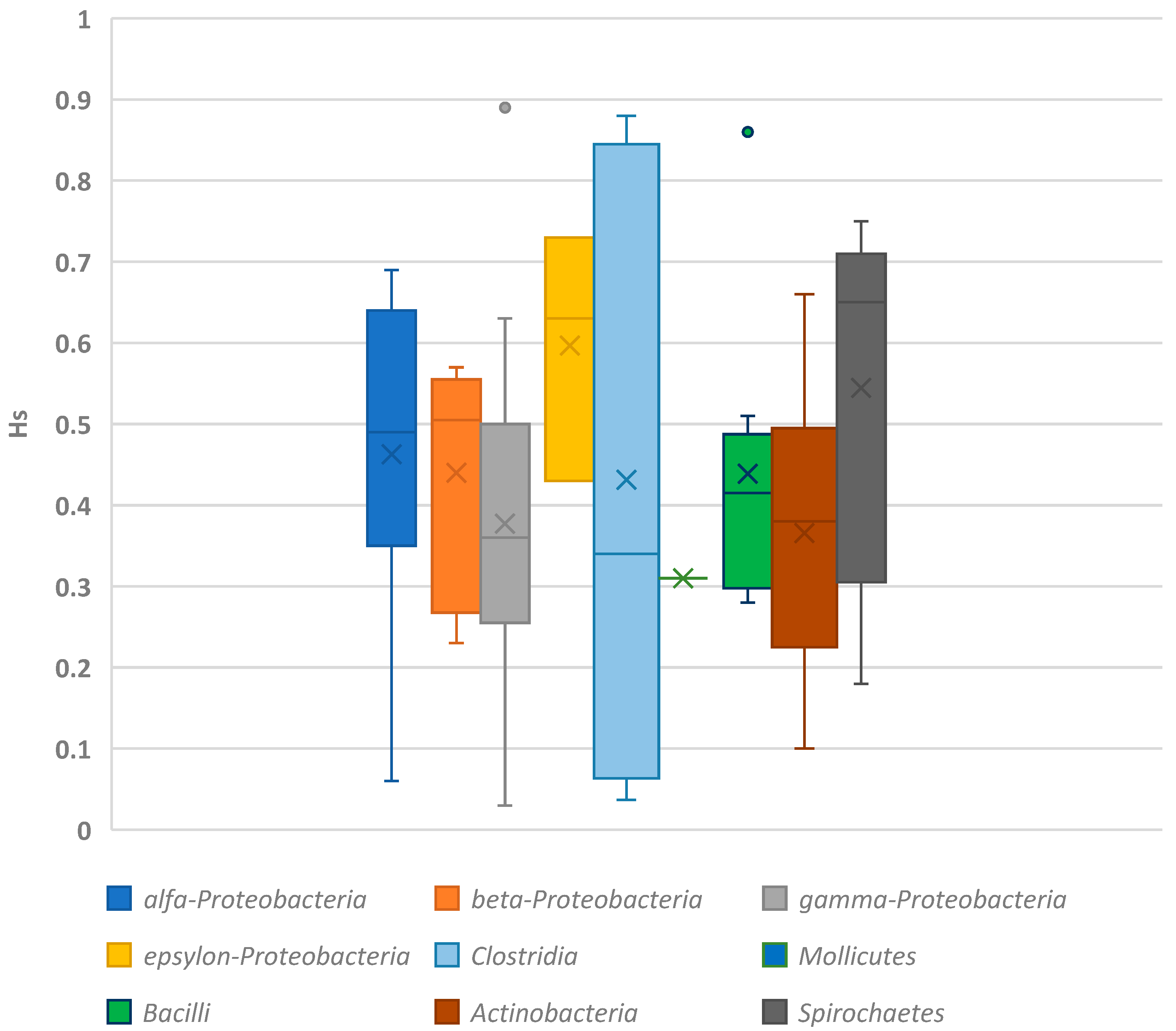
| Class | Species/Strain | HS | Reference |
|---|---|---|---|
| Class I α-Proteobacteria | Acetobacter diazotrophicus | 0.06 | [60] |
| Bradyrhizobium sp. | 0.64 | [61] | |
| Rhizobium etli biovar phaseoli | 0.49 | [62] | |
| Rhizobium leguminosarum biov. phaseoli | 0.69 | [63] | |
| Rhizobium leguminosarum biov. viciae | 0.58 | [64] | |
| Rhizobium legumonosarum biov. trifolii | 0.35–0.43 | [65] | |
| Class II β-Proteobacteria | Burkholderia cepacia | 0.52–0.57 | [66] |
| Bordetella sp. | 0.28 | [67] | |
| Neisseria gonorhoeae | 0.23–0.49 | [68,69] | |
| Neisseria meningitidis | 0.55 | [70] | |
| Class III γ-Proteobacteria | Actinobacillus pleuropneumoniae | 0.31 | [71] |
| Citrobacter diversus | 0.24 | [72] | |
| Escherichia coli | 0.34–0.52 | [73,74] | |
| E. coli (O101 strain) | 0.27 | [75] | |
| E. coli (O20 strain) | 0.45 | [75] | |
| E. coli (O9 strain) | 0.39 | [75] | |
| Edwardsiella ictaluri | 0.03 | [58] | |
| Haemophilus influenzae | 0.47–0.57 | [52,53] | |
| Haemophilus parasuis | 0.40 | [76] | |
| Klabsiella sp. | 0.23 | [77] | |
| Legionella pneumophila | 0.31 | [78] | |
| Pasteurella multocida | 0.30–0.36 | [79] | |
| Pasteurella trechalosi | 0.29 | [80] | |
| Pseudomonas sp. | 0.89 | [55] | |
| Pseudomonas syringae pathovar syringae | 0.48 | [81] | |
| Pseudomonas syringae pv. tomato | 0.08 | [81] | |
| Salmonella sp. | 0.56–0.63 | [82] | |
| Salmonella enteritica | 0.63 | [67] | |
| Vibrio anguillarum | 0.13 | [59] | |
| Vibrio cholerae | 0.44 | [83] | |
| Vibrio ordalii | 0.11 | [59] | |
| Class V ε-Proteobacteria | Campylobacter jejuni | 0.43 | [50] |
| Campylobacter sp. | 0.63 | [84] | |
| Helicobacter pylori | 0.73 | [67] | |
| Mean within all | 0.42 |
| Class | Species/Strain | HS | Reference |
|---|---|---|---|
| Class I Clostridia | Aeromonas salmonicida | 0.037 | [87] |
| Aeromonas sp. | 0.09–0.88 | [88] | |
| Clostridium perfringens | 0.34–0.81 | [89] | |
| Class II Mollicutes | Erysipelothrix sp. | 0.31 | [67] |
| Class III Bacilli | Bacillus subtilis | 0.28 | [90] |
| Listeria monocytogenes | 0.42 | [91,92] | |
| Staphylococcus aureus | 0.29 | [67] | |
| Streptococcus pneumoniae | 0.32–0.41 | [86] | |
| Streptococcus pyogenes | 0.42 | [67] | |
| Streptococcus sp. | 0.86 | [93] | |
| Streptococcus suis | 0.51 | [51] | |
| Mean within Firmicutes | 0.43 | ||
| Actinobacteria | |||
| Class I Actinobacteria | Renibacterium salmoninarum | 0.16 | [94] |
| Dermatophilus congolensis | 0.41 | [95] | |
| Mycobacterium avium | 0.29 | [96] | |
| Mycobacterium avium complex | 0.38 | [97] | |
| Mycobacterium intracellulare | 0.33–0.38 | [98] | |
| Mycobacterium scrofulaceum | 0.66 | ||
| Mycobacterium sp. | 0.58 | [67] | |
| Mycobacterium tuberculosis complex | 0.1 | [99] | |
| Mean within Actinobacteria | 0.33 | ||
| Spirochaetes | |||
| Class I Spirochaetes | Borrelia burgdorferi | 0.67 | [48] |
| Borrelia burgdorferi sensu lato | 0.65–0.75 | [100,101] | |
| Borrelia sp. | 0.67 | [67] | |
| Treponema sp. | 0.75 | [102] | |
| Serpulina hyodysenteriae | 0.29 | [103] | |
| Serpulina pilosicoli | 0.18 | [104] | |
| Serpulina sp. | 0.32–0.62 | [105,106] | |
| Mean within Spirochaetes | 0.54 |
| Origin of Bacteria | Strain Number | HS |
|---|---|---|
| Human (average) | - | 0.42 |
| Human (Australia) | 41 | 0.57 |
| Human (Mexico) | 131 | 0.71 |
| Carnivora individuals | 34 | 0.65 |
| Artiodactyla individuals | 11 | 0.51 |
| Marsupialia individuals | 28 | 0.60 |
| Rodents (Australia) | 17 | 0.52 |
| Rodents (Mexico) | 34 | 0.64 |
| ECOR collection standard * | 13 | 0.49 |
| Sewage | - | 0.61 |
| Markers | Selected Representatives | Samples of Genes or Results of Their Expression |
|---|---|---|
| Quorum sensing inducers | Vibrio fischeri, Pseudomonas aeruginosa, Erwinia stewartia, Aeromonas hydrophila, Staphylococcus aureus, Streptococcus pneumoniae, Bacillus subtilis, Enterococcus faecalis | HHL *, OHHL *, HBHL *, 7,8-cis-HtDHL *, 3-OH PAME **, DSF ***, signal components A, plasmid transferring signals, competention and sporulation compounds, resistance mechanisms shifting, luminescening proteins and extracellular pigments or dyes |
| Glucose metabolism | Aeromonas hydrophila, Brucella suis, Staphylococcus aureus, Neisseria meningitidis, Yersinia pestis, Burkholderia pseudomallei, Bacillus anthracis, Halobacterium salinarum, Lactobacillus delbrueckii bulgaricus, Lactobacillus salivarius, Helicobacter pylori, Bacillus cereus | glk, glcK, nagC, Rru_A2486, HPAG1_1041, BC_0441, BC_4260 |
| Dehydrogenase of CoA modulators | Escherichia coli, Haemophilus influenzae, Salmonella enterica serov. Cholerasuis, Salmonella typhimurium, Yersinia pseudotuberculosis, Aeromonas hydrophila, Nitrosomonas europaea, Pseudomonas aeruginosa, Mycobacterium leprae, Mycobacterium tuberculosis, Nitrosospira multiformis, Pseudomonas fluorescens, Mesorhizobium loti | aceEF, lpdA, pdhA, NOC_1254-1256, Nmul_A0358-59, Pfl_0462-63, Mlr_9539, AHA_3863 |
| Monooxygenase pathways hydroxylating aromatic rings (phenol and toluen) | Pseudomonas putida, Pseudomonas putida, Comamonas. testosteroni, Acinetobacter sp., Burkholderia cepacian, Ralstonia pickettii, Pseudomonas stutzeri, Xanthobacter sp., Ralstonia eutropha | phlABCDEF, dmpKLMNOP, phhKLMNOP, ophKLMNOP, dsoABCDEF, tomA0A1A2A3A4A5, tbmABCDEF, tbuA1UBVA2C, touABCDEF, aamABCDEF, phlKLMOP |
| Vector sequences | Escherichia coli, Pseudomonas sp., Pseudomonas putida, Agrobacterium tumefaciens | pUC8, ColEI, RP4, F, TOL, pTiAch5 |
| Selected bioreceptors | Pseudomonas putida, Pseudomonas fluorescens, Pseudomonas putida, Ralstonia eutropha, Pseudomonas fluorescens, Pseudomonas syringae | luxCDABE, nar, hang, cnrYXH, pUCD607, gfp |
| Target sequences for genetic manipulation | Lactic acid pathway bacteria among others Lactococcus lactis, Lactobacillus plantarum, L. fermentum, L. helveticus, L. delbrüeckii, L. bulgaricus and Streptococcus mutans | idh, aldB, ribC, glk, pepN, pepX, pepC, pepI, gdh, alaD, alr, phyC, amyA |
Disclaimer/Publisher’s Note: The statements, opinions and data contained in all publications are solely those of the individual author(s) and contributor(s) and not of MDPI and/or the editor(s). MDPI and/or the editor(s) disclaim responsibility for any injury to people or property resulting from any ideas, methods, instructions or products referred to in the content. |
© 2025 by the authors. Licensee MDPI, Basel, Switzerland. This article is an open access article distributed under the terms and conditions of the Creative Commons Attribution (CC BY) license.
Share and Cite
Korzekwa, K.; Obuch-Woszczatyńska, O.; Krzyżowska, M. Neglected Genetic Coefficients for Bacterial Diversity as a Supporting Tool for Public Health and Wastewater-Based Epidemiology. Water 2026, 18, 96. https://doi.org/10.3390/w18010096
Korzekwa K, Obuch-Woszczatyńska O, Krzyżowska M. Neglected Genetic Coefficients for Bacterial Diversity as a Supporting Tool for Public Health and Wastewater-Based Epidemiology. Water. 2026; 18(1):96. https://doi.org/10.3390/w18010096
Chicago/Turabian StyleKorzekwa, Karol, Oliwia Obuch-Woszczatyńska, and Małgorzata Krzyżowska. 2026. "Neglected Genetic Coefficients for Bacterial Diversity as a Supporting Tool for Public Health and Wastewater-Based Epidemiology" Water 18, no. 1: 96. https://doi.org/10.3390/w18010096
APA StyleKorzekwa, K., Obuch-Woszczatyńska, O., & Krzyżowska, M. (2026). Neglected Genetic Coefficients for Bacterial Diversity as a Supporting Tool for Public Health and Wastewater-Based Epidemiology. Water, 18(1), 96. https://doi.org/10.3390/w18010096