Spatial Heterogeneity in Economic Benefits of Water Use: Sectoral Analysis of Chinese Cities in 2017


 , ,
, ,  , ,
, ,
Abstract
1. Introduction
2. Materials and Methods
2.1. Dataset
2.2. Method for Calculating the Economic Benefit of Water Use
2.3. Exploratory Spatial Data Analysis Method
3. Results and Analysis
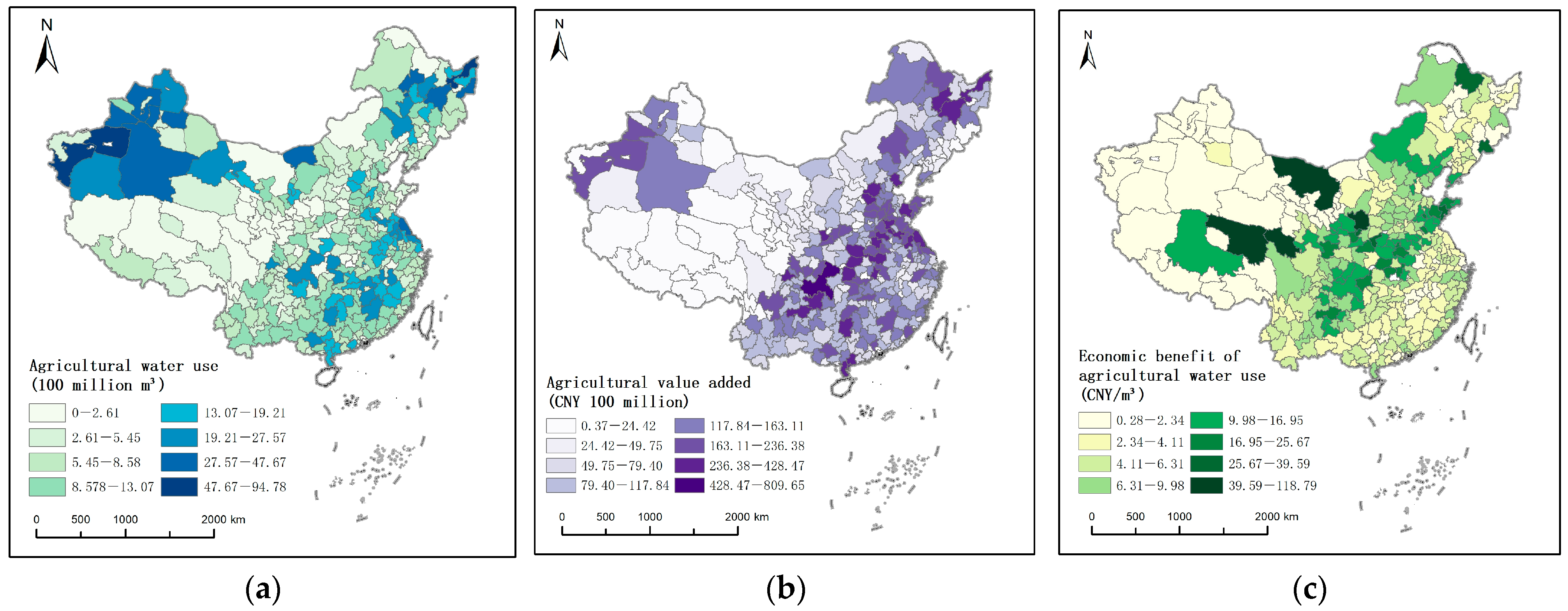
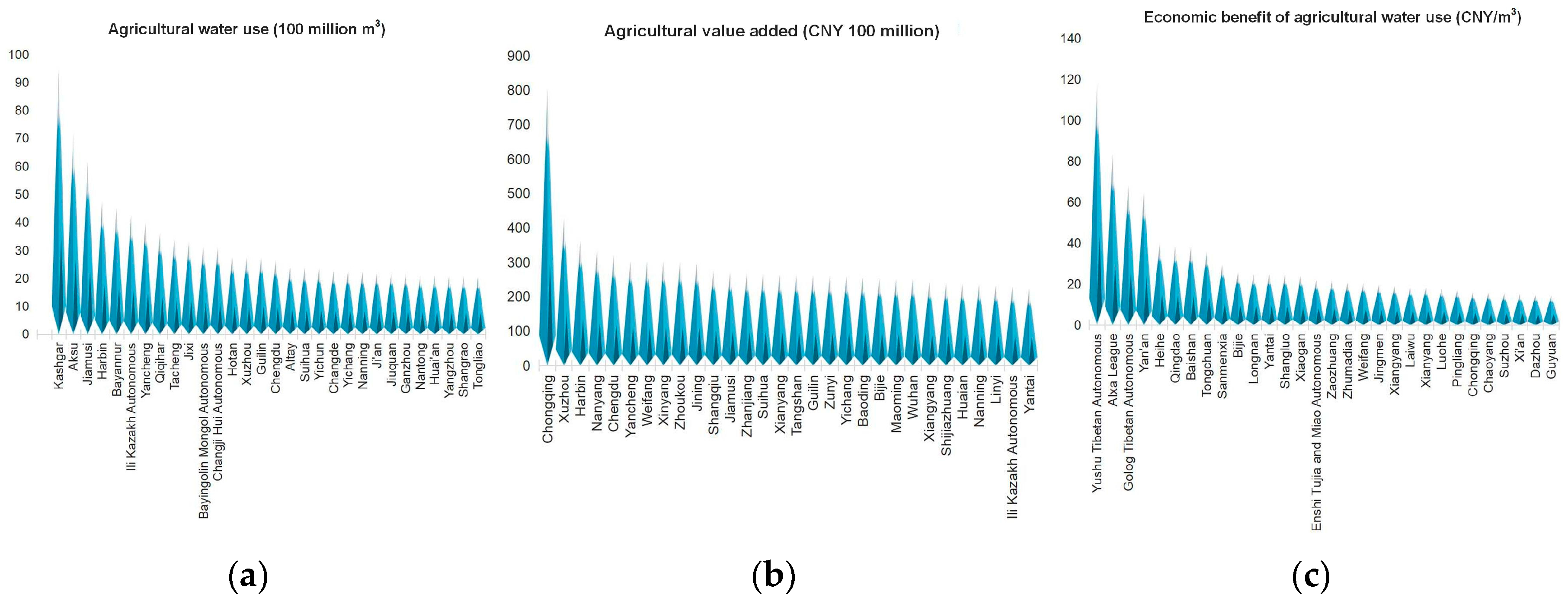
3.1. Spatial Heterogeneity of Economic Benefit of Agricultural Water Use
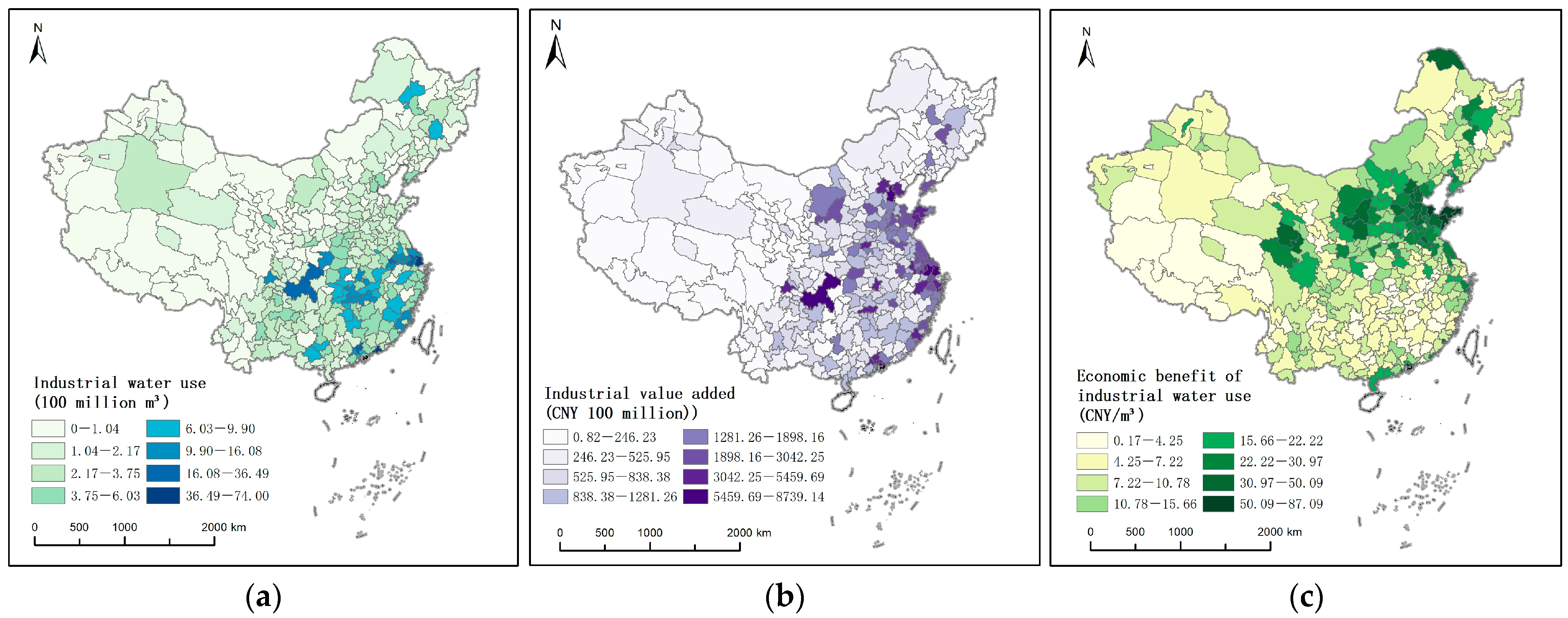
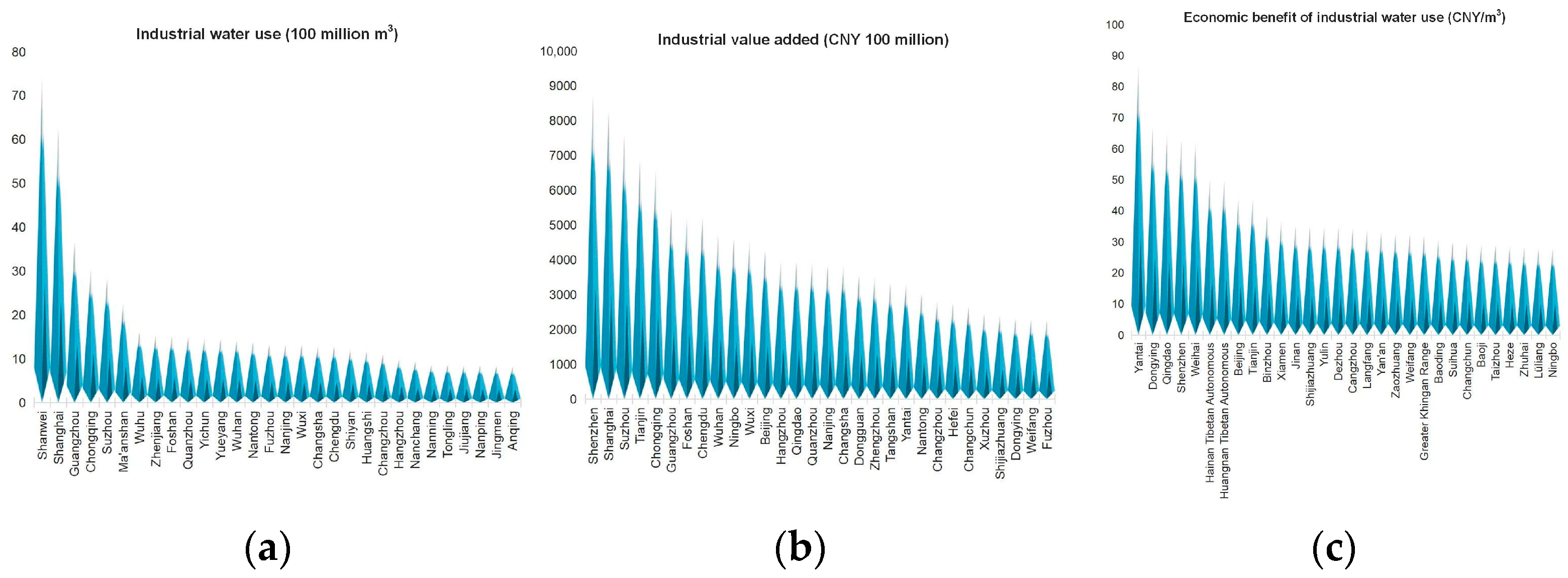
3.2. Spatial Heterogeneity of Economic Benefit of Industrial Water Use
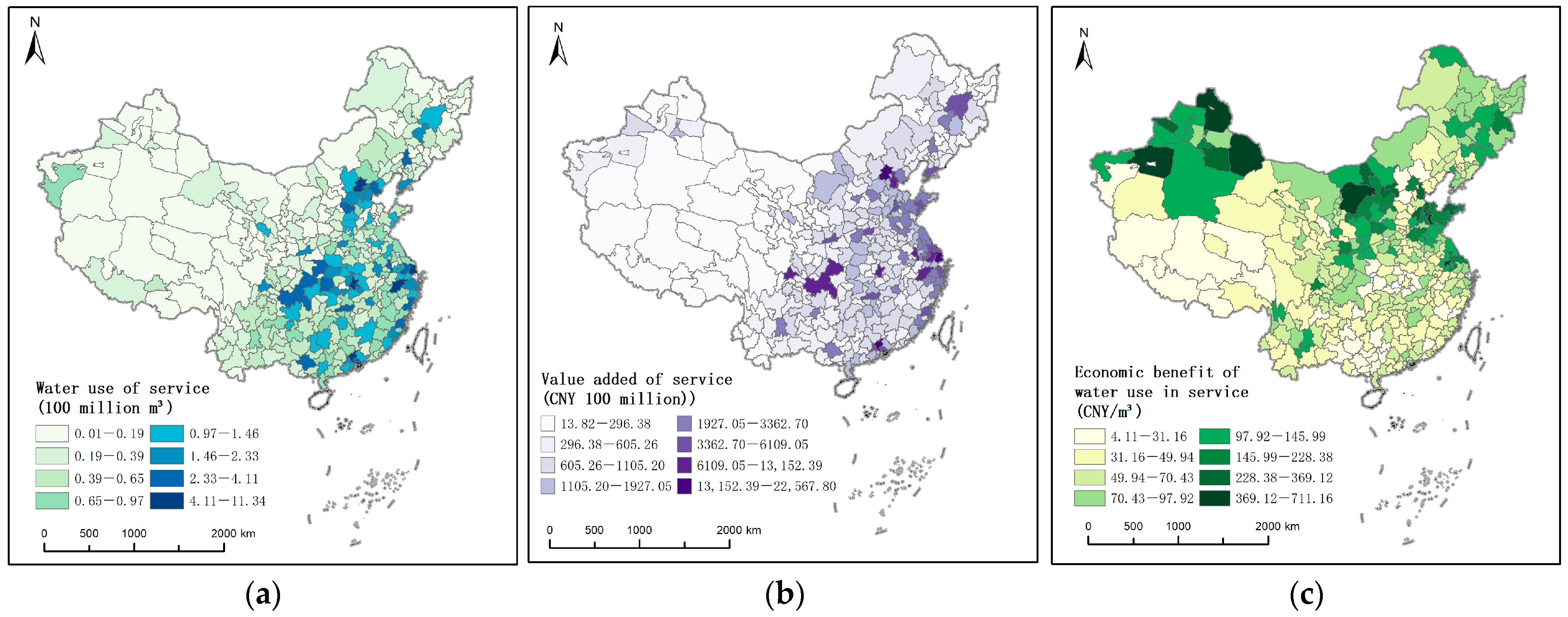
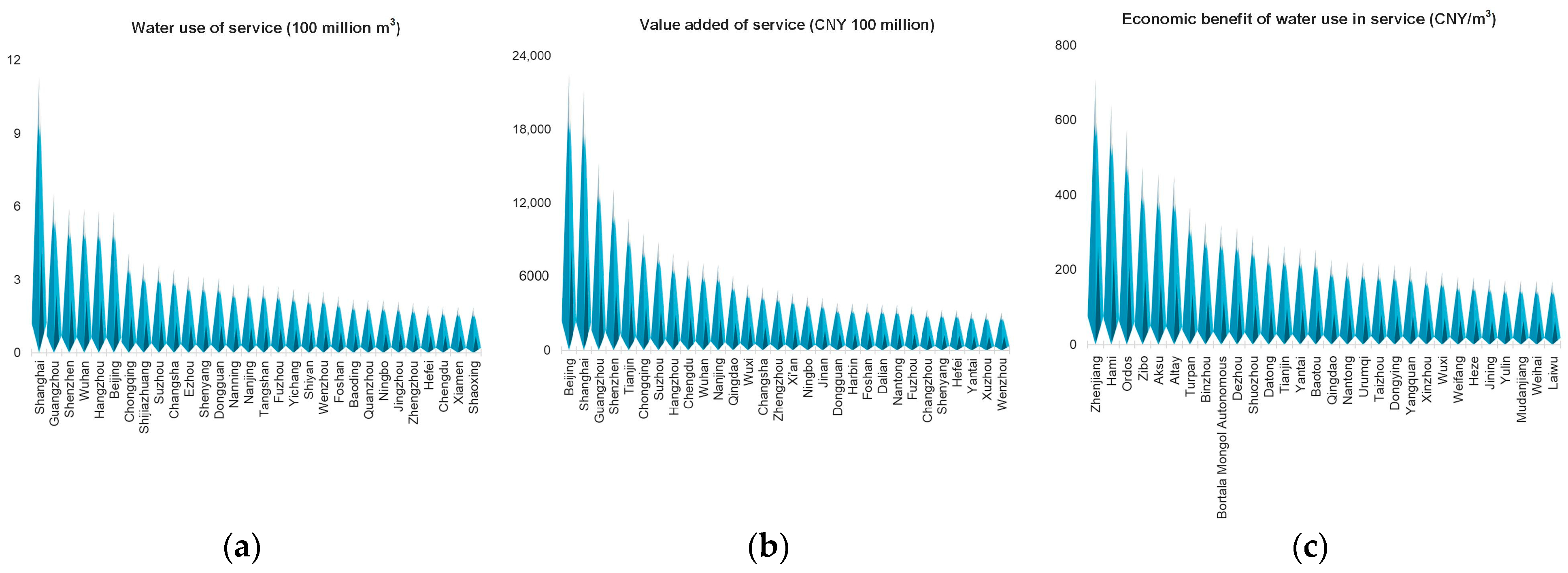
3.3. Spatial Heterogeneity of Economic Benefit of Service Water Use
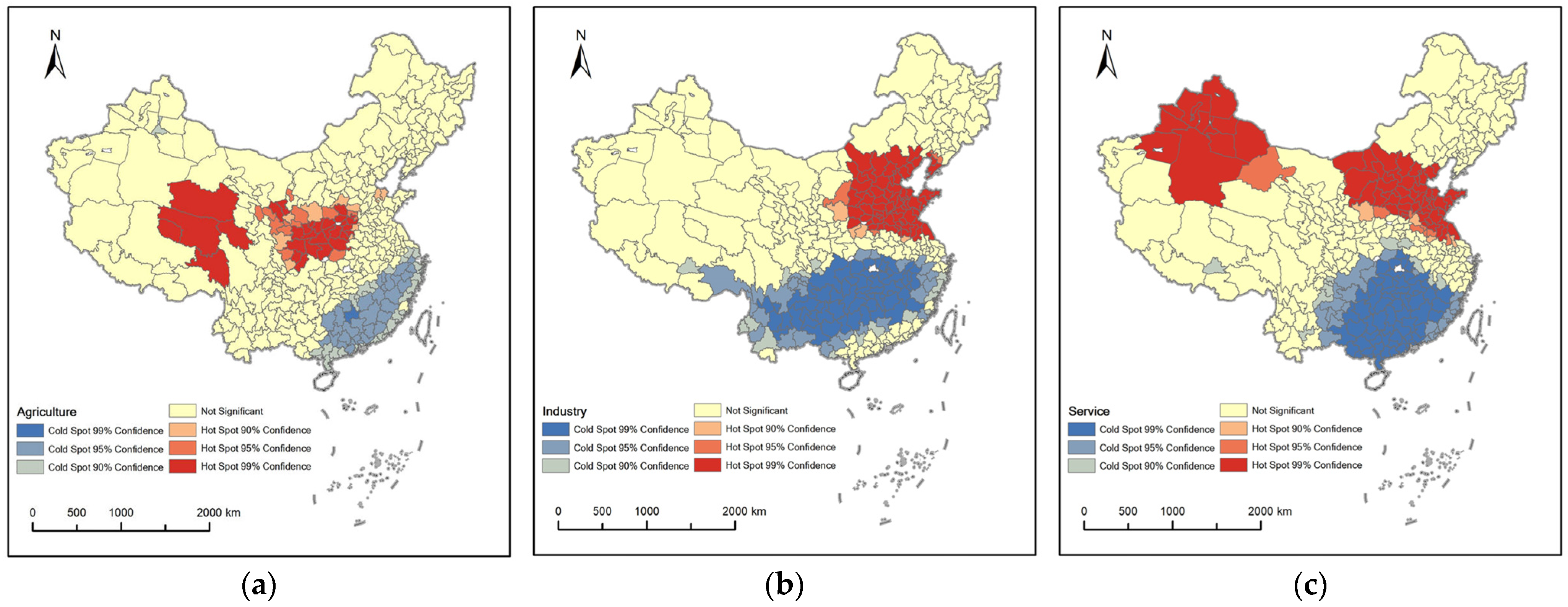
3.4. ESDA for Sectoral Economic Benefit of Water Use
3.5. Preliminary Identification of Potential Water Diversion Areas
4. Discussion
4.1. Spatial Heterogeneity in Economic Benefit of Water Use and Water Resource Allocation of China
4.2. Applicability of the Apportionment Coefficient Method and Insights from Cross-Sectoral Comparison
5. Conclusions
- (1)
- Given that China’s agricultural production relies primarily on irrigation, the high economic benefits of water use regions are primarily concentrated on both sides of the “Hu Huanyong Line”. Regions with high economic benefits from industrial water use are mainly found in the North China Plain, the middle and lower Huanghe River basin, the Yangtze River Delta, the Pearl River Delta, Chongqing, and Chengdu. The economic benefits of service water use are higher in the northern area than in the south.
- (2)
- Global Moran’s I shows statistically significant positive autocorrelation for all three sectors, while the Getis-Ord General G statistic indicates pronounced high-value clustering in industry. Hotspots for agricultural economic benefits of water use are concentrated in central regions such as Henan, Anhui, and Sichuan, as well as the northeastern Qinghai–Tibet Plateau, whereas industry and service benefits are concentrated in the North China Plain, with an extra service hotspot in central-eastern Xinjiang. Cold spots are systematically located south of the Yangtze River—especially the hilly southeast (Zhejiang, Fujian, Hunan, Guangdong)—whereas most southern coastal cities escape the low-benefit zone for all sectors. Spatial hotspot analysis can reveal the partial distribution characteristics of the economic benefit of water use to a certain extent, such as the primary regions exhibiting high or low benefits. ESDA provides significant evidence for the analysis of spatial heterogeneity with regard to the economic benefits of water use in China.
- (3)
- The eastern part of southwestern China, distinguished by its abundant water resources and relatively low elevation, in conjunction with the middle and lower reaches of the Yangtze River, has the potential to function as water export zones. These regions have effectively been designated as transfer areas for the South-to-North Water Diversion Project, including subsequent stages of planning.
Author Contributions
Funding
Data Availability Statement
Conflicts of Interest
Abbreviations
| ESDA | Exploratory Spatial Data Analysis |
References
- Rockström, J.; Falkenmark, M.; Allan, T.; Folke, C.; Gordon, L.; Jägerskog, A.; Kummu, M.; Lannerstad, M.; Meybeck, M.; Molden, D.; et al. The unfolding water drama in the Anthropocene: Towards a resilience-based perspective on water for global sustainability. Ecohydrology 2014, 7, 1249–1261. [Google Scholar] [CrossRef]
- Lyu, H.D.; Xing, H.F.; Duan, T.X. Optimizing Water Resource Allocation for Food Security: An Evaluation of China’s Water Rights Trading Policy. Sustainability 2024, 16, 10443. [Google Scholar] [CrossRef]
- Hoekstra, A.Y.; Mekonnen, M.M. Reply to Ridoutt and Huang: From water footprint assessment to policy. Proc. Natl. Acad. Sci. USA 2012, 109, E1425. [Google Scholar] [CrossRef]
- Liu, D.; Yu, N.Z.; Wan, H.; Ou, J.H.; Yao, S.J.; Wang, Q.H. Water rights trading and corporate productivity: Evidence from a quasi-natural experiment of China’s pilot policy. J. Econ. Surv. 2024, 38, 1846–1872. [Google Scholar] [CrossRef]
- Chen, Y.; Zhang, R.Z.; Dehghanifarsani, L.; Amani-Beni, M. Dynamics and Drivers of Ecosystem Service Values in the Qionglai-Daxiangling Region of China’s Giant Panda National Park (1990–2020). Systems 2025, 13, 807. [Google Scholar] [CrossRef]
- Dong, T.; Wei, Y.Q.; Jin, J.L.; Zhou, P.; Hu, Y.; Chen, M.L.; Zhou, Y.L. Evaluation and Diagnosis of Water Resources Spatial Equilibrium Under the High-Quality Development of Water Conservancy. J. Am. Water Resour. Assoc. 2025, 61, e70014. [Google Scholar] [CrossRef]
- Lou, Y.Q.; Qiu, Q.T.; Zhang, M.T.; Feng, Z.L.; Dong, J. Spatial Equilibrium Evaluation of the Water Resources in Tai’an City Based on the Lorenz Curve and Correlation Number. Water 2023, 15, 2617. [Google Scholar] [CrossRef]
- Li, F.; Du, J.E.; Huang, X.; Xu, X.Y.; Gao, J.Y.; Luo, Z.Y. Spatial equilibrium evaluation of water resources in the water-receiving area of the central route of the South-to-North water diversion project in Henan province. Water Sci. Technol. 2025, 92, 1021–1049. [Google Scholar] [CrossRef] [PubMed]
- Grafton, R.Q.; Williams, J.; Perry, C.J.; Molle, F.; Ringler, C.; Steduto, P.; Udall, B.; Wheeler, S.A.; Wang, Y.; Garrick, D.; et al. The paradox of irrigation efficiency. Science 2018, 361, 748–750. [Google Scholar] [CrossRef] [PubMed]
- Young, H.P.; Okada, N.; Hashimoto, T. Cost Allocation in Water-Resources Development. Water Resour. Res. 1982, 18, 463–475. [Google Scholar] [CrossRef]
- Peng, Z.Y.; Yin, J.X.; Zhang, L.L.; Zhao, J.; Liang, Y.; Wang, H. Assessment of the Socio-Economic Impact of a Water Diversion Project for a Water-Receiving Area. Pol. J. Environ. Stud. 2020, 29, 1771–1784. [Google Scholar] [CrossRef]
- Wu, L.Z.; Bai, T.; Huang, Q. Tradeoff analysis between economic and ecological benefits of the inter basin water transfer project under changing environment and its operation rules. J. Clean. Prod. 2020, 248, 119294. [Google Scholar] [CrossRef]
- Yu, M.; Wang, C.R.; Liu, Y.; Olsson, G.; Wang, C.Y. Sustainability of mega water diversion projects: Experience and lessons from China. Sci. Total Environ. 2018, 619, 721–731. [Google Scholar] [CrossRef]
- Ju, Y.S.; Sun, Y.Y.; Ning, W.Q.; Li, Q.G.; Lin, Y.Y.; Chen, H.; Yang, S.X. Cost Apportionment Method for Transmission and Distribution Projects Based on Multiple Apportionment Factors. Sustainability 2024, 16, 8844. [Google Scholar] [CrossRef]
- He, G.; Zhang, S.Y.; Zhang, S.Y. Analysis of Decoupling State between Water Use Efficiency and Economic Development under Rank-Sum Score Hierarchy -Anhui Province as an Example. Pol. J. Environ. Stud. 2025, 34, 6189–6201. [Google Scholar] [CrossRef]
- Liu, B.; Zhang, L.R.; Wang, W.P.; Sun, C.W.; Dong, S.F.; Wang, Z.W. Development of a conceptual regional industrial water use efficiency model driven by economic development level. J. Hydrol.-Reg. Stud. 2024, 55, 101926. [Google Scholar] [CrossRef]
- Quan, Z.M.; Zuo, Q.T.; Zang, C.; Wu, Q.S. A multi-index comprehensive evaluation method for assessing the water use balance between economic society and ecology considering efficiency-development-health-harmony. Sci. Rep. 2024, 14, 25924. [Google Scholar] [CrossRef]
- Yin, Y.Y.; Wang, L.; Wang, Z.J.; Tang, Q.H.; Piao, S.L.; Chen, D.L.; Xia, J.; Conradt, T.; Liu, J.G.; Wada, Y.; et al. Quantifying Water Scarcity in Northern China Within the Context of Climatic and Societal Changes and South-to-North Water Diversion. Earths Future 2020, 8, e2020EF001492. [Google Scholar] [CrossRef]
- Wang, D.; Jia, J.W.; Bing, J.P.; Liang, Z.M. Study on benefits evaluation of water diversion project: Case study in water transfer from the Yangtze River to Lake Taihu. In Proceedings of the 5th International Conference on Water Resource and Environment (Wre 2019), Macao, China, 16–19 July 2019; Volume 344. [Google Scholar] [CrossRef]
- Ni, Y.K.; Chen, Y. Does the implementation sequence of adaptive management countermeasures affect the collaborative security of the water-energy-food nexus? A case study in the Yangtze River Economic Belt. Ecol. Indic. 2024, 163, 112090. [Google Scholar] [CrossRef]
- Ilyas, A.; Manzoor, T.; Muhammad, A. A Dynamic Socio-Hydrological Model of the Irrigation Efficiency Paradox. Water Resour. Res. 2021, 57, e2021WR029783. [Google Scholar] [CrossRef]
- Shi, C.F.; Shang, T.; Zhi, J.Q.; Na, X.H. Research on the impact of China’s new urbanization on industrial water utilization efficiency—Based on spatial spillover effects and threshold characteristics. Water Sci. Technol. 2023, 87, 1832–1852. [Google Scholar] [CrossRef]
- Ding, X.H.; Fu, Z.; Jia, H.W. Study on Urbanization Level, Urban Primacy and Industrial Water Utilization Efficiency in the Yangtze River Economic Belt. Sustainability 2019, 11, 6571. [Google Scholar] [CrossRef]
- National Bureau of Statistics. China Statistical Yearbook 2018; China Statistics Press: Beijing, China, 2018. [Google Scholar]
- Tu, X. Economic benefit analysis of the west route of South-North Water Diversion Project in China. Water Resour. Plan. Des. 1998, 29–33. (In Chinese) [Google Scholar]
- Dall’erba, S. Exploratory Spatial Data Analysis. In International Encyclopedia of Human Geography; Kitchin, R., Thrift, N., Eds.; Elsevier: Oxford, UK, 2009; pp. 683–690. [Google Scholar]
- Symanzik, J. Exploratory Spatial Data Analysis. In Handbook of Regional Science; Fischer, M.M., Nijkamp, P., Eds.; Springer: Berlin/Heidelberg, Germany, 2021; pp. 1845–1861. [Google Scholar]
- Cao, X.; Liu, Y.; Li, T.; Liao, W. Analysis of Spatial Pattern Evolution and Influencing Factors of Regional Land Use Efficiency in China Based on ESDA-GWR. Sci. Rep. 2019, 9, 520. [Google Scholar] [CrossRef]
- Mu, L.; Fang, L.; Dou, W.; Wang, C.; Qu, X.; Yu, Y. Urbanization-induced spatio-temporal variation of water resources utilization in northwestern China: A spatial panel model based approach. Ecol. Indic. 2021, 125, 107457. [Google Scholar] [CrossRef]
- Xu, W.J.; Zhang, X.P.; Xu, Q.; Gong, H.L.; Li, Q.; Liu, B.; Zhang, J.W. Study on the Coupling Coordination Relationship between Water-Use Efficiency and Economic Development. Sustainability 2020, 12, 1246. [Google Scholar] [CrossRef]
- Lankford, B.A. Resolving the paradoxes of irrigation efficiency: Irrigated systems accounting analyses depletion-based water conservation for reallocation. Agric. Water Manag. 2023, 287, 108437. [Google Scholar] [CrossRef]
- Cai, W.J.; Jiang, X.H.; Sun, H.T.; Lei, Y.X.; Nie, T.; Li, L.C. Spatial scale effect of irrigation efficiency paradox based on water accounting framework in Heihe River Basin, Northwest China. Agric. Water Manag. 2023, 277, 108118. [Google Scholar] [CrossRef]
- Kalvani, S.R.; Celico, F. Analysis of Pros and Cons in Using the Water-Energy-Food Nexus Approach to Assess Resource Security: A Review. Sustainability 2024, 16, 2605. [Google Scholar] [CrossRef]
- Zhu, Y.; Zhang, C.Z.; Huang, D.C. Assessing Urban Water-Energy-Food Security: A Case of Yangtze River Delta Urban Agglomeration. Soc. Indic. Res. 2024, 175, 487–516. [Google Scholar] [CrossRef]
- Wang, X.X.; Xiao, X.M.; Zou, Z.H.; Dong, J.W.; Qin, Y.W.; Doughty, R.B.; Menarguez, M.A.; Chen, B.Q.; Wang, J.B.; Ye, H.; et al. Gainers and losers of surface and terrestrial water resources in China during 1989–2016. Nat. Commun. 2020, 11, 3471. [Google Scholar] [CrossRef]
- Zou, D.L.; Cong, H.B. Evaluation and influencing factors of China’s industrial water resource utilization efficiency from the perspective of spatial effect. Alex. Eng. J. 2021, 60, 173–182. [Google Scholar] [CrossRef]
- Okamoto, S.; Hayashi, M.; Nakajima, M.; Kainuma, Y.; Shiozawa, K. A Factor-Analysis Multiple-Regression Model for Source Apportionment of Suspended Particulate Matter. Atmos. Environ. Part A-Gen. Top. 1990, 24, 2089–2097. [Google Scholar] [CrossRef]
- Yu, E.R.; Li, Y.; Li, F.; He, C.Y.; Feng, X.H. Source apportionment and influencing factors of surface water pollution through a combination of multiple receptor models and geodetector. Environ. Res. 2024, 263, 120168. [Google Scholar] [CrossRef] [PubMed]
- Berrittella, M.; Hoekstra, A.Y.; Rehdanz, K.; Roson, R.; Tol, R.S.J. The economic impact of restricted water supply: A computable general equilibrium analysis. Water Res. 2007, 41, 1799–1813. [Google Scholar] [CrossRef]
- Czyzewski, B.; Staniszewski, J.; Staniszewska, J.; Guth, M. Does Increasing Agricultural Efficiency Contribute to Food Security-Trade-Offs of Value Addition in Crop Production? Sustain. Dev. 2025, 33, 939–970. [Google Scholar] [CrossRef]
- Fu, P.; Zhang, Y. Enhancing resource efficiency and value addition in food and agricultural by-product processing: A green recycling approach. Front. Sustain. Food Syst. 2025, 9, 1589807. [Google Scholar] [CrossRef]
- Qamar, Z.; Munir, A.; Langrish, T.; Ghafoor, A.; Tahir, M. Experimental and Numerical Simulations of a Solar Air Heater for Maximal Value Addition to Agricultural Products. Agriculture 2023, 13, 387. [Google Scholar] [CrossRef]
- Keesstra, S.; Nunes, J.; Novara, A.; Finger, D.; Avelar, D.; Kalantari, Z.; Cerdà, A. The superior effect of nature based solutions in land management for enhancing ecosystem services. Sci. Total Environ. 2018, 610, 997–1009. [Google Scholar] [CrossRef] [PubMed]
- Fang, L.; Zhang, L. Does the trading of water rights encourage technology improvement and agricultural water conservation? Agric. Water Manag. 2020, 233, 106097. [Google Scholar] [CrossRef]
- Lyu, J.; Mo, S.H.; Jiang, K.X.; Yan, S.Y. Seeking a pathway towards a more sustainable human-water relationship by coupled model—From a perspective of socio-hydrology. J. Environ. Manag. 2024, 368, 122231. [Google Scholar] [CrossRef] [PubMed]
- Xu, X.H.; Chen, Y.S.; Zhou, Y.; Liu, W.Y.; Zhang, X.R.; Li, M. Sustainable management of agricultural water rights trading under uncertainty: An optimization-evaluation framework. Agric. Water Manag. 2023, 280, 108212. [Google Scholar] [CrossRef]
- Lyu, F.; Zhang, H.B.; Dang, C.H.; Ding, H.; Ye, Z.X. Tracking and assessing water behaviors in the management of irrigation districts’ water rights trading through water accounting. Agric. Water Manag. 2025, 318, 109741. [Google Scholar] [CrossRef]
- Tembo, G.; Banda, K.; Chundu, M.L.; Lyoba, C.; Sichingabula, H.; Nyambe, I. Direct market valuation method to evaluate economic value of provisioning ecosystem services on household income in Zambia’s Bangweulu Wetland. Front. Environ. Sci. 2025, 13, 1538921. [Google Scholar] [CrossRef]
- Song, Z.; Chen, M.; Zhou, H.Z.; Xiao, Y.X.; Wang, T.; Shi, Z. Evaluation of ecosystem service value based on land use change and analysis of driving forces in Ningxiang City, a representative county in the metropolitan hinterland in Hunan Province, China. Front. Environ. Sci. 2025, 13, 1672389. [Google Scholar] [CrossRef]



| Sector | Moran’s I | Getis-Ord’s General G 1 | |||
|---|---|---|---|---|---|
| I | Z Score | p Value | Z Score | p Value | |
| agriculture | 0.07 | 5.75 | <0.01 | 1.58 | 0.11 |
| industry | 0.38 | 26.84 | <0.01 | 7.90 | <0.01 |
| service | 0.18 | 12.92 | <0.01 | 1.98 | <0.05 |
Disclaimer/Publisher’s Note: The statements, opinions and data contained in all publications are solely those of the individual author(s) and contributor(s) and not of MDPI and/or the editor(s). MDPI and/or the editor(s) disclaim responsibility for any injury to people or property resulting from any ideas, methods, instructions or products referred to in the content. |
© 2025 by the authors. Licensee MDPI, Basel, Switzerland. This article is an open access article distributed under the terms and conditions of the Creative Commons Attribution (CC BY) license.
Share and Cite
Liang, Y.; Jia, S.; Lan, L.; Song, Z.; Yan, J.; Zhu, W.; Han, Y.; Liu, W.; Abulizi, K.; Deng, J. Spatial Heterogeneity in Economic Benefits of Water Use: Sectoral Analysis of Chinese Cities in 2017. Water 2026, 18, 71. https://doi.org/10.3390/w18010071
Liang Y, Jia S, Lan L, Song Z, Yan J, Zhu W, Han Y, Liu W, Abulizi K, Deng J. Spatial Heterogeneity in Economic Benefits of Water Use: Sectoral Analysis of Chinese Cities in 2017. Water. 2026; 18(1):71. https://doi.org/10.3390/w18010071
Chicago/Turabian StyleLiang, Yuan, Shaofeng Jia, Lihua Lan, Zikun Song, Jiabao Yan, Wenbin Zhu, Yan Han, Wenhua Liu, Kailibinuer Abulizi, and Jieming Deng. 2026. "Spatial Heterogeneity in Economic Benefits of Water Use: Sectoral Analysis of Chinese Cities in 2017" Water 18, no. 1: 71. https://doi.org/10.3390/w18010071
APA StyleLiang, Y., Jia, S., Lan, L., Song, Z., Yan, J., Zhu, W., Han, Y., Liu, W., Abulizi, K., & Deng, J. (2026). Spatial Heterogeneity in Economic Benefits of Water Use: Sectoral Analysis of Chinese Cities in 2017. Water, 18(1), 71. https://doi.org/10.3390/w18010071