Abstract
Soil water flux is a key parameter for understanding water and heat transport processes in the vadose zone. The heat pulse technique (HPT) has shown considerable potential for predicting soil water flux. Traditional three-needle probe methods, the maximum dimensionless temperature difference (MDTD) method and the ratio of downstream to upstream temperature increases (Ratio) method, can only measure water flux along the probe alignment. To enhance the applicability of the HPT method, the five-needle probe with vector addition allows for the measurement of soil water flux in any direction within the plane perpendicular to the needles. However, its applicability across different soil textures remains unclear. The objective of this study was to evaluate the applicability of the MDTD and Ratio methods when combined with vector addition across different soil textures. Experimental results show that the vector MDTD and Ratio methods improve water flux measurement accuracy compared with traditional three-needle methods, confirming the reliability of the vector HPT approach. Specifically, the mean absolute percentage error (MAPE) of the vector MDTD method decreased by 1.69%, 1.04%, and 1.80% in sand, sandy loam, and silt loam, respectively, compared with the traditional MDTD method. In contrast, the MAPE of the vector Ratio method varied by +8.83%, −6.73%, and −18.20% in the same soils, relative to the traditional Ratio method. Examining the root mean square error (RMSE) of each method yields a similar conclusion. Similarly to traditional HPT methods, the measurement accuracy of the vector HPT approach is influenced by soil texture, water flux range, and probe spacing. Notably, because the vector HPT method involves four probe spacings, namely the distances between the heating needle and the temperature-sensing needles, it can exacerbate the instability of the resultant water flux measurements. These findings may facilitate the broader application of the HPT method.
1. Introduction
Soil water represents a fundamental state variable that governs mass transport and energy exchange within the vadose zone [1,2,3,4]. Variations in soil water dynamics influence a wide range of hydrological processes, including rainfall infiltration [5], surface runoff [6], preferential flow [7], and plant transpiration and photosynthesis [8,9]. Understanding these processes requires accurate quantification of soil water flux, as it provides direct insight into the movement of water within the soil [10]. Advances in temperature monitoring technology have created opportunities to use heat as a tracer for estimating water flux [11,12]. Among these approaches, the heat pulse technique (HPT) is a commonly used method for measuring soil water flux [13,14].
By using the HPT method, a heat pulse is applied to a linear heat source, and then the resulting temperature responses are measured at equidistant positions upstream and downstream of the source [15]. The probes used for these measurements typically consist of three parallel needles: one containing the heat source and the other two containing temperature sensors [16]. Common analytical approaches are based on either the maximum dimensionless temperature difference (MDTD method) or the temperature rise ratio (Ratio method), with calculations based on the measurements from the upstream and downstream probes [17,18]. The accuracy of water flux measurements using these two methods is influenced by soil texture and the range of fluxes [19,20].
Although three-needle probes can be used to measure soil water flux, they can only quantify the component along the needle alignment. For water fluxes of arbitrary direction and magnitude in the plane, the flux can be determined by vector addition of measurements along two orthogonal directions. This requires a five-needle probe, which consists of a central heater needle surrounded by four temperature sensor needles arranged orthogonally around it [21]. Under unsaturated conditions, the inverse method, combined with finite element simulations, has been used to measure and analyze temporal variations in both horizontal and vertical components of water flux in sand, sandy loam, and sandy clayey loam [22]. In saturated sand, the inverse method combined with vector addition was used to determine soil water flux vectors, and the root mean square error of the resultant water flux density was within 0.107 log(cm·h−1) for fluxes below 7000 cm·d−1 [23].
Currently, studies using the five-needle probe have mostly been conducted in saturated sand [23,24,25], and limited information is available regarding the influence of soil texture on the prediction accuracy of resultant water flux derived from vector addition. Furthermore, although the five-needle probe method offers the advantage of measuring water flux without considering probe installation angles, its measurement accuracy and reliability require further evaluation. This is due to the increased number of probe–spacing parameters. The objective of this study was to use a seven-needle heat pulse probe (SHPP) to simultaneously apply both the five–needle and three-needle methods, and to evaluate the applicability of the MDTD and Ratio methods when combined with vector addition across soils of different textures. Traditional HPT methods were used as a reference to further investigate the advantages, limitations, and underlying mechanisms of these methods, providing insights for their broader application.
2. Materials and Methods
2.1. Theory
For homogeneous soil with water moving uniformly in the x-direction, the two-dimensional heat conduction–convection equation can be expressed as follows [17]:
where T is temperature (K); t is time (s); α is the thermal diffusivity of saturated soils (m2·s−1); x and y are coordinates; V is the thermal front advection speed (m·s−1), which is defined as follows [17]:
where J is soil water flux (m·s−1); Cw is the volumetric heat capacity of water (MJ·m−3·K−1); Cb is the volumetric heat capacity of saturated soils (MJ·m−3·K−1).
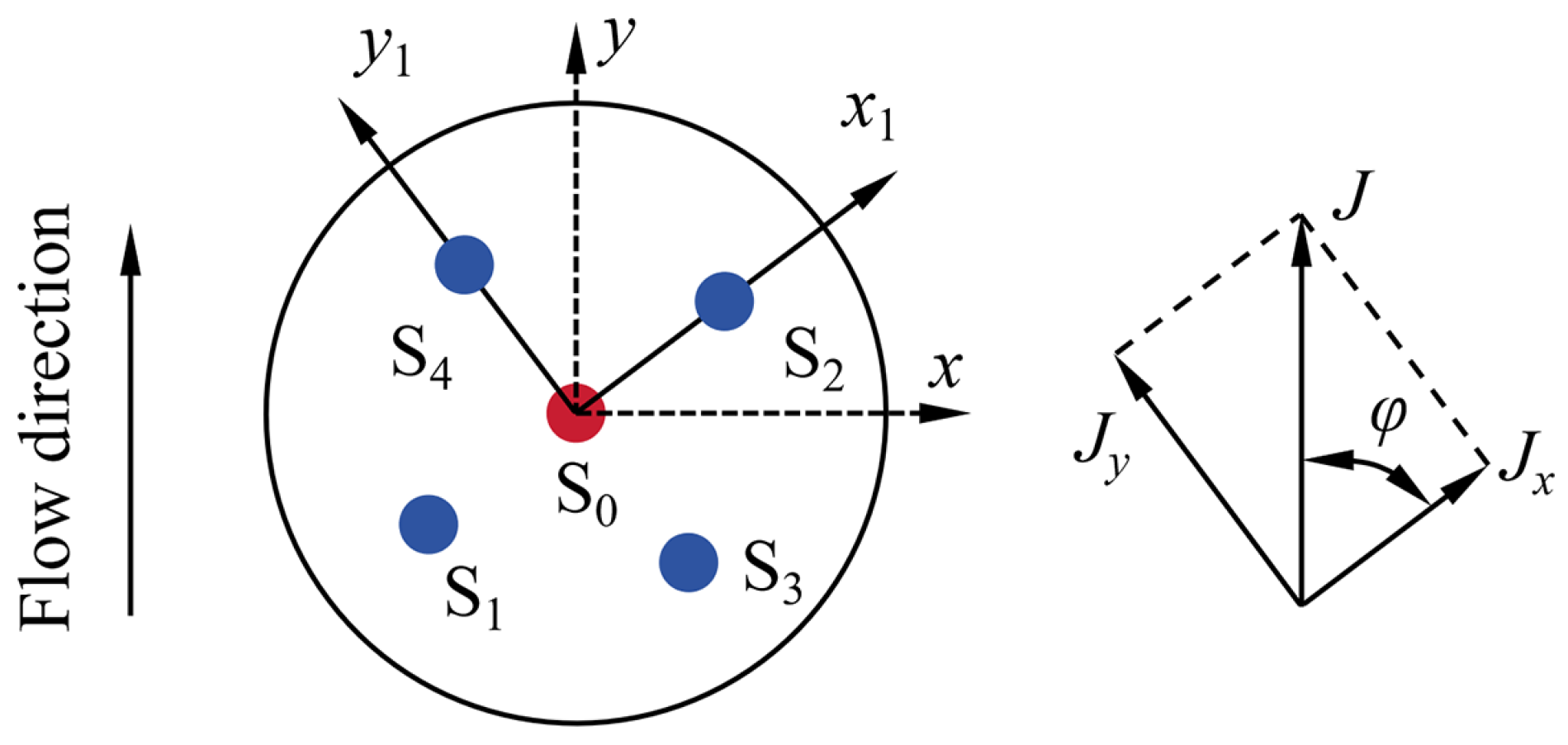
Under the condition of an infinite line heat source located at (x, y) = (0, 0) and normal to the x–y plane (Figure 1), the analytical solution to Equation (1) can be derived through the integral transform method [17].
where q is the heating power (W·m−1); λ is the thermal conductivity of saturated soils (W·m−1·K−1); t0 is the duration of the heat pulse (s); s is the variable of integration.
Figure 1.
Schematic diagram of planar vector water flux measurement in the plane normal to the probe axis. Note: S0 is the heating needle; S1–S4 are four thermocouple needles; Jx and Jy are the water flux in the S1S2 and S3S4 directions; J is the resultant water flux; φ is the angle between the S1S2 line and the flow direction.
Ren et al. [17] proposed a theoretical expression for soil water flux based on the dimensionless temperature difference (DTD) between the downstream and upstream locations that varies over time.
where Td and Tu are the temperature increase (K) at the downstream and upstream probes, respectively; xd and xu are the distance (m) from the heater to the downstream and upstream probes, respectively; tm represents the time at which the DTD reaches a maximum (s).
Wang et al. [18] simplified the calculation by using the ratio of Td/Tu. For t >> t0, water flux can be approximated as:
The Ratio and MDTD methods, which employ a three-needle probe, an determine water flux density only along the direction of the needle alignment. Within the two-dimensional x–y plane normal to the heating needle (Figure 1), the water flux vector can be obtained through vector addition of its component fluxes along any two orthogonal axes. When combined with vector addition, the Ratio and MDTD methods are referred to as the vector Ratio method and the vector MDTD method, respectively.
where Jx and Jy are the water flux in the S1S2 and S3S4 directions, respectively (m·s−1); φ is the angle between the S1S2 line and the flow direction (°).
2.2. Experimental Setup
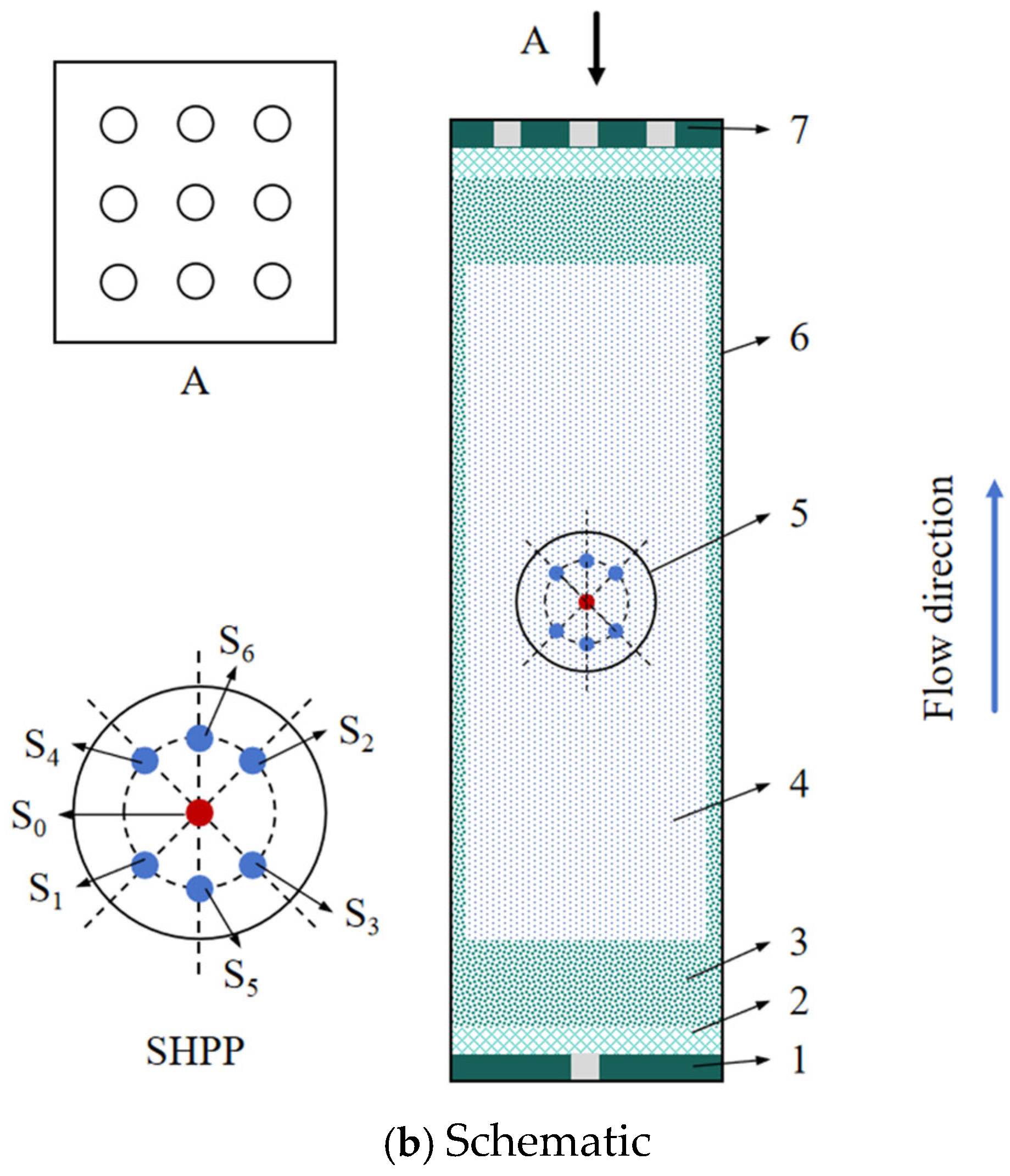
To enable the simultaneous application of the traditional HPT and the vector HPT methods, a SHPP was developed. The SHPP comprised a central heating needle (2 mm in diameter) encircled by six T-type thermocouples (TFE-T-20S, Omega Engineering Inc., Stamford, CT, USA) housed in 1 mm stainless-steel tubes. All needles were aligned parallel to each other with a uniform length of 20 mm, and the thermocouples were spaced 4 mm from the heating needle center-to-center. The heating needle contained a heating resistance wire encased within a stainless steel casing, and the residual internal space was densely filled with MgO ceramic. The resistance of the heating wire was 17.2 Ω, and the applied voltage was 15 V. The S1–S2 and S3–S4 lines were mutually perpendicular, and both formed an angle of 45° with the S5–S6 line (Figure 2b). The five–needle configuration (S0–S4) enabled the determination of the magnitude and direction of water flux within the plane perpendicular to the probe needles using the vector HPT method (Figure 1). The two additional probes (S5–S6) were used to measure water flux along the flow direction using the traditional HPT method.

Figure 2.
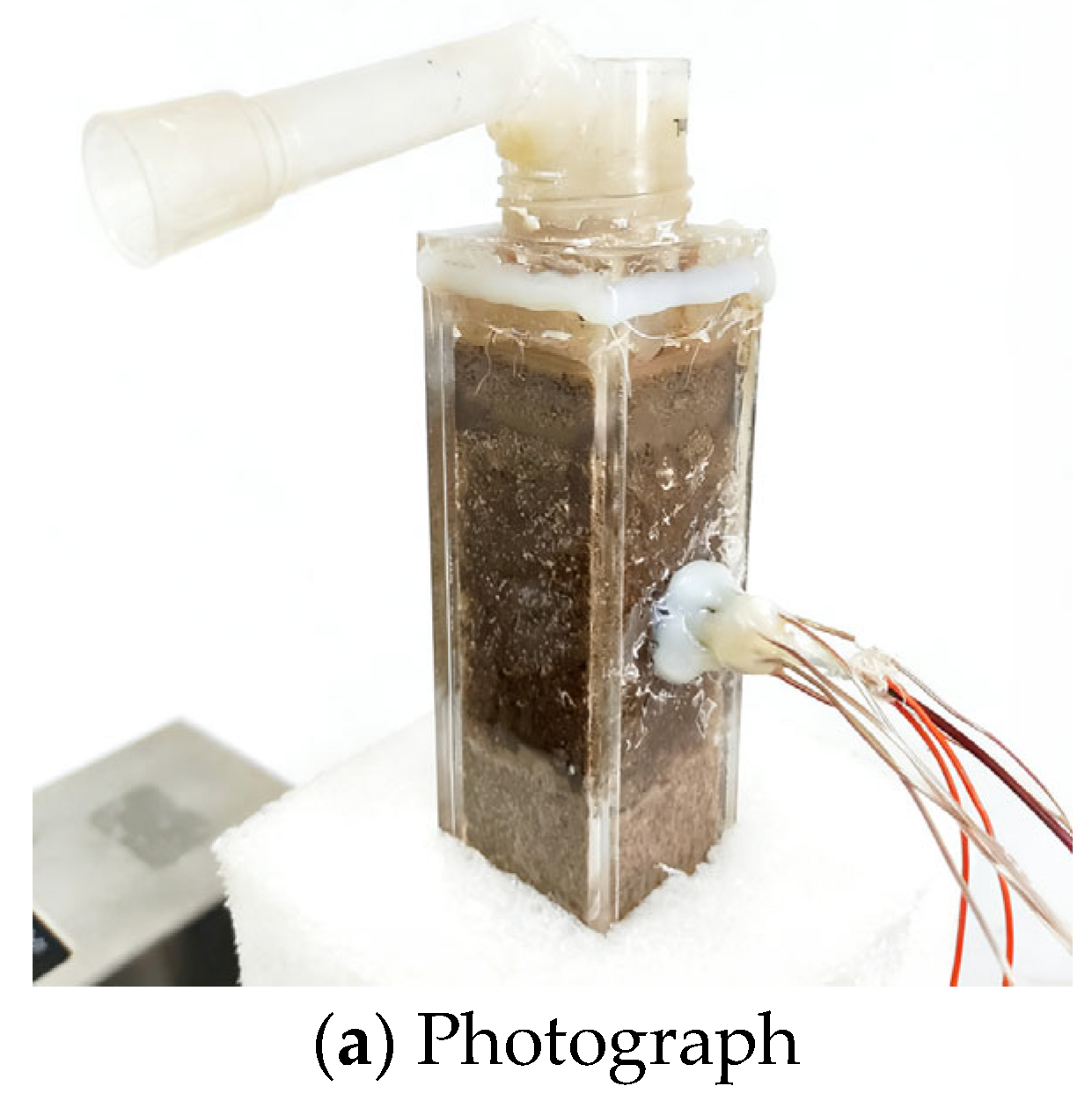
Experimental soil column. Note: The seven-needle heat pulse probe (SHPP) consists of a heating needle (S0) and six thermocouple needles (S1–S6). 1. Bottom lid 2. Sponge 3. Sand 4. Soil sample 5. SHPP 6. Acrylic vessel 7. Top lid A. Upper view of the soil column.
The experiments were conducted indoors using a transparent acrylic vessel (internal dimensions: 30 mm × 30 mm × 100 mm) filled with soil samples (Figure 2a). A layer of glue was evenly applied to the inner surface of the acrylic vessel to adhere sand to prevent preferential flow caused by the air gap at the soil–acrylic interface. Three soil types were tested: sand, sandy loam, and silt loam, with parameters listed in Table 1. The soil samples were air-dried and sieved through a 2 mm mesh, and then moistened with distilled water to a uniform volumetric water content of about 0.10 m3·m−3. To achieve the predetermined bulk density (Table 1), the moist soil was packed into the acrylic chamber in 10 mm layers until a final height of 80 mm was reached. Sponge and sand layers were placed at both the top and bottom of the soil column to ensure a uniform water flux distribution across the cross-sectional area. To prevent soil loss due to water movement, the top and bottom ends of the soil column were sealed. The top lid was perforated evenly to prevent water accumulation at the outlet and to ensure uniform hydraulic resistance across the soil cross-section. The acrylic square column was designed with holes drilled in the sidewalls, matching the diameter of the probes. The SHPP was inserted horizontally into the soil through a precut hole in the center of the acrylic square column, and the gap between the probes and the tube was filled with wax. In the probe arrangement, the S5–S6 line was kept parallel to the central axis of the soil column, with the S5 needle positioned upstream of the heating needle (Figure 2b).
Table 1.
Particle size distribution and bulk density for the three soils.
Before the experiment, distilled water was slowly supplied to saturate the soil column for 24 h using a peristaltic pump (BT100–1, Baoding Qili Constant Flow Pump Co., Ltd., Baoding, China). The pump speed was manually adjusted to regulate the flux within a range of 0 to 90 μm·s−1 by monitoring the mass of water exiting the soil column. After the water flux had stabilized, a constant direct current was applied to the heater probe to generate a 5 s heat pulse. Additionally, temperature–time data at the S1–S6 points were recorded for 80 s at 0.25 s intervals using a temperature acquisition module (DAM–3130F, ART Technology, Beijing, China). Each treatment was replicated three times.
2.3. Probe Spacing Calibration and Model Evaluation
The effective spacing between the heater and temperature sensors significantly affects the accuracy of water flux measurements using the HPT method. In this study, the probe spacing in the saturated soil column was corrected in situ using the method described by Mori et al. [26]. A nonlinear optimization technique was applied to estimate the probe spacing from the temperature–time data and the thermal properties of the saturated soils (Table 2), which were calculated as described by Ren et al. [27,28]. To assess the performance of the different approaches, the mean absolute percentage error (MAPE) and root mean square error (RMSE) were employed as the evaluation metrics:
where n denotes the number of measurements, Jm denotes the measured water fluxes through the various methods, and Jt denotes the true water fluxes from the outflow.
Table 2.
Thermal diffusivity (α), volumetric heat capacity (Cb), and thermal conductivity (λ) for the saturated soil columns, and the needle-to-needle spacing xi between thermocouple probe Si and heater probe S0. Note: Means (standard deviations) of three measurements.
3. Results
3.1. Influence of Water Flux on Probe Temperature
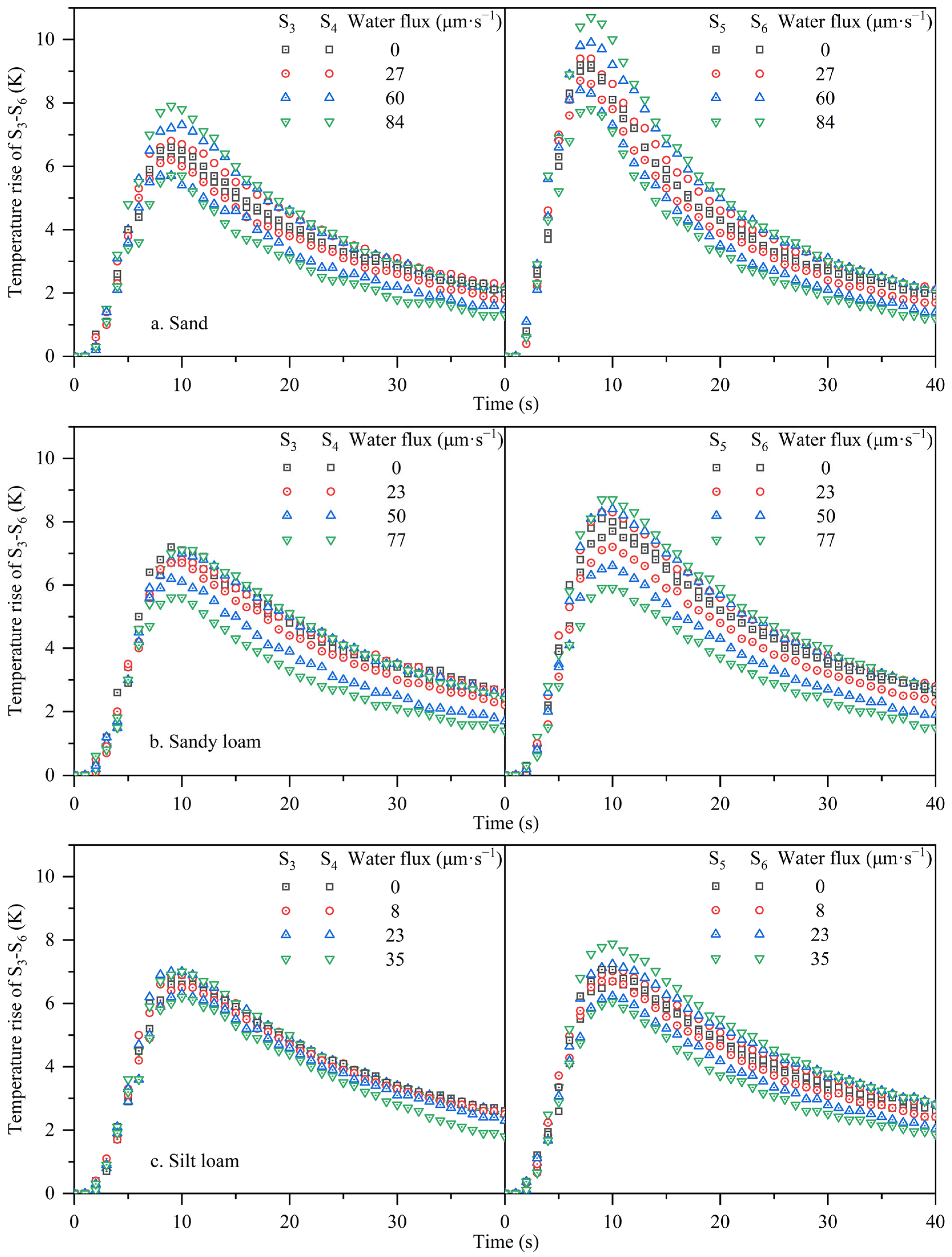
As shown in Figure 2b, due to the needle arrangement in the experimental setup (φ = 45°), the temperature responses of probes S1 and S2 were identical to those of probes S3 and S4. Therefore, only the temperature responses of the four thermocouples (S3–S6) in the various test soils are shown in Figure 3. All probes exhibit a temperature pattern characterized by an initial rise followed by a gradual decline after the heat pulse. In the absence of water movement, the temperature responses of the four equidistant thermocouple probes are similar under the heat pulse generated by the heating needle. Furthermore, the maximum temperature rise decreases as soil particle size becomes finer. As flux increases, the temperature of the upstream probes (S3 and S5) decreases, while that of the downstream probes (S4 and S6) increases. Notably, the increased flux does not induce noticeable additional fluctuations in the temperature signal (Figure 3). As flux increases, the two probes (S5 and S6) positioned along the flow direction exhibit a more pronounced temperature response compared to the upstream probes (S3 and S4).
Figure 3.
Temperature rise of four thermocouple needles (S3–S6) under water fluxes in soils of different textures. Note: The temperature rise is calculated as the probe temperature minus the background temperature.
3.2. Measured Soil Water Flux
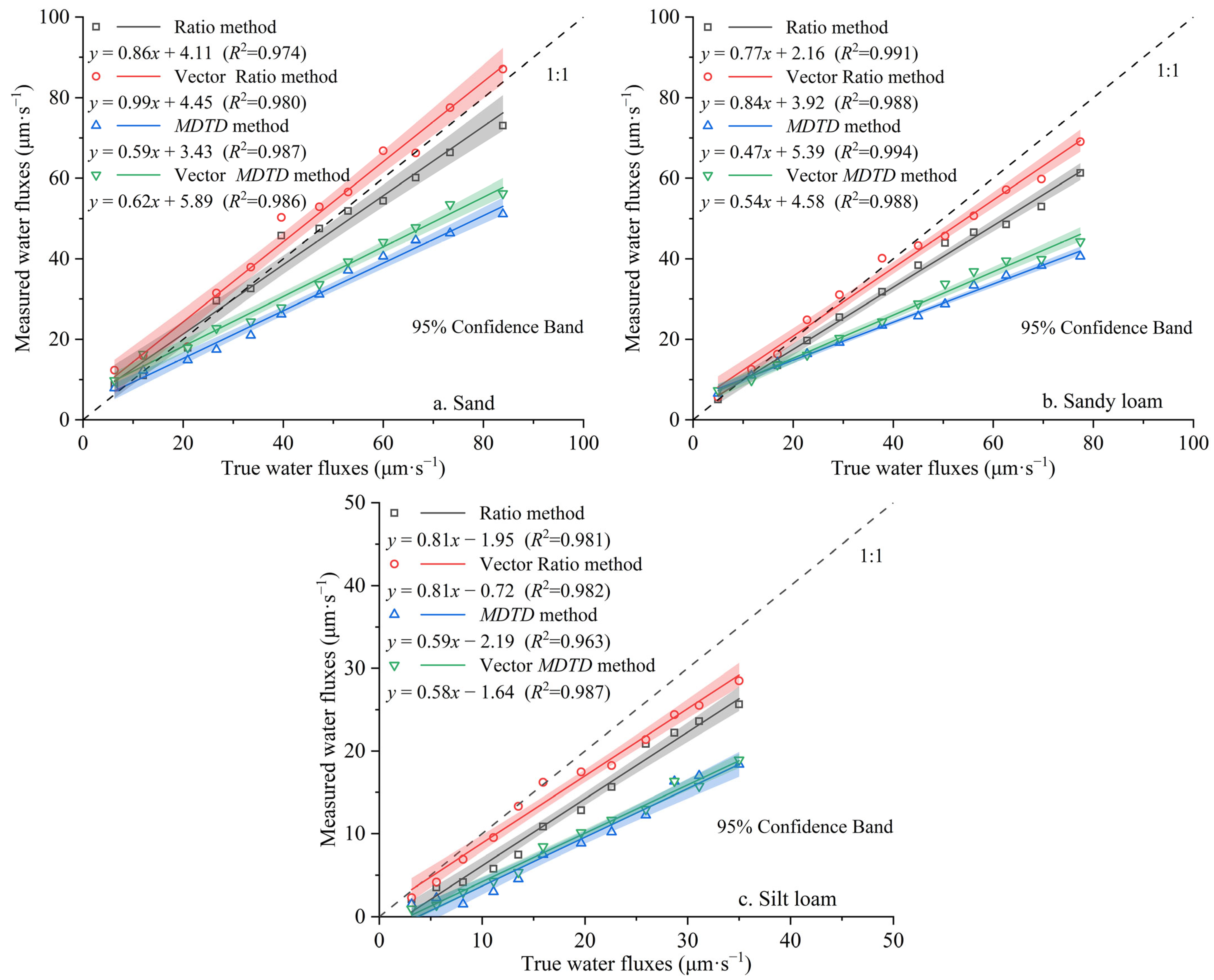
Figure 4 illustrates the relationship between the measured and true water flux values for various methods. The vector Ratio method used the 45–55 s time segments to predict water flux, as the data during this period were relatively stable with minimal noise. For the two vector HPT methods, the measured water flux values exhibit a strong linear correlation with the true values (R2 > 0.96). Except for the vector Ratio method in sand, both vector HPT methods tend to underestimate water flux, with linear fitting slopes less than 1. Compared to the vector MDTD method, the measured values of the vector Ratio method are closer to the 1:1 line. The prediction accuracy of both vector methods decreases as soil texture becomes finer.
Figure 4.
Measured water fluxes by different methods versus true water fluxes. Note: True water fluxes, calculated as the soil column outflow divided by its cross-sectional area.
The MAPE was used to evaluate the accuracy of water flux measurements. For the vector MDTD method, the MAPE increases as soil texture becomes finer (Table 3). Unlike the vector MDTD method, the vector Ratio method shows the highest MAPE value in the sand among the three tested soils. Moreover, the vector Ratio method exhibited higher prediction accuracy, with MAPE values less than 20%. In contrast, the MAPE for the vector MDTD method exceeded 28% across all tested soils. Similarly to the MAPE results (Table 3), the RMSE of the vector HPT methods was lower than that of the corresponding traditional HPT methods under the same soil texture, except for the vector Ratio method in sand. In addition, the RMSE of the vector Ratio method was consistently lower than that of the vector MDTD method.
Table 3.
Comparison of the mean absolute percentage errors (MAPE) and root mean square error (RMSE) of water flux estimates from four methods.
4. Discussion
4.1. Performance of the Vector HPT Methods
As shown in Figure 4, in terms of predictive accuracy, the vector Ratio method outperforms the vector MDTD method, which is consistent with traditional Ratio and MDTD methods [20]. Moreover, the two vector HPT methods exhibit similar predictive behaviors. Both methods show decreased accuracy in finer soils, a strong linear correlation with measured values, and a tendency to underestimate actual water flux to varying degrees, consistent with the findings of Lu et al. [16], Ren et al. [17], and Ochsner et al. [19] using traditional HPT methods.
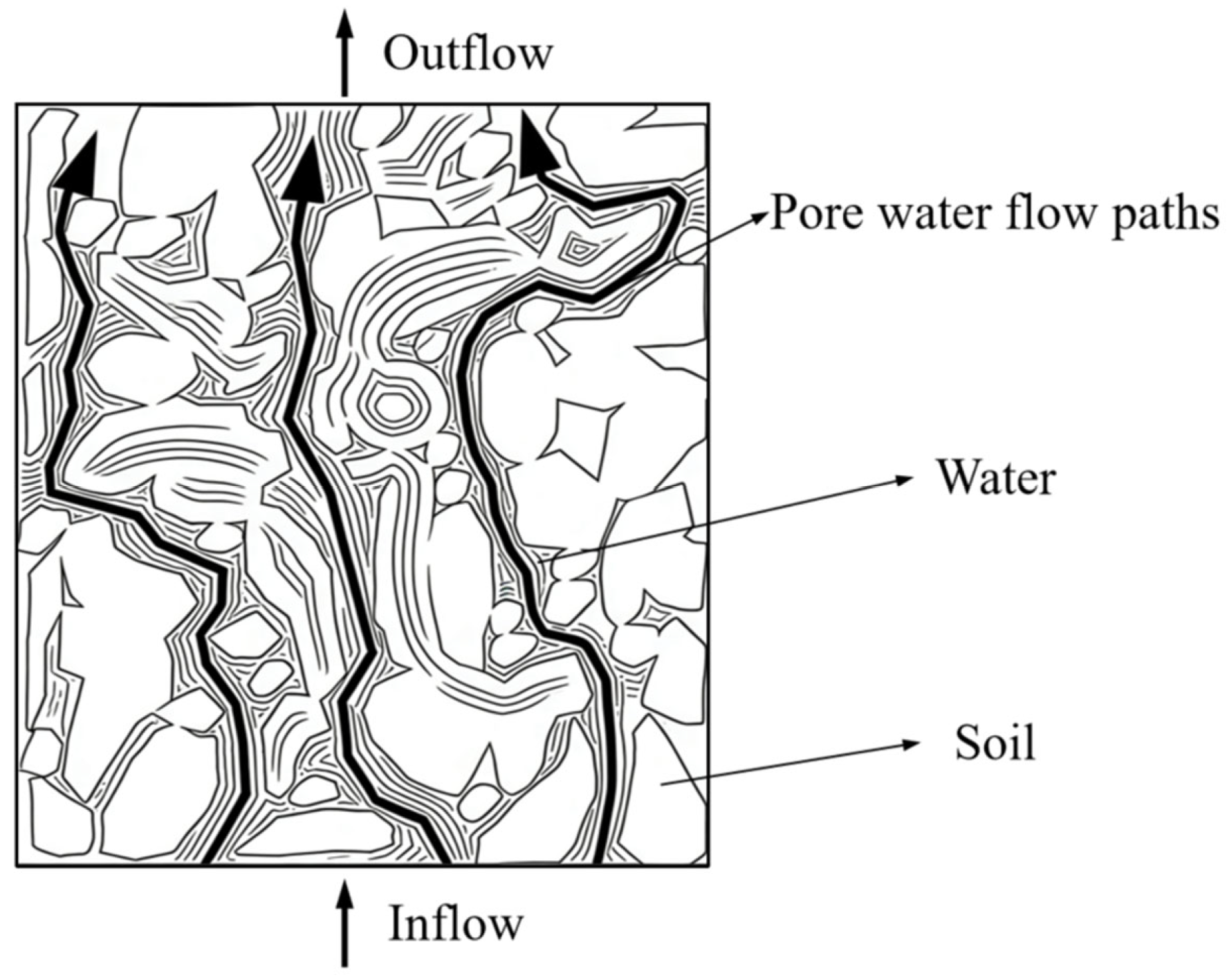
The prediction results of the vector Ratio and vector MDTD methods were comparable to those of their original methods, demonstrating that the vector HPT methods are applicable for water flux measurement. However, the measured values from the vector HPT methods were consistently higher than those from the traditional HPT methods. One possible reason is that unavoidable deviations occur during probe insertion [29,30,31]. These deviations can shift the S5–S6 probe line away from the column centerline, leading to underestimation by the traditional HPT method. Another factor may be the mismatch between the local flow direction within the SHPP measurement region and the overall flow direction in the column (Figure 5) [32,33]. The nonuniform particle composition (Table 1) and uneven soil packing can cause water to preferentially flow through larger pores under a given hydraulic gradient, increasing the tortuosity of flow paths [34]. This effect becomes more pronounced in finer soils due to lower hydraulic conductivity [35]. As a result, the line between probes S5 and S6 forms an angle with the true local flow direction, causing underestimation in the traditional HPT method. By contrast, the vector HPT approach eliminates dependence on probe orientation, allowing more accurate estimation of the true water flux within the SHPP region. Since traditional HPT methods tend to underestimate actual water flux, the vector HPT methods increase measured fluxes, thereby improving prediction accuracy.
Figure 5.
Schematic diagram of pore water flow paths in a soil porous medium.
4.2. Effects of Soil Texture and Probe Spacing
Compared with the vector Ratio method, the vector MDTD method produced water flux predictions closer to those of the original approach (Figure 4). This difference is likely due to the greater sensitivity of the Ratio method to probe spacing errors [36,37]. Unlike the traditional method, which involves two probe-spacing parameters, the vector HPT method introduces four such parameters. Consequently, the uncertainties in flux components caused by probe spacing errors are compounded through vector addition, leading to higher prediction instability in the vector Ratio method.
In contrast to the traditional HPT methods, the largest MAPE of the vector Ratio method occurred in the sand (Table 3). This may be attributed to the relationship between soil particle size and the physical distance between the heating needle and thermocouples. In sand, the particle size distribution is comparable to the 2.5 mm probe spacing (Table 1), meaning fewer but larger particles occupy the measurement region. At low water flux, the limited disturbance to soil structure allows the random arrangement of large particles dominate flow paths, which in turn affects HPT measurements [38]. As water flux increases, greater hydraulic head may induce slight particle rearrangement, promoting the formation of continuous flow paths along the hydraulic gradient and reducing the influence of particle size and probe spacing [39,40]. Compared with traditional HPT methods, the vector HPT approach amplifies the geometric effects related to particle size and probe spacing, as it requires measurements in two directions. Therefore, selecting a probe spacing appropriate to the soil’s particle size distribution may improve the reliability of the vector HPT method.
In summary, compared with the traditional HPT method, the vector HPT method captures water flux within the SHPP region more effectively. Measurement errors are generally reduced across the three tested soils, indicating that the vector HPT method is a reliable approach. However, as the method involves four spacing parameters, probe spacing errors exert a stronger influence, which is particularly pronounced in the vector Ratio method. Selecting an appropriate probe spacing based on the soil particle size distribution may improve the reliability of the vector HPT method. Furthermore, the performance of the vector HPT method in soils with a broader range of textures, such as clay, warrants further investigation.
5. Conclusions
This study employed an SHPP combined with vector addition to evaluate the performance of the Ratio and MDTD methods in measuring planar water flux. The experimental results demonstrate that the vector HPT method is a viable approach for measuring water flux. As with traditional HPT methods, its accuracy is influenced by factors such as soil texture, probe spacing, and the water flux range. Overall, the vector HPT method generally improves the accuracy of water flux measurements, except for the vector Ratio method in sand. Moreover, because it does not depend on probe installation angles, the vector HPT method can more accurately capture the true water flux within the measurement region. However, the method involves a greater number of probe-spacing parameters, which increases its sensitivity to spacing errors and may lead to greater prediction instability. Selecting probe spacing based on the soil particle size distribution can further enhance the reliability of vector HPT measurements. Furthermore, the performance of the vector HPT method in soils with a broader range of textures, such as clay, warrants further investigation.
Author Contributions
Conceptualization, Y.W. and F.L.; methodology, F.L.; formal analysis, F.L. and Z.Z.; resources, Y.W., Y.Z. and Q.P.; writing—original draft preparation, F.L.; writing—review and editing, Y.W. and F.L.; supervision, F.L., Z.Z. and D.L.; project administration, Y.W. and Q.P. All authors have read and agreed to the published version of the manuscript.
Funding
This study was funded by the National Key Research and Development Program of China (2023YFD1701901-04), the Science and Technology Innovation Capacity Building Program of Beijing Academy of Agriculture and Forestry Sciences (KJCX20240317 and KJCX20251312), the National Natural Science Foundation of China (U2243212), and the Youth Research Fund of the Institute of Forestry and Pomology, Beijing Academy of Agriculture and Forestry Sciences (LGSJJ202502).
Data Availability Statement
The original contributions presented in this study are included in the article. Further inquiries can be directed to the corresponding author.
Conflicts of Interest
The authors declare no conflicts of interest.
References
- Huang, L.M.; Shao, M.A. Advances and perspectives on soil water research in China’s Loess Plateau. Earth Sci. Rev. 2019, 199, 102962. [Google Scholar] [CrossRef]
- Fu, Z.; Yan, Z.; Wang, Y. The deep soil water dynamics and its environmental controls after long-term revegetation. J. Hydrol. 2024, 628, 130530. [Google Scholar] [CrossRef]
- Luo, Z.; Zhang, X.; Wang, Y.; Zhang, C.; Jiang, M.; Zhu, X. Surface Soil Moisture Retrieval over Winter Wheat Fields Based on Fused Multispectral and L-Band MiniSAR Data. Water 2025, 17, 3345. [Google Scholar] [CrossRef]
- Zahra, H.; Sajjad, A.; Sajid, G.H.; Iqbal, M.; Khan, A.H.A. Identification of Groundwater Recharge Potential Zones in Islamabad and Rawalpindi for Sustainable Water Management. Water 2025, 17, 3392. [Google Scholar] [CrossRef]
- Rossi, M.J.; Ares, J.O.; Jobbágy, E.G.; Vivoni, E.R.; Vervoort, R.W.; Schreiner–McGraw, A.P.; Saco, P.M. Vegetation and terrain drivers of infiltration depth along a semiarid hillslope. Sci. Total Environ. 2018, 644, 1399–1408. [Google Scholar] [CrossRef]
- Vereecken, H.; Huisman, J.A.; Pachepsky, Y.; Montzka, C.; Van Der Kruk, J.; Bogena, H.; Weihermüller, L.; Herbst, M.; Martinez, G.; Vanderborght, J. On the spatio–temporal dynamics of soil moisture at the field scale. J. Hydrol. 2014, 516, 76–96. [Google Scholar] [CrossRef]
- Tang, D.W.; French, H.K.; Leijnse, A.; Bartholomeus, R.P.; van der Zee, S.E. Reactive contaminant infiltration under dynamic preferential flow. J. Hydrol. 2024, 634, 131111. [Google Scholar] [CrossRef]
- Vicente–Serrano, S.M.; Miralles, D.G.; McDowell, N.; Brodribb, T.; Domínguez-Castro, F.; Leung, R.; Koppa, A. The uncertain role of rising atmospheric CO2 on global plant transpiration. Earth Sci. Rev. 2022, 230, 104055. [Google Scholar] [CrossRef]
- Rowland, L.; da Costa, A.C.L.; Galbraith, D.R.; Oliveira, R.S.; Binks, O.J.; Oliveira, A.A.; Pullen, A.M.; Doughty, C.E.; Metcalfe, D.B.; Vasconcelos, S.S.; et al. Death from drought in tropical forests is triggered by hydraulics not carbon starvation. Nature 2015, 528, 119–122. [Google Scholar] [CrossRef]
- Iinuma, R.; Harada, S.; Yamauchi, N. Modeling Three-Dimensional Exfiltration Rates from Permeable Street Stormwater Inlets as One-Dimensional Water Flux in Urban Hydrological Models. Water 2024, 16, 3076. [Google Scholar] [CrossRef]
- Su, M.; Ma, R.; Wang, Y.; Sun, Z.; Yin, M.; Ge, M. Tracing the soil water flux in variably saturated zones using temperature data. Water Resour. Res. 2023, 59, e2022WR033677. [Google Scholar] [CrossRef]
- Naranjo, R.C.; Turcotte, R. A new temperature profiling probe for investigating groundwater-surface water interaction. Water Resour. Res. 2015, 51, 7790–7797. [Google Scholar] [CrossRef]
- Rau, G.C.; Andersen, M.S.; Acworth, R.I. Experimental investigation of the thermal dispersivity term and its significance in the heat transport equation for flow in sediments. Water Resour. Res. 2012, 48, W03511. [Google Scholar] [CrossRef]
- Kinar, N.J.; Pomeroy, J.W.; Si, B. Signal processing for in situ detection of effective heat pulse probe spacing radius as the basis of a self–calibrating heat pulse probe. Geosci. Instrum. Methods Data Syst. 2020, 9, 293–315. [Google Scholar] [CrossRef]
- Naruke, C.; Sheng, W.; Zhou, R.; Jones, S.B. Standardizing Heat Pulse Probe measurements for thermal property determination using ice and water. Agric. For. Meteorol. 2021, 308, 108610. [Google Scholar] [CrossRef]
- Lu, X.R.; Sun, Y.; Chen, G.S.; Qin, Y.; Bai, Y.F.; Li, X.J.; Mou, X.J. Influences of thermal dispersion on soil water flux estimates using heat pulse technique in saturated soils. Catena 2018, 167, 228–235. [Google Scholar] [CrossRef]
- Ren, T.; Kluitenberg, G.J.; Horton, R. Determining soil water flux and pore water velocity by a heat pulse technique. Soil Sci. Soc. Am. J. 2000, 64, 552–560. [Google Scholar] [CrossRef]
- Wang, Q.; Ochsner, T.E.; Horton, R. Mathematical analysis of heat pulse signals for soil water flux determination. Water Resour. Res. 2002, 38, 27-1–27-7. [Google Scholar] [CrossRef]
- Ochsner, T.E.; Horton, R.; Kluitenberg, G.J.; Wang, Q. Evaluation of the heat pulse ratio method for measuring soil water flux. Soil Sci. Soc. Am. J. 2005, 69, 757–765. [Google Scholar] [CrossRef]
- Lu, X.; Chen, G.; Qin, Y.; Sun, Y.; Li, X. Evaluation of water flux prediction with heat-pulse technique in saturated soils. Arch. Agron. Soil Sci. 2017, 63, 455–467. [Google Scholar] [CrossRef]
- Sheng, W.; Rumana, K.; Sakai, M.; Silfa, F.; Jones, S.B. A multi-functional penta-needle thermos-dielectric sensor for porous media sensing. IEEE Sens. J. 2016, 16, 3670–3678. [Google Scholar] [CrossRef]
- Endo, A.; Hara, M. Simultaneous measurement of water flux density vectors and thermal properties under drainage conditions in soils. Paddy Water Environ. 2007, 5, 171–180. [Google Scholar] [CrossRef]
- Yang, C.; Sakai, M.; Jones, S.B. Inverse method for simultaneous determination of soil water flux density and thermal properties with a penta–needle heat pulse probe. Water Resour. Res. 2013, 49, 5851–5864. [Google Scholar] [CrossRef]
- Endo, A.; Hara, M. Simultaneous measurement of thermal front advection velocity vector and thermal properties of sandy soil under two–dimensional flow field with quintuple–probe heat–pulse technique and its applications. Trans. Soc. Instrum. Control Eng. 2003, 2, 88–95. [Google Scholar]
- Yang, C.; Jones, S.B. INV–WATFLX, a code for simultaneous estimation of soil properties and planar vector water flux from fully or partly functioning needles of a penta-needle heat-pulse probe. Comput. Geosci. 2009, 35, 2250–2258. [Google Scholar] [CrossRef]
- Mori, Y.; Hopmans, J.W.; Mortensen, A.P.; Kluitenberg, G.J. Multi-functional heat pulse probe for the simultaneous measurement of soil water content, solute concentration, and heat transport parameters. Vadose Zone J. 2003, 2, 561–571. [Google Scholar] [CrossRef]
- Ren, T.; Noborio, K.; Horton, R. Measuring soil water content, electrical conductivity, and thermal properties with a thermo-time domain reflectometry probe. Soil Sci. Soc. Am. J. 1999, 63, 450–457. [Google Scholar] [CrossRef]
- Ren, T.; Ochsner, T.E.; Horton, R.; Ju, Z. Heat-pulse method for soil water content measurement: Influence of the specific heat of the soil solids. Soil Sci. Soc. Am. J. 2003, 67, 1631–1634. [Google Scholar] [CrossRef]
- Wen, M.; Liu, G.; Li, B.; Si, B.C.; Horton, R. Evaluation of a self-correcting dual probe heat pulse sensor. Agric. For. Meteorol. 2015, 200, 203–208. [Google Scholar] [CrossRef]
- Kluitenberg, G.J.; Kamai, T.; Vrugt, J.A.; Hopmans, J.W. Effect of probe deflection on dual-probe heat-pulse thermal conductivity measurements. Soil Sci. Soc. Am. J. 2010, 74, 1537–1540. [Google Scholar] [CrossRef]
- Liu, G.; Wen, M.; Chang, X.; Ren, T.; Horton, R. A self-calibrated dual probe heat pulse sensor for in situ calibrating the probe spacing. Soil Sci. Soc. Am. J. 2013, 77, 417–421. [Google Scholar] [CrossRef]
- Beven, K.; Germann, P. Macropores and water flow in soils revisited. Water Resour. Res. 2013, 49, 3071–3092. [Google Scholar] [CrossRef]
- Urbina, C.F.; Van Dam, J.C.; Hendriks, R.F.A.; van Den Berg, F.; Gooren, H.P.A.; Ritsema, C.J. Water flow in soils with heterogeneous macropore geometries. Vadose Zone J. 2019, 18, 1–17. [Google Scholar] [CrossRef]
- Bacq–Labreuil, A.; Crawford, J.; Mooney, S.J.; Neal, A.L.; Ritz, K. Phacelia (Phacelia tanacetifolia Benth.) affects soil structure differently depending on soil texture. Plant Soil. 2019, 441, 543–554. [Google Scholar] [CrossRef]
- Gupta, S.; Borrelli, P.; Panagos, P.; Alewell, C. An advanced global soil erodibility (K) assessment including the effects of saturated hydraulic conductivity. Sci. Total Environ. 2024, 908, 168249. [Google Scholar] [CrossRef]
- Kamai, T.; Tuli, A.; Kluitenberg, G.J.; Hopmans, J.W. Soil water flux density measurements near 1 cm d−1 using an improved heat pulse probe design. Water Resour. Res. 2008, 44, W00D14. [Google Scholar] [CrossRef]
- He, H.; Dyck, M.F.; Horton, R.; Ren, T.; Bristow, K.L.; Lv, J.; Si, B. Development and application of the heat pulse method for soil physical measurements. Rev. Geophys. 2018, 56, 567–620. [Google Scholar] [CrossRef]
- Wang, B.; Chen, L.W.; Niu, Z. Critical hydraulic gradient and fine particle migration of sand under upward seepage flow. Sci. Rep. 2022, 12, 14440. [Google Scholar] [CrossRef] [PubMed]
- Huang, Z.; Bai, Y.; Xu, H.; Cao, Y.; Hu, X. A theoretical model to predict the critical hydraulic gradient for soil particle movement under two-dimensional seepage flow. Water 2017, 9, 828. [Google Scholar] [CrossRef]
- Nguyen, T.T.; Indraratna, B. Fluidization of soil under increasing seepage flow: An energy perspective through CFD-DEM coupling. Granul. Matter. 2022, 24, 80. [Google Scholar] [CrossRef]
Disclaimer/Publisher’s Note: The statements, opinions and data contained in all publications are solely those of the individual author(s) and contributor(s) and not of MDPI and/or the editor(s). MDPI and/or the editor(s) disclaim responsibility for any injury to people or property resulting from any ideas, methods, instructions or products referred to in the content. |
© 2025 by the authors. Licensee MDPI, Basel, Switzerland. This article is an open access article distributed under the terms and conditions of the Creative Commons Attribution (CC BY) license.